




Abstract
The stab-resistant fabric like scale structure has a promising application prospect for areas of stab prevention owing to its great flexibility and excellent stab-resistance performance. In this paper, a kind of novel stab-resistant fabric has been designed by coating with epoxy resin (ER) and silicon carbide (SiC) particles, which was based on the warp-knitted fabric like scale structure (WKFS). The uniformity of dispersion has been investigated with different diameter and mass fraction of SiC, and polymerization degree of polyglycols (PEG); the flexibility and quasi-static properties of different kinds of WKFS treated with different coating solution has been studied, and the coating solution was prepared by mixing SiC particles and ER at different ratios. The results showed that the dispersion uniformity of the dispersion was the best when the diameter of SiC is 1 μm, the content is 50%, and the polymerization degree of PEG is 600. The longitudinal flexibility of the stab-resistant fabric is greater than that of transverse due to the gap between the longitudinal scales, and the addition of SiC particles can increase the transverse and longitudinal flexibility of stab-resistant fabric, and the flexible properties were the greatest when SiC:ER = 50:30. In addition, the WKFS treated with SiC of 16.7% has fatigue resistance; the damage mechanism of the fabric treated with pure ER is thankful to the brittleness of the resin; the added SiC particles hinder the further crack propagation of the resin, and the failure mode is mainly in stretch.
Introduction
Knife stab injury had become one of the main risk factors threatening people’s life; stab-resistance equipment like scale structure had been research hotspots in recent years [1]. Natural creatures had attracted widespread attention because of their unique scales structure and excellent stab resistance, such as pangolin and armadillo, even ferocious lions cannot destroy their scales [2–4]. Based on this, many scholars had devoted themselves to the preparation of stab-resistant equipment like scale structures, and studied its stab resistance and flexibility by multi-angle analysis. Vernerey et al. [5] studied the mechanical properties of the fish skin, and this study showed a fish skin with a softer bending stiffness in the longitudinal direction of the fish. Funk et al. [6] had presented a kind of bionic fish skin which was prepared by cellulose acetate butyrate, and the bioinspired fish skin material was designed to replicate the structural, mechanical, and functional aspects of a natural teleost fish skin comprised of leptoid-like scales, and it had been proved that it has good toughness and stab resistance. Guo et al. [7] had designed a stab-resistant substrate using the titanium alloy material with a triangular pyramidal structure inspired by the biological armor model in the nature, and its concluded from the experiment that the puncture performance of the equipment with the bionic scale structure was better than that of the flat plate because the puncture energy can be effectively dispersed by the inclined structure of the pyramid. He et al. [8] produced a structure that mimicked the complexity of a hierarchical shell-scale structure by using laser sintering technology combined with polyamide 3200, and the results of this research showed the promise of the proposed design for lighter and more effective SRBA. To sum up, stab-resistant equipment like the scale structure mainly focuses on the simulation of the biological scale structure and shape such as 3D printing scales, resin scales, and sheet tower connection of bendable metal and rock [9–11], and was connected through coarse fiber, rivet, or metal wire. However, this stab-resistance equipment had high weight and poor flexibility; moreover, it is easy to break the connecting material and causes scales to fall off during use [12,13].
Especially, fabric structure innovation is one of the important research directions in the field of stab resistance. The knitted method has advantages in knitting special structure due to its unique coil structure and excellent forming ability [14]. The fabric structure was mainly plain stitched and consists of other simple structures in practice, and the composite layers, of 30–50 layers, were bulky and uncomfortable [15], which limit the enthusiasm of the wearer. Many scholars had been working on new fabric structures to reduce the number of layers of stab-resistant equipment, and it mainly includes warp-knitted spacer fabric, double-sided fabric, double axis multi-layer yarn lining fabric [16–19], and so on. There are few studies on scale fabric as a stab-resistant material. Particularly, the WKFS could be divided into two layers, namely the scale part and bottom part, shown in Figure 1(a). Different from the plane structure fabric, the scale part and the bottom part exist separately, so the scale part can be treated alone to prepare stab-resistant fabric with the advantages of both great stab-resistance performance and wearable flexibility, and the WKFS is similar to armadillo’s armor structure. Consequently, the WKFS has a promising application prospect for areas of stab prevention. Photograph and SEM images of the WKFS, ER, and SiC particles. (a) Photograph and SEM images of the WKFS; (b) SEM images of ER and SiC particles.
The stab resistance of the fabric can be further improved by the treatment of the reinforcement solution, such as resin, rigid particles, or shear thickener [20,21]. SiC and ER show excellent performance among reinforced materials, and it is widely used in the field of stab resistance because of its chemical stability and hardness [22–24]. Wei et al. [25] explored stab resistance of amid composite fabrics by coating with SiC particles, and the results showed that the stab resistance of the fabrics was effectively improved by the introduction of SiC particles, but the tear force was slightly decreased. Feng et al. [26] and Gurgen et al. [27] studied the effects of different SiC particles on quasi-static stab-resistant properties of fabrics impregnated with shear thickening fluids, and the result showed that quasi-static stab-resistant properties of treated fabrics containing submicron SiC particles was better than that of treated fabrics containing fumed SiC particles, and the added SiC particles further improve the stab resistance of the fabric.
As mentioned above, there are few studies on scale fabric as a stab-resistant material, and the effect of SiC proportion on the stab-resistance performance of ER has not been thoroughly investigated in most published studies. In this paper, the research aimed to investigate stab resistance and the damage mechanism of the flexible composite reinforced with the WKFS at quasi-static loading. The influence of SiC content, the SiC size, and different puncture points on the stab resistance of fabric was studied. It provides a reference for the preparation of stab-resistant fabric like scale structures.
Experimental
Materials
Main process parameters of the WKFS.

The reinforced materials are ER and SiC. ER E51 (618) is produced by Kunshan Jiulimei Electronic Materials Co., Ltd., and the epoxy value is 0.48–0.54/100 g and the viscosity is 11,000–14,000 mPa.s. SiC particles are produced by Nangong Ruiteng alloy materials Co., Ltd., and the diameter of SiC is 1 μm, 5 μm, or 10 μm; the density, Young’s modulus, and hardness of SiC are 3200 kg/m3, 370 GPA, and 3200 kgf/mm2, respectively. The SEM images of the ER and SiC particles are shown in Figure 1(b). The dispersant PEG is produced by Qiyuan experimental equipment business department, Mawei District, Fuzhou City, with polymerization degrees of 200, 400, and 600.
Preparation of coating solution
The preparation of coating solution can be divided into three steps, as shown in Figure 2. First is preparation of dispersion: SiC powder was mixed with PEG in a certain proportion; the specification parameters of SiC power and PEG are shown in Table 2. It was sealed and stirred by a magnetic stirrer at 30oC for 30 min after the dispersion was initially stirred by a glass rod, and then it was allowed to remain at 30oC for 120 min. Second is preparation of adhesive: the ER and curing agent were mixed at the ratio of 10:3 and sealed for standby after mixing. Finally, the ER and the dispersion were proportioned according to the ratio of 50:50, 50:30, and 50:10 and then preheated at 30oC for 30 min to improve the fluidity of the coating solution. Furthermore, it should be noted that SiC powder can easily absorb water in the air during the preparation. Schematic diagram of coating solution preparation. Specification parameters of SiC power and PEG.

Sample preparation
The specific preparation process of the new stab-resistant fabric is shown in Figure 3(a). First, the fabric is cut into a size of 10 cm × 10 cm, where the scale parts of the fabric is cut according to the spacing of 2.5 cm, and the surface of the fabric is ironed flat with a hot machine to ensure the uniformity of the coating effect. The fabric needs to be preheated at 60oC for 30 min to remove moisture. Second, a layer of hot melt adhesive film (the component is polyurethane) is pasted on the back of the scales part to avoid leakage of the coating solution to the substrate; then, the coating solution is evenly coated on the scales with a coating brush, with the coating thickness of about 1–1.5 mm. Finally, the treated fabric is placed on a specific support and put in the oven at 60oC for 1 h to remove the excess ethanol before heating in the oven at 120oC for 6–8 h. The fabric after treatment is shown in Figure 3(b), and the fabric was observed under SEM from Figure 3(c); the coating solution was evenly coated on the fabric, and the color depth of the fabrics with different SiC contents is different. Each fabric was coated with 20 g coating solution. Since the coating solution has a certain fluidity, the coated fabric can ensure the uniformity of the coating when it is standing flat. Schematic diagram and images of stab-resistant fabric. (a) Preparation of stab-resistant fabric; (b) stab-resistant fabric treated with ER; (c) photograph and SEM images of the WKFS treated with the coating solution.
Flexibility test
The tests were referred with the GB/T 18318-200 standard [23], as shown in Figure 4. The stab-resistant fabric is placed on a smooth desktop along the horizontal and vertical part with the coated side facing upward and the uncoated side facing downward. One side of the desktop is fixed with a heavy object and a certain force is applied on the other side, and kept for a period of time. After stabilizing the stab-resistant fabric, the bending angle is measured with a protractor α; the larger the α, the better the flexibility. Testing method of flexibility.
Quasi-static stab test
The quasi-static test equipment was self-designed based on the universal tester, using an MTS universal testing machine (MTS Systems (China) Co., Ltd., Shenzhen, China), as shown in Figure 5. The knife blade D3 is used in the police stab-resistant armor (GA 68-2019) of China. Schematic of setup for the stab test.
Main quasi-static stab testing parameters of the specimens.

Result and discussion
Uniformity of dispersion
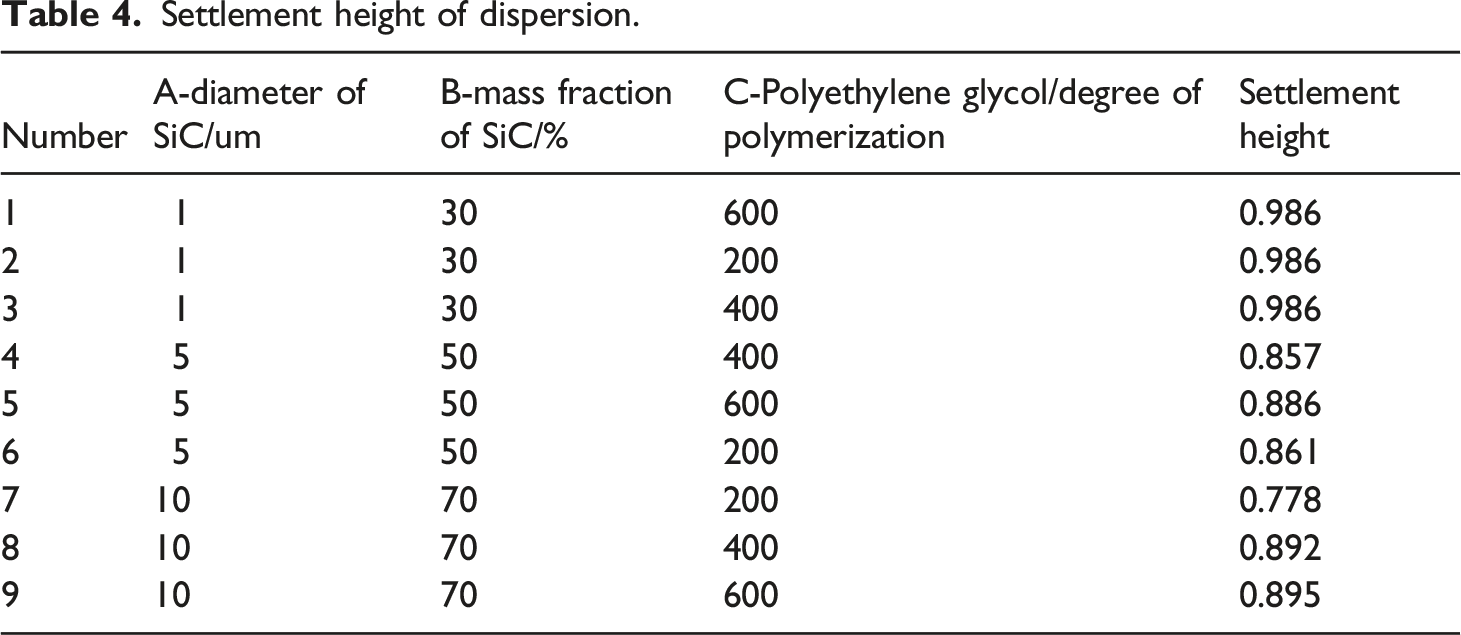
Settlement height of dispersion.
Parameters of stab test specimens of fabric treated with Pure ER and SiC particles.

In summary, it can be concluded that the diameter of the SiC has the greatest influence on the uniformity of dispersion, then followed by the mass fraction, and the polymerization degree of PEG has the least influence.
Flexibility of the stab-resistant fabric
Flexibility is an important factor to measure wearing comfort. Figure 6 shows the longitudinal and transverse flexibility of the stab-resistant fabric with different SiC contents. The data were the average of the five measurement results. Flexible properties of different stab-resistant fabrics.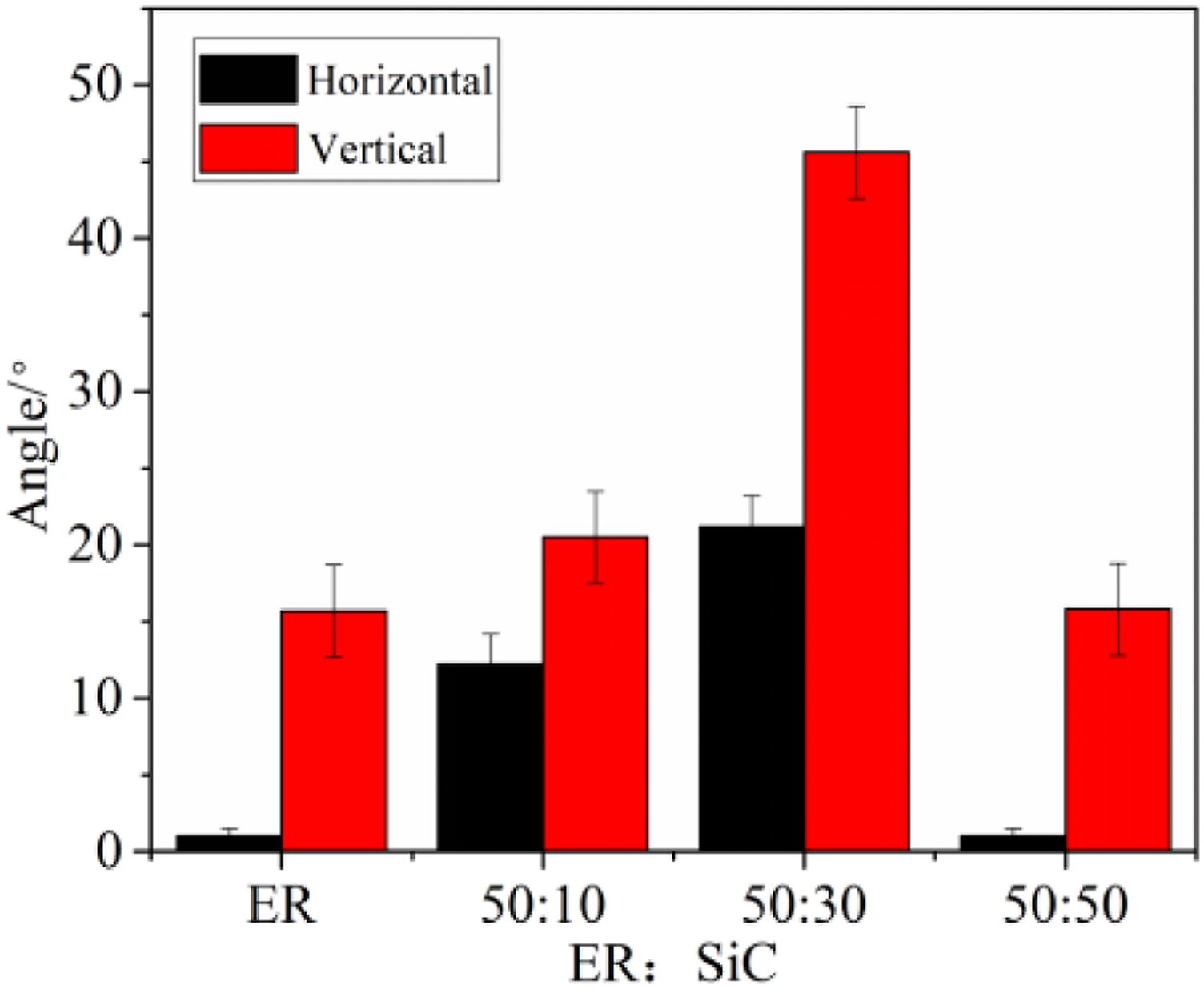
It can be seen from the Figure 6 that the longitudinal bending angle of the stab-resistant fabric is larger than that of transverse. That is because the longitudinal connecting part of the fabric is not covered by the coating liquid when the fabric is treated, so there are certain pores between the longitudinal scales, and the fabric is completely covered by the coating liquid in the transverse direction; therefore, the flexibility of the fabric in the longitudinal direction is better than that in the transverse direction because there is a gap between the longitudinal scales.
The rigid ring material (the benzene ring) is regularly distributed in ER; when the material was subjected to puncture force, the rigid rings on the chain segments are bound to each other, resulting in high strength. But at the same time, when the material was impacted, the instantaneous force was easy to concentrate on a bound chain segment due to the existence of the rigid ring. Consequently, the treated fabric became rigid, brittle and poorly flexibile when ER was used alone as the coating solution.
The stab-resistant fabric had the best flexibility when the ratio of the coating solution was ER:SiC = 50:30, and the flexibility was second best when the ratio of coating solution was ER:SiC = 50:10. However, when the SiC content went up to 50%, the fabric showed the similar flexibility to the fabric treated with ER. For one thing, the SiC particles can be used as a relatively small movement unit. When the SiC particles has less content in ER (not more than 37.5%), the tension and slip between yarns increased, so the toughness of the fabric improved. However, with the increase of SiC content (more than 37.5%), the gap between adjacent particles was too small and the moving unit was too small, which reduced the toughness of the coated fabric. For another, the density of SiC particles (3.2 g/cm3) was greater than that of ER (1.2 g/cm3), and the coating solution appeared as a delamination phenomenon because of this density difference. The particles are relatively small and not easy to settle down when diameter is less than 10 μm [28]. With the increase of SiC diameter, the deposition of the coating solution was obvious, and SiC particles were evenly dispersed in the coating solution when SiC particles were small; this indicates that SiC particles are easy to penetrate into the fabric when the diameter is relatively small.
Quasi-static stab test results
Quasi-static properties of the fabric can reflect the stab resistance of the fabric. The stab-resistant property of the fabric is evaluated by puncture load (N) and puncture energy (J). The parameters of specimens for the quasi-static stab test are shown in Table 3 and quasi-static results are shown in Figure 7. As shown in Figure 7, “load” represents the changing of puncture force of the fabric during quasi-static puncture. “Displacement” expresses the penetration depth of the cone tip into the fabric; the larger the “force” and “displacement,” the better the stab resistance of the fabric. The standard of police stab-resistant armor (GA 68-2019) of China stipulates that the fabric cannot be punctured at the energy of 24J, the energy W (J) = F(N).S(m). The following data are the average of the five measurement results. Stab resistance of the stab-resistant fabrics. (a) Load-displacement curves for different stab-resistant fabrics; (b) load-displacement curves for different position of stab-resistant fabric treated with pure ER; (c) load-displacement curves of the fabrics with different number of layers; (d) load-energy curves of the fabrics with different number of layers.
As shown in Figure 7(a), the maximum force of the fabric treated with pure ER is greater than added SiC particles, but the maximum puncture displacement showed the opposite phenomenon. The load-displacement curve of the pure ER treated fabric is linear before the awl pierced through the stab-resistant layer; however, the load-displacement curve of the SiC particles treated fabric is curved, and the curvature is the largest when ER:SiC = 50:30. From Figure 7(b), it appears that the edge of the scale has the largest puncture load, while the junction has the smallest puncture load. There are two reasons accountable for the large value of the maximum puncture force on the edge; one is that the thickness of the coating on the edge of the scale is greater than that on the upper part of the scale due to the gravity at the bottom of the scale. Due to the gap between adjacent scales, flexibility and wearing comfort greatly improved, but stab-resistant weak ring formed at the same time.
The puncture probability mainly occurs in the middle of scales because of the large coverage area of scales. The puncture process of the stab-resistant fabric can be divided into three stages as shown in Figure 7(b). First, the curve before point A shows the deformation process of the fabric before puncture; the whole deformation of the fabric can absorb energy quickly. Second, point A indicates that the awl’s tip starts to pierce the fabric and point B means that the cone tip completely pierces the fabric, so the A∼B stage is the penetration process of the stab-resistant layer. Finally, the load drops suddenly after the stab-resistant fabric is completely punctured, then the awl starts to puncture the underlying fabric, and the untreated fabric at the bottom is easily pierced because of the common fiber and loose structure, and the load peak point is C. Figure 7(c) shows the load-displacement curves of the fabrics with different number of layers, and Figure 7(d) shows the load-energy curves of the fabrics with different number of layers. It can be seen from the figure that the force and energy of the fabric increase with the increase of the number of layers, and the maximum puncture force and energy almost linearly increased with the increase of the number of layers. With 8 layers, the energy absorption of the fabric reaches 24J.
Figure 8 shows the average top displacement and load curves of different kinds of stab-resistant fabric, “top load” is the force of the fabric at the puncture point, and “top displacement” refers to the displacement of the fabric at the puncture point. Figure 8(a) shows that the top load and displacement of the fabric increase with an increase in SiC particle diameter. Figure 8(b) shows that the stab resistance and flexibility of the stab-resistant fabric show an increasing trend when the content of SiC is less than 16.7%. The stab resistance of the stab-resistance layer first decreasesand then increases, while the critical puncture displacement showed the opposite trend when SiC content is more than 16.7%. The increase of SiC particles can passivate the awls tip to a certain extent, but the stab-resistance performance will decrease if the stab-resistant fabric becomes over soft. Average top displacement and load curves of different kinds of stab-resistant fabric. (a) Top load-displacement curves of the fabric for different SiC diameter; (b) top load-displacement curves of the fabric for different SiC content.
Fabric damage mechanism
Figure 9 shows the damage images of pure ER and SiC particles treated fabrics after the stab test against the awl. It clearly shows in the Figure 9(a) that the stab morphology of the fabric treated with pure ER is round, while the stab morphology of the fabric added with SiC particles is a line. The main damage on the back of the stab-resistant fabric is the extrusion of the cone and the fracture of individual fibers, as shown in Figure 9(c). Photographs and SEM images of fabric damage areas after the quasi-static stab test. (a) Photographs of fabric damage areas after the quasi-static stab test_front; (b) SEM of the micro morphology of the damage zone and yarn fracture surface; (c) photographs of fabric damage areas after quasi-static stab test_back.
For the better understanding of the failure modes of fabrics, the micro morphology of the damage zone and yarn fracture surface are observed, as can be seen from Figure 9(b). The pores of the fabric are filled with the coating solution, the fiber is bonded in a fixed position, and the fracture of the fabric is mainly manifested in the fracture characteristics of the coating materials. The fracture of ER treated fabric is not regular and some filaments are extracted, while the fracture of SiC treated fabric is relatively regular. This is because of the brittleness of ER; the added SiC particles reduce the simultaneous fracture properties of the fiber and block the propagation of the fracture crack in the stab-resistant fabric; meanwhile, SiC particles have high hardness and can passivate the tool tip. So both ER and SiC can increase the interaction of yarns and filaments to restrict the mobility of yarns and filaments, making it difficult for awl to separate filaments.
Conclusions
In this paper, a kind of novel stab-resistant fabric was prepared based on the WKFS. This paper investigated the uniformity of dispersion, and the flexibility and stab resistance of the fabric at quasi-static loading were tested. The following conclusions can be reached: (1) Coating solutions with different SiC contents were prepared, and the main factors affecting the dispersion uniformity had been studied. It can be concluded from the settlement height of the dispersion that the dispersion uniformity was the best when the diameter of SiC was 1 μm, the mass fraction of SiC was 50% and the polymerization degree of PEG was 600. A kind of stab-resistant fabric like scale structure was prepared by this coating solution. (2) The flexibility of the novel stab-resistant fabric was analyzed. The flexibility of the fabric was the best when the mass fraction of SiC is 37.5%, and with the increase of SiC particles, the flexibility and toughness of the fabric reduced. When the SiC content does not exceed 16.7%, the stab resistance and flexibility of the stab-resistant fabric increased at the same time. (3) The puncture process of the stab-resistant fabric can be divided into three stages. In the first stage, the deformation of the fabric can absorb energy quickly, and the existence of ER and SiC passivates the cone tip. In the second stage, the tip penetrates the fabric further, and the friction between fabrics hinders the cone tip. Finally, the tip of the cone presses the fabric further until it is completely penetrated. (4) The damage mechanism of the ER treated stab-resistant fabric was mainly the fracture of ER and yarn, which was because of the existence of the rigid ring in epoxy resin (ER). The instantaneous force was easy to concentrate on a bound chain segment when the material was punctured by a tool, resulting in material brittle rupture. SiC has higher strength which hinders the further diffusion of ER fracture. Therefore, the fabric has a certain tensile effect during penetration.
In general, the WKFS was woven by knitting technology, which simplified the production process, reduced the production cost, and avoids the phenomenon that the spliced single scale was easy to fall off. Different from the composite method of plane structure, only the scale part was treated, which greatly improves the flexibility and wearing comfort of the fabric. The added SiC particles improved the stab resistance of the fabric further. Although this study could provide basic reference to structural design of the stab-resistant fabric, some limitations still exist. The raw material of the fabric was a ordinary fiber. Washability and heat resistance have not been studied, the dynamic puncture of fabric has not been considered, and the mathematical model of puncture response is not proposed. These characteristics will be taken into account in further developments of this investigation.
Footnotes
Declaration of conflicting interests
The author(s) declared no potential conflicts of interest with respect to the research, authorship, and/or publication of this article.
Funding
The author(s) disclosed receipt of the following financial support for the research, authorship, and/or publication of this article: The authors acknowledge the financial support from the National Nature Science Funds of China (11972172), the Fundamental Research Funds for the Central Universities (JUSRP22026), and a Project Funded by the Priority Academic Program Development of Jiangsu Higher Education Institutions (PAP).
