




Abstract
Cushioning pads alleviate the effects of mechanical stress on the human body due to impacts and daily activities. One relevant application for such pads is orthopedic insoles used for diabetic foot to improve energy absorption and reduce stress gradient by using suitable materials and structures. This article considers a novel design that improves the energy absorption capabilities of cushioning pads. Experiments were conducted to evaluate the properties of the designed weft knitted spacer fabrics. Six groups of samples were knitted in which steel, polyamide, and shape memory alloy materials were utilized as spacer monofilament. Stress–strain, energy absorption and efficiency diagrams were obtained following the quasi-static compression tests carried out on the samples. Three investigation groups were adopted to evaluate the effect of the spacer monofilament material, diameter, and slope on energy absorption capacity. It was determined that shape memory alloy monofilament with 0.1 mm diameter was the optimum configuration to be utilized as spacer yarn in a typical 3D weft knitted fabric. It was also concluded that higher-inclined spacer monofilament in spacer fabric was the optimum choice for knitting cushioning pads as it absorbed more energy. The energy absorption capacity of the optimum design of spacer fabric obtained in this study, increased by a factor of 2.4 compared with commercial polyamide pads. This design can be utilized in any cushioning pad exposed to high mechanical stress due to impact, sports and daily activities.
Introduction
Impacts during normal daily activities or sports impose mechanical stresses and potentially trauma to the human body. Therefore, the use of cushioning pads as protective equipment is a simple and affordable preventive measure to alleviate such effects. For different protection zones on the human body, a variety of protective devices are designed and introduced, in which cushioning materials are commonly used as energy absorbing elements. These materials are characterized by different maximum allowable stresses and capacity for absorbing impact energy. The cushioning material not only plays the role of an intermediate element to moderate the gradient of the impact forces or mechanical stresses, but also decreases the deceleration rate through undergoing deformations or other shape changes on its surface, which consequently reduces the effects of such forces or stresses.
A large variety of cushioning elements have been reported in the literature. Mills et al. [1] investigated the use of polymeric foams in protective equipment such as cushions, shoes, and helmets. Kurt et al. [2] introduced airbag helmets and used air as cushioning element to prevent injuries to cyclists. Lin et al. [3] analyzed the impact behavior of rubberized fiber as cushioning element in bulletproof vest. Dongmei [4] evaluated the compressive behavior of corrugated sandwich structures for packaging applications. Among these, polymeric foams have wider commercial applications owing to their lower cost. Although polymeric foams exhibit appropriate cushioning behavior, they are susceptible to low endurance and weakening elasticity with adverse effects. Polymeric foams have weak air ventilating and moisture properties, thus making them unsuitable for cushioning pads. This concern worsens in cases where the pad makes direct contact with part of the human body such as in the insoles or in sports protective equipment. Salimi et al. [5] showed that the most paramount alternative for diabetic foot ulcer prevention and treatment approach is decreasing the plantar stress. Therefore, finding cushioning materials used in protective equipment that can reduce the exerted stress on the body and has a better lifecycle merits investigation.
One solution that can overcome the above limitations and concerns is the use of three-dimensional spacer fabrics. Wollina et al. [6] used 3D spacer fabrics in medical textiles as wound dress. Yip and Ng [7] introduced the use of such fabrics in sportswear and foundation garments. Ye et al. [8] presented the utilization of 3D spacer fabrics in car seats and later in 2008, they managed to find out a proper replacement for polymeric foams such as polyurethane for cushioning applications through comprehensive study on pressure distribution, air permeability and heat resistance of fabrics [9]. Armakan and Roye [10] demonstrated a different application of this material in geotextiles. Spacer fabrics are also a viable option for cushioning material in protective equipment, especially for orthopedic insole applications owing to certain properties, such as good compressibility, breathability, and light weight. In such type of fabrics, separate outer layers are connected by spacer yarns as the core of the sandwich structure as illustrated in Figure 1. Polymeric fibers are the major materials used for the structure of 3D knitted spacer fabrics in which the outer layers and core are made of multifilament or monofilament yarns.
Spacer fabric structure.
Liu et al. [11] presented the behavior of 3D spacer fabrics under compression as depicted in Figure 2. The curve indicates that the behavior has three stages. The first stage consists of two parts. At first, a lower slope curve is seen which results into free post buckling of monofilaments. Then, the higher slope occurs which is called linearly elastic part in which free post buckling is confined due to continued compression and increasing constraints on spacer monofilaments. In the second stage (plateau stage), two phenomena occur with inverse effects on deformation force which eventually cause the deformation force to remain nearly constant in a wide range of deformation. The first phenomenon refers to increased deformation force as a result of reduced effective length of monofilament due to increasing compression. The second phenomenon refers to decreased deformation force as a result of torsional and shear deformation of the spacer monofilament. In the last stage (densification), due to the contact between monofilaments together and with outer layers, a rapid increase is observed in the deformation force. Hou et al. [12] performed a finite element modeling on the compression behavior of spacer fabrics which can conform the aforementioned empirical results.
Schematic stress–strain curve for a typical 3D spacer fabric under compression.
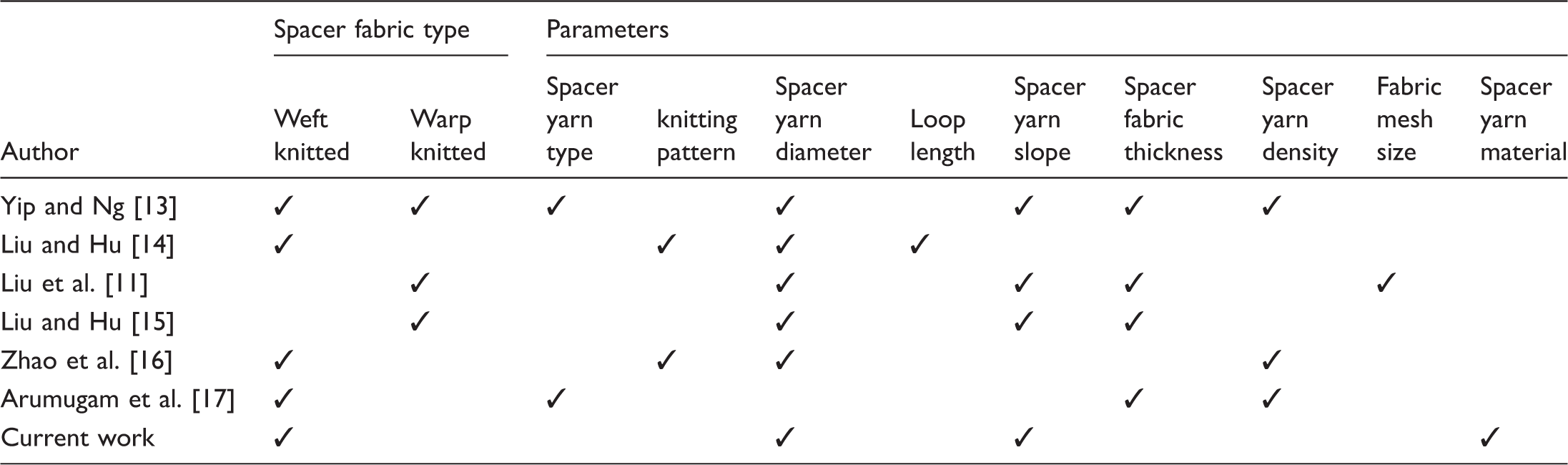
Several empirical and theoretical studies have been conducted on 3D knitted spacer fabrics to examine the effect of various structural parameters on enhanced compression properties. Yip and Ng [13] investigated the fabric density, fabric thickness, spacer yarn type, diameter, and slope of five different samples of spacer fabrics (warp-knitted and weft-knitted), and showed that the spacer yarn type and slope were the parameters with the most significant effect on the compression properties. Liu and Hu [14] conducted experiments on 20 weft-knitted spacer fabrics and considered the effect of different knitting patterns, spacer diameters, and loop lengths on the compression properties. They reported that larger diameter monofilaments yielded better compression resistance, while a higher loop length led to a lower compression resistance. Liu et al. [11] investigated the effects of spacer yarn slope, diameter, fabric thickness, and layer mesh size on the compression behavior of 12 warp-knitted fabrics and reported that fabrics with higher spacer yarn slope, larger diameter, smaller fabric thickness, and smaller mesh size absorbed more energy and were more efficient. Liu and Hu [15] extended their previous work in 2012 by carrying out finite element analysis on the samples; the simulation results confirmed the effects of structural parameters on compression behavior. Zhao et al. [16] analyzed the effects of the knitting pattern, diameter of spacer yarn, and spacer yarn density on the compression characteristics of 16 weft-knitted spacer fabrics and reported that fabrics knitted with shorter spacer yarn span distance, coarse monofilaments, and higher monofilament density had better compression resistance. Arumugam et al. [17] evaluated the effects of spacer yarn type, density, and spacer fabric thickness on the compression behavior of six different types of weft knitted spacer fabrics and concluded that thicker spacer fabrics using monofilaments as spacer yarn with higher stitch density had better compression resistance properties.
Scope of published works on behavior of spacer fabrics compared to the current research.
As mentioned above, bending rigidity and energy absorption are the two main parameters for selecting spacer materials. It is obvious that most of the metals have higher Young's modulus than majority of polymers and for the same type of shape and size, the material with higher Young's modulus has higher bending rigidity. On the other hand, materials which are able to withstand higher elastic strain are better options as spacer yarn due to the fact that the fabrics knitted out of such spacers do not easily undergo plastic deformation. The combination of these two characteristics can be found in shape memory alloys (SMAs).
SMAs are smart materials mainly based on nickel-titanium alloys with the capability to remember their original shape and exhibit shape memory and superplastic behavior. In addition, these materials are non-toxic, light-weighted and compatible to vivo environment. The potential of producing SMA wires with different diameter sizes on top of aforementioned advantages makes them the best option for spacer monofilament in 3D weft knitted fabrics used in cushioning pads of protective equipment.
In this study, we carried out the design, fabrication, and testing of special 3D weft knitted spacer fabrics using SMA monofilaments. The superelastic properties of SMA material were utilized to enhance the cushioning properties of spacer fabrics. Several experiments were performed to evaluate the effect of spacer material, diameter, and slope on energy absorption capacity of the knitted samples.
Fabric design
Despite the increasing number of products and extensive studies on the cushioning properties of protective equipment, there is still the need to improve the energy absorption capacity of such products. Owing to the commercialization of foam structures for cushioning applications, it can be initially inferred that the reinforcement of such structures with elastic materials to ensure higher endurance can become a permanent solution for enhancing the cushioning properties. However, as discussed in the previous section, such changes may not provide the desired comfort to users due to the disadvantages of polymeric foam structures. Therefore, the use of weft knitted spacer fabrics as cushioning material is introduced in this research to provide a more convenient cushioning pad and enhanced energy absorption properties.
The superelastic behavior of shape memory materials and its high bending rigidity make them unique as spacer monofilaments for enhanced cushioning properties of spacer fabrics. Shape memory alloys are known as smart materials with shape memory effect, which occurs when the alloy in martensite phase is deformed under loading below the martensite start temperature (Ms), unloaded at the same temperature, and recovers its original shape after being heated up to full austenite temperature (Af). If deformation occurs at temperatures higher than Af, large strains can be recovered in response to unloading, which illustrates higher elastic deformation capacity (up to 10%), namely, superelasticity [20]. Raghavan et al. [21] showed that superelastic behavior, which is a distinct property of SMA materials, yielded high energy absorption capability compared to other materials.
Mechanical properties of spacer yarns.

SMA: shape memory alloy.
aEA represents NiTi wire Young's modulus in austenitic phase.
bEM represents NiTi wire Young's modulus in Martensitic phase.
Due to the SMA wires high bending rigidity which is calculated by equation (1), the knitting process got more complicated for SMA samples:
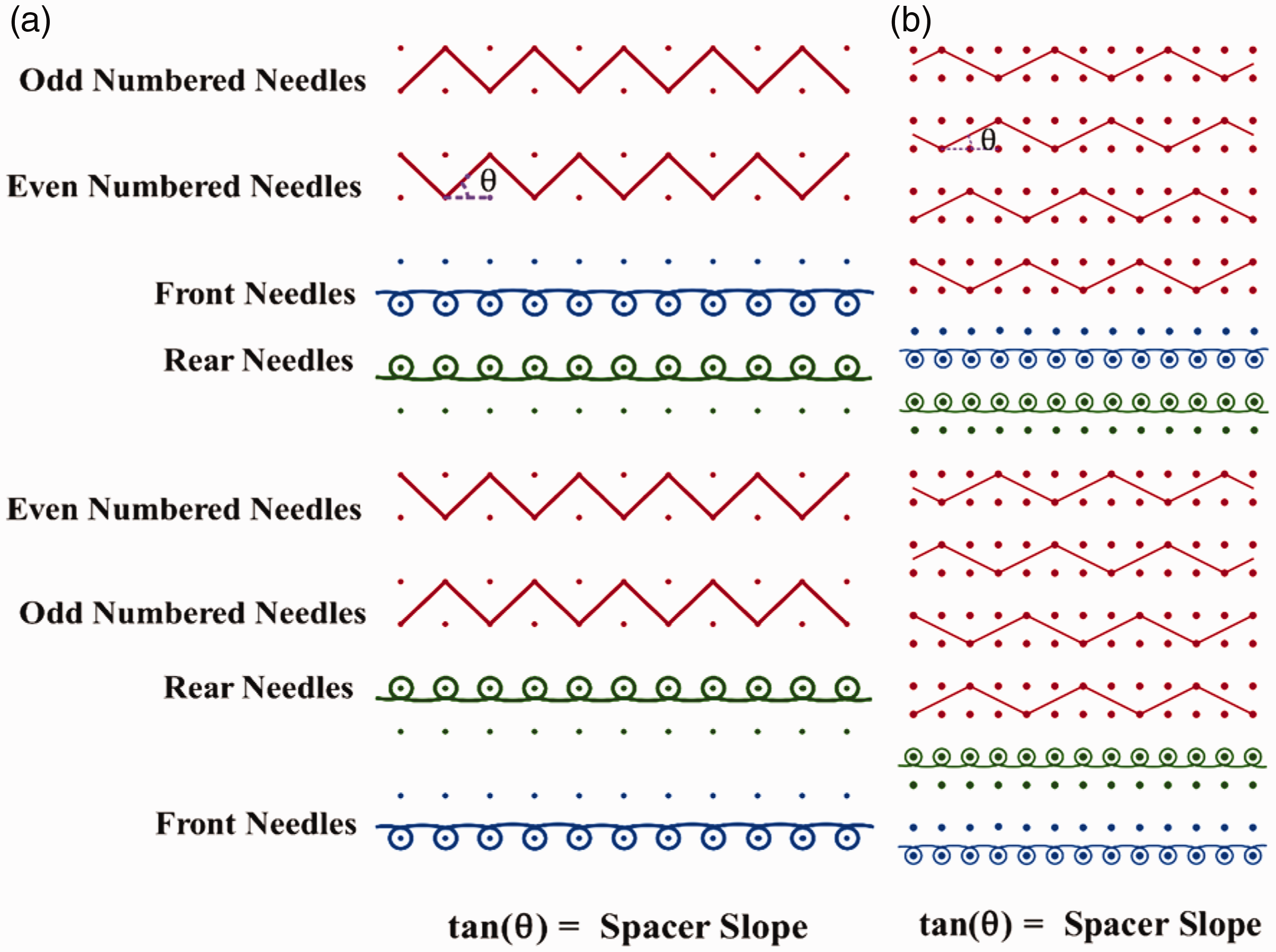
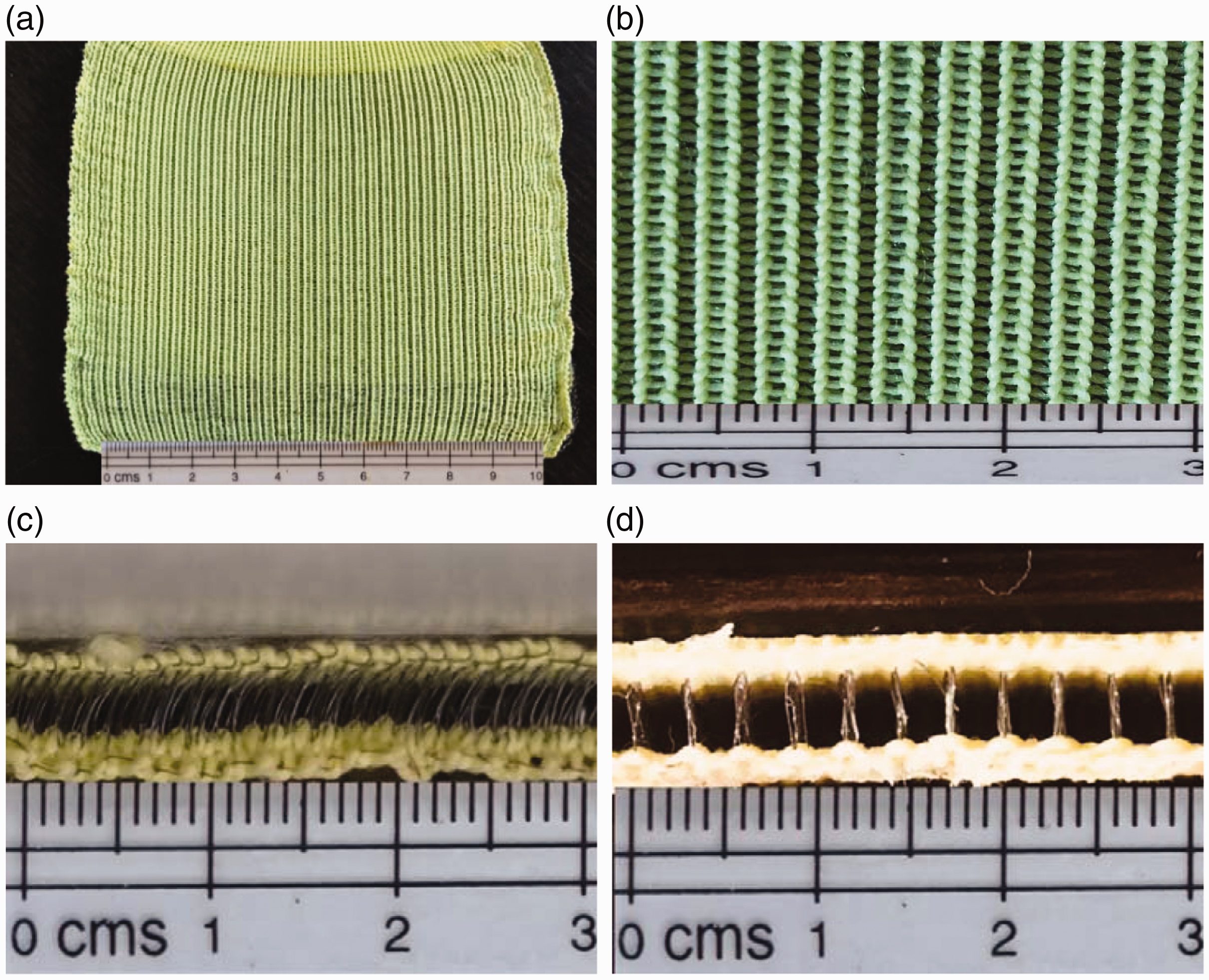
(a) Pattern-1 and (b) Pattern-2. (a) SMA-3 sample, (b) magnification of SMA-3 sample, (c) walewise cross section of SMA-3 sample, and (d) coursewise cross section of SMA-3 sample. (a) Walewise cross section of PA-1 sample, (b) coursewise cross section of PA-1 sample, (c) walewise cross section of ST-1 sample, and (d) coursewise cross section of ST-1 sample. Specifications of samples. SMA: shape memory alloy.


Procedure of the experiment
For running experiments, six sample groups each consisting of five knitted specimens were prepared. The quasi-static compression tests were carried out on all specimens (total of 30 tests) and eventually in each specific group, the obtained dataset for all five specimens, was imported to MATLAB® software and a curve was fitted to the dataset showing the trend of stress-strain behavior in sample group. The resulted six curves out of the obtained dataset was further utilized to investigate the effects of spacer material (target group: ST-1, PA-1, SMA-3), spacer diameter (target group: SMA-1, SMA-2, SMA-3) and spacer slope (target group: SMA-2, SMA-4) on spacer fabric compression properties.
Experimental setup
Compression tests were conducted using INSTRON 5566 machine. Two 100 mm platens with circular shapes were used as the compression interface on the device. Square specimens with sizes of 100 × 100 mm were prepared and in order to provide full contact to platens, circular samples with 100 mm diameter were cut out of square specimens. Figure 6 shows the final prepared circular specimen and also how it was positioned on INSTRON 5566 machine to perform quasi-static compression test. The specimens were compressed up to 80% of their initial thickness using a compression speed of 12 mm/min (according to ASTM D575) in 20℃ and 65% relative humidity environment. The value of 80% was selected to make sure that all samples were in densification stage and besides to avoid excess compression of outer layers.
Circular specimen for quasi-static compression test on INSTRON 5566 machine.
Characterization method
The spacer fabric energy absorption behavior can be defined using the stress–strain curve. However, Avalle et al. [22] directly utilized the energy absorption diagram and calculated the absorbed energy per unit volume based on the following equation, which represents the area under the stress–strain curve

Furthermore, they reported that the efficiency can also be used to determine the energy absorption capacity. The efficiency E is defined as the ratio of the energy absorbed by a real cushioning material which is compressed up to a certain amount of strain to absorbed energy by an ideal cushioning material that transmits a same constant stress for the same amount of strain, as given in equation (3).

This study utilized both the interpretation of energy absorption and efficiency diagrams to investigate the cushioning behavior of the samples.
Structural properties of knitted samples
Properties of knitted samples.

To evaluate the spacer material effect on structural properties, ANOVA test was run on specimen numbers 1–10 and 21–25 and the results showed that knitted spacer fabrics with higher bending rigidity led to lower WPC (p = 0.000). This was due to the higher resistance of spacer yarns with higher bending rigidity to outer layer shrinkage force. Although the change in material affected the CPC (p = 0.000) and stitch density (p = 0.000), a clear trend was not found for any of them. Regarding the thickness, the mechanics was more complicated. One-way ANOVA result reported significant effect of spacer material change on specimen thickness. After fabric removal from machine, outer layer shrinkage caused increase in spacer yarn slope toward outer layer which resulted in higher thickness of final removed specimen. For ST-1 group in which steel wires were used as spacer monofilaments, due to higher bending rigidity, the resistance toward shrinkage was more leading to lesser increase in slope and lower thickness of specimens compared to SMA-3 group. In PA-1 group, low buckling force due to low Young's modulus, caused buckling of spacer monofilaments under the weight of outer layer which resulted in lower thickness. The course view of ST-1, PA-1 and SMA-3 is depicted in Figures 4 and 5. As expected, areal and bulk density changes were directly proportional to spacer material density (p = 0.000, p = 0.000).
The effect of spacer diameter was evaluated with the same approach through running one-way ANOVA test on specimen numbers 11–25. For this case, results showed that WPC decreased by increasing spacer monofilament diameter (p = 0.000) which the reason could be found in increasing of spacer bending rigidity by increasing diameter and therefore increasing in resistance toward shrinkage force of outer layer. CPC was influenced directly by diameter change (p = 0.000). Stich density was also significantly affected by diameter change (p = 0.000); however, since the two affecting parameters (CPC and WPC) showed contrast behavior, no clear trend of variations was found on this property. Increasing diameter led to thicker specimens (p = 0.000) due to increase in spacer monofilament buckling force as the result of spacer diameter increase. Areal density and bulk density increased by increase in diameter which was as per expected (p = 0.000, p = 0.000).
Summary of ANOVA results.

Results and discussion
After carrying out the tests and compressing the samples to 80% of their initial thickness, the stress–strain data was obtained and the corresponding curves were plotted as depicted in Figure 7. As expected, all the samples, except ST-1, followed the trend for real cushioning materials as previously illustrated in Figure 2. As shown in the diagram, two SMA samples (SMA-2, SAM-3) showed better cushioning properties compared to the other samples (ST-1, PA-1, SMA-1, SMA-4) as indicated by their larger plateau.
Stress–strain diagram of knitted samples.
As one of the initial criteria for cushioning application, the recovery percentage was obtained through loading-unloading curves. Figure 8 shows the loading–unloading diagram for SMA-3 as an example in which the ratio of the area under unloading to that in loading curves was considered as recovery percentage. This percentage is reported in Table 6 for all sample groups.
Loading-unloading curve for SMA-3 sample. Recovery percentage after loading-unloading.

To determine the characteristics of a pad with optimum cushioning properties, the effect of the spacer yarn material, diameter, and slope was investigated using three sets of experiments.
Effect of spacer material
To evaluate the effect of spacer material, three sets of fabrics were knitted with the same spacer yarn diameter (0.1 mm) and the same spacer slope (Pattern-1). The spacer monofilament for the samples was selected as steel, polyamide, and SMA, which were tagged as ST-1, PA-1, and SMA-3, respectively as presented in Table 3. Quasi-static compression tests were carried out on all three sample groups and the resulting stress–strain curve was fitted on obtained dataset from all five specimens in each group which is depicted in Figure 9. It can be observed from the figure that ST-1 did not reflect the behavior of a typical cushioning material because its strain did not increase at constant stress. Because of the fact that elastic strain of steel wire was very low, when being used as spacer monofilament, plastic deformation occurred under compression which could not be recovered after being unloaded (the recovery percentage was 35.78%); although, it absorbed high amount of energy in first use, it could not be used for the same purpose again due to occurrence of permanent plastic deformation. Therefore in general, this confirmed that steel wire was not suitable for spacer monofilament in cushioning pad applications. Figure 10 shows permanent deformation of sample with steel monofilament. Samples PA-1 and SMA-3 showed good agreement with the stress–strain behavior of a typical cushioning material. It was also observed that SMA-3 not only had a longer plateau stage, meaning that it could withstand more strain up to densification, but also had a higher plateau stress compared to PA-1. This indicated a higher energy absorption at the same constant stress which eventually made sample SMA-3, the ideal material for spacer monofilament in cushioning pad applications.
Stress–strain diagram for ST-1, PA-1, and SMA-3 sample groups for spacer material evaluation. One knitted sample in ST-1 group (a) before compression and (b) after compression.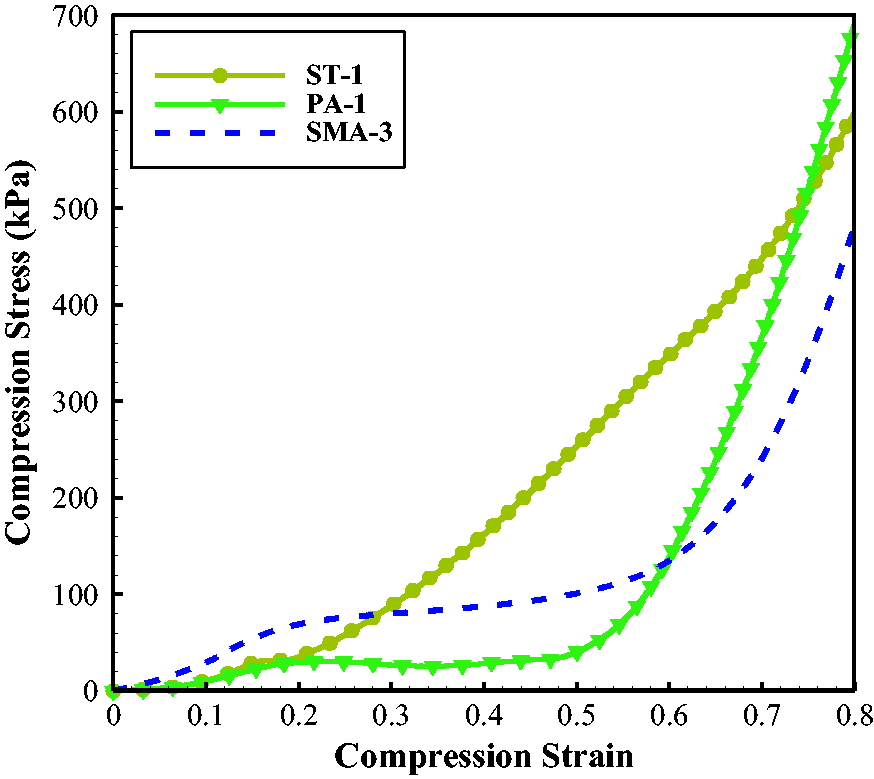

The corresponding energy absorption and efficiency diagrams of ST-1, PA-1 and SMA-3 are shown in Figure 11. Since ST-1 could not be categorized as cushioning material due to permanent deformation, it was removed from further investigations. The goal of the energy absorption analysis is to determine the material that absorbs higher energy at certain constant stress. As can be inferred from Figure 11(a), for low stress levels (approximately 50 kPa in this study), PA-1 showed higher energy absorption. However, for high stress levels, such as in-shoe plantar pressures in the range of 200–300 kPa for diabetic foot insole application as reported by Owings et al. [23], SMA-3 absorbed more energy at the same stress. For example, the mean in-shoe peak plantar pressure in a previous ulcer site, which is a risky area for re-ulceration, is approximately 207 kPa. It was shown that for this stress value, the energy absorption capacity increased from 25 kJ/m3 for 3D fabric with polyamide spacer yarn to approximately 60 kJ/m3 for knitted 3D fabric with SMA spacer yarn, which clearly indicates an improvement of the cushioning properties by up to a factor of 2.4. Considering that high stress levels exist in protective applications, this result confirmed that SMA-3 is suitable for such applications; thus, it is a better option for spacer yarn materials. Furthermore, Figure 11(b) shows that for lower stress levels, PA-1 was more efficient, whereas for higher stress levels, SMA-3 showed higher efficiency. Referring to Table 6, SMA-3 showed lower recovery percentage compared to PA-1 after compression which this stated wider hysteresis loop and higher energy absorption for SMA-3 after loading-unloading cycle.
(a) Absorbed energy vs. stress diagram for ST-1, PA-1 and SMA-3. (b) Efficiency vs. stress diagram for ST-1, PA-1 and SMA-3.
Effect of spacer diameter
A second experimental evaluation was carried out to examine the effect of spacer yarn diameter on the cushioning properties of knitted fabric. In this section, all three samples were made of SMA materials, but with different wire diameters of 0.05, 0.075, and 0.1 mm tagged SMA-1, SMA2, and SMA-3, respectively. The knitting pattern (spacer slope) was kept the same while preparing the samples. Figure 12 shows the (a) stress–strain, (b) absorbed energy–stress, and (c) efficiency–stress diagrams of the SMA samples. As monofilament diameter increased, bending rigidity also increased due to enhancement in moment of inertia thus as expected, the sample with coarse monofilament showed higher compression resistance, which indicated that it achieved a higher plateau stress. The absorbed energy diagram indicated that for low stress levels, using fine SMA monofilament yielded better results; however, for high stress levels, coarse SMA monofilaments were more suitable to absorb higher energy and to significantly enhance cushioning properties. In the efficiency diagram, the maximum efficiency peaks occurred at high stress values when coarse wires were used, which also confirmed that increasing the spacer diameter enhanced the cushioning properties of knitted pads. Since yarn linear density is directly characterized by monofilament diameter for specific material, it can be stated from the results that energy absorption capacity enhances with increase in spacer yarn linear density. Referring to Table 6, with increasing diameter, recovery percentage decreased which this also indicated wider hysteresis loop and higher energy absorption.
(a) Stress–strain, (b) absorbed energy vs. stress, and (c) efficiency vs. stress diagram for SMA samples.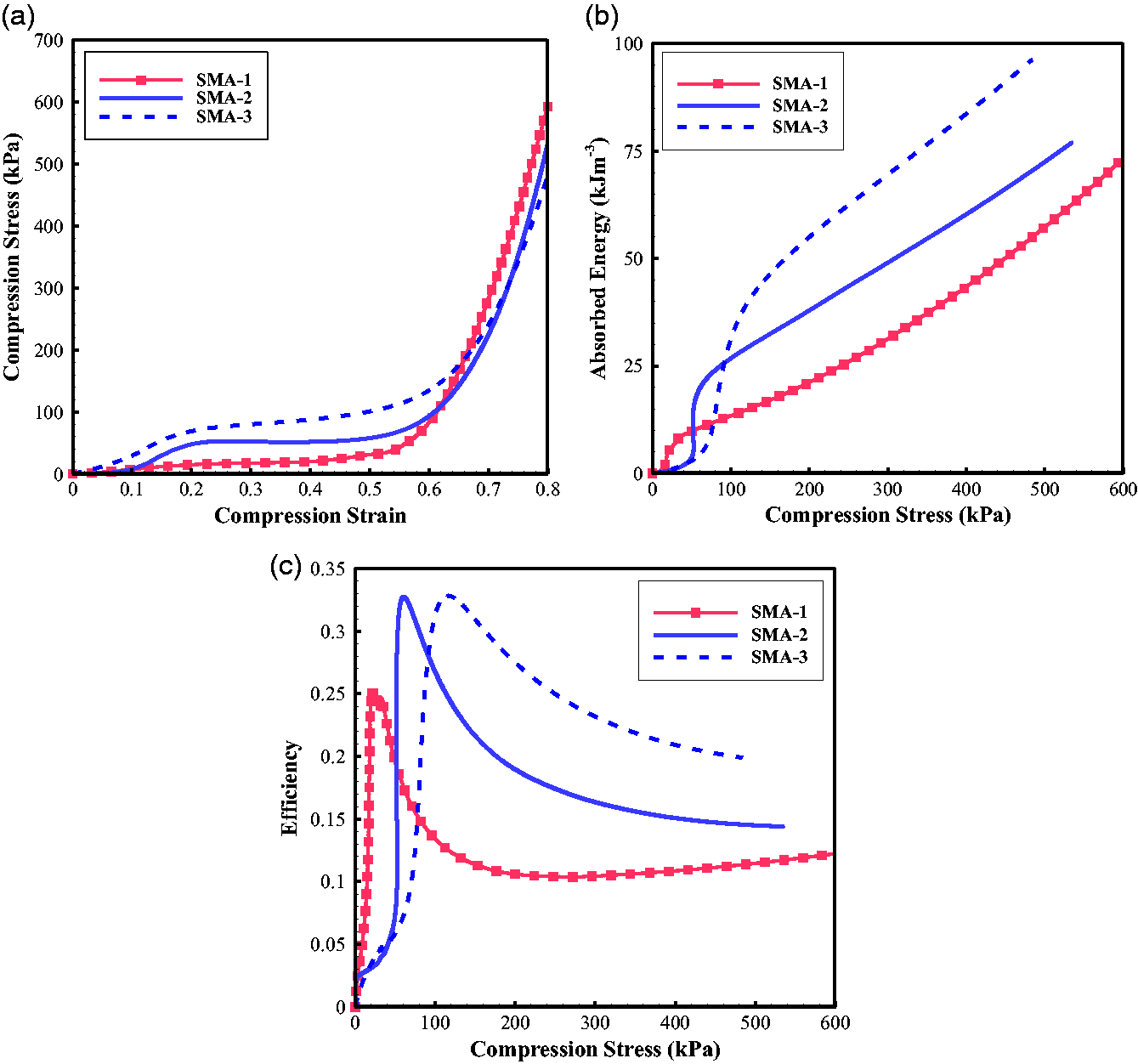
Effect of slope
The objective of the third comparison group was to investigate the effect of slope on the cushioning properties. To achieve this, two test samples were prepared using SMA with 0.075 mm as the spacer monofilament. The spacer monofilaments in Pattern-1 (SMA-2) had higher slope compared to that of Pattern-2 (SMA-4) as depicted in Figures 3 and 13. According to the diagram shown in Figure 14(a), the plateau stress for SMA-4 was significantly lower than that of SMA-2, and SMA-4 was compressed to 80% of the initial thickness under lower stress values, which could be attributed to the spacer slope. In Pattern-2, the monofilaments tend to slide instead of buckling owing to lower slope of the spacers compared to Pattern-1. This made the structure less suitable for bearing compression stress because the outer layers slid against each other at lower stress values. On the other hand, as inferred from Table 4, stitch density was reduced due to reduction in spacer slope. This caused reduction in number of load bearing elements which eventually led to lower compression resistance on sample. This showed that reduction in both spacer slope and stitch density reduced compression resistance conjointly. In addition, samples thickness was increased due to increase in tuck connecting distance (lower spacer slope). This caused increase in effective length of spacer monofilaments and reduction in buckling critical force which eventually led to reduction in compression resistance. The same interpretation is applicable for energy absorption and efficiency for the tested sample (Figure 14(b) and (c)). It can be concluded that since protective applications such as insoles require structures with high compression resistance and energy absorption capacity, Pattern-1, which had a higher slope, is a better option. Referring to Table 6, the change in recovery percentage was not significant; however, the knitted sample with Pattern-1 which had higher spacer slope, showed lower recovery percentage.
(a) Coursewise cross section of SMA-2 sample and (b) coursewise cross section of SMA-4 sample. (a) Stress–strain, (b) absorbed energy vs. stress, and (c) efficiency vs. stress diagram for SMA-2 and SMA-4 showing the effect slope.

Conclusion
This study investigated the optimum design of a weft knitted 3D spacer fabric as cushioning material for protective applications, specifically for ultimate use in offloading insoles for persons with diabetes. In such applications, the main concern is employing a structure that can absorb as much energy as possible to keep the relevant transmitted stress under a certain limit. Results of quasi-static tests carried out on the samples showed that for high stress levels, spacer fabric with SMA wires as spacer yarn, exhibited significantly better cushioning behavior compared to samples with polyamide and steel spacer monofilaments. On the other hand, for the same type of material (SMA in this experiment), energy absorption increased as the spacer yarn diameter increased. In addition, two different spacer slopes were examined and it was found that SMA sample with higher-inclined spacers was more resistant to compression and had higher energy absorption capacity. Therefore, it can be concluded that 3D weft knitted fabrics with coarse SMA monofilament spacers in higher-inclined patterns are the most suitable option for cushioning pad in protective equipment. The knitted spacer fabric with SMA spacer yarn can be utilized in medical applications such as orthopedic insoles for diabetic patients or impact-imposed sports activities. The key element for the prevention and treatment of diabetic foot ulcers decreases the plantar stress on the diabetic foot. Moreover, for diabetic patients with a history of foot ulcers, the mean in-shoe peak plantar pressure in a previous ulcer site, which is a risky area for re-ulceration, is approximately 207 kPa. In this paper, it was shown that for this stress value, the energy absorption capacity increased from 25 kJ/m3 for 3D fabric with polyamide spacer yarn to approximately 60 kJ/m3 for knitted 3D fabric with SMA spacer yarn, which clearly indicates an improvement of the cushioning properties by up to a factor of 2.4. This characteristic significantly increases the potential of the fabricated design for protective applications.
Footnotes
Declaration of conflicting interests
The author(s) declared no potential conflicts of interest with respect to the research, authorship, and/or publication of this article.
Funding
The author(s) received no financial support for the research, authorship, and/or publication of this article.