



Abstract
Textile clothing coated with silica aerogels has the potential of thermal insulation performance for heating and cooling. This work investigated the thermal isolation properties of untreated and treated three-layered weft-knitted spacer fabrics with different thicknesses (2 mm, 3 mm, and 4 mm) by using silica aerogels. Three samples of spacer fabrics (300GSM, 350GSM, 540GSM) were coated with nanoporous silica aerogel at a 26°C temperature and then kept for aging, exchanging the solvent, surface modification. The characteristics, for example, thermal resistance, thermal conductivity, yarn arrangement angle, porosity, and air permeability of spacer fabric samples, were investigated. Scanning electron microscopy analysis and Fourier transform infrared spectroscopy–attenuated total reflection test were conducted to explore the surface morphology and surface changes initiated by the silica coating. The experimental results indicated that the treated weft-knitted spacer fabrics with 350GSM have a higher thermal resistance of 0.09131 m2 K W−1, higher porosity ratio, higher air permeability, higher arrangement angle, and lower density. The statistical analysis also verified the significant performance (p = 0.000) of treated fabric samples at the 0.05 level.
Introduction
In recent years, the use of high-performance textiles has been increased due to the high demand in comfort, health care, and safety of living beings. 1 Therefore, consumption of multifunctional textile materials (ultraviolet (UV) radiation protection, antimicrobial protection, dye fastness, anti-wrinkle finishing, superhydrophobicity, biomolecules immobilization, etc.) has made expanding trend in the worldwide clothing, including casual wear, sportswear, work wear, military wear, medical wear, active wear, underwear, and so on.2,3 However, the dynamic interactions of textile clothing with human skin have led to the reduction of skin maceration, such as discomfort most specifically due to the thermo-physiological factor. 4 Thus, it is necessary to investigate the optimization of insulation that enables human to remain in a good physiological state comfort, especially in cold weather.
Thermo-physiological comfort is associated with thermal properties, water vapor transmission, sweat absorption, and drying ability of fabrics. 5 These are affected by the numerous major parameters like fiber geometry, cross section, structure, pore distribution, pathways, molecular structure, surface tension, fabric structure, thickness, density, and so on.6,7 Similarly, its functionality and durability are also prompted by the finishing treatments. 8 In the past few years, extensive research has been carried out on the evaluation of thermo-physiological characteristics of fabrics.9–11 A lot of researchers also have developed a neural network, statistical, mathematical, and theoretical models for the determination of the thermal properties of textile knitted fabrics.12–14 Among all, weft-knitted spacer fabrics have gained significant importance due to the special 3D structure with high porosity and open apertures in the surface. 15 Moreover, they are regarded as eco-friendly textile materials since they can be recycled.
Weft-knitted spacer fabric is constructed on a double jersey circular knitting machine having a rotatable needle cylinder and needle dial. 16 The fabric generally consists of two outer layers of elastic yarn (an upper layer and a bottom layer) and one middle layer of spacer yarn. 17 The two outer layers are made up of knitted fabrics; however, the middle layer is constructed by spacer filaments (monofilament or multifilament) tightly connecting the two outer layers. This helps to reduce the air permeability and minimize heat loss through convection. 18 Thus, it becomes excellent for tailor-made attires because of softness and comfort qualities compared to the other (warp and woven) spacer fabrics. Moreover, they have excellent transversal compressibility and planar elasticity. 19 The characteristics of the weft-knitted spacer fabrics were further enhanced with the addition of even small amount of additives in particular micro-sized and nano-sized bio-ceramic additives (BCAs), such as silica (SiO2), zirconia (ZrO2), magnesium oxide (MgO), ferric oxide (Fe2O3), silicon carbide (SiC), and germanium (Ge) derivatives.20–25
Silica aerogels (SAs) are super-insulating nanoporous materials, although they have inadequacies due to brittleness, moisture instability, and high cost. 26 However, the integration of these kinds of additives improves the attenuation of textile fabrics. SAs have a large internal surface area, low density, small pore size, and large pore volume. 27 It possesses very low thermal conductivity and high thermal insulation properties and performance due to the reduction in the conduction, convection, and radiation. 26 Therefore, it has become very popular in establishing desired modifications in textiles, that is, weft-knitted spacer fabric surfaces, and used in aerospace suits, sea, and biological purposes, and so on. 28 Many researchers have applied SAs to the fibers and fabrics as functional agents (super-thermal insulating, superhydrophobicity, protection from UV radiation, static biomolecules, colorfastness of materials and antimicrobial preservation) through sol-gel method.29,30
The relationships between the knit structures and the thermal isolation properties of the weft-knitted spacer fabrics are still very limited. The authors have not found significant research work on the weft-knitted spacer fabric with the SAs coating for investigating its thermal isolation properties. Therefore, in this research work, SiO2 tenuous gels were made from tetraethylorthosilicate with some other important substances through the sol-gel method. The 3D spacer fabric samples (uncoated and coated with SAs) were investigated. The influence on thermo-physiological characteristics of weft-knitted spacer fabrics was evaluated rigorously through scanning electron microscopy (SEM) and Fourier transform infrared spectroscopy–attenuated total reflection (FTIR-ATR) analysis test. Further, porosity, thermal insulation, and air permeability test were also conducted to determine their effectiveness. These fabrics have low weight, excellent porosity ratio, and good thermal resistance simultaneously. Thus, weft-knitted spacer fabrics with SA coating were investigated as an alternating source for thermal isolation material.
Experimental work
Materials
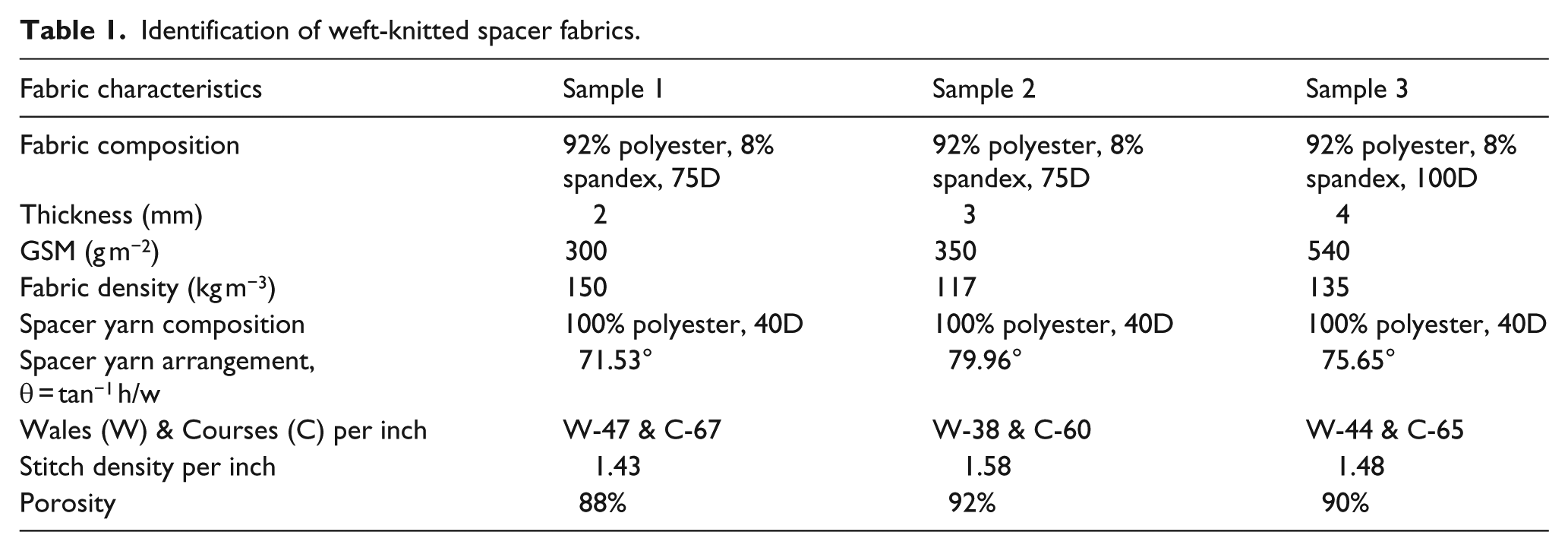
Three kinds of weft-knitted spacer fabric samples (92% polyester + 8% spandex) were collected from Tianbin Textile Co. Ltd., Changshu, China. All weft-knitted tuck spacer fabrics were made on a circular knitting machine of gauge 28. The first and second fabric samples were supplied with similar yarn count (75D) while the third sample with 100D. The yarn count of the middle layers of the three spacer fabrics was uniform (40D). The thickness of the three samples was different, that is, 2 mm, 3 mm, and 4 mm, respectively. The detailed specifications of fabric samples have been given in Table 1. Tetraethyl Orthosilicate (TEOS) and N-hexane (>99%) were purchased from National Drug Group Chemical Reagent Co. Ltd. and Yangyuan chemical Texnology Co. Ltd. Ethyl alcohol (99%, EtOH), N,N-dimethyl-formamide (>98%, DMF), Hydrochloric acid (37%, HCl), and ammonia (25%, NH4OH) were procured from Shanghai Union Chemical Industry Co. Ltd., Shanghai Lingfeng Chemical Reagent Co. Ltd., Algae Group Chemical Reagent Co. Ltd., and Shanghai Macklin Biochemical Co. Ltd. HMDS (hexamethyldisilazane) was bought from Shanghai Code Group Chemical Brake Co. Ltd. All the chemicals and reagents were of analytical grade and applied without any further rectification.
Identification of weft-knitted spacer fabrics.
Silica sol preparation
The silica sol-gel process was carried out in two stages, that is, primarily acid-catalyzed TEOS hydrolysis and finally base-catalyzed gelation. Initially, 111.1 mL of TEOS were dissolved in 694.4 mL of EtOH. This mixture was stirred at 400 r/min to form a homogeneous solution. After that, the acid catalyst solution was prepared by dissolving 27.8 mL of HCl in 83.3 mL of H2O. It was then added dropwise into the (TEOS/EtOH) solution with magnetic stirring which was continued for 60 min at 60°C. Second, 27.8 mL of NH4OH was added into the (TEOS/EtOH) solution with magnetic stirring of 30 min. Then, 27.8 mL of DMF was added to form the homogeneous nanoporous structure of the aerogels. Finally, 27.8 mL of HMDS were dissolved in the solution (TEOS/EtOH) for 2 h at 60°C with magnetic stirring. The ultimate silica concentration of the sol solution was 11.11 wt%. Figure 1 has shown the stages for the preparation of a silica sol-gel process.

Preparation of silica sol-gel process (acid-catalyzed TEOS hydrolysis and base-catalyzed gelation).
Fabric samples treated with silica gels
All the weft-knitted spacer fabric samples were cut into 35 cm2 pieces and immersed into the silica sol for 15 min. Subsequently, the samples were solidified into a tightly sealed container. After the formation of the gelled layer on fabric samples (20 min), the wet-gelled samples were further kept for 24 h at 25°C to secure the gel network structures (shown in Figure 2). The wet-gelled samples were washed with ethanol for 8 h. The washing was repeated thrice with the exchanging into n-hexane. The wet-gelled films were washed with n-hexane for 8 h to remove the ethanol-containing fluid. It was then dried in an oven at 40°C and 60°C systematically for 5 h, followed by further drying at 100°C for 5 h.

Fabric samples treated with (a) silica aerogel during dip-coating and (b) forming gel network structure.
The fundamental test for samples
Examine of silica gel on fabric samples
The treated and untreated samples of spacer fabrics were dried at 107°C for 60 min. The add-on % of silica on spacer fabric samples was calculated according to equation (1)

where W1 is the weight of untreated samples in kg and W2 is the weight of treated samples in kg.
SEM analysis
The SEM was completed with a Flex-SEM 1000 (SU1000, Hitachi Ltd. Japan). All weft-knitted spacer fabric samples were coated with a gold layer using a vacuum sputter coater before analysis. The surface morphology of fabric samples was examined by SEM.
FTIR analysis
The Fourier transform infrared spectroscopy (FTIR) was performed with a Nicolet TM 5700 FT-IR spectrometer (USA). The spectra were generated in the range of 400–5000 cm−1 based on ATR. The test was used in 64 scans and encoded at 8 cm−1 resolution.
Spacer yarn arrangement angle
Weft-knitted spacer fabrics were prepared with two distinctive layers (upper layer and bottom layer) fabrics that were joined together by a connecting layer (middle layer). Figure 3 has shown the critical yarn arrangement angle of the spacer fabric. The spacer yarns were formerly settled perpendicular to the two outer layer fabrics. The yarn arrangement angle of spacer fabrics was calculated by the equation (2)

where θ is the spacer yarn arrangement angle in degree, h is the thickness in mm of the spacer fabric, and w is the segment width in mm.

The spacer yarn arrangement angle of weft-knitted spacer fabric.
Porosity test
In this test, the dry samples were measured in weight, then dipped in water for 24 h and re-measured their weights. The porosity of the samples was found as the percentage of the ratio of the difference in the dipped and the dry weight to the dry weight. The porosity measurements were accomplished for the average of 10 readings. Therefore, porosity percentage was calculated as follows equation (3)

where P is the porosity ratio in %, Wt is the dipped weight in kg, and Wr is the dry weight in kg.
Thermal insulation test
Thermal insulation properties of spacer fabrics were verified by the thermal resistance tester (YG606E) of China. The temperature of the testing plate was kept at 35°C. Each sample was measured three times, and the average values were calculated. The heat transferred from one part of the medium to another (medium). Thermal resistance substantiated heat properties and amounts of temperature variance by which a material resists heat flow. The fabric density and entrapped air inside the fabric structure caused higher thermal resistance. The surface of spacer fabric is self-possessed of pores enclosed by the yarns. The thermal resistance is connected with the thermal conductivity and thickness of the spacer fabric. The relationship between thermal resistance and the thermal conductivity was defined by equation (4)

where R is thermal resistance in m2 K W−1, h is the fabric thickness in mm, and λ is thermal conductivity in W m−1 K−1.
Air permeability analysis
The air permeability of weft-knitted spacer fabrics was investigated through air permeability tester (YG461E, China). The test was conducted under specific conditions, that is, air pressure 100 Pa and the circular test area was 20 cm2. Air permeability defined as the volume of air passing in 1 s through 100 mm2 of fabric samples at a pressure variance of 100 Pa. In this experiment, each sample was measured 10 times in several places, and the average results were recorded.
Measurement of density
Density compares the amount of material of an object to its volume. The densities of untreated samples and treated samples were measured by equation (5)

where ρ is the density of spacer fabrics samples in Kg m−3, m is the mass of samples in Kg, and v is the volume of samples in m3.
Statistical analysis
The statistical analysis was also carried out to examine the level of significant impact. With a certainty interim set at 95%, p value smaller than 0.05 was viewed as a statistically significant distinction. Noteworthy contrast information (Figures 6 and 8) were entitled by various characters, that is, A, B, C, D, E, F and a, b, c, d, e, f.
Results and discussion
Measurements of thermo-physiological comfort and its effectiveness in three types of weft-knitted spacer fabrics integrated with SAs were performed under standard conditions, BS1051, at 20°C and 65% relative humidity. To verify the performances of these fabric samples, the results were analyzed through add-on %, SEM, FTIR, yarn arrangement angle, porosity, thermal insulation, and air permeability test. The influence of SAs on the fabric structure features has also been statistically analyzed. Moreover, the effects of density and thickness on isolation properties have also been discussed respectively. Table 2 has shown the face side, a back side, wales-wise and course-wise view of weft-knitted fabric samples.
Different visualizations of weft-knitted spacer fabrics.

Influence of add-on % of SA coating on the fabric samples
SAs were made through the sol-gel method and applied to the fabric samples. It was found with the help of equation (1) that the add-on % of silica on the three samples was 49%, 62%, and 55% respectively. The Si-OH in silica particles vastly interconnected with the fibers by thermodynamic (hydrogen and dipolar-dipolar bonds) interaction. The polar chain structure of polyester (PET) fibers have the initial issue for the hydrogen, and dipolar-dipolar interaction thus caused the higher add-on % of silica on the samples. The tight adhesion between SAs accumulations and fabric structures attributed the formation of hydrogen bonds among spacer fabric samples and silica nanoporous due to the surface hydroxyls. It was observed that the higher the add-on % of silica, the higher the thermal resistance of samples (as in sample 2).
Influence of SA coating on the thermal resistance
The surface particle morphology and microstructure of the untreated and treated samples with silica gels were observed by the SEM test, as shown in Figure 4. Figure 4(a) has not shown any effect of the silica gel on the fabric surface, while Figure 4(b) has displayed a dense surface morphology and incessant structure. The silica gels have a nanoporous, tantamount, and well-structured network on the surface of treated fabric samples. After treated with silica gels, the morphology and uniformity coating of all treated fabrics was exaggerated by the substrate surface. Furthermore, the surfaces of treated fabrics coated by silica particles were found thicker than untreated fabrics. Thus, the treated fabrics have the existence of the SiO2 network in their structures.

SEM images of (a) untreated and (b) treated samples with silica gels (scale bars: 1 mm).
In addition, several large bridges and crusts of interphase substantial were noted in the spaces of the fibers. The surface of untreated spacer fabric samples was smooth while stubs and burls were observed on the surface of treated fabrics. Hence, the treated fabric samples covered with silica sol nanoparticles made the surface severe and harsh. Among all the three treated fabric samples, sample 2 had the most silica gel on the surface. Therefore, it had fewer friezes and more porosity ratio on the surface. Consequently, it caused the highest thermal resistance as compared to sample 1 and sample 3. Sample 1 has the lowest amount of silica on its surface; therefore, it was smoother than the other two samples and, as a result, has the lowest thermal resistance.
Influence of SA coating on the molecular structure
Figure 5 has shown the outcomes of FTIR analysis. All the fabric samples have indicated the availability of specific functional group at the absorption peaks. The occurrence of the absorption peak at around 1050 cm−1 has the stretching and bending of C–O bonds. It was present in all untreated and treated samples. The absorption peak at 1050 cm−1 was due to the unbalanced stretching and vibration of Si–O–Si bonds that confirmed the formation of nanoporous silica network structure on the samples. Due to the two kinds of the peak at the same position, the spectra were observed among the untreated and treated samples at 1050 cm−1. The presence of an absorption band at nearly 1350 cm−1 and 2950 cm−1 were owing to the stretching and bending of C–H bonds. The strong peak at 1700 cm−1 has indicated that all the samples have C=O groups in their structures. The peak around 2200 cm−1 was due to the asymmetric stretching of –C≡C– bonds. Thus, the existence of Si–O–Si bonds in the spectra ensured the improvement of the thermal insulating properties of the materials (fabric samples).

The FTIR spectra of untreated samples (UTS) and treated samples (TS).
Influence of SA on yarn arrangement angle
The yarn arrangement angle of three spacer fabric samples (S1, S2, and S3) was calculated and found 71.53°, 79.96°, and 75.65°, respectively. It was observed that the SA coating had no effect on the yarn arrangement angle. However, the fabric sample that had a higher spacer yarn angle had higher thermal resistance, that is, in our case, sample 2 had shown the highest thermal resistance since having the largest yarn arrangement angle (79.96°) as compared to the other two samples. Therefore, thermal resistance has a direct relationship to the spacer yarn arrangement. Greater the yarn arrangement angle, higher would be the thermal resistance. Moreover, it was revealed that the thermal resistance was higher when the spacer yarns placed into “v” form (Table 2 wales-wise and courses-wise figures) between the same two fabric faces rather than the spacer yarns perpendicular to the fabric faces.
Influence of SA coating on the porosity
The relationship among the porosity ratio, thermal conductivity, and thermal resistance of all spacer fabrics has been displayed in Table 3. The untreated fabric samples have higher porosity (88%, 92%, and 90%) and thermal conductivity levels (0.03519, 0.04739, and 0.06867 W m−1 K−1). However, when the fabric samples were treated with SAs, the porosity (85.67%, 90.33%, and 87.67%) and thermal conductivity (0.02706, 0.03286, and 0.05200 W m−1 K−1) were reduced. Among all untreated fabric samples, the samples that had lower porosity level also had lower thermal conductivity. The similar trends were observed in the treated fabric samples, that is, the samples with lower porosity level (85.67%) had decreased thermal conductivity (0.02706 W m−1 k−1). The untreated and treated fabric samples with higher porosity ratio have a higher thermal resistance.
Thermal insulation properties of weft-knitted spacer fabrics.

UTS = untreated samples; TS = treated samples.
It was found that the decreasing porosity rates were 2.64%, 1.82%, and 2.59% after coating with silica gels. With the decrease in porosity (%), there was an increase in thermal resistance. Sample 2 had lost the lowest (1.82%) porosity after coating with SAs, and consequently, it had a higher thermal resistance. After the SA coating, the thermal resistance of three samples increased, that is, 0.07390, 0.09131, and 0.07692 m2 K W−1, respectively. It was also observed that after the treatment with SA, the fabric sample (S2) had the most thermal resistance among all the entire weft-knitted spacer fabric samples. This was due to the greater spacer yarn arrangement (79.96°), higher porosity (92%) level, and lower density (117 Kg m−3). High porosity ratio indicated the more spaces in the sample structure, which entrapped the huge air. The entrapped air in the fabric directed the high thermal resistance. The highest porosity ratio possessed the highest thermal resistance, since with the porosity ratio of 92% and the thermal resistance of 0.09131 m2 K W−1 in the fabric sample (S2). Thus, among the three fabric samples, the fabric sample (S2) has the highest porosity and the maximum thermal insulation properties. The higher values of thermal resistance signpost a lower heat transmission from the skin to the fabric surface. This is related to a warmer feeling.
However, when the porosity ratio decreased from 88% to 85.67%, 92% to 90.33%, and 90% to 87.67%, the thermal conductivity values also decreased from 0.03519 to 0.02706, 0.04739 to 0.03286, and 0.06867 to 0.05200 W m−1 k−1 for sample 1, sample 2, and sample 3, respectively. These SAs treated samples possessed lower thermal conductivity due to the reduced conduction, convection, and radiation. The circuitous path for heat transfer from the treated solid nanoporous structure and low density minimized the conduction. Notable tiny pore sizes reduced the convection. The radiative thermal conductivity with dissipating dopants has made the impact to diminish the aggregate thermal conductivity. The multi-porous structure of the treated spacer fabrics with SAs assumed an essential job in diminishing the thermal conductivities contrasted with the untreated spacer fabrics. Aerogels were astonishing thermal protectors since they verged on invalidating these methods of heat transfer. Henceforth, the lower thermal conductivity of the aerogel has made an alluring thermal protecting material.
Influence of SA coating on the air permeability
Figure 6 presented the pictorial relationship between the air permeability (pink color bar) and thermal resistance (green color line) in the selected samples. Moreover, these different characters (A, B, C, D, E, F and a, b, c, d, e, f) indicated the significant differences in the figures. It has expressed an indirect relationship (inversely proportional) between air permeability and thermal resistance, that is, after the treatment with SAs; the air permeability decreased while the thermal resistance increased. When the air permeability ranges were from 189.83 to 473.81 m ms−1, the thermal resistance of the untreated and treated fabrics was 0.05683 to 0.09131 m2 K W−1. After the chemical treatment of sample 1, sample 2, and sample 3, the air permeability values decreased to 56.98%, 46.04%, and 52.16% with the increase in thermal resistance of 30.05%, 44.25%, and 32.05%, respectively. Thus, there was an increase in thermal resistance with the decrease in air permeability. Moreover, sample 2 lost the lowest air permeability rate (46.04%) and achieved the highest thermal resistance rate (44.25%) as compared to sample 1 and sample 3. Higher the air permeability, lower the thermal resistance. The error bars appeared in Figure 6 represented the standard deviation. Among all the three fabric samples, sample 2 displayed the highest thermal resistance value as compared to sample 1 and sample 3. It was due to the less decrease rate of air permeability with the silica gels coating that also indicated sample 2 possessed higher air permeability than the other two samples.

The relationship between the air permeability (qv) and the thermal resistance (R).
The air permeability and thermal resistance curve has been illustrated in Figure 7 of the three untreated and treated weft-knitted spacer fabrics. In addition, there was a positive relationship between air permeability and thermal resistance from 189.83 to 473.81 m ms−1. The square relationship coefficient of first-order linear fitting was 0.612. The intercept and the slope of the curve were 859.63 and −7560.64, respectively. The relationship between air permeability and thermal resistance has been expressed by equation (6)


The linear fit curve of air permeability (qv) and the thermal resistance (R).
Since a higher value of thermal resistance specified a lower heat transferred from the skin to the fabric surface, this is generally allied with a warmer feeling.
Influence of SA coating on the fabric density
The correlation between fabric density (red color bar) and thermal resistance (blue color bar) has been illustrated in Figure 8. The different characters (A, B, C, D, E, F and a, b, c, d, e, f) indicated the significant differences in the figures. It has demonstrated that thermal resistance increased with the increase in fabric density of every individual sample after the chemical treatment. Thus, both have a direct relationship (directly proportional). The fabric density of three treated samples was 196, 150, and 155 kg m−3, wherein thermal resistance was 0.07390, 0.09131, and 0.07692 m2 K W−1. In the table, sample 2 has the lowest density and the highest thermal resistance as compared to sample 1 and sample 3. Among all the fabric samples, it has the best thermal resistance since it has a higher space to trap the air inside. Higher fabric density leads to greater thermal resistance and vice versa. The error bars appeared in Figure 8 represented the standard deviation. It validated that the density of all treated samples was increased after coating with silica gel. In addition, when the fabric density values altered from 117 to 196 kg m−3, the thermal resistance of the fabric samples changed from 0.05683 to 0.09131 m2 K W−1. This was due to the increase in fabric density, in accumulation to the fabric thickness.
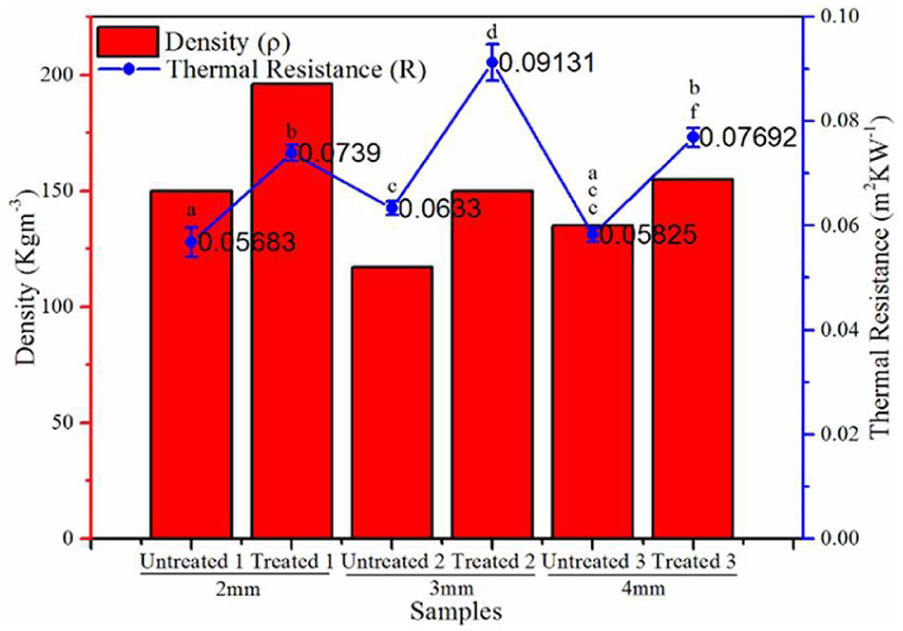
The relationship between fabric density (ρ) and thermal resistance (R).
It was observed that the density of sample 1 was 150 kg m−3 before treatment, and the density of sample 2 was 150 kg m−3 after treatment with SAs. All the fabric samples gained more density after coating with SA; hence, SAs played a vital role in increasing the fabric density and hereafter the thermal resistance. In sample 1, there was no silica particle before SAs coating, whereas sample 2 had silica particles after coating with SAs, although both sample 1 and sample 2 have the same densities but different thermal resistances. This was due to the amount of SA on the fabric samples.
Influence of SA coating on the fabric thickness
It was observed that the thicknesses of samples were unaffected by the silica treatment. Thus, the thickness had not made any effective influence on thermal conductivity. However, the thermal conductivity of all the treated samples was decreased after coating with silica gels. This was due to the influence of other fabric characteristics as, for example, the thermal conductivity decreased with the decrease in porosity. The values of thickness and thermal conductivity have been displayed in Table 3. The thermal conductivity decreased in every individual sample after coating with SAs. The thermal conductivity values decreased with SAs coating from 0.03519 to 0.02706, 0.04739 to 0.03286, and 0.06867 to 0.05200 W m−1 k−1 for sample 1, sample 2, and sample 3, respectively. The decreasing rates of thermal conductivities of three samples after coating were 23.10%, 30.66%, and 24.28%. Sample 2 has shown the lowest thermal conductivity. It also indicated that sample 2 possessed the highest thermal resistance among all the three samples.
The fabric sample with more thickness (sample 3 = 4 mm) had a less thermal resistance (0.07692 m2 K W−1). Similarly, the fabric sample with less thickness (sample 1 = 2 mm) had less thermal resistance (0.07390 m2 K W−1) than sample 3. Sample 2 (with thickness 3 mm) exhibited the highest value of thermal resistance (0.09131 m2 K W−1). Thus, sol-gel silica coating had no effect on fabric thickness; therefore, it had not any direct or indirect relationship with the change in thermal resistance. However, in all the samples, the thermal resistance values were improved to 0.07390, 0.09131, and 0.07692 m2 K W−1, respectively, after the SAs coating. The reason was porosity, density, and air permeability factors. Moreover, the stitch density of sample 1, sample 2, and sample 3 were 1.43/in, 1.58/in, and 1.48/in, respectively. Sample 2 had a higher stitch density compared to sample 1 and sample 3. It also played an important role to enhance the thermal resistance. Likewise, the change in fabric tightness changed the effect of thermal resistance. Sample 2 showed higher thermal resistance among all other samples since holding higher SAs percentage in the structure after coating. The higher the add-on % of silica gels, the higher the thermal resistance.
Statistical analysis
The performance analysis of untreated and treated spacer fabric samples was also statistically analyzed using the t test. Table 4 has shown the spacer fabric samples results in thermal conductivity, thermal resistance, yarn angle arrangement, porosity, air permeability, fabric density, and fabric thickness. It was observed a statistically significant difference (p-value ⩽ 0.05) in treated samples of thermal conductivity, thermal resistance, porosity, and air permeability at the level of 0.05, while yarn angle arrangement, fabric density, and fabric thickness have no statistically significant results (p = 1) at the level of 0.05. Thus, treated samples have better results in fabric characteristics as compared to the untreated spacer fabric samples. According to the results of thermal isolation properties (thermal resistance and thermal conductivity) of silica coating, it is observed that the structures of fabric samples and the chemical composition of SA have in primitive influence to the higher thermal resistance of silica coating on the surfaces of the spacer fabrics samples.
Statistical analysis of untreated and treated spacer fabric samples.

UTS = untreated samples; TS = treated samples.
Conclusion
In this article, the thermal isolation properties of weft-knitted spacer fabrics treated with SA were investigated. This is a novel approach for the insulation of SA on the spacer fabric structure. In the investigation, it was observed that SAs had a significant influence on the thermal resistance, thermal conductivity, porosity, and air permeability. It did not influence fabric thickness and yarn angle arrangement. The important results of the study under discussion can be summarized as follows:
It was a successful application of SA by generating SiO2 network on the weft-knitted spacer fabric structures. All the three fabric samples have shown higher thermal resistance (0.05683 to 0.07390, 0.06330 to 0.09131, and 0.05825 to 0.07692 m2 K W−1) after coating with SAs and could be used for warmer feelings in winter. The performance analysis of thermal resistance was also statistically significant (p = 0.000) at the 0.05 level. Sample 2 (with greatest stitch density and lowest wales and courses) has the highest thermal resistance.
The three spacer fabric samples showed lower thermal conductivity (0.03519 to 0.02706, 0.04739 to 0.03286, and 0.06867 to 0.05200 W m−1 k−1) after coating with SAs. The statistical analysis of treated and untreated samples was also statistically significant (p = 0.050) at the 0.05 level.
The weft-knitted spacer fabrics have high porosity ratio (85.67%, 90.33%, and 87.67%) after treated with SAs. The air could be trapped more to keep the body warmer. The performance analysis of the porosity ratio between treated and untreated fabric samples was also statistically significant (p = 0.001) at the 0.05 level.
The air permeability of the spacer fabrics was decreased after the SAs treatment. The performance analysis of air permeability between treated and untreated fabric samples was also statistically significant (p = 0.000) at the 0.05 level.
The fabric density was increased after the SAs in the weft-knitted spacer fabrics. However, the performance analysis of density between treated and untreated fabric samples was not statistically significant (p = 0.154) at the 0.05 level.
The spacer fabric samples showed no change in fabric thickness and yarn angle arrangement after the SA treatment. The performance analysis was not statistically significant (p = 1.000) at the 0.05 level.
Sample 2 has the lowest fabric density, highest porosity ratio, and highest air permeability, among all samples. It has the highest thermal resistance and resists more heat transfer between the objects. Therefore, it is the most suitable in an industrial application having good insulating properties such as space suits, down jackets, and cold protective materials.
Thus, changing parameters of weft-knitted spacer fabrics through SAs, the fabrics, or garments could be used in a severe situation.
Footnotes
Declaration of conflicting interests
The author(s) declared no potential conflicts of interest with respect to the research, authorship, and/or publication of this article.
Funding
The author(s) disclosed receipt of the following financial support for the research, authorship, and/or publication of this article: The work was supported by the National Key R&D Program of China (2016YFC0802802).