




Abstract
In this work, high-performance hybrid fabrics for electromagnetic interference-shielding were constructed via a novel approach of space-structure fabrication and Ni film deposition. First, the composite yarns containing stainless steel filaments and stainless steel staple fibers were weaved into fabric. Then, the surface of the fabric was coated with a Ni film by magnetic filtration cathodic vacuum arc deposition technology. Optical microscopy illustrated that stainless steel filaments and stainless steel staple fibers formed complex structures of conductive grids. Scanning electron microscopy and energy-dispersive spectroscopy confirmed that Ni was deposited to form a Ni film on the surface of the fabric. Research result shows that the electromagnetic interference shielding effectiveness of the hybrid fabrics was improved effectively through space-structure-fabricating and film-depositing. Film coating can improve the fabrics’ shielding effectiveness up to 12.14% under the same stainless-steel staple fibers content condition. As a result, the novel approach is an effective means for improving the shielding effectiveness of fabrics.
Introduction
With the development of modern science and technology, electronic products have been widely used by humans for convenience and comfort. However, electromagnetic waves produced by electronic products have brought considerable concern. Electromagnetic waves can destroy some enzymes of metabolic, causing metabolic disorders, and even damage the cell structure directly. When exposed to excessive electromagnetic waves for a long period, a person can show symptoms of depression, such as fatigue, decreased vision, and headaches [1,2]. Electromagnetic radiation is known as the “invisible killer.” To reduce the damage of electromagnetic waves on the human body, a variety of shielding materials have been used in various fields.
For electromagnetic interference (EMI) shielding materials, the three kinds of shielding mechanism [3] are the reflection, absorption, and multiple reflections. For reflection, the shield must have mobile charge carriers (electrons or holes) which can interact with the electromagnetic fields, exhibiting the electrical conductivity. As for shield’s conductivity, complex permittivity can be expressed as ɛ = ɛ′-iɛ″. The real part (ɛ′) and imaginary part (ɛ″) of the formula show the energy capacity of electric field and the ability of dielectric losses. For significant absorption, the shielding materials should have electric and/or magnetic dipoles, which interact with the electromagnetic fields in the radiation. Complex permeability can be expressed as µ = µ′-iµ″. The real part (µ′) indicates the energy storage of magnetic field and its imaginary part (µ″) represents the ability of magnetic loss. Multiple reflections refer to the reflections at various surfaces or interfaces, which requires the presence of a large surface area or interface area in shielding materials.
To protect the human body effectively, many attempts have been made in preparing shielding fabrics. Conductive fibers such as conductive glass fiber [4], conductive polymer fibers [5,6], metal fibers [7–9], and carbon fibers [10,11] have been selected to prepare shielding fabrics. In-situ polymerization was used to get higher shielding effectiveness (SE) by adding conductive polymer on the fabrics’ surface [12,13] and some conductive nonwoven composite [14]. Coating methods [15] were also utilized to enhance SE by depositing conductive materials, such as Cu powder [16], Ag power [17–19], and carbon black powder [20] on fabrics’ surface. Although these fabrics have EMI shielding performances to some extent, they still have some disadvantages, such as poor ventilation, poor shielding durability.
A magnetic filtration cathodic vacuum arc deposition technology [21] is a rapidly developing film forming technology, which can deposit metal ion on the material’s surface. It is widely used in the semiconductor industry, stamping mold, wear-resistant parts, medical equipment and other surface protection [22]. We assume the metal film on the fabric’s surface may endow the fabric higher electrical conductivity and permeability.
In this paper, a new approach was adopted to improve the fabrics’ SE. Space-structure fabrics were fabricated by a kind of composite yarn based on our former research work [23]. Composite yarns consist of stainless steel filaments, staple fibers and cotton fibers. Three stainless-steel filaments surrounded the center forming a three-dimensional spiral, and the metal staple fibers interlaced inside and wrapped outside of the filaments. Then, the magnetic filtration cathodic vacuum arc deposition technology was conducted to coat Ni film on the space-structure fabrics’ surface, forming the hybrid fabric.
For comparative analysis, we constructed seven types of hybrid fabrics with different stainless steel staple fiber contents and coating thickness. The structural characteristics, electrical conductivity, permeability and SE of the hybrid fabric were studied.
Fabrication and experimental
Fabrics preparation
Characteristics of materials.

An innovative ring-spinning method [24] was used to produce composite yarns. The yarn is made of three stainless-steel filaments and cotton/stainless-steel staple fibers. During the spinning process, three stainless steel filaments are evenly distributed in the center of the yarn, forming a 3D spiral in the longitudinal direction. The stainless steel staple fibers and cotton fibers interlace inside and wrap outside of the stainless steel filaments. Three kinds of composite yarns with different stainless steel staple fiber content ratios (0%, 5%, and 15%) are obtained in this work.
Specifications of the fabrics.

Finally, Ni film was coated on the fabric’s surface by the magnetic filtration cathodic vacuum arc deposition technology. The deposition chamber was evacuated in advance to 2 × 10⁻⁵ Pa. The vacuum pressure is maintained about 6 × 10⁻³ Pa during the deposition. Pulse voltage with a duty ratio of 20% was added on the cathode target, and a negative bias voltage of 100 V was added on the substrate holder. The pulse current was 100 A. The target is 99.99% Ni, and the plasma was magnetically filtered through a 90° duct onto the desired fabric.
Processes in constructing hybrid fabrics are illustrated in Figures 1 and 2.
Scheme of space-structure fabric constructing. Scheme of space-structure fabric coating.

Table 2 shows the characterizations of the seven types of fabrics. Numbers 1, 2, and 5 were grouped a; numbers 2, 3, and 4 were grouped b; numbers 5, 6, and 7 were grouped c. No wires (including stainless steel filaments and stainless steel staple fibers) were contained in fabric number 1.
Experimental
To find the wires connecting structure in the fabric, we firstly burned up the cotton fibers of the fabric, and then cleaned up the ash. An optical microscope was used to observe the wire’s structure.
The surface features of the fabrics were characterized by the SEM attached with the EDS. The fabrics’ surface morphology was observed by the JSM-6510LV SEM (Japan Electronics Corporation) and the components were analyzed by the EDS Inca X-Max (Oxford Instruments). Fabrics were not metalized before the test because they were electrically conductive.
To obtain the hybrid fabrics’ electrical conductivity and permeability, a multimeter (Model 17B, Shanghai Shilu Instrument Co., Ltd) and two parallel electrode plates were used to measure the fabrics’ surface resistivity, and the magnetic saturation strength of the fabrics was measured by a vibrating sample magnetometer (Nanjing NanDa Instrument Co., Ltd).
According to the standard ASTM D4935-10 (2010), SE of the hybrid fabrics was measured by an EM radiation tester (FY800, Nantong Sansi textile instrument Co., Ltd, Jiangsu, China.) within frequencies of 300 kHz–3 GHz.
Results and discussion
Structure and surface characterization
Figure 3 shows the fabric’s internal structure image observed by the optical microscope. It can be seen that stainless steel filaments and staple fibers interleaved to form the complicated grid structure. This structure endowed the hybrid fabric with more metal contact points and conductive meshes [25]. The more contact points and conductive meshes there are in the grid structure, the higher conductivity the hybrid fabric will have. This fabric with the metal grid structure can lead to the loss of electromagnetic energy, thereby achieving the purpose of electromagnetic shielding [26].
Wire structure micrograph.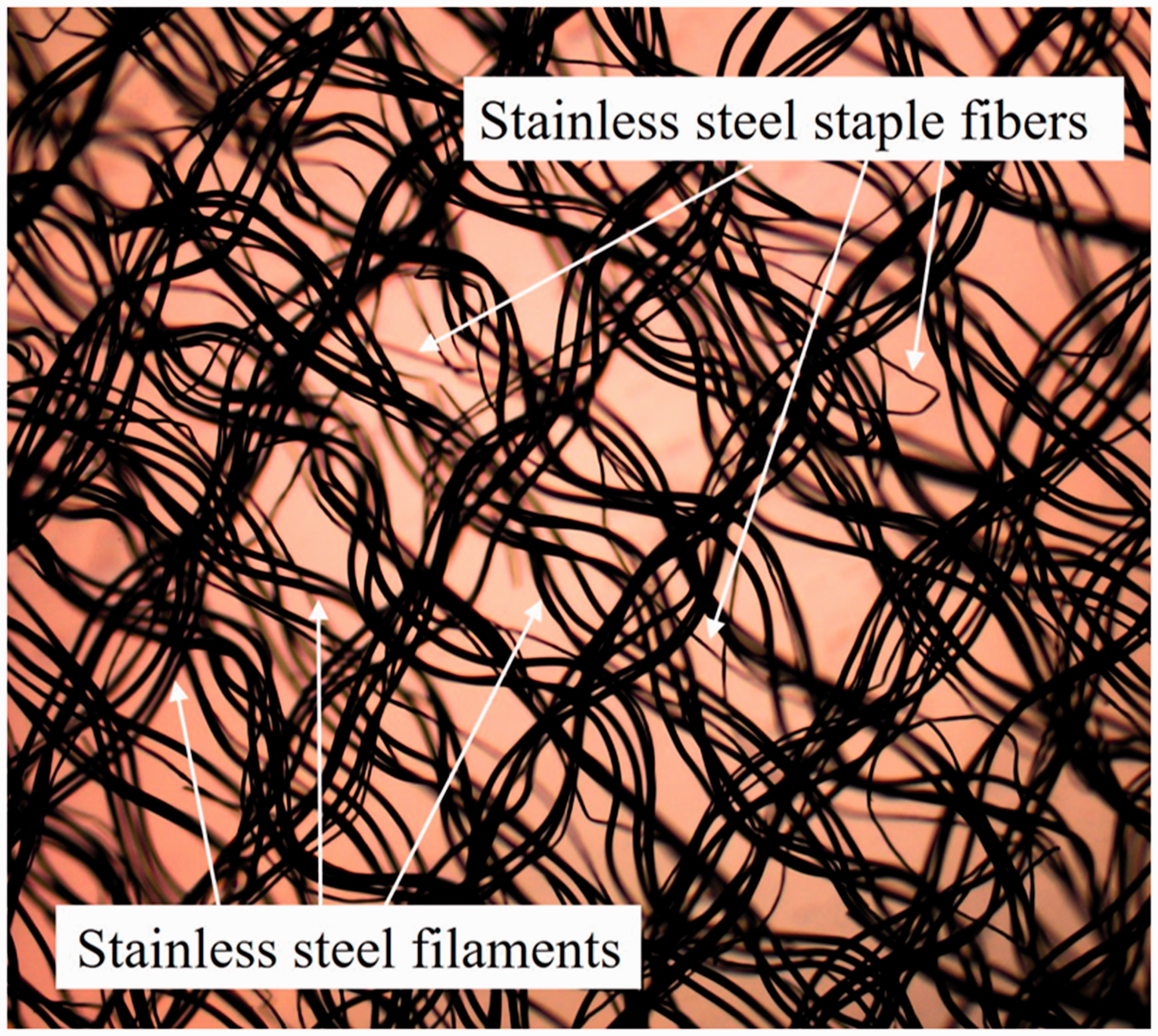
Surface morphology and EDS analysis
Figure 4 shows the SEM images of fabric surface. Figure 4(a) is the surface morphology of the fabric without coating, and Figure 4(b) shows the hybrid fabric surface coated by Ni film. By comparing the two pictures, we can see that the surface of the fabric coated by Ni is covered by a dense, uniform metal film.
SEM images of fabrics: (a) fabric without coating; and (b) hybrid fabric.
Relying on energy spectrum analysis, we studied the elemental changes of the fabric surface before and after coating (shown in Figure 5). Figure 5 illustrates that the content of Ni on the fabric surface increased remarkably from 2.51% to 99.33%, and the total content of oxygen and carbon decreased from 81.5% to 0.67% after coating. This indicated that the Ni film covered firmly on the fabric surface by the magnetic filtration cathodic vacuum arc deposition technology. It should lead to the improvement of the hybrid fabric’s conductivity and permeability.
EDS lines of fabrics: (a) uncoated fabrics’ EDS line; (b) hybrid fabrics’ EDS line.
Electrical conductivity
Testing results of the fabrics resistivity.

Permeability analysis
Figure 6 shows the hysteresis loops of the fabrics. Because both stainless steel staple fibers and Ni have good ferromagnetism, the hysteresis loops of the fabrics present typical ferromagnetism curves. The slope of the curve represents the level of permeability [27]. The higher the slope of the curve is, the better the permeability of the fabric would be. It can be seen that the fabrics’ permeability was improved as the stainless steel staple fibers content and the coating thickness increased. This is because the stainless steel staple fibers and Ni film have excellent magnetic property. The experiment was repeated three times and the average value of the testing results was obtained for plotting hysteresis loop. The standard error of the results is 2.36 × 10⁻⁴ A/m.
Fabrics’ hysteresis loop. (a) Group a, (b) group b, (c) group c.
SE of the fabrics
Figure 7 shows the testing results of the fabrics’ SE. It can be seen from Figure 7(a) that the uncoated fabric No. 1 without wires has hardly any shielding performance. In the frequency range of 300 kHz–3 GHz, the SE of fabrics Nos. 2 and 5 is 8.70 dB–51.63 dB. The uncoated fabrics with stainless steel staple fibers exhibit higher SE; the fabric’s SE is enhanced with the stainless steel staple fibers content increasing. As mentioned above, the metal contact points and conductive meshes in the fabrics can influence the fabric’s SE. The increase of stainless steel staple fibers content in the fabrics is contributed to forming more contact points and conductive meshes, which leads to the increase of SE.
Shielding effectiveness curves. (a) Group a, (b) group b, (c) group c.
For the coated fabric at the same stainless steel staple fibers content, the SE of fabrics is enhanced with the coating thickness increasing. In the frequency range of 300 kHz–3 GHz, the SE of fabrics group b is 8.70 dB–52.68 dB (Figure 7(b)), and the SE of fabrics group c is 11.11 dB–57.90 dB (Figure 7(c)). Under the same stainless steel staple fibers content condition, the SE of coated fabrics can be increased up to 12.14% compared to that of the uncoated fabrics. As we know, Ni film interacts with the metal grid structure to form electric current path, which can contribute to electromagnetic absorption and reflection. The conductivity of the electric current path will be improved as the Ni film gets thicker, leading to the improving of fabrics’ SE.
In addition, around the frequency of 0.75 GHz and 2.25 GHz, the fabrics’ SE curves show sharp downward trend to the lowest peak. Actually, there is cut-off frequency in the metal grid-structure fabrics, which is related to the diameter of the conductive mesh. When the testing frequency coincides with the cut-off frequency, the electromagnetic wave can easily pass through the conductive mesh, thereby leading to the decrease of SE.
Consequently, the shielding capacity is dependent not only on the conductive Ni film, but also on the space-structure of the hybrid fabric. The space-structure in the hybrid fabric can consume the microwave energy by dielectric loss, and more importantly, the conductive grids can induce multiple reflections of electromagnetic microwaves, thus significantly promoting the SE.
Conclusions
In this paper, a novel approach of space-structure-fabrication and film-deposition was introduced for enhancing the hybrid fabrics’ EMI shielding. Research results indicated that the space-structure meshes in fabric can form metal contact points and conductive meshes, and Ni film on the fabric’s surface could help forming electric current path, both of which are contributed to electromagnetic absorption and reflection. Through comparative study, we can find that film coating can improve the fabrics’ SE up to 12.14% under the same stainless steel staple fibers content condition. Therefore, adopting the novel approach is an effective strategy for improving the SE of fabrics.
Footnotes
Declaration of conflicting interests
The author(s) declared no potential conflicts of interest with respect to the research, authorship, and/or publication of this article.
Funding
The author(s) disclosed receipt of the following financial support for the research, authorship, and/or publication of this article: This work was financially supported by the Fundamental Research Funds for the Central Universities (grant number XDJK2017D043).