




Abstract
As a consequence of modern life and technology, noise causes many negative side effects, especially with regard to health. Today, the presence of acoustic problems in transport vehicles such as airplanes, cars and train wagons has become one of the major problems of modern life. Many methods and materials have been developed to provide acoustic comfort in indoor spaces. One of them is the development and application of sound-absorbing materials. Nonwoven webs, which are considered to be the most ideal materials for sound insulation, have micron-sized pores as well as large surface areas. Among these materials, materials with double-layered porosity have greater effect. In recent years, researchers are increasingly turning to the development of sound-absorbing materials from production waste and natural materials that are easily decomposed in the environment. In this study, the sound-absorbing properties of nonwoven webs produced from chicken feather fibers, a by-product in chicken production and a significant amount of waste, were investigated. For this purpose, nonwoven web samples with different parameters were produced by using different binding materials by using thermal bonding method. The sound absorption coefficient and sound transmission loss values of the samples were measured and evaluated. As a result of the analyses, the influence parameters such as thickness, bulk density and porosity on the sound insulation properties of the produced samples was revealed. The assumptions concerning the mechanism of sound insulation of nonwoven webs produced from chicken feather fibers are detailed. Studies have shown that nonwoven webs from chicken feather fibers can be used as soundproof materials because of their good sound-absorbing properties.
Keywords
Introduction
As a consequence of modern life and technology, noise causes many negative side effects, especially with regard to health. Accordingly, fighting against noise is becoming increasingly important. Nowadays, the presence of acoustic problems in transport vehicles such as airplanes, cars and train wagons has become one of the major problems of modern life. Many methods and materials have been developed to provide acoustic comfort in indoor spaces. One of them is the development and application of sound-absorbing materials.
By ‘sound absorption’, it is understood that spreading of sound in any environment, or sound waves are transformed into other energy types, i.e. usually thermal energy during the falling of two different environment boundaries. In materials that have an increased ability to convert the energy of sound waves into other forms of energy, when forming a boundary with the air environment, sound absorption is especially pronounced. Such materials are called sound absorbers or sound-absorbing materials. Materials with high sound absorption properties appear as a combination of opposite structural features. In other words, porous materials, which are a mixture of air and solid, have high sound-absorbing capabilities [1]. The sound absorption properties of these materials are determined by the structural parameters such as density, porosity and surface area of pores.
Nowadays, mineral and polymeric natural and synthetic materials are used as raw materials for sound-absorbing materials. Among these materials, the raw material of the fibrous structure is increasingly being used. This is due to the lightness and low cost of fibrous materials and their high sound absorption properties, which are due to the presence of air gaps between the fibers in the form of many open pores [2]. The sound-absorbing properties of porous fibrous materials are based on the expenditure of energy of sound waves on the vibration and friction of fibers and air between fibers [3].
Nonwoven webs have a special place among the sound-absorbing materials due to their fibrous structure. The sound absorptive properties of nonwoven web have been studied by many researchers. The number of researches carried out in this field is increasing every year after Zwikker and Kosten [3].
Nonwoven webs, which are considered to be the most ideal materials for sound insulation materials, have micron-sized pores as well as large surface areas. Irregular placement of fibers in the materials increases the efficiency of sound absorption and at the same time, enables the homogenization of this absorption. The most important advantage of the nonwoven web is thatit is structurally lighter and technologically less expensive than woven and knitted fabrics. In recent years, the use of nonwoven webs with different contents for the purpose of sound insulation has become widespread, and acoustic ceilings, protective barriers and other sound insulating web are produced from these materials.
Fibrous materials, including the nonwovens, are natural, artificial and synthetic based and have mineral or polymeric content [4]. The common examples of sound-absorbing materials that are produced from natural fibers with mineral content are glass and stone wool. Insulating materials produced from these fibers have widespread use because of their low cost and high insulation properties. These materials, which have high sound-absorbing properties at medium and high frequencies, also have significant drawbacks. They are not resistant to water and chemicals, dangerous to human health, since they can cause skin erosion, and lead to severe consequences by inhalation particles of these fibers, if they are distributed in the air [5]. For these reasons, the materials should not be left open when they are used. This negatively affects their insulation properties [6]. On the other hand, these materials are thick enough and have low structural strength [7].
Recently, the use of polymer-based materials as sound insulation materials has become widespread. The main reason for this is the fact that these materials are lighter in weight when compared to conventional porous sound insulation materials which are made of stone, glass and wool, do not deteriorate during use, do not harm people's health, have low toxicity and controlled properties. The investigations reveal that it is possible to effectively utilize various combinations of synthetic materials in sound insulation [8]. However, synthetic materials are more expensive than conventional materials and are more disadvantageous in terms of decomposition in nature. Accordingly, in recent years, researchers are increasingly turning to the development of sound-absorbing materials from production waste and natural materials that are easily decomposed in the environment.
Production wastes are important in terms of environmental clean-up and low cost of sound-absorbing materials. In this respect, the re-processing of textile production waste and recycled materials yields good results [9–11]. Studies are also being carried out on the development of sound-absorbing materials from various scrap and waste [12,13].
Natural materials have many advantages when compared to traditional materials and are less harmful to the environment [14]. In recent years, development of sound absorbing materials by using materials such as banana and flax fibers [14,15], tea wastes [16], coconut husk fibers [17], palm fibers [18], palm tree fibers [19], bamboo fibers [20], kenaf [21], straw [22,23], tree [24], rice husk [25], rice straw [26] has revealed that these materials are good alternative to both conventional and synthetic sound-absorbing materials. It has also been shown that sound absorption ability of the materials increases because of the increase in the proportion of natural fibers in the blends produced in the production of nonwoven web from synthetic fibers [8,26].
In this study, the sound-absorbing properties of nonwoven web product from chicken feathers fibers were studied. Chicken feathers, being natural materials, are obtained as a by-product in the production of chicken meat and a large part is in a state of waste.
Production of nonwoven web from chicken feather fibers
It is not possible to produce nonwoven web from chicken feathers which do not have a homogeneous and fibrous structure. However, it is possible to produce a nonwoven web of fibrous material obtained by cutting barbs from the rachis of a chicken feather. This material is referred to as chicken feather fibers. Figure 1 shows a schematic view of the structure of bird feathers.
Structure of bird feather (Encyclopedia Britannica) [41].
Some properties of chicken feather fibers have been investigated. There are studies about this topic in the literature [27–30]. The investigations revealed that the chicken feather fibers are similar to the feather: there is a rachis in the middle part of the barbs called and small part is branched from this rachis. The length of the fibers varies from 0.5 to 3.5 cm depending on the location of the feathers on the chicken body.
Despite the fact that in the literature there are studies confirming the expediency of the regain of chicken feathers in the form of fibers, to date, these fibers are not applied on an industrial scale and in a structurally homogenized form.
Studies have shown that chicken feather fibers have a microporous internal structure [31]. Figure 2 shows the SEM images of the cross-section of the fibers we obtained from chicken feathers. Thanks to this structure, these fibers become a valuable raw material for soundproof materials. The presence of porosity within the fibers ensures that the nonwoven webs obtained from these fibers will have macro and micropores. This means there is more energy loss in the transmission of sound.
General and cuticle SEM images of chicken feather fibers.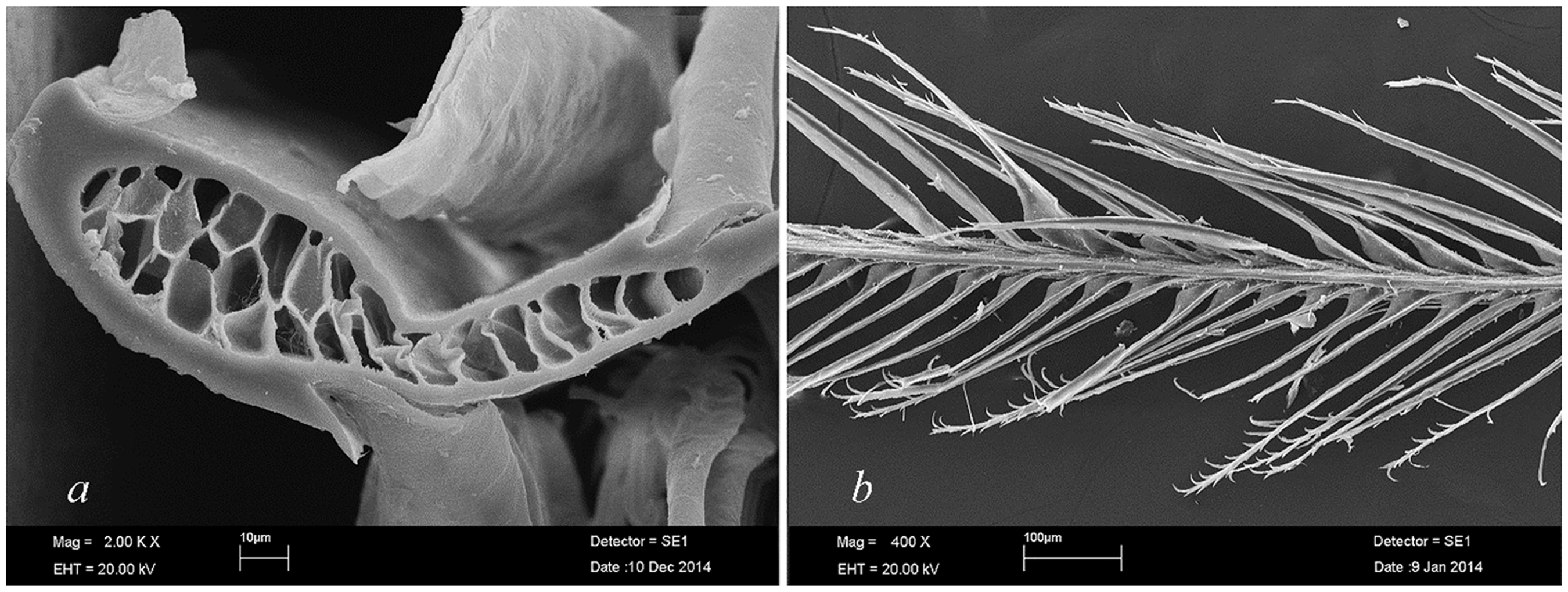
According to a study on nonwoven web made from fibers of different thicknesses, nonwoven web made primarily of thin and irregularly arranged fibers absorb sound better [32]. The very fine structure of chicken fibers (the thickness of the fibers is 5 to 50 µm) also makes them suitable for sound insulation.
Studies have shown that there is a positive linear relationship between the sound-absorbing properties of the material and the surface area of the fibers [33]. It is argued that fibers with a serrated cross-section absorb sound better than fibers with a rounded section. Since the fibers of the chicken feather are arranged in the form of a tiny feather, the surface area of the fibers is large enough, and in this respect, they are also a suitable raw material for soundproofing (Figure 2(b)).
Researchers have shown that double-ply porous materials have better sound absorbing properties. Especially microporous materials exhibit higher absorption ability in the wider sound diapozone [34–36]. From this point of view, the insulation materials produced from these fibers should have high sound-absorbing properties as the chicken feathers have a microporous internal structure.
In the literature, there are not so many studies on the production of nonwoven web from the fibers of bird feathers. In one study, a filter was developed in the form of a nonwoven web of duck feather fibers by thermal bonding for use in wastewater treatment [37]. There have been some studies on the use of chicken feather fibers in the production of nonwoven web. In these studies, the fibers of chicken feathers were used as a mixture with other fibers [38,39].
Experimental
Material
Chicken feathers obtained from ‘Tad Piliç’ company in Gaziantep in Turkey were used. The feathers obtained from the company were washed, disinfected and dried in the laboratory. The fibers were produced from the dried feathers using a special machine.
Method
Formation of nonwoven web from chicken feather fibers
The production of nonwoven web from the chicken feather fibers is carried out in two stages: the formation and the fixing of the fibers web. To form a homogeneous structure of the chicken feather fibers, we used a vacuum molding device which was developed by N. Pasayev (Figure 3(a) and (b)).
Vacuum molding device.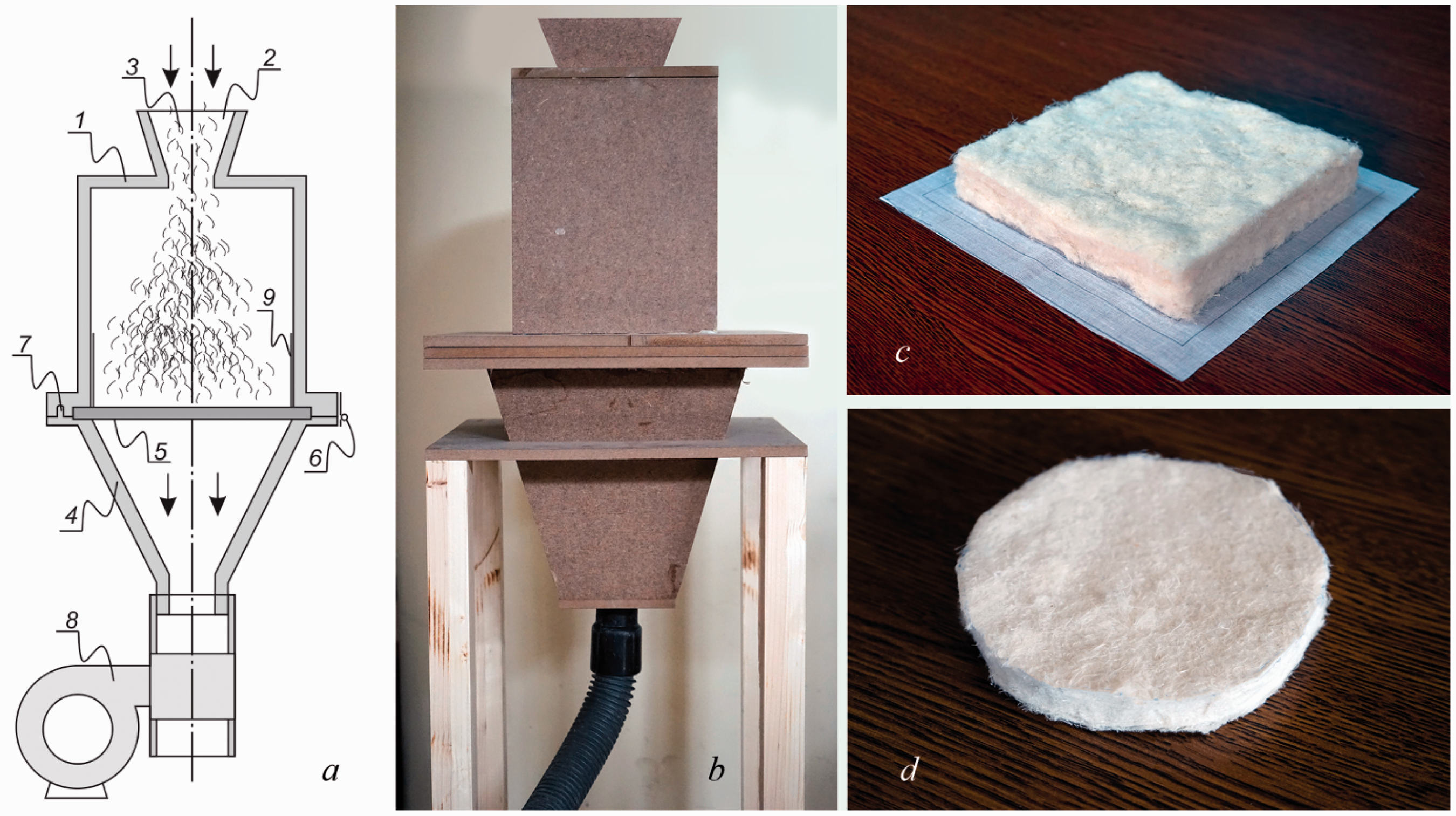
Figure 3 shows the vacuum molding device for web forming and laying. It consists of three parts: top part is 1, bottom part is 4 and part 5 on which the fibers are laid. Number 5 consists of a metallic mesh with holes 0.5 × 0.5 mm. Part 1 is connected to 4 through 6 and it can be opened and closed. After the part 5 is placed in the hollow over part 4, part 1 is closed and locked with part 7. Fibers are loaded through ‘3’ and the inlet ‘2’ of the upper part. Being extremely light, they are laid on the grid 11 of part 5 sucked by a vacuum pump 8. A high vacuum is provided, since the remaining voids are filled with vacuum suction. The height of the laid web is determined using a ruler 9 glued to the inside of the section 1.
Figure 3(c) shows the image of the laid web using this device.
Production of nonwoven web from chicken feather fibers
Some properties of selected binder polymers.

The thermal bonding method has different shapes depending on the application method of heat. We used the contact method in experiments. After the powdered polymer was blended with the fiber material, texture was formed by air laid method (Figure 3(c)). In the next step, samples were put in the hot press in specially prepared molds. The inside dimensions of the molds are (16 × 16) cm, pressing was made up to 5 mm thickness. The purpose of pressing the samples into such a mold is to fix the pressing pressure and to produce samples with different porosities by keeping the produced sample thickness constant.
The pressing time was determined according to the melting temperature of the binder polymer used. A data logger, which measures and records temperature, was used to check the internal temperature of the samples during pressing. A thermocouple which is in the form of a wire was placed in the mass of the fiber and the press was operated. The temperature displayed on the data logger screen was observed, the time of reaching the melting temperature of the polymer was recorded as the fixation time. The sample taken from the hot press zone was cooled in the cooling system at the bottom of the press and then allowed to rest for 48 h under normal ambient conditions. Then, the samples were removed from the mold and the samples were placed in locked sample bags. Three replicates were produced from each sample.
Production of samples for experimental studies
Experimental factors, variation intervals and levels.

LDPE: low-density polyethylene; EVA: ethylenevinylacetate.
Experimental plan and codes of samples with natural values.

LDPE: low-density polyethylene; EVA: ethylenevinylacetate.
The samples were produced according to the test plan given in Table 3 and coded according to the numbers in the test plan. The produced samples were rested in the test cabin under normal ambient conditions for 48 h, and then the thickness and weight were measured, and surface weight, volumetric weight and porosity were calculated. The surface weight of the material A
s
is calculated as the weight of the unit area of the material.

The volumetric weight of the material, A
v
is calculated as the weight of the unit volume
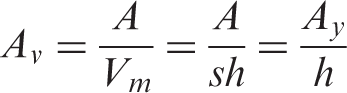
In this expression, V m – the volume of the material, h – thickness.
The volumetric weight differs from the specific gravity and takes into account the volume of the material with the pores.
The porosity of the material is calculated according to nominal weight A
d
and volumetric weight

The specific weight of chicken feather fibers is 800 kg/m³ [29].
Samples for testing with a diameter of 100 mm and 30 mm were cut from the samples produced. The cut out samples were placed in a test cabin with normal conditions before testing.
Measurement of the sound absorption parameters of the produced samples
The sound absorption coefficient and loss of sound transmission of the prepared samples were measured. The measurements were carried out in accordance with ISO 10534-2 standard with BSWA IMPEDANCE TUBE SYSTEM SW422 + SW477. Samples were measured in one, two, and three layers to see how the sound absorption coefficient and transmission loss of sound vary depending on the thickness of the sample.
Results and discussion
Some parameters of the produced samples.

LDPE: low-density polyethylene; EVA: ethylenevinylacetate.
Nonwoven web samples produced from chicken feather fibers are double porous materials. Double porosity materials contain two pore networks, the characteristic sizes of which are separated at least by an order of magnitude [40]. Here, the internal structure of the chicken feather fibers constitutes the primary porous structure (Figure 2(a)). This porous structure consists of cells of 2–10 µm in size. The secondary structure is a porous nonwoven web formed from these fibers. Chicken feather fibers in structure resemble feathers. That is, here also in the middle there is a spine, which we call a chicken feather fiber, and from it branch more short fibrils with even smaller denticles (Figure 2(b)). These fibrils with denticles do not allow the fibers to be laid tightly to each other, thereby providing the formation of air gaps between the fibers in the form of pores in the structure of the nonwoven web. SEM images of the internal structure of the nonwoven web are shown in Figure 4. The black stains marked in Figure 4(a) are glue particles. When increase the number of these particles, in other words, increasing the amount of binder polymer used in the production of nonwoven web, the volumetric density increase. This adversely affects the sound absorption properties of the material. Sound insulation mechanism of nonwoven web produced from chicken feather fibers which have a double porosity can be explained as follows. Some of the sound waves which hits to the web return from the web and some go into the material. When the density of insulating material is high, the density of waves rotating from the web is quite high. The waves in materials move the air in the spaces between the fibers and consume the significiant part of energy for it. Air moves in fiber walls by friction, so some of the energy is consumed in to the thermal events that occur there and re-supply the lost energy from the sound waves. Some of the waves in the material strike the fibers and glue particles, so spend their energy for these thermal events and a small part of them returns to the medium where the sound source is from the materials’ pores. When the waves which hits the fibers of the material is thinner and more elastic, more energy can be lost. Here, it is important that the fibers are hollow. Waves that strike to fibers which have no pores, only give part of the energy to these fibers. When a part of the waves which strikes the hollow fibers coincide the end portions of the fibers, it entries inside of the fibers. If the fiber is open-ended and inside of it is hollow, thermal events which is emerged in the nonwoven material, occur in here in micro level.
SEM images of the internal structure of nonwoven samples.
Statistical test results which was applied to acoustical values of samples.

Each sample was tested as single layer, double layer, triple layer to see how the sound insulation parameters change depending on the thickness of the material. Figures 5 to 12 show the graphs reflecting the dependence of the sound absorption coefficient of the samples on the frequency of sound, which are based on measurements.
Sound absorption coefficient curves of samples produced using 10 g fiber and 3 g binder polymer.
In these graphs, the samples are grouped according to the amount of fiber and binder polymer. The sound absorption curves of samples created with EVA are given by continuous lines, the sound absorption curves of samples obtained using LDPE are given by dashed lines. In each figure, the absorption curves of sample which are one, two and three layer thickness are differentiated.
When we examine the curves in Figures 5 to 8, the first thing to notice is that all of the samples of the have good absorption ability at medium and high frequencies. This is due to the very fine structure of the fibers, large surface area and the double porosity of the materials produced from these fibers.
It was noted that in all variants with an increase in the thickness of the samples, the curve of the absorption coefficient shifts to the left, that is, toward low frequencies along the frequency scale of sound. This suggests that as the material thickness increases, the frequency range of sound absorption expands toward the low-frequency region. As can be seen from the graphs in Figures 7 and 8, the lower limit of this range can drop to 200 Hz with an increase in the sample thickness by three times. Accordingly, from the graphs in Figures 9 to 13 one can note the ascending transmission loss in of sound with increase thickness of the samples.
Sound absorption coefficient curves of samples produced using 10 g fiber and 5 g binder polymer. Sound absorption coefficient curves of samples produced using 20gr fiber and 6gr binder polymer. Sound absorption coefficient curves of samples produced using 20 g fiber and 10 g binder polymer. Curves of loss of sound transmission of samples produced by using 10 g fiber and 3 g binder polymer.


As seen from the graphs, the binding polymer has a definite meaning in terms of sound absorption. Thus, the use of LDPE as a binder at low values of the bulk density of the material results in a shift in the sound absorption curve towards the low-frequency region of the spectrum. This effect changes in the opposite direction with increasing volumetric density. However, it can be said that the use of LDPE causes a little increase in the sound absorption coefficient throughout the frequency scale, which is especially seen in materials with a lower volumetric density. Therefore, it can be concluded that the choice between these two polymers is a matter of preference. LDPE and lighter in weight, and cheaper, but its melting temperature is 40℃ higher than that of EVA. This means that the use of LDPE will lead to increased energy costs.
Increasing the amount of fiber in the samples did not significantly affect the porosity values, but the thickness of the samples increased slightly. Therefore, the sound absorption coefficient curve is shifted towards the low frequency range. An increase in the amount of the binder polymer results in the sound absorption coefficient falling and the curves of sound absorption coefficient shifting towards the high-frequency region.
However, low values of the amount of binder polymer are not good in terms of stability of the resulting nonwoven web, and the amount of binder polymer is required to be optimal in terms of the sound absorption coefficient and the stability of the material construction.
In Figures 9 to 12, change graphs of sound transmission values of same samples according to sound frequency are given.
As can be seen from the graphs, sound transmission loss values of samples increases along the whole frequency scale when the thickness of the material increases. This is due to the increase the sound absorption values of the samples. As the sample thickness increased, the curve loss of sound transmission is increased further at medium and high frequencies. In other words, the increase in material thickness has improved the loss of sound transmission values.
As can be seen from the graphs, sound transmission loss values of samples which have different densities are not same. For example, when the thickness increases, the sound transmission loss values increase along the whole frequency scale. This is due to the increase in the sound absorption values of the samples at considerable levels.
As the thickness of the samples increases, the sound transmission loss curves shift up, especially in the middle and high frequency regions. In other words, when the thickness of the material increases, the sound transmission loss during increases.
The binding polymer is important not only in terms of sound absorption, but also in terms of loss in sound transmission. Both in terms of the sound absorption coefficient and loss of sound transmission, in production of sound insulation materials with a low bulk density value, the choice of LDPE gives better results (Figure 9). However, with increasing bulk density of the material, EVA is more preferable (Figures 10 to 12).
Curves of loss of sound transmission of samples produced by using 10 g fiber and 5 g binder polymer. Curves of loss of sound transmission of samples produced by using 20 g fiber and 6 g binder polymer. Curves of loss of sound transmission of samples produced by using 20 g fiber and 10 g binder polymer.


Conclusion
Experimental studies have shown that nonwoven structures obtained from chicken feather fibers, which is a by-product and in the most part a waste product in the production of chicken, have high sound absorption properties. Chicken feather fibers are a natural porous material with a microporous internal structure. This material looks like double-ply porous materials. Studies have shown that nonwoven web made from chicken feather fibers are an alternative material with high sound absorption properties that is not a hazard to human health, has a light weight and low economic value compared to mineral and synthetic soundproof materials.
At the end of the experimental studies, sound absorption and sound insulation properties of nonwoven web produced from chicken feather fibers are significantly dependent on the thickness of the material. As the thickness increases, the characteristics of the samples such as sound absorption coefficient and sound transmission loss are improved. As it is known, nonwoven web is not a good sound isolator at low frequencies [40]. However, thanks to the double porous structure, it was possible to obtain material which has an approximately 37 mm thickness with a sound absorption coefficient of 0.7 at a frequency of 200 Hz.
The volumetric density of the nonwoven materials, that is the porosity of material effects the sound absorption coefficient and sound transmission. There is a negative dependence between the porosity value and the volumetric density of the material and the volumetric density varies more than the porosity. The increase in density leads to a decrease in the porosity value and consequently a decrease in the sound absorption coefficient. So, the sound insulation is mainly due to loss of sound transmission. At lower densities, the sound absorption coefficient increases and the sound insulation is achieved by sound absorption. The increase in volumetric density of the material caused the curve of the sound absorption coefficient to go towards lower frequencies. It means that as the volumetric density of the insulation material increases, the sound absorption coefficient of the material increases slightly at high frequencies, but it rises at low frequencies.
As a result of the studies, it has been found that the binder polymer used in forming the nonwoven web is also important for sound insulation. So, use of LDPE which is the binding polymer with a lower molecular weight has caused a little increase throughout the frequency scale and this is seen especially seen in materials with a lower volumetric density.
Footnotes
Declaration of conflicting interests
The author(s) declared no potential conflicts of interest with respect to the research, authorship, and/or publication of this article.
Funding
The author(s) disclosed receipt of the following financial support for the research, authorship, and/or publication of this article: This study was supported by The Scientific and Technological Research Council of Turkey (TÜBİTAK) with 115M725 numbered researching project.