




Abstract
This study attempts to investigate the influence of the inlay-yarn insertion density into a knitted structure and of the area of a rigid element integrated into a knitted orthopaedic support on a compression generated by the support. The samples were made on a flat double needle-bed knitting machine with a laid-in structure knitted on a rib 1 × 1 pattern base, differing in the inlay-yarn insertion density. In general, research studies analyse compression and other properties of compressive stockings and do not investigate the influence of non-textile parts usually used in the knitted orthopaedic support. It was established that the linear density of the inlay-yarn has a visible influence on the compression generated by knitted support when inlay-yarn insertion density is every other course and less. When inlay-yarn is inserted into every course, the generated compression is the highest and the influence of inlay-yarn linear density on the generated compression is significant. It was found that compression of the support increases depending on the area of the rigid element in the knitted support. The rate of influence of the rigid area on compression rises with an increase in the inlay-yarn insertion density and in the elongation value. By designing a knitted compressive orthopaedic support, it is necessary to find an optimal ratio between an inlay-yarn insertion density and an area of a rigid element, thereby achieving the best compressive, wear comfort and economical result.
Keywords
Introduction
Medical textile is one of the most important areas of functional textiles because it is related to human health. The use of compression textile products for medical purposes has significantly increased since 1970. Originally, these products have been used to exert pressure for the treatment of scars as a result of burns, and for the treatment of post-surgical conditions. Recent medical compression garments are individually designed and manufactured for particular part of the body, such as stocking, gloves, sleeves, face masks and body suits. Knitted orthopaedic supports are one type of medical textile products assigned to compression garments. The level of compression is governed by the garment size as well as the ability of fabric stretching. Fabric for compression garments is usually designed with a stretchable structure and contains elastomeric yarns to achieve highly stretchable and appropriate compression [1,2].
Knitted orthopaedic supports generally are divided into three groups: preventive supports, functional supports and post-operative/rehabilitative supports. The main differences between these supports are the compression size and consolidation strength. A physician prescribes the compression class for compression stocking corresponding to the pathology of the patient. According to the German Standard RAL–GZ–387/1:2008, four compression classes are used: light compression class 1 (18–21 mmHg) or 2 (23–32 mmHg), strong compression is class 3 (34–46 mmHg) or 4 (>49 mmHg) depending on the used norm. Unfortunately, the compression requirements for orthopaedic supports are not standardised to date [3].
A fabric used to make compression garments is produced by knitting at least two types of yarn together: a ground yarn, ensuring thickness and stiffness of knitted fabric, and an inlay-yarn, generating compression. Inlay-yarns are produced by wrapping polyamide or cotton yarns around a stretchable core such as latex or polyurethane (PU). The wrapping can be adjusted to vary the tensility and strength of the yarn. The elastomeric inlay-yarn can be inlayed, floated or plated into a knitted structure. Higher levels of compression are mainly achieved by increasing thickness of the elastic core of the inlay-yarn, although adjustments may also be made to the ground yarn [4,5].
The weft inlay-yarns can be introduced in each course or in certain courses according to a pattern. The presence of these yarns increases fabric strength and fabric compactness. Such structures with elastomeric inserted yarns are used for the stockings welt and for medical products – orthopaedic stockings and supports [3,6]. The compression level is defined by inlay-yarn properties, which are directly related to the modulus of elastic core yarn and the covering parameters. However, there is still a lack of data of the influence of inlay-yarn insertion density into the knit on the compression level and to this question must be given an appropriate attention.
Mechanical behaviour of a covered elastomeric yarn, which is the main component of elastic orthopaedic knits, has been investigated by several authors. The structure analysis shows that properties of the inlay-yarns reflect significantly the global behaviour of the fabric. Therefore, by characterizing the elastic properties of the inlay-yarn, it is possible to predict the mechanical behaviour of the compression knit [3,7–9].
Elastic knitted orthopaedic supports are available in many forms. Commonly such supports are composed of soft, elastic material so that when worn, they provide a certain amount of support for an injured joint [10]. The supports can be produced by cutting out suitable blanks from planar, more or less elastic knitted fabric, foam materials, e.g. neoprene, etc. The main disadvantage of this is that an exact anatomical fit of the bandages can be achieved with difficulty, and a large number of connecting points, such as seams, are created. Such connecting points partially alter the properties of material used, e.g. its elastic properties and adaptability, and this poses in particular the risk of pressure points or chafing points of the skin. Another possible way of producing orthopaedic supports is shaped knitting on a flat or circular knitting machine [11–13]. The benefits of flat knitted supports are as follows: (a) the anatomical shapes guarantee perfect fitting; (b) the supporting and compressing effect due to the stretch construction; (c) the integration of viscous-elastic profiles or pads for stabilization, support and massage effects improve blood circulation and absorption of haematomas and oedemas [13].
Mostly, a combined knitting pattern is used for the manufacture of orthopaedic products. Alternating compression in the length of the product can be achieved by changing the knitting density and/or by changing the tension of a core spun elastomeric yarn. Compression of a support depends on the support area, shape and characteristics of knitting [12].
Mechanical properties of weft-knitted fabrics are strongly related to the fabric structure, yarn properties and fabric direction. The ways how textile materials stretch under applied stresses play an important role in their processing and end-use. Many studies have been made on stretchability of knitted fabrics [14–16].
Knitted orthopaedic supports often are made from an anatomically shaped knitted fabric with some additional inserts. Such a support without knitted frame often has added silicone, metallic or other parts. Orthopaedic supports may also comprise other components, such as straps, fasteners, including disengageable two-part fastener system, such as Velcro (i.e. the brand name of the first commercially marketed fabric hook-and-loop fastener) or similar hook-and-loop type fasteners for engaging the support with the body [17,18]. All parts included into support can change elasticity of entire product.
The aim of this study was to investigate the influence of the inlay-yarn total amount used and insertion density into a knitted structure, and of area of a rigid element integrated into a knitted orthopaedic support, on a compression generated by the support.
Originality of this study lies in analysis and evaluation of compression of knits used for orthopaedic supports depending on an inner structure, especially on elastomeric inlay-yarn amount and insertion density in the knitted structure, as well as depending on overall construction of a knitted orthopaedic support.
Materials and methods
Experimental samples were manufactured on a flat double needle-bed 14E gauge knitting machine CMS 340TC-L (f. STOLL, Germany) in a laid-in pattern in basis of rib 1 × 1 pattern with elastomeric inlay-yarns inserted into the knitted structure with a different density (Figure 1). The main characteristics of the tested knitted fabrics and the used yarns are given in Table 1.
Pattern of investigated knitted fabrics: (a) structure (H is the high of the pattern repeat, R is the width of the pattern repeat); (b) surface view (PM_1_1, PM_1_2, PM_1_4). Characteristics of knits tested.

For elastomeric inlay-yarns, two types of elastomeric core yarns were used considering to their linear density and raw material of covering yarns. It should be noted that linear density of elastomeric covered yarn is not the arithmetical sum of linear densities of core yarn and covering yarns because the covering yarns are not parallel to the core yarn, but twine around the core yarns with certain twist level. The measurements of knitted samples were 20.5 × 20.5 cm, and the surface area of each sample was equal to 0.042 m2.
The linear density of elastomeric yarns was estimated according to Standard D 2591–01. Five segments of yarns, approx. 1300 mm length, were cut from each package, taking them at irregular intervals of at least 2 m. The specimens, without tension, were preconditioned on a specimen board in the standard atmosphere for textiles testing (LST EN ISO 139:2005) for a minimum of 4 h. One end of the conditioned specimen was fastened in the top clamp and the tension weight (∼1.0 cN/tex) was attached to the opposite end. After approx. 5 s, the bottom clamp was closed. The specimen of elastomeric yarn was cut centrally in the bottom slot and then in the top slot. The actual length of the specimen after cutting is 1 m ± 1 mm. Last of all, the specimen was weighted and the linear density of elastomeric yarn specimen was calculated according to the formula

Average linear density with 1 tex accuracy was calculated from 10 elementary tests. Coefficient of variation of all tested yarns was less than 3%.
The tensile behaviour of the knitted fabric tested was evaluated using universal testing machine ZWICK/Z005 according to Standard LST EN ISO 13934–1:2000. The distance between clamps was 100 mm; tensile speed – 100 mm/min; pretension – 2 N. Knitted samples were strained till 10% and 20% fixed extension. Such extension percentages are chosen because knitted supports often are stressed perpendicularly to their surface and undergone such stresses extended in various directions. In the middle of the knitted sample surface, parallel to courses of the knitted sample, square rigid element was sewn (using covering chain stitches) to investigate the influence of the rigid element area on the knit elasticity. Samples were tested in five groups: (1) without the rigid element; (2) the rigid element occupies 10% of the total area of the support area; (3) the rigid element occupies 15% of the total support area; (4) the rigid element occupies 20% of the total support area; (5) the rigid element occupies 25% of the total support area. Five tensile tests were performed in each case. The rigid linen with 130 dm−1 density of warps (101 Tex) and 110 dm−1 density of wefts (94 Tex) was used to imitate the rigid element. The rigidity of the rigid element used is very high. For instance, at 45 N tensile force, the rigid element extents just at 3% (see Figure 2), while the knitted orthopaedic support at such tensile force extents approx. 50%. Compression of the knitted samples tested is calculated by the Laplace formula [12]
Force-strain curve of the rigid element tensile test.

All experiments were carried out in a standard atmosphere for testing according to Standard LST EN ISO 139:2005. Structure parameters of knitted samples were analysed according to British Standard BS 5441:1998.
Results and discussions
In order to analyse the influence of the inlay-yarn’s insertion density and relative area of the rigid element on the compression properties of knitted orthopaedic supports, research of tensile properties was carried out with two groups of elastic double covered inlay-yarns laid in the knit in four different variants (as presented in Table 1 and Figure 1). Five variants of samples, depending on the area occupied by the rigid element (0%, 10%, 15%, 20%, 25% relative area), were used in this experiment. Values of the tensile force measured are presented in Figure 3.
Influence of inlay-yarn insertion density and relative area of rigid element S on tensile force F of knitted orthopaedic support at fixed extension ɛ value – 10% and 20% (samples notation as in Table 1).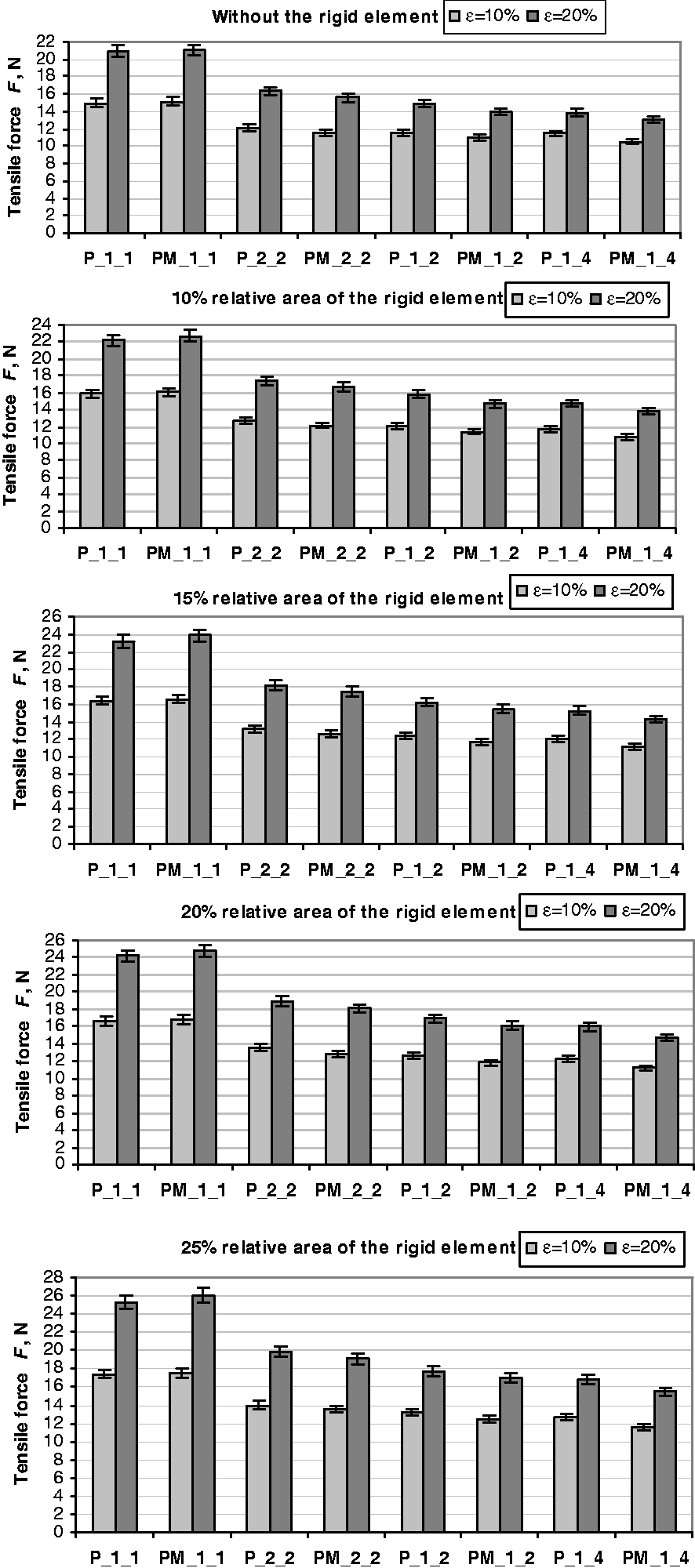
The tensile force was measured at 10% and 20% fixed extension of the samples. Such values of the extension usually are used in orthopaedic supports. The coefficient of variation of the tensile force measurements did not exceed 3.5%. The experiment is informative because the Fisher criterion found is much higher than the tabular: 150.30 and more, while Ftabular = 0.6287.
As it was stated in our earlier work [16] and is seen from the results presented in Figure 3, the influence of total linear density of the elastomeric inlay-yarn on tensile force is not significant, if the linear density of elastane core is similar (in this case – 47 tex and 47.5 tex), the elongation of the yarn does not exceed 50% (in this case – until 20%) and the inlay-yarn is inserted in every course of the knit. Orthopaedic supports sustain low elongation during exploitation and the inlay-yarn is stretched so that only elastomeric core is affected by the tensile force. Covering yarns practically do not have significant influence on tensile force values as elastomeric yarns are used in orthopaedic supports in the limits of extension (until 30%) in which only elastomeric core is affected [16].
As might have been expected, the results presented in Figure 3 show the evident highest tensile force values of samples with the highest inlay-yarn insertion density (in each course of the knit). The tensile force of knits P_1_1 with maximum inlay-yarns insertion is in 24–30% (for knits with 55 tex linear density inlay-yarn P: 47 tex PU core double covered with 2.2 tex PA6.6 yarns) and in 30–35% (for knits PM_1_1 with 70 tex linear density inlay-yarn PM: 47.5 tex PU core double covered with 2.2 tex PA6.6 and 4.4 tex cotton yarns) higher than of knits with twice lower inlay-yarn insertion, respectively P_1_2 and PM_1_2, when inlay-yarn is inserted into every second course. Meanwhile difference in tensile force values between the knits with inlay-yarn in every second course and knits with inlay-yarn in every fourth course is much lower, only 2–7% (depending on the elongation). The same tendency of tensile force dependencies on the inlay-yarn insertion density is observed in all cases investigated, not depending on the area of the rigid element. It clearly demonstrates that for orthopaedic supports of light compression class (according to the German Standard RAL–GZ–387/1:2008), the lower insertion of inlay-yarns can be used. The approx. twice lower consumption of relatively expensive elastomeric inlay-yarns (designed for medical applications) has an important economical aspect. Also, the meaningful information seen from the results presented is that tensile force of knits with inlay-yarn insertion in every fourth course at 20% elongation is in 4–12% (depending on the area of the rigid element in the knitted structure) lower than of knits with inlay-yarn insertion in each course at 10% elongation. It means the knit with lower inlay-yarn insertion density and lower spread can be used for orthopaedic support to achieve a required compression. In case of variation of elastomeric inlay-yarn insertion density, compression of product’s special areas could be changed and this may provide possibility to create multifunctional product that is likely to more fulfil medical requirements.
Compression values (hPa) at 10% and 20% fixed elongation, depending on relative area of rigid element and inlay-yarn insertion density.

From the results presented in Table 2, it is seen that compression increases by increasing of the relative area of the rigid element and the inlay-yarn insertion into the knitted structure density. At 10% fixed elongation, samples without the rigid element and with the maximal inlay-yarn insertion (one inlay-yarn in every course) generate 48.2–48.4 hPa compression (depending on the type of inlay-yarn). If absolute quantity of inlay-yarn is the same but insertion density is reduced twice (two inlay-yarns in every second course), compression generated by the sample is 36.4–38.2 hPa, i.e. in 20.7–24.8% lower than of knits with one inlay-yarn in every course. However, knits with the same inlay-yarn insertion density (one inlay-yarn in every second course) but twice lower absolute quantity in the knit structure generates 34.3–35.8 hPa compression, which is only in 1.9–2.4 hPa (i.e. in 5.8÷6.3%) lower than of knits with two inlay-yarns in every second course. Moreover, samples with twice more reduced density of inlay-yarn insertion (one inlay-yarn in every fourth course) generated 30.8–34.2 hPa compression, which is in 4.5–10.2% lower than generated by the samples with inlay-yarn in every second course. In comparison with maximum density of inlay-yarn insertion (one inlay-yarn in every course), compression generated by the samples with minimal insertion density is in 29–36% lower (depending on the type of inlay-yarn). A similar changes of compression generated was also observed in samples with the rigid element.
At 20% fixed elongation, compression variation was observed even higher. Samples PM_1_1 in comparison with PM_2_2, and P_1_1 in comparison with P_2_2 (with the same absolute amount of inlay-yarn but twice reduced insertion density) generate 23–28% higher compression. Samples with two times reduced inlay-yarn insertion density (comparing PM_2_2 with PM_1_2, and P_2_2 with P_1_2) generated 11–13% lower compression, depending on the type of inlay yarn and the rigid element relative area. Comparing compression generated by samples with minimal inlay-yarn insertion density (one inlay-yarn in every fourth course) and maximal inlay-yarn density (one inlay-yarn in every course), 38–45% lower compression was observed.
Consequently, the density of inlay-yarn insertion as well as the relative area of the rigid element have significant influence on compression generated by the orthopaedic support. In case of variation of the elastomeric inlay-yarn insertion density and/or area of the rigid element, compression of the orthopaedic support special areas can be changed and this may provide possibility to create multifunctional areas of the product and fulfil medical requirements.
From our previous works, it is known that if relative area occupied by the rigid element is lower than 3%, its influence on knitted fabric compression properties is low, but if relative area of the rigid element is higher than 3%, influence on generated compression is significant – samples with 7.6% relative area of the rigid element generate up to 15% higher compression values [12].
Influence of the rigid element on the compression generated by the orthopaedic support was investigated in this work, when relative area of the rigid element is 10%, 15%, 20%, and 25%. Dependencies of generated compression on the rigid element relative area are shown in Figures 4 and 5.
Dependence of compression P, generated by knitted orthopaedic support with different insertion of inlay-yarn of type PM at fixed extension value ɛ = 10% and ɛ = 20%, on relative area of rigid element S. Dependence of compression P, generated by knitted orthopaedic support with different insertion of inlay-yarn of type P at fixed extension value ɛ = 10% and ɛ = 20%, on relative area of rigid element S.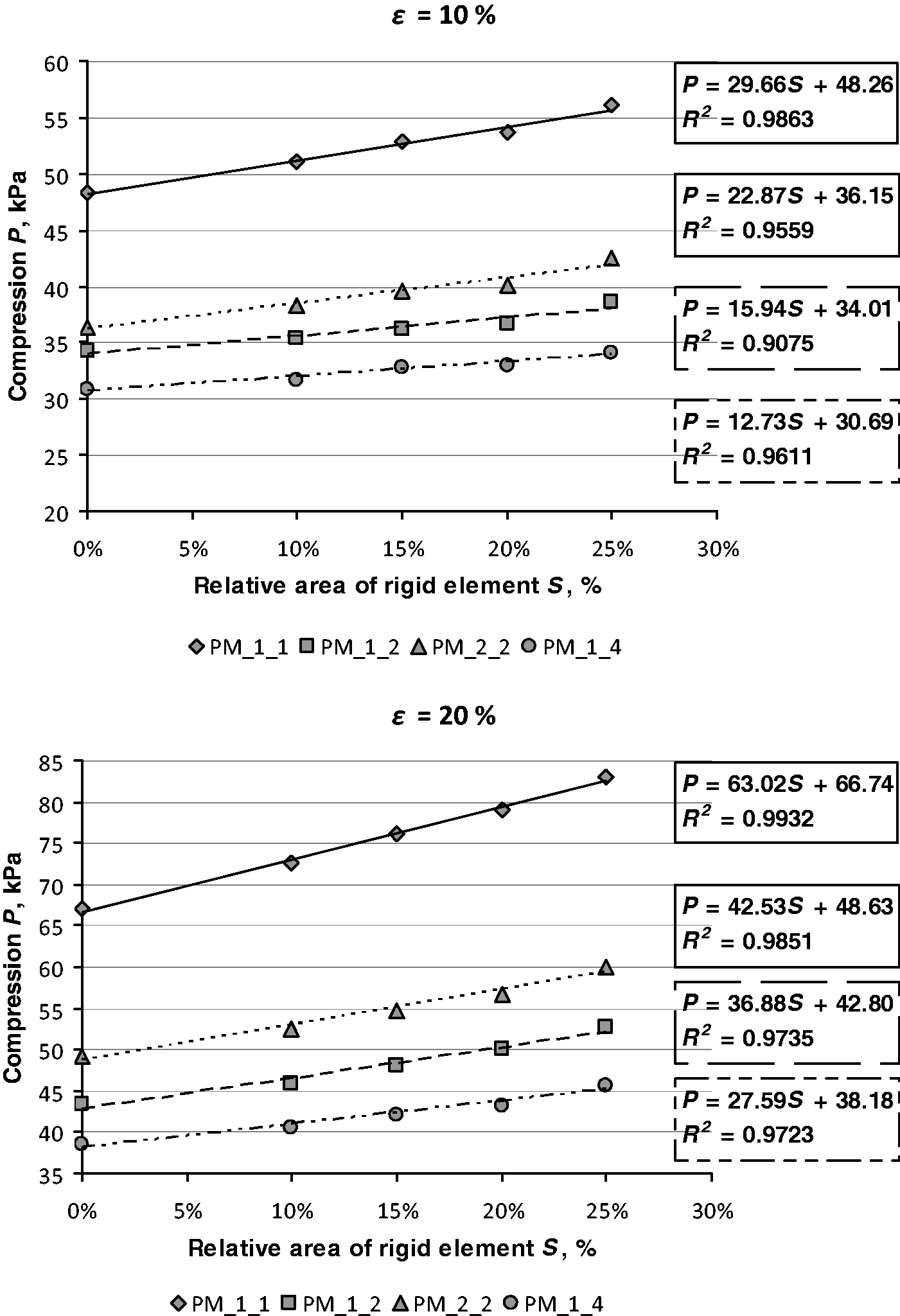

According to the experimental results, it was estimated that there is a strong linear dependence between relative area of the rigid element and compression generated by the knitted orthopaedic support – by increasing relative area of the rigid element, compression linearly increases as well. Coefficient of determination R2 of the presented linear dependencies is very high and varies in the ranges 0.9075–0.9932. Hence, compression level of such knitted orthopaedic supports with various area occupied by the rigid elements can be predicted according to the formulas presented in Figures 4 and 5. The highest influence of increase of the rigid element relative area on compression changes is obtained for samples knitted with the highest inlay-yarn insertion density (one inlay-yarn in each course). As it was expected, at 20% extension, the influence of increase of the rigid element relative area on the compression is more observable as at 10% extension. It means that for knitted orthopaedic supports, used in higher extension level, the influence of the rigid elements on the compression generated by the support has necessarily be taken into account.
The percentage alteration of compression at 10% and 20% fixed elongation, increasing relative area of rigid element (in comparison with samples without the rigid element).

Results show that compression generated by the supports with 25% relative area of the rigid element increases up to 17% at 10% fixed elongation and up to 24% at 20% fixed elongation, in comparison with samples without the rigid element. The highest compression alterations were observed in samples with the highest inlay-yarn insertion density (PM_1_1 and P_1_1). In this case, at 10% elongation compression increases in 16% (PM_1_1) and 17% (P_1_1), and at 20% elongation – in 21% (P_1_1) and 24% (PM_1_1). Samples with 25% rigid element relative area and with one inlay-yarn inserted in every second course (PM_1_2 and P_1_2) generate 13% higher compression at 10% fixed elongation and 19% (P_1_2) and 21% (PM_1_2) at 20% elongation higher compression than samples without the rigid elements. Compression, generated by samples with 25% rigid element relative area and low inlay-yarn insertion density (one inlay-yarn in every fourth course), is in 7% at 10% elongation and in 21–22% at 20% elongation higher than of the samples without the rigid elements.
Considerable attention must be paid on the area occupied by the rigid elements during designing and manufacturing process of orthopaedic compression supports. Otherwise usage of uncalculated and uncontrolled rigid elements can affect compression generated or even change the compression class. In other hand, systemized insertion of rigid elements to construction of compression support could be a way of possibilities to regulate compression values and to change it during healing process.
Conclusions
In the area of low extensions, the influence of total linear density of the elastomeric inlay-yarn on generated compression is not significant if the linear density of the yarn elastomeric core is similar. In this case the covering yarns practically do not have significant influence on tensile force values. Meanwhile, inlay-yarn insertion density has valuable influence on the compression generated, i.e. 21–25% higher compression was estimated in knits with the inlay-yarns inserted in every course compared with the knits with twice lower inlay-yarn insertion density but with the same total amount of the inlay-yarns (two yarns in every second course). Even more, knits with two times reduced total amount of the inlay-yarn (from two inlay-yarns in every second course to one inlay-yarn in every second course) generated 6–13% lower compression. According to this, it is clear that for orthopaedic supports of lower compression class, the lower inlay-yarn insertion density and its total amount can be used.
In the area of low extensions, the strong linear dependence between the rigid element relative area and compression generated by the knitted orthopaedic support was estimated – compression increases by increasing of the relative area of the rigid element. According to this, considerable attention to the rigid elements amount and relative area must be paid during design process otherwise unlimited rigid elements amount can even change compression class of medical support.
Therefore, compression generated by the orthopaedic support can be predicted and it may provide possibilities to create multifunctional products that are likely to more fulfil medical requirements. Finally, the obtained results enable possibilities to more accurately pre-calculate the generated compression changes caused by the rigid elements.
Footnotes
Declaration of Conflicting Interests
The author(s) declared no potential conflicts of interest with respect to the research, authorship, and/or publication of this article.
Funding
The author(s) received no financial support for the research, authorship, and/or publication of this article.