




Abstract
This research was carried out to investigate behaviour of a knitted orthopaedic knee support in simulated real conditions as well as to propose a new approach to compression evaluation to preclude the possibility of any error in designing of new orthopaedic supports with exact compression level. Fully finished supports with all additional non-textile elements were analysed in this research. The support is defined as a corrective or orthopaedic item intended to grip or support any movable part of the body in the correct position and allows movement of that body part. The ways how textile material deforms under applied stresses as well as relaxation processes over the time play an important role in its processing and end use. A strong linear dependence between elongation of the support and compression generated by the support was found in this research. However, investigation on stress relaxation over the time showed that stress decrease over 36,000 s coincides with ranges of one full compression class, and the highest change (approx. 50%) in tensile force occurs during the first 100–200 s of relaxation. Such a change of compression has significant influence on the predictive pressure value generated by the compression garment and undermines its functionality. The obtained results indicate that a new approach to compression evaluation methodology must be adopted for theoretical compression value computation. Consequently, evaluation of the compression according to the tensile force must be performed not earlier than after at least 120 s relaxation.
Introduction
Compression garments are beneficial for the recovery of several markers of exercise-induced muscle damage, accelerate recovery of muscle function, and may also assist athletic following exercise [1,2]. It is found that swelling, power and strength are improved during recovery with compression garments [2,3], and the efficiency of compression garments is affected by garment construction, fabric properties, garment fit and positioning on the body. All these factors play a significant role on the predictive pressure value generated by the compression garment and may undermine its functionality [4,5]. In case of medical requirements, it has to ensure the required compression level. However, the problem is that there is no universally accepted standard in the world in which requirements for orthopaedic supports’ compression would be defined. In Europe, compression garments are classified into four groups according to the compression intensity. Different scientific papers and standards refer to the different recommended value of compression, for example compression class of compression socks at the ankle ranges from 10 mmHg according to the French standard ASQAL to 21 mmHg according to the German standard RAL-GZ 387/1:2008 [6,7]. According to previous researches, it is proved that the blood flow is faster under the gradual compression with an average compression rate of 25 mmHg. However, it is recommended that the compression should not exceed 40–60 mmHg [8,9].
Compression products are worn repeatedly many times; accordingly, the properties of resilience are equally important as elastic properties. Functional post-operative/rehabilitation supports are indicated for a short-term use (about two to eight weeks). Other functional knee supports can be worn from 6 to 12 months [10]. It should not disturb blood circulation due to pressure to the limb, also it should not be too loose, and not to slip away, and it should not have sharp corners. The construction of functional compression supports consists of crucial elements for particular functions that are substantial for patient health or healing process. Orthopaedic supports often have added silicone or other parts for functional application and may also comprise other components, such as straps, fasteners, including a disengage-able two-part fastener system for fastening the support to the body [11]. All the rigid elements inserted into the support can change the elasticity of the entire product. In the area of low extensions, there is a strong linear dependence between the rigid element relative area and the compression generated by the knitted orthopaedic support – compression linearly increases by increasing the area of the rigid element [12]. Therefore, compression of the orthopaedic supports must be evaluated for the final structure of the support, with all additional textile and non-textile parts.
During the design and production processes of compression products, modelling of the product must be based on the analysis of the compression phenomenon [13]. In order to design suitable orthopaedic compression support, the type and the linear density of the base yarn and elastic yarns, knitting pattern, support shape and surface area and other important structural parameters must be appropriately selected [5,14]. The level of compression is partially defined by inlay-yarn properties which are directly related to the modulus of elastic core yarn and the covering parameters. Regardless of the selected raw material of covering yarns, the tensile force of elastomeric inlay-yarn exponential increases by increasing elongation [15]. Currently, the design and production of compression products is based on an identical percentage decrease between the dimensions of the main structural parameters compared with the corresponding values of patient body dimensions [16]. However, the problem is that inner structural changes as well as stress/strain relaxation in the stretched knitted support over the time are not taken into account in compression evaluation, what is especially important in the stage of compression garments designing. There is a lack of scientific-based information in scientific literature about the influence of stress relaxation on the compression alteration over the time. Therefore, taking into account the importance of sufficient compression on a healing process, the compression alteration over the support’s wearing period must be investigated as well as relevant recommendations for compression evaluation methodology have to be given.
The main goal of this research is to investigate behaviour of a knitted orthopaedic knee support in simulated real conditions as well as to propose a new approach to compression evaluation to preclude the possibility of any error in designing of new orthopaedic supports with exact compression level.
Materials and methods
Experimental specimens were knitted on a 14 E gauge double needle-bed flat knitting machine CMS 340TC-L (f. STOLL, Germany) in combined laid-in jacquard pattern with elastomeric inlay-yarns inserted into the knitted structure and with two types of rigid elements in the construction of the finished orthopaedic knee support: the two flexible lateral stabilisers (metal flat springs) to strengthen the sideway support from both sides of the knee and to control the degree of joint movement, and silicon pad for kneecap fixation (Figure 1). In this study, three groups of orthopaedic supports (M, L and XL) were investigated. The supports of these groups differed in size, i.e. in surface area and relative surface area covered by the rigid elements as well. The main characteristics of the tested knitted fabrics and the orthopaedic supports are given in Table 1. The orthopaedic supports were manufactured in JSC ‘Ortopedijos technika’.
Investigated knitted orthopaedic knee support (a), principle knitting structure (b) and two types of rigid elements (c, d) used in the construction of the support. Main characteristics of knitted structure and geometry of orthopaedic supports.

Tensile force values according to compression class and size of the orthopaedic support.

One-cycle tensile tests up to fixed stress values (see in Table 2) and 120 s stress relaxation in the top stretched point as well as cyclic fatigue test (200 cycles for specimens of the group L up to 110.87 N stress) were performed using ZWICK/Z005 (speed – 100 mm/min; pretension – 2 N, sensor – 5 kN). Complete equipment for such research and stretching machine was operated by the testXpert® software. Number of elementary tests for one experimental point was 10.
Limb compression depends on the ratio between the limb circumference and the support size. This ratio has to be chosen with respect of the desired compression size. Compression of the orthopaedic supports tested was calculated by the Laplace formula [14]

All experiments were carried out in a standard atmosphere for testing according to Standard LST EN ISO 139:2005. Structure parameters of knitted samples were analysed according to British Standard BS 5441:1998.
Results and discussions
The ratio between circumferential force in a knitted support and the body circumference is described by Laplace’s relation. According to Laplace’s law, cylindrical models of human limbs are used for designing of compression supports [5]. In order to achieve the required compression level, circumference of the orthopaedic support has to be in corresponding level lower than the limb’s circumference.
The tensile test up to the fixed tensile force was performed to determine the level of elongation of the knitted supports. As it was mentioned before, three mostly used sizes of the supports (M, L and XL) in their finished form and structure with all additional constructional elements were used in this research. Values of the tensile force according to the support size and compression level are presented in Table 2, curves of the tensile test are presented in Figure 2, and elongation values obtained are presented in Table 3. Each curve in Figure 2 represents particular value of the tensile force from the Table 2. The curves presented in the figure clearly demonstrate that higher tensile force value is needed to reach higher elongation. On the other hand, higher elongation of the support determines higher compression generation.
Correlation between tensile force and elongation of orthopaedic supports of: (a) M, (b) L and (c) XL size. Elongation values according to compression class and size of the orthopaedic support.

Compression generated by orthopaedic support depends on both tensile force and surface area of the support, due to that elongation value for each support’s size as well as for each compression level is different. The investigated orthopaedic supports were stretched starting from 3% (size M and first compression class) to 15% (size XL and fourth compression class), according to requirements of standard RAL-GZ 387/1:2008. In the area of the low compression level (first compression class and the very beginning of the second class), the difference between elongation values of the supports of M, L and XL size is quite low, i.e. up to 2%. However, in the area of high compression level, such as third or fourth compression classes, this difference can be 3–5%. Thus, the evaluation of compression at the designing stage must be carried out strictly for each support’s size with all additional constructional elements because these elements usually are on uniform size and only dimensions of the textile part are different.
Correlation between elongation of the support and compression generated by the support is presented in Figure 3. This correlation can be well described by linear equation with very high coefficient of determination (R2 = 0.9912–0.9936). It means that more stretched knitted supports generate higher compression to the limb. It is highly important to notice that rigid elements inserted into the support structure have crucial influence on the compression generation [12,14]. Therefore, fully finished knee supports with all additional elements and final shape were analysed in this research. Taking into account the fact that the rigid elements, such as two flexible lateral stabilisers and silicon pad, cover marked surface area (22.0% of the M, 20.5% of the L and 20.0% of the XL support), supports have to be stretched only 3–5% to reach level of the first compression class and 10–15% to reach the highest fourth compression class level.
Estimated correlation between orthopaedic support elongation and compression generated by the support.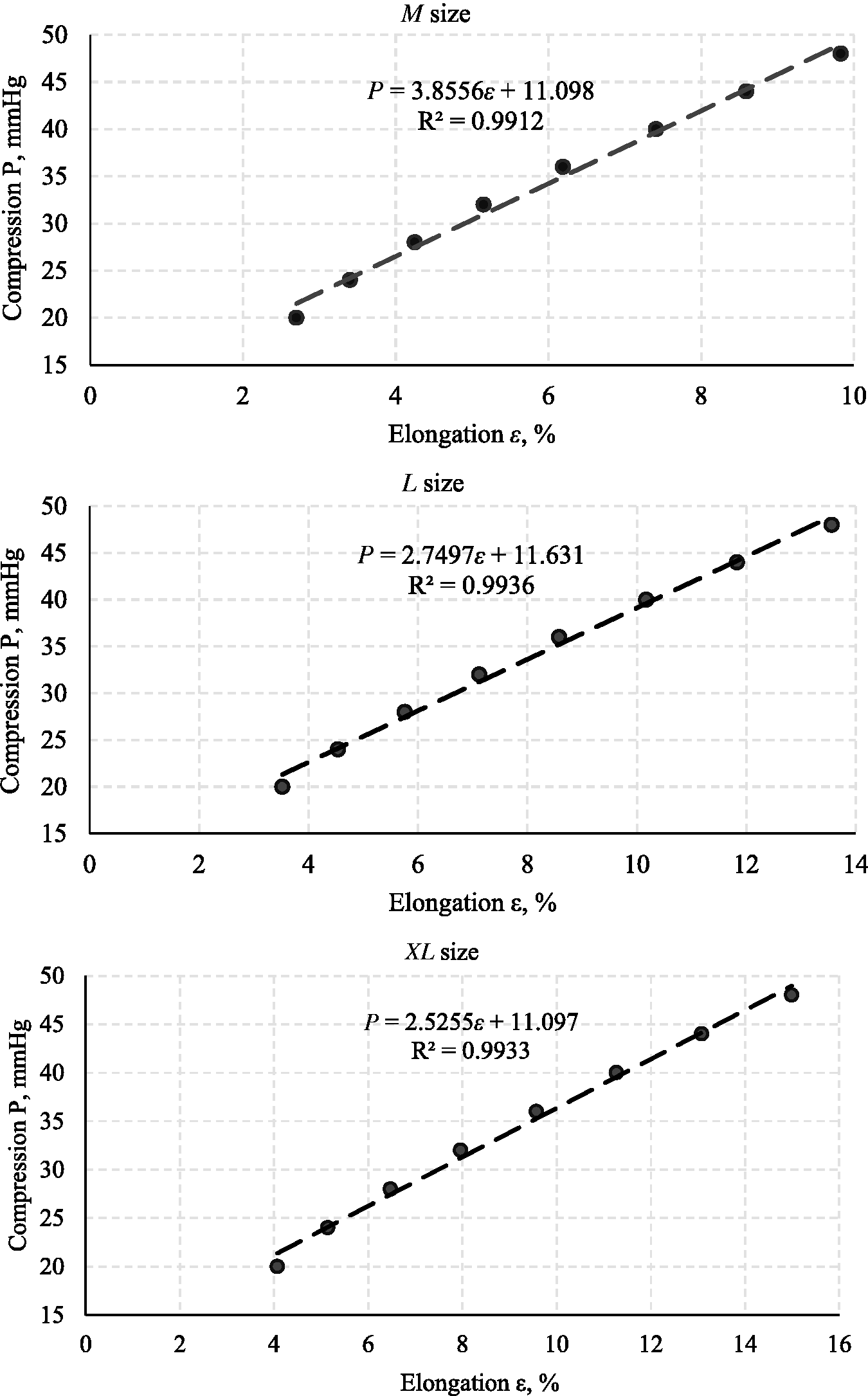
Compression level, using both direct and indirect measurement methods, generally is evaluated at the moment of stretching to the fixed stress or fixed strain [7,8,13,17]. However, it is well known that relaxation processes over the time have significant influence on dimensions as well as on forces acting in the textile structure. Time-dependent processes in textile products are often observed when deformed products are relaxed. Phenomenon, when stress in textile structure decreases in response to the same amount of generated strain, is known as stress relaxation and was investigated by Laureckiene and Milasius [18]. Consequently, behaviour of knitted structure and changes of tensile force during 10 h stress relaxation was investigated in the next step of our research. The curve of XL size orthopaedic support stress relaxation at 11.5% strain elongation (to reach 120 N tensile force, to generate 40 mmHg compression) is presented in Figure 4. Duration of relaxation was 36,000 s (10 h), simulating the conditions for daily wear. Development of stress reduction over the time was observed.
Stress relaxation curve of XL size orthopaedic support at 11.5% strain elongation (a) and initial part of the relaxation curve (b).
It was found that the initial stress value was 120.13 N and the stress at the final moment – 98.88 N. Thus, the stress decrease over 36,000 s is 21.25 N, accordingly 8.4 mmHg, and this coincides with ranges of one full compression class, and this fact can be crucial to the success of the compression treatment. In other words, 40 mmHg compression is generated at the stroke of the sample, which corresponds to the average value of the third compression class, while after 10 h of stress relaxation it remains 31.6 mmHg, which corresponds to the second compression class. It means that during wearing of an orthopaedic support compression level gradually sinks over the time. The highest change in tensile force occurs during the first 100 s of relaxation (decrease of tensile force was 10.43 N, i.e. approx. half of overall decrease: F0 = 120.13 N, F100 = 109.70 N, F120 = 109.31 N, F150 = 108.86 N, F180 = 108.60 N, F200 = 108.33 N). During the next 100 s, the drop in tensile force was 1.37 N.
Tensile force and compression after 120 s stress relaxation.

It is obvious that decrease in tensile force over the 120 s stress relaxation determined decrease in generated compression as well. In comparison between the compression at the initial time of strain and at the time after 120 s stress relaxation (Figure 5), it is clear that after such short relaxation compression generated by the support decreases in 2–4 mmHg (depending on support’s size and compression level), and this difference is significant for the successful compression treatment. Thus the results obtained confirm that new approach to compression evaluation methodology must be adopted. Evaluation of the compression according to the tensile force values must be performed not earlier than after at least 120 s relaxation, and only then the determined compression will be close to the real compression generated by the support.
Differences between compression values at the initial strain time and at the time after 120 s relaxation.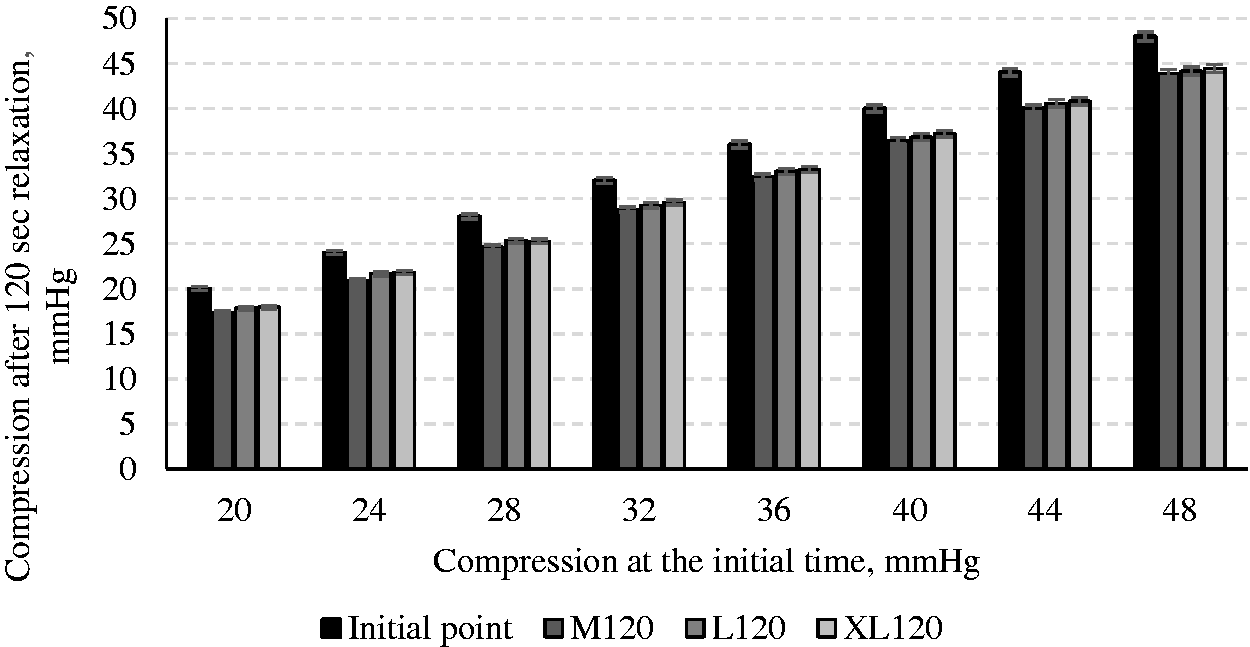
On purpose to find out whether fatigue of repeated wearing of the orthopaedic support has an influence on variations of compression generation, the cyclic fatigue test was performed. It was found that cyclic deformation does not have significant influence on compression generation, and after 10 h relaxation in fully free state the support generates the same compression as during the first deformation cycle.
Conclusions
The results of this research confirm that there is a strong linear dependence between elongation of the support and compression generated by the support (R2 = 0.9912–0.9936). However, the results of stress relaxation tests showed that compression generated by the support significantly decreases during the stress relaxation process. Orthopaedic support stress relaxation at 11.5% strain elongation (to reach 120 N tensile force and to generate 40 mmHg compression) demonstrated that selected specimens stress decrease over 36,000 s is 21.25 N (from 120.13 N to 98.88 N), accordingly compression decreased 8.4 mmHg and this coincides with ranges of one full compression class. It means that compression level of the orthopaedic support gradually decreases over the time of wearing. Moreover, it was observed that the highest change in tensile force occurs during the first 100 sec of relaxation (decrease of tensile force was 10.43 N, that is approx. half of overall decrease). Compression at the initial time of strain compared with compression at the time after 120 s stress relaxation demonstrated significant difference (decreases was in 2–4 mmHg, depending on support’s size and compression level). Presented results clearly demonstrate that stress–strain relaxation phenomenon must be taken into account and methodology of compression evaluation has to be changed, respectively. Thus compression evaluation according to the tensile force values after at least 120 s relaxation is highly recommended on purpose to simulate real conditions and to reach the best healing result.
The results obtained will be used in our further investigations. In the next stage, the influence of used orthopaedic knee supports with individually designed compression level as well as leg muscle strength and power development acceleration, aerobic dynamical equilibrium enhancement, and combined power and motion control enhancement on psychophysiological working capacity of motor system and cognitive functions of physically passive elderly will be investigated.
Footnotes
Declaration of conflicting interests
The author(s) declared no potential conflicts of interest with respect to the research, authorship, and/or publication of this article.
Funding
The author(s) disclosed receipt of the following financial support for the research, authorship, and/or publication of this article: This research was funded by a grant (No. S-MIP-17-29) from the Research Council of Lithuania.