




Abstract
This paper involves a comprehensive evaluation of electromagnetic shielding characteristics of woven fabrics. The conductive fabrics produced by using cotton/copper-wrapped and cotton/stainless steel-wrapped hybrid yarns in plain and twill weaves were tested in single and double layer structures to determine the electromagnetic shielding effectiveness (EMSE), absorption and reflection values over an incident frequency of 0–3000 MHz. In addition, the shielding effectiveness (EMSE) of these conductive fabric layers was tested under pure cotton fabric. The results indicated that fabrics including copper-wrapped hybrid yarns exhibited EMSE values that increase with increasing incident frequency then decline after a peak value is reached. On the other hand, fabrics including stainless steel-wrapped hybrid yarns showed no sharp peak values, instead; slight peaks were observed. The differences between the EMSE values of plain and twill weave fabric samples were found to be statistically insignificant. The use of fabrics including stainless steel-wrapped hybrid yarns in the layered structures resulted in better shielding effectiveness in a wider incident frequency range when compared to the fabrics including copper-wrapped hybrid yarns. Finally, it was found that the use of conductive fabrics under pure cotton fabric did not interrupt the shielding effectiveness of the conductive fabrics, which can lead to consider the use of layered structures for garments requiring special protective capabilities.
Keywords
Introduction
Electromagnetic waves that originate from various types of sources, where electrical and magnetic fields exist, pose risk for technical devices, information technology equipments and more importantly, for human health. These sources are industrial plants, base stations, mobile phones, wireless transmitters, television and radio transmitters, high-voltage transmittance lines, household appliance such as microwave ovens and electrical heaters, X-ray devices and equipments. In conjunction with the technological developments, electromagnetic fields have become a part of daily life and exposure to electromagnetic waves can cause electromagnetic interference (EMI) and result in serious diseases including cancer, since they disturb the immune system and cause cellular damage and tissue repair reduction [1,2]. Therefore, there is a growing need for developing textiles having shielding effect against electromagnetic waves for daily use as well as technical applications.
Electromagnetic shielding is limiting the flow of electric and magnetic field between two places by using conductive barriers. Conventional textile structures in knitted, woven and nonwoven forms and textile-based composites with desired electromagnetic shielding effectiveness (EMSE) are used for protecting the electronic and electrical appliances against electromagnetic radiation instead of metallic products due to their light weight and extensible structures [3]. Shielding curtains and wall covers for protecting high security buildings, banks and hospitals are other applications on this issue [4]. Protective clothing used to be protected against the harms of electromagnetic and electrostatic fields are preferred by people who directly expose to electromagnetic wave in working areas [5]. Other than protective clothing, protection of human body against electromagnetic waves in daily life is the emerging area of application in garments including lining fabrics for pockets and jackets especially for people with pacemakers, underwear, outwear such as shirts, blouses and jackets.
The idea behind obtaining EMI shielding textile products is to make them electrically conductive. This can be achieved by adding conductive fillers such as carbon fibre, metal fibres or metal powders and flakes to the insulating material, coating and laminating conductive layers onto the surface of the fabric, and incorporating conductive fibres and yarns into the fabric. The latest method provides flexibility in designing conductive garments [6]. One of the most feasible ways of incorporating conductive yarns into the fabric is producing core yarns, covered yarns and ply yarns with metal wires and using such hybrid yarns in knitted and woven fabric production. Manufacturing of hybrid yarns including metal wires by using different yarn production methods were proposed in several studies [7–12]. Hybrid yarns including metal wires were used to produce knitted and woven fabrics; and their EMSE was investigated by many researchers. The effect of parameters including conductive wire diameter, amount of wire content, yarn type such as blended yarn and core yarn, yarn count, knit structure, tightness, loop length, number of conductive fabric layers laminated at various angles on the EMSE of the knitted fabrics were investigated in various studies [13–23]. The effect of similar parameters such as conductive wire diameter, amount of conductive fibre/wire, yarn type, yarn count, weave type, warp and weft density, cover factor, number of conductive fabric layers laminated at various angles on the EMSE of the woven fabrics were investigated by many researchers [7,24–35].
Recent studies related to the manufacturing conductive fabrics and investigating their shielding characteristics have been focused on novel processes such as polyaniline or polypyrrole deposition [36,37], electroless coating, metal coating films and vacuum evaporation deposition technique [38,39]; using different types of wires and filaments such as nickel-coated copper wire and infrared emissive polyester filament [40], textured stainless steel yarn for improving the handle and flexibility [41]. In addition, there is very limited number of studies recently published in this area that investigated the wearability of such kinds of conductive fabrics. Zhang et al [42] investigated and selected the optimum comprehensive performances of metal wire composite fabrics by using grey clustering analysis. They tested and analysed six factors that have infleunce on the performances of the fabrics, namely EMSE, breathability, moisture permeability, waterwashing durability, and warp-way and weft-way shrinkages. Bilgin [43] investigated the electromagnetic shielding and thermophysiological comfort properties of circular-knitted sandwich fabrics produced by using various types of electrically conductive yarns.
In some of the studies in the literature, in which the effect of number of conductive layers (up to six layers) were investigated, it was aimed to decrease the pores in the conductive fabrics for preventing electromagnetic waves from penetrating the fabric. However, this type of layered structure can only be appropriate for using in technical applications such as covering sheets for electronic and electrical appliances, shielding rooms, health care blankets and sheets, protective clothing; rather than garments for daily use.
The purpose of this study was to investigate the EMSE characteristics of woven structures produced by using metal-wrapped hybrid yarns in different weave types. EMSE characteristics of the conductive woven fabrics were measured both as a single layer and double layer. Besides, these combinations were analysed as a secondary layer under a pure cotton woven fabric in order to understand the contribution of conductive woven fabric to the EMSE when applied as a layer into a garment, especially for daily purposes. The study was further extended to observe shielding characteristics of various 2-layer and 3-layer structures with varying metal wire type and weave type. The results were expected to guide for applying conductive fabrics as a layer into a garment requiring special protective capabilities.
Materials and method
Production of yarns
Metal wire included conductive hybrid yarns can be produced by using core spun yarn production technique [7,8,10,21,25,27] or doubling technique, which has a lower production cost when compared to core spun yarn production technique [18,25,30].
In this study, 20 × 2 tex (Ne 30/2) cotton ring yarn was used as warp yarn in the production of all fabric samples. Cotton/copper-wrapped hybrid yarn and cotton/stainless steel-wrapped hybrid yarn were used as weft yarns in the production of conductive fabrics. In the production of the fabric sample without metal wire (reference sample) 30 × 2 tex (Ne 20/2) plied cotton yarn was used as weft yarns.
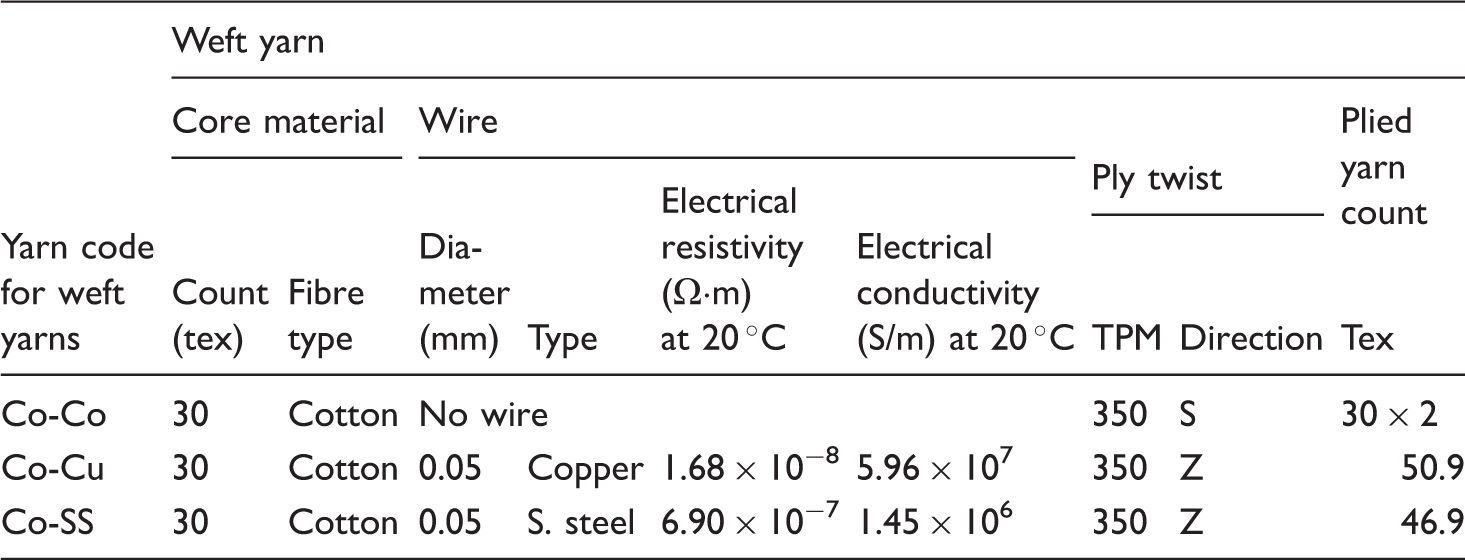
In the production of cotton/metal-wrapped hybrid yarns, 30 tex (Ne 20/1) cotton ring yarn with twist coefficient of α e 4.03 (710 TPM (turns per meter) in Z direction) was wrapped with copper and stainless steel wires in diameter of 0.05 mm by using Agteks DirecTwist® Machine. 30 × 2 tex (Ne 20/2) plied cotton yarn was also produced on Agteks DirecTwist® Machine. In this way, comparable weft yarns in terms of yarn count were obtained. DirecTwist® principle enables time and cost-saving hybrid yarn production in a single operation without additional doubling or rewinding requirement. In addition, by using DirecTwist® principle, the hybrid yarns can be produced by controlled twisting parameters such as twist direction, speed and twist amount, which can be adjusted independently.
Single yarns are generally ply-twisted in the direction opposite to single yarn twist in order to remove the torque on the yarn and obtain a balanced yarn [44]. Therefore; plied cotton yarn was twisted in S direction. On the other hand, metal wires were wrapped in Z direction in order to avoid possible yarn breaks due to untwisting of single cotton yarn during ply-twisting. The pictures of the metal-wrapped yarn samples are shown in Figure 1. The wrapping density of metal wire in the hybrid yarn was measured as 3.5 coils/cm and 3 coils/cm for copper wire and stainless steel wire, respectively.
Pictures of metal-wrapped hybrid yarn samples: (a) copper-wrapped hybrid yarn, (b) stainless steel-wrapped hybrid yarn.
Production of woven fabric samples
The fabrics made of pure cotton yarns and conductive fabrics made of metal-wrapped hybrid yarns were produced on a CCI sampling loom in plain and twill structures (Figure 2).
Pictures of fabric samples including metal-wrapped hybrid yarns: (a) plain weave fabric including copper-wrapped hybrid yarn, (b) plain weave fabric including stainless steel-wrapped hybrid yarn, (c) twill weave fabric including copper-wrapped hybrid yarn, (d) twill weave fabric including stainless steel-wrapped hybrid yarn.
Measurement of yarn and fabric characteristics
Specifications of weft yarns.
Fabric specifications.

While producing the fabric samples, although the warp and weft densities per cm were set to be the same for a comparative analysis, slight differences were observed in samples. For this reason, porosity of the fabric samples was calculated according to equation (1) for better explanation of the EMSE of the fabrics [49]. In addition, since plied and metal-wrapped yarns were used in the production of the fabric samples, measuring the cover factor and tightness of the samples was difficult and not accurate. Therefore, the air permeability of fabrics was measured according to TS 391 EN ISO 9237 [50] as a good estimation for cover factor.

EMSE, absorption, reflection and transmittance of the fabric samples were measured by using a specimen holder (EM-2107A) utilising the coaxial transmittance line method and a network analysing instrument, according to ASTM D4935-1 standard [51]. The image of the measuring instrument is shown in Figure 3.
EMSE measurement device.
The EMSE of the fabric samples was determined from equation (2), which is the ratio of the incident field to that which passes through the material.

Electromagnetic shielding behaviour of fabrics was also described in terms of absorption and reflection of electromagnetic waves. A part of an incident electromagnetic wave is generally attenuated through reflection on the surface of a material, absorption by the material, or multiple internal reflections inside the material (usually neglected) and the rest of the wave is transmitted. Total shielding effectiveness of a material is, therefore, the sum of shielding effectiveness resulting from these three shielding mechanisms [52]. As the wave imposes the surface of the material, it forces charges in the material to oscillate at the same frequency of the incident wave, which results in reflection. As the charge is forced to vibrate in the medium, energy is lost in the form of heat. This mode of signal loss is known as attenuation due to absorption. Thus, there are two basic mechanisms for shielding function of a material as reflection from a conducting surface, and absorption in a conductive volume [53].
By measuring the reflection (R
e
) and the transmittance (T
r
) of the material, the absorption (A
b
) can be calculated using the following equation [1]



Finally, in order to evaluate the convenience of the fabric samples for use in garments, the extensibility of the fabric samples in both warp and weft directions were measured on FAST-3 extension meter.
Results and discussion
The effects of metal wire type, weave type and layering on EMSE values of the fabric samples were investigated and the results are demonstrated in Figures 6 to 11 comparatively. The measurements were obtained at incident frequencies between 0 and 3000 MHz. It was observed for all fabric samples as a general trend that shielding effectiveness decreased with increasing incident frequency, which can be thought as the result of smaller wavelength in higher frequencies [29]. With the increase in the frequency, the electromagnetic wave length became shorter and the incident waves were able to penetrate through the gaps of the fabric [35].
Effect of metal wire type
The absorption and reflection percentages of the conductive fabric samples were illustrated in Figures 4 and 5, respectively. The measurements were obtained at incident frequencies between 0 and 3000 MHz.
Absorption percentages of conductive fabric samples. Reflection percentages of conductive fabric samples. The effect of metal wire type on EMSE values of conductive fabric samples: (a) plain weave fabric samples, (b) twill weave fabric samples.


The examination of Figures 4 and 5 shows that the conductive fabric samples including copper-wrapped hybrid yarns have reflection-based shielding mechanism in lower frequencies; whereas, higher contribution of absorption-based shielding was observed with increasing frequency. The results are consistent with the literature, where it has been cited that absorption increases with increasing frequency, whereas reflection tends to decrease with an increase in the frequency [54]. On the other hand, fabric samples including stainless steel-wrapped hybrid yarns have low reflection percentage and high absorption percentages at lower frequencies; i.e. almost up to 600 MHz, and above that frequency, the trend is similar to that of fabric samples including copper-wrapped hybrid yarns, where the absorption increases with increasing frequency, whereas reflection tends to decrease with an increase in the frequency. The difference in the frequency range below 600 MHz may be important for the end uses of such kind of conductive fabrics. Within relatively low frequency range (i.e. up to 600 MHz), the fabrics including stainless steel-wrapped hybrid yarns may be used as electromagnetic wave absorbents.
The EMSE values of the woven fabric samples including metal-wrapped hybrid yarns were compared in Figure 6 in order to examine the effect of metal wire type. It was observed that the fabrics including copper-wrapped hybrid yarns showed higher EMSE values between 0 and 500 MHz when compared to the fabrics that were produced by using stainless steel-wrapped hybrid yarns. This result, which can be attributed due to the higher electrical conductivity of copper wire [35,55] was obtained both in plain and twill weave fabrics.
Effect of weave type
In order to examine the effect of weave type on EMSE values of the fabric samples, the EMSE values of plain and twill weave fabric samples were demonstrated in Figure 7. It was observed that twill weave fabric sample that includes copper-wrapped hybrid yarn reached a higher peak EMSE value at the incident frequency of around 350 MHz than its plain weave counterpart. In addition, the twill weave fabric sample including stainless steel-wrapped hybrid yarn reached slightly higher EMSE values between the incident frequency range of 15 MHz and 225 MHz. However, statistical analysis revealed that these differences with regard to weave type were insignificant. In some of the previous studies it was stated that higher EMSE values were obtained in twill fabrics due to the fact that yarns can be packed closer because of lower number of interlacing; therefore, the porosity of the fabric reduces and it results in higher shielding effectiveness in twill weave fabrics [28,30,56]. Nonetheless, in the present study, twill weave fabric samples were found to have higher porosity and be more permeable to air than the plain weave fabrics, as a result of having longer yarn floats than the plain fabrics [57]. In addition, the thickness, which is directly proportional to the shielding of any material [31], of the twill weave fabric samples, was measured to be higher than that of plain weave fabrics. Consequently, the shielding effectiveness of the plain and twill weave fabric samples included in the present study was found to be similar.
The effect of weave type on EMSE values of conductive fabric samples: (a) fabric samples included copper-wrapped hybrid yarns, (b) fabric samples included stainless steel-wrapped hybrid yarns.
Effect of layering
Single- and double-layer conductive fabrics
Figure 8 illustrates the EMSE values of conductive fabric samples in plain and twill weaves in single- and double-layer structures. It was observed that shielding effectiveness of the conductive fabric samples including copper-wrapped hybrid yarns in 2-layer structure was higher than that of the fabric samples in single-layer structure at higher incident frequency range (800–2000 MHz) for both plain and twill weave types. Within the mentioned frequency range, the average improvement in EMSE values when 2-layer structure was compared to single-layer structure was found to be 40% for plain weave fabric and 54% for twill weave fabric. For the fabric samples including stainless steel-wrapped hybrid yarns, it was found that 2-layer structures had better shielding effectiveness in a wider incident frequency range (400–2000 MHz) for both plain and twill weave types. The average improvement in EMSE values when 2-layer structure was compared to single-layer structure was found to be 54% for twill weave fabric and 29% for plain weave fabric.
EMSE values of conductive fabric samples in single and 2-layer structure: (a) plain fabrics including single- and 2-layer copper-wrapped yarns, (b) twill fabrics including single- and 2-layer copper-wrapped yarns, (c) plain fabrics including single- and 2-layer stainless steel-wrapped yarns, (d) twill fabrics including single- and 2-layer stainless steel-wrapped yarns,
Previous studies found that shielding effectiveness increases with the increase in the number of layers; in other words, the shielding effectiveness of any material is directly proportional to the thickness of the material apart from the other related parameters; since thicker materials have greater absorption of electromagnetic waves [18,20,21,23,25,28,30,31,35]. However, the decrease of the EMSE values between the incident frequency range of around 200 MHz and 800 MHz with the increase of the layer for the fabrics including copper-wrapped hybrid yarns; which was also detected as a slight decrease for the fabrics including stainless steel-wrapped hybrid yarns between the incident frequency range of around 165 MHz and 405 MHz may be attributed to the fact that, the fabrics in the 2-layer structures were placed in parallel direction (The angles were 0 °/0 °). Since all metal-wrapped hybrid yarns from each layer were arranged with the same angles, and were corresponded each other, conductivity per unit area could not be increased effectively; even, electric field intensity decreased with the increase in penetration depth [35].
The shielding effectiveness of 2-layer structures that were obtained by placing two conductive fabrics composed of different type of metal wire in the same weave type was measured and shown in Figure 9 (Co-Cu-P/Co-SS-P and Co-Cu-T/Co-SS-T), and the findings were compared to the 2-layer structures that were obtained by placing two conductive fabrics composed of same type of metal wire in the same weave type, which were already illustrated in Figure 8. Within this comparison, the highest peak EMSE values were obtained at lower incident frequency values for the ones including different type of metal wires for both plain and twill weave types; as 30.15 dB at 195 MHz and 31.81 dB at 105 MHz, respectively. On the other hand, at higher frequencies, i.e. around 400 MHz, higher EMSE values were observed in 2-layer structures including stainless steel in each layer for both plain and twill weave types.
EMSE values of conductive fabric samples in 2-layer structure composing different metal and weave types.
Figure 9 also involves EMSE values of 2-layer structures composing different metal and weave types (Co-Cu-P/Co-SS-P and Co-Cu-T/Co-SS-T). It was observed that the combinations of different metal wire and weave type displayed higher EMSE values when compared to the 2-layer structures composing different type of metal wire in the same weave type. It can be attributed due to the fact that combining the fabrics in different weave types enlarged the metal-wrapped part of the structure, in other words, the gaps in one weave type could be compensated by the other one, and intensify the electrically conductive area [35].
Single- and double-layer conductive fabrics under pure cotton fabric
In order to explore the contribution of the conductive woven fabrics including metal-wrapped hybrid yarns to the EMSE when used as a layer in a garment, the shielding effectiveness of the conductive fabric samples as a separate layer was compared with that of 2-layer and 3-layer structures that were composed of both conductive fabrics and pure cotton fabric. Figure 10 illustrates the EMSE values of conductive fabric samples including metal-wrapped hybrid yarns in comparison to the EMSE values of the same fabrics when used together with pure cotton fabrics as 2-layer and 3-layer structures.
EMSE values of conductive fabric samples in 2-layer and 3-layer structures with pure cotton fabric: (a) plain fabrics including copper-wrapped yarns, (b) twill fabrics including copper-wrapped yarns, (c) plain fabrics including stainless steel-wrapped yarns, (d) twill fabrics including stainless steel-wrapped yarns.
As expected, while any shielding effectiveness was not obtained with pure cotton fabric, the use of fabrics including metal-wrapped hybrid yarns together with pure cotton fabrics as layered structures resulted in obtaining shielding effectiveness against electromagnetic waves. It was observed that copper-wrapped hybrid yarn included conductive fabric itself had a shielding effectiveness almost at the same level with the shielding effectiveness of 2-layer structure that are composed of pure cotton fabric and conductive fabric including copper-wrapped hybrid yarn in plain weave, generally for the whole incident frequency range. Also, the peak EMSE values were detected at the incident frequency interval of around 330–345 MHz (40.64 dB and 45.47 dB, respectively). On the other hand, 3-layer structure, whose one layer is pure cotton fabric in plain weave and the other two layers are conductive fabrics in plain weave including copper-wrapped hybrid yarn had lower EMSE value at the incident frequency interval mentioned above (330–345 MHz); whereas, the shielding effectiveness of the 3-layer structure was found to be slightly higher than that of single-layer and 2-layer structures at the incident frequency interval of 390–675 MHz. Nonetheless, maximum shielding effectiveness of the 3-layered structure occurred at 435 MHz as 30.95 dB, which was a lower peak value than that of single-layer and 2-layer structures. These results were found to be in the same trend for the fabric samples in twill weave type.
The samples including stainless steel-wrapped hybrid yarns together with pure cotton fabrics as 2-layer and 3-layer structures were observed to show different trends when compared to the fabric samples with copper-wrapped hybrid yarns. The results revealed that 2-layer structure showed better results in terms of shielding effectiveness at the incident frequency interval of 0–150 MHz for the plain weave fabric samples, and 0–165 MHz for the twill weave fabric samples when compared to single-layer structure. However, opposite results were obtained at the incident frequency intervals of 165–375 MHz and 180–405 MHz for plain weave and twill weave fabric samples, respectively. The positive effect of using 3-layer structures including stainless steel-wrapped hybrid yarns was examined in a wider incident frequency range. Accordingly, 3-layer structures had higher EMSE values in the incident frequency range of around 400–2200 MHz for plain weave fabrics with an improvement of 32%, while it was around 600–2300 MHz for twill weave fabrics with an improvement of 29%, when compared to the single and 2-layer structures. Besides, for the structure with 3 layers, highest shielding of 30.69 dB was obtained at 450 MHz for the plain weave structures; and 25.86 dB at 675 MHz for twill weave structures.
To study the effect of metal wire type in 3-layer structures on the shielding effectiveness, two additional 3-layer structures for both plain and twill weave fabric samples were obtained by placing one layer of pure cotton fabric, one layer of copper-wrapped hybrid yarn included conductive fabric, and one layer of stainless steel-wrapped hybrid yarn included conductive fabric while carrying out the shielding test. The shielding effectiveness of these additional 3-layer structures were compared with the previously obtained 3-layer structures that compose of one layer of pure cotton fabric and two layers of conductive fabric samples including the same type of metal wire. The results were illustrated in Figure 11. According to the results, it can be stated that for the plain weave 3-layer structures, using the same type of metal wire in each layer presented higher shielding effectiveness results at the incident frequency range of around 300–800 MHz. Using combination of different wire types resulted in obtaining higher EMSE values only within the frequency range of 0–300 MHz. For the twill weave 3-layer structures, it can be concluded that the EMSE values of the one including different wire types were slightly higher within the frequency range of 0–300 MHz; which were in parallel with the findings in 2-layer structures stating that using different types of metal wires resulted in higher EMSE values only at low frequencies.
The effect of metal wire type on EMSE values in 3-layer structure: (a) 3-layer plain weave structures, (b) 3-layer twill weave structures.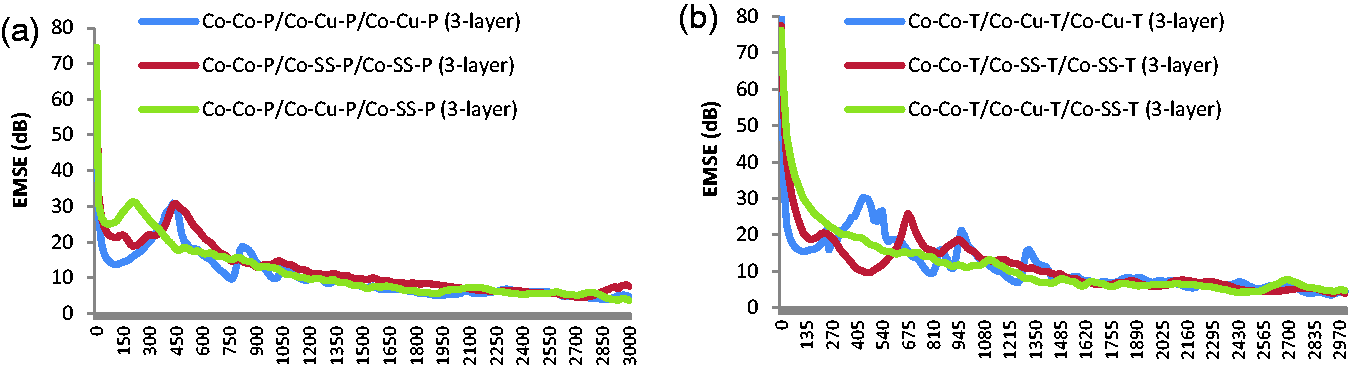
Based on the findings related to the 2-layer and 3-layer structures including pure cotton were considered, it can be stated that higher EMSE values were obtained compared to the single-layer structures of conductive fabrics in a wider frequency range for both copper and stainless steel wires. Thus, it can be suggested to use layered structures when shielding is required at higher incident frequency ranges. Even, stainless steel seems to show better performance due to higher peak values. Moreover, the samples including stainless steel-wrapped hybrid yarns had higher peak EMSE values in layered structures than that of single-layer structure. In addition, using these conductive fabrics under pure cotton fabric does not interrupt shielding effectiveness. Therefore, it can be suggested that conductive fabrics including metal-wrapped hybrid yarns can be further applied as a protective inner layer for the applications such as pockets of jackets, trousers, front panel of maternity clothes, etc. in order to protect the wearer from the harmful effects of electromagnetic waves.
Extensibility of fabric samples
Extensibility values measured on FAST-3 extension meter.

The results showed that the lowest extensibility values at low loads in weft direction were obtained from the samples produced without metal wire, followed by the samples produced by using copper-wrapped and stainless steel-wrapped weft yarns in that order, irrespective of the weave type. This result may be related with the elongation of the components of the yarn samples with the values of 7.34%, 18.35% and 35.97% for cotton yarn, copper wire and stainless steel wire, respectively. The extensibility of the fabric samples with metal-wrapped hybrid yarns was found generally to be higher in warp direction. This can be due to the fact that the smoother surfaces of metal-wrapped hybrid yarns enable easier slippage of yarns, particularly in the intersecting points of warp and weft yarns, when a force is applied. The twill weave fabrics exhibited greater extension due to longer yarn floats and, therefore, looser structure when compared to plain weave fabrics. The looser structure allows yarns and fibres to adjust and realign when deformation forces are applied, which results in higher extensibility [58,59]. Consequently, it can be inferred that comfortable garments can be produced by using metal-wrapped hybrid yarns in the fabric structure due to their high extensibility.
Conclusion
In this study, investigations were carried out about the possibility of using woven fabrics for the purpose of obtaining shielding effectiveness against electromagnetic waves. For this aim, the effects of metal wire type used in the production of hybrid yarns, weave type of the woven fabrics and layering were evaluated.
The evaluation of the test results revealed that metal wire type, weave type and layering had impacts on shielding effectiveness. Conductive woven fabrics produced by using copper-wrapped hybrid yarns exhibited EMSE values that increase with increasing incident frequency then decline after a peak value is reached. On the other hand, conductive woven fabrics including stainless steel-wrapped hybrid yarns showed no sharp peak values, instead; slight peaks were observed.
Regarding the weave type, the statistical analysis revealed that these differences between the EMSE values of plain and twill weave fabric samples were insignificant.
Conductive fabrics in 2-layer structures exhibited higher EMSE values above 800 MHz and 400 MHz for samples including copper and stainless steel wires respectively; even the structures including stainless steel-wrapped hybrid yarns had higher peak values when compared to single-layer structures. The combinations of different metal wire and weave type used in 2-layer structure displayed higher peak EMSE values when compared to the 2-layer structures composing different type of metal wire in the same weave type. Using different types of metal wires in both 2- and 3-layer structures exhibited higher EMSE values only at low frequencies.
The layered structures that were tested for observing the contribution of conductive woven fabrics to the EMSE when applied as a layer into a garment showed parallel behaviour with the layered structures that were not including pure cotton fabric, which enabled to understand that the use of conductive fabrics under pure cotton fabric does not interrupt the shielding effectiveness of the conductive fabrics and allowing to consider the use of layered structures for garments requiring special protective capabilities. Such protective layers can be used in front part of maternity clothes or in the garments for people with pacemakers. It is also noteworthy to mention that higher extensibility of the fabrics including metal-wrapped hybrid yarns relatively suppresses the ‘uncomfortable’ perception of fabrics including metal wire. On the other hand, the appearance and behaviour of this type of fabrics under low stresses when used in a layered structure should be evaluated as a future work.
Footnotes
Declaration of Conflicting Interests
The author(s) declared no potential conflicts of interest with respect to the research, authorship, and/or publication of this article.
Funding
The author(s) received no financial support for the research, authorship, and/or publication of this article.