




Abstract
Reinforcing concrete with fiber is one of the most effective methods to improve the properties of cement-based materials. In this study, the effect of using two different polyamide fibers (i.e. PA6 and PA66) as reinforcement in fine aggregate concretes was investigated. The effects of the fiber length and type of supplementary cementitious materials (SCM) were also studied. Three-point bending test, pullout, and compression tests were carried out on the cementitious composites. The effect of embedment length was also investigated on pullout behavior. Pseudo-strain hardening behavior was obtained in the fiber-reinforced concretes. Although there was no significant difference in the flexural properties of composites containing PA66 and PA6 fibers, the pullout load and energy which were obtained by PA66 fibers were 36% and 45% higher than PA6 fibers, respectively. It was found that an increase in PA66 fiber embedment length up to 10 mm leads to an increase in pullout energy. The compressive strength of more than 90 MPa was obtained using PA66 fibers, which were considerably higher than ordinary concrete and PVA fiber-reinforced concrete.
Introduction
Cementitious materials are brittle under tensile and flexural loads, which lead to crack creation and propagation in the matrix. To overcome this problem, a variety of textile products have been used. Short staple fibers are one of the most effective and popular materials which have been applied as reinforcement in cementitious composites. In this case, polymeric fibers such as polyethylene, polypropylene, and polyvinyl alcohol are used as the best reinforcement in the cement-based matrix [1–4]. Usually, the addition of fibers develops the tensile and flexural strength, energy absorption capacity, strain capacity, ductility, and toughness of the matrix [5,6].
Fiber–matrix bonding and interfacial adhesion have great importance in cementitious composites and the fiber type and length are key parameters which affect fiber–matrix bonding [7–10].
Due to the differences in chemical interaction between various fibers and matrix, the effect of fiber types on flexural properties and fiber pullout characteristics has already been studied [10–14]. It has been shown that high bonding strength leads to more fiber rupture under flexural load and during fiber pullout from the matrix and worse strain hardening and multiple micro-cracking performances [15].
Fiber length plays an important role in their performance in cementitious composites. An extreme increase in the fiber length leads to their agglomeration during the mixing process which decreases the ability of fibers to bear the applied stresses. On the other hand, an appropriate bonding between fibers and matrix cannot be achieved using extremely short fibers because of the fibers slippage through the matrix. Therefore, the aspect ratio (length-to-diameter ratio) of the fibers should be selected accurately [16].
The mix design of the composite and type of the supplementary cementitious materials (SCM) have important effects on the mechanical properties of the concretes as well [17,18].
Engineered cementitious composite (ECC) is a new kind of fine aggregate concrete containing high values of fly ash, with a moderate tensile strength of 4–6 MPa and high ductility. High modulus polyvinyl alcohol (PVA) fibers are usually used in this composite [1].
According to prior studies, polyamide (PA) fibers are introduced as good reinforcement in cement paste [19–22]. However, it should be noted that the presence of aggregates in the cementitious matrix probably has an influence on the behavior of the composite. Meanwhile, only a few researches have been carried out on investigating the mechanical behavior of low modulus fibers in ECC mix design [13,14,23].
In this research, the effect of PA fiber types (PA6 and PA66) and lengths on flexural, pullout, and compression properties of a typical fine aggregate concrete with ECC-M45 mix design is investigated. Furthermore, the effect of fiber embedment length and the SCM type on fiber-matrix bonding and pullout strength is studied.
Experimental
Materials
Properties of used fibers.

Methods
Determination of fiber tensile properties
A single fiber tensile test was carried out on both fibers using an Instron 5566 machine according to ASTM D3822-07 [24]. Thirty specimens were tested for each fiber. Figure 1 shows the mean load–elongation curves of the two different PA fibers.
Load–elongation curves of PA fibers.
Concrete mix design
Mix design proportions by weight.

Pullout test
Pullout samples were produced using a mold which is shown in Figure 2(a). To investigate the bonding strength and pullout characteristics, single fiber pullout tests were performed using an Instron 5566 machine with a 50 N load cell at the crosshead rate of 1 mm/min (see Figure 2(b)). Five specimens were tested for each sample. According to previous studies, 5 mm embedment length was selected. More details have already been presented by the authors [14].
(a) The mold and (b) test set up which used for single fiber pullout test.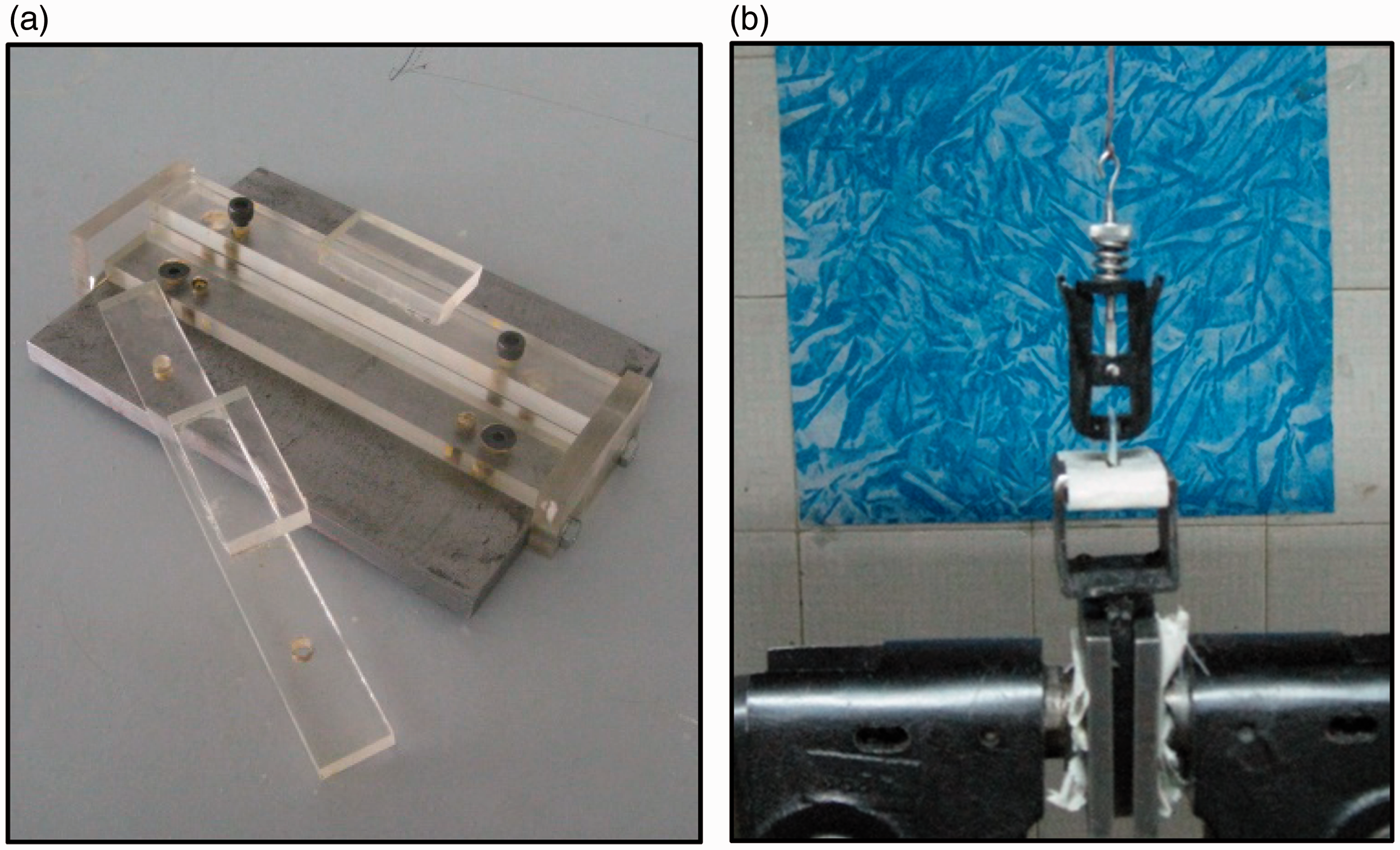
The effect of fiber types (PA6 and PA66) and supplementary cementitious materials were investigated. For this purpose, three different samples were produced: (1) without SCM, (2) containing flyash, and (3) containing silica fume. Thereafter, the effect of fibers embedment length on the bonding properties of fiber/matrix was evaluated.
Finally, the pullout energy of the samples was calculated from the surface area under the pullout load–displacement curves.
Scanning electron microscopy
Scanning electron microscopy (SEM) analysis was performed on the surface of the fibers before and after the pullout test in order to investigate the interfacial characteristics of the fibers and matrix.
Three-point bending test
Five specimens, containing 2 vol.% of short staple fibers, were produced by a special mold for each sample. The details have already been presented by the authors [13]. The effects of fiber types (PA6 and PA66) and fiber lengths (6 and 12 mm) were studied. The control sample (without fibers) was also prepared to investigate the effect of the presence of fibers.
The specimens with dimensions of 230 mm × 100 mm × 9 mm were cured at the temperature of 25 ± 2℃ and approximately 95 ± 5% relative humidity.
In order to study the flexural behavior of the samples, a three-point bending test was carried out using a Zwick-1494 machine based on EN 12467 standard [25]. The selected span length was 200 mm. Figure 3 shows the used setup for the three-point bending test.
Three-point bending test set up.
Finally, the flexural toughness of the samples was calculated from the surface area under the load–deflection curves using the trapezoid method.
Compression test
The mix design which is presented in Table 2 was applied to produce the cubic compressive specimens with dimensions of 50 mm × 50 mm × 50 mm. As illustrated in Figure 4, three specimens were prepared for each sample to ensure the reliability of the results. PA66 fibers of length 6 and 12 mm were utilized for this purpose. After curing, the compressive test was carried out using a Zwick-1494 machine (Figure 4(c)). The compressive toughness of the samples was calculated from the surface area under the compressive load–displacement curves.
(a) The molds, (b) specimens and (c) test set up, which used for compressive test.
Results and discussions
Pullout test
Figure 5 shows the pullout behavior of two different kinds of PA fibers from the fine aggregate cementitious composites containing fly ash. Although the first parts of the curves are coincident, the higher maximum pullout load has been obtained using PA66 fibers. It was found that the pullout length in the case of PA6 fiber is less than 5 mm. This means that the fiber has been ruptured during the test. This is while the PA66 fiber has been pulled out entirely which is accompanied by fiber extension. The second parts of the curves which show the mechanical involvement of fibers in the matrix are higher for the PA66 fiber. This leads to more pullout energy in comparison to the PA6 fiber.
Pullout load–displacement curve of the PA66 and PA6 fibers.
According to SEM analysis which can be seen in Figure 6, there are some hydrated cement and crystals on the lateral surface of PA6 fiber. Despite the groove on the PA6 fiber surface, there are more and deeper grooves on the lateral surface of another fiber. This is why the second part in the case of PA66 fiber has been improved compared to the PA6 fiber. In fact, the mechanical interaction between PA66 fiber and the matrix is more than any other.
SEM images of PA6 and PA66 fibers pulled out from fine aggregate concretes.
In addition to the fiber’s type, the mix design of the matrix is an important factor which has an effect on the properties of the composite.
In order to investigate the effect of fiber to matrix interaction, three different matrix mix designs were used and the pullout properties of fibers from the cementitious matrix were studied.
Generally, the application of fly ash increases the strength of the matrix. This is while using silica fume leads to matrix toughening. It has got a negative effect on the fiber’s pullout and increases the possibility of the fiber’s rupture during the pullout process. Although it has been already claimed that an increase in the strength of the matrix does not have a significant effect on the pullout load and energy [17], an increase in fiber pullout load and fiber–matrix bonding has been reported by some researchers [18].
The effect of SCM type on the results of fiber pullout test.

Due to the importance of pullout energy, it is necessary to obtain the optimum value of fiber embedment length which leads to the highest value of pullout energy and energy dissipation. According to the above results, the single fiber pullout test was performed on PA66 fibers with four different embedment lengths in the matrix containing fly ash.
As illustrated in Figure 7, embedded fibers in all the samples are pulled out completely and the processes are accompanied by the fiber extensions.
Pullout load–displacement curves of PA66 fibers with different embedment lengths.
Although the displacements are increased by an increase in the fibers embedment length, a unique procedure in the fiber pullout loads was not observed. This is while it had already been expressed that pullout load increases by an increase in fiber embedment length [10,26,27].
Similar results as the present study have been already provided by Peled et al. [28]. They have expressed that an increase in the length of polyethylene yarns (2.5–20 mm) leads to a decrease in bonding strength. Therefore, increment in pullout load by an increase in fiber length is not correct for all the textile products (fiber, yarn, or fabric). Thus, fiber–matrix friction is not the only mechanism which affects pullout load.
According to the results, the effect of fiber embedment length on pullout load is related to fiber types and properties. However, as shown in Figure 8, the pullout energy is increased by an increase in fiber embedment length which leads to higher energy dissipation achievement. This is attributed to the increase in the surface contact area between the fiber and matrix.
Relation between PA66 fibers embedment length and pullout energy.
As illustrated in Figure 9, improvement in pullout energy (E) is developed by an increase in the ratio of fiber embedment length (L/L1). Where L is the embedment length of fiber in each sample and L1 = 3 mm.
Relation between the improvement in pullout energy and fiber embedment length ratio.
The obtained curve shows a good correlation with a polynomial curve by the order of 3.
It should be noted that the bonding between PA66 fiber and the fine aggregates cementitious matrix is appropriate because none of the fibers have been ruptured during the pullout process. It was found that it is possible to use PA66 fibers as long as they are 10 mm in ECC matrix, while the maximum pullout length of 1 mm has been presented for polyvinyl alcohol fiber in previous researches [29].
Bending test
Results of the three-point bending tests on the composites containing PA6 and PA66 with 6 mm lengths are illustrated in Figure 10.
The effect of PA fiber types on the flexural properties of composites.
It is evident that the control sample is quite brittle similar to ordinary cement based materials. The addition of short staple fibers has improved the ductility of the composites. PA fiber-reinforced concretes have shown pseudo-strain hardening behavior. This means that the flexural load is increased even after the first peak in the load–deflection curves up to the second peak.
After the first crack creation, fibers bridge on the crack width, so the applied stress would transfer to the fibers and prevent crack propagation. This leads to energy dissipation and the composite can undergo more stress before failure.
Although the PA66 fiber had shown better performance in the pullout test compared to PA6 fiber, no significant differences were obtained in flexural properties of reinforced composites using these two different fibers.
However, the effect of fibers length on the flexural characteristics of the composites was investigated using PA66 fibers. Results are illustrated in Figure 11.
Load–deflection curves of composites containing PA66 fibers with different lengths.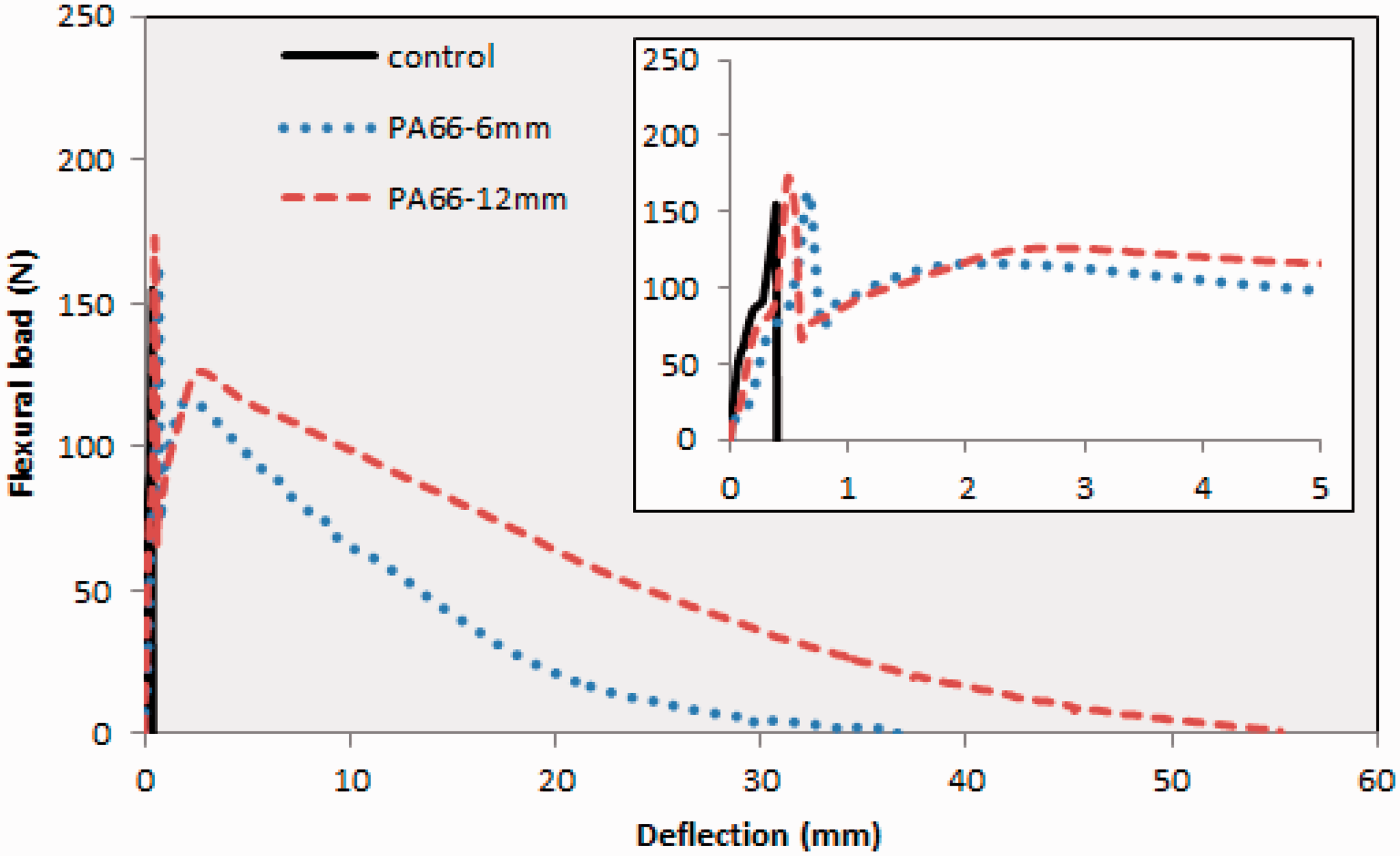
It is evident that an increase in fiber length has led to an increase in flexural deflection and hence the area under the curve. Generally, in the same volume fraction of the fibers, the number of fibers in the matrix decreases as the fiber length increases. Therefore, the surface contact area between the fibers and matrix decreases. This leads to a decrease in fiber–matrix bonding. On the other hand, increment in fiber aspect ratio (l/d) occurs with an increase in fiber length, which results in improvement in the crack width control and the flexural behavior of the composite.
As illustrated in Figure 12, the flexural toughness of the composite containing fibers with 12 mm length has increased 98% and 45% in comparison to the control sample and the composite reinforced by 6-mm-length fibers, respectively.
Flexural toughness of the composites reinforced by PA66 fiber with different lengths.
Compression test
According to previous researches, it was found that PA66 fibers are more effective than PA6 fibers in order to improve the mechanical properties of fine aggregates concrete. Therefore, 2 vol.% of PA66 fibers 6 and 12 mm in length were applied. The results are illustrated in Figure 13.
Results of compression test.
It was found that the compressive strength of the composite containing 12 mm fibers has increased compared to other samples, but there was no significant difference between the strength of the two other samples.
The control sample (without fiber) was damaged under compression stress while the PA66 12 mm fiber-reinforced concrete resulted in compressive strength of more than 90 MPa which was considerably higher than the compressive strength of regular concretes (i.e. between 3 and 50 MPa).
It is interesting to know that the compressive strength, which has been achieved in this study by applying low modulus PA66 fibers in the fine aggregate concretes, was obviously more than the compressive strength of ECCs reinforced by high modulus PVA fibers [30,31]. The maximum compressive strength of 75 MPa for the PVA-ECC composite has been presented by Wang and Li [30].
It was also found that the area under the compressive load–displacement curve (i.e. compressive toughness) of the reinforced samples has increased up to 50% in comparison to the control sample.
Conclusions
Two different polyamide fibers (i.e. PA66 and PA6) were used as reinforcement of fine aggregate concrete. The effects of fiber length and supplementary cementitious materials were also studied. The following results were concluded:
The pullout load and energy by PA66 fibers were obtained at 36% and 45% higher than PA6 fibers, respectively. Both pullout load and energy of PA66 fibers from the cementitious matrix containing fly ash were more than 30% higher than the matrix with silica fume. The pullout behavior of PA66 fibers from fine aggregate concretes increased by an increase in fiber embedment length up to 10 mm. Both PA fibers enhanced the flexural properties of the composites and showed pseudo-strain hardening behavior. The flexural toughness of 12 mm PA66 fiber-reinforced concrete were 98% and 45% higher than the control sample and concrete containing 6 mm PA66 fibers, respectively. PA66 fibers improved the compressive strength of the composites in a range of 15–60% compared to PVA fiber-reinforced ECCs. Application of the PA fibers improved compressive toughness of the concrete up to 50% compared to the control sample.
Footnotes
Declaration of Conflicting Interests
The author(s) declared no potential conflicts of interest with respect to the research, authorship, and/or publication of this article.
Funding
The author(s) received no financial support for the research, authorship, and/or publication of this article.