




Abstract
Nowadays, the advantages of staple fibers applied as reinforcement in cementitious composites are well known. The interaction of fiber to cement matrix affects on the mechanical properties of composites. In this research, bonding of three types of polymeric fibers (acrylic, polypropylene, and nylon 66) to a fine aggregates concrete has been studied. Single fiber pullout test was carried out to investigate the bonding and fiber–matrix adhesion. Afterwards, scanning electron microscopy was performed to characterize pulled out fibers surfaces. The effect of water-to-binder (w/b) ratio on the fiber–matrix bonding was also assessed. It was found that the pullout strength of acrylic fiber is more than polypropylene (29%) and nylon 66 (10%) fibers. It was also found that the pullout energy of polypropylene and nylon 66 fibers is 75% higher than the acrylic fiber. The best result of bonding strength was obtained at w/b ratio of 0.25. It was concluded that it is possible to improve the mechanical properties of concrete using low price polymeric fibers.
Introduction
Due to brittle nature of cement-based materials under flexural and tensile stresses, cracks are created and propagated in the cement matrix. For this purpose, textiles in the form of fiber, yarn, woven, and nonwoven fabric have been used as reinforcement in cementitious materials. This leads to decrease in crack creation and propagation, increase in toughness and ductility of the matrix, increase in energy absorption capacity, and increase in tensile/flexural strengths [1–4].
The composites have been characterized on the basis of their constituents including reinforcing fiber properties (i.e. elastic modulus, tensile strength, length, diameter, volume fraction), matrix properties (i.e. fracture toughness, elastic modulus, initial flaw size) and interfacial properties (i.e. bonding properties) [5].
The effect of fiber–cement bonding and interfacial adhesion on flexural/tensile performance of cement-based composites has been well known [4, 6–8].
A commonly used technique to investigate fiber to matrix interfacial bonding is single fiber pullout test [9]. Some researchers have assessed bonding properties and pullout behavior of fiber reinforced cement-based composites [10–15]. It has been found that various parameters affect flexural and pullout behaviors and damping energy capacity of the composites such as fiber type [16, 17–22], longitudinal and cross sectional shape of fiber [23–26], fiber length [23, 26–28], water-to-cement ratio [29, 30], curing age [16, 19, 23], loading velocity (strain rate) [31], etc.
Depending on the fiber type, fiber–matrix bond, and specimen age, the pullout curve exhibits slip hardening or slip softening behavior after fiber–matrix debonding [17, 30, 32].
It has been proved that the frictional bonding between fiber and matrix increased by application of fly ash [18]. It has been also shown that high bonding between fiber and matrix leads to fiber rupture during pulling out, the worst strain hardening, and multiple micro cracking performances [30]. In fact, differences in fibers hydrophilic nature lead to difference in their mechanical behavior.
According to the high prices of high modulus fibers it is necessary to replace them with some regular and low prices fibers as reinforcement in cement-based materials. In this regard, the influences of utilizing three different polymeric fibers (acrylic, polypropylene, and nylon fibers) and glass fibers in cement paste matrix have been investigated and the superiority of the polymeric fibers rather than the glass fibers on improvement of the mechanical properties of cement paste matrix has been presented [19]. However, there are a few researches on the effect of low modulus/price fibers on the characteristics of fine aggregate concrete [33].
The effect of fiber types on flexural behavior of fine aggregate cement-based concrete has been already studied by the authors using acrylic, polypropylene, and nylon 66 fibers [33]. It was found that acrylic fibers can improve the flexural strength of the concrete despite their low modulus. It was also found that the polypropylene and nylon 66 fibers increase the flexural toughness of the fine aggregate concrete. According to the good performance and low prices of the used low modulus polymeric fibers, it was concluded that the used fibers will be useful for utilizing in cement-based matrixes [33]. It should be noted that the flexural property of the fiber reinforced concrete is not the only important factor for determining the concrete characteristics. For this reason, in this study, single fiber pullout test was carried out to investigate the pullout behavior of three different polymeric fibers (acrylic, polypropylene, and nylon 66) from a fine aggregate concrete. Afterward the interfacial bonding of the fibers to cement-based matrix was studied using scanning electron microscopy (SEM) analysis. Finally, the effect of w/b ratio on the pullout behavior of nylon 66 fiber from fine aggregate concrete was studied.
Experimental
Materials and methods
In this research, three types of polymeric fibers (acrylic, polypropylene, and nylon 66) with equivalent diameter of 30 µm were used. The nylon 66 fiber produced by Saba Tire Cord Co. was used in this study. The polypropylene and acrylic fibers were manufactured by Behkoush Sepahan Co. and Iran polyacryl Co., respectively.
Figure 1 shows the longitudinal and cross sectional shapes of the used fibers. It is obvious that nylon 66 and polypropylene fibers have circular and triangular cross sections, respectively. The acrylic fibers which have been made in wet spinning process have kidney shaped cross sections. The effects of fibers cross sectional shapes on the properties of cement-based matrix have been already investigated [24, 34, 35].
Longitudinal and cross sectional shapes of (a) acrylic, (b) polypropylene, and (c) nylon 66 fibers.
Due to the effect of fibers cross sectional area on their pullout behavior from matrix, a program was written using MATLAB software [36] to determine the equivalent diameter of fibers. With this method, the fibers with almost equal diameters were selected for the present investigation.
Physical and mechanical properties of used fibers.

Chemical composition of used cement.

Fine aggregate concrete mix design proportions by weight for one sample.

Afterwards three w/b ratios of 0.2, 0.25, and 0.3 were used to investigate the effect of w/b ratio on the pullout behavior of nylon 66 fibers from fine aggregate concrete.
Specimen preparation
In order to investigate the pullout behavior of fibers from fine aggregate concrete the pullout specimens were produced by a special mold which is shown in Figure 2. Regarding to previous researches, 5 mm embedment length of fibers was selected [16, 19]. Five specimens were made and tested for each sample. The average data were observed as mean value of test result.
Designed mold for pullout sample preparation.
The produced specimens were cured at the temperature of 25 ± 2℃ and approximately 95 ± 5% relative humidity.
Specimen test method
To study the bonding and adhesion characteristics, single fiber pullout tests were carried out using an Instron 5566 machine with a 50 N load cell at the crosshead rate of 1 mm/min.
Figure 3 shows the pullout test setup schematically. Before testing, one end of embedded fiber was cut and another end was sandwiched between two small talc paper closes by a drop of glue (Figure 3(a)). This was performed for strengthening single fiber and to avoid fiber elongation (increase in the free length of the fiber) instead of fiber pullout during the test.
Schematic image of fiber pullout test setup.
Finally, the results of pullout test were presented in the form of pullout load–displacement curves.
The pullout energy of the samples was calculated from the surface area under the pullout load–displacement curves using the trapezoid method.
Results and discussions
Single fiber tensile test
Results of the single fiber tensile tests are presented in Figures 4 to 6.
Load–elongation curves of acrylic fibers. Load–elongation curves of polypropylene fibers. Load–elongation curves of nylon fibers.


Effect of fiber type on pullout behavior
To ensure the repeatability of the pullout test results, five specimens were tested for each sample. The average results were obtained based on five specimens that are shown in Figure 7.
Effect of fiber types on pullout behavior.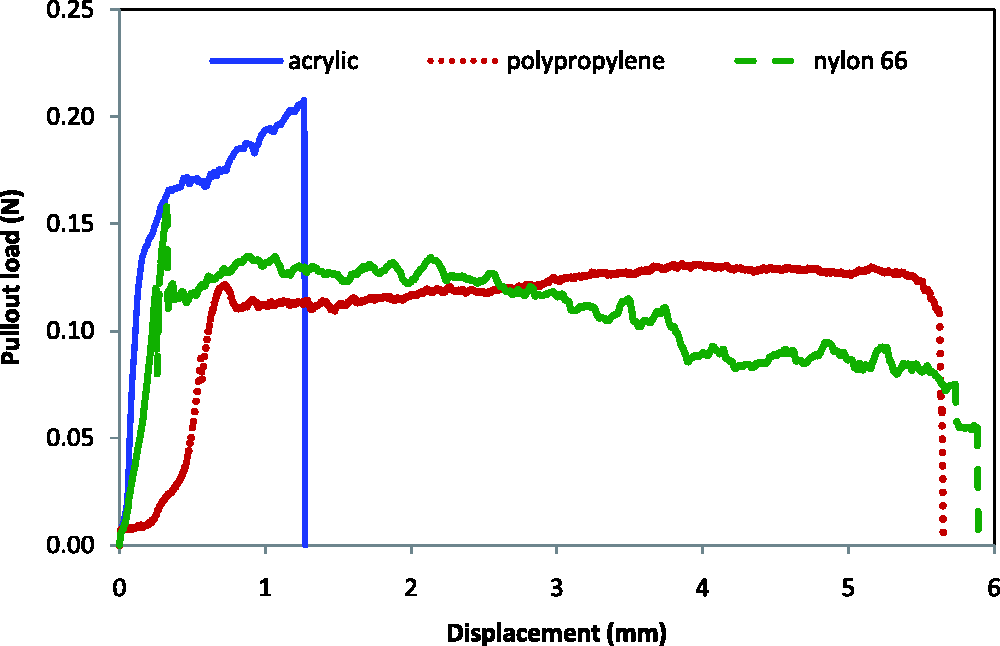
It is evident that the maximum pullout load of polypropylene fiber is less than other fibers and acrylic fiber shows the most value of pullout load. It can be attributed to the mechanical and chemical bonding between acrylic fiber and matrix [16, 19]. Moreover, kidney shape of acrylic fiber leads to increase in lateral surface at the same cross sectional area which helps to improve pullout load [38].
The pullout load–displacement curve shows three different zones. The first zone in the pullout load–displacement curve corresponds to the debonding process along the interface of fiber and matrix. The fiber–matrix debonding occurs completely when the maximum load is obtained. Afterwards the load drops suddenly and the second zone is formed. Finally, at the third zone, the friction between the fiber and matrix leads to resistance to fiber pullout [39]. However, it is seen that different fibers have been presented various behavior during pullout test.
The nylon 66 and polypropylene fibers were pulled out from the matrix, entirely. The fibers extend during pullout test, because the pulled out lengths are higher than fibers embedment lengths (i.e. 5 mm). However, in case of acrylic fiber, the configuration of pullout curve is similar to fiber tensile curve, i.e. acrylic fiber is ruptured during pullout test and it isn’t shown in the third zone in the pullout curve. This reveals high bonding between the acrylic fiber and cement-based matrix. Similar results have already been obtained using PVA fibers in the fine aggregate concrete and it has been proposed to decrease the embedment length of the fiber or decrease the value of fiber/matrix bonding by surface treatment to avoid PVA fiber rupture [12, 32]. Therefore, it seems that surface treatment on acrylic fibers in order to decrease the bonding between fiber and matrix may be useful to pullout acrylic fiber from matrix without rupture.
Results of fiber pullout test.

The lowest pullout energy has been obtained using acrylic fibers. The results attributed to rupture of these fibers under pullout test which caused lower surface area under the curve. Indeed, the calculated energy is not the pullout energy of the acrylic fiber and it is the energy expended for fiber breakage during the test.
Polypropylene and nylon 66 fibers showed the best pullout energy to the cement-based matrix. In fact, two factors affect pullout energy: interfacial interactions and loss function. Loss function is defined as the ability of energy waste at the interface of fiber and matrix, which is dependent on the modulus of elasticity, the fiber shape, and the fibers elongation. It should be noted that loss function is a dominant factor in pullout energy [6–8]. Although acrylic fiber has higher chemical interactions to cement matrix, loss function of this fiber is lower in comparison to polypropylene and nylon 66 fibers. It was attributed to the ability of these two fibers for elongation under tensile stresses instead of pulling out from the matrix.
In previous research [16] which had been focused on fiber pullout from cement paste, the lowest area under pullout load–displacement curve was obtained by polypropylene fiber, and nylon 66 fiber showed the highest value of area under pullout curve. These differences between the prior research and the present study should be attributed to differences in properties of cement paste and fine aggregate concrete.
It should be noted that the results of pullout test show good correlation with the results of flexural test which have been already obtained by the authors [33].
To investigate the interface of fibers and matrix, pullout surface of all three fibers was analyzed by SEM. As shown in Figure 8, nylon 66 fiber deforms during pullout process. This means that mechanical interactions occurred between the fiber and the matrix helps to wasting energy and increase in mechanical friction.
SEM images of the nylon 66 fiber pulled out from cement-based matrix.
It should be noted that no nucleation on fiber lateral surface is shown. Hence, chemical reaction and thus chemical bonding between fiber and matrix is negligible.
Some grooves are performed on polypropylene fiber lateral surface which are suitable for mechanical friction to matrix (Figure 9). It can be also seen that some crystals nucleation has occurred on the fiber surface.
SEM image of the polypropylene fiber pulled out from cementitious matrix.
Figure 10 shows surface image of acrylic fiber pulled out from matrix. On lateral surface of pulled out fiber, a large number of hydrated particles and crystals of hydrated cement paste can be seen. The presence of these materials was attributed to hydrophilic nature of both fiber and matrix. This observation reveals high chemical bonding between acrylic fiber and cement-based fine aggregate matrix which is accompanied by high pullout strength.
SEM image of acrylic fiber pulled out from cementitious matrix.
Effect of w/b ratio on pullout behavior
Water-to-binder ratio is an effective factor on determination of concrete properties. Figure 11 shows the pullout behavior of nylon 66 fibers with 5 mm embedment lengths from three specimens with different w/b ratios.
Pullout load–displacement curves of nylon 66 fibers from specimens with different w/b ratio.
It is evident that the pullout energy and pullout load values are decreased with increase in w/b ratio (Figure 12). The size of the crystals on fiber lateral surface is increased with increase in water content, which led to decrease in fiber–matrix interfacial strength. Decrement in fiber–matrix involvement during fiber pullout leads to decrease in fiber–matrix bonding and adhesion. Therefore, the best pullout behavior is obtained by the specimen with w/b ratio of 0.2, according to the pullout curves.
Results of pullout test for specimens with different w/b ratio.
Figure 13 shows the SEM images of pulled out nylon 66 fibers from two different matrixes with w/b ratio of 0.2 and 0.3. It is obvious that the crystals nucleation and the crystals sizes in the matrix with w/b ratio of 0.3 are considerably higher than another one.
SEM images of pulled out nylon 66 fiber from matrix (a) w/b = 0.2 and (b) w/b = 0.3.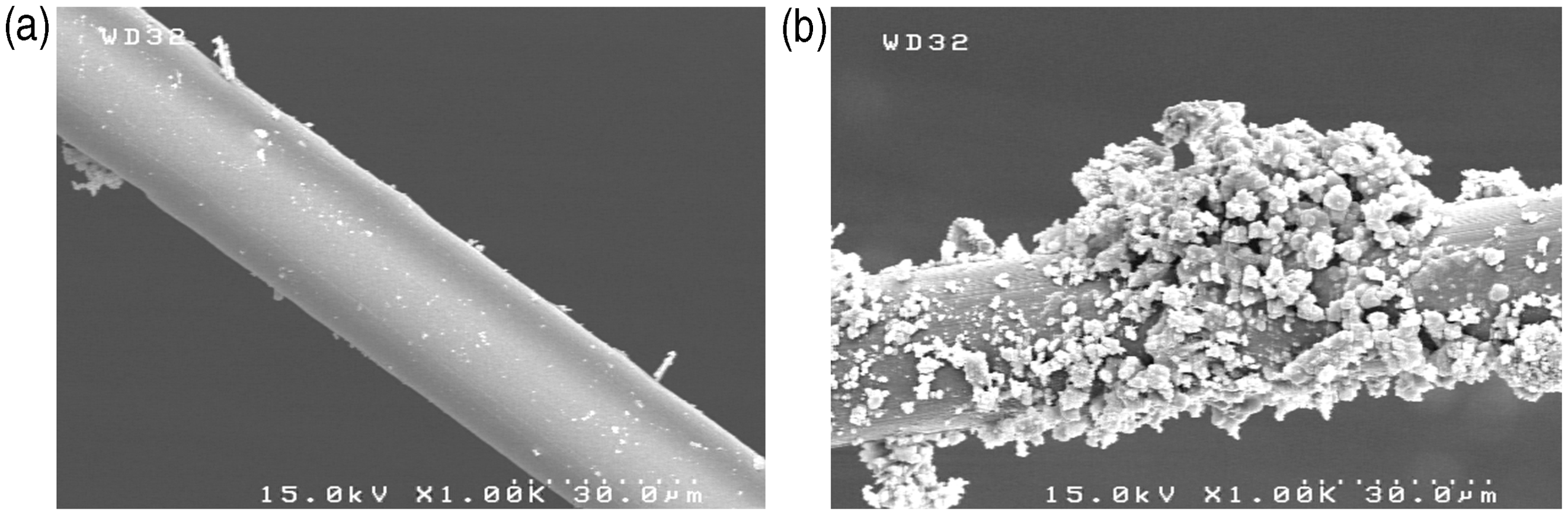
It should be noted that the consumedly decrease in water content leads to toughening of the matrix, difficulty in mixing procedure and non-uniformity of fibers dispersion. Therefore, it seems that w/b ratio of 0.25 is an optimum value which is appropriate for producing fiber reinforced fine aggregate concrete with appropriate pullout behavior.
Conclusions
In this study, three types of low modulus polymeric fibers were embedded in a fine aggregate concrete. Pullout behavior, bonding, and pullout energy of these fibers to the matrix were investigated and the following conclusions were obtained:
Acrylic fibers showed the highest pullout load but they were ruptured during the pullout test. It was concluded that a surface treatment should be used for these fibers to decrease the chemical adhesion and increase the pullout energy. Polypropylene fibers despite of the lowest pullout load have the highest pullout energy due to their ability for energy dissipation and increase in loss function. Nylon 66 fibers due to their higher modulus of rupture have lower chemical interactions to cement matrix than the acrylic fibers. It leads to lower pullout load in comparison to acrylic fibers. However, similar to polypropylene fibers, nylon 66 fibers have much higher pullout energy than acrylic fibers. The w/b ratio of 0.25 was obtained as the optimum value for producing the fiber reinforced fine aggregate concrete with appropriate pullout behavior.
Therefore, according to the above results and the previous conclusions [33], it is possible to use low price nylon 66 fibers as reinforcement in fine aggregate concretes to obtain the concrete with improved behavior.
Footnotes
Declaration of Conflicting Interests
The author(s) declared no potential conflicts of interest with respect to the research, authorship, and/or publication of this article.
Funding
The author(s) received no financial support for the research, authorship, and/or publication of this article.