




Abstract
The effect of fiber cement interactions and its influence on flexural and tensile properties of cementitious composites are well known. In this research, acrylic fibers with different cross sectional and longitudinal shapes and different tensile strengths were selected as reinforcement of the specific fine aggregates concrete. Three point bending test, pullout test, and scanning electron microscopy were used to investigate flexural and pullout behavior of the composites. It was found that flexural toughness and pullout strength were increased 20% and 34%, respectively, by application of kidney shaped acrylic fibers in comparison to dog bone shaped acrylic fibers. It was also found that the flexural and pullout strength of composites containing non-crimped fibers are 33% and 26.5% higher than specimens with crimped fibers, respectively. Results showed that the flexural toughness and pullout strength of high tenacity fiber is 75% and 131% higher than regular fiber as well, respectively. The effect of fine aggregates on the adhesion of fibers to cement matrix was evaluated.
Introduction
Nowadays, the advantages of staple fibers as reinforcement of cementitious composites are well known. Mechanical properties of fiber reinforced cementitious composites (FRCCs) are affected by several parameters such as fiber (type, volume fraction, and diameter), matrix (strength, stiffness, and elastic modulus), and interfacial properties. It has also been found that fibers improve tensile, flexural, impact, and shear behaviors and other mechanical properties of reinforced mortars and concretes [1]. Generally, fibers play two important roles in cement based composites; improving the flexural/tensile properties and preventing crack creation and propagation in the cement matrix by bridging on the micro cracks [2]. For this purpose, polymeric fibers such as acrylic [3–5], polyethylene [6], polypropylene [7–10], polyvinyl alcohol [11], and nylon [4,12] have been used.
Fiber to matrix bonding is an important parameter that affects composite performance. Therefore, many studies focused on fiber–matrix bonding and their interfacial adhesion [13,14]. Fiber geometry is an important factor that affects the bonding strength and adhesion of fiber to cement based materials and thus mechanical performance of cementitious composites [7,15–19]. Fiber geometry modification may be achieved by altering the fiber longitudinal feature (i.e. by indentation, crimping, and hooking the end, etc.) [7,11,20,21] or by modifying fiber cross sectional shape (i.e. changing shape factor).
Naaman [22] defined a fiber intrinsic efficiency ratio (FIER) for fibers which can be calculated as follows:

Where ψ, L, and A are the fiber perimeter, the fiber length, and cross sectional area of fiber, respectively.
The composite properties were studied by modeling of steel fibers with different cross sectional shapes (i.e. circular, triangular, square, and polygonal). It was found that fibers with typical polygonal cross sectional shape had the highest FIER and were more effective than circular fibers in contribution to the post cracking response of the composite [22]. On this basis, a factor named “shape factor” is presented for acrylic fibers with two cross sectional shapes [23]. The value of the factor, which is presented in equation (2), was calculated as 1.3 and 1.16 for kidney shaped and dog bone shaped acrylic fibers, respectively.
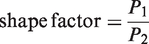
The pullout mechanism of fibers from the cement based matrix contains two different parts; breaking chemical bonds and mechanical interlocking. The strength value of the matrix, geometry, and type of fibers are effective parameters on the straight fiber pullout mechanism. For deformed fibers (in longitudinal direction), mechanical involvement and specific geometry play important roles on pullout behavior [23].
Naaman [22] believes that any longitudinal deformation which can increase the lateral surface of fiber (in an equivalent cross sectional area) will increase the bonding and frictional force and will thus raise the pullout strength. Therefore the longitudinal shape of fibers is a key factor for determination of composite properties as well as cross sectional shape.
Fiber’s tensile strength and modulus are parameters which affect the composite characteristics as well. Fibers ability to bear the tensile stress increases by an increase in specific strength or tenacity of fibers which is defined as the ratio of tensile strength over linear density. This leads to an increase in flexural strength but a decrease in flexural deflection.
In general, the effect of fibers’ tensile properties and fiber geometry on fiber–cement bonding has been investigated by few researchers. However, there are not clear explanations about the effect of aggregates on fiber to cement bonding. In this research, the influence of aggregates presence on bonding of acrylic fiber to the cement matrix in fine aggregate concrete was investigated. The effect of the acrylic fiber cross section (kidney shape and dog bone shape) and longitudinal shape on bonding strength in the presence of fine aggregates was also evaluated. Finally, the influence of fibers tension on the concrete was studied as well.
Experimental procedures
Materials
Chemical composition of the used cement.

Physical and mechanical properties of acrylic fibers.

The cross sectional and longitudinal shapes of acrylic fibers were characterized with optical microscopy (OM), the results of which are shown in Figure 1. Due to the effect of fibers diameter on flexural behavior of composites, equivalent diameter of the fibers was determined. Equivalent diameter is the diameter of a circle that its cross sectional area is equal to the fiber cross sectional area. Because of differences in fibers’ cross sections a program was written by MATLAB software which counted the number of existing pixels in each fiber's image and then the equivalent diameter of each fiber was calculated by image processing [24]. For each sample, 30 fibers were used at least, but the maximum numbers of used fibers were obtained according to the amount of their cross sections unevenness.
Images of acrylic fibers cross sectional and longitudinal shapes obtained by optical microscopy, (a) kidney shaped and (b) dog bone shaped acrylic fibers.
Methods
Determination of fiber tensile properties
The single fiber tensile test was carried out on fibers using Instron 5566. The span length was 30 mm according to ASTM D3822-07 [25] and 10 specimens were tested for each sample.
Fiber reinforced concrete mix design

Specimen preparation
Flexural test specimens
After mixing the FRC ingredients as per Table 3, the ingredients containing acrylic fibers with 12 mm in length were casted into a special mold which was designed and produced during this research (Figure 2(a)). Five specimens were prepared in each sampling, which caused an increase in the production rate and reproducibility of the specimens.
Designed mold for (a) flexural and (b) pullout sample preparation.
Dimensions of the specimens were 230 × 100 × 9 mm. The specimens were cured at the temperature of 25 ± 2℃ and approximately 95 ± 5% relative humidity.
Pullout test specimens
Pullout test samples were prepared into a special mold (Figure 2(b)). Five specimens were made and tested for each sample. The average data was observed as the mean value of the test sample. In the prior researches [4,27], the fibers with 10 mm length had been used for pullout test and it was suggested to decrease the embedment length. So, the embedment length of fibers used for pullout test was selected 5 mm in this study.
Test method
Three point bending test
The three point bending tests were carried out using a Zwick-1494 machine based on EN 12467 standard [28] with 200 mm span length.
The flexural toughness of the samples was calculated from the surface area under the stress–deflection curve using the trapezoid method. The deflection capability of the samples from the horizontal axis of the flexural stress–deflection curves was determined as the ductility of the composite samples.
Pullout test
Single fiber pullout tests were carried out using an Instron 5566 machine with a 50 N load cell and at crosshead rate of 1 mm/min.
The bonding energy between the fibers and cement matrix was calculated from the surface area under the pullout stress–length curves using the trapezoid method.
Results and discussion
Fiber tensile properties
Results of the single fiber tensile tests are shown in Figures 3–5.
Load–elongation curves of fibers with different cross sectional shapes. Load–elongation curves of fibers with different longitudinal shapes. Load–elongation curves of fibers with different tension.

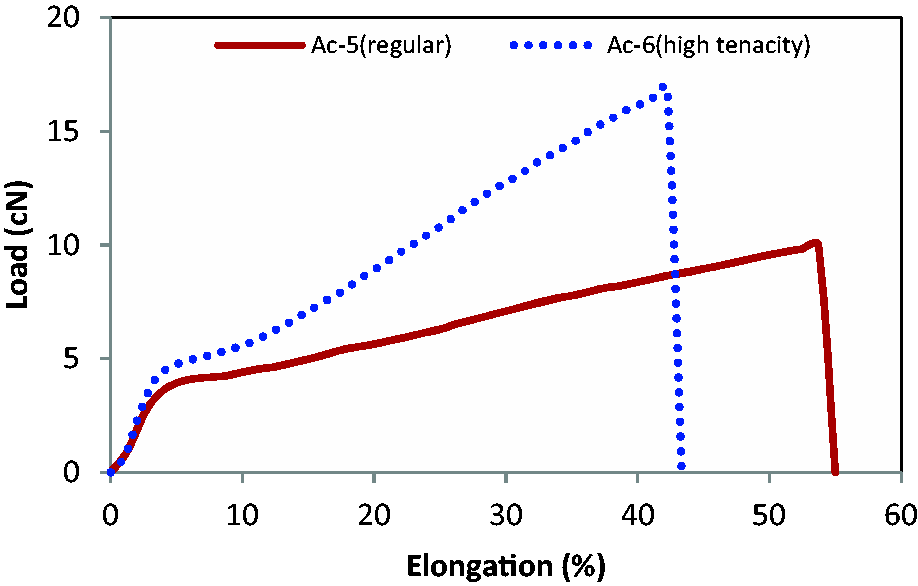
It is evident that the used fibers show the viscoelastic behavior and high range of tensile strain. According to the previous research [5], the high strain capability of the fibers will be useful for improving the mechanical behaviors of fiber reinforced cement based concrete.
Three point bending test
To ensure the repeatability of the flexural test results, five specimens were tested for each sample. High accommodation in the all five curves obtained from the five specimens for each sample demonstrates the dispersion uniformity of the fibers within the cementitious matrices. The average results were obtained based on five specimens that are shown in the figures.
Effect of fibers cross sectional shapes
Results of the three point bending tests of the control sample (fine aggregate FRC) and the samples containing acrylic fibers with two different cross sectional shapes (Ac-1 and Ac-2) are illustrated in Figure 6. As expected, the control sample was brittle similar to ordinary cement based materials and its deflection was less than 0.45 mm. The flexural strength of the control sample was about 6 MPa. It is evident that the flexural behavior of samples has improved with the use of acrylic fibers. The flexural strengths of both fiber reinforced concretes are 24% higher than the strength of the control sample. It is obvious that application of the acrylic fibers strongly improved the flexural deflection of samples in comparison to the control sample. However, the first crack occurred in all specimens. Although it was expected to observe strain hardening behavior in the samples containing acrylic fibers, tension softening behavior was obtained. This could be attributed to low modulus of acrylic fiber.
Flexural stress–strain curves of specimens reinforced by fibers with different cross sections.
The first ascending part in any stress–deflection curve is attributed to chemical bonding between fiber and the matrix which is dependent on fiber type and fiber/matrix interaction. Usually the second part is attributed to mechanical bonding which is dependent on fiber mechanical/physical properties and mechanical involvement between fiber and matrix [2,20].
It was found that kidney shape fibers showed better performance compared to dog bone shaped acrylic fibers. This could be related to their higher shape factor as has already been demonstrated [23].
According to the prior research [23], the flexural strength of cement paste reinforced with kidney shape acrylic fibers was about 3.8 MPa which had 74% incensement in comparison to the control sample (without fiber). According to the results of Figure 6, the flexural strength of the fine aggregate concretes reinforced with the same fibers was about 7.6 MPa. It is clear that the flexural strength of the samples containing kidney shaped acrylic fibers has been increased more than 100% due to the presence of fine aggregates.
The results of the flexural toughness of the samples are shown in Figure 7. It is clearly evident that the presence of the fibers has changed the materials from brittle to tough form.
Flexural toughness of specimens reinforced by different cross sectional shaped fibers.
The chemical bonding part of both fiber reinforced samples were consistent (see Figure 6), but the mechanical bonding part and the second peak of the specimens reinforced with kidney shaped fibers were more than dog bone shaped fibers containing specimens.
Effect of fibers longitudinal shapes
Results of flexural test of specimens containing Ac-3 and Ac-4 fibers.

Generally, it is expected to obtain an increment in the flexural toughness because of changes in fibers longitudinal shape due to an increase of mechanical involvement. At first, the applied force is expended to open the crimps of fibers and then it is led to fibers elongation. Therefore, the fibers ability to overcome the stress and crack width is increased. On the contrary, crimped fibers showed lower flexural deflection compared to uncrimped fibers (see Figure 8).
Flexural stress–strain curves of specimens reinforced by fibers with different longitudinal shapes.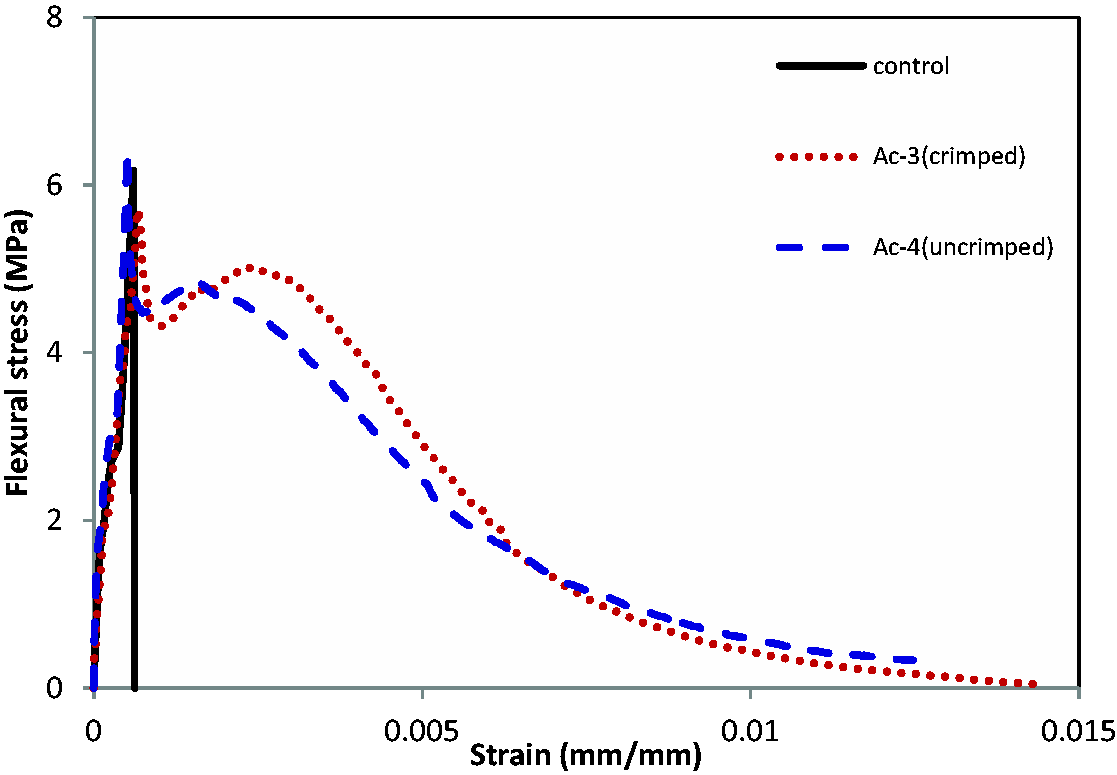
It was found that the changes in fibers longitudinal shape has no effect on the composites flexural toughness which was attributed to the lower modulus of acrylic fibers in comparison to the stiff matrix. However, a pseudo-strain hardening behavior was observed in the specimens reinforced with crimped fibers.
Effect of fibers tension value
Results of the three point bending test of specimens containing polyacrylonitrile (PAN) fibers with two different tensile properties (Ac-5 and Ac-6) are illustrated in Figure 9.
Flexural stress–strain curves of specimens reinforced by fibers with different tension.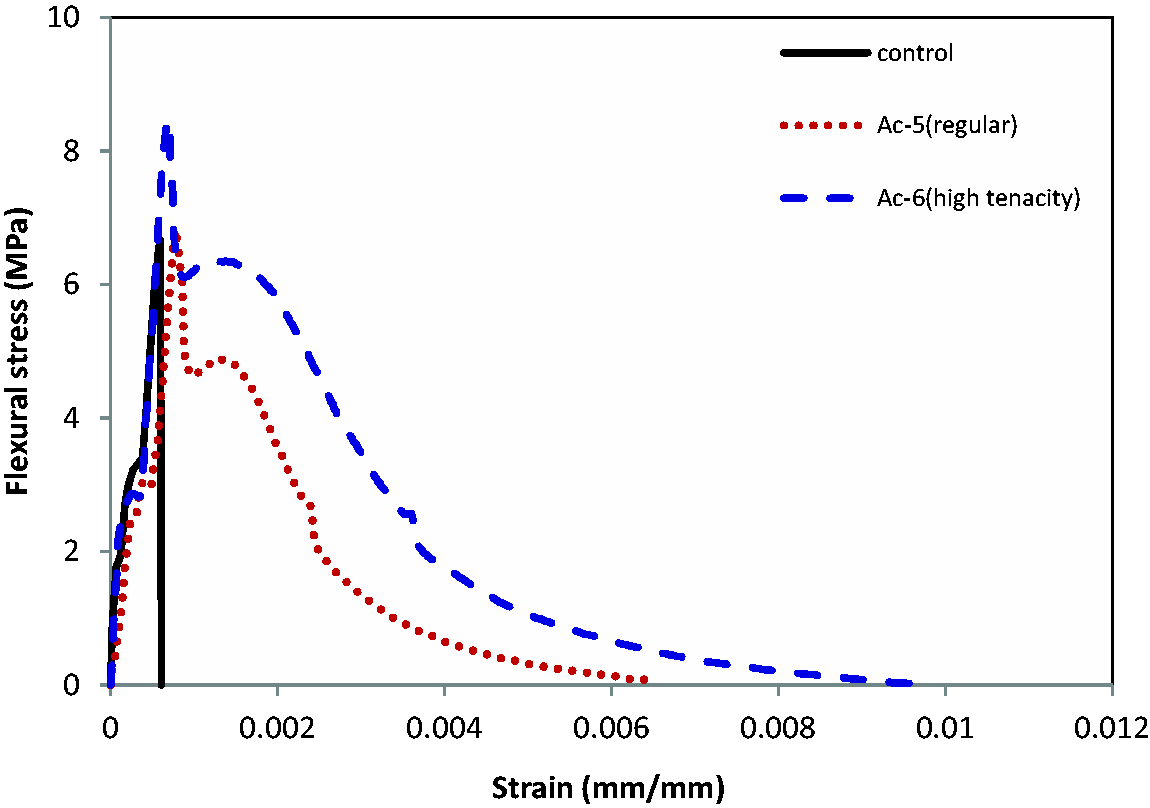
According to the results, the flexural strength of the sample containing high tenacity fibers is more than another one, as it was expected. It is evident that the flexural strength of the composite containing high tenacity PAN fibers is increased about 20% compared to the composite reinforced with regular fibers and the control sample.
Results of flexural test of specimens containing Ac-5 and Ac-6 fibers.

The flexural toughness of specimens with high tenacity fibers is increased 75% in comparison to specimens containing regular PAN fibers. The application of high tenacity PAN fibers improved flexural behavior of the composite.
Pullout test results
Effect of fibers cross sectional shape
Results of pullout test of fibers with different cross section.

As illustrated in Figure 10, it is evident that pullout strength and pullout length of the kidney shaped fiber are 34.4% and 26.7%, respectively, more than the dog bone shaped fiber. It was seen that results of the pullout test of the fiber from the cement based matrix in presence of fine aggregates agreed to the trend that has already been presented for pullout behavior of acrylic fibers from cement paste [23].
Pullout stress–length of fibers with different cross sections.
Since the embedment length of acrylic fibers had been selected as 5 mm, and the fiber pullout length is less than 1.5 mm, it is obvious that acrylic fibers had been ruptured during the pullout test and total pullout has not occurred for these fibers. This can be attributed to high bonding strength between the acrylic fiber and matrix.
It is found that the bonding energy of the kidney shaped fiber is twice more than the dog bone shaped fiber. This can be attributed to the existing groove in kidney shape acrylic fibers which is responsible for the mechanical interaction in matrix fine particles and cement hydrated products. Furthermore, at the same equivalent diameter, kidney shaped acrylic fiber has higher lateral surface area and shape factor compared to the dog bone shaped fiber [23]. This leads to a greater fiber–matrix interfacial interaction which is accompanied by an increase in surface area under the stress–pullout length curve.
In fact lateral surface area and shape factor are the effective parameters in order to determinate pullout behavior of composite specimens, while chemical characteristics and fibers modulus should be concerned with the addition of shape factor in case of flexural behavior.
Effect of fibers longitudinal shape
Results of pullout test of fibers with different longitudinal shape.
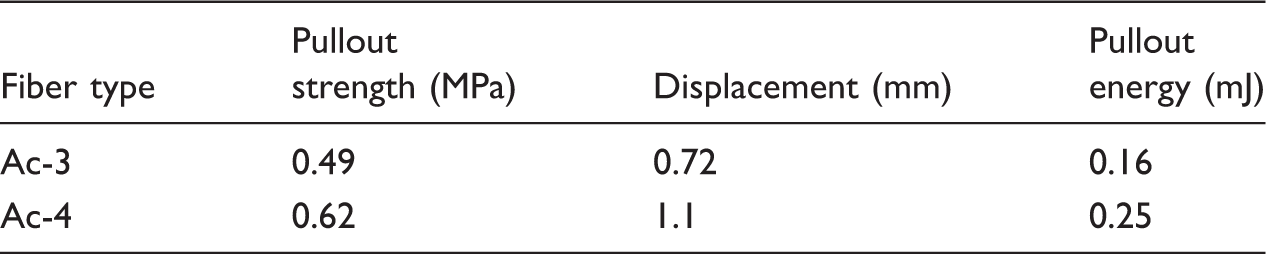
It was expected that crimped fiber shows much better performance in comparison to uncrimped fiber during the pullout test; because a part of the pullout force should be applied to straighten up the crimps of the fiber. In this case, loss of energy and the area under the pullout curve should be increased, but results showed that uncrimped fiber showed higher strength and bonding energy compared to crimped fiber (see Figure 11).
Pullout stress–length of fibers with different longitudinal shapes.
This should be attributed to the fact that fiber to matrix adhesion is composed of two different parts; chemical interactions and mechanical interactions. In the acrylic fiber case, the chemical interactions are too high which cause fiber breakage during pullout before they involve mechanical interactions. It was proposed to decrease the fiber–matrix bonding value similar to PVA fibers in the ECC matrix [29–31] to give them the opportunity of total pullout and involvement in mechanical interactions.
A few fibers such as polypropylene and steel fibers have been previously used to investigate the effect of longitudinal shape of fibers on fiber–matrix bonding behavior [7,20]. Naaman [22] has expressed that the effect of fibers longitudinal shapes is more perceptible in the low strength matrix. While in the present research the addition of fly ash in the matrix mix design led to an increase in composite strength, the high strength of the matrix and low modulus of the acrylic fiber caused a decrease in the performance of crimped fiber in reinforced concrete.
Effect of the fibers tension value
Results of pullout test of fibers with different tension.

The pullout strength of high tenacity PAN fiber was twice more than regular PAN fiber which can be attributed to higher value of its tensile strength. It was found that the displacements of both fibers were less than 1 mm as shown in Figure 12. This means that both PAN fibers were ruptured during the pullout test which is ascribed to high bonding strength between fibers and the matrix.
Pullout stress–length of fibers with different tensile behaviors.
The pullout energy of the specimens containing high tenacity PAN fiber increased more than 75% in comparison to regular PAN fiber.
Scanning electron microscopy (SEM) analysis
SEM was performed on the surface of the fibers before and after the pullout test in order to investigate the fibers/matrix interface (Figures 13–15). As illustrated in Figure 13, the existing groove in the kidney shaped acrylic fiber (Ac-2) can be assumed as a suitable place for interlocking with cement hydrated products, which lead to better pullout behavior.
SEM images of fiber with kidney shape cross section. SEM images of fibers with different longitudinal shapes. SEM images of fiber with different tension values.


It is obvious that crystals of hydrated cement are nucleated and grown on the lateral surface of the fiber which is attributed to the hydrophilic nature of the acrylic fiber and its affinity to the cement based matrix. This observation reveals high chemical bonding between acrylic fiber and the fine aggregate cement based matrix, which is accompanied by high pullout strength.
Results of SEM images of Ac-3 and Ac-4 fibers after the pullout test are illustrated in Figure 14. It is evident that matrix particles created more grooves on the lateral surface of uncrimped fiber which has led to higher bonding energy in comparison to crimped fiber (Ac-3).
Figure 15 shows images of Ac-5 and Ac-6 fibers after the pullout test. It is evident that crystals formation on high tenacity PAN fiber is extremely higher than regular fiber which leads higher pullout characteristics.
Conclusions
On the basis of the tests the following results were concluded:
Application of both kidney and dog bone shaped acrylic fibers considerably improved flexural behavior of the fine aggregate concrete but higher flexural toughness (about 20%) was obtained in the case of reinforcement with kidney shaped acrylic fibers. In contrast to expectations, altering the longitudinal shape (by crimp creation) did not have any positive effect on the mechanical behavior of the composite and the flexural and pullout strength of composites with crimped fibers were 33% and 26.5% higher than the specimens containing uncrimped fibers, respectively. Application of the high tenacity acrylic fibers considerably improved the flexural and pullout behavior of the composite even compared to the samples reinforced by fibers with two times diameter.
Footnotes
Declaration of Conflicting Interests
The author(s) declared no potential conflicts of interest with respect to the research, authorship, and/or publication of this article.
Funding
The author(s) received no financial support for the research, authorship, and/or publication of this article.