




Abstract
In order to improve the functionality of certain defective characteristics of polypropylene polymer and fiber, their blends are analyzed physically and chemically both in the industry and the academia. There are fibers obtained from two different polymer blends and additive-added fibers in the polypropylene fiber industry. The aim of this study is to obtain polymer blends and their fibers, which consist of isotactic polypropylene and linear low-density polyethylene. In order to improve the blending of isotactic polypropylene and linear low-density polyethylene, ethylene vinyl acetate was added in the blend at different concentration such as 1, 5, 10, and 15% by using a twin-screw extruder. Polymer blends and their fibers were produced from the blends with different ratios of blending. Besides, the mechanical properties including strength, elongation, modulus of elasticity, yield of strength, Izod impact strength, hardness, thermal properties (differential scanning calorimetry and melt flow index), and morphological properties (scanning electron microscopy) of polymer blends and their fibers were investigated.
Introduction
Polymer blends constitute an important technique that is used in the industry. Binary or ternary polymer blends are made in order to substitute the defective characteristics of the homopolymers.
It is possible to blend polymers under certain conditions by only blending them under certain conditions or by utilizing appropriate compatibilizers. Polymer blending also has several advantages, such as cheap, easily processable, and specific properties, that can be obtained depending on the composition and preparation methods [1].
In polymer blends, the objective properties are the compatibility among fibers to which several types of engineering and the basic fiber properties are closely related [2,3]. A compatible blend can be defined as one with stable morphology and one or more useful properties for particular applications. In general, blends are binary or ternary systems with either similar or different molecular characteristics. The blends of polyolefin groups stand out in terms of both the academic and industrial interest due to their simple applicability in the industry and the wide range of usage areas (polymer chips, plastics, fibers, films, etc.). In order to improve the morphology and properties of blends as much as possible, the key issue is to establish the proper relationship between them.
Polypropylene (PP) fibers have several significant properties and applications [4]. PP fibers are used in domestic and industrial fields such as carpet backing and ropes because of their low cost and excellent mechanical properties [5] but PP fibers lack some properties for special application fields. In order to improve the properties of polyolefin fibers, polymer blends are used. For this purpose, since 1960, polyethylene and polyisobutylene polymers have been mixed with PP [6]. PP fiber is undyeable because of its non-polar, aliphatic structure as well as its high crystallinity and high-stereo-regularity (which are responsible for the physical properties of the material), which limit the accessibility of dye molecules [7].
When PP and EVA (two distinct and important commercial polymers) were blended, a semi-crystalline thermoplastic and an elastomer were obtained. Dutra et al. [8] reported that good mechanical properties were obtained from PP/EVA fiber blends.
According to these studies, when the mechanical properties of PP/LDPE polymer blend fibers are improved [9], the mechanical properties of PE/PA6 blend fibers are improved with an increase in the PA6 % [10], and the elasticity modulus of PP/EVASH (poly(ethylene-co-vinyl alcohol-covinyl mercaptoacetate)) blend film is increased [11]. The enthalpy values of P/LDPE blend fibers decreased with LDPE blend content [12,13].
The other way to improve mechanical, dyeability, thermal, and surface properties involves the manufacture of polymer blend fibers [14]. By blending PP with a polymer that contains functional characteristics, it is possible to develop fibers with good adhesion, mechanical, and dyeing properties. In this respect, EVA should be a good candidate for improving the adhesive properties of PP fibers because of the presence of the acetate group active sites. In addition, as recently reported this copolymer acts as an impact modifier for isotactic PP [15] and may also be used as a compatibilizing agent in PP/polyethylene blends [16].
Ethylene vinyl acetate, an elastomer, is a candidate known to modify the processing of organic–inorganic blend polymers and to balance the improvements in impact strength and stiffness, which have been achieved in several plastic products. Dutra et al. [17] found that PP fibers blended with a small amount of EVA showed higher elastic modulus than that of pure PP fibers. A similar improvement in mechanical properties was also found in colored PP fibers with the addition of hyperbranched polymer [18]. Gupta et al. [19] reported the melt-rheological properties of PP/EVA blends by varying the blend ratios and using EVAs with altered vinyl acetate content. Good dispersion of EVA spherical droplets in the PP matrix was found. The mean diameter of the dispersed droplets is affected not only by the blend ratio but also by the shear stress. We previously reported the rheological properties of blends of PP, zeolite, and EVA [20]. It was found that compared to those of PP/zeolite binary systems, the apparent viscosities of the blends could be lowered when the content of vinyl acetate in EVA was judiciously controlled. Furthermore, surface modification of zeolite with coupling agents substantially influenced the viscosity of blend systems, and use of polar coupling agents resulted in lower apparent viscosity because of the better interaction between the coupling agent and EVAs.
In this study, EVA that was added in the blend consists of different ratio of LLDPE and iPP at different concentration. Polymer blends and their fibers were produced, and then the properties of polymer blends and their fibers were investigated. In this study, the different ratios of iPP/LLDPE/EVA ternary polymer blends of the first are fibers. The use of EVA elastomer in different ratio of provided improvement in the mechanical characteristics of the blending. The iPP/LLDPE/EVA blending fibers are considered to be used in the fiber industry.
Experimental
Materials and polymer blends and their fibers sample preparation
The nominal compositions of the iPP/LLDPE/EVA blend.

Production conditions of polymer blend fibers.

Process parameters used in injection press molding of tensile test specimens.

Testing and characterization of polymer blends and fibers
Mechanical tests
Polymer blends and fibers were produced using a Hamdiboy (Turkey) extruder and spinneret. The test samples were prepared in accordance with the ISO 294 standard by using an NMC injection-molding machine (NMC Group, Canada). Polymer blends and fiber tensile tests were conducted according to ASTM D 3822 at a crosshead speed of 10 mm/min, and polymer blends’ tensile strength and impact strength tests were conducted according to ISO 527.2 at a crosshead speed of 50 mm/min and ISO 180 standards, respectively, using Zwick brand machines. The MFI values were obtained according to ASTM D 1238 using Ceast test equipment.
Thermal analysis
Differential scanning calorimetry (DSC) tests were performed on a Perkin Elmer. Samples of the original polymer and fibers were heated at a rate of 10℃/min−1 from 50℃ to 220℃ (melting) and increased the heating from the room temperature to 220℃ and hold for 5 min. Then start cooling to room temperature and again hold for 5 min; again, heat the samples to 220℃. (crystallization). After that, the sample was immediately heated from 0 to 200℃ at 10℃/min (melting). Data were collected in parts of melting.
Thus, a melting endotherm of the original samples with the melting temperature T m and melting enthalpy ΔH m was obtained. Subsequently, the sample was exposed to second heating at a rate of 10℃/min−1, and an endotherm with melting point T m and melting enthalpy ΔH m was determined. There was nitrogen atmosphere during the measurements.
For the LLDPE, iPP, and EVA samples, the degree of crystallinity was calculated via the total enthalpy method according to equation (1)

Morphological properties
The morphological (SEM) properties of samples were analyzed with JEOL JSM-T330 instrument, which operated at 5 and 10 kV, according to TS EN ISO 9220 standard. The samples were coated with gold in order to increase the conductivity.
Results and discussion
Result of mechanical properties
The mechanical properties of the polymer blends and their fibers are shown in Figures 1 and 2. The mechanical properties of the polymer blends and their fibers are obtained by comparing the ratios of the EVA elastomer. According to the tensile strength, the yield strength, elongation, and elasticity modulus of the samples (fibers) were increased with increasing the EVA content. The mechanical properties of the blend fibers were increased by comparing to 100% iPP and LLDPE polymers. Good compatibility was obtained between iPP and LLDPE polymers by adding EVA elastomer. It is seen in the literature that iPP/PE iPP/HDPE blends have increased the tensile, flexural, and impact properties [24,25].
Changes in the mechanical properties of iPP/LLDPE/EVA polymer blend fibers. Changes in the mechanical properties of iPP/LLDPE/EVA polymer blends.
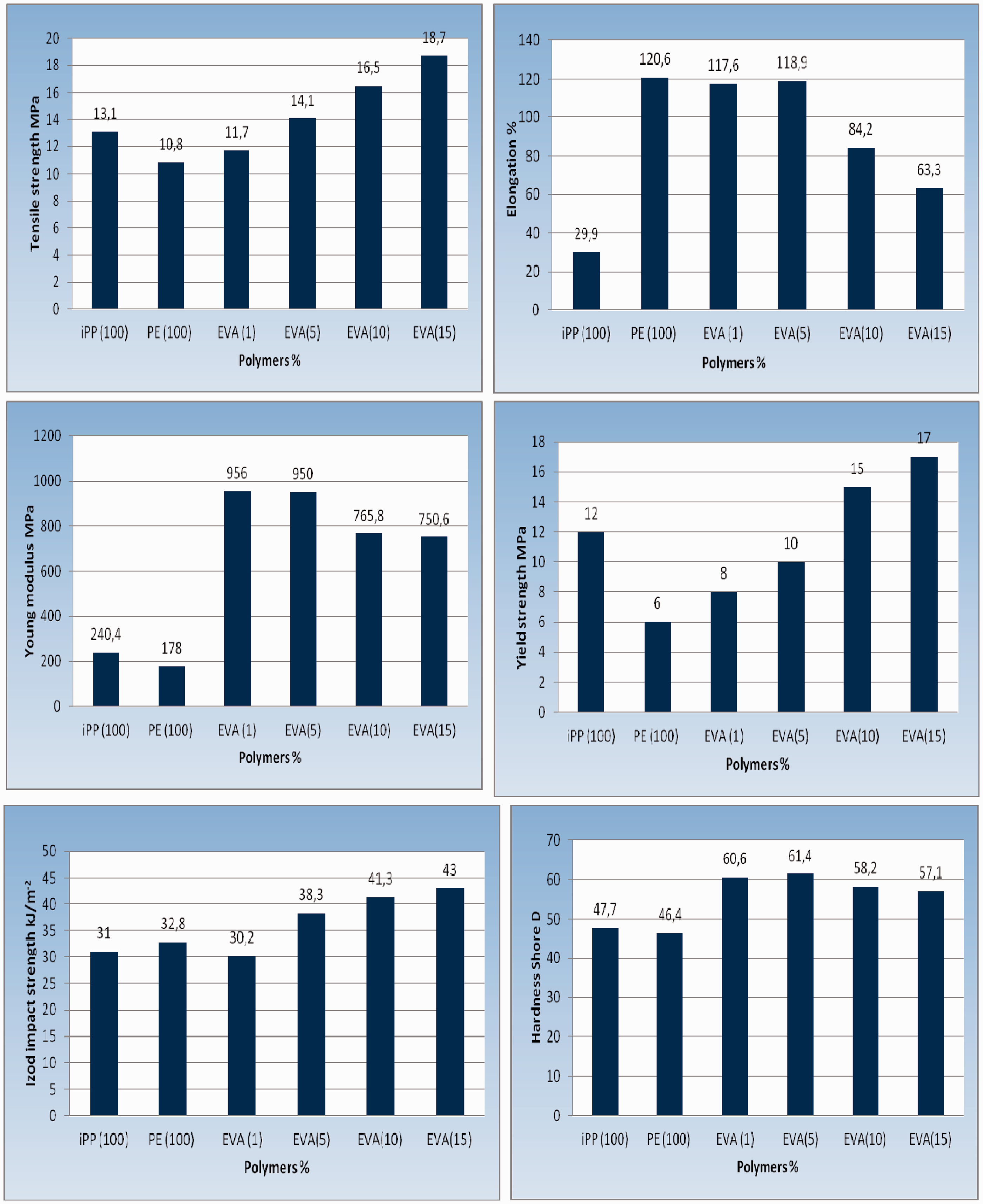
The same improvements were obtained in the binary blend of iPP/EVA and PE/EVA polymers. EVA elastomer was used to improve the surface adhesion of the binary blend fibers by adding it to iPP polymer, and good results were obtained [26,27].
In this study, the results demonstrated that increasing the EVA content affected the mechanical properties of the fibers. The reason for that is the orientation of the molecular chains of the fibers, which occurred during the fiber spinning. EVA increased the amorphous structure, LLDPE, and iPP polymers that built the crystalline structure of the fiber, and the final structure of the textile fiber was obtained successfully.
As shown in Figure 2, the tensile strength properties of the iPP/LLDPE/EVA polymer blends increased with increasing EVA content, but elongation properties of the polymer blend decreased [28–30].
The reason is that the linear structure of the LLDPE polymer affected the tensile strength properties positively, but decreased the elongation properties. About 5% addition of EVA elastomer is the optimum content for the elongation properties of the polymer. The yield strength, impact strength, and hardness strength (Shore D) properties of the polymer blends increased by increasing the EVA content. EVA elastomer built good compatibility between iPP polymer and LLDPE polymer [31]. It is known that EVA polymer has compatibility properties, and it increases the mechanical properties of the blend polymers [32]. The adhesive properties of the EVA elastomer come from the acetate groups of the polymer [33,34].
Thermal properties
Melt flow index
MFI values of iPP/LLDPE/EVA polymer blends.
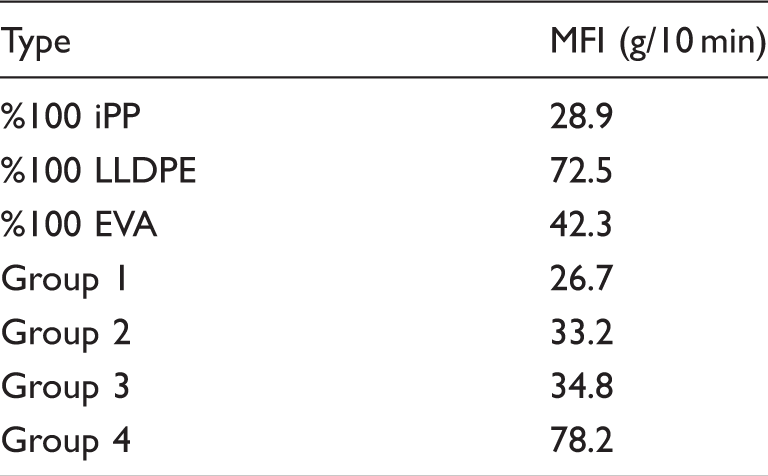
The MFI values (g/10 min) of polymers obtained at 230℃ and under 2160 g load increased by increase in LLDPE and EVA ratios. The highest improvement was obtained at 15% of EVA.
The value of MFI of 100% iPP polymer is low. However, the value of MFI of group of polymer blends increased because of the increase in the concentration of LLDPE and EVA polymers and decrease in the concentration of iPP polymer. In addition to these, the low density of LLDPE caused to increase of value of MFI of group of polymer blends [34–36]. It is also correlated with Tc point properties (Table 4).
DSC observations
The thermal analysis results of the iPP/LLDPE/polymer blends and fibers’ DSC analysis results at the first heating and second heating (heating rate = 10℃ min−1) were obtained from Tm (melting temperature) and ΔHm (melting enthalpy) peak. (%) Xc is the degree of crystallinity.
Endotherms were obtained at the first heating. Anisotropic components of iPP/LLDPE/EVA blend fibers contain two single peaks, which correspond with the melting and crystallization behavior of fibers (Figure 3). The endotherm obtained at the second heating corresponds to blend fibers and has a similar shape to those obtained during the first heating (Figure 4).
Melting (Tm) temperature of components in anisotropic iPP/LLDPE/EVA polymer blend fibers at the first heating (heating rate = 10℃ min−1). Melting (Tm) temperature of components in isotropic iPP/LLDPE/EVA polymer blend fibers at the second heating (heating rate = 10℃ min−1).

Tm values of the iPP polymer decreased by increasing the EVA content, and generally, the optimal Tm peaks were obtain at the first and second heating of LLDPE polymers. The influence of EVA on the melting temperature of the PP and LLDPE components may be attributed to a partial miscibility of blend components in the melt state [37].
By increasing the EVA elastomer content, the Tm values of the groups increased.
When Figures 5 and 6 are investigated, ΔH
m
values of the iPP, LLDPE, and EVA polymers decreased relative to their 100% structure at the first anisotropic heating. At the second isotropic heating, ΔHm values increased due to the increased content of the LLDPE polymer and increased the content of the EVA in the groups [38,39].
Melting enthalpy (ΔHm) of components iPP/LLDPE/EVA polymer blend fibers at the first heating (heating rate = 10℃ min−1). Melting enthalpy (ΔH
m
) of components iPP/LLDPE/EVA polymer blend fibers at the second heating (heating rate = 10℃ min−1).

When Figure 7 is investigated, the contribution of the EVA elastomer to X
c
crystallinity properties is quite great. Increased EVA content in the groups affected the X
c
crystallinity properties of the LLDPE and iPP polymers. The reason for that are the good adhesion and compatibility properties of the EVA elastomer in iPP and LLDPE polymers.
iPP/LLDPE/EVA polymer blend fibers Xc (%) is the degree of crystallinity.
According to Figures 8 and 9, the Tm values of the iPP, LLDPE, and EVA polymers were decreased at first and second heating, the same as with the iPP/LLDPE/EVA polymer blends. However, depending on the increased EVA content, Tm values increased at the first and second heating in groups.
Melting (Tm) temperature of components in anisotropic iPP/LLDPE/EVA polymer blends at the first heating (heating rate = 10℃ min−1). Melting (Tm) temperature of components in isotropic iPP/LLDPE/EVA polymer blends at the second heating (heating rate = 10℃ min−1).

According to Figures 10 and 11, the ΔHm values of the iPP/LLDPE/EVA polymer blends decreased. However, ΔHm values increased according to the iPP, LLDPE, and EVA content in groups. For example, the ΔHm value of group 4, which contained 15% EVA elastomer, also increased.
Melting enthalpy (ΔH
m
) of components iPP/LLDPE/EVA polymer blends at the first heating (heating rate = 10℃ min−1). Melting enthalpy (ΔH
m
) of components iPP/LLDPE/EVA polymer blends at the second heating (heating rate = 10℃ min−1).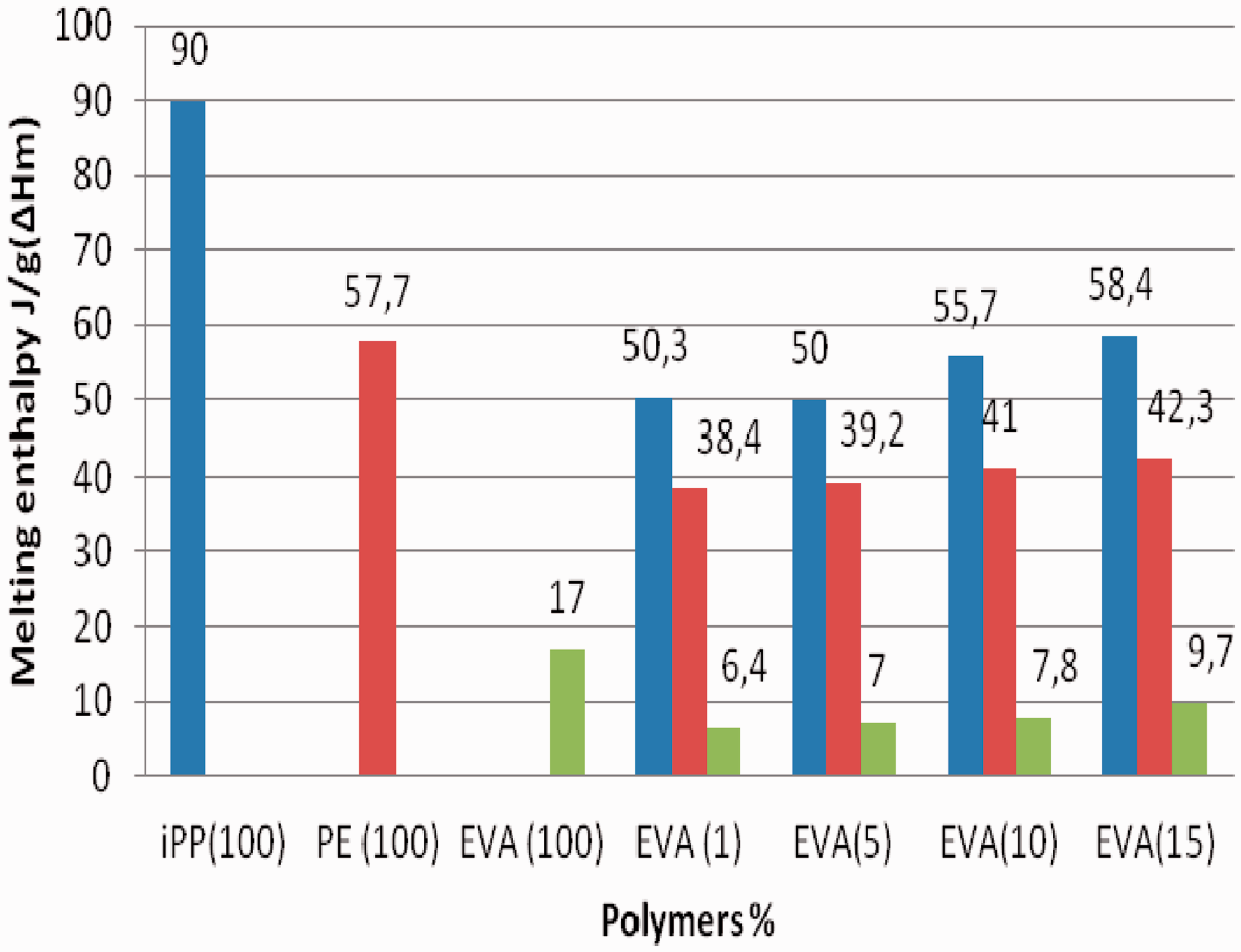

From Figure 12, it was seen that increasing the EVA content affected the crystallinity degree of the iPP/LLDPE/EVA blend polymers. The effect of the increased EVA content on the crystallinity degree is clearly seen in group 4. The reason for that are the compatibility and intermolecular bonding properties of the EVA polymer [40].
iPP/LLDPE/EVA polymer blends X
c
(%) is the degree of crystallinity.
Morphological characteristics
The fracture surfaces of the polymer blends and fibers were examined via SEM in an attempt to correlate the mechanical properties to the micro structural characteristics. Figure 13 shows the micrographs taken from the fracture surfaces of the four polymer blends studied.
SEM micrograph revealing the appearance of the fracture surfaces of the iPP/LLDPE/EVA polymer blend fibers.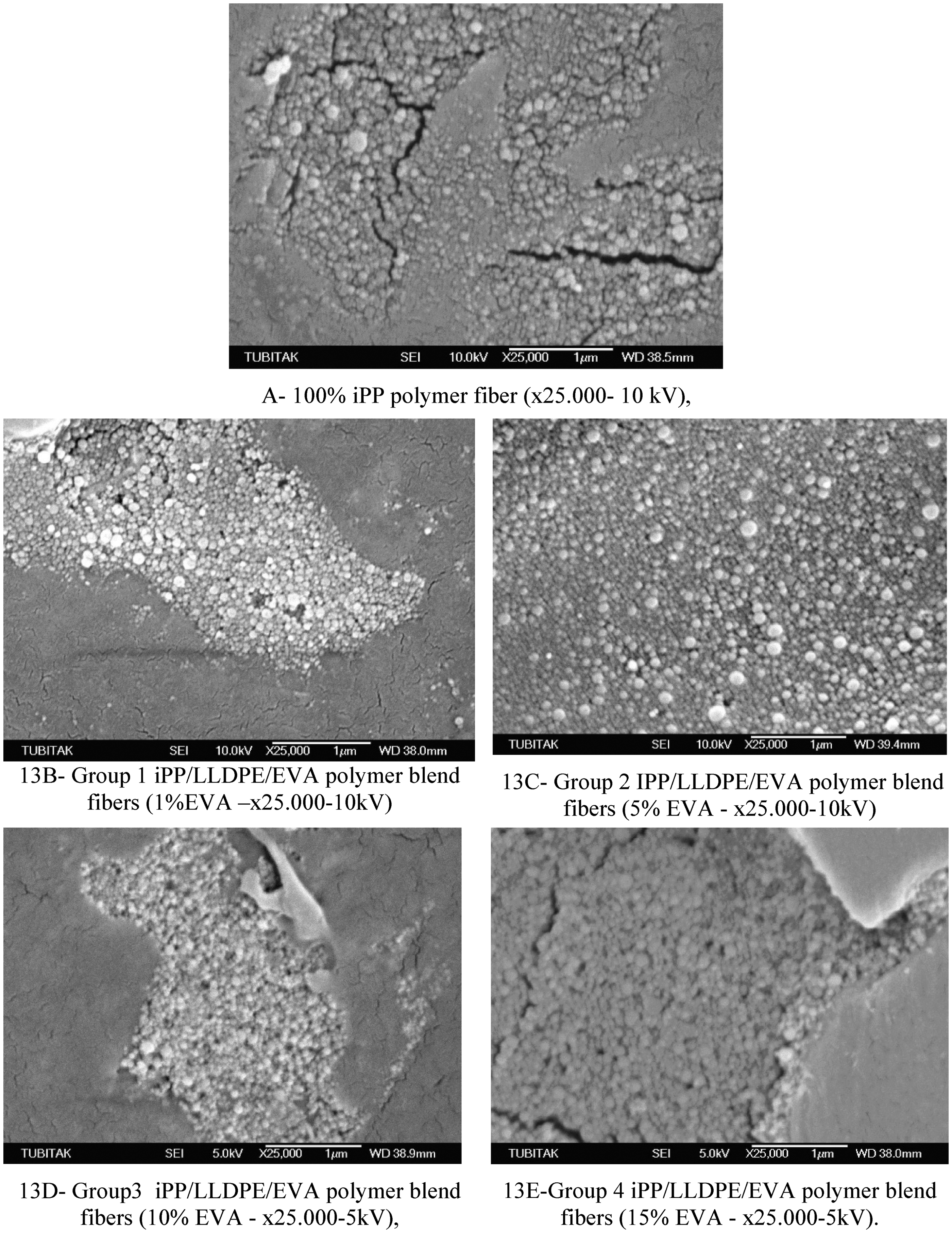
Figure 13(a) to (e) shows the surface of iPP, the surface of 1% EVA, the surface of 5% EVA, the surface of 10% EVA, and the surface of 15% EVA, respectively. The results demonstrated that the increase of EVA caused iPP and LLDPE to become dispersed form. This clearly indicates that the blends are not miscible. The increase in EVA concentration caused to occur well connects the surfaces. According to Figure 13(e), it is shown that iPP and LLDPE polymer surfaces are more close, and the adhesion of surfaces is very high. The increase in EVA concentration caused both the increase in adhesion of polymers and compatibility of polymers.
Conclusions
When the mechanical values of polymer blends and their fibers are evaluated, it can be seen that the strength and elongation properties of polymer blend fibers improve by increasing the EVA content. Elasticity and yield modulus results verify the same improvement.
Yield, Izod impact, and hardness values of iPP/LLDPE/EVA polymer blends improved too.
The tensile strength, the yield strength, elongation, and elasticity modulus of the fibers were increased by increasing the EVA content.
Using EVA affected the results in a better way in all polymer and fiber blends. The reason for the improvement in mechanical properties is the excellent adhesion between iPP and LLDPE obtained by using EVA with increasing content. Also, the homogeneity of the blend improved the mechanical properties in a better way.
When the thermal values of blends and their fibers are evaluated, enthalpy values increased depending on the increase in EVA ratio. Again, enthalpy values increased with decreasing iPP ratio. Enthalpy values were higher in all groups of both polymers with EVA ratio increases. The effect of EVA elastomer on crystallization of blend was observed.
When the mechanical, thermal, flow, and morphological properties of the polymer blends and their fibers are evaluated, it can be clearly seen that fibers give better results than polymer blends. This is due to orientation during drawing giving better mechanical and thermal properties. EVA concentration also helps to improve orientation.
Footnotes
Declaration of Conflicting Interests
The author(s) declared no potential conflicts of interest with respect to the research, authorship, and/or publication of this article.
Funding
The author(s) received no financial support for the research, authorship, and/or publication of this article.