




Abstract
In this review, a summary of documented research on immersion suits (i.e. constant wear, abandonment suit and diving suit) is presented. Particular emphasis was placed on research regarding the performance and analysis of these protective suits. Heat loss from the human body is critical for the protection of the wearer of the suit during cold water immersion, while thermal stress can be experienced by the pilots or helicopter rescuers when wearing immersion suits under normal or hot environmental conditions. In addition, the knowledge gaps have been identified in the aspects of environmental hazards, development of novel textile materials, garment design features and test methods. The key factors that are fundamental to thermal insulation of immersion suits have been summarized. Efforts for improving thermal insulation have been presented. Three-dimensional body scanning, as a new approach being used to understand and improve fit and sizing of garment, may contribute to a better understanding of thermal protection and thermal comfort of immersion suits. The simulation of real open sea scenario to test thermal performance of textiles poses a big challenge for researchers. This article reviews what is known about immersion suits, describes future development trends and identifies domains for improving performance of immersion suits and testing methods.
Introduction
Terminologies related to immersion suits. a

Till the middle of the 19th century, little attention was paid to personal thermal protection in the marine accidents, where people were dead in cold water. A safety suit for crews of ocean vessels was the first record of a survival suit in 1930s, when American Life Suit Corporation offered safety suits to merchant and fishing firms. During the First World War, 12,000 Royal Navy sailors, 10,000 merchant seamen and 5000 Germans were dead because of being drown in the cold water [7]. Later, the Royal Canadian Air Force developed basic immersion suits for their Trans-Atlantic ferry pilots and Frankenstein's in the UK mainly for their Hurricane pilots on the Murmansk convoys [8]. These basic immersion suits were simply constructed with a leather or neoprene fabric closed by a waterproof zipper and rubber seals at the neck and wrist. The introduction of cotton ventile fabric later was superseded by Gore-Tex® and introduction of the reliable waterproof zip in the 1980s [9]. After the 1980s, second-generation suits were being developed, mainly being applied to the offshore oil industry.
It was recorded by the International Labour Organization that 24,000 fishermen died each year, which was attributed to drowning because of inability to stay afloat and exposure to cold [10]. In addition, inadequate thermal protection can severely limit survival time in cold water. It is recommended by the Canadian General Standard board that immersion suits should protect aircrew for a minimum of 6 h against hypothermia during immersion in icy water and that immersion suits should provide an immerse insulation of 0.75 Clo to achieve this level of protection [2]. The immersed insulation value of garments could be affected by the following factors: posture, movement, wind, clothing fit, water leakage and wave motion [11,12]. The determination of how these factors influence the clothing insulation value and immersed insulation value and the principle behind the phenomenon needs further study.
Hazards related to immersion suits
Cold water
Being immersed in cold water is one of the major hazards to ship passengers, rescuers and helicopter pilots. When resting in water, the thermal balance of the human body can only be attained at 35℃ [13]. The body's response to cold water immersion progresses from an initial stress situation to eventual hypothermia or even death, depending on time and intervention. The cold environment can cause chilling and result in a reduced cognitive ability with progressive cooling. When the temperature of a human being subjected to hypothermic anesthesia decreases to 34℃ in core temperature, amnesia occurs for the period of cooling below that temperature. Cold hands or feet, confusion, inability to perform simple tasks, loss of memory, reduced strength and cessation of shivering while still cold are the indicators to monitor in order to avoid life-threatening situation.
The various physiological changes associated with water immersion in a stepwise fashion can be classified into four stages – initial immersion, short-term immersion, long-term immersion and post-immersion [14]. The severity of the physiological changes in each of the stages will rely on a number of factors: water temperature and current, body movement, individual features and protective gears.
The most sensitive issue for the performance of rescuers is hand temperature. Unfortunately, dexterity and thermal comfort are competing priorities in rescuing [15]. Severe cooling of the hands and feet affects physical performance and impairs the ability move [16]. This loss of dexterity can occur very fast (5–10 min if hands are inadequately protected) [17]. Protection of hands is critical in terms of studying the protection afforded by immersion suits.
Heat and mass transfer related to immersion suits
Heat loss is critical for a wearer's thermal protection as well as thermal comfort during cold water immersion. Heat transfer occurs in the presence of a temperature gradient among body, clothing and the environment and the relative movement of water in which the body is placed. In water, convection and conduction are the dominant heat transfer modes and evaporation also contributes as a mass transfer by convection. Heat transfer modes are shown in Figure 1.
Heat transfer between body and environment, reproduced from Stinton [18].
Conduction is heat exchange within a substance or between the skin and the surrounding surfaces with which the skin is in direct contact. One of the major heat exchanges in water occurs by means of conduction with the surrounding water [19]. Water has a high specific heat and value of conductivity. The thermal conductivity of water is 25 times greater than that of air and it absorbs body heat approximately 3500 times greater than air of the same volume. Factoring in evoking physiological responses, such as vasoconstriction that may compromise the intensity of heat transfer, humans cool 2–5 times faster in water compared with air at the same temperature [17].
Convection is the transfer of energy between a surface and the bulk motion of a fluid (gas or liquid). Convection can be caused either by an external source (e.g. fan) or a natural source where heat exchange is induced by differences in buoyancy and density. Warmer water next to skin flows away and is replaced by cold water. There is forced convection caused by currents or from moving through this water [20]. Convective heat transfer of the human body (hc) is an essential factor to evaluate the amount of convective heat exchange between the human body and its environment. In the presence of winds and waves, heat flow increases significantly compared with calm water [21–23].
Evaporation is the process by which energy transforms liquid to gas. Even when at rest, humans lose approximately 500–850 ml of fluid through the skin daily, so-called insensible sweating. In this process, as moisture collects in undergarments, transdermal loss undermines the insulation of the suits. As depicted in Figure 1, next to the surface of the skin, the diffused water through the skin forms a boundary water vapor layer, which is saturated at 100%, while the inner surface of the immersion suit is at a relatively lower temperature and the air layer next to it holds less moisture [18]. A vapor pressure gradient is created, moving water vapor across the microenvironment to the direction of the immersion suit that eventually condenses on the inner side of the immersion suit. The high thermal conductivity of sweat contributes to the degradation of thermal insulation of immersion suits and leads to a high conductive heat loss.
Water ingression
The average suit insulation was significantly higher for all dry conditions when compared with wet conditions [24]. When water ingresses the suit, as little as 500 ml of water can reduce the immersed Clo value by 30%; 500 ml could wet out 20% of the surface area. Suits lost insulation significantly in the wetting area [25]. Cold strain can occur if the immersion suits does not provide sufficient insulation or the vapor transfer is limited, resulting in wet skin or damp garment, which may lead to a higher conductive heat loss. Many researchers have investigated on the effect of water leakage on physiological response of the human body and thermal insulation of immersion suits [21,26,27]. However, how water ingress influences the thermal performance properties of the fabrics, the interaction between the layers and the thermal performance of the entire garment in the water and the mechanisms behind the phenomenon still need to be investigated.
Hydrostatic pressure
Depending on different using conditions, the wearers of immersion suits may not encounter as high pressure as the divers may experience in deep sea. Hydrostatic pressure influences thermal insulation in two ways: (a) it may compress the suit system, reduce the thickness, squeeze the air lying in between the fabric layers and therefore undermine thermal insulation and (b) it may squeeze the air trapped in the microenvironment, which is critical to thermal insulation of immersion suits. Hence, immersed Clo value was used to characterize thermal insulation of immersion suits instead of Clo [1,2]. However, little literature exists to the relevance of the impact of hydrostatic pressure on immersion suits. Several studies have been conducted in diving dry suits to help define the impact of hydrostatic pressure on clothing performance. It was found that diving suits lost 57% of their insulation through hydrostatic squeeze when human body was immersed to the neck [28]. The influence of hydrostatic pressure gradient on insulation was investigated [29,30]. Pressure can be critical when selecting potential materials for dry suits. As shown in Figure 2, without pressure, two examples of high-loft materials with the highest Clo value lost 80–90% of their insulations when a load as small as 35 cm water (3447 Pa) was applied. This was mainly due to significant decrease in thickness of materials, critically influencing the thermal insulation of fabrics.
Effect of hydrostatic pressure gradient on thermal insulation (determined in accordance to ASTM C-177). The water pressure applied here was 3447Pa [18].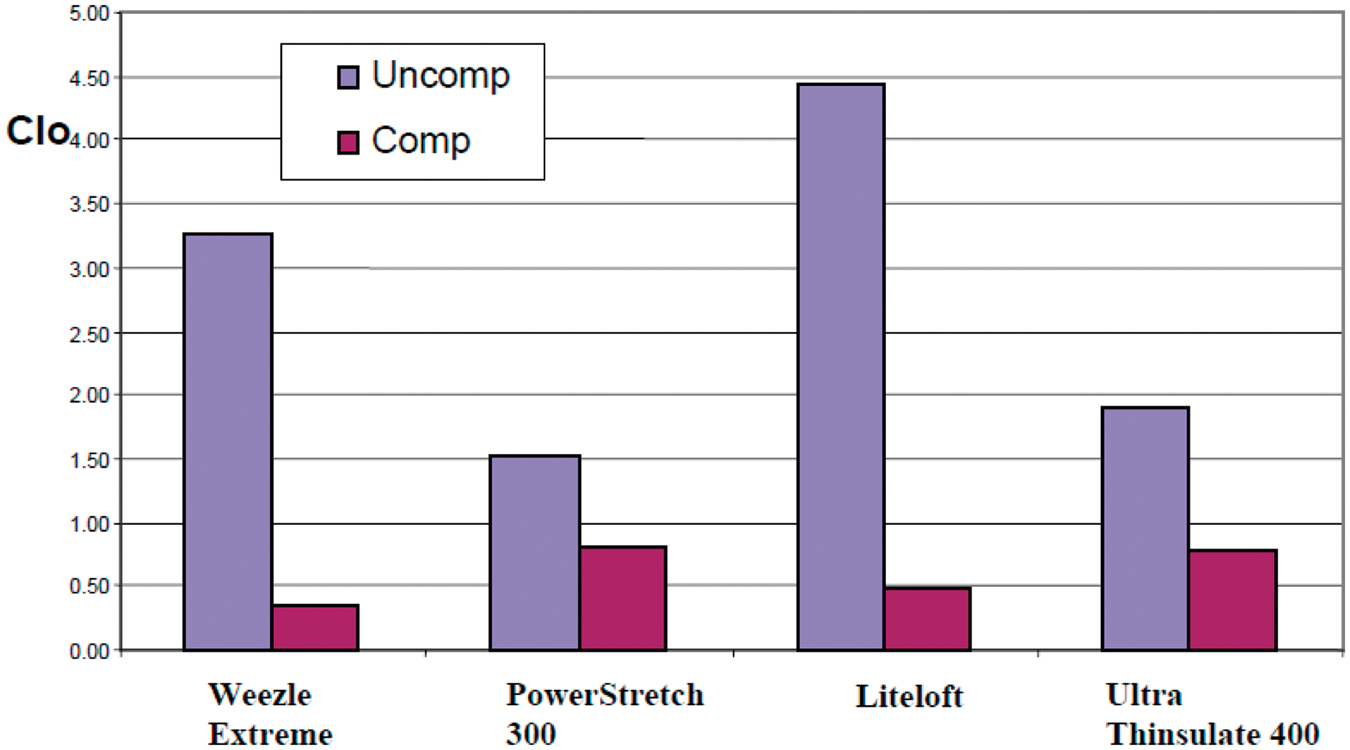
In addition, wave motion has influences on the thermal insulation of immersion suits [11,22,31], in a manner similar to the hydrostatic pressure influence on thermal insulation of immersion suits system. In the research conducted by Romet et al. the immersed Clo of 11 marine work suits had been measured using both human trial and thermal manikin. They concluded that turbulent water significantly reduced the immersed Clo value of immersion suits. Using human trials, Ducharme and Brooks [11] showed that wave heights up to 70 cm would decrease dry suit system insulation by 14%. This may be attributed to two reasons: (a) the elevated water may be able to compress the fabrics used in the immersion suits and (b) water and air boundary layers surrounding the body had been significantly influenced by the wave motion.
Heat stress issue associated with immersion suits
In accordance with the cold water hazard discussed above, immersion suits were initially designed primarily to protect the wearers from cold stress. Paradoxically, thermal stress could be experienced by pilots or helicopter rescuers under hot conditions (e.g. the cabin during flight). The very nature of being impermeable contributed to the bad ventilation of immersion suits. As it was concluded by several research studies, the relatively high thermal resistance and extremely low water vapor permeability of clothing ensemble impede evaporative heat dissipation and thus elevate the rate of heat storage, creating a state of uncompensable heat stress [32–34].
When the heat load exceeds the body's ability to dissipate heat, heat stress increases and heat illness or injury could occur. Heat stress may lead to the increased temperature, reduced performance, dehydration and even heat stroke. Insensible sweating when wearing constant suits also contributes to the thermal stress and discomfort of the wearer. Pathological states of heat strain include heat exhaustive, heat injury and heat stroke [35]. Helicopter aircrews who wear constant immersion suits are subjected to heat stress when they are in warm or hot environments [34–36]. Norwegian military Sea King conducted a research to show that even during winter, the pilots could experience significant heat stress [37]. Human trials were conducted in a climatic chamber at Defense Research and Development Canada to study the heat stress of the aircrews when carrying on a certain level of activity. The severity of heat stress was investigated during the flights of aircrew in a temperature range between −15℃ and 25℃. It was concluded that during the summer in northern climates, aircrews wearing immersion suits might experience thermal discomfort and heat stress at ambient or cabin air temperature as low as 18℃ [32]. One of the reasons that resulted in thermal discomfort is the impermeability of certain immersion suits. This brought up the challenge as to how to accomplish thermal comfort, incorporating moisture management features inside immersion suits, considering the fact that immersion suits have to be waterproof.
Heat, flame and hot water
A complex condition incorporating heat, flame and hot water may be encountered in the application of immersion suits. This may be caused by continuous fire on the sea during airplane crashes or marine accidents. In this case, immersion suits need to deal with the situation where there is fire, hot liquid and sometimes even steam. Limited research exists in this area regarding fabric properties and garment performance. Ducharme [24] investigated the flame-resistance properties of the modified constant wear immersion suits by exposing the manikins to 4 s flame. The trials were conducted using the Thermal-man Thermal protection Evaluation System from DuPont® to simulate fire scenarios that the aircrew may experience during rescuing in air crash [24]. However, the conditions with more complexities (e.g. with both fire and water), which may contribute to much more severe burn injuries, need to be considered in the future when evaluating the thermal performance of immersion suits. The simulation of real scenarios, incorporating heat, flames, hot water and steam, will be a challenge for textiles and clothing researchers.
Textile materials, performance and new technology
Insulation properties of immersion suits are highly relevant to the constructed textile materials and fabric structures. Normally, immersion suits are constructed with a waterproof outer shell fabric and an inner liner, which determine the immersed thermal insulation values. Besides the suit, there are undergarments and accessories worn in accordance with the layered suits, i.e. top and bottom long cotton underwear, woolen socks, flying leather summer boots, flying gloves, helmet and un-inflated or inflated life vest [24,32]. Originally, the immersion suits were made of neoprene and chloroprene-coated rubber, which is impermeable to sweat. This may lead to thermal discomfort and thermal strain. The invention of cotton ventile fabric helped address the previous issue about sweating but was expensive to manufacture and for mass production; also, oils and grease may degrade its water integrity, which was a critical drawback [9].
Shell fabrics of immersion suits
Shell materials can be foam neoprene, crushed neoprene, urethane-coated nylon, tri-laminate and vulcanized rubber and are applied for different degree of protection [20]. A lot of efforts have been made to improve the performance of immersion suits. An internal three-dimensional layer, which consists of polyester was received by the external waterproof layer of butyl rubber, which allows moisture from the suit to be carried into the inner layer and received in order to prevent water penetration from the outside into the suit [38]. Myerscough [39] constructed the dry suit with a smooth elastomeric outer shell that envelopes a separate element proof inner shell. The first flexible waterproof inner shell material can be formed of breathable polyurethane-coated nylon fabric, flexible breathable waterproof nylon fabric, elastomer-coated fabric, neoprene, flexible polystyrene, latex, butadiene, polyvinyl, rubber or waterproof lycra® fabric. The second elastic outer shell can be neoprene, flexible polystyrene, latex, butadiene, polyvinyl, rubber or elastic fabrics [39].
Then Gore-Tex® and fire-retardant Nomex Gor-Tex® fabric has been adopted in the production of the current immersion suits. A dry suit incorporated with rubber neck and wrist seals, Nomex® and Gore-Tex® waterproof and flame-resistant shell and a perforated foam insulation liner (Mustang survival Inc, BC, Canada) was used to define the lowest ambient air and cabin temperature at which there is the onset of thermal discomfort and heat stress when wearing immersion suits during a flight [32].
New materials were developed to construct the immersion suit as well. Bardy et al. [40] compared the thermal resistance of a suit fabricated from aerogel-syntactic foam hybrid insulation with that of a foam neoprene suit [40]. It was concluded that unless the surface depressions were eliminated, foam neoprene provided more thermal protection. Different thermal conductivities of types of materials are depicted by Stinton [18] (see Figure 3). Aerogel was a breakthrough in the underwater suits material development because its thermal conductivity is lower than that of air, indicating a higher insulation. It has been applied in the area of immersion suits. As part of US Navy-sponsored effort, aerogel was tested and evaluated for use in diving suits application. This can also be a breakthrough if aerogel could be applied in the area of immersion suit development. However, applying aerogel to do immersion garments requires a special encapsulation process. Aerogel is 99.8% empty space and cannot be sewn or bonded. Nuckols [41] compared third-generation aerogel garments utilizing a new encapsulation process with B400 Thinsulate® garments, regarding the different thermal insulation of body parts, including hand, arm, foot, leg and torso. With approximately the same thickness and bulk, the third-generation aerogel showed a better thermal performance with the impact of water pressure [41].
Thermal conductivity values of different materials [18].
Thermal liners of immersion suits
As for thermal liners of the immersion suits system, the wearers can choose the thickness of liners according to environmental conditions. The design of the thermal liner should exhibit a level of resistance against compression pressure. Some novel liners are incorporated with a wicking layer that transfers the moisture generated from the human body to the surface of the suits [9]. Gordon and Gordon [42] constructed an immersion suit that included an outer layer typically made of rubber foam and a layer of wool or wool blend, which would increase the absorption of moisture and sweat generated during activity and reduce thermal stress and thereby enhance the thermal comfort of immersion suits [42]. This was an excellent improvement from the viewpoint of improving both protection and comfort of immersion suits.
An incompressible phase change material was applied in the thermal liner of a dry suit in order to store latent heat energy and to release the stored energy while changing phase [43]. This could effectively reduce the thermal shock of sudden immersion in cold water and prolong the survival time of wearers. Alternately, the thermal liner may cool the wearer during dressing on the surface by absorbing the diver's body heat as the phase change materials melt prior to the immersion. A series of modified liners were used to investigate the performance of the constant wear suits under different scenarios. Modified liner was made of Coolmax® inner fabric, un-uniform insulation distribution and unquilted Thinsulate® insulation (Figure 4). Modified liner 2 was constructed with Coolmax® inner fabric, un-uniform insulation distribution and quilted Thinsulate® insulation. Liner 3 was fabricated with Coolman® inner fabric, un-uniform insulation and perforated foam insulation. These improved characteristics show distinctive effect on mean skin and rectal temperature, sweat evaporation and accumulation rate, and mean vapor pressure inside the clothing.
Liner modification. No insulation on front, 3 mm insulation on limbs and 8 mm insulation on the back.
An inflatable immersion suit was invented that contained a gas layer principally giving buoyancy to assist flotation but also acting as the insulation layer when the wearer becomes a survivor on being cast in sea. The outer layer was made of a polyurethane directly-coated fabric with a total weight of at least 270 g per square meter whereas the inner layer was made of a polyurethane-coated fabric that is extensible in all directions to provide enough stretching properties during inflation [44]. With the development of new textile materials, there are a variety of outer shell fabrics and thermal liners. The detachable inner liner makes it easier to launder and adjust the thermal insulation according to environments.
Test methods and standards
Immersion suits have a wide range of applications (e.g. personal protection, military, transportation and oil industry). They fall under different frameworks of legal regulations developed by international organizations and government research institutes. The basis and objectives for standardization work in the field are to provide acceptable flotation and to minimize the risk of drowning and to not impair the wear's ability to perform fundamental survival actions [1,2,6].
Standards and regulations for immersion suits
List of current standards and regulations for immersion suits.
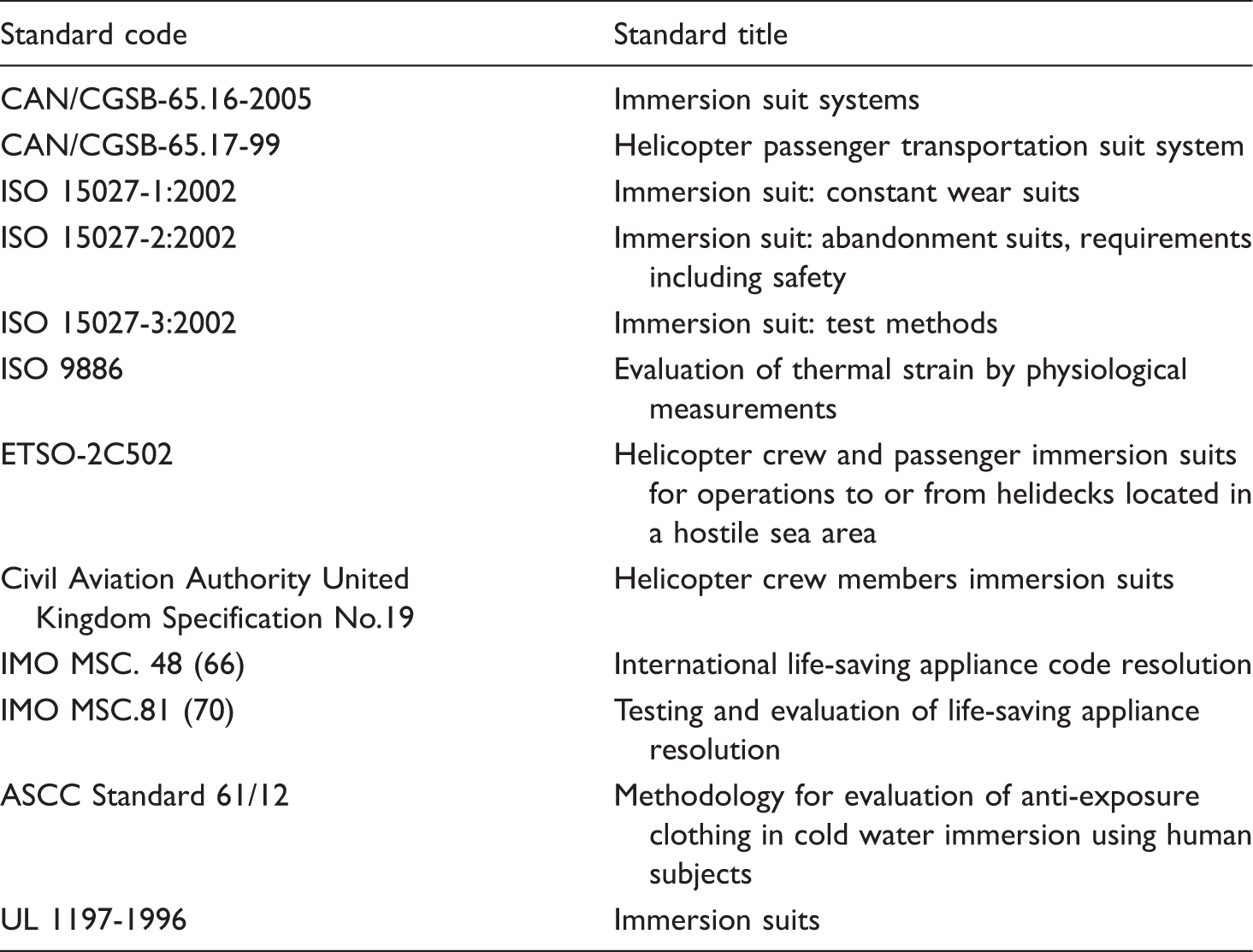
The ISO standards specifies the minimum levels of insulation provided by the different ranges of suits, in particular water temperatures for manufactures, purchasers and users of constant wear suits and abandonment suits. Test methods of immersion suits are also specified. They are frequently used by researchers to define criteria for immersion suits. Flammability, fuel resistance, leakage, resistance to rot, resistance to illumination and tensile strength of fabric properties (including coated fabrics and other fabrics) are required to test in these standards. It is stated that the performance of the suit system using a thermal manikin for the thermal test has to be proved by tests with human trials. Otherwise, thermal manikin is out of the range of options to continue the tests. Thermal insulation of the suits can be determined by thermal manikin test and human trial.
The testing condition specified in ISO 15027 is in calm but circulating water, which is not the real simulation of real scenarios with winds, waves and splashes. There are no regulations related with fit and sizing, which will have a great influence on water leakage, the users' performance and survival time. These factors would also have great influence on the immersed thermal insulation of suits. In addition, in order to simulate the real marine accidents scenario, conditions with flames, hot water and hot steam, and cabin environment with high temperatures would be also be considered in designing test methods. US Coast Guard Department of Transportation issued ‘Life Saving Equipment’ regulations related to thermal protection aids. In the oil industry, Shell Health, Safety and Environment Committee developed the regulation called Personal Protection of Helicopter Passengers in the Event of a Ditching in 1996.
As for testing thermal insulation properties, none of these standards specify the immersed pressure, which contributed the most to the immersed value of textile materials. Immersion value is defined as the insulation measurement taken when a suit system is subjected to the effect of hydrostatic compression. CAN/CGSB 65. 16-2005 described the way to simulate the hydrostatic pressure when testing the insulation value: a tank of water deep enough to hold the assembly of the can, material and clap arrangement at least 1 m below the surface of the water. However, the specific pressure was not specified.
Thermal manikins and human trials
Testing methods for immersion suits have been studied for several decades. The thermal insulation properties of immersion suits systems can be defined in two ways. One is through physical measurements using thermal manikins and the other is through wear trials using human test subjects. Scientists use thermal manikins for the evaluation of immersion suits for two reasons. First, compared with human trials, the superior issue is that manikins can be used in extreme conditions that are unethical to use in human trials. These include conditions of being exposed to toxic and corrosive chemical environments, flash fires, hot liquids and hot water, extremely cold water and weather and so on. Second, a thermal manikin can act as a standardized subject. However, compared with other application of thermal manikins, two special factors associated with water should be taken into consideration. Manikins that are used to evaluate the properties of immersion suits should reflect more closely the thermal physiological conditions of humans in water and its flotation characteristics [45]. Ducharme and Brooks [11] compared the thermal resistance of immersion suits obtained from human and manikin testing in calm and turbulent water in the open ocean. They made great efforts to provide similar conditions between the two test methods: same clothing, buoyancy, skin temperature distribution, location of probes on the skin, test duration and ambient conditions. It was concluded in their research that the manikin tests in turbulent waters would underestimate the thermal insulation of immersion suits due to larger water leakage into the suits and greater inertia of the manikin. Greater wave propagation would lead to a larger convective heat loss [46]. Hence, further study and development about the manikin test are required for the immersion suit evaluation. Ducharme et al. [47] used the complementation of computer survival model and thermal immersion manikin data to study the thermal protection of military protective clothing equipment for cold survival of aircrew on land and at sea.
In his study, Ducharme [24], used aircrew from Helicopter Operational Test and Evaluation Facility as human trials in the simulated flight maneuvers and immersing conditions, while he used thermal manikin in the third scenario, which was intended to study the flame resistance of immersion suits. National Research Council of Canada – Institute for Ocean Technology (NRC-IOT) conducted the research to investigate the ability to use thermal manikins to determine thermal properties of immersion suits under non-uniform cooling conditions (different water and air temperatures) and the relationship between human thermal responses and manikins [26,48,49]. Also, it is concluded in the research of Mak et al. (2009) that further studies about the thermal manikins would be needed to add confidence for suit evaluation using this method. In perfect dry suit system, the volume of water into the suit at the end of the tests should have been zero for the dry tests and 2 l for the wet tests [24].
Another knowledge gap in the test method is how to simulate the real seawater scenario waves and splashes, which are difficult to be quantified. In Tipton's work, it was concluded that testing in calm waters will underestimate the thermal insulation properties of the tested immersion suits and water leakage will also lead to significant decrease in the immersed insulation [27,31]. Ducharme and Brooks [11] conducted a research to study the effect of wave motion on dry suit insulation and the response to cold water immersion. The author simulated a number of different wave conditions, ranging from still water to waves 70 cm in height at 16℃, and measured the physiological and physical parameters, which were used to calculate the total thermal resistance of the suit system and its components. Six subjects wearing a dry immersion suit were immersed once a day for nine consecutive days in water at 16℃ for 1 h for a total of nine tests. It was found that the insulation of the dry suit system was decreased by 14% by the wave height up to 70 cm compared with calm water. However, further studies are necessary to determine the practical limitations of the reduction effect of waves and splashes. In 2007, the NRC-IOT conducted a series of experiments in Offshore Engineering Basin to address the previous shortcomings and ensure the consistency of the experimental conditions, which were significantly worse than the calm, circulating water used for current immersion suit certification [26,48,49]. It was concluded in the study by Power and Ré [26] from NEC-IOT lead work that the cooling capacity of an environment will be increased significantly by the velocity of wind and height of waves. Although valuable insight into the performance of the equipment and humans can be gained by testing in the open sea conditions, randomized environmental conditions can be difficult to control and keep consistent, which will lead to inaccuracy of testing results [26]. Completely and consistently recreating the open sea environment in the laboratory using climate chambers is a great challenge for future studies. Also, there are few laboratories in the world capable of generating both wind and waves, simulating the real scenarios in the open sea.
Another submersible thermal manikin, NEMO, has been developed by Measurement Technology NW (Seattle, Washington). Another representative of submersible thermal manikin is thermal instrumented manikin (TIM) manufactured by the CORD group. NEMO and TIM were applied to evaluate insulation measurement of immersion suit of helicopter transportation suit [50]. The aim of this research is to assess inter-manikin differences and manikin–human correlation and quantify errors from tools, test methods and calculations that could assist the ISO thermal manikin working group to better understand the measurement differences and provide appropriate recommendations for the development of ISO-15027 immersion suit standard. A 13-segment thermal immersion manikin (TIM from the CORD group, Dartmouth, NS) was used to compare the thermal resistance of the CT 156 Harvard II survival kit and new proposed equipment. The survival time in 19 scenarios, including the aircrew dressed in wither clothing and exposed to −35℃ air with 20 km/h wind in dry and wet conditions, were investigated in this research. Based on this study, with the proposed and approved survival kit, it is unlikely to meet the requirement of 12-h survival under the worst conditions at sea. Also, the author recommended further testing with human trials in the laboratory or in the field in order to validate the results gained from the immersion thermal manikin [32,51].
In order to determine thermal comfort of immersion suits using human trials, rectal temperature, skin temperature, heart rate and relative humidity inside the clothing should be monitored as the parameters. McInnis Thermal Comfort scale is frequently used in determining the thermal comfort when wearing immersion and diving suits. Sweat rate, evaporation and accumulation are also measured as important parts of thermal comfort of the suits. The CGSB requires that a rectal thermometer be used to measure deep body temperature and that the skin temperatures of the index finger and larger toe be measured for human participants tests. The immersion test is terminated if a participant's deep body temperature is 2℃ lower than baseline conditions, if the temperature of the index finger or toe skin is 5℃ lower or according to the attending physician's order [2].
Conclusions and future work
This article has reviewed research into the current development of immersion suits, regarding the hazards, textile materials, garment design features and testing methods and standards. The wearers of immersion suits or survival suits may encounter multi-hazard environments, not only the cold water but also flames and hot liquids under some extreme circumstances.
As for the textile materials, it requires a balance among properties such as being water –proof and thermal insulation, moisture permeability and the flame retardant properties of the garment system. There is no significant revolution since the application of Gore-Tex® and Nomex® in the immersion suit area. Novel fabrics and systems need to be developed to improve the overall performance of the garment, including thermal protection and thermal comfort. Kevlar® may be adopted with waterproof coatings or laminations to provide better flame retardant properties.
As for the garment features, the difficulties of achieving a good neck, wrist and boot seal were identified. Pros and cons about the entry methods and zip closure should be addressed systematically regarding water leakage, ease of don and doff, thermal insulation, flame retardant, and so forth
Current studies overlook a real scenario that may happen during marine accidents and airplane crashes, that is, a hazardous condition with flames, hot liquid and steam, which may lead to much more difficulties and dangers for the survivors and rescuers. More studies associated with the thermal resistance towards flash fires, hot steams and liquids need to be conducted to allow greater improvement of overall performance. Wave height and water pressure have impact on thermal insulation of immersion suits, which varies depending on orientation and layers at specific points on the body. In the real test, it is a great challenge to simulate the real open sea environment with high speed winds, strong waves and splashes, which would have great influence on the thermal responses and thermal insulation properties of the immersion suits. As for the flame retardant properties, simulating the real scenario with heat, flames and water is another big challenge when characterizing the thermal properties of immersion suits. Developing testing methods for evaluating flame resistance and predicting burn injuries is necessary in future research.
Heat stress is an important issue when helicopter pilots wear a constant wear suit and more research is necessary to understand the heat stress generated by various kinds of suits during different conditions. More extensive and accurate models need to be developed to predict the heat stress when a wearer is in different environmental conditions.
While there have been many researches into the performance of new immersion suits, little research has been conducted into the performance of used garments. The maintenance and durability of immersion suits need to be further studied.
Fit is one of the key issues for immersion suits in order to provide sufficient thermal protection. Universal size immersion suits, which are designed to fit individuals with the widest range of heights and weights, may lead to leak past neck and wrist seals or at the zippers. Three-dimensional body scanning technology is a promising application in this area to investigate the air gap sizes and distributions and help understand the heat transfer mechanisms.
In future research, investigating the ability to use thermal manikins to determine thermal properties of immersion suits under non-uniform cooling conditions (different water and air temperatures) and the relationship between human thermal responses and manikins is a promising direction.
Footnotes
Funding
This research received no specific grant from any funding agency in the public, commercial, or not-for-profit sectors.