




Abstract
The analysis of the air gap between fire-protective clothing and the skin plays a crucial role in evaluating the protective performance of the clothing. However, the more accurate the analysis of the air gap, the more complex the air-gap model. This article introduces a novel air-gap model that stands halfway in terms of accuracy and complexity between other two models that already exist in the literature. A comparison between the performances of fire-protective clothing predicted by using the three air-gap models is discussed in this article. Different parameters that affect heat transfer within the air gap and hence the protective performance of the clothing were studied to assess the novel air-gap model compared with the other two models. Despite its simplicity, the novel air-gap model predicted the performance of fire-protective clothing as accurately as the most realistic model.
Introduction
Workers in many fields and industries such as petroleum and petrochemical industries, firefighting, and even race car driving rely on protective clothing to protect themselves from fire exposure. Exposure to fire can result in skin burn injuries that range from first-degree to third-degree burns, depending on the intensity and duration of exposure. The type of protective clothing varies from one application to another, depending on the probability and type of exposure. Nevertheless, the typical protective clothing system consists of at least one fire-resistant fabric, the human skin and an air gap between the fabric and the skin. Evaluating the thermal protective performance (TPP) of the clothing is accomplished by estimating the total energy transfer through the clothing that causes burn injury to the human skin on the other side of the clothing. Bench top tests [1–4] were used in evaluating the TPP of the clothing against a variety of different types of exposure. For example, according to ASTM D 4108 [2], the fabric specimen is exposed to flame contact from a Meker burner, while ASTM F 1939 [3] employs a set of quartz tubes to produce a purely radiant exposure. In addition, NFPA 1971 [4] uses a Meker burner and quartz tubes to produce both convective and radiant exposures. On the other hand, manikin tests [5] are used to evaluate the TPP of the whole garment at different locations of the manikin body.
Modeling of the thermal performance of protective clothing has been extensively reported in the literature during the past decade. Torvi and co-workers [6,7] and Zhu and Zhang [8] modeled heat transfer in a single layer of a fire-resistant fabric during local flame and radiant exposure tests, respectively. Mell and Lawson [9] modeled heat transfer in firefighters’ clothing during radiant exposure. Song et al. [10] modeled coupled heat and mass transfer in firefighters’ clothing during a local flame test. Zhiying et al. [11] tested the TPP and moisture transport of firefighter’s clothing. Li and Zhu [12] developed a mathematical model for moisture and heat transfer coupled with phase change materials in porous textiles. Mercer and Sidhu [13] investigated the performance of protective clothing with embedded phase change material.
Pennes’s model [14] was extensively used in the literature to model heat transfer in the human skin. Ng and Chua [15] developed and compared one-dimensional and two-dimensional numerical codes to predict the state of skin burns. Jiang et al. [16] developed a one-dimensional multi-layer model to predict the effects of thermal physical properties and geometrical dimensions on the transient temperature and injury distributions in the skin. Most of these models employed the burn integral of Henrique and Moritz [17] to estimate times to receive burn injuries.
The air gap between protective clothing and the skin plays an important role in the protective performance of the clothing since the energy transfer through the air gap determines the level of exposure on the skin. This role has been addressed in the literature by many researchers. Torvi and co-workers [6,18] investigated the influence of the air gap width on the protective performance of a single layer fire-resistant fabric during a contact flame bench top test. Sawcyn and Torvi [19] and Talukdar et al. [20] attempted to improve the modeling of the air gap in bench top tests of protective fabrics. Ghazy and Bergstrom [21] introduced a more realistic analysis for the transient heat transfer in the air gap between protective clothing and the skin. Ghazy and Bergstrom [22] further extended this analysis to the air gaps between the fabric layers in firefighters’ protective clothing. The three-dimensional body scanning technology was used [23–26] to determine the width and distribution of air gaps between the protective garment and the manikin body and the influence of these gaps on the protective performance of the garment.
The size of the air gap between the clothing and the skin determines the modes of energy transfer within the air gap. Torvi and co-workers [6,18] demonstrated numerically and by flow visualization that convection and radiation heat transfer modes occur within the air gaps of the contact flame bench top test for gap widths that are bigger than 6.4 mm (1/4 in.), while energy transfers by conduction and radiation modes for smaller gaps. In addition, thermal radiation was shown to be the dominant mode of heat transfer within the air gaps regardless of size [6,7,18–21]. Moreover, the more accurate the analysis of the air gap, the closer is the evaluation of the protective performance of the clothing to its actual value. Nevertheless, a small improvement in the accuracy of evaluating the protective performance of the clothing may require more complex calculations.
Given this context, this article assesses the effect of the air gap analysis on the evaluation of the performance of protective clothing during fire exposure. The article holds a comparison between two extremes in modeling the air gap between protective clothing and the skin: a simple model (SM) that uses approximate analysis for the air gap and a realistic model that accounts for the combined conduction–radiation heat transfer in the gap. Unlike the SM that ignores the interaction between the air gap and thermal radiation through the gap, the realistic model deals with the gap as a radiation participating medium that absorbs and emits thermal radiation. Furthermore, this article introduces a simplified conduction–radiation model (SCRM) that stands halfway between the two models as an attempt to balance between the accuracy and complexity in modeling the air gap in protective clothing. In addition, the performance of protective clothing was predicted by the three models and compared for different parameters that affect heat transfer through the air gap such as the air gap absorption coefficient, air gap width and fabric thickness.
Problem formulation
A typical protective clothing system that consists of a single layer of Kevlar®/PBI fire-resistant fabric, the human skin and an air gap between the fabric and the skin is shown in Figure 1. The human skin consists of the epidermis, dermis and subcutaneous layers, where blood perfusion takes place in the latter two layers. The fabric is exposed to a flame contact with a nominal heat flux of about 83 kW/m2 to simulate flash fire exposure. Energy is transferred by both convection and radiation from the flame to the fabric. A portion of this energy is stored inside the fabric, raising its temperature and causing thermochemical reactions within the fabric, while another portion of this energy is transferred by radiation from the fabric to the ambient environment. For air gap widths that are equal or less than the air gap width of the standard TPP test [2] of 6.4 mm (1/4 in.), energy transfers by both conduction and radiation from the backside of the fabric to the skin, raising the skin temperature and potentially causing skin burn injuries. After exposure ends, energy transfers by convection and radiation from the fabric to the ambient environment.
The protective clothing system schematic diagram.
Heat transfer in the fire-resistant fabric
The energy equation for the Kevlar®/PBI fabric is expressed [6,21,27] as


The boundary conditions for the fabric energy equation are as follows


The fabric initial condition is

Heat transfer in the human skin
The bioheat equation developed by Pennes [14] was employed to model heat transfer in the skin tissues. The energy equations for the three layers (epidermis, dermis and subcutaneous) of the skin are written as



The skin boundary conditions are


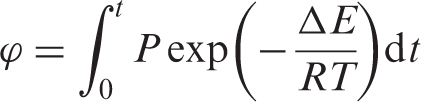
The initial condition of the skin is introduced by a linear temperature distribution between 32.5°C at the epidermis surface and 37°C at the subcutaneous base (core body temperature). When the basal layer (interface between the epidermis and the dermis layers) temperature reaches 44°C, skin burn injury takes place. The integral of Henrique and Moritz [17] was employed to predict times to receive skin burn injuries as follows
Heat transfer in the air gap
There are three approaches considered here to model the conduction and radiation heat transfer within the air gap between protective clothing and the skin. The essential differences between the three approaches are the accuracy in modeling the thermal radiation through the gap and the coupling between the two modes of heat transfer – conduction and radiation – within the gap.
Simple model
Most studies reported in the literature [6–8,10,11,18,19,23,24] used a relatively simple model for the air gap between the fabric and the skin. For example, they decoupled the conduction and radiation heat transfer through the air gap and instead assumed steady-state conduction and only surface radiation heat transfer within the air gap. The conduction and radiation heat transfer within the gap are introduced by


Combined conduction–radiation model
A second approach to model the air gap between protective clothing and the skin was developed by Ghazy and Bergstrom [21]. They dealt with the air gap as a radiation participating medium that absorbs and emits thermal radiation, where the conduction and radiation heat transfer within the gap was coupled by the air gap energy equation as follows



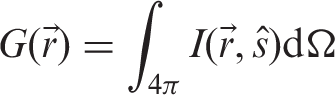
The RTE for the air gap as a gray, absorbing and emitting medium [28] is written as

The boundary conditions for the air gap RTE are written as


The divergence of radiative heat flux in equation (13) is calculated as



Simplified conduction–radiation model
This model deals with the air gap as a radiation participating medium that only absorbs thermal radiation. The ability of the air gap to emit thermal radiation was disregarded while its ability to absorb thermal radiation was considered via the exponential decay that is introduced by Beer’s law [30]. The conduction and radiation heat transfer within the air gap is coupled by the air gap energy equation as follows


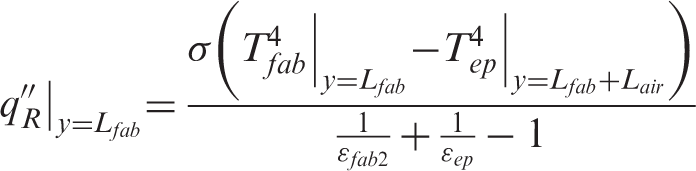
The boundary and initial conditions for the air gap energy equation (equation (24)) are introduced by equations (14)–(16), similar to the case of the combined conduction–radiation model (CCRM). The radiation heat fluxes on both sides of the air gap (equations (3) and (8)) are estimated as follows


Results and discussion
The energy equations for the fabric, air gap and skin were solved along with their boundary conditions by the finite volume method [31] using the Gauss–Seidel point-by-point iterative scheme. For each time step, temperatures from the previous time step were used as initial values for the iteration loop. Then, new temperatures were calculated by visiting each control volume starting from the fabric surface to the subcutaneous base. When convergence was achieved, the basal layer and the dermal base temperatures were used in Henriques’ integral (equation (10)) to predict times to receive skin burns.
Kevlar®/PBI and burner parameters [21].

Human skin thermophysical properties [21].

The SM decouples the conduction and radiation heat transfer within the air gap while the other two models combined them. In order to justify the influence of only coupling the conduction and radiation heat transfer within the air gap on predicting the performance of protective clothing, simulations were first carried out for the CCRM and SCRM using an air gap absorption coefficient of 0 m−1 while the SM implicitly assumes a zero air gap absorption coefficient by considering only the surface radiation through the air gap.
A comparison between the three air-gap models in predicting the temperature distributions within the gap is shown in Figure 2. The temperatures predicted by the CCRM and SCRM are identical for the fabric backside, air gap center and epidermis surface. Despite the big difference in the number of calculations required by both models, the only physical difference between the two models is the way that the air gap interacts with thermal radiation. This interaction is related to the absorption coefficient of the gap. Therefore, the two models behave the same way for the case of a zero air gap absorption coefficient. In addition, the figure shows that the SM over-predicted the temperature of the fabric backside, while it under-predicted the temperatures of the air gap center and epidermis surface. Moreover, the discrepancy between the predictions made by the SM and those made by the other two models is evident at the air gap center. This discrepancy is attributed to the decoupling between conduction and radiation heat transfer within the air gap that the SM assumes.
Comparison between the temperatures predicted by the three air-gap models at three locations in the air gap: (a) fabric backside, (b) the air gap center and (c) epidermis surface.
More insight can be acquired from the energy transfer within the gap. Figure 3 shows a comparison between the three models in predicting the conduction and radiation heat fluxes within the air gap (the case of a zero absorption coefficient). The conduction and radiation heat transfer predicted by the CCRM and SCRM are identical, which is consistent with the temperature distributions shown in Figure 2. In addition, the decoupling between the conduction and radiation heat transfer that is assumed by the SM caused the SM to underestimate the conduction heat flux and overestimate the radiation heat flux within the gap. Furthermore, the deviation in predicting the conduction heat flux is about double that of the radiation heat flux.
Comparison between the predictions made by the three models for the energy transfer within the air gap: (a) conduction heat flux at the fabric–air interface and (b) radiation heat flux emitted from the fabric backside surface.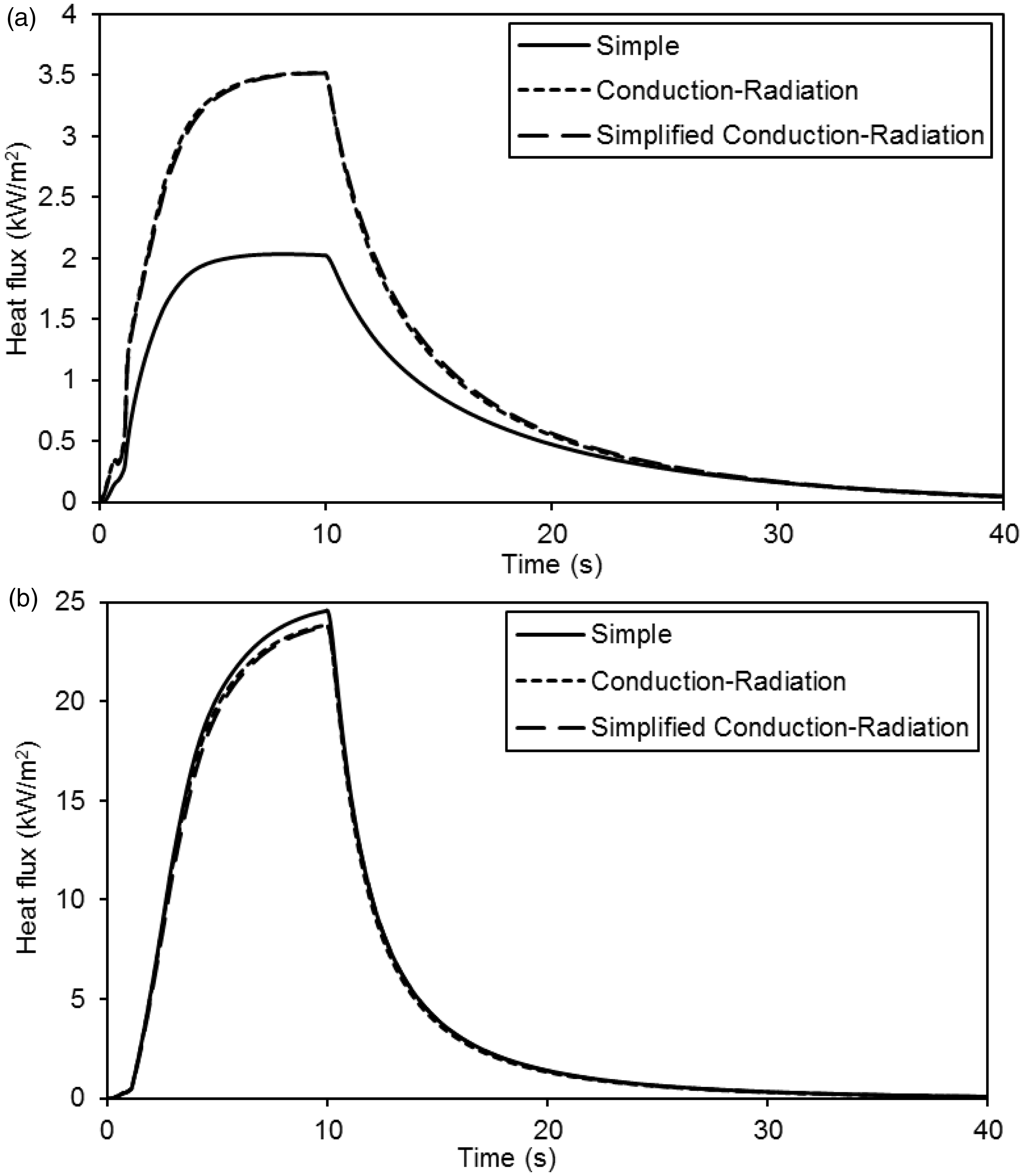
Influence of the air gap absorption coefficient on skin burn predictions.

Influence of the air gap width on skin burn predictions.

Influence of the fabric thickness on skin burn predictions.

The SM was shown to be inappropriate for predicting the performance of protective clothing. On the other hand, the SCRM, although less complex than the CCRM, predicts the performance of protective clothing almost as accurately as the CCRM. The SCRM, as a novel model, can be a possible replacement for the CCRM as an accurate but less complex model.
Conclusions
The effect of the air-gap model between protective clothing and the skin in evaluating the clothing performance during fire exposure was studied numerically. This article introduces a novel air-gap model–SCRM–that balances between the accuracy and complexity in modeling the air gap between protective clothing and the skin. The performance of protective clothing was investigated by the SCRM and compared with that predicted by the other two air-gap models–SM and CCRM–from the literature. Skin burn predictions made by the three models for different values for the air gap absorption coefficient, air gap width and fabric thickness were compared. The decoupling between the conduction and radiation heat transfers within the air gap that the SM assumes caused it to over-predict the temperature of the fabric backside and under-predict the temperatures of the air gap center and epidermis surface compared with the other two models, with an air gap absorption coefficient of 0 m−1. The SCRM over-predicts times to third-degree burns for different values of the air gap absorption coefficient compared with the CCRM. This deviation in predicting times to third-degree burns increases as the air gap absorption coefficient increases. The SCRM predicts times to skin burns almost the same as does the CCRM for different air gap widths while the SM under-predicts times to skin burn injuries, especially for third-degree burns. For different fabric thicknesses, the SM under-predicts times to skin burns while the SCRM over-predicts times to skin burns for different fabric thicknesses compared with the CCRM.
In general, the SCRM produces skin burn predictions that are very close to those produced by the CCRM as compared with the SM. That makes the SCRM, as a simple and accurate model, a potential replacement for both the SM and CCRM. Nevertheless, caution should be exercised for the minimal over-prediction in times to skin burns made by the SCRM, especially for third-degree burns.
Footnotes
Funding
This research received no specific grant from any funding agency in the public, commercial, or not-for-profit sectors.