




Abstract
In this study, the ability of Haloarcula sp. IRU1 isolated from Urmia lake, Iran, for production of cruxrhodopsin as a biomacromolecule with nanofunction from textile wastewater was evaluated and optimized by Taguchi experimental design. According to Taguchi method, the optimum conditions at which high cruxrhodopsin production could be achieved were observed to be in the presence of textile wastewater at 0.25% (volume/volume), yeast extract at 0.025% (weight/volume) and KH2PO4 at 0.005% (weight/volume). In conclusion, Haloarcula sp. IRU1 is capable of cruxrhodopsin production from textile wastewater in different conditions.
Introduction
Retinal proteins are pigment–protein complexes, which contain retinal (vitamin A aldehyde) as the chromophore, and are invariably bound to biological membranes. The first knowledge retinal protein was the visual pigment rhodopsin, which exists in the rod photoreceptor membranes of the vertebrate eyes. Invertebrates also utilize retinal proteins as the visual pigment [1]. However, retinal proteins are not unique to the animal kingdom. In the 1970s, Oesterhelt and Stoeckenius discovered a new retinal protein in Halobacterium salinarium, which was named bacteriorhodopsin [1,2]. This biomacromolecule is an integral membrane protein with seven transmembrane α-helices and a chromophore group, retinal [3,4]. Although the primary function of bacteriorhodopsin is to pump protons, it is the ability of this biomacromolecule to absorb and convert light into energy that is of particular importance for use in photonic devices [5]. The light-driven photoreaction of bacteriorhodopsin is very similar to that of rhodopsin. Furthermore, the biomacromolecule shows highly efficient quantum conversion and excellent stability compared with other light-sensitive biological pigments [6]. Bacteriorhodopsin is used in the fabrication of micrometer and nanometer scale devices, structures and patterns for a wide range of applications such as biosensors [7–10]. The purple membrane with bacteriorhodopsin consisted of various intrinsic photochemical and photoelectric properties are well suited for exploitation in the artificial retinas [9].
Cruxrhodopsin (CR; MW ≈ 27,500) is a homologue of bacteriorhodopsin found in the species of genus Haloarcula (halophilic archaeon) [11,12]. In the present study, we report for the first time, the ability of Haloarcula sp. IRU1 isolated from hypersaline Urmia lake, Iran, in production of CR from textile wastewater as carbon source.
Experimental
Textile wastewater
The textile wastewater (from Kerepnaz textile factory, Kermanshah, Iran) contains multiple dyes and auxiliary chemicals such as Red PN3B, Red RB, Red 2G, Yellow GR, Yellow 4GNL, Orange 2R, Orange 3R, Scarlet GR, Blue GG, Blue GR, Blue RB, Black HFGR, Black NB Extra, Brown GR, Brown B, Na2CO3, NaCl and NaC6H7O6. The pH and chemical oxygen demand (COD) of wastewater were 9.5 and 700 mg/ml, respectively.
Microorganism and growth conditions
Setting of factors and their levels in experiment for CR production.

CR: cruxrhodopsin; v/v: volume/volume; w/v: weight/volume.
The orthogonal array of Taguchi experimental design and corresponding CR production.

CR: cruxrhodopsin.
Determination of CR production
Cells from 10 ml culture broth were harvested by centrifugation and were lyzed by resuspending in equal volume (10 ml) of deionized water containing (0.01 mg) DNase (Fermentase). The lysate was homogenized and mixed with 4M NaOH and 4M NH4OH in the ratio of (9:0.5:0.5, v/v) in the dark. The absorbance at 568 nm (A568) was first measured in the dark (A5680 ). The mixture was exposed to light for 24 h to remove retinal from membrane, and again the absorbance was measured (A56824). As the molecular weight of CR is 27.5 kDa and the molar extinction coefficient is 58,000 per M cm, the concentration of CR was determined by the following equation [13,14]:

Taguchi methodology experimental design
A factorial design using Taguchi method with three variables (carbon source, phosphorus source and nitrogen source) was examined in shake-flask cultivation. All the combination experiments using the assigned parameter values were conducted with the aim of obtaining the final optimum conditions. The Qualitek-4 software was used to design and for analysis of Taguchi experiments.
Results and discussion
The Taguchi experimental design differentiates between control factors and noise or uncontrollable factors and treats them separately by means of special design matrices called ‘Orthogonal Arrays’ (OA). Columns and rows of an OA are arranged in a fixed way indicating the combination of factor levels in each experiment to be run and allowing the simultaneous evaluation of several parameters with the minimum number of trials [15,16]. The Taguchi experimental design is a good option for optimization of biotechnological processes for microbial synthesis [17].
In order to attain maximum CR yield, three important variables including the carbon, nitrogen and phosphorus sources were simultaneously optimized by applying Taguchi statistical design. The matrix of the experiments, with factors levels and the response in terms of CR production are presented in Table 2. The range of CR was 15.7 mg/ml in run No. 1 (maximum) and 7.2 mg/ml in run No. 4 (minimum). Results indicate that Haloarcula sp. IRU1 give the highest CR production in the presence of textile wastewater 0.25%, yeast extract 0.025% and KH2PO4 0.0005% (Table 2).
Analysis of variance (ANOVA) of Taguchi experiments results.
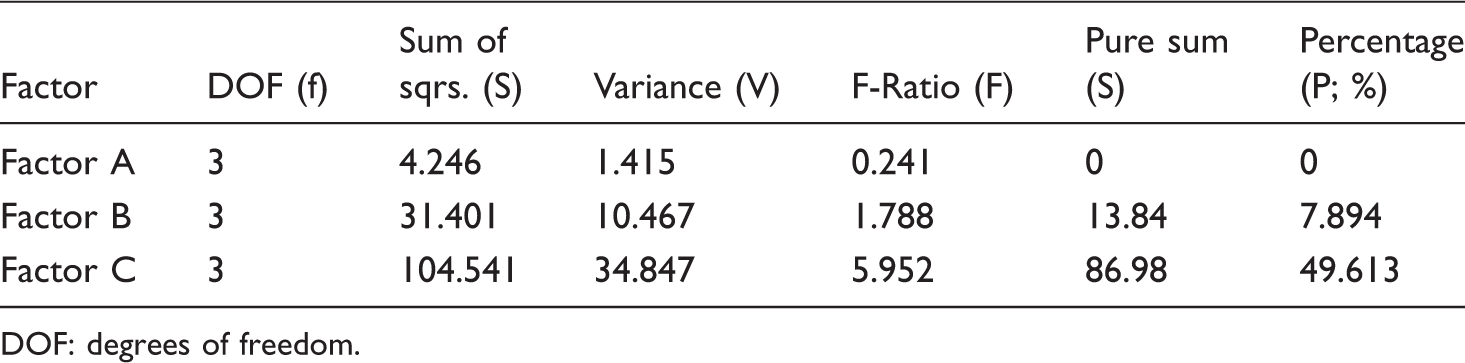
DOF: degrees of freedom.
Point prediction for optimum conditions of CR production.

CR: cruxrhodopsin.
Total contribution from all factors = 5.93.
Current grand average of performance = 10.73.
Expected result at optimum condition = 16.36.
Conclusions
This work demonstrated that Haloarcula sp. IRU1 can be a potential microorganism for production of CR from textile wastewater in extreme conditions, which makes the use of this microorganism even more promising for the industrial applications. In conclusion, by the production of CR from textile wastewater via this microorganism, the production cost of CR would markedly reduce, enhancing the economical feasibility of commercial applications of this potent biomacromolecule.
Footnotes
Acknowledgements
We gratefully acknowledge financial support from the Iran National Science Foundation (INSF) and Ilam University of Medical Sciences.