



Abstract
Background
Behavioral sustenance is one of the main outcomes of social marketing programs to address health issues, such as HIV and AIDS prevention. However, academic research into consistent condom use is interestingly sparse, particularly in South Africa, the country with the highest HIV-infected population in the world. Young adults are particularly vulnerable because they often engage in unprotected sex.
Focus of the Article
This study explores the factors driving consistent condom use intention with theoretical considerations in the expectation confirmation theory. The study investigates whether factors within the condom product category such as brand satisfaction and brand value enhance or weaken the effect of met/unmet brand expectations on consistent condom use intention of young adults. It further tests whether this potential enhanced or weakened effect significantly differs between male and female condom users.
Research Questions
Does dis/confirmation influence consistent condom use in the presence of brand satisfaction and brand value or not? Does gender moderate the mediations found in the expectation confirmation model?
Importance to the Social Marketing Field
From a theoretical perspective, the study expands the expectancy confirmation theory by focusing on the indirect effects of dis/confirmation on continuance intention. The study also tests the mediated moderating role of gender
Methods
The study was descriptive in nature and a quantitative survey was used to obtain data from 724 young adults in South Africa. Quota sampling was applied to select respondents. Finally, the structural equation modelling technique was used to assess the measurement and structural models.
Results
Findings indicate that perceived brand value determines consistent condom use intention. The mediating role of perceived brand value on the relationship between dis/confirmation and consistent condom use intention was more pronounced among males compared to females. Dis/confirmation and perceived brand value were significant determinants of condom brand satisfaction. However, the influence of brand satisfaction on consistent condom use intention was not supported.
Recommendations for Research or Practice
The concept of consistent condom use should be integrated in the brand message. A segmented approach based on gender should be used by condom companies to promote their products to young adults. These companies should provide condoms that meet the expectations of male and female young adult consumers as two different market segments.
Limitations
Only one province was investigated in South Africa. Social desirability bias was not controlled.
Keywords
Introduction
HIV/AIDS remains a severe pandemic, claiming the lives of millions of people across the globe. Statistics of the World Health Organization, 2020 indicate that approximately 79.3 million people worldwide have been infected by HIV since its discovery in the 1980s, resulting in more than 36.3 million deaths over the same period. In addition to its increasing spread, the burden of HIV and AIDS is distributed disproportionally across countries, with some experiencing a higher burden of the infection. South Africa remains the country with the highest HIV-infected population globally, with a current figure of 8.2 million people living with HIV (UNAIDS, 2020). Young adults are mostly vulnerable to HIV infection because they often engage in risky sexual behaviors, such as multiple concurrent and successive sexual partners and inconsistent condom use (Kalolo & Kibusi, 2015; Protogerou, Flisher, Wild, & Aaro, 2013). Studies in South Africa (De Wet et al., 2014; Protogerou & Hagger, 2017) have established that the prevalence of HIV is significantly high among young adults, as they make up 58% of the HIV-infected population in the country.
Condom use is identified widely as being one of the most effective means of preventing HIV infections, even in the context of multiple successive and concurrent sexual partners (Giannou et al., 2016; Pitpitan et al., 2015). Research (e.g., Mahlalela & Maharaj, 2015; Sweeney et al., 2020) shows that, when used correctly and consistently, condoms offer 80–99% protection against HIV. Given its effectiveness in reducing the HIV/AIDS prevalence rate, condom use has been one of the main focuses of social marketing (Eggers et al., 2016; Kalolo & Kibusi, 2015). Condom social marketing (CSM) interventions often integrate condom promotion, condom branding and packaging, and condom distribution (Neville, Adams, & Holdershaw, 2014; Patouillard, Goodman, Hanson, & Mills, 2007).
Indeed, the aim of social marketing is to promote a behavior i.e., condom usage, instead of specific brands e.g., Durex or Lovers plus. However, it goes without saying that brands ‘carry’ a category and vice versa; thus, there are different brands within the condom product category. In category promotion, manufacturers seek to compare the attributes of their brands against others in the category and give consumers reasons to choose their brands. Although social marketing promotes a category instead of a brand, manufacturers promote their brands in the category, and this promotion effort influences consumers’ choice of a brand within the category. Therefore, the present study aims to ascertain if brand attributes of condoms influence the consistent condom use intention of South African young adults.
Being both a complex and rational behavior, Sastry (2016) points that behavioral intention is necessary for condom use. Hence, understanding the drivers of intention is a critical step toward comprehending consistent condom use. A significant amount of the CSM literature focuses on condom use, yet the real issue is consistent condom use (Agha, Tollefson, Paul, Green, & Babigumira, 2019; Sweat et al., 2020). Prior studies (Cohen, Scribner, Bedimo, & Farley, 1999; Eggers et al., 2016; Milhausen et al., 2018) established that factors such as attitude, social norms, peers, condom price, condom promotion, and condom distribution affect both intention and actual condom use. While these factors may explain the behavior of interest (e.g., condom use), they are not necessarily adequate predictors of consistent condom use given that the former focuses on the occurrence of the behavior (which may be causal) while the latter refers to the consistency of the behavior. In addition, consumer needs have evolved with time, today condom users are increasingly looking for brands that offer both safety and pleasure (Ajayi, Ismail, & Akpan, 2019; Jebarajakirthy, Thaichon & Sivapalan, 2017).
At a product level, the feature preference seems to vary according to gender; men prefer condom brands with thinner and stronger latex, while women are more concerned about the brand associations and the possible allergies caused by the chemicals contained in the condom lubricant (Collier, Colarossi & Sanders, 2017; Sastry, 2016). Based on the satisfaction and the value acquired from the brand, both male and female condom users develop brand preferences that inform their decision to use or not use condoms consistently (Taruberekera et al., 2019). Therefore, Rundle-Thiele, Dietrich, and Kubacki (2017) advocate for more gender-based segmentation studies like Jebarajakirthy et al. (2017) and Terris-Prestholt and Windmeijer (2016). In spite of this, the CSM literature has done little to appraise the contribution of brand satisfaction and brand value in meeting the expectations of both genders, especially in relation to consistent condom use intention.
Considering the gaps discussed above, the study uses the expectation confirmation theory (ECT) framework to investigate the effects of met/unmet brand expectations (dis/confirmation) on consistent condom use intention through brand value and brand satisfaction. It further examined whether these effects significantly vary according to gender. The study makes different contributions to literature. Firstly, it provides an extended version of the ECT, which integrates brand satisfaction, perceived brand value, and gender in the same model. Secondly, the study provides strategic guidelines that enable condom marketers to enhance young adults’ intentions to use condoms consistently.
The paper starts with positioning of the issue of consistent condom use within the context of social marketing. Then, the theoretical background of the study and the relevance of the ECT are established. The research hypotheses are formulated, and the proposed conceptual model is discussed. Lastly, the research methodology, findings, discussion, and recommendations are presented.
Literature Review and Hypotheses Development
Condom Social Marketing
CSM has been playing a pivotal role in preventing HIV, sexually transmitted infections, and teenage pregnancy since 1980 (Domegan et al., 2016; Truong, Dang, Hall, & Dong, 2015). Early studies (Barron, 1991; Chapman et al., 2012) described two types of CSM interventions namely the Indian model versus the Indonesian model. The Indian model of CSM prioritizes a partnership public-private sector for easy access and free distribution of condoms to all those who need them. While the Indonesian model prioritizes profit in the condom business. Given their low purchase power, most countries in sub-Saharan Africa adopted the Indian approach to CSM; the Indian approach has been effective in reducing condom taboo, increasing condom distribution and condom uptake in countries such as Kenya, Nigeria, Cameroon, Zimbabwe, and South Africa (Harvey, 1994; Meekers, Agha, & Klein, 2005).
While CSM’s contribution is laudable, consistent condom use remains a challenge, especially among young adults in South Africa. Studies have been conducted to predict the intention to use and actual use of condoms, particularly among young adults (Rich, Mullan, Sainsbury, & Kuczmierczyk, 2014; Heeren, Jemmott, Mandeya, & Tyler, 2007; Chitamun & Finchilescu, 2003). However, most of this research focused on behavior occurrence (e.g., condom use) instead of behavior sustenance (e.g., consistent condom use). Since the choice of theory depends on the variable of interest, these studies used behavioral theories like the social cognitive theory, the theory of planned behavior, the health belief model, and the theory of reasoned action. Although these theories provide valuable insights into the initial adoption of the behavior (e.g., condom use), they are not necessarily appropriate to explain behavior sustenance (e.g., consistent condom use) (Veeramootoo, Nunkoo, & Dwivedi, 2018). Therefore, there is a need for condom studies based on theory grounded in continuance usage (Veeramootoo et al., 2018; Xu, Benbasat, & Cenfetelli, 2013). In response, this study applies the ECT as the theoretical foundation to investigate consistent condom use intention among young adults.
Theoretical Grounding of the Study
Expectancy Confirmation Theory
The ECT describes the process through which consumers evaluate their satisfaction with a product (Oliver, 1980). Since its introduction, the ECT has been applied extensively to commercial marketing to explain satisfaction and loyalty in the context of consumer behavior (Liao et al., 2017; Tsao, 2013). In addition to its sparse application in social marketing research, most marketing studies that have applied the ECT to predict satisfaction and loyalty did not consider the role of intention (Liao et al., 2017; Tsao, 2013).
Considering the central role of intention in predicting behavior sustenance, Bhattacherjee (2001) and Lin, Wu, Hsu, and Chou (2012) adapted the ECT to the context of continuance product usage. Bhattacherjee (2001) distinguished the concept of perceived performance from perceived usefulness, contending that perceived performance occurs in the first trial, while perceived usefulness is a perceptual assessment after using the product over a long period. Hence, Bhattacherjee (2001) adapted the ECT to propose the expectation confirmation model (ECM) for information systems (IS) continuance intention. In the ECM, Bhattacherjee (2001) posited that users’ perceived usefulness and dis/confirmation influence satisfaction, which in turn affect IS continuance intention. However, Lin et al. (2012) argued that the concept of “perceived usefulness” was narrow as it only captures the utilitarian benefits of the product. Therefore, Lin et al. (2012) adapted the ECM by replacing the “perceived usefulness” construct with “perceived value”, which includes utilitarian and hedonic benefits.
Proposed Conceptual Model and Hypotheses Development
Based on the adaption of the ECM by Lin et al. (2012), the current study proposes a conceptual model (Figure 1), which posits that the effect of dis/confirmation on consistent condom use intention is mediated by perceived brand value and consumer satisfaction. Given that there are limited ECT studies considering moderators, this study’s proposed model also incorporates gender as a moderator of these mediations. Studies by Huang and Ren (2020), Marinković, Đorđević, and Kalinić (2020), Seçilmiş and Uysal (2016), and Turgut, Tokmak, and Ates (2016) included moderators, but these studies referred to the original ECM of Bhattacherjee (2001), not the adapted ECM by Lin et al. (2012) which is the focus of this study. Furthermore, examining gender as a moderator is particularly relevant to condom research, because previous studies (Chowdhury, Jeon, & Saha, 2017; Khalid & Martin, 2019; Lento, Sayed, & Bujaki, 2018) have shown that males and females have different perceptions of condom use. This explains the rationale for testing the moderating effect of gender on the mediations found in the ECM adapted by Lin et al. (2012). Moderated mediation model. Source: Researcher’s own construct.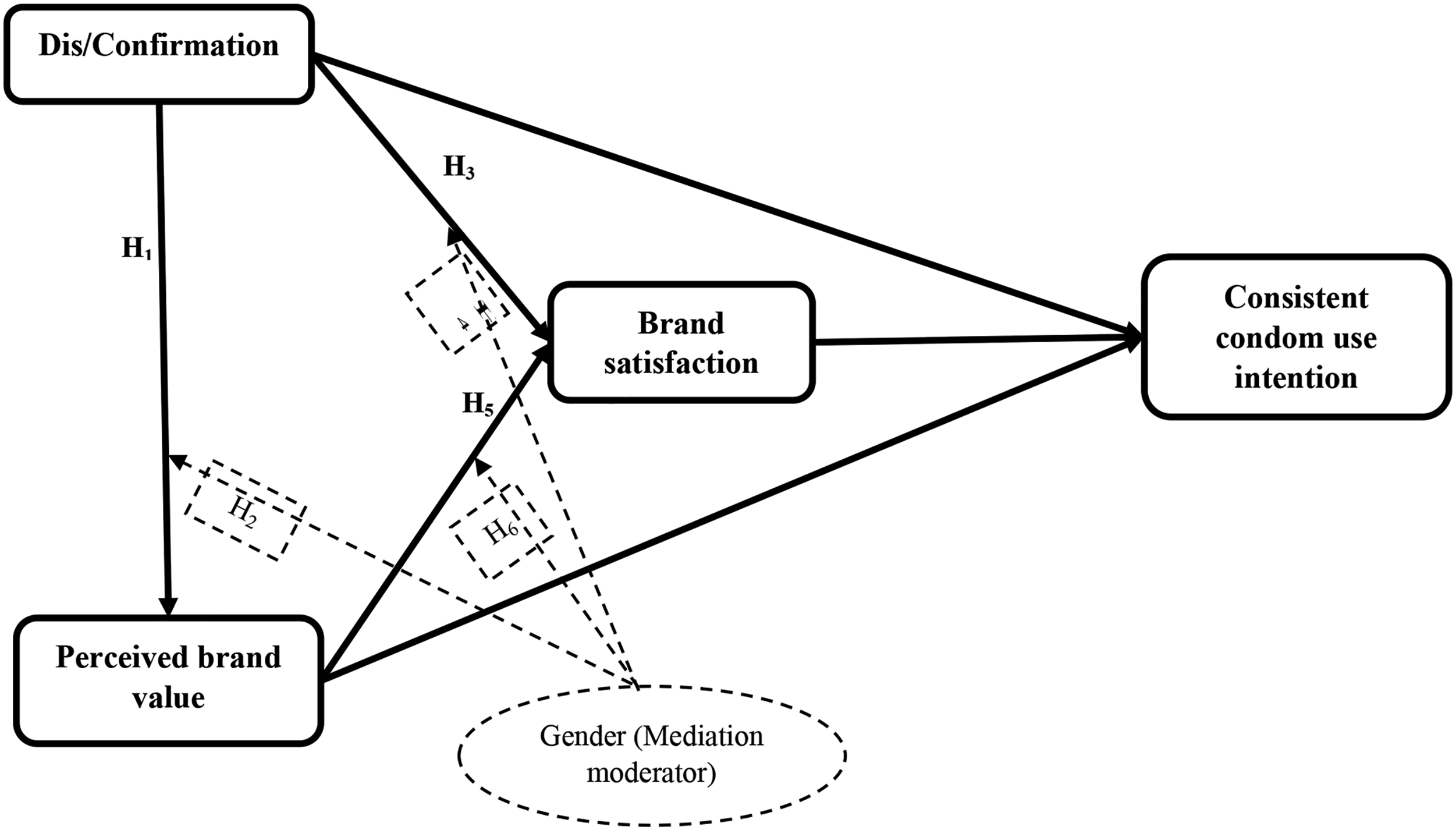
Hypotheses Development
Relationship Between Dis/Confirmation, Perceived Brand Value, and Consumer Satisfaction
Oliver (1980) defined dis/confirmation as the extent to which a product meets or fails to meet consumer expectations. Since dis/confirmation occurs after using a condom, Osah (2015, p. 90) believes that dis/confirmation shapes the way condom users value a brand, especially when it has consistently delivered on its promises over a long period. Several other studies (Hsu & Lin, 2015; Oghuma, Libaque-Saenz, Wong, & Chang, 2016) have established that dis/confirmation shapes the manner in which consumers value a product brand.
Perceived brand value is an overall evaluation of the benefits received in exchange of the price paid to acquire a specific brand (Fu, Zhang, & Chan, 2018; Zeithaml, 1988). Bahri-Ammari, Van Niekerk, Khelil, and Chtioui (2016), Hsu, Chang, and Chuang (2015), and Lin et al. (2012) found that condom users assess the value of the brand through the rapport benefits/price. If the benefits are worth the price, condom users are satisfied and more likely to reuse the brand. If the benefits are not worth the price, condom users are less likely to repurchase or reuse the brand. There is also additional empirical support that dis/confirmation positively affects perceived value, which in turn enhances consumer satisfaction (Chen, 2015; Ifinedo, 2017).
Throughout the literature, perceived value was found to mediate several predictors of consumer satisfaction. Liu, Chang, and Tsai (2015) established that perceived value mediates the influence of service traits on software users’ satisfaction. The same conclusion was reached by Hapsari, Clemes, and Dean (2016) and Yi (2015) in the restaurant and airline industries. However, BarNir, Watson, and Hutchins (2011) and Kreager, Staff, Gauthier, Lefkowitz, and Feinberg (2016) recommended that perceptual studies consider the moderating role of gender, as males and females often differ in their views, depending on gender-based norms. BarNir et al. (2011) found that gender plays a moderated mediation role in the relationship between self-efficacy and behavioral intention. Similarly, Kreager et al. (2016) established that gender moderates the relationship between sexual behavior of young adults and peer acceptance. Based on these arguments, the following hypotheses are formulated.
H1: Perceived brand value mediates the relationship between condom dis/confirmation and consumer satisfaction.
H2: The mediating effect of perceived brand value on the relationship between condom dis/confirmation and consumer satisfaction is moderated by gender.
Relationship Between Dis/Confirmation, Consumer Satisfaction, and Consistent Condom Use Intention
According to Oliver (1997), consumer satisfaction is the judgment that a product provides a pleasurable or non-pleasurable level of consumption-related experience. Existing marketing studies (Curras-Perez & Sanchez-Garcia, 2016; Walsh & Bartikowski, 2013) have established that consumer satisfaction is a significant predictor of behavioral outcomes, such as repurchase intentions, continuance intention, and loyalty. According to Carrizo-Moreira, Freitas-da Silva, and Ferreira-Moutinho (2017, p. 26), satisfied customers are more likely to develop loyalty intentions or a willingness to repurchase the brand.
Joo, Park, and Shin (2017) established that consumer satisfaction mediates the influence of perceived usefulness on continuance intention to use digital textbooks. Joo and Choi (2016) conducted a study among young adults in the USA and found that satisfaction mediates the effects of usefulness, dis/confirmation, and resource quality on the continuance intention of online library users. In addition, prior studies have established that gender moderates the mediated effect of consumer satisfaction. For example, Karatepe (2011) found that gender moderates the mediating effect of consumer satisfaction on brand loyalty in the banking sector. Furthermore, Kisler and Christopher (2008) established that the mediated effect of sexual satisfaction on relationship satisfaction was moderated by gender. Based on this, the following hypotheses are formulated:
H3: Consumer satisfaction mediates the effect of condom dis/confirmation on consistent condom use intention.
H4: Gender moderates the mediating effect of consumer satisfaction on the relationship between condom dis/confirmation and consistent condom use intention.
Relationship Between Perceived Brand Value, Consumer Satisfaction and Consistent Condom Use Intention
According to Ali, Leifu, YasirRafiq, and Hassan (2015), brand satisfaction and perceived value are the direct result of product experience. Thus, the more positive condom users’ experiences are, the more likely they are to be satisfied as well as value and reuse the brand (Mulwo, Tomaselli, & Dalrymple, 2009). Jalil, Fikry, and Zainuddin (2016) reflected on the relationship between perceived brand value, brand satisfaction and repurchase intention in the context of store atmospherics, proposing that satisfaction is a potential mediator of the relationship between behavioral intention and perceived brand value. Lee, Jin, and Kim (2018) confirmed that consumer satisfaction mediates the effect of perceived healthy food value on behavioral intention and considered gender a moderator of that mediation. In addition, Mencarelli and Lombart (2017) found that the mediated effect of perceived hedonic value on repurchasing behavior was stronger for men compared to women. In Mencarelli and Lombart’s (2017) study, gender was applied as a moderating variable of the mediated relationship explored. Based on the evidence above, the following hypotheses are proposed:
H5: brand satisfaction mediates the relationship between perceived brand value and consistent condom use intention.
H6: The mediating effect of brand satisfaction on the relationship between perceived brand value and consistent condom use intention is moderated by gender.
Figure 1 illustrates the proposed theoretical model for this study, depicting the different constructs as well as the hypothesized relationships between these constructs.
Methodology
Sample and Data Collection
This study adopted a descriptive research design. Ethical clearance for the study was provided by the Departmental Research and Ethics Committee (DREC) of the Department of Marketing Management, at the University of Johannesburg in South Africa. The ethical clearance number for the study is ESN001/14. Furthermore, consent provided by the respondents were secured in writing. Data was collected from condom users residing in the Gauteng province of South Africa. The Gauteng province was selected because it has the largest population of young adults in South Africa (Stats SA, 2018). The study targeted young adults aged 18–24 years old because they are more likely to be sexually active and make up 58% of the HIV-infected population in South Africa (De Wet, Oluwaseyi, & Odimegwu, 2014). Screening questions aimed to select participants aged 18–24 years old who had used condoms at least once in 6 months prior to the survey date. Gender and race quotas were applied to ensure that the sample distribution reflects the studied population at least on these two criteria.
Twenty-six fieldworkers were trained and deployed in different areas in the Gauteng province to distribute the questionnaires and collect the data. Twenty-six suburbs were covered, that is one per fieldworker. Since there is no sampling frame for the target population described above, the fieldworkers used a non-probability sampling approach to recruit participants. Fieldworkers were allowed to select participants who met the criteria above in the area assigned to them. Participants were required to sign the completed questionnaire and record their cellphone numbers and signatures on a separate sheet. The quality control consisted of matching the signatures on the separate sheets with those on the questionnaires, and 80 participants were randomly called at the end of the survey to ensure that they completed the survey. The age and gender quotas of respondents were reported daily in a separate form to ensure that the target population was adequately presented. The survey lasted two months and 724 questionnaires were collected for data analysis.
A paper-based self-administered questionnaire was used to collect the data. The questionnaire comprised three main parts. The first part consisted of an informed consent form that all respondents were requested to sign before completing the questionnaire. The second part included three screening questions and measured the constructs through their respective items on a five-point Likert scale of agreement. These constructs are dis/confirmation, perceived brand value, brand satisfaction, and consistent condom use intention. The different items in these constructs were adapted from Chuah, Marimuthu, Kandampully, and Bilgihan (2017), Lin et al. (2012), and Teye-Kwadjo (2014). The content validity of these items was carefully checked by two marketing experts. The last part of the questionnaire focused on demographic information, such as gender, age, income, level of education, employment status and marital status.
Data was captured, cleaned and screened with SPSS version 26. Descriptive analysis was conducted to determine the respondent profile. Structural equation modelling (SEM) was then performed with IBM SPSS AMOS version 26 to test the research hypotheses. The SEM analysis included the confirmatory factor analysis (CFA) and the analysis of the structural model. SEM assumptions of sample size and multivariate normality were also rigorously assessed (Byrne, 2010).
Analysis
Respondent Profile
Descriptive statistics indicate that respondents earned an average income of R5 340.46 per month and the average age of participants was 22 years old. Most respondents were female (55.1%), of which 25.7% were employed and 61.3% were students. Half of the respondents (52.8%) have at least an undergraduate degree and the majority are black (80.5%) and single (89.7%).
Structural Equation Modelling Analysis
SEM, using the covariance-based approach with AMOS 26, was the main technique used to analyze the data. Following Anderson and Gerbing (1988), a two-step approach was adopted. The first step consisted of testing the validity of the measurements through CFA, while the second step tested the research hypotheses through the structural model analysis. Prior to the CFA, the univariate outliers were checked using the skewness and kurtosis values; all items fell within the acceptable range of +/−3 and +/− 10 respectively (Kline, 2015). Multivariate outliers were also assessed through the Mahalanobis distance, which indicated no significant gap in the coefficient trend. Therefore, the normality assumption was met. Since the questionnaire was self-administered, common method bias was tested to ensure that there was no artificial inflation of relationships in the model (Simmering et al., 2015). Harman’s (1976) one-factor test indicated a single factor of 34.056%, which is below 50%, suggesting that the data is free of common method variance bias.
Confirmatory Factor Analysis
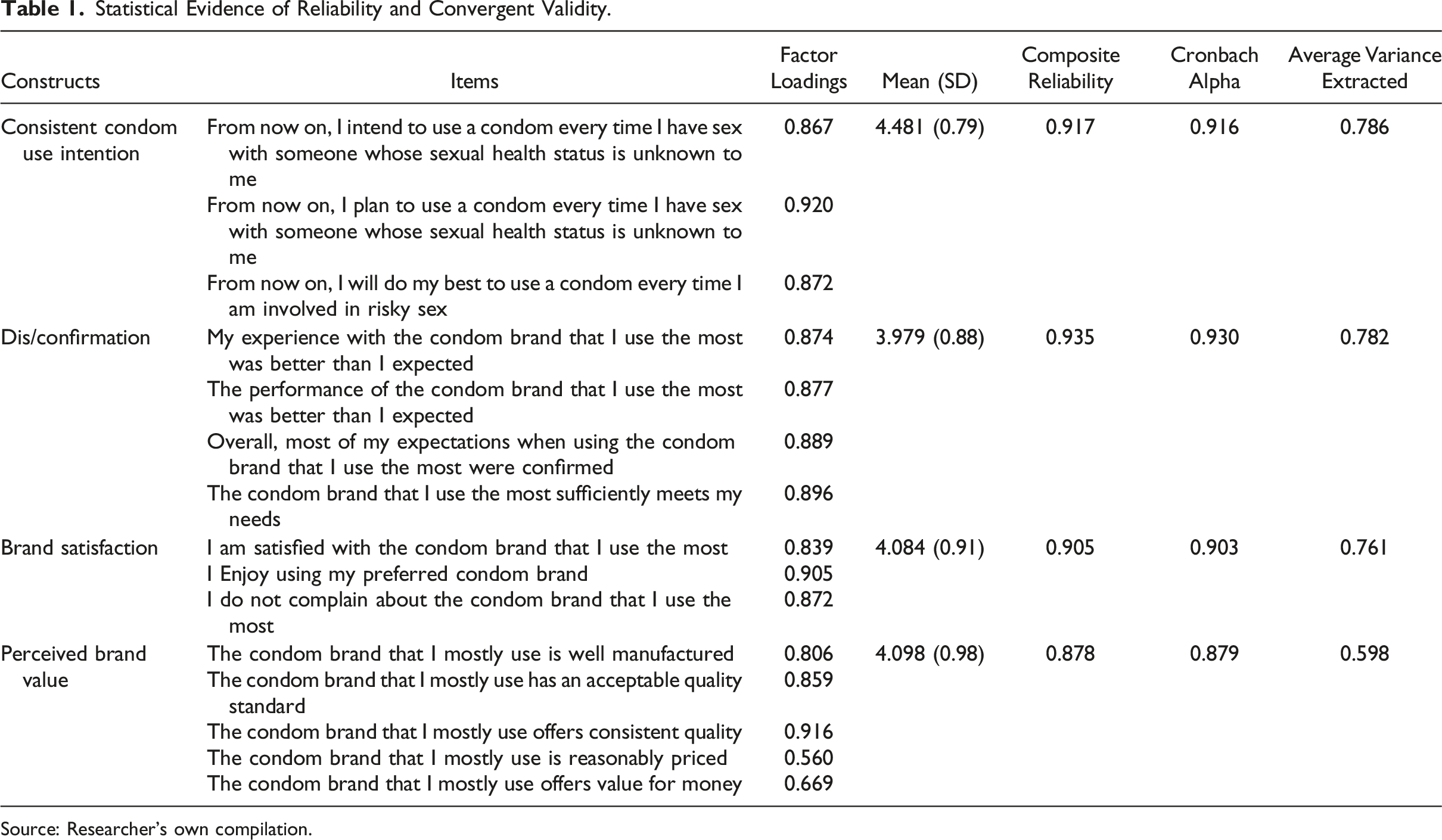
CFA was tested to establish the reliability, convergent and discriminant validity of the measurements used in the study. First, the fit indices of the CFA model were assessed to determine the extent to which the data fit the model. The results of the initial model fit estimation [χ2 = 704.402, p = .000, df= 129, χ2/df= 5.460, goodness-of-fit index (GFI) = 0.889, Tucker-Lewis index (TLI) = 0.939, comparative-fit index (CFI) = 0.949, root mean square error of approximation (RMSEA) = 0.079] suggested poor fit. Measures were taken to improve the model fit. The standardized residual covariance matrix suggested that two items should be deleted from perceived brand value and one item from brand satisfaction. The modification indices of the CFA requested that three additional inter-item correlations be added to the measurement model to improve its fit. These measures led to the improvement of the model as reflected by the following indices [χ2 = 199.627, p = .000, df = 81, χ2/df = 2.465, GFI = 0.912, TLI = 0.983, CFI = 0.987, and RMSEA = 0.045].
Statistical Evidence of Reliability and Convergent Validity.
Source: Researcher’s own compilation.
Evidence of Discriminant Validity.
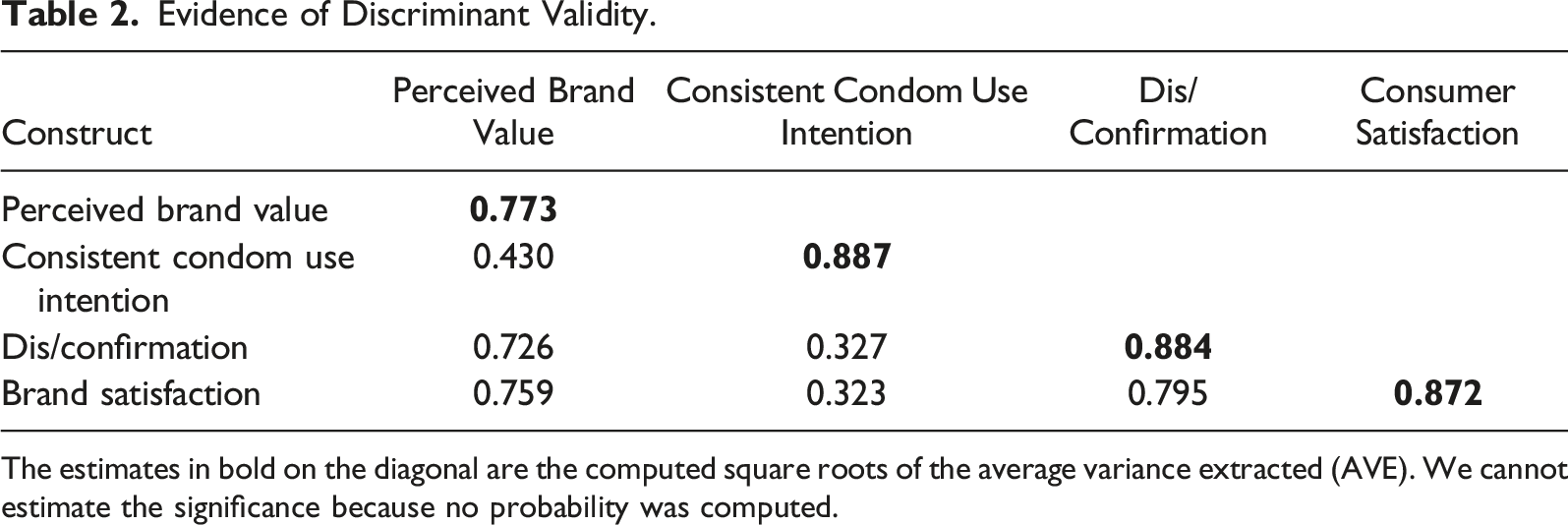
The estimates in bold on the diagonal are the computed square roots of the average variance extracted (AVE). We cannot estimate the significance because no probability was computed.
Structural Model
Since the normality assumption was met, the maximum likelihood was used to estimate the measurement and structural models. According to the maximum likelihood estimation method, the fit indices of the structural model were satisfactory [χ2 = 199.627, p = .000, df = 81, χ2/df = 2.465, GFI = 0.912, TLI = 0.983, CFI = 0.987, and RMSEA = 0.045].
Results
Standardized Direct Relationships.
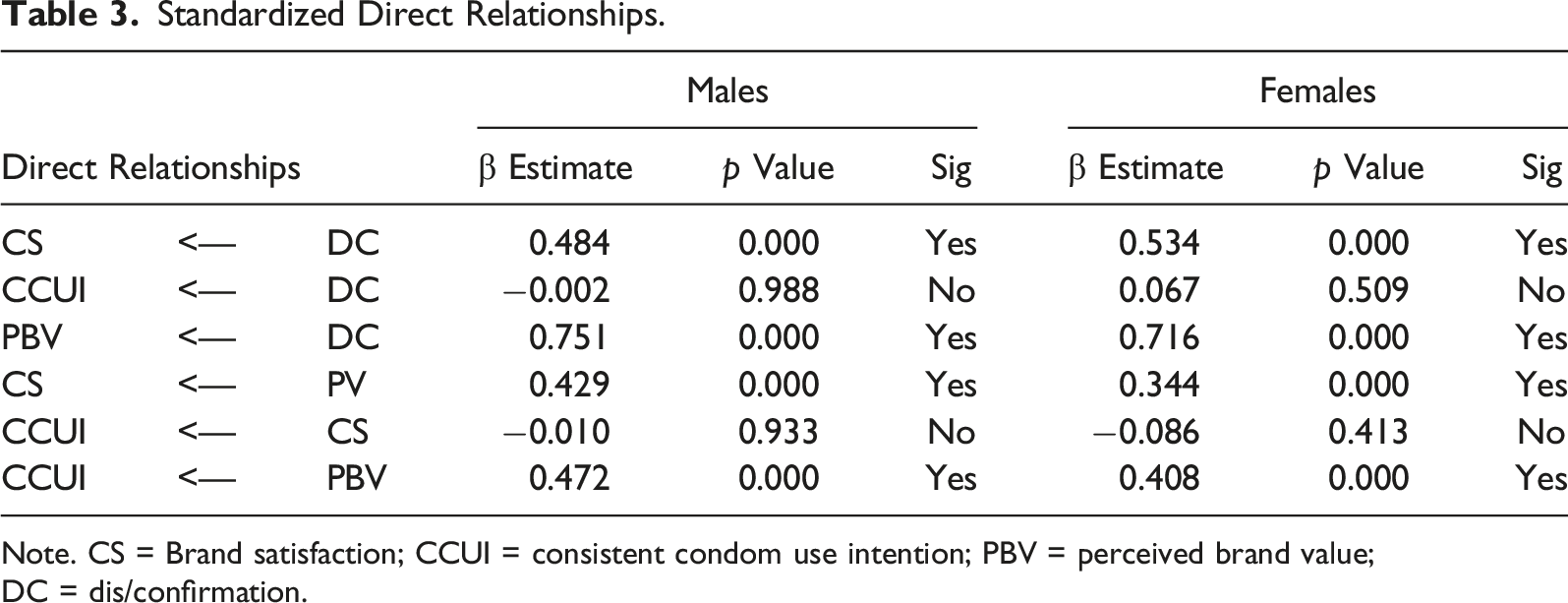
Note. CS = Brand satisfaction; CCUI = consistent condom use intention; PBV = perceived brand value; DC = dis/confirmation.
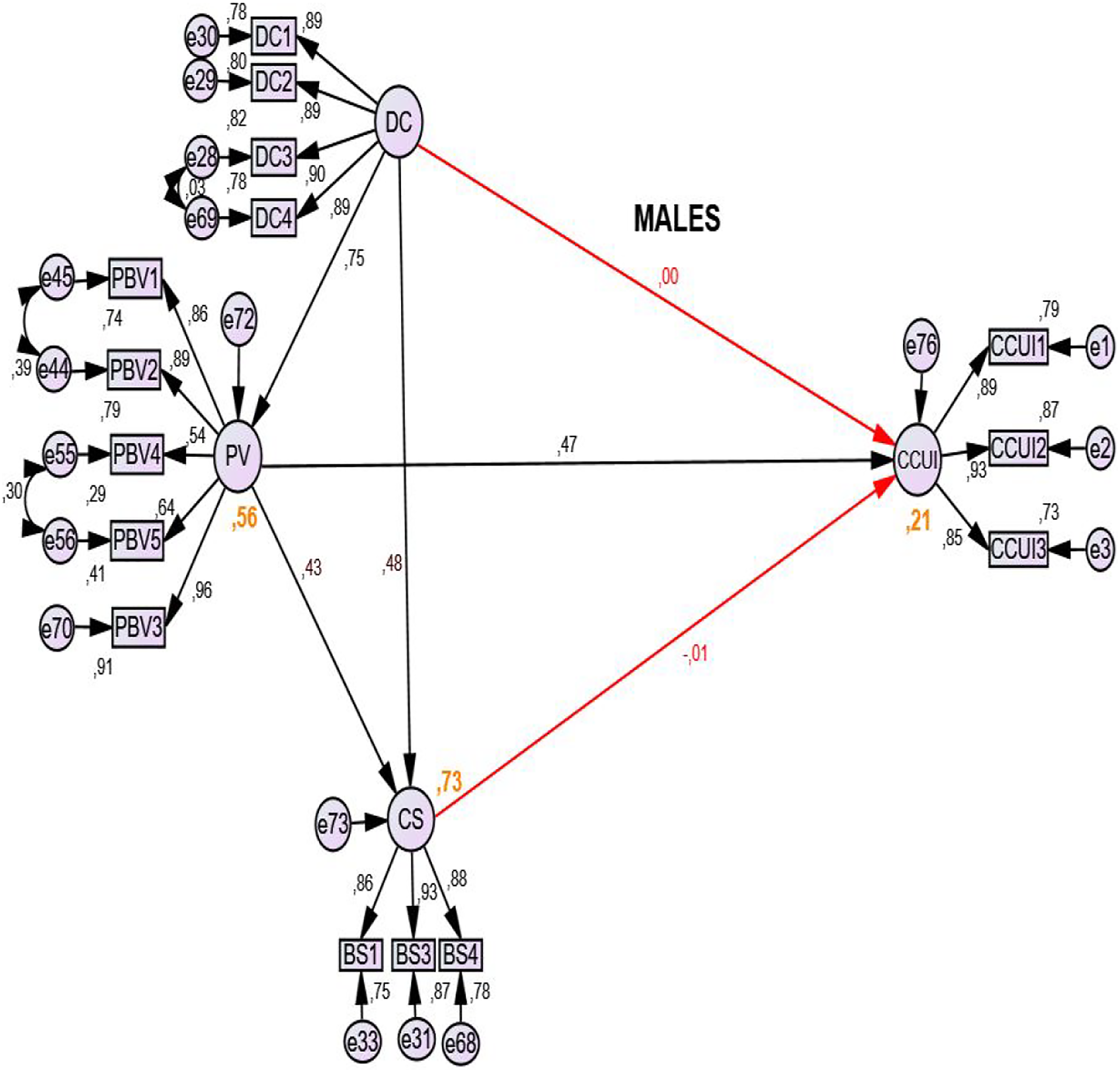
Model tested for males.
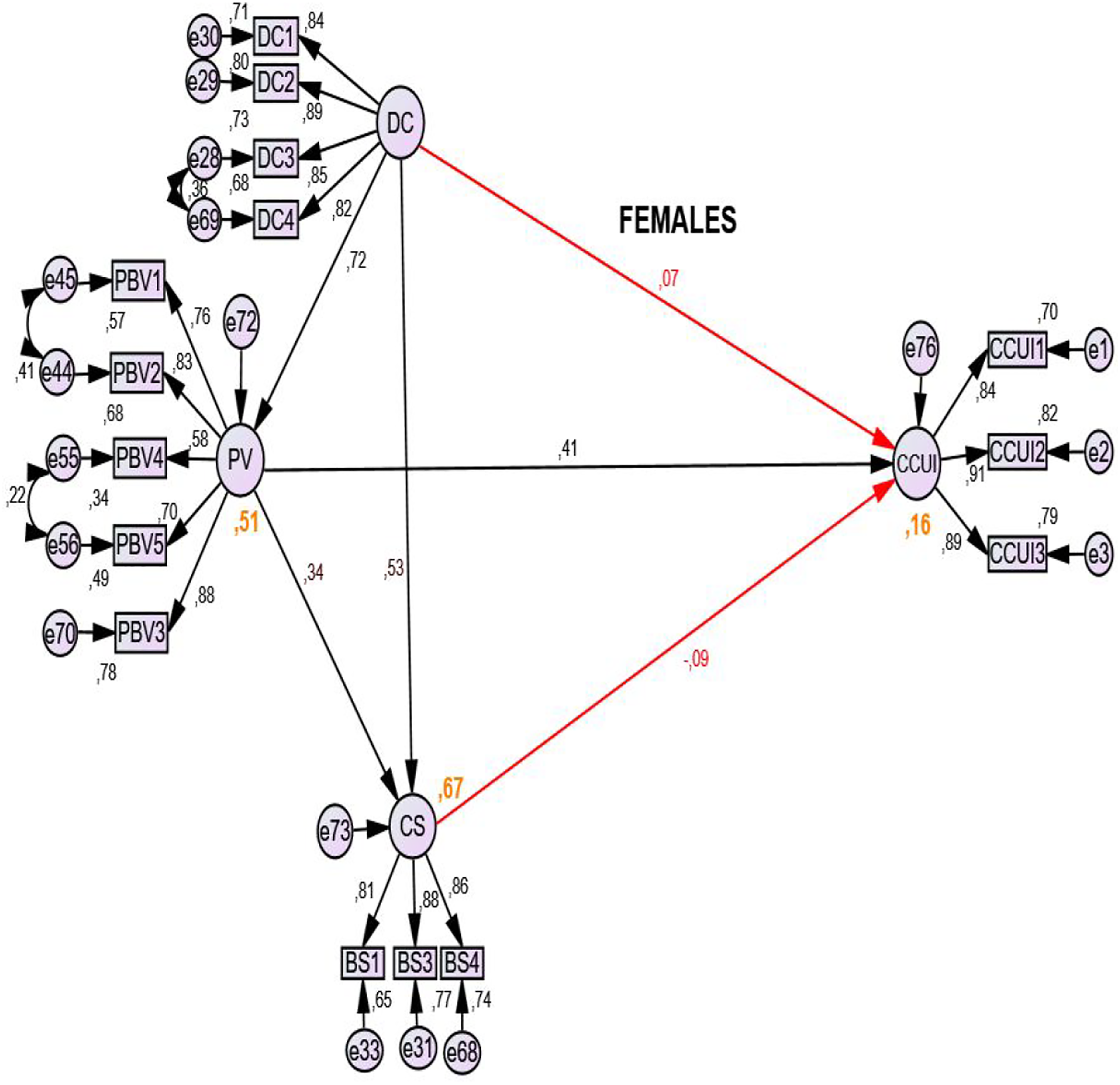
Model tested for females.
Standardized Indirect Relationships.
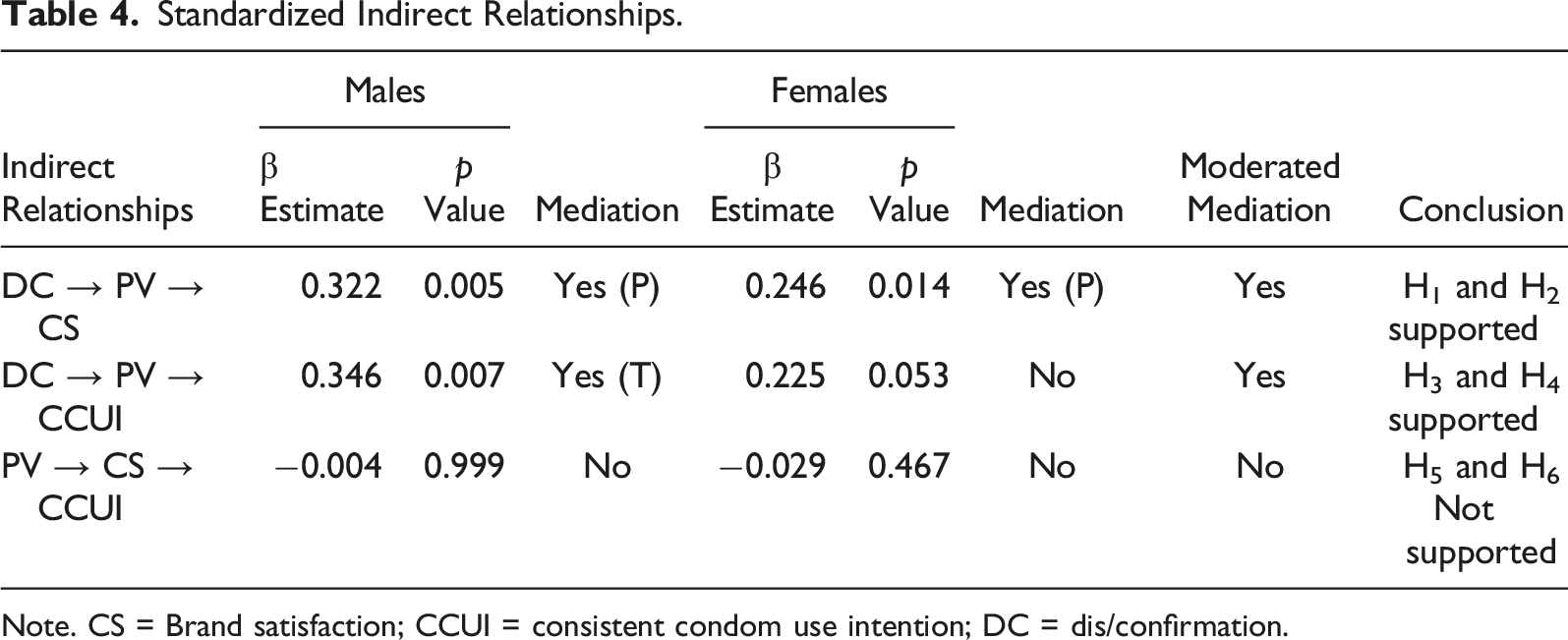
Note. CS = Brand satisfaction; CCUI = consistent condom use intention; DC = dis/confirmation.
Moreover, the results confirmed that the mediated role of perceived brand value on the relationship between dis/confirmation and brand satisfaction is moderated by gender, as the strength and confidence interval of the indirect effect are significantly different between males and females. The mediated effect is stronger for males compared to females (βMales = 0.322 vs. βFemales = 0.246), and the interval confidence (IC) is also significantly higher for males compared to females [ICMales= 99% (p < .01) vs. ICFemales= 95% (p < .05)]. In conclusion, H2 is supported.
The mediation analysis of the overall sample revealed that perceived brand value also mediates the relationship between dis/confirmation and consistent condom use intention (β (indirect effect) = 0.285, p < .01). This is a full mediation because the direct effect of the overall mediation model is non-significant (β = 0.042, p > .05). Hence, H3 is supported. Table 4 further indicates that the mediated effect of dis/confirmation on consistent condom use intention is moderated by gender, since the indirect effect is significant for males (β = 0.346, p < 0.01), but non-significant for females (β = 0.225, p > .05). Consequently, H4 is supported.
Lastly, the results indicate that brand satisfaction does not mediate the relationship between perceived brand value and consistent condom use intention as the indirect effect is non-significant for males (β = 0.042, p > .05) and females (β = 0.042, p > .05). Thus, H5 is not supported. Since H6 depends on the occurrence of H5, the researcher confidently deduced that H6 was not established and so H6 is also not supported.
Discussion
The increase in HIV and STIs infections has raised scholar’s interest in the factors that drive condom use especially among young people. While several theories have been developed and applied to understand condom use intention, theories that predict consistent condom use intention based on brand performance (such as brand satisfaction and brand value) remain scares. This study is the first of his kind to demonstrate that the ECT framework can effectively explain consistent condom use intention among young adults in a high HIV prevalence country. While previous application of the ECT (in other contexts) have focused on the direct relationships, this proposed model uncovered the complexity of consistent condom use intention through the validation of the indirect relationships specified in the model, coupled with the moderating role of gender.
When considering the results, dis/confirmation has a greater impact on brand satisfaction when it is joined with perceived brand value. In other words, the more consumer expectations are met, the more they will value and will be satisfied with the brand. In this case, satisfaction is a function of the combined effect of both dis/confirmation and perceived brand value. This finding which applies to both males and females is consistent with the findings from Malik, Ghafoor, and Iqbal (2012), who found that the effect of perceived quality (dis/confirmation) on brand satisfaction was mediated by consumer perceived value in the Pakistani banking, transport, courier, and telecommunication industry. Hsu and Lin (2015) reached the same conclusion when investigating Taiwanese young adults’ purchase intentions of paid mobile apps.
Moreover, the results indicate that the mediated relationship between dis/confirmation and brand satisfaction is more significant among males than females. This gender dissimilarity may be due to men and women processing information differently. According to Meyers-Levy and Maheswaran (1991), men tend to select information and pay little attention to the details when judging a product (e.g., condoms). Conversely, women make their judgment of a product based on detailed information. This implies that the marketing of a product (such as a condom) to women should be more grounded on factual information to stimulate their interest in the product. This could explain why the mediated effect of perceived brand value in the model is weaker among females.
Interestingly, this study revealed that perceived brand value only mediates the effect of dis/confirmation on consistent condom use intention for males. Other studies (e.g., Hapsari et al., 2016; Kim & Damhorst, 2010), reached a similar conclusion without any particular highlight on gender difference. According to Biron, De Reuver, and Toker (2016) and Tannen (1990), perceived brand value often fails to mediate the effect of dis/confirmation on women’s condom use intention because, compared to men, women give more importance to affection and relationship building.
Finally, this study established that brand satisfaction does not mediate the relationship between perceived brand value and consistent condom use intention. In other words, the effect of brand satisfaction on consistent condom use intention is not enhanced or weakened by brand value. This finding is inconsistent with previous studies that often indicate that brand satisfaction is a mediating factor. Yen (2013) conducted a study among young adults in Taiwan and established that brand satisfaction mediates the relationship between perceived value and loyalty intention to use social networking sites. Zainal, Atikahambar, Hafiz, Zali, and Kutut (2014) explored the same relationships in the tourism industry in the island of Penang and obtained the same result. This inconsistency in findings seems to suggest that the mediating effect of brand satisfaction is most likely to occur when it is applied to services. The mediating effect of brand satisfaction does not seem to work well with health goods such as condoms.
Implications and Limitations
Two main strategic implications are derived from this study. First, results indicated that brand satisfaction results from the combined effect of both dis/confirmation and brand value. Since dis/confirmation is the discrepancy between the brand performance and consumers’ expectations, condom producers who want to improve their brand satisfaction should invest more in understanding and meeting the expectations of their clients. An improved dis/confirmation score will lead to a higher perceived value which will then increase brand satisfaction. This recommendation requires that condom companies frequently re-evaluate customers’ expectations against the performance of their brand. A thorough research will be needed to identify condom expectations that are important to young adults. Both quantitative and qualitative approaches can be used to ensure that the expectations of young adults both males and females are well understood. A deep understanding of consumers’ expectations will not only enable condom producers to improve their offerings, but it will also assist them improving their perceived brand value and brand satisfaction scores.
Second, if the brand is to be relevant to the HIV prevention, its communication should integrate the concept of consistent condom use with other benefits offered by the brand. This approach will, improve the perceived value of the brand and remind consumers to act responsibly by avoiding unprotected sex. Since males and females assess brand value differently (especially in connection to relationship and sexuality), brand managers should investigate the distinct value expectations of each gender to ensure that their brand promise resonates well with the needs of both segments. A qualitative study may help to uncover these value expectations and improve both the condom design and the brand message. Any improvement of the condom brand should be communicated to young adults through social media, such as Facebook, Twitter and Instagram as these are the platforms mostly used by young people (Anderson & Jiang, 2018; Vromen, Xenos, & Loader, 2015).
Despite its contribution, this study is not without its limitations. Firstly, the study was confined to one province in South Africa due to financial and time constraints. Therefore, it is recommended that further studies test the validity of these findings across all nine South African provinces. Secondly, the questionnaire was self-administered, and no measure was taken to control the social desirability bias that often occurs in condom studies. Consequently, it is recommended that further research include a social desirability scale in the questionnaire to control the social desirability bias.
Conclusion
This study improved the ECM version of Lin et al. (2012) to examine the factors explaining consistent condom use intention of South African young adults. The findings emphasized the mediating role of perceived brand value on the impact of dis/confirmation on brand satisfaction. Moreover, the study found that the mediating effect of perceived brand value is significantly different for males and females. These findings suggest that using an undifferentiated marketing strategy (one-size-fit-all) to promote consistent condom use among young adults would be less effective than using a gender-based approach.
Footnotes
Acknowledgments
We would like to express our sincere gratitude to Osmoz Consulting for the statistical support.
Declaration of Conflicting Interests
The author(s) declared no potential conflicts of interest with respect to the research, authorship, and/or publication of this article.
Funding
The author(s) received no financial support for the research, authorship, and/or publication of this article.
