



Abstract
Background
The availability of formal academic training is essential to the development and professionalization of any discipline. Previous research described the worldwide availability of social marketing academic course offerings and their accompanying pedagogical approaches. This research has been demonstrably appreciated by the social marketing community, resulting in calls for its continuation.
Focus of the Article
We present an update to and expansion upon prior research, and identify patterns and trends observed over the past decade.
Importance to the Social Marketing Field
As social marketing continues to expand in its scope and uptake, an update to prior research has become increasingly relevant and necessary. Further, limited attention has been paid to social marketing pedagogical approaches. The patterns and trends identified through this research represent an updated baseline that can be used to assess and guide the discipline’s ongoing advancement.
Methods
Research was carried out via an online survey that was open between Fall 2019 and Fall 2021. In addition to general information about their university’s course offering(s), respondents were invited to share their course syllabi. The survey was promoted via online networks and academic conferences. Resulting data were cross-referenced with the outcomes of a prior study to identify patterns and trends.
Results
This research resulted in a listing of academic courses that can now be found on the Web site of the International Social Marketing Association (International Social Marketing Association, 2022). Over the past decade, we identified an upward trend in course availability alongside shifts in the disciplinary and other contexts associated with the courses. We also described instances where social marketing courses were eliminated or scaled back and the apparent reasons for those occurrences. Finally, geographic disparities were evident in course availability between Global North and Global South countries.
Recommendations for Research or Practice
Recommendations for increasing social marketing academic course offerings are presented within a systems framework focusing on targeted strategies for audiences and contexts such as university students, faculty, instructors, and administrators; accreditation bodies, and practitioner settings. We also call for increased collaboration between academics and practitioners in general, but specifically in the Global North and Global South in order to address issues of equity and diversity.
Limitations
A key limitation to this study is the fact that the survey was developed in English, thus introducing a bias towards Western academic settings. We also acknowledge the difficulty in searching online for courses using the term “social marketing” due to the pervasive confusion with “social media.” Finally, we only obtained 31 syllabi (from the total 104 courses reported via the survey), thus the pedagogical analysis should be considered incomplete and not fully representative of current practices.
Keywords
Introduction and Background
Social Marketing as a Discipline
In 2021, social marketing marked the 50th anniversary of the first academic paper to formally identify and delineate it as an innovative social change discipline (Kotler & Zaltman, 1971). In practice, social marketing originated in the 1960s, primarily within public health contexts around the world (Deshpande & Lee, 2013; French, 2015; Lefebvre, 1996), and has been increasingly recognized as having a vibrant—albeit often unrecognized—history of practice within the Global South (Alonso Vázquez & Aya Pastrana, 2022; Cateriano-Arévalo et al., 2022; Pang et al., 2021; White, 2018). In academic settings, it has been taught predominantly in business schools and schools of public health for decades. Further, social marketing has expanded in its disciplinary focus to include environmental sustainability and conservation issues, with the first formal introduction of community-based social marketing appearing in the academic literature in the mid-90s (McKenzie-Mohr, 1994, 1996), and with social marketing being applied in biodiversity conservation contexts even before that, though often unlabeled as such (Veríssimo, 2019).
Indeed, over the decades, social marketing has expanded both in scope—in terms of its approaches, application contexts, and theoretical underpinnings (Akbar et al., 2019; Dibb, 2014; Dibb & Carrigan, 2013; Gordon, 2013; Gordon et al., 2016; Hastings & Saren, 2003; Lefebvre, 2011; Rundle-Thiele et al., 2019; Saunders et al., 2015) —and in practice, in terms of the increased professionalization of the field (Kassirer et al., 2019). The network of social marketing associations is also growing and now covers all the world’s continents (save Antarctica). Through a consensus process coordinated by the associations, a set of principles, concepts and techniques has been developed for the discipline (International Social Marketing Association, 2017), along with a statement of ethics (Kubacki et al., 2020), and a list of academic competencies (International Social Marketing Association, 2014). Hundreds of master’s theses and doctoral dissertations focused on social marketing have been produced since the 1970s (Truong, 2017; Truong & Dietrich, 2018; Truong et al., 2014).
However, despite all these advances, social marketing is arguably still not widely known beyond its disciplinary boundaries and communities of practice. As part of the many ongoing calls for social marketing to do a better job marketing and positioning itself (Akbar et al., 2021; Andreasen, 2002; Deshpande, 2019; Kassirer et al., 2019; Lee, 2020; Newton-Ward et al., 2004; Wood, 2012), the importance of academic coursework continues to be elevated in the discussion. The availability of formal academic courses, programming, and degrees is a significant indicator of the status of a discipline (Kelly, 2009, 2013; Truong et al., 2014); being taught regularly at major universities is one means of conferring legitimacy to a field of study (Andreasen, 2002). As Truong and Dietrich have argued, “If social marketing is to continue developing as an academic discipline, it is important that more academic programmes are created at the undergraduate and graduate levels so that future social marketers can be trained” (2018, p. 69), yet Lee (2020) has noted that “only a small portion of academic institutions offer courses in social marketing” (p. 5). Therefore, an examination and analysis of the current state of social marketing academic programming can serve a timely and important purpose in support of the discipline.
Picking up the Beat
The present study was carried out as both a follow-up to research conducted by Kelly (2009, 2013) investigating academic course offerings in social marketing, and as part of a broader inquiry into the institutionalization of social marketing as a discipline (Foote, 2022). Kelly’s prior research resulted in a listing of academic courses available around the world. The original listing (Kelly, 2009) was revisited and updated (Kelly, 2013); both studies were published in Social Marketing Quarterly. Kelly found 54 courses housed within 41 academic institutions located in 12 countries. This work revealed that as of 2012, the majority of social marketing courses were offered in North America and Global North countries, and they were concentrated within the disciplinary domains of public health, business, and communications. Only three Global South countries (China, Venezuela, and Jamaica) were found to have social marketing academic programming available. [For the purposes of this research, we use the designations for Global North and Global South derived from the International Telecommunications Union’s (ITC) regional classification in partnership with the United Nations (International Telecommunications Union, n.d.).] Notably, there did not appear to be significant growth in the number of courses during the four to five years between the two studies.
The research also incorporated a summary of the pedagogical approaches used in the courses, and outlined the instructional methods used, the most common learning objectives, curricular materials, and the types of major assignments and assessment strategies. Most courses used a mix of lectures and discussion, often including guest speakers. The most common project assigned was the development of a social marketing plan (accounting for the bulk of the final grade), though many courses also weighted exam scores heavily in determining students’ grades. A list of commonly assigned textbooks and case studies was also compiled.
This research proved to be valued by the social marketing community. As the 2019 World Social Marketing Conference was approaching, Kelly was fielding an increasing number of requests to undertake a new update, and ultimately connected with Foote after convening an exploratory session at the conference. The result is this collaboration, further supported by many individuals from the International Social Marketing Association (iSMA), the Social Marketing Association of North America (SMANA) (which had been hosting a spreadsheet on its Web site listing social marketing and professional development opportunities), and the other regional associations around the world [European Social Marketing Association, Australian Association of Social Marketing, and Asociación Latinoamericana de Mercadeo Social (LAMSO)].
In this study, we will address the following research question: “What is the current global state of social marketing formal academic course offerings, and what trends, challenges, and opportunities can be identified?”
Methods
This study represents both an update to and expansion of prior research by Kelly (2009, 2013). Kelly’s original research (2009) was conducted through inquiries posted to the social marketing global listserv (Social Marketing Association of North America, 2018) and through online searches using terms such as “social marketing,” “teaching social marketing,” “social marketing course,” and “social marketing syllabus.” Course syllabi were collected from professors who were willing and able to share them, then analyzed in order to summarize pedagogical approaches. For the follow-up study (2013), Kelly contacted professors whose courses had been included in the 2009 study via email or phone, to determine if their course(s) were still being offered. While these methods were also used in the present study, data were primarily collected using an online survey instrument, which was then disseminated through a number of channels.
Online Survey Development
A survey was created to collect information about ongoing social marketing academic courses housed within and offered through accredited colleges or universities. The survey used a combination of multiple-choice and open-ended responses to collect basic descriptive information about academic courses. Respondents were informed that the information they provided would ultimately be made available via a public-facing online resource available through the regional social marketing associations, as well as included in the present study and its corresponding author’s dissertation research. Survey items were designed to align with Kelly’s prior research (2009, 2013). However, in order to capture a wider array of academic coursework that incorporated social marketing, we included a checkbox for participants to indicate whether the course had a primary focus on social marketing (i.e., approximately half or more of the content was focused on social marketing, aligning with the criteria from Kelly’s prior studies), or whether social marketing comprised only a component of the course. The survey instrument also included a field that allowed respondents to upload a syllabus. A draft of the survey was shared with both academic and practitioner colleagues from the social marketing community and regional associations; these individuals provided valuable feedback on its design. Multiple iterations were created before applying for Institutional Review Board approval to Antioch University New England, which was granted in the form of exempt status in September 2019.
Survey Deployment and Dissemination
Obtaining results required a lengthy and thorough process to ensure fidelity and integrity. The online survey was open for two years, from Fall 2019 through Fall 2021. The survey was promoted through a variety of United States and international social marketing networks and social media channels. In addition, the invitation to take the survey was translated into Spanish by the Latin American Social Marketing Association (LAMSO) leadership and shared in Spanish on their social media channels and within their newsletter.
Analysis
Survey data were compiled, edited for grammar and spelling, and formatted for consistency. Summaries of basic information were compiled, and patterns and trends were identified and developed through content analysis.
Social Marketing Academic Course Offerings.

Note. G = Graduate; U = Undergraduate; PGC = Postgraduate Certificate.
aThe course is required within its program or specialization.
bThe university offers a degree in social marketing.
Results
Academic Coursework
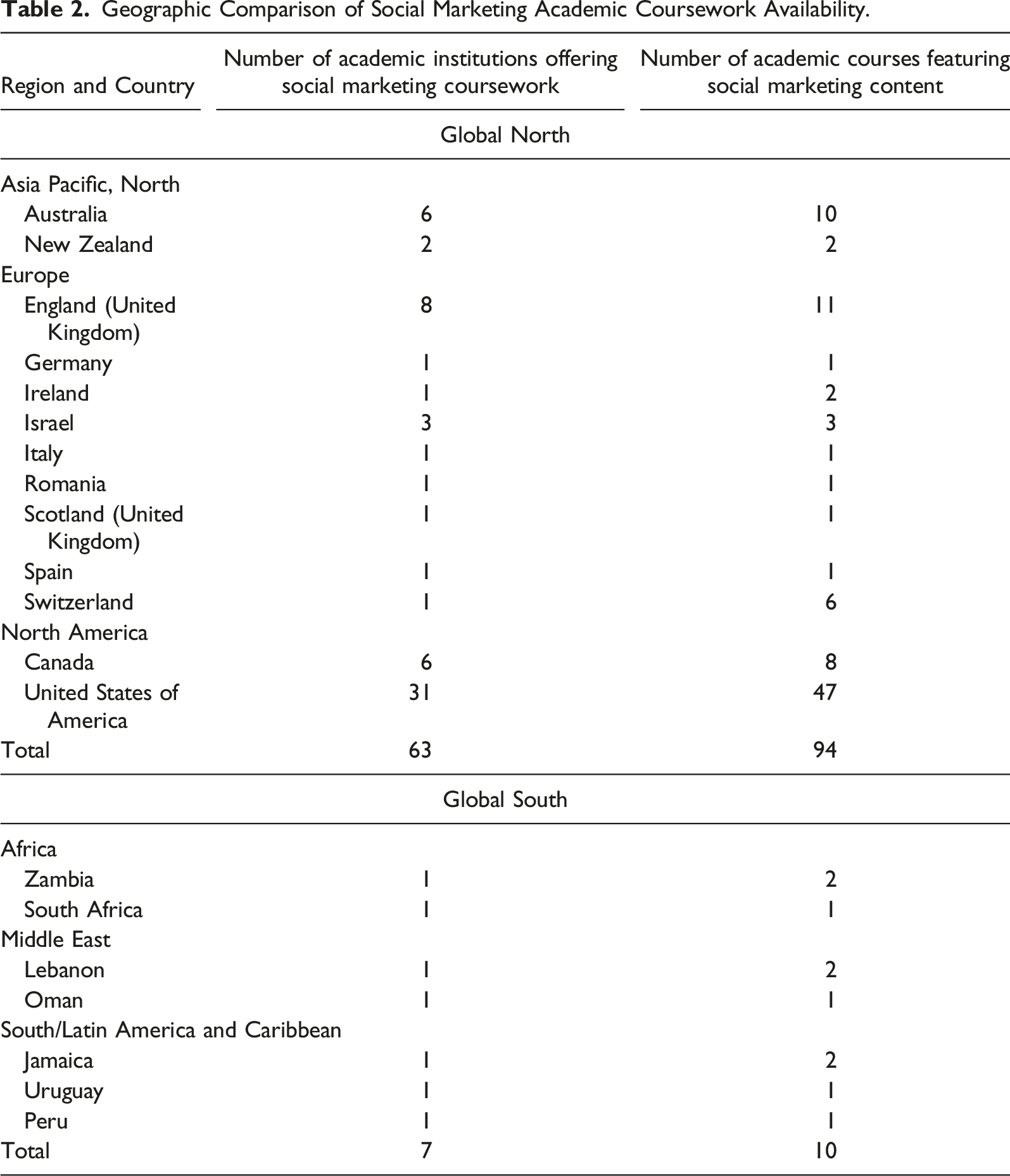
Table 1 presents a listing of ongoing academic courses found at educational institutions around the world.
We were able to identify a total of 104 courses housed at 70 different universities within 20 countries. Of these courses, 80 focused primarily on social marketing, while 24 included it as a component (less than half of course content).
Approximately half of the courses are offered at the graduate level (48%), with slightly fewer (41.3%) offered at the undergraduate level, and much fewer (7.8%) offered as part of a postgraduate certificate; several courses were offered at multiple levels, either graduate and undergraduate, or graduate and postgraduate certificate. Some of the courses are required within their degree program, which is denoted in Table 1.
For the “primary disciplinary area” of the courses, a third (33.7%) were classified as “Health” (which includes these “other” responses written in by respondents: “Health Communication,” “Public Health,” “Global Public Health,” and “Behavioral Science & Health Communication”) and followed by “Marketing” (28.8%). “Communications” and “Business” each made up 12.5% of the total. Nearly 10% of the courses can be classified as “Environment & Conservation,” which includes examples within “Environmental Studies” and “Conservation Sciences, General.” The final few disciplinary areas selected by respondents include “Public Administration,” “Political Science,” “Psychology,” and “Humanities,” each represented by one course. Figure 1 presents these data in comparison with the disciplinary context of the courses available in 2012. Disciplinary Context, 2012 versus 2022.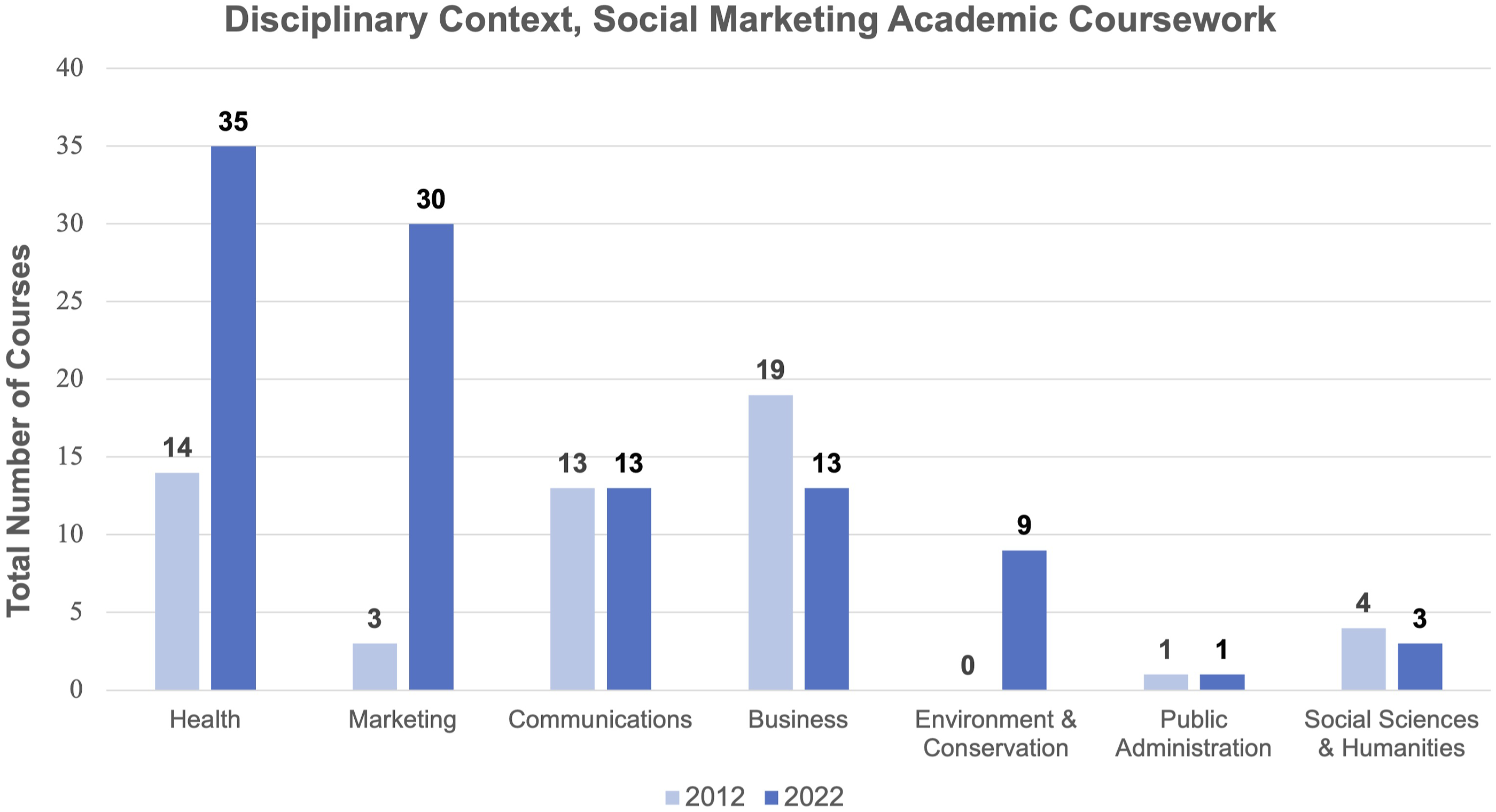
Twenty-three universities offer more than one course featuring social marketing, and five universities offer these courses in different departments within the university (e.g., business and communication, business and health, or psychology and marketing). We also found examples of courses that were cross-listed by degree program, for instance covering both health and environmental sustainability disciplines.
Geographic Comparison of Social Marketing Academic Coursework Availability.
Only two academic institutions reported offering degrees labeled as “social marketing.” The University of South Florida has a longstanding academic program in social marketing and offers a Masters of Public Health in social marketing and a freestanding social marketing graduate certificate. The second institution, the National Institute of Public Administration based in Zambia, is slated to launch bachelors and masters degrees in social marketing in 2022. While Griffith University in Australia has a center dedicated exclusively to social marketing (Social Marketing @ Griffith), due to conventions in academia in Australia, the undergraduate and graduate degrees conferred are general (e.g. “Marketing” or “Business”) and not labeled “Social Marketing.” We also uncovered one instance of a university (University of Wollongong) eliminating its social marketing major, previously housed within the university’s Bachelor of Social Science program, and another instance of a postgraduate certificate in social marketing being discontinued (Stirling University).
Trends
Figure 2 presents a comparison of the courses known to exist in 2012 (Kelly, 2013) alongside the data obtained through this study, demonstrating a clear increase in courses focused primarily on social marketing. Social marketing academic coursework availability, 2012 versus 2022.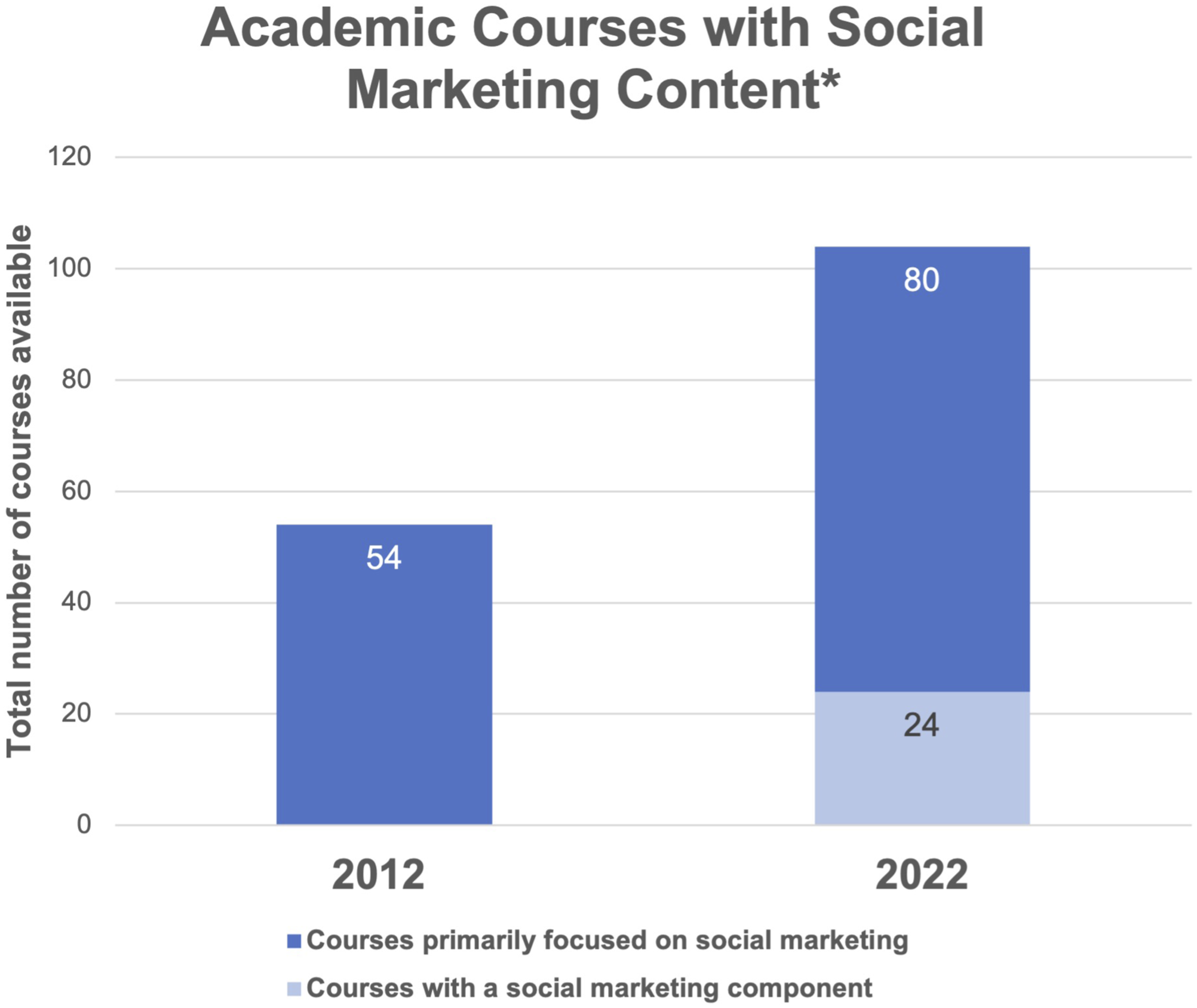
Trends Associated With Social Marketing Academic Coursework.
Due to the pervasive confusion between “social marketing” and “social media” (Akbar et al., 2021), we also made an effort to examine the terminology and labeling associated with these courses. Sixty-nine of the courses listed in Table 1 include “social marketing” in the course title. Comparing courses listed in the prior study (Kelly, 2013) that are still available today, we found that two academic institutions added “social marketing” to course titles that had previously not included it, while four universities removed the term “social marketing” from the course title, opting instead for more general terminology linked to behavioral science or social change. However, correspondence with one of these courses' instructors indicated that the reason for the change was not in response to the aforementioned confusion with social media, but because the new name better reflected the course’s content.
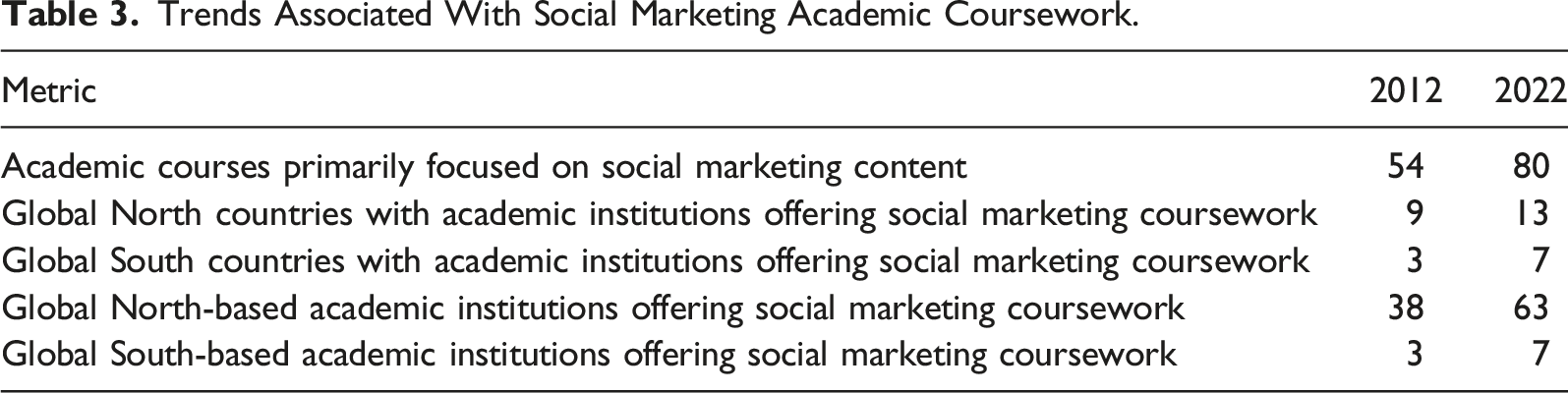
Further comparisons between the results of the prior study (Kelly, 2013) and the present one reveal additional trends. Five courses from the original study are no longer being offered, and two remain unconfirmed. Thirty-four of the 41 total academic institutions known to be offering social marketing courses in 2012 are still offering social marketing programming today. Overall, the number of academic institutions offering social marketing coursework increased (from 41 to 70, see Table 3), and we found 45 new individual courses that were added in the last 10 years. Notably, eight of the ongoing courses listed in Table 1 have been offered for 20 years or longer.
Pedagogical Approaches
We received 31 syllabi submitted by survey respondents. We analyzed the syllabi by compiling and reviewing the information provided on course goals and outcomes, learning objectives, textbooks and readings assigned, instructional approaches, main assignments/final projects, and assessment methods. We found approximately 250 learning objectives specified; these overlapped across courses. Many of the learning objectives from the syllabi aligned to multiple academic competencies developed by iSMA (International Social Marketing Association, 2014; see Appendix A), and several learning objectives that were not addressed by iSMA’s competencies were also identified.
Most courses used a combination of lectures and discussion, with many incorporating online platforms for students to post assignments, engage in discussion, and provide feedback on others’ work. Guest speakers were also common. The majority of the courses either required group assignments or allowed students to choose whether they worked together or individually. Several courses incorporated service learning in support of local organizations or agencies. Course materials varied; most of the courses used a mix of textbooks, journal articles, popular literature, reports, and multimedia (e.g., videos or podcasts). Appendix B presents a list of textbooks used in the courses for which syllabi were provided.
The most common main/final project (as determined by the weighting of assignments for the final course grade) was the development of a comprehensive social marketing plan (i.e., goals, objectives, formative research, audience segmentation, behavior selection, audience insights, application of behavioral theory and frameworks, marketing mix, and a monitoring and evaluation plan). Quizzes and exams were also used to evaluate student performance, but rarely amounted to a greater percentage of students’ grades than the social marketing plan. Several other assignments were included within syllabi, such as research reports, campaign briefs, or critical analyses of social marketing initiatives.
Of the learning objectives, the ones most frequently observed on syllabi were to define and differentiate social marketing from other approaches (competency #1); design and conduct situational analyses and formative research (competency #5); select and apply relevant theory, models, and frameworks (competency #6); create an integrated social marketing mix strategy to influence a desired behavior (competency #7), and identity stakeholder and community priorities and determine if and where social marketing approaches are appropriate (competency #2).
Discussion
This study has contributed to the current understanding of social marketing education at a global scale and has extended the scope of previous research while identifying challenges and opportunities to expanding academic course offerings in social marketing. Kelly’s previous studies (2009, 2013) provided a listing of academic course offerings alongside an overview of pedagogical approaches in use. Our study has updated those findings while also a) broadening the focus of inquiry, b) identifying trends, and c) providing recommendations to improve the current state of social marketing education.
In the time that has passed since the previous studies (Kelly, 2009, 2013), notable changes have occurred within the social marketing academic programming landscape. First, we were able to document a substantial increase in the number of social marketing courses currently available. The fact that 45 of the courses were created within the past 10 years is encouraging for the discipline, and denotes a clear trend. Further, several universities went from having only one course available previously, to adding more course(s), sometimes in different departments within the university. Another notable development was documenting the first social marketing academic coursework housed within Environmental Studies departments. Finally, it is also encouraging to have found two dozen courses that include social marketing as a component, as this will serve to at least introduce students to the discipline.
However, our study did uncover several examples of regression, with some courses being discontinued, and a social marketing degree dissolving outright. Follow-up correspondence with instructors, as well as qualitative interview data from the larger research within which the present study is embedded (Foote, 2022), revealed some insights behind this observation. In most cases, losses of courses or substantial changes in the curriculum were a result of the instructors leaving the university, via transfer to another institution or their retirement; sadly, some also passed away. This observation aligns with prior research noting that there may be a gap in interest and activity in social marketing within the 40- and 50-year old cohort, while the original thought leaders continue to retire (Akbar et al., 2021). Other factors cited by respondents linked to changes in course availability include restructuring of degree programs and shifting interest and demand within students in particular degree programs, despite general accounts of increasing interest in social marketing within younger cohorts of students.
One example of a university’s reducing its number of courses merits exploring more in depth, as a focus on the absolute number of courses does not tell the full story. The University of the West Indies in Jamaica has one of the most longstanding academic programs in social marketing, with courses first being offered in 1998 as part of a specialization within the university’s Media and Communication bachelor’s degree program. These included four courses: two offered in the second year (Basic Social Marketing I and II) and two offered in the final year (Advanced Social Marketing I and II). Then, the two final year courses involved students working on real-world applications. This evolved into a more structured laboratory course which continued focusing on real-world applications; this was added in 2014. Also in 2014, the social marketing programming was shifted to be a part of new Integrated Marketing Communication bachelor’s degree; the two Basic courses became a single course “Social Marketing Principles and Practice” and the two Advanced courses were restructured into the laboratory course “Social Marketing Lab”. Thus, while the university’s total number of courses was reduced from four to two, the opportunities for students remained, and the shift from social marketing being available only as a specialization to a required course within a degree program is a significant development for the discipline.
We found a striking disparity between formal education opportunities in social marketing between the Global North and the Global South (see Table 2). Our listing should be considered non-exhaustive for the reasons we discuss below. There are courses we missed from the Global South (for instance, while preparing this manuscript we learned of several courses currently being offered in Pakistan). This Western bias is a familiar pattern (Gordon et al., 2016) that is not unique to social marketing and should be of concern to academics and practitioners. Access to formal academic training was reviewed as one of several potential indicators of diversity within the discipline of social marketing, alongside professional associations, global conferences, research, professional development, publication, and practice (Cateriano-Arévalo et al., 2022). Discrepancies in access and opportunities were found between the Global North and Global South for all the indicators. These disparities may however be viewed as an opportunity for reflection and growth within the field. Indeed, the field would be strengthened through increased collaboration between academics and practitioners in the Global North and Global South.
Depending on the structure of the academic program, the physical location of the university may not necessarily present a constraint, as more programs are transitioning to online programming, particularly in response to the COVID-19 pandemic. Indeed, we found that 41% of the academic courses listed in Table 1 are available either exclusively online or in a hybrid online/in-person format. The pandemic resulted in a shift to online instruction out of necessity that will, it is hoped, persist due to demand. Similarly, online access to global conferences has undoubtedly benefitted the social marketing community (Veríssimo, 2020). From an equity standpoint, increased accessibility of online courses and training can only advance the discipline, serving to narrow the epistemological gap that currently exists as a result of disparate opportunities between the Global North and Global South (Cateriano-Arévalo et al., 2022).
Interestingly, social marketing academic scholarship does not appear to be limited to universities that offer formal courses. Analyses of graduate research focused on social marketing topics revealed that the 266 master’s degree granted between 1971 and 2015 were from 158 different universities around the world (Truong & Dietrich, 2018); the 209 doctoral degrees earned between 1971 and 2015 were from 138 different academic institutions (Truong, 2017). When cross-referencing the list of academic institutions from these two studies we found a total of 265 different universities where graduate students have produced either master’s theses or doctoral dissertations between 1971 and 2015; 31 of these schools have produced both theses and dissertations. While there is some overlap between our updated course listing and the institutions granting these degrees (and it is possible we did not capture courses at all these schools), there does appear to be some degree of disconnect between institutions that offer courses and institutions where social marketing graduate research is occurring. Additionally, Truong and colleagues indexed the disciplinary context associated with the degrees and found that a wide range of disciplines and topics were covered. This is encouraging as it indicates an interest in social marketing that could translate to a demand for increased academic course offerings.
Examining the disciplinary contexts linked to social marketing courses (Figure 1) highlights a few notable observations and trends. A decade ago, there were no known social marketing courses housed within university environmental departments; through the present study we were able to find nine courses that are part of environment and sustainability programs. While still a relatively low number, this represents an encouraging trend, which aligns with the pattern seen in academic publishing within social marketing. An analysis of articles appearing in Social Marketing Quarterly from 1994 to 2019 (Veríssimo, 2019) showed that publications on environmental and biodiversity topics have increased to become a consistent feature of the journal within the last decade, though still considered “a rarity” (p. 6) due to their low overall numbers and in comparison to other topics. Also, in 2012, surprisingly few social marketing courses were housed in marketing departments, with the majority relatively evenly distributed between health, communications, and business; this may however be a result of marketing departments existing within colleges of business. Since 2012, the number of courses within communications departments has remained the same, while there was a dramatic increase in courses within health and marketing departments.
To date, social marketing pedagogy has received very little attention within the peer-reviewed literature or via conference proceedings, although recent scholarship (Kapetanaki & Spotswood, 2021; Kennedy et al., 2022) indicates a positive shift toward an increased focus. The analysis of syllabi provided an interesting snapshot of the current pedagogical approaches used in social marketing courses. However, this analysis should not be considered a full and comprehensive accounting of social marketing pedagogy, since only 31 syllabi were received and analyzed; this represents less than a third of the total courses.
As noted, most of the courses’ final projects consisted of the development of a social marketing plan, which provides a unique opportunity for students to address complex societal issues and in the process, experience theory to practice. In some cases, the plans are hypothetical though developed “for” actual community partners, while in others, students actively work with real organizations or governmental agencies to develop their plans, and depending on the context, may even implement and evaluate them over the course of a semester. Several courses also incorporate service learning, which appears to be gaining in popularity within many graduate programs. Service learning goes beyond simply volunteering in that students participate in an organized service activity within community settings while meeting intentionally-designed learning objectives (Bringle & Hatcher, 2009). Service learning has explicitly been called out as being an excellent fit as a pedagogical tool within social marketing education (Domegan & Bringle, 2010). These approaches allow students to develop and work on “real life” projects that benefit their community and natural environment and thus reinforce the underpinnings of social marketing as a discipline committed to social change.
Recommendations
While our study has demonstrated an encouraging upward trend of course availability, we echo many others in the social marketing community (Deshpande, 2019; Kassirer et al., 2019; Lee, 2020) in asserting that the current status of formal academic training in social marketing is insufficient to support the needs and potential of the discipline. Many feel that social marketing courses should be available as electives or even required in academic degree programs. Kapetanaki and Spotswood argue that social marketing is “a vital element of any well-rounded marketing program” (2021, p. 203), and according to Deshpande (2019), “post-graduate programs in marketing, public health, environmental studies, or public administration should be required to offer a social marketing course to retain accreditation” (p. 240).
While many of the following recommendations have been proposed as collective tasks for the regional associations (Kassirer et al., 2019), we suggest that on an individual basis, social marketers can take a more active role in advocating for the discipline more generally.
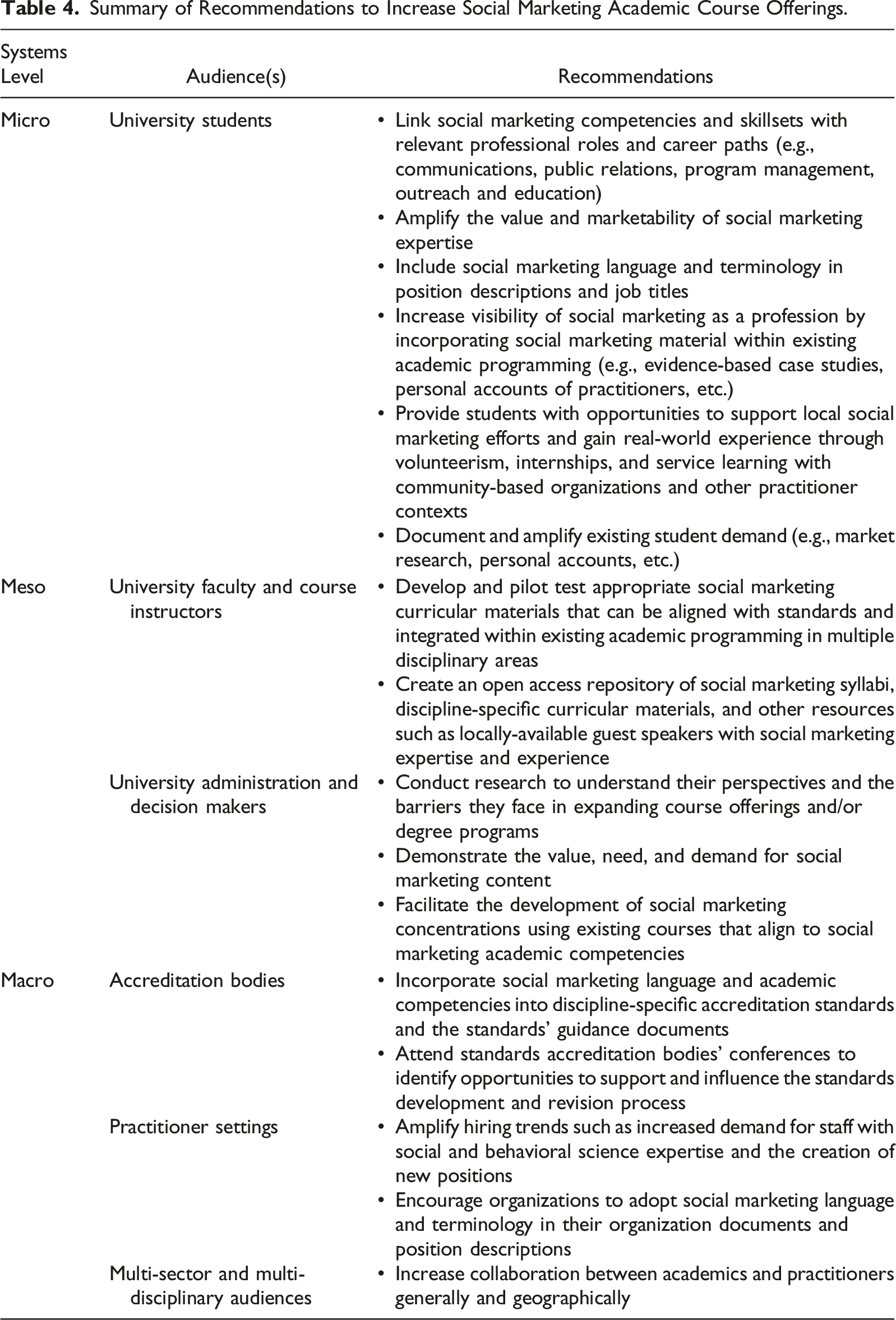
Summary of Recommendations to Increase Social Marketing Academic Course Offerings.
Micro Level: University Students
In the system related to academic course offerings, current and prospective university students can be considered the downstream audiences, at the “micro” level. The main goal at this level is to increase the demand for social marketing programming. However, the current dearth of jobs labeled “social marketing” is problematic and likely a key barrier to generating student demand. Students need to be reassured that studying social marketing will provide them with career opportunities. One potential solution is to more explicitly link social marketing with the broader professional roles and positions that social marketing students will be qualified to fill, such as communications, public relations, program management, and outreach and education. Indeed, research exploring the career paths of social marketing graduate students (Truong, 2017) reveals a broad range of academic and professional roles within numerous disciplinary domains, suggesting the versatility of social marketing expertise and experience, and social marketing has been identified by scholars as “a relevant curriculum element for various schools and departments” (Kapetanaki & Spotswood, 2021, p. 226). Instructors can help students recognize that the academic competencies and professional skills associated with social marketing (International Social Marketing Association, 2014, 2017) will serve them well in many jobs (and may also provide them with an advantage when job-seeking). Alongside this, efforts should be made to include social marketing language and terminology in position descriptions and job titles (Kassirer et al., 2019; Lee, 2020).
Demand can also be generated by increasing the visibility and appeal to students of social marketing as a profession. In academic settings where social marketing coursework does not yet exist, social marketing content can be incorporated into existing academic programming in order to share compelling and inspiring evidence-based case studies. Students can also be provided with engaging and worthwhile opportunities to support real-world social marketing projects in the communities surrounding the university through internships and service-learning opportunities. In fact, research has demonstrated that the completion of an interdisciplinary social marketing project positively influences students’ environmental awareness and concern while enhancing their understanding of commercial and social marketing concepts (McKay-Nesbitt et al., 2012). Finally, documenting and amplifying existing demand is another strategy that can only serve to generate further demand through the amplification and activation of social norms. For instance, a global survey of conservation practitioners (Robinson et al., 2019) revealed a high demand for training in social marketing, coupled with a recognition of the value of social marketing skills.
Meso Level: University Faculty and Administration
We acknowledge that there are many structural and systemic issues within academia that make establishing new academic programming challenging, such as budgetary and time constraints as well as incentive and reward systems. Given that reality, at the meso or midstream level, focus can be shifted to making it as easy as possible for instructors to incorporate social marketing content into existing courses and curricula, with the ultimate goal of generating increased student support and demand. For instance, as suggested by Kassirer et al. (2019), materials such as “sample lesson plans, slides, journal articles, and/or a list of short books on the subject relevant to the degree” (p. 220) can be curated and provided to instructors. “Marketing 101” and introductory courses focused on promoting social or environmental change (particularly within multi-disciplinary programs) would be a natural fit for this approach. To further reduce barriers, these curricular materials could be aligned to the relevant set of academic standards university departments are beholden to by accrediting bodies. We propose future research to support this approach by engaging with instructors receptive to teaching social marketing, in order to determine exactly what type of materials would be appropriate, and how they can best be aligned to standards to meet a program’s needs. Then, these materials can be developed and piloted, and ultimately made available to those in similar academic contexts. In fact, during the course of our study, multiple participants noted that they would like to see others’ syllabi. An open-access repository of syllabi, curricular modules linked to specific disciplines, texts and readings, multimedia, assessment tools, listings of community organizations able to host internships or service-learning projects, listings of guest speakers, and other supporting materials could be created and made available through iSMA. We envision a scenario whereby a guest speaker appearing in an Environmental Studies course could lead to the instructor adopting a social marketing module the following semester. This in turn could lead to increased student interest and might pave the way toward the instructor advocating for the development of an elective course, followed by becoming a required course. In fact, this pathway is essentially how the University of South Florida’s social marketing program came to be, as it moved from a certificate program to a degree program.
University administration and decision makers are another key audience at this level, and increased efforts can be made to 1) understand their perspectives about social marketing and the barriers they face in expanding course offerings and/or degree programs (Truong, 2017), and 2) demonstrate to them the value, need, and demand for social marketing content. Another relevant strategy for these audiences, as suggested by interview participants (Foote, 2022), would be to facilitate the development of specializations (or concentrations, certificates, tracks, microcredentials, or capstones, depending on the context) in social marketing by identifying existing courses at a given university which support social marketing’s academic competencies and would result in a valuable and marketable skillset for graduates (e.g., marketing, psychology, sociology, behavioral science, communications, quantitative and qualitative research design, etc.). A seminar in social marketing could be added, and/or social marketing content could be incorporated into existing courses as described above. Social marketing content could be integrated within existing specializations such as those focused on social change and advocacy (Abrash Walton et al., 2021).
Macro Level: Accreditation Bodies and Practitioner Settings
Because of the barriers and constraints associated with establishing entirely new courses and degree programs, it also becomes increasingly necessary to address the issue at the upstream level. This can be accomplished by engaging with accreditation bodies and their process to develop standards (Kassirer et al., 2019). Incorporating social marketing language and academic competencies into the discipline-specific standards universities must meet will drive support for social marketing programming. However, since these standards are typically only reviewed and revised every five to ten years, this approach may be less viable in the short term, depending on the specific accreditation body’s schedule. As an alternative, social marketing terminology and competencies can be incorporated into the official guidance documents that accrediting bodies create to support implementation of existing standards. If it is possible for academics to attend—or even present at—the periodic conferences of the various accreditation bodies, they should seek to do so as a means of making connections and identifying opportunities to engage with and influence the standards development process.
Further, efforts can be made to amplify hiring trends within practitioner settings such as governmental agencies, nongovernmental organizations, and private sector firms, such as increased demand for staff with social and behavioral sciences and marketing expertise, as well as the creation of behavioral insights units, where students with social marketing training would be competitive. These entities can be encouraged to adopt social marketing language and terminology in their organizing documents and position descriptions, with an ultimate goal of increasing requirements and standards for skills and competencies linked with social marketing.
Finally, multi-sector and multi-disciplinary approaches are necessary in order to increase collaboration between social marketing academics and practitioners. This is necessary in general (Sherring & Foote, 2023), but particularly between the Global North and Global South (Cateriano-Arévalo et al., 2022).
Study Limitations and Future Research
Undoubtedly, there are academic courses in existence around the world that we did not capture in this study, particularly courses which only include social marketing as a component. One constraint was the fact that the survey and invitation were developed in English. While LAMSO was able to translate the email invitation to Spanish and assist us in more widely sharing it among the Latin American community, the survey instrument itself remained in English. Therefore, the results should be considered biased towards Western academic settings.
Another issue that bears highlighting is the difficulty of searching for courses using the term “social marketing” due to the fact that “social media marketing” is often shortened to “social marketing,” thus confounding any online search. We relied more heavily on other approaches.
Regarding social marketing pedagogy, not all academics were willing or able to share their course syllabi, so the sample we analyzed should be considered incomplete. We call for an increased focus on pedagogy both within the literature and in settings such as global conferences.
A more concerted effort could be undertaken to uncover additional courses that include social marketing as a component, or that meet the criteria of social marketing even if not explicitly labeled as such. For instance, the increasing popularity of behavioral science at the broader level means that more students are being exposed to the same foundational theories and frameworks that inform many social marketing interventions (e.g., transtheoretical model of behavior change, diffusion of innovations). A focus on theory aligns with iSMA’s academic competency #6; thus, it would be beneficial to the discipline to identify courses that provide training in the application of theory.
Further research is needed to document academic programming in social marketing around the world, particularly in Global South countries. This can be accomplished through the translation of the survey instrument into multiple languages and then disseminated through regional networks supported by the social marketing associations.
Relatedly, following the recommendations in Cateriano-Arévalo et al. (2022), the social marketing academic landscape could be enhanced through an increased focus upon diversity and equity. This not only includes increasing course offerings, but also expanding the scope of research collaborations among scholars from the Global North and the Global South and facilitating knowledge exchanges.
Finally, we suggest future research should more thoroughly explore the career paths in social marketing while identifying and addressing the associated barriers and challenges. Tracking and amplifying career opportunities and desirable skillsets for students enrolled in social marketing courses should be a priority. Also, an elevated focus on the connections between the academic and practitioner communities and how to drive further demand for academic programming would also be beneficial.
In conclusion, this research has provided a timely and useful update to previous studies, given the importance of academic training to the advancement of a discipline, and the fact that social marketing is now in its seventh decade as a social change discipline. We hope that compiling and sharing this information about academic coursework availability and trends will support the ongoing development and professionalization of the discipline.
Footnotes
Acknowledgments
We would like to acknowledge the contributions of the many individuals who supported this research. We appreciated the opportunity to work closely with the leadership teams of the International Social Marketing Association (iSMA) and the Social Marketing Association of North America (SMANA) and thank them for all their help with this project. Thank you to those who helped review and pilot the survey instrument: Ross Gordon, Sharyn Rundle-Thiele, Nedra Weinreich, Kelley Dennings, and Nancy Lee. Thank you to the many people from all the regional social marketing associations who helped disseminate the survey and invitation to participate. A special thank you to Nathaly Aya Pastrana who translated the invitation and shared the survey with the Latin American Social Marketing Association’s membership. Thank you to Livingston White for reviewing components of the manuscript multiple times. Another note of gratitude goes out to Mahmooda Pasha and Christopher Nenninger of the University of South Florida for creating the GIS map of academic course offerings found in (Foote, 2022). And finally, thank you to the iSMA orbit subcommittee focused on increasing social marketing academic course offerings, and to co-chair Gael O’Sullivan (alongside corresponding author Liz Foote), for everyone’s volunteer work to explore solutions to the many challenges associated with this issue.
Declaration of Conflicting Interests
The author(s) declared no potential conflicts of interest with respect to the research, authorship, and/or publication of this article.
Funding
The author(s) received no financial support for the research, authorship, and/or publication of this article.

Appendix A
Academic Competencies (International Social Marketing Association, 2014) 1. Describe social marketing to colleagues and other professionals and differentiate it from other approaches to influencing behaviors and social change. 2. Work with colleagues and stakeholders to identify community, state, province, national, regional, and/or international priorities, and identify those for which a social marketing approach may be appropriate. 3. Identify and segment populations and select appropriate, high-priority segments. 4. Prioritize and select measurable behaviors (not just awareness or attitudes) of individuals, organizations and/or policy makers to influence. 5. Design and conduct situational analysis and formative research, employing mixed methodologies needed to understand current audience barriers and benefits, as well as competing behaviors and direct and indirect competition. 6. Select and apply relevant social marketing, behavioral, exchange and social science theories, models, frameworks and research to inform development of a social marketing strategic plan, one that meets the needs and wants of the intended audience. 7. Create an integrated social marketing mix strategy that extends beyond communications-only campaigns, with consideration of all appropriate evidence-based tools and theory needed to influence a desired behavior. 8. Critically reflect and test the effectiveness, acceptability, and ethics of potential social marketing strategies with representatives of target audiences and stakeholders, and adapt as necessary. 9. Finalize an implementation plan, incorporating opportunities for scaling up and sustainability. 10. Design and implement an evaluation plan, including a monitoring system to assure programs are on track to achieve goals and meet agreed quality and efficiency standards. 11. Apply ethical principles to the conduct of research, developing, implementing, and evaluating a social marketing plan. 12. Document and communicate the results of social marketing initiatives to colleagues, stakeholders, communities, and other relevant organizations and groups.
Appendix B
List of texts used in courses for which syllabi were provided (n = 31) • Consumption: A Sociological Analysis (Warde, 2017) • Corporate Responsibility (Blowfield and Murray, 2014) • Designing and Managing Programs: An Effectiveness-Based Approach (Kettner et al., 2017) • Ethics in Social Marketing (Andreasen, 2001) • Fostering Sustainable Behavior: An Introduction to Community-Based Social Marketing (McKenzie-Mohr, 2011) • Hands-On Social Marketing, A Step-by-Step Guide to Designing Change for Good (Weinreich, 2010) • Making Health Communication Programs Work: A Planner’s Guide (National Cancer Institute Office of Cancer Communications, 2004) • Marketing Management for Nonprofit Organizations (Sargeant, 1999) • Marketing Social Change: Changing Behavior to Promote Health, Social Development, and the Environment (Andreasen, 1995) • Nudge: Improving Decisions about Health, Wealth, and Happiness (Thaler and Sunstein, 2009) • Principles and Practice of Social Marketing: An International Perspective (Donovan and Henley, 2010) • Project Management in Health and Community Services: Getting Good Ideas to Work (Dwyer et al., 2013) • Robin Hood Marketing: Stealing Corporate Savvy to Sell Just Causes (Andresen, 2006) • Routledge Handbook on Consumption (Halkier, 2019) • Social Marketing (Eagle et al., 2013) • Social Marketing and Public Health: Theory and Practice (French, 2017) • Social Marketing and Social Change: Strategies and Tools for Improving Health, Well-being, and the Environment (Lefebvre, 2013) • Social Marketing in Action: Cases from Around the World (Basil et al., 2019) • Social Marketing in the 21st Century (Andreasen, 2006) • Social Marketing to Protect the Environment: What Works (McKenzie-Mohr et al., 2012) • Social Marketing: Behavior Change for Social Good (Lee and Kotler, 2020) • Social Marketing: From Tunes to Symphonies (Hastings and Domegan, 2014) • Strategic Social Marketing for Behaviour and Social Change (French and Gordon, 2020) • Sustainability Marketing: A Global Perspective (Belz and Peattie, 2013) • Sustainable Marketing (Martin & Schouten, 2011); Sustainable Enterprise: A Macromarketing Approach (Peterson, 2013) • Sustainable Solutions: Problem Solving for Current and Future Generations (Niesenbaum, 2020) • The Last Mile: Creating Social and Economic Value from Behavioural Insights (Soman, 2021) • Thinking, Fast and Slow (Kahneman, 2011) • Yes!: 50 Scientifically Proven Ways to be Persuasive (Goldstein et al., 2009)
