



Abstract
While campus food pantries are growing increasingly popular as an intervention aimed at improving student retention, little work has examined what it takes to start and maintain these resources on the ground. We leverage data from 17 interviews with pantry leaders, and social media posts and internal documents, to describe the creation and institutionalization of the Grove Grocery at the University of Mississippi. Findings confirm the role of collaborative partnerships, the benefits of advisors serving as liaisons between student leaders and administrators, and the challenges of institutionalization within the higher education context, including university hesitancy, reliance on uncompensated student labor, lack of resource awareness, and stigma surrounding food insecurity.
Introduction
In recent decades, colleges and universities have expanded student support services to improve retention and completion rates (e.g. Broton & Cady, 2020; Caple, 1998). Food insecurity is one barrier to college completion that has recently gained attention from policymakers and practitioners, with estimates suggesting that between 11 and 56 percent of college students experience food insecurity (Blagg et al., 2017; Goldrick-Rab et al., 2017). While there are multiple approaches to combatting food insecurity, colleges have primarily focused on creating campus food pantries (Gupton et al., 2018). The College and University Food Bank Alliance (CUFBA), founded in 2012, has over 800 member organizations (Metti, 2021). While some research has identified common services provided by these food pantries (e.g. Goldrick-Rab et al., 2018b), little is known about how these services are established and institutionalized on college campuses.
This case study aims to provide insight into the processes campuses use to institutionalize food pantries by focusing on the University of Mississippi (UM) Food Bank, renamed the Grove Grocery in 2020. The Grove Grocery was founded in 2013 by administrators, faculty, staff, and students. Since its inception, it has served thousands of students and expanded to two campus locations. The food pantry is a member of the Partnership for a Healthy Mississippi, the University Anti-Hunger Alliance, and the CUFBA.
To better understand institutionalization processes for college food pantries, our study uses theories on institutionalization and volunteer labor to address the following research questions through an intrinsic case study at UM:
How did students, administrators, and staff create and institutionalize the Grove Grocery? What types of barriers did students, administrators, and staff encounter when trying to institutionalize and operate the Grove Grocery? What do students, administrators, and staff perceive as being important for the continued operation of the Grove Grocery?
Findings indicate that student advocacy, staff advisors, and internal and external partnerships played important roles in the pantry's institutionalization, while university hesitancy, stigma, lack of awareness, and reliance on uncompensated student labor pose challenges for the continued operation of the pantry and its complete inclusion in UM campus life. Findings also call into question the sustainability and equity of campus programs that rely on uncompensated student labor and activism for continued service.
Literature Review
Prevalence of Food Insecurity in Higher Education
Research estimating the prevalence of food insecurity 1 among college students has found varying results, ranging from 11.2 percent (Blagg et al., 2017) to 56 percent (Goldrick-Rab et al., 2017). These results differ by institution type. Goldrick-Rab et al. (2018a) found through a national survey of 43,000 U.S. college students that 36 percent of university students and 42 percent of community college students reported experiencing food insecurity in the last 30 days. In another survey of 8,600 students, Goldrick-Rab et al. (2019) found that 45 percent of respondents experienced food insecurity. While these studies had low response rates (some less than 10 percent) and were not nationally representative, the findings remain concerning.
In a nationally representative study, Blagg et al. (2017) found a food insecurity rate of 11.2 percent among households with students in 4-year colleges, 13.7 percent among households with students in vocational education programs, and 21.2 percent among households with students in 2-year colleges. These results do not reflect the individual student's experience, though, but rather that of their household. 2 In a systematic review of the literature on the topic, Bruening et al. (2017) found average cited rates of food insecurity between 35 and 42 percent. Overall, research suggests that food insecurity rates among college students are at least as high as the general population, and are likely higher.
Effects of Food Insecurity
Existing evidence shows food insecurity's adverse effects on health (Bruening et al., 2016, 2018; El Zein et al., 2017 Payne-Sturges et al., 2018) and student success outcomes (El Zein et al., 2017; Ilieva et al., 2018; Maroto et al., 2015; Silva et al., 2017). For example, one study at an urban community college found that “students connect their food insecurity to their ability to concentrate on academic tasks” and that students expressed a desire for food accessibility on campus (Ilieva et al., 2018, p. 1). As a result of growing awareness of this problem, campuses have started to respond by instituting initiatives designed to combat food insecurity and increase student retention.
Campus Food Pantries as an Intervention
One such intervention is the campus food pantry, which typically provides basic food items for free to students and/or staff affiliated with the college. In addition to providing food, some food pantries offer other resources for students. In their survey of campus food pantries, Goldrick-Rab et al. (2018b) found that 66 percent referred students to off-campus resources, 29 percent helped register students for SNAP benefits, and 26 percent offered counseling services. Offering these types of services may serve as a “signal” that the college “cares” about students and their needs and thus increase student retention (Goldrick-Rab et al., 2018b, p. 11; Braxton et al., 2014). While the functions of campus food pantries vary by setting, and while administrators have reported how institutionalizing these resources can be complicated in college settings (Gupton et al., 2018), they have grown increasingly popular. In fact, CUFBA, which was founded in 2012 with two university members, grew to more than 800 member organizations as of 2021 when the organization was acquired by Swipe Out Hunger (Metti, 2021). While food pantries attempt to reduce food insecurity on campuses, they may also serve larger social and psychological functions for both students and colleges (Garcia, 2022).
Other work has focused on informing practitioners how to best advocate for and start campus food pantries (e.g. Cady & White, 2018; McCarthy, 2019). McCarthy (2019) summarizes the advice of two practitioners who helped start pantries, explaining that advocates should work with a team of diverse stakeholders, including students and faculty. Additionally, Cady (2020) explains that CUFBA encourages advocates to secure the following components early in the process: support of campus leaders, partnership with an existing, registered 501(c)(3) nonprofit organization, appropriate space on campus, paid staff position(s), a network of referral resources, a data collection plan, and a sustainability plan (Cady, 2020).
Institutionalizing Campus Food Pantries
Although research on campus pantries has grown, less is known about how these resources become institutionalized. This is particularly relevant as institutionalizing these resources may be difficult on college campuses, especially as state funding for higher education has declined in recent decades (Pew Charitable Trusts, 2019). Some existing work has found that securing funds, student activism, cross-campus partnerships, and linking the pantry with the college's institutional mission are important aspects of institutionalizing campus pantries (Goldrick-Rab et al., 2018b; McCarthy, 2019; Gupton et al., 2018; Twill et al., 2016). For these colleges, food pantries also operated as a bridge to other institutionalized services, such as mental health services (Gupton et al., 2018), consistent with other research on campus food pantries (Broton & Cady, 2020; Twill et al., 2016).
Coordinators, however, cited difficulty institutionalizing these resources (Gupton et al., 2018). Challenges include lack of awareness of campus food pantries due to informal outreach strategies (such as word-of-mouth referrals) (Garcia, 2022; Goldrick-Rab et al., 2018b); “insufficient funding, food, and volunteers” (Goldrick-Rab et al., 2018b, p. 1); and reliance on student labor (Broton et al., 2022). Low awareness among students of pantries, along with stigma associated with accessing benefits, remains barriers for student access (Garcia, 2022; Twill et al., 2016). Increased advisor training on campus resources may help with this (Zhang et al., 2019). Still, while student activism often serves as the impetus to start campus pantries, Broton et al. (2022) explain that leading the pantry at the University of Iowa required an immense time commitment of student leaders that was difficult for them to maintain alongside their other responsibilities.
Additionally, because campus pantries are often started through cooperative efforts of individuals across campus departments (e.g. Twill et al., 2016), pantries often lack an independent identity or centralized administration. This can result in difficulty advancing the mission of the pantry. Better understanding how pantries can be institutionalized on campus can aid in ensuring greater student access to basic needs and support student retention.
Theoretical Framework
We use institutional theory, which conceptualizes how resources become part of an organization over time, to guide our research questions and analysis, and theories on volunteer labor and burnout to help us interpret our results. While institutional theory offers numerous perspectives on how organizations function after they are founded, less work considers the actual process of institutionalizing new organizations. We use Kanter's (1983) definition of institutionalization: a process that occurs when an organization or resource becomes “part of legitimate and ongoing practice, infused with value and supported by other aspects of the system” (p. 299). To better understand the Grove Grocery's institutionalization process, we use Tolbert and Zucker's (1996) framework. They conceptualize three key steps in the process of institutionalization: habitualization, objectification, and sedimentation.
Habitualization
Habitualization refers to the creation of new organizational components used to respond to problems. In the context of a college, this could refer to the establishment of a new center, such as one devoted to serving international students, or the beginning of a new department. In this study, habitualization refers to the initial establishment of the Grove Grocery in 2013. The pantry was created as a result of students and administrators on campus recognizing the prevalence of food insecurity on their university campus and responding by founding a campus pantry. Habitualization is the important first step in the process, but it alone does not mean an organization has been institutionalized.
Objectification
Next, objectification is the process by which consensus is built around the new organizational components, including the meanings those components take on in specific contexts. Stakeholders assign meaning to the organization, and establish its place in the larger environmental context, negotiating how the structure of the organization is related to its intended objectives. This process of meaning-making is especially important in the context of campus food pantries, which can be burdened by stigma surrounding food insecurity. Objectification is often pushed forward by a champion, or advocate, who builds consensus around the need for this new organization or organizational component (Tolbert & Zucker, 1996). In the case of campus food pantries, existing research has found that individual champions are often responsible for initially advocating for the creation of a pantry (Cady, 2020). For a campus food pantry to go through the objectification process, members of the campus community would need to see the organization as critical to the college and commit to building its resources.
Sedimentation
Building consensus is critical to ensure the final step of the institutionalization process: sedimentation. This milestone occurs when those new organizational components maintain longevity and consistency over time. Institutional theorists have suggested that “when large and more centrally linked organizations are innovators and early adopters of a given structure, that structure is more likely to become fully institutionalized than other structures” (Tolbert and Zucker, 1996, p. 185). Other factors contributing to successful institutionalization, as outlined by Tolbert and Zucker (1996), include the scope of an organization, the “number of ‘champions’ or size of champion groups,” the costs of making changes necessary to institutionalize, and the “strength of the correlation between adoption and desired outcomes” (p. 185). More specific to higher education, Bringle and Hatcher (2000) found “campus collaboration, planning, infrastructure, [and] budget allocations” to be critical to institutionalization (p. 278).
Because existing literature shows that creating resources on college campuses is a complex task, learning more about how established campus food pantries have become part of campus culture can aid in our understanding of how resources are institutionalized in higher education and help practitioners create and maintain campus resources.
Volunteer Labor and Burnout
One challenge to institutionalizing campus food pantries is that they are often student-run resources on campus and depend on uncompensated student labor for their continued operation (Goldrick-Rab et al., 2018b). Only 49 percent of campus food pantries pay for a staff member to be present when the pantry is open, and even for pantries with paid staff, 88 percent still relied on volunteer labor for operation (Goldrick-Rab et al., 2018b). Due to the Grove Grocery's reliance on student labor that began to emerge during our initial interviews, we incorporate theories on volunteer labor and burnout. The Maslach Burnout Inventory defines burnout as a “psychosocial syndrome of emotional exhaustion, depersonalization, and reduced personal accomplishment that can occur among individuals who work with other people in some capacity” (Maslach et al., 1997, p. 192).
While it is a common misconception that volunteers can and will stop their volunteer activities whenever they experience burnout (Kulik, 2007), numerous studies have indicated that volunteers do face burnout and that burnout does not always cause them to quit (e.g. Allen & Mueller, 2013). Specifically, the emotional labor involved in volunteer work may contribute to feelings of burnout (Allen & Augustin, 2021). We use these theories to better understand the role of the student leaders who initially founded, and continue operating, the Grove Grocery.
Data and Methodology
This study employs an intrinsic case study approach, defined as “the study of a case (e.g., person, specific group, occupation, department, organization) where the case itself is of primary interest in the exploration” (Mills et al., 2010, p. 500). Our study's case is the Grove Grocery, located in UM's campus. UM is Mississippi's flagship institution, serving 21,014 students during the Fall 2020 semester. Seventy-five percent of students in Fall 2020 were White, 13 percent were Black, 4 percent were Hispanic/Latino, and 3 percent were Asian, Native Hawaiian, or Pacific Islander. Twenty-two percent of students were awarded Pell grants during the 2020–2021 academic year (Integrated Postsecondary Education Data System, 2020–2021).
Using a case study approach allowed us to collect rich data on our site in a holistic way. It also gave us an overview of the “life cycle” of the Grove Grocery, which is critical in understanding how the food pantry was institutionalized. We chose the Grove Grocery because it has been in operation for a decade, which gave us confidence that there had been enough time for institutionalization to occur and that we had a sufficient group of leaders over the course of the decade to draw upon. The pantry is also a large organization on UM's campus, with two locations, a social media presence, and many product offerings. These features provided evidence that the organization had been successfully institutionalized, which motivated our site selection. Finally, existing personal connections, as one of the researchers helped found the pantry as a UM student, allowed us to gain participants’ trust and buy-in to our research and gave us increased access to information about the pantry's operation and program data.
Positionality Statement
We come to this topic with existing knowledge of and experience with campus food pantries. As former founders of pantries, we recognize that our perspectives could lead to bias. Through active discussions and memoing, we stayed committed to answering the research questions, rather than simply advocating for a certain policy. We also recognized that our knowledge and experience came with strengths, such as insight into the challenges and strategies we used to help start campus pantries, and we used that knowledge to navigate the sensitive issues with which we were engaging.
Data Collection
Consistent with the best practices in case study research, we collected data from multiple sources to triangulate our findings, thus strengthening the study's validity (Yin, 2003). The main source of data came from 17 semi-structured phone interviews with administrators and student leaders. We conducted interviews from Spring 2020 to Spring 2021. We leveraged our theoretical framework of institutionalization theory, as well as our previous experience and knowledge of existing literature, to construct our interview protocol and guide our data analysis. Each phone interview lasted between 25 min and 1 hour. Both authors participated in each interview, and questions covered topics including the participant's role with the pantry, motivations for involvement, and their primary collaborators. We obtained participants’ verbal consent to participate and audio-recorded interviews. Both authors cleaned interview transcripts. To protect the confidentiality of our participants, we use pseudonyms for individuals’ names.
Participants were selected using purposive and snowball sampling methods (Creswell, 2009). First, we emailed several publicly known student and administrative pantry leaders to request their participation. During interviews with initial participants, we asked for recommendations of who else we should talk with, which helped us gain access to other Grove Grocery leaders. We intentionally interviewed student leaders, volunteers, and staff advisors who had served throughout the history of the pantry's operation to understand the timeline of institutionalization and how the pantry had developed. Additionally, we asked the current Grove Grocery Volunteer Leader to include a request for participants in a weekly email to volunteers.
In addition to interviews, we gathered data from a range of public and nonpublic artifacts and documents. The public documents included media stories about the Grove Grocery, the information presentation that is shown to interested individuals and organizations, and social media posts on the Grove Grocery's Facebook, Instagram, and Twitter accounts. Nonpublic documents provided by the Grove Grocery leadership included the Volunteer Handbook and data collected by the Grove Grocery on customer suggestions, number of customers, pounds of food distributed, and food orders made at local grocery stores. These data provided additional context to the founding, institutionalization, and operation of the Grove Grocery, as well as assisted in “verify[ing] findings or corroborat[ing] evidence from other sources” (Bowen, 2009).
Data Analysis
We use Deterding and Waters’ (2021) flexible coding approach to analyze our data, employing a mix of index, emergent, and analytic codes in NVivo, a qualitative data software. We derived our index codes from our interview protocol, and these served to organize our data into the themes we expected would arise in our interviews. For example, we expected conversations about stigma around food insecurity, so “stigma” was a deductive, index code added at the beginning of our process. We also allowed for “emergent” coding as we reviewed the interviews. For example, we did not anticipate the strong themes of partnerships and collaborations that were discussed by all interviewees. Thus, “collaboration across departments” and “partnerships” became emergent codes. We also used analytic codes, such as “psychological burden on volunteers,” which combine emergent codes with the preexisting theories and literature (Deterding & Waters, 2021). The interviews were coded and interpreted jointly by both coauthors, which enabled us to organize our data thematically and triangulate key responses using multiple data sources (Saldaña, 2015).
Findings
Overall, we find that important factors contributing to the establishment and institutionalization of the pantry included the role of student advocacy, staff advisors serving as liaisons between student advocates and university representatives, and external and internal partnerships. Barriers to institutionalization included university hesitancy, lack of awareness, securing accessible physical space, organizing volunteers, and disconnection between student leaders’ and customers’ lived experiences. Student leaders and administrators saw reducing stigma, adopting more accessible operational procedures, continuing to value customers’ dignity and privacy, and administrative growth as important next steps to the pantry's sustainability. Finally, we find that the pantry's reliance on uncompensated student labor is a significant barrier to the pantry's full institutionalization at UM.
Processes of Institutionalization
Student Advocacy
The creation of the Grove Grocery was a collaborative effort between administrators, faculty, and students, with student advocates playing a critical role. A high-level student affairs administrator, Jennifer, worked directly with student advocates to start a committee focused on addressing campus food insecurity. Jennifer explained that it was her experience working with UM students that drove her to prioritize addressing food insecurity. As a student affairs leader, she had daily interactions with students and began to hear about food insecurity as a barrier to student retention. She recounted, “A lot of times, I would just look up from my desk, and there would be a student that I didn’t know who would come in and tell me his story or her story. So I had a lot of different channels to get information about the need for a food pantry on our campus.”
Learning about food insecurity on campus played an important role in defining the problem for leaders, an essential component of the habitualization stage of institutionalization (when new structures of an organization are added to address an agreed-upon problem). Student advocates had similar experiences that sparked their investment in starting a campus food pantry. For Eloise, a student director, it was taking an environmental anthropology class that helped her understand the salience of food insecurity. She explained that learning about basic needs in a classroom setting gave her a sense of responsibility to advocate for her peers. This process of learning about food insecurity, through college coursework, engaging with peers on campus, or, in some cases, volunteering at food pantries before college, was instrumental to activating student leaders and clarifying what the problem was that the food pantry was intending to mitigate.
Having established a group of students, staff, and faculty on campus focused on addressing food insecurity, leaders pushed to start a food pantry. While Jennifer played a key role mediating between student advocates and university representatives, the work of student advocates proved essential to overcoming bureaucratic barriers. As Eloise explained, “I think that having a group of students who weren’t afraid to push back to the leadership a little bit was also important, because I think this could have gotten shut down at various stages of the process, but we weren’t going to let that happen.” Students committed to advocating for the food pantry kept university representatives accountable for ensuring that the committee's collaboration would result in a tangible resource they believed would benefit students. The end result (the founding of the pantry) fulfilled the habitualization stage of institutionalization.
Staff Advisors Acting as Liaisons
The process of transitioning from forming a group of stakeholders focused on food insecurity to opening a campus pantry involved significant legwork. Staff advisors assigned to the pantry acted as liaisons between student food pantry leaders and higher-level university administrators and aided in connecting student leaders with additional resources and garnering institutional support, contributing to the objectification stage of institutionalization (building consensus around the pantry's role). While the advisor role was originally under the purview of the Office of Sustainability, it was later moved to the Dean of Students Office, a department that leaders felt was more student-facing and thus appropriate for aiding student leaders. As Eloise, a student director, said, “Having some faculty on our side was helpful [for] connecting us to resources that we may not have known about.” Eloise explained that staff advisors guided student leaders through the bureaucratic tape of higher education, such as rules for on-campus signage. Connecting students to university resources was essential for the pantry to secure space on UM's campus and garner sufficient university support.
The role of staff advisors has been important throughout the pantry's history, aiding all three stages of the institutionalization process. For example, Olivia, a staff coadvisor and student affairs professional, explained that after the university closed due to the COVID-19 pandemic, she was responsible for giving regular updates on the food pantry to other administrators (a task typically performed by the pantry's student leaders). She advocated for the food pantry to be considered “mission critical” and aided in running it while the university was closed. She created a grab-bag program where she would fill bags with essentials and place them outside the food pantry for customers. Staff advisor support has helped the pantry navigate bureaucratic hurdles and continue operating despite hurdles.
Building Partnerships
Founders of the food pantry also relied heavily on internal and external collaborative partnerships to ensure progress, contributing to the objectification stage of institutionalization (building consensus). For example, Jennifer, who had been at UM for many years, emphasized that convening individuals from across campus was essential for securing institutional support. Jennifer described how the university's health center donated funds to pay for updates to the food pantry's allocated space and the library donated shelves to store inventory. “So that's what I mean by collegiality,” she stated, indicating that those she reached out to were generally willing to share resources.
Jennifer also noted they reached out to peer institutions that housed food pantries on their campuses, which aided in the habitualization (initial creation) of the pantry. A few student leaders visited the University of Arkansas's campus to see their food pantry in action and learn from other student advocates. Information sharing between higher education institutions was important for helping the leaders establish a pantry that had the potential to be sustainable from the outset. While the literature on campus food pantries was quite slim when the pantry was founded in 2013, informal information channels helped student leaders and administrators thoughtfully design the pantry, contributing to both the objectification (building consensus) and sedimentation (sustainability) stages of the pantry's institutionalization.
Several student leaders also noted that through collaborating with the UM Foundation, donors could give directly to the Grove Grocery as the pantry was, as a result, linked with the foundation's 501(c)(3) status. This provided the pantry with a budget, institutional legitimacy, and consistent access to food, essential components for the continuity of the pantry and contributing to its sedimentation (longevity) stage in the institutionalization process.
While the pantry initially only served nonperishable food, student leaders have expanded these product offerings through other internal and external collaborations. Peggy, a student director, explained how the campus daycare's garden provides fresh produce. Jared, a student leader, indicated that a $10,000 donation in gift cards from Kroger helped keep the food pantry stocked. These external partners and ‘champions' expanded the food pantry's resources beyond the university's campus, contributing to the pantry's objectification (consensus around the pantry's role) and sedimentation (sustainability).
Barriers to Institutionalization
Participants described several barriers to institutionalizing and operating the Grove Grocery, including university hesitance and resistance, lack of awareness of the prevalence of food insecurity among UM students, subpar physical space for the pantry, and difficulty organizing volunteers. Additionally, a disconnect between student leaders’ and food pantry customers’ lived experiences emerged as an important factor potentially undermining institutionalization efforts.
University Hesitance
Interviewees explained that one barrier to initially establishing the pantry was skepticism from university leaders that a campus food pantry was necessary. One student director, Brianna, told us: “It's hard, I felt at times the school didn’t want negative PR that students were hungry. And so sometimes I just didn’t feel supported by the school.” Students and administrators combatted this hesitancy by (1) seeking to educate leaders on the importance of mitigating this problem on campus and (2) involving actors from across university departments. As Eloise explained, moving the pantry forward required students to “push back to the leadership.” This sometimes manifested in student leaders actively working with departments to advocate for the inclusion of the pantry and consideration of its customers. One example involved parking. Explaining that the lot near the pantry was monitored in accordance with the university's parking policy, Brianna told us that “students would get tickets, and so I would once a week have to go battle tickets.” While university hesitancy and lack of departmental coordination posed barriers to all three stages of the institutionalization process, advocates were ultimately able to overcome these challenges to clarify the role of the pantry within the institution and advocate for its inclusion on campus.
Lack of Awareness
Another barrier participants identified to the institutionalization of the pantry was a general lack of awareness on campus of the prevalence of food insecurity among UM's student body. Participants, and particularly student leaders, often described that others had a general feeling that UM students were financially well-off, and Oxford, MS, where the college is located, had low rates of food insecurity. However, even though the median household income in Oxford is above the U.S. average (United States Census Bureau, 2021), 15.3 percent of Mississippi residents were food insecure in 2021 (Coleman-Jensen et al., 2022). As Jennifer, the student affairs administrator, explained: [Food insecurity] was largely … an unrecognized problem on campus. … When you drive through our campus, it's beautiful. You see a lot of expensive cars and large sorority and fraternity homes. And there's … a perception that students who go there are well-off. But that was not my experience as an administrator.
The general lack of consensus among university stakeholders that food insecurity was a problem made it more difficult for advocates to generate buy-in from the university that a food pantry should be founded and well-funded. This posed barriers to the habitualization (defining a problem) and objectification (building consensus) stages of institutionalization.
Difficulty Securing an Accessible Space and Staffing the Pantry
Because of initial hesitancy from university leaders to support the establishment of the pantry, and general lack of awareness of the problem that food insecurity posed, our interviewees explained that securing an accessible space for the pantry had been an ongoing struggle. When the Grove Grocery was first founded, the pantry's sole location was in a building next to the campus police department on top of a large hill. Ongoing battles with campus facilities over allowing food pantry customers access to the proximate parking lot made this location difficult for maintaining the resource's goal of accessibility. A student director, Sophie, described the location, saying, “So the building itself is honestly just really old. And sort of off-putting in my personal opinion. … It's just not very welcoming … we’re sort of out in the middle of nowhere. So, not a lot of people know about us.” Advocates in more recent years have attempted to overcome the barriers posed by the pantry's subpar physical location by creating a second location, which includes a kitchen where customers can prepare their own food. One volunteer said of the new location: “It's meant to serve a separate purpose … there's a lounge space as well for people to be able to socialize… I believe we’re just mainly trying to stock it with frozen foods, and the grab-bags that the nutrition committee makes … kind of like a Hello Fresh type thing.”
Additionally, recent student leaders cited difficulty continually staffing the pantry. The pantry maintains two consistent sources of student volunteers: honors students fulfilling volunteer requirements and volunteers through AmeriCorps. Brianna, a student director, explained there is still a challenge with securing reliable volunteers: “It's hard to get people to staff [the pantry], to show up … staffing is the biggest stressor.”
Disconnect in Student Leaders’ and Customers’ Lived Experiences
While not explicitly identified as a barrier by our participants, a consistent theme in our interviews with student leaders revealed a disconnect between the lived experiences of the food pantry's customers and student leaders and volunteers. Madison, a volunteer at the food pantry, said, “If I didn’t volunteer at the food bank, I might never have any idea what it's like to not be able to afford food.” While the student leaders and volunteers we interviewed expressed care for the pantry customers, this care was sometimes couched in problematic language, depicting customers as notably different from them. One student volunteer said, “It just helped me to realize how there are a lot of people out there that are different than me, and they’re no less important.”
While student leaders leveraged their own social and cultural capital to advocate for food insecure students, it is important to note that the students initiating reform efforts at the pantry had not experienced food insecurity. This disconnect functioned as a barrier to the objectification (consensus about the resource's role) of the pantry as leaders often needed to educate themselves on how the pantry could best serve its customers, rather than rely on personal experience. Yet, a few of the student leaders we interviewed acknowledged this disconnect and explained mitigation efforts to better understand customers’ needs and experiences. For example, two student leaders studied the food pantry and its outreach to students as part of their honors senior thesis, using the results to inform how the pantry was serving its customers.
Sophie, a student director, told us she felt that even though she had put a lot of work into the pantry, “That doesn’t mean that … I may be the best person for the job. Like, maybe there's someone out there who … has experienced hunger and has … a completely different perspective than I do.” She felt that a barrier, though, to expanding leadership to include those with personal experiences with basic needs insecurity, was that those positions are not paid. She explained: I’m... someone who… doesn’t need to have a job in order to … get through college. All the people that the pantry is serving are probably not in the same boat. So … if we want people on board who … have … a more personal understanding of hunger, I think that's something to be really mindful of … We’re putting in a ton of work for free. Like, for me, it's sort of an inconvenience, but for someone else, it would be like, “I literally can’t do that.”
The organizational structure, which relies on volunteer rather than compensated labor, serves as a barrier to the inclusion of food-insecure students in pantry leadership, which may stymie the objectification (consensus around the pantry's role) stage of institutionalization.
Sustainability of the Grove Grocery
The student leaders and administrators we talked to felt that several factors were important for ensuring the continued operation of the pantry, including increasing awareness and reducing stigma, retaining more accessible physical space and operational processes, continuing to value customers’ dignity, and diversifying and specializing student labor.
Increasing Awareness and Reducing Stigma
Most student leaders and administrators we talked with noted a lack of student awareness of the pantry as a challenge, posing a barrier to the pantry's sedimentation (sustainability). As a Grove Grocery staff advisor, Ava, explained, “We’ve talked about visibility quite a bit or lack thereof…That's an area where we’ve always had a little bit of trouble.” Some interviewees questioned whether the pantry was reaching students who might benefit from accessing the resource the most, and many leaders explained that increasing awareness of the pantry was a top priority. To do this, leaders emphasized the importance of making the pantry visible, including increasing marketing efforts. Ava spoke of students’ efforts to increase visibility, explaining, “We worked on doing a signage campaign where we put signage on all of the [campus] buses. And that campaign was very successful; we saw a major increase in the amount of students who were using the food bank.”
Expanding their social media presence has also been an important goal for student leaders. As of Fall 2022, their Instagram page had over 1,600 followers and more than 140 posts. The page caters to multiple audiences: both food pantry customers and potential volunteers. The page recruits volunteers and promotes a sense of community by posting about the “Volunteer of the Month,” thanking donors, selling T-shirts to fundraise, and announcing events like raffles. To serve customers, the page announces changes to operating hours, closures, and customer-focused events. Overall, the pantry's social media presence caters to multiple stakeholders essential for the continued operation of the pantry, contributing to the pantry's sedimentation (sustainability).
Inherent to this work of increasing awareness was leaders’ dedication to reducing stigma associated with pantry usage. Juliette, a student leader, articulated this goal: “We want to rebrand not only to increase awareness, but also we want to take away some of the social stigma around having to use a food pantry.” These efforts to rebrand resulted in the name of the pantry changing from the UM Food Bank to the Grove Grocery, which student leaders felt was more inviting. Leaders felt these efforts were important to ensuring the pantry's continued relevance (sedimentation).
Increasing the Pantry's Accessibility
Regarding stigma, another central debate revolved around the pantry's location. While some advocated for a more public location, like the student union, others felt that it should be in a private location to respect students’ privacy. In the end, the pantry was located on the outskirts of campus. More recent student leaders, though, have pushed for destigmatizing the pantry's resources by increasing accessibility. During the onset of the COVID-19 pandemic in 2020, pantry leaders instituted a grab-bag and delivery system. Customers could order food through an online ordering system and then stop by to pick up a preprepared bag. Some volunteers went to extraordinary lengths to ensure customers could access food during this time. As Jordyn, a student volunteer and leader, explained: “There's a couple of customers that haven’t actually been able to pick up the orders because they’re immunocompromised or they don’t have a car. … So me and [Sophie] decided it would be a good idea to start delivering if anyone needed it.”
The pantry also expanded to a second location on campus to mitigate the challenges of the first location. Fred, a student leader, felt that student leadership has made progress in making the pantry more accessible and less stigmatized in the last 2 years: “I think it's so much more inviting.” These efforts to make the pantry more accessible and combat stigma have aided in the pantry's sedimentation (continued operation and sustainability).
Prioritizing Customers’ Dignity and Privacy
A central component of making the pantry's resources more accessible was maintaining the pantry's values of student dignity and privacy. The pantry does not require a student ID number and is set up like a grocery store, including shopping carts and bags. Instead of requiring personally identifiable information, the pantry collects data from customer surveys and feedback, using this information to tailor the services provided to customers’ needs. As Ava, a staff advisor, noted: “A lot of the students I think that use the food bank are international students. And so I think it's really important that we make more efforts to offer foods that would be familiar to those students.” In carefully curating and catering to the customers’ experiences, the pantry intended to identify itself as an inclusive and affirming space, an important part of the resource's objectification (consensus on the pantry's role) on campus.
Reliance on Uncompensated Student Labor
Since its founding, the pantry has grown, especially after the onset of COVID-19 when it experienced much higher usage rates. 3 Responding to this growth, one student director decided to expand the student leadership team to help distribute the increase in labor required to operate the pantry, nearly tripling the number of student leaders (from 15 in 2020 to 40 in 2021). This resulted in more highly specialized roles, such as a marketing director and nutritional liaison committee. 4 As Sophie, a student director, shared, this reorganization was essential for managing the increased labor demands of running a growing pantry: “[Prior to expanding the leadership team, I was spending about] 20 hours a week. Now, [with committees], I was able to transfer leadership pretty effectively. I’ve been able to delegate a lot more.”
Although increasing the number of student leaders has helped organize labor, our interviewees continued to highlight the drawbacks of not having a full-time staff member focused on running the pantry. Ava explained: I think that the food bank is always going to struggle … it's kind of a challenge because there's no one who's actually employed by the food bank, like I’ve seen [another university] … hire somebody who's spending 40 hours a week or even 20 focusing on the food bank and strategically assessing where they see this resource going and how else we can support students on campus.
Not having a full-time staff member means consistent leadership turnover. “There's a vulnerability there when it is staffed by people who can’t stay long term, and I think that's a lot of why we don’t really have any goals,” Ava added. Not only does the lack of a full-time employee negatively impact student labor, but it also threatens the institutional legitimacy of the Grove Grocery. These drawbacks threaten the sedimentation (sustainability) of the pantry as an integral facet of campus life at UM and demonstrate that while the pantry operates as a large student-run organization on campus (an important motive for selecting the Grove Grocery as our research site), it has not yet been fully institutionalized.
Relatedly, student leaders consistently expressed fatigue operating the pantry, aligning our results with theories of volunteer labor and burnout. Indeed, our findings point to the pantry's reliance on student labor as an inherent barrier to the pantry's sustainability and complete institutionalization at UM. Student leaders often expressed working long hours and frequently struggling to balance their coursework alongside their pantry responsibilities. Fred emphasized how much time he spent volunteering with the Grove Grocery, saying, “I spent more time working on this than I had on my classes.” For some students, this led to burnout, consistent with Maslach et al.'s (2001) theorization that exhaustion leads to burnout. This was particularly true for student leaders in higher levels of leadership. Student leaders often chose to take on unexpected tasks, such as contesting tickets with the campus's parking services and delivering food directly to customers, as discussed earlier.
Consistent with Allen and Augustin's (2021) finding that volunteers engage in emotional labor, student leaders expressed feeling high levels of responsibility for the pantry's continued maintenance, and this was oftentimes expressed in tandem with feelings of guilt or fear that in the absence of their labor, students would go hungry. Daniela, a student leader, told us, “You know, people do not have food available to them… if [the Grove Grocery] flopped, it's hard not to take it personally, like as a personal failure, even if what happened was out of your control. It does get hard to balance.”
Student leaders were not university employees, were unpaid, and told us that they decided to engage in the work of the pantry because of their personal values and desire to give back to their campus community. Consistent with work theorizing volunteer burnout, we did not find that students expressed desires to quit because of long work hours (Allen & Mueller, 2013). Students were, though, clearly overwhelmed by the amount of work required to maintain the pantry. Sophie, a student director, said that the recent expansion of the pantry's student leader team took a great deal of time and effort: “At first, I was super overwhelmed … it's taken up, like an ungodly amount of my time.” This did not deter her, though, from continuing her work. In fact, she completed this quote by saying “and I love it.” But still, many student leaders told us that volunteer turnover was a consistent problem that continued to place more pressure on student leaders who then had to fill in when there were no volunteers to staff the pantry. The university's reliance on uncompensated student labor due to the pantry's designation as a student organization prevents the pantry's full institutionalization, wherein the Grove Grocery would be considered an integral campus resource that the university funded directly. This is the primary barrier we found to the sedimentation (sustainability) of the pantry on UM's campus.
Implications for Policy and Practice
While some work has explored the operational procedures of campus food pantries as an intervention to meet students’ basic needs and increase student retention (e.g. Goldrick-Rab et al., 2018b; Broton & Cady, 2020), our study uniquely contributes to the existing literature by describing in-depth what it takes to start and run a campus food pantry. Our findings indicate that student advocacy, staff advisors, and partnerships are important for starting campus pantries. Consistent with the existing work (Goldrick-Rab et al., 2018b; Twill et al., 2016), we also find that limited awareness of the pantry, exacerbated by lack of university paid support and staff, as well as stigma, posed barriers to the pantry's operation.
Perhaps the most important implication from our study is that colleges should fund full-time staff focused on operating pantries. While the Grove Grocery has operated for a decade under the structure of volunteer student labor and the part-time support of a staff advisor, both student leaders and administrators told us that this structure posed challenges to the pantry's institutionalization. Student leaders demonstrated intense emotional burden and felt personal responsibility for keeping the pantry open, and frequent leadership turnover prevented leaders from achieving long-term goals for the pantry's development. Hiring a university representative to operate a campus pantry could help reduce student leader burden and facilitate the pantry's sedimentation (continued operation and sustainability).
While UM operates with a large institutional budget, many other campuses, and particularly community colleges, may lack the institutional capacity to fund food pantry directors. State or federal grants aimed at supporting campus food pantries are one intervention that could facilitate hiring professionals to run these resources and increase institutional buy-in. A competitive grant program aimed at funding campus food pantries could be one step toward helping to officially institutionalize these resources, in much the same way as the Child Care Access Means Parents in School (CCAMPIS) program funded through the U.S. Department of Education funds campus childcare centers. Campuses could also consider funding student labor by utilizing the Federal Work Study (FWS) program to fund student workers whose college majors align with the pantry's objectives (such as nutrition or public health). By funding the work being carried out by campus food pantry leaders, colleges can aid in more fully institutionalizing these resources on their campuses and including students who have experienced basic needs insecurity in the operation and leadership of the pantries.
We additionally find that staff advisors were key to moving the Grove Grocery along the path of institutionalization. While student advocates and volunteers did much of the on-the-ground labor to operate the pantry, advisors were instrumental in connecting advocates with university resources that were essential to the pantry's establishment. Advisors’ connections with university representatives and knowledge of the bureaucratic system of the university helped ensure that the pantry was partnered with the UM Foundation and was able to secure space on campus. The continued support of advisors was especially important during times when student volunteer labor was disrupted, such as during the onset of the COVID-19 pandemic. Administrators hold an incredible amount of institutional knowledge that can be leveraged to support the work of student advocates on campus; in starting a food pantry, professionals should partner with students to reduce student labor and ensure that pantries are supported as a part of the institution's official student success initiatives.
Finally, this case study provides further evidence for Cady's (2020) recommendation of ensuring that structures and resources are in place before founding a pantry. The Grove Grocery has been in operation for a decade, and we find that important factors contributed to the pantry's longevity, including the consistent support of staff advisors, internal and external partnerships that facilitated resource pipelines for the pantry and expanded product offerings, and the university foundation's 501(c)(3) status, which ensured that donors could provide donations directly to the pantry. Seeking customer feedback on product offerings and accessibility also helped ensure that the resource could evolve to meet customers’ needs and avoid stigmatizing the experience of accessing resources. Campus food pantry leaders can use these strategies to support the sustainability of their pantries and to ensure that their products and procedures are, in fact, meeting customers’ needs.
Conclusion
Campus food pantries remain important resources on college campuses for combatting basic needs insecurity and increasing student retention. Advocates play a critical role in institutionalizing these resources by leveraging resources across campus, forming partnerships, including both students and administrators in leadership teams, and maintaining values of customer dignity and privacy. Staff and administrators are essential in securing institutional support for the founding and continued operation of campus pantries. Maintaining and expanding these resources, though, require a great deal of labor on the part of student leaders. Reliance on unpaid student labor for operating pantries can threaten the resource's institutionalization on campus and lead to volunteer burnout. Colleges can mitigate these issues by appropriately compensating student workers and/or funding a full-time pantry director and staff. State and federal policy can support this work by providing grant funding aimed at increasing institutional capacity for operating food pantries. More broadly, our findings call into question the relegation of essential student resources to student organizations, rather than being housed and funded directly through a department. Future research should seek to better understand the effects of pantries’ reliance on student labor, to describe how institutionalization of these resources play out in different university and community college contexts, and to evaluate the effectiveness of pantries at reducing the prevalence of basic needs insecurity.
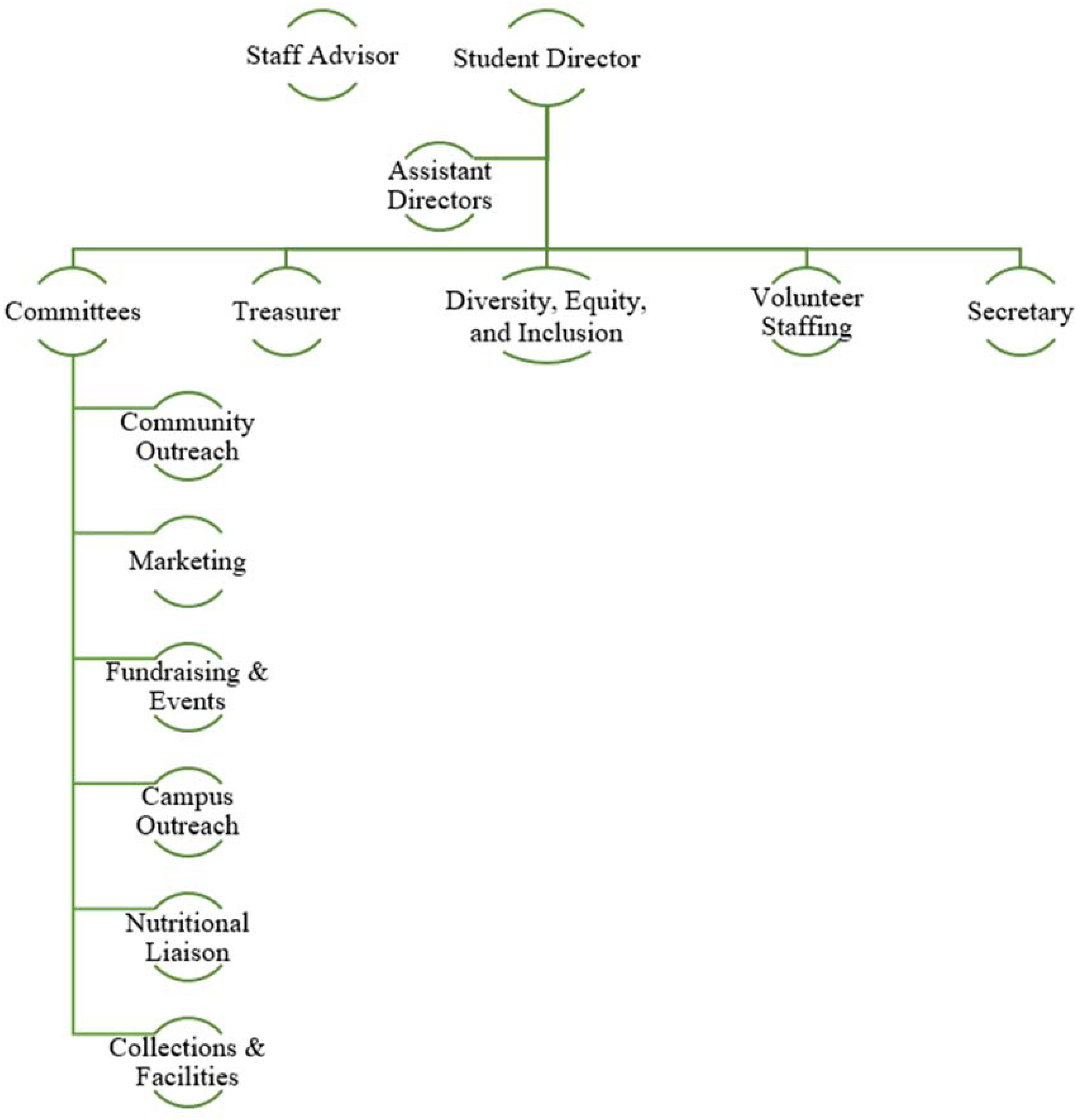
Note. This chart describes the pantry's structure as of Fall 2022. The organization is headed by the student director, who retains assistance from a staff advisor. The student director manages a team of student assistant directors, who then each heads a particular aspect of the pantry's operation (e.g., volunteer staffing). The director and assistant directors manage five committees, staffed by students (e.g., marketing).
Footnotes
Appendix: Organizational Structure of the Grove Grocery
Acknowledgements
Thank you to the administrators and students who participated in this research, without whom this work would not have been possible. We'd also like to thank Dr. Joanne Golann, Dr. Katharine Broton, and Dr. Brenda McKenzie for their valuable feedback on this manuscript. Any errors are our own.
Authorship Note
Both authors contributed equally to this research. Authors' names have been listed in alphabetical order.
Declaration of Conflicting Interests
The authors declared no potential conflicts of interest with respect to the research, authorship, and/or publication of this article.
Funding
The authors received no financial support for the research, authorship, and/or publication of this article: This research received no specific grant from any funding agency in the public, commercial, or not-for-profit sectors.
