




Abstract
Introduction
Chronic obstructive pulmonary disease (COPD) is a preventable chronic respiratory condition that predominantly affects the elderly population. 1 Given the aging demographic trends, COPD incidence rates are expected to rise. COPD imposes a significant economic burden, particularly in China, where hospitalization costs make up a substantial portion (ranging from 65.9% to 77%) of total healthcare expenses related to the condition. 2 Notably, acute exacerbations frequently lead to hospital admissions in patients with COPD, exacerbating both the economic burden and the severity of symptom. Individuals with frequent exacerbations are more prone to rapid declines in lung function, an increased risk of readmission, and higher mortality rates. 3 Inhaled pharmacotherapy remains a pivotal intervention for preventing acute exacerbations and mitigating adverse outcomes associated with COPD.
In 2023, the Global Initiative for Chronic Obstructive Lung Disease emphasized that inhaler adherence among patients with COPD is generally low, often falling below 50%. 4 Low inhaler adherence not only jeopardizes patient health but also escalates costs for health systems. 5 Therefore, comprehending the factors influencing inhaler adherence is crucial for alleviating the disease burden in patients with COPD. Prior research suggests that self-awareness or the perception of the disease plays a pivotal role in medication adherence. 6
Illness perception is a fundamental concept within Leventhal’s Common Sense Model of Self-Regulation (CSM), positing that individuals develop their own beliefs and thoughts about illness. The perceptions encompass the emotional and cognitive responses individuals generate when facing health threats or diagnoses and they profoundly influence patients’ strategies and behaviors in coping with the disease. 7 Notably, it serves as a modifiable factor influencing patient compliance. However, specific research investigating the relationship between illness perception and medication adherence in patients with COPD remains limited.
While the two aforementioned studies8,9 explored the influence of illness perception on medication adherence, it’s noteworthy that they measured medication adherence using generic scales. It is crucial to recognize that inhaler use is more intricate than conventional oral medications in other chronic diseases. Patients must master correct inhalation techniques and adhere to intricate inhalation regimens, which can significantly affect medication adherence. 10 Therefore, employing disease-specific scales to assess medication adherence to inhaler therapy in patients with COPD is essential. Additionally, the mechanisms by which illness perception influences inhaler adherence remains unclear among Chinese elderly patients with COPD. Consequently, this study aims to investigate the current status of medication adherence to inhaler therapy in elderly Chinese patients with COPD, understand how illness perception components influence inhaler adherence, and provide a theoretical basis for interventions aimed at improving inhaler adherence.
Materials and methods
Design and participants
This study recruited patients with stable COPD from the Department of Respiratory Medicine at a tertiary hospital in Anhui Province, China, between June 2022 and December 2023. A total of 305 participants were enrolled based on the following criteria: (1) aged ≥60 years; (2) diagnosed with COPD according to the Guidelines for the Diagnosis and Treatment of Chronic Obstructive Pulmonary Disease (Revised 2021) 11 ; (3) undergoing treatment with an inhaler; (4) having good cognitive capacity; (5) voluntarily participating in the study and willing to provide informed consent. Patients with severe hepatic or renal insufficiency, malignant tumors or psychiatric diseases were excluded from the study. In this study, 12 influencing factors were analyzed, and according to the Events Per Variable principle, 12 a minimum sample size of 120 cases is required. Considering a 10% non-response rate, the study sample should include at least 134 cases. The study received approval and consent from the Ethics Committee of Bengbu Medical College ([2022] No.106), and all participants provided written informed consent.
Data collection
Face-to-face questionnaires, encompassing demographic information, the Chinese version of the Test of Adherence to Inhalers (TAI) and the Brief Illness Perception Questionnaire (B-IPQ) were administered to the participants following the acquisition of their informed consent. The TAI was used in this study to evaluate adherence to inhaled medication in patients with COPD. 13 It comprises 10 items, each measured on a 5-point Likert scale. Total scores range from 10 to 50, with adherence categorized as good (TAI = 50), moderate (TAI = 46-49) or poor (TAI <46). The B-IPQ was used to assess perception of their illness in patients with COPD. This questionnaire comprises 9 items, the first 8 items rated on a scale of 0-10. The ninth item is an open-ended question and is not scored. 14 Uniform guidelines were provided to explain how to complete the questionnaires, facilitating patients to independently fill out the surveys. All questionnaires were completed on site and subsequently checked for completeness.
Statistical analysis
SPSS 27.0 software were used to analyze data, and statistical tests were performed using a two-tailed method with p < 0.05 set as the level of significance. Measurement data conforming to a normal distribution were described using the mean and standard deviation (SD), while measurement data like B-IPQ subscale scores not conforming to normality were expressed using the median (interquartile range), maximal value and minimal value. Count data were presented as frequency and percentage.
To explore the relationship between disease perception and adherence to inhaler therapy in patients with COPD, binary logistic regression analyses were performed. The presence of multicollinearity was evaluated through variance inflation factors. The model’s fit was evaluated with the Hosmer-Lemeshow test. The importance of correlations was ascertained by adjusted odds ratio (AOR) and 95% confidence intervals (CI).
Results
Demographic characteristics and TAI score of participants
Frequency of demographic and classification of adherence to inhaler therapy in patients with COPD (n = 305).

Notes: Data are presented as the number of patients (%), mean (standard deviation), and median (interquartile range). SD: standard deviation, TAI: Test of Adherence to Inhalers.
Perception of their illness in patients with COPD
Illness perception of elderly patients with COPD (n = 305).
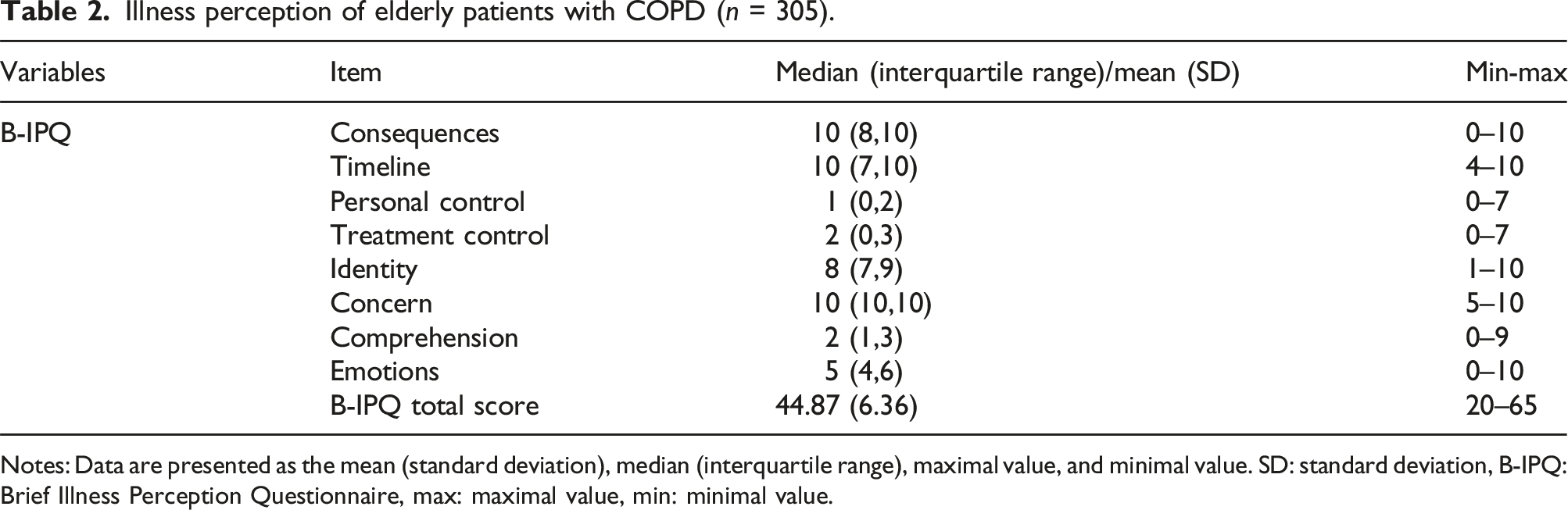
Notes: Data are presented as the mean (standard deviation), median (interquartile range), maximal value, and minimal value. SD: standard deviation, B-IPQ: Brief Illness Perception Questionnaire, max: maximal value, min: minimal value.
Relationship between illness perception and adherence to inhaler therapy
Correlation between illness perception and medication adherence to inhalation therapy in patients with COPD (n = 305).
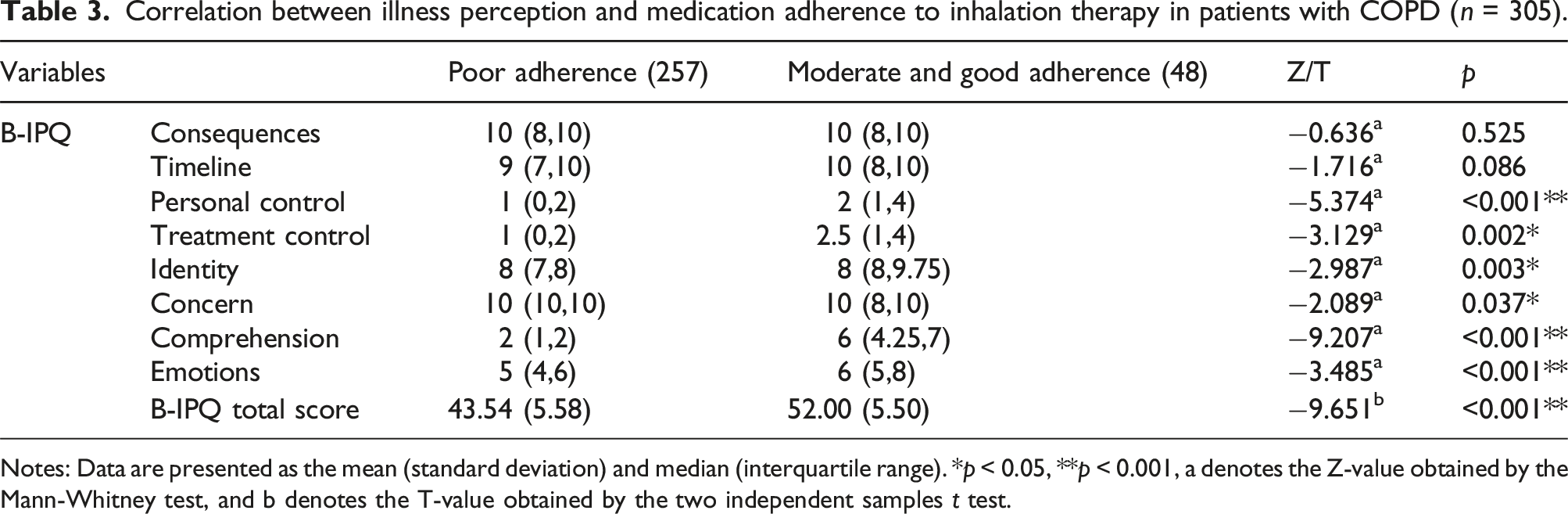
Notes: Data are presented as the mean (standard deviation) and median (interquartile range). *p < 0.05, **p < 0.001, a denotes the Z-value obtained by the Mann-Whitney test, and b denotes the T-value obtained by the two independent samples t test.
Association between only illness perception domain and medication adherence to inhaler therapy
Binary logistic regression analysis of the correlation between illness perception and adherence to inhaler therapy (n = 305).

Notes: *p < 0.05, **p < 0.001, COR: crude odds ratio, AOR: adjusted odds ratio, CI: confidence interval.
Association of medication adherence to inhaler therapy with illness perception and demographic information
Logistic regression analysis of inhaler adherence in relation to illness perception and participant background information in China.

Notes: *p < 0.05, **p < 0.001.
Discussion
This study represented the first comprehensive investigation into the relationship and mechanisms between perceptions of disease and adherence to inhaler therapy in Chinese elderly COPD population. The results showed that illness perception and inhaler adherence have a significant association in patients with COPD. This aligns with results among diabetic 15 and hypertensive patients. 16 Notably, personal control, treatment control, comprehension, and emotions within disease perceptions emerged as significant positive predictors for inhaler adherence among patients with COPD.
The study’s findings revealed that 84.3% of Chinese elderly patients with COPD exhibited poor adherence to inhaled medication. The mean B-IPQ total score in this study was 44.87, consistent with findings from a systematic review. 17 Notably, patients scored highest in concern, indicating that patients with COPD exhibited elevated levels of disease-related worry, which aligns with a study in New York and Chicago. 18 Simultaneously, lower scores in personal and treatment control, indicating reduced patient confidence and belief in controlling their disease and uncertainty about inhaled medication effectiveness. Considering the variability of perceptions of their disease in patients with COPD, it becomes crucial for healthcare professionals to comprehensively understand the diverse dimensions of disease perception among patients with COPD and designed tailored interventions to enhance inhaler adherence.
This study sought to assess how various aspects of illness perception affect inhaler adherence in patients with COPD. The analysis revealed that personal control, treatment control, comprehension, and emotions significantly predicted inhaler adherence. Patients with strong confidence in controlling their disease tended to adhere better to inhalation therapy, consistent with studies on diabetic 15 and hypertensive patients. 19 Furthermore, this study revealed that awareness of inhaler medication regimens in patients with COPD influenced inhaler adherence, consistent with previous study. 20 Inhaler therapy is fundamental to COPD treatment, offering advantages over oral medications including rapid access to airway linings, lower doses, and fewer side effects. However, patients with COPD often struggle to differentiate between recommended medications. 21 Therefore, healthcare professionals should thoroughly explain the rationale for inhalation medication use, clarify its role and effects, and ensure patients understand the benefits and proper usage.
Our study also indicated that patients with a strong understanding of their disease were more likely to adhere well to inhaled medications, consistent with prior research. 20 However, studies in Greece 22 and Italy 23 revealed limited knowledge about COPD and lower awareness of its treatment among patients. To bridge this gap, healthcare professionals should provide comprehensive information about COPD, ensuring patients are well-educated about their condition and the associated treatment regimens. Our results further demonstrated that the emotions in the illness perception of patients with COPD significantly predicted medication adherence, consistent with studies conducted in asthma 24 and hypertensive population. 20 According to the CSM, disease-induced emotional burden corresponds to the emotional aspect of disease representations, impacting patient’s development and implementation of self-management measures, which subsequently affects disease outcomes and emotional well-being. 7 These findings emphasize that healthcare professionals should engage in effective communication with patients to better understand and address their emotional needs.
The implication of the study
This study advances the theoretical and practical applications of the CSM by exploring the correlation between multiple dimensions of illness perception and inhaler adherence in patients with COPD. The results underscore the importance for healthcare providers to assess how patient perceive the illness and develop individualized interventions to improve adherence to inhaler therapy. Specifically, the impact of personal and treatment control, comprehension, and emotions on inhaler adherence among patients with COPD provides valuable insights for future intervention studies. Healthcare providers can enhance patients’ understanding of disease progression through health education or cognitive-behavioral interventions, instill the belief that COPD is a controllable and treatable disease, and foster patients' confidence in disease management. Furthermore, it is crucial to enlighten patients about the pivotal role of consistent inhaler usage in symptom control, guide them to master correct inhalation techniques, and provide home-based or remote follow-ups to help patients understand their inhaler usage status and address any concerns or difficulties encountered during inhaler use.
The limitations
This study has some limitations. Firstly, it is important to note that our study focused on patients with stable COPD from the Department of Respiratory Medicine at a tertiary hospital in China. Therefore, caution should be exercised when extrapolating these findings to other demographic groups. Secondly, using self-reported questionnaires to assess inhaler adherence may introduce recall bias. However, previous findings indicate that self-reported questionnaires align with measurements from electronic monitoring devices, 25 and they are preferred in clinical practice due to their low cost, and ease of use in various healthcare settings. Thirdly, the study did not collect information on GOLD staging or lung function and types of inhaler devices in patients with COPD, which may affect the applicability of the findings.
Conclusion
Our results highlight the need for improvement in medication adherence to inhaler therapy among Chinese patients with COPD, who perceive poor personal and treatment control. Moreover, a comprehensive understanding of the illness perception will help healthcare providers to develop targeted interventions aimed at enhancing inhaler adherence among patients with COPD. Specifically, attention should be given to the important role of personal control, treatment control, comprehension, and emotions in improving adherence to inhaler therapy in patients with COPD.
Supplemental Material
Supplemental Material - Association between illness perception and adherence to inhaler therapy in elderly Chinese patients with chronic obstructive pulmonary disease
Supplemental Material for Association between illness perception and adherence to inhaler therapy in elderly Chinese patients with chronic obstructive pulmonary disease by You-Ran Liu, Yan Wang, Jie Wang and Xi Wang in Chronic Respiratory Disease.
Footnotes
Declaration of conflicting interests
The author(s) declared no potential conflicts of interest with respect to the research, authorship, and/or publication of this article.
Funding
This work was supported by grants from the Bengbu Medical College (2021byzd242sk).

Supplemental Material
Supplemental material for this article is available online.
References
Supplementary Material
Please find the following supplemental material available below.
For Open Access articles published under a Creative Commons License, all supplemental material carries the same license as the article it is associated with.
For non-Open Access articles published, all supplemental material carries a non-exclusive license, and permission requests for re-use of supplemental material or any part of supplemental material shall be sent directly to the copyright owner as specified in the copyright notice associated with the article.
