



Abstract
This article conducts a scoping review to explore the key determinants of political legitimacy in participatory budgeting. The scoping review employs a comprehensive search of Scopus to select relevant studies. Three main sources of legitimacy emerge from this analysis: (1) institutions, (2) citizen participation, and (3) deliberation. The findings reveal that participatory budgeting can significantly affect political legitimacy through these mechanisms. In addition, the study highlights the relevance of legitimacy, as it relates to participatory budgeting, in both democratic and non-democratic contexts, with particular attention to participatory budgeting practices in China.
Introduction
Legitimacy is a critical element for the stability and effectiveness of political systems, with beliefs in legitimacy considered to form a basis for state authority (Habermas, 1973; Hurd, 1999; Schoon, 2022; Weber, 1968). While research has varied in its understanding of legitimacy’s constituent elements, in its broadest sense, it can be understood as the acceptance and justification of political authority by the governed (Hurd, 1999; Weber, 1968). There have been several specific definitions of legitimacy that have been proposed within the literature, which emphasize different elements such as communicative processes (Habermas, 1973), legal frameworks (Habermas, 1996; Weber, 1968), and normative understandings (Hurd, 1999). While emphasis varies, it has been demonstrated that research shares some common definitions of legitimacy: an object or authority that is being evaluated for its legitimacy, a population that assesses and ultimately bestows legitimacy upon the object or authority, and a set of shared expectations or norms about how the object or authority should operate or behave to be considered legitimate (Schoon, 2022).
In today’s crisis of representative democracies, there have been attempts to restore legitimacy by relying on novel forms of participation (Pogrebinschi and Ryan, 2018), with Participatory Budgeting (PB) standing out for its widespread use. PB is a process by which a governing authority involves the citizenry in budgeting decisions, typically allocating a portion of the budget for the citizenry to distribute through a vote. In relation to legitimacy, PB has often focused on inclusion and the transparency of the decision-making process, with the aim of increasing legitimacy in both governance and the allocation of public funding (Baiocchi, 2005; Fung, 2004; Wampler, 2012), as well as ensuring that public spending aligns with community needs and priorities, thereby encouraging trust and accountability (Health, 2020; Powered, 2020). PB complements representative democracy by facilitating direct interaction between citizens and policymakers, thereby addressing democratic deficits. Moreover, in non-democratic regimes, PB offers a controlled avenue for citizen participation, serving as a strategic tool increase legitimacy without challenging existing power structures (He, 2011).
The worldwide adoption of PB, compounded by a lack of systematic approach in its design, has led to a wide set of PB models and research. As such, literature has taken steps to offer a systematic overview, bringing together a broad body of knowledge on PB. For example, Bartocci et al. (2023) undertake a systematic literature review to offer an overview of PB applications and outcomes, and Campbell et al. (2018) undertake a scoping review to demonstrate the impact of PB on health and well-being. While both papers offer a general overview of PB research, they lack an empirical focus on the specific mechanisms through which PB affects legitimacy. This lack of focus raises questions that our research seeks to address, bringing together findings relating to the determinants of legitimacy within PB.
To capture the broadest range of relevant studies, our research adopts a flexible approach to defining legitimacy, suitable for the comprehensive nature of this scoping review. This is also beneficial due to the fact that PB has been conducted across diverse contexts, which (as we will come to demonstrate) is reflected within the diversity of literature. In doing so, three main determinants of legitimacy emerge from this empirical analysis: institutions, participation, and deliberation. In addition to this result, it is found that the issue of legitimacy is far from being limited to liberal democracies. Indeed, the sources of legitimacy seem to be of interest in non-democratic contexts, above all in relation to participatory experiences that were implemented at the local level of the People’s Republic of China under the guidance of the Communist Party (Yan and Xin, 2016).
To address this research, we propose the following research questions:
RQ1: What are the main themes in the literature regarding the impact of participatory budgeting on political legitimacy?
RQ2: How is the existing literature distributed in terms of political system, and how may we explain this distribution?
The remainder of this article is organized as follows: section “Selection of Articles” describes the procedure for the selection of articles that are used for this literature review. Section “Results” presents the results of the analysis by focusing on the main sources of legitimacy. Section “Conclusion” summarizes and discusses the findings.
Selection of Articles
The aim of this scoping review is to provide an analytical overview of existing research on the sources of legitimacy in participatory politics. To that end, the selection of articles relied on Scopus, Elsevier’s citation, and abstract database. Specifically, the following search query was applied:
ALL ((“participatory budget*” AND (“vote” OR “voting” OR “election” OR “ballot”) AND (“case study” OR “pilot”)))
Given that PB has become increasingly salient in academic literature addressing participatory innovations (Bartocci et al., 2023), it was decided that a pre-selected article needed to contain “participatory budget*.” In addition, the articles were required to exhibit at least one of four electoral terms (i.e. vote, voting, election, and ballot) and to exhibit case study terms (i.e. case study and pilot). This is due to the fact that the scope of this analysis lies within the voting experiences of participatory politics that were made in empirical case studies.
This research follows PRISMA-ScR (Tricco et al., 2018), which is guidance to ensure thorough and transparent reporting when undertaking a scoping review. Figure 1 demonstrates the process by which the article selection was undertaken. Altogether, 464 articles met these conditions by matching the keywords. The removal of duplicates, books, and articles written in other languages than English resulted in a stock of 339 articles. After collecting the corresponding PDF documents, only those 177 articles that contained PB as well as an electoral term and a case study term in the main texts were included.
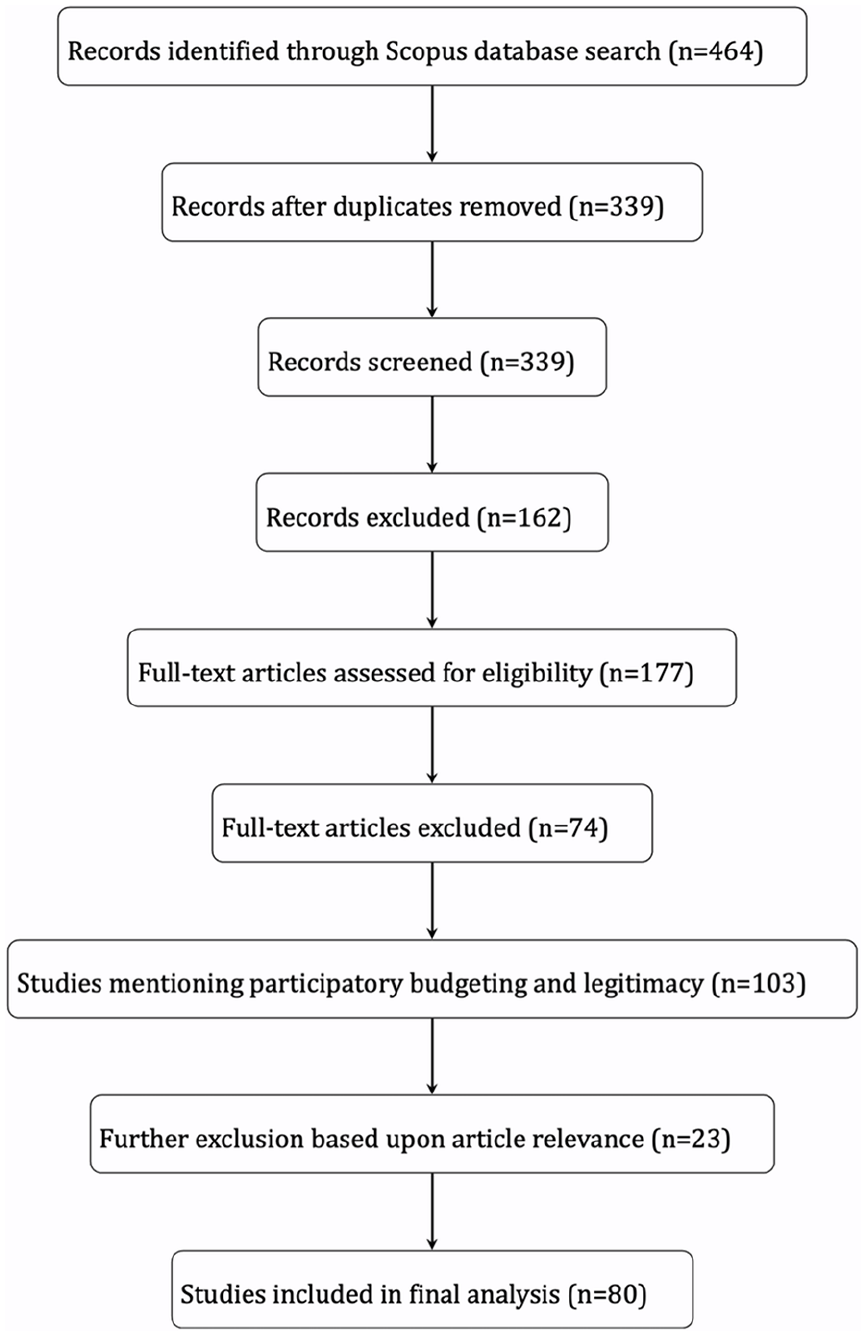
Article Selection Flow Diagram.
From these 177 articles, a further selection was made based on the relevance and depth of discussion on legitimacy. Articles were coded on a scale ranging from 0 (“no mention”) to 5 (“main focus”) for their mention of legitimacy. This step identified 103 articles that mentioned legitimacy at least once, as outlined in Table 1.
Salience of Legitimacy in the Selected Articles.

Out of these 103 articles, a subset of 80 was selected for detailed analysis (the specifics of which are outlined in Appendix 1). This subset was chosen based on their detailed coverage of PB processes and the empirical data they provided on the sources of legitimacy. The remaining 23 articles were excluded from the detailed analysis due to insufficient data or relevance.
Article Specifics
When looking at the types of articles, it becomes obvious that this selection is dominated by rather recent empirical analyses in general and qualitative case studies in particular. As to the main purpose of the 177 articles at hand, 78% refer to empirical analyses. Next in line are literature reviews (10%), methodological contributions (6%), theoretical work (3%), and others (3%). When accounting for the articles that at least partially rely on empirical analyses, the share reaches 90%. In addition, around three-quarters of the selected articles adopt at least, to some extent, a case study approach (81%). Note that since the search query used within this article required the presence of case study terms, this high proportion is to be expected. In addition, the qualitative contributions represent roughly two-thirds of the selected articles (68%), whereas 24% prove to be quantitative and 8% mixed in nature. Finally, the publication years range between 2001 and 2022. The more recent contributions are clearly overrepresented in our sample, which corresponds with the findings of (Bartocci et al., 2023). As a matter of fact, the median article was published in 2017.
Regarding the context of the studies, scholars generally focus on an individual country (81%), while only 19% are comparative. Eighty-nine percent focus on the local level of politics, rather than the national level. In addition, as is highlighted in Figure 2, scholars focus on both developed and developing countries. Moreover, it appears that scholars overwhelmingly focus their research on Europe (33%), Asia (25%), North America (12%), and South America (21%). By contrast, Africa (10%), Oceania (2%), as well as intercontinental studies (7%) play a rather marginal role.
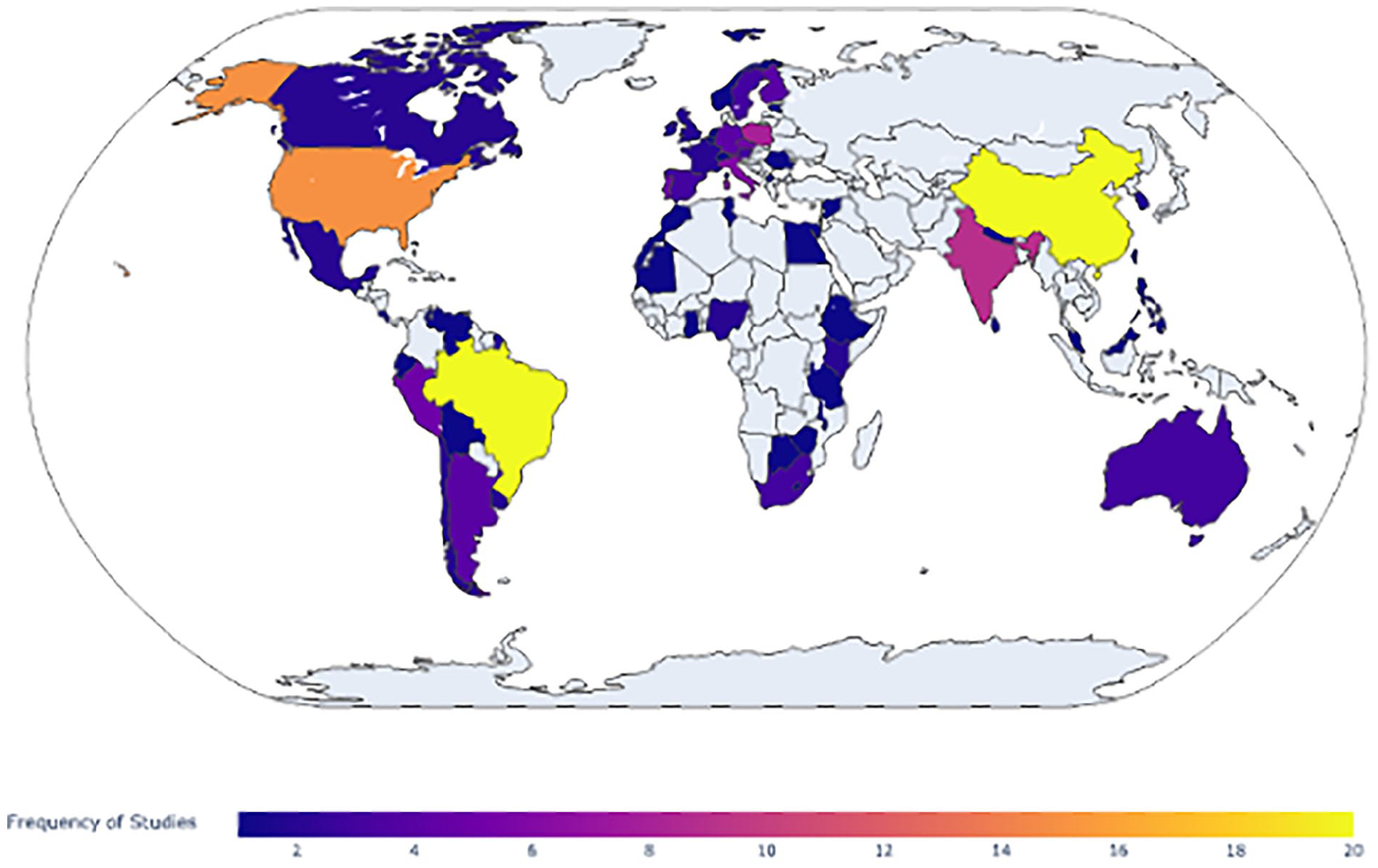
Frequency of Studies Distributed by Country.
The high share of Eastern Asia is above all attributable to work on China, which makes up for 20% of the selected articles. This needs to be highlighted in light of the non-democratic orientation of the People’s Republic of China. Yet the distinction between electoral and non-electoral regimes shows a clear overall picture. Sixty-three percent of the selected analyses refer to electoral democracies, and only 29% refer to non-electoral regimes, with 8% resorting to comparisons across political regimes. This finding is significant, as it was thought that understanding of participation in non-democratic countries is not as well developed as their democratic counterparts (Yan and Xin, 2016).
Finally, the classification according to human development highlights a domination of very high (52%) and high (26%) developed countries. Comparative contributions (17%) and especially those interested in medium (4%) and low (2%) developed countries are much less frequent. The over-representation of high HDI countries may be a reflection that PB is not necessarily associated with a Human Development Index (HDI) improvement (Boulding and Wampler, 2010).
Content Analysis of Legitimacy
Subsequently, a content analysis of the salience of legitimacy was performed on the 177 full-text articles, using a scale ranging from 0 (“no mention”) to 5 (“main focus”). In doing so, we found that 103 articles mentioned legitimacy at least once, with 74 making no mention of legitimacy. To understand the role of legitimacy in PB, we compared the sub-sample of 103 articles that mention legitimacy at least once to the sub-sample of 74 articles that did not mention legitimacy (with the specifics outlined in Table 1).
The results indicated no systematic differences between the two groups with regard to theoretical characteristics. However, a notable exception emerged in relation to the context in which legitimacy was discussed.
Contributions that dealt with non-electoral regimes were found to be overrepresented in the sub-sample of articles that received 1–5 coding scores, indicating that articles mentioning legitimacy were more likely to focus on countries that have non-electoral regimes. Conversely, articles that did not mention legitimacy were less likely to deal with non-electoral regimes.
To further explore the relationship between mentioning legitimacy and the type of government, a chi-square test was conducted. The results revealed a statistically significant association between these two variables (χ2 = 9.91, p < 0.05), suggesting that mentioning legitimacy is related to the model of governance. The observed values were significantly different from what would be expected under the null hypothesis of no association, as indicated by the expected frequencies.
A closer look reveals that this bias is above all attributable to contributions that study participatory experiences implemented at the local level of the People’s Republic of China under the guidance of the Communist Party. The emergence of democratic innovations in such authoritarian contexts can be considered an intriguing feature in the field of participatory politics. With this in mind, future research may wish to expand on current understandings of participation in relation to democratic systems. As it stands, it is understood that authoritarian contexts are more likely to opt to promote limited participation in low-risk policy areas to pacify local tensions, reign in corruption, and/or strengthen political legitimacy (Yan and Xin, 2016). However, there is a need to expand on current knowledge within authoritarian contexts, with a specific emphasis on the use of legitimacy in relation to participation.
Results
As previously mentioned, out of the 103 articles that mention legitimacy, a subset of 80 was selected for detailed analysis. This subset was chosen based on their detailed coverage of PB processes and the empirical data they provided on the sources of legitimacy. The remaining 23 articles were excluded from the detailed analysis due to insufficient data or relevance. An overview is presented in Table 2. When the coded determinants are inductively regrouped into major categories in an ad hoc manner, it turns out that 59% of these articles mention institutions as drivers of legitimacy. Twenty-one percent more specifically make reference to the aspect of citizen participation, while 19% put forward the aspect of deliberation.
The Main Determinants of Legitimacy.

The content analysis allows for several codes per article due to the non-exclusionary nature of the determinants.
Distribution Within the Peoples Republic of China.

As with Table 2, content analysis allows for several codes per article due to the non-exclusionary nature of the determinants.
Interestingly, when the determinants of legitimacy are filtered by papers focusing on the People’s Republic of China, as is outlined in Table 3, there is a decrease in papers focusing on participation, standing at 5%. There is an increase in papers that focus on deliberation, standing at 26%. Papers that focus on institutions correspond with the overall corpus, standing at 58%.
Institutions
When it comes to institutions (which is the most frequent source of legitimacy), a very positive view prevails among scholars. Democratic institutions in general, and specific participatory devices, are considered promising tools in order to increase or restore legitimacy. They are explored under various banners such as democratic institutions, democratic innovations, participatory mechanisms, as well as collaborative, democratic, and participative governance.
There is a wide range of institutions in the sub-sample. In non-democratic contexts (that, for instance, are characterized by one-party rule), the simple fact that local-level elections are held is considered to foster legitimacy—even though the much-studied Chinese case presents some ambivalence due to the strong control exercised by the ruling Communist Party (e.g. Qin and He, 2022; Wu and Wang, 2012). In representative democracies, it is the inclusion of direct democratic elements that is generally expected to lead to higher levels of legitimacy. Other frequently mentioned devices include, above all, PB, but also mini-publics and more informal institutions such as roundtables. In countries with lower levels of development, the decentralization of political decision-making is sometimes expected and shown to exert some desired effects (Hanif et al., 2020; Talitha et al., 2020).
In addition, it shall be noted that the aspect of e-participation proves to be of some importance, since a couple of articles more specifically revolve around institutions of digital participation. The contributions by Aichholzer and Strauss (2016), Prosser (2012), and Quental and Gouveia (2018) illustrate that the discussion on the role played by e-democracy on legitimacy in advanced democracies has established itself in the literature.
Finally, it needs to be mentioned that scholars have not addressed the design of the decision-making process in general, and voting mechanisms in particular, as institutional drivers of legitimacy, even though these factors may be of importance from a theoretical point of view (Hänggli et al., 2021; Pournaras, 2020). It thus appears that there is a research gap in the field.
Participation
Let us now turn to the group of determinants related to citizen participation. The theoretical considerations and empirical findings are characterized by a high degree of coherence. The basic contention that unites these contributions is that the involvement of a large number of people increases legitimacy.
This is often discussed in political contexts of declining participation, most notably declining turnout levels due to voter apathy, and more generally, to the current crisis of representative democracies. While the problems are often considered to be wide-ranging, most empirical studies focus very narrowly on project and problem-specific questions, as is illustrated by the work by Halvorsen (2019) on urban issues in Buenos Aires and by Hakala (2021) on dwellers in two Finnish cities. In relation to authoritarian states, as argued by Weldon and Dalton (2014) and He (2011), participation is often a symbolic experience, used as a key resource to strengthen the regime’s claim to legitimacy (Von Soest and Grauvogel, 2017).
Deliberation
As we mention in the introduction, deliberative democracy is an important element of legitimacy, where dialogue and critical discourse are seen as constituent elements of legitimate authority. Deliberative democracy emphasizes that legitimate outcomes go beyond simply the act of voting, instead engaging citizens in debate that promotes consensus and mutual understanding (Habermas, 1973, 1996). We found that, within the literature review, deliberation is widely acknowledged as an important element of enhancing legitimacy within PB. Given that the idea of deliberation is regarded as being universal, it seems consistent that scholars have studied a wide range of contexts. In democratic contexts, deliberation in PB is often characterized by its focus on transparency, inclusivity, and participation of citizens in shaping outcomes (Holdo, 2016). This deliberative approach helps to bridge the gap between citizens and authorities, promoting transparency and accountability.
It is noteworthy that scholarly contributions also include deliberation in non-democratic settings (e.g. Ma and Hsu, 2018; Qin and He, 2018) and sometimes additionally in the non-public realm (He, 2021). In non-democratic settings, such as China, deliberation plays a unique role. Here, deliberation often involves structured interactions between government authorities, like the People’s Congress, and citizens’ assembly. These deliberative processes are designed to enhance governmental responsiveness and efficiency without challenging the centralized power structure (He, 2011; Ma and Hsu, 2018; Qin and He, 2018). This use of deliberation serves as a mechanism for the government to maintain social stability and reinforce state authority, demonstrating the strategic adaptation of deliberative practices in authoritarian regimes (Wu and Wang, 2012). The way in which deliberation is implemented in China may offer an understanding of why deliberation is overrepresented in the Chinese context.
Other Determinants
Regarding the remaining determinants of legitimacy, a distinction between three levels appears to be indicated: political system, elites, and citizens. As to the former, corruption, patronage, and low economic development appear as the main factors that reduce legitimacy. At the level of elites, this primarily applies to poor accountability and government performance. With respect to citizens, inequalities and low levels of education are considered to negatively affect legitimacy. Apart from that, the meso level seems to be of some importance, as groups from civil society are sometimes viewed as a force to increase legitimacy (e.g. Sheely, 2015). While it is not obvious how to unite these factors to a coherent underlying concept, it nevertheless appears that they are in a rather fragmented way ultimately connected with poor government performance—which undoubtedly affects legitimacy in a negative manner.
Conclusion
This literature review systematically examines the existing body of research on PB and its impact on political legitimacy. By analyzing 80 studies, the review identifies 3 primary determinants of legitimacy: institutions, participation, and deliberation. The methodological approach involved a comprehensive search and analysis using the Scopus database, ensuring a broad analysis of relevant academic work. This allowed for an in-depth understanding of the role of legitimacy within PB across different political contexts. The studies included in the review were selected based on their focus on PB and its implications for legitimacy, allowing for a detailed examination of both theoretical and empirical contributions. This approach enabled the identification of key themes in the literature, highlighting the varying impacts of PB on legitimacy depending on the political and cultural context.
Output of Literature Review
When considering the specifics of the literature review, the study demonstrates a significant emphasis on democratic institutions, which are the most frequently cited source of legitimacy, present in 59% of the studies. Institutions are generally viewed positively, demonstrating their ability to increase or restore legitimacy.
Participation, highlighted in 21% of the studies, emphasizes the importance of involving citizens to increase legitimacy. This aspect plays a crucial role in addressing the challenges posed by declining voter turnout and engagement in established democracies. By directly involving citizens in decision-making processes, PB can address democratic deficits and enhance political legitimacy.
Deliberation, identified in 19% of the studies, is recognized as an essential element of legitimacy within PB. However, its role varies depending on the political context. In non-democratic regimes, deliberation often serves strategic purposes. This highlights the need for further research to understand the applications of deliberation in enhancing political legitimacy across different systems of governance within the context of PB.
The review’s findings suggest that the issue of legitimacy in participatory politics plays an important role outside liberal democracies, which is particularly interesting. This is evident at the local level in the People’s Republic of China, where PB has been used strategically to enhance legitimacy without challenging centralized power. In light of recent developments, especially the restrictive approach by the Communist Party in the context of the Covid-19 pandemic and beyond, scholars are encouraged to continue critically studying this case. However, academics should consider the quality and reliability of data gathered from non-electoral regimes, as there is potential response bias regarding political attitudes due to repressive limitations on freedom of expression.
Limitations
This literature review has at least three notable limitations. Perhaps most importantly, academic search systems (in our case it was Scopus) are not 100% precise or do not necessarily represent a representative sample. In addition, the selection of the articles that address the issue of legitimacy relies on a literal approach. Future research may treat this semantic challenge by broadening the selection procedure. Apart from that, scholars may want to narrow their scoping reviews to specific types of democratic innovations such as PB. Even though this contribution required the latter to be part of the selected articles, the sample was in fact rather heterogeneous, thus containing various forms of participatory politics. Finally, this literature review has included both theoretical and empirical considerations on legitimacy. For the sake of coherence and depending on the research interest in question, a focus on either theoretical or empirical work may be indicated.
Footnotes
Appendix 1
Overview of the 80 Analyzed Articles That Mention at Least a Source of Legitimacy (in Chronological Order Within Decreasing Rating Score Groups).
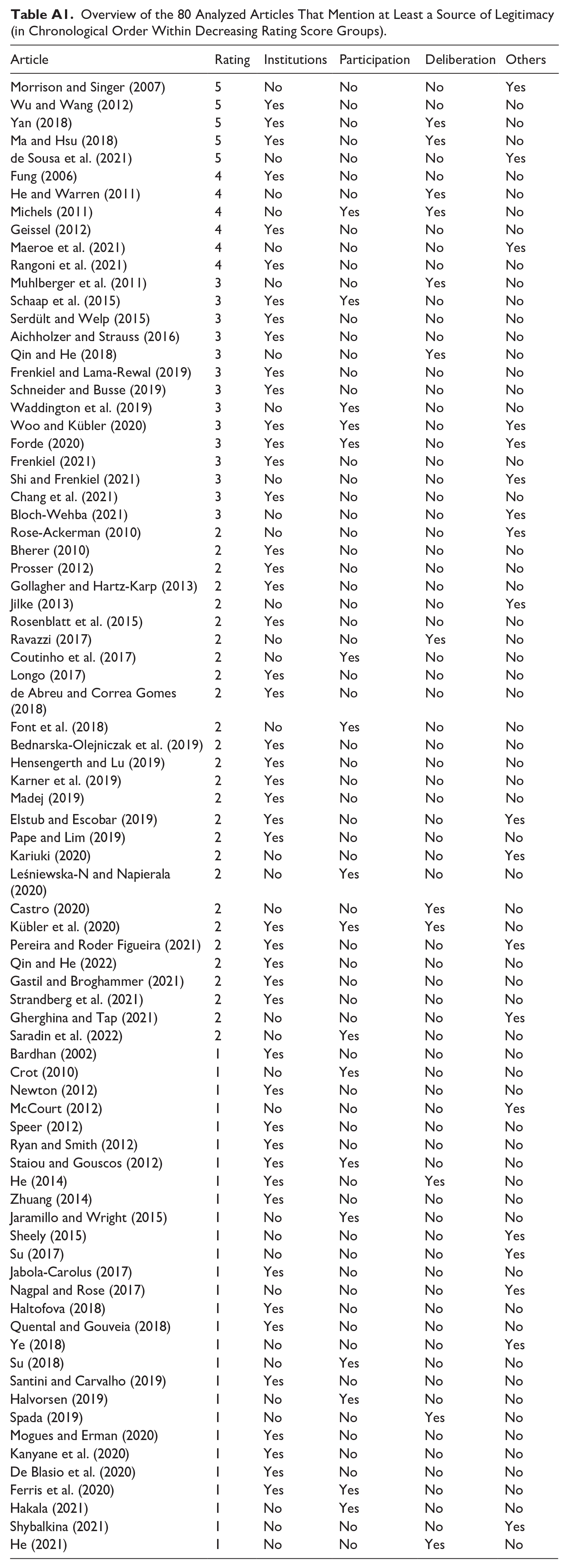
| Article | Rating | Institutions | Participation | Deliberation | Others |
|---|---|---|---|---|---|
| Morrison and Singer (2007) | 5 | No | No | No | Yes |
| Wu and Wang (2012) | 5 | Yes | No | No | No |
| Yan (2018) | 5 | Yes | No | Yes | No |
| Ma and Hsu (2018) | 5 | Yes | No | Yes | No |
| de Sousa et al. (2021) | 5 | No | No | No | Yes |
| Fung (2006) | 4 | Yes | No | No | No |
| He and Warren (2011) | 4 | No | No | Yes | No |
| Michels (2011) | 4 | No | Yes | Yes | No |
| Geissel (2012) | 4 | Yes | No | No | No |
| Maeroe et al. (2021) | 4 | No | No | No | Yes |
| Rangoni et al. (2021) | 4 | Yes | No | No | No |
| Muhlberger et al. (2011) | 3 | No | No | Yes | No |
| Schaap et al. (2015) | 3 | Yes | Yes | No | No |
| Serdült and Welp (2015) | 3 | Yes | No | No | No |
| Aichholzer and Strauss (2016) | 3 | Yes | No | No | No |
| Qin and He (2018) | 3 | No | No | Yes | No |
| Frenkiel and Lama-Rewal (2019) | 3 | Yes | No | No | No |
| Schneider and Busse (2019) | 3 | Yes | No | No | No |
| Waddington et al. (2019) | 3 | No | Yes | No | No |
| Woo and Kübler (2020) | 3 | Yes | Yes | No | Yes |
| Forde (2020) | 3 | Yes | Yes | No | Yes |
| Frenkiel (2021) | 3 | Yes | No | No | No |
| Shi and Frenkiel (2021) | 3 | No | No | No | Yes |
| Chang et al. (2021) | 3 | Yes | No | No | No |
| Bloch-Wehba (2021) | 3 | No | No | No | Yes |
| Rose-Ackerman (2010) | 2 | No | No | No | Yes |
| Bherer (2010) | 2 | Yes | No | No | No |
| Prosser (2012) | 2 | Yes | No | No | No |
| Gollagher and Hartz-Karp (2013) | 2 | Yes | No | No | No |
| Jilke (2013) | 2 | No | No | No | Yes |
| Rosenblatt et al. (2015) | 2 | Yes | No | No | No |
| Ravazzi (2017) | 2 | No | No | Yes | No |
| Coutinho et al. (2017) | 2 | No | Yes | No | No |
| Longo (2017) | 2 | Yes | No | No | No |
| de Abreu and Correa Gomes (2018) | 2 | Yes | No | No | No |
| Font et al. (2018) | 2 | No | Yes | No | No |
| Bednarska-Olejniczak et al. (2019) | 2 | Yes | No | No | No |
| Hensengerth and Lu (2019) | 2 | Yes | No | No | No |
| Karner et al. (2019) | 2 | Yes | No | No | No |
| Madej (2019) | 2 | Yes | No | No | No |
| Elstub and Escobar (2019) | 2 | Yes | No | No | Yes |
| Pape and Lim (2019) | 2 | Yes | No | No | No |
| Kariuki (2020) | 2 | No | No | No | Yes |
| Leśniewska-N and Napierala (2020) | 2 | No | Yes | No | No |
| Castro (2020) | 2 | No | No | Yes | No |
| Kübler et al. (2020) | 2 | Yes | Yes | Yes | No |
| Pereira and Roder Figueira (2021) | 2 | Yes | No | No | Yes |
| Qin and He (2022) | 2 | Yes | No | No | No |
| Gastil and Broghammer (2021) | 2 | Yes | No | No | No |
| Strandberg et al. (2021) | 2 | Yes | No | No | No |
| Gherghina and Tap (2021) | 2 | No | No | No | Yes |
| Saradin et al. (2022) | 2 | No | Yes | No | No |
| Bardhan (2002) | 1 | Yes | No | No | No |
| Crot (2010) | 1 | No | Yes | No | No |
| Newton (2012) | 1 | Yes | No | No | No |
| McCourt (2012) | 1 | No | No | No | Yes |
| Speer (2012) | 1 | Yes | No | No | No |
| Ryan and Smith (2012) | 1 | Yes | No | No | No |
| Staiou and Gouscos (2012) | 1 | Yes | Yes | No | No |
| He (2014) | 1 | Yes | No | Yes | No |
| Zhuang (2014) | 1 | Yes | No | No | No |
| Jaramillo and Wright (2015) | 1 | No | Yes | No | No |
| Sheely (2015) | 1 | No | No | No | Yes |
| Su (2017) | 1 | No | No | No | Yes |
| Jabola-Carolus (2017) | 1 | Yes | No | No | No |
| Nagpal and Rose (2017) | 1 | No | No | No | Yes |
| Haltofova (2018) | 1 | Yes | No | No | No |
| Quental and Gouveia (2018) | 1 | Yes | No | No | No |
| Ye (2018) | 1 | No | No | No | Yes |
| Su (2018) | 1 | No | Yes | No | No |
| Santini and Carvalho (2019) | 1 | Yes | No | No | No |
| Halvorsen (2019) | 1 | No | Yes | No | No |
| Spada (2019) | 1 | No | No | Yes | No |
| Mogues and Erman (2020) | 1 | Yes | No | No | No |
| Kanyane et al. (2020) | 1 | Yes | No | No | No |
| De Blasio et al. (2020) | 1 | Yes | No | No | No |
| Ferris et al. (2020) | 1 | Yes | Yes | No | No |
| Hakala (2021) | 1 | No | Yes | No | No |
| Shybalkina (2021) | 1 | No | No | No | Yes |
| He (2021) | 1 | No | No | Yes | No |
Declaration of conflicting interests
The author(s) declared no potential conflicts of interest with respect to the research, authorship, and/or publication of this article.
Funding
The author(s) received no financial support for the research, authorship, and/or publication of this article.
