




Abstract
This article systematically reviews the literature on combining referendums and deliberative processes. With referendums being criticized for various reasons, including their deliberative deficit, and amid the deliberative turn in democracy, various hybrid combinations of referendums and deliberative processes have been practised or suggested. We bring together the hitherto scattered literature that focuses on assumed and observed strengthening effects of deliberation in light of ascribed referendum deficits. Following the Preferred Reporting Items for Systematic Reviews and Meta-Analyses method, we reviewed and thematically analysed 55 publications. We show that, despite their different focal points, a clear overlap exists between perceived shortcomings of referendums and the added value of deliberation. Expectations of hybridization run high, with empirical evidence emerging that shows promising positive effects. Nevertheless, non-positive effects are both anticipated and observed, and these underscore the importance of ensuring appropriate connections between aggregative and deliberative processes and of systemic embedding.
Keywords
Introduction
In the search for ‘better’ democracy, various democratic innovations are emerging, commonly centred on voting or deliberation. Both modes of participation have particular strengths and challenges. In this article, we are interested in the extent to which the purposeful addition of deliberative instruments to referendum processes reduces the deliberative deficits while retaining the unique benefits of the latter, thereby strengthening rather than replacing the referendum instrument.
Democratic innovations are defined as ‘processes or institutions that are new to a policy issue, policy role, or level of governance, and developed to reimagine and deepen the role of citizens in governance processes by increasing opportunities for participation, deliberation and influence’ (Elstub and Escobar, 2019: 11). They are developed and designed with the aim to increase democratic legitimacy (Elstub and Escobar, 2019: 15). These include referendums, which cover ‘all kinds of ballot measures pertaining to individual issues’ (Jäske and Setälä, 2019: 91) and can take various forms, such as mandatory, top-down or bottom-up initiated (including citizens’ initiatives). Referendums generally offer several advantages, including accessibility, inclusiveness and efficiency (Altman, 2011; Taillon, 2018). They produce tangible results that can put pressure on politicians to implement the outcomes, thereby establishing more direct consequences and impacts (Michels, 2011; Taillon 2018).
Regardless of such advantages, the literature also notes several shortcomings of referendums. 1 A prominent criticism concerns their deliberative deficit: referendum processes are criticized for lacking reasoned public discussion and failing to produce well-considered decisions. Tierney argues that this deliberative deficit resides in the fact that ‘public reasoning which allows for the informed reflection and discussion of ideas before decisions are reached is absent from referendum processes’ (Tierney, 2013: 510). Chambers even argues that the majoritarian character of referendums reduces the motivation to deliberate by diminishing, among both majorities and minorities, the feeling that one’s input makes any difference and hence ‘an important incentive to be reasonable’ (Chambers, 2001: 241). Moreover, voter deliberation is discouraged because flexibility and reversibility are absent: the vote terminates the talking and indicates finality, causing participants to be less deliberative than when no decision needs to be made. Such deliberative deficits in referendum processes could negatively affect their legitimacy (Taillon, 2018).
Scholarship on deliberative democracy is rapidly expanding, particularly on deliberative mini-publics and citizens’ assemblies (Elstub and Khoban, 2023; Grönlund et al., 2014). With the deliberative turn in democracy, deliberative criticisms of referendums have become more prevalent. At the same time, deliberative democracy theory has introduced various solutions to counter the deliberative, and other, shortcomings of referendums. While referendums were initially disparaged and deemed incompatible with deliberative democracy (El-Wakil, 2017; Saward, 2001), there is now a growing interest in adding deliberation to referendums to compensate for their deficits. Della Porta et al. observe that ‘deliberative democracy has been seen as a way to overcome the problems of a (simply) majoritarian form of preference aggregation through the debate, based on justification of arguments and positions. In this perspective, referendums can be seen as opportunities’ (Della Porta et al., 2017: 15). Being ‘mutually supportive’ and able to ‘reinforce the attractiveness of each’, Saward (2001: 363) proposes to sequence aggregative and deliberative components. Smith similarly advocates ‘institutional complementarity’ (Smith, 2009: 189). Various deliberative elements have been added to or proposed for referendums (Chambers, 2018; Gastil and Richards, 2013; Hendriks and Wagenaar, 2023; LeDuc, 2015; Stojanović, 2023). Well-known empirical examples include the Oregon Citizens’ Initiative Review and the Irish Citizens’ Assembly and referendum on abortion. We refer to such combinations of voting-based and deliberation-based participation as hybrid democratic innovations, which are at the heart of our study. 2 In this article, we focus on purposeful additions of deliberation, as opposed to deliberation materializing spontaneously around a referendum vote. While deliberation has its own shortcomings, and adding voting-based instruments might counter these shortcomings, our analytical focus here is on deliberation being added to the referendum process. However, this does not preclude mutual reinforcement of the two instruments, that is, deliberative exercises and voting processes simultaneously benefiting from being coupled.
Research on hybrid combinations has so far been scattered, often focusing on just one combination type in a specific context. However, by reviewing the combined findings of similar studies one is better able to comprehend their conclusions (Dacombe, 2018). That is, systematic reviews enable us ‘to speak with far greater certainty about the wisdom of existing research [and to] highlight common findings’ (Dacombe, 2018: 150). Nevertheless, to the best of our knowledge, no systematic review has previously been conducted in this field, although reviews have recently been published in the respective fields of referendums and deliberative processes (e.g. Harguindéguy et al., 2023; Van der Does and Jacquet, 2023). In rapidly expanding academic fields such as democratic innovations, there is a danger that strands of literature end up on parallel tracks. The aim of this article is to fill a knowledge gap by uncovering the rationale for hybrid processes.
Here, we map the shortcomings of referendums that have been noted, which added value deliberation is seen to contribute and what the hybridization of referendums and deliberative processes is considered to offer. Despite the inherent limitation of systematic literature reviews in not being able to zoom in on the contexts of individual studies, an overarching review of findings and expectations does contribute to a systematic understanding of the effects of hybrid democratic innovations beyond single empirical observations.
Below, we outline our search and selection process and our approach to data extraction and synthesis. Subsequently, we report and discuss the findings of the review. In the concluding section, we reflect on the findings and implications for further research.
Methodology
In reporting the review process and our findings, we follow the Preferred Reporting Items for Systematic Reviews and Meta-Analyses 2020 guidelines (Page et al., 2021).
Search and selection strategy
First, we searched Scopus and the Web of Science Core Collection, two major multidisciplinary databases as appropriate principal sources (Gusenbauer and Haddaway, 2020). We searched within the titles, abstracts and keywords for the following search terms and operators:
((‘referendum*’ OR ‘referenda’ OR ‘popular vote*’ OR ‘citizen* initiative*’ OR ‘popular initiative*’ OR ‘direct democracy’ OR ‘plebiscit*’) AND (‘deliberati*’ OR ‘mini-public*’ OR ‘mini public*’ OR ‘minipublic*’ OR ‘citizen* assembl*’ OR ‘citizen* jur*’ OR ‘citizen* panel*’)) OR (‘citizen* initiative review’).
3
The focus of our review is on the purposive organization of citizen deliberation in conjunction with a referendum process. Because deliberative democracy and deliberation are established terms, we expected these concepts to be referred to as such in studies within the scope of this review. We therefore did not include any synonyms for ‘deliberative’ or ‘deliberation’ (both of which are captured by ‘deliberati*’) as search terms. 4 We did however add some common deliberative institutions. 5
From the resulting records, duplicates within and across the two databases and non-English results were removed. 6 We did not select based on publication year, as we expected that most of the identified literature would date from after the deliberative turn and that the number of publications would therefore be manageable. We then assessed the relevance of the remaining records (n = 363) based on document type, title, abstract and keywords. 7 First, in terms of literature type, we only included journal articles, working papers, conference papers and proceedings, book chapters, and books. Book reviews and editors’ prefaces were excluded. Second, regarding content, we only included records that, based on title, abstract and keywords, were potentially about any combination of: (a) an official referendum; and (b) an organized deliberative process involving citizens. 8
We assessed the remaining records (n = 114) based on their full text. In this stage, we only included records that made substantial comments about a hypothetical or actual combination of: (a) an official referendum; and (b) an organized process of citizen deliberation. With compilations of conference proceedings (n = 1) and books (n = 6) that were eligible based on their general abstract, we first assessed each conference paper or chapter separately on title, abstract and keywords. Apparently eligible 9 papers and chapters were then retrieved and assessed based on their full text. Five of these book chapters were already present in the other records to assess. Papers and chapters which were not already among the remaining records but were considered eligible based on their full text (n = 8) were added to the documents for review.
In the first stage (assessment based on document type, title, abstract and keywords), the first author screened all the records. The second author screened a random 10% sample and those records considered ineligible by the first author. This reduced the risk of excluding possibly eligible records. In the second stage (assessment based on full text), the first author again screened all records and the second author a random 10% sample and all cases marked as doubtful by the first author. Differences of opinion in both stages were initially discussed between the two assessors and, if not resolved, presented to the third author, whose assessment was final. Finally, in addition to the database searches, we conducted backward searching to trace possibly overlooked publications. 10 This did not yield additional records. Figure 1 summarizes the search and selection process.
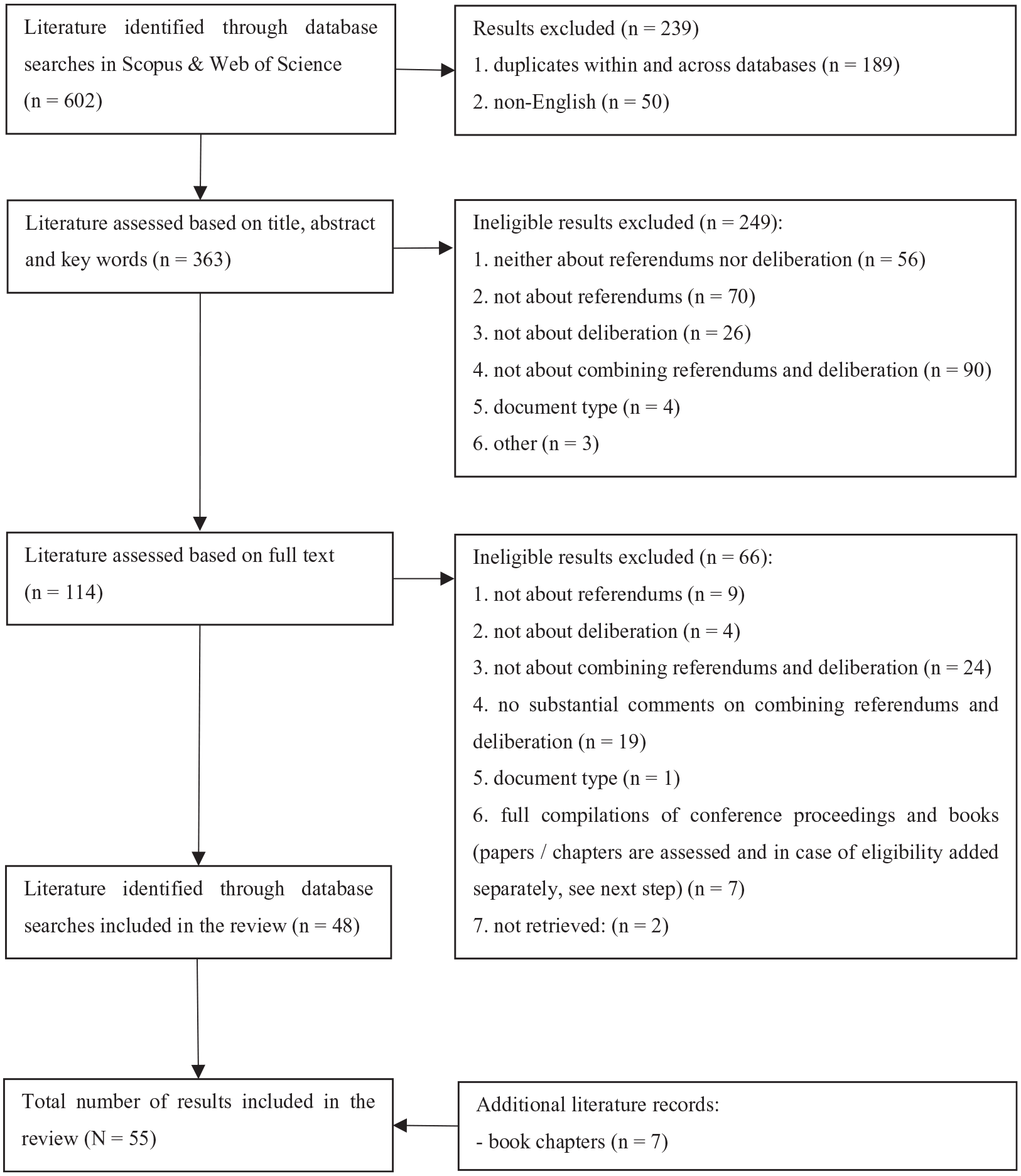
Summary of the search and selection process.
Data extraction and analysis
To analyse the selected literature we applied reflexive thematic analysis (Braun and Clarke, 2022). We used ATLAS.ti to extract, code and analyse the data. The first two authors independently coded the same subset of 10% of all records, discussed and resolved any disagreements, and agreed on the coding scheme. As coding progressed, the coding scheme was refined based on mutual agreement. Such regular discussions on the coding scheme and the mutual resolving of disagreements is consistent with methodologies applied in similar systematic literature reviews (Ritz et al., 2016; Van der Does and Jacquet, 2023). All the selected records were then recoded by the first author based on the final coding scheme. 11
Guided by four overarching categories (referendum deficits, deliberation benefits, positive effects of hybrid forms and non-positive effects of hybrids) as a deductive starting point, we inductively coded specific manifestations of each of these categories in the records being analysed. In the first round of inductive coding, we stayed close to the data and the wording used. Often a record would discuss multiple manifestations or categories (for example, several referendum deficits, or both referendum deficits and expected effects of added deliberation). In recording both positive and non-positive effects, we included both hypothesized and empirically observed effects of hybrids. Through multiple rounds of inductive and deductive coding, we merged the literal codes into overarching semantic or latent codes, and deduced overarching themes that were present in the literature (Braun and Clarke, 2013; Graebner et al., 2012; Linneberg and Korsgaard, 2019). In identifying themes, we considered not only how often a particular theme was mentioned, but also the fuller picture emerging from the literature. Finally, we grouped themes that showed substantive proximity into four coherent clusters.
Results
Overview of included literature
The publications included in our review (n = 55) reflect the growing interest in hybrid democratic innovations that combine deliberative practices and formal referendum votes (see Figure 2). As expected, the relevant literature mainly dates from after the proclaimed deliberative turn. Since the first publication in 2003, the number of publications addressing hybrid combinations has gradually increased. The majority of the publications are theoretical or conceptual (n = 33), with roughly one-third empirical (n = 19) and just a few (n = 3) that combine both perspectives.
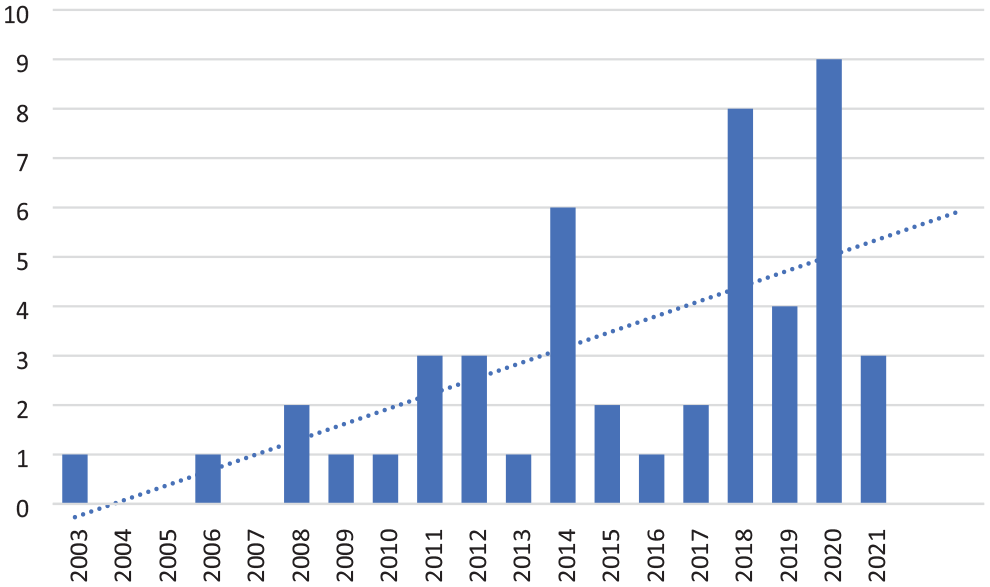
Distribution of records included in the review by publication year.a
Variety in deliberative referendum hybrids
An overview of the different hybrid processes reported in the literature is presented in the Supplemental Materials. Here, we make some general observations. First, there are clearly more hypothesized than observed hybrids, although several proposals are variations on the same theme. A limited number of practical cases are extensively covered in multiple studies. Furthermore, both in the hypothetical and empirical cases, the deliberations are organized for different purposes in different stages of the referendum process, such as agenda-setting, designing initiatives before signature circulation, deciding on a ballot alternative and providing voting recommendations. In most instances, deliberation takes place within mini-publics. Only in a few of the hypothetical cases is the deliberation organized for, and open to, the wider public. For example, Quinlan et al. (2015) explore whether moderated online discussion forums can serve as deliberative platforms for referendums, and various proposals include the organization of a ‘deliberation day’, engaging citizens in small, locally organized discussions and larger plenary sessions (e.g. Ackerman, 2018; Fishkin, 2011).
Findings
When reviewing the themes, we inductively derived four thematic clusters: ‘popular control’; ‘cross-cutting reflection’; ‘epistemic quality’; and ‘process and systemic embedding’. In each of our four categories of analysis (deficits of referendums, benefits of deliberation, and positive and non-positive effects of hybridization), these clusters manifest themselves through different themes, which we summarize in Supplemental Tables 1 to 3 and illustrate below.
Themes in referendum deficits
The identified referendum deficits are presented in Supplemental Table 1, panel A. In terms of popular control, the literature mentions the role of elites and interest groups that have power to set the agenda and strategically trigger referendums. Money can have a detrimental role, with large sums spent on campaigns to influence public opinion. The literature also notes voters’ distrust of opinion leaders and second-order effects on referendum voting ‘with government popularity and/or partisan politics determining the outcome rather than the issue voters are being asked to decide on’ (Quinlan et al., 2015: 192). Referendums may also undermine responsibility and accountability.
Second, many inadequacies are mentioned related to cross-cutting reflection, where referendum processes are seen as providing insufficient opportunities or stimulation. Reflection is seen as lacking from various perspectives and may be characterized by prejudice, bias and partisanship. The tone of the debate around referendums also receives criticism, being ‘characterized by excessive spin, fear-mongering, and attack politics’ (Gallop, 2014: 209) and for ‘[hindering] the cultivation of mutuality and reciprocity’ (Smith, 2012: 106). Given that referendums are ‘aggregative and other-defeating [. . .] each side seeks to win the contest rather than [. . .] facilitate deliberation and debate’ (LeDuc, 2011: 552). Referendums are accordingly said to increase polarization and effectively produce a tyranny of the numerical majority.
A third, significant, group of criticisms relates to epistemic quality. Referendum voters tend to have information and knowledge deficiencies on the subject at hand and, consequently, ‘voting typically relies on top-of-the-head, under-informed reasons’ (Levy, 2019: 348–349). The literature also criticizes the constrained choice set given that a ballot question is often binary, simplified and ‘take-it-or-leave-it’ (Parkinson, 2020: 485). Claims made during the referendum campaign, or even the ballot question itself, may be misleading. Additionally, ballot choices may ignore the context making them ‘difficult to implement in practice’ (Jäske and Setälä, 2020: 477) and obstruct long-term thinking. Referendums can be complex and cognitively demanding, sometimes being ‘too complicated and confusing to fully comprehend’ (McFadden and Reilly, 2017: 82). Furthermore, voters may lack motivation and have ‘little incentive to become seriously informed’ (Fishkin, 2011: 249) and voter incompetency can become a real concern given that the ‘expertise [required] is generally beyond the capacities of voters’ (Levy, 2010: 807) and the ‘poor draftsmanship’ of many initiatives (Burke, 2009: 1475).
Finally, some publications made references to systemic embedding, in particular that ‘the legitimacy of the result of the referendum [is] disputable’ (Jäske and Setälä, 2020: 476) as there are ‘questions about the proper nature of [popular] consent’ (Levy, 2019: 339). Inefficiency and ineffectiveness follow from tight time frames and referendums being ‘blunt [. . .] tools’ (Levy, 2010: 808) and ‘expensive and difficult to organize’ (Levy, 2018: 1271). Furthermore, their use may ‘override other existing democratic processes’ (Burke, 2009: 1478) and thus jeopardize stability.
Themes in deliberation benefits
The claimed benefits of deliberation are listed in Supplemental Table 1, panel B. In terms of popular control, deliberative processes are claimed to increase citizen involvement and deepen their engagement, enabling ‘meaningful citizen input’ (Gastil and Richards, 2013: 271). Deliberation allows the expression of voices of the public and is praised for its responsiveness to the citizenry. The literature notes the restrained role of elites, interest groups and money. Deliberative processes are also associated with participants’ increased trust in popular rule and ‘in representative institutions and actors’ (Setälä, 2011: 207), and participants further report satisfaction with the process.
Cross-cutting reflection is considered the main benefit of deliberation. Deliberation involves deliberative scrutiny, including considered and reasoned judgements and choices ‘based on the merits of the argument’ (Fishkin, 2018: 365). Deliberative processes encourage reflection from various standpoints thereby ‘prompting participants’ open-minded engagement with, and learning from, people who have identities and views different from their own’ (Levy et al., 2021: 79). The literature also mentions counteracting polarization, enlightened understanding, opinion change and heightening of the public spirit. Deliberation ‘seeks the common ground in respective of any issue’ (Gallop, 2014: 207), and stimulates ‘collective agreement [. . .] rather than the individual preferences’ (Hayward, 2014: 13). It is furthermore said to promote equality, ameliorate the tone of debate and counteract ‘distortions such as domination by the more advantaged’ (Fishkin, 2018: 365).
Third, deliberation potentially enhances information provision and knowledge gains, areas where referendums are considered deficient. Deliberative processes encourage the ‘building of a solid information base’ and participants ‘learn a great deal about the subject at hand’ (Setälä et al., 2020: 4), also ‘improv[ing] the wider information environment’ (Suiter, 2021: 249). Deliberation is expected to enhance long-term thinking as it ‘better informs public participants about the complexities of both short- and long-term consequences’ (Levy, 2010: 823). Other noted benefits are that it enhances participant competencies and increases efficacy.
Finally, the literature mentions overarching benefits of deliberation regarding the democratic process and systemic embedding. Deliberation is said to enhance overall legitimacy: of the process itself, of the decisions made, and of the system. Finally, deliberation is associated with fairness and political stability.
Themes reflecting the positive effects of hybridization
Supplemental Table 2 shows the positive effects of hybridization for each cluster. We distinguish between intended/expected/assumed effects (hereafter: expected effects) and established or empirically observed effects (hereafter: observed effects). Panel A shows that expectations of hybridization are high and that there is a strong resemblance with the identified referendum deficits and deliberation benefits.
Regarding popular control, hybrid processes are expected to strengthen reliance and trust. Voters may ‘be more likely to trust information developed by people like them than information coming from a distant elite’ (Renwick et al., 2020: 531). Beyond the hybrid process itself, trust may also increase ‘in the democratic process and politicians’ (Organ, 2019: 275). Combinations of referendums and deliberation are expected to ‘invigorate citizen awareness, involvement [. . .] and participation’ (Altman, 2014: 22). Hybrid approaches are expected to restrain the role of elites, interest groups and money, and to provide checks and balances.
Turning to cross-cutting reflection, the literature expects hybrids to realize, encourage and improve deliberation and second-order reflection among the wider public. Ballot choices, contributions to the debate, and voters’ views and judgements are expected to benefit from being ‘deliberatively scrutinized’ (Suiter, 2021: 252). More substantive campaign dynamics are anticipated, with simplistic arguments replaced by motivated reasoning as hybrids ‘mak[e] rationalised inputs available’ (Parkinson, 2020: 494). Hybrids thus encourage reflection, enlightened understanding and opinion change, including an increase in correct voting. Voters are presumed to be ‘actively reconstructing their attitudes and beliefs’ (Gastil et al., 2018: 550). Correspondingly, inclusiveness, equality and public spirit, comprising collective understanding, public reasoning and greater empathy, could be advanced.
Improved information provision and knowledge gains are the most frequently expected positive effects of hybridization. Deliberative processes produce information, and voters with increased levels of subjective knowledge are ‘much better equipped to choose’ (Gastil and Richards, 2013: 255) and so hybrid processes support voters in making grounded decisions. Furthermore, recommendations from deliberative processes could function as a more profound heuristic than ‘the simple voting cues provided by campaigns’ (Gastil et al., 2016: 177). Benefits regarding political efficacy and enhanced citizen competencies are also mentioned.
Supplementing referendums with deliberative processes is expected to increase the legitimacy of both the referendum itself and the broader democratic system. ‘Citizens who find themselves on the losing side [. . .] may be more likely to accept the outcomes as legitimate’ and hybrids are expected to be perceived as legitimate ‘by a wide cross-section of people, including both those who value majoritarian process and those who value deliberation’ (Levy et al., 2018: 35). Hybrids are associated with fairness, transparency and mutual reinforcement and could ‘realize more compelling combinations of democratic goods’ (Smith, 2012: 106). Hybrids are expected to fare better than isolated referendums in terms of efficiency, effectiveness, robustness and outcomes, partly because the supplementary deliberative process ‘would extend the time period during which the issues would become a focus of debate and deliberation in the wider public sphere’ (Suiter, 2021: 253).
Some of the aforementioned expectations are supported by empirical evidence, but the number of empirical studies is rather limited given the many expectations, and some effects may be harder to empirically establish than others. Starting with popular control, there is some evidence for deepened citizen involvement, but more so for fortified reliance and trust. Voters trust the deliberative process and the information provided to them, and they trust the judgement of their peers participating in the deliberations, who are themselves found to feel highly responsible. One study shows that there is no ‘pattern of selective trust’ in that ‘both supporters and opponents [. . .] seemed to put an equal amount of trust’ in the deliberative process (Setälä et al., 2021: 11).
Second, there is positive evidence that reflecting on various perspectives counters polarization and increases empathy: ‘being exposed to balanced information from both sides of the issue’ positively affected ‘people’s empathy among the wider public’ (Suiter et al., 2020: 266). The Korsholm Citizens’ Initiative Review prompted an increase in voters ‘thinking about the issues from perspectives of those with opposed views’ (Setälä et al., 2020: 15). Several publications observe how enlightened understanding, opinion change and motivated reasoning counteract bias and prejudice. Evidence also points to an ameliorated tone of debate, with deliberations showing ‘high level[s] of civility’ and ‘low evidence of flaming’ (Quinlan et al., 2015: 193).
A boost in epistemic quality receives the most empirical support with evidence that hybrid processes contribute to enhanced information provision and knowledge gains. Deliberative processes are observed to provide accurate information and voters are subsequently better informed and more knowledgeable. Moreover, Strandberg et al. point to evidence from the Oregon Citizens’ Initiative Review that combining referendums with deliberative processes ‘helps lower the cognitive costs’ for voters (Strandberg et al., 2023: 2). In some cases, voters’ internal and external political efficacies are both increased.
There are a few observations of increased public awareness, use and appreciation of the added deliberative process within the systemic embedding cluster. Findings that ‘widespread knowledge about the process’ exists among voters (Suiter and Reidy, 2020: 543) are encouraging since many, if not all, empirically observed effects are dependent on voters’ awareness of the deliberative process.
Themes reflecting the non-positive effects of hybridization
Relative to the positive expectations of hybridization, non-positive expectations are scarce (see Supplemental Table 3, panel A). Some claim it is unclear whether referendum voters actually trust the deliberative process, and some worry that hybrid processes still lack accountability. Furthermore, some fear that widescale deliberation will not be realized, and that prejudice, bias and an adversary tone of debate will continue. Despite the high expectations on information and knowledge gains, concerns over continuing information and knowledge deficiencies remain, including ‘concerns that the information generated by regular citizens rather than experts may suffer in terms of accuracy and balance’ (Renwick et al., 2020: 531) and uncertainty as to whether voters will understand the information. Moreover, some authors fear that constraints in the deliberative process result in the downplaying of values relative to information.
Perhaps most importantly, some authors note the potentially suboptimal interconnection between referendum and deliberation, which might be weak, dependent on media exposure or even completely absent. Moreover, a direct link to a referendum might be detrimental if this forecloses deliberations. Finally, insufficient embedding in representative democracy might create problems.
Although few in number, there are more empirical non-positive effects reported than envisaged in the more theoretical publications (see Supplemental Table 3, panel B). For example, in the moderated online discussion forums on Scottish independence, there was little participatory engagement and equality associated with the deliberations (Quinlan et al., 2015). Other findings show that voters put no more trust in the deliberative process and its output than in other sources of information, and that the hybrid process still suffers from second-order effects.
Not all hybrid processes succeed in realizing widescale deliberation and some have suffered from prejudice, bias and motivated reasoning. As such, enlightened understanding and opinion change does not always materialize, and ‘being exposed to mere information about [the deliberative process] and its findings did not per se lead to an increase in empathy among the wider public’ (Suiter et al., 2020: 265).
In line with expectations, some empirical findings indicate that the epistemic quality is still inadequate, including continued information and knowledge deficiencies, lacking or inadequate information campaigns and ‘low levels of information exchange’ (Quinlan et al., 2015: 193). Two publications report that the helpfulness of the deliberative process was limited: not all voters believed that its output helped them decide how to vote. With the 2010 Oregon Citizens’ Initiative Review, awareness of the deliberative process had no effect on internal political efficacy (Knobloch et al., 2020).
Also, issues concerning process and systemic embedding are observed. A lack of interconnectedness and public awareness of the deliberations are two important themes. In one instance, connection with the deliberative process was not part of the referendum campaign and, in another, the output of the deliberative process ‘became unavailable to the public after the campaign began’ (LeDuc, 2011: 560). Notably, in the British Columbia Citizens’ Assembly and in the Oregon Citizens’ Initiative Review, voters were unaware of the existence and output of the deliberative process. Finally, some authors observe that hybrids are insufficiently embedded in representative democracy.
Discussion of findings
In this section we discuss the positive and non-positive effects of hybridization as either anticipated or observed in the literature, and the related findings on referendum deficits and deliberation benefits.
Popular control
Both the expectations and the empirical evidence were mixed as to whether hybridization would strengthen the reliance and trust of citizens both in the process and in political actors. In the two empirical studies that explicitly failed to identify an increase in trust, the levels of trust remained the same rather than decreased. We also found empirical support for a deepening of citizen involvement. Although referendums clearly provide, in numerical terms, popular control, the literature indicates that supplementary deliberation can potentially strengthen the referendum process by balancing the deliberative deficits encountered in practical reality.
We also identified some criticisms concerning the participatory engagement and equality observed in the deliberative process. Hybrid forms, just like self-contained referendums, may also have second-order effects, although the empirical evidence for hybrids is thus far limited to one observation. To date, empirical studies have not provided examples of hybrids reducing second-order effects and distrust in opinion leaders. Expectations yet to be proven or disproven in practice include whether adding deliberation reduces the role of influential elites, interest groups and money in referendum processes, and could enhance checks and balances.
Cross-cutting reflection
The most prominently encountered concerns regarding referendums refer to cross-cutting reflection. This is where expectations of hybridization were highest, particularly of achieving widescale deliberation. However, widescale deliberation as such was rarely mentioned in the empirical literature, possibly due to a focus on mini-public rather than maxi-public deliberation. Nevertheless, what is observed empirically is a reflection that incorporates various (including opposing) points of view. This can be linked, at least implicitly, to several theoretical expectations of hybrids, including deliberative scrutiny, inclusiveness and greater empathy. Through deliberative reflection, hybrids also enhance understanding and can change opinions. Indeed, there were some indications in empirical studies of biases being counteracted, an ameliorated tone of debate and polarization–countering abilities (linking to recognized deficits in referendums). Deliberative reflection involves qualitative attention rather than blindly driving voters into ‘yes’ or ‘no’ camps.
The observed (and sometimes anticipated) non-positive effects of hybridization that concern cross-cutting reflection mainly pertain to failing to encourage widescale deliberation, enlightened understanding and enhanced empathy, and not correcting prejudice and bias. The fear that constraints on the deliberative process may in hybrids downplay values related to factual information has, so far, not been empirically demonstrated.
Epistemic quality
In line with the most-mentioned deficits of self-contained referendums and the benefits of deliberation, the expectations of hybridization are highest in terms of information and knowledge gains. It is encouraging that empirical studies seem to confirm these expectations. Voters in referendums that are connected to deliberative efforts more often than not consider the output of the deliberative process to be informative, useful and important. On gains in political efficacy, empirical evidence on hybridization is even more compelling than theoretically expected. Although improvements in citizen competency have not yet been empirically demonstrated, political efficacy could be considered related. Empirical evidence shows that supplementary deliberative processes aid referendum voters in decision-making. In addition to more general gains in information, knowledge and political efficacy, all commonly mentioned benefits for those participating in deliberation, a key feature of hybrid procedures is that they aid voters, that is, the wider public, in decision-making.
With high expectations expressed on information and knowledge gains through hybridization, it is perhaps unsurprising that some studies question the ability to meet these expectations. Indeed, empirical evidence indicates that, in some instances, voters’ information and knowledge are still insufficient, which reduces the value of deliberation in voter decision-making and questions possible gains in political efficacy. Given that positive empirical findings in this regard are more prominent, further research could delve deeper into instances that succeeded and failed to produce such gains and analyse whether there are specific design or contextual factors that explain these differences.
Process and systemic embedding
None of the positive expectations related to systemic embedding have so far explicitly been empirically verified. However, increased public awareness, use and appreciation of a supplementary deliberative process are observed, and could arguably enhance overall legitimacy, effectiveness and transparency, leading to better referendum outcomes. Empirical evidence thus provides positive indications for systemic embedding, although further research should investigate the mechanisms involved. Further research could also more specifically analyse to what extent hybrid processes are perceived as fair, efficient and robust, and whether they are effective in securing societally supported outcomes and impact. The latter could contribute to the academic debate on the output legitimacy of hybrid participatory processes.
The instances where positive effects related to systemic embedding were not identified differ from the other clusters in that here they specifically concern the connection between the deliberation and the referendum. Here, a lack of interconnectedness and weak embeddedness in the representative democratic system are important (both hypothesized and observed). Some empirical studies further show a deficiency in public awareness of the deliberation procedures. As such, interconnectedness and voter awareness appear to be prerequisites to realize the potential positive effects. Future development of best practices for hybridization should therefore pay attention to connecting the two instruments.
Conclusions
Given the deliberation-related criticisms of referendums, and the growing attention on linking referendums and deliberative processes, this article has systematically reviewed the literature on perceived shortcomings of referendums, added value of deliberation, and possible gains and challenges in combining both in hybrid democratic innovations.
We identified four clusters of dominant themes: popular control; cross-cutting reflection; epistemic quality; and process and systemic embedding. Despite their different focuses, referendums are considered to fall short in all four areas, while much is expected of deliberation and hence hybridization. Based on our broad scoping review, we would not claim that deliberation benefits will automatically remedy referendum deficits, but their systemic correspondence on the main themes is encouraging. Our categorizations can pave the way for further empirical and experimental research to test the realization of these connections in practice. In-depth case studies would also allow contextual factors to be taken into account.
Most of the empirical evidence on the benefits of hybridization relates to the themes of information provision and knowledge gains, and fortified reliance and trust. Several studies also mention benefits regarding reflection from multiple perspectives, enlightened understanding and opinion change, political efficacy and helpfulness in making decisions. Our most compelling observation from the non-positive effects of hybridization is that such outcomes are imperfections or unmet expectations in the hybrid process rather than genuine negative effects of supplementing referendum processes with deliberation. Furthermore, there are many fewer mentions of non-positive effects of hybrids than of positive effects, which suggests a practical potential.
Important points to consider in future experimentation with hybrids are the connection between the two instruments and, relatedly, raising public awareness of the deliberative process on which many, if not all, the positive effects depend. Sufficient attention should also be paid to embedding the combined participatory effort within the representative system. This reinforces findings elsewhere on isolated deliberative and aggregative democratic innovations (Bussu et al., 2022; Lord, 2021).
The referendum deficits that seem the most challenging to counter with hybridization concern epistemic quality. None of the encountered benefits of deliberation explicitly address constrained choices or voting being complex, confusing and burdensome. However, the general knowledge gains observed could to an extent address these deficits as educating voters could reduce complexity and the perceived burden. Hybrid variants in which the referendum component is also innovatively designed, for instance by facilitating an additional counter-proposal by a deliberative mini-public, could further address referendum deficits by broadening the choice and bringing referendum outcomes closer to societal preferences (Wagenaar, 2023).
Our overall conclusion is that supplementing referendum processes with deliberation may not solve all the referendum deficits but will have positive effects without being detrimental to the process. The non-positive effects reported mostly reflect the imperfect realization of hopes or expectations, rather than disadvantages of hybridization per se. More practical experience and empirical research is needed since most publications are based on hypothetical proposals. Further research could delve into the discrepancies between expectations and reality by including relevant design and contextual elements. Testing the hypothesized expectations in practice and verifying the mechanisms behind empirically observed successes and challenges will contribute to our understanding of the robustness and generalizability of these findings and expectations. Further exploration of deliberative processes in which the encompassed maxi-public can participate could also be fruitful, and additional research into new practical examples and other hybrid forms can add differentiated insights.
This systematic literature review provides an insightful overview of the current state of research. Given our scope and analytical angle, we focused on deficient qualities of referendums and added benefits of deliberation. This article hence offers a starting point for further empirical, comparative and experimental research that could extend the scope and zoom in on the interplay between all the benefits and deficits of hybrid processes, thereby furthering the emerging and growing debate.
Supplemental Material
sj-docx-1-ips-10.1177_01925121231210048 – Supplemental material for Improving referendums with deliberative democracy: A systematic literature review
Supplemental material, sj-docx-1-ips-10.1177_01925121231210048 for Improving referendums with deliberative democracy: A systematic literature review by Irene Witting, Charlotte Wagenaar and Frank Hendriks in International Political Science Review
Footnotes
Acknowledgements
The authors are grateful for the valuable comments from the REDRESS consortium and participants at the 2022 European Group for Public Administration conference and would like to thank the three anonymous reviewers for their helpful suggestions on a previous draft of this work.
Funding
The authors disclosed receipt of the following financial support for the research, authorship, and/or publication of this article: This work is part of the REDRESS project which is supported by the Dutch Research Council (NWO) under Grant no. NWA.1292.19.048.

Supplemental material
Supplemental material for this article is available online.
Notes
Author biographies
References
Supplementary Material
Please find the following supplemental material available below.
For Open Access articles published under a Creative Commons License, all supplemental material carries the same license as the article it is associated with.
For non-Open Access articles published, all supplemental material carries a non-exclusive license, and permission requests for re-use of supplemental material or any part of supplemental material shall be sent directly to the copyright owner as specified in the copyright notice associated with the article.
