




Abstract
So-called populist citizens feel excluded from political decision-making, which in their eyes is dominated by an unresponsive political elite. While democratic innovation scholars suggest that empowering citizens in the decision-making process can affect populist sentiments, this article addresses the lack of theorization and empirical research on the mechanisms behind such effects as well as the scarcity of qualitative research regarding populist attitudes. It generates a theory that accounts for changes in participants’ populist attitudes and tests this theory in a most-likely case study. An analysis of pre–post survey data and 35 semi-structured interviews from three participatory budgeting events in the Netherlands shows that for populist citizens, the inclusion of politically marginalised groups and the empowerment of citizens can explain populist attitudes change. On the contrary, the representativeness of the participants and the ability to have deeper discussions are drivers of populist attitudes change for non-populist citizens.
Introduction
Citizens in old democracies have a high level of support for the idea of democracy, but are dissatisfied with how democracy works in practice (van Ham and Thomassen, 2017). Democratic innovations have been put forward as a cure to the democratic malaise that we observe today (Dryzek et al., 2019; Elstub and Escobar, 2019). They can enhance ‘democratic goods’, such as the level of inclusiveness, popular control, or considered judgement, of traditional representative decision-making processes (Smith, 2009). In doing so, they can strengthen the legitimacy of these processes and curb existing disillusionment with the practices of democracy.
Populism is a major contemporary expression of the democratic malaise. Mudde and Rovira Kaltwasser (2017) conceptualise populism not as a full political ideology, but as a thin-centred ideology. According to the populist thin-centred ideology, current representative democratic processes are dominated by corrupted elites at the expense of the people’s voice. There is a great lack of inclusiveness of the people in decision-making processes, while illegitimate elites take the most important political decisions at the expense of popular control (Mudde, 2004). Hence, populism especially denounces the lack of popular control in contemporary representative democracy.
Democratic innovations could appease the democratic malaise as expressed through populism. Especially participatory budgeting (PB), a type of democratic innovation that is high in its level of popular control (Baiocchi and Ganuza, 2014; Smith, 2009), could affect populist dissatisfaction. When populist citizens participate in a PB, they could experience a sense of popular control and subsequently decrease their level of populism.
However, there are two gaps in the current literature. First, how and why citizens would change their populist attitudes due to participation in a democratic innovation has never been fully theorised. Elstub and Escobar (2019) hypothesised that participation in a democratic innovation could affect citizens’ external political efficacy and political trust. Nevertheless, no theoretical account of how participation in a democratic innovation could cause a change in populist attitudes has yet been formulated. Moreover, there is currently very little research into the effects of participatory processes on participants’ political attitudes (Theuwis et al., 2021).
Second, the mechanism leading to a change in participants’ populist attitudes has never been studied empirically. There has been research into populist citizens’ preferences for different types of democratic innovations (Mohrenberg et al., 2021; Trüdinger and Bächtiger, 2022; Zaslove et al., 2020) and their behaviour during a democratic innovation (Jacobs et al., 2018), but a qualitative assessment of how populist citizens experience these democratic innovations is lacking. Moreover, according to a recent systematic review of the available literature by Marcos-Marne et al. (2022), research on populism among citizens using qualitative data is extremely scarce.
This article will fill these theoretical and empirical gaps by generating a theoretical framework that accounts for changes in populist attitudes. First of all, it conceptualises populism at the individual level with insights from sociopsychological theories in order to account for populist attitudes change. In addition, it applies this initial theory of populist attitudes change to a most-likely case of citizen participation, namely, PB.
Survey data from three PBs in the Netherlands have guided the selection of interviewees. Subsequently, a thematic analysis of 35 semi-structured interviews allowed for a specification of the experiences that account for a change in populist attitudes. In doing so, this article answers the following research question: how and why does participation in a PB lead to a change in citizens’ populist attitudes?
It finds that there exist important differences in the mechanisms leading to populist attitudes change between populist and non-populist citizens. For populist citizens, the formulation and execution of the general will is a key aspect of their PB experience. It is important that authorities genuinely support that process. In addition, the inclusion of politically marginalised groups in the PB process is highly salient for this group. For citizens with low populist attitudes, or so-called non-populist citizens, 1 on the contrary, the process of will-formation through discussion and the representativeness of citizens are important factors that account for populist attitudes change.
The findings of this article are relevant for understanding how citizens engage with the democratic system and how populism can affect citizens’ experience of democracy. The findings show that the same democratic process can be experienced very differently depending on one’s attitudes and democratic expectations. For instance, populist citizens greatly value the process’ level of ‘popular control’, whereas the level of ‘considered judgement’ is more significant for non-populist citizens. It is, therefore, important for scholars and practitioners to design democratic processes in such a way that they take into account these diverse democratic expectations and experiences.
Democratic Innovations and Populism: A Match Made in Heaven?
In this section, I will build a theory that links experiences during a democratic innovation to populist attitudes change. First, the main concepts in this article, democratic innovations and populism, are discussed. These concepts are then connected to each other through a theory of attitude change. The last part of this section provides an overview of the existing research into democratic innovations that could potentially explain a change in participants’ populist attitudes.
Democratic Innovations
Democratic innovations are ‘[p]rocesses or institutions that are new to a policy issue, policy role, or level of governance, and developed to reimagine and deepen the role of citizens in governance processes by increasing opportunities for participation, deliberation and influence’ (Elstub and Escobar, 2019: 14). Democratic innovations can fulfil a corrective function for representative democracy. Where representative democracy lacks in inclusiveness, popular control or transparency, democratic innovations can strengthen a democracy by fulfilling these functions (Smith, 2009). In doing so, democratic innovations can potentially curb existing democratic disillusionment (van Ham and Thomassen, 2017) by enhancing satisfaction with the democratic process and its outcomes.
Participatory budgets (PBs) are a type of democratic innovation that originates from the Brazilian city of Porto Alegre in the 1990s. Originally, they were part of a transformative project that aimed to increase social justice. When they spread internationally in the 2000s, they were adapted into a tool for innovative governance rather than a means to enhance social justice (Baiocchi and Ganuza, 2014). Yet, the focus on popular control is a central aspect of PB (Baiocchi and Ganuza, 2014: 32; Smith, 2009: 39–55). In this article, the ‘Porto Alegre adapted for Europe’ model of PB will be studied (Sintomer et al., 2008). In this format, through a combination of discussion and voting, citizens get to decide directly how to spend a part of the local budget (Elstub and Escobar, 2019; Sintomer et al., 2008). PB processes in theory thus increase the democratic good of ‘popular control’ that lacks in representative democracy and can thereby potentially counter democratic disillusionment.
Populism and Populist Attitudes
One expression of this democratic disillusionment is populism. Many conceptualisations of populism have been developed over the last decades, but the ideational approach that defines populism as a set of ideas has become dominant in the political science literature (Hawkins and Rovira Kaltwasser, 2017). This article will employ the ideational approach because it lends itself well for research into populism among citizens. However, other important accounts of populism that follow a discursive or sociocultural approach will also be used in order to identify the core dimensions of populism.
Mudde (2004: 543) has introduced an ideational definition of populism, in which he conceives of populism as a ‘thin-centered ideology that considers society to be ultimately separated into two homogeneous and antagonistic groups, “the pure people” and “the corrupt elite”, and argues that politics should be an expression of the volonté générale (general will) of the people’. Populism provides an idea of how the political world is and how it should be, but it is not a complete ideology (Mudde and Rovira Kaltwasser, 2017: 6). It provides a pair of glasses through which to look at the public sphere, rather than a full-fledged vision of that public sphere. 2
The populist thin-centred ideology has three core concepts or entities around which it is built (Mudde and Rovira Kaltwasser, 2017: 9–19). First, ‘the people’ as being pure and inherently good is common to all expressions of populism. ‘The people’ are defined by their ‘heartland’ which is an ‘idealised conception of the community they serve’ (Taggart, 2004: 274). The people are thereby an empty signifier (Laclau, 2015) that could refer to many social entities depending on the thick ideology populism is attached to. Second, the conception of ‘the elite’ as inherently evil is deep-rooted in the populist thin-centred ideology. The elite could refer to political, economic and cultural actors, but as a group they are marked by the fact that they are corrupted (Taggart, 2017). Third, there exists a ‘general will’ that has to guide the political process. This general will is not the mere sum of individual wills, but refers to some abstract monist ‘common sense’ (Mudde and Rovira Kaltwasser, 2017).
These three core entities form the building blocks of the populist thin-centred ideology, but it is in their mutually dependent relationships that these concepts provide citizens with a way of making sense of the political world, with cognitive balance (see Figure 1). Heider (1958) has famously theorised, and many studies have confirmed his predictions in several applications (Crandall et al., 2007), that in our minds, we aim for the relationships between entities, such as ‘the people’ and ‘the elite’, to be in balance. Relationships between entities can be either positive (+) or negative (–). A balanced state means that ‘there is no stress toward change’ (p. 201). A state of balance between n entities arises when the multiplication of the relationships is positive (Lan et al., 2020). Focusing on the relationships between the entities of the populist thin-centred ideology, these can be described as follows.
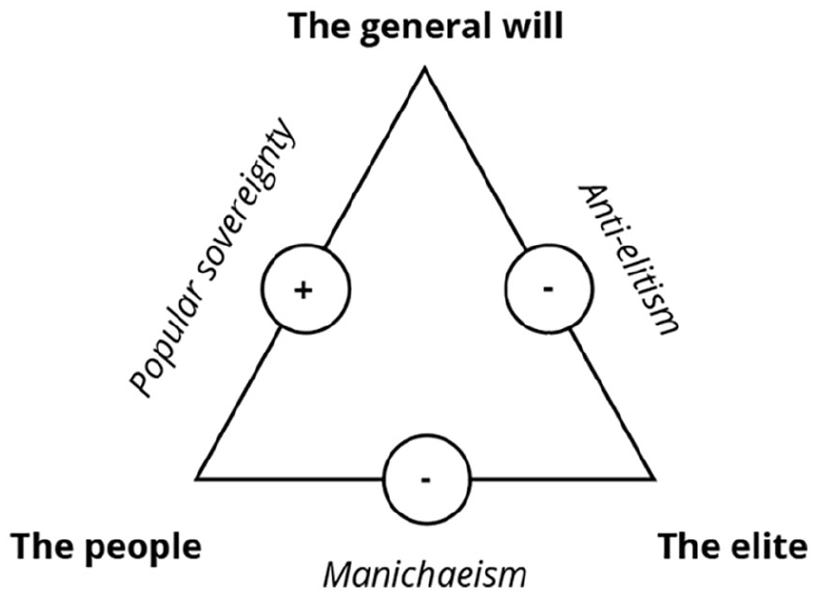
A Model of the Populist Thin-Centred Ideology.
The relationship between the people and the elite is one of moral superiority (Mudde and Rovira Kaltwasser, 2017), emphasising an opposition between the pure people and the evil elite (Hawkins, 2009; Mudde, 2004) or between the ‘low’ and the ‘high’ (Ostiguy, 2017). This opposition accompanies a perceived lack of respect and recognition from the out-group: the elite (Hirvonen and Pennanen, 2019: 36). Populist ideology thrives on this ‘us versus them’ dynamic (Aslanidis, 2020), which refers to the Manichean dimension (Erisen et al., 2021). Furthermore, individual wills are submerged into some ‘general will’ that defines the people as a social entity (Laclau, 2015). The people are thus the ultimate point of reference for the political process, which is commonly referred to as ‘people-centrism’ (Wirth et al., 2016: 9). Populism channels aspirations that someday that general will is executed (Canovan, 1999), which pertains to the dimension of popular sovereignty (Schulz et al., 2018). However, the elite obstruct the expression and execution of the general will. They do so intentionally (Betz, 1994), leading to feelings of resentment and moral anger (Ostiguy, 2017; Rico et al., 2017). These negative perceptions of the elite and their role in the political process refer to the dimension of anti-elitism (Erisen et al., 2021; Schulz et al., 2018). Together, these three dimensions form a coherent thin-centred ideology that provides a way of making sense of disillusionment with the public sphere and for expressing such disillusionment.
In order to know to what extent citizens adhere to the populist thin-centred ideology, populist attitudes have been introduced (Akkerman et al., 2014). Citizens who perceive the public sphere through these populist glasses have a higher level of populist attitudes. I refer to this group, in line with previous empirical research, as ‘populist citizens’ (Schulz et al., 2020). Citizens who rely less on the populist thin-centred ideology to make sense of the public sphere have a lower level of populist attitudes. I refer to them as ‘non-populist citizens’. 3
Empirically, it has been found that populist citizens perceive themselves as ‘true democrats’ (Mény and Surel, 2002). Populist citizens have a strong belief in the democratic ideal of ‘rule by the people’. However, current systems do not meet that ideal because they focus on representation and delegation, rather than unmediated rule. In other words, populist citizens are ‘dissatisfied democrats’ (Rovira Kaltwasser and Van Hauwaert, 2020).
How Democratic Innovations Could Affect Populist Attitudes
I have discussed the concepts of democratic innovations and populist attitudes separately. But how could democratic innovations affect populist attitudes? To connect these concepts, I rely on balance theory (Crandall et al., 2007; Heider, 1958) and cognitive dissonance theory (Festinger, 1962; Harmon-Jones and Mills, 2019).
Balance theory and cognitive dissonance theory are sociopsychological theories that explain attitude change as a search for cognitive balance (Festinger, 1962; Heider, 1958). As I mentioned earlier, the populist thin-centred ideology provides citizens with a, albeit limited, way of making sense of the present and future political world, with cognitive balance. However, input that is inconsistent with the populist set of ideas is likely to cause cognitive dissonance. New input entails information about the populist attitudes entities that causes an emotion, which in turn influences the processing of information about those entities (Crano and Prislin, 2008).
For instance, if the relationship between the elite and the people was originally perceived as very negative, positive input about that relationship could cause cognitive dissonance (see Figure 2). Since individuals tend to strive for cognitive balance, they would seek to either disregard that input or process that input and adapt their attitudes accordingly (Harmon-Jones and Mills, 2019).
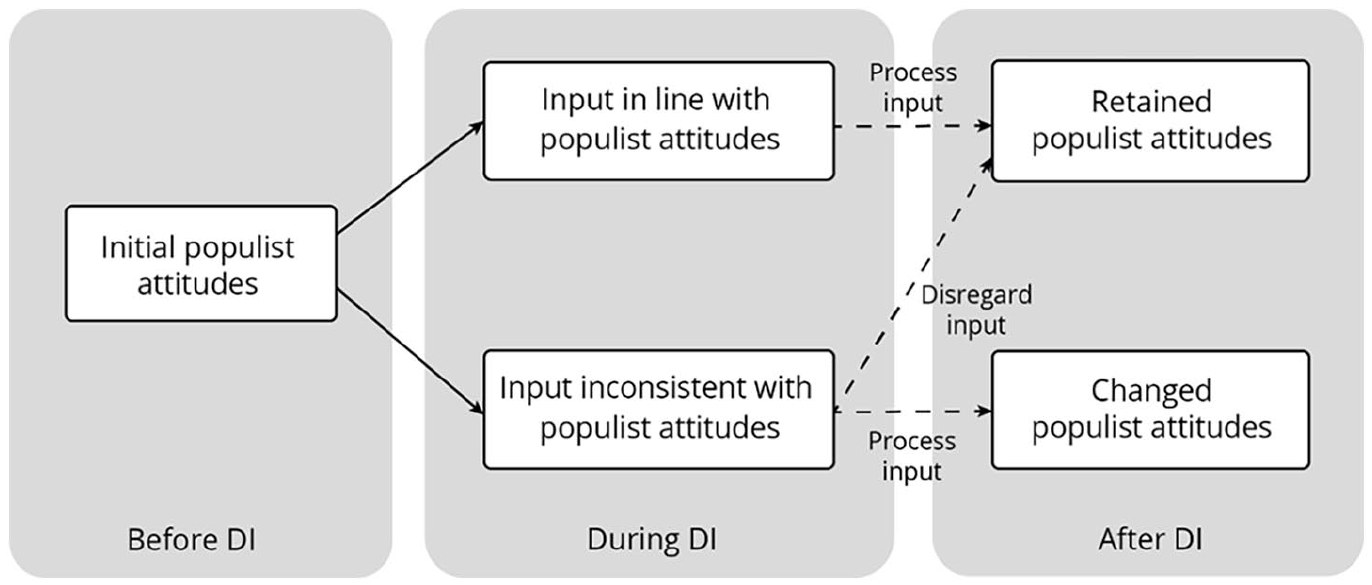
Model of Populist Attitudes Change.
Disregarding new input is likely to occur especially when attitudes are extreme and important to an individual (Howe and Krosnick, 2017) or when an individual is more politically aware (Taber and Lodge, 2006). As participants to democratic innovations tend to be more politically aware (Trüdinger and Bächtiger, 2022), they could be more likely to dismiss counter-attitudinal information (Howe and Krosnick, 2017; Taber and Lodge, 2006). Processing new input occurs more often when the new input is in large opposition to one’s previously-held attitudes (Crano and Prislin, 2008). PBs involve direct exposure to the populist attitudes objects, thus making it harder to disregard counter-attitudinal input (Olson and Kendrick, 2008; Zaller, 1992). In any case, the processing of input largely happens unconsciously and can thus not be observed in this study. However, the result of this process, change or retention of one’s attitudes, can be observed.
Importantly, since all the dimensions of the populist thin-centred ideology are related and depend on one another to reach cognitive balance, input that leads citizens to a change on one dimension would likely also affect other dimensions.
Nevertheless, for attitude change to take place, the democratic innovation event has to be in some way linked to the populist attitudes entities. Theoretically, the democratic innovation event could indeed serve as a ‘mini public sphere’ which could spill over into perceptions of the wider public sphere as the attitude entities of the populist attitudes scale (see Figure 1) are potentially reflected in this ‘mini public sphere’. The people could be represented by the other participants in the democratic innovation; the elite can be reflected in the organising authorities, and the formulation and expression of the general will can be reflected in the process and outcome of the democratic innovation.
Hence, for democratic innovations to affect the level of populist attitudes among participants, two conditions have to be fulfilled:
Citizens have to receive and process input that contradicts their previously-held views of the public sphere.
Input received during such innovations has to be connected to the attitude entities of populist attitudes.
In order to further construct a theoretical framework for the analysis, existing empirical research into how democratic innovations could affect citizens’ attitudes and how these findings link to populist attitudes will be discussed in the following paragraphs.
Why Would Populist Citizens Change Their Populist Attitudes During a PB?
As I described earlier, populist citizens perceive the public sphere in terms of a moral opposition between the people and the elite, while the elite prevent the general will of the people from being implemented. If these ideas were to change, there has to be input during the PB that concerns these ideas. PBs have indeed been theorised to affect participants’ perspectives (Lerner, 2008).
Swaner (2017) has found that the mere presence of elected local authorities at the democratic innovation was perceived as a cue that authorities were open to citizen input. During the discussions, citizens enter into direct contact with local authorities which increases a sense of accessibility. Muradova (2020) has found that when citizens are given the opportunity to share their personal stories as well as give fact-based arguments, perspective-taking is stimulated. Participants come to feel more respected and heard by the authorities, which decreases feelings of misrecognition. Conversely, if the authorities do not provide cues to citizens that they are interested in their opinions, this confirms and enhances populist citizens’ perceptions of disinterest from the part of the elite.
Citizens who go through a decision-making process empathise more with authorities and thereby increase mutual respect (Swaner, 2017). On the contrary, if populist citizens experience that they as a group of citizens engaged in an effortless and straightforward decision-making process, they come to think even less of the elite’s capability to execute the general will and become even more convinced that the people should make policy decisions.
Felicetti et al. (2020) found that participants in a democratic innovation came to learn about other participants’ different views. This resulted in them having a more diverse conception of the general will and the people, as different citizens were perceived to have different interests due to their backgrounds. Talpin (2011) found that informal interactions between diverse citizens resulted in learning about different preferences. Perceiving different wills and engaging in compromises or bargains could potentially clash with the idea that the people are united in one general will and thereby decrease a longing for popular sovereignty. On the contrary, when populist citizens perceive a high degree of similarity between the citizens during the PB, they are strengthened in their view of one popular will that should be reflected in political decisions.
In addition, in her research on a PB event in New York City, Swaner (2017) has found that when participants perceive that they have a voice and can directly impact policies, they come to perceive the local policy process as more legitimate. Similarly, during the Australian Citizens’ Parliament, participants perceived that each citizen had an equal chance to participate, which increased the legitimacy of the deliberative process (Hartz-Karp et al., 2010). A higher level of perceived popular control thus indicates to citizens that the general will is implemented, and thereby leads to a decrease in a longing for more popular sovereignty. On the contrary, if populist citizens perceive that the PB process did not allow for the general will to be formulated and implemented, they would perceive the process as illegitimate and be reinforced in their cynicism and longing for popular sovereignty (Talpin, 2011).
Why Would Non-Populist Citizens Change Their Populist Attitudes During a PB?
When the PB process stimulates perspective-taking between citizens and authorities (Muradova, 2020), citizens come to feel closer to the authorities and this would lower their populist attitudes. However, if those authorities show no interest at all in the citizens or disregard their perspective during the PB process, this would lead non-populist citizens to increase their populist attitudes as these cues would go against their previously-held beliefs.
During a PB process, non-populist citizens could be surprised by citizens’ ability to make decisions and in that way become more convinced of popular sovereignty. Conversely, if it turns out that citizens cannot come to an agreement and are worse at decision-making than expected, non-populist citizens would decrease their populist attitudes.
Learning about differences in opinions probably has a smaller effect on non-populist citizens as they do not necessarily perceive the people as homogeneous (Felicetti et al., 2020). Nevertheless, in case citizens are perceived as being in full agreement, this would go against non-populist citizens’ expectations of the citizens being diverse and lead to an increase in populist attitudes.
Finally, when non-populist citizens perceive that the authorities go out of their way to give citizens a voice through the PB process, they would become even more positive towards the authorities and decrease their populist attitudes (Swaner, 2017). However, if the authorities behave in opposition to their expectations by preventing citizens from formulating and executing their will, this would backfire and non-populist citizens would become more populist.
To summarise, for populist citizens, the presence of and positive contact with local authorities, citizens holding diverse opinions and the PB process being inclusive and providing citizens with voice and a direct impact would go against their previously-held populist beliefs and thus decrease their populist attitudes. On the contrary, a perceived disrespect towards citizens by authorities, citizens having very similar opinions and a lack of voice and direct impact during the PB would confirm and enhance populist citizens’ previously-held beliefs, leading to an increase in their populist attitudes. For non-populist citizens, a positive exchange with local authorities, citizens being internally diverse and the PB process providing citizens with a voice would reaffirm and strengthen their previously-held beliefs and thereby lead to a decrease in populist attitudes. However, negative contact with local authorities, citizens having homogeneous opinions and being good at making political decisions and a perceived lack of voice would go against the beliefs of non-populist citizens and lead them to increase their populist attitudes.
Methods
In order to assess the theorised model of populist attitudes change, this article uses survey and interview data from three PBs in the Netherlands. In the first subsection, the case selection for this article is discussed. Then, the measurement and analysis of populist attitudes in the surveys is explained. In the third subsection, the coding and analysis of the interviews is described. Finally, in the last subsection, the collection and usage of observational data is discussed.
Case Selection
This article relies on survey and interview data from three PBs in the Netherlands. Two PB events took place in Amsterdam-East (in Amsterdam Old-East and Amsterdam IJburg) and one in Maastricht.
The country of the Netherlands has been chosen as it has populist parties at both the left and the right, which means that the populist thin-centred ideology is present in the public sphere across the political spectrum (Akkerman et al., 2017). As a result, the populist set of ideas can conceivably be found among citizens with different ideological orientations (Hameleers et al., 2021; Neuner and Wratil, 2022). This means that there is a lower risk of the findings being driven by ideological orientation rather than populist attitudes. 4 In addition, just like in most old democracies, with the exception of Switzerland, direct citizen participation is not highly institutionalised in the Netherlands (Michels, 2006). The context of the Netherlands is therefore representative of other old democracies with an ideological variation of populist parties and a low degree of institutionalisation of direct citizen participation.
The cities of Amsterdam and Maastricht have been selected as they differ in their context but not in their process. Amsterdam is a large city subdivided in districts, whereas Maastricht is a middle-sized city. The outcome of the PB, therefore, concerns only the district in the case of Amsterdam-East, while in Maastricht decisions are made for the entire city. Participants in Amsterdam-East enter into contact with district authorities, whereas participants in Maastricht gain access to city representatives. The differences between these two cases allow for construction of the causal mechanisms across diverse contexts.
On the contrary, the cases of Amsterdam Old-East, Amsterdam IJburg and Maastricht are similar in their process. 5 All cases apply a model of PB that can be described in Sintomer et al. (2008) terms as ‘Porto Alegre adapted for Europe’. Central to this model is that citizens have de-facto decision-making power about the allocation of part of the local budget. The discussions take place in groups and concern the allocation of the local budget. This model of PB has been adopted in many other cities in Europe which enhances the external validity of this study.
In particular, these cases apply a form of PB that has first been employed in the Belgian city of Antwerp since 2014 (Renson, 2020). This is a type of PB which takes place in several rounds. In the first round, participants choose five themes which they consider important in small groups. In the second round, within their groups, participants divide money among the chosen five themes by allocating poker chips to each theme. The themes participants could choose from were similar across cases. In the case of Amsterdam, both neighbourhoods could each spend €200,000, while in Maastricht there was a budget of €300,000. Then, all citizens can submit projects that fall within the chosen themes. Subsequently, civil servants check the feasibility of these projects. Finally, in the third round, all citizens in the town or neighbourhood can cast a vote on the projects they prefer (Sobol, 2021). A more detailed case comparison and description can be found in Supplemental Appendices E and F.
In the case of Amsterdam-East, all citizens could vote online, whereas in Maastricht the vote took place at an afternoon gathering. In Amsterdam IJburg, the second round was moved online due to the developing COVID-19 pandemic. These small differences in procedure could potentially make the cases less comparable as concerns of inclusiveness could be raised by participants in the Maastricht case. However, participants from all cases raised the issue of inclusiveness as both online and offline participation have limitations in this regard. It is, therefore, conceivable that the cases are comparable in terms of their process. For an overview of the specific timeline for each case, see Supplemental Appendix A.
Importantly, all inhabitants can participate in the PBs. Based on previous research, it is likely that the ‘usual suspects’, that is, citizens who are older, more educated, more politically interested and knowledgeable and previously politically active will be overrepresented (Jacobs et al., 2018; Smets and van Ham, 2013; Trüdinger and Bächtiger, 2022). Indeed, when looking at the sociodemographic background of the participants, the sample turns out to be a good reflection of citizens who would usually participate in PBs as they were older, more educated and more politically interested than the general population (see Supplemental Appendix J). Hence, the population that I research in this article and consequently will be able to generalise to consists of citizens who would participate in PBs, not of all citizens.
Moreover, it is likely that populist citizens will attend the PBs as they are highly supportive of direct and deliberative forms of citizen participation (Jacobs et al., 2018; Mohrenberg et al., 2021; Trüdinger and Bächtiger, 2022; Zaslove et al., 2020). However, populist attitudes do not predict actual participation in direct democratic procedures and as such populist citizens will likely not be over- or underrepresented (Jacobs et al., 2018; Trüdinger and Bächtiger, 2022). When looking at the sample, we can see that the populist citizens who participated are a good reflection of populist citizens in the population in terms of terms of age, education and trust in the local council (see Supplemental Appendix J).
PB events have been chosen as the studied democratic innovation because they are often high in their level of popular control (Baiocchi and Ganuza, 2014; Sintomer et al., 2008: 167; Smith, 2009: 39–55). As the populist thin-centred ideology protests a lack of popular control as the general will is not adopted by evil elites, PBs seem most suited to cause a change in this thin-centred ideology among participants. In addition, as I argued earlier, during PBs, unlike during more direct democratic innovations such as referendums, citizens conceivably enter into contact with the populist attitude objects. A direct interaction with one’s attitude objects has a greater effect on those attitudes than indirect contact (Mazziotta et al., 2015). Therefore, by choosing to study PBs, this article applies a most-likely case design.
Survey Data
In order to know how well the populist thin-centred ideology resonates among citizens, scholars have captured it as an attitude in surveys. The existing populist attitudes scales all rely on Mudde’s (2004) conception of populism as a thin-centred ideology (Castanho Silva et al., 2020). They measure to what extent citizens perceive the public sphere through populist glasses. The higher one scores on such an attitude scale, the higher one’s populist attitudes and the more one perceives the public sphere through populist glasses. The existing scales all have limitations in terms of how well they are able to capture populism.
In this study, I have opted for the Akkerman et al. (2014) scale because it is unidimensional and performs well on important aspects. Unidimensionality is important because I have conceptualised populism as consisting of three interdependent dimensions that together provide cognitive balance. In addition, the Akkerman et al. scale has high internal coherence, meaning that it captures the concept of populism well. The conceptual breadth of the scale is one of the highest available, meaning that it is able to distinguish fairly well between higher and lower populist citizens (Castanho Silva et al., 2020). This is important for this article, as initial levels and levels of change in populist attitudes inform the interviewee selection and qualitative analysis. Since the conceptual breadth is good, I can be confident that the scale is able to capture change and retention of populist attitudes.
The Akkerman et al. (2014) scale consists of six items that each tap into at least two of the three dimensions of the populist thin-centred ideology (Castanho Silva et al., 2020):
The politicians in the Dutch parliament need to follow the will of the people.
The people, and not politicians, should make our most important policy decisions.
The political differences between the elite and the people are larger than the differences among the people.
I would rather be represented by a citizen than by a specialised politician.
Elected officials talk too much and take too little action.
What people call ‘compromise’ in politics is really just selling out on one’s principles.
These items were measured on a Likert-type scale ranging from 1 ‘completely disagree’ to 5 ‘completely agree’. Populist attitudes were calculated by taking the average of the six items. In case of missing values, the average of the completed items was taken. 6
Surveys were conducted among participants immediately before the first round, immediately after the second and (in the case of Maastricht) immediately before and after the third round of the PB (see Supplemental Appendix A). As such, changes in populist attitudes can be assessed. The survey data served to inform participant selection for the interviews.
Interview Data
Interviewees were selected based on holding high (>3.5) or low (⩽3.5) populist attitudes 7 and their extent of attitude change, 8 in order to have a diverse and representative pool of participants (see Table 1 and Supplemental Appendix B). Representativeness in terms of sociodemographic factors was of secondary importance as I am primarily interested in attitude change. Sociodemographic factors could, however, affect the experience of the PB and the process that leads to attitude change. 9 In the discussion, I will reflect further upon this. However, this article’s primary aim is not to generalise but rather to build a theory to account for attitude change in the population of interest, namely, citizens who would participate in a democratic innovation.
Descriptive Statistics for All Participants and Interviewees.
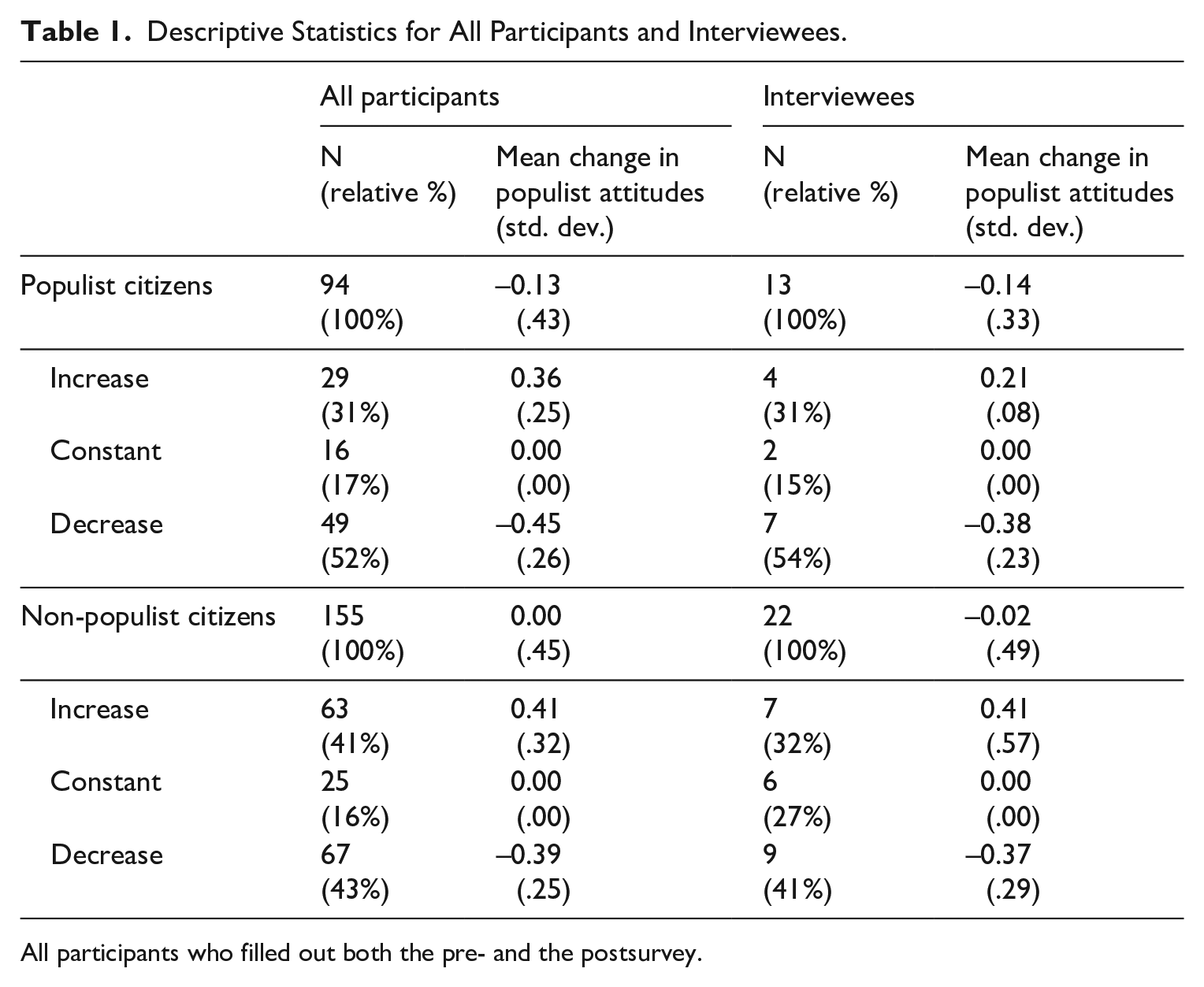
All participants who filled out both the pre- and the postsurvey.
This article operationalises constant populist attitudes as a zero change in a citizen’s level of populist attitudes over time. Even though measurement error is limited by choosing for a populist attitudes scale with a good conceptual breadth (Castanho Silva et al., 2020), it might still affect the observed populist attitudes. This means that some citizens might be categorised as changing their populist attitudes while they actually do not (Bland and Altman, 1996). Bartle (2000) has demonstrated that more ‘politically aware’ citizens have greater opinion constraint and more stable opinions over time. Citizens who are more politically knowledgeable and interested can more easily access their political attitudes. As participants to self-selected direct decision-making processes are generally more politically aware (Trüdinger and Bächtiger, 2022), the influence of measurement error is, therefore, conceivably limited. However, in order to further limit the possibility of measurement error influencing this article’s findings, I have reconducted the interview analysis where only changes of .33 or larger are qualified as ‘change’, rather than anything other than zero. The findings remained largely the same (see Supplemental Appendix G).
Thirty-five semi-structured interviews were conducted after the first, second and third rounds of the PBs. A set of questions was prepared in advance (see Supplemental Appendix C), but throughout the interview additional questions could be posed. The prepared questions covered the interviewee’s expectations for the PB, their experience of the process, the participants, the role of the authorities and the interviewee’s perceptions of the outcome. The interviews lasted on average 31 minutes.
The interview data were qualitatively coded for perceptions of and experiences at the PB. The initial theorising confined the scope of the codes to perceptions of the relationship between participants, the organising authorities and the process. This scope was maintained throughout the consecutive coding process (Braun and Clarke, 2006; Maguire and Delahunt, 2017). Since the aim of this article is theory-generation, a semi-open coding strategy was applied which means that apart from the pre-identified stipulations, codes are developed and amended throughout the coding process (Maguire and Delahunt, 2017). This article thus combines a deductive and inductive approach to coding, thereby leaning towards an abductive research strategy (Timmermans and Tavory, 2012).
Coding was done by one researcher who at the time of coding was unaware of the populist attitudes of the concerning interviewee in order to limit the possibility of bias. Another researcher checked the codebook for any concerns with regard to the internal consistency as well as mutual exclusivity of the codes. In case an unclarity or disagreement arose, the codebook and definitions of the codes were amended through mutual discussion until both researchers were satisfied with the codes. 10
After several rounds of coding, the codes were analysed thematically in order to construct a causal mechanism that can account for changes in populist attitudes across the cases (Attride-Stirling, 2001). An initial number of 109 codes that all pertained to perceptions of the PB event were brought under 24 organising themes (see Supplemental Appendix D). These themes covered the underlying codes and served to build the causal mechanism. In order to do so, interviewees were divided into two groups: populist citizens and non-populist citizens. Within these groups, some interviewees increased, retained or decreased their populist attitudes. For each group, the organising themes, codes and quotations were analysed and summarised into global themes. These themes were constructed first of all based on how many interviewees mentioned this theme. Second, the number of utterances during the interview about this theme and the amount of speech devoted to this theme were also taken into account (see Supplemental Appendix F). Global themes are the most abstract building blocks of the causal mechanisms that can explain changes in populist attitudes and therefore further substantiate this article’s theory. The global themes will be discussed in the analysis section.
Observations
At each PB event at least two researchers were present to observe the process. The proceedings were described and extra attention was devoted to possible deviations from the Antwerp model of PB and incidents that could affect participants’ experiences of the process. These observational data will serve as a context to interpret the interview data. 11
Results
In this section, the causal mechanisms that emerge from the thematic analysis will be presented for populist and non-populist citizens. First, the global themes for those citizens who retained their populist attitudes will be presented in order to serve as a benchmark. Then, the themes of citizens who increased their populist attitudes will be followed by the themes of citizens who decreased their populist attitudes. In doing so, the experiences and perceptions that lead citizens to change their populist attitudes due to participation in a PB will surface. The global themes are presented in order of how often they are mentioned; thus, the most salient themes are discussed first. The quotes that illustrate the findings have been translated from Dutch and have therefore been adapted grammatically in order to enhance reading comprehension. The respondents were anonymised in order to protect their identity, but demographic information at the group level can be found in Supplemental Appendix B. All themes and codes for each group can be consulted in Supplemental Appendix F.
How and Why Populist Citizens Change Their Populist Attitudes During a PB
A summary of the mechanisms leading to a change in or retention of populist attitudes among populist citizens is depicted in Figure 3.
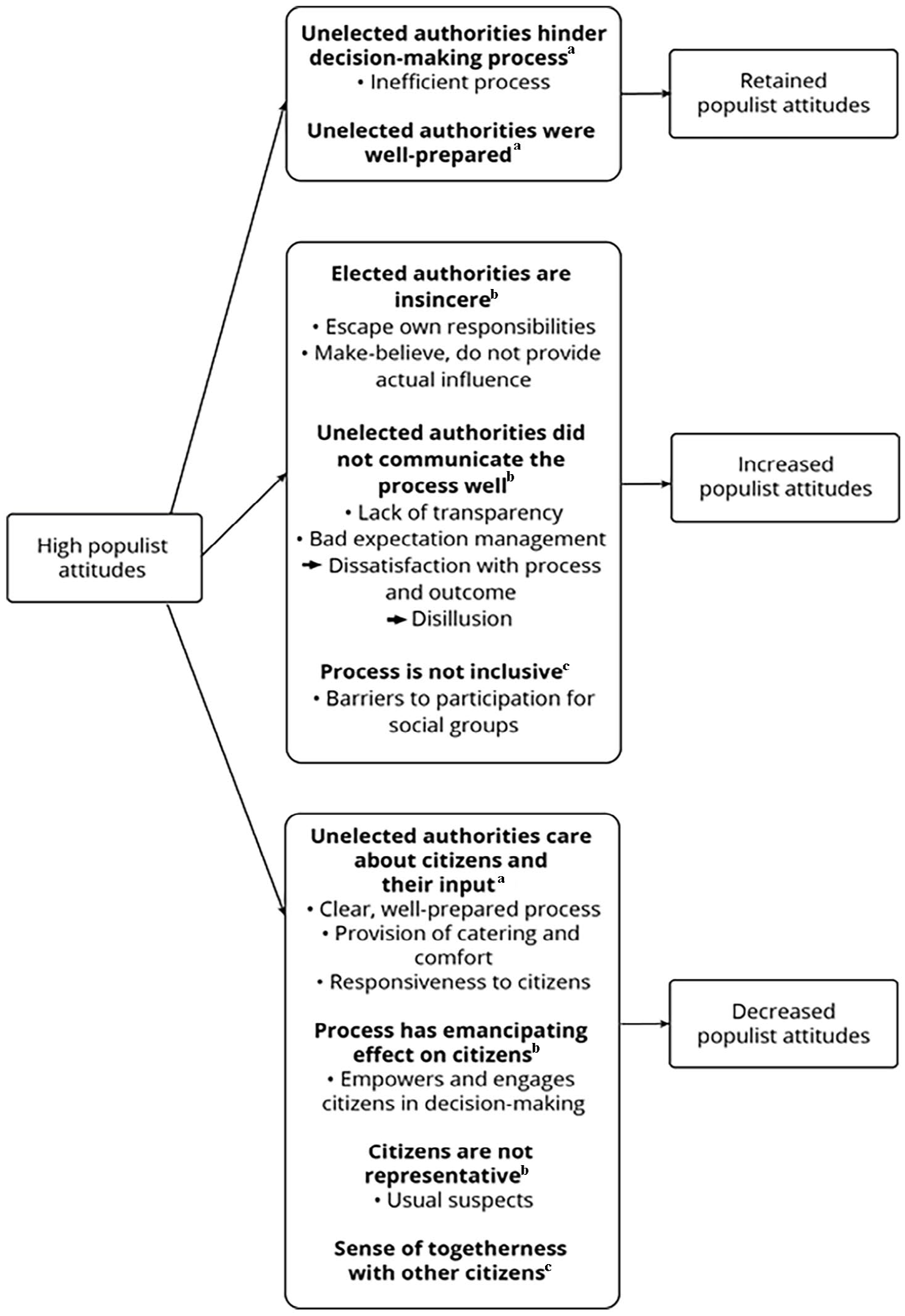
Causal Mechanisms for Effect of PB on Populist Citizens’ Populist Attitudes.
Populist citizens who retained their populist attitudes often mention the mixed role of the unelected authorities in the process. On the one hand, the unelected authorities hindered the efficiency of the PB process because the process took too long. On the other hand, unelected authorities did prepare and guide the process well. Overall, this mixed experience seems to be in line with the previously-held beliefs of populist citizens and thus does not lead to attitude change.
The role of the authorities in the process is also very important for populist citizens who increased their populist attitudes, even though this group majorly had negative experiences, in line with theoretical expectations. Populist citizens who increased their populist attitudes perceived that the elected authorities were insincere in their intentions with the PB. First of all, they thought the elected authorities used the process as a way to deflect their own responsibilities because the policy domains of the PB overlapped with the authorities’ responsibilities. Moreover, this group felt that the PB process functioned as a make-believe, since citizens did not actually gain direct influence on policy-making. A lack of direct impact was indeed theorised to be one of the key drivers of increases in populist attitudes. Hence, populist citizens who increased their populist attitudes thus received input that confirmed and even strengthened their previously-held beliefs about the authorities’ insincere intentions with regard to including citizens in decision-making:
That money was for the citizen, and now they decide from above again, you see? So we were actually very angry about that, that was from the citizens, but then again we actually had no say (rnr. 171).
In addition, the unelected authorities failed to communicate the process to citizens, resulting in feelings of disillusion. Due to a lack of transparency and clarity about how the process would evolve, several citizens felt dissatisfied with the process and the outcome. Upon arrival, citizens expected to gain policy influence, improve their neighbourhood and gain funding for their projects. However, the authorities failed to meet these expectations as these citizens felt that they had very limited influence on the PB process and outcome. This resulted in a feeling of disillusion and frustration with the actions of the authorities during the process, thereby reconfirming feelings of misrecognition of the people by the authorities.
A few citizens in this group also felt that the process was not inclusive enough, that not all citizens had an equal opportunity to participate. They noted that several marginalised social groups experienced barriers to participate. This could strengthen this group’s previously-held belief that the real people are not included and that the popular will is thus not implemented:
. . . this participatory budget is only going to be interesting for clubs of people who have projects or are able to think about them and are able to bring people together and then go create a project. That’s the thrust of this form of citizen participation. Yes, in that sense it bothers me that it concerns only the happy few (rnr. 123).
12
Hence, the experiences that were associated with an increase in populist attitudes among populist citizens seem largely related to negative contact with the authorities and a lack of direct impact on policy decisions. In addition, some of the participants perceived the PB process as lacking inclusiveness. Unlike theorised, there was no sign of the homogeneity of citizens’ opinions being related to an increase in populist attitudes.
Contrarily, populist citizens who decreased their populist attitudes generally had a positive perception of the process and the role of the authorities in it. They experienced that the unelected authorities actually cared about citizens’ input. Citizens could give that input during a process that was clear and carefully prepared by the unelected authorities. The catering and comfort was considered to be a sign of appreciation from the authorities. The unelected authorities were perceived as responding quickly and positively to citizens’ input. Populist citizens who decreased their populist attitudes thus noticed that authorities cared about the process and took citizens seriously, which conceivably went against their populist beliefs:
. . . when things actually went wrong with the rest of the votes, then they actually also said, okay, this is indeed not correct, what we are doing, we are going to do it differently as promised. So that was good (rnr. 236).
Moreover, this group considered the process to have an emancipating effect on citizens. The process managed to empower and engage citizens in decision-making, which they considered highly valuable. Nevertheless, the participating citizens were not entirely representative of the wider population, as the ‘usual suspects’ who always participate were overrepresented. Interestingly, however, this perceived lack of representativeness did not seem to affect the legitimacy of the process as much as a lack of inclusiveness, as was the case for populist citizens who increased their populist attitudes. The perception that participants were not representative was perhaps in line with populist citizens’ previously-held beliefs. Alternatively, it could be that populist citizens actually enjoy a lower level of representativeness, as this could lead the participants to be more homogeneous and similar to themselves. Indeed, populist citizens often mentioned that they enjoyed a feeling of togetherness with their fellow participants: ‘And we did get closer together with some people who all want to do projects as well’ (rnr. 127). They perceived a sense of like-mindedness with other citizens, potentially resulting in the legitimisation of the PB process and outcome.
Hence, these observations suggest that populist citizens who decreased their populist attitudes did so because of the positive contact with the authorities and the perceived impact they had on the policy process. Interestingly, an additional perception appeared that had not been theorised. Populist citizens did not seem to mind a lack of representativeness of the participants. This could be because populist citizens actually prefer a more homogeneous group of participants in which they recognise themselves. They enjoyed a sense of togetherness and like-mindedness, which, contrary to the expectations, is associated with a decrease in populist attitudes. So, even though the citizens were not representative, the will of ‘the people like me’ had been in a sense formulated and executed through the PB process.
How and Why Non-Populist Citizens Change Their Populist Attitudes During a PB
An overview of the mechanisms leading to a change or retention of populist attitudes for non-populist citizens can be found in Figure 4.
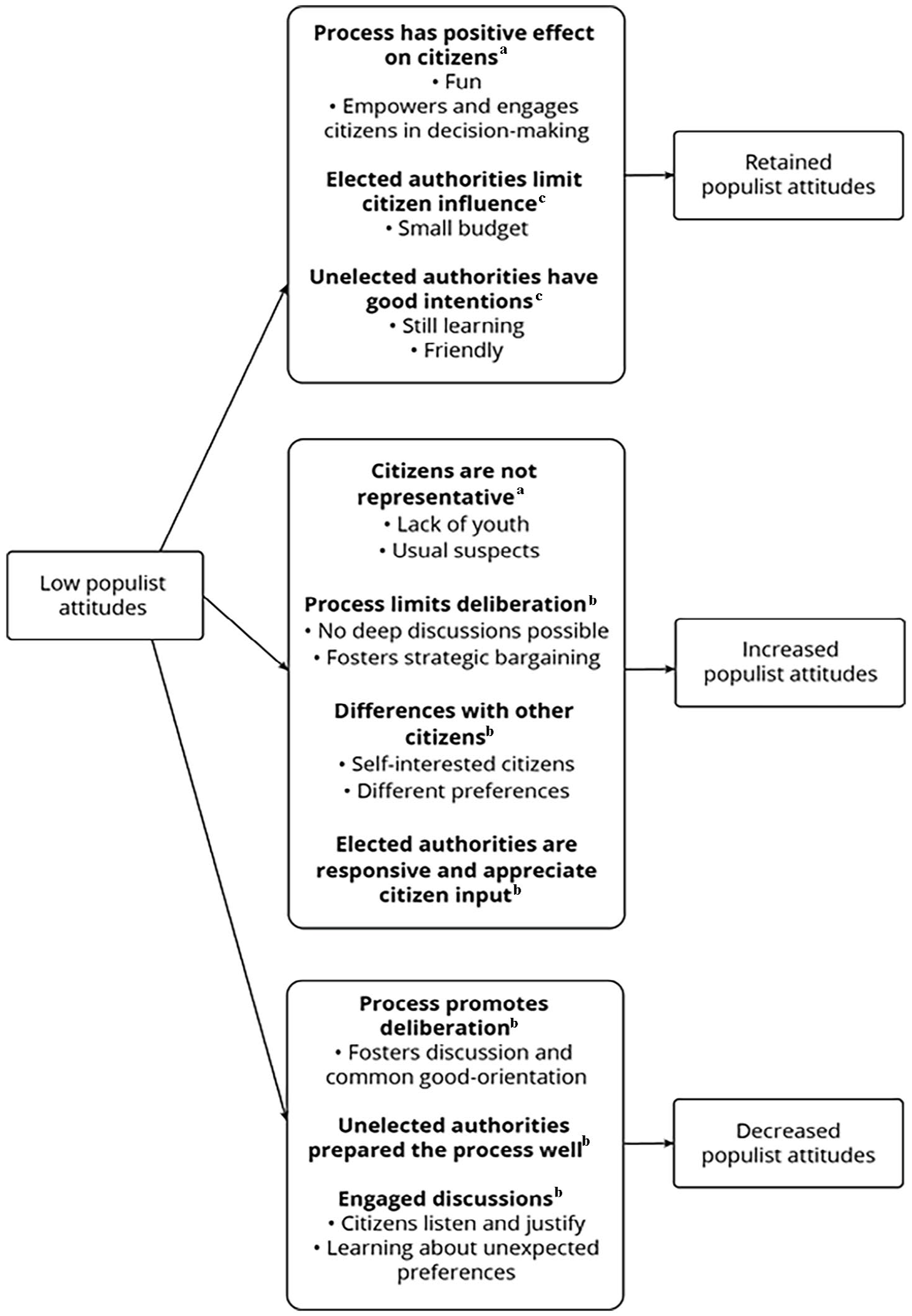
Causal Mechanisms for Effect of PB on Non-Populist Citizens’ Populist Attitudes.
As can be seen, non-populist citizens who retained their populist attitudes overall felt that the PB process affected citizens positively. They enjoyed their experience and felt that the process managed to engage citizens in the decision-making process. Nevertheless, this group perceived citizens’ impact on local policies as limited because the budget provided by the elected authorities was rather small. The unelected authorities were perceived as trying their best. They were still learning and acted friendly towards the citizens. These experiences were conceivably in line with the expectations and previously-held beliefs of non-populist citizens, as they did not affect the populist attitudes of this group.
Non-populist citizens who increased their populist attitudes had a more negative experience of the PB process and its effect on citizens. To begin with, the participating citizens were perceived as non-representative of the general population. Older people and the ‘usual suspects’ were overrepresented. Contrary to populist citizens, non-populist citizens were thus concerned with of a lack of representativeness as this could make citizens less able to find a common interest:
I did notice that at our table of four people there were two people who were already active, are becoming active or have been active in politics, and then I think, yes, no, it’s good that they are interested in this and want to commit themselves to it, but on the other hand, you would like this kind of initiative to really come from the bottom-up and from the neighbourhoods, and yes, to be driven by people who have a certain distance from the political business but who do know very well what they would actually like, what would be good for their own neighbourhood (rnr. 24).
Also, non-populist citizens who increased their populist attitudes experienced that the other participants were focused on their own interest, and had diverging preferences: ‘. . . those 300 people who all have their own pet subject, who are not objective actually because they themselves are thinking about their own projects’ (rnr. 2). This goes against the expectation that perceiving a more diverse group of citizens would actually lead to a decrease in populist attitudes. Perhaps, the diversity of citizens was in line with non-populist citizens’ expectations.
Moreover, non-populist participants felt that the process limited possibilities for deliberation. The set-up of the process was such that it stimulated citizens to engage in bargaining and a superficial focus on their own preferences, rather than engaging in deeper discussions: ‘The consensus that has now been reached is really more of a calculation exercise than coming up with good ideas by talking to each other’ (rnr. 24). This lack of deeper discussions seems to represent a sense of lack of voice that the non-populist citizens who increased their populist attitudes experienced. Finally, non-populist citizens did mention often that the authorities were responsive. Yet, also this observation seemed to be in line with their previously-held beliefs about the authorities as it was not related to populist attitudes change in the expected direction.
Hence, non-populist citizens who increased their populist attitudes expected the authorities to be responsive to citizens’ input and the citizens to differ in their opinions. Just like populist citizens who decreased their populist attitudes, they noticed the lack of representativeness of the participants. In addition, and in line with expectations, this group perceived that the PB process did not stimulate citizens to express their opinions, that there was a lack of voice.
Inversely, non-populist citizens who experienced a decrease in populist attitudes did feel like the process had a positive effect on the citizens. This group felt that the process stimulated deeper discussions among citizens which enabled them to focus on their common interests:
But I noticed very much that the way, say the form in which it was done, that everybody was forced to just have the conversation. And to talk about, yeah what do you think? And then why should I agree with you? And what is your view on this or that? (rnr. 7)
13
Non-populist citizens who decreased their populist attitudes furthermore thought that the unelected authorities prepared and guided the PB process well. Citizens could partake in engaged discussions where they listened to one another and justified their preferences. In doing so, this group felt that they could learn about and engage with other citizens’ unexpected preferences.
Hence, it seems that deeper discussions and finding common interests with other citizens are highly valued by non-populists, as they draw out the citizens’ voice. This might be because, in line with theoretical expectations, their idea of the common will has been implemented. In addition, also as expected, this group perceived the authorities as playing a stimulating role and as the citizens being diverse in their preferences.
Discussion and Conclusion
This article posed the question of how and why participation in a PB leads to a change in citizens’ populist attitudes. It has found that different experiences during a PB are related to populist attitudes change among populist and non-populist citizens. The contact with authorities plays a crucial role for populist citizens. When authorities are perceived to care about citizens and their input, this is associated with a decrease in populist attitudes. In addition, populist citizens are concerned with the extent to which the PB process and authorities allow for the formulation and expression of the popular will, whereas non-populist citizens long for deeper discussions and finding a ‘common will’. Populist citizens consider the inclusiveness in the PB of politically marginalised groups to be very important. Non-populist citizens are more focused on whether the participants in the PB are representative of the wider population. Interestingly, the representativeness of the participants does not seem of major concern to populist citizens, who actually enjoy feeling similar to other participants.
This article has generated a theory to study how participation in a PB affects citizens’ populist attitudes. This theory can serve as a building block for further research into how democratic innovations affect citizens’ attitudes. For instance, against the expectations, this study has found that a sense of similarity with other citizens is associated with a decrease in populist citizens’ populist attitudes. It would be worthwhile to explore this finding further, as it might indicate that participatory processes with similar people could lead to an alleviation of populist citizens’ feelings of cultural insecurity (Spruyt et al., 2016).
In order to increase the applicability of this theory, future studies could test the findings in different country settings with other types of PBs. In addition, since this study used the most-likely case of a PB, future studies could test the explanatory scope of this theory for other, less-likely cases of democratic innovations such as mini-publics, where citizens have no direct decision–making power, or referendums, where no face-to-face discussions with other citizens take place.
Moreover, the participants of democratic innovations are, as compared to non-participants, usually more politically interested, older, and more highly educated (Jacobs et al., 2018; Trüdinger and Bächtiger, 2022). That is why the findings of this article can only be generalised to those citizens that would usually partake in a democratic innovation, not to all citizens. Therefore, it would be beneficial to study how democratic innovations affect the populist attitudes of non-participants, since these form a rather large and significant group, especially in the case of deliberative processes such as PBs or mini-publics.
Similarly, the change in populist attitudes in this article was measured immediately after the PB. However, it could be that this change reverses, persists or intensifies based on policy adoption and subsequent interactions with authorities (Boulianne, 2019). Hence, it would be beneficial for future research to study more long-term processes of attitude change.
In addition, this article chose to focus on having a populist outlook or not as an important individual characteristic when exploring how citizens experience democratic innovations. The role of other individual characteristics such as political ideology, previous experience with participation and sociodemographic background in the experience of democratic innovations is an important avenue for future research.
Furthermore, even though great care was exercised to ensure that the design was similar across the studied PB cases, it could be that certain case-specific aspects partially drive the findings of this article. In addition, all towns included in the study had their first experience with PB. Therefore, additional studies testing the applicability of the mechanism to other cases would increase its generalisability.
Finally, interview data were used to build and further refine the theory. However, as indicated, the theorised mental mechanisms cannot be fully observed through post-intervention interviews. Therefore, the current study can serve as a building block for further research, using, for instance, more interpretative approaches or different data sources, into the mechanisms that lead to populist attitude change during participation in democratic innovations.
This article has shed light on citizens’ experiences of the democratic system and how populism can affect this experience. In addition, this article is the first qualitative account of populist citizens’ relationship with democracy. It provides insight into how populist citizens experience democracy and make sense of democratic interventions. If democratic innovations are to strengthen democracies, then it is important to continue studying how and why they affect democratically dissatisfied citizens.
Supplemental Material
sj-docx-1-psx-10.1177_00323217241273590 – Supplemental material for Power to the People? How Participatory Budgets Affect Citizens’ Populist Attitudes
Supplemental material, sj-docx-1-psx-10.1177_00323217241273590 for Power to the People? How Participatory Budgets Affect Citizens’ Populist Attitudes by Marie-Isabel Theuwis in Political Studies
Footnotes
Acknowledgements
I would like to thank Jean-Benoit Pilet, Sebastien Rojon, Camille Bedock and Arthur Borriello for their detailed and helpful feedback on this paper. I would also like to thank the discussants and participants to the NEXT GDC Symposium 2022, the panel ‘Revitalizing Democracy Through Citizen Participation: Taking Stock and Looking Ahead’ of the Politicologen Etmaal 2023 and the panel ‘Political Psychology: Representation and Democratic Innovation Challenges’ of the ECPR General Conference 2023 for their great comments on this paper. Finally, I would like to thank the two anonymous reviewers for their valuable feedback on this paper.
Declaration of Conflicting Interests
The author(s) declared no potential conflicts of interest with respect to the research, authorship, and/or publication of this article.
Funding
The author(s) disclosed receipt of the following financial support for the research, authorship, and/or publication of this article: This research is financed by the Dutch Research Council (NWO) in the framework of the NWO-VIDI project nr. 195.085.

Supplemental Material
Additional Supplementary Information may be found with the online version of this article.
Contents
Appendix A. Timeline of the PB Cases. Appendix B. Interviewees Descriptive Statistics and Demographic Data. Table A2. Descriptive Statistics for Interviewees. Appendix C. Interview Guide. Appendix D. Codebook. Appendix E. Case Comparison. Appendix F. Case Descriptions and Observations. Appendix G. Thematic Analysis per Group. Appendix H. Check: Different Operationalisation of Populist Attitudes Change. Appendix I. Descriptive Statistics of Participants per Case. Appendix J. Descriptive Statistics of Participants.
Notes
Author Biography
References
Supplementary Material
Please find the following supplemental material available below.
For Open Access articles published under a Creative Commons License, all supplemental material carries the same license as the article it is associated with.
For non-Open Access articles published, all supplemental material carries a non-exclusive license, and permission requests for re-use of supplemental material or any part of supplemental material shall be sent directly to the copyright owner as specified in the copyright notice associated with the article.
