



Abstract
A variety of research has found strong evidence that men are more likely to donate to political parties and candidates relative to women. Yet studies of other kinds of political participation have observed a shrinking gender gap. What explains this variation? One possible explanation comes from several studies that report women are more likely to donate to nonpolitical groups when told they have been entered into a monetary draw. Does simulating resource equality also reduce the political donations gender gap? To answer this question, we analyse original Canadian data from two surveys that asked participants how much they would give to a federal (survey 1)/provincial (survey 2) political party if they were given CDN$100. Contrary to our expectations, we find no gender gap at the federal level and a positive gap favouring women at the provincial level.
Introduction
Numerous studies have found strong evidence of a persistent yet shrinking gender gap when it comes to political interest and participation across democratic contexts. While some research has found that women are less interested in and informed about politics (Barabas et al., 2014; Dolan, 2011; Jerit and Barabas, 2017; Solt, 2008), recent studies find no such gap exists when it comes to political interest in female-oriented or locally focused political issues (Sánchez-Vítores, 2019; Tormos and Verge, 2022). In terms of participation, similar trends are emerging. In the United States, for instance, women are more likely than men to register and cast a vote in presidential and non-presidential elections (CAWP, 2023). Yet women in many countries remain less likely to contact politicians and engage in political protests and demonstrations (Carreras, 2018: 36; Childs, 2004) and are less likely than men to donate to political candidates (Gothreau and Sanbonmatsu, 2023) and political parties (Barber et al., 2016; Tolley et al., 2022).
Political parties and candidates are crucial to the health of democratic systems. Among other things, they organize government, formulate public policy, aggregate and articulate interests, and recruit leaders and other candidates to run for office. To be effective, parties and candidates rely on civil society actors to support and finance their activities, especially in contexts where the state provides little to no public subsidies. In those instances, party officials face strong incentives to adopt recruitment strategies, manifestos, and priorities that cater to their donors’ wishes and concerns (Cross et al., 2022; Fisher, 1999; Flanagan, 2014). Reflecting these trends, a variety of research has found that ‘donations influence both the descriptive and substantive facets of representation that are a central preoccupation in the women and politics literature’ (Tolley et al., 2022: 245). In general, men are more likely to donate more often and in larger amounts to political parties and candidates relative to women (Barber et al., 2016; Tolley et al., 2022).
It follows that a gender gap in political donations may reinforce unequal representation if politicians and parties must rely on and therefore must become highly responsive to their donors (Gothreau and Sanbonmatsu, 2023), especially when party finance rules limit party and candidate income to individual donations (Cross et al., 2022; Flanagan, 2014; McMahon et al., 2023). Although the gender gap in donations has not shrunk or disappeared as it seems to have in voting in the United States (CAWP, 2023), other literature has found that women are more altruistic than men in giving to non-political groups such as charities (Bilén et al., 2021). One study, for instance, has found that woman survey respondents were more likely to donate to non-political recipients when they are told that they are entered into a draw to win $100 and are invited to donate none, some, or all their winnings to those groups (Brañas-Garza et al., 2018). What might explain these differing results?
We explore this puzzle by analysing data from two surveys fielded in 2022 that asked: ‘if you won $100 in a draw’, to which federal (survey 1)/Ontario provincial (survey 2) political party would you donate and how much? One barrier to the full participation of women in politics is differential access to financial resources. Our study allows us to investigate whether artificially increasing the money available to potential donors has any effect on the propensity of men and women to donate to parties. We might expect the additional money to reduce the gendered resource gap, given the literature on the importance of financial and other resources for political participation (Verba et al., 1995). Alternatively, the modest sum (CDN$100) and the large and robust literature on political donations suggests that the gender gap should persist despite this gift (Barber et al., 2016; Gothreau and Sanbonmatsu, 2023; McMahon et al., 2023; Tolley et al., 2022). Our study builds on previous research, which has tended to rely on administrative records of actual donations (Barber et al., 2016; Gothreau and Sanbonmatsu, 2023; Pruysers, 2023) and on survey questions that ask respondents to indicate if they have donated to a political party in the last 12 months (McMahon et al., 2023; Thomas, 2013), by investigating whether ‘gifting’ survey respondents with a modest sum of CDN$100 reduces the political donations gender gap.
Political Participation, Donations, and the Gender Gap
When it comes to political donations, most studies have found evidence of a persistent and significant gender gap (Barber et al., 2016; Gothreau and Sanbonmatsu, 2023; McMahon et al., 2023; Tolley et al., 2022). On a theoretical level, we might expect women to be more likely to donate to political parties relative to men given that they are more likely to engage in fundraising for social groups. Studies using dictator game experiments and on renal and charitable giving have found that women are far more generous than men (Brañas-Garza et al., 2018; Carpenter et al., 2008; Dreber et al., 2014; Godara and Jeswani, 2019; Mesch et al., 2011; Piper and Schnepf, 2008) when it comes to altruistic giving. Yet, these motivations are often mediated by cultural norms that suggest traditional politics is the domain of men (Coffé and Bolzendahl, 2010: 330–331; McMahon and Alcantara, 2019) and by significant gender differences in basic values towards political participation (Blais, 2000: 95, 97–98; Carreras, 2021; Cross and Prusyers 2019; Gidengil, 1995). Also important are significant gender differences with respect to familial responsibilities and resource endowments (e.g. time and money) (Beauvais, 2020; Córdova and Rangel, 2017: 266). In most countries, women tend to have more responsibilities and fewer resources, which in turn can limit their ability to participate in politics. One study, for instance, found that men were more likely than women to donate larger sums (+CDN$500) and more money overall to political parties and candidates (Tolley et al., 2022; see also Barber et al., 2016; Gothreau and Sanbonmatsu, 2023; McMahon et al., 2023). As such, we expect:
H1: Men are more likely than women to donate to political parties.
H2: Men will donate larger amounts to political parties than women.
Data and Methods
To test our assumptions, we draw on data from two Canadian studies. The first was an omnibus national survey administered by the Network for Economic and Social Trends (NEST) between 26 July 2022 and 3 August 2022. The second was an Ontario provincial survey funded by the Laurier Institute for the Study of Public Opinion and Policy (LISPOP) that ran from 22 March 2022 until 24 March 2022. In the case of the latter survey, we commissioned Dynata to provide an online sample of approximately 1800 individuals representative of the Ontario voting age population. For the former, Leger was tasked with securing a sample of approximately 2600 Canadian citizens and permanent residents, aged 18 or older. In both surveys, participants were presented with a hypothetical situation where they were asked to which political party, and how much, would they donate if they won CDN$100. For the national survey, the question listed ‘federal political party’ while the Ontario survey referred to ‘Ontario provincial political party’. In both surveys the participant could select a party from a closed list with the option of selecting ‘other’ and writing in a party other than those listed. Respondents were then asked to enter in the amount of money they would like to donate to the selected political party.
From the two donation questions, we create two dependent variables. The first is a dichotomous measure used to test for gendered differences in the likelihood of donating to a political party (H1). For the national survey, participants were asked to write a value between CDN$0 and CDN$100. For the Ontario survey, the range was CDN$1 to CDN$100. We operationalize ‘donate’ as respondents who indicated a donation of more than CDN$1. The second dependent variable (H2) is the raw dollar amount of the donation amount indicated by the respondent (‘donateamt’).
Our primary predictor variable of interest is gender. We operationalize this measure by creating a variable that takes the value of ‘1’ for men and ‘0’ for women. 1 In all models we include controls for age (18–99), education (no schooling to professional/ doctorate), income (above CDN$60 K = 1), and partisanship (strong or very strong party attachment). We also include a dichotomous measure of whether the individual was part of the federal or provincial survey. With the exclusion of individuals with missing values on any of the variables listed above, we are left with a final sample of 1707 respondents (868 women) from the Ontario survey and 1713 respondents (886 women) from the national survey.
Results
As a preliminary assessment of the relationship between gender and political donations, Figures 1(a), 1(b), 2(a), and 2(b) present a gendered summary of donations by political party and the average amount donated at the provincial and federal level. Except for the provincial/federal Liberal party, the patterns of gendered support at the federal and provincial levels are similar (see Figure 1(a) and (b)). For instance, observe the patterns for the Ontario Progressive Conservative Party (PC) and the Conservative Party of Canada (CPC). In the case of the Liberal party, the results show women to be more apt than men to support the provincial party, while men show a greater likelihood than women to support the federal Liberal party. We see a somewhat similar gendered difference in support of the New Democratic Party and the Green Party at both levels; if men are more likely than women to make political donations, it would seem that the relationship varies by party, something which is consistent with previous research (Tolley et al., 2022) and perhaps by level, something, that to our knowledge, has yet to be investigated by political donations and federalism scholars.
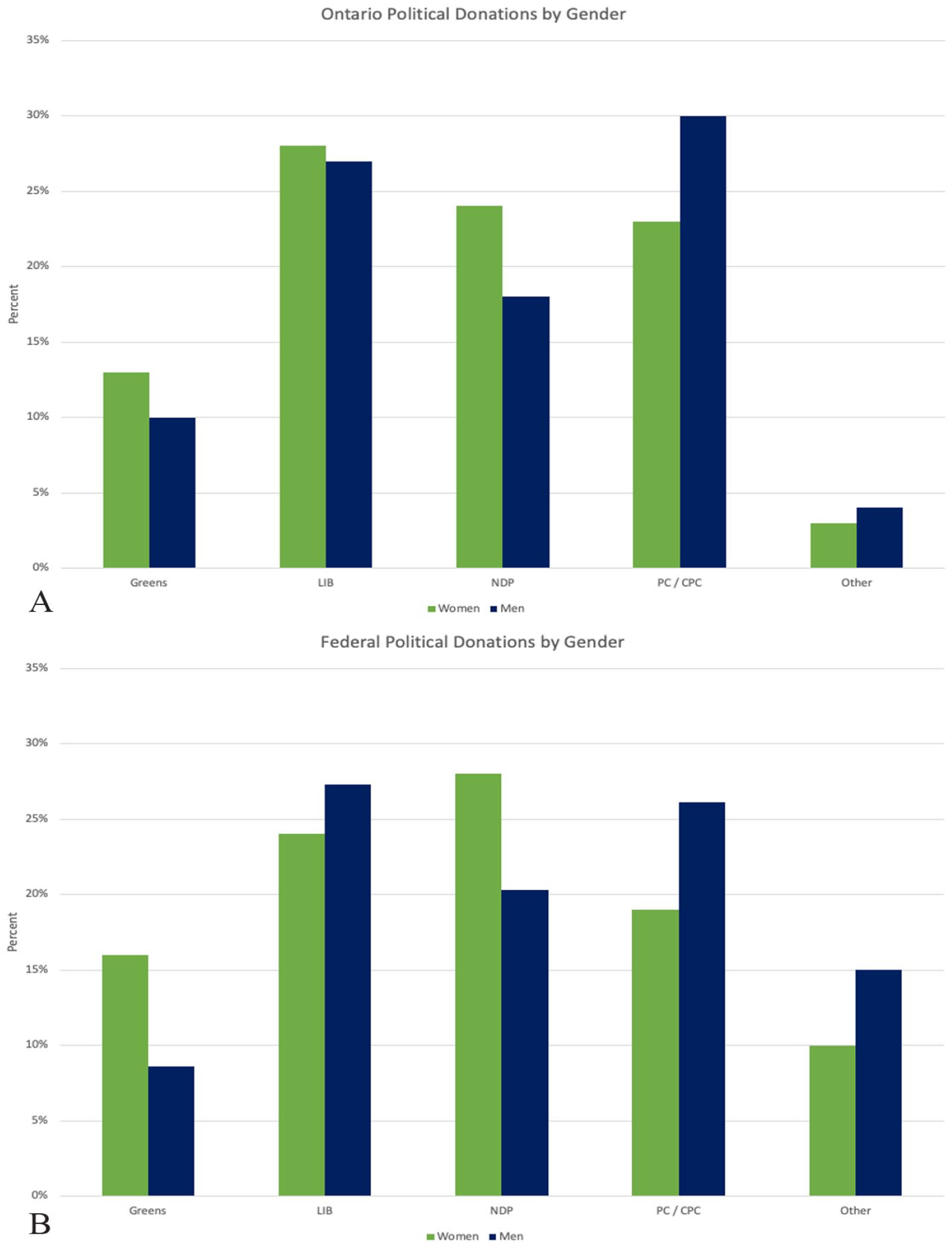
Ontario and Federal Political Donations by Gender (%).
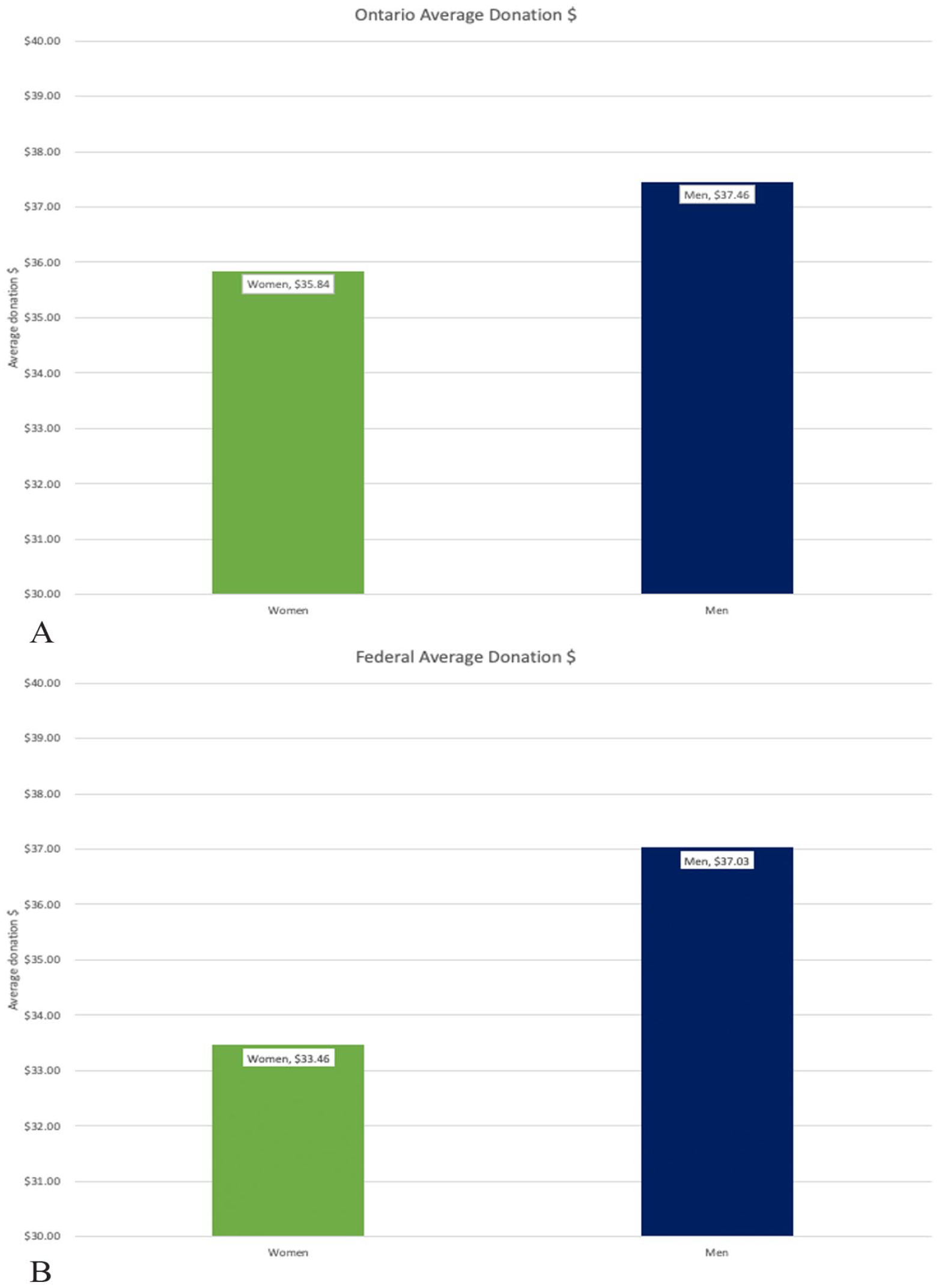
Ontario and Federal Average Political Donations by Gender ($).
When it comes to gendered difference in the amount of money donated, in line with our second hypothesis, we find that men tend to donate larger amounts of money to political parties relative to women (see Figure 2(a) and (b)). At the provincial level, men donated an average of CDN$37.46 compared to the CDN$35.84 donated by women (p = 0.35). An even larger (and statistically significant) gap is observed at the federal level, with men donating, on average, CDN$3.57 more than women (p < 0.05). It is noteworthy that men donated nearly identical amounts across levels (CDN$37.46 and CDN$37.03 at the provincial and federal level, respectively), but women donated CDN$2.38 more to provincial parties relative to their federal counterparts (p = 0.14).
To fully test our expectations, we regress each of our dependent variables on gender, controlling for age, education, income, and partisanship to yield a more precise estimate of gendered differences. In all models we test for gender effects conditional upon level of government. We report the full results from each model in the appendices with graphical representation of gendered effects by level of government within the body of the text. Estimates of statistical differences by gender and level of government are computed using Stata 17’s suite of margins commands. We present the results for each of our expectations in turn.
In terms of our first hypothesis, that men are more likely than women to donate to a political party, our results run contrary to expectations; on average, the likelihood of a man donating to a political party was 4.1 percentage points less than that of a woman (p < 0.01; see Appendix 1). Notably, the gendered difference we find at the aggregate level varies according to whether we are estimating differences across provincial or federal political parties (see Figure 3). Our results indicate that it is the provincial-level differences that are driving this relationship; the likelihood of a man donating to a provincial political party was nearly seven percentage points lower than that of a woman (p < 0.01). At the federal level, while the general pattern holds, the gendered difference in the likelihood of donating to a political party is negligible (see Figure 3). 2 It is also noteworthy that men are significantly (p < 0.01) more likely to donate to a federal party (85.2%) than a provincial party (77.7%).
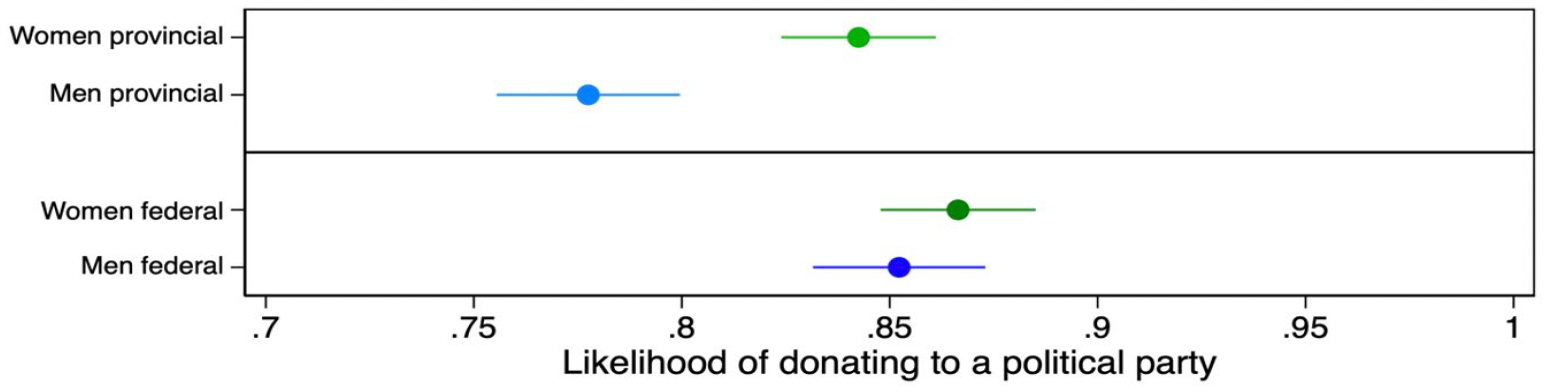
Likelihood of Donating to a Political Party by Gender and Level of Government.
Our second hypothesis is that men will donate greater sums of money to political parties compared to women. On average, respondents donated CDN$35.91 (SD = 34.81) to the political party of their choice. Contrary to expectations and the summary results reported above, there appears to be little difference in the amount of money donated by men and women at the federal or provincial level. The only notable variation is the amount donated by women across levels; women donated approximately CDN$4 more to provincial political parties than their federal counterparts (p < 0.05; see Figure 4).
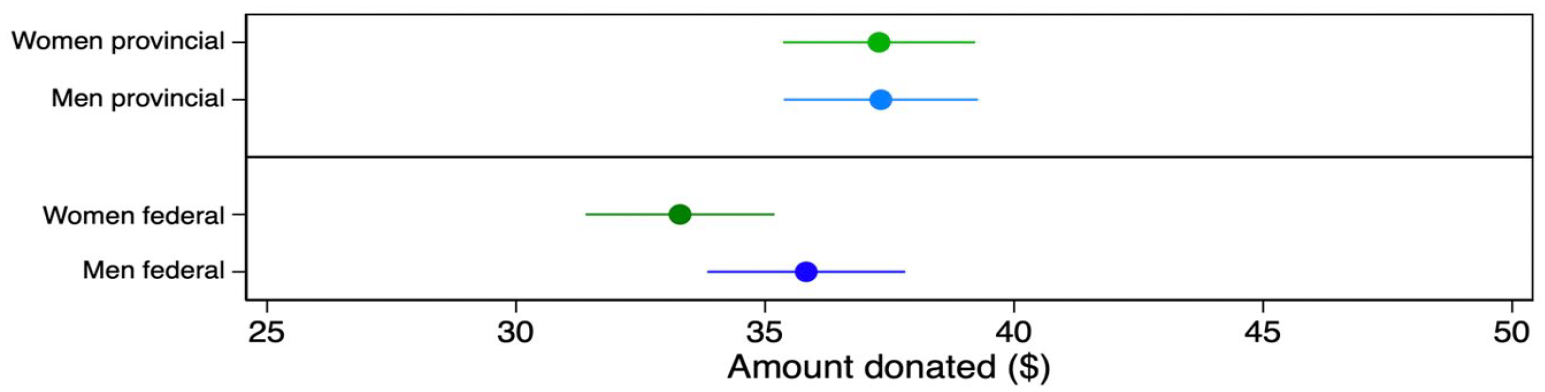
Amount of Political Donation by Gender and Level of Government.
Conclusion
Overall, we found no support for our hypotheses. Our results suggest women were more likely than men to give to political parties at the provincial level, which is different from what most studies have found. We think this unexpected finding may reflect our research design that removed gendered resource constraints that are believed to limit political engagement (Córdova and Rangel, 2017: 266; Tolley et al., 2022; Verba et al., 1995). At the same time, we acknowledge that the generalizability of our findings is restricted by the hypothetical nature of our donation measure, where respondents are not actually given CDN$100. Would the results presented here carry over to real-world behaviour? While there is evidence from the psychology literature that finds donation similarities between conditions where participants are given real money and those under hypothetical situations (see Doñate-Buendía et al., 2022, for example), we are not able to directly test our hypothetical scenario against real world behaviour in the present work. We hope that the results presented here will encourage further study to test our assumptions under multiple conditions.
Another possible explanation for our null results is that donation behaviour may vary across levels of government. Given that women’s political participation and interest tend to be more prominent at the local level (Dolan et al., 2016: 159–163; Paxton and Hughes, 2017: 107; Sánchez-Vítores, 2019), the women in our survey may have chosen to direct their participation towards the provincial parties because they are thought to be more local in their proximity and functions relative to the federal parties. We are unaware of any studies that have investigated this possibility and believe future research should investigate whether gendered political donation behaviour is more complicated under nested, multi-level party systems.
Finally, future research might build on our work by varying the amounts gifted to see if the effects we observed are affected by the sum offered. Respondents might also be given the choice of dividing their donation across multiple parties and levels. For now, we conclude with the hope that the findings we report here will encourage others to continue this research to better understand the conditions under which gendered differences in political donations are evident.
Footnotes
Appendix 1
Full Results for Figure 4: Amount of Political Donation by Gender and Level of Government.
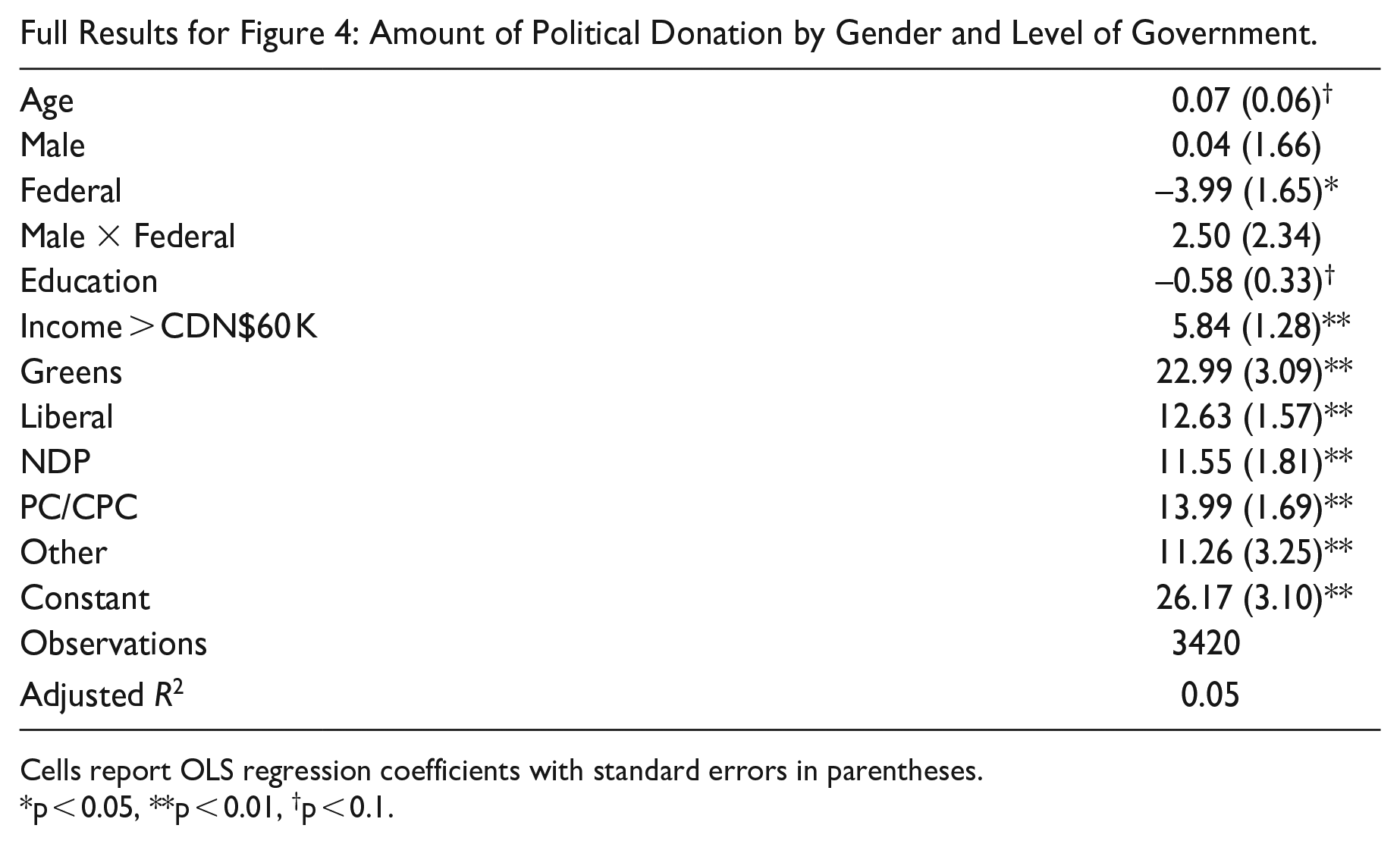
| Age | 0.07 (0.06) † |
| Male | 0.04 (1.66) |
| Federal | –3.99 (1.65)* |
| Male × Federal | 2.50 (2.34) |
| Education | –0.58 (0.33) † |
| Income > CDN$60 K | 5.84 (1.28)** |
| Greens | 22.99 (3.09)** |
| Liberal | 12.63 (1.57)** |
| NDP | 11.55 (1.81)** |
| PC/CPC | 13.99 (1.69)** |
| Other | 11.26 (3.25)** |
| Constant | 26.17 (3.10)** |
| Observations | 3420 |
| Adjusted R2 | 0.05 |
Cells report OLS regression coefficients with standard errors in parentheses.
p < 0.05, **p < 0.01, †p < 0.1.
Declaration of conflicting interests
The author(s) declared no potential conflicts of interest with respect to the research, authorship and/or publication of this article.
Funding
The author(s) received data and/or financial support from the Network for Social and Economic Trends (NEST) and the Laurier Institute for the Study of Public Opinion and Policy (LISPOP).
