




Abstract
A recent study by Aldrich, Ballard, Lerner, and Rohde (2017) examines whether a specific type of money—donations from leadership political action committees—is systematically related to party goals outside of policy influence. Their model is theoretically incomplete, as leadership political action committees donate considerable money to candidates who do not help the party win new seats or maintain ideological cohesion. I account for this behavior by introducing a new conditional predictor: incumbency. When modeled as a triple interaction with party status and ideological fit, incumbency helps better explain the donating behavior of leadership political action committees. This interaction is paired with a technical extension, more directly modeling the multiplicity of races in which leadership political action committees do not make a donation in a campaign cycle. I find that extending the study with a more appropriate model allows us to draw better inferences about the behavior of leadership political action committees.
Introduction
Political action committee (PAC) contributions have long been of interest to political science, as they provide an avenue for monetary contributions to influence policy or policymakers. The substance of this general linkage between donations and policy is increasingly important, as evidence suggests donors might be better represented than traditional geographic constituencies, including voters (Barber, 2016). Yet the strength of this specific link between PACs and candidate access is unclear, as PAC contributions routinely go to members of Congress who are ideologically similar to their donors (Barber et al., 2017), and PAC contributions dry up when a member falls out of importance in the policymaking process (Powell and Grimmer, 2016).
Leadership PACs (LPACs), though, are different. The monetary rewards are distributed by party leadership, a group who already has access to policy content and the policy process. Accordingly, LPACs might distribute money on the basis of other party goals, as opposed to strictly policy access. Aldrich, Ballard, Lerner, and Rohde (2017, hereafter referred to as “ABLR”) test competing motivations behind the distribution of leadership funds to candidates for the House of Representatives. They hypothesize that the majority and minority parties face different incentives whereby (a) the majority party directs more money towards members to help it maintain ideological cohesion (important for a variety of strategic and procedural goals), while (b) the minority party directs more money towards the closest races (important for taking back the majority).
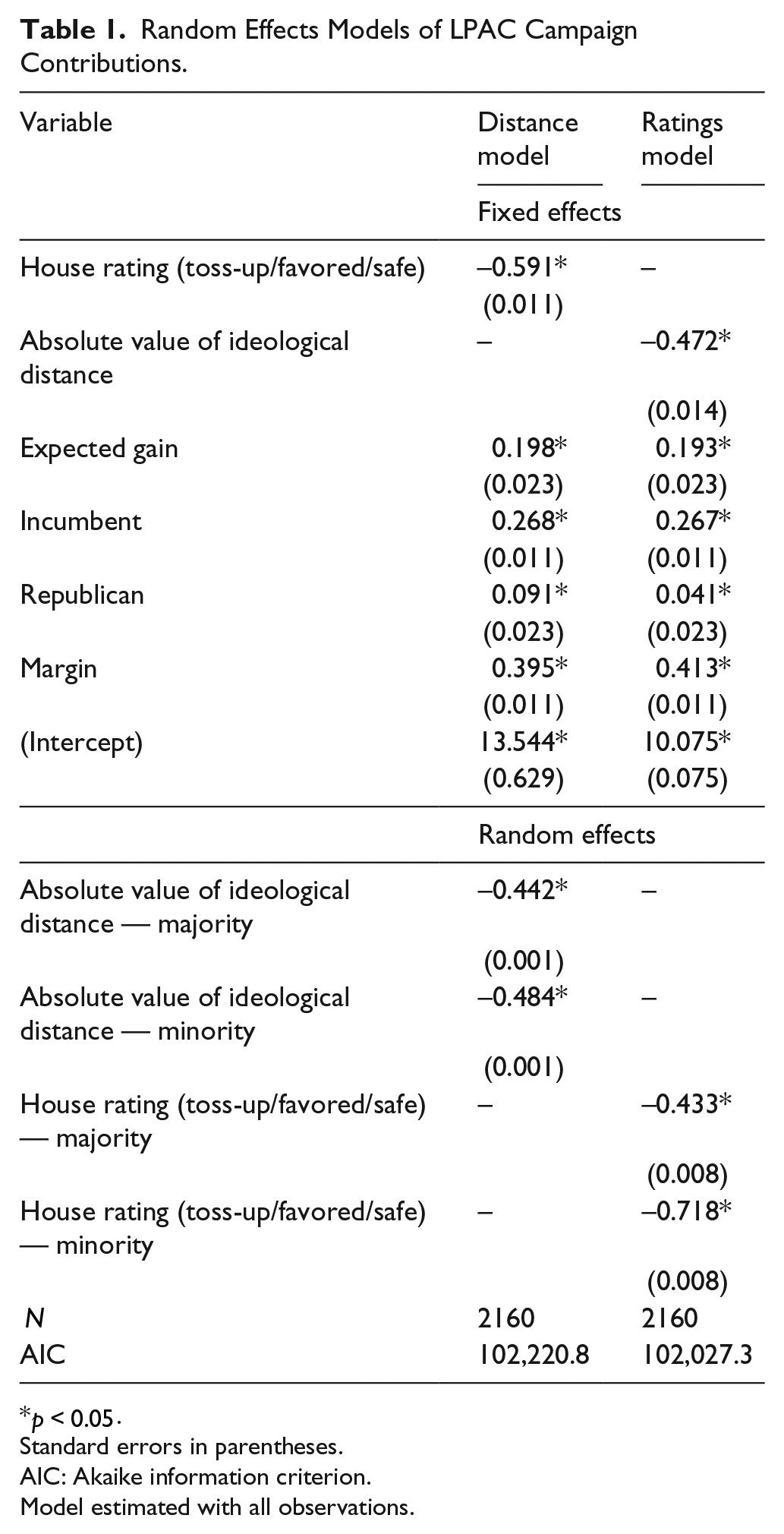
These expectations are tested with a pair of negative binomial models with random effects for ideological cohesion (measured by the absolute value of the ideological distance of the member from his or her party) and competitiveness (a three-tiered rating of the race as a toss-up, favored for one candidate, or safe for one candidate). These random effects are estimated based on party status. The models are strictly replicated in Table 1. ABLR find initial support for these straightforward hypotheses: majority LPACs give more (in the average) to ideologically similar members (compared to minority LPACs), and minority LPACs give more (in the average) to close races (compared to majority LPACs).
Random Effects Models of LPAC Campaign Contributions.
Standard errors in parentheses.
AIC: Akaike information criterion.
Model estimated with all observations.
The need for an extension
Despite this initial evidence, I argue the model should be extended for three principal reasons. The first argument is for a technical extension: the original modeling strategy is only able to test the hypotheses separately, rather than directly against each other. As ABLR (2017: 1451, footnote 6) note, “conditional standard errors cannot be computed if random effects depend on the same variable (majority status in this case);” thus we must estimate the two separate models in Table 1. This is important, as it imposes an artificial theory: parties can donate to competitive races holding ideological fit constant, or parties can donate to ideological fit holding competitiveness constant. In reality, competitiveness and fit are competing goals that require a strategic choice. This prevents us from learning which strategic goal—cohesion or competitiveness—is more important to each party (a key part of ABLR’s argument). This tension is important to capture, as it represents the fundamental balance of the majority party: how much to work towards cohesion versus maintaining majority status (Lebo et al., 2007). A simple resolution is a straightforward interactive framework, interacting the variables of interest (minority party status with ideological distance or closeness of the race) in a single unified model. This might offer additional leverage over random effects, given the small number of groups (two, the minority and majority party). As Gelman and Hill (2007: 275) suggest, “when the number of groups is small, it is difficult to estimate the between-group variation and, as a result, multilevel modeling often adds little in such situations beyond classical no-pooling models.”
The second argument is for a theoretical extension. ABLR’s theory predicts that the majority party should give few donations to candidates who are ideologically distant from the party. However, the majority party LPAC still donated to almost half (47%) of candidates who are above the mean ideological distance from the party, with a median contribution (when the LPAC donated) of almost US$25,000. The reason is incumbency: the majority party is willing to donate to extreme members if those members are incumbents, since losing their seats would threaten the party’s majority status. LPAC donations, then, should be conditional on ideological distance, party status (majority or minority), and a new conditional predictor, incumbency. Accordingly, I reconcile these two arguments by estimating a single model that includes a triple-interactive term between ideological distance, party status (majority versus minority), and incumbency.
The third argument is for a technical extension: the dependent variable is poorly fit by a negative binomial model. ABLR (2017: 1451, footnote 5) note that “our DV has many 0s,” but the predictions and theoretical behavior they interpret in the main text are derived from regular negative binomial models. ABLR recast the models in Table 1 as hurdle models in their Online Appendix, but their hurdle models do not include the theoretical interaction outlined above, and the hurdle models themselves are not interpreted beyond the coefficients. Thus we can gain additional insight by investigating the zeroes more fully. These US$0 contributions are especially important, as the histogram of LPAC contributions in the left panel of Figure 1 shows the overwhelmingly modal contribution is zero. 1 These data suggest many races receive no attention from party leadership whatsoever, thereby receiving no donations. This inattention is intuitive: some races are virtual locks, others feature candidates deeply unappealing to the leadership. It also implies a two-step model of decisionmaking: should leadership contribute anything?; then, conditional on a yes answer, how much should leadership contribute?

Histograms for Donations and Ideological Distance.
To account for this two-step theoretical process, I suggest a zero-inflated negative binomial model. This empirical strategy is analogous to party leadership first deciding races to which they would never donate (for instance if the candidate is ideologically unattractive, if the race is unwinnable, if the candidate is an inexperienced challenger). Then, party leadership decides how much money to donate to the remaining races. Some of these races might still not receive a donation—for instance if the party leadership might normally donate, but is short of funds in a particular election cycle. But most importantly, these races are empirically differentiated from those to which the leadership would never make a donation, helping us account for the modal US$0 in Figure 1. 2
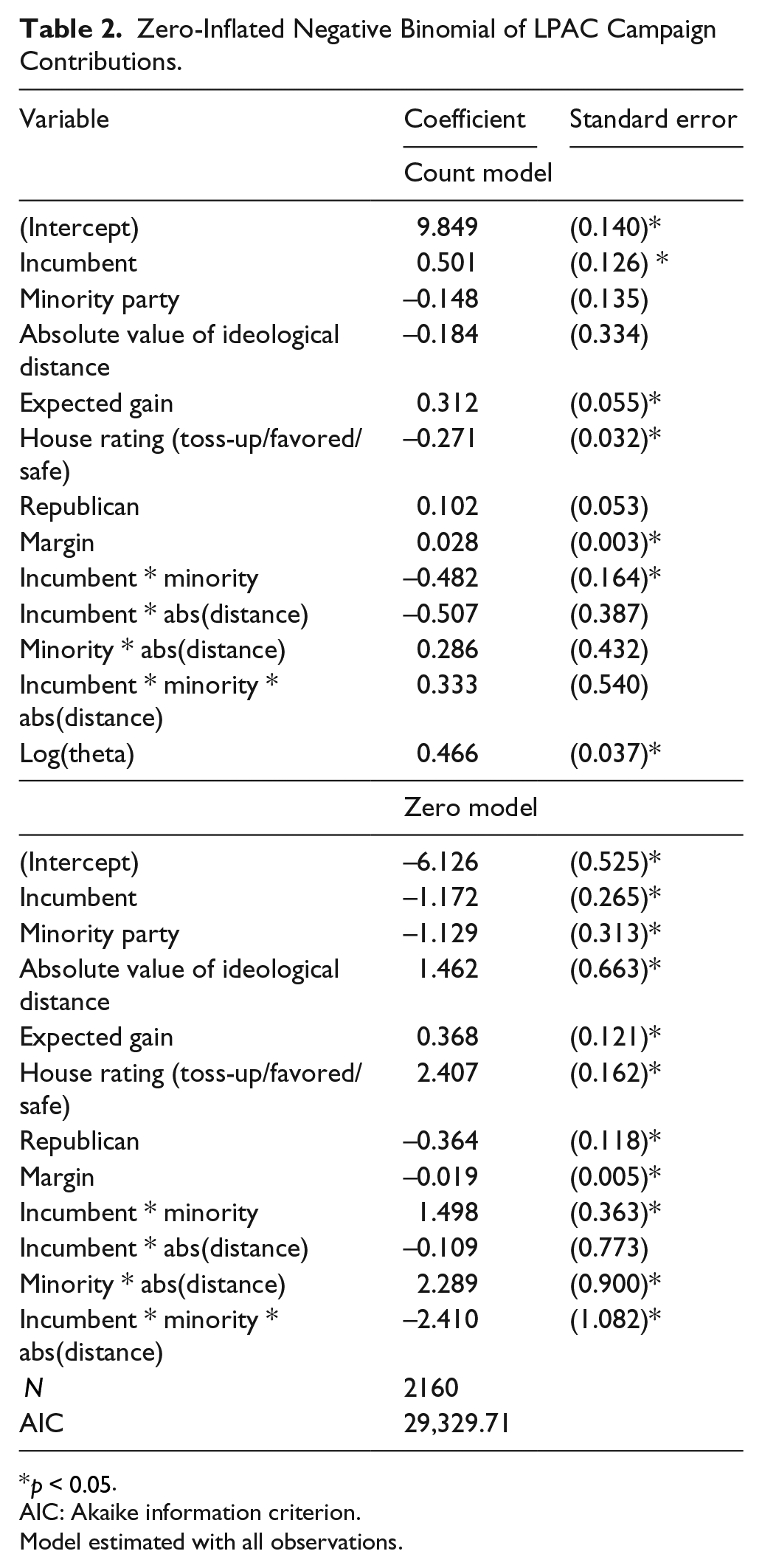
Accordingly, I estimate a zero-inflated negative binomial with the theoretical interaction in both the zero-inflation equation and the count equation: whether a candidate ever receives a donation, as well as how much s/he receives. 3 I include the same control predictors as the original authors: whether the party is expected to gain seats, a dummy indicator for Republicans, and the margin of the majority party in the House. The results are in Table 2.
Zero-Inflated Negative Binomial of LPAC Campaign Contributions.
AIC: Akaike information criterion.
Model estimated with all observations.
Results
The coefficients in Table 2 do not have an immediate interpretation beyond their sign and significance. Accordingly, I interpret the triple interaction in Figures 2 and 3. While triple interactions can be difficult to interpret, we can get some leverage here because two of the variables (party status and incumbency) are binary predictors. Accordingly, we can fully interpret the interaction by just looking at the effects of the single continuous predictor, ideological cohesion, across the four combinations of incumbency (challenger or incumbent) and party status (minority or majority). The x-axes of Figures 2 and 3 runs across a reasonable range of ideological cohesion, given Figure 1. The black lines represent incumbents; the gray lines represent challengers. The panel on the left depicts majority party behavior; the panel on the right minority party behavior. Finally, the solid lines represent safe seats; the dashed lines represent toss-up races. All other covariates are set at their modes (if they are binary) or medians. Error bars are 90 percentile intervals from 10,000 bootstrapped simulations (Carpenter and Bithell, 2000).

Probability of Never Receiving a Donation (“Always Zero”) Given Party Status, Incumbency, and Ideological Cohesion.

Expected Donation Amount Given Party Status, Incumbency, and Ideological Cohesion.
Figure 2 shows the probability of never receiving a donation (the inflation equation) on the y-axis (higher, meaning more likely to never receive a donation). Both panels help us understand why some races never receive any contributions (the modal US$0 case in Figure 1): they are unwinnable. Begin with the left panel for the majority party. Challengers in unwinnable races (safe for the other side (the solid gray line)), even if they are a perfect fit with the majority party (distance is zero), are 60% likely to never receive any donations from LPACs. We can contrast this directly with ABLR’s original inference. Since their theory for the majority party is comparatively more about ideological fit—not competitiveness (see Table 1)—they find across all races where the majority party candidate is a good ideological fit, s/he will receive US$5800 more than if s/he were a minority party candidate. Here, though, we see even if a majority party candidate is a perfect fit ideologically, if s/he is a challenger in an unwinnable race (safe for the other side), s/he is 60% likely to receive no donation at all.
The probability of receiving no donation increases to 90% for majority party challengers in unwinnable races who are poor fits with the majority. The dynamics are much more interesting for incumbents in safe races (the solid black line): only incumbents who are good fits with the party receive any attention (even though they are virtually guaranteed to win their races). Toss-up races are different: almost regardless of party fit, the majority party tries to win races. As long as they are in toss-up races, even the worst-fitting candidates for the majority party are only 12% likely to never receive a donation from an LPAC, suggesting that retaining majority status trumps ideological cohesion as a goal of the majority party. And completely regardless of ideological cohesion, the majority protects its incumbents in toss-up races (the dashed black line, incumbents in toss-up races, is flat and close to zero).
This new evidence is in direct contrast to ABLR. The original random effects models in Table 1 test ideological cohesion separately from competitiveness. When we include both predictors in the same model, we learn that competitiveness of the race matters more than cohesion, even for the majority party. Even for perfect ideological matches—where distance is 0.0—safe incumbents are 40% more likely to never receive a donation from the majority than incumbents in toss-up races, a percentage that jumps to 70% for perfect-fitting challengers in safe races versus toss-up races.
The dynamics are different for the minority (the right panel of Figure 2): even challengers in unwinnable races (safe for the other side (the solid gray line)) are more likely than not to receive attention (the probability of staying in the zero-contribution state is under 50%). But this is true only of challengers who fit the minority party ideology. The dynamics for toss-up races are similar to those for the majority. In contrast to ABLR, though, it is the minority party that stops supporting challengers (even in toss-up races) if those challengers are sufficiently far away from the party ideology. If the challenger is at least 1.0 units away from the minority party median ideology (putting the challenger well in the most extreme candidates, given Figure 1), s/he is anywhere from 20% (at 1.0) to over 50% (at 1.5) likely to never receive any donations, even if his or her race is a toss-up. This new model implies that the minority party places limits on its investment in growing the size of the party caucus. In other words, ideological fit plays a role in the dynamics of which races the minority party chooses to invest in, instead of assuming that the minority party has a fixed average investment in winning all races.
Figure 3 interprets the count portion of the model: assuming that an LPAC has decided to give money to a race (a race “exits” the zero-state), how much money can a candidate expect? The panels, line types, colors, and calculated error bars are consistent with Figure 2. In the panel on the left, the majority party, we can see that the expected contribution is highest for a well-fitting incumbent defending a seat in a toss-up race (the dashed black line). Such candidates are predicted to receive US$70,000 from LPACs. Challengers of similar fit in toss-up races (the dashed gray line) are predicted only to receive US$40,000, supporting the argument that the majority is focused on defending its majority status first. In these toss-up races, however, even the most extreme candidates (1.5 units away from the median party) are still predicted to receive donations of US$30,000. 4
Contrast these toss-up races with safe races. Majority party incumbents running for safe seats (the solid black line) only receive US$20,000 in LPAC donations if they are perfect fits with the party ideology. In other words, the worst-fitting majority party incumbent is predicted to receive more money in donations than the best-fitting majority party incumbent if s/he is in a race the majority party might lose (a toss-up). Again, in contrast to ABLR, the majority party looks to preserve majority party status first, then looks to preserve ideological cohesion.
The patterns for the minority party (the panel on the right of Figure 3) are similar, but nuanced. The minority gives virtually identical amounts to both challengers and incumbents who fit the party even reasonably well (an ideological distance of 1.0 or less)—around US$35,000—as long as the race is rated to be a toss-up (the two dashed lines). The minority seems much more interested in an equal distribution of money to all candidates who are running in competitive elections, ostensibly in an attempt to shore up the party’s share of the seats in the chamber. It also makes relatively equal (but much lower) investments in well-fitting incumbents and challengers in safe races—around US$10,000.
Comparison of predictions
I argue this modeling strategy is a useful technical and theoretical extension because the original model (in Table 1) relied on testing the effects of ideological cohesiveness in a separate model from competitiveness, rather than directly against one another in the same model. When we incorporate both into an interactive framework, along with an empirical model that theoretically separates US$0 contributions from positive contributions, the predictions fit the data better: Figure 3 predicts a median US$15,600 contribution from the minority party, very close to the actual median contribution of US$20,000 (excluding US$0 contributions). And the median majority party contribution, excluding US$0 contributions, is US$25,000, versus the predicted median of US$20,900, again well represented in the left panel of Figure 3.
The new predictive power of this extension is best illustrated by direct comparison with the original model from ABLR. I offer this comparison in Figure 4. 5 The left column contains the predicted donations for the minority party (top row) and majority party (bottom row) from ABLR’s model of distance (the first model in Table 1). The predicted donations are on the x-axis, with the actual donations on the y-axis. We can compare these predictions to the innovation provided from the zero-inflated model: the predicted probability of a race never receiving a donation, versus its actual donated amount, which is shown in the right column. I differentiate the data by the triple interaction: party status, ideological fit, and incumbency. To make the plot easier to interpret, observations in the first quartile of ideological proximity (closest to the party median) are “Most similar,” and observations in the last quartile of ideological proximity (furthest from the party median) are “Least similar.”
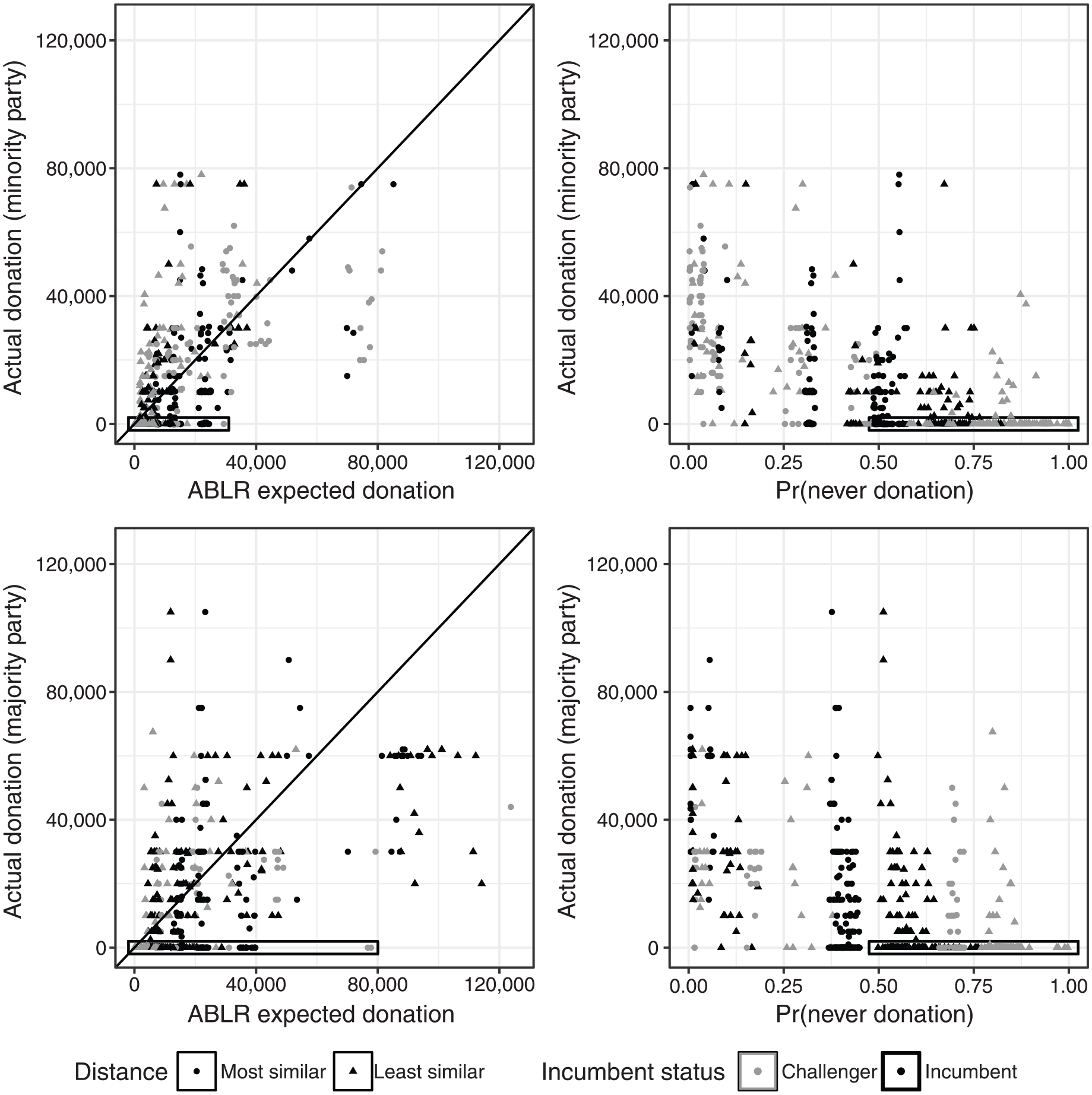
Model Comparisons: Random Effects Model (Using Distance) Versus Zero-Inflation. Most Similar is the First Quartile; Least Similar is the Last Quartile.
Of particular interest are the US$0 donations, which in each panel are shown in a black rectangle. In the top-left panel, donations to minority party members, 44% of minority party candidates received an actual donation of US$0. Yet ABLR predict 91% of these US$0 donations to receive at least US$2000 from minority party leadership. Similarly, in the bottom-left panel, 44% of majority party candidates actually receive US$0 donations. But ABLR’s model predicts 99% (483 out of 488) of those US$0 cases to receive donations of at least US$2000.
Compare this to the right column. Here, the black rectangle represents cases that are correctly predicted to receive US$0 donations, meaning that the model estimates their probability of remaining in the zero-state to be at least 0.50. For the minority party in the top right, 78% of the US$0 donations have a predicted probability of never receiving a donation of at least 0.50. For the majority party in the bottom right, 57% of the US$0 cases are similarly predicted to never receive a donation.
Conclusion
Party leadership behaves strategically when disbursing money to candidates for political office in the House of Representatives. ABLR offer a first cut at this analysis, arguing that minority and majority parties are motivated differently by strategic considerations, where the majority party is more motivated by ideological cohesion and the minority party more by electoral gains in close races. Our inferences can be extended, though, by conceptualizing this as a two-step process. All races are not created equally in their likelihood of receiving a donation. In fact, some are almost certain to be ignored, either because leadership dislikes a member (s/he doesn’t fit the party) or s/he is running in an unwinnable district. This two-step model—of deciding whether to donate at all, then how much to donate—is well captured by the zero-inflated model. Additionally, testing a single triple interaction allows us to interpret the effects of these predictors simultaneously, rather than relying on separate random effects models. Doing so allows our empirical conclusions regarding the interaction to be more nuanced. The triple interaction, in concert with the zero-inflated model, clarifies four refinements to ABLR:
Despite the potential importance of cohesion for party goals, the majority party is more focused on maintaining majority status than on maintaining cohesion. Figure 3 suggests that the principal goal of the majority party is to maintain majority party status by donating considerably more to competitive races, even towards members who are poor ideological fits.
The minority party is unwilling to invest in members who might win, but are poor fits with the party (Figure 2). In addition, minority party leadership spreads money even to candidates who are likely to lose elections, as long as these candidates fit the minority party ideology. These goals are indeed in tension with one another, rather than considered separately.
Both effects are conditional on incumbency. Incumbency explains why almost guaranteed winners (safe seats) still receive strategic investments from party leadership. Even though these contributions could be redirected to other races to help either party win more competitive seats, growing the size of the party caucus, both the majority and minority parties contribute something to incumbents as long as they fit the party ideology, even if their seat is safe (Figure 2). This conditionality is a novel insight over the unconditional effect of incumbency in Table 1.
We can explain what makes a race more likely to join the large group of zeroes in Figure 1. From Table 2, races with a higher margin of victory, the competitiveness of the race, and the patterns explained by the triple interaction in Figure 2 all increase a candidate’s likelihood of receiving no donation at all, instead of just affecting the amount of the donation they receive.
ABLR provide a novel insight that the goals of each party can be distinguished relative to one another (that the majority is more motivated by ideological cohesion and the minority more by electoral gains in close races). However, we better understand the extent to which these goals are in conflict, as well as conditional on the incumbency of the candidate, when we test the effects directly through an interaction, rather than in separate models.
Supplemental Material
compareerrorsappendix2 – Supplemental material for Leadership political action committee donations and party status: A technical and theoretical extension
Supplemental material, compareerrorsappendix2 for Leadership political action committee donations and party status: A technical and theoretical extension by Soren Jordan in Research & Politics
Supplemental Material
comparepredsappendix2 – Supplemental material for Leadership political action committee donations and party status: A technical and theoretical extension
Supplemental material, comparepredsappendix2 for Leadership political action committee donations and party status: A technical and theoretical extension by Soren Jordan in Research & Politics
Footnotes
Acknowledgements
Thank you to Andrew Ballard for help replicating the original analysis. Thanks also to Kim Quaile Hill and an anonymous reviewer for helpful comments.
Declaration of conflicting interests
The author(s) declares that there is no conflict of interest.
Funding
The author(s) received no financial support for the research, authorship, and/or publication of this article.
Supplemental materials
The supplementary files are available at http://journals.sagepub.com/doi/suppl/10.1177/2053168019889558. The replication files will be available at 
Notes
Carnegie Corporation of New York Grant
This publication was made possible (in part) by a grant from the Carnegie Corporation of New York. The statements made and views expressed are solely the responsibility of the author.
References
Supplementary Material
Please find the following supplemental material available below.
For Open Access articles published under a Creative Commons License, all supplemental material carries the same license as the article it is associated with.
For non-Open Access articles published, all supplemental material carries a non-exclusive license, and permission requests for re-use of supplemental material or any part of supplemental material shall be sent directly to the copyright owner as specified in the copyright notice associated with the article.
