



Abstract
Existing studies argue that anti-immigrant sentiment stems from threat perception. Yet, conventional theoretical approaches cannot fully explain hostility toward immigrants in the Middle East and North Africa, where low-skilled foreign workers occupy an inferior social and legal status vis-a-vis natives under the kafala system. Building on existing studies of immigration politics, we theorize how immigration policies can either facilitate or prevent the social mobility of foreign workers. Exploring immigration attitudes in 14 Middle East and North Africa countries using an original dataset that matches survey responses with host country-specific factors, we find that extreme rights-restricting immigration policies (such as the kafala system) encourage wealthier natives to be more hostile than their lower-class counterparts. Our study suggests that anti-immigrant sentiment is context-specific and influenced by local institutions.
Introduction
According to data compiled by multiple human rights organizations, poor working conditions are responsible for thousands of deaths of low-skilled migrant workers in the Middle East North Africa (MENA) region every year (The Deaths of Migrants in the Gulf, 2022). This is particularly true in the Gulf Cooperation Council 1 (GCC) states, where the local economies have heavily depended on labor migrants for decades (Al-Ghanim, 2015). On an aggregate level, some of the most commonly reported abuses have included withholding of wages and passports, poor living conditions, physical and psychological abuse, denial of proper healthcare, and intimidation against voicing concerns (Kane-Hartnett, 2018). Individual stories are also telling; in May 2019, Lovely, who worked at the time as a housemaid in Saudi Arabia, found herself tied up to a tree outside her employers’ lush mansion because she had left expensive furniture outside the house. Displeased, Lovely’s Saudi employers believed it was acceptable to tie their Filipino maid to a tree to understand the “effects of staying outside in the sun” (Simon and Craggs, 2013). Lovely’s story is but one of many that have surfaced and exposed the abuse that foreign workers tend to be subjected to in the Middle East and North Africa (MENA) region because the kafala system effectively locks low-skilled migrants into precarious situations.
As a rights-restrictive immigration policy that enables human rights abuses within MENA countries (Motaparthy, 2015), the kafala system may be seen as an effective way for policymakers in illiberal and authoritarian polities to capture the benefits of admitting foreign workers without triggering public opposition. Existing studies show that perceived threats to natives’ social and/or economic status drive anti-immigrant sentiment (Hainmueller and Hopkins, 2014; Hierro and Rico, 2019; Kunovich, 2017; Norris and Inglehart, 2019). Though not wrong, few studies have examined the degree to which threat perception explains public attitudes toward immigration in the MENA region where the kafala system prevents low-skilled migrants from competing with locals for jobs and locks them into an inferior socio-legal status. Addressing this gap, our study explores anti-immigrant sentiment where foreign workers are unlikely to threaten natives’ socio-economic status.
With an eye toward theorizing what shapes public attitudes in illiberal and non-democratic contexts, our study examines how key differences in local immigration policies can influence immigration attitudes. We argue that when immigration systems prevent the social mobility of migrants, as the kafala system does, negative attitudes do not arise from fears that immigrants will threaten natives’ pre-existing ethno-cultural or socio-economic dominance. Instead, we highlight the impact of a previously unconsidered source of hostility: the reinforcement of natives’ dominant social status via a rights-restrictive immigration policy. Specifically, we conceptualize and identify the effect of status enhancement—the belief held by wealthier natives that low-skilled foreign workers are socially inferior. As such we predict that wealthier natives in kafala countries will express negative views of immigrants based on feelings of contempt, not fear. Moreover, we also predict that lower-class natives in kafala countries are far less likely to express hostility toward immigrants because they do not compete with low-skilled foreign workers for jobs.
We present quantitative evidence to support our argument using a dataset that includes over 30,000 responses to the Arab Barometer and World Values Survey conducted in 14 MENA countries between 2000 and 2011. Our study produces two main findings. First, it shows that in MENA countries without a kafala system, lower-class natives are more likely to express anti-immigrant sentiment, while wealthier natives are more tolerant. Second, it demonstrates that the reverse of this pattern is found in kafala countries as predicted by our status enhancement theory. To our knowledge, this is the only quantitative study that explores how the kafala system influences public attitudes toward immigrants in the MENA region. Moreover, our study suggests that the formation of anti-immigrant sentiment is context-specific, and in some jurisdictions influenced by structural conditions such as local policies that structure immigrants’ social status and legal rights.
The Kafala System and Immigration Attitudes: If Not Fear, What?
For several years, literature exploring the politics of immigration has tended to focus on developed liberal democracies such as EU countries and the United States (Natter, 2018). Within this larger topic, seminal studies have identified how public opinion can influence policymakers (Ellermann, 2013; Howard, 2009). Building on these insights, a large subset of this literature is focused on explaining what shapes public policy preferences. Several studies have argued that public opposition to immigration stems from economic and cultural anxieties (Hainmueller and Hopkins, 2014; Norris and Inglehart, 2019). For the most part, these theories have largely been applied to developed democracies though a smaller number of studies have used threat perception to explain anti-immigrant sentiment in developing countries (Barceló, 2016; Whitaker and Giersch, 2015). As we will demonstrate below, theories based on threat perception cannot fully explain why natives in MENA countries express hostility toward immigrants given that low-skilled foreign workers are socially marginalized and have few, if any, legal protections.
Most studies of immigration attitudes pinpoint how natives hold negative attitudes based on real or perceived threats they associate with immigrants. One theory holds that anti-immigrant sentiment is triggered by fears natives may have about competing with foreign workers for jobs (Dancygier and Donnelly, 2013; Gusciute et al., 2021; Kunovich, 2017; Mayda, 2006; Mellon, 2019; Scheve and Slaughter, 2001). Yet, this economic threat argument has been challenged by studies which demonstrate that natives prefer immigrants who will benefit the host country economically (Hainmueller and Hiscox, 2007, 2010).
A second school of thought explains anti-immigrant sentiment as deriving from cultural anxieties. Several studies claim that within the native population there is a shared animosity toward foreigners because the latter may challenge long-established cultural traditions, values, or social norms (Coenders and Scheepers, 2003; Sniderman et al., 2004; Wright and Bloemraad, 2012; Wright et al., 2016). This cultural threat argument has been used to explain the rise of far-right parties as well as restrictive policies in developed democracies (Abou-Chadi, 2016; Hainmueller and Hangartner, 2013; Howard, 2009; Ivarsflaten, 2008; Morales et al., 2015; Schain, 2009; Wright et al., 2016). Similar studies of the developing world have found that political entrepreneurs in new democracies mobilize public animosity toward ethnically distinct immigrants for political gain (Whitaker and Giersch, 2015). While some experimental studies show that racial bias plays a considerable role in shaping attitudes toward immigration (Iyengar et al., 2018; Pérez, 2016), others suggest that both economic and ethno-cultural factors influence public attitudes toward immigrants (Hainmueller and Hopkins, 2015; Mellon, 2019; Newman and Malhotra, 2019; Valentino et al., 2017).
Whether economic and cultural anxieties operate separately or together, these theories presume that immigrants will become threatening to natives because liberal rules and norms will allow the latter to pose credible economic and socio-cultural challenges to natives’ dominance. Yet, threat perception cannot fully explain situations in which foreign workers do not pose credible threats to natives’ dominance within the host society as is the case in MENA countries that recruit foreign workers under the kafala system. Through the kafala system foreign workers are recruited to do jobs reserved for non-citizens and virtually denied legal rights. Instead, foreign workers are governed by the contract they signed with their employers who often restrict the personal autonomy and social mobility of their foreign employees (Khan, 2014). Because the kafala system is designed to keep immigrant populations economically and socially marginalized, it is unlikely that natives are likely to view foreign workers as credible threats.
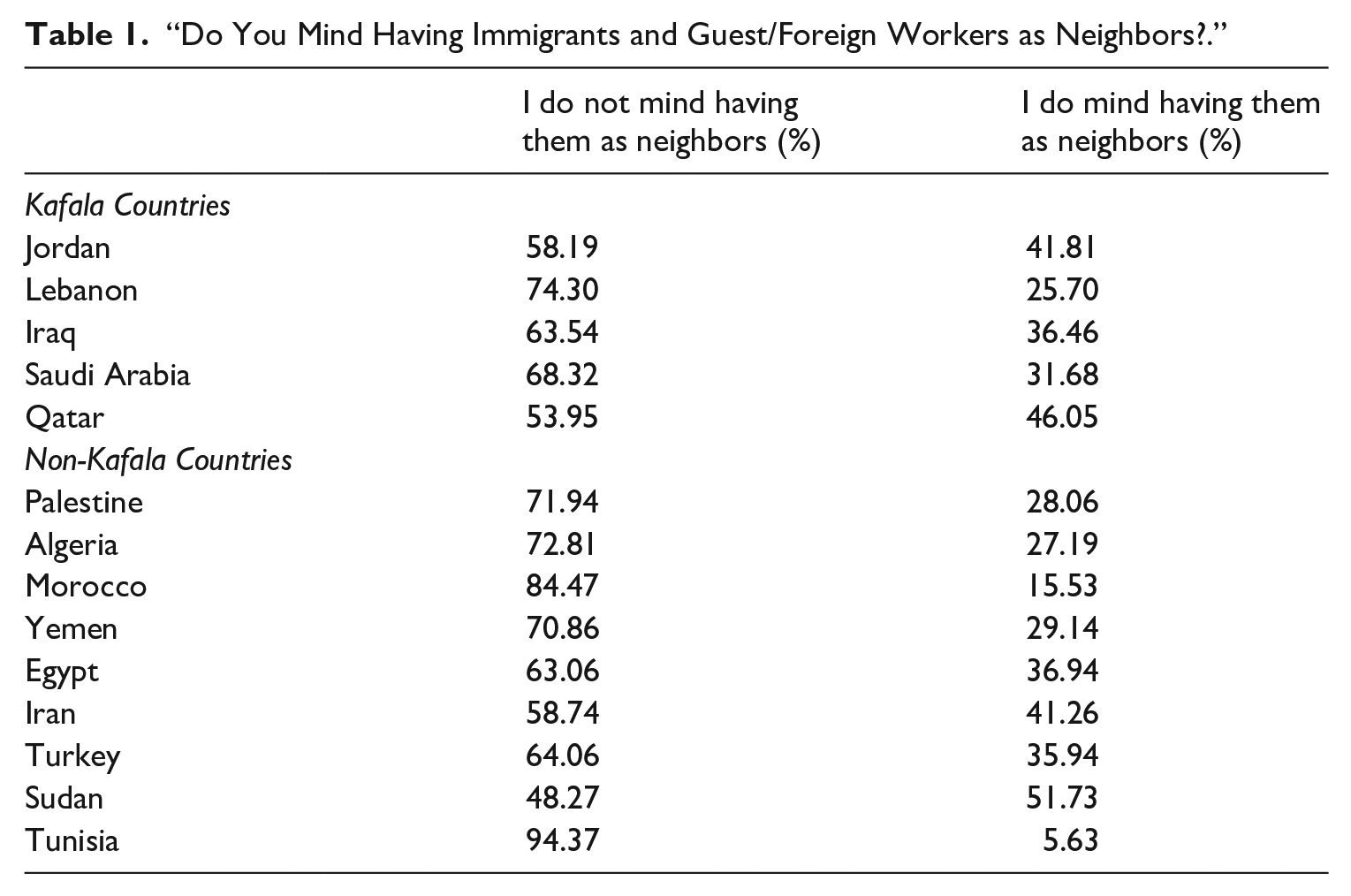
Existing studies argue that natives’ expressions of hostility toward immigrants are based on fear. Based on this logic of threat perception, we would expect to see lower levels of anti-immigrant sentiment in countries with rights-restrictive policies such as MENA countries that recruit foreign workers through the kafala system (henceforth, kafala countries). To date, few studies have investigated this. The Carnegie Middle East Governance and Islam dataset (CMEGID) from the 2000s and early 2010s allows us to compare public tolerance of immigrants in different MENA countries (see below). When we examine a standard measure of anti-immigrant sentiment, asking natives whether they mind having immigrants or guest/foreign workers as neighbors, we find that kafala and non-kafala countries have similar levels of public hostility. If natives in kafala countries are less likely to view immigrants as credible threats, what explains anti-immigrant sentiment in these polities? The remainder of our study explores this question and in doing so explains how the kafala system operates as a rights-restrictive immigration policy regime as well as theorizes how rights-restrictive immigration policies can engender anti-immigrant sentiment.
The Kafala System: Rights-Restriction and Status Enhancement
The Rights-Restrictive Policy Regime
The Kafala system, originally a guest worker program, was transformed into a rights-restricting immigration policy regime designed to supply the domestic economy with an influx of foreign workers. Limited-term contractual arrangements create a local individual or corporate kafīl, or sponsor, who is legally liable for the worker’s employment and well-being before the government. (Lori, 2019) Atypically, the kafala system institutionalizes the socio-economic and legal inferiority of these labor migrants vis-a-vis locals. With no path to citizenship and at continuous risk of deportation, labor migrants under the kafala system are characterized by their social immobility.
We argue that the kafala system encourages natives to express hostility toward low-skilled foreign workers. Moreover, we contend that the kafala system is fundamentally different from immigration policies that operate in developed democratic states because of the degree to which it locks low-skilled foreign workers into marginalized and vulnerable positions often enabling widespread state-sanctioned abuse by native employers. Due to its peculiar dynamics, we explain the origins and dynamics of the kafala system before developing our theoretical argument (in the following section).
The current/post-colonial/existing kafala system began with the onset of the petro-dollar development boom of the 1960s and 1970s. The number of foreign nationals coming to work in the MENA region rose sharply following the oil shock of 1973 and the subsequent development boom. These successive “oil booms,” which also included a 2004–2008 price spike, facilitated the mass intake of migrant labor to mitigate demographic shortages and local aversion to low-paying, socially stigmatized jobs. Furthermore, infrastructure and private development projects also spurred continued reliance on foreign labor (Al-Kafala, 2014). Initially employed by public organizations, increased privatization opened the way for companies and private citizens to recruit cheap migrant laborers who worked on short-term contracts mainly for construction projects (Al-Ghanim, 2015).
The largest beneficiaries of this period of economic growth were the GCC states, though other Arab states (e.g. Iraq, Jordan, Lebanon) also witnessed a rise in the number of foreign workers due to wealth accumulated from remittances (Jureidini, 2005). By the mid-1970s, Jordan was a net importer of migrant workers owing to the exodus of domestic workers to the neighboring oil-rich states (approximately 47%) (Humphrey et al., 1991), leading to the country’s economic dependence on remittances. In fact, from the mid-1970s to the mid-1980s, the Jordanian government proactively sought to train its work force to meet demand for skilled labor in neighboring states. This further intensified the need for foreign labor in Jordan and led to its adoption of the kafala system. While Iraq possessed a larger domestic workforce, the influx of oil wealth encouraged the recruitment of migrant workers under the kafala system for infrastructure projects and construction work (Halliday, 1984).
The kafala system is designed to ensure that migrant workers remain contract workers with weak ties to the host country. This arrangement excludes the possibility of permanent settlement or naturalization, and thus, accessing rights or obtaining legal status based on citizenship. Foreign workers receive an entry visa, a work permit, and a residence permit when a citizen or a public or private institution employs them. In this sense, the kafala system is a set of rules designed to control and monitor the numbers, presence, and mobility of migrant workers within the local labor market. The persistence of this rights-restrictive policy regime is attributable to historical, economic, and political factors (Al-Ghanim, 2015). The social contract in rentier kafala states (i.e. Qatar and Saudi Arabia) necessitated that low-skilled workers reside and work within these states under an exclusionary hierarchy of windfall income beneficiaries (i.e. sponsors) (Al-Kafala, 2014). For natural resource rent income to remain in abundance and for locals who are wealthier by virtue of this system to perpetuate this hierarchy, low-skilled workers had to be maintained as financially and socially inferior (Al-Kafala, 2014).
What makes the kafala policy regime unique is that it delegates wide discretionary authority to native employers who take on the role as sponsors who determine working and living conditions within the host country. Locals and public/private institutions activate the system by sponsoring foreign workers as their guarantors, which makes the employer solely responsible for the wellbeing of their foreign employees. The sponsor assumes full legal and economic responsibility for the worker under contract. Sponsors typically sign government forms declaring their responsibility and agreeing to inform the government of any changes to the contractual relationship. The kafala system requires that the sponsor and employer be the same person/entity which often grants native employers significant influence over their foreign employees. Workers can only be legally employed by their sponsors, and the latter’s approval is necessary to switch jobs or sponsors. Furthermore, the sponsor approves family reunification, travel, marriage, and can have employees deported at will (Al-Ghanim, 2015). The end of a contract often includes a return ticket for the worker to his or her home country that is paid for by the employer. Yet, workers who wish to exit their job arrangement prematurely incur this expense and risk retaliatory moves by their sponsors/employers (e.g. preventing them from seeking another job in the country and forcing them back home instead) (Longva, 1999).
Low-Skilled Migrant Populations
While native employers have used the kafala system to recruit high-skilled expatriates from several Western countries, most migrants who come to work in the MENA region are from developing countries. Low-skilled workers came to Iraq from Bangladesh, Indonesia, Nepal, the Philippines, Sri Lanka, and Thailand. They filled labor demand in construction, domestic service, hospitality, and healthcare. Lebanon’s low-skilled labor—preceding the Arab Uprisings and the arrival of Syrians refugees—was dominated by mainly undocumented Syrian workers in agriculture and construction. Palestinian refugees in Lebanon were formally recognized as foreigners without access to multiple professions. In Jordan, Egyptian migrant workers dominate the agriculture and construction sectors. Between 1994 and 2011, more than 60% of all foreign work permits in Jordan were held by Egyptians, as per data collected by the Migration Policy Centre (Jordan, 2013; McCormack et al., 2015) The migrant work force in Jordan also differs from the Gulf states.’ It is relatively more recent and more temporary, since these workers only arrived as replacement for the Jordanians who exited en masse to work in the oil-rich states following the 1973 oil shock and subsequent economic boom. A survey of the migrant workers in Jordan revealed their intentions to stay 18 months or less, that only 7.3% were accompanied by their families, and that they mainly worked in commodity production and services, especially construction and agriculture. Meanwhile, Asian workers comprise 15% of the workforce in Gulf states, half of which are South Asian and the rest Southeast Asian.
Under the kafala system, many migrant workers are also female domestic employees working as housemaids (Jureidini, 2005). In Lebanon, they are mostly Asian migrant workers and are primarily from Sri Lanka and the Philippines. In 2001, local embassies reported that tens of thousands of Sri Lankan, Filipina, and Ethiopian women worked in Lebanon, predominantly in the household service industry (Jureidini and Moukarbel, 2001). Jordan’s migrant laborers also included a significant population of domestic workers. They came primarily from Bangladesh, Sri Lanka, and the Philippines, but also from Indonesia, Kenya, and Ethiopia (McCormack et al., 2015). In 2000, embassies also reported that there were tens of thousands of Sri Lankan and Filipina working as domestic maids in Jordan (Jureidini, 2005).
The largest ethnic group working in low-skilled jobs under the kafala system is South Asians. South Asian laborers constitute most foreign workers in Qatar and Saudi Arabia (Hamaizia, 2015). In Qatar, expatriate workers make up more than 50% of the total population, while they make up 25% of the total population in Saudi Arabia (Longva, 1999). Cheap migrant labor in the GCC states is predominantly from the South Asian states of Bangladesh, India, Nepal, Pakistan, Sri Lanka, the Philippines, Indonesia, and Egypt (Hamaizia, 2015). Saudi Arabia receives the highest number of Indian workers in the Gulf region—approximately 1000 low-wage workers get work and travel clearances daily (Annual Report 2012–2013, n.d.). Household workers primarily come from Indonesia, the Philippines, Sri Lanka, and have increasingly also come from Bangladesh, Nepal, and Vietnam (McCormack et al., 2015).
Over time, employers in kafala countries have relied more on South Asian workers. From 1975 to 1985, both skilled and unskilled labor migrants from Arab states (Egypt, Jordan, Lebanon, Palestine, Sudan, Yemen) and Asia (India, Pakistan) doubled the population residing in Saudi Arabia (Jureidini, 2005). Between 1980 and 1985, the share of Asians in the GCC labor population (including Qatar and Saudi Arabia) increased from 30% to 63% to a total of 3.2 million with 2 million in Saudi Arabia alone. Increasing numbers were being recruited from Southeast Asia (Indonesia, Philippines, South Korea, Thailand), who accounted for more than 50% of Asian labor immigration to the MENA region (Jureidini, 2005). In the 1990s, Asian workers from Bangladesh and Sri Lanka specifically had increased their share of Asian migrants to 20% of the total Asian labor force in the MENA region. In 1999, Saudi Arabia had hundreds of thousands of Filipino workers, serving as their largest labor market globally (Jureidini, 2005).
A large sample (n = 1189) study of migrant workers in Qatar reflects the propensity for South Asians to occupy low-status jobs in kafala countries. There were 25 nationalities of foreign workers. Most low-skilled workers came from South Asia: Nepal (39%), India (29%), Sri Lanka (9%), and Bangladesh (9%). The remaining nationalities constituted 13% of foreign workers. Almost all surveyed laborers were male, bearing in mind that the sample omitted the household worker sector. They identified by the following job titles: “labourer”—“helper” (25%), “driver” (10%), cleaner (6%), mason (5%), carpenter (6%), electrician (4%), painter (3%), salesman (3%), and security guard (3%) (Gardner et al., 2013).
The Kafala System’s Impact on Public Attitudes
As stated above, the presence of anti-immigrant sentiment in countries that regulate foreign labor under the kafala system confounds conventional explanations of public opposition to immigration. This gap in the literature highlights core assumptions that have guided many studies of public attitudes toward immigrants—namely, that citizens express hostility toward immigrants when they view them as threatening. Given the geographic focus of our study, it is important to draw on studies that conceptualize immigration politics in illiberal and non-democratic settings. We build on recent studies of immigration politics in the Global South to develop a theory designed to explain anti-immigrant sentiment in MENA countries.
Seminal studies of immigration politics have argued that public attitudes toward immigration are but one of several constraints that political elites must deal with when making policy (Ellermann, 2013; Freeman, 1995, 2006; Howard, 2009; Joppke, 1998). According to Howard (2009), there are latent pressures for adopting liberal policies such as demographic change, international human rights norms, interest groups, and court decisions. Policymakers must balance these latent pressures against public opinion which can be activated by popular movements or far-right parties to restrict immigration (Howard, 2009: 53–62). This position squares with other studies such as Hollifield (2004) that develops the concept of the migration state in which policymakers seek to benefit from admitting foreign workers, while protecting the individual rights of immigrants (Hollifield, 2004: 886–887). In this way, exploring what predicts public antipathy toward immigrants helps scholars better understand the political dynamics of immigration policy in liberal democratic receiving countries (Hollifield, 2004).
To date, there are fewer studies that examine immigration politics in illiberal and non-democratic contexts. Adamson and Tsourapas (2019) offer a powerful critique of Hollifield’s migration state concept explaining: first, that it takes for granted that the state will focus on hosting economic migrants; second, that it has the capacity to effectively regulate immigration; and third, that policymakers seek to benefit from globalizing labor markets and adhere to liberal norms (Adamson and Tsourapas, 2019: 6–10). Exploring several countries in the global south, they draw a distinction between the liberal migration state and several other types that more accurately reflect the politics of migration in developing countries (Adamson and Tsourapas, 2019: 10). In fact, they identify three new types of migration states that populate the developing world: the developmental migration state that relies on exporting foreign workers to facilitate economic growth; the nationalizing migration state that seeks to use immigration and emigration to build an ethnically homogeneous nation; and the neoliberal migration state that adopts inclusive policies to extract revenue from immigrants and/or sending states.
Shin (2017) identifies a fourth political dynamic at play in non-democratic regimes—redistribution. He argues that when autocrats extract revenues from natural resources, they rely on redistribution to buy the loyalty of citizens and couple it with a policy of admitting cheap foreign labor because the cost of hiring natives rises significantly in the process (Shin, 2017: 18–19). Using a series of quantitative tests, Shin’s analysis demonstrates that Kuwait and Saudi Arabia have more open immigration policies than non-democracies without such natural resources (Shin, 2017: 29–32). While Shin does not discuss the kafala system in MENA countries, his argument about why some non-democratic states pursue more open immigration policies compared with others has implications for understanding public attitudes toward foreign workers in that part of the world.
We combine insights from these two studies of immigration politics in the global south. First, we suggest that many policymakers in MENA countries adopted the kafala system as part of a redistributive strategy to ensure that native employers could benefit from admitting low-skilled economic migrants. There are two related but distinct motives, at least one of which must be considered as a priority for policymakers. As Shin points out, the first is reducing labor costs, which is addressed by admitting low-skilled foreign workers. We also suggest that policymakers must consider public opposition to admitting foreign workers based on perceived threats to their social status or established societal norms. 2 To address social costs, policymakers must also dramatically restrict the rights of foreign workers to ensure that natives do not see them as a threat. Once this extreme form of rights-restrictive immigration policy is established it influences public attitudes in a way that policymakers may not anticipate given their preference to avoid the politicization of immigration. 3
Under such policies, natives’ socio-economic dominance is reinforced leading to feelings of superiority. We call this dynamic status enhancement. In other words, adopting a rights-restrictive immigration policy allows policymakers to supplement the domestic economy with cheap foreign labor, but also reinforces a kind of social closure among natives based on their superior social status vis-a-vis low-skilled foreign workers. We argue that regardless of policymakers’ intentions, pursuing immigration for redistributive purposes has profound social consequences which ultimately impact public attitudes toward immigrants.
We argue that the kafala system generates feelings of status enhancement among natives in the MENA countries where it operates. Due to their inferior socio-legal status vis-a-vis natives, regardless of the latter’s socio-economic status, wealthy natives are likely to view low-skilled foreign workers with contempt in kafala countries. Unlike their poorer fellow citizens who do not compete with immigrants for jobs, wealthy natives are most likely to employ and exert power over low-skilled foreign workers with few legal constraints. By contrast, poorer natives in MENA countries without a kafala system are most likely to hold negative attitudes toward immigrants because they must compete with them for jobs. We hypothesize that in kafala countries, wealthier natives will be more likely to express anti-immigrant sentiment than poorer natives. Alternatively, in non-kafala countries, poorer natives will be more likely to express anti-immigrant sentiment attitudes than wealthier natives.
While many of the GCC states today have formally began to dismantle their kafala systems (AlJazeera, 2021; BBC, 2016; Lebanon Takes Crucial First Step towards Dismantling Kafala in Lebanon, 2020), we anticipate that the institutional effects will continue to be salient. As many of these foreign labor-reliant economies combat native unemployment, we find evidence that they do so in ways that continue to maintain status enhancement as a feature of employment policymaking, and particularly as it pertains to low-skilled jobs. For example, the Saudi Ministry of Human Resources and Social Development issued procedural guidelines articulating the mandatory gradual replacement of foreign laborers with natives but has specifically excluded a specific category of jobs from native hire quota requirements. These jobs include “driver,” “janitor,” “plumber,” “barber,” and “freight helper” (الدليل الاجرائي لقرار توطين; 2021,, 2022, ). We find no plausible justification as to how these exclusions would benefit the local economy. Rather, we believe that they stem from the persistence of status enhancement dynamics when it comes to low-skilled employment that had been typically held by foreign workers under the kafala system.
Data and Methods
To test the plausibility of our argument, we investigate immigration attitudes in 14 MENA countries using an original dataset, which matches survey responses with host country-specific factors. Data for individual-level variables come from the CMEGID 1988–2014, an aggregate of many sociopolitical surveys on the Middle East. The CMEGID aggregates more than 80,000 observations from dozens of Middle Eastern and North African countries ranging from 1988 to 2014 and is based on many well-known surveys such as the World Values Survey and the Arab Barometer. In fact, it is arguably the best source of longitudinal data for the MENA region that is publicly available to the scientific community. Because large-scale surveys have only recently been conducted in MENA countries, we acknowledge that our dataset contains gaps—for the analysis that follows, we have 30,077 valid observations for 14 different countries ranging from 2000 to 2011. As discussed further below, our analysis is based on a series of multi-level models.
We distinguish between kafala and non-kafala countries using a dummy variable. Out of the 14 countries available in our dataset, only five regulate foreign labor under the kafala system (Jordan, Lebanon, Iraq, Saudi Arabia, and Qatar) and were coded as “Kafala” (Kane-Hartnett, 2018). The remaining nine countries (Turkey, Iran, Egypt, Morocco, Algeria, Sudan, Palestine, Yemen, and Tunisia) and were coded as “No Kafala” (Kane-Hartnett, 2018). Finally, for the 11 years that span between 2000 and 2011, we have data available for 9 years (2000–2007, 2010–2011).
Our study relies on a single measure of anti-immigrant sentiment (the question, “Do you mind having the following groups as neighbors: Immigrants and guest workers”), 4 which is coded dichotomously, taking the value of “0” for tolerant replies (“I don’t mind having them as neighbors”) and the value “1” for intolerant replies (“I do mind having them as neighbors”). Table 1—presented earlier—shows the repartition of answers to this survey question by country and immigration system. We use this measure of anti-immigrant sentiment because it has been used in similar studies based on surveys run in Europe, Asia, and North America (Barceló, 2016; Cochrane and Nevitte, 2014). In addition, previous studies of xenophobia in MENA countries have used this exact variable (Inglehart et al., 2006; Kaya, 2014; Solakoglu and Gurbuz, 2015).
“Do You Mind Having Immigrants and Guest/Foreign Workers as Neighbors?.”
Our analysis is based on fitting multi-level binary logit models with an interaction term along with country and year random effects, all the while controlling for several individual- and societal-level variables. Fitting binary multi-level logits is justified for three reasons. First, a binary logit is appropriate because our dependent variable is binary. Second, our hypothesis suggests a two-level dynamic where a societal-level feature (type of immigration system) affects the connection between two individual-level variables—specifically, the correlation between income groups and hostility toward immigrants as well as the correlation between education level and anti-immigrant sentiment. Third, our data lack sufficient temporal variation required for time-series cross-sectional analysis. In sum, due to the nature of our data and the configuration of our hypotheses, our analysis is based on multi-level binary logit models.
To test our status enhancement hypothesis, we stipulate an interaction term between immigration systems—Kafala versus non Kafala—and one individual-level variable—income groups—with country and year random effects. The variable we use for income groups has five levels, ranging from first to fifth quintile of monthly individual income—the highest quintile representing the wealthiest of society. In the pages that follow, we refer to this interaction between immigration systems and income groups as our status enhancement variables. We also include variables that control for respondents’ socio-economic status through all models—age group, gender, and educational group. Age group takes seven different levels: “18–24,” “25–34,” “35–44,” “45–54,” “55–64,” “65–74,” and “75+.” Gender is a categoric measure of “Male” or “Female.” Educational group is a categoric measure of “Illiterate,” “Elementary and Primary,” “Secondary,” “Undergraduate Degree,” and “Graduate Degree.” Additional control variables are included in the models used for robustness checks.
In the next section, we discuss our main findings using a coefficient plot that focuses on the most relevant results of our hypothesis tests. We then discuss our robustness checks using a regression table that presents the findings of several models with tests of alternative hypotheses that serve to cross check our main findings. We also refer to additional robustness checks in the Supplemental Appendix—they include several additional control variables and predicted probabilities which support the findings we present in the next section of this article. These include employment status, GINI coefficient, natural resources as a percentage of gross domestic product (GDP) per capita, societal levels of unemployment, international migrant stock, interpersonal trust, societal freedom, total number of female migrants, the share of female migrants in the migrant stock, the share of migrants who are of working age, the ethnicity of the largest migrant group, the ethnicity of the second largest migrant group, the ethnicity of the third largest migrant group, the number of refugees in host country, and finally, the main region of origin of migrants. Tables B1–B4 in Supplemental Appendix B show the results of these robustness checks, which combine various combinations of societal and individual-level controls and the inclusion of different interaction terms.
The control variables we use in our robustness checks are a mix of continuous and discrete measures. Employment status is a categoric measure of “Employed,” “Unemployed,” or “Other.” GINI coefficient is a measure of income inequality from the World Bank dataset. Natural resources as a percentage of GDP per capita measures the extent to which a state’s economy is reliant on oil. Societal levels of unemployment are used to better understand the impact of difficult socio-economic conditions at the societal level on individual levels of xenophobia. The variable we use for international migrant stock is a numeric estimate of people living in a country as foreign-born. If that statistic was not available, the estimate refers to the number of people living in a country as non-citizens. Interpersonal trust can take three values—where “1” means most people can be trusted, “2” means some people can be trusted and some people cannot be trusted, and “3” means most people cannot be trusted. Societal freedom is made up of two scores—“political” and “civic” freedoms. Taken together, the score for societal freedom is conventionally accepted to measure levels of democratization worldwide(Jamal and Nooruddin, 2010). The total number of female migrants is the count of female immigrants within the total migrant stock residing in the host country in the year in which it is measured. The share of female migrants in the migrant stock is the female migrant population as of the year indicated as a percentage of the international migrant stock residing in the host country. Percentages shown are calculated by dividing the number of female international migrants by the total migrant stock. The share of migrants who are of working age is the share of international migrants of working age (20–64 years) as a percentage of the international migrant stock residing in the host country. The ethnicity of the largest migrant group is the ethnicity of origin for the largest group of migrants within the international migrant stock residing in a host country. The ethnicity of the second largest migrant group is the ethnicity of the second largest group of migrants within the international migrant stock residing in a host country. The same logic applies to the ethnicity of the third largest migrant group. The number of refugees in host country is the total count of refugees (including asylum seekers) within the total migrant stock as reported by the Office of the United Nations High Commissioner for Refugees or the United Nations Relief and Works Agency for Palestine Refugees in the Near East when fit. Finally, the main region of origin of migrants is the continent or subcontinental region of origin for the majority of the international migrant stock residing in a host country.
Results
Figure 1 presents the key results of our tests for the status enhancement hypothesis advanced in this article. The coefficients that are plotted illustrate the correlation of income classes and immigration systems with anti-immigrant sentiment in the MENA region. The reference category of the income group variable is the first income quintile; coefficients for income quintiles preceded by “No Kafala” identify the correlation between these variables and anti-immigrant sentiment in countries whose immigration system is not based on the kafala model. Conversely, coefficients for these same variables not preceded by “No Kafala” in Figure 1 identify the correlation between these income quintile and xenophobia in countries legislated by a kafala immigration system. The model presented in Figure 1 controls for several variables—age groups, educational levels, employment types, and gender. Coefficients for control variables and random effects are masked as we focus on the coefficients that matter most to our analysis—the full results are available in Table 2 under “Model 1.”
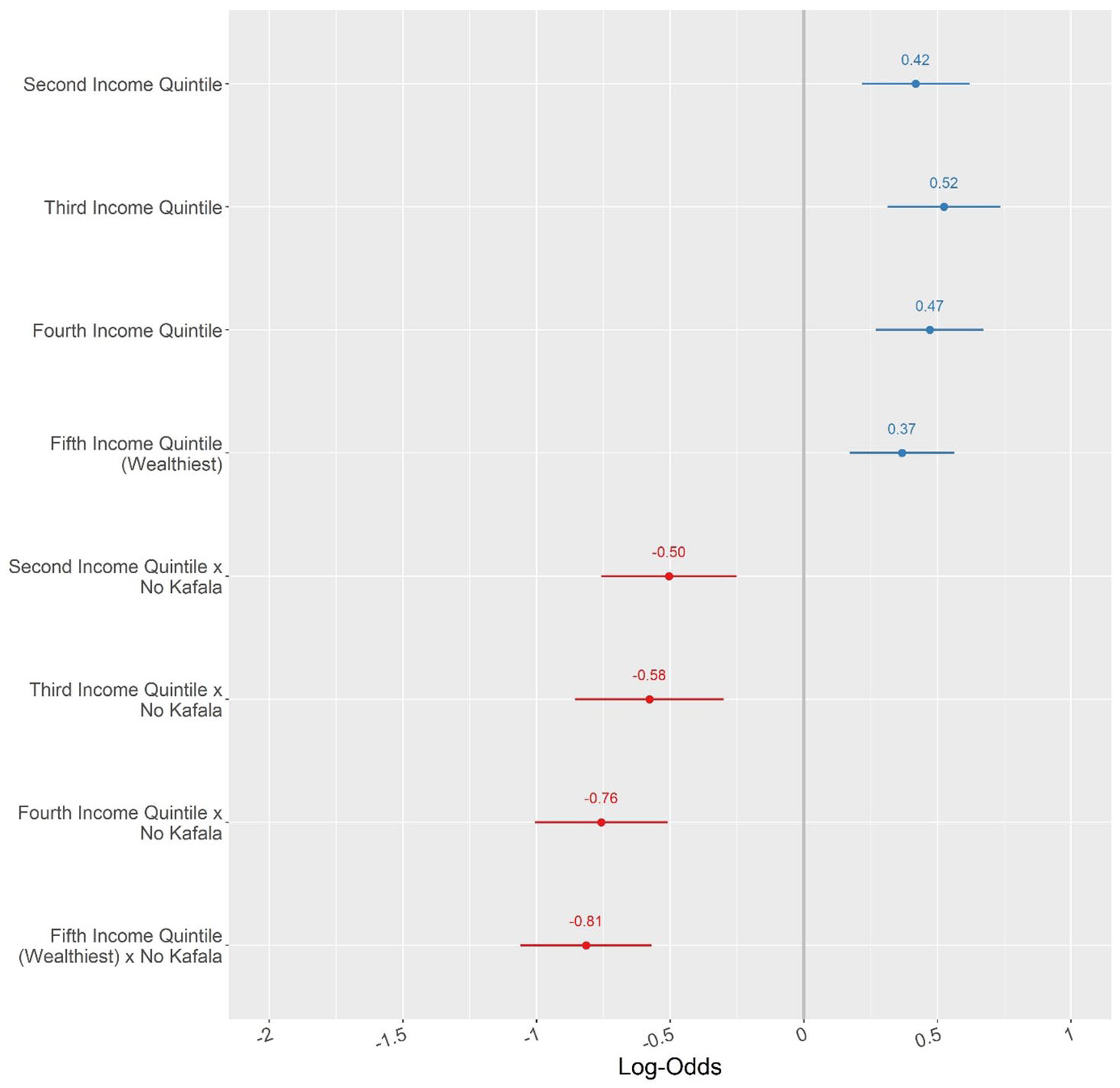
Coefficient Plot for Predicted Hostility Toward Immigrants and Guest Workers in the MENA Region.a
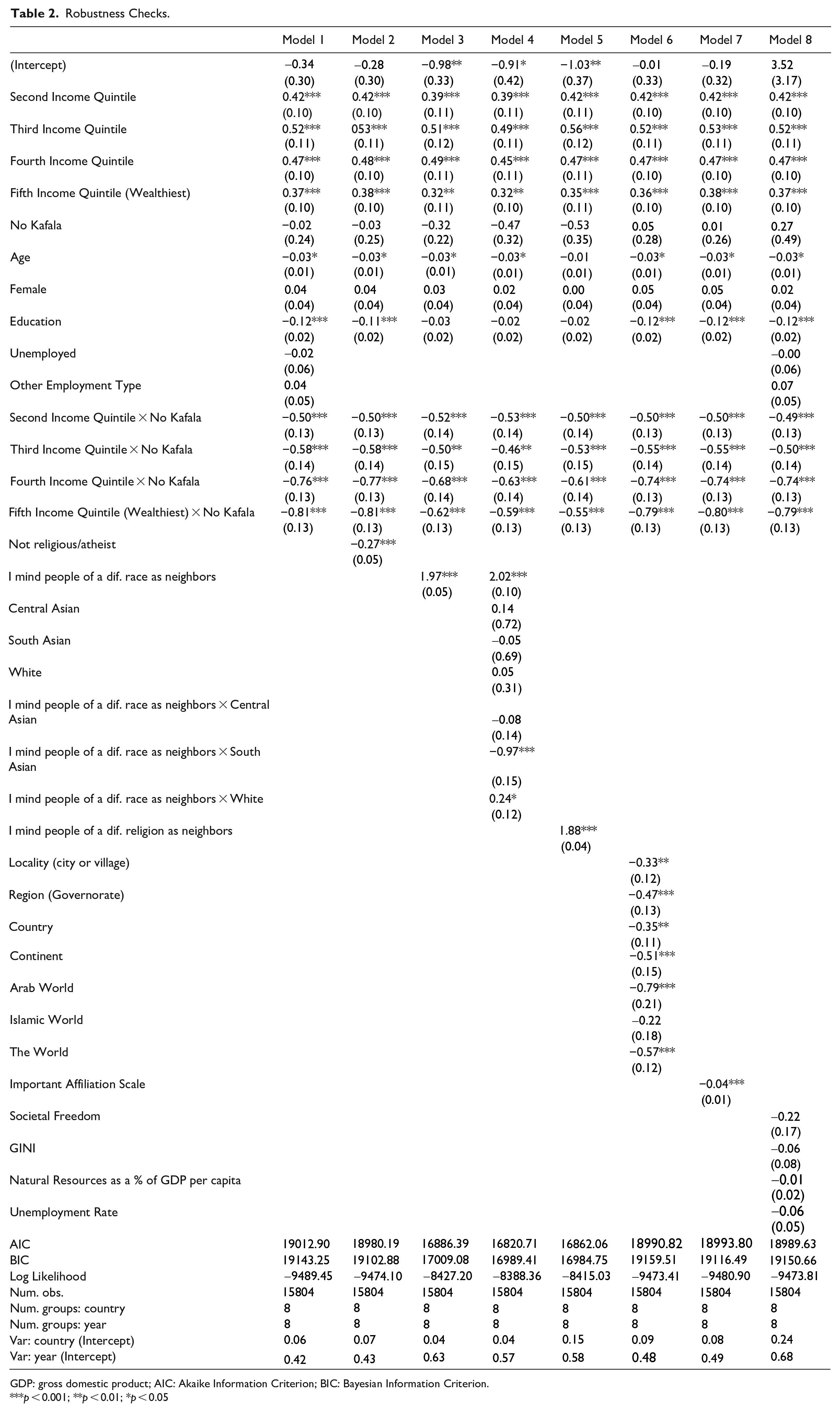
Robustness Checks.
GDP: gross domestic product; AIC: Akaike Information Criterion; BIC: Bayesian Information Criterion.
p < 0.001; **p < 0.01; *p < 0.05
In Figure 1 and in all our models, higher coefficients represent a higher likelihood of intolerant attitudes, while lower coefficients denote a lower likelihood of intolerant attitudes toward immigrants and foreign workers. We color code the coefficients, so that positive ones are shown in blue, while negative ones are in red; we also include a gray vertical bar at the “0” value to denote statistical and substantive significance of coefficients. Moreover, because the income class variable is discrete, coefficients for each income quintile denote the likelihood that members of that income quintile would express more or less hostility than members of the reference category—the first income quintile. In all our models, this logic of interpretation of the coefficient for income classes is compounded by the presence of an interaction term with the variable immigration system. As a result, the coefficient named “Second Income Quintile” denotes the likelihood that the second income quintile in countries with a kafala system of migration will be more hostile than the first income quintile. The same logic applies to all subsequent income quintiles without a mention “no Kafala.” Coefficients preceded by “no Kafala” should be interpreted in the same way—the probability that each income quintile will be more or less intolerant than the reference category, that is, the first income quintile—yet for countries where no kafala system exists.
The coefficients plotted in Figure 1 support our status enhancement hypothesis as they suggest that immigration systems substantially affect the relationship between income groups and anti-immigrant sentiment. It shows that kafala and non-kafala countries have completely reversed patterns of class-based prejudice in the MENA region as the first has positive coefficients and the second has negative coefficients. As a result, where non-kafala immigration systems exist (“No Kafala”), the better off are generally more tolerant than the poorest of society across age groups, educational levels, employment types, and gender. The prediction is therefore that the first income quintiles are substantially more hostile than the wealthiest of society—the fourth- and fifth-income quintiles.
Where a kafala immigration system exists, the relationship between wealth and anti-immigrant sentiment is completely reversed. There, the better off are generally more likely to be intolerant toward immigrants and foreign workers than the poorest of society even when we control for age, education, employment type, and gender. In fact, the first income quintiles in countries with a kafala system of immigration are predicted to be the most tolerant of all income classes, whereas they are predicted to express the most hostility in non-kafala system countries. Such substantive findings largely support our main research hypothesis and all our coefficients for the interaction between immigration system and income quintiles are statistically significant with at least 95% confidence. 5
In Table 2, we show that the results presented in Figure 1 remain consistent to the introduction of various control variables drawn from several alternative hypotheses. 6 In summary, Table 2 shows that threat perception and other alternative hypotheses are not enough to defeat the status enhancement hypothesis which we advanced in this article. The direction of correlation of our main coefficients remains the same, while substantive values and statistical significance remain very similar across all models. In Model 2, we control for the religiosity of respondents by using a variable consisting of two values—religious (the reference category in the model) and not religious/atheist. It shows that people who are irreligious/atheists tend to be more tolerant of immigrant and foreign workers than religious people, but this does not affect the status enhancement dynamic described in Figure 1. In Model 3, we control for the racial prejudice of respondents by using a binary variable—a yes/no answer to the question “Do you mind people of a different racial group as neighbors.” The results show that people who mind members of a different racial group as neighbors tend to be more intolerant of migrants and foreign workers than those who do not mind members of a different racial group as neighbors. Yet, this also does not affect the status enhancement dynamic described in Figure 1.
In Model 4, we control for the interaction of the racial prejudice variable with the primary ethnic group of migrants in the country of residence of respondents using a variable whose reference category is the “Arab” ethnic group. Despite some significant interaction between the two, the status enhancement dynamic described in Figure 1 remains largely unchanged in this model too. In Model 5, we control for the religious prejudice of respondents by using another binary variable, which records a yes/no answer to the question “Do you mind people of a different religion as neighbors.” As with racial prejudice, religious prejudice also correlates with more anti-immigrant attitudes, but has very little impact on status enhancement coefficients.
In Models 6 and 7, we control for the impact of respondents’ most important affiliation on prejudice toward migrants. In Model 6, we use a variable consisting of six possible answers to the question “Which of the following is the most important to you from the following social and geographical affiliations?” Possible answers are “Family/Tribe” (the reference category in Model 6), “Locality” (City or Village they live in), “Region/Governorate they live in,” “their Country,” “the Middle East,” “Arab world,” “Islamic world,” and “the World.” In Model 7, we transform the most important affiliation variable into a scale, ranging from value 1 being the most local identity (Family/Tribe) to value 6 being the most global identity being “the World.” Overall, Model 6 shows that people who identify mostly with the Arab World or the World tend to be the most tolerant of immigrants (in respective order), while Model 7 shows that people who have a more global identity tend to be more tolerant of immigrants than people who have a more local identity. In both cases, this leaves the status enhancement dynamic largely unchanged once more. Finally, in Model 8, we control for additional societal-level dynamics of relevance to anti-immigrant prejudice—societal freedom and material inequality in society (using the GINI coefficient), as identified by Whitaker and Giersch (2015). We also control for unemployment rate, as identified by many before us such as Cochrane and Nevitte (2014). We finally control for economic reliance on natural resources (using the percentage of GDP per capita occupied by natural resources’ exploitation) to assess whether importance of specific sectors of the economy matters, in a nod to the resource curse theory (Ross, 2015). None of these variables are statistically significant, and the status enhancement dynamic remains largely unchanged once more.
In addition to Table 2, we run a number of robustness checks. In Models 2–6 of Table B4 in Supplemental Appendix B, we conduct robustness checks for the model plotted in Figure 1 by adding several socio-economic country-level controls. Four variables control for the socio-economic features of the countries where respondents are surveyed, while the other five control for different profiles of migrants in these same countries. The four socio-economic controls resting at the societal level are societal freedom, GINI coefficient for income inequality, natural resources as a percentage of GDP per capita, and societal levels of unemployment rate. The five migration controls are stock of international migrants in country of respondent, share of work age migrants in the total migrant stock, main ethnicity of the first migrant group in the country, and country of origin of the first migrant group in the country where the survey is delivered. Our results remain constant throughout these tests. The relationship plotted in Figure 1 also holds as we control for—and sometimes interact with—levels of inequality in country of respondent, levels of political and social freedoms, unemployment rate, and natural resources as a percentage of GDP per capita. In Models 1–6 of Table B2 in Supplemental Appendix B we include the migration country-level controls which we mentioned earlier. The relationship holds again even as we control and interact with ethnicity of migrants, share of migrants of working age, total number of migrants in country of respondent, and country of origin of migrants. Finally, in Supplemental Appendix C, we verify the substantive impact of immigration systems on wealth-based prejudice by using predicted probabilities for the whole sample, split by states. In Figure C1 in Supplemental Appendix we show that the substance of the correlation estimated in Figure 1 holds when computed through predicted probabilities. We also find in the split-sample predicted probabilities presented in Figures C3 and C4 in Supplemental Appendix that no one country overwhelmingly drives the results we present here. 7
Discussion and Conclusion
Why do natives in countries where immigrants pose no real or perceived threat to the latter’s economic or socio-cultural status express anti-immigrant sentiment? This question has significant implications for future studies because the presence of anti-immigrant sentiment in jurisdictions with extreme rights-restrictive immigration policies confounds dominant theories of public attitudes toward immigration. As we have discussed above, previous studies emphasize the ways in which natives see immigrants as a threat to their economic interests and/or socio-cultural status within the host society. If threat perception is what drives hostility toward immigrants, one would expect that adopting rights-restrictive immigration policies is the best way for policymakers to alleviate public anxieties while reaping the economic benefits of admitting low-skilled foreign workers. Yet, the presence of comparable levels of animosity toward foreign workers in MENA countries with and without a kafala system suggests that there is more to anti-immigrant sentiment than threat perception.
Our study builds on previous research by exploring what drives anti-immigrant sentiment in MENA countries as well as developing a new theoretical approach that may explain public attitudes in illiberal and non-democratic host countries that adopt rights-restrictive immigration policies. While we recognize the fruitfulness of tracing the historical colonial origins of the kafala system in the Middle East (AlShehabi, 2019), we specifically choose to focus on a stable phase of postcolonial labor policy regulation and inter-Arab relations (i.e. 2000–2010), which saw the relative absence of exogenous factors that may have biased survey responses in preceding and succeeding time periods. In other words, we have reasons to believe that the institutional effects and anti-immigrant sentiment we observe were strongest and more accurately attributable in this time period to the demographics of low-skilled migrant groups.
Our study complements existing studies which aim to explain such sentiments using explanations centering on racism (Fernandez, 2021). Global criticism and a desire for more competitive labor markets spurred changes to the kafala system. Legal reforms alongside efforts to improve living conditions for workers have suffered from compliance deficits in the past, which led to recurrent violations with minimal consequences for sponsors (Damir-Geilsdorf and Pelican, 2019). Kafala states, especially in the GCC, have sought to revamp their foreign employment regulation policies to attract talent, improve the competitiveness of their labor markets, and bolster their international image (Al-Ghanim, 2015). We also do not anticipate the most recent changes to the kafala system to have a quick or profound impact on the anti-immigrant sentiments toward low-skilled migrant laborers. This is primarily due to the fact that these changes have not completely eliminated the subordination created by the kafala system, and has transferred some of the powers held over migrants by sponsors to the state, as opposed to eliminating them altogether (Robinson, 2021). For example, Saudi Arabia, historically a kafala country, has continued to exhibit policymaking that reflects the significance of status enhancement in the gradual replacement of foreign workers with natives to confront high levels of unemployment among locals. Its Ministry of Human Resources and Social Development has issued guidelines that exclude a specific category of jobs from local hiring quota requirements for public and private enterprises. These jobs include “driver,” “janitor,” “plumber,” “barber,” and “freight helper” (2021, منطقة الباحة, p. 5; 2022, الدليل الاجرائي لقرار توطين مدن ا لملاهي والمراكز الترفيهية, p. 6). In the context of a rights-restricting immigration policy regime, these directives indicate that status dynamics continue to persist when it comes to low-skilled employment opportunities typically held by foreign workers in kafala countries. This also speaks to the continued salience of our study in terms of the kafala system’s consequential effects beyond its actual implementation or termination.
Using a series of statistical tests that match individual traits and preferences with societal variables, we have shown that hostility toward foreign workers expressed by natives in MENA countries is context-specific and not solely based on threat perception. In MENA countries without a kafala system, lower-class natives are more likely to express animosity toward foreign workers because they compete with each other for jobs while their upper-class fellow citizens are more tolerant. This finding suggests that economic self-interest shapes public attitudes toward immigrants in MENA countries that extend social mobility to foreign workers.
By contrast, we also found that the nature of anti-immigrant sentiment in kafala countries is different. It is lower-class natives who do not compete with foreign workers for jobs who are the most tolerant, whereas it is wealthier natives who are the least tolerant. We argue that the nature of anti-immigrant sentiment is different in kafala countries because the rights-restrictive nature of immigration policies in these jurisdictions strongly reinforces pre-existing social closure among natives in such a way that enhances their status vis-a-vis low-skilled migrant workers. Because immigration rules lock them into a specific social status, upper-class natives always encounter foreign workers as subordinates. In this way, the kafala system disproportionately benefits upper-class natives by denying rights and opportunities for social mobility to foreign workers. We argue that this leads to status enhancement characterized as a feeling of superiority that wealthy natives have toward their dependent and vulnerable foreign employees hired to serve them on their terms. Imbued with a sense of power over non-citizens, wealthier natives are more likely to associate foreign workers with low-skilled migrants who they view as socially inferior even though they benefit from the latter’s presence.
Focused on theory-building, our study is not without limitations. Due to the nature of our data, our analysis should be interpreted as evidence that supports the plausibility of status enhancement. In other words, precise causal estimation lies beyond the reach of this study. We leave it to future studies to present direct evidence that rights-restrictive immigration policies induce contempt toward foreign workers within natives. To test the validity of our theory’s core assumptions, pursuing an experimental design that develops a more precise measure of contempt toward foreign workers is critical. Future studies taking this path may learn a lot from some who have already employed survey experiments to study other aspects of anti-immigrant sentiment in that part of the world (Inglehart et al., 2006).
Future studies should also explore more closely the connection between immigration policies and public attitudes toward immigrants, with the aim of further disentangling it from political support for or opposition to admitting certain kinds of immigrants. Our study also points to a major gap in the literature on immigration politics and migration more generally by examining non-Western, developing countries as host societies. Researchers should therefore seek to understand the added dynamic of racial and religious discrimination in the status enhancement, which we have identified in this article. Do natives in MENA countries have stronger/weaker sympathies or status enhancement behavior toward immigrants and foreign workers of a specific racial origin or religious conviction? Such questions are hard to answer as of now due to the limited nature of survey data in that part of the world but would greatly enhance scholars’ knowledge about the nature of anti-immigrant sentiment in that region.
Supplemental Material
sj-docx-1-psw-10.1177_14789299221130901 – Supplemental material for Does Social Mobility Matter? The Kafala System and Anti-Immigrant Sentiment
Supplemental material, sj-docx-1-psw-10.1177_14789299221130901 for Does Social Mobility Matter? The Kafala System and Anti-Immigrant Sentiment by Amir Abdul Reda, Nicholas AR Fraser and Ahmed Khattab in Political Studies Review
Supplemental Material
sj-docx-2-psw-10.1177_14789299221130901 – Supplemental material for Does Social Mobility Matter? The Kafala System and Anti-Immigrant Sentiment
Supplemental material, sj-docx-2-psw-10.1177_14789299221130901 for Does Social Mobility Matter? The Kafala System and Anti-Immigrant Sentiment by Amir Abdul Reda, Nicholas AR Fraser and Ahmed Khattab in Political Studies Review
Footnotes
Acknowledgements
The authors wish to express their thanks to members of the Canadian Political Science Association 2019 General Meeting for their comments on previous drafts of this paper.
Declaration of conflicting interests
The author(s) declared no potential conflicts of interest with respect to the research, authorship, and/or publication of this article.
Funding
The author(s) disclosed receipt of the following financial support for the research, authorship, and/or publication of this article: With support from the Carnegie Corporation of New York and the American Political Science Association.

Supplementary Information
Additional supplementary information may be found with the online version of this article.
Contents
Appendix A: Descriptive Statistics
Table A1. Samples Composition: Number of Observations Per Country & Year (Countries in Italic are Kafala countries).
Table A2. Samples Composition: Number of Observations Per Country & Year (Countries in Italic are Kafala countries).
Appendix B: Statistical Estimations & Robustness Checks
Table B1: Main Model & Robustness Checks.
Table B2: Robustness Checks.
Table B3. Robustness Checks.
Table B4: Robustness Checks.
Table B5.
Figure C1: Predicted Probabilities of Hostility Toward Immigrants and Guest Workers in the MENA Region—By Income Group & Immigration System.
Figure C2: Predicted Probabilities of Hostility Toward Immigrants and Guest Workers in the MENA Region—By Income Group & Immigration System (Iran Omitted from Dataset).
Figure C3: Split Sample Predicted Probabilities of Hostility Toward Immigrants and Guest Workers in the MENA Region—By Income Group, Immigration System & Country of Respondent.
Figure C4: Split Sample Predicted Probabilities of Hostility Toward Immigrants and Guest Workers in the MENA Region—By Income Group, Immigration System & Country of Respondent (Iran Omitted from Dataset).
Demographics of locals and migrants in kafala and non-kafala countries.
Notes
Author Biographies
References
Supplementary Material
Please find the following supplemental material available below.
For Open Access articles published under a Creative Commons License, all supplemental material carries the same license as the article it is associated with.
For non-Open Access articles published, all supplemental material carries a non-exclusive license, and permission requests for re-use of supplemental material or any part of supplemental material shall be sent directly to the copyright owner as specified in the copyright notice associated with the article.
