



Abstract
This study examines differences based on school gender in the teaching of Civic, Social and Political Education (CSPE), a mandatory subject in the Irish post-primary curriculum. These differences are considered in relation to Westheimer and Kahne’s three types of citizens – personally responsible, participatory and justice-oriented. The article presents the findings of a survey conducted with 223 CSPE teachers in single-sex female, single-sex male and co-educational schools. The data were analysed using statistical and thematic analysis. The findings suggest that CSPE teachers in single-sex female schools place greater value on the subject and are more likely to promote social responsibility and student voice, suggesting a greater emphasis on participatory and justice-oriented citizenship. Teachers in single-sex male schools are more likely to focus on politics and action aligning with participatory citizenship. In co-educational schools, teachers seemed to focus on personally responsible and participatory citizenship.
Keywords
Introduction
Civic, Social and Political Education (CSPE) was introduced as a compulsory subject in 1997 to provide citizenship education at junior-cycle in Irish post-primary schools. The syllabus was concept-based and with little defined content, teachers had latitude in relation to what they taught. CSPE was assessed by an action project and examination for the Junior Certificate Programme (JCP) and these assessments were also focused on concepts rather than content. In 2017, a new Junior Cycle Profile of Achievement began to replace the JCP. As a result, CSPE became a mandatory subject in the Wellbeing Programme in schools and is no longer formally assessed (National Council for Curriculum and Assessment, 2016). While the new course has specific learning outcomes, the content chosen to achieve these outcomes remains at the teacher’s discretion. This flexibility as regards content has the potential to influence the type of citizenship promoted by CSPE teachers, which consequently may differ from school to school.
Westheimer and Kahne (2004) identified three visions of citizenship: personally responsible, participatory and justice-oriented. They reject the personally responsible model as insufficient, as it focuses only on individual behaviour beneficial to society. A personally responsible citizen contributes food to a food drive, whereas a participatory citizen helps to organise the food drive and a justice-oriented citizen explores why people are hungry and acts to solve the root causes. A model of citizenship that emphasises volunteerism and responsibility alone is incapable of addressing and even diverts attention from deep rooted problems in society (Connolly, 2007). Teachers of personally responsible citizenship education programmes emphasise voting and the local community, disregard critical inquiry and concentrate on responsible participation and knowledge acquisition by learning rules and laws (Patterson et al., 2012). Gillborn (2006) argues that citizenship education focused on duty and responsibility stifles the potential of the subject to generate debate on controversial topics.
The participatory model emphasises organising and leadership but ignores root causes and power relationships. Teachers who promote participatory citizenship have a more global outlook and stress the value of knowledge, critical thinking, fulfilling one’s potential and social action (Patterson et al., 2012). Participatory citizenship education activities such as debating, student council membership, mock elections and classroom opportunities with an explicit civic dimension impact political engagement into adulthood and can overcome disadvantages related to socio-economic status or ethnicity (Kahne and Sporte, 2008; Keating and Janmaat, 2016). Galston (2004) suggests that effective citizenship education entails civic engagement by all, student input on school governance and community collaboration, all features of participatory citizenship. In Ireland, participatory citizenship education has been found to be the dominant model amongst CSPE teachers (Cosgrove et al., 2011; Reichert and Torney-Purta, 2019).
The justice-oriented model looks at long term solutions to issues by concentrating on the sources of injustice and how to address these. However, this model fails to foster effective community leaders or increase personal responsibility (Westheimer and Kahne, 2004). Teachers who promote justice-oriented citizenship education focus on changing inequality by practicing skills, such as letter writing, organising petitions and advocating running for office (Patterson et al., 2012). Leung et al. (2014) however, found that few schools delivered a justice-oriented citizenship programme. Similarly, Lynch (2012) notes the absence of social and political analysis from mainstream Irish education. Frazer (2007) argues that teaching justice requires an understanding of political power as it offers a mechanism for conducting conflict. However, schools often model the powerlessness of politics through ineffective student councils and withholding meaningful decision-making roles. Worryingly, the citizenship education programmes of the UK and Ireland are lacking in knowledge of substantive structures and the ability to engage with topics through a distinctive citizenship lens (Jerome, 2018).
While participatory citizenship appears to be the most common type of citizenship amongst CSPE teachers, other factors such as the school have the potential to impact this. Almost one third of Irish post-primary schools are single-sex schools. Little research has been conducted on the impact of school gender in how citizenship education is taught. Cohen (2016) suggests that the distinction between the type of citizenship taught was more likely to be based on socio-economic factors. However, Tormey and Gleeson (2012) found that global citizenship education (GCE) was more valued in single-sex schools than in co-educational schools. Single-sex girls’ schools were more likely to focus on social responsibility, discuss aid and development and mark occasions such as World AIDS Day; their extra-curricular activities often dealt with development issues. Single-sex boys’ schools were more likely to discuss environmental issues and less likely to engage in debates. Tormey and Gleeson (2012) suggest that schools’ institutional ideologies may be an influencing element. Historically, single-sex female schools run by female religious orders emphasised care, whereas male religious orders prioritised religious and moral formation and academic goals.
The current study will look at the role school gender plays in the type of citizenship education taught. School gender will include three types of school: single-sex female, single-sex male and co-educational.
Literature review
Social role theory states that behavioural differences and similarities between the sexes represent people’s perceptions of men and women’s social roles in society (Eagly and Wood, 2012). The male role is seen as agentic, dominant and willing to take risks and aggressive actions, whereas the female role is viewed as communal and associated with nurturance, parental bonding and intimacy. These gender roles appear natural and accordingly influence people’s self-concepts and become gender identities. People who conform to the expected role are rewarded, and those who do not are cast aside.
Schneider and Bos (2019) warned that schools may perpetuate traditional gender roles because of teachers’ actions. Research has demonstrated how teachers can be influenced by gender differences in their students. This affects how they teach and what they teach. Farkas et al. (1990) found that considerations other than coursework mastery have a bearing on teachers’ evaluation of their pupils. These include homework quality, participation, effort and organisation. Sukhnandan’s (1999) analysis of the differences between male and female students shows how girls are more likely to display these features. They have higher aspirations, value presentations and clear expression, underestimate their ability, and work hard to compensate. They are socialised to sit still, conform, be quiet and listen. Boys prefer active learning, are less attentive, more disruptive, more reluctant to do schoolwork and are socialised to want to do things quickly. Girls’ views of classrooms and school would appear to bear this out, as they see the classroom climate as more open and have a higher perception of their ability to influence school decisions (Cosgrove et al., 2011).
Teachers also form opinions based on gender stereotypes. Gordon et al. (2008) found that girls avoid conflict with teachers in order to benefit from the education setting, yet teachers credited girls with being obedient, hardworking and diligent rather than talented. Martino et al. (2005) identified that low levels of teacher threshold knowledge about gender reinforced assumptions about how boys learn, behave and respond. Jones and Myhill (2004) similarly found that teachers were influenced by gender stereotypes. They described boys in terms of poor behaviour and low achievement, whereas girls were viewed as compliant, passive and high achievers. Classroom observations, however, identified that participation was linked to ability rather than gender. Kollmayer et al. (2018) suggested educating teachers about the causes of gender differences as they are easier to reach than other adults who influence young people and will impact larger numbers.
Political knowledge has been shown to be greater amongst males (Frazer and MacDonald, 2003; Niemi and Junn, 1993). Perliger et al. (2006) equally noted how boys had more political knowledge but that girls were more socially aware. Other studies have uncovered specific differences. Bernstein (2005) found that men were more interested in discussion and information-seeking. Conover et al. (2002) found women underrepresented amongst high discussants, indicating lower political knowledge, but also conforming to gender roles in which political discussion was considered inappropriate. Wolak and McDevitt (2011) showed how men’s political knowledge is increased by debating, partisanship and political parties. Young women, on the other hand, gain political knowledge by engaging in communal and civic activities.
Other differences have been identified, such as higher political efficacy (Cosgrove et al., 2011; Murphy, 2017) and political interest amongst men (Bernstein, 2005; Cicognani et al., 2012). Care-related careers are less valued, and this appears to be linked to men’s low communal values (Beutel and Marini, 1995; Block et al., 2018). Schneider et al. (2016) showed how a career in politics presented as power and conflict based was unlikely to entice females, whereas one presented as communal was. Social compassion and the opportunity to improve their rights were more likely to attract women to a political career (Eagly and Diekman, 2006). Schneider and Bos (2019) cautioned that when masculinity is a dominant feature of politics, it is shown as something unsuited to girls; by contrast strong female candidates seeking or gaining office are more likely to attract teenage girls towards politics.
Schmid (2012) observed a contrast between male and female adolescents. For males, political interest fostered their social responsibility, whereas for females, social responsibility inspired their political interest. Eagly et al. (2004) found females to be more socially compassionate, traditionally moral and focused on protecting family and marital relationships. Other findings are less clear. Cosgrove et al. (2011) identified no differences between genders in support for social justice and social activism. Wilson (2000) found a gender difference with females being more likely to volunteer in North America, whereas in Europe there was none.
Studies suggest that women’s and men’s online political interest and activities also differ. Pasek et al. (2008) found that website use, local issues and political deliberation in class led to greater political efficacy. Women’s political activism tends to be private, whereas men are involved with political parties and partake in demonstrations (Coffé and Bolzendahl, 2010). Men use social media for information seeking and posting political information, whereas women use it for social interaction, relationship maintenance and commenting on others’ postings (Bode, 2017). In addition, women use Facebook for social activities and like comments with a humanitarian and social activist approach, but men use it for informal and political reasons and like political and informational pages (Brandtzaeg, 2017).
The findings are not unanimous. Geijsel et al. (2012) found that girls scored higher on both the political and social domains of citizenship, with girls being more likely to act in a socially responsible way. Alozie et al. (2003) stated that girls see voting as more important, are more likely to have cast a mock ballot, express interest in political activity at school or ask a relevant question at home than boys. Hahn and Quaynor (2012) showed how girls were political but with a more socially responsible outlook. They were more likely to advocate for more governmental involvement in health and education, vote in national elections, collect signatures for a petition and money for charities, anticipate joining a political party, write to newspapers about social or political concerns and envisage future candidacy for local political office. Many of these features align with justice-oriented citizenship. Girls were more supportive of the rights of immigrants and ethnic minorities and equality for women. This supports the findings of Cosgrove et al. (2011) and Torney-Purta (2002). Holding leadership positions such as student council membership increased civic knowledge and the prospect of future civic activism (Hahn and Quaynor, 2012; Torney-Purta, 2002).
Fox and Lawless (2014) found that early exposure to competitive activities, daily website use, discussions with friends, experience of student government, mock trials, debating and family interest increase the likelihood of running for political office. There was no gender difference in these factors, but males were more politically ambitious because they were more likely to encounter these factors.
Some studies have shown greater interest in local issues among females (Coffé, 2013; Hayes and Bean, 1993), whereas men tend to be more involved in national or economic-based groups (Dow, 2009). In addition, Bernstein (2005) found low levels of interest amongst women in foreign policy. Other writers, however, have identified alternative reasons for focusing on local issues such as students’ socio-economic backgrounds (Wood, 2014) or ability (Osler, 2011).
Research has identified the benefits of citizenship education. Studies have shown gender-based differences in the social and political areas of citizenship. The potential for teachers to deliver different types of citizenship education based on school gender remains an under-researched area. Tormey and Gleeson (2012) identified some differences in schools based on GCE, which encompasses more subjects especially Religious Education (RE). Department of Education and Skills (DES) statistics show that all but three single-sex schools in 2017/18 were voluntary secondary schools, which are primarily Roman Catholic or Protestant owned (DES, 2018). It is likely that these schools have strong RE programmes. The current study takes a narrower focus, examining CSPE teachers only.
To address this gap, I formulated the following research questions based on an analysis of the literature relating to CSPE and citizenship education:
Is there a difference in how teachers teach CSPE based on school gender?
If there is, what is the difference?
School gender was single-sex female, single-sex male and co-educational.
Methodology
To answer the research questions, a mixed-methods methodology was employed for gathering and analysing data. Mixed-methods research brings together the strengths of quantitative and qualitive methods of data collection and analysis to give greater understanding and validation to a study and allows collation of in-depth data by using numbers, statistics and words (Creswell and Plano-Clark, 2018; Johnson et al., 2007). A self-completion survey with closed and open questions was designed to gather data for this enquiry. Surveys provide a practical method of gathering quantitative and qualitative data in a single instance and capture many aspects of a phenomenon from each respondent (Creswell and Plano-Clark, 2018).
The survey contained 29 questions – 23 closed and 6 open-ended questions. Section 1 contained 12 closed attitude questions designed to measure CSPE teachers’ perspectives. Section 2 contained 11 closed questions on teacher and school practice. One question was subdivided for analysis. Some questions in the first draft of the questionnaire were original, others were taken from the International Association for the Evaluation of Educational Achievement International Study of Civic Education Teacher Questionnaire. Response bias of the Likert scale was avoided by reversing two questions. The final six questions were open-ended allowing for more detailed, less directed responses.
Ethics approval was granted prior to data collection. A cover letter which informed the respondents of the survey purposes was included in all surveys. In completing the survey, respondents gave their consent for the data to be used. All respondents were teachers aged 18 or above. Their responses were anonymous.
Content validity of the instrument was achieved by consultation with two educational researchers. It was suggested that more questions be open-ended, as too many closed questions directed the respondents to one set of answers only. In addition, the Likert scale questions were recentred around three undefined categories: the attitudes of pupils, parents and teachers. The questionnaire was piloted by six teachers (non-sample) to check for reliability. Following the pilot, two questions were removed and one was rephrased.
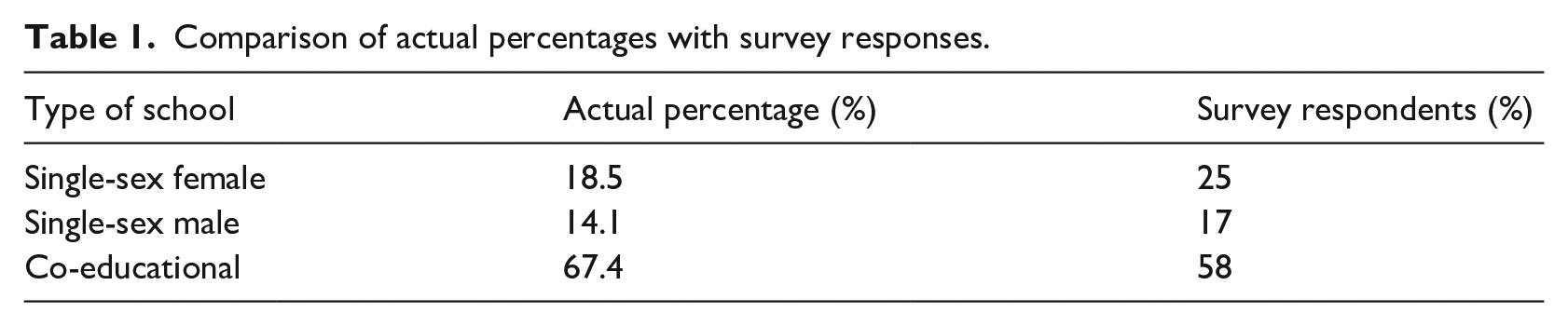
Participants were chosen by quota sampling to generate a sample equivalent to the overall population. Quota sampling is a non-probability sampling method used to find representatives of a population in the relative proportions in which they occur (Robson and McCartan, 2017). This approach involves three stages: identifying the factors occurring in the wider population which must occur in the sample, determining the proportions in which these factors appear in percentage terms and ensuring the percentaged proportions appear in the sample (Buckingham and Saunders, 2004; Cohen et al., 2007). The quota was derived from DES statistics, which showed there were 714 post-primary schools in Ireland, 481 co-educational, 132 single-sex female and 101 single-sex male (DES, 2018). Therefore, the quota amongst participants was 67.4% for co-educational schools, 18.5% for single-sex female schools and 14.1% for single-sex male schools.
The high turnover of CSPE teachers has been identified as a challenge facing the subject (Jeffers, 2008) and this has been borne out in DES subject inspections (DES, 2008). Considering this, the target population was CSPE co-ordinators in schools and members of the Association of CSPE Teachers (ACT) as these teachers would be expected to be more consistently involved in teaching the subject and in overseeing how it is taught in schools. The survey was circulated in October 2018 and all results were collected by the end of November. Initially, postal surveys were addressed to named co-ordinators in 40 schools and an online version on Survey Monkey was circulated to members of the ACT. The response rate to both was poor. Consequently, the online survey was emailed to the CSPE co-ordinator in a further 450 schools. These schools were chosen to meet quota requirements. The response to the 450 online surveys was significantly higher. Respondents were given 2 weeks to return the postal questionnaires. Reminder emails were sent via Survey Monkey after 6 days, and a final reminder was sent 6 days later. In total, 223 responses were received. Table 1 shows single-sex schools were overrepresented and co-educational were underrepresented in the final figures.
Comparison of actual percentages with survey responses.
Coefficient alpha testing in SPSS was used to achieve internal consistency reliability. The result for the attitude questions appeared low α 0.60. Deletion of items would have led to little change in the score, so all items were retained. The attitude questions were analysed using a two-way ANOVA. The Section 2 questions were analysed using chi square statistical tests. The open-ended questions were analysed using thematic analysis.
Findings
Teacher gender was 69.5% (N = 155) female and 30.55% (N = 68) male. School gender (Figure 1) was 16.1% (N = 36) single-sex male, 26% (N = 58) single-sex female and 57.8% (N = 129) co-educational.
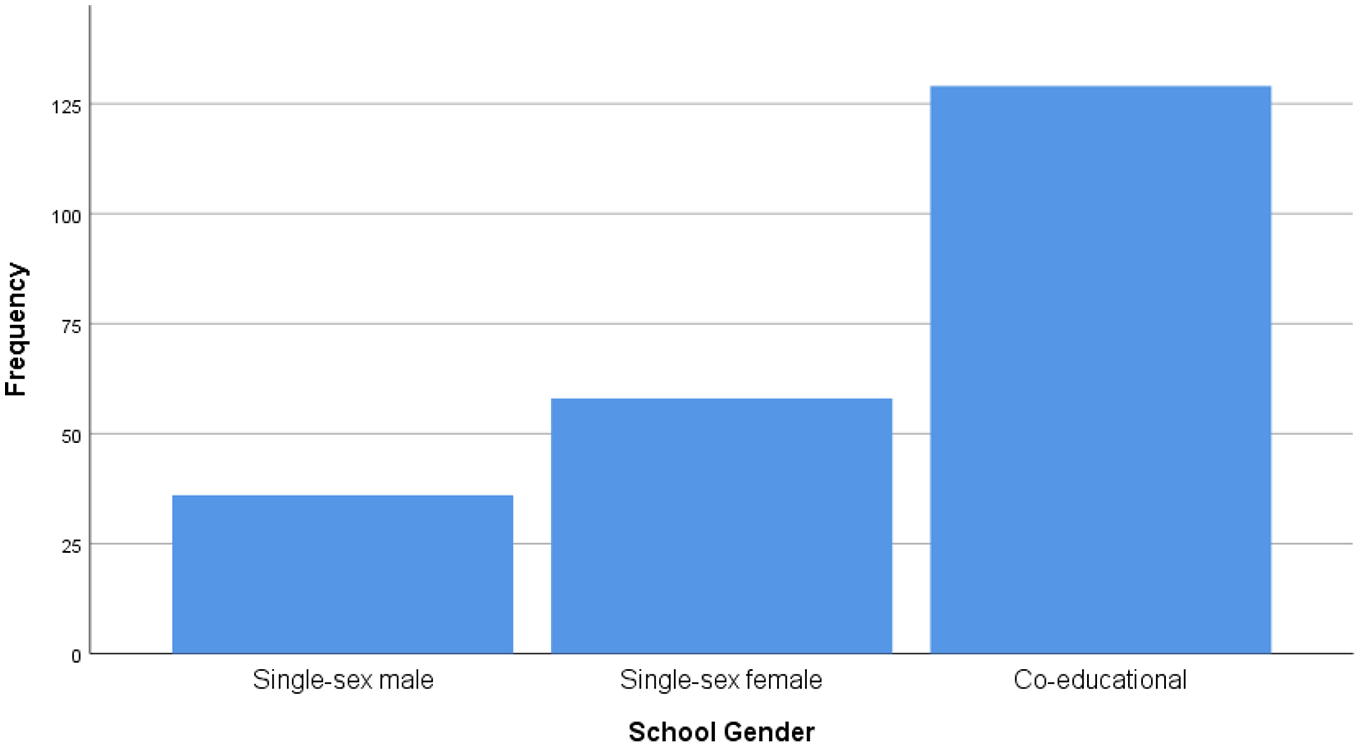
Bar chart showing school gender.
Statistical analysis
Twelve questions were developed to identify measures of teachers’ attitude towards CSPE. The responses were given on a five-point Likert scale ranging from strongly agree, to strongly disagree. Normality testing of the attitude scale was conducted to determine whether to conduct parametric or non-parametric testing (Pallant, 2007). Ghasemi and Zahediasl (2012) suggested that normality be evaluated visually and with the Shapiro-Wilk test. The histogram and normality curve showed a normal distribution and the Shapiro-Wilk test found a significance level of 0.23, which indicates normal distribution. The attitude scale therefore indicates a normal distribution.
The first test examined the effect of school gender on the overall attitude of CSPE teachers. Given that school gender was being tested, it was also decided to test whether the gender of the teacher affected the overall attitude. The hypotheses tested were:
H1 There is a difference in overall attitude towards CSPE by school gender.
H10 There is no difference in overall attitude towards CSPE by school gender.
H2 There is a difference in overall attitude towards CSPE by teacher gender.
H20 There is no difference in overall attitude towards CSPE by teacher gender.
H3 The effect of school gender on overall attitude towards CSPE does not depend on the effect of the gender of the teacher.
H30 The effect of school gender on overall attitude towards CSPE does not depend on the effect of the gender of the teacher
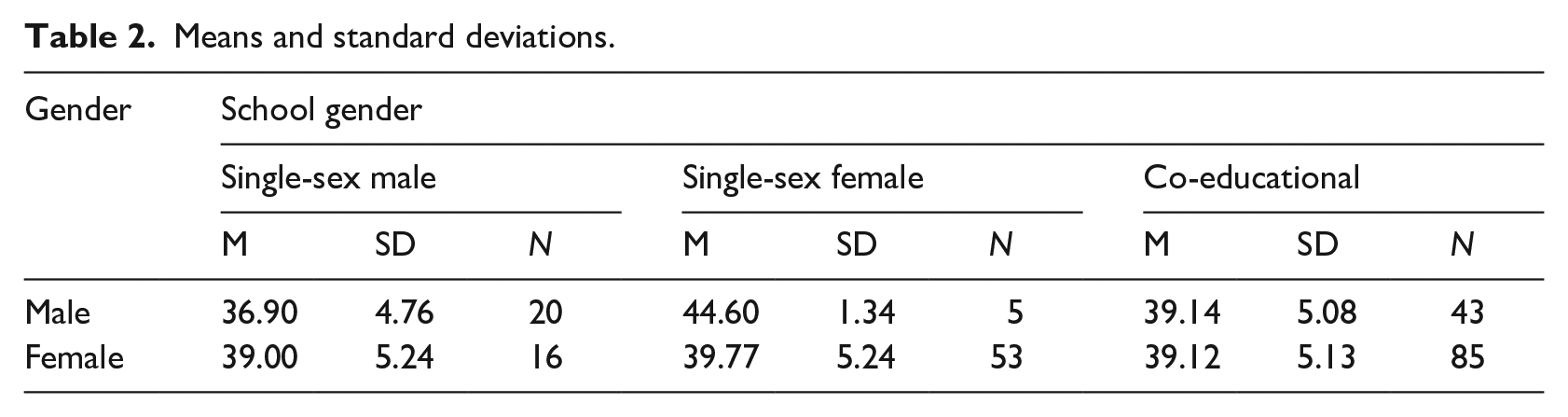
A two-way ANOVA was conducted on the influence of two independent variables (teacher gender and school gender) on CSPE teachers’ attitude towards CSPE. School gender included three levels (single-sex male, single-sex female, co-educational) and teacher gender consisted of two levels (male, female). The main effect for teacher gender yielded an F ratio of F (1, 216) = 0.79, p = 0.38 indicating that the effect for teacher gender was not significant – male (M = 38.88, SD = 5.14), female (M = 39.33, SD = 5.22). There was a significant main effect of the school gender on teachers’ overall attitude towards CSPE, F (2, 216) = 4.17, p = 0.017. Pairwise comparisons revealed that the teachers’ attitude was significantly higher in single-sex female schools than in both single-sex male (p = 0.004) and co-educational schools (p = 0.019). There was no significant difference in teachers’ attitudes in single-sex male schools and co-educational schools, p = 0.232. The interaction effect was not significant F (2, 216) = 2.77, p = 0.065. These figures are shown in Tables 2 and 3.
Means and standard deviations.
ANOVA summary table for variable 1.
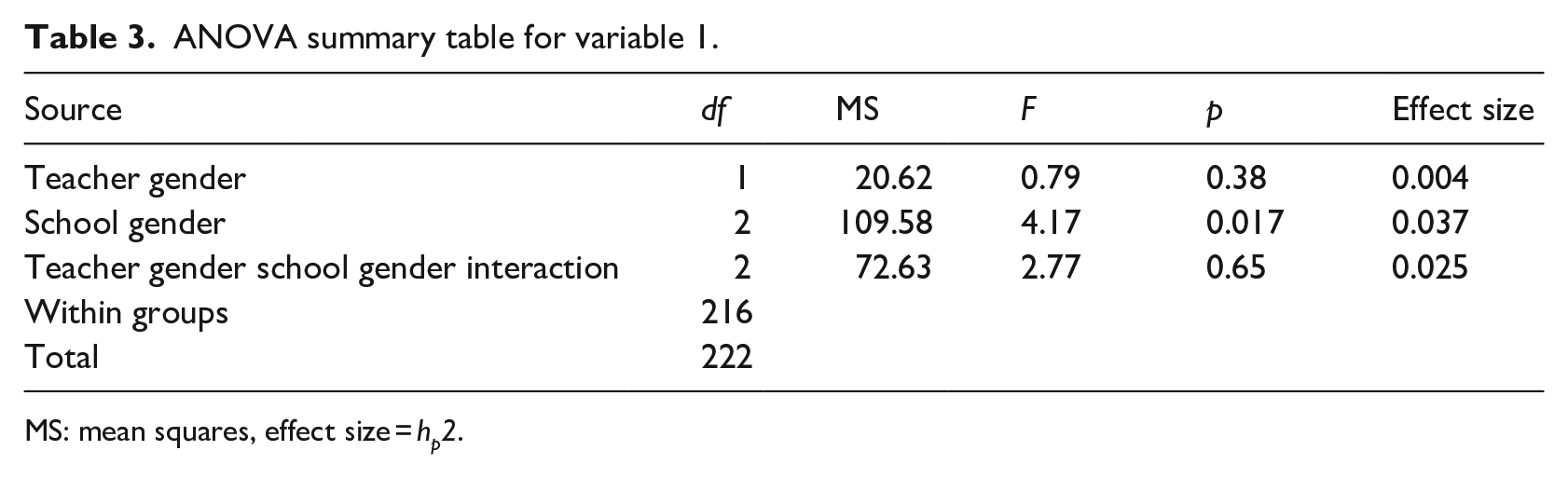
MS: mean squares, effect size = hp2.
Chi-squared tests of association were conducted on 12 aspects of teaching CSPE related to the classroom and CSPE school experiences. Four were found to be significant. The significant results are shown in Table 4 and the complete results are in the Appendix. The following outlines the significant findings.
Significant chi square test results based on school gender.
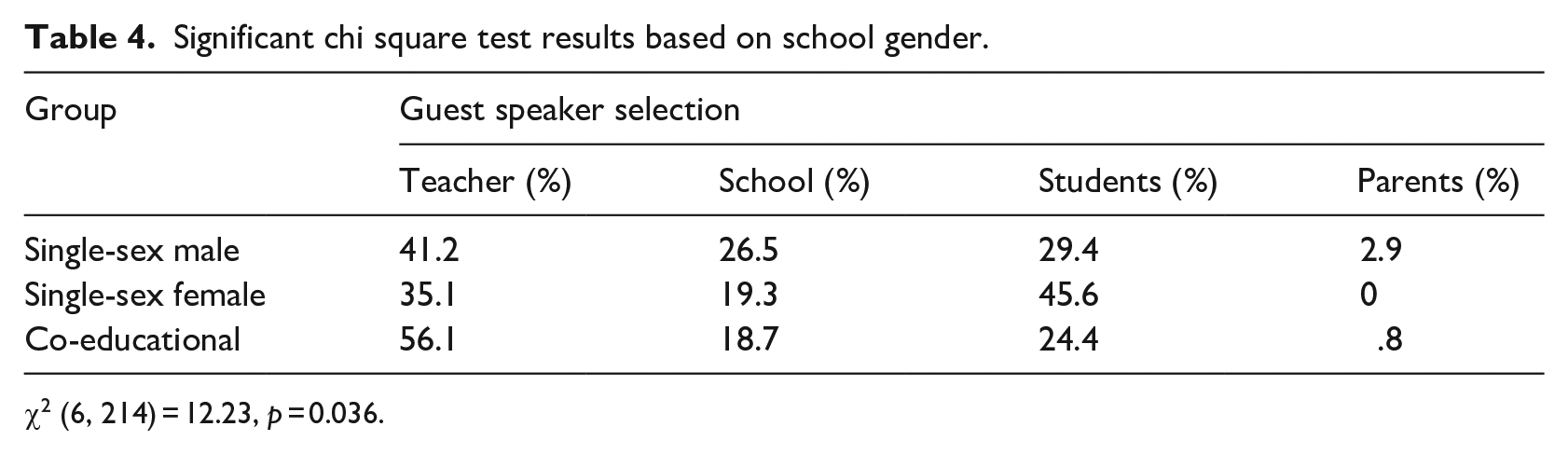
χ2 (6, 214) = 12.23, p = 0.036.
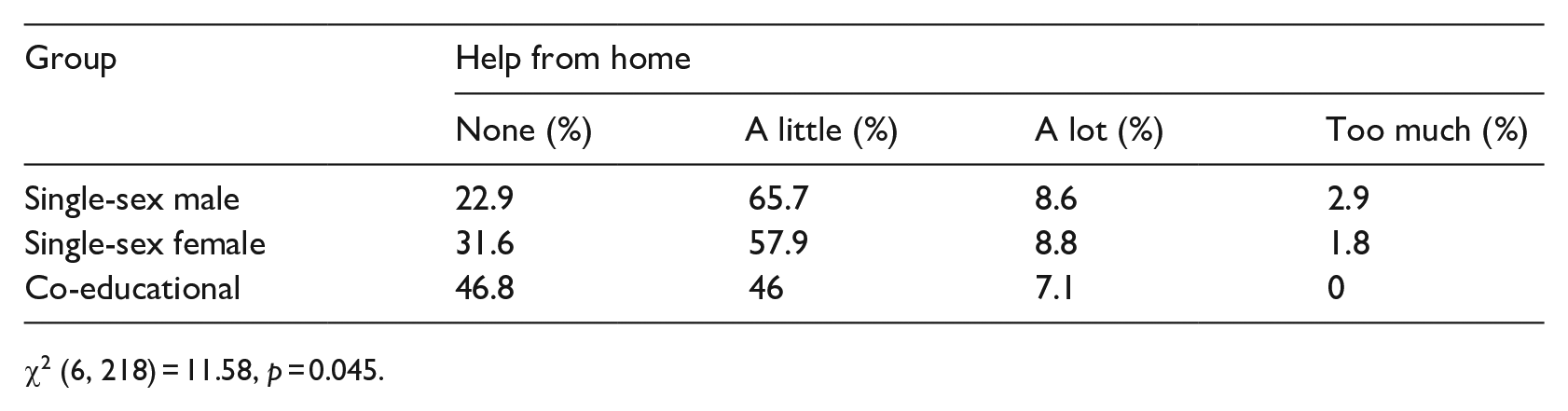
χ2 (6, 218) = 11.58, p = 0.045.
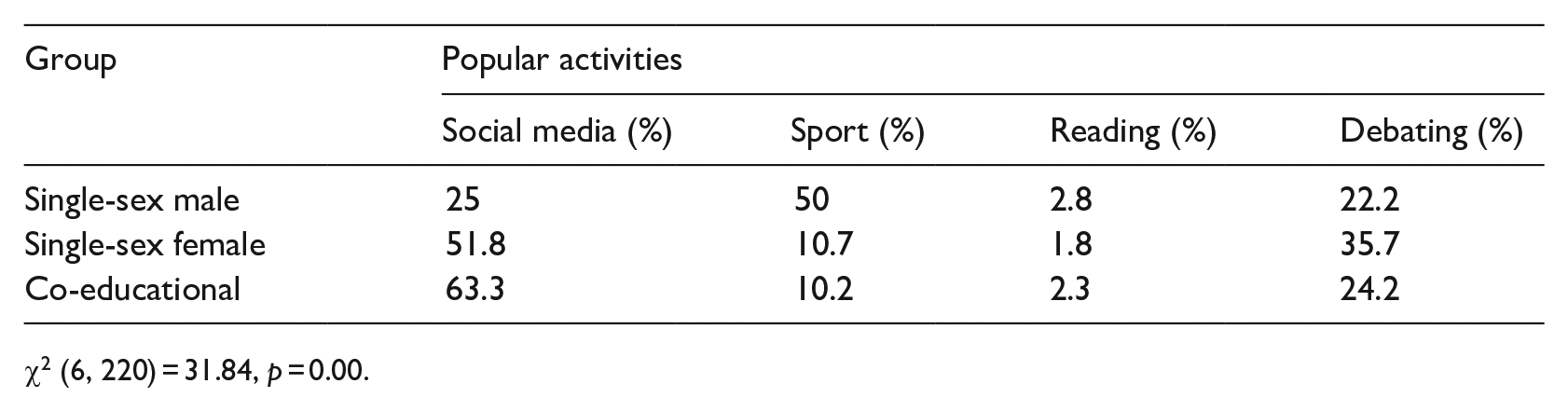
χ2 (6, 220) = 31.84, p = 0.00.
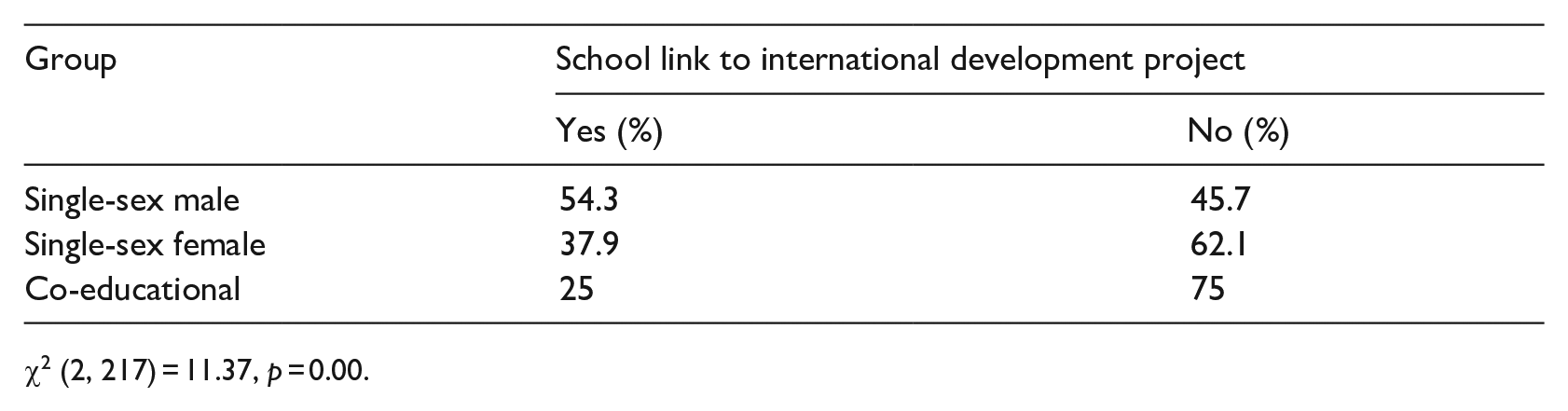
χ2 (2, 217) = 11.37, p = 0.00.
In co-educational schools, the decision to choose the guest speaker was made by the teacher in 56.1% of cases, compared with 41.2% for single-sex male schools and 35.1% for single-sex female schools. The decision was made by the school in 26.5% of single-sex male schools, whereas it was 19.3% in single-sex female schools and 18.7% in co-educational schools. The choice was made by students in 45.6% of single-sex female schools, whereas it was 29.4% in single-sex male schools and 24.4% in co-educational schools. In single-sex male schools, 2.9% reported that parents made the decision as opposed to 0.8% in co-educational schools and 0% in single-sex female schools. The results of the chi-squared test (4 × 3) show that there is a significant association between school gender and guest speaker choice χ2 (6, 214) = 12.23, p = 0.036. The effect size was measured by Cramer’s V, and was a medium effect (0.17; Cohen, 1988).
In co-educational schools, 46.8% reported that students received no help from home, as opposed to 31.6% in single-sex female schools and 22.9% in single-sex male schools. In single-sex male schools, 65.7% said they got a little help as opposed to 57.9% in single-sex female schools and 46% in co-educational schools. In single-sex female schools, 8.8% said students received a lot of help from home. The equivalent figures were 8.6% in single-sex male schools and 7% in co-educational schools. In single-sex male schools, 2.9% replied that students received too much help from home as opposed to 1.8% in single-sex female schools and 0% in co-educational schools. The results of the chi-squared test (4 × 3) a significant association between school gender and help from home χ2 (6, 218) = 11.58, p = 0.045. The effect size was measured by Cramer’s V, and was a medium effect (0.16; Cohen, 1988).
In relation to popular activities, 63.3% in co-educational schools rated social media as their pupils’ favourite activity, as opposed to 51% in single-sex female schools and 25% in single-sex male schools. Sport was rated as the most popular activity in 50% of single-sex male schools, but only 10.7% in single-sex female schools and 10.2% in co-educational schools. Reading was rated as the most popular activity by 2.8% in single-sex male schools, 2.3% in co-educational schools and 1.8% in single-sex female schools. Debating was rated as the most popular activity by 35.7% of teachers in single-sex female schools, whereas the figures for co-educational schools were 24.2% and 22.2% in single-sex male schools. The results of the chi-squared test (4 × 3) show that a significant association between school gender and popular activities χ2 (6, 220) = 31.84, p = 0.000. The effect size was measured by Cramer’s V, and was a medium effect (0.3; Cohen, 1988).
Of single-sex male schools 54.3% are involved in an international development project, whereas the figures for single-sex female schools was 37.9% and 25% for co-educational schools. The results of the chi-squared test (2 × 2) show a significant association between school gender and school involvement in an international development project χ2 (2, 217) = 11.37, p = 0.003. The effect size was measured by Cramer’s V, and was a medium effect (0.23; Cohen, 1988).
The results show that the responses to these four questions were dependent on the school gender. Single-sex female schools were significantly more likely to allow students to select the guest speakers, co-educational schools were significantly more likely to report that students receive no help from home and in single-sex male schools sport was significantly more likely to be reported as a popular activity and the school was significantly more likely to be involved in an international development project. In each case, the school gender played a medium role in how the respondents replied to the question.
Thematic analysis
Responses to the open questions were analysed using Braun and Clarke’s (2006) six-step thematic analysis, which involves searching across a data set to find repeated meaning patterns. Three major themes emerged: challenges in teaching CSPE, social responsibility and politics (Figure 2).
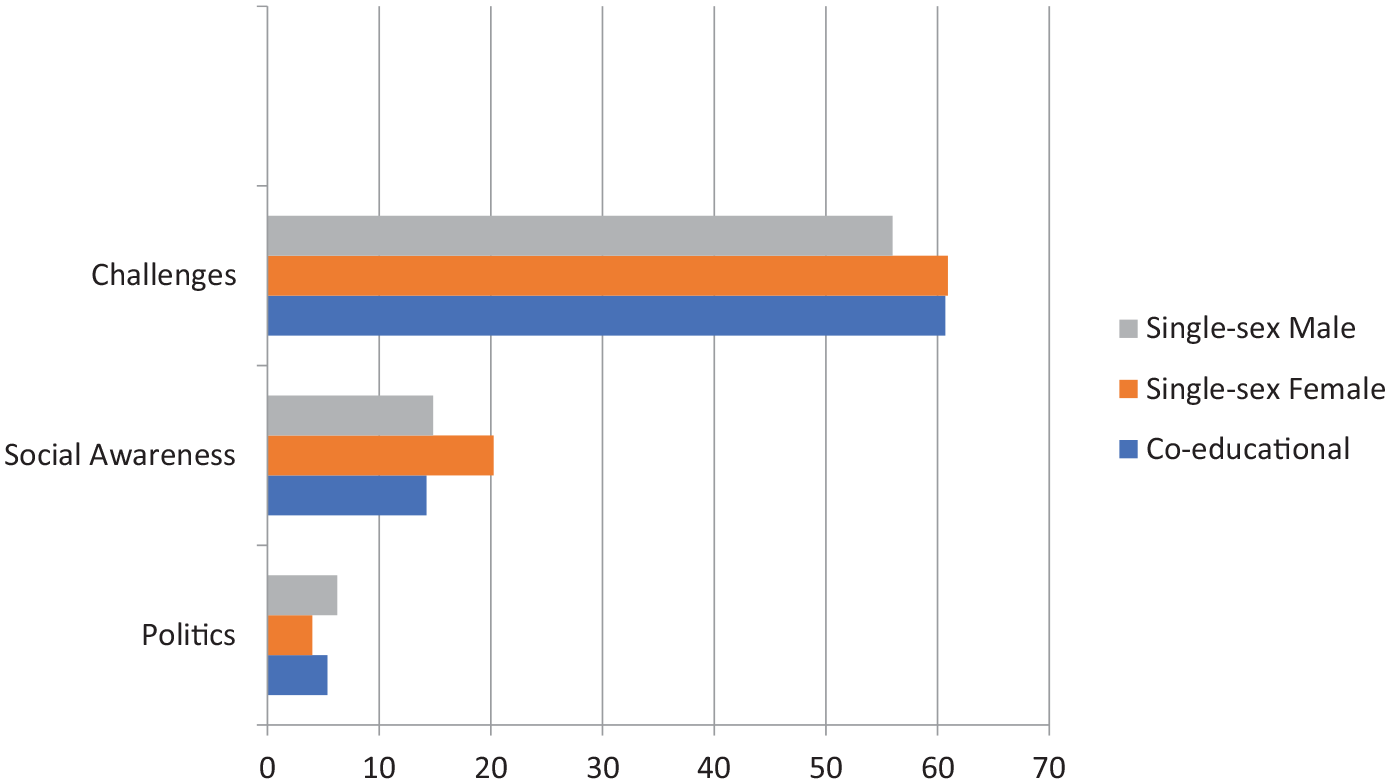
Thematic analysis for school gender coding.
Challenges
The predominant theme across all school types was the challenges of teaching CSPE, which were grouped into three sub-categories: lack of status, stereotypical beliefs or lack of knowledge from home and relevance. Some minor differences emerged. Teachers in single-sex female schools were less concerned about the lack of status in CSPE. Concerns about the lack of assessment for certification were higher in co-educational and single-sex female schools. Teachers in single-sex male schools were most likely to mention the challenge of making the subject relevant.
As the research questions focused on differences in teaching based on school gender and given that there were few differences between schools in terms of challenges, the findings will concentrate on social responsibility and politics where clearer differences emerged.
Social responsibility
Social responsibility included the subthemes active citizenship, rights, responsibilities and social awareness (Figure 3). Citizenship involved active community participation and knowing how things work. Social awareness focused on making pupils aware of their responsibilities and the plight of others. Rights and responsibilities were rarely referenced. Wellbeing was mostly mentioned as a curricular requirement, few respondents referred to it as a care issue.
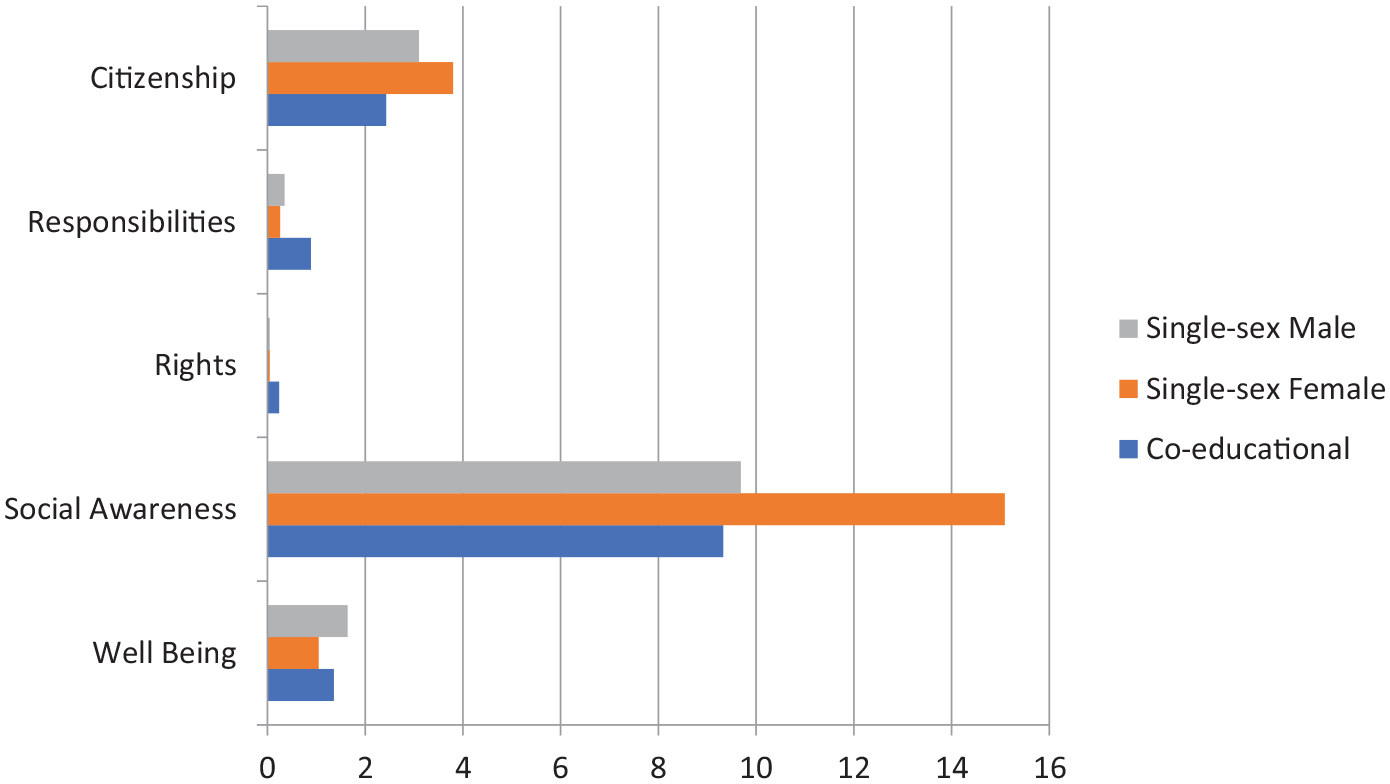
Thematic analysis for school gender social responsibility coding.
Social responsibility was highest in single-sex female schools at 20.25% compared with 14.25% for co-educational and 14.83% for single-sex male schools. The subtheme social awareness showed similar differences with 15.09% for single-sex female, 9.33% for co-educational and 9.69% for single-sex male schools.
Teachers in single-sex female schools emphasised the need for knowledge and skills to promote participation. Frequent reference was made to knowledge as a requirement for developing informed opinions and appreciating alternative viewpoints. Enabling discussion, encouraging reading, and harnessing social media were suggested as means of developing these skills and knowledge. Providing knowledge, interacting respectfully with others, being exposed to controversial issues and exploring causes of problems were the requirements for developing the skills needed to educate people capable of delivering change.
Teachers in single-sex male schools frequently mentioned the words ‘aware’ and ‘active’ in relation to social responsibility, suggesting that they do not merely know the issues but are doing something about them. The need to engender a social conscience was emphasised, as was learning how to take action in order to address problems in society. Organising measures to improve was promoted rather than examining root causes.
Teachers in co-educational schools were more likely to use the terms ‘aware’ and ‘exploration’. There was greater reference to consciousness and attitudes but less to specific skills or actions. Many respondents commented on the need to provide knowledge. Greater reference was made to pupils’ diverse backgrounds.
Politics
Politics had two main subthemes: political structures and elections and voting (Figure 4). Student voice was referenced but generally only in relation to student councils. Politics was most likely to be referenced in single-sex male schools and least likely in single-sex female schools. Some differences were detected on local, national and global issues, but the variation was small. Single-sex male schools were more likely to promote the subthemes political structures and elections and voting, and single-sex female schools were least likely to do so, but the differences were not large.
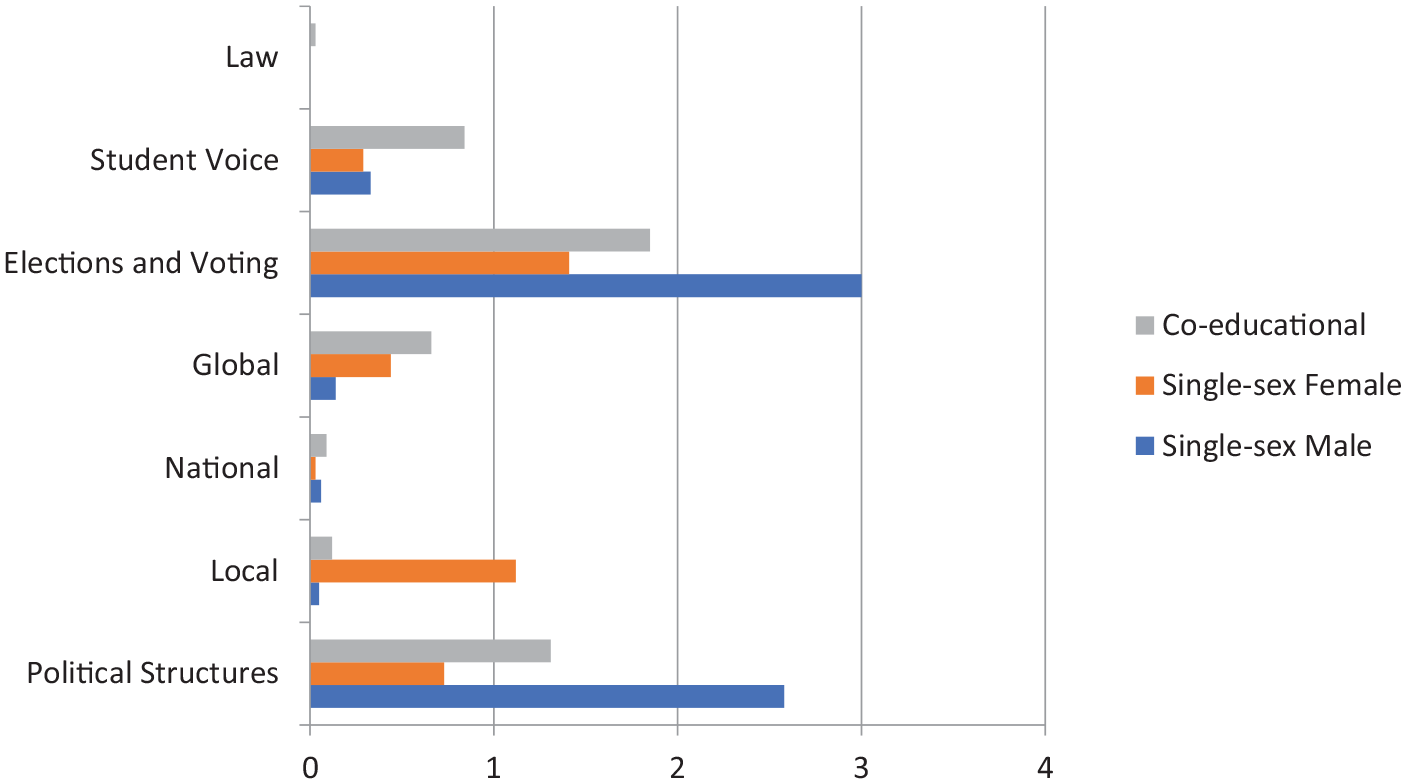
Thematic analysis for school gender politics coding.
In single-sex female schools, politics was linked to social responsibility. School-based leadership roles were used to promote political experience. The following example outlines some of these roles.
Students get to voice their opinions in school, it’s probably where they get their first taste of democracy, voting for prefect, for student council, Head Girl, etc, besides being on various committees e.g. Green Schools Committee, Peace and Justice Committee, Well Read Committee, being a Fifth Year student leader, Childline Fundraising Committee, working with SHARE every Christmas, working to help the Hope Foundation, etc.
The US and Irish presidential elections and topics such as water charges were chosen to generate student interest. Local issues were used to create interest in and understanding of national and global issues.
Teachers in single-sex male schools identified voting age as a challenge to the relevance of politics, whereas this challenge was not unusual to single-sex male schools; it was more common. Problems of irrelevance were frequently overcome by making students aware of an issue and following it by action. The following example looks at how conducting a mock election addressed the problem of irrelevance and engaged the students.
I have completed two mock elections for the Action Project and they really enjoy the process. They love seeing politics in action and feeling that they are a part of it. It also allows everyone in the class to take part as they are all in different committees. They are very enthusiastic and I have had students volunteer to go and make the ballot box in the woodwork room.
Teaching about voting started in school democracy and moved to national and global issues such as the Irish and US presidential elections. Political parties, the language of democracy and current affairs were often referenced. Politics emphasised political structures and voting; there was no reference linking this to social responsibility.
In co-educational schools, student voice was referenced more but only in relation to student councils. Positive comments focused largely on the election process rather than the council’s functioning. Respondents were frequently dismissive of the role they had in practice.
Student councils not genuine – set up in schools – some students not allowed to run in elections. No one at top levels want to hear their complaints so prefer non-functioning student councils which exist in name only
Topics such as the Irish presidential election, water charges, same sex marriage, LGBT issues and repeal were mentioned. Mock elections were used to help teach about voting. The difficulties of teaching political structures were frequently referenced. Using local issues to access national and global issues was often mentioned, but global issues beyond Donald Trump were not defined. The challenge of incorrect knowledge from home was more dominant in co-educational schools.
Discussion
This study finds some evidence of differences in the teaching of CSPE based on school gender. This has implications for young people’s citizenship, as teachers have a unique capacity to influence their students’ knowledge, attitudes and behaviour (Torney-Purta, 2002). Three indications emerge from the findings. First, in each school type, there is evidence of the three different types of citizenship being taught. Second, in single-sex female schools, there is a more positive attitude towards CSPE. Third, in line with social role theory, students in single-sex female schools are more likely to experience an education in CSPE which emphasises social responsibility whereas students in single-sex male schools are more likely to study politics.
Different types of citizenship
There is evidence of Westheimer and Kahne’s three types of citizenship being taught in each school type but at different levels. The findings indicate that student voice is promoted more in single-sex female schools, and the choice of guest speaker is most likely to be made by the students, indicating a more democratic classroom environment. Additionally, the most positive attitudes towards student government are in single-sex female schools. This has the benefit of providing experience of both voting and decision-making. Other school-based activities involving leadership are mentioned, such as membership in charitable committees and promoting literacy. Teachers in single-sex female schools may promote more than simple factual knowledge, moving to other levels of powerful knowledge as outlined by Jerome (2018). This is to be seen in the use of knowledge as a requirement for leading change, exploring causes, and developing people capable of delivering change.
The findings support Tormey and Gleeson’s (2012) conclusions that single-sex female schools place a greater emphasis on social responsibility. Politics is referenced less in single-sex female schools but is more likely to have the aim of using politics for social responsibility. Unlike previous studies (Coffé, 2013; Dow, 2009; Hayes and Bean, 1993), there is no difference in the type of politics referenced. The statistical tests indicate that single-sex female schools have no special focus on local issues, and the thematic analysis demonstrated how teachers in all school types used local issues to teach national and global issues. There are many features of participatory citizenship in single-sex female schools: student voice is promoted, student council and other student leadership roles are provided and there is greater student involvement in class-related decision-making. There are also some indications of justice-oriented citizenship, with reference to economic roots and possession of full facts from all sides, but this is often implied rather than explicit. There is less evidence of actions such as protests and letter writing.
In single-sex male schools, action is emphasised. This may be related to boys’ preference for active learning (Sukhnandan, 1999). Awareness of inequality is referenced, but there is a greater emphasis on doing things to help rather than addressing the causes. In line with other findings, politics is referenced more than in any other school type (Cosgrove et al., 2011). This may stem from the greater political interest amongst males (Bernstein, 2005; Brandtzaeg, 2017). Concerns about CSPE relevance are higher amongst teachers in single-sex male schools, suggesting a challenge to engage pupils; the emphasis on action seems to be a response to this. Elections and voting are more likely to be referenced but often viewed as irrelevant by pupils without the right to vote. Teachers aim to engage boys by mock elections. Yet mock elections rather than real elections to student councils are more likely to be promoted. Teaching about voting and politics increases likelihood of voting (Pontes et al., 2019; Torney-Purta, 2002) and participation in political activities (Manning and Edwards, 2014), whereas lesser political knowledge limits citizenship (Wolak and McDevitt, 2011). The contrast outlined by Coffé and Bolzendahl (2010) between male and female interest in politics is borne out here – the social responsibility focus viewing politics for improvement and social activism taken in single-sex female schools differs from the more general interest in political structures and voting in single-sex male schools. In the latter, action is taken to respond to social problems; for instance, pupils can experience international development projects. Action suggests a response but not one focused on sourcing and removing the root of inequalities. There is little evidence of a justice-oriented model being promoted in single-sex male schools, but the participative model is likely.
In co-educational schools, the teacher was most likely to choose guest speakers. There is a less favourable perception of the efficacy and autonomy of the student council. The words most frequently used are ‘aware’ and ‘explore’. These suggest exposure to issues but not necessarily action. There is some reference to social responsibility, but this is not supported by specific examples. In politics, a broad approach is evident, including teaching facts, as well as concrete political issues such as Donald Trump, the Irish presidential election, repeal and same-sex marriage. There were suggestions that social issues are more of a challenge because of students’ backgrounds. Moreover, the lack of exposure to topics and inaccurate information coming from the home is referenced more in co-educational schools. These challenges seem to impinge on the teaching of CSPE and may influence the type of citizenship taught, which appears personally responsible but with less explicit references to participatory or justice-oriented citizenship.
Attitude towards CSPE
Statistical differences between school genders pointed to the greater value put on CSPE by teachers in single-sex female schools. This was not related to teacher gender. Thematic analysis supported this with teachers in single-sex female schools being less concerned by constraints such as lack of or incorrect knowledge from outside school and the low status of the subject. This indicates a confidence that CSPE, when properly taught, could overcome the challenge. This more positive view of CSPE appears shared by the school, teachers and students. Pupil response may have a bearing on this outlook. It has been shown that girls are more compassionate and more interested in finding meaning in life (Beutel and Marini, 1995). This suggests that they may be more interested in the message of CSPE. In addition, CSPE teachers have been found to be better exposed to diversity issues (Clarke and Drudy, 2006). Cosgrove et al. (2011) noted how girls saw the classroom climate as more open to discussion. These factors may help align the interests of students and teachers. Furthermore, teachers’ perceptions of their pupils impact their teaching (Farkas et al., 1990; Gordon et al., 2008; Jones and Myhill, 2004; Martino et al., 2004). Tormey and Gleeson (2012) highlighted that most single-sex female schools were founded by female religious orders that focused on care issues, unlike single-sex male schools which prioritised academics.
Social role theory
Some indications of the influence of social role theory are evident in single-sex schools with greater prominence given to politics in boys’ schools, and a more pronounced emphasis on social responsibility in girls’ schools. Politics implies leading, whereas social responsibility implies care. However, the findings demonstrate that teachers in single-sex female schools prioritise social responsibility which is political, that is, using politics to deliver change. Girls are given leadership roles in schools, are consulted more, are given decision-making opportunities and consider causes of problems. This is not evident in other school types and goes against Fox and Lawless’s (2014) suggestion that males were more likely to experience leadership roles that would promote their political ambition. In single-sex male schools, there is greater emphasis on taking action and politics, but politics seems to be a more abstract concept and is not driven by social responsibility. These findings suggest that the female gender role may be evolving, with girls being educated to become more politically active, however, the motivation for this stems from care issues. This development has the potential to create an imbalance in young people’s capacity to act in an informed manner. Girls are encouraged to take political action for a cause, given experience of decision-making roles and examine sources of problems. These factors provide them with the skills and knowledge to know how to take action and why. Boys gain political knowledge and the skills to take action, but without identifying motivations for taking political action, having less opportunities to be involved in decision-making in schools and less understanding of the root causes of issues, they may know how to act, but not why.
Conclusions
This study has identified differences in the approach of CSPE teachers based on the school gender. Girls educated in single-sex girls’ schools are more likely to experience CSPE aligned with participatory and justice-oriented citizenship; boys in single-sex male schools experience a participatory and action-focused CSPE; and students in co-educational schools encounter elements of personally responsible and participatory citizenship. The type of citizenship education has a bearing on students’ experience of citizenship, for instance boys educated in single-sex schools develop skills in organising action, whereas girls educated in single-sex schools have a greater opportunity to contribute to issues and understand why they are taking action.
A limitation of self-completion surveys is their reliance on espoused views. Argyris and Schön (1974) distinguished between espoused theory of action and theory-in-use. Espoused theory is the answer a respondent gives to how they would behave under certain conditions, which may differ consciously or subconsciously from their practice. Theory-in-use can only be measured by observations, not by asking. An ethnographic method would have yielded greater information on the respondents’ practice. In addition, the results are based on quota sampling and not generalisable.
This study has identified differences in the teaching of CSPE in schools of different genders and what these differences look like. There is a need for further research to examine why these differences exist and how such differences impact students’ experience of citizenship. Finally, the volume of responses outlining the challenges of teaching CSPE needs to be addressed, with particular emphasis on the challenges raised in co-educational schools.
Footnotes
Appendix
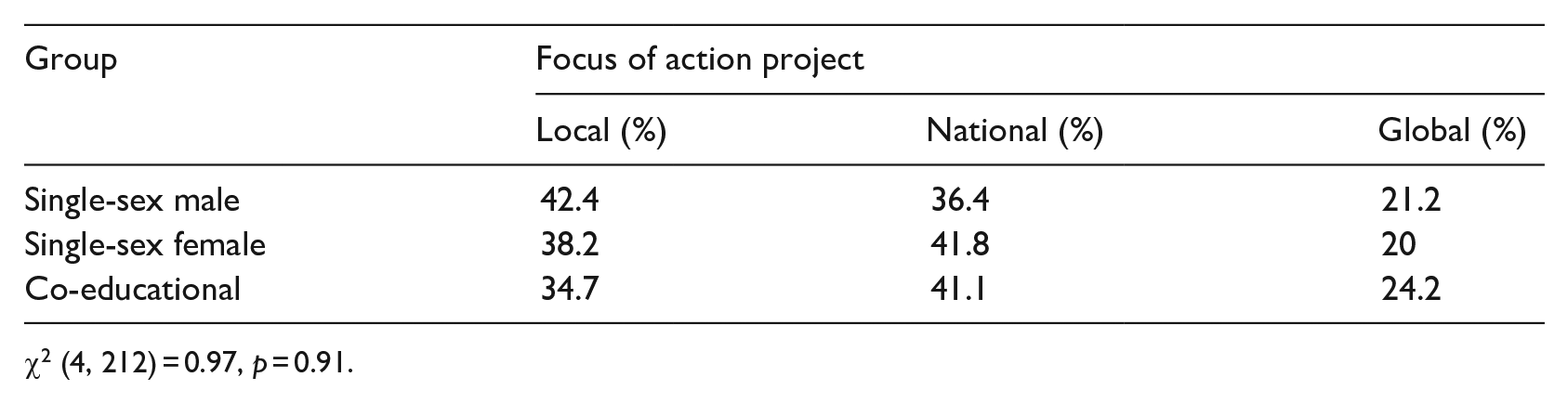
| Group | Focus of action project | ||
|---|---|---|---|
| Local (%) | National (%) | Global (%) | |
| Single-sex male | 42.4 | 36.4 | 21.2 |
| Single-sex female | 38.2 | 41.8 | 20 |
| Co-educational | 34.7 | 41.1 | 24.2 |
χ2 (4, 212) = 0.97, p = 0.91.
Declaration of conflicting interests
The author declared no potential conflicts of interest with respect to the research, authorship, and/or publication of this article.
Funding
The author received no financial support for the research, authorship, and/or publication of this article.
