




Abstract
Democratic school systems are expected to equip students with the knowledge, abilities, and attitudes needed for life as citizens, particularly through social science education. Disciplinary knowledge, derived from the academic counterparts to school subjects, is essential in developing these skills. However, research has also emphasized the importance of life-world perspectives, where students’ experiences are included and taken seriously in teaching. This study suggests that the theory of (civic) narrative competence can function as a bridge between the disciplinary domain and the life-world domain in its focus on how students’ civic reasoning can be developed through teaching. The article uses narrative theory to explore how the students’ civic narratives changed and became more nuanced after a teaching segment focusing on social and political trust. In the article, we demonstrate how the students’ personal experiences colored their interpretations and orientations before the teaching segment and how their civic narratives were developed through the implemented teaching, which provided them with concepts, a theoretical model, and empirical examples. We found that the students did not discard previous perceptions after the teaching segment, but integrated them into their new knowledge and orientations, thus integrating the life-world and disciplinary domains.
Keywords
Introduction
Schools are assigned the task of preparing young people for life in democratic societies, particularly through social science education. This assignment often emphasizes the importance of developing the knowledge and abilities young people need to use as citizens (Gutmann & Ben-Porath, 2015). This assignment can be described as a matter of developing students’ knowledge and abilities through teaching, often grounded in powerful knowledge from disciplinary communities such as political science, sociology, law, and economics (Sandahl, 2020; see also Young, 2013; Young & Müller, 2013). By enquiring into social issues, students are expected to develop critical thinking through a disciplinary lens and to understand and discuss values related to such matters (Barton, 2017; Sandahl, 2019). However, these disciplinary aspects of social science education are often supplemented with an ambition to include students’ own experiences and ideas about society in order to stimulate their involvement. This ambition, highlighted in political education (Christensen & Grammes, 2020; Reinhardt, 2016; Wehling, 1977), invites life-world experiences and encourages students to discuss, deliberate, and reach their own conclusions regarding societal issues.
In social science educational research, the relationship, and possible tensions, between the domains of the life world and the scientific disciplines has been widely debated (Englund, 2006; Jay, 2022; Mason & Metzger, 2012). To simplify somewhat, two primary approaches to the question of how these domains might be integrated can be identified. The first approach emphasizes the role of disciplinary knowledge, whereby education takes students beyond their own experiences and enables them to understand societal issues through a disciplinary and academic lens (Journell et al., 2015; Sandahl, 2015, 2020). The second approach underlines the role of deliberative discussions in highlighting “the political” in social issues (Englund, 2006; McAvoy & Hess, 2013). These two approaches intersect and aim to connect the processes of developing young people’s understandings with disciplinary concepts and practices, while providing space for reflection and life-world perspectives. However, the two approaches emphasize either the life world, or the disciplines, as the most important arena for social science education. For Jay (2022), this divide is central to social studies education, and he argues that it can be described as “an ongoing schism” (p. 354). Bridging this divide is not a question of methodology but should rather be seen as a theoretical challenge. However, few theoretical attempts to bridge the two domains have been made, to find a model for teaching that enables students to use their experiences while simultaneously developing qualified and disciplinary-rooted understandings of societal issues and orienting in relation to those issues.
This study begins with the historian Rüsen’s (2005, 2017) theory of narrative competence. In Rüsen’s narrative paradigm, the life-world domain is linked to the disciplinary domain through three distinct and interrelated aspects, or mental processes: experiencing, interpreting, and orienting. This narrative paradigm was shaped for history education in order to understand historical narratives, but we argue that it has the potential to distinguish and understand civic narratives as well. In this study, the concept of civic narrative refers to narratives constructed by students, which relate to the feelings, reflections, and duties that students have because they belong to, or aspire to belong to, a community or society, or to become citizens. In order to follow the students’ narrative processes and to understand how their arguments are developed, while providing them with new orientations, this article charts students’ encounters with the phenomenon of social and political trust. The study reports on focus group interviews conducted before and after a teaching segment in two upper secondary schools. Two social science classes at each school were involved, and the schools are situated in two different socio-economic settings.
The article’s purpose is to contribute to developing narrative theory in social science education research. We argue that civic narrative theory can potentially connect students’ life-world perspectives with the schools’ assignment of developing their conceptual and disciplinary knowledge of the social sciences through social science teaching. The article explores and describes the process of developing students’ civic narrative competence in social studies education. The students’ narratives were studied empirically through the concept of social and political trust, before and after a teaching segment that addressed these concepts. Hence, two research questions were formulated: (1) How did the students’ civic narratives change due to the teaching? and (2) How do the student groups’ civic narratives differ, and what may be the reasons for those differences? The research questions include the process of understanding how students’ civic narratives were developed, and how their perceptions and knowledge of trust as an object of learning changed.
Social Science Education as Citizenship Education
Most western democracies give schools an explicit assignment to address contemporary social issues through a specific school subject, but these subjects are shaped and formed differently. In some cases, citizenship education/democracy education assignments are formulated as a broad cross-curricular aim, as in England (Andrews & Mycock, 2007; Kerr, 2003), but it is more common to assign the task to specific subjects. One such subject is US/Canadian “social studies,” where contemporary subjects share space and time in the syllabus with history education (Barton, 2012; Barton & Avery, 2016). Another approach is a more narrowly constructed subject, such as the German/Nordic version, where social science education is based on political science, sociology, law, and economics (Sandahl et al., 2022), and focuses primarily on contemporary issues. However shaped, these subjects often share a common focus on human activity in past and present societies and aim to equip students with the necessary knowledge and skills to enquire into social, economic, and political issues, while considering the role of values in such matters (Barton, 2012; Sandahl, 2020).
As the school subject of social science encompasses several academic disciplines, the necessary knowledge, and skills can be described as substantive and procedural knowledge whereby students are taught to engage with specific content and use social-scientific tools to develop their understanding of social issues. Education in and about contemporary social issues will inevitably invite students to engage their interests, experiences, normative conclusions, and processes of meaning-making. This turns the school subject of social science into something different than a reduced version of its academic counterparts. In social science/social studies educational literature, there has been an extended discussion about how the “disciplinary world” and the “life-world” should be integrated. Often, however, one perspective or the other has been more strongly emphasized and advocated, although social science researchers are commonly interested in converging the two approaches.
Advocates of a disciplinary perspective typically emphasize knowledge originating from “epistemic communities,” that is, academic specialists like political scientists, sociologists, or economists, who engage in understanding political, social, and economic issues. Over the last decade, several researchers have used Young’s (2013), Lambert (2017), and Young and Müller (2013) terminology from his work on powerful knowledge to pinpoint the importance of disciplinary perspectives. Young argues that specialized knowledge explains the world better than everyday knowledge and experiences. In contrast to everyday understandings, disciplinary knowledge is grounded in evidence, is reliable (yet dynamic and evolving), testable and exists outside the direct experience of teachers and learners. In other words, it needs to be learnt and practiced because it will not naturally become part of students’ experiences (Lambert, 2017, p. 24). The strength of disciplinary knowledge does not lie in subject content per se but in the procedural skill of understanding how knowledge is obtained through discipline-specific and systematic thinking. In social science education, it has been suggested that this procedural knowledge consists of second-order thinking concepts or high-order thinking (Barton, 2017; Sandahl, 2015; see also Newmann, 1990). We return to these below when we conceptualize the disciplinary world in the theory section.
One key argument in the disciplinary approach is that specialized knowledge can provide students with perspectives and understandings that cannot be obtained elsewhere. A critique of the approach is that it does not become meaningful to students because there is a “top-down” perspective, meaning that normative issues and students’ experiences become more of a problem than an asset in teaching (Roberts, 2014). In political education, this critique can be condensed to the third principle of the Beutelsbach consensus, in which students’ interests are highlighted. This consensus refers to a German agreement on three principles for political education, whereby teaching should: (i) avoid the indoctrination of students, (ii) treat controversial issues as being fundamentally controversial, and (iii) give weight to the students’ personal interests (Christensen & Grammes, 2020; Reinhardt, 2016; Wehling, 1977). The third principle raises the question of how students’ interests should be given weight and attention in the classroom, that is, how life-world perspectives should be invited. The concept of the life world is addressed in the theory section.
One recurring suggestion is to allow for deliberation in the classroom, implying that, through “mutual and carefully-balanced consideration of different alternatives’ (Englund, 2006, p. 506), students should become involved in conversations with peers around observations and conclusions. In this approach, students’ experiences and interests are at the heart of social science education, with the goal of generating high-quality conversations and inviting students to identify the effects of those experiences and interests on their future political and civic engagement (McAvoy & Hess, 2013). In deliberative approaches, all discussions should end in a temporary consensus, and the teacher is an important facilitator and moderator of such discussions (Englund, 2006; Samuelsson, 2018). A closely related tradition is agonism (originating from Mouffe, 2013), where the general goal is similar. Still, the outcome is different in its emphasis on non-consensus, with students learning to accept and channel conflicting ideas positively (and thus is more likely to reflect the “reality” of political life, see Tryggvason, 2018). These approaches have been theoretically explored by researchers, who have discussed merits, disadvantages, and efficiency (for an overview, see Koutsouris et al., 2022; Samuelsson & Bøyum, 2015; Tryggvason, 2021).
Advocates for the disciplinary and life-world perspectives, respectively, share the notion that these domains are not necessarily in opposition but instead represent two sides of the same coin. Knowledge is needed to engage in high-quality discussions, and most social issues are deeply embedded in values and emotions, and thus must be dealt with through other means than disciplinary tools (Englund, 2006; Sandahl, 2020). Few scholars in social science education have explored theoretical models designed to integrate these domains into teaching (Jay, 2022). We suggest that the theory of narrative competence is a way to move forward.
A Narrative Approach
This study begins with the narrative paradigm and an understanding of humans as homo narrans (Fisher, 1984). This refers to the perception that storytelling is at the core of human existence and that the process of learning and communicating knowledge is narrative in nature. A closely related point of departure is Somers’ (1994, pp. 613–614) understanding that social life “is storied and that narrative is an ontological condition of social life.” This implies that humans tell stories and understand social and societal phenomena and changes through narratives and narrating. Narratives can be more or less based on (scientific) evidence as individuals make sense and meaning out of their place in society. In historical philosophy, this mental process has been conceptualized as historical consciousness (Rüsen, 2017).
Historical consciousness has become an essential theoretical paradigm for understanding meaning-making processes in history, and the role of history education, particularly how it can help students to develop their historical narrative competence. The process of narration can be described through three distinct but interwoven aspects: experiencing, interpreting, and orienting. Narration is an inevitable part of social life, and narratives are constructed and communicated with or without education as we experience societal phenomena and try to make sense of them by interpreting them with the tools and concepts we have at hand. The starting point of this mental process is important to consider because the questions we ask, and try to understand, originate from the life-world domain.
The life world is where humans construct meaning from social reality (Schutz & Luckmann, 1973). Therefore, knowledge is intertwined with feelings and identity is continuously formed by an individual’s experiences. Individual experiences and interpretations of society are often initiated by changes or challenges in society, which pose questions that demand answers. The individual’s previous experiences and knowledge are used to interpret what is being perceived in order to answer these questions. The individual’s interpretations form representations that signify new understandings, which guide his/her actions in relation to the perceived phenomenon. In other words, experiencing and interpreting societal phenomena provides the individual with new orientations. The process of experiencing, interpreting, and orienting is iterative and constitutes a natural part of our existence as we form meaningful narratives to understand the world. In line with the narrative paradigm, we storify the social world when we convey our understandings in conversations with others. Hence, the life world is the foundation for students’ perceptions and experiences, and questions emanate from this life world in the same way as new orientations integrate with this part of the self.
For Rüsen (2005), the disciplinary domain, which provides concepts, tools, and practices, is critical for developing students’ narrative competence, especially their ability to interpret perceived phenomena. In social science education, the concepts, procedures, and practices of the social sciences are provided through teaching (Lambert, 2017; Sandahl, 2015). We refer to this process as developing the students’ civic narrative competence. In this context, civic narratives refer to narratives that students construct, which relate to feelings, reflections, and duties they have because they belong to, or aspire to belong to, a community or society. This process is commonly associated with civic education, which refers to acquiring the knowledge, skills, and dispositions needed for effective and responsible citizenship in democratic societies (McCurry-Mullins, 2008).
While students bring their experiences of social issues to the classroom, subject-specific teaching provides new and previously unknown experiences through disciplinary concepts that develop students’ understandings. In the present teaching design, a few so-called second-order concepts (thinking concepts) have been used as tools in the students’ analytical work. These include using evidence, models and theories, and perspective-taking (Sandahl, 2015, 2020). The students used these procedural and disciplinary tools to interpret social issues of trust. The students’ new understandings and knowledge become integrated into their life-world domain as new orientations. These orientations lead to some kind of action (including thinking), which may be explicit, or may remain implicit.
There is a dual nature to narrative competence that has to be dealt with. On the one hand, it is a theoretical description of the mental process of narration; on the other, it is an analytical concept for exploring empirical materials. The mental process of experiencing, interpreting, and orienting in relation to societal phenomena is iterative and continuous as we construct meaningful narratives in order to understand the world. The narrative process as an analytical tool evades this complexity by dividing the mental stages empirically; for example, as episodes through a teaching sequence. This implies that it is possible to describe teaching episodes by focusing on the aspects of experiencing, interpreting, and orienting separately. The staging of a specific task or exercise can focus on experiencing a societal phenomenon, although the staging will inevitably involve all three aspects simultaneously. In this paper, we have organized the analysis based on the assumption that narrative competence can be divided analytically into segments of experiencing, interpreting, and orienting, while observing the iterative power of narrative competence.
Methods and Empirical Materials
This study reports from a larger research project (VR, 2020), which focused on social and political trust in relation to critical citizenship. The research team consisted of two political scientists, two didactics scholars, and four social science teachers, who collaborated in developing a teaching module spanning five to 6 weeks of the social science two courses (Swedish: Samhällskunskap 2). The empirical materials consist of a survey, focus groups, observed lessons, teaching materials, and students’ essays. This article, however, only analyses interview transcripts from the focus groups before and after the teaching.
The two schools are somewhat different in character and were chosen to provide room for different student experiences and backgrounds. The two schools, designated “Tulip High” and “Rose High,” are located in the Stockholm region and situated in different social settings. Tulip High is located in an upper-middle-class neighborhood populated mainly by ethnic Swedes. Rose High is located in a lower-middle-class area with many first- and second-generation immigrants. Still, the schools are similar in that the students choose to attend the school by applying rather than being assigned there. The two schools are roughly the same size, with around 1,200 students each. However, the admission points differ between the schools: Tulip High had 302 to 315 points (max 340) and Rose High had 150 to 270. Hence, Tulip High can be regarded as more prominent in academic achievement (Upper Secondary Schools Admission Office in the Stockholm Region, 2018).
The four participating classes (a total of about 120 students) were part of a survey conducted before teaching. This revealed additional differences in the observed classes, which included the focus group students. Compared to the students at Rose High, the students at Tulip High had parents with higher education levels, a greater proportion of students self-identified as “Swedish,” and generally had higher levels of social and political trust. Female students were overrepresented in the participating classes (Rose High, 76%; Tulip High, 59%). The researchers conducted focus groups with six to eight students in each class before and after the teaching (see below). For this paper, transcripts from two of the focus group interviews were analyzed. The groups consisted of eight students (age 17 years) at Tulip High (four girls and four boys) and six students (age 17 years) at Rose High (five girls and one boy). The interviews lasted 45 to 68 minutes. They were audio-recorded and transcribed in full.
The focus group interviews were semi-structured to allow students to speak freely about issues related to trust. They comprised 18 prepared items organized under four themes relating to central aspects of social and political trust (Brinkmann & Kvale, 2015; Uslaner, 2018). The group interviews were fruitful, with students sharing their experiences from personal and public spheres. A standard critique of group interviews is that answers from respondents run the risk of becoming mainstream as the group tries to reach a consensus (particularly about what they think are the correct answers, see Acocella, 2012). Although individual students occasionally directed discussions, the researchers’ view was that their deliberations on the themes made it possible to “obtain new answers and unexpected opinions” (Acocella, 2012, p. 1132).
The focus group interviews enabled the researchers to investigate the narratives that students negotiated and constructed as a group. This is in line with the theoretical approach taken in this paper (Somers, 1994). In the first round of focus groups, an elicitation task was conducted to introduce and engage students. Elicitation (Barton, 2015) is a technique to encourage informants to talk about issues they are not familiar with, in this case, trust, by providing them with assignments where they focus on an external object. In smaller groups, the students were asked to arrange and rank six government agencies 1 (the police, the courts, schools, universities, elected politicians, and the media) and motivate their reasoning. The task became a vital introduction to the semi-structured questions and allowed the researchers to moderate discussions and direct conversations. The second round of focus groups started with questions about what the students had learnt and then continued with a discussion of trust and democracy, in line with the first round of interviews (see Appendix for the organization of the interviews). As participants in the project, the students had been informed of the nature of the project in full and the focus group interviews in particular. All students also signed a consent form.
The Teaching Design
The research project originated in the idea of introducing social and political trust, that is, trust between individuals and groups, and trust toward political institutions (Warren, 2018, p. 75) as suitable subject content for approaching government agencies and democracy issues. In international comparisons, Sweden and the Scandinavian countries reveal high levels of social and political trust (Holmberg & Rothstein, 2020), which are considered to be essential aspects of democracy and societal stability and development (Newton et al., 2018; Warren, 2018). Although Sweden possesses this high general level of trust, it can be seen to be unevenly distributed between regions and social groups; for instance, suburbs and social groups like the unemployed (Holmberg & Rothstein, 2020).
Social and political trust, and their importance for democracy, have been largely absent from curricula, syllabi, and social science textbooks in Sweden. The teaching design involved trust as a subject content and was taught in the ordinary social science course during the second year at two upper secondary schools. The teaching extended over 5 to 6 weeks and spanned a series of seven or eight lessons. The teaching was designed as an enquiry (Swan et al., 2018). This enquiry focused on social and political trust, and the roles of government agencies in a democracy were used as practical examples. As a methodological choice, the enquiry approach appeared to be particularly relevant because it has been common in research focusing on disciplinary and life-world aspects of social science education (Jay, 2022).
The enquiry approach focuses on the learner, who actively constructs knowledge by systematically exploring a topic or problem and uses various sources to substantiate claims (Swan et al., 2018). The approach requires teachers, as experts on investigating social phenomena, to mentor, and guide students (Holmberg et al., 2022; Saye, 2017). In designing the teaching, the research group tried to motivate students by establishing authentic teaching problems (Johansson, 2019; Saye & Brush, 2006) through compelling questions such as: “Should you trust our government agencies?” (Tulip High), and “Can Swedish society be strengthened through increased trust?” (Rose High).
In teaching, the students investigated what government agencies are, what they do, and what might increase or decrease trust in various agencies. They also investigated various levels of trust in society and trust directed toward several government agencies statistically. The students were provided with a simple theoretical and graphical model, drawn from political science (Holmberg & Weibull, 2013), with “the building blocks of trust” for scaffolding their analyses and reasoning. This analytical model illustrates how trust in society is built and broken down in a dynamic relationship between citizens and government agencies. The model includes six aspects, which form building blocks. These aspects are ability, integrity, empathy, transparency, commonality of values, and proximity (closeness). The students used the model to explore, analyze, and discuss the authorities’ activities and their possible implications for democracy through the examples that the teachers introduced in class (see p. 15, for instance). The teachers introduced the theoretical model early in the segment to explain what trust is and what its components might represent in a theoretical sense. The teachers then mentored the students as they established more complex understandings of the dynamics of trust between citizens and the authorities and the links between trust and democracy. Learning about trust also implied negotiating the students’ trust or mistrust and their experiences of actual encounters with the authorities regarding how trust was taught.
A Grounded Narrative Analysis
Jelec and Fabiszak (2019) argue in favor of using micro-narratives as a unit of analysis for multimodal materials, particularly materials collected in semi-constrained settings like focus group interviews. A micro-narrative is defined as “one or more subsequent clauses on an identifiable discourse topic, where meaning is created or co-created by one or more speakers” (Jelec & Fabiszak, 2019, p. 7). These authors primarily use the micronarrative for quantitative analyses of the frequency of gestures in stories. However, we think the concept can also function to identify narrative units in qualitative studies. Unlike a “full narrative,” the content of a micro-narrative does not need to communicate “a full story,” but it does have to convey meaning about a phenomenon and needs to be appropriate to share in a particular context. The micronarrative must be organized, but not necessarily temporally. The plot can revolve around a person, place, concept, or phenomenon like trust. The micro-narrative should be analyzed within the specific social context, giving consideration to the type of group of individuals and their interaction, the topic in focus and the shared, or conflicting goals of those who take part in a conversation. The following quote from the empirical material illustrates how we understand and have identified micro-narratives in the students’ discussions on trust. In this conversation, the student motivates her ranking of the police in relation to other government agencies:
Well that depends, I trust that the police, you know, if I were in a vulnerable situation, I would trust the police to help me, but then. . . I don’t think everyone in Sweden feels that way. [. . .] And then, there are many examples where the police have acted wrongly or abused their power [. . .]. So, I wouldn’t say that I would wholeheartedly trust them to do a good job in that way. (Tulip High)
Here, the student embodies the whole narrative process. Initially, she expresses the experience of conditionally trusting the police and interprets this trust in relation to other citizens’ possible lack of trust because the police sometimes abuse their power, and finally orients to this fact by limiting her trust in the police—the police can never be fully trusted. We used a basic grounded qualitative analysis while listening to the recordings and reading the transcripts to identify and categorize the content of the students’ narratives into the three aspects of narrative competence. It is important to point out that it is not possible to conclude that the students’ perceptions changed as a direct effect of the teaching. The teaching and learning causality should be regarded as a “black box” (Black & William, 2010). However, it was clear that the students’ perceptions did change, that the narratives of trust, government agencies, and democracy also changed, and that these changes were enabled by and connected to the teaching.
Results
Civic Narratives Before Teaching
The interview started with the students reporting back from their discussions on the ranking task, and then an open conversation commenced where the participating researchers asked several open questions. In the following two sections, the characteristics of the narrative frameworks at each school are related through the process of experiencing, interpreting, and orienting to the phenomenon of trust. The students’ reflections were influenced by their previous experiences and knowledge, but they did not prepare in any other way before the interviews.
Rose High: A Narrative of Systemic Problems
Students at Rose High were part of a rather heterogeneous school in ethnic and socio-economic terms. As they began to reason about social and political trust during the focus group interviews, it was clear that they had quite extensive experience with government agencies. These experiences were not necessarily personal in the sense that they had interacted with social workers or the police themselves. Still, they had abundant examples of concrete situations where people close to them had direct contact with such representatives.
The students’ collective experiences of dealing with government agencies became important for interpreting social and political trust. As they ranked agencies in the elicitation task, it was clear that their discussions were focused on the authorities they had experienced, such as schools and the police. When discussing schools, they were concerned about the fairness of teachers’ assessments of students (particularly regarding grading) and how the police acted toward citizens in different situations. Initially, several students referred to how “corrupt” these actors could be, in the sense that they were biased toward some people and thus treated them differently. A recurring aspect was racial discrimination that they had experienced. In the following conversation, the students were discussing why courts should be trusted more than the police:
Surely, it’s connected to the media and such, but you see many police assaulting people, and you don’t see that with the courts, like if they’re privately racist. . . you know, abusing their power. Again, it also has to do with the media [images]. But we’re learning about the courts [in school] and there’s always a due process and everything is released to the public [in the form of transcripts] [. . .]
Sure, the police, like, have body cams but they can switch them off, and you don’t know what’s going on or not, and they can use that. . .
So, it’s about the importance of transparency? [. . .]
Yes, I agree. It’s, like, more transparent in the courts. There are jury members as well – if someone is corrupt, there are others who aren’t and that can equalize things. And if the judge is biased you can appeal the judgement, but police can withhold evidence and stuff.
You’re talking about corruption and racism, is that the same to you?
For me it’s the same. [. . .] [It’s] founded in racism and the individual police officers’ opinions while the courts. . . It’s about the law.
Although the students had different personal experiences of dealing with the police, it was clear that these experiences had initiated questions. In their search for answers, the students shared a common narrative that the police took different approaches toward different ethnic groups, giving a reason not to trust them. On the other hand, the courts were inhabited by professionals with extensive education, and checks and balances were in place. As the students tried to explain this fact, they “worked” with the conceptual knowledge and tools they had from previous everyday experiences. One example was recurring references to the situation in the USA and the public debate around the death of George Floyd, and the activities of the Black Lives Matter movement. In addition to news from political reality, their narratives were colored by popular culture references, such as TV shows or music. In general, the students tended to personalize explanations in the sense that individual police officers, social workers, or teachers were considered biased, and this individual behavior affected the governmental agencies negatively. Still, they tried to explain the behaviors of police officers using structural explanations, such as institutional pressure or lack of education. Accordingly, students’ interpretations were informed by experiences from the life world and, in most cases, expressed in everyday language.
Students’ experiences and interpretations led them to conclusions about trust and how they positioned themselves in relation to government agencies—in other words, orienting them to social and political trust. This orientation was not straightforward in the sense that students took a firm position as a group; instead, it was dependent on their personal experiences. In the particular setting of Rose High, students (or people in their proximity) had had several problematic interactions with governmental agencies that, in most cases, led them to emphasize structural problems, particularly about race-related issues. This was not the case for all students, however. Many wanted to trust the system, but they acknowledged one another concerning the experiences within the group. One of the students described the following orientation when discussing the structural problems in schools, where teachers treat students differently, but not only based on the students’ ethnicity: I don’t think it’s only about racism. I mean, there are other things too, like homophobia and whatnot. But I feel like, you know, about the school, that there are politicians who decide about schools and that school doesn’t educate us to understand what life [society] is like and how it works. Schools educate us to be labourers, a workforce. I remember when I was in lower secondary school, you know, I had terrible grades because I didn’t know what I wanted to do. And I wasn’t motivated at all, and all of the teachers judged me, so I couldn’t get any decent grades even if my assignments were good, like ‘ok, it’s him; he can’t do it’. In the end, I struggled to get in here [at this school]. And now that I know what I want, it’s all going well. It’s not because of them but because of me.
This student concluded that the system has problems that seem impossible to address. This particular student’s experiences and interpretations of the situation oriented him toward an understanding that he is on his own against the class system. Although the students’ orientations differed, they were all closely linked to their own experiences. In this sense, they were negotiating different orientations. Still, they shared a narrative that severe problems in society need to be addressed, but these problems are not being dealt with. In their interpretations and orientations, the students generally struggled to understand actions by individuals and the role of societal structures. On the one hand, they could see structures, such as racism, but explained them by singling out individual actors with bad behavior.
Tulip High: A Narrative of Expertise and Objectivity
The students at Tulip High formed part of a relatively homogeneous and high-achieving group, typically with a middle- or upper-middle-class background. These students had fewer personal experiences of government agencies and a greater intuitive trust in the democratic system and government agencies than the students at Rose High. However, this did not stop them from continuously being critical toward aspects of the system and certain agencies. As at Rose High, personal experiences influenced these students’ experiences and interpretations of trust and government agencies. The students’ perceptions were expressed in everyday language, although they used expressions and concepts they had picked up from previous teaching, the media, or the current task. The following conversation followed on from the previously mentioned ranking exercise of government agencies, and it shows how they depended on personal experiences in their reasoning:
I think you trust politicians more than the police, don’t you think?
I’m not sure, I don’t have any personal experience with the police, so I can’t tell.
Well, that depends; I trust that the police, you know, if I were in a vulnerable situation, I would trust the police to help me, but then. . . I don’t think everyone in Sweden feels that way. [. . .] And then there are many examples where the police have acted wrongly or abused their power [. . .]. So, I wouldn’t say that I would wholeheartedly trust them to do a good job in that way.
I would personally say that I trust the police a bit more because they’re a governmental institution with clearer guidelines to follow than, for example, politicians. As a politician, you can basically come forward and say anything you like [. . .].
However, I think we have more influence over politicians than over the police. It’s much easier for us as a society to affect which politicians we’d like to have, but it’s difficult for us to affect the police. Well, we can protest. . . like George Floyd and Black Lives Matter, against the police, but it’s still more difficult to influence the police.
This conversation reflects an experience of basic trust in the democratic system and the police. Still, the students also reflected that other citizens may have different and negative experiences of the same agency. However, this emerging perspective-taking regarding trust was still distant. While experiencing the societal phenomenon, the students formulated explicit or implicit questions that guided the narrative process. For example, regarding how other people in Sweden might think of, and feel about, the police. One student pointed out that rules and regulations should contribute to a feeling of trust in agencies like the police. Another student contributed with a critical reflection upon how democracy can work to influence politicians, while it is more difficult to influence the police in the same manner.
Both these utterances are examples of emerging and more complex interpretations of the phenomenon of trust. In the extract above, the students also entered the interpretative and orienting phases. Notice that the quotation from student 3 was used in the section on the grounded narrative analysis to illustrate the process in a micro-format. This student began to interpret trust in relation to other citizens’ lack of trust as the police sometimes abuse their power. She also began to orient to this situation by limiting her trust in the police.
The students continuously used previous perceptions and knowledge from the media to contextualize their reasoning by using, for instance, international events like the Black Lives Matter protests in the USA. The interpretative phase can be observed in more detail in the following extract, where the students explained their rankings of the government agencies:
We put the courts at the top, then came the schools, then the universities, then the police, then politicians and finally the media. [. . .]
Yes, we put the politicians in last place but one because, well, they make certain decisions because they want more votes, and then they may not be objective. They might follow the media’s reporting and public opinion because. . . [. . .].
Then we put the universities here because we thought that we trust them a lot, but professors are less objective than schools, they have more freedom to be more independent, but in schools, it’s more important that everyone is more objective.
We felt less trust in schools than universities because maybe. . . We still have much trust in them, but we think people are more competent in universities; perhaps they have higher education, so they become wiser and the like.
The students’ explanations and interpretations reflect a high degree of trust in expertise and education. They appeared to believe that objectivity is achievable within the system or that objectivity could be a feasible goal for government institutions. There is a connection between expertise, education, and objectivity, and the students’ trust in a particular government agency increased with the perceived degree of objectivity and expertise. These perceptions may reflect the fact that most Tulip High students come from academic homes, and several of them used a parent or relative as an example of an expert who could potentially influence the system. This position could be regarded as privileged in relation to the Rose High students, who did not engage in these types of reflections.
The students’ orientations were influenced by a sense that it is essential to be critical toward societal phenomena. When responding to a question from the interviewer on whether it is important that we trust each other and government agencies, one student responded in the following way: If we don’t trust the police, they can’t do their job, so if they don’t get any tips and if people don’t call them when crimes are committed, they won’t be able to solve any crimes. In one way or another, they all depend on the people’s trust, for example, the courts or the schools. [. . .] But then maybe, the trust shouldn’t be too high because then they have more room to do whatever they want, which can be dangerous too.
This student’s orientation is strongly influenced by the view that “the system should work,” but a critical reflection is added about the dangers of too much trust. There is a feeling that critique is important for maintaining the system and for government representatives not to exceed their authority.
Both focus groups at Tulip High had an even mix between the genders (as opposed to the focus groups at Rose High), which enabled a comparison of the boys’ and girls’ orientations. One aspect that stood out is that their orientations differed significantly regarding personal experiences of trust. The following extract can illustrate this difference:
Every time I’m out in the evenings, I’m afraid of something.
I’d say if you’re with your friends, it’s not so. . . Then it’s pretty cool, but if you’re going home alone and it’s late on the weekend, you check over your shoulder from time to time.
The girls’ orientations were characterized by caution, a sense of being exposed and fear in public space. In contrast, the boys expressed more certainty and a sense of safety. A final characteristic of the students’ orientations was a sense that they would not be able to influence or affect the system, or that they did not engage in changing the system: I often think that ‘I don’t agree with this, then I think, like ‘this isn’t good’, and then I think it doesn’t matter if I, in particular, do anything. . . [. . .] It lies with the politicians, and then you can vote, but I feel it’s more of the politicians’ responsibility. I don’t think that my engagement will lead anywhere.
This student reflected that he/she often does not agree with what is being said, but there was a feeling that there is no point in engaging with society as it will not influence the system. In other words, the students often felt passive in relation to the system. To summarize, the students’ civic narrative was characterized by a basic trust in the democratic system and government agencies. However, they expressed good reasons for being critical of what agencies do. Experiences also differed between the genders. The students believed that objectivity is desirable and achievable for the system. They appeared to put their trust in expertise and think that education is critical to maintaining objectivity in the system. On the whole, the system works, although individuals occasionally do wrong.
Civic Narratives After Teaching
The later focus group interviews involved the same students and started by reflecting upon the first group interview and the ranking task. Then several open questions followed, focusing on the teaching and the students’ general reasoning around trust. In the following two sections, characteristics of the narrative frameworks at each school after the teaching are related. Again, the process of experiencing, interpreting, and orienting guide the analysis.
Rose High: A Narrative of a Predictable System
Students at Rose High came into the teaching segment with a critical attitude, emphasizing the structural problems in society. In most cases, these attitudes were colored by their own (or known others’) experiences of dealing with government agencies. During the focus group discussions after teaching, these students—in many cases—held onto such critical perspectives, and often returned to experiences from their life world. However, these experiences were complemented by new examples from the teaching, which they referred to during discussions. This included two case studies that they had encountered during the teaching. The first case was a fictitious event in which the police pulled over a person for not stopping at a stop sign. The man was permitted to drive away with a warning (and not a fine). Students were asked to discuss how the driver’s level of trust might be affected by this, and to use the building blocks from the theoretical model to motivate their reasoning. The second case was a real example from the news about the deportation of an underage immigrant who lacked legitimate reasons for staying in Sweden. The students were instructed to use the building blocks to discuss how this event might affect trust toward the Swedish Migration Agency.
These new experiences of discussing cases beyond the students’ personal experiences allowed them to create a distance that then enabled them to make a different interpretation. Students in the focus group could find several new angles that extended beyond the individual actions of the civil servants (although their actions were part of the case):
I think that was clear with that police case, where they didn’t give him a fine when he didn’t stop at the stop sign, then there was trust, and it was connected to ability [to do a good job] and empathy, and when you read the case you saw that he [the driver] had frost on the windshield and that wasn’t fair, so I think that [the building blocks] made it clear. . .
So, it [the building blocks] made it distinguishable what the differences were?
Yes, when you could use them on the case and conclude from them [the interplay between the building blocks].
As the students encountered new experiences through the teaching, their language changed. They used several concepts introduced by the teacher, particularly the different conceptualizations in the theoretical trust model (the building blocks). The excerpt above also provides an example of new, more complex, and nuanced ways to discuss how trust is built and torn down in society. Instead of focusing on individual perspectives from their own experiences, they learned to ask different questions that enabled differential perspectives. Above, a student gave examples emphasizing the rules that govern civil servants in the process, rather than arbitrary decisions. By doing so, the students were more clearly using discipline-based practices, rather than everyday understandings. However, the students’ new experiences and interpretations did not necessarily lead them to distance themselves from their previous use of personal experiences. On the contrary, they often included such experiences in their narratives after teaching, but as just one perspective to take into account along with other perspectives.
These new interpretations generated new orientations. As the students tried to make sense of trust, their shift toward distinguishing individuals from the structural level revealed an important insight that transparent rules make the decision-making process of government agencies more predictable. In the following excerpt, a student made this insight an important part of the orientation process:
I mean. . . I believe that what I’ve come to realize is that these building blocks. . . They’re an important part of creating trust towards society and the government. But, I think it’s important that we can trust other individuals [as representatives of the governmental agencies], like when you’re talking to the Swedish Social Insurance Agency, I need to know that the person is doing a good job and that the system is fair from the beginning. That they’re fair and impartial and have empathy and that it’s not about the individual [behind the desk]. [. . .] If there aren’t such rules, you become unfairly treated, like the guy stopping at the stop sign. . . If the police were doing their job. . . I mean, he was, like, guilty. He felt that they showed empathy. But if you’re an [ethnic] minority and often violated like this and you feel that others are treated this way. . . [. . .] If the system had such rules from the beginning, you could create trust. . . [. . .] I mean that these building blocks go hand in hand, and the ability is the biggest [most important] one. The other things [building blocks] are really important too, but at the end of the day, the ability should be the most important.
I’ve learnt how important trust is for a society to work. Without it, it [society] wouldn’t work. [. . .] I mean, I think it [trust] is really important for a society to work, and that these building blocks have a function to understand different situations.
Instead of trying to understand societal structures through the individual behavior of civil servants, the students above emphasized structures per se. They discussed what they had learnt in the project but also revealed a new understanding of how rules and regulations within the system play a crucial role in how we perceive the actions of governmental agencies. The first student returned to the case study from teaching and questioned the police’s behavior, because they did not follow the rules they are supposed to uphold. The theoretical model enabled this student to argue that empathy (not giving a fine) can damage the system’s integrity (upholding the law). In this sense, the theoretical model provided the student with tools to analyze and problematize trust and the actions of government agencies. The students used these insights and reflections to develop new orientations.
Tulip High: A Narrative of a Dynamic and Participative Democracy
The students at Tulip High maintained their trust in the democratic system and government agencies, but their reflections and critique resulted in significantly more advanced narratives. This shows that, although the teaching design asked students to criticize government agencies and specific aspects of the democratic system, they did not lose faith in democracy. Instead, they realized how important it is to review agencies, and how democracy depends on the dynamic and critical discourse between government institutions and citizens. Although the students’ perceptions were strongly influenced by what they had learnt, they still did not abandon their initial personal perceptions. Instead, they integrated previous experiences into the new, more advanced narratives of trust and society. They also started using the expert language of social scientists—for example, the concepts used in the theoretical model of trust—to reason around societal phenomena. The following extract shows how the teaching influenced one student’s immediate response to the teaching segment concerning what he had learnt: This thing about why you trust government agencies and what increases trust was very interesting. It made you reflect on if you should really have as much trust as I have. When all the building blocks [referring to the theoretical trust model] cannot be achieved all the time, I can only hope they do a good job, but I can’t really see what they do [. . .]. Is it good that I have as much trust as I have? Do I really have support to trust as much?
This quote shows that the student was using the theoretical model while reflecting upon the importance of trust in society, the fact that the democratic system is continuously changing, and that the system is dynamic rather than static. In addition, the student asked relevant questions while reasoning. This reflects a more advanced and complex experience of trust as a societal phenomenon.
More importantly, the students’ ability to interpret phenomena improved with the teaching. In the following example of reasoning, the students were discussing the role of the police in society, and one student related her experience of learning about trust and comparing her level of trust with general trust levels in society: This thing about the police is something I’ve really reflected upon because I was shocked by how high our trust really was. I wasn’t prepared for that because I don’t have that much trust in the police, and I think you hear about scandals all the time [. . .]. You think that, well, isn’t that the police’s assignment to be there and protect and stop those things? [. . .] It depends on where you come from, who you are, what you see, and what your view is. I’ve lived in ‘the Northwest’ all the time, and it’s quite unsafe in many surveys and one of the police’s ‘problem areas’. [. . .] I find it interesting that when the police make mistakes, well, the police are supposed to stop crime. But when the police commit crimes, who. . .? Who reviews what they do? Who protects us from those who are supposed to protect us?
Here, the student connected the individual and personal level with the structural level in her reasoning, and she was also critical through posing relevant questions. Typical of the students’ reasoning after the teaching is that they appeared to include themselves in the narratives more frequently. As already mentioned, the teachers used a theoretical model for understanding and discussing trust. In the focus group, after teaching, the students typically used this model to discuss both structural and individual phenomena. In the following extract, one student referred to the model while discussing the Swedish Security Service: I definitely think there might be ‘holes’ in the model. For example, about the Swedish Security Service. I think one of the most important aspects for their trust is popular culture, and they’re portrayed as secret agents who are positive and protect us. Then you might miss that we don’t have insight into what they do, and it can be a problem when they have so much power. But I still think this model is very functional as you can understand why there are high levels of trust but also start questioning your own trust. Like, ‘So, we don’t have insight into what the security police do; why do I trust them so much?’
This student critically used the trust model to reflect upon an “odd” and analytically tricky government agency, the security service. The theoretical model provided the students with tools to understand the dynamics between citizens and government agencies, and tools to ask the right questions when trying to understand trust as a societal phenomenon. In this extract, the student used this understanding to critically review her position and her understanding of trust. The quote reflects a structural level of reasoning, but the students frequently used the model for reflections and observations at the individual or personal level. In the following extract, a student used one of the concepts (referred to as “building blocks”) from the model to make a personal reflection: I think, like Anna said, I think someone mentioned it; I think ‘community of values’ is one of the things that I build much of my trust on. I think it would be very difficult for me to trust another person or be close to someone with whom I don’t share fundamental values. I think that can make me distance myself from others, like my grandfather.
In this comment, the student used one of the building blocks, community of values, from the theoretical model to reason around a personal relationship and the fact that there might be a lack of trust in certain relationships. An important observation after the teaching is that the students’ ability to separate and move between the individual and personal levels and the structural and abstract levels increased. In the post-teaching focus group, the students moved continuously between these levels in their reasoning.
Although the teaching smoothed out individual differences in experiences between the students, some of the gender differences remained. In the following extract, some of the differences can still be seen, but the boy’s reflection was more nuanced due to his ability to take the girl’s perspective as part of the orientation:
I try to think of a situation in which I don’t have as much trust. I used to go to the gym before, and I think it grew on me that I was suspicious [. . .]. It felt like it was a hostile environment, there were almost only men there, large men who were pumping testosterone.
I agree with [S1]. Sometimes when I go to the gym, I think that I wouldn’t go there if I were a girl, like, in the morning it’s quite ok, then I’d say there is 60–40 [%] between the genders, but in the evening, seriously, there are 95 % men. I think that’s unpleasant too.
The differences between the sexes regarding a sense of feeling safe or unsafe in society remained, but the students could take on each other’s perspectives. Besides improving the students’ perspective-taking, their orientations incorporated more complexity and meta-reflections upon the role and function of democracy and the connection with trust, which is reflected in the following extract: It’s actually a pretty good question, so I think like this when talking about building blocks and trust and such; what does this have to do with democracy really? [. . .] I think many of these building blocks are linked to the principles and foundations of democracy and such. For example, this thing with integrity, everyone’s equal value. It’s the foundation of democracy. [. . .] So many of these building blocks go into different foundations of democracy, so that’s what it has to do with it.
This student asked how trust and democracy are related and also gave an answer, while connecting the theoretical model to trust and the dynamics of democracy, which is a complex and abstract task. Most students could connect government agencies’ concrete work with the function and content of democracy in some way. To sum up, the students’ civic narratives incorporated more complexity; for example, regarding multiple perspectives and the need for participation. They reflected critically upon the democratic system, and their role in that system, while using the theoretical concepts provided through teaching. Consequently, the students were able to move more freely between the personal and structural levels in their reasoning. On the whole, the students constructed more complex civic narratives, which reflect a deeper understanding of democracy and, hence, a more nuanced orientation to the democratic system.
Concluding Discussion
This study aimed to explore the process of developing students’ civic narratives through social science education, focusing on social and political trust. The narratives were analyzed by identifying passages in conversations that reflected the students’ processes of experiencing, interpreting, and orienting to trust (see Figure 1). An important observation is that personal experience played an essential role in forming the students’ narratives. This was particularly prominent before the teaching segment. As the students encountered trust as a social phenomenon, they invoked experiences from their life world. The students at Rose High had more experiences of interacting with government agencies, such as social workers and the police, and referred to structural discrimination and racism more frequently. In contrast, students at Tulip High had a more privileged position and “kept distant” from government agencies.
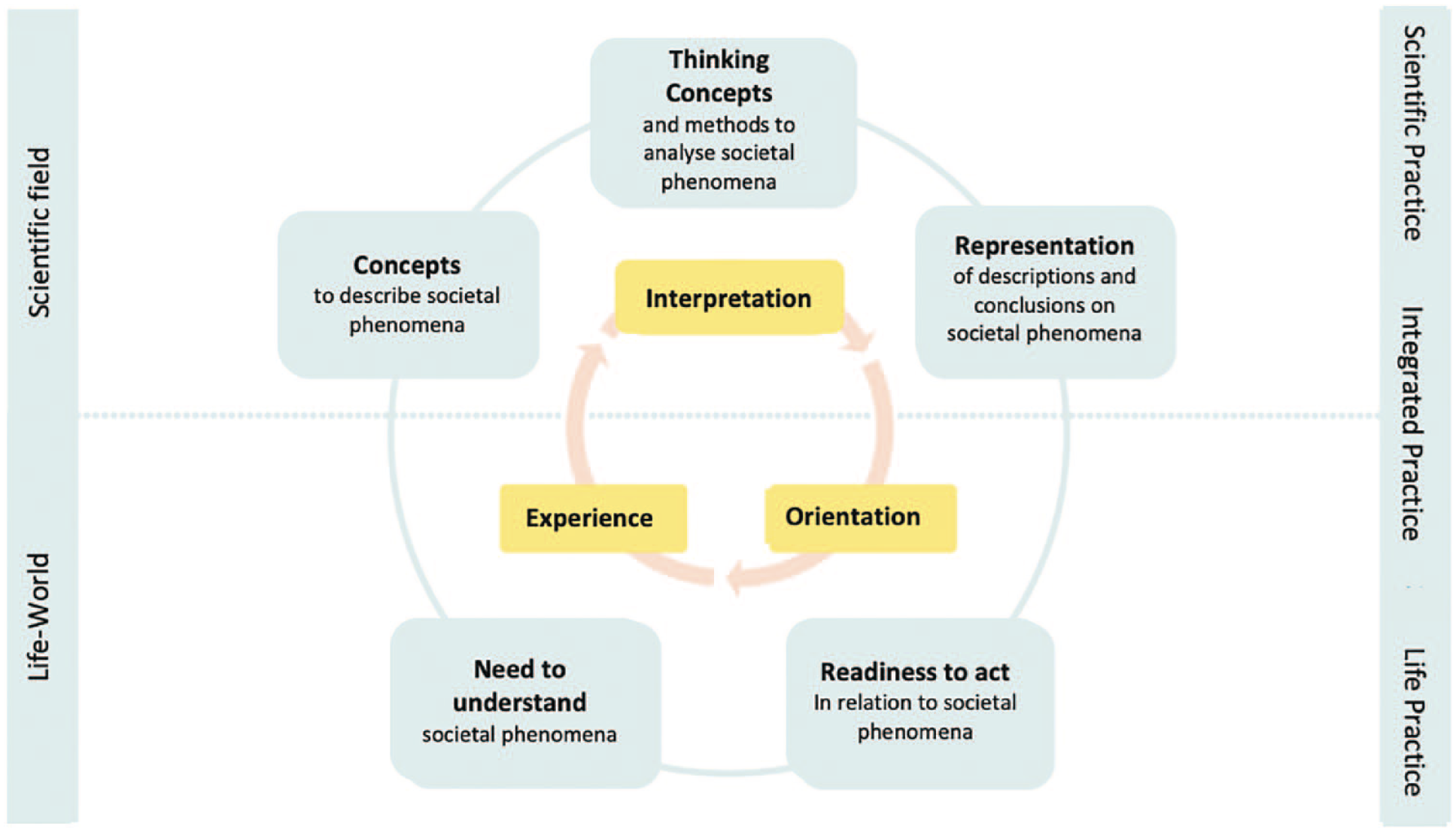
An illustration of the process of experiencing, interpreting, and orienting to societal phenomena (Sandahl & Johansson, 2020, p. 3; adapted from Rüsen, 2005, 2017). As students experience changes in a societal phenomenon, a need to understand these changes is established in relation to the life-world domain. Teaching can contribute with new experiences and disciplinary approaches to deal with the phenomena at hand—in terms of conceptual understandings and through second-order thinking concepts. As students encounter these new approaches, they eventually display their understandings in some form of representation. Consequently, the new understandings will enable the students to orient to the original phenomenon. This new orientation can guide them during their participation in society.
In both schools, these experiences became crucial when the students interpreted events and oriented in relation to trust. Students engaged with the knowledge and tools they had, some from prior teaching but largely originating from everyday knowledge and experiences (Lambert, 2017; Young, 2013; Young & Müller, 2013). These different experiences, and their subsequent interpretations, resulted in different orientations. The students at Rose High tended toward a critical position where government agencies appeared to have problems treating citizens in an unbiased and equal manner. The students at Tulip High took a critical approach too, but put more trust in the system and the competence of experts in government agencies. However, there were similarities in the students’ approaches to trust, particularly in the challenge of acknowledging other people’s perspectives. Students also experienced difficulties in differentiating between structures and agents; for example, by identifying racist structures while pointing toward individual racists within the system. It is important to point out that the students had a different level of command of the language, and the students from Tulip High used more formal language. However, the students’ understandings, or knowledge levels, were largely equal between the two groups.
Although it is difficult to assess the impact of the teaching and what it was that transformed the students’ narratives (Black & William, 2010), it was apparent that the narratives had changed between the focus group sessions. After the teaching segment, the students’ narratives included disciplinary concepts, representations, and thinking concepts. Their narratives were significantly more complex and nuanced. It was clear that the theoretical model for the “building blocks of trust” (Holmberg & Weibull, 2013) was important for the students’ ability to make advanced interpretations of the real-world cases that were used in the teaching. We argue that this change in the students’ narratives is probably an outcome of their active use of second-order thinking concepts (Barton, 2017; Journell et al., 2015; Sandahl, 2015), which researchers have argued to be important in classroom enquiry work (Saye, 2017; Swan et al., 2018). Notably, the students did not “abandon” or disregard prior experiences. Instead, they integrated them with new perspectives acquired from the teaching. Hence, their personal perspectives became a part of disciplinary and other individuals’ perspectives. In this sense, disciplinary concepts and procedures can be “powerful” in social science education (Lambert, 2017).
The narratives after the teaching were characterized by the active use of disciplinary concepts and thinking tools and continuous shifts between perspectives and levels. In their interpretations, the students at Rose High put more emphasis on structural explanations, rather than trying to explain their lack of trust in terms of individual behavior. The students did not abandon their initial critical positions, but had more nuanced orientations toward such questions and focused on the rules and regulations of government agencies. At Tulip High, the students’ narratives became more complex; for example, by incorporating multiple perspectives and reflections upon the need for participation in democratic societies. They also reflected upon their own role within the democratic system.
We argue that the changes in the students’ reasoning and narratives can be regarded as a development of their civic narrative competence. The subject content, second-order thinking concepts—like perspective-taking—and the theoretical model for trust enabled them to formulate more nuanced civic narratives. It is reasonable to assume that these narratives helped the students to orient in new directions, probably affecting their readiness to engage in future trust-related issues in real political life. This scenario remains hypothetical, however, and has not been explored in this study.
We argue that the theoretical model of civic narrative competence can bridge the two approaches of emphasizing disciplinary perspectives (Barton, 2017; Lambert, 2017; Sandahl, 2015) or deliberative perspectives (Englund, 2006; McAvoy & Hess, 2013). Teaching that aims to develop students’ reasoning and understandings of social phenomena, such as trust, does not have to disregard their individual experiences. Instead, these can be seen as a resource for learning. This study shows that students approach teaching with different perceptions, grounded in their personal experiences. This highlights the importance of teachers knowing about students’ diverse perspectives and experiences. In Figure 1, below, we conceptualize and illustrate the narrative process, particularly the dynamic between the scientific or disciplinary domain and the life-world domain.
This study emphasizes that teaching can provide students with new experiences, concepts, and practices that allow them to deepen their understandings and orient in new ways. Good citizenship education, however, should take students’ personal experiences seriously and incorporate them into social science teaching. Deliberative elements, such as carefully-balanced considerations of different alternatives or perspectives, do not necessarily need deliberative teaching methods to allow for students’ interests. What students choose to do with their new orientations is hardly the responsibility of schools. To prepare students for active participation in a democracy, however, is their responsibility.
We believe that narrative theory and narrative competence can contribute to developing theory in social science education research. The narrative competence paradigm can be a theoretical tool for designing and testing social science tasks and teaching. The framework could provide the researcher with several prerequisites for how students relate to society and what aspects of their narrative competence can be developed. In addition, we argue that civic narrative competence can be used productively as a theoretical tool to interpret empirical materials from social science education, as shown in this study. Accordingly, developing students’ narrative competence can be a way to approach their learning processes in social science education.
Footnotes
Appendix
Declaration of Conflicting Interests
The author(s) declared no potential conflicts of interest with respect to the research, authorship, and/or publication of this article.
Funding
The author(s) disclosed receipt of the following financial support for the research, authorship, and/or publication of this article: This work was funded by the Swedish Research Council (Vetenskapsrådet), educational research within the project “Social science education on trust for an active and critical citizenship”—project number 2019-03439_VR.
