




Abstract
There are no perfect solutions to the complex mess the planet is in right now, but there might be some better directions for the contemporary ‘university in ruins’ (Readings, 1996). In a world of struggling liberal democracies, climate change, biodiversity loss and global pandemics, this paper builds on the philosophical work informing the Ecological University (Barnett, 2018; Stratford, 2019) to shore up the theoretical groundwork for an ecological approach to higher education. While such a concept is fanciful (or utopian) in many respects, the possibilities for an ‘ecological’ turn in higher education policy and practice – beyond liberal and neoliberal approaches to higher education – point towards university policy and practice requiring a clearer understanding of ecological subjectivity as a basis for an ecological curriculum in higher education. This paper explores how ecological subjectivity could be developed via the concept of Anthropocene Intelligence. It explores how Anthropocene Intelligence can be used as a way of challenging the mainstream, liberal context of the higher education curriculum. Several ways in which this might occur are pointed to with potential changes to economics teaching being detailed as an example of the transformation that might be possible in an ecological higher education curriculum.
Thus, it is not power, but the subject, that is the general theme of my research. – Michel Foucault (Foucault, 1982) p. 778
Introduction
There is plenty in and around the higher education context not to like right now. In the face of COVID-19 and its impact on student engagement (Neuwirth et al., 2020), Artificial Intelligence, post-truth politics (Stratford, 2017) and the associated moral demise of the United States as a global leader, record weather extremes and ongoing biodiversity loss (Steffen et al., 2015), we might well be asking not just about Bill Readings ‘university in ruins’ (Readings, 1996), but also perhaps, the university on the planet ‘in ruins’.
While Higher Education alone can’t be expected to be ‘the’ solution to the many unhealthy aspects of the planet, there continues to be questions about how universities might do better, and contribute to teaching, learning and research that ‘could just’ improve on the status quo (Barnett, 2010: p. 12). This paper links such questions to the concept of the Ecological University (Barnett, 2010, 2011, 2017, Stratford, 2015, 2019). While the Ecological University has been discussed for over a decade, there is a considerable amount of theoretical and imaginative work still to do to explore how this ‘utopian’ concept might operate as more than a creative possibility, but also as an alternative policy and practice approach for the higher education needed in the world.
Following a discussion summarising the idea of the Ecological University, this paper explores the philosophical notion of ‘subjectivity’ as a focus for ‘ecologising’ higher education. Moving beyond traditional liberal (and neoliberal) approaches to ‘the subject’, and drawing on the ideas of Michel Foucault, Felix Guattari and Gregory Bateson, this paper explores the possibility of an ecological subjectivity as an interconnected alternative to the dualism of the Western philosophical tradition. Instead of the abstracted and somewhat disembodied mind of the Plato-Descartes-Liberal tradition, ecological subjectivity posits the development of our collective conscious and unconscious ‘selves’ in relation to the interconnected relationships we share with the psychological, social, political and natural ecologies of the planet.
The possibility for an ecological subjectivity in turn raises questions about how such a ‘framework’ might be nurtured by higher education. The argument made here is that we need an ‘ecological’ set of principles for negotiating what it means to live well and indeed be educated on ‘Anthropocene’ Earth, described here as ‘Anthropocene Intelligence’. Anthropocene Intelligence was initially developed as part of this author’s doctoral research (reference) and has links to a diverse set of ecological theorists (such as Lorraine Code, Chet Bowers, Donella Meadows, Fritjof Capra, Felix Guattari and John Dryzek). While there is not space in this paper to fully explore each of these principles, a few aspects of Anthropocene Intelligence are applied in this paper to the higher education curriculum and in particular to mainstream economics teaching in higher education. Although only a brief analysis is possible, it is possible to see how ecological subjectivity, and the aspiration to develop Anthropocene Intelligence, can have profound changes, not just for economics teaching, but for realising an ecological curriculum in higher education.
The ecological university
The Ecological University is an idea developed by Ronald Barnett as a ‘feasible Utopia’ for higher education and, in this sense, a possible step forward for how the university might operate in a complex world (Barnett, 2011, 2013, 2017). There are many ways in which we might approach this conceptually ‘thick’ (Barnett, 2014) approach to higher education, not least of which is how we might understand what is meant by the term ‘ecological’.
For Barnett (2017), and in my own research (Stratford, 2016, 2019), being ecological is more than the everyday reference to the scientific study of ecology, or more broadly again, to the those variously considered concepts of what is ‘natural’, ‘green’ or ‘eco-friendly’. Drawing on the work of Felix Guattari, in particular his work in The Three Ecologies (Guattari, 2000) and Chaosmosis (Guattari, 1995) as well as essays such as ‘Remaking Social Practices’ and ‘Subjectivities for Better or for Worse’ (Guattari and Genosko, 1996), the ecological is understood in terms of the ontological, epistemological and ethical interconnections that exist between our mental ecologies, social ecologies and natural ecologies. Eschewing traditional (technocratic, modernist, liberal and reductionist) Western notions of these domains as intellectually separate, Guattari interconnects human minds with complex social (and political) systems and natural systems. Guattari is influenced by the work of Gregory Bateson (Bateson, 1972; Shaw, 2015), and the recursive, interconnected relationships that Bateson has identified in socio-ecological systems and his ‘ecology of mind’. Without reference to the work of Arne Naess (Næss et al., 1989, 2008), Guattari subsequently uses his interconnected philosophy of ecologies to argue for an ecosophical perspective – or what he also calls an ecosophy: Without a change in mentalities, without entry into a post-media era, there can be no enduring hold over the environment, there can be no change of mentalities. Yet, without modifications to the social and material environment, there can be no change in mentalities. Here we are in the presence of a circle that leads me to postulate the necessity of founding an “ecosophy” that would link environmental ecology to social ecology and to mental ecology. (p. 264 in Remaking Social Practices)
How this plays out in terms of ‘subjectivity’ is discussed below, but in terms of the Ecological University, Barnett broadens the three ecologies of Guattari to at least eight ecologies or eco-systems (Barnett, 2020). These eight eco-systems not only interconnect with higher education but are the basis through which we might imagine relationships of obligation and responsibility for higher education. These are eight domains of dynamic complexity and interconnection ranging over social institutions, persons, culture, learning, knowledge, the economy, the natural environment and the polity. For the Ecological University, there is subsequently an obligatory focus on what sustainability and wellbeing might mean for staff and students in these domains.
The broad scope of the Ecological University might be compared and contrasted to the discourse surrounding concepts like the Sustainable University (Sterling et al., 2013), or indeed ‘Green’ pedagogy (Fassbinder et al., 2012). While such an exercise is not pursued here, there is a considerable amount of work to be done to explore how the theoretical framework of the Ecological University might reinforce the good work being done in such contexts and the efforts of those within Sustainability and Environmental Education traditions to develop rich and critical frameworks for a curriculum in the face of global environmental disaster (see for example Lotz-Sisitka et al., 2015; Wals, 2019).
Leaving aside for the moment this considerable amount of future work, it is worth noting that the alternative, philosophical educational future aspired for by the Ecological University can be understood against those discourses connected to the liberal or Humboldtian university as well as the neoliberal managerial university lamented by Bill Readings (1996), and a long line of others (Giroux, 2014; Lorenz, 2012; Olssen, 2016; Shore, 2010). While there is not space to tease out all the ways in which the Ecological University is a richer starting place for Higher Education thinking than those reanimating the work of Cardinal Newman and/or neoclassical economics, it is important to remember that many of the contested rationales underpinning ’thin’ concepts such as the ‘World-Class University’, and ‘The University of Excellence’ are drawn from established, economic and managerial approaches to knowledge and the labour market (Barnett, 2020; Rider et al., 2020). At its worst these rationales have been seen as ushering in a toxic age of ‘Zombie’ existence at the university (Harper, 2013; Smyth, 2017; Walker et al., 2013).
While we should never forget that the economy is part of the interconnected systems constructing and being constructed by higher education, the Ecological University puts such notions in a broader context than typical policy approaches. Indeed, just as some thinkers are looking for alternative economic and policy thinking – beyond neoclassical economics – so the thinking world is also in search of wholly different rationales for education. With due reference to the sustainability discourse mentioned earlier, sustainability and wellbeing are far more central to the Ecological University – as are responsibility and care – than that which currently plays out in higher education. The Ecological University is far more than an ivory tower on the hill, but a university that recognises that the world does not just need knowledge (for knowledge’s sake) but knowledge and action (being) within the complex set of social, political, natural and mental ecologies that make up the world. In the words of Barnett, the Ecological University is ‘is none other than the fullest expression of the idea of the university' (Barnett, 2010: p. 151).
Subjectivity
Before exploring the notion of subjectivity at the Ecological University, it is useful to make clear the assumptions being used here about the nature of subjectivity (especially for those outside of an educational philosophy field). In plain language, subjectivity can be a somewhat vague, concept. From one perspective, it is seen in opposition to objectivity, though that is not so much the connection made here. Rather, the focus in this paper is the philosophical concern with how humans are constructed as subjects. This approach to subjectivity is well presented in the framework provided by Nick Mansfield (among others) (Mansfield, 2020). Mansfield’s approach to subjectivity questions any essential or over-arching theory of how ‘selves’ are produced. Instead, his view eschews the autonomous individual of the Enlightenment tradition, (see also Bowers, 2012b; Peters and Tesar, 2016) and theorises the construction of ‘selves’ via a complex array of systems, forces and other intersections: ‘Subjectivity’ refers, therefore, to an abstract or general principle that defies our separation into distinct selves and that encourages us to imagine that, or simply helps us to understand why, our interior lives inevitably seem to involve other people, either as objects of need, desire and interest or as necessary sharers of common experience. (Mansfield, 2020 p. 3)
While Mansfield takes care to explain that his ‘genealogical’ approach to subjectivity doesn’t lead to an ultimate model of the self, or ultimate theory of the subject, his approach owes much to Foucault. It is this genealogy then, through which the subject is seen as the: Primary workroom of power, making us turn in on ourselves, trapping us in the illusion that we have a fixed and stable selfhood that science can know, institutions can organise and experts can correct. (Mansfield 2020: p.10)
The emphasis of interest here then is the subject as a construct. Leaving behind essential ideas about how subjects are created, the idea that our ‘selves’ are products of complex interconnections with complex ideas, structures and responses explains not only how Foucault’s focus was in his words ‘not power, but the subject, that is the general theme of my research’ (Foucault, 1982: p.778) but also how those teaching and learning at universities, variously present with deep identities based on essentialist liberal (modernist) and neoliberal tropes about being individuals, male or female, ‘non-binary’, ‘green’ or otherwise. Subjectivity is understood here as the basis on which we are both created and create the world, including our conscious, sub-conscious and unconscious basis for the decisions we (think) we make, and for the actions we take, in the context of a dying planet. Subjectivity helps us understand why it was near impossible to not believe in God in 10th century Europe (Latour, 1993) and why it is such a struggle to find new ways of living now, saturated as we have become in our complex, diverse, but nevertheless predominantly technocratic, scientific, modernist, liberal and neoliberal contexts. It is in this broad sense too, that that we can cite the critical literature resisting the ongoing production of all of us as neoliberal subjects within education (Ball, 2016; Ball and Olmedo, 2013; Davies and Bansel, 2007; Houghton, 2019; Peters, 2016).
What is ecological subjectivity?
The (Foucauldian) approach to subjectivity set out above sets a platform for understanding how subjectivity might be contested as ‘ecological’. There is an irony here too, in that just as the definition of subjectivity above helps us understand why so many of the moderns and postmodern subjects in Western Civilisation are shaped by liberal, individualistic and neoliberal ideas, it is also possible to see that there are ‘ecologies’ of forces, systems and ideologies making this so. The idea of interconnection does a lot of work for us here, as the culture that brings us mass-media, politics and higher education (among everything else) can be understood as a networked or ‘ecological’ set of systems for producing us as students, teachers, researchers, policy analysts, parents, consumers and so on.
From the perspective of Guattari’s triplex of ecologies – and the interconnections that exist between our individual, social and natural ecosystems – there is a fundamental (epistemological) error to be corrected by extending our thinking about subjectivity to the interconnection with our natural systems (Bateson, 1972). While so many of the media, political, educational and mass-marketing eco-systems of the world construct us as individual subjects without suitable interconnections to the planet, we need to instead (consciously and unconsciously) understand and construct ourselves as interconnected subjects – across multiple psychological, social and natural systems. From such a basis, we can better develop a foundation for understanding the ontologies in which we find ourselves (so to speak) and for acting on our collective ‘responsibility’ via an education system that might support such responsibility. Such a position seems all the more urgent in a world where humans are living beyond planetary limits – to the point that a new geological epoch being is now being ushered in via climate change, ocean acidification and mass extinctions – the Anthropocene (Steffen et al., 2015; Steffen et al., 2015; Zalasiewicz et al., 2010).
From a slightly different perspective, the epistemological, political and educational struggle for an interconnected, ecological subjectivity is positioned against a Western history of dualism which has arguably served us well – up until the Anthropocene (Hamilton et al., 2015). This heritage has typically operated on the basis of opposites such as ‘subjects’ and ‘objects’, ‘culture’ and ‘nature’, ‘politics’ and ‘science’, ‘theory’ and ‘practice’, and is now being deeply questioned as we realise that much of what we do actually happens ‘somewhere’ and that assumptions that ‘nature’ was somewhere else while we were conducting an experiment or writing a poem or developing economic policy no longer looks like a good idea when the unsustainability of the very culture we are in, is literally bringing melted ice to our doorsteps. As Clive Hamilton has said in welcoming us to the ‘Anthropocene’: And in an epoch in which ‘Gaia’ has been reawakened, the social-only conceptions of autonomy, agency, freedom and reflexivity that have been modernity’s pillars since the nineteenth century are trembling. The idea of the human, of the social contract, of what nature, history, society and politics are all about – in other words, all of the essential ideas on which these disciplines have been constructed – ask to be rethought. (p. 5 Hamilton et al., 2015).
From this perspective, developing ‘ecological subjectivity’ is concerned, at least at one level, with aspirations for a transformation commensurate with the historical shift to modernism – and its associated Enlightenment principles, from the middle of the 17th century. Ecological subjectivity is a repositioning of the historical subject from a ‘mind’ in opposition to ‘nature’ (as an object) to an interconnected being whose agency, ethics and ‘education’ needs now to take account of the many systems to which he/she/other is now a part. In essence, ecological subjectivity seeks to replace the liberal modernist subject of Western civilisation (and its neoliberal incarnation) and clarify the nature of the postmodern subject – not just as a social construct – but as a complex and interconnected being – not so much an autonomous (rational) individual or by-product of social systems – but an agent variously negotiating the surrounding complex of mental, social, political and natural ecosystems. Somewhat ironically, perhaps, subjectivity from this perspective moves us beyond ‘individuals’ and locates the development of our individual and collective conscious and unconsciousness in our contexts as much as our imaginations.
Significantly, there are many dimensions of interconnection for the ecological subject. The ethical is especially important, as there is a necessary sense of responsibility to the interconnected systems of an ecological subject. This is already well understood by cultures outside of the West. As Whanganui Māori say in Aotearoa/New Zealand –
From the point of view of Guattari, ecological subjectivity not only reflects the complexity of our interconnection but also points to the need for new artistic and political ways of living well on Earth. While Guattari’s approach to subjectivity is in line with the broadly Foucauldian approach set out by Mansfield above, the ‘earthly’ interconnections made by Guattari through ecosophy, as well as his response to the (Batesonian) ‘bad ideas’ inherent in modernist, technocratic and overly scientific approaches to knowledge and action, make poetry and other aesthetic (and political) knowledges part of a better aspiration for a planet on the brink. As Guattari points out at the end of the essay ‘Subjectivities for Better or For Worse’: A response to the poisoning of the atmosphere, and global warming due to the greenhouse effect, is inconceivable without a mutation of mentalities, without an advancement of a new art of living. … …. The only acceptable end result of human activity is the production of subjectivity such that its relation to the world is sustained and enriched. The mechanisms of the production of subjectivity can be on the scale of the megalopolis as well as that of the language games of a poet. To apprehend the inner workings of this production, its fundamental ruptures of the meanings of existence, poetry today, has perhaps more to teach us than the economic and human sciences put together. (p. 202)
From a Guattarian point of view, this poetic approach to subjectivity is far more than a romanticisation of poetry over science (which would be too dualist of course). Stemming as it does from a reconceptualisation of knowledge itself – from an interconnected epistemological point of view best seen in The Three Ecologies – the subjectivity aspired for here is the basis of a diverse and healthy way to live on a finite planet. There is a diverse, political and interconnected (and variously defined sense of ‘health’) sought here as the basis for ecological subjectivity, one which draws together ‘poetry’ and ‘science’, and as Guattari has also explained in the texts referenced here – democracy and capitalism.
Although there is not space to tease out all the ways Guattari might argue the case for life in what he imagined would be a ‘post-media’ age, the point to emphasise here is that at the various levels of our interconnected psychological, social, political and natural systems – there is an aspiration for remade social practices – new ways of relating to – and being constructed within – our interconnections. There are new forms of healthy living to be developed. Ecological subjectivity then aspires for new relationships and new forms of living – and provides a basis for collecting up a range of alternative ethical, aesthetic, and pedagogical ways of operating. Moreover, it also provides a way of initiating the development of a healthy and ‘ecological’ society in the face of the liberal and neoliberal individualistic scientism seen so typically in the West, and so typically in its universities.
Anthropocene Intelligence at the ecological university
How can ecological subjectivity be realised at the university? More importantly perhaps, how could staff and students develop as ecological subjects – interconnected, and, in some ways, responsible as citizens on a finite planet? In my doctoral research, a set of principles was compiled from a range of ecological theorists in response to such a question (Stratford, 2019). From the outset, it needs emphasising, that even in the ample space afforded by a doctoral study (which technically amounted to little more than a chapter), the extent to which such principles can be detailed is challenging. Indeed, such work needs far more than any one thesis or book on its own.
Within such a proviso, the term given to the principles that might help develop ecological subjectivity at an Ecological University is (tentatively) given the name ‘Anthropocene Intelligence’. The intent here is to encapsulate, the knowledge, skills and attitudes required for the planet in overshoot. It is also intended that the term echoes the aspiration for acceptance observed in such terms of emotional intelligence and ecological intelligence, these ideas seen most prominently in the works of Daniel Goleman (Goleman, 2009) and Chet Bowers (Bowers, 2012a). In a slight shift from these terms, however, the name ‘Anthropocene Intelligence’ was chosen to reflect a resonance with both the current shift in geological epoch as described by Hamilton et al. (Hamilton et al., 2015) and the work Gregory Bateson (Bateson, 1972), as emphasised by Chet Bowers (Bowers, 2010, 2011a, 2012a). Bowers (who also cites Goleman) uses the term ecological intelligence as a contrast to ‘individual’ intelligence (and its association to the mythical autonomous individual of the liberal mainstream). For Bowers, ‘ecological intelligence’ includes such ideas as Bateson’s ‘Level 3’ approach to learning and Fritjof Capra’s system thinking (Capra and Luisi, 2014).
Anthropocene intelligence framework.
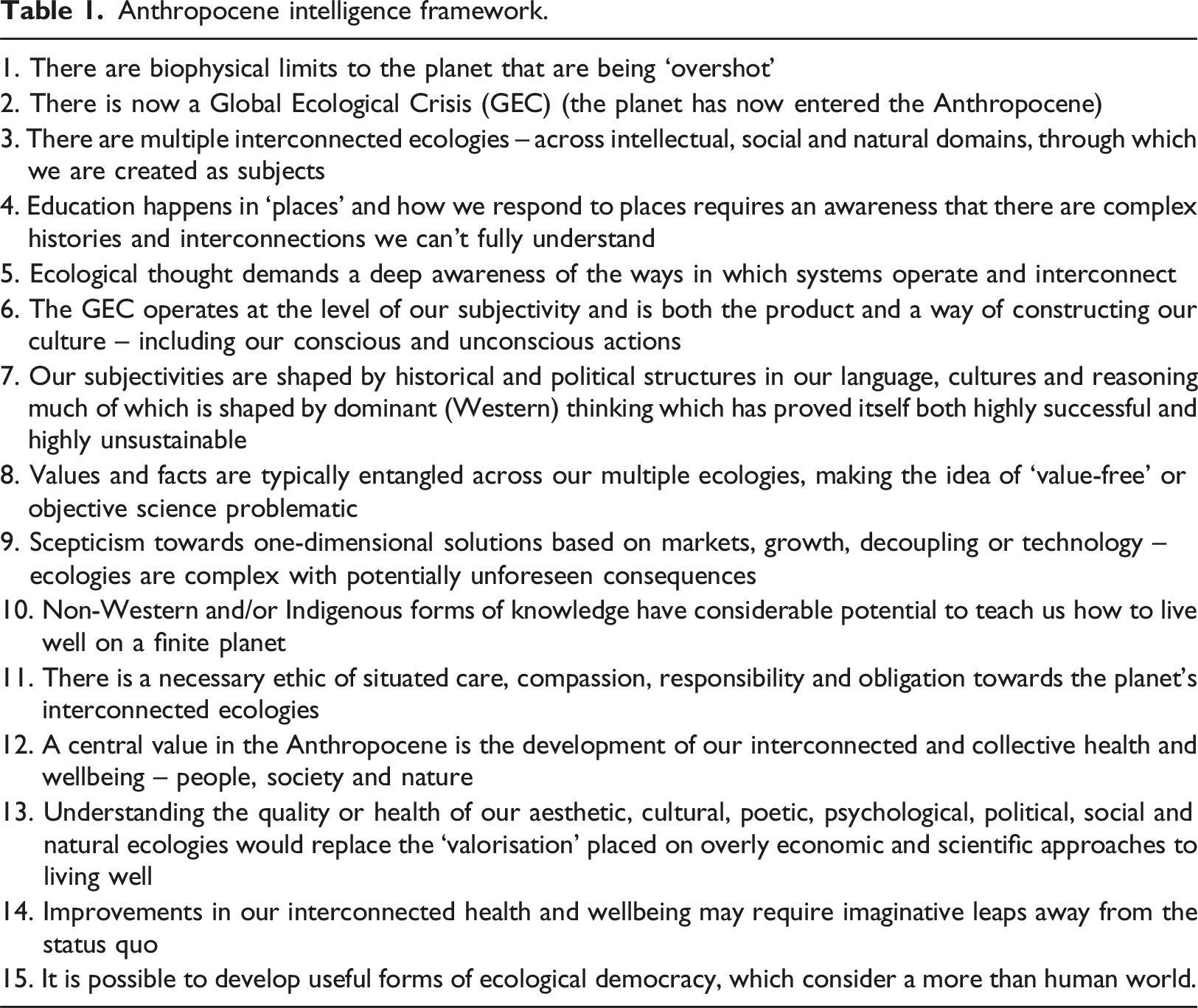
As pointed out above, unpacking the ideas pulled together in the table above requires much more space than is available in this paper. It is still worth pointing out that these principles have been derived from authors as diverse as Hilary Putnam, Donella Meadows, Mason Durie, Lorraine Code, Chet Bowers, Bruno Latour, Gregory Bateson and John Dryzek. While each contribution has its own genealogy in this sense it is still preferable to read these ideas collectively and flexibly such that the ethical, epistemological, and ontological content above does not limit Anthropocene Intelligence to a ‘single issue’ as might be seen in approaches which seek to green the academy or the develop sustainability literacies (McBride et al., 2013). Moreover, critical readers should also not assume that these principles offer a universal or essential set of ideas. They are better thought of as a summary way of thinking ecologically, of developing ecological subjectivity. In specific curriculum areas and ways of teaching, they may in fact be more wrong than transcendent, albeit that they still function as holding open the idea of an alternative to traditional liberal subjectivities.
In line with arguments made about the Ecological University itself, the point is made that Anthropocene Intelligence, and indeed knowledge itself, exists in a complex and interconnected set of contexts – on a finite planet. Subsequently the development of education – and subjectivity for that planet – requires a fundamental shift pointed via Anthropocene Intelligence. This shift is more than a greening of the curriculum in a relatively narrow political sense. It could be thought of as a Copernican shift for teaching and learning (Code, 2006) which aspires for the development of learners (and societies) that increasingly understand themselves as interconnected beings within complex ecologies. Anthropocene Intelligence potentially illuminates the idea that as planetary inhabitants we have a responsibility to contribute to the knowledge/action/wisdom that improves the (contested) health of these same systems (Maxwell, 2006, 2007). From a slightly different perspective, education within an aim for Anthropocene Intelligence, is less concerned with the traditional liberal goals of ‘freedom’ and ‘knowledge’ (for their own sakes) but for agency, understanding and being within a set of systems that are currently needing responsible, interconnected subjects.
While it might end up in some of the same places as the functional (and less theoretical) ‘sustainability’ discourse, the pedagogical depth and breadth of Anthropocene Intelligence goes well beyond ‘sustainability’ as it is too-often constructed in campus greening projects (Blewitt, 2013; Brown, 2018). From a basis in ecological subjectivity, and the pedagogical framework sought in Anthropocene Intelligence, is arguably more open to critical, ecological perspectives, which have the potential to develop new ways of thinking – ontologically and ethically – in an interconnected world. While the example at the end of this paper briefly explores what this might mean for university economics teaching, there is a wide array of other examples that might be pointed at as ways to develop a curriculum in line with Anthropocene Intelligence.
For example, traditional Western approaches to psychology are all too often build from a theoretical base centred on the disembodied rational subject criticised in this paper. Micah Ingle, in writing from a critical, ecological perspective, sets out how the taken-for-granted individual at the centre of psychology teaching, learning, research and practice has been a barrier to developing the sorts of therapies that better connect the wellbeing and development of people to the context of their lives (Ingle, 2021). In particular, Ingle points to the possibilities for narrative therapy, feminist therapies and eco-therapies which go beyond ‘contextualising’ the individual in a therapeutic setting and aim instead to develop healthier interconnections between people and place.
The example from ecopsychology is consistent with the ethical, epistemological and ontological changes suggested by Anthropocene Intelligence and changes to the very ‘unit of analysis’, which has been the traditional focus of Western psychology (Bateson, 1972). Such changes have transformational counterparts across the diverse courses offered at universities. There are ecological possibilities for medicine, for example, through the development of biopsychosocial theorising (Tretter and Löffler-Stastka, 2019) and integrative medicine (Assmuth et al., 2020) – both of which develop their theorising in relation to ‘person in context’ starting points.
Similarly, there is also a growing understanding about the possibilities for ecological social sciences and humanities too – which seek to understand the human subject interconnected to diverse cultural, political, psychological and natural ecosystems. In political science, for example, there are compelling ecological reasons why graduates should be engaged with ideas that not only de-centre the individualism of political discourse but also connect with such concepts as John Dryzek’s notion of ecological democracy. A critical approach to ecological democracy could, perhaps, also help students understand this ideas potential in the post-truth political ecologies of our time (Dryzek, 2013; Dryzek and Pickering, 2018).
In the humanities, there is a diverse range of ideas and writers which would support students to explore ecological thought and develop their ecological subjectivity. Examples of such work ranges from the rigorous post-humanism of Rosi Braidotti (Braidotti, 2013) through to the darker ecological utterances of Timothy Morton (Morton, 2007, 2010, 2013). Regardless of the differences, these writers bring to ecological thought, when seen against the summarising principles of Anthropocene Intelligence, they underline the sort of teaching, learning and research in the humanities that no longer draws on the universal ‘everyman’ of liberal thought, but instead explores how people, technology, politics and place are interconnected. Indeed, in the interconnected world of the Anthropocene, whatever arguments we make in the humanities, whatever poems we read or write, however, we might interpret Shakespeare, we cannot escape the idea that this all now happens in a world on the brink and requires students to understand their connection in this context.
Ecological perspectives are then a considerable challenge to the status quo in universities. Alongside these richer, philosophical perspectives, however, the idea of ecological subjectivity also challenges the everyday assumptions built in to teaching and learning including those that might not otherwise be linked to a critique of Western subjectivity. For example, in accepting the ethical importance of students graduating with some understanding of their responsibility for the planet – it no longer seems okay to credential history students who have not reflected on the current fate of the planet; or physics students who are limited to knowing about particle dynamics but know nothing of the Indigenous rights and wellbeing of those in the country where they live; or lawyers who understand environmental law, but have done little to explore ways to reduce their own carbon footprint. At the level of even these somewhat polemical examples, Anthropocene Intelligence is a way of theorising our way to an education system that reconceptualises knowledge ecologies for the world we now live in. It reminds us that there is a theoretical framework available for not just bolting on ‘sustainability literacy’ and green pedagogies, but reorienting university learning – knowledge itself – within a domain of collective wellbeing. Following on from this, and once we accept the need for universities to contribute to Anthropocene Intelligence, we might go on to ask such fundamental questions as: • To what extent can students understand how their knowledge is connected to living well on a finite planet? • How well do my students understand the diverse eco-systems in which this knowledge I’m teaching interconnects? Do they see the world in narrow, disciplinary forms, and can they apply this knowledge to make leaps away from our current unsustainability? • To what extent do students understand the limits of their Western theories and understand the importance of non-Western ways of knowing and being? • How well do my students understand themselves as responsible agents within diverse communities, rather than ‘individuals’ with freedom of choice? • To what extent does my faculty explore, contest and develop the wellbeing of a range of interconnected systems and support students to learn within such systems? • To what extent have the students in this programme learnt about alternative forms of knowledge that challenges unsustainable approaches to the status quo?
Generating challenging questions in the face of aspirations for ecological subjectivity and Anthropocene Intelligence is a sobering follow-on to exploring what it means to teach, learn and research on planet Earth right now. In looking at the above questions, there is a short step to developing more specific evaluative tools that help university staff to reflect on how well their graduates might be prepared – not just to take up vocations within the workforce, or operate knowledgably in relation to particular subject area – but actually contribute to the health of the various political, social, natural or psychological ecologies that are struggling on planet Earth. Ecological subjects, as more interconnected and responsible agents than their (more commonly found) liberal and neoliberal counterparts, are more than subjects who ‘know’ stuff. Students with Anthropocene intelligence are ethically interconnected to the life and health of the ecologies they connect to. They also have more understanding of themselves as products and actors within complex and interconnected systems. Evaluatively speaking, Anthropocene Intelligence points to the development of subjects who actively and critically engage in the world as if it was at risk, limited and in need of radical change.
The ecological curriculum in higher education – ecologising economics
There are a vast number of ways in which ecological theory might translate into education which supports the development of ecological subjectivity and Anthropocene Intelligence. While the references made above to ecological psychology, medicine, political studies, and ecological humanities, along with the questions asked of history, physics, and law, point to a range of significant changes to how education might be altered, this is only the start of what is potentially possible. In many ways, the ‘utopian’ possibilities for ecological thought, in line with the points made by Hamilton et al. (Hamilton et al., 2015), point to an even more dramatic reorientation of the Western ontological, epistemological and ethical traditions and classrooms. Within such a framework, any examples are perhaps as limiting as they are illuminating.
That said, one example is presented here as a slightly more detailed starting point of what it might mean to develop ecological subjectivity in higher education – that of economics teaching. The learning and knowledge ecology that is economics in higher education is chosen as an example because there is already an established set of heterodox economic discourses that effectively questions mainstream economics teaching and learning (Costanza et al., 2017; Daly, 2005; Daly and Farley, 2004; Dietz and O'Neill, 2013; Jackson, 2009; Keen, 2011, 2021a; Raworth, 2017). In this sense, the argument for ‘ecologising’ economics – has already been argued by a wide range of heterodox economists and there is an established set of arguments which can be connected to the aspiration for Anthropocene Intelligence (Bowers, 2011a; Stratford, 2019).
Moreover, while there are arguments to be made for ecologising across the higher education curriculum, another reason for seeing the potential for Anthropocene Intelligence in mainstream economics teaching is the role economics plays in continuing an unflinching pro-growth unsustainability on planet Earth. In this sense, the teaching of neoclassical economics, without Anthropocene Intelligence, sits at the core of our planetary overshoot. Similarly, given the extent to which neoclassical economic thinking dominates the development of such areas as government policy – including education policy – then such an example provides a powerful illustration of just what is to gain in drawing on Anthropocene Intelligence as a way of ecologising the higher education curriculum.
Planetary limits and the global ecological crisis
The first aspect of Anthropocene Intelligence considered in relation to neoclassical economics is planetary limits. In turn, planetary limits are then linked to the way the Global Ecological Crisis (GEC) is poorly understood by traditional economic methods. For those who have not spent time surveying economics textbooks, the idea of planetary limits is not a typical focus for economics. Instead, the approach taken in neoclassical economics is to typically work through a highly abstracted set of equations and modelling to (objectively) argue for the importance of (endless) economic growth. Observe the following ‘tone-setting’ starting point in the work of economics textbook writer Charles Jones: (Jones, 2002) The importance of economic growth is difficult to overstate. The more than tenfold increase in income in the United States over the last century is the result of economic growth. (p. XI)
This same emphasis on economic growth dominates the discourse of politicians and business leaders. Moreover, the emphasis placed on economic growth by mainstream economics (especially as it is taught in undergraduate programmes) is such that more growth is typically seen as better and, significantly, there is no technical limit to continuing to grow the economy. This fixation with economic growth – by politicians and mainstream economists alike – has been subject to a wide-ranging set of criticisms from Herman Daly (Daly, 2005; Daly and Farley, 2004) to David Attenborough and Greta Thunberg. We have a finite environment – the planet. Anyone who thinks that you can have infinite growth in a finite environment is either a madman or an economist – David Attenborough as quoted in The Guardian (Cardwell, 2013) We are in the beginning of mass extinction, and all you can talk about is money and fairy tales of eternal economic growth. - Greta Thunberg as quoted in The Conversation (Good, 2019).
The lack of Anthropocene Intelligence that comes teaching and learning that economic growth is unlimited is based on the methodological flaws that comes from economics’ use of overly simplistic assumptions and overly abstracted mathematical equations. The result is the privileging of a worldview that serves as a basis for the neoliberal values structuring too many decisions across politics, education and society. One way this oversimplifying approach can be seen is the concomitant emphasis on the role of technology to support endless growth. While it may seem comedic to the outsider, university textbooks on economic growth think nothing of allowing their simplifying assumptions about the potential of technology to undermine the idea that the world need be made of anything at all: If resources are a necessary input into production but there is a resource-augmenting technological change at a sufficiently rapid rate then the resource share can decline over time, potentially to zero. (Jones and Vollrath, 2013: p. 247)
In the example above, Jones and Vollrath’s Introduction to Economic Growth (Jones and Vollrath, 2013), points out that humans can theoretically avoid the environmental impacts of production by increasing our technological efficiency. While this makes some superficial sense, in terms of the development of energy efficiency (at least to those readers of this journal who have not heard of the Jevon’s Effect) the logical extrapolation of this ‘equation’ brings us to the enlightening conclusion that through our ingenuity with technology we may never need to use materials at all. This may be interesting news to those of us who live in houses stuffed with the outputs of technology, or those that have noticed the actual correlation that exists between a growing global GDP and the increasing use of resources (Dietz and O'Neill, 2013). Subsequently, in the context of such a statement from Jones and Vollrath, the ‘simplifying assumptions’ shown here not only lack Anthropocene Intelligence’s understanding of limits but also have a level of faith in technology that is actually magical.
The ability to build highly suspect positions based on such simplifying assumptions and abstracted equations is a point made by many critics of neoclassical economists. Steve Keen, for example, has described this methodological approach as a series of ‘armchair fantasies’ (Keen, 2021, p. 142).
As an extension of the point made about the magical (one-dimensional) thinking that exists in mainstream economics’ conceptualisation of technology and economic growth, there are a wider set of assumptions made in economics classrooms that also require some scrutiny. Most notably is the idea that humans can ‘decouple’ economic growth from its impact on the planet. Now, the arguments about decoupling go over technical ground that will not be detailed here. But the point to be emphasised is, not just that there is little evidence that we have in any global way meaningfully decoupled economic growth from its planetary footprint (Parrique et al., 2019), but that neoclassicals treat decoupling as an extension of their armchair fantasies about technology. Their approach to economic growth does not typically teach the complexity and debate that goes beyond their abstracted methodologies. Structurally, therefore their approach to planetary limits, ecological impact and decoupling sits in virtual opposition to Anthropocene Intelligence.
The criticisms concerning neoclassical’s lack of insight regarding planetary limits and the Global Ecological Crisis goes to the core of ecological economics criticisms of contemporary economics. Such points have been levelled since The Club of Rome’s work in 1972 (Meadows et al., 1972) and then on through the work of Herman Daly and more latterly the likes of Tim Jackson (Jackson, 2016), Steve Keen (Keen, 2021, 2021b), Peter Victor (Victor, 2008), Peter Brown and Peter Timmerman (Brown and Timmerman, 2015), and Kate Raworth (Raworth, 2017). The central point these authors all make in various ways is that a far different form of economics is possible when the simplistic models of the mainstream are set aside in favour of analysis forms that interconnect with some planetary realities and the imperative to operate an economic system within planetary boundaries. In terms of the perspective provided in this paper, there are options for ‘ecological’ economics teaching, which are better aligned to Anthropocene Intelligence.
In New Zealand and Australia, however, a mainstream, neoclassical approach to economics teaching continues throughout university programmes (McNeill et al., 2014). Mainstream economics approaches are also actively rallied against around the world too especially by many different student-led groups seeking to ‘Rethink Economics’ (https://www.rethinkeconomics.org/) and develop a ‘Post-Autistic Economics’ (Badiou, 2009). In such a context, suitable pedagogical and evaluative questions for mainstream economics teaching at universities include: how well do economic students understand that there are limits to human activity? How would an economics programme be different if economics students were actively taught that ‘limits’ undermined those simplistic assumptions? With reference to the principles of Anthropocene Intelligence outlined in this paper, even the (heterodox) inclusion of limits in an economics paper has the potential to considerably shift what is taught and subsequently foster, (to some extent) the ecological subjectivity sought in an Ecological University.
Complexity, subjectivity and place in economics
In addition to the points raised about economic growth, and the lack of suitable references to planetary limits in mainstream economics teaching, there are some additional points that can be emphasised about the possibilities for ecologising economics. These points are attached to the idea of the ecological subject and ecological subjectivity. As has been discussed extensively in critiques of neoliberalism, neoclassical economics’ rational model of humanity is, in a way, a crowning achievement in simplifying assumptions. In line with the criticisms made earlier about liberal and neoliberal subjectivity, mainstream economics’ abstract and simplified view of humanity, also known as homo economicus (Peters, 2016) is an especially decontextualised being. This criticism is well-worn ground, but the fact that the economic ‘subject’ is so removed from the ecological subject sought after in this paper, still needs a reminder. Furthermore, in line with the points made about growth and technology, many economics students are, it seems, regularly fed a pedagogical diet that ‘scientifically’ assumes that humanity can (universally) be understood as individuals, outside of nature and interested in little more than their own consumerist utility. Such an approach is a simplistic parody of the student concerned for their river, whānau and the state of the planet.
As an extension to the point above, the tendency of mainstream economics to rely so heavily on simplistic mathematical modelling as an ontology means that students typically learn to ‘decontextualise’ in economics, taking their thinking away from real contexts and the complexity that happens in the systems ‘down on the ground’ to quote Lorraine Code (Code, 2006). There have been various heterodox economic points of view which argued against the pedagogical monoculture that is the typical university economics course, including those who have argued for the teaching of economic history, to ‘complexify’ how the current orthodoxy might be contested, as well as those looking to usher in more pragmatic and nuanced forms of economic analysis linked to complexity theory, system analysis and macroeconomic realities, such as those leading up to the Global Financial Crisis (Keen, 2011) and the non-‘rational’ behaviours of actual, real people (Quiggin, 2012).
When held up to the outline of Anthropocene Intelligence above, the approach taken by mainstream economic teaching faces away from system thinking, interconnections and complexity as it seeks to provide students with the basic tools to understand market ‘utility’. From Steve Keen’s perspective, and in relation to the Global Financial Crisis, mainstream economic teaching fails to provide students with the system thinking tools to understand debt, credit and the irrational complexity of what actually happens beyond abstract modelling. Keen persuasively argues for a greater plurality of methods, including system dynamics, to inform future responses to economics (Keen, 2021b; Keen and Rev, 2011). Through Keen’s argument, economics students not only fail to develop anything like Anthropocene Intelligence, but also continue to develop the same skills that contributed to both the Global Financial Crisis and our ongoing environmental system collapse.
Keen’s example of the ‘appalling bad economics of climate change’ (Keen, 2021a) is particularly instructive here as he breaks down in detail how neoclassical economists, including those who have contributed to IPCC reports, have assumed that most of the economy will not be impacted by climate change because
Conclusion: Towards ecological everything
This paper explores the notion of ecological subjectivity and the need to develop higher education outside of mainstream liberal approaches. It points to the potential of Anthropocene Intelligence as a core rationale for universities. By using the ideas of the Ecological University, ecological subjectivity and Anthropocene Intelligence, this paper has argued that it is possible to sketch out new theoretical and interconnected ways of teaching and learning in higher education. These approaches transcend the operational focus of ‘greening the academy’ and ‘sustainability’ in education. They point to potentially deep changes in higher education. While all areas of the higher education curriculum should be scrutinised for their ability to support ecological subjectivity, the example of economics teaching was briefly surveyed to show how flawed methodological approaches in the classroom can lead to a profound lack of Anthropocene Intelligence. It was argued that much more is possible in light of the range of ecological perspectives already being promulgated by a range of heterodox economists.
While the range of possibilities from heterodox economists provides considerable scope for understanding the distance that exists between Anthropocene Intelligence and the economics classroom, the example of mainstream economics teaching also demands further examination of the higher education curriculum and how it might be developed with Anthropocene Intelligence. Questions were asked in this paper in relation to psychology, medicine, political science, the humanities, physics and law, for example, but these tended to be single examples in what might be a wider ecological transformation. As the slightly more detailed discussion of economics implies, there are significant, wide-ranging, methodological changes possible in how teaching and learning might take place through the aspiration for ecological subjectivity. In this sense, there is much work still to be done.
Footnotes
Acknowledgment
I would like to thank Ron Barnett for his encouragement to publish this article.
Declaration of conflicting interests
The author(s) declared no potential conflicts of interest with respect to the research, authorship, and/or publication of this article.
Funding
The author(s) disclosed receipt of the following financial support for the research, authorship, and/or publication of this article: This work was supported by the University of Waikato doctoral scholarship and a doctoral scholarship from the Philosophy of Education Society of Australasia (PESA).
