




Abstract
Periods of being NEET (not in education, employment or training) can have long-term consequences for individuals’ future job opportunities, earnings, psycho-social well-being and health, all with high societal costs. Therefore, policy-makers across Europe seek interventions that successfully reduce NEET numbers. Drawing on a longitudinal qualitative study in London, this paper explores the processes and mechanisms that contribute to young people becoming NEET after leaving education.
Through analysis of 53 young NEETs’ accounts of their school and transition experiences, we draw upon Bronfenbrenner’s ecological systems theory to explore the multitude of factors and structures of disadvantage that might have contributed to these young people’s marginalisation in education and employment. We discuss how unfulfilled support needs, a lack of career advice and socio-economic disadvantage can lead to educational disengagement, dropping out and, ultimately, becoming NEET. While many of these issues were presented as personal difficulties, in this article we reject the individualisation of the ‘NEET problem’. Instead, we argue that negative school experiences need to be understood in the context of structural conditions, including funding cuts in education and support services, transformations in the labour market and socio-economic deprivation.
Keywords
Introduction
Across Europe, the last three decades have witnessed the expansion of education, with more young people participating in upper secondary and tertiary education than ever before (France, 2016). In these circumstances, academic qualifications are regarded ‘as central cultural capital’ (2016: 85) necessary for successful labour market entry. However, the neoliberal promise that better qualifications will provide access to well-paid, better quality jobs in the ‘knowledge economy’ has proven illusory (MacDonald, 2011; Wolf, 2002). Instead, today’s young people are facing a precarious labour market which offers limited access and scarce jobs to inexperienced new entrants. Moreover, young people tend to be concentrated in insecure, short-term, poorly paid jobs with few career development opportunities (Ainley and Allen, 2013; Bell and Blanchflower, 2011; France, 2016).
In an environment of ever-increasing qualification levels and a precarious labour market, young people who leave school with low or no qualifications are particularly vulnerable to experiencing unemployment and periods of being neither in education, employment nor training (NEET). Indeed, in 2018 in the UK, 23% of 16–24 year olds with no qualifications were NEET, compared with 9% of those qualified to GCSE 1 level and above (Powell, 2018). International statistical evidence also shows that underqualified young people are the most likely to become NEET (France, 2016). In fact, the risk factors most associated with becoming NEET are often described, both in academic research and policy, in individual terms: low academic attainment, physical or mental health problems, special educational needs (SEN) and so on (Furlong, 2006; Powell, 2018).
In this article, drawing on rich qualitative data from a large European study, we explore young NEETs’ accounts of their school and transition experiences through the lens of Bronfenbrenner’s ecological systems theory (1979), to gain a more holistic understanding of the processes and mechanisms that contribute to young people becoming NEET. We aim to challenge the individualisation of the ‘NEET problem’ by examining the structural context of young people’s negative school experiences and difficult transition to work, and highlighting the impact of macrosystemic forces on their opportunities and choices.
The ‘NEET problem’
At EU level, the proportion of young people aged 18–24 who are NEET varies significantly across countries: from the low end of 5.3% in the Netherlands to 25.7% in Italy, in 2017 (Eurostat, 2018). Overall, close to 5.5 million young people – 14.3% of the 18–24 age group – were NEET in 2017, which is larger than the total population of some EU countries (Eurostat, 2018). In the UK, whilst the overall rate of 16 to 24 year olds who are NEET has been declining since its peak of over 1.1 million (19.4%) shortly after the financial crisis in 2008, there nevertheless remains a substantial number of young people – 783,000 or 11.2% of all people in this age group – who are not currently participating in any form of education, training or paid work (Powell, 2018). While the percentage of NEETs differs across geographical regions and age groups, the overall 16–24 rate in the UK has not dropped under 10%, and it is just reaching pre-2008 levels. The proportion of NEETs is skewed towards the older age group since the majority of 16–18 year olds are nowadays enrolled in education or training. While only 4% of this age group were NEET in the second quarter of 2018, the NEET rate is 13% for 18–24 year olds (Powell, 2018).
Periods of being NEET can have long-term consequences for individuals’ future job opportunities, earnings, psycho-social well-being and health – all with high societal costs (Bell and Blanchflower, 2011; Coles et al., 2010; Mawn et al., 2017). NEETs often experience financial hardship, a loss of self-esteem and status, and a range of psycho-social distress and disorders including depression and anxiety, which then negatively affect relationships with family and friends. In an ethnographic study of NEETs, Russell found that ‘feelings of marginalisation across work, home and education’ (2016: 172) were widespread among participants. Moreover, being NEET has long-term negative consequences, increasing the likelihood of lower wages and unemployment later on. In Scotland, Ralston et al. (2016) found that previous NEETs had lower occupational status 20 years later. On a societal level, the lifetime cost of being NEET is estimated to reach several billions. In England, estimates of the cost of NEETs to public finances range between £12bn and £76bn, reflecting tax losses and benefit payments (the lower estimates), as well as lost productivity to the wider economy (higher estimates) (Coles et al., 2010).
With this concern in mind, policy-makers across Europe seek interventions that would successfully reduce NEET numbers (Hutchison et al., 2016; Mawn et al., 2017; Thurlby-Campbell and Bell, 2017). Since academic under-attainment is among the main risk factors for becoming NEET (Archambault et al., 2009; Duffy and Elwood, 2013; Furlong, 2006; Janmaat et al., 2015), many of these interventions focus on education and training. The UK government has attempted to reduce the number of young NEETs through both education and labour market strategies. Most notably, the Raising the Participation Age (RPA) legislation requires, since 2015, all young people to be engaged in some form of education or training until the age of 18 (Education Act, 2011; Education and Skills Act, 2008). Thus, between the ages of 16 and 18, young people must participate through either full-time education, a job or volunteering combined with part-time study, or by undertaking an apprenticeship or traineeship. Under the September Guarantee implemented in 2007/08, all 16 and 17 year olds are entitled to a suitable education or training offer. Local authorities have a statutory obligation to provide sufficient education and training provision in their area, and identify and monitor those who are not participating. Beyond this age, government policies are focused towards widening participation in higher education, improving the availability and quality of apprenticeships, and increasing the level of the National Minimum Wage for under-25s (Hutchison et al., 2016; Powell, 2018).
More could be done, however, to identify and better support youth at risk of becoming NEET while they are still in education. Drawing upon Bronfenbrenner’s conceptual framework (1979), we investigate young people’s experiences of schooling and becoming NEET by presenting individual stories, as well as looking thematically at interviews and focus group discussions. First, individual, micro-level issues will be discussed, such as unrecognised special educational needs and a lack of emotional and learning support, and how these play out and lead to school disengagement in specific unsupportive school environments. Then, we focus on issues with career education in schools. There was widespread agreement among participants that the education system does not prepare young people for ‘real life’ and the world of work. According to them, a lack of adequate career advice and guidance contribute to dead-end post-compulsory education and training choices, dropping-out and, ultimately, becoming NEET. While many of these issues were presented as personal difficulties, in this article we reject the individualisation of the ‘NEET problem’. Individual experiences are located within wider socio-structural macro-contexts. Therefore we argue that the relationship between negative school experiences and individual experiences of NEET needs to be understood in the context of structural conditions, including funding cuts in education and support services; transformations in the labour market leading to less secure employment and a casualisation of jobs; and socio-economic deprivation.
Ecological systems theory
To better understand the impact of social context, structural conditions and political factors on young people’s school and transition experiences, we draw on Bronfenbrenner’s ecological systems theory of development (1979), which highlights the prominent role that contextual factors in one’s environment play in mediating an individual’s specific developmental pathway. This way, Bronfenbrenner’s ecological theory can be useful as a means of understanding the complex relationships experienced and developed as young people negotiate the transitions throughout their educational careers. Within this overarching theory, an individual’s environment can be thought of in terms of interacting but distinct ecological ‘systems’. These exist at successive levels from the individual at the centre, from the microsystem – comprising ‘a pattern of activities, roles and interpersonal relations experienced by the developing person’ (Bronfenbrenner, 1979: 22) – outwards towards more distal systems: the mesosystem, exosystem and macrosystem, envisaged in a nested concentric arrangement around the individual (see Figure 1).
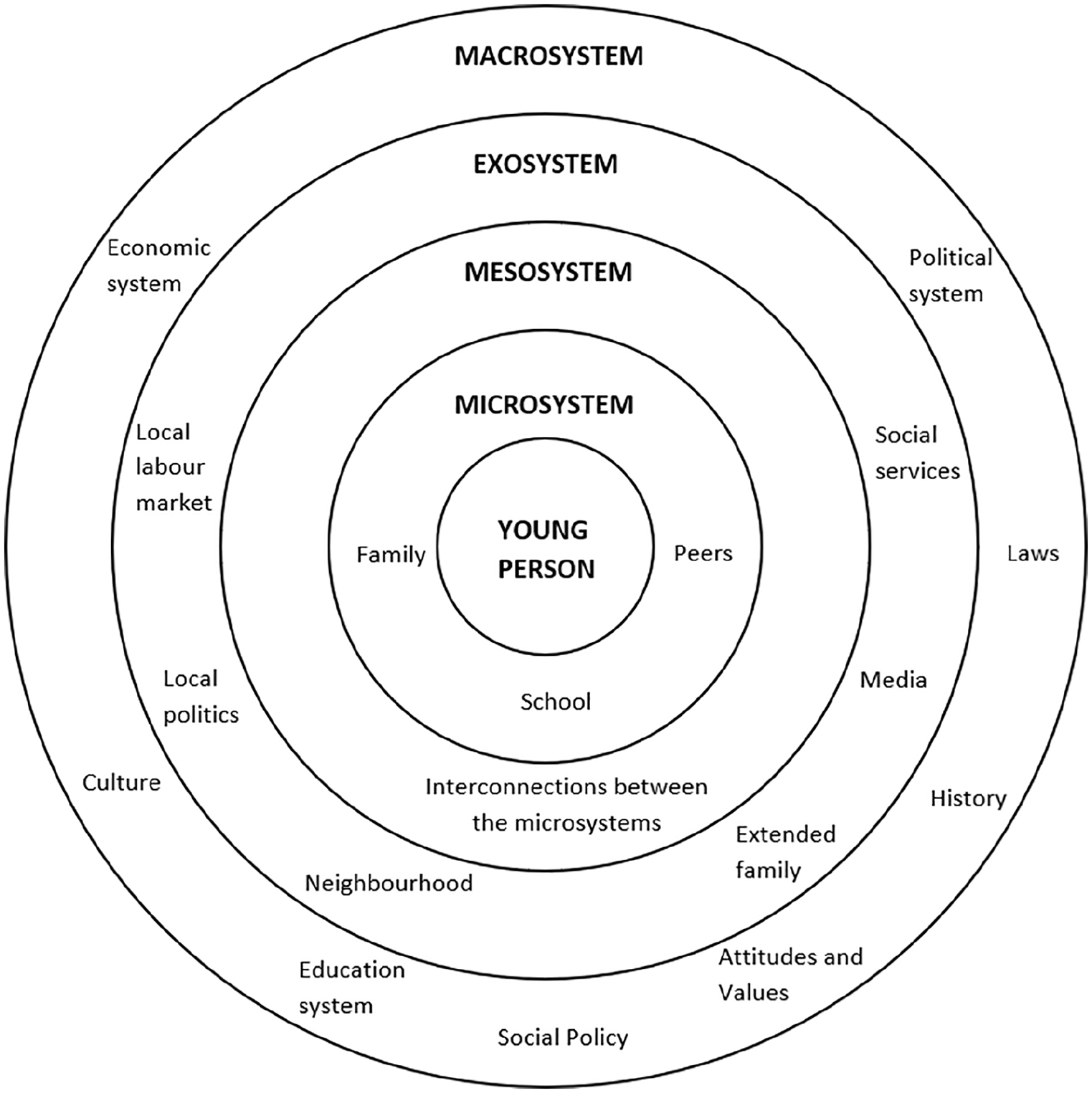
Adapted model of Bronfenbrenner’s ecological systems theory, authors’ original illustration drawing on Eisenmann, 2008.
This framework highlights the importance of the microsystem for individuals negotiating their way through the education system. The microsystem includes the interactions they have with family members, peers, in schools and within their communities, which have the most direct and significant impact on the development of an individual. Closely related, the mesosystem involves the interactions that take place between these different groups, for example, between parents and school or between peers, which will have an impact on the development of the young person. The mesosystem can be seen, therefore, as a system of microsystems. Beyond this, distal systems can also impact significantly on young people, in a more indirect but powerful way. Exosystems comprise settings that may not include the young person but have important impact on them indirectly, such as government agencies, neighbourhood amenities and educational provision, local labour market, transport and health services, the media and so on. As France notes (2016: 24), ‘exosystems, in a sense, carry various macro forces into immediate ecologies’. Finally, the broader macrosystemic socio-cultural and policy environment can profoundly impact on young people’s educational development and transition from school to work. Macrosystems include belief systems and values in a given society, as well as laws and regulations, the political and economic system. These interact with exo- and meso-structures, shaping young people’s opportunities and everyday experiences.
Bronfenbrenner’s model therefore provides a systematic way to explore ‘how the social environment is shaped and intersects with systems and wider ideas and practices’ (France, 2016: 23). Although personal experiences are often narrated as microsystemic occurrences happening at the individual level, we argue that these must be situated within the broader socio-structural contexts in which they take place. In this paper we explore the complex interactions of ecological systems, as they mediate young people’s experiences in education and while transitioning into employment.
The study
This paper draws upon data collected as part of a five-year (2013–2018), international, EU-funded project, Reducing Early School Leaving in Europe (RESL.eu), that aimed ‘to provide insights into the mechanisms and processes that influence a pupil’s decision to leave school or training early’ (RESL.eu, n.d.), before gaining adequate qualifications for today’s demanding labour market. The project also focused on the vulnerable group of young people who became NEET after leaving school with low or no qualifications (RESL, n.d.).
Our case study of NEETs was undertaken across London between May 2015 and October 2016. We aimed to recruit young people from different educational, socio-economic, ethnic and migration backgrounds (including White British), to capture a wide variety of voices and experiences. In order to achieve this aim, participants were recruited through various channels and across a diverse range of locations: with the help of two local authorities from North and West London; following up information on school and college leavers from the same area; and through two NGOs working with vulnerable youth in Central London. We also used targeted networking and snowballing techniques.
As a result, we collected a significant amount of qualitative data from 53 young NEETs. Of these, 26 participants took part in semi-structured interviews (May 2015–May 2016). We also conducted four focus groups with 30 participants altogether, organised with the help of NGOs, at their venues located in Central London (March–May 2016). Three participants took part in both an interview and focus group. In order to gain a longitudinal perspective on NEET experiences, we attempted to invite all 26 interview participants to a repeat interview. Given how hard to reach some of our participants were, we aimed to re-interview at least a third of them. In the end, 11 young people took part in a follow-up interview (April–October 2016). Attrition was due mostly to difficulties with reaching participants through the contact details they provided during the first interview. Nonetheless, with the help of NGOs and local authorities, we managed to engage with young people who were outside of most institutional structures and conduct follow-ups even with some of the most vulnerable young people, including some who were homeless.
Participants ranged from 16 to 24 years of age, with 33 males and 20 females. The majority were White British (21), 17 were Black, 8 were of Mixed background, 4 participants were Asian and 3 were White Other (Polish, Italian and Romanian). Half of the interviewees reported having learning difficulties, disabilities, physical illnesses and mental health problems. Most participants left school with very low or no qualifications; however, two participants became NEET after dropping out of university. Participants were mostly of working-class origin, with only two indicating middle-class background. Three interviewees grew up in the care system with foster families, and 12 participants were homeless. Thus, we managed to collect data from a variety of young people who were NEET. This composition was not meant to be statistically representative; however, it provided us with a range of profiles, reflecting the sheer diversity of London’s young population. This informed our understanding of the complex factors, processes and mechanisms that might contribute to young people becoming NEET.
Throughout this article, pseudonyms are used to ensure the anonymity of the young people who took part.
Data analysis
All interview and focus group data were audio-recorded, fully transcribed and analysed using two methodological approaches. First, we conducted thematic analysis across all transcripts with NVivo, using a priori codes, whilst also allowing new themes to emerge to capture commonalities, shared themes across our dataset. Then, narrative analysis was conducted, which allowed us to better understand participants’ experiences and the meanings they attached to these. By integrating thematic and narrative analysis, we aimed to produce a multidimensional understanding of young people’ experiences of be(com)ing NEET, focusing on how participants told their individual stories, on the one hand, and on patterns in the data which connected across narratives, on the other.
As discussed at length elsewhere (Ryan, 2015), we see narratives as embedded in and shaped by wider discourses framed by media, policy and public debates (Plummer, 1995). Although we are using narrative analysis, that is not to suggest an overly individualising approach. As Jennifer Mason argues, ‘a gaze of individualisation [. . .] loses sight of the connectivity of social relations, identity and agency’ (2004: 178). Personal narratives are ‘grounded in changing webs of relationships’ demonstrating ‘the significance of context, contingency, constraint and opportunity’ (Mason, 2004: 166). In other words, to relate back to Bronfenbrenner’s ecological systems framework, individual stories need to be understood as part of a wider ecosystem of macro-, exo-, meso- and micro-contexts.
The next section analyses young people’s experiences by presenting two narrative portraits and thematically looking at individual interviews and focus group discussions.
Findings
Participants dissected the numerous challenges they faced while in education and transitioning to the job market, such as lack of support with often undiagnosed SEN and mental health issues, leading to school disengagement, low/no qualifications and, eventually, becoming NEET; bullying; lack of access to adequate career guidance and information about further education, jobs and jobs-search skills; poverty; the cost of living; and the fiercely competitive job market in London.
We start our analysis by presenting the stories of Rosie and Adam in order to bring to life NEET experiences and illustrate how ecological structures (Bronfenbrenner, 1979) shape young people’s educational trajectories and transition from school to work. Although these are just two of the many stories shared by our NEET participants, they highlight many themes which were repeated across other interviews and focus group discussions. We believe these narratives resonate with the experiences of NEETs not only in the UK, but across Europe and beyond.
Becoming NEET: Rosie’s story
We met Rosie, an 18-year-old girl of Asian background, at an employability programme for NEETs provided by a local authority in West London. She was interviewed twice in 2016, during and after the programme.
Rosie left school at 16 with poor GCSE results, failing both her English and Maths exams, thus not achieving the minimum expected qualifications. Then, she enrolled on several consecutive vocational courses, all below GCSE level. In the meantime, she had a number of paid jobs: at McDonalds, as a shop assistant, then receptionist at a family business; but none of these lasted and she has been falling back into NEET status repeatedly. Her interview narratives suggested a childhood associated with illness (epilepsy) and family problems: I was kind of a good kid, but then, because some things happened in my family, I just got a bit depressed, and then I got into a bad route and ended up with bad friends. [. . .] People just called me trouble-maker for fun and that, just caused a big problem in my house. (2nd interview)
She also experienced bullying in school: ‘Back then I did get bullied. It’s like every kid gets bullied [. . .] in that school’ (2nd interview). Although she reported this to her parents and teachers, Rosie felt she did not receive any support; instead she was encouraged to ignore the bullying: ‘they were like “you just have to do what you have to do and you don’t have to think of what other people are doing when they are talking about you”’ (2nd interview). Rosie explained her behavioural issues as a response to bullying: ‘I did get a very bad short temper. It just flips on people’ (2nd interview). Although she used the third-person pronoun, it is possible that she suffered mental health issues: I would say, mostly in London, most kids are getting bullied. [. . .] I feel kind of bad saying this, but after they get bullied and when they get so depressed they feel like they want to commit suicide. (2nd interview)
To avoid bullying, Rosie started truanting, lost interest in education and left school without any qualifications. She spent the following two years churning between low-skill, low-security jobs, low-level vocational courses, volunteering and periods of being NEET.
Rosie had a complex relationship with her family. While she found some jobs through her extended family, they also interfered with her educational and occupational choices: for instance, she dropped out of a course in which she was interested, because of her parents’ insistence. Although NEET, Rosie was expected to pay rent to her parents and contribute to her brothers’ upbringing: I have to pay for my brothers to go to school. [. . .] Basically I have to pay my parents for the rent house, and then I am paying some of the other money, like pocket money and stuff, giving them money as well. . . For my brothers. (2nd interview)
During the first interview, Rosie described her ‘massive dream’ of becoming a flight attendant but had given up on her dream by the second interview. Turning 18, she now had to pay for education and although the cost was a fraction of what she had to provide to her family, Rosie could not afford this.
Becoming NEET: Adam’s story
Childhood trauma and lack of stability caused school behavioural issues in Adam’s life too. He was White English and 21 years old when we met him through a North London local authority which provided support for him.
Growing up in the care system, Adam’s childhood was marked by constant change, being moved around foster parents, care homes, social workers and schools, which impacted on his school engagement and academic attainment significantly. He explained that ‘(it’s) really hard trying to concentrate because you get into a subject and all of a sudden you move to a different school where they’re not even doing the exact same subject’ (1st interview). Adam felt let down by the education system and the schools he attended; he was bullied by other students, and ignored or discouraged by teachers. He recounted being told by teachers in various schools and ‘numerous times’ that ‘there’s no point learning this, you’re only going to fail it’ (2nd interview). Due to his behavioural problems, Adam was suspended and excluded from school several times during his education. He completed his GCSEs in an Emotional and Behavioural Difficulties (EBD) school attached to the care home where he lived. Adam described the school as chaotic and sometimes dangerous: ‘a lot of EBD schools, all they focus on is trying to control the behaviour side of it, instead of trying to work out what’s best for the student’ (1st interview).
Nonetheless, Adam realised the importance of education and asked for further support from his teachers at the EBD school, and they agreed to provide one-to-one lessons for him in the evenings. In this environment, even getting low GCSE results was a success and, although he failed to achieve the minimum required qualifications, Adam was proud: ‘I’m the only student in the 23 years it’s been open that’s actually walked away with any GCSEs from the school’ (1st interview).
Unlike Rosie, Adam described himself as highly motivated and engaged in his studies. But his EBD school only provided basic education, with very limited opportunities for learning: There wasn’t History, there wasn’t Geography, there wasn’t PSHE
2
, there wasn’t Art, there wasn’t French, it was just the basics. [. . .] They were just ticking the boxes again to get children through at least with a basic education. (2nd interview)
After finishing school at 16, Adam attended vocational courses and achieved an upper secondary diploma. Although he aspired to study further and made clear and achievable plans for the future, all his study and work plans were shattered when he received a criminal conviction. After that, Adam was refused entry to college courses and was unable to secure any jobs. In spite of the resilience and drive that clearly came across from Adam’s narrative, his agency proved insufficient to tackle the enormous personal and structural challenges he faced due to his traumatic childhood, his lack of social networks and his criminal record.
In many respects, Adam exemplified the ‘ideal-type’ student postulated by the education and youth policy discourse: he was engaged in his studies, aspirational and motivated, he sought his teachers’ support and had a realistic strategy for achieving his goals. He made ‘intelligent choices’ based on well-researched information on his chosen occupation, and the educational route leading to that. However, for him, as for many, simply having the ‘right’ attitude was not enough to compensate for and overcome the structural challenges of his environment.
Lack of support in schools
As in the case of Rosie and Adam, the majority of participants faced a multitude of challenges which interacted in complex ways. For example, many young people mentioned struggling with personal problems on the path to becoming NEET, such as mental health issues, illness, behavioural problems and family breakdown. Drawing on Bronfenbrenner’s model allows us to see how these personal factors became impediments to educational achievement in specific unsupportive or inflexible institutional settings, where they fell through the cracks of micro- and exo-level support systems (Bronfenbrenner, 1979). Thus, although we highlight specific challenges that participants described at the level of their microsystems, these cannot be interpreted in a contextual vacuum. Individual, microsystemic challenges manifest differently in specific institutional settings, which in turn are shaped by macrosystemic forces and structures.
Like Rosie and Adam, many participants described having behavioural problems and low attainment in school. While in the microsystemic ecology of classrooms (Bronfenbrenner, 1979) these issues are often construed as individual characteristics, during the interviews and focus groups, participants identified the context-specific factors in their micro- and mesosystems that negatively impacted on their school-related behaviour and academic achievement. These included disrupted family relationships, bullying and a lack of support with the ensuing emotional problems, as well as SEN: I’m autistic [. . .] but obviously they didn’t do the right assessments, and teachers don’t have that much training, like somebody is taught to teach Math, she doesn’t have the understanding to see if you have any emotional difficulties. (Emeka, FG
3
)
Participants explained that behavioural problems and disengagement were often the result of maladaptive responses to undiagnosed SEN and mental health problems; as Adam explained, ‘children will kick off, scream and shout because they want to be listened to and no-one’s doing it’ (1st interview). Several participants mentioned traumatic childhood experiences. For example, Bernard arrived in the UK at the age of eight from Jamaica to reunite with his mother. His immigration status, however, was not legalised while still a child, so at the time of the research, he was facing deportation from the UK: I had a troubled childhood. I went to four schools; I got expelled from every school I’ve been to. [. . .] I realised last year [. . .] that I suffered trauma and what I noticed was I always screwed up when it was the end of the school year, so the transition, so from primary to secondary, or from secondary to college. I’ve only just realised this and no-one else really took, didn’t realise neither, but it was destined that I was going to turn out to be, I don’t know, your average stereotype of ‘in and out’ and locked up and probably sent away. (Bernard, FG)
Instead of receiving support in school, participants reported being labelled disruptive, and this label followed them through their educational trajectories, impacting on their treatment even in new educational settings: They just put everyone in a box and they would just make a judgement on what your performance was going to be from a young age in the school. It just doesn’t allow room for progression. (Andrew, 1st interview)
Individual problems with SEN, mental health, behaviour and under-attainment seemed to have a disproportionate effect in an educational environment where schools focus on academic achievement above all. As Joseph remarked: ‘in school they only care about your GCSEs, they just want you to sit there, do your GCSEs and they don’t really care’ (FG). In this context, ‘problematic’ students can become a liability. As illustrated by the stories and quotes above, many reported being expelled from schools.
With much of the criticism directed at schools, participants’ narratives also revealed that many schools attempted to support struggling and disruptive students, for example, by employing additional teaching staff and sending students to counselling. Miriam (FG) thought that ‘every school has a counsellor’ and ‘an extra classroom. . . for people that have emotional situations’. However, support measures were not always effective. As shown by the narratives of Rosie and Adam, discussed earlier, many young people face complex risk factors in their social environments, which are difficult to address by school measures alone, especially if those focus on single risk factors such as behavioural problems or low achievement, in isolation from the broader ecologies of these young people’s lives.
Transition from school
Another common theme in the NEET narratives was that the education system failed to prepare young people for the world of work. The quality of careers’ information, advice and guidance (IAG) at school is highly variable and many participants agreed that this was inadequate for their needs. They reported not receiving enough support to make informed educational and occupational choices: ‘all they teach you is Maths and basics’ (Samira, FG). Bernard remarked on the lack of career guidance for undecided students: ‘They expect young people to just know what they want to do and it’s like here’s all the information and these classes’ (FG). According to participants, it is often assumed that, given the information, young people will work out their educational and occupational choices on their own. However, many young people seemed to struggle with defining their aspirations and developing a plan on how to achieve them. Others highlighted that learning effective job search techniques was not part of their curriculum: ‘They didn’t help us with like CVs or anything. I still struggle with that’ (Craig, FG). This seemed to be a widespread experience shared by many participants. It also correlates with wider research findings: according to an Ofsted 4 report from 2013, only one fifth of schools provided young people with adequate IAG, while a large number did not offer career education at all (Gibson et al., 2015).
Participants also felt that there was too much emphasis on academic achievement in schools, instead of preparing students for adult life and work: ‘They will train you. . . what is needed for your course, but then they don’t really train you for the real life type of situations that you end up in after college’ (Shirley, FG). Several participants noted that schools, being assessed on academic outcomes, try to direct young people towards academic studies even when they would be more interested in or suited to vocational education. Participants criticised the lack of information about alternative learning options such as apprenticeships. Liam explained that he went to university following his school’s advice. However, he ended up dropping out of his university course and became NEET and homeless (the latter partly due to family problems as well). He realised later on that an apprenticeship would have suited him better, but no-one mentioned that option to him while in school: ‘I didn’t have any support around me to say there’s different. . . I didn’t even think about apprenticeships when I was at school’ (Liam, FG).
For many young people the transition from school to A-levels (academic route) or further education (usually a more vocationally oriented route) at the age of 16 can be a particularly vulnerable period, with increased risk of disengagement from education, dropping out (often with no qualifications) and becoming NEET: You may end up picking something you don’t want to do, or you think you want to do it and then halfway during the course, you’re just, like, ‘no, why did I sign off for this?’, and you end up dropping out. (Samira, FG)
Those going to further education to study vocational courses have to adjust to a new educational environment and expectations, and get disconnected from their peer groups from school, increasing feelings of isolation. As Andrew explained: ‘I just didn’t care about my education. I was more concerned with social life after that point. [. . .] Because most of my friends were going to [another college]’ (2nd interview). Churning between a string of vocational and training courses, apprenticeships and unpaid voluntary work, interspersed with periods of being NEET is a common experience for many young people (France, 2016; Furlong, 2006). Rosie’s story was a typical example of this: over a two-year period, she enrolled on three different courses, in three different fields and all at the same low qualification level; also working in several low-skilled jobs, but becoming NEET repeatedly.
Socio-economic disadvantage
Poverty, the high cost of living and the fierce competition for jobs in London were recurrent themes in participants’ narratives. Les explained during a focus group: It’s expensive to live in London. If you want to study and you want to build yourself further, you need to be able to support yourself. . . Most people here, their parents can’t support them, you know. (Les, FG)
As we explained earlier, staying in some form of education or training became mandatory in England from 2014/15, under the RPA legislation. However, just like Rosie discussed earlier, many young people were also expected to contribute financially at home. Being NEET with no income, Ahmed, for example, was threatened with being thrown out of the family home. James recalled during the interviews that he dropped out of education mainly because he could not afford buying a few outfits for the different days of the week and was bullied as a result. Several participants felt overwhelmed by the difficulties of balancing work and education at the same time: The work that we get [in college] is so demanding and it’s very rushed, like giving in work on time, [. . .] we have late nights doing work, [. . .] sometimes they’re just tired to get to work. (Nelson, FG)
Participants also remarked that the youth labour market – especially for people with low or no qualifications – comprises low-quality, poorly paid jobs, with little opportunity for learning and career progression, further hindering their future employment prospects. Nelson asked: ‘if you go to jobs where it doesn’t benefit us and we’re only there for the income and cash flow, how are we actually bettering ourselves to push forward?’ (FG)
Some participants argued that poverty and lack of job opportunities lead young people to crime. During a focus group, Joseph explained that ‘they sell drugs just to try and make money’. Nelson added: ‘London is expensive, it’s very expensive; how are we getting money, we don’t know, if we’re not working, we’re not doing anything. It helps, it increases criminal activity’. During this research we met a number of young people who had a brush with the law. As shown earlier through Adam’s story, his criminal conviction proved to be an insurmountable obstacle: he was unable to study or find work as a result.
Participants interpreted their failure in the labour market as a result of high competition in London: ‘there are jobs there, but it’s the fact that there’s too many people looking for the same job, that exact same job’ (Gemma, FG). They highlighted that young people were in a particularly disadvantaged position because in London employers have the opportunity to ‘only go for people that have more experience so us youths don’t get a chance’ (Joseph, FG). Others mentioned that their lack of qualifications was also negatively viewed: ‘you’re always competing with people that have more qualifications’ (Luke, FG).
On the one hand, participants recognised the multitude of issues which impacted on their education and employment outcomes. On the other hand, they tended to stress their own responsibility in becoming NEET; for instance, Luke said emphatically during a focus group: ‘In my opinion, it’s down to the individual whether they want to succeed or not. [. . .] I’m not going to blame anyone else, I’m here because of me’. At a different focus group, Gemma, who was homeless, also argued that the onus is on young people to take responsibility for their own lives: You have to help yourself before someone else can help you; and it’s just the fact that you just can’t be lazy, because if you want something you’ll do it. You don’t have to sit on the street and beg for money. That’s your choice. That’s everyone’s choice. (Gemma, FG)
Consequently, participants tended to favour individualistic responses to overcome their disadvantaged position, such as staying positive and putting more effort into looking for jobs and training courses. However, as illustrated by the stories above, the agency of these very marginalised young people was greatly restricted.
Discussion
As described earlier, participants were understandably critical of the schools they attended for the lack of support with SEN, mental health issues and careers IAG. By applying Bronfenbrenner’s ecological systems theory (1979), however, we can see that the reasons behind this failure of provision do not necessarily lie only at the institutional level. The model of ‘nested ecology’ draws attention to the wider macrosystems that affect and intersect with young people’s proximate social environments and structure their opportunity horizons. The school years of these young people coincided with the economic recession and the ‘age of austerity’ in the UK that followed the global financial crisis. Like in many countries, the government’s austerity programme consisted of sustained and severe reduction in public spending that affected the education system as well, leading to major cutbacks to support services in many schools (France, 2016; Hutchinson et al., 2016; Ryan and Lőrinc, 2015). Further education and, more broadly, the 16 to 18 age group were the hardest hit by austerity measures (Belfield et al., 2018). Drawing on Bronfenbrenner’s (1979) conceptual framework, schools mediated the macro forces of policy and economics into the immediate ecologies of young people’s lives, shaping their educational experiences and transition from school to the next steps of their lives.
Similarly, the ‘patchy’ careers education in England, with fluctuating quality (Moote and Archer, 2018) reflects recent policy changes. The Education Act 2011 removed the requirement from local authorities to provide universal career service, at the same time as removing the obligation of schools to provide career education as part of their curriculum. Whilst schools were given a statutory duty to offer access to independent careers advice to all pupils, they did not receive any additional funding for this (Andrews, 2016). The independent Connexions service that provided IAG for young people was also dismantled (Moote and Archer, 2018). Left to their own devices, without additional funding and with limited regulations, many schools struggled to provide adequate IAG for their students. Thus, participants’ individual negative experiences with career advice in their school microsystems may reflect macro forces of policy, which were mediated by the exo- and mesosystemic institutions responsible for implementing education and youth policies locally (Bronfenbrenner, 1979).
The ecological approach (Bronfenbrenner, 1979) also proposes a more holistic understanding of young people’s opportunity structures and their decision-making within these, by bringing attention to the multiple influencing factors at different levels of the social environment, including the characteristics of the education system, economic conditions (macro-level), local education, training and career IAG provision (exo-level), and so on. Statistics show that underprivileged young people and those with lower prior achievement are more likely to follow vocational studies (Hupkau et al., 2017). However, while the academic route to university through A-level studies is well established and simple to navigate, often undertaken in the same educational institution, vocational choices are ‘not as well-known, which partly has to do with the complexity of the vocational education system and the difficulty of deciphering available data’ (Hupkau et al., 2017: 42; Ryan and Lőrinc, 2018). For instance, in 2016, 16- to 18-year-old learners in England could choose from 9,835 qualifications at Level 2 (equivalent to 5 A*–C GCSEs) and 3,729 qualifications at Level 3 (equivalent to A-levels), depending on local availability (Hupkau et al., 2017). A large proportion of these courses, however, are not valued by employers and do not lead to subsequent jobs, instead providing ‘blind alleys’ of studies (Roberts and Atherton, 2011). Students heading for vocational studies – over 50% of young people in England (Hupkau et al., 2017) – face the daunting exercise of making ‘informed’ choices in this opaque, complex system, with limited or no career guidance available, which is likely contributing to higher NEET numbers.
The above-mentioned changes in careers education and guidance thus seem to disadvantage those who arguably would need IAG the most, such as students from lower socio-economic backgrounds (Moote and Archer, 2018). Besides, youth transitions became more complex for all, and churning between different vocational courses, low-skilled, low-paid jobs and unemployment is a common experience for many (France, 2016; Furlong, 2006; MacDonald, 2011), as shown in the stories presented above. These examples reveal that macrosystemic factors such as changes in the youth labour market, poverty and socio-economic disadvantage exert their influence cutting through meso- and exosystems (Bronfenbrenner, 1979), and framing the context of young people’s educational and transition experiences and their opportunity horizons.
However, there seemed to be a disconnect between the macro- and micro-level issues in participants’ narratives: between their awareness of the socio-economic disadvantages manifesting in their lives and their stated ‘faith in the power of their own agency’ (Franceschelli and Keating, 2018: 12). Participants tended to interpret their own marginalised position in education and employment in terms of personal responsibility. As the quotes from Luke and Gemma illustrate, young people seem to have internalised neoliberal individualistic discourses, thus interpreting structural-systemic problems (such as youth unemployment) in individualised terms (being NEET, as an attribute of the individual). Several participants declared their belief that ‘success’ is solely dependent on individual ambition and effort. Yet, as the stories of Rosie and Adam have clearly shown, the agentic potential of these very marginalised young people was extremely constrained, and often defeated by structures of disadvantage located at various levels of their social ecologies.
Conclusion
Policy-makers in the UK and across Europe have voiced concerns about the ‘NEET problem’, given the high individual, social and economic costs associated with the NEET status. Research shows that young people with low or no qualifications are among the most vulnerable to becoming NEET (France, 2016). Indeed, policy discourses tend to describe ‘risk of NEET factors’ in individual terms – such as academic under-attainment, behavioural problems, having physical or mental health problems, SEN and so on (Furlong, 2006; Powell, 2018).
In this article, drawing on rich qualitative data from a large European study, including the narrative portraits of two young people, we have explored young NEETs’ accounts of their school and transition experiences. Applying Bronfenbrenner’s ecological systems theory (1979) allowed us to better understand the complex and dynamic interplay between the micro-, meso-, exo- and macro-dimensions of young people’s lives and gain a more holistic understanding of the processes and mechanisms that contribute to young people becoming NEET. In particular, we have argued that, while participants tended to present the challenges they faced in education and on the labour market in terms of personal struggles at the micro-level, there were clearly institutional and wider policy and economic contexts – at meso-, exo- and macro-level – that shaped and constrained their school experiences and their transition from education to employment. We highlighted that lack of support and inadequate career guidance provision in schools is likely the result of widespread cutbacks in the education system and auxiliary services as part of the UK government’s austerity programme.
But beyond the fact of funding cuts, our findings also highlighted the power and ubiquity of the individualising ideological policy agenda and the extent to which young people have internalised this discourse. Although aware of social inequalities, young people tended to interpret these in individualised terms of personal failure in education and the job market. To counter and dispute this discourse, we have used Bronfenbrenner’s ecological systems theory (1979), which was particularly helpful in enabling us to explore how individual experiences are located within wider macro- and exo-structures. As our analysis has shown, the agentic potential of these very disadvantaged young people is severely restricted. Thus, while acknowledging young people’s agency on the path to becoming NEET, re-engaging with education and finding a job, we argue that the ‘risk of NEET factors’ most associated with becoming NEET (such as low attainment and qualifications) are fundamentally social and structural in nature.
Footnotes
Acknowledgements
The views expressed here are those of the authors; they are not necessarily those of the RESL.eu project and the EU.
Declaration of conflicting interest
The author(s) declared no potential conflicts of interest with respect to the research, authorship, and/or publication of this article.
Funding
The author(s) disclosed receipt of the following financial support for the research, authorship, and/or publication of this article: The research leading to these results has received funding from the European Community’s Seventh Framework Programme [grant number SSH-CT-2011-1-320223 RESL.eu].
Notes
Author biographies
