




Abstract
Qualitative social inquiry into action on climate change involves understanding the intersections between contemporary social life and the technological development for environmental matters that work in this context. Thus, this article presents a solution in two parts about how to do qualitative research into the climate change action of human populations. Part 1 unravels the complex political and technological situation that we find ourselves embroiled within, and specifically with respect to climate change. The resultant patchwork vector theory of this article comes from Deleuze/Guattari’s Anti-Oedipus and lays out the expansionist system of global capitalism in terms of speeds, flows, and thresholds. Second, the creative ecologies theorized here examine the reality of social-political organization in response to climate change. In sum, these creative ecologies are arranged to pry into the qualitative principles of the patchworks through a combination of Bookchin’s social ecology, Guattari’s Three ecologies, and Harris’ creative agency. In combination, the dual strands of patchwork theory and creative ecologies in this article gives rise to a new qualitative methodology, suitable for social investigation under climate change and here applied to (a) play and (b) water.
Introduction—What is a Patchwork?
The situation that we find ourselves embroiled within in terms of climate change reveals difficult and confronting truths. On one side of these truths lies the scientifically proven facts of climate change (DiMento & Doughman, 2007, pp. 1–67), produced by human action, and escalating, despite calls for the move toward net zero carbon emissions, and the development of a suite of technologies capable of enacting the shift to a decarbonized, renewable, and fossil fuel free economy (cf. Vieira et al., 2023, pp. 1251–1259). On the other side of these truths lies the complexity of the political, social, economic, and cultural situation that we are locked into, here defined by global capitalism. In contrast to the scientific truths of climate change, the capitalist side of the equation is more complicated, with half-truths, corporate greenwashing, a myriad of opinions, lies, and a regime of images that now circulate through social media to blur the lines between understanding the facts of climate change and the necessary action on climate change (Waisbord, 2018, pp. 20–31; Cole, 2021, pp. 121–137). I am calling the “social-capitalist-political” side of the equation a “patchwork,” and the necessary translation to qualitative, social inquiry as “patchwork theory.”
Patchwork theory in this context exhibits the complexity of the current situation, the relativity, differentials and contradictions with respect to how politics “fixes” climate change. For example, a democratic majority of the population voting for a “green new deal,” will, at the same time, not act to arrest climate change, if they knew their vote could lower living standards, even though climate mitigation demands it. Patchwork theory in the vocabulary of populist critics such as Moldbug (2017, pp. 5–14) denotes how the bindings in contemporary society are systematically deteriorating in the current global geopolitical situation. Moldbug counters this deterioration with a call for a return to centralized authoritarian regimes, that he equated to cameralism (Tribe, 1984, pp. 268–274). Cameralism describes German state policy in the 18th and early 19th centuries that advocated for control of a central economy. I am defining patchworks similarly to Moldbug (2017), in that there has been a serious erosion of social cohesion in the present political-economic-cultural circumstances that has led to separate societal-technological patches. However, I suggest that climate change derived social-cultural-economic deterioration will simultaneously create fresh opportunities for small-scale organization, that I am defining through social inquiry as “creative ecologies” (from Bookchin/Guattari/Harris);
1
and as a consequent revitalization of local control over human society. I need the underpinning of creative ecologies in “Bookchin/Guattari/Harris” as a strong political basis for personal, social and ecological change in times of global warming and the Anthropocene.
2
Furthermore, to enable this position, I must circumvent the right wing (NRx – neo—reactionary movement) use of the patchwork, and take the patchworks back to Deleuze & Guattari’s, (1972/1984, p. 142) formulation in Anti-Oedipus and the key conceptual term of “deterritorialization,” as summarized by Nick Land (2017): In socio-historical terms, the line of deterritorialization corresponds to uncompensated capitalism. The basic schema is a positive feedback circuit, within which commercialization and industrialization mutually excite each other in a runaway process, from which modernity draws its gradient . . . As the circuit is incrementally closed, or intensified, it exhibits ever greater autonomy, or automation. It becomes more tightly auto productive . . . because it appeals to nothing beyond itself, it is inherently nihilistic. It has no conceivable meaning beside self-amplification. It grows in order to grow. Mankind is its temporary host, not its master. Its only purpose is itself . . . The point of an analysis of capitalism, or of nihilism, is to do more of it. The process is not to be critiqued. The process is the critique, feeding back into itself, as it escalates. (online)
This quote helps to move the argument along with respect to patchwork theory and the resultant creative ecologies for the Anthropocene. Land’s critical nexus in terms of understanding the consequences of capitalism and the effects of escalating cybernetic processes as described by deterritorialization above is a “dark enlightenment” (Land, 2022, p. 1). This dark enlightenment critically reverses and takes apart the formative moves of the enlightenment, that no longer hold sway under pressure from “hyper accelerated” digital capitalism. For example, the notion of a pure democracy; unsullied rational choice; simple, directed agency (not the creative agency from Harris (2021) and used by this article]; social solutions based on applying scientific method, but that ultimately strengthen state/capital power (this is why a complex notion of social inquiry is required for this paper via creative ecologies and including the move to micro social/political organization embodied by social ecology and the Three ecologies); and, indeed, a human society based on evidence-based, quantifiable principles, but simultaneously subject to economic controls (cf. Kane, 2019, pp. 1114–123)—are all immanently critiqued by capitalism according to Land (2022). In effect, Land (2022) speculates that as capital joins with the processes of automation, data and calculation, it sets up new regimes of algorithm that chart the future of a different society, with humans no longer fully in control of what happens next.
This idea of humans losing control of society is not the “Terminator mythology” (Laist, 2015, p. 72) that sets machines against humans in a perpetual battle derived from the future, but describes, for example, real and ongoing processes whereby global stock exchanges use algorithms powered by super computers to divert investment, determining how and where money and wealth flows around the globe, and where/when it accumulates, Sadowski (2020, pp. 23–52). It is striking that these flows of capital determine the patchworks of this article, and yet, it is in the context of these flows that a solution to understanding the social principles of climate change, here rendered as the qualitative social inquiry of creative ecologies, must forge a path toward a better future. In the words of Droz (2021) “. . . in the line of the challenge of global dispersion of climate change effects and causes, deterritorialization due to the ubiquity of long-distance transportation and communication challenges the common assumption of limiting the reach of ethics and responsibility to within given territorially bounded communities” (p. 7). Hence, the patchwork theory of this article takes account of capital flows that define a process of deterritorialization, wherein capitalism exhibits the characteristics of expansionism, gathering speed and forces (both human and nonhuman) with the sole fixed goal of making profit, while also rendering these flows through creative ecologies (Bookchin/Guattari/Harris).
The qualitative, social method of inquiry derived from patchwork theory, and the vectors that it defines, specifically produces cracks in the patchworks, here illustrated through, (a) play, (b) water, and these cracks appear due to the forces that are pushing through the patchworks in time (Shackley & Wynne, 1996, p. 301). This method for social inquiry is critical, but immanently so, which I have previously defined as a mode of immanent materialism (Cole, 2013, 2014) and that, in this case, follow capital with the intent of opening fissures in the patchworks by engendering creative ecologies that head toward a better future under climate change. The sections (a) and (b) of the article below show how creative ecologies work as modes of resistance within the patchworks (as they focus on its cracks) and as applied to play and water.
The creative ecologies of this article articulate a mode of qualitative, social inquiry suitable for the patchworks and that consists of three combined and synthetic elements: (a) Bookchin’s (2006) social ecology is a highly rationalist approach to reconciling social life with ecological matters and, (quite rightly), designates local control as being crucial to wrestling unified human micro societies back onto a sustainable path in the current situation (contra corporation controlled, interventionist, divisive, large scale, accumulative global capitalism). Bookchin’s (2006) social ecology is essential to the mode of social inquiry for the cracks in the patchworks, as it provides a critical and political platform for analyzing the patchworks in terms of scale. (b) Guattari’s (2000) Three ecologies is parallel to the move toward small-scale political organization that is found in Bookchin, (2006, 2015); but also suggests that the effects of global capitalism on the self are more profound than Bookchin admits, and thus requires a new mode of psychoanalysis, which he termed as schizoanalysis, and that turns the deterritorializing forces of capitalism outwards to rebuild one’s relations with society and nature. Guattari (1989/2013, 2015) worked out a unique and complete mode of reverse psychoanalysis, or anti-psychiatry, which deals with the most pernicious effects of capitalism, and the inclusion of his Three ecologies in the creative ecologies of this piece reinforces the need to delve into the modes of lunacy now paraded as rational economic control in the patchworks. Finally, (c) Harris’ (2021) creative agency deploys strategies from new materialism (cf. Hood & Kraehe, 2017, pp. 32–38) and posthumanism (e.g., Brigstocke & Noorani, 2016, pp. 1–7) to reconnect human action and society with the nonhuman and offers a way forward for enhanced ecological and nondualistic human socializing, action and thought in the Anthropocene. Harris’ (2021) work in “creative agency” importantly complements Bookchin’s (2006, 2015) critical approach to social inquiry, as well as Guattari’s (1989/2000) reverse psychoanalysis, because it proposes a zero ontological plane whereby the critical work of Bookchin and schizoanalysis of Guattari proliferate as a new thinking self fit for climate change analysis. In combination, these three strands of what I am terming as “creative ecologies” (adding to, for example, Harris’ [2018, 2021, pp. 3–24] use of the term), present a synthetic, qualitative strategy for working with, through, and between the vectors of the patchworks, which is the movement of the political-social-economic realities and future(s) that we face under capitalism and climate change today.
Playing Between the Lines of the Patchwork
The first level of material immanence and vectoral analysis in this story of creative ecologies and social inquiry in between the patchworks is “play.” Play is a much-researched aspect of early childhood education, wherein unscripted episodes of intra-child action have proven to be essential in terms of the child’s formative development, and specifically with respect to learning how to make bonds, trust, and interact successfully with others (Ailwood, 2003, p. 289; Nilsson et al., 2018, pp. 240–245). For the creative ecologies in the patchworks, play mitigates and expands the potential of agency at the local level from a set of preordained, profit-driven intentional capitalist objectives (defined from without), to an immanent set of possibilities (or potentia), that can also be understood as experimental procedures, or sets of “becomings” (Harris & De Bruin, 2018, p. 221) that head to a better future, but in a nonlinear fashion (as defined from within). Of course, capitalism, whose actions, under the definition of deterritorialization from Deleuze & Guattari (1972/1984) and Land (2022), is fully capable of pre-programming the algorithm of play for its own benefit as permutation. However, for the purposes of creative ecologies of this article, there is always a necessarily unaccounted aspect of play that cannot be defined in advance or from the outside. To this extent, play resolves into local experiments or niches, which join to mark out patchworks, and eventually the landscape, for example, of a renewable future which is in line with the climate change focus of this article, (Figure 1), as was previously theorized and represented by Andersen and Geels (2023, pp. 1–12) when depicting how social change happens under climate change:
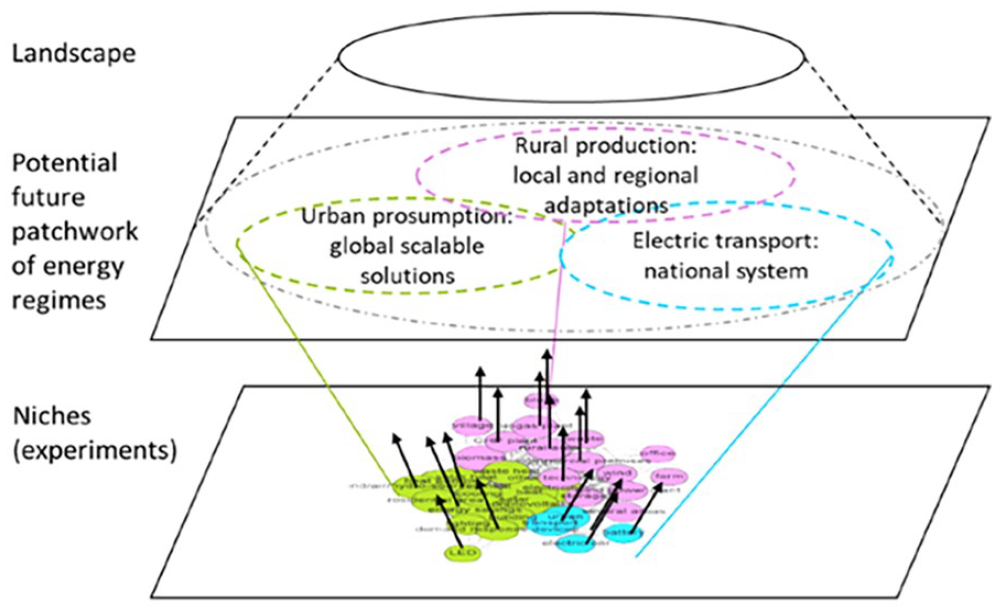
The Nestled Relationships Between Experimental Niches, Potential Future Patchworks (of Energy Regimes), and the Landscape.
Figure 1 depicts the relationships between local niche experiments, the patchworks, and the eventual landscape for renewable energy transition (this study was from Finland but is transferable to other locations). As depicted in Figure 1, the patchworks are empirical coagulations of local and situated matters, that bound the movement and change factors inherent in the local niche experiments (Matschoss & Repo, 2020, pp. 1–9). As such, the move to a better future under climate change is a vector or set of local niche experiments that come together as a patchwork, and definite sets of innovations that move society in the right direction in terms of climate mitigation. However, as has been made plain through the definition of capitalism as deterritorialization, this article does not consider technological innovation in isolation.
This lateral, interconnected, and time-based view on technological development means that the local niche experiments (Figure 1), such as those depicted above in terms of the specific energy transition in Finland, also have personal, political, social, cultural, economic, and ecological consequences over time (Tuathail, 1999, pp. 139–152). In terms of play, the consequences of innovation take place internally as well as in the patchworks. For example, the use of renewable technologies, such as the placement of PV (photovoltaic) arrays on rooftops to reduce housing emissions by generating energy are operationalized when individual households can afford the cost of the arrays (Mulleriyawage & Shen, 2020, pp. 854–858), and make the decision to install them. Thus, play in the structures of the patchworks and their vectors is technological innovation mitigated by economic and personal realities, a theme returned to throughout this article in terms of the deterritorialization and financial perturbation.
In the precise terms of creative ecologies, Bookchin’s (2006, 2015) social ecology suggests that play happens in the patchworks as niche experiments of local communities that have taken back their power and autonomy, to question and resist the negative impacts and hierarchies of global capitalism, such as the expanding divisions and contradictions between social life and natural ecology caused by deterritorialization and capital. Social ecology looks to reinforce connections between human society and ecology, as it perceives an unassailable link between ecological degradation and societal disfunction (Bookchin, 2006, p. 19). Hence, the experimental niches (Figure 1) and resultant patchworks, can be analyzed for disparities in the social and ecological orders as part of the mode of qualitative research suggested by creative ecologies and play. Guattari’s (1989/2000) Three ecologies centralizes play as the connective matrix between one’s existence, social life, and ecology, and hence is an important aspect of how the patchworks may be imagined, conceived and formed.
3
Guattari’s (1989/2000) playful experimentation with self, society, and ecology aims to disenfranchise the capitalist and accumulative ego, and redistribute its energies for, in the terms of this article, a means to analyze qualitative data under climate change, and not as the accumulation of wealth or power. For Harris (2021), the focus on human and nonhuman entanglement and agential cuts, inserts “play” as an aspect of an expanded agency, which allows for and creates patchworks between human and nonhuman actors in situ. The addition of Harris (2021) completes the mode of creative ecologies to examine niche experiments for climate change and the patchworks, as nonhuman actors and their representative play is deliberatively brought into the framing of the study. In terms of pure patchwork theory, play, while creating new possibilities between actors through situated experimentation (niches) and the creative ecologies of this article, also enhance a sense of isolation, and hence produce a new vista for examining society: Patchwork doesn’t delineate a rigid set of neighbours for each patch but allows local structures to change internally and with respect to its outside: some patch might want to cluster next to some set of microstates, another time escaping them, or drifting out into the open smooth cosmos, alone, but perhaps connecting via the immense cyberspace, or even stranger vistas, to the others. Just like the individual subject—strange, not-fixed, mobile, “garnering here, there, and everywhere” through connections, but not integrations. (XG, 2018)
This quote shows how patchwork theory enables an understanding through qualitative inquiry of the ways in which society is falling apart under pressure from capitalist deterritorialization (Cole, 2022a, pp. 2–7; Ringrose, 2015, pp. 395–399) and foregrounds a notion of patchwork spacetime. However, while I acknowledge this “falling apart” through the deployment of patchwork theory, I also suggest that this movement creates opportunities for regeneration and sustainability, or what I am calling creative ecologies. One such opportunity involves enhancing play by covering playgrounds (Figure 2A and B), to keep them cool under pressure from global warming (Pfautsch & Wujeska-Klause, 2021, pp. 10–25). Creative ecologies involve the active promotion of play as designated by the new, enhanced playground, and as an amalgam of social ecology, Three ecologies (self, society, nature), and creative agency.
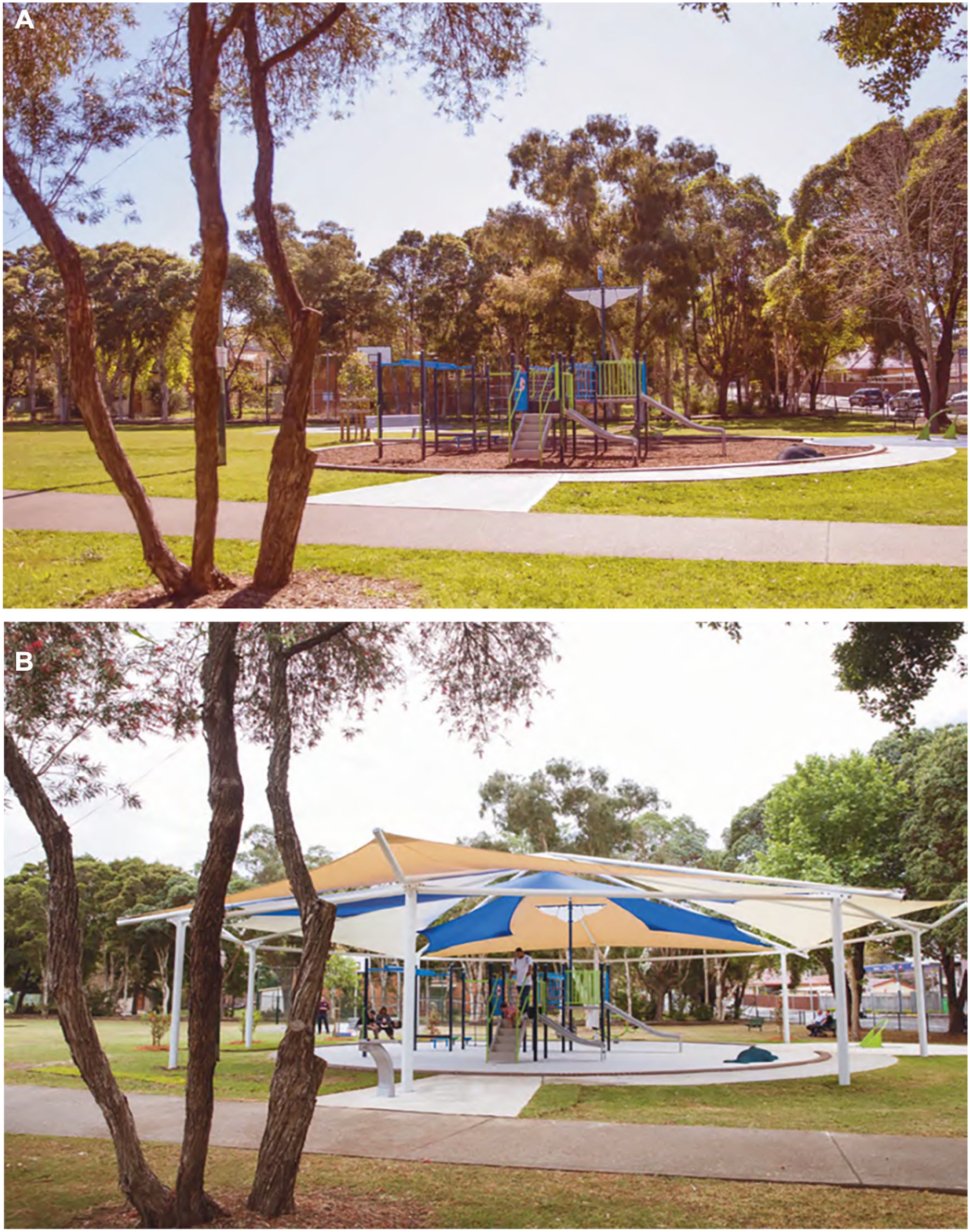
The Memorial Park Playground (Cumberland City, Sydney) Before (A) (August 2020) and After (B) (October 2020) the Transformation into Australia’s First Dedicated UV-Smart Cool Playground.
Underneath the new shading systems, the children will be enabled to play for longer under the Australian summer heat. This example of a patchwork does not lead us to an overall renewable future (as is the nature of patchworks) and shows how practical and real-life patchwork operations can function, as niche experiments that merge with other urban trials to tend toward a more sustainable future. This example of a patchwork deals with the social, political, economic, and cultural implications of creative ecologies as it shows how play is enhanced and protected locally. In effect, this patchwork, by emphasizing the importance of play, exactly complements this article’s focus on augmenting creative ecologies leading to positive work on climate change by connecting ecological, personal and social matters (Grimm et al., 2008, p. 758). Play is essential to this connection, as the children protected by this new sail covering will have increased opportunities to communicate, experiment, and question their roles and standing in the community in which they exist, while communing with nonhuman others (e.g., bugs). This aspect of play, that questions existing power structures, aligns with Guattari’s (2015) notion of transversality, which is an important early theorization to complement the Three ecologies, in that it encourages transverse connections between parallel lines that are connectors between individuals in a group under pressure from outside forces (e.g., capitalist profit making). The patchwork of this example (Figures 2A and B and 3) encourages lateral movement in the future of society as produced through enhanced play, and this lateral movement is captured by the creative ecologies of this article and transversality in the face of globalization (Cole & Bradley, 2018, pp. 1–15).
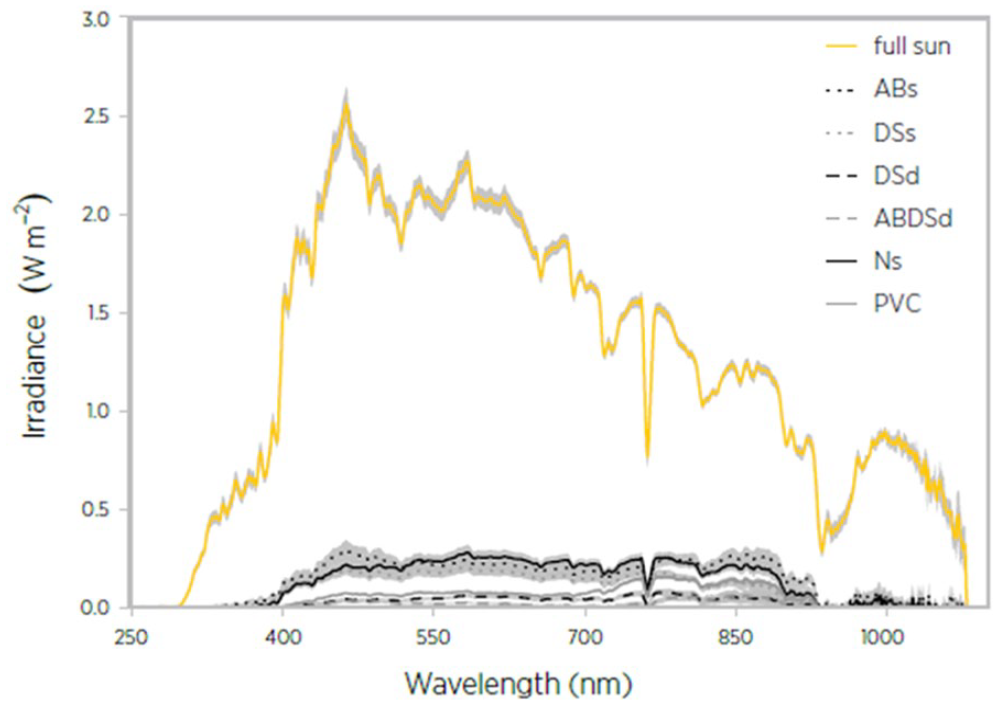
The Cooling Effect of the New Playground.
The creative ecologies of the playground are precise vectors of the future, preserved and mutated in the collective push to survive climate change. How exactly this is going to happen is of course contingent upon other factors, such as what takes place with respect to the individuals and society of the playgrounds, and how climate change impinges upon their lives over time. This point coincides with the quote from Donna J. Haraway (1991): “Our bodies, with the old genetic transmission, have not kept pace with the new language-produced cultural transmission of technology. So now, when social control breaks down, we must expect to see pathological destruction,” (p. 35). Playgrounds and their unmediated play are one of the last places and spacetimes belonging to social life that is not interrupted by screen culture and the technology of mobile phones and other electronic devices. In effect, the communicative art of play found in playgrounds is a vector preserved and nourished in society for climate change adaptation. This statement comes about because communication captured by the electronic world of cyberspace is already subject to the deterritorializing influence of global capitalism, Basch et al. (2020, pp. 209–212). Consequently, the innocence of directly playing in the playground and its communication without electronic mediation is a vector to be preserved for the fight against climate change, because it harbors values that sit outside of deterritorializing world capitalism (Krause & Petro, 2003, pp. 5–10). As a method of qualitative inquiry, the creative ecologies of play determine a means to work between the expanding separation and isolation of the deterritorializing patchworks, while not diminishing their importance and/or power (i.e., tending toward idealism).
This example of cooling a playground helps to preserve the innocence of play, as a vector for the future, and as an instance of creative ecologies, wherein the effects of the preservation of play shall have profound consequences, such as enhanced action against climate change. Such action will be apparent because of the nature of the expanding patchworks (Scott, 2008, pp. 32–56) and the creative ecologies of this article. Even though the deterritorializing power of capitalism is immanent on a situation, including this one of cooling playgrounds, and hence the commercial system of exchange is able to exploit the material product of a cooler playground (if it is for sale), the system of exchange is simultaneously unable to exploit the power of the child at play, that is a significant pillar of the creative ecologies of this paper and the fight against climate change, as Nietzsche (1883/1980) has said: “The child is innocence and forgetting, a new beginning, a game, a wheel rolling on its own, a prime movement, a sacred ‘Yes’” (p. 55).
Water Use and the Fluidity of Patchworks
The next patchwork to consider in this approach to qualitative social inquiry that counters but does not ignore the impact of the deterritorialization of capitalism is “water,” and specifically its usage by humans. In the Anthropocene, the use of fresh water by humans is one of the crucial vectors to be addressed as a matter of urgency, for example, Savenije et al. (2014, pp. 321–330). Clearly in a warming environment, already scarce fresh water supplies must be protected and preserved for the human population (and for the rest of nature), and one way to understand these social-ecological mechanisms is through the patchworks of this article. In contrast to the previous example of covering a playground, the example of water use as a patchwork extends and reshapes what a patchwork is to begin with in terms of the nature of water, and its propensity to flow (e.g., Jones et al., 2000, p. 80). Even though areas of human inhabitation and their water use may be defined as patchworks, the flows of water in and out of these areas are also parts of the patchwork by extension, and only bounded by the water cycles, and the eventualities of the flows of water. Hence, water use enables a different quality and sense of the patchworks and creative ecologies necessary to preserve life under conditions of climate change. Edelenbos et al. (2015) define the patchworks of human water use as: “a social system of actors with different backgrounds and from different scales and levels with lively, energetic and productive relationships that are constantly seeking to explore, develop, and consolidate common ground in dealing with complex water governance issues” (p. 239). In sum, the vector of human water use in the Anthropocene for this article is dependent on understanding the mutating patchworks as they buckle and change due to climate change (Wallace-Wells, 2019, pp. 145–215). This section will use data from a study of water use in Australia, which is particularly susceptible to widespread and prolonged drought, Bond et al. (2008, pp. 4–7).
First, according to the underpinning from Bookchin (2006), and his social ecology, human use of water must be removed from large scale capitalism exploitation and handed back to sensitive small-scale local water use. If local communities have enough clean water to drink, to use for sanitation and to grow food, some of the social problems associated with poverty and disassociation from nature will be reconciled, and the connection between the social and the ecological, that is the object of social ecology, will be strengthened and iteratively produced as a means to maintain and create a new means of economic life, beyond the grasp of deterritorializing capitalism (Miller, 2019, pp. 110–223). However, the overall communalist theorization of Bookchin (2006) can lead to idealism and the creation of a utopic fix to the contemporary situation, which is contrasted by the patchwork theory of social change and inquiry advocated by this article. Patchwork theory subtends to the notion that water use will be fixed in different territories through different methods, and that any one overall means to connect water use to local control of behaviors will fail due to the inherent diversity of factors in every local situation. For example, dry and arid regions need help in terms of piping fresh water to their localities, regions replete with natural rainfall, will be able to export excess fresh water to other regions. Hence, the ongoing cooperation and negotiations between patchworks are essential in terms of water use, and to avoid eco-collapse and desertification in other areas (e.g., Ross, 2011, pp 1–34). As Harris (2021) has stated, . . . That is, are human rights and environmental rights not entangled projects? And how might creativity play a more agentic role than just describing a utopian not-yet or used-to-be? (p. 140)
Bookchin (2006) while attending to the scientific principles of social ecology, neglects the unconscious and desirous elements of creativity in society and social change, and, as such, extends utopic solutions to social problems (e.g., by only being anti-capitalist). In contrast, Harris (2021) and Guattari (1989/2000) address the links between social change, inquiry, and the unconscious—for Harris, through posthumanism and the new materialisms; for Guattari (1989/2000, 1989/2013), through schizoanalysis. Harris (2021) puts posthumanism and new materialism to work in terms of the matter involved with water use plus an emptied human subject, and as such frees up the unconscious, to create a mobile and expanded notion of what it means to use water, and that is encapsulated by the concept of “creative agency.” Guattari’s (1989/2013) schizoanalysis attends to the schizophrenic situation created by capitalism, in that the excessive and unrelenting pressure to consume and accumulate, which includes territory and its resources such as water, is contradicted by capitalism’s systematic push to use and not replenish resources, and hence the imperative to save and limit their use to survive, Foster et al. (2011, p. 116). In short, Guattari’s Three ecologies is about working out the ways in which capitalism impinges upon the self, territory, social life, and imagination, to inhibit and stymie thought and analysis, and to henceforth create enhanced connections between action, thoughts, and the unconscious, and to “free up” divergent patterning or mutational approaches in the face of frequently overwhelming and total change (i.e., in the Anthropocene due to enhanced climate oscillation). In sum, the method of creative ecologies of this article acts as a mode of qualitative, social inquiry in terms of setting up the conditions for social and ecological harmony from Bookchin (2006), while incorporating strategy and tactics from posthumanism (Oppermann, 2016, p. 200), the new materialisms (Sonu & Snaza, 2015, pp. 258–270), and schizoanalysis to alleviate the possibility of the overly rationalist and instrumental (human only) methods from Bookchin (2006, 2015); leading to utopic idealism, which is tempered and complemented by the approaches of Harris (2021) and Guattari (1989/2000). The creative ecologies of this article treat water use in terms of patchworks that are rational and representative of the differences apparent in human society (and their uses of water) yet includes the unconscious desire for water as a survival mechanism, by which this usage can be accounted for.
Another way to understand the desire for water in this article is through vitalism (Osborne, 2016, p. 200). Vitalism’s relevance to water use, patchwork theory, and creative ecologies can be derived from Bergson’s (1907/1911) creative evolution: Bergson’s crucial point is that life must be equated with creation, as creativity alone can adequately account for both the continuity of life and the discontinuity of the products of evolution. But now the question is: if humans only possess analytic intelligence, then how are we ever to know the essence of life? Bergson’s answer . . . is that, because at the periphery of intelligence a fringe of instinct survives, we are able fundamentally to rejoin the essence of life. For, as the tendency and the multiplicity theories made clear, instinct and intelligence are not simply self-contained and mutually exclusive states. They must be called tendencies precisely because they are both rooted in, hence inseparable from, the duration that informs all life, all change, all becoming. There is, therefore, a little bit of instinct surviving within each intelligent being, making it immediately—if only partially—coincide with the original vital impulse. This partial coincidence, as we described above, is what founds intuition. (Lawlor, 2021)
Hence, vitalism in terms of this article refers to the creativity involved with water use due to the instinct to survive that draws us to water. As such, we have a special relationship with water, that connects us to the élan vital of life (Kreps, 2015). We can make rational decisions about water use, but we can also think creatively, and “become” instinctively along the fluid lines of water, a qualitative method deployed as a strategy for early childhood education (Postila, 2019). The vitalism of water and its use conjoins the element with the creativity inherent in human communities, as a life-giving source and productive of connectivity and fecundity. Further, the vitalism of water use determines the time of water use as a continuous effect of its usage, or as a “duration” (Buchberger & Wells, 1996, pp. 12–16), a synthetic time element that continues despite the analytical and discontinuous nature of decision making about water and its usage. In other words, the creative ecologies of this article, which are an amalgam of Bookchin’s (2006) social ecology, Harris’ (2021) creative agency, and Guattari’s (1989/2000) Three ecologies, includes the vitalism of water, to extend an intuitive consciousness to the patchwork theory of social inquiry. Vitalism adds depth and critical relational work to the creative ecologies in this article, and complements the overall immanent materialism offered here to do positive work in the Anthropocene (Cole, 2021, p. 148).
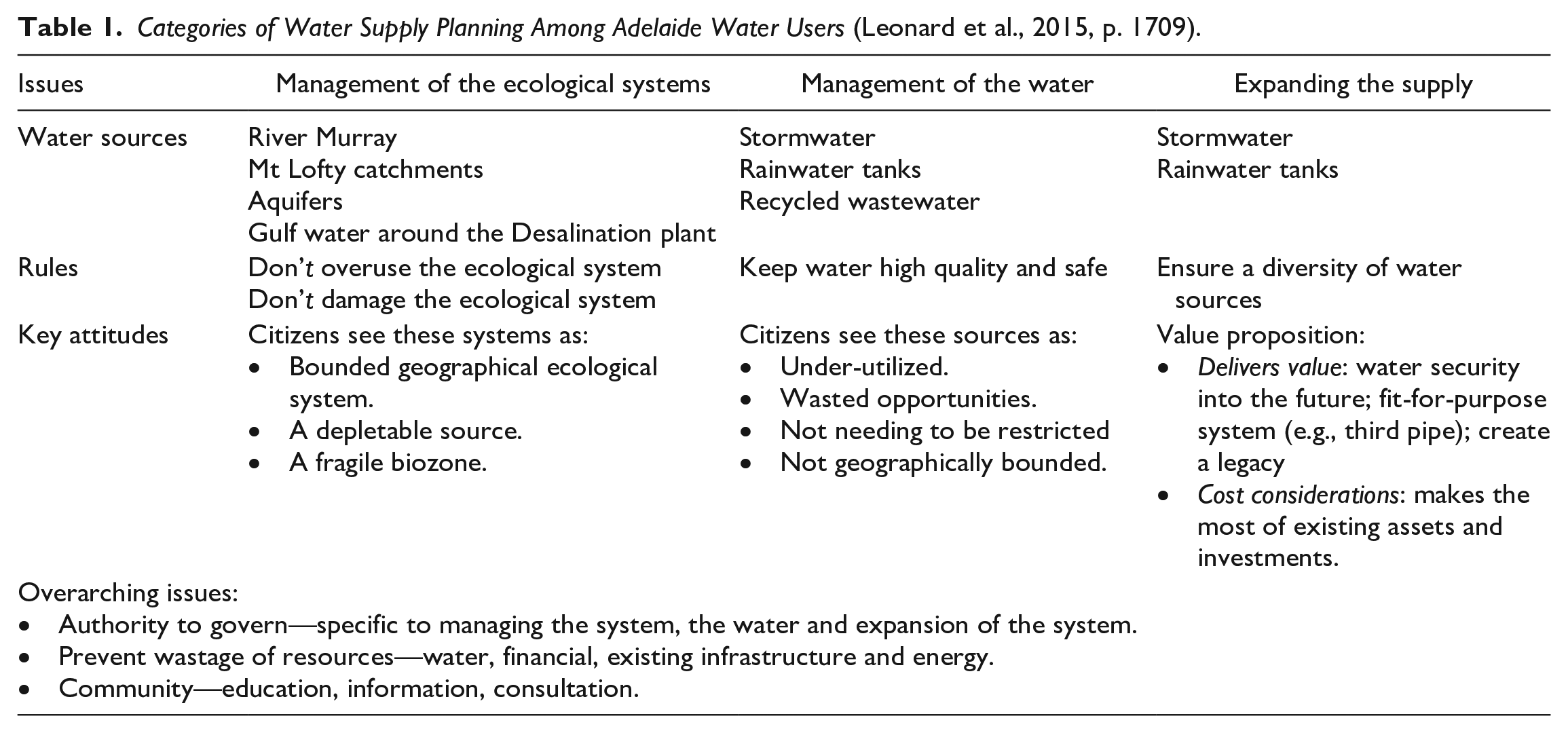
To illustrate the vitalist approach to creative ecologies and the use of water, a study was selected that asked residents (n = 130) of Adelaide (South Australia), to play a card game to arrange their water planning along two axes (Figure 4). Participants were given pieces of string to connect the various cards from end users to water sources, and that were mapped alongside “Quality Assurance,” “Risks,” “Benefits,” “Storage,” and “Cost.” The result was a creative and synthetic means to address water use, which demonstrates the creative ecologies of this article (Figure 4) and the vitalism of water use in terms of focusing community attention on its life source. This example shows how local community engagement is produced through a simple card arrangement exercise, and how the vitalism of water use may be represented along these lines through a game as “life.” A card game is a communal setting that invites buy in and engagement, that helps to produce the intuition and imagination, and encourages the “creativity” in the creative ecologies of this article, as participants are directly considering their local ecologies in terms of the permutation of water use in a social milieu (Lucas & Spencer, 2017, pp. 65–72). Such usage coincides with the social ecology from Bookchin (2006), as the power of control of local resources is steered back to the community, and includes Harris’ (2021) creative agency, as the participants are augmenting their abilities to think creatively about a nonhuman resource beyond their usual self. Furthermore, this water use game coincides with Guattari’s (1989/2000) Three ecologies, as participants are moving between personal, social, and ecological matters, as they consider and play among themselves with respect to water and its usage (Figure 4).
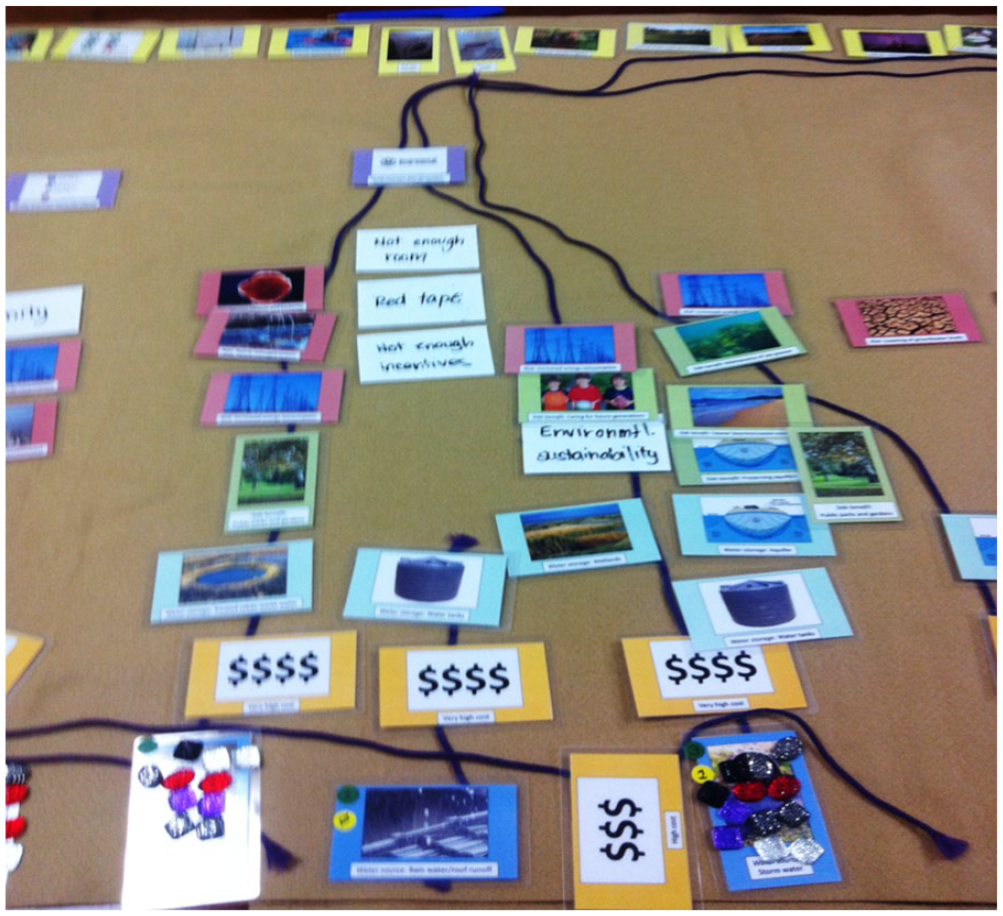
Picture of Water Use Game in Process.
The results of the water use game are presented above (Table 1). “Management of the ecological systems,” “Management of the water,” and “Expanding the supply” was mapped against “Water sources,” “Rules,” “Key attitudes,” and “Overarching issues.” As can be seen (Table 1), the game has encouraged the participants to think about their water use, and to map its management against distinct factors, issues and attitudes. Not surprisingly, given the propensity for drought and hot weather that exists in Australia, water conservation and water quality, and making sure that human use does not decimate the ecosystems, are of prime importance, Arthington and McKenzie (1997, p. 22). Furthermore, the participants advocated local control over water supplies, and further workshopping in terms of education and community involvement with water supply, conservation, recycling and usage (Table 1). The point of these conversations and games about water at the local level is to indicate the vitalist connection between human water use and the life-giving properties of this element as instinct and creativity. Such a connection, if effectively managed and understood leads away from an objectifying, capitalist, instrumental view on water, which could view it as a commodity or resource to be quantified and simply bought and sold on a market. The game and outcome of the water use arrangement procedure aligns with the creative ecologies of this article, that through Bookchin (2006, 2015), Guattari (1989/2000), and Harris (2021), show how human power and control can be wrestled back to local agency and connected with overriding ecological and creative concerns, for example, the overuse (Table 1) and vitalism of water.
Categories of Water Supply Planning Among Adelaide Water Users (Leonard et al., 2015, p. 1709).
Analysis of the Patchwork Vectors: The Creative Ecologies of Play and Water
According to the theoretical and empirical approach that guides this article, the patchworks are powered by the deterritorialization of global capitalism, which is an immensely complex engine (or machine), that requires fuel in terms of resources, human buy-in, and territories both real and imagined (i.e., that are produced by desire). The patchworks that are responding to climate change are discernible (in the article, the patchworks are the playground in Sydney, and water users in Adelaide), yet there is essential movement built into the patchworks, they are vectors, always changing and being modified according to specific force diagrams that can be worked out at any given moment in spacetime (Magee, 2016, p. 184). The creative ecologies derived from Bookchin (2006), Guattari (1989/2000) and Harris (2021), are designed to be agile enough to move between the lines of the patchworks, and to exploit any ambiguities or the fuzzy nature of the patchworks, which are always prone to change. This agility and ability to exploit the lines of the patchworks is due to the strong political platform of the creative ecologies in social ecology, which is mitigated and focused through Guattari’s Three ecologies and brought to personal life through Harris’ creative agency. The examples given in this article of two patchworks: the transformation of a playground, and social inquiry into water use, show how the patchworks have creative ecologies incorporated into them, and even though capitalism can negatively exploit play and water, play and water simultaneously escape outside capture, play through innocence, water through its foundation of life and as an important aspect of the survival instincts. This is not an essentialist reading of play and water (Vandenhole & Wielders, 2008, p. 397), but a pure reading of the patchworks as subject to multivariant forces in time, and that those forces are combinatory, as explained by Shaw (2019), in his analysis of patchworks, and how they are determined by climate change: Climate change being an event horizon means that its dynamics and its relation to exit and voice are difficult to predict. However, exits and arenas for voice may well increase as we reach the tip of this horizon, where inaction at centralised scales gives way to actions at local, regional and networked scales due to our survival instincts and realisations that our current institutional nexus is inadequate. Here the lines between patchwork as potentia and as brute reality mix in their most potent ambiguity. (Shaw, 2019, n.p.)
This interesting extract from Shaw (2019) points to climate change as being the most powerful force of our times. Thus, capitalist exploitation in the Anthropocene can use climate change as a vector along which it plots growth (deterritorialization), and hence tend toward greenwashing, or telling eco-friendly stories about their involvement in the patchworks to cover up negative environmental actions (Miller, 2017, pp. 23–42). Such movements in force and representation lead to the patchworks of this article, and definite zones where climate change is being tackled (in this article by cooling a playground, and by engaging residents in their water use). However, the patchwork theory of this article also articulates the holes, gaps and ambiguities of the changing patches, parallel to the immanent materialism (Cole, 2013, 2014); and vitalism (Jagodzinski, 2022, pp. 586–590) as suggested above. The creative ecologies of this article are tactics and strategies molded into the patchworks, not as external modes of verification or freezing the patchworks as being static, nor as an internal pulsion that simply drives the patchworks in an opposite direction to the deterritorialization that is happening in the patchworks (i.e., as only anti-capitalist). Rather, the creative ecologies of play and water can slew between the pincers of the ongoing and inevitable influence of divisive global capitalism (e.g., via digital penetration by social media and its anti-ecological images of excess and wealth). The approach of this article does not downplay or underestimate the power of global capitalism but looks for ways to do positive qualitative social inquiry under its extraordinary panoply. Parallel to Marx lauding capitalist achievement in the Communist Manifesto (Engels & Marx, 1848/2004, p. 21) to destroy its foundations, the patchwork theory and creative ecologies of this article suggest a positive means to fight climate change, while fully comprehending the magnitude of the problem—for example, runaway, integrative worldwide capitalism. Such a means absolutely embraces the task ahead and presents “play” and “water” as two leading examples to illustrate how changing human society in tandem with qualitative inquiry can be managed (and thought) via patchworks and creative ecologies.
Conclusion(s)
This article has stated that the contemporary state of capitalism, understood in this article through the mechanism of “deterritorialization,” is setting up patchworks under pressure from climate change, wherein variant inter-connected zones are emerging that are adapting and transforming due to a changing environment differently (Cole, 2022b, p. 140). Hence, this article stands in opposition to blanket or vanilla solutions to climate change as being effective. To understand the complexity involved with the transition to a renewable, net zero, climate adaptive society, the patchworks are a means to present the mosaic of responses, as well as the increasing divisions and fracturing of human society under pressure from a warming planet and capital investment. In sum, there will be no simple technological solution to climate change. Rather, there will be gated communities able to afford PV (Photo Voltaic) arrays, water recycling and treatment systems, and incorporating battery energy storage into their micro grids (Cole & Baghi, 2023, pp. 20–22). There will be EV (electric vehicle) drivers likely to shell out the necessary extra expense for their climate friendly vehicles. There will be zones in the world that effectively organize circular economies (CE) within their boundaries, so that products do not go to landfill, and that waste is minimized (Korhonen et al., 2018).
The patchworks will be characterized by zones able to incorporate the latest in environmental technologies in their areas of control (e.g., Finland in Figure 1), to make sure their region at least is not continuing to destroy the ecosystem, and others that do not (and cannot). The dimension that runs throughout this article and is connected to the immanent materialism of the qualitative creative ecologies mode of inquiry, is that these successful areas of the patchworks in terms of climate depend on capital to pay for the modern, sustainability technologies (SOI—Sustainability Oriented Innovation). This dependence adds a vertical dimension to the patchworks, through which flows of capital must pour to counter the climate crisis. However, these flows of capital are open to perturbation, as the subprime mortgage collapse of 2008 proved (Figure 5). Hence, the dimension of capital cannot be assumed (as idealist pro-capitalist solutions to climate change may do), but is a vital aspect of the patchworks:
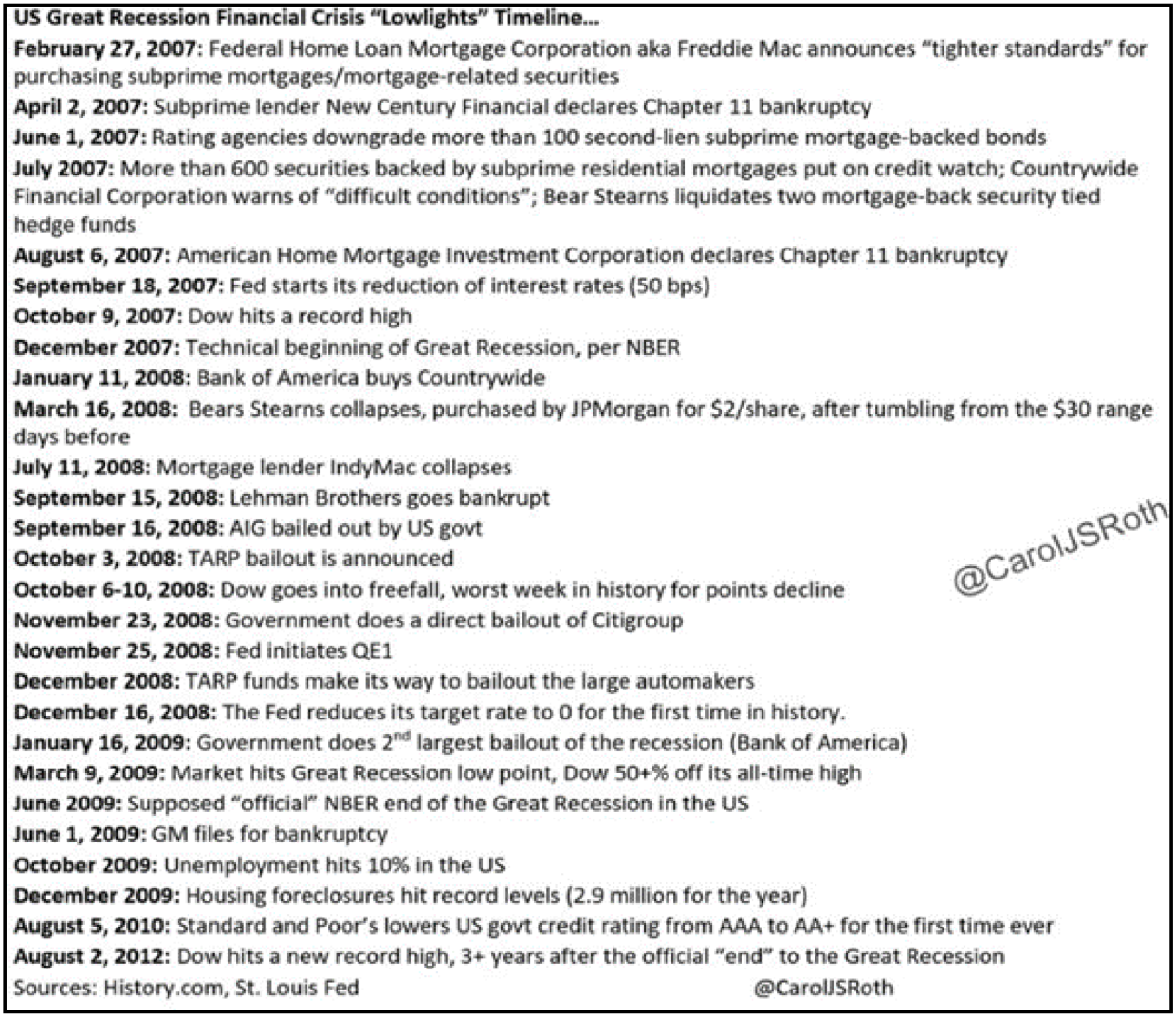
A Patchwork Timeline of the US Recession and GFC (2008). NBER, National Bureau of Economic Research. AIG – America International Group. TARP, Troubled Asset Relief Program.
Hence, the new qualitative mode of social inquiry that this article has put forward, named as “creative ecologies” includes such perturbations as foundational to the patchworks (Figure 5). Capital flows and their markets are connected to the development and sales of new sustainability-oriented technologies (SOTs), but these flows are not constant, guaranteed or regular. Indeed, economic crises (Cole, 2012, pp. 1–23) (Figure 5) are integral to the rise and fall of capital flows that will fund the transition economy, and as such, should be included in the creative ecologies of this article that present a means to analyze the shifting formations of the patchworks. Akin to “play” and “water use” that are empirical examples of creative ecologies, capital flows also have an undisclosed other, or part of the formation of the patchworks that escapes straightforward rational explication and logical inclusion in a schema that positively represents every aspect of their functioning. Rather, the capital flows respond to, for example, sentiment, different value systems (e.g., religious and secular), abrupt reversals and escalations in circumstances, as well the previously mentioned algorithmic bedrock of the current world stock exchanges (Kelbaugh, 2019, pp. 67–82). In sum, the creative ecologies of this article show how qualitative analysis can be performed on a changing society under pressure from within and without, and how significant conscious and unconscious forces will be brought to the surface of ever transforming patchworks. It could be argued that this is the most important academic work that can be performed by the humanities and social sciences to accelerate the genuine transition to a renewable and ecological society today.
Footnotes
Declaration of Conflicting Interests
The author(s) declared no potential conflicts of interest with respect to the research, authorship, and/or publication of this article.
Funding
The author(s) received no financial support for the research, authorship, and/or publication of this article.
