



Abstract
The aim of this paper is to explore how practical knowledge can enhance higher education and Bildung for the human service professions. The paper sheds light on how governance reforms such as New Public Management have influenced higher education, where we argue that scientific rationality has weakened the professional’s autonomy and responsibility. The paper is based on the three authors’ experiences as university teachers and researchers from three different fields, namely, nursing, social work, and special education. By using Foucault’s theory of the panoptic gaze, the analysis shows what is at stake in professional practice, education, and research and introduces perspectives from practical knowledge as a more functional understanding, highlighting 1) that subjective experiences are not being legitimized, 2) the inherent knowledge of practice, and 3) evidence and valid knowledge.
Keywords
Background
A common appeal to maintain professional identity was addressed to professional education in 1988 (Stave, 1996). The appeal concerned market orientation and performance management in public administration and public services. Pressure on professions has been increasing through the implementation of New Public Management (NPM) and post-NPM reforms over the last 15 years (Agasisti et al., 2019; Christensen, 2011; Helgøy and Homme, 2016; Paradeise et al., 2009; (KD Kunnskapsdepartementet/Ministry of Education and Research, 2017) (Christensen and Lægreid, 2011)(Christensen, 2012)).
Universities and university colleges work to educate knowledgeable, active, and conscious citizens and to expand knowledge through high-quality research and development work (Meld. St.19 (2020–2021): 7). Before implementation of NPM, the universities had a rather close and integrated connection with the ministries of education and research (Bleiklie et al., 2011). In recent years, the authors of this paper have seen the introduction of more and more performance management in higher education, increased use of scrutiny and control systems, more use of intensive systems, and more reporting to superior authorities’ rankings of qualifications, academic positions, and research production; greater research activity has been called for, but funding is based on research production. Biesta et al. (2021), for example, talk about the Philosophy of education in a new key: publicness, social justice, and education. Public education will then tend to connect education to the public it should serve, it becomes a public good rather than a private commodity.
The importance of the institutions themselves taking a greater responsibility for priorities and path choices is emphasized in national governing documents regarding higher education in Norway (Meld. St.19 (2020-2021): 8). A main question raised in several articles focusing on university governance reforms (Bleiklie, 2009; Christensen, 2011; Radcliffe, 2013) is whether universities, which traditionally have had quite a lot of real autonomy, are actually getting less autonomy through the reforms, not more like the reforms’ supporters often promise (Christensen, 2011: 504).
In the Nordic countries, several researchers have expressed concern about the consequences of structural changes for higher education and research (Adamson and Rauhut, 2018; Bleiklie, 2009; Christensen, 2011; Solbrekke and Englund, 2011; Peters and Tesar, 2015). Solbrekke and Englund (2011) discuss how professional practice has been influenced by the changing policies in the Nordic context. NPM often goes hand in hand with scientism and positivism, where “all knowledge is knowledge about an object” becomes an axiom, and as a consequence, only what can be measured can be called “real” (Bornemark, 2018a). Dilemmas arise in the tension between traditional professional management and collegial governance, as it is in academia, and public goal management. With help from Durkheim (2001), they argue that there is a tension in professional practice between responsibility and accountability. Acting responsibly is then measured using criteria based on economic and legal rationale and less based on professional and moral assessments (Argento and Van Helden, 2021; Bornemark, 2018a; Buchanan et al., 2022; Hovednak and Wiese, 2017), which are essential in human service professions. With this we refer to professionals with higher education who provide human services, for example, teachers, nurses, and social workers. Accountability alone will challenge professionalism (Hovednak and Wiese, 2017; Kinesella and Pitman, 2012; Solbrekke and Østrem, 2011), and professionals must be able to identify ethical dilemmas, make good assessments, and make the right decisions (NOU, 2020), and that involves both responsibility and accountability.
Due to the introduction of NPM, Adamson and Rauhut (2018) argue that there has been an inappropriate academization of professional education in Swedish universities. They describe this as a silent process that shifts researchers’ loyalties from collegiality, knowledge, and scientific truth to profit, allegiance, and anti-intellectualism. In Norway, Aksel Tjora (2019) writes how a production-oriented structure and vocabulary is displacing the more knowledge or reflection-oriented academic culture. Can this accelerate pressure on academic staff to produce measurable knowledge in favor of academic freedom and responsibility? The study of professions reveals a systematic process of acquiring and controlling knowledge, which is subsequently exploited by different professional groups (Abbott, 1988: 48). Adamson and Rauhut (2018) and Tjora (2019) describe this cultural change as a democratic problem that gives cause for concern. Black and Dwyer (2021) argue for a shift from neoliberal principles of individualism, meritocracy, efficiency, and competition in academia towards an academia that recognizes and values the experiences, differences, multiplicities, and subjectivities of academics.
Drawing on Foucault’s concept of the panopticon (1977), we wish to highlight how Human service professions practice is guided and influenced by ideas related to NPM. Have we gone too far in trying to control professional practice and to reshape academic knowledge as enterprises in a competitive setting? Our concern is shared by various critics in the fields of health, social science, and education (Biesta, 2010; Buchanan et al., 2022; Hanssen et al., 2015; Heggen and Engebretsen, 2009; Martinsen and Eriksson, 2009; Rosenberg and Bu, 2005; Peters and Tesar, 2015). There is no doubt that such an approach has a certain function, but there are questions that cannot be answered if we base our research only on measurable knowledge.
In the various disciplines, it is recognized that the subject’s experiences can be truth-bearing and form the basis for a kind of evidence in professional practice. In order to validate this form of knowledge, the subject’s experience must be examined, articulated, understood, and tested through dialogue with the aim of eliciting the ambiguous and complex elements that arise in the encounter between the person’s experience and their social, historical, and cultural roots (Eikeland, 2017). Practical knowledge recognizes the subject as the knower, while at the same time the subject’s knowledge can be tacit and difficult to communicate in unambiguous and established terms.
The aim of this paper is to explore how practical knowledge can enhance professional education and Bildung for human service professions in higher education, as we address following research questions: In the light of NPM; what is at stake in human service professional education and how can practical knowledge be useful in this context?
Theoretical framework and perspective
To reflect on the research question, we use selected perspectives from the Theory of practical knowledge and Foucault’s theory of the panoptic gaze.
Practical knowledge and the importance of the subject in higher education
Studies of practical knowledge are based on a multidisciplinary and multidimensional view of knowledge. The field is rooted in both the humanities and the social sciences and involves an understanding of humans as sensing, meaning-creating, relational, agentive, and knowledge-bearing subjects, including their place in a broader cultural, organizational, and societal context (Halås and Fuglseth, 2021: 24). A key question is: What can be considered knowledge and how do we learn to become good practitioners?
With roots going back to Aristotle, there are today several different approaches and theories that emphasize different aspects and dimensions of practical knowledge; related to questions of manifestation, constitution, possession, appropriation, context, effect, and dimensions of meaning and value (Wackerhausen, 2017). Theories of practical knowledge are closely linked to practice theory and philosophy of knowledge and are rooted in different philosophical science positions, such as phenomenology, hermeneutics, pragmatism, social constructionism, and critical theory. Practice theories in general carve a specific space for individual agency and agents, leaving space for initiative, creativity, and individual performance, as performing a practice always requires adapting to new circumstances, so that practicing is neither mindless repetition nor complete invention (Nicolini, 2013). To shed light on the interaction between the professional practitioner and governance mechanisms, this article draws on a functional understanding of practical knowledge, in particular on phenomenological as well as social constructionist perspectives on knowledge formation, learning, and cognition.
This implies that the practitioner creates practical syntheses by using discretion to determine how to apply abstract knowledge to specific situations (Grimen, 2008). Skilled practitioners are consciously or unconsciously able to see, recognize, imagine, face, and react to challenges in specific practice situations (Meløe, 1973). They have acquired the ability to make distinctions in order to see what is different or contradictory and to see connections (Martinsen, 2005), and they have answerability, which is the capacity to respond appropriately (Martinsen and Eriksson, 2009). Learning and developing practical professional knowledge involve not merely learning different subjects or sources of knowledge, but rather the ability to combine several complementary forms of knowledge, such as episteme, techne, and phronesis (Aristotle, 1999/2006), and different dimensions of knowledge, such as emotional, cognitive, practical, esthetic (Dewey, 1934/2008) and bodily aspects (Merleau-Ponty, 1994). Reflection on experience leads to discernment, wisdom, and reason, and thus our ability to orient ourselves in the world. The question is what correct practice and what valid knowledge will be linked to the situation. This can be understood as a tacit process of knowing (Polanyi, 1969) and as knowledge in action (Molander, 1996). The recognition of the subject as knowledgeable and as a bearer of knowledge highlights the importance of in site experiential learning, taking an exploratory and questioning approach to a situation. The ability to respond cannot be fixed. New perspectives will mean that what is appropriate in one situation may not be appropriate in another similar situation. Our response requires the insights that we gain through our sensory impressions and participation in the contexts and activities of life (Halås, 2023; Martinsen, 2005; Martinsen and Eriksson, 2009).
In human service professions, practical knowledge is particularly important when dealing with new, diffuse, and complex cases and situations that might require ethical considerations, and where current practice and procedures cannot provide answers to what the professional should do. For example, What does the teacher do when one of the students does not respond like the others, and demands all the attention in class? What does the social worker do to get into a position to help a person who is not responding to the usual approaches? And what does a nurse do with her bodily sense of something wrong, when faced with a patient who cannot communicate? These are all situations in which the practitioner needs to engage in a dialog with the situation, the other person, the context, and themselves, to determine the best way to respond to the situation. The question is what it takes for students to learn to listen to the situation, reflect, articulate, and justify the basis for this type of decision.
Focusing on the quest of learning practical knowledge in professional education, other researchers are also occupied with questions related to subjectivity as fundamental for the capacity to doing good judgments (Biesta, 2020; Bornemark, 2018a, 2018b; Buchanan et al., 2022; Peters and Tesar 2015; Solbrekke and Østrem, 2011). In the field of education, Biesta (2020) focuses on three domains of education: Together with qualification and socialization, subjectification is in the core or the outer ring, binding it all together. For him, subjectification has to do with the existence of the student as a subject of her or his own life, not as an object of educational interventions. It has to do with the question of qualified freedom, to create new beginnings, and act in, with, and for the world. For him, education for subjectification has an interruptive quality, which challenges NPS managerial ideologies, where responsibility is not a goal we choose, but which we encounter as it comes to us. This means we must make space for students to exist as subjects and their sense-making, for exploring the unknown or the not-yet-known, on their own. In different professional fields subjectivity in education is addressed in the subject of ethics, for example, in nursing (Jakobsen and Mæhre, 2022), social work (Banks, 2016), and teaching (Buchanan et al., 2022).
Foucault’s perspectives on systemic guidance through a panoptic gaze
Even if Foucault is not using the word NPM, we find his philosophy about panopticism and subjectivity useful when we are talking about the implementation of NPM in higher education. The original meaning of panopticism is “all-seeing,” and Foucault (1977) uses the word to mean “seeing everything” in order to describe a system of societal control that dominates various organizations. He explains that panopticism must not be understood as an imaginary structure, but as an ideal diagram of a power mechanism exemplified through the architecture of a prison building that becomes a control system for the inmates. This power mechanism is transferred to social structures at the macro-level, which then affects the individual young service user, pupil, or patient in institutions at the micro-level. According to Foucault the minute disciplinary techniques—the “everyday panopticisms”—form a machinery that deepens the asymmetry between government and subjects.
Foucault (1966) argues that knowledge has today been taken over by a network of signs built up gradually in accordance with knowledge of what is probable. A critical view of how signs can create truths in a system can affect actors at the micro-level. The knowledge of the signs, which in this case are ideological policy guidelines in higher education, gives them a key role in a societal analysis. Signs are created when separated and isolated from an overall impression. This takes place in the higher education context as a network of signs formed through a system of knowledge and power implemented through ideological policy guidelines such as official reports that health and education must follow. Foucault (1977) argues that this also enhances the public moral standpoint of the population and can ensure growth and development. The critical question here is what type of understanding and what results are created in the encounter with the health, welfare, and education sectors. How then can practical knowledge raise its status through increased awareness of its importance?
The discourse analytical approach
Critical discourse analysis problematizes empirical evidence by examining the relationships between discursive practice and social and cultural developments in different social contexts. Discourse is an important form of social practice that both reproduces and changes knowledge, identities, and social and power relations. At the same time, however, it is shaped by other social practices and structures (Chouliaraki and Fairclough, 1999). According to Foucault, and our experiences of concern, our critical reflection involves asking questions about practice, examining it to determine what it consists of, and observing any limitations of the practice as well as the explanations and theories associated with it. In constructive reflection, we turn our attention back to practice in order to assess what is needed to improve it (Halås, 2022). Practical knowledge is a knowledge tradition that includes subjective experiences as a source of scientific knowledge. Our Ph.D. work is from three different education fields. Mæhre (2017) comes from a health care field where the aim was to explore experiences of a changed practice in a palliative ward after implementing a new health care reform. What kind of consequences can political and ideological guidelines have for practice in a palliative nursing home ward? Hvidsten et al. (2020) comes from an education field and has looked at the phenomenon of concentration difficulties and how these are operationalized in assessments by counselors and perceived by teachers. How can this research be understood based on the political and ideological guidelines that teachers and counselors are required to follow? Halås (2012) conducted action research with young adults and professional workers in social services. She studied whether practical knowledge represents an alternative understanding of the way society and academia perceive questions of scientific theory and how this manifests itself in and challenges research, policy, and practice. During and after our Ph.D. studies we experienced tensions in human service professions practice, education, and research between the paradigms (ideas) of professionalisms as accountability and responsibility, and this was in line with the research presented above. By applying critical discourse analysis, the results in our three Ph.D. studies led to a common concern about how implementation of NPM reforms affect what knowledge gets legitimized in academia. Philosophy education is for the individual or particular groups and not only implies what society as a whole should consider as desirable (Biesta et al., 2021).
Can this discourse influence our disciplines in a way that weakens the autonomy of the individual professional? Foucault (1972) defines discourses as rule-governed, socio-historically situated “practices that systematically form the objects of which they speak” (p. 49). Further, he expounds upon discursivities and subjugated knowledges as a way to help us to understand hegemonic discourses (Foucault, 1980: 85). Since completing our Ph.D. studies, all three authors have been concerned about the consequences of governmental policy guidelines for practice, education, and research. Our concern can be understood as experiences of discrepancies (Lindseth, 2017), for example, an unexpected outcome, disappointed expectations, a feeling that something is wrong or poorly done, or even the unexpected joy of succeeding (Halås, 2017; Halås and Fuglseth, 2021). These are experiences that deviate from our preconceptions and expectations, and for the experienced professional these are a warning about a problem that requires attention and thought. To determine whether more systematic investigation is necessary, we need to ask questions about this concern, which is something we have done. By focusing on our experiences of discrepancies, tensions became visible, and this helped us to identify what is at stake in human service professions education.
Through Foucault’s (1970) theories about the tools of discourse, we emphasize the principle of analysis, namely, the “principle of discontinuity.” The discourses must be perceived as discontinuous practices that overlap, intersect, and touch or exclude each other. This way of looking at the text can be interpreted as a picture of who the actors are and what the various agencies represent in terms of opinions. Overlaps in the discourse can be perceived as a convergence of each other’s opinions in an investigation.
Ethical consideration
Because we all studied in the same educational institution, there is a real risk that we have the same blind spots (Wackerhausen, 2017). However, we now work in different universities and in different fields, which will also help us to question each other’s perspectives on knowledge.
Results
Authors’ experiences of NPM and its consequences in practice, education, and research.
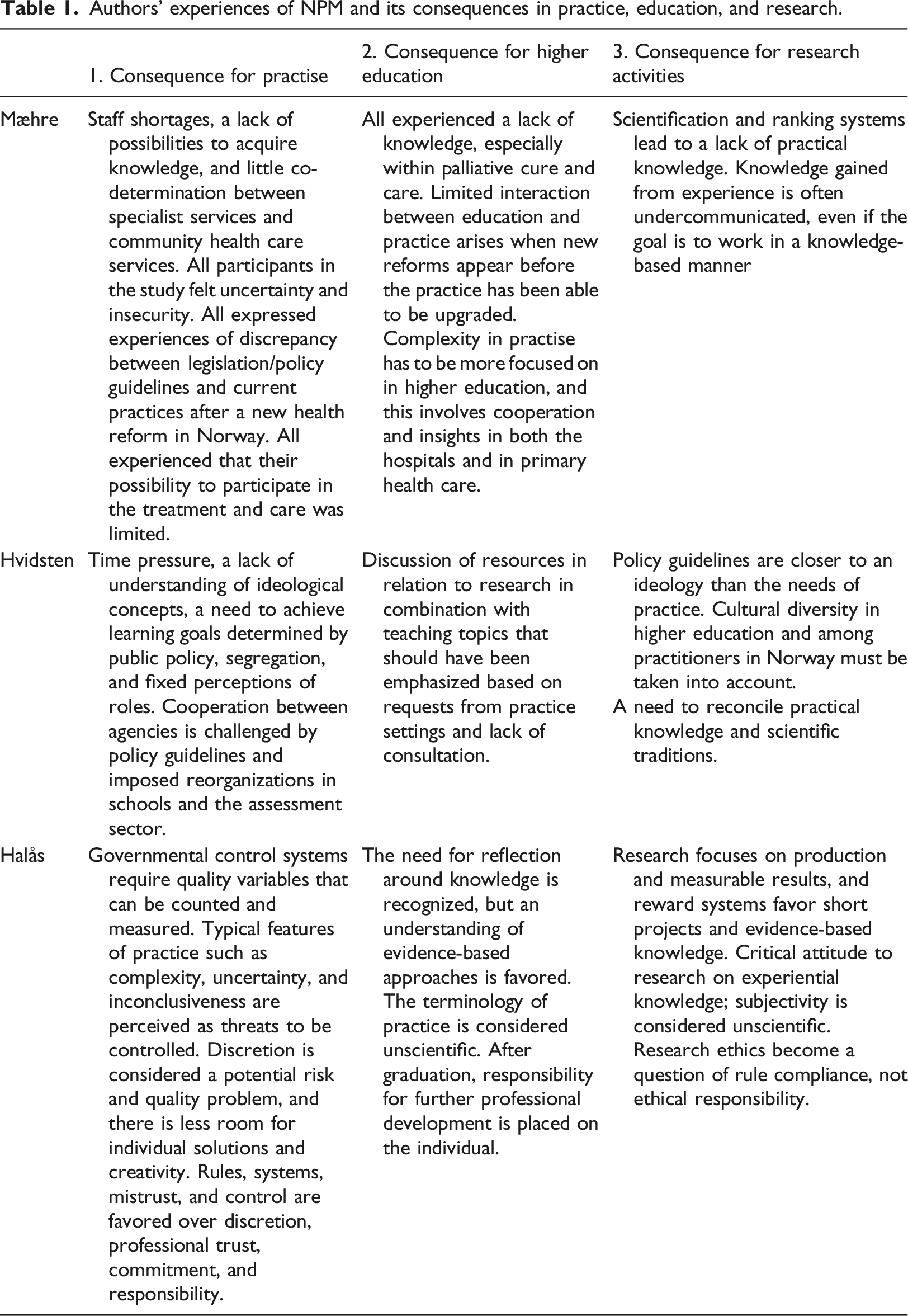
The table shows what we find to be at stake in professional education, which we have summed up/identified in following three themes
Subjective experiences are not being legitimized
Practitioners’ experiences of what constitutes good practice receive little recognition, and discretion is regarded as uncertain knowledge. External control systems undermine the professionals possibility to be an responsible agent in their practise.
The inherent knowledge of practice
The experiences of practical knowledge as being given less legitimacy in practise and in higher education seems to reveal an ideological gap between the educational institution and the knowledge and skills that students and professionals need in their practise.
Evidence and valid knowledge
Experiences of evidence-based knowledge as more valuable than practical knowledge entail consequences for research activity and show that research in the tradition of practical knowledge cannot be ranked. However, not everything of importance in human interaction can be counted or measured.
Overall, our common concern can be understood as inherent in our experience of discrepancies between government policy ideologies and operational practices and the need to pay more attention to practical knowledge.
Discussion: What can practical knowledge contribute?
The summary analysis shows how the prerequisites for this kind of knowledge are threatened in higher education today. In what follows, we will examine more closely what emerges if we use practical knowledge as our lens as an alternative to the instrumental knowledge that underlies NPM governance reforms and entails problems for increased autonomy. In the discussion we will focus on what we perceive as a more functional understanding of knowledge that qualifies students for practice in human service professions than that seemingly found in the current systems and governance that arise from NPM.
Our analysis reveals concerns about the consequences of an increasing culture of production, which we find weakens the individual professional’s autonomy and responsibility. Foucault (1977) shows how minute disciplinary techniques or “everyday panopticisms” prevent us from even noticing that we are helping to prolong a culture that can be difficult to see and break out of. His thinking helps us to realize how ideas from NPM and instrumental thinking at the expense of a more reflective approach to key issues related to the field of practice (Flyvbjerg, 2006; Frank et al., 2012; Kinsella and Pitman, 2012) have colonized both practice and academia with quality requirements in ways that have constrained professional education, especially human service professions.
Subjective experiences are not being legitimized
In light of the panopticon, Foucault (1977) would argue that our society is not dominated by the open-minded gaze of observation, but by the “control society” with its continuous and profound influence on practice. This is seen, for example, in the way healthcare services after the health care reform (St. meld 47 (2008–2009) are focusing more on costs and efficiency. Many patients are transferred from specialist care to a lower level of care before their medical treatment is finished, and nurses in nursing home can then experience lack of advanced medical knowledge, which is something they are concerned about (Mæhre, 2017; Mæhre and Solstad, 2022). Further examples are the way young people are categorized without clear guidelines (Hvidsten, et al., 2020) and how categorization policies shape perceptions of students that can lead to counselors and teachers becoming blind to the student’s challenges (Foucault, 1977). Foucault describes how the control society is expressed in all societal strata: “We are neither on the benches of the amphitheater nor on the stage, we are in the panoptic machinery exposed to the effects of a power which we ourselves forward by being cogs in the machinery” (Foucault, 1977: 193).
Both instrumental knowledge and NPM thinking have a top-down rationalist perspective based on mistrust, security, and control that favors compliance, standard treatments, and general techniques irrespective of context (Biesta, 2010; Hansen et al., 2015; Martinsen and Eriksson, 2009). This in contrast to a bottom-up perspective on practical knowledge, revealing the importance of the subject’s professional autonomy, responsibility, and discretion in professional education and Bildung, where the professionals have the capacity to have answerability and to see, judge, and respond to challenges in specific practice situations (Martinsen, 2005). Similarly, the university sector has shifted its focus from reflection to adaptation, compliance, and production (Tjora, 2019). Such systems can cope with what is most likely to happen, but they are worse at dealing with what deviates and differs. The design of governance systems that promote a thinking where instrumental knowledge is the best kind of knowledge can be an expression of a desire to reduce the influence of what is perceived as subjective and arbitrary. However, it can also be an undesirable consequence that is not necessarily linked to a lack of recognition of a multidimensional view of knowledge in human service practices. Regardless of this question, we can see that there are aspects of this form of governance that may make certain aspects of professional practice invisible.
Arendt (1958) highlighted the importance of individual responsibility. Today we experience the involvement of the state through NPM reforms in higher education. The responsibility will then lie in the system and not in individuals. Hannah Arendt warned against the dangers of absolving the individual of responsibility and leaving it to the system. She refers to the trial of the German officer Eichmann, who said he was only following routine, when he was accused of being guilty of transporting the Jews to the gas chambers. And with this, Arendt pointed to the importance of the individual thinking and taking responsibility. A responsibility a system cannot take. If the individual are not allowed to take this responsibility, we could become pawns at risk of committing evil acts without wanting to. It is only the individuals themselves who can criticize the system, and a second-order reflection will then be necessary. Universities must train students to become critical and bold citizens who can create new and responsible communities and not just be disciplined to live in them and reproduce them.
The inherent knowledge of practice
In our practices in higher education, we have met wise and experienced colleagues who had a particular ability to know the right way to deal with different situations. Ready-made procedures and rules for action could be helpful, but not without the use of professional discretion in deciding between courses of action (Frank et al., 2012; Hovednak and Wiese, 2017; Kinsella and Pitman, 2012; Mæhre, 2009). To describe practical knowledge in the form of procedures is difficult because the way knowledge is expressed and communicated will vary according to the practice. Slavishly filling out forms with descriptions of observations and checklists without involving professional discretion suggests that the knowledge of the experienced practitioner will be undercommunicated. In an attempt to ensure the quality of practice, experienced practitioners are obliged to adapt their practice to certain standards. Such procedures can be perceived as mistrust of the person’s knowledge. Furthermore, such procedures and descriptions can provide a false sense of security in training new colleagues to gain understanding and knowledge. The easiest way is to teach them to follow the manual and the rules, but will that be the best practice, and if so, best for whom?
Forms and procedures can be of some assistance, but they do not help us to become complete professionals with working methods as an integral part of the way we think and act. Phronesis is a knowledge type that can counter the increasing instrumental rationality in various professional educations. Foucault (1977: 30) described how it is not the activity of the knowledgeable subject that produces useful or unpleasant knowledge for those in power, but rather it is the “knowledge-power relationship”—in other words, the processes and struggles this relationship contains and constitutes—that determines the forms and possible areas of application of the knowledge.
Systematic thinking involves the ability to make distinctions in order to see what is different or contradictory, but also to see connections (Martinsen, 2005: 121). We let impressions affect us, thus enabling theoretical knowledge to become practical knowledge that involves both “seeing that” and “seeing as.” Meløe (1973: 113–114) writes that in order to gain insight into people’s experiences, we must know the activities from which the concepts originate. To understand how people understand their existence, one must start with the statements and concepts they use. If we wish to see an issue from the other’s point of view, we must move from the place we see from towards the place the other sees from (Meløe 1977: 28).
Although all three authors come from different forms of professional education and practice (health, education, and social services), we have all found that keeping to established practices inhibits rather than promotes creativity, which is about doing something new or in a new way. Being a critically reflective professional practitioner involves exploring our professional knowledge and loyalty, but also adopting more professionally deviant and disloyal thinking by using concepts, views, and knowledge that lie outside established knowledge in our profession. According to Wackerhausen (2015), first-order reflection where one thinks within and with the profession’s traditional concepts and discourses will be insufficient. The professional must also make use of second-order reflection where questions are asked about the perspectives we think and act from, which will require input and openness from new theories, different experiences, or other professions because the professional may have blind spots within their own field. Taking responsibility for our actions implies having insight into those actions and thinking about why we do what we do and the consequences of different possible actions, and for this second-order reflection will be necessary.
Practical knowledge and how it is understood and practised is not only important for the practitioner, but also for the people involved in the practice, and our studies are about schoolchildren who need special education, young people who need help from social services, and palliative patients and their relatives who need care in nursing homes. Practical knowledge can thus be viewed as an understanding of practice within a practice, and one that is changing and becoming increasingly multidimensional and complex.
Evidence and valid knowledge
In order to exercise discretion and phronesis and to be able to respond to a specific situation, the professional must form an impression through sensing and insightful reflection on the situation. When practical knowledge is the lens, the understanding of what constitutes valid knowledge will be situational, contextual, and relational. Practical knowledge is what is revealed through action and can be both articulated and tacit. This is in line with the origin of the concept of evidence, which is about seeing what is obvious (Martinsen and Eriksson, 2009), and is a different form of evidence than the evidence of science where elements must be categorized, counted, and measured as objective phenomena. Ontological evidence is about something becoming visible in a situation, but always in a surprising manner: “We have an experience” (Gadamer, 2010). This is evidence that is communicated and assessed intersubjectively. The criteria for valid and evident knowledge may thus vary between different knowledge traditions.
This is perhaps where the tacit dimension of knowledge emerges. “We know more than we can tell,” as Polanyi (1969) expressed it. Knowledge is not just a well-argued belief. It does not need to be linguistic, explicit, and systematic, and it may be either explicit or tacit/implicit. There is a dialectic between the explicit and tacit elements of knowledge. Based on such an understanding, knowledge can also be bodily knowledge. Having an expert gaze is not a matter of applying a rule or a principle, but is rooted in a tendency or disposition to be able to see and understand what actions are required in a particular situation. This form of knowledge can be difficult to express in language that is transparent to experienced practitioners. In this sense it may be considered as tacit, but it is not truly tacit when seen in the form of action, only in terms of a linguistic understanding and formulation.
In our Ph.D. theses, we all wanted to gain an understanding of how professionals in our own professional field experienced their practice. We discovered that it was necessary to question established practices and the tacit dimensions of practice (Wackerhausen, 2017) in order to test the validity of knowledge within this form of evidence. In critical reflection, the various sources of knowledge from both the scholastic and the non-scholastic paradigm will be involved, giving us a broader and deeper picture of the situation and possible actions; however, it is important to realize that experience can be both misleading and insightful (Wackerhausen, 2015: 82). In our view, we need to be critical practitioners, teachers, and researchers. Foucault uses the term “practices of freedom” for such demanding but creative work where we dare to ask critical questions about what we want to change and what we want to resist.
Describing our experiences in writing can reveal what is evident in a situation and thus at the very core of the theory of practical knowledge. We will then be capable of both “seeing that” and “seeing as” regarding something that requires theoretical and practical knowledge.
Cause for concern
Raising our own awareness of our role as researchers and educators in health, education, and social work can be understood as a hermeneutical spiral. Our concern may be due to a lack of ways to understand what we see, how we see, and why we see what we do. Our concern involves our shared critical view that systems outside practice, education, and research provide guidelines for the content of these areas without the individuals involved being consulted. The formal autonomy was not experienced to be a real autonomy. The political guidelines seem to be closer to an ideology than a critical attitude to research on experiential knowledge.
Although our concern is first experienced by a sensing subject, this does not mean that the experience is subjective. The concepts and theories we adopt, and our values and habitus, are socially, culturally, and historically rooted (Foucault, 1977). Our experience of concern will thus often be a reaction to breaking with our ideas and expectations of how things should be, which the educator and philosopher John Dewey (1934/2008) would call an esthetic experience. In this way, subjective emotions can reveal something about norms, values, power relations, etc., and from Foucault’s perspective can be understood as micropolitical expressions that are macropolitically constituted and constitutive.
Indicating our concern about NPM has increased the focus on undercommunicated forms of knowledge and on questioning rules for practice without considering whether these rules merely simplify a diverse and complex practice. The opportunity and responsibility for the subject to use discretion are, as we see it, pressurized by the domination of control and governance according to NPM.
What could then be solutions in higher education for addressing the issues raised? Wackerhausen (2017) considers that the professions must be open to the multidimensionality of practice to understand the conditions for the individual practitioner’s experience and practice. The relationship between the micro-level (the practitioner’s practice), the macro-level (the organizational and professional level), and the mega-level (the societal level) could be an asymmetric dialectical relationship that professionals must take into consideration (Wackerhausen, 2017). The ability to see complex and multidimensional aspects is twofold; practitioners must acquire their profession’s body of knowledge, but also develop a subjective capacity to go beyond habitual practices by critically analyzing and questioning their professional practice. At the mega-level (the societal level), there is a need to acknowledge practical knowledge as fundamental for professional education and practice and develop managerial systems in line with this. At the macro-level (the organizational and professional level) universities need to allocate sufficient resources to engage in learning processes together with the students and to supervise and follow up on students' subjective Bildung. Both government and university administration must rein in their desire to ensure quality through control and measurement of what can be concretely measured and create systems based on trust in the capacity of the professions to maintain and develop quality in education. At the micro-level (the students learning) one should prioritize learning students to reflect upon practice experiences, as well as doing “ethics work,” which refers to the effort professionals put into seeing ethically salient aspects of ever-changing situations, developing themselves as good practitioners, working out the right course of action and justifying who they are and what they have done (Banks, 2016; Buchanan et al., 2022; Halås, 2022; Jakobsen and Mæhre, 2022).
We began this paper by pointing out the need to find perspectives that would help us to see and address what is at stake for professional education in universities and the need to find ways to “resist and push back” neoliberal forces (Black and Dwyer, 2021). We have emphasized how theories and research on practical knowledge can legitimize the subject’s professional practice in higher education with the help of the panoptic gaze. We have discussed the importance of acquiring a critical and questioning view of what and how practical knowledge as a research field can contribute to the development of useful professional practice. This is an awareness-raising process that can enrich practice in our professions. At the same time, the higher education sector is not without blame itself as we sense a lack of action. This paper provides one of a number of ways to understand the question: In the light of NPM; what is at stake in human service professional education, and can practical knowledge be useful in this context? It shows how practical knowledge can be conceptualized and can encourage responsible reflection by both practitioners and teachers. Practical knowledge can help us to see what is at stake in practice and how important it is to recognize this knowledge in professional practices.
Footnotes
Declaration of conflicting interests
The author(s) declared no potential conflicts of interest with respect to the research, authorship, and/or publication of this article.
Funding
The author(s) received no financial support for the research, authorship, and/or publication of this article.
