



Abstract
This case focuses on the 2023 budget standoff between the Universities of Wisconsin (UW) and the Republican-controlled state legislature. The legislature voted to approve pay raises for UW employees, while simultaneously voting to cut UW funding by $32 million—the amount spent on diversity, equity, and inclusion (DEI). However, the legislature decided to withhold pay raises for UW employees until the system cut all DEI programs. After multiple negotiations, a controversial deal was finalized in December 2023, which included a hiring freeze and realignment of DEI staff positions in exchange for a new engineering building and approved pay raises.
Introduction
One dynamic and sometimes contentious relationship in the public square of education is the role of state legislatures in the governance of public higher education. From developing laws to funding decisions, these political external stakeholders have a large impact on public institutions. In the last several legislative sessions, state legislatures have limited diversity, equity, and inclusion (DEI) initiatives, cut academic programs with low-enrollment, and mandated post-tenure review for tenured faculty members (Quinn, 2025; Stahl, 2025). A professor at the University of Utah recently stated, “The State Legislature loves to interfere in higher education. They’re afraid of faculty governance and they don’t respect the expertise of faculty at any of their state institutions” (Quinn, 2025, para 9).
In recent years, the relationship between the state government and public postsecondary institutions has become strained with state legislators increasingly exercising the power of the purse. In fall 2024, a group of 11 Republican lawmakers in Texas sent a letter to the University of Texas System (UT System) Board of Regents (BOR) expressing their concerns about the expanded eligibility for the Texas Promise Plus program, a free college program that covers students’ tuition and fees (Fox Texas Digital, 2024). The group called the inclusion of students from families making $100,000 or less in the Promise Plus Program an abuse of power and threatened to cut the UT System budget (Fox Texas Digital, 2024). Also in Texas, lawmakers passed Senate Bill 17 in 2023, which focuses on DEI in higher education. Specifically, Senate Bill 17 (2023) bans DEI offices or any unit that performs DEI functions, removes DEI statements and preferential treatment in hiring, and eliminates mandatory DEI training. Public universities that are in violation of the law will face fiscal penalties if they do not correct the violation—including no funding formula increases, institutional enhancements, or exceptional items (Senate Bill 17, 2023). In Ohio, a similar anti-DEI bill passed the legislature (SB 1) in 2025, which eliminates DEI initiatives on public colleges and universities campuses, bans diversity statements in hiring, promotion, and admissions, and removes DEI trainings among other provisions (Associated Press, 2025; The Chronicle of Higher Education, 2025). If higher education institutions are in violation of the law, the state can withhold their funding (Associated Press, 2025). These examples provide context for our case study in Wisconsin.
The state legislature has three main areas of responsibility in public higher education—lawmaking, appropriations, and oversight (Hillman et al., 2015). For lawmaking, state legislators first introduce bills to either chamber (House or Senate), the bills are assigned to legislative committees, and then they are discussed, debated, and voted on in each chamber. If the bill passes both chambers, it becomes law when it is signed by the governor (Hillman et al., 2015). Recent higher education bills include state financial aid programs (Billings et al., 2025), tenure and promotion policies (Krupnick, 2023), and curriculum reform policies such as anti-DEI (The Chronicle of Higher Education, 2025) and anti-Critical Race Theory (anti-CRT) (Alexandar et al., 2023). For appropriations, the state budget is created by the governor and reviewed, debated, and voted on by the state legislature (Schmidt, 2020). During the budget hearing meetings, there are key interactions between higher education leaders and state legislators where higher education leaders tell stories about their campuses when requesting funds, and state legislators ask questions of higher education leaders before making their decisions (Billings et al., 2024). Finally, state legislatures provide oversight to institutions of higher education through standing committees focused on topical areas such as finance, human resources, and program approvals (Hillman et al., 2015).
This case explains one of the most recent and high-profile budget standoffs that took place in 2023 between the Universities of Wisconsin (UW) and the Republican-controlled state legislature. In June 2023, the legislature cut funding to UW by $32 million, which was the amount spent on DEI across the 13 campuses. In these budget meetings, the legislature also voted to approve pay raises for UW employees. In October 2023, the legislature changed course and voted to withhold pay raises for UW employees until the system cut DEI programs and staff (Venhuizen, 2023). This led to multiple negotiations between the system, UW-Madison, and state legislators. After the proposed resolution was finalized in December 2023, it required approval of the Universities of Wisconsin Board of Regents (UW BOR), who first rejected and then finally approved it. The resolution was controversial because it included a hiring freeze on DEI staff through the year 2026 and realigned at least 43 DEI staff positions to “academic and student success” in exchange for the approved pay raises and a new engineering building at UW-Madison (Carpenter, 2024).
The purpose of this case study is to highlight the complex 2023 budget standoff between UW and the state legislature. This case underscores the recent and growing influence of state legislatures’ oversight of higher education. Furthermore, this case is aligned with two key frameworks which are articulated in the teaching notes including the Advocacy Coalition Framework (Jenkins-Smith et al., 2018; Sabatier, 1993; Sabatier & Jenkins-Smith, 1999) and strategic leadership (Ruben et al., 2021). This case study has three guiding questions:
Why did the budget standoff between UW and the state legislature transpire?
How did two coalitions form in response to the state legislature’s proposed budget deal?
What leadership strategies could have been employed by UW leaders to navigate the controversial deal?
Context and Setting
The UW system includes 13 public universities which serve approximately 164,000 students. The current system includes 11 comprehensive universities and two Carnegie Research I universities, UW-Madison and UW-Milwaukie (Universities of Wisconsin, 2024). In 2018, the 13 two-year institutions in Wisconsin were turned into branch campuses aligned with the seven nearby 4-year institutions as part of a major consolidation effort. Prior to the consolidation, the 2-year institutions were part of the UW system, but experienced large enrollment declines in the decade leading up to the consolidation (Schonfeld & Radecki, 2021). While this consolidation was supposed to preserve community colleges (Kelderman, 2024), unfortunately the enrollment declines and loss of tuition revenue continued, leading to the closure of four branch campuses in 2024 and plans to close two more in 2025 (Knox, 2024).
The Universities of Wisconsin (2024) annual budget is $7.98 billion with $1 billion from state sources. Every 2 years, the Wisconsin legislature must pass a state biennial budget (Schmidt, 2020). The governor proposes the state budget bill and the Joint Committee on Finance (JCF), at the request of the governor, introduces the budget bill by the end of January. Typically, JCF introduces the budget bill concurrently into both houses of the legislature through companion bills. The budget bill is then referred to JCF in both chambers. JCF holds public hearings with representatives from state agencies (including public higher education leaders), meets in executive committee to finalize the proposal, and forwards the proposal to each house for full legislative consideration, debate, and vote (Schmidt, 2020). If both chambers pass different versions of the budget bill, they form a conference committee with representatives from both houses to reconcile the differences through a conference report. The conference report is unamendable and submitted to each house for a vote (Schmidt, 2020). The bill needs a majority vote in each chamber to pass. Once the budget bill passes in the legislature, the Governor must enact the budget by early July and they can use their power of partial veto to delete specific budget line items at their discretion. The legislature can override any partial veto with a two-thirds vote by each chamber (Schmidt, 2020). Figure 1 displays a visual representative of the state budget process in Wisconsin.
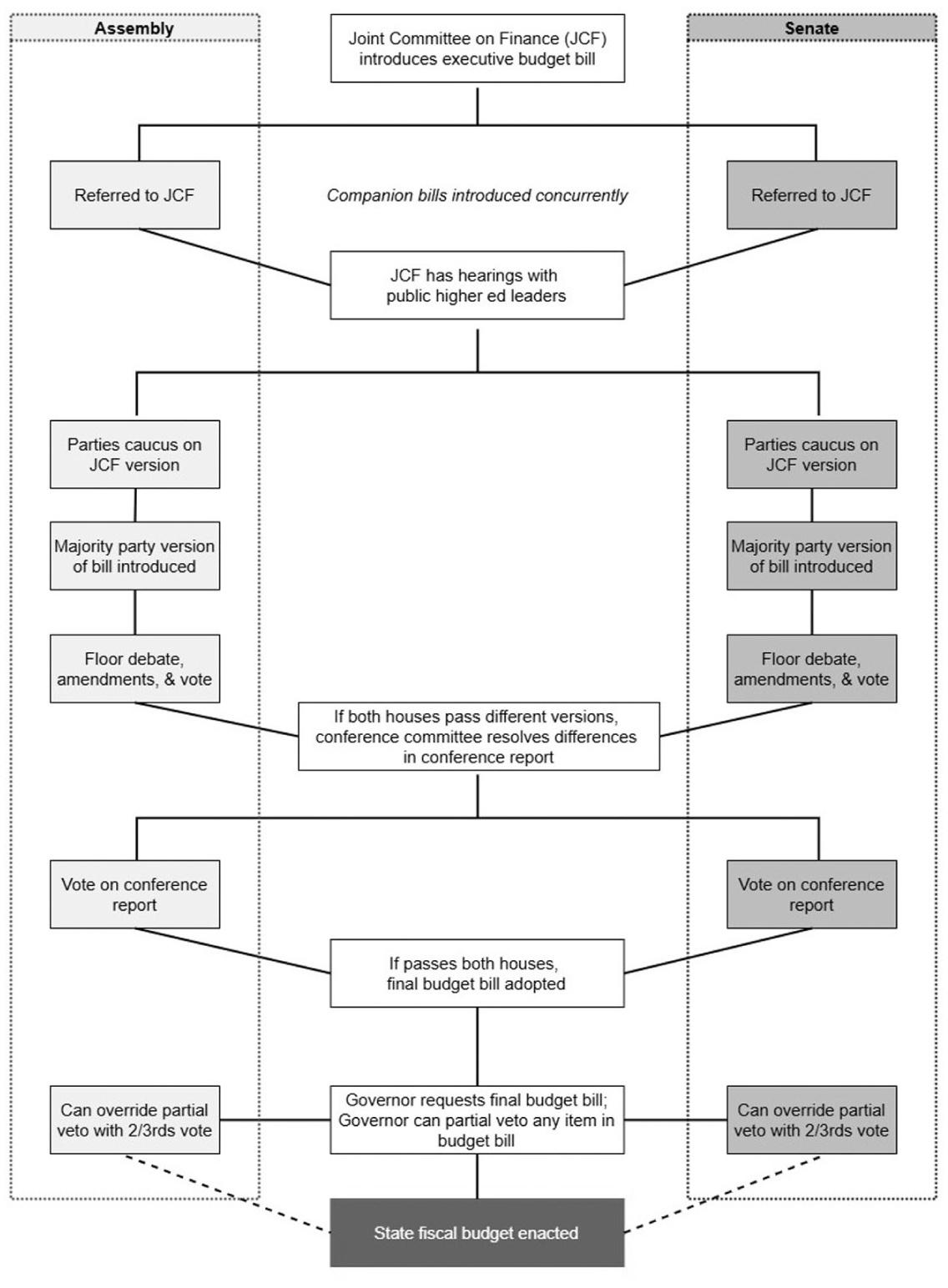
Wisconsin State Budget Process.
There have been historical tensions between the UW system and the state legislature prior to the budget standoff in 2023. Representative Amanda Nedweski explained, “The Universities of Wisconsin aren’t always necessarily willing to be open minded about the ideas coming from the Legislature. And the Legislature isn’t necessarily always open minded about the ideas coming from the universities” (Bahl & Jacobs, 2024, para. 16). For example, the state legislature imposed a 10-year tuition freeze in addition to decreasing state appropriations for higher education, which had severe consequences for campuses (Kelderman, 2024). In 2016, UW-Stout Chancellor Bob Meyer warned that he would have to make cuts to academic offerings and changes to academic quality if the tuition freeze and state disinvestment continued (PBS Wisconsin, 2016). Notably, Representative Robin Vos, who previously believed that tuition increases were a “necessary evil” to avoid a decline in academic quality and offerings, now aligns with his Republican colleagues in support of the on-going tuition freezes (Kyle & Shastri, 2018, para. 3).
The Case Narrative
Over the span of 6 months, UW and state legislators engaged in a budget standoff over DEI and pay raises for UW employees. This case explains the key events that led up to the budget standoff, the reaction from UW campuses and other concerned individuals, and how it was resolved. As this case narrative describes a real event, we use the exact words from key players (when possible) that are sourced from recorded legislative hearings and UW BOR meetings, 863 pages of emails from an open records request, direct quotes from newspaper articles, UW BOR meeting minutes and agendas, and state budget documents.
Inflection Point—Assembly Speaker Vos and Colleagues Withhold Pay Raises for UW Employees
On October 17, 2023, the Joint Committee on Employment Relations met to discuss the 2023–2025 state compensation plan. In an executive session, the committee voted 6-2 (along party lines) to approve pay raises for state workers, but excluded UW employees from these pay raises—affecting approximately 36,000 people (Venhuizen, 2023). Republican Assembly Speaker and Co-Chair of the Joint Committee, Robin Vos, told reporters that he would not approve the pay raises until UW cut DEI programs and staff across the 13 campuses (Lieb, 2023). Democratic Senate Minority Leader Melissa Agard expressed her frustration with the vote:
We’re only doing half our job today, and we’re not taking up the needed pay raises for employees at UW system or the Universities of Wisconsin. . .In any sense, we are denying pay increases to half of our state workforce because of one person’s [Vos] resistance to initiatives to increase inclusion in our campuses. This is a sad moment for our state, when the majority party is actively holding our workers hostage because they cannot ban them the ability to focus on equity and diversity in the state of Wisconsin . . . But please don’t fool yourselves into thinking that you did any good for our state by continuing to deny these raises for people who show up every single day for the state of Wisconsin to make our state better. You’re doing the opposite. You’re hurting higher education, you’re hurting our economy, you’re harming our future. (WisconsinEye, 2023)
Representative Vos fired back and said,
As [UW] enrollment is the same or declining, we are seeing a massive increase in the number of bureaucrats funded by somebody else. Now, when I brought that idea up to the system people and said, “Well, what if we were able to figure out a way to give the raises and say that we will not increase the number of positions without the legislature authority—just like every other agency in the state?” Their initial reaction is we’d rather not have the raises for our employees than to have any kind of control by the legislature over the number of positions . . . So there’s a way for us to get to yes, it just requires the university to actually realize they are funded by the taxpayers. They are not an entity that gets to do whatever the heck they want because they have their own ideological agenda that they’re going to drive home whether people like it or not. (WisconsinEye, 2023)
This was an “unprecedented” move as voiced by UW President Jay Rothman by the Republican-controlled state legislature to force the issue of DEI by using pay raises as the bargaining chip (Venhuizen, 2023).
How It Started—The State Legislature Debates the Budget Bill
Four months earlier, the state legislators reviewed, debated, and amended Governor Tony Evers’s proposed budget bill. For UW, the original bill included 5% pay raises in Fiscal Year (FY) 2024, 3% pay raises in FY 2025, $120 million increase (1.8%) in the UW system budget for FY 2024, and $186 million increase (2.7%) in the UW system budget for FY 2025 (State of Wisconsin, 2023a; University of Wisconsin-Madison [UW-Madison], 2023a). Governor Evers also included a new $356 million engineering building for UW-Madison (2023b) in the capital budget bill. Given the $7.1 billion state surplus, Governor Evers called his proposal a “breakthrough budget” and stated “we have a duty to invest in needs that have long been neglected . . . we have a duty to protect the future we’ve worked hard to build together” (Office of the Governor, 2023a, p. 1).
Instead, the Republican-controlled legislature decided to ignore the Governor’s budget bill and create their own budget. On June 1, 2023, the Joint Committee on Finance withheld approval for the new engineering building for UW-Madison (2023b). Later that month, the Joint Committee of Finance voted to cut funding to UW by $32 million—the amount spent on DEI across the system—and eliminate 188 DEI positions (Bauer, 2023). In July, Governor Evers enacted the 2023-2025 biennial state budget and used his partial veto power to save the 188 DEI positions, but the $32 million cut to UW remained (Lieb, 2023). In his veto message, the Governor stated,
I object to this infringement on the Board of Regents’ authority to manage the University of Wisconsin System and believe it is in the state’s best interests to allow the system to preserve and continue its dedication to diversity, equity, and inclusion as it sees fit . . . These [DEI] positions function to improve the University of Wisconsin experience for all and work to help students, staff, and faculty from all backgrounds and experiences reach their full potential. (Office of the Governor, 2023b, p. 5)
The enacted budget included 4% pay raises in Fiscal Year (FY) 2024, 2% pay raises in FY 2025, $77 million increase (1.1%) in the UW system budget for FY 2024, and $113 million increase (1.6%) in the UW system budget for FY 2025 (State of Wisconsin, 2023b).
How’s It Going—Trying to Find a Compromise to End the Budget Standoff
After the October 17 vote by the Joint Committee on Employment Relations to withhold pay raises to UW employees, UW President Rothman, UW-Madison Chancellor Jennifer Mnookin, and Representative Vos met to discuss a solution. It took several months, but they were able to reach a budget compromise—Resolution 12129 (Carpenter, 2024). The proposed resolution froze 130 DEI positions across the system through December 31, 2026, reassigned at least 43 DEI positions to “academic and student success” over 2 years, included pay raises for UW employees, and approved the new engineering building at UW-Madison (Carpenter, 2024; UW BOR, 2023a). The deal required majority approval by the UW BOR to adopt the budget compromise.
First Vote—December 9
UW President Rothman presented the proposed resolution during the UW BOR’s special meeting on December 9, 2023. President Rothman stated that reaching the agreement was a “challenging and arduous process” but he “believe[d] the agreement is in the best interests of the Universities of Wisconsin” (UW BOR, 2023b). He also shared,
The core values of the Universities of Wisconsin around diversity and inclusion are not changing as a result of this action. The proposed agreement neither eliminates diversity, equity, inclusion nor does it continue business as usual in its entirety—that we have to evolve, to continue to move forward, but I think it is absolutely essential that the principles of diversity and inclusion are imbued throughout our universities. (UW BOR, 2023b)
Regent Edmund Manydeeds summed up the unfair position that the BOR was in by explaining, “an individual that has an agenda [Vos] has placed us in a position where we have to choose between people and their success and buildings and money for our employees” (UW BOR, 2023b).
During the special session, the BOR voiced their support or opposition for the proposed resolution before they voted. The regents in favor of the proposed resolution explained how they supported the budget compromise because “no jobs are being lost” [Regents Mike Jones and Ashok Rai 1 ], it “gives us an opportunity to reimagine our approach to diversity” [Regents Jones, Rai, and Mark Tyler 2 ], and “it keeps our business running” [Regent Jones] (UW BOR, 2023b). Regent Kyle Weatherly also expressed concerns that the “delay in the release of compensation packages . . . [causes UW to] lose more faculty and staff than we have already due to devaluation, low salaries, and lack of support from the state of Wisconsin” (UW BOR, 2023b).
The regents against the proposed resolution discussed how “the time has passed for minorities to be deprioritized” [Student Regent Evan Brenkus] and this plan will cause some “Black, Indigenous, people of color, military veterans, first generation students, [and] disabled students” to “lose hope” by “tak[ing] the EDI symbol away” and they “need hope—hope that they can live and succeed” [Regent Manydeeds] (UW BOR, 2023b). Regent Joan Prince, also in opposition of the plan, explained that the proposed resolution is not “about buildings” and that students “can learn just as well in an engineering building that is 20 years old versus one that is new” (UW BOR, 2023b). As a former UW-Milwaukee administrator and faculty member, she said that UW employees are “very proud” and
They are not going to leave because a raise hasn’t shown up in 60 days. They will get their raise, but what they will never, ever get back if you vote “yes” on this resolution, is the pride in the institutions they work for, inside of, and the students, who pass through our doors, who deserve a whole lot better from people who sit in privileged positions. (UW BOR, 2023b)
After an “emotional” week as voiced by BOR President Karen Walsh, the regents voted on the proposed resolution. It failed to pass with 8 regents voting for the budget compromise (Regents Atwell, Colón, Jones, Kruser, Peterson, Rai, Tyler, and Weatherly) and 9 regents voting against the budget compromise (Regents Adams, Brenkus, Bogost, Manydeeds, Miller, Prince, Staton, Wachs, and Walsh) (UW BOR, 2023a).
Reaction From UW Campuses and the Concerned Community
Meanwhile, UW students, faculty, staff, alumni, and community members became aware of the proposed resolution for the budget standoff (Carpenter, 2024). Eventually, two coalitions formed: those who were
For the Budget Compromise
UW-Platteville Donor: My irritation results from the fact that DEI itself is divisive and polarizing and receives an unproportional amount of attention and funding from Universities that should afford equal opportunity for all in the first place . . . I will continue my contributions to the Platteville School of Engineering, however, you must promise me that not a single penny will be spent on DEI. (p. 170) Retired High School Principal: I can also understand the points made by some of the Regents who voted against the proposal. HOWEVER, I am extremely disappointed that they couldn’t see this was NOT the “Hill to Die On!” Don’t let the 9-8 vote get you down. (p. 201) UW-Madison Economics Professor: If you polled the 34K+ employees and asked them what they thought of the deal, I am sure the vast majority would take the deal (especially if the poll was anonymous). Please do not let a vocal set of employees deter your hard work. (p. 203) UW-Green Bay Staff: It is clear that you have been tirelessly at work trying to negotiate this deal. I recognize that not everyone will be happy with the outcome, but I appreciate you trying to come to a solution that maximized benefit and minimized possible harm. (p. 385)
Against the Budget Compromise
Non-UW Affiliated Person: “Following the racist legislation affecting your university, I wonder what is next. Book burnings? If so, please provide a list of books” (p. 47). UW Alumnus [Not Specified]: Speaker Vos has repeatedly demonstrated that he is not an honest broker when it comes to UW and the impounding of funds budgeted and approved sets dangerous precedent that the University System President never should have accepted in the first place. (p. 73) UW-Madison Staff: “Would you really trade my humanity for a building? Playing by these illegitimate rules is not the look” (p. 81). UW-Madison Alumnus: “This compromise is putting your head in the sand. More outreach and new approaches are needed, not less. This deal signals a step backwards” (p. 104). UW-Oshkosh Alumnus: “You kowtowed to a political jihadist in Robin Vos, setting a dangerous precedent. Letting him play out his culture war antics, potentially illegally, but certainly backhandedly, by withholding funds already approved, is inexcusable” (p. 105). Non-UW Affiliated Person: “Money talks and minorities suffer as usual . . . I hope you enjoy kissing white nationalist ass” (p. 106).
Second Vote—December 13
After a closed door meeting the day before, the BOR met on December 13 for a second vote on the proposed resolution. BOR President Walsh stated that the board “faced one of its toughest votes in memory” but they are not “a deeply divided board.” While they “cannot escape that we are a board of political appointees . . . of two governors on opposite sides of the aisle,” they are also a “group of Wisconsinites with a deeply felt purpose to do what’s best for the Universities of Wisconsin” (UW BOR, 2023c). Then she invited three chancellors from UW-Milwaukee, UW-Superior, and UW-Whitewater to urge the BOR to vote yes (UW BOR, 2023c). The Chancellors expressed that there was “no real win” but “at the end of the day, [they need to be] very pragmatic” and that the “agreement is such that we can work with it to continue to provide opportunities for each student to be successful” (UW BOR, 2023c). In addition, the restoration of the $32 million is “desperately needed on our campus” and the budget cut “has compromised our campus in a time of already difficult financial straits” (UW BOR, 2023c).
After 40 min of discussion, BOR voted for a second time on the proposed resolution. Three regents (President Walsh, Vice President Amy Bogost, and Student Regent Jennifer Staton) changed their vote from “no” to “yes.” Resolution 12129 was adopted with 11 regents voting for the budget resolution and six regents voting against the budget resolution (UW BOR, 2023d). Vice President Bogost and Student Regent Staton explained why they changed their votes. Vice President Bogost acknowledged the “direct human implications [of] this compromise” but after discussions with “many stakeholders from every campus”:
I have decided to support this resolution. We simply can’t ignore the immense challenges facing our universities. It is clear that this compromise resolution, which includes a much needed increase for our university’s employee compensation, among other things, will allow the University of Wisconsin to continue to pursue opportunities for all underserved students . . . President Rothman and Chancellor Mnookin have reassured this board to continue to honor the commitment to diversity. We will hold our feet to the fire on this end by adopting this resolution. It does not reduce or eliminate that accountability for them or for us. (UW BOR, 2023c)
Regent Staton, a UW-Parkside student, shared her decision to change her vote:
We have heard from all of the chancellors, and they have asked for our help, and right now, I will place their needs above my own. They are the leaders of their campuses, and we have entrusted them with this leadership. The reality is, without this resolution, [UW-] Parkside may not be here in the years to come. (UW BOR, 2023c)
After 6 months of back and forth between the state legislature and UW, the budget standoff came to a close.
Teaching Notes
This case highlights two key concepts: (1) the Advocacy Coalition Framework (ACF) and (2) strategic leadership. Based on the topic of the course, students can use these theoretical/conceptual frameworks to analyze the case from either a policy or leadership perspective. In an education policy class, students can use the ACF to analyze the case based on the formation and advocacy of the two coalitions that were either for or against the budget compromise to influence the BOR’s votes. In an education leadership class, students can analyze the case using strategic leadership to discuss how UW leaders and BOR responded to the state legislature and subsequent compromises that they made in the budget standoff.
Advocacy Coalition Framework
The ACF explains how individuals organize into coalitions within a policy subsystem to advocate for their preferred policy action to influence policy change (Jenkins-Smith et al., 2018; Sabatier, 1993). The policy actors within these higher education coalitions can include students, faculty, staff, BOR, parents, donors, the media, and so on (Parker et al., 2022). Policy change occurs through policy-orientated learning within and across coalitions and/or through responses of certain members to external shocks as these events shift the policy beliefs of some of the policy participants (Jenkins-Smith et al., 2014, 2018) These external shocks can be changes in socioeconomic conditions, changes in public opinion, governmental turnover, or policy impacts from other subsystems (Sabatier & Jenkins-Smith, 1999).
ACF conceptualizes that there is a belief system with three layers: deep core beliefs, policy core beliefs, and secondary beliefs (Jenkins-Smith et al., 2014; Sabatier & Weible, 2007). The first layer is the deep core beliefs which represent ideas involving
very general normative and ontological assumptions about human nature, the relative priority of fundamental values such as liberty and equality, the relative priority of the welfare of different groups, the proper role of government vs. markets in general, and about who should participate in governmental decisionmaking. (Sabatier & Weible, 2007, p. 194)
As these deep core beliefs are developed in childhood, they are often very difficult to change (Sabatier & Weible, 2007). The second level is policy core beliefs that guide the behavior of policy actors toward specific policy preferences (Sabatier & Jenkins-Smith, 1999). Sabatier and Jenkins-Smith (1999) define 10 characteristics of the policy core beliefs such as orientation on basic value priorities, identification of groups/individuals whose welfare is of concern, overall seriousness and basic causes of the policy problem, preferred distribution of authority to solve the problem between government and the market or among the levels of government, method of financing the solution to the problem, ability of society to solve the problem, desired level of participation from the public, governmental officials, and experts, and policy core policy preferences. The third level or the secondary beliefs are narrow in scope and focus on either local issues or program-specific concerns. They are thought to be the easiest to change and often each coalition has members with wide ranges of secondary beliefs (Sabatier & Weible, 2007).
Coalitions usually organize themselves based on their policy core beliefs and coordinate their actions to influence policy change (Jenkins-Smith et al., 2014, 2018). In the budget standoff case, the two coalitions are those individuals who were
Strategic Leadership
This case highlights the importance of strategic leadership and communication for leaders in higher education (Ruben et al., 2021). When a president or chancellor is facing multiple challenges, it is helpful if they follow the five critical steps in the rubric for strategic leadership. For example, UW President Rothman could utilize this framework, as the goal is for leaders to enhance their effectiveness and reframe challenges as opportunities (Ruben et al., 2021). The first step, Analyze the Situation, involves taking the time to carefully assess the circumstances and what is at stake (Ruben et al., 2021). In any situation, there are always issues at stake and it is important to think through what is at stake for the department/institution, for others, and for you as a leader. “Being clear on the nature and significance of the issue(s) involved and what is at stake provides a necessary starting point for developing a thoughtful strategy” (Ruben et al., 2021, p. 180).
The second step of the strategic leadership framework is to Define the Audience(s), where the leader determines who they need to reach with a particular message. Communication is a key component of strategic leadership, as the success of higher education institutions depend on effective communication (Ruben et al., 2021). After the leader determines what is at stake and what audiences they need to communicate with, their third step is to Clarify Goals. During this step, leaders should determine exactly what they want, hope, and/or need to accomplish (Ruben et al., 2021).
The fourth step is to Select and Implement a Plan of Action, which involves three key decisions that the leader must make to successfully execute their action plan. First, the leader must decide if any action should be taken to respond to the situation and what is the appropriate timing to respond (Ruben et al., 2021). The second decision the leader makes is what message to convey and if it will be informative or persuasive. The final decision of the action plan is to decide what channels are the most effective to deliver the message (e.g., one-on-one discussion, group meeting, email, social media).
The fifth and final step of the strategic leadership rubric is to Debrief, which involves self-reflection and consideration for how well the plan was executed (Ruben et al., 2021). Incorporating the five-step strategic leadership rubric can feel cumbersome to a leader at first, but over time it will become a natural habit for a leader to implement these steps. Notably, leaders in higher education are faced with numerous challenges, including growing financial issues. It is important that higher education leaders have strategic approaches to dealing with these challenges.
In this budget standoff case, both UW President Rothman and the campus chancellors could utilize the five steps in the leadership approach. For example, the UW-Milwaukee Chancellor would first analyze what is at stake and articulate how taking the budget deal would affect their campus overall, the faculty and staff, the students, and external stakeholders. Next, the Chancellor would complete step two and identify the audiences they need to communicate with about what is going on with the budget standoff. They would craft a message to send out and then complete the third step of clarifying their goals. Now that they identified what is at stake, they could set goals about the financial health of the institution, how they will prioritize DEI initiatives (or not), and how they will continue to communicate. For the fourth step, the Chancellor decides and implements a plan of action. Interestingly, the BOR President Karen Walsh invited the UW-Milwaukee Chancellor and two other chancellors to come to the second meeting and to urge the BOR to vote yes. This aligns with step four, as the UW-Milwaukee Chancellor is now implementing a plan of action by advocating for the BOR to vote yes and take the budget deal. After the final vote, the chancellor would then complete the final step of debriefing, in which they could debrief with other UW chancellors and then return to the Milwaukee campus and debrief with the key audiences they identified in step two.
Teaching Activities and Discussion Questions
Building on the teaching notes and theoretical frameworks, instructors can facilitate two activities in their classes related to this case study. These activities are designed to encourage students to think critically about the role of the state legislature and the competing fiscal priorities in higher education. Several questions are guided by the theoretical frameworks and are designed to encourage students to apply theory to practice.
Activity 1: Group Discussion
The first teaching activity is a group discussion with guided questions. The questions are aligned with the two key concepts outlined in the teaching notes:
What types of stories should higher education leaders share with state legislators about their campus to request more funding? Provide an example from a local institution or the campus you work at.
If you were
What key stakeholders would you invite to strengthen your coalition either for or against the budget compromise?
Using the 5 critical steps of strategic leadership, how would you approach the budget standoff if you were the UW President?
If you were the faculty senate president, what research or data evidence would you use to argue for equitable and fair compensation?
Focusing on the relationship between the state legislature and public higher education, what are some other issues that could lead to a future budget standoff?
Activity 2: Budget Negotiations
In the second activity, students watch a clip of a legislative budget hearing and are provided with a transcript of the university’s initial presentation. To find legislative budget hearings, the National Conference of State Legislatures (NCSL) has an online resource of live and archived legislative meetings across the 50 states and U.S. territories: https://www.ncsl.org/state-legislatures-news/details/legislative-broadcasts-and-webcasts. Once the instructor has identified a budget hearing, use transcription software to transcribe the meeting. Next divide the class in half with one group playing the university leaders and the other group playing state legislators. The university leader group develops alternative arguments for their budget request and the state legislator group creates key questions to ask the university leaders.
Footnotes

Funding
The authors received no financial support for the research, authorship, and/or publication of this article.
Declaration of Conflicting Interests
The authors declared no potential conflicts of interest with respect to the research, authorship, and/or publication of this article.