




Abstract
In 2010, the Finnish Ministry of Education and Culture formulated Finland’s first education export strategy. This policy document attributed Finnish Higher Education Institutions (HEIs) a significant role in the emerging sector by declaring them as ‘engines’ of education export. Situated in a phenomenological approach towards policymaking, this paper empirically investigates how HEIs perceive their role as education exporters. A case study is presented in order to give voice to those who are supposed to implement the education export strategy. The data was gathered from HEIs’ international offices across Finland and analysed by means of content analysis. The findings indicate a gap between vision and reality and thus challenge the existing policy discourse.
Finland as an education exporter
Since its high rankings Programme for International Student Assessment (PISA), Finland has been regarded as a role model for educational excellence (see for example Sahlberg, 2007, 2011a; Waldow et al., 2014). The international praise affected Finland’s reputation as much as the Finnish perceptions about the value of the Finnish education system. The Finnish government sought to capitalise on this positive reputation and made education one of the core messages of the Finnish country brand (Country Brand Report (CBR), 2010: 29), emphasising Finland’s opportunity to create ‘top-level educational products’ in order ‘to become a major power in learning’ (CBR, 2010: 197). Aligned to this national branding campaign, the government actively invested in creating a Finnish education export sector in order to disseminate good education practices and to enter the global education marketplace (Ministry of Education and Culture (MOEC), 2010).
Education export is not a univocal term and thus requires contextualisation. While historically rooting back to colonialism, education export is nowadays regarded as a commercial business sector in many countries. Currently, the dominant education exporters are Australia, Canada, England, New Zealand and the USA. In these respective contexts, education export refers to the higher education sector. The largest revenue is obtained through tuition fees from international students, partnership agreements and campus franchises. Based on this context, Adams defines education export as ‘an educational service approach based on a public-private partnership with market-driven services that may provide a surplus to the institution, high quality educational and pastoral services to students, and export income to the nation, within a strong regulatory framework’ (Adams, 2007: 410).
However, education export in Finland differs from the setting of traditional education-exporting countries. Firstly, the absence of tuition fees in Finnish education institutions contrasts with the dominant education exporters. Secondly, there is no ‘strong regulative framework’ in the Finland education export sector. Thirdly, the Finnish education export is primarily based on the PISA-initiated interest in basic education and the national education system as a whole. Thus the ‘products’ on offer include the internationalisation of higher (tertiary) education services as well as primary education services, secondary education services, adult education services and other educational services such as exchange programmes, consulting services and technical learning solutions (MOEC, 2010: 7). Due to the novelty of education export in Finland (Cai et al., 2012: 218), no clear trends in education export activities have crystallised yet. In this paper I therefore adopt a broad definition of education export as an intentional business transaction concerning educational services, practices, expertise and materials between countries (both inside of Finland and abroad).
In 2010, the Finnish MOEC published an education export strategy with the goal to transform Finland into ‘one of the world’s leading education-based economies’ (MOEC, 2010: 5), and the more specific aim that ‘by 2015 the proportion of education and knowledge exports will have grown significantly in overall exports’ (MOEC, 2010: 5). In the strategy, Finnish higher education institutions (HEIs) were declared to become the ‘engines’ (MOEC, 2010: 13) of education export. The document further postulated: ‘Higher education institutions will be encouraged to be active and assume a major role as education export operators.’ (MOEC, 2010: 13, highlights by the author). In this context, the metaphor of an engine associates the Finnish HEIs with a driving force, taking initiatives and pushing the education export sector forward.
The year 2015 was mentioned as a progress benchmark for education export growth. It is thus an interesting undertaking to question what has actually happened within these five years. In this paper I am presenting an empirical case study with the aim to investigate how Finnish HEIs perceive their role in education export.
From education providers to education exporters: the changing role of Finnish HEIs
In order to contextualise the research, the following section provides a brief summary of recent developments in Finnish higher education. The Finnish higher education landscape includes 10 multidisciplinary universities, five specialised HEIs with university status and 26 polytechnics or universities of applied sciences. Similar to other Nordic countries, the Finnish constitution treats education as a fundamental right, and the government is responsible for regulation, support and funding (65 per cent of revenue sources) of the higher education sector (Välimaa et al., 2014).
Nevertheless, internationalisation, global competition and marketisation of education have a growing impact on Finnish higher education policies. Although Finland avoided the global trend of standardisation and performance measurements in basic education (Sahlberg, 2007), neo-liberal terminology is strongly present in policy discourses on the education system (e.g. Aarrevaara et al., 2009; Komulainen et al., 2011; Välimaa, 2004). A legislative turning point were the amendments to the constitutional University Act in 2008, (followed by the similar Act for Universities of Applied Sciences in 2009), which gave HEIs more autonomy from the state by turning universities into independent legal entities. In practical terms, this allows external stakeholders and more freedom in terms of gaining revenue and profiling the institutions on the educational market (Aarrevaara et al., 2009).
Simultaneously in 2008, a country brand delegation was appointed by former Foreign Minister Alexander Stubb with the aim to create a national Finnish brand image. Education was identified as one of the key aspects of Finnish society (CBR, 2010). The country brand delegation urged Finland to capitalise more on its internationally competitive education system and to disseminate Finnish education across the world (Chapter ‘Lessons from Finland’, CBR, 2010: 181–252). Still inspired by the PISA results, Finland’s education branding became thus tightly entangled with the Finnish national brand (Schatz et al., 2015; Suomi, 2014).
At the same time, a working group appointed by the Ministry of Foreign Affairs and the Ministry of Education and Culture drafted Finland’s first education export strategy (MOEC, 2010). The declared aspiration of Finnish education export was: Finland’s strengths in the education field must be utilised and education must be developed into successful export articles for Finland. Measures must be taken to maintain and enhance the international competitiveness of the Finnish education system. The aim is that Finland will be one of the world’s leading education-based economies resting on the quality of the education system. By 2015 the proportion of education and knowledge exports will have grown significantly in overall exports. (MOEC, 2010: 5)
However, the policy document did not provide guidelines on how to export, what to export and to whom. Instead, the document declared Finnish HEIs as the ‘operators’ and ‘engines’ of education export. Hereby, the responsibility for future initiatives and the growth of the education export sector was transferred to HEIs. As a result, HEIs are no longer perceived as mere education providers. Instead, they were pushed by the strategy to make use of their new financial autonomy by becoming active education exporters. The question of how this change is perceived by HEIs is partly addressed in this case study. Nevertheless, more empirical research is needed to grasp the impacts this new market-oriented perception will have on the Finnish education sector in the long run.
The immediate response from HEIs varied, and since the education export strategy did not impose concrete goals, actions ranged from faineance to ambition depending on the respective institution. The variety of Finnish educational ‘products’ became large and incoherent, including educational tourism, training packages, educational technology, policy counselling, teacher exchanges, involvement in school projects and universities abroad, and joint programmes. The export activities were mostly based on initiatives of individual actors, rather than coordinated across institutions (Cai et al., 2012; Schatz, 2015).
Two national umbrella organisations, Future Learning Finland (http://www.futurelearningfinland.fi) and Team Finland (http://team.finland.fi/etusivu), were created to function as support networks by linking HEIs with the private sector, embassies and external consulting agencies. Both networks kept rather loose ties among the members and understand themselves as providing contacts rather than real national coordination.
In 2013, a second working group (also set up by the MOEC) evaluated the challenges and opportunities of ‘Finnish education on the global market’. The working group criticised that previous education export activities did not meet expectations and failed to create a flourishing Finnish education export sector. Hinting at the decline of Nokia, the former figurehead of Finnish economy, the potential revenue from a prosperous education export sector was presented as a necessity to stimulate the Finnish economy (MOEC, 2013: 13). The working group further noted that international students create the largest revenue for the world’s leading education export industries (MOEC, 2013), and urged the introduction of tuition fees for non-EU and non-EEA students. Indeed, the positive reputation of Finnish education had indeed attracted a growing number of international students since the early 2000s (Center for International Mobility (CIMO), 2012). Turning internationalisation strategies into education export (gaining revenue through degree programmes), this new strategy proposal marks a pivot point in the Finnish education export business. A few pilot fee-based study programmes were introduced, yet the prospect of tuition fees was strongly debated and the proposal was disregarded by the parliament in January 2015 (Välimaa, 2015). Five months later, under a new parliament, a new government programme was released (Prime Minister’s Office Finland, 2015), which forecast the introduction of tuition fees within the upcoming four years.
The future introduction of fee-based programmes would radically change the Finnish education export landscape, but the focus of this paper is the trajectory created by the 2010 education export strategy up to 2015. The past reforms in the University Acts and the funding model increased HEIs’ independence and venues of entrepreneurialism (Aarrevaara et al., 2009; Hölttä, 2000; Kantola and Kettunen, 2012; Pinheiro et al., 2014), and thus created strong incentives for education export. These structural changes were accompanied by auxiliary public discourses in line with the earlier mentioned international recognition and the national education branding campaign (CBR 2010). But although the extensive politicking created a prominent starting position for Finnish HEIs to become proactive education exporters, few seemed to have aspired to the task.
In an empirical study from the beginning of the strategy implementation, Cai and colleagues investigated the readiness of HEIs to become education exporters (Cai et al., 2012). The authors applied Naidoo’s framework of export market orientation in order to evaluate (1) export competence, (2) management commitment and (3) export coordination (see Naidoo, 2010 in Cai et al., 2012: 221). Their informants (11 representatives of the Finnish HEI sector 1 ) hinted at a number of challenges within all three dimensions, including lack of knowledge in marketing, a lack of vision and coordination, legislation issues and funding. The study highlights practical problems encountered in the education export market and the need for future education export policies to address these issues. Without immediate policy revisions that would better support HEIs, the authors forecast that Finnish education export might degenerate into a ‘fashionable policy rhetoric lacking actual meaningful content’ (Cai et al., 2012: 232).
The identified gap between policy ambitions and HEIs’ realities, suggesting a case of ‘policy failure’, is a significant outcome which adds urgency to the research question in this paper.
However, Naidoo’s market orientation framework does not allow the authors to engage with the issue of dynamics in policy making. Their underlying assumption is that policy dictates and HEIs receive, thus a policy is either successful or not. But against the background of declaring HEIs as powerful engines, I argue to address institutional agency as a crucial part of the policy process. In the following section I will therefore engage more deeply with the theoretical perspectives in which this study is embedded.
Applying a phenomenological perspective towards education export policy making
Educational policy research is not a field per se; it can be conducted from a variety of scholarly disciplines, such as political science, history, sociology, education or anthropology. Since study design and research outcomes are shaped by the researcher’s perspective, the following section will outline the underpinning theoretical assumptions shaping my approach towards Finnish education export policies. My research focuses on the dynamics among stakeholders and their realities. Therefore I chose to follow what Trowler sketched as the phenomenological approach within policy sociology (Trowler, 2003: 128–148).
Borrowing from Organisational Development terminology, Trowler distinguishes between top-down and bottom-up approaches. A top-down approach towards institutional change requires a leader on top of an organisation formulating goals and creating the necessary attitudes and resources for implementation at a lower level. Applied to the context of higher education, this implies that policies are created by the ministry and obediently implemented by HEIs. From within this understanding of policy making, power and responsibility is attributed to the policy itself and its creators: ‘Given clear policy goals, a strong culture, sufficient resources and an understanding of how to bring about change, the strong manager relatively easily ensures that policy is carried out as intended by the policy-makers.’ (Trowler, 2003: 126) This managerial perspective resonates with the policy recommendations formulated by Cai, et al., 2012, who urged for a more concrete Finnish education export policy and an increase of resources and directions for the HEIs.
The constructivist turn in the 1980s, however, challenged the understanding of management as a top-down approach. As remarked by Barrett and Fudge: … the problems of implementation are defined in terms of co-ordination, control or obtaining ‘compliance’ with policy. Such a policy-centered … view of the process … tends to play down issues such as power relations, conflicting interests and value systems between individuals and agencies responsible for making policy and those responsible for taking action. (Barrett and Fudge, 1981, in Trowler 2003: 126–128)
In Finland, policy research in education has focused much on the Finnish PISA results and the national education policies behind the good results. As Simola et al. argue, Although being the winner of PISA, Finland is the country, whose educational practices are running in many areas counter to the vast main stream mantra of accountability. Rather than being the gloss scarp of the OECD, Finland is in this respect a kind of model case against it succeeding in spite of that in the international race for benchmarking by avoiding to play the same game by the same rules. (Simola et al., 2013: 613)
Some researchers have coined this as the Finland paradox, emphasising that Finnish education does so well in international comparison particularly because it has resisted neo-liberal trends in education policies (Meyer and Benavot, 2013; Sahlberg, 2007; 2011b; Silander and Välijärvi, 2013; Simola, 2005; Simola et al., 2013; Varjo et al., 2013). On the other hand, Rinne and colleagues argue that the success in PISA has created national pride for Finnish education and paved the way for Finnish education policies to welcome OECD advice and policy directions (Rinne et al., 2004: 463). As a result, the OECD had a significant impact on the changes in Finnish higher education (Rinne et al., 2004: 466–469, 473–475) which, according to the authors, marks a ‘great turning point in Finnish education policy from the decades of egalitarian policy towards emphasis on competition, individuality and markets’ (Rinne et al., 2004: 477).
Similarly, changes towards marketisation have been identified in Finnish higher education policies (Aarrevaara et al., 2009; Cai and Kivistö, 2013; Hölttä, 2000; Komulainen et al., 2011; Välimaa, 2004). Simola and colleagues more recently argued: ‘[in Finland] we came on a late train, but in the field of Higher Education we have also clearly seen this new dawn of the enterprise university (Clark, 1998) and academic capitalism (Slaughter and Leslie 1997)’ (Simola et al., 2013: 617). In his research on higher education policies in Finland, Kauko challenges researchers to oversimplify this process (Kauko and Varjo, 2008; Kauko, 2013, 2014). He reminds us that in Finland, the change of education policy is a complex process with many stakeholders involved, and proposes to deepen the analysis of policy ‘contingency’ (cf. Kauko, 2013: 196) by looking at the dynamics between policy and stakeholders. Based on historic policy review, Kauko observes four types of dynamics: reform, consensual change, gridlock and friction.
Having this in mind, the hypothesis of this study is that there is a variety of reactions within Finnish HEIs towards the MOEC’s education export policy. The aim of this research is to make those visible through empirical inquiry. Hereby, new insights can be gained for the case of Finland’s education export, but also for the ongoing policy debate.
Case study: how do international offices perceive their role as education export engines?
Study design
The phenomenological perspective implicates awareness that policy researchers take part in the complex process of policy making by giving voice to certain actors and ideologies. I agree with Trowler who remarked: The values, attitudes and perceptions of those lower down, who were doing the donkey work of putting policy into practice, had been ignored. These people often use strategies which in effect change policy. They inevitably have discretion in order to cope with uncertainty; as a result policies tend to evolve through the interactions of a multiplicity of actors. Consequently policy becomes refracted as it is implemented, that is, it becomes distorted and less coherent as it is interpreted and put into practice by ground-level actors, such as teachers. (Trowler, 2003: 128)
The data collection targeted participants working at the international offices from different types of HEIs all across Finland. For practical reasons, I chose to collect the data by means of an electronic questionnaire. The recipients were selected according to their involvement in international affairs and their participation at the KV Kevätpäivät 2015 (6–7 May 2015), the spring forum for international affairs in higher education (organised by CIMO). The programme of the spring forum featured keynotes from the MOEC as well as politicians and administrative decision makers on issues concerning internationalisation and Finnish education export. Thus, all participants in this study had some background knowledge on the topic of education export and were aware of the MOEC’s discourses, even if their specific tasks might be related more to other aspects of internationalisation. I introduced the research during the conference to ensure participants would be informed about the objectives of the survey.
In order to increase the amount of responses, the questionnaire was rather short (four mandatory questions and one optional question of further comments). The aim of the questionnaire was to capture perceptions and opinions of the participants rather than standardised phrases representing the official position of their institutions. Therefore all questions were open-ended and included personal signifiers in each question (‘according to your opinion’, ‘do you think’, ‘to your knowledge’, ‘if you had’, ‘do you have’). In addition, the design of the questionnaire was colourful to avoid an overly official presentation. The position and institution of the respondents was an optional field, to grant participants anonymity in case they wished to give answers that do not align with institutional strategies.
The questionnaire started with the earlier presented working definition of education export as ‘intentional business transactions concerning educational practices, services and materials between two countries, both inside of Finland and abroad’. Optional fields enabled participants to leave their contact details or further comments. The four mandatory questions were:
Q1: To your knowledge, in what type of education export activities is your institution involved? Q2: What, according to your opinion, should be the role of Finnish higher education institutions in education export? Q3: How important do you think education export is for your own institution? Q4: If you had a magic wand, what would be the one thing you would do to boost Finnish education export?
After a pilot study (not included in the analysis), the questionnaire was disseminated via email. In total, 29 participants (R1–R29) responded from diverse institutions across the Finnish HEI sector (multidisciplinary universities, specialised universities and universities of applied sciences). Most responses were gathered in English; one Swedish and three Finnish responses were translated into English for the analysis.
Method
As the analytical method, I chose Mayring’s qualitative content analysis (Mayring, 2000, 2003) as a practical compromise between the aim to produce summarised results and the interpretive framework of qualitative analysis. In qualitative content analysis, the coding is generated close to the text and the researcher provides insights into the progress of categorisation. Mayring developed two models for the actual analysis procedure: (1) inductive category development, in which codes and categories are created while working with the data with the aim to summarise the information, and (2) deductive category development, which starts from a developed and defined coding agenda derived from the research question (Mayring, 2000: 11–14). In this case, I applied inductive category development in order to establish commonalities and incongruities derived from the participants’ responses.
As a first step of analysis I familiarised myself with the data through several readings. Second, each response was read word by word in order to grasp the meaning; keywords and phrases were highlighted and notes taken for preliminary analysis. Already at this point, similarities across the respondents caught my attention. This persuaded me to group the responses according to each question (Q1–Q4), rather than investigating each respondent individually (R1–R29). Based on the earlier highlighted keywords, a separate coding system was developed for each of the four questions.
Defining the coding frame closely followed the analytical steps of summary, explication and structuring. For example, the statements ‘Change the present legislation concerning tuition fees’ (Q4/R13) and ‘Enable Finnish institutions to apply a tuition fee when exporting.’(Q4/R19) both include the keyword ‘tuition fees’, and were thus grouped together. In case responses included more than one keyword, the one that was highlighted by linguistic signifiers as the main argument (e.g. ‘most important is’, ‘first of all’) defined the coding of the statement. After this initial grouping, the categories based on keywords were enlarged to categories based on key themes, for example the code ‘tuition fees’ was enlarged to ‘legislation changes’ in order to encompass other statements with similar content (e.g. ‘I would change the legislation and make it possible to sell entire degrees.’(Q4/R25)). In a final round of structuring, the key themes were summarised into theme groups, enabling me to extract key contents. The coding process was repeated for each of the questions respectively.
Findings
The first question (Q1: ‘To your knowledge, in what type of education export activities is your institution involved?’) revealed the level of insights the participants had in ongoing education export businesses at their institutions. Only three respondents (R6, R13, and R22) replied they are currently not involved in any export activities. But since those were able to respond to the other questions, it can be assumed that they were aware of the current discussions about education export. Two of these three were not aware of any activities at their institutions (R13: ‘None for the time being’, R22: ‘No activities that I’m aware of’), but the third respondent R6 mentioned ‘dreams’ (‘Not involved at all but the “dreams” would be focused on either fee-based programmes or learning technologies.’). This indicates the awareness of the respective staff member of possible future education export activities.
Overview of HEIs’ education export activities.
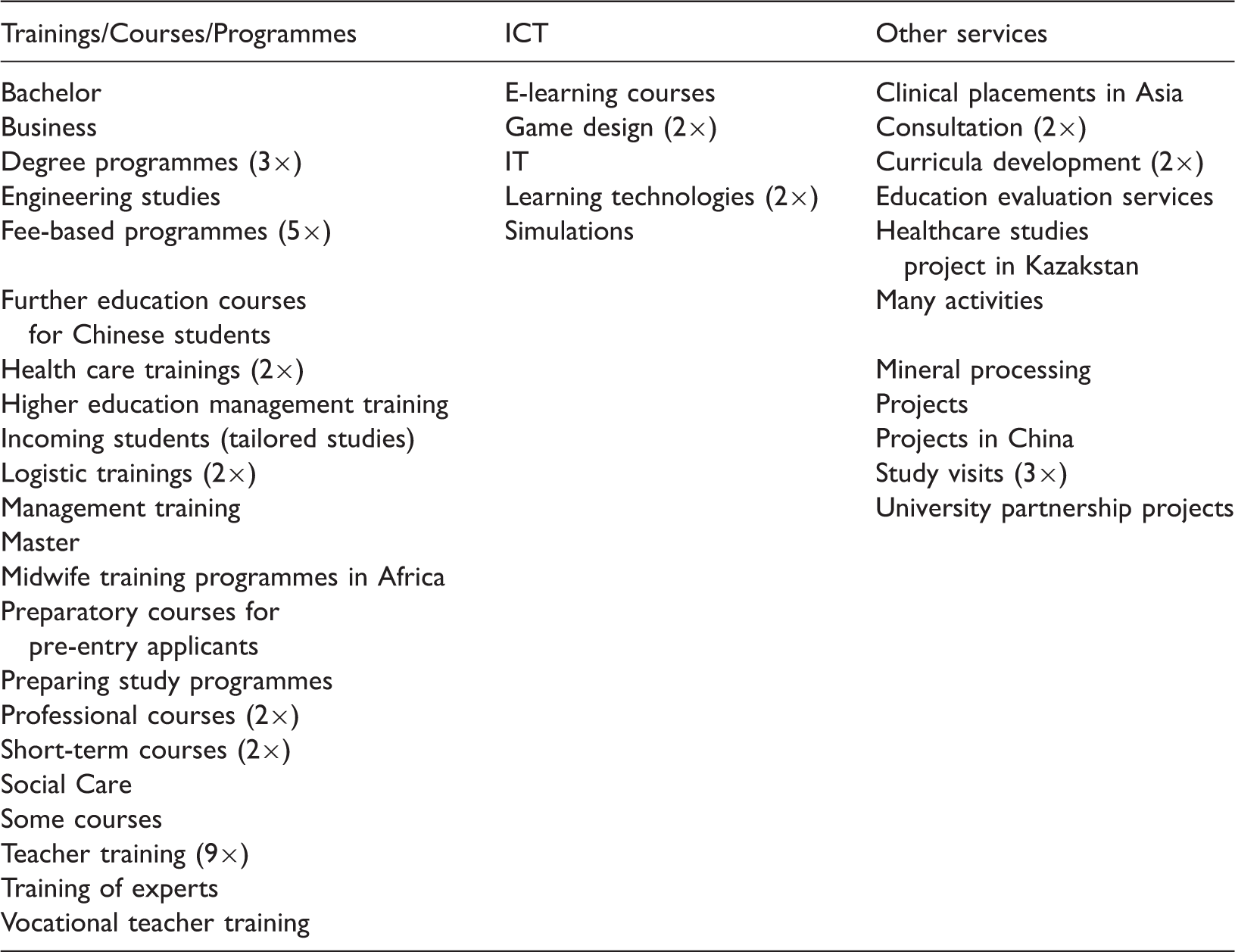
The second question (Q2: ‘What, according to your opinion, should be the role of Finnish higher education institutions in education export?’) was directly targeted to answer the research question. The aim of the question was to identify whether, and how, the ‘engine’ metaphor was present among the respondents. However, the metaphor itself did not appear in the data at all.
Only five respondents attributed HEIs a significant role in education export (R13: ‘of course, HEIs should have a central role …’; R16: ‘Active, as we’ve seen and heard from our partners that in this field we have lot to give …’; R17: ‘HE institutions should have a crucial rike (sic) in exporting these products’; R22: ‘HEIS are expected to lead Finnish education export …’; and R24: ‘The role of Finnish higher education institutions should be significant.’). Two more mentioned an ethical responsibility to spread Finnish education across the world. One of them, respondent R19, argued that ‘The export we do should be to strengthen the education in other countries and should be ethically based.’ Here the participant implies an ethical imperative to education export, which is based on the idea of sharing good practices and perhaps opposes the profit-oriented approach spread by the Ministry. The second, R20, argues for the importance of HEIs as higher education institutions by saying ‘We have a lot to of potential, a lot to give to the world’ (R20). This resonates with the Ministry’s strategy document, which emphasises the ‘evident demand for Finnish know-how on the international education market’ (MOEC, 2010:3). This makes in total seven participants who support an active role of HEIs in education export.
In contrast, 11 respondents thought Finnish HEIs should be involved to some extend by taking part in the content creation of educational products. This would mean undertaking a supporting role in creating educational content for export, rather than being a driving force of the sector. When comparing these answers with those of the previous question, it could be argued that content development – in the form of creating trainings, courses and programmes – is currently indeed of more relevance for HEIs than other services.
Another 11 respondents did not see how education export aligned with the goals of their HEI institutions. Six among these argued that the role of Finnish education exporters is currently insignificant, but that this could possibly change if the institutions were to cooperate more rather than working individually. As R01 put it: At the moment at the moment, I think that everybody is desperately trying to do this too much with themselves … there is a huge competition going on, (between institutions etc) and, really, in this small country we should do more co-operation.
The following three excerpts are from respondents who argued that education export is not important for all types of HEIs, and that therefore HEIs, or even respective faculties, should be able to choose whether or not they take part in education export (R06: ‘for some faculties it should not exist at all, but some faculties depending on the needs of the market’; R28: ‘Each institution has its own profile and should make its own decisions about whether to sell some programmes and if yes, to whom and for what price’; R29: ‘Passive or active, this depends on how it has been seen in the international strategy of individual HEI. All HEI’s should not be involved.’). Similarly, R03 argues: ‘It depence (sic) on institution's own will and aim, in my opinion. In general, institutions should consider what international activities benefits their strategical goals. In real life, also resources matters.’ These four respondents challenge the national strategy by highlighting the importance of the respective institutions profile and resources. They imply that while education export might be lucrative for some, it might not benefit Finnish HEIs in general.
In total, less than a quarter of the participants shared the strategy’s aspiration according to which HEIs should take an active role as education exporters. These findings display a significant gap between the MOEC’s engine-discourse and the staff’s own perceptions about the role of HEIs in education export. Some of the respondents see current challenges as problematic for their institutions (increasing competition, differences among institutions and departments, resources, ethical concerns) which are not taken into consideration in the national strategy.
The third question (Q3: ‘How important do you think education export is for your own institution?’) aimed to discover the meaning and sense-making of the education export mandate. While the second research question investigated the general role of Finnish HEIs, this was more targeted at the respondents’ immediate work environment. As expected, there are some noteworthy differences between the participants’ general attitudes and the reality in their institutions.
While only five respondents stated previously that Finnish HEIs should be active as education exporters, six regarded education export activities as ‘important’ for their institution. In contrast, 13 described it as not relevant (R13, R17, R22: ‘not important’; R04: ‘not very high‘; R05: ‘minimal’; R06: ‘not big’; R07: ‘ei prioritetti’ (transl. no priority); R09: ‘pienimuotoisesti’ (transl. in small scale); R13: ‘not important’; R21: ‘a minor effort’; R23: ‘This has not been emphasised much’; R25: ‘Olemme alkumetreillä’ (transl. We’re at the first steps); R28: ‘It’s a very small-scale activity’).
The remaining 10 found it somewhat important, but identified a problem in the divergence between the official institutional strategy on the one hand, which supports education export activities, and the practical reality on the other hand, in which export activities are of little or no relevance. Representative of this ambivalence is an excerpt from R26’s response: It is quite important, theoretically speaking. From the practical point of view, it looks like the education export activities are still under construction. The tactical modus operandi is still something we just have to learn. It is a relatively new concept and so it requires a lot of flexibility, diplomacy, smartness and – last but not least – marketing skills. The latter turns out to be extremely challenging. (R26, Q3)
Solutions to boost Finnish education export.
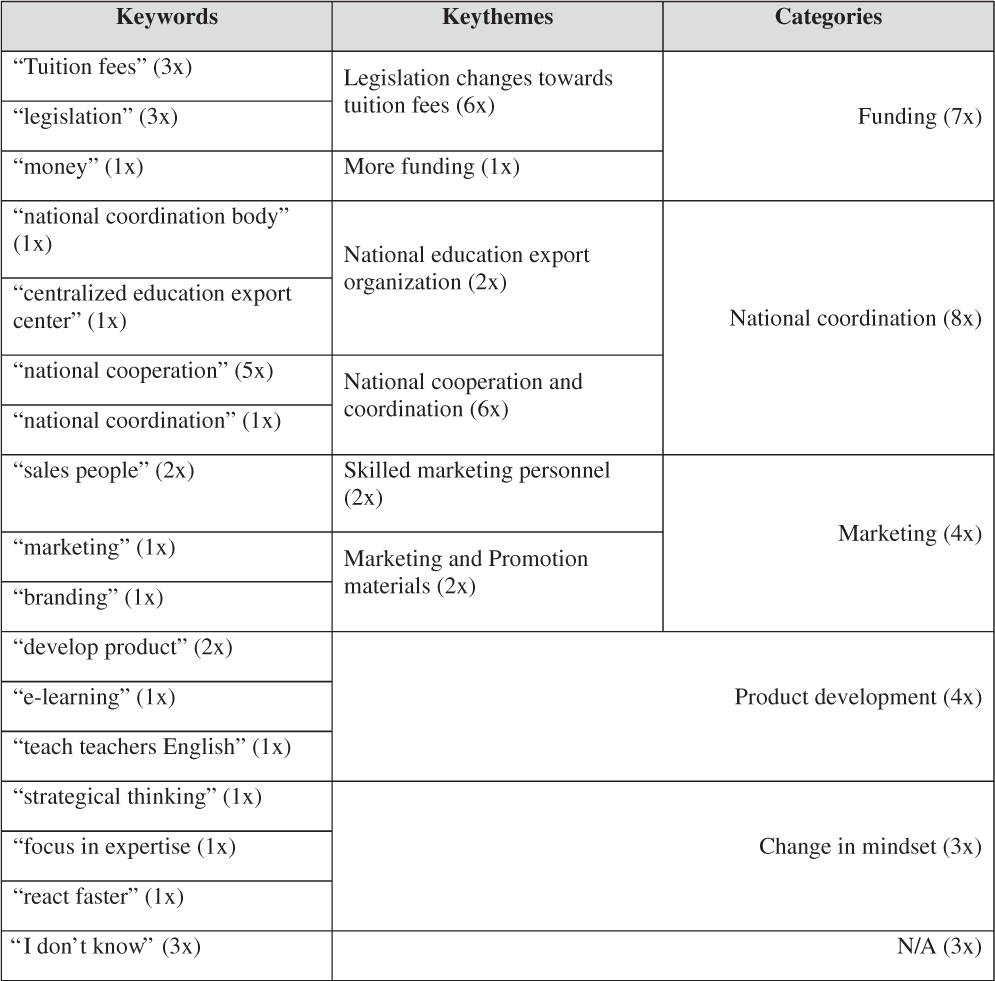
As Table 2 shows, the offered solutions to improve the education export sector can be grouped according to five different approaches. In the largest group, eight respondents would wish for better national education export coordination. This ranges from wishes for better and cooperation among the HEIs (e.g. R15: ‘More cooperation so, that not every small operator works alone, we are a small nation and when working together that would give more power’; R17: ‘I would bring in all wise heads together, make a guidebook how to sell education and stop competing among other Finnish HEI. It is very closed now’) to the establishment of a centralized education export centre: ‘I’d have a centralized export education “Center” that would coordinate the education exports of Finland. This way a company, for instance, could contact the “center” and tell them what kind of education they want. The “center” would then find the appropriate HEIs for the job’ (R12). Common among all these eight respondents is that they regard a lack of coordination and cooperation as the major obstacle to Finland’s success in education export.
The second largest group regards funding as the major problem. Out of seven, six suggest changes in the Finnish legislation to enable tuition fees. Allowing HEIs to charge for entire degrees would save the institutions from having to go through the current loophole of offering customer tailored programmes and courses. As R19 comments, ‘now it is all made too difficult’. Since most respondents regarded training and courses as the current major education exports (see Q1), it is not surprising that they wish to sustain their ongoing core activities rather than having to invest extra resources to overcome the legislative challenges.
Four respondents would like to get support through marketing experts to improve their institutional brand and make it more competitive. This indicates that they feel a lack of expertise in marketing and branding, which resonates with the previously quoted comment that education export at HEIs is still ‘under construction’. Education export adds new work tasks from the domain of education marketing and branding for the staff at international offices. Without additional funding or consultations, the staff might not feel sufficiently well equipped to build a presence on the marketplace and to become active education exporters. R10’s suggestion is therefore: ‘I would bring sales persons to all universities and more recourse to the creation of educational packages.’
Another four respondents criticised the lack of an actual education export product. The absence of such has already been highlighted in the introduction, and further underlined by the results of Q1. These respondents indicate that the actual role of HEIs as education exporters is not very clear among all institutions, and that a major focus should be placed on product development.
Finally, three respondents urged for a change in the mindset of HEIs themselves. They criticise that their institutions have not reacted as ‘strategic’ (R03), ‘focused’ (R09), or ‘fast’ (R23) as they should have, and that this needs to be changed in order to improve the Finnish education export sector.
The solution approaches suggested by the study participants match with the challenges identified in their earlier responses and the identified challenges of having a clear export product, unnecessary competition and a lack of experience in education export. In addition, these findings are similar to those of Cai et al.’s study on the challenges in education export (2012); apparently, similar challenges are persistent in 2015. Aligned to the responses to the earlier questions, I started to look for proactive agency in the responses in order to trace the underlying attitudes towards the engine metaphor. Interestingly, most of the solutions (national coordination, funding, marketing expertise) require support from outside the HEI sector. This means that according to the majority of respondents, the education export sector should be improved via external help. The role of the respondent is therefore mainly passive, waiting for something external to happen, improve, or change, before education export really can flourish at the institution. Only seven participants suggested solutions which require action also within the HEIs (product development and change in mindset), and could possibly be regarded as a responsibility of the respondent or his/her institution. The predominantly passive attitude sets a stark contrast to the vision of HEIs as ‘engines’ and ‘driving forces’.
Engines without fuel? Conceptualising HEIs’ agency in Finnish education export
Finnish HEIs should offer quality education first of all to even start thinking about the export. Yes, our educational system is very good, however the quality is not in the same level as our primary education. The export should focus on the fields where we are good at: Health, social services, educational training and ICT. There is no point to start compete with our business or social sciences studies, cause I think we are behind many other countries in them. It is also important for HEIs to know WHAT exactly we export. Do we export the concept of the studies, curriculum, teachers, study material or something else? (R04, Q2, highlights by respondent)
The vagueness of the Education Export policy document allows for a range of interpretations, as its goals are not clearly defined. This is reflected by the variety of education export products listed by respondents in Q1. That the predominant product of HEIs belongs to the category of courses, training and programmes indicates that the first education export policy was perhaps overambitious in expecting HEIs to expand significantly on new business ventures. Indeed, the second education export policy seems to take the situation of HEIs better into account by focusing directly on the sales of entire degrees.
The findings from Q2 indicated that only a small group of enthusiasts support the role of Finnish HEIs as education exporters. Similarly, according to Q3, education export is regarded as important in only a minority of surveyed HEIs. In contrast, the majority of respondents are not convinced that education export is a feasible strategy for their institution. Their concerns on lack of strategy, support and resources align to the earlier discussed challenges of Finnish education export as a new sector. These findings indicate a stark contrast between the Ministry’s education export ambition and its actual implementation. The results of Q4 reveal a predominantly passive approach towards future improvements in the sector. This strengthens the argument that there is a clear mismatch between policy and practitioners.
This dissonance could explain why the Finnish education export sector has not flourished as expected. As Kauko argued, policy making in Finland is a complex interplay of different actors, and this could be regarded as a case of friction or gridlock in policy dynamics. Following this argument, the second education export strategy from 2013 indicates a policy adjustment from the side of the government. Further empirical research on the interactions between international offices, university management and ministries would be needed to elaborate on this interplay. But indeed, the strategy from 2013 seems to align better to the realities in international offices. With the prospect of selling entire degrees, the challenges of funding and legislation would be overcome. However, the problems of cooperation, marketing, product development and change in mindset remain to be addressed.
Due to the small sample group, I do not claim statistical evidence with the numbers presented in this case study. However, the findings indicate that education export is still not very high on the agenda of all international offices, despite the government’s policy aims and the apparent knowledge of the sector within international offices. According to the data presented above, by remaining mostly inactive most of the respondents do not see themselves as a driving force of education export, thus challenging the policy itself. Rather taking a proactive, self-initiating role, it seems many remain a more static position. To stay in the engine metaphor, it seems that the international offices at HEIs are engines without fuel. Change needs to be initiated by others (actions by the government or institutional leadership) in order to make them take responsibility for Finnish education export. This confirms the theoretical assumption that international offices are not mere respondents of the government’s policy. The attitudes of the staff, embedded in the institutional setting, create an active counterpart.
Without fuel, an engine itself is not enough to move things forward. Based on the findings I argue that Finnish education export policy is an insightful case of the power play involved in policy making. By insisting on governmental support and external solutions, HEIs also contest their newly ascribed role as independent enterprises and active education exporters. Consciously or unconsciously, they challenge the education export strategy both in terms of content and ideology, and thus co-create possibilities for future policy developments.
Footnotes
Declaration of conflicting interests
The author(s) declared no potential conflicts of interest with respect to the research, authorship, and/or publication of this article.
Funding
The author(s) received no financial support for the research, authorship, and/or publication of this article.