



Abstract
The Computer Science (CS) for All national movement is increasingly relying on state-level change to broaden participation in computing. To foster an environment in which all students have opportunities to thrive in CS education, policy action is necessary to help create the learning conditions for success. CS education in California has grown substantially in the last decade, yet opportunity gaps remain for young women and Black, Latinx, and Native American students. Early grassroots efforts to advance equity in computing evolved into the Computer Science for California coalition of K–16 educators, industry leaders, and other equity advocates to promote the growth of equity-minded teaching and learning opportunities in K–12 CS education. New policies at the state level reflect an increasing commitment among Sacramento policymakers to expand CS education. Yet troubling disparities in CS access and success continue to exist between traditionally advantaged students and their historically underserved peers. By drawing on interviews with 20 individuals involved in CS education policy, this study illuminates the contributing factors to recent policy successes and considerations for achieving further progress. Interviewees described the importance of tapping into the values of influential decision makers, educating policymakers about the benefits of CS education, and identifying the problems and solutions that require policy attention. To build the capacity of key policy actors in making informed decisions, this research demonstrates the continued value of providing useful information, developing relationships with policymakers, and creating resources that are easy to consume and understand. The interviews also suggest that attention to funding, disruptions from the COVID-19 pandemic, equity, and ongoing stakeholder support will shape prospects for CS education policy success moving forward.
Keywords
Introduction
The national Computer Science for All (CSforAll) movement to scale K–12 computer science (CS) education has largely been driven by industry leaders in Silicon Valley, fueled in part by the tech ethos of “move fast and break things.” This rush to expand CS education has state leaders across the United States competing to check off a list of important policy priorities (Ericson et al., 2016; Code.org, CSTA, and ECEP Alliance, 2020). Although their efforts injected much-needed urgency into the CS education landscape, an approach driven by a single constituency can potentially yield short-term wins at the cost of sustainable long-term gains. For example, mandating that schools offer CS in an environment where teachers do not yet have the knowledge and skills to deliver the content with quality can ultimately undermine efforts to promote access to computing. Moreover, expanding CS opportunities rapidly might open doors within communities with preparatory privilege but fail to create entry points for students who are historically underserved. Absent input from a multistakeholder coalition representing diverse perspectives, well-intentioned policies can potentially exacerbate existing educational inequality.
This article describes how a statewide multistakeholder coalition uses a reciprocal top-down and bottom-up approach to address the challenge of implementing CS education and ensuring its opportunities are accessible to all students, including females and Latinx, Black, and Native American students (Oaks and Rogers, 2006; Margolis et al., 2008). 1 A symbiotic relationship between CS educators and advocates at the local level and policymakers at the state level has fostered supportive conditions for the scalable and sustainable implementation of equitable CS education in California. In this article, we discuss what we learned from this systemic approach and what more is necessary to democratize high quality K–12 CS teaching and learning opportunities for every student.
The case for equity in computer science
CS is the “study of computers and algorithmic processes and includes the study of computing principles and theories, computational thinking, computer hardware, software design, coding, analytics, and computer applications” (Tucker et al., 2003: p. 6). CS extends far beyond computer literacy (use of a computer and the internet) or educational technology (instruction using technology) by positioning students to solve complex problems through quick prototyping and the management of large amounts of data and intricate algorithms.
CS is driving innovation across all fields and occupations, from the sciences to the arts, from auto mechanics to agriculture. Much of the momentum for technology inclusion aims to prepare students a growing industry need to fill jobs. Even though more than 60% of jobs in science, technology, engineering, and mathematics (STEM) in the next decade will be in the computing professions (U.S. Bureau of Labor US Bureau of Labor Statistics, 2021), only 11% of STEM graduates study CS (National Center for Education Statistics, 2021). Currently, there are insufficient graduates with CS skills and degrees to meet workforce demands. These nationwide trends align with California’s workforce demands, where more than 1 million STEM available positions are projected within the next decade; 75% of those positions will require a bachelor’s degree or higher (Byrd and Shorette, 2016).
The ways in which we engage with our economy and industry, our families and friends, and our political system have become increasingly reliant on CS (Bobb and Brown, 2017; Ryoo, et al., 2021). Despite this growing impact on society, CS education in K–12 schools has long been relegated to the margins, outside the core curriculum. Consequently, these essential learning opportunities are too often reserved for students from well-resourced schools with pathways to develop knowledge and skills in computational thinking—the inquiry, problem solving, and design processes for preparing students for college, careers, and civic engagement. Meanwhile, computer access for students from schools with high numbers of students from low-income backgrounds and/or students of color often features the most basic rudimentary skills—such as keyboarding and internet searching—instead of the deeper learning associated with CS.
Despite the state’s position as a hotbed of activity in the CS industry, the barriers to access for California students are especially troubling. Six in ten high schools in the state do not offer any CS coursework at all, and only 14% offer Advanced Placement (AP) CS classes. Only 3% of high school students were enrolled in any CS course in 2017. Among schools predominantly attended by Black, Latinx, and Native American students, only 39% offer any CS courses, and only 8% offer AP CS A. Although Black, Latinx, and Native American students comprise 60% of California’s high school population, they represent only 16% of AP CS A test takers (Scott et al., 2019).
A multistakeholder coalition to advance equity policies: A theory of action
Computer Science for California (CSforCA) is a coalition of stakeholders—including members of the K–12 and higher education communities, tech companies, and nonprofit organizations—that has engaged in a multipronged effort to inform policymakers about the need for CS education progress and advocates for structural changes to support it. Originally convened as the Alliance for California Computing Education for Students and Schools in 2012, the group launched CSforCA in 2017 and aligns with the nationwide CSforAll movement, seeking to expand CS education across California. CSforCA works to build the capacity of policymakers and other key decision makers to make informed decisions by organizing informational hearings and webinars, developing and disseminating infographics, and sharing data about access to CS in California.
However, a coalition advocating at the state level is effective only when practitioners on the ground can both inform and monitor the implementation of equitable state policies. A coalition collectively holds power to ensure that opportunities for teaching and learning are provided at the state level and implemented at the local level.
This symbiotic process of both informing and implementing policy drives the theory of action for the CSforCA coalition. Central to this theory is a fundamental commitment to meet the needs of students who have been historically underserved in CS. More than 50 years after the Coleman (1966) report highlighted racial disparities in learning environments, Black and Latinx students from low-income backgrounds are more likely to attend overcrowded schools that receive fewer resources and feature less effective teachers (e.g., Darling-Hammond, 1998, 2001; Darling-Hammond et al., 2018; Edley and Kimner, 2018; Goldhaber et al., 2018; Ready et al., 2004; Willis et al., 2018). Access to CS coursework too often mirrors the patterns of opportunity that characterize our school systems overall, with deeply rooted structures and mindsets creating barriers for students of color to thrive (Margolis et al., 2008). Yet, it is the communities most closely tied to these schools—and the organizations that represent them—that possess our country’s best hope for working to improve them, as demonstrated by studies on parental and community involvement in mathematics (Howard et al., 2019; Howard and Joseph, 2021). Their grassroots activism, informed by data that illustrates their experiences, is an essential voice missing in too many school reform initiatives (Oakes and Rogers, 2006). Moreover, in a state and country where the majority of students is nonwhite, meeting the technological demands of the workforce and our society can happen only when all students—including those for whom opportunity has historically been denied—can develop the knowledge and skills that enable them to thrive.
With a shared goal of advancing equity, CSforCA designed its coalition work to foster a reciprocal process of knowledge generation among members of the CS and policy communities. Practitioners—whether teachers; school, district, or county administrators; policy advocates; or industry representatives—bring invaluable expertise to the table about promising opportunities for progress and obstacles to success. These practitioners also help elevate the unintended consequences of well-intentioned policies. In turn, CSforCA translates the needs of teachers and other practitioners to help build the understanding and capacity of key decision makers to support equity and CS education systemwide. Through a shared leadership model that integrates the diverse perspectives of multiple stakeholders, CSforCA established five working groups that focus on different key elements in the system for meaningful change in the state: K–12 Teaching and Learning, Coalition Building, Higher Education, Research and Communications, and Policy.
Through its working groups and overall body of work, CSforCA created a community of support within its membership. Equally important are the efforts in which CSforCA seeks to engage and influence a set of stakeholders beyond the group. In the policy arena, CSforCA embraced an approach to coalition-building that exhibits key elements from the literature on the policy development process. For example, coalitions can act as policy intermediaries or policy entrepreneurs to create, broker, and translate policy-relevant research (Mintrom, 1997; Sin, 2008). By actively engaging in activities that generate and share an evidence base about CS access and success, CSforCA provides valuable information to key policy audiences. Providing this information, however, is necessary but insufficient. Kingdon (2003) described policy windows in which policy change can occur, arguing that opportunities emerge when the environment features a confluence of problems, solutions, and political support. By generating evidence from research and elevating voices from the field, CSforCA seeks to amplify both problems and potential solutions for key CS issues. By building relationships with policy actors and taking advantage of areas where interests align, CSforCA enlists the support of influential individuals and organizations in positions within the policy sphere. CSforCA thus creates a feedback loop (Figure 1) designed to ensure that state-level policies support local implementation and, conversely, that best practices and local implementation inform state policy. The CSforCA theory of action.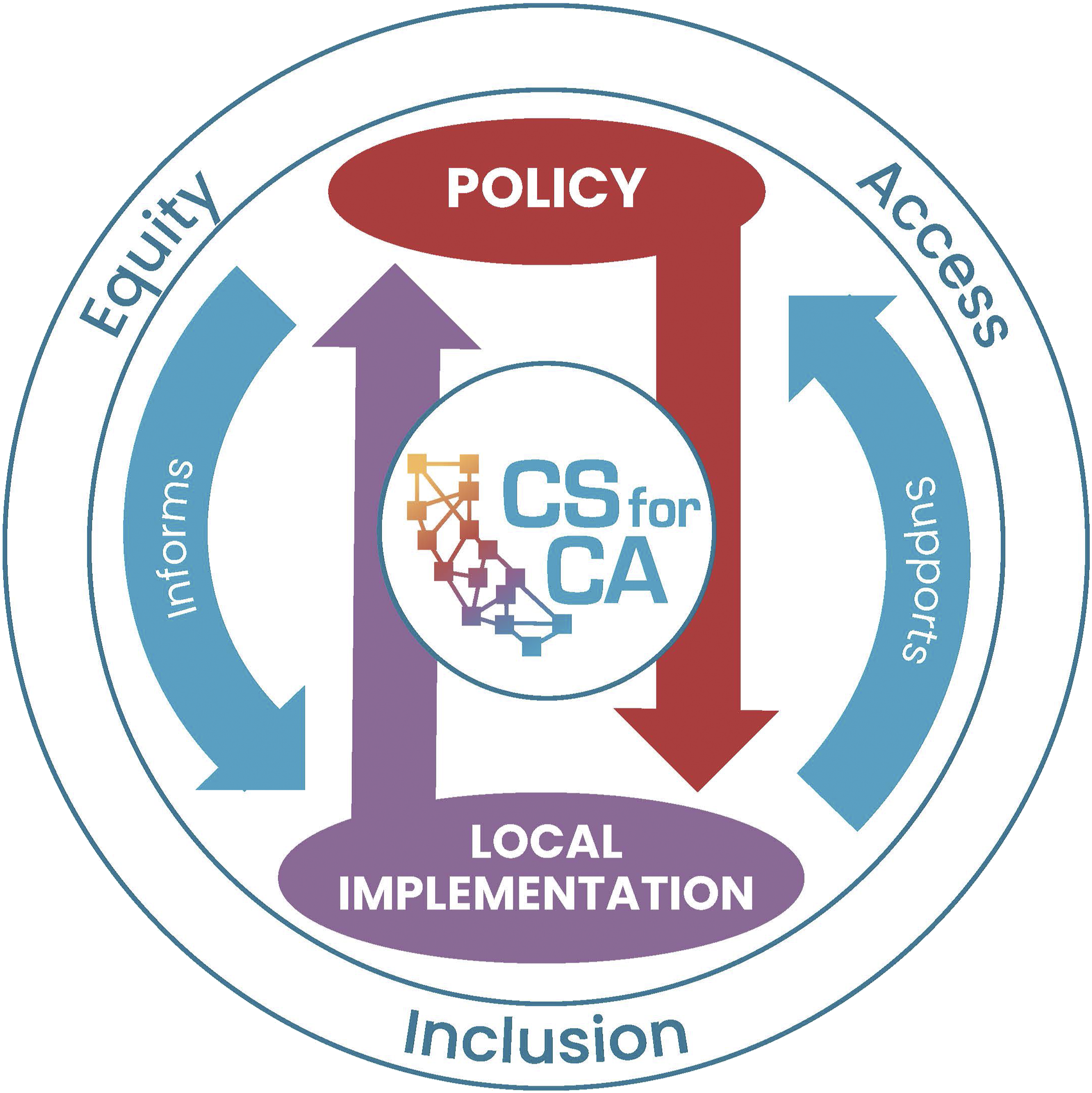
Methods
This article draws on information collected through interviews conducted between October and December 2020 to examine lessons learned from CSforCA’s policy-focused efforts. The research team identified an initial interview sample by consulting with the CSforCA co-director, who recommended individuals who were most closely engaged in discussions and actions to advance policy with the California legislature, the California Department of Education, the California State Board of Education (SBE), and the state’s systems of higher education. The team continued with a snowball sampling approach, in which members of the research team asked the interviewees for their recommendations of individuals with high levels of understanding or involvement with California CS policy developments. The final sample comprised 20 interviewees from two general categories. Ten interviewees played policymaking roles as elected or appointed officials or as members of these officials’ staffs. Ten other interviewees had actively sought to inform or influence state policy in their primary professional roles and as members of a CSforCA working group.
A member of the research team spoke to each person in the sample using a semi-structured interview protocol in conversations that were approximately 1 hour in length. Researchers established a set of a priori codes, then expanded and refined a codebook based on topics and insights that emerged during data collection (Miles and Huberman, 2020). A team of three researchers then used qualitative analysis software to code the interview transcripts according to the main topics addressed in the interviews. After co-developing the codebook, team members coded two interviews independently, and then discussed any discrepancies in coding decisions to develop interrater consistency and update the codebook. Team members met weekly throughout the coding process to resolve questions about coding decisions. By analyzing the responses associated with each code, the study team identified emerging themes, examples, and illustrative quotes to characterize the evolving CS education policy landscape in California. Some themes were consistent across interviewees. However, we recognize that the lenses through which different people view the policy process may differ based on their role in that process. In cases where perspectives were particular to one group of individuals (policymakers vs CSforCA working group members), we offer that clarification in the text.
In addition, members of the research team used interview responses to identify legislative text and other policy language as well as advocacy materials that were relevant to the policy development process. Team members collected and analyzed these materials to establish a timeline of notable policy developments and develop contextual understanding of interview respondent examples and insights.
Findings
Policy developments in California CS education
CSforCA has been a powerful force behind several major policy developments in the expansion of California’s CS education landscape. In the last decade, policy support for implementing and expanding CS education has grown noticeably. Building on a sustained and growing grassroots effort, interviewees pointed to a sequence of notable policy wins beginning in 2014 that have advanced state-level support for CS education. Figure 2 depicts a timeline of select changes that interview respondents identified as consequential. Timeline of consequential CS education policy developments in California.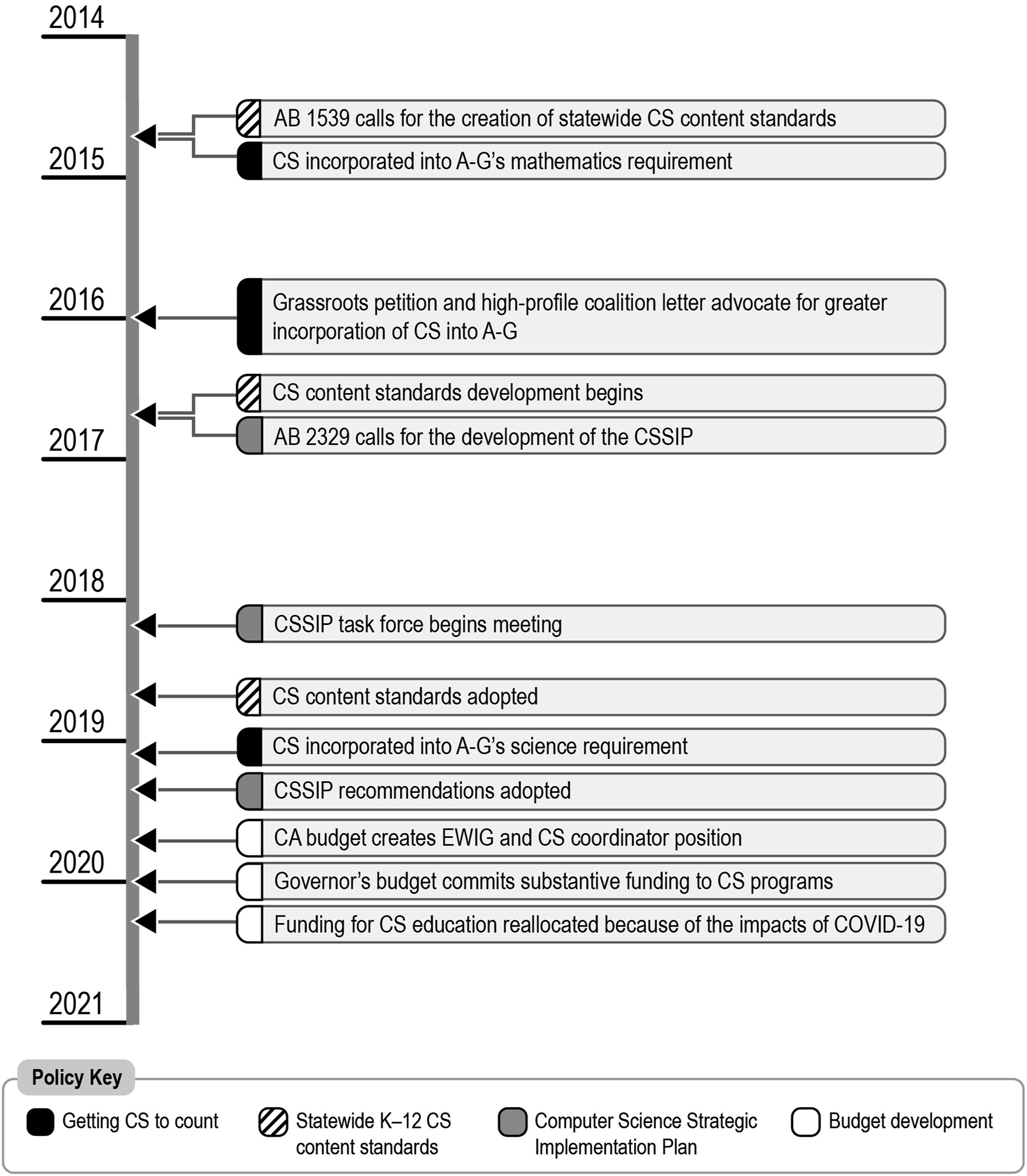
Aligning CS coursework with postsecondary admission requirement incentivizes participation in CS
The interviewees saw the incorporation of CS coursework into the mathematics and science components of the state’s A–G requirements as a major impetus for increasing involvement in and access to CS education. The A–G requirements specify the minimum expectations for coursework completion to achieve eligibility for California State University and University of California (UC) admissions; each letter represents a different subject area (A is history, B is English, C is mathematics, etc.). Historically, CS only counted toward the elective course (“G”) component of A–G. In an environment where pressures have increased for schools to prepare students for postsecondary success, the sparse attention to CS in higher education guidelines offered limited incentives for districts, schools, and students to prioritize CS coursework in schedules.
A series of policies and initiatives since 2014 has collectively contributed to what one respondent called “making computer science count” (WG3) 2 in considerations for K–12 academic progress and transitions to postsecondary education. New legislation in 2014 allowed CS to count as a third- or fourth-year mathematics course when it included extensive mathematical components, making it the first step in incorporating CS as a core academic content area (SB 1200). Following additional advocacy efforts, including an Oakland-based teacher’s petition garnering more than 18,000 signatures and a high-profile coalition letter signed by numerous policy and tech leaders, the Board of Admissions and Relations with Schools (BOARS) announced in February 2019 that it will allow CS classes meeting certain specifications to count for the lab science (“D”) component of A–G. One working group member described the incorporation of CS into the mathematics subject area requirements as “a really important development for equity, helping to create more pathways for students to meet that eligibility” (WG9). Advocates hope the change in making CS count will increase participation in and access to CS courses, particularly for young women and students of color (Johnson, 2019).
Development of statewide CS academic standards promotes a higher number of quality courses while signifying importance of the subject
Another key CS education policy initiative launched in 2014 when the California legislature called for the creation of statewide K–12 CS content standards (AB 1539). Multiple members of CSforCA served on the CS Standards Advisory Committee, which recommended a final set of standards that the SBE adopted in fall 2018. Policymakers and standards developers intended to have the standards model key CS concepts and practices for educators and, in doing so, increase the number of quality CS classes in schools across the state. In a state where content standards exist for 12 subject areas—most of them representing traditional core academic content—the incorporation of CS as one of these subjects validates it as a priority in the state’s approach to K–12 education. One policy representative suggested that this success was particularly noteworthy given the scope of the challenge involved in developing an entirely new set of standards: The adoption of computer science standards was the most important because we had never had computer science standards before. Next Generation Science Standards [were] a vast improvement over the old science standards, but at least we had science standards before. . . . The computer science standards [were] starting from scratch (P9).
Strategic implementation plan lays groundwork for future policy developments
In September 2016, progress with incorporating CS into the state’s K–12 education system continued when the legislature called for the development of a Computer Science Strategic Implementation Plan (CSSIP, AB 2329). The CSSIP was to set out strategies and recommendations for increasing access and supporting implementation of CS across the state. This bill specified that an advisory panel consisting of educators, researchers, and policymakers was to collaborate to form the CSSIP recommendations, and several CSforCA leaders were nominated by the governor and the superintendent of public of instruction. The final recommendations, adopted in 2019, included suggestions such as integrating CS into other subject coursework and providing more professional learning opportunities in CS, as well as more specific state-level recommendations, such as the creation of a CS supervisor (California Department of Education, 2019). Although the CSSIP did not directly create new policies, the plan represents an important effort to articulate and establish support for future policy objectives. One working group member described the importance of the CSSIP: “I’d say that was probably the biggest thing because it’s not just a big policy, but it sets the groundwork for future policy” (WG2).
Devotion of financial resources to CS education, though hindered by COVID-19, signals broad support
State budget allocations in 2019 and 2020 built on some of the early policy successes by devoting significant financial resources to support CS education (SB 75). These commitments symbolically affirmed the importance of CS education for the state and provided tangible resources to support it. When the legislature approved the state budget in 2019, it established the Educator Workforce Investment Grant, which created grants to support professional development in CS, in direct response to portions of the CSSIP recommendations that called for increased professional development opportunities. 3 Following another recommendation from CSSIP, the 2019–20 budget also included funding for the creation of a statewide CS coordinator—a supervisor position meant to enact the CSSIP and related education initiatives.
Building on this momentum, Governor Gavin Newsom’s initial budget proposal in January 2020 committed funding for multiple additional CS education initiatives. One participant who has engaged in CS education advocacy efforts in multiple states even noted, “When the governor put his proposal out for the. . . January 2020 budget, it was the single largest recommendation of computer science in any state that we’ve tracked” (WG5). Although many of these budget commitments were paused in 2020 because of the pressing demands of COVID-19, pandemic recovery funds and components of the state budget passed in summer 2021 reinstated the commitments and reaffirmed policy support for continued progress in CS. 4
Contributing factors to California CS policy success
In their reflections on policy-focused efforts emerging from CSforCA, the interviewees offered insights about effective approaches for influencing policy and identified several contributing factors to recent policy successes in California. Among these were support from influential stakeholders, policymaker exposure to important information, and alignment with policymaker priorities and values.
Support from influential stakeholders
Policymakers and CSforCA working group members consistently attributed policy developments in California CS education to support from key stakeholders, including champions within policymaking bodies, a coalition of support from outside, and the specific roles that leaders from practice and industry have played.
Champions for CS education
Most frequently, the interviewees pointed to the importance of having a “CS champion” in a policymaking role. When an influential policymaker is willing to take up an issue and shepherd it forward, it can significantly shape that issue’s prospects for policy success. Effective advocacy efforts, then, may be those that enlist the support of individuals who both share an interest in CS education and have the standing in policy spaces to motivate forward progress. A policymaker explained how the power dynamics operate in this situation: “It’s about your reputation, your influence, and the level of trust you have with their peers. It’s about targeting and finding that right person who has that sphere of influence” (P3).
A working group member suggested that because of the tech industry presence in the state, the California context makes it easier to find champions: There’s definitely an interest, and that grows year by year. We have no issues with staff reaching out to us asking for [help with writing] legislation. That doesn’t happen in other states. I think part of it is who these legislators are representing and who their stakeholder groups are (WG5).
The specific individuals who can serve as effective champions may vary by policymaking body and the specific policy change that advocates are targeting. For example, multiple interviewees attributed the prominence of CS education in the initial 2020 budget to the governor’s commitment and support from the SBE. “[Governor Newsom] made a pledge to computer science when he was lieutenant governor that all high schools should offer a computer science course,” one working group member explained. “It’s sort of a commitment he’s made, and I think that there is also a certain level of accountability from the community to his office” (WG5).
A broad, diverse coalition of support
Nearly all interviewees expressed the belief that having diverse perspectives represented in a broader coalition for advancing equity in CS education was instrumental to achieving policy success. Several interviewees noted that policymakers are responsive to advocacy efforts that represent a wide range of constituencies—suggesting, for example, that the incorporation of CS into the state’s A–G requirements happened in part because of a coalition letter to BOARS. In describing that letter of support, one working group member observed, “To see the nonprofit industry, K–12, universities, it’s impressive, and it holds power. And it also shows that the work is being done with or without the support of legislation at the moment, which can be very powerful” (WG6). Broad-based collective action can underscore the importance of an effort and provide political cover to policymakers who can act with the assurance that their support will not invite undue controversy or political risk.
A coalition consisting of stakeholders from multiple perspectives also enhanced the quality of the coalition itself by incorporating a range of experiences and areas of expertise—which in turn enhances its outward effectiveness. The unique perspectives, experiences, and skills that the broad range of CSforCA members bring to the table informed other coalition members. One working group member described ways in which the network “cuts across the county offices, higher ed, policy folk—all kinds of folk are represented on CSforCA. That just makes it easier for us to do things in a well-informed way” (P8).
By drawing individuals together from a range of professional roles, CSforCA features members with different areas of content expertise, relationships with key policy actors, and understanding of the systems that craft and implement CS education policy. Turning to members with the knowledge, skills, and connections appropriate to a given group action allows a group such as CSforCA to spread out the workload while maximizing the effectiveness of its actions. Because members have their own network of colleagues, peers, and other connections, outreach can happen on a broader scale and at a quicker pace. As one working group member explained, Once we get a bill introduced, because CSforCA and all of the members of CSforCA were part of the initial conversation, it’s so much easier and faster to then get them to do the things that need to happen when a bill is at risk of being lost. So that’s calling members, it is testifying before committees, it is potentially disagreeing privately but supporting something publicly (WG5).
Developing relationships with policymakers
Interviewees also highlighted the importance of CSforCA working group members developing relationships with policymakers. One policy actor referred to an informational hearing organized through CSforCA, noting that it “exposed me to all of the different organizations that were really trying to advocate for CS education. So, it actually helped me to talk to them, introduce myself, and to continue working with them as well” (P6). Another policy representative further explained the value of developing relationships with legislators’ offices to bring important issues to policymakers’ attention: “If you have a good relationship and you’ve worked on an issue before. . . [an advocate might] reach out and say, ‘Hey we’re looking at this bill idea’” (P2). This interviewee continued to describe the way in which this kind of connection operates in a symbiotic relationship: “We might reach out as well and say, ‘Hey, do you have any ideas for legislation this coming year?’ It really is that type of partnership.” Interviews with policymakers suggest that CSforCA has been effective in forging these kinds of relationships.
Input from education practitioners
Given the value that the interviewees found in a coalition that supports CS education, they yielded further insights into the value that various CSforCA participants—in particular, educators and representatives of the technology-based business community—bring to the collective policy-focused efforts.
Incorporating practitioner perspectives into coalition efforts resonated with nearly all interviewees as useful. The voice of local educators plays a key role, for example, in informing policymakers about what can be feasibly implemented in schools and districts. One policy actor observed, “The process is always smoother when you’re working directly with practitioners, especially at the front end” (P5). A working group member added, “Having that engagement and involvement allows you to say, ‘Okay, what do you need in order to implement it within the district?’ as opposed to just sort of requiring them to do it, which is very difficult in California” (WG4). Practitioners also offered compelling narratives that swayed policymaker opinions. According to one CSforCA participant, “Some of the most memorable testimony that I have heard . . . has been hearing directly from the teachers and some of the students about the impact [that] having access to computer science courses has had in their lives, in their school, in their community” (WG3).
Engagement from technology-focused industries
The interviewees also reflected on the importance of having advocates from the technology industry engaged in the policy development process. Industry voice can help articulate the connections between classroom and career in CS. One policy representative, for example, explained as follows: “It really helps us understand the future goal that we’re trying to achieve: to have more students exposed to computer science, and if that’s what they choose to have a career in, then they just have a whole range of options for careers and industry” (P6).
Other interviewees commented on the ability of the technology community to bring wider recognition to the CS education cause. “I can’t imagine that this work would have the same success if we didn’t have industry pulling,” one working group member reflected (WG6). “I think that that has been a very influential part of what’s happening in Sacramento is industry affirming just so much of what we do on a very basic level.” In addition, some interviewees believed that industry plays an important role in providing funding streams to launch and sustain CS education programs, initiatives, and policies.
Despite these positive impressions, roughly one-third of the interviewees expressed reservations about the role that industry plays in the education policy process. Although education and business communities have found an area of common interest, they still operate in response to different sets of priorities and incentive structures. Members of the education community sometimes worry about the feeling of having “strings attached” (WG10) to receiving industry support for their CS efforts, even as they depend on outside funding in the resource-constrained realm of public K–12 education. Consequently, one working group participant explained, “Sometimes it feels more economic, or industry driven, as opposed to being student focused. We absolutely need the stakeholders at the table, but I think it really needs to be balanced, and not an outsized voice” (WG9).
Exposure to evidence-based research and data
A second contributing factor to policy developments in CS education has been the ability of advocates to provide useful and actionable information to policymakers. An interviewee with a long history of developing policy in Sacramento offered this overview of the dynamics that legislators and their staffs must navigate to create responsible legislation: One of the most problematic realities of serving in a state legislature like California is your lack of access to information and the fact that you are making enormous decisions on a drip feed of information. Anyone with any sense of conscience or responsibility starts to feel very nervous at some point that you are casting votes on things you know very little about, so there is a thirst among most responsible legislators to actually understand issues so that they can feel confident and their conscience can be quelled that they are doing the right thing. . . . So the way to present the education of a legislator is really to say, “I have a solution for you. I have a solution for the families in your district, your constituency” (P3).
Interviews with policy actors suggest that CSforCA has been effective in addressing this thirst for information by educating stakeholders about the need for expanded CS education policy and offering solutions to help get there. Data and evidence about current levels of CS education access and success appear to have been especially useful in this regard.
Echoing observations about the value of CS education advocates providing useful information to policymakers, several interviewees described ways in which resources affiliated with CSforCA had played this role. One policy actor pointed to the value of illustrating problems by “starting off with that baseline of having really solid data to be like, ‘Ah, this is a problem’, because we don’t have time to work on things that aren’t a problem.” This interviewee continued to explain that it also is important “to have an idea of targeting if we know enough about the problem to understand where the solutions are, where the potential solutions, or where the breaking points are. That’s super-duper helpful.” Another policy representative described ways in which data from the Kapor Center helped in this regard: “What’s really helpful about their data is they bring in data that you can’t really find in other places” (P1). For the office in which the interviewee worked, “it was always a matter of equity for communities of color and low-income disadvantaged communities, and there wasn’t a lot of data out there that was showing the details of the disparity between these communities and other more affluent communities.”
Alignment with policymaker values: Growing the economy and enhancing equity
Another contributing factor to policy success has been the alignment between CS education and values that many California policymakers already prioritize. Chief among these are growing the economy and enhancing equity.
One compelling argument for policymakers to support CS education builds on the recognition that quality jobs are available, and preparing students for those jobs serves the state’s economy. One CSforCA member referred to a report developed by Microsoft in 2012 as an influential early push to raise the profile of CS education in California and recalled, “A big focus of [the report] was this issue on computer science education and how the current job market had a huge demand for these skills, and our education system across the US was just not meeting this demand.” (WG3) Another working group member succinctly echoed the point: “There’s just so many jobs available; it’s almost impossible to argue” (WG6).
Given the progressive nature of politics and priorities in California, some interviewees also suggested that policymakers see CS education as an opportunity to advance goals related to equity. “People care far more about equity than they care about computers,” one policy actor argued (P3). “I think it was largely an equity issue and an economic issue, and a realization that the only way to tackle this pervasive and growing issue of poverty is to equip our children more effectively.”
Discussion: Lessons learned about influencing California CS education policy
Reflections from interviewees highlighted several dynamics that will shape prospects for sustaining policy momentum: securing funding, clarifying CS and its unique role in technology, centering equity, and maintaining a strong coalition to keep equity front and center.
Funding for CS education plays a powerful role in supporting or inhibiting policy progress
Like many other developments in the policy realm, funding plays a critical role in CS education policy. New policies may call for changes but often lack the funding to implement them. For example, the statewide CS coordinator role was established through legislation, but resources have not yet been allocated to fill the position. In the area of teacher capacity, preservice training, certification programs, and in-service professional development can play an instrumental role in preparing teachers to meet student demands for CS education, but large-scale professional development and training programs are costly. For many CS policy priorities, financial investment is necessary to design, staff, and implement promising ideas.
There are reasons for hope that policymakers will allocate the funding necessary for some critical areas of CS education policy progress. Unlike other policy issues that promote partisan conflict, CS is typically a bipartisan issue supported across party lines. One policy interviewee explained, “Computer science is really interesting because Democrats, Republicans, everybody loves it” (P2). Another working group representative echoed, “Everybody’s on board; everyone’s supportive” of computer science (WG3). In addition, the commitments from the governor’s preliminary 2020 budget included funding for a statewide CS coordinator, CS professional learning, and other CS priorities. These commitments, according to one policy interviewee, allowed for “increased investment in computer science and continued progress in across policy areas that don’t happen often” (P5). The fact that the governor was willing to allocate resources for CS education suggests that the political will exists to make it a priority.
Despite these reasons for optimism, constrained resources present a formidable obstacle to CS education policy progress. Indeed, half of the interviewees pointed to funding as a barrier to new developments. When the COVID-19 pandemic forced school buildings to close in spring 2020, policymakers reallocated resources originally intended for CS professional learning and other priorities to meet more immediate basic needs. At the time when the interviews took place, continuing struggles to navigate crises that include the pandemic, statewide fires, and the prospect of an upcoming recession threatened to divert policy leaders’ priorities and funding commitments in other directions. Subsequent California budget developments in spring and summer 2021—which took place after the interviews were conducted—restored funding for many of these programs and affirmed that policy support for CS remains strong despite the substantial disruptions to K–12 education. As schools and districts continue their transitions from crisis to pandemic recovery, and as one-time relief funding begins to expire, it will be important to monitor the continuing willingness of local and state policymakers to fund CS initiatives.
COVID-19 disrupted priorities and progress for CS education and presents opportunities for progress
The COVID-19 pandemic has profoundly reshaped the education world. Although the resulting challenges are immense and will likely resonate for years, the interviewees also highlighted the opportunity to take advantage of this moment in time and make waves in CS education. For example, although the digital divide has been a long-standing barrier to equity within CS and the broader education system, the pandemic brought attention to disparities in access to devices and broadband connections and prompted educators in many communities to address a fundamental need so that students could participate in distance learning (Chandra et al., 2020). With expanded access to devices, school systems may now have a stronger starting point for students to build interest in CS. Indeed, improved connections to devices and the internet can create a foundation for further discussion about emphasizing CS in schools.
At the same time, expanded access to devices could potentially contribute to community misunderstanding of CS among educators, parents, and students who incorrectly equate the use of computers, tablets, and even phones—essentially, computer literacy—with CS. One policymaker explained the potential backlash of COVID-19 and access to devices: In the public's mind, there’s no difference between using a computer and learning about a computer. It’s all screen time, it’s all virtual. [The public doesn’t] understand that the real goal here is to equip students to understand computer science and become the designers, the programmers, the engineers, the thinkers behind this tool (P3).
This misconception may lead some stakeholders to mistakenly believe that responses to COVID-19 have appropriately addressed the gaps in access among students and communities, without recognizing the vast divide that continues to exist in students’ abilities to develop skills in computational thinking that are the bedrock of effective CS education.
As districts and schools manage their transitions back to in-person schooling, the interviewees argued for members of the CS education community to seize a rare window of opportunity for progress—indeed, to take advantage of the kind of policy window that Kingdon (2003) describes. Simultaneously advancing policy priorities with governing bodies and educating the public may be critical to ensuring that CS education priorities are at the forefront of policy developments. As one working group interviewee described the path forward, As the immediate crisis evolves into more long-term planning, ensuring that computer science education is part of that mix of policy conversations. . . And so that CS isn’t just a limited, narrow conversation about devices or hotspots, but it’s a broader conversation about the skills and the trainings and the digital access and what that means (WG3).
Centering equity
CSforCA members described a central emphasis in their education and capacity-building efforts on ensuring that opportunities for CS are fairly distributed. Nearly half of the interviewees, including a majority of working group participants, voiced the need for equity to be a continued priority in CS education and forthcoming policy developments. According to one interviewee, Equity has always been a core value of every aspect of the policy battles; . . . it’s the equitable access to computer science, whether it’s making computer science count, or giving the correct teaching credential. Whatever the policy piece is, the goal has consistently been the equitable access to computer science (WG3).
Given the persistent disparities in access to CS courses, initiatives, and programs, these interviewees argued that equity-focused policy should target marginalized and underrepresented students and communities. Interviewees drew particular attention to students from low-income families, students with disabilities, and Black and Latinx communities in California. One interviewee highlighted the need to explicitly address systemic racism as a barrier to access and success: When we think about actual solutions to increasing students’ access, like meaningfully increasing access, we have to take those hard looks at the institutional racism that exists within all of our institutions but seem to be particularly kind of profound in the STEM fields (WG9).
In the continuing effort to expand CS access for students who are historically underrepresented, policy and working group interviewees pointed to CSforCA as playing an instrumental role in elevating equitable policy considerations in CS education. By transforming grassroots activism into actionable policy activity, CSforCA can channel the voices and priorities of underserved communities in a way that Oakes and Rogers (2006) describe as too frequently missing from school improvement efforts. According to one working group interviewee, CSforCA puts equity to the heart of what they do. And I feel comfort in knowing that when I go into a meeting with CSforCA and policymakers on the other side of the table, I know that because they’re in the room, either they or I, or one of our other partners, will bring the conversation back to the importance of equity and diversity at some point in the conversation and have that be a crux of the argument (WG5).
Building and sustaining stakeholder support for equity in CS education
These findings suggest that the key roles that champions for CS education play and the relationships CSforCA members have developed with many influential policy actors, will be important for ongoing progress. Among the possible facilitators of future policy success in CS education, the interviewees identified a range of policymakers who can promote progress, including the governor, legislative leaders, SBE, and institutions of higher education.
Beyond the high-profile champions for CS, other individuals and groups in positions of influence also shape progress toward CS policy expansion, and these stakeholders also merit attention in plans for moving forward. Among these are parents and families, community organizations, and the California Teachers Association (CTA). Families and community organizations, by representing the “on-the-ground” experiences of CS education participants and beneficiaries, can play a powerful role in contextualizing problems and articulating specific needs worthy of policy intervention. From a more Sacramento-focused perspective, one working group interviewee described the influence of CTA: “The California Teachers Association is a factor in any education policy in California. . . . When they were willing to stay quiet on our policy agenda, we were able to move it forward. If they were opposed to it, that was usually a deal breaker” (WG3).
Overall, it is the maintenance of a coalition of members across these stakeholder groups as policy intermediaries or policy entrepreneurs (Mintrom, 1997; Sin, 2008) that may be most influential in sustaining CS education policy progress. A coalition comprising diverse stakeholders adds value to multiple actors in the policy process. According to one policy interviewee, a coalition is influential because the group is able to bring together all these different entities, to really push that same goal to make it all fused together. It’s going to take a lot of effort, and then, all great things I’ve noticed in policy take like decades. . . in order to come together and create a plan, create goals, and really find those next steps that need to take place (P1).
Conclusion
In less than a decade, the state of California has seen tremendous progress in state policy that promotes and facilitates the equitable expansion of CS education. This progress has been enabled by a combination of interlocking factors, including a set of policy “champions” committed to prioritizing CS, a coalition of advocates committed to collaborating and leveraging their combined strength in service of a shared goal, and a body of resources that can educate policy actors and focus their attention on concrete solutions to persistent equity and access challenges. The growth of CS in the policy landscape is encouraging and even promising, but it also is sobering: Policy is a long game that can take years to unfold, and promising developments often stall when they encounter barriers within the political system or external crises that reshape priorities and possibilities. As CSforCA continues its work moving forward, it builds on a strong foundation of relationships within the coalition and with influential policymakers. The group’s ability to navigate dynamics related to funding; to take advantage of the disruption and possibility introduced by the COVID-19 pandemic; and to maintain, strengthen, and grow a coalition of support are likely to shape its prospects for continued success in advancing the CS for all movement.
Footnotes
Declaration of conflicting interests
The author(s) declared no potential conflicts of interest with respect to the research, authorship, and/or publication of this article.
Funding
The author(s) disclosed receipt of the following financial support for the research, authorship, and/or publication of this article: This work was supported by the National Science Foundation.
