



Abstract
Recent research on Computer Science (CS) has largely found that inequities in access persist. In 2016, President Obama announced the Computer Science for All initiative, recognizing that CS is a “new” basic skill in K-12 schools and over US$4 billion was pledged to Computer Science education (CSEd) initiatives. While general support for computer science and the associated funding is currently evident, this has not always been the case. From no mention in 2001’s No Child Left Behind legislation (2002) to making the national educational agenda in 2015’s Every Student Succeeds Act (ESSA), CS has found a place in K-12 education. The current state of the CSEd agenda in the US has been greatly influenced by those who have served in industry. However, ESSA was designed to give states flexibility in creating equitable educational systems, especially for students who have been historically marginalized. Given this contrast of federal legislation and the economic motivations of industry on CSEd, we ask, why did computer science education become part of the US federal agenda, and how have business and industry “pushed” and influenced computer science education? We draw on policies, research, reports, organization websites, and professional networking sites, to better understand the national support for CSEd as well as how state-level flexibility has resulted in specific states engaging within this policy window in varying ways. We then examine one company that has “pushed” a CSEd agenda to highlight the magnitude of the impact of industry on the field of CS. We close with implications for researchers and policymakers.
Introduction
There are limitations as to who has had the opportunity to prepare to solve the world’s computing-based problems. In 2016, under President Barack Obama’s administration, a new educational initiative was unveiled entitled “Computer Science for All.” At that time, US$4 billion for states and US$100 million for school districts was pledged to expand K-12 computer science education (CSEd) across the US over 10 years. A federal focus on enhancing the computer science pipeline was a drastic shift of attention toward the computer science industry (Goode et al., 2020). Computer science K-12 education has been discussed since the 1960s (Caeli and Yadav, 2020), without significant movement in the field until recently. Although there is federal support, CSEd must be addressed at the state-level for substantive changes to be made (Goode et al., 2020). We then wonder, how did computer science become part of the federal agenda? From no mention of computer science in the No Child Left Behind (NCLB) legislation (2002) to making the national educational agenda in the 2015 Every Student Succeeds Act (ESSA), and later, significant federal financial backing, there has been a way paved for CSEd in education.
Although CSEd has been taken up explicitly in ESSA and recent federal funding (Goode et al., 2020), ultimately, each state determines how federal policies are implemented (Santo et al., 2019). The federal government provides less than 10 percent of public school funding (Hursh and Martina, 2003). Still, it yields some authority through federal legislation like the Elementary and Secondary Education Act of 1965 (ESEA), NCLB, and most recently ESSA. Each state determines its standards and various policies related to CSEd (e.g., standards, funding allocation, certification requirements, requirements for high school graduation, etc.). Code.org Advocacy Coalition has compiled a state-by-state review of computer science education policy in each of the 50 states and Washington, DC. This review is constantly updated and highlights the nine policy elements “that states can adopt to make computer science foundational for all students” (Code.org, n.d.). The nine policy ideas put forth by Code.org Advocacy Coalition are: Create a state plan; adopt standards; provide funding; require certification to teach CSEd; offer preservice incentives; have a State-level CSEd position; require HS offer CSEd; have CSEd count toward graduate requirements (e.g., as a math, Career and Technical Education, foreign language, etc.); and allow CSEd to satisfy higher education requirements. To date, 28 states in the US have adopted CSEd standards and 20 require high schools to offer courses, yet only 28 allocate funding specifically for CSEd. It should be noted that the 28 states that allocate funding to CSEd overlap with those that require courses and/or standards, but not necessarily.
Despite the federal call to action for CSEd through “Computer Science for All,” we ask, is CSEd in K-12 really for all? Although course-taking has improved with time, enrollment in said courses by historically marginalized groups in CSEd has not improved (e.g., African Americans, Native Americans, Latinos, and women; Gretter et al., 2019). Cooper et al. (2014) state that, “studies at the intersection of race, ethnicity, and gender are needed, to better understand why certain groups choose to enter and persist in computing while others do not (p. 35).” What resonates from this notion is that it is assumed that those marginalized in and from the field of CSEd actively choose not to enter the field, when CSEd is not even an option. ESSA was designed to give states flexibility in creating equitable educational systems, especially for students who have been historically marginalized (Cook-Harvey, et al., 2016). However, with each state having different graduation requirements, funding, and stakeholders, state-level decision-making may not be based on CSEd being offered to meet a public good, but rather is being guided by financially invested stakeholders.
In this study, we examine federal policies to consider the shift in the federal agenda on CSEd over time, as well as the networks (Haider-Markel, 2001) that have impacted the growth of CSEd in K-12 schools. We use policy network analysis to consider the actors who are participating in the CSEd agenda in the United States. We seek to identify actors, their associations and relationships, and understand how networks and industry have influenced CSEd both at the federal- and state-level. We draw on policies, research, reports, organization websites, and professional networking sites, to better understand the national support for CSEd as well as how state-level flexibility has resulted in specific states engaging within this policy window in varying ways. With influence comes power, and we, therefore, consider who potentially loses in regards to CSEd in our current education policy environment. In this study, we specifically ask, 1) Why did computer science education become part of the US federal agenda? and 2) How are business and industry “pushing” and influencing computer science education? Next, we review the literature on access to CS. We close with implications for researchers and policymakers.
Literature review
As business leaders warn of a critical shortage of skilled workers, there have been various calls for equitable STEM education through campaigns like ScienceForAll and CSforAll (Basile and Lopez, 2015; Ryoo et al., 2020). However, these calls for action are grounded in a need to compete in a global marketplace, rather than rectifying, overhauling, or removing the barriers from white-normed STEM field (Basile and Lopez, 2015). The persistence of marginalized persons in STEM will be dependent upon providing support systems, opportunities for networking, and educational opportunities that tightly connect the sociocultural and political contexts to both curriculum and practice (Ryoo et al., 2020; Strayhorn et al., 2013). As we explore the intentions of “for all”, we must first engage the overall access to STEM and CSEd for people from marginalized groups, as well as the current barriers within the CSEd workforce.
Although the need for laborers in the STEM workforce is rising, K-20 schooling has not sufficiently supported the needs of marginalized people in pursuing STEM fields at equitable rates (Cerf and Johnson, 2016; Strayhorn et al., 2013). Despite Black and Latinx students making up 29% of the population, they are just 9% of the science and engineering workforce. Although overall enrollment of women and marginalized students has increased in CSEd college courses, this has not translated into improved graduation rates from CSEd programs for these same populations (Cerf and Johnson, 2016). According to the 2020 State of Computer Science Education: Illuminating Disparities report (Code.org, CSTA and ECEP Alliance, 2020), states that have implemented more CSEd policies in K-12 education have a greater percentage of high schools teaching CSEd. However, policy alone does not translate to access to all students. Systemic racism contributes to the limited opportunities for marginalized students in CSEd (Code.org, CSTA and ECEP Alliance, 2020).
One indicator often used for access and participation for minoritized students is enrollment in Advanced Placement computer science courses. Of the students that participate in advanced coursework nationally, few identify as Black (6%), Native Hawaiian/Pacific Islander (0.1%), Hispanic/Latinx (17%), or Native American (0.2%). These demographics demonstrate a disparity in participation that greatly varies by state (Code.org, CSTA and ECEP Alliance, 2020). What has been found to be pivotal to access to CSEd in schools is attentiveness to policies that strategically support CSEd being prioritized at both the state and at the local-level.
Historically, the “digital divide” has marginalized Black, Hispanic/Latinx, and Indigenous children and children in low-income communities. Public schools in wealthier communities often offer courses in advanced computing knowledge (including Advanced Placement courses) to prepare for “high status knowledge careers” while less affluent and more diverse schools offer more low-skill courses (Goode, 2007; Rafalow, 2014). Variations within STEM/CTE courses, for example, differentiate between preparing students for a 4-year engineering degree or a 2-year engineering certification. These variations can have a direct impact on long-term earnings. Students of color, girls, and less affluent students are often pushed into lower-track courses, even within STEM/CTE programs (Butrymowicz et al., 2020). The life-long impact of funneling students into higher versus lower skilled computer science careers is demonstrated in average salaries. According to the US Bureau of Labor Statistics (2021), the median salary of a web developer, which requires an associate’s degree, is US$77,200, while the average salary for a Software Developer, needing a 4-year degree, is US$110,140.
How those implementing policies define equity CSEd also impacts decision-making (Santo et al., 2019). Specifically, after examining CSEd plans, implementation activities, as well as rationales for specific decisions within a five district Research-Practice Partnership (RPP), equity was found to be defined as who CSEd was for, how it was taught, as well as what was taught. Santo et al. (2019) found that the district commitments toward CSEd materialized in the curriculum and course development, professional learning opportunities, learning outcomes, and the district’s broad vision for CSEd. However, even when there are opportunities to pursue CSEd in schools, marginalized youth are not always made to feel welcome. Questions about culture and climate begin as early as high school. Goode (2007) describes a “chilly computer science classroom” where “students hold preconceived notions of who studies computer science” (p. 69). Guidance counselors can act as gatekeepers, making decisions for students about which courses they should be taking and in which academic track (Goode, 2007). Teachers’ classroom practices combined with assumptions about students’ futures based on their race and income can also affect how students are introduced to particular digital/computing topics (Rafalow, 2014). Despite increased diversification efforts over the past several years, computer science remains largely white and male. There is a need for policymakers to remove systemic barriers and a shift in normative practices currently inhibiting students from pursuing STEM (Chubin et al., 2005; Goode et al., 2020). The conceptual framing for this study, outlined next, enables us to center the role of stakeholders in guiding CSEd.
Conceptual Framework
Our study of the influence of industry on CSEd draws from an understanding that key actors influence educational policy creation and implementation (Mawhinney, 2001; Song and Miskel, 2005). DeBray-Pelot and McGuinn (2009) outline two categories necessary for an analysis of the educational policy landscape: inside (including interest groups/think tanks) and outside (including public pressure). Following the passage of NCLB and the resulting change in the landscape of educational reform, “new policies created new politics” (DeBray-Pelot and McGuinn, 2009: p. 28). Included among the “new politics” of education was increased accountability, in which business groups joined the push for educational reform, and particularly for reform in urban neighborhoods (DeBray-Pelot and McGuinn, 2009; Lipman, 2013). Berry (1977) describes several strategies used by interest groups to influence policy, including, among others, research reports, Congressional testimonies, and making presentations to governmental agencies. Private stakeholders become part of the “policy creation community” (Mahony et al., 2004). This makes an examination of elites’ influence necessary (Ball and Junemann, 2012), especially because policymakers (and those with influence) can both “push” and “pull” policy (Haider-Markel, 2001).
An issue network includes various stakeholders that have different policy preferences, levels of interest, and power and control over a particular policy issue (Young et al., 2016). Burch (2006) suggests that, following NCLB, high-stakes accountability pressures—especially for schools serving high numbers of low-income students and students of color—caused schools to turn to private entities for support. One aspect of this type of “new educational privatization” is content area programming (p. 2702). As we take into account the growth of educational privatization in conjunction with accountability pressures and the focus on workforce development, we pay particular attention to the concept of influence within the CSEd issue network.
Ball (2009) explored the “intensity and strategic engagement” of PriceWaterhouseCoopers LLP in education policy, and described its myriad relationships with local educational agencies and nonprofit organizations. In using Ball’s study as a reference, we rely on Weaver-Hightower's (2014) concept of influence, or the combination of “getting others to do what you want, power, and success” (p. 118) to shape our study. Influence “can be claimed for those whose ideas about a policy…get included in, and thus legitimized by, policy documents and their resulting interventions” (p. 118). Weaver-Hightower (2014) used this definition to identify influential stakeholders on boys’ education in Australia. His study was centered around social justice and the identification of those with and without power within that particular policy context. Although not explicitly stated, our research is similarly grounded in a critical examination of influence and power, specifically because access and diversification is an element in the push for Computer Science for All. Given their increased levels of advocacy for and influence on computer science education, business and industry could be considered among the elite stakeholders within the CSEd issue network. Thus, we focus on how the private sector is using its influence to “push” CSEd access and workforce diversification.
We are reminded that the tension between the provision of education as public good versus a private good is not new. Labaree (1997) explains that schools sit at the intersection between what society actually is—especially given economic realities—and what we imagine it could be. Social efficiency is “a public good in service to the private sector” (Labaree, 1997: p. 43), and in education, its primary goal is to prepare students for “useful economic roles” (p. 42). The Smith-Hughes Act of 1917 initiated vocational education in schools and focused primarily on agriculture. At the time and for decades later, vocational and academic instruction were kept separate.
Today, vocational education is known as Career and Technical Education (CTE), where students of all academic and ability backgrounds are connected to growing areas of industry (Dougherty and Lombardi, 2016; Jocson, 2018). As CTE has shifted and its reach expanded, so too has the private sector’s influence on vocationalism and the provision of education as a public good. Depending on the state, CSEd counts for high school credit for CTE or other academic content areas (e.g., math, science, foreign language, technology, etc.). To that end, this study uses the concept of influence within the CSEd issue network to, first, identify how computer science became part of the federal educational agenda following ESSA authorization, and second, to examine how the private sector is influencing CSEd access.
Data and Methods
Data for this qualitative study comes from publicly-available policy documents (Bowen, 2009; Merriam, 1998), including federal policy documents like No Child Left Behind Act (2002) and Every Student Succeeds Act (2015) and state-level data about CSEd policy implementation available from Code.org (n.d.-a). Sources also include data from nonprofit and business/corporation websites as well as administrative reports, press releases, and newspaper articles. These documents provide a deeper contextual understanding (DeBray-Pelot and McGuinn, 2009) of the role of interest groups in CSEd implementation.
Our data collection procedures began with creating the “initial corpus of data” (Wood et al., 2020). To supplement the federal policy documents, we conducted internet searches using combinations of various search terms, including “federal policy computer science,” “computer science equity diversity,” “industry and computer science,” “private funding computer science,” “federal support and computer science education,” and “private sector computer science education.” We focused our search from 2017-present to coincide with the authorization and early implementation of ESSA.
These searches led to over 85 newspaper articles, press releases, and organizational websites. After amassing the documents, we then conducted a “first pass document review” (Bowen, 2009) to identify relevant information. This first review helped us to highlight important names (of people and organizations) to investigate further. As we further refined the search terms and included individual and organizational names, we repeated the process of gathering data and taking a “first pass” of the subsequent documents (Wood et al., 2020).
Using deductive coding processes (Yin, 2011), we coded for themes related to computer science within the federal policy documents and for themes specific to private sector/industry involvement in computer science education in the other documents. Then, an inductive coding process (Yin, 2011) was used on the non-policy documents to find themes describing industry influence. Wood et al. (2020) note that “educated hunches” require deeper investigation. As we coded, our “hunches” were detailed in memos and tables/charts for reference (Saldaña, 2013). These hunches sometimes led to another round of data collection, in which the entire process was repeated again. We met frequently to debrief emerging findings.
Earlier, we described an issue network as including various stakeholders with different policy preferences, interests, and levels of influence. An issue network is a loosely connected policy network (Rhodes, 2006) linking stakeholders into “intricate webs of common benefit-seeking actions” (Knoke et al., 1996: p. 6). Stakeholders employ strategic learning, where network outcomes affect their participation (Marsh and Smith, 2000). Education policy has become global (Schuster et al., 2021), and we must consider how private, multi-billion dollar corporations with international offices influence educational content and policy. The themes that emerged from the deductive and inductive coding processes also suggest a network analysis.
Network analyses are often used in political science studies to explain organizational (and interorganizational) behavior and outcomes (Knoke et al., 1996). Stakeholders use networks to “build alliances and jointly promote their policy preferences” (Schuster et al., 2021: p. 215). Scholars have studied education policy networks in global and transnational contexts (Ball, 2016; Han and Ye, 2017). Policy network analyses encourage bottom-up analyses, rather than top-down, and draw attention to how stakeholders share resources (Han and Ye, 2017). Attention paid to the labor conducted by stakeholders to move policy is essential (Ball, 2016) but there is a dearth of research, however, that explores the “embeddedness” of particular stakeholders in shaping policy agendas (Schuster et al., 2021). The emerging themes pertaining to the CSEd issue network encouraged a focus on how industry stakeholders directly influence policy (behavior) and the extent to which equity and access to CSEd and related careers are broadened in an effort to provide “Computer Science for All” (outcomes).
Bias is a potential limitation to the use of documents (Bowen, 2009; Yin, 2017), as the documents under review may align with an organization’s agenda and/or policies and practices. Organizations amplify their identities through attention paid to particular values (Aust, 2004). In this sense, the documents under review in our study (including federal policy documents) serve as credible examples of organizational identities, values, and benefit-seeking actions. Given our research focus, bias is an advantage because it allows for a closer examination of agenda-setting, the scope of influence of both government and industry, relationships between stakeholders, and public commitments to equity.
Findings
Federal legislation and computer science
As previously discussed, the Computer Science for All initiative offered substantive funding to states and local districts (The White House, 2016). This initiative was announced just a month after President Obama signed the Every Student Succeeds Act (ESSA)—the most recent reauthorization of the Elementary and Secondary Education Act of 1965 (ESEA)—into legislation. Computer science was also deemed a priority through ESSA. In fact, the words “computer science” did not appear in NCLB legislation, but was mentioned nine times in ESSA in relation to being a “STEM subject.” However, ESSA was not the first time computer science education was mentioned in federal education legislation. Computer science was included in the definition of a “well-rounded” education in section 8102 of ESEA of 1965 which reads as follows, courses, activities, and programming in subjects such as English, reading, or language arts, writing, science, technology, engineering mathematics, foreign languages civics and government, economics, arts, history, geography, computer science, music, career and technical education, health, physical education, and any other subject, as determined by the State or local educational agency, with the purpose of providing all students access to an enriched curriculum and educational experience.
Therefore, a federal focus on computer science under ESSA was not new, but instead was a renewed prioritization.
Given this history, it is important to examine how CSEd is being represented in ESSA. From this analysis, there were four key noticings: 1) computer science was mentioned exclusively in conjunction with STEM, never in a stand-alone statement. In fact, computer science is presented as though it should not be forgotten when discussing STEM. According to Sec. 4107 of ESSA, CSEd is referenced in the following way, “science, technology, engineering, and math, including computer science (referred to in this section as ‘STEM subjects’)”; 2) federal funding can be utilized to contract with for profit and nonprofit organizations for professional development and supports needed for comprehensive schools to provide high quality instruction for “STEM subjects including computer science”; 3) there is attention on access to STEM subject areas for underrepresented groups in these “subject fields” through grade 12. The underrepresented groups identified in ESSA are: female, minority, English learners, children with disabilities, and economically disadvantaged students; and 4) there is encouragement to increase STEM interest through the development of STEM schools, in-school and out of school programming, as well as through arts-based education. Based on these themes, it is clear there is an intentional effort to connect CSEd to STEM given it is explicitly named throughout ESSA and only in conjunction with STEM.
In September of 2017, the Trump administration committed to STEM and computer science in a memorandum that opens with, “President Donald J. Trump is dedicated to setting American workers up for success” (The White House, 2017). The memorandum later states, “Less than half of high schools currently offer computer programming, according to Code.org,” which indicates Code.org informed the memorandum or at least interpretation of data. Although the memorandum states more can be done to support participation of marginalized populations in STEM and CSEd, the directives listed are not specific to these groups. The directives center making STEM education, “with a particular focus on Computer Science,” a priority, to “establish a goal of devoting $200 million per year in grant funds,” and to “explore administrative actions that will add or increase focus on Computer Science in existing K-12 and post-secondary programs.” In many ways, this commitment centers CSEd access for all without targeting specific resources to support the students who have been consistently marginalized. It is also clear that these “commitments” are exploratory, rather than guaranteed.
Although there is a written commitment to support accessible CSEd at the federal-level, it is essential to consider that our US Constitution legislates local control of education. Goode et al. (2020) described the commitment President Obama initiated through Computer Science for All as starting a “firestorm” (p. 163) of various CSEd initiatives. However, despite these efforts, states ultimately will operationalize CSEd programming (Goode et al., 2020). Therefore, while this federal attention has invigorated attention to CS, we must be attentive to what is specifically happening at the state-level concerning CSEd in conjunction with key stakeholders at the federal-level. By understanding who is at the table in conversation with one another, we can better understand who is “pushing” computer science education within the US at both the federal-level and the state-level.
National advocacy for CSEd
To gain an understanding of who is guiding CSEd at the federal-level, we must consider who is in a position of power and influence to directly impact K-12 schools. The person who advises the President of the United States on technology policy is the Chief Technology Officer (CTO) of the United States. The CTO serves as an assistant to the president on issues of technology, policy, and innovation to support the future of the US. In 2018, the White House Committee on STEM Education (Committee on STEM Education, 2018) released a report entitled, Charting a Course for Success: America’s Strategy for STEM Education. At that time, there was no person appointed to the CTO position. The role of CTO was vacant for 2 years after the Obama administration left office, notably following the push for CSEd nationally. We must then consider Megan Smith, the person who preceded the current CTO, Michael Kratsios, who was appointed in 2019.
Megan Smith was appointed to the role of CTO in 2014 in the Office of Science and Technology Policy. Under her leadership, the “Computer Science for All” initiative was launched and computer science was explicitly written into ESSA. It is important to understand Megan Smith’s background and the influence she held in her role as CTO given her impact on CSEd at the federal-level. Before working for the US government, Smith also served as the Vice President of New Business Development for Google. She later became the Vice President of Google[x], the advanced products team of Google. Smith has been described as an “entrepreneur, engineer, and tech evangelist” (MIT Media Lab, n. d., para. 1). A tech evangelist, according to Forbes magazine, is “a person who builds up support for a given technology, and then establishes it as a standard in the given industry” (Priestley, 2015). This position reframes the role of sales that typically centers making money, quotas, and commissions to making history, changing the world, and promoting a universal shift. From serving on the advisory board for MIT Media Lab, to being named a Reuters Digital Vision Program Fellow at Stanford from 2003–2004, Megan Smith was essential to pushing the CSEd agenda forward.
Policy advocacy is also instrumental in setting a policy agenda. There are three organizations that collaborated in releasing the 2019 State of Computer Science Education: Equity and Diversity report (State of Computer Science Education, 2019): Code.org Advocacy Coalition, Expanding Computing Education Pathways (ECEP), and Computer Science Teachers Association (CSTA). ECEP is a National Science Foundation (NSF) project first funded in 2018. The principal and co-principal investigators of ECEP are largely researchers from across the US and the executive directors of CS for All (also an NSF funded project in 2016) and the Massachusetts Green High-Performance Computing Center. CSTA was founded as a professional organization in 2004 and strives to support the instructional needs of computer science teachers (Computer Science Teachers Association, 2020). Code.org Advocacy Coalition is a branch of the Code.org organization that brings industry, nonprofits and various advocacy groups together to expand the CSEd movement.
There is a thread common to two of these organizations, CS for All and Code.org. There is a deep seed of philanthropy from computer scientists that initiates, and in some cases, drives the direction of said organizations. According to CSNYC (the former name of CS for All), Fred Wilson, a noted venture capitalist (CSforALL, 2020b) and CS for All Board Member, and current board member Evan Korth started two schools, Bronx Academy for Software Engineering and Academy for Software Engineering, prior to the launch of CS for All. They later went on to fund grants for CSEd programming in over 100 NYC public schools, eventually reaching over 10,000 middle and high school students.
Venture capitalism has also played an essential role in CSEd. Code.org was founded by entrepreneurial twins, Ali and Hadi Partovi. They have also been known to be “angel investors” and venture capitalists in Silicon Valley. Ali Partovi referenced his tech “evangelizing” on his LinkedIn page. According to Code.org (n.d.-b), the organization’s purpose is grounded in access, “Code.org® is a nonprofit dedicated to expanding access to computer science in schools and increasing participation by young women and students from other underrepresented groups. Our vision is that every student in every school has the opportunity to learn computer science as part of their core K-12 education. The leading provider of K-12 computer science curriculum in the largest school districts in the United States, Code.org also created the annual Hour of Code campaign, which has engaged more than 15% of all students in the world. Code.org is supported by generous donors including Microsoft, Facebook, Amazon, the Infosys Foundation, Google and many more.”
The goal of Code.org and other non-profit organizations should not be viewed as entirely altruistic. Although the above statement puts forward the focus of increasing the participation of women and students from underrepresented groups into coding, there has been some skepticism of code-related non-profits. Cellan-Jones (2014) noted that organizers of the Year of Code, an initiative started in the UK in 2014 encouraging people to code, had not collaborated with organizations and researchers who had long been engaged in computer science advocacy. It is also believed that various large tech organizations are backing code-related non-profits and coding initiatives given their own workforce needs (Williamson, 2016). Thus, we see that efforts to include CSEd in federal legislation were “pushed” by those in industry.
How industry “pushes” computer science into schools
The earlier section provides an understanding about how CSEd was “pushed” into federal legislation, and by whom. This “policy window,” opens for a short time (Kingdon, 1995), affording private stakeholders opportunities for action. The sections that follow examine how business and industry used this window to contribute to the CSEd “push.” In 1983, A Nation at Risk argued that “our once unchallenged preeminence in commerce, industry, science, and technological innovation is being overtaken by competitors throughout the world” (National Commission on Excellence in Education, 1983, p. 1). Since then, this ongoing narrative about international competition in the workforce (Suter and Camilli, 2019)—and specifically in STEM fields (Anderson and Kim, 2006; Suter et al., 2019)—has heightened the social efficiency model of CSEd and drawn increased attention to (diversification within) workforce development. These contextual factors are important for understanding what the industry “push” now looks like, after being legitimized by ESSA’s computer science mandate.
Findings from our analysis indicate that Lockheed Martin is one of a handful of major corporations that have influence over CSEd and related efforts to diversify the computer science workforce. Rather than focus on the “web of common benefit-seeing actions” between the major corporations, we instead explore the benefit-seeking actions of this one corporation. We then turn attention to how business and industry are able to “push” CSEd across states.
Lockheed Martin
We use Lockheed Martin—a global security and aerospace company (Lockheed Martin, n.d.)—as an example of how industry can influence education policy implementation. Lockheed Martin is best known for defense contracting and military aircrafts. The following subsections outline how this elite, private sector member of the CSEd issue network is “pushing” CSEd at the national (macro), local (meso), and individual (micro) levels.
Another example of Lockheed Martin’s national investment in K-12 computer science education is its commitment to Project Lead the Way (PLTW). PLTW (n.d.-a) uses hands-on learning to “provide transformative learning experiences for PreK-12 students and teachers across the US,” and reports having served millions of students over the past 20 years. Its program graduates are more likely to major in a STEM field in college. PLTW has a specific pathway focused on computer science, which provides students with opportunities to engage in courses that develop “knowledge and skills they will use in high school and for the rest of their lives, on any career path they take” (PLTW, n. d.-b, para. 2). Lockheed Martin has partnered with PLTW since 2007, and in 2014, committed US$6 million to support programming in urban districts. This funding includes educator professional development, software, supplies, and opportunities for Lockheed Martin engineers to volunteer in local public schools (Project Lead the Way, 2014; Project Lead the Way, 2015). Lockheed Martin was named one of PLTW’s 2017 Partners of the Year (PLTW’s 2017). Its director of community relations stated that STEM careers are not only important to the company, but are “critical to maintaining our nation’s competitive advantage” (PLTW’s 2017; para. 10).
Lockheed Martin is one of the 100-member companies of Colorado Succeeds, a nonprofit designed to connect the state’s business and government leaders with the state’s public education system. STEM education is among Colorado Succeeds’ statewide priorities, and in 2016, Lockheed Martin invested US$800,000 in STEM education for Denver Public Schools (Lockheed Martin, 2016). Colorado adopted high school computer science standards in 2018 (Code.org, n. d.-a). In a 2019 Colorado Succeeds blog post, Lockheed Martin’s director of workforce programs wrote that “our current education system was built for a past era and has not kept pace, leaving many students unprepared for today’s—let alone, the future’s—workforce demands” (Heylinger, 2019, para. 12). According to Lockheed Martin (2016), “Colorado has a need to fill its talent pipeline with skilled, technical graduates” (para. 8). Lockheed Martin’s statements and financial investments reflect an interest in school reform and improved academic outcomes.
In addition to the K-12 “push,” Lockheed Martin has postsecondary partnerships in Colorado, including a M.S. degree in Computer Science at the Colorado School of Mines specifically designed for its employees, which can be completed in 2 years of part-time study (Colorado School of Mines, n. d.). Lockheed Martin has also entered into a US$3 million partnership with the University of Colorado-Boulder’s College of Engineering and Applied Science that includes a new M.S. degree, an endowed faculty chair position, a faculty fellow position, and graduate fellowships (Poppen, 2016).
Lockheed Martin has also partnered with the Girl Scouts of America, funding a 2012 report titled Generation STEM: What Girls Say about Science, Technology, Engineering, and Math (Girl Scout Research Institute, 2012). Lockheed Martin hosted Girl Scouts Day in its Denver offices in 2019. There, girls were invited to earn a “space science” badge. Participation in the 2020 virtual event for the Girl Scouts of Colorado afforded girls the opportunity to earn the STEM Career Exploration badge. It also partnered with the National 4-H Council—a nonprofit designed to provide hands-on projects to millions of students across the country—to invest US$500,000 in computer science education. These funds were for “underserved youth” in five communities across the US, including in Colorado Springs, CO (approximately 70 miles outside of Denver) and Dallas/Ft Worth, TX (National 4-H Council, 2019). The 4-H Study of Positive Youth Development conducted annually by Tufts University between 2002 and 2010 found that high-school aged participants were twice as likely to participate in science programs, and that girls in Grade 12 were three times more likely to participate in science programs (Lerner and Lerner, 2012). As broader efforts to diversify the computer science pipeline have increased, Lockheed Martin has taken particular steps (and, noticeably, in particular locations) to participate.
In 2020, Lockheed Martin launched its Vocational Scholarship program. This program is designed for students who are pursuing careers that do not require a 4-year or advanced degree. Students are awarded up to US$6,600 per year to pursue a technical certificate or 2-year degree in a specified field of study. Up to 150 scholarships will be awarded (Lockheed Martin, n.d.). Computer science is among the top three majors for Vocational Scholars (Martin, 2020). The then-CEO, Marillyn Hewson, noted that “this program shows that our company is fully committed to preparing works at every level for the competitive challenges of the modern global economy” (Brothers, 2020). As with the STEM Scholarship, there was no student-level demographic data provided; however, regional and institutional data were not provided either.
We used Lockheed Martin as an example of a private sector stakeholder with a broad reach and significant “embeddedness” in the CSEd issue network. This “embeddedness” mirrors the description by Burch (2006) of content area programming via the “new educational privatization.” We also see how Lockheed Martin has created its own web of influence. Findings indicate that it has influenced the provision of CSEd through financial investments worth millions of dollars and via partnerships with other major corporations and state and national nonprofits. Lockheed Martin has intentionally invested money and resources into higher education institutions, school districts, and college scholarships as a means to encourage youth to consider computer science as a profession, and to subsequently consider employment with them specifically.
We further outlined how it has invested millions of dollars and numerous volunteer hours in encouraging girls, students of color, and students in urban communities to explore careers in computer science. Lockheed Martin’s broader investment in raising awareness about computer science at the macro-, meso-, and micro-levels and expanding its workforce cannot be disputed.
CSEd across state lines
Lockheed Martin serves as an example of one elite, industry stakeholder’s efforts to “push” CSEd from the federal-level to the individual student. By doing so, it has created its own smaller network. An aspect of network analysis is to examine organizational behavior and outcomes. Study findings have identified how CSEd was pushed into the federal education policy landscape. That, then, created specific opportunities for private stakeholders, like Lockheed Martin, to create webs of influence and “push” CSEd to the individual level. We close with a broader examination of how these influential private stakeholders “push” computer science across state lines, and how this aligns with K-12 CSEd implementation.
We begin with California’s Silicon Valley as a starting point. Silicon Valley—in the San Francisco Bay area—is home to large tech companies like Google, Facebook, and Apple, and is in close proximity to Palo Alto’s Stanford University. An increasingly expensive cost of living has caused technology companies to avoid Silicon Valley and look instead to Boise, ID, Portland, OR, or Salt Lake City, UT. These metropolitan areas—Boise’s “Treasure Valley,” Portland’s “Silicon Forest,” and Salt Lake City’s “Silicon Slopes”—offer employees a better quality of life (Bindley, 2020; Warren, 2019). The CEO of a smaller tech company that recently opened in Salt Lake City noted that “Utah has a great talent base with strong universities, a very driven and friendly culture, [an] accessible location, beautiful [landscapes], and a cost of living that is significantly less than cities such as [San Francisco]” (Howell, 2020, para. 4). While relocation has caused local economies to grow, unintended consequences include local residents being priced out of their own neighborhoods (Loudenbeck, 2019) and transplants moving from progressive California to more conservative Idaho and Utah (Gopal and Buhayar, 2018).
State-level implementation of K-12 computer science education.
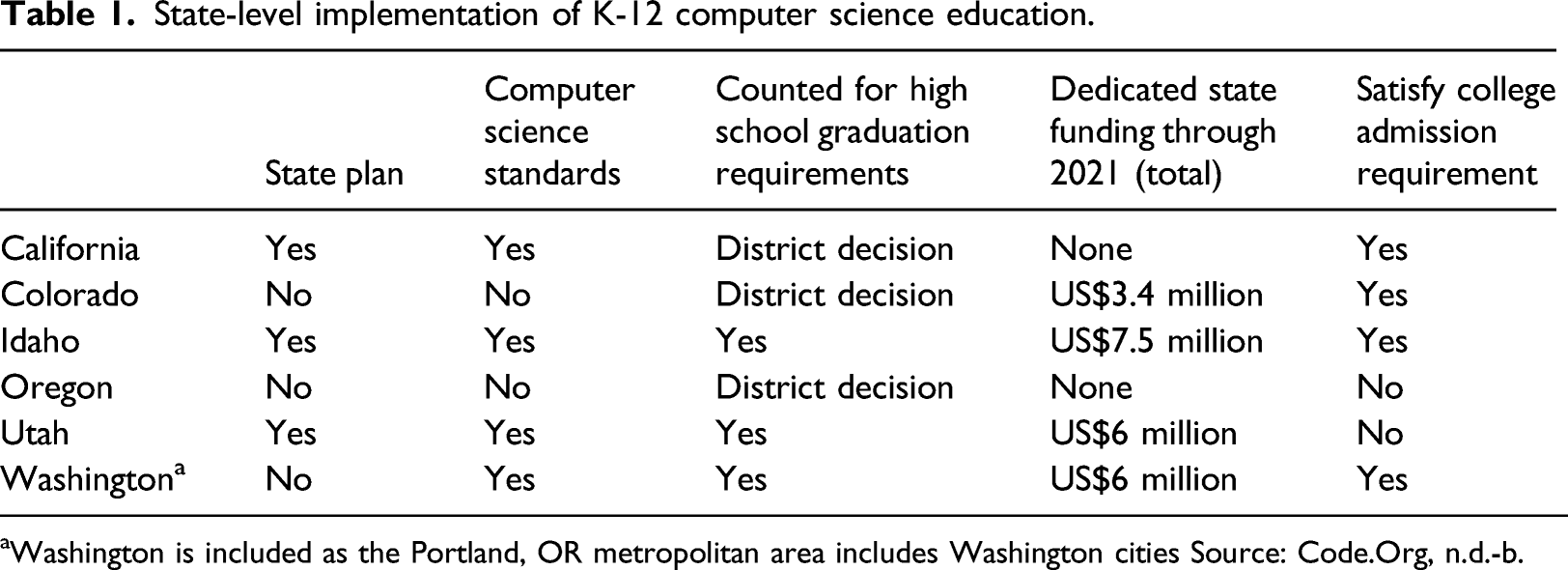
aWashington is included as the Portland, OR metropolitan area includes Washington cities Source: Code.Org, n.d.-b.
Each of the six states included in Table 1 allow for computer science to be counted toward high school graduation requirements, although California, Colorado, and Oregon leave it to a school district’s discretion. Notably, neither California nor Oregon have dedicated state-level funding to computer science education, but in California’s case, that may be in response to substantial private sector funding driven by multi-million-dollar investments by local corporations such as Google and Amazon. Oregon is the only state among the six that does not have a significant state-level policy investment in computer science education, but that may change as more technology companies relocate there and seek to build a workforce. Each of the three states with a state plan for K-12 computer science education has a stated focus on equity and inclusion: California includes culturally responsive training for educators, while Idaho and Utah include strategies to increase access for students from historically marginalized backgrounds, including girls, rural students, and low-income students. Idaho is the only state that specifically mentions increased access to computer science for students of color.
Tech corporations took advantage of the policy window created by ESSA’s inclusion of computer science education and began funding computer science initiatives across the country. Additional policy windows opened once tech companies started relocating to lower-cost states to offer employees a better quality of life. Boosts to the local economies, however, bring with them corporate questions about local talent. For example, during American Civil Liberties Union (2018) quest to find a home for its second headquarters, they examined the SAT and ACT scores of high school students in the competing cities (Stevens et al., 2018). Private sector stakeholders with infinite resources have the power and the means to influence local education policy in order to better serve their own corporate needs. While the states with a dedicated state-level plan for CSEd have plans for equity and improved access for students from disenfranchised backgrounds, it remains to be seen exactly what access and workforce diversification efforts look like over time.
Discussion
Our findings outline how elite, private sector stakeholders are influencing CSEd at the macro-, meso-, and micro-levels (Federal, State, local, and individual levels). We also see particular attention paid to Black, Hispanic/Latinx, and Indigenous students as well as those that identify as girls in CSEd becoming a policy agenda. We also see millions of dollars spent to fund programs in urban schools. As we consider the social efficiency model of education, industry influence on CSEd is particularly noteworthy. Interest-convergence, as described by Derrick Bell (1980), reminds us that the interests of people of color—and in particular, Black people—are only supported when they align with the interests of white people. Scholars (Labaree, 1997; Bowles and Gintis, 2011) have argued that educational equality cannot exist in the social efficiency model—a public good in service to the private sector—because its alignment to capitalism reproduces stratification in schools and in society. In building on the racialized foundation of interest-convergence, we suggest there simultaneously exists economic interest-convergence in the “push” for CSEd, where the interests of industry groups (private sector) align with the focus on racial and gender equity (public good) because it specifically serves the private sector bottom-line. A 2018 report by McKinsey & Company found that, around the world, companies with the most racially/ethnically diverse boards of directors were almost 50% more likely to experience increased profits (Hunt et al., 2018). Costs to replace employees that voluntarily leave tech companies top US$16 billion per year (Scott et al., 2017). Thus, tech companies are working hard to recruit and retain employees from diverse backgrounds to not only reduce costs but signal diversity and grow profits.
The 2018 McKinsey & Company report is particularly notable as many of the industry-leading technology companies based in the US have worldwide headquarters—for example, Lockheed Martin has either headquarters in or partnerships with 18 other countries. Companies with more gender diversity among their executive leadership team were more likely to see increased profits, and technology companies are overrepresented among the least gender diverse companies. Less than 20% of technology company executives are women and less than 15% are Asian, Black, or Hispanic/Latinx (Hunt et al., 2018). Lockheed Martin (2019) reports that 36% of its Board of Directors identify as women, and none identify as a person of color. Among its US leadership, 22% identify as women and 19% identify as people of color. Thus, it is perhaps a financial imperative rather than an altruistic one that drives business and industry to not only “push” CSEd into schools but to pay particular attention to racial and gender diversification within the field. This begs the question, into what culture and climate are technology companies recruiting women and people of color?
A 2017 cover story of The Atlantic asks, “Why is Silicon Valley So Awful to Women?” Participants in the story recount stories of their authority or intelligence being questioned and of fears of sexual harassment or assault. A group of women in tech created a survey—The Elephant in the Valley—or other women in tech. They received over 200 responses. Among the findings: two-thirds of women felt excluded from networking opportunities because of their gender and over 90% witnessed some sort of sexist behavior at conferences or work events (Elephant in the Valley, n. d.). Girls Who Code (GWC) was founded in 2011 with the goal of achieving gender parity in entry-level computer science jobs by 2027. Since its inception, GWC has served over 300,000 girls between grades 3–12, has 80,000 college-aged alumni, and over 8,500 clubs around the world (Girls Who Code, 2019a). Interestingly, states that have implemented computer science education policies have reduced rates of participation by girls. Thus, Girls Who Code (2019a) advocates for a gender-specific approach to computer science education that centers girls and uncovers the implicit bias in their experiences.
The focus on gender parity broadly overshadows the racial disparities that persist within gender. While women earn 21% of all doctorates in computing, less than 5% are awarded to Black, Latina, Native American/Alaskan Native, or Native Hawaiian/Pacific Islander women. Less than 1% and less than 0.5% of leadership positions in Silicon Valley technology companies are held by Latinas and Black women, respectively. A 2018 data brief by the Kapor Center for Social Impact found that less than 7% of students taking AP Computer Science were Latina, Black, or Native American/Alaskan Native girls. In citing Crenshaw (Crenshaw, 1989), the Kapor Center report notes the “double bind” faced by women of color in STEM fields, in which systemic racism and sexism further exacerbates disparities within the field (Kapor Center for Social Impact, 2018). Although industry may be making concerted efforts to diversify the computer science workforce, they must challenge themselves to dismantle systems of oppression that are reproduced as early as the high school classroom.
Black Girls CODE (BGC) (Black Girls CODE, n.d.) was launched in 2011 to address this “double bind,” and aims to train one million Black girls by 2040. Black ComputeHER (BCH) (Black ComputeHER, n.d.) was founded to support computer and technology education for Black women and girls, and joins GWC and BGC in supporting workforce development. Unfortunately, however, GWC sees far more financial and industry support than BGC or BCH. Girls Who Code (2019a) has received million dollar investments from AT&T, Walmart, and Uber, among others. While GWC does serve girls from all backgrounds, these financial investments underscore the lack of value afforded to Black girls specifically. A Black woman interviewed for the Atlantic story explained how even among women, micro- and macro-aggressions committed by white women abound (Mundy, 2017). Notably, none of the publicly available responses to the Elephant in the Valley survey address discrimination related to race, gender identity, or sexual orientation. These data further highlight the lack of attention to disparities and discrimination that lie at the intersection of race and gender, and overlooks the experiences of women of color and women from other marginalized groups in the field of computer science.
Racial disparities and discrimination clearly exist outside of gender as well. As noted, the “chilly” climate starts early and we find evidence that it is exacerbated through internship experiences. The chair of Howard University’s (a Historically Black College/University) Computer Science Department, and four undergraduates (two female and two male) were featured in a 2016 Bloomberg Businessweek cover story titled, “Why Doesn’t Silicon Valley Hire Black Coders?” In describing experiences in interviewing and interning at tech companies, one student shared that, “there are not a lot of people of color in the Valley—and that, by itself, makes it kind of unwelcoming” (Vara, 2016, para. 7). Another student believed that Google’s diversity program, Google in Residence, is “probably impacting Google’s image more than it’s impacting Google as a place” (para. 28). Simply releasing reports announcing (slightly) more workforce diversity as a result of hiring women and/or Black, Latinx, Native American/Alaskan Native, and Pacific Islander coders is not enough.
If private industry stakeholders aim to increase access to computer science, then they must do more than diversify their recruitment efforts and invest in public schools. They must “create unbiased and welcoming learning and work environments that allow Black people to be their authentic selves and learn and work without experiencing racism and bias” (Black in Computing, 2020; para. 7). Black in Computing (BIC), an organization dedicated to creating systemic change within the field of computing, released an open letter and Call to Action in June 2020 following the killing of George Floyd by Minneapolis (MN) police officers. Importantly, BIC drew attention to concerns about data science and product development/design, arguing that artificial intelligence and machine learning is being used to further marginalize communities of color: We see AI and big data being used to target the historically disadvantaged. The technologies we help create to benefit society are also disrupting Black communities through the proliferation of racial profiling. We see machine learning systems that routinely identify Black people as animals and criminals. Algorithms we develop are used by others to further intergenerational inequality by systematizing segregation into housing, lending, admissions, and hiring practices (para. 4).
An understudied aspect of private industry’s influence over CSEd policy implementation and practice are questions about the types of products these companies produce. Big Data is racially biased and discriminatory (Buolamwini and Gebru, 2018), whether in Google advertising (Sweeney, 2013) or in predictive policing (Richardson et al., 2019). This raises questions about whether Black computer scientists and others from disenfranchised backgrounds would want to contribute to algorithms that maintain oppression. While that is outside the scope of this particular study, attention must be paid to the work happening within the computer science field, not just who is employed.
Although industry is pushing for expanded access, without racial demographic data from Lockheed Martin’s STEM and Vocational scholarship programs, or the specific course curricula and student assignment policies used in classrooms in partner schools and districts, it is unclear whether access as it is currently imagined is just a replication of the “digital divide.” Further research is necessary to examine the differences in the academic and employment opportunities provided for girls and Black, Hispanic/Latinx, and Indigenous students through programs supported by private industry as compared to those for white, wealthy students. Additional research should investigate how funding investments in urban schools and districts are being spent. Finally, research should explore the alliances between the multi-billion dollar global corporations interested in promoting Computer Science for All. We suggest that industry stakeholders consider whether and how their influence on the push for “Computer Science for All” may actually be reproducing academic, postsecondary, and professional inequities.
Racialized and economic interest-convergence add particular nuance to the broader conversation about industry influence and its focus on access and workforce diversification. Relocation to lower-cost states further complicates the narrative. If California’s Silicon Valley is “unwelcoming,” how, then, might women, LGBTQ-identifying, and Black, Hispanic/Latinx, and Indigenous computer scientists feel in more conservative and less diverse places like Utah’s Silicon Slopes or Idaho’s Treasure Valley? Similar to research about the retention of educators of color in public schools across the country (Grooms et al., 2021), industry cannot assume that simply pouring money into access and workforce diversification efforts will solve persistent problems related to marginalization, disenfranchisement, and white supremacy within the classroom or the field. Although various initiatives present as well-intentioned, the ways policies are enacted may further marginalize oppressed youth (Marshall and Khalifa, 2018). Until inclusion efforts are more than performative and perfunctory, then “Computer Science for All”'' simply means computer science for profit margin and public perception.
Conclusion
This study examined the national shift toward improving access for CSEd in the United States context. In the age of ESSA, there is much state flexibility in how CSEd is being implemented in K-12 schools. CSEd has received substantive attention in both recent federal legislations, as well as at the state-level; however, there are venture capitalist and philanthropic roots that are deeply seeded in these initiatives. When we consider that the overarching goal of Computer Science for All is “to make high-quality computer science an integral part of the educational experience of all K-12 students and teachers and to support student pathways to college and career success,” it sounds inherently good. However, researchers and policymakers must consider that this goal is insufficient when the motivations and opportunities accessed overwhelmingly serve white people rather than those from marginalized groups. That, on the other side of the “pathway,” what must be considered is a STEM field that is not prepared to hire, promote, and retain women and people of color given the toxic culture commonly associated with STEM fields (Burke, 2017; Xu, 2008). As such, equity should be a stand-alone policy element outlined by Code.org to ensure intentional and sustained K-12 access for historically disenfranchised youth, rather than inclusion as part of a state plan. If equity is not its own element with specific policies and resource allocation guidelines, then how can access “for all” truly be realized?
Researchers and policy makers must also consider that unlike math, reading, and social studies and other content commonly taught in K-12 schools, computer science is an extremely lucrative business. Some work to leverage their high-ranking positions in multi-billion dollar corporations to serve and inform at the federal-level and/or through philanthropic and nonprofit organizations. An equity agenda should not be a facade for capitalistic motivations. One scholar recently wrote, “we must trust that the current social and political support of STEM is useful in promoting STEM for all” (Brown, 2019). Although “useful” considering this important policy window, we urge researchers and policymakers to be critical of efforts that are “pushing” the field of computer science education in ways that demonstrate a lack of focus on serving marginalized groups. This study demonstrates that we cannot inherently trust systems, policies, initiatives, and programs that were not designed to serve the needs of marginalized groups, but rather to maintain the status quo.
With influence comes power, and we see how said power has “pushed” its way into both the federal- and state-level politics concerning CSEd. We did not engage in how these efforts have impacted access for those who are disabled, speak a language other than English at home, or identify as LGBTQ+. We encourage additional research in these areas so we can continue to gain insights and consider other marginalized groups’ access to computer science education in our current education policy environment. We also encourage researchers to continue to critically examine the impact of industry on CSEd so that there are motivations to stay the course of “Computer Science for All.”
Footnotes
Declaration of conflicting interests
The author(s) declared no potential conflicts of interest with respect to the research, authorship, and/or publication of this article.
Funding
The author(s) received no financial support for the research, authorship, and/or publication of this article.
