



Abstract
This study examines select demographics of the American Educational Research Association (AERA) Fellows (n = 644), and whether or not the cohorts of AERA Fellows are becoming more diverse in racial and gender terms in relation to the inaugural year of Fellows in 2008. This study tests the mission statement of this exclusive program to ‘… recognize excellence in research and be inclusive of the scholarship that constitutes and enriches education research as an interdisciplinary field’. Our findings suggest that homophily – a sociological phenomenon that describes the ways in which individuals and institutions prefer sameness – is a real problem in higher education, and programs such as the AERA Fellowship are not accomplishing their mission to recognize the research of faculty of color, women faculty, and faculty in interdisciplinary fields. In contrast to the AERA Fellows mission statement, we find that the Fellowship program relies on homophilous social networks in selecting AERA Fellows and, in turn, reinforces social reproduction in higher education.
[T]he concept of cultural cloning challenges us to question and re-assess the larger package of norms, values, and practices (post)modern science and society stands for. Durable inequality is deeply embedded in the culture of cloning: values underlying modern science (reductionism), the organization of our societies (dissecting, separating and categorizing), the commodification of time, the commodification of education (standardization and cost-benefit approach), and the dehumanizing practices that go along with that...
(Philomena
Essed, 2004
: 121)
Introduction
There is widespread belief in ‘meritocracy’ in the United States (Alvarado, 2010; Douthat, 2005). In the context of US higher education, meritocracy mythically implies that it does not matter where one earned their PhD, of whom one was a protégé, or what undergraduate and/or intermediate degrees one earned before one’s terminal degree. When it comes to professors, what matters most, according to meritocratic logic, is the effort and intelligence of the professors themselves and the quality of their work (e.g., their merit as a scholar). Accordingly, professors who outwork their peers in the form of publications, fellowships, grants, etc., will be rewarded with tenure, promotion and other academic adoration befitting their merit, so the myth contends. As we explore in this study, it appears as though homophily begets homophily: scholars at institutions with the most resources (funding, course releases, etc.) for professors (and their students) get more resources and unobstructed entry into the most prestigious circle of academics – as we will argue in this study – of the prominent Fellows program instituted by the American Educational Research Association (AERA).
Founded in 1916, AERA is the leading international research organization whose central goal is to strengthen and improve upon the educational process by fostering scholarship that focuses primarily on education (American Educational Research Association, 2017). The AERA Fellows program celebrates scholars who have contributed significantly to our understanding of the educational process, and whose work has enriched the body of education research as an interdisciplinary field. AERA Fellow status is awarded to individuals for scholarly contribution, development of research opportunities, and the expectation of continual contribution to the field via research, mentorship and leadership (www.aera.net).
Our interest in the AERA Fellows program is twofold: first, the authors of this article work in the field of educational research, so the Association is familiar and relevant to their overarching programs of research. Second, given its interdisciplinary nature, the authors expect that an investigation of the AERA Fellows program can serve as a useful example for other scholars and scholarship because the phenomena they explore are likely to be present in a range of academic arenas. Thus, the AERA Fellows program serves as an interdisciplinary example, and it is the hope of the authors that the findings of this investigation will spark inquiry into both other multidisciplinary and disciplinary-specific fellowship programs.
‘What you know’ versus ‘who you know’
Networking is important in many careers, including higher education. Networking with ‘well-connected’ scholars is a powerful tool for gaining access to opportunity, influence and visibility in academia. In this article we draw on network theory literature and existing studies to make the argument that, in higher education, ‘what you know’ (an individual’s knowledge) does not change your professional circumstances (e.g., meritocractic mobility) so much as ‘who you know’ (e.g. who your advisor was, or where you attended graduate school). In academia, who you know matters equally, at least, to how much you know, at least in terms of invitations to write, nominations for awards, and consultations (e.g., speaking engagements) – which expand an individual scholar’s visibility – and in turn they continue to attract more writing invitations, award nominations, and consultations. Social closure marginalizes some professors, preventing them from obtaining opportunities that are secured by others due to their positions of privilege (Swartz, 2008; Twine and Gardener, 2013).
For instance, Clauset et al. found that institutional prestige hierarchies shape ‘faculty hiring across academe, both for institutions and for individuals seeking faculty positions’ (Clauset et al, 2015: 4–5). One consequence of prestige hierarchies is that the majority of professors who are hired first during each season of hiring come from the most elite graduate schools, leaving few positions to be filled by those from less elite schools. In fact, Warner and Clauset (2015) pointed out that ‘after graduating with PhDs, only about 10 percent of faculty move “up” the academic prestige hierarchy’ (Warner and Clauset, 2015: para. 6). When applicants from perceived lower-status schools apply for faculty positions at higher prestige insitutions, seldom do they receive the consideration for their merit that someone at a school equal to or higher than that institution would get. The finding that mobility is somewhat fixed de-legitimizes meritocratic logic since elitism through institutional affiliation, not effort, shapes hiring: hardworking professors, by and large, are unable to work at institutions of higher learning that are socially more prestigious than where they earned their terminal degrees, because of invisible networks.
Warner and Clauset’s (2015) statistics and existing research on prestige hierarchies provide a rival explanation to meritocratic faculty hiring. As Hartlep (2013) has written on the American Educational Research Association’s (AERA) website, ‘the narrative of meritocracy has a dark side. It implies that a person who does not succeed must lack ambition; conversely, that anyone who is successful must have gotten there solely on her or his own’ (Hartlep, 2013: para. 4). Brown (1997) asserted that merit is the sum of both ability and effort against the assumption of equal opportunity. As such, variance between two individuals’ achievements is the sum of effort carried out on an even playing field. The individual with less achievement can, therefore, blame only themself since meritocracy presumes equal opportunity. ‘Meritocratic justification’, therefore, becomes the metric and means of justifying inequalities (Darder, 2012: 417). This raises the question: Do professors progress on their own merit or does their professional progress come from ‘who they know’ and who helps them? Social networks – alumni, friends, colleagues, and peers – serve as conduits to knowledge, influence, and opportunities, to be sure. But are there more insidious ways that ‘who you know’ guarantees preferential treatment from privileged academics (and associations) who have the power to make decisions on hiring, promotion, and fellowships? We believe so. Homophily is a sociological phenomenon described as the ways in which individuals and institutions prefer sameness; what Essed (2004) in the epigraph above was referring to when she wrote that higher education contributes to cultural cloning.
A pipeline of opportunities and knowledge (for some)
Where one earns a PhD constitutes a gatekeeping pipeline that provides its graduates with information and access. Those who graduate from elite ‘Research I’ universities usually gain the most access to high-paying, secure faculty jobs (Clauset et al., 2015). The reality – that alumni are sorted and placed in a hierarchy in terms of the institution from which they graduated, which in turn affects the institution(s) where they are most likely to be hired – is evidence that meritocracy is a myth (Clauset et al., 2015). Qualitative research has described this reality in detail. Higdon (2013) detailed his personal experience facing the hierarchy of academic pedigree in legal education. According to Higdon (2013), the path to becoming a law professor was mostly determined by the law school from which a professor graduates. Higdon pointed out that having an academic pedigree from an elite institution is ‘less a statement of individual accomplishment and more a reflection of circumstance that placed that person in a position to achieve that academic pedigree’ (Higdon, 2013: 198). Consequently, opportunities and experiences beget future opportunities and outcomes; homophily drives the flow of this pipeline. Opportunities and knowledge flow through the actors who inhabit pipelines and networks. Indeed, professors, program officers, editors and students selectively share their knowledge, which leads to homophily in network ties, which affects group membership. This phenomenon is seen in research which has found that collaborative research participants tend to follow same-gender lines (McDowell and Smith, 1992). In other words, men tend to write and collaborate with other men, while women do the same. This is damaging, because it leads to inequity for women, such as gender gaps in citations (see, for example, Voeten, 2013). As mentioned earlier, homophily is a sociological term that simply means a ‘love for the same’ (McPherson et al., 2001). Love of the same leads to ‘cloning’ or sameness (Essed, 2004), whether real or perceived.
Members of groups are affected by real and perceived sameness in myriad ways. Consider the process of nominating faculty for awards and hiring decisions. Who nominates whom, and why? Who is hired and why? Mental shortcuts such as, ‘Oh, I know her advisor’ may implicitly influence the hiring process and search committee work. It is not difficult to imagine this, especially when considering existing research on how inequality is socially reproduced in higher education (e.g., see Bastedo and Jaquette, 2011; Bidwell, 2013; Carnevale and Strohl, 2013; Goldin, 2015; Piketty, 2014; Triventi, 2013).
This research demonstrates that individuals are affected by the institutions and organizations in which they are employed. Once an organization is homophilous it is difficult to change. As Higdon observed: Now, is it surprising that those who went to the best law schools would be the most successful at obtaining employment in the legal academy? No, of course not. In many ways it makes sense that those who have the academic credentials to get into the top law schools would also be the most qualified to teach law to future generations. That’s not the problem. Rather, the problem comes from the fact that, in practice, it is not that those applicants who possess law school degrees from elite schools beat out the applicants from non-elite schools because the former end up having the best credentials. Were that the case, we would need to assume that hiring committees are actively looking at candidates who graduated from elite and non-elite schools. Overall, that is not the case. Instead, the only candidates law schools really even look at are those who graduated from an elite law school – thus, academic pedigree is the most meaningful credential one can possess and, without the proper pedigree, all else is largely irrelevant. (Higdon, 2013: 179, original emphasis)
Purpose of the present research
The present study examines the pipeline from post-secondary education to American Educational Research Association (AERA) Fellow status. Specifically, the investigation examines the path to becoming an AERA Fellow. The AERA Fellows program serves as an interdisciplinary example of a program that celebrates the academic achievements of its members. We expect that patterns uncovered through the present investigation may be found in other, more discipline-specific, fellowship programs.
We raised the following questions about the descriptive statistics of AERA Fellows.
At what institutions (elite status, Carnegie Classification) did an AERA Fellow complete their formal higher education (degrees) and in what fields? Is an AERA Fellow a member of the National Academy of Education? Does an AERA Fellow have an EDU Scholar Ranking? If yes, what is it and how does it compare to other AERA Fellows? [P]ublished scholarship has been the common currency of academic achievement. All of the official and unofficial perquisites of academe flow from scholarship and publication: tenure, endowed chairs, merit raises, reduced teaching loads, distinguished lectureships, summer and semester research grants, election to learned societies, appointment to editorial boards, faculty awards, fewer or more powerful committee assignments, honorary degrees, and mobility. (Axtell, 1997: 8) AERA Fellows by year Note: BC = Baccalaureate Colleges: Arts and Sciences Focus. RU/H = Doctoral Universities: Higher Research Activity. RU/VH = Doctoral Universities: Higher Research Activity. RU/L = Doctoral Universities: Limited Research Activity. M/L = Master's Colleges and Universities: Larger Programs. M/M = Master's Colleges & Universities: Medium Programs. MED = Special Focus Four-Year: Medical Schools and Centers. OHP = Four-Year: Other Health Professions Schools. NONAC = Holds a non-University position. NONUS = Holds a position at a non-US university.
Not surprisingly, AERA is a research-focused association, so it places a high value on research. The valuing of research relates to power in US higher education. For example, Axtell wrote the following: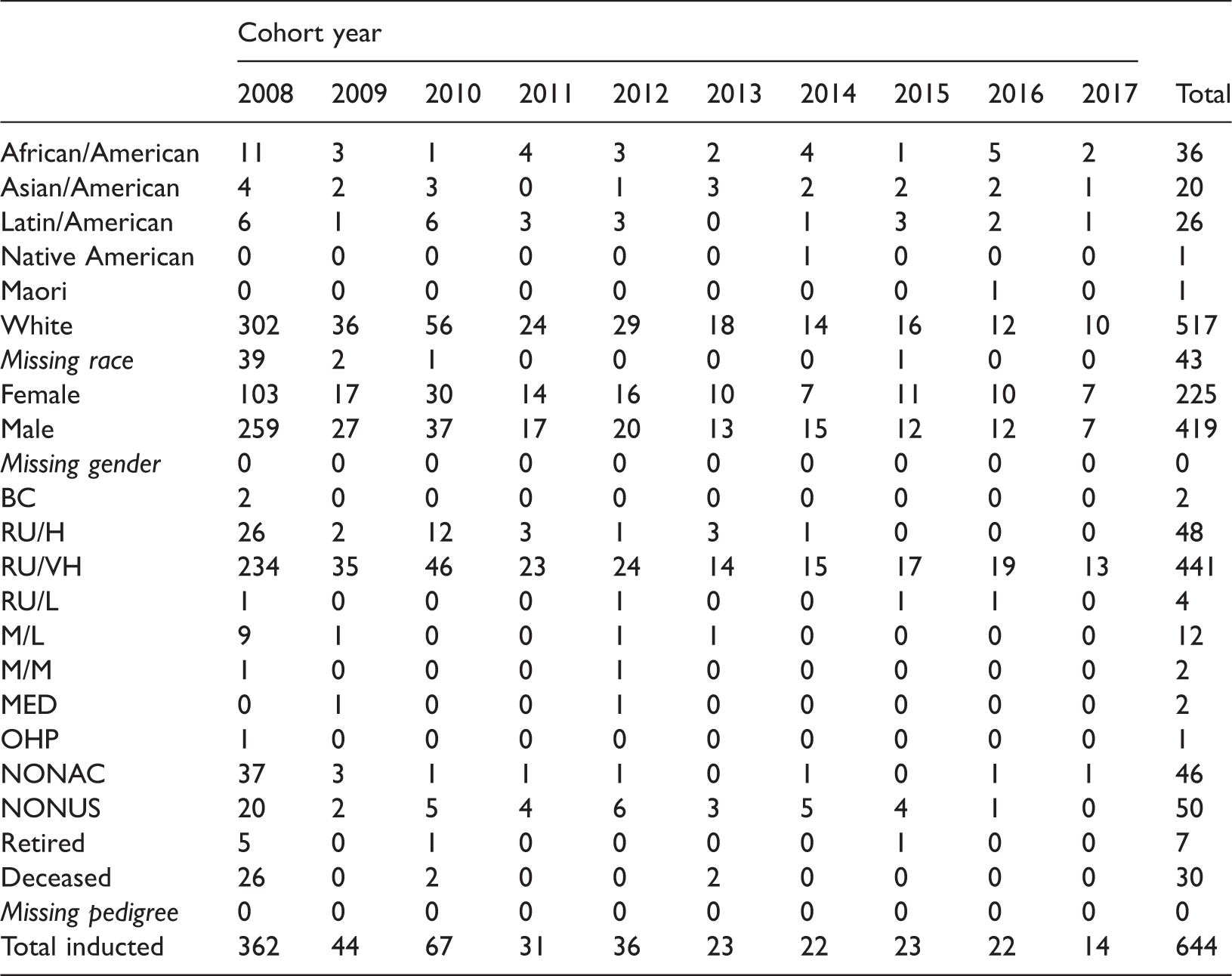
Background and relevant prior research
Based on a review of prior research (e.g., see Hartlep, 2016; Hartlep et al., 2016; Leathwood, 2004) we hypothesized that Whites, males and individuals with elite pedigrees and institutional affiliations would be more represented in the ranks of AERA Fellows. In the sections below we identify the phenomena of social reproduction and institutional and individual ‘cloning’ as they relate to homophilous networks of race, gender and institutional pedigree. Social reproduction theory has been used to analyze how higher education reproduces existing inequities for students (Armstrong and Hamilton, 2013; Stuber, 2011) and for faculty (Messner, 2000); consequently, it is a valuable theoretical tool in this investigation because it provides rival explanations for why systems-level change is difficult. For instance, Essed pointed out that ‘newcomers into power elites survive by demonstrating conformity and loyalty to those who dominate American and European institutions – straight White males’ (Essed, 2004: 114). The consequence of conformity is that real change is an impossibility when scholars become elite sycophants and social closure leads to elitism and exclusion.
Social reproduction and institutional and individual ‘cloning’
Essed (2004) described the phenomenon of ‘cloning’ within academe. She introduced the term ‘cultural clones’, and operationalized it as follows: ‘[A]cademic glass ceilings are maintained through preference for … cultural clones: look-alikes representing more of the same images and values’ (Essed, 2004: 114). According to Essed, clones need not be identical to current or existing members of the academy; they must just be similar enough so as not to attract attention for their difference. Granted, positions of power in higher education (and other institutions) have become more diverse in the decades since the Civil Rights Movements of the 1960s. However, this turn toward inclusion cannot be equated to full equal opportunity for all (Essed, 2004). Because institutions of higher learning themselves have historical identities, the individuals who are employed by them perpetuate these status markers with their professional behaviors. If the Harvards and the Yales graduated doctoral students who would not go and work at other elite/Ivy League institutions, their ‘brand’ and ‘reputation’ would be jeopardized. Consequently, the dynamic of institutions of higher education and the individual professors who work for them leads to a ‘cloning’ of both the university and teacher. The cycle is virtuous and self-perpetuating. Research by Blackburn et al., found that ‘those who are regarded as most successful are those who replicate the mentor’s experience. They are, in essence, the mentor’s “clones”’ (Blackburn et al., 1981: 320). The cloning of individuals is logical. Blackburn et al. contended the following: The preferred treatment of, and attention to, protégés who follow the career paths of their mentors may serve, at some level, to justify the mentors’ own career decisions. On the other hand, from the mentor’s point of view, placement of protégés at research universities seems to be a necessary condition for maintaining a network of influence at that type of university. Additionally, successful placement of protégés at highly rated universities would yield colleagues who operate within a similar value system (e.g., importance of research) and who are apt to be more interested and available as coauthors. (Blackburn et al., 1981: 326)
Race
The social construction of race has a long and problematic history in the United States. Race has been used to segregate societal institutions, including higher education. Segregation of formal schooling at all levels (P–20) has caused an unequal opportunity contest whereby Whites have been advantaged (see African American Policy Forum’s video).
1
As Wright (2009) stated: In order for certain jobs to confer high income and special advantages, it is important for their incumbents to have various means of excluding others from access to them. This is also sometimes referred to as a process of social closure, in which access to a position becomes restricted. One way of doing this is by creating requirements that are very costly for people to fulfill. Educational credentials often have this character: high levels of schooling generate high income in part because there are significant restrictions on the supply of highly educated people. Admissions procedures, tuition costs, risk-aversion to large loans by low-income people, and so on, all tend to block access to higher education, to the benefit of those in jobs that require such qualifications. (Wright, 2009: 104)
Gender
In 1962 the American Geophysical Union (AGU) established a Fellows Program. Druffel (1994) found that women, when compared to men, were underrepresented as AGU Fellows. She made five recommendations for correcting this gender imbalance: (1) nominate more women; (2) use genderless language (e.g., ‘chair’ as opposed to ‘chairman’); (3) promote and prioritize gender equity along with other forms of equity such as racial equity as a society; (4) ask why gender and racial imbalances exist; and (5) provide mentorship for underrepresented fellow groups.
In addition to receiving fellow status, gender homophily has been shown to have an impact on the likelihood of women graduating with their doctorate (Main, 2014; Zeltzer, 2016). As a case in point, Main (2014) found that gender homophily, or same-gender mentorship, is associated with higher graduation probabilities for women doctoral students.
Institutional pedigree
There is a host of factors that come into play when it comes to the graduate school to which students apply, and ultimately attend. An important consideration of many prospective students is the value a college or university provides its graduates, and one variable that graduates may take into consideration is the job placement rate. Prospective doctoral students who aspire to be professors may apply to the most prestigious universities because they stand to benefit from this prestige when they graduate. As Cook and Frank stated, ‘A degree from an elite college long has helped graduates gain high-status jobs – and the payoff of those jobs has grown sharply’ (Cook and Frank, 2006: para. 7). However, doctoral programs at elite institutions, when applications are being reviewed, are not immune to the racial and gender homophily described in the above sections. For instance, in her book Pedigree: How Elite Students Get Elite Jobs, Lauren Rivera laments, Economic inequalities that occur long before job offers are made help explain how elite kids come to have elite jobs. In prior eras, elite reproduction in the United States commonly took the form of parents handing the reins of companies or family fortunes to their adult children. Today, the transmission of economic privilege from one generation to the next tends to be indirect. It operates largely through the educational system. (Rivera, 2015: 3)
Research design
Sample and analytical technique
The population of interest for this study comprised individuals who held the status of being an AERA Fellow. We identified this population in two ways: (1) a list of current AERA Fellows was published in Educational Researcher (see AERA Inaugural Fellows, 2008); and (2) the AERA website lists all AERA Fellows as of 21 February 2017. 2 The names of the AERA Fellows, their institutions, and the years they were inducted, were added to a Google spreadsheet. Similar to previous research which used network analysis in academe (see DiRamio et al., 2009; Hartlep et al., 2016), we used curriculum vitaes to cross-check and supplement the data we found above. We recorded the Fellow’s degree(s), the year they were conferred, and in what field, as well as the Fellow’s institution. The 2015 Basic Carnegie Classification of the current institution was recorded, as were any degree(s) awarded to each Fellow. 3 The 2015 classification makes use of the most recent available data from the source federal agencies (National Center for Education Statistics and National Center for Science and Engineering Statistics) and non-profit agency (The College Board). The 2015 ‘Basic’ Classifications are as follows for Research Universities: Doctoral Universities: Highest Research Activity; Doctoral Universities: Higher Research Activity; and Doctoral Universities: Limited Research Activity. In the event the Fellow earned or worked at a university that was outside of the United States, it was coded as such. This was the case for 7.8% (n = 50) of AERA Fellows. This research asked the following (below) 10 research questions (RQs) and made the following (below) 10 hypotheses (Hs).
Once the AERA Fellows were identified and relevant information entered into the Google spreadsheet, it was downloaded and cleaned in Microsoft Excel. Once cleaned and coded, all descriptive and inferential statistics were generated in R (R Development Core Team, 2016). Because the statistics in this study were primarily descriptive or simple group comparisons, cases with missing data were only excluded from the specific comparisons or descriptions involving those missing items. In the following sections, statistical analysis is offered against each research question (RQ). To assess significance, goodness-of-fit chi-square tests were run assuming a proportional population in order to most adequately address the research questions. After responding to each of the RQs, we present implications as well as limitations and future research possibilities.
Research questions and hypotheses
Results
As was hypothesized, Whites make up the largest portion, 80.3%, of AERA Fellows, followed by Unknown, 6.7%, African/Americans, 5.6%, Latin Americans, 4.0%, Asian/Americans, 3.1%, Native Americans 0.2%, and Maori 0.2%. Similarly, men comprise 65.1% of the known population.
AERA Fellows received their terminal degrees largely from universities classified as Doctoral Universities: Highest Research Activity. The sole Native American AERA Fellow received her terminal degree from this type of university followed by African/Americans with 83.3%, Latin/Americans with 80.8%, Whites with 74.1%, Asian/Americans with 70.0% and the Maori Fellow receiving his terminal degree from a non-US university. Combining the Doctoral Universities: Highest Research Activity category with the Doctoral Universities: Higher Research Activity category, 92.3% of Latin/Americans received their degrees from these universities. in addition, 86.1% of African/Americans also received their degrees from these universities, with Whites at 78.0% and Asian/Americans at 75%. This is consistent with the studies cited above. If you do not attend a university in the categories Doctoral Universities: Highest Research Activity or Doctoral Universities: Higher Research Activity you are unlikely to get a faculty position at a university in these same categories. If you do not get a faculty position at a Doctoral Universities: Highest Research Activity or Doctoral Universities: Higher Research Activity university, you are unlikely to get the support (both academic and social network) necessary to produce the research that will ultimately get you invited to be an AERA Fellow.
To assess whether or not the body of AERA Fellows was becoming more diverse over time we analyzed how each new cohort altered the overall diversity of the AERA Fellows. We analyzed dichotomized race, gender and institutional pedigree proportions using a series of 2 x 2 contingency tables. We were then able to compare the composition of the Fellows after the addition of each new cohort to the original composition of the Fellows.
Diversity composition comparison to 2008 cohort by year
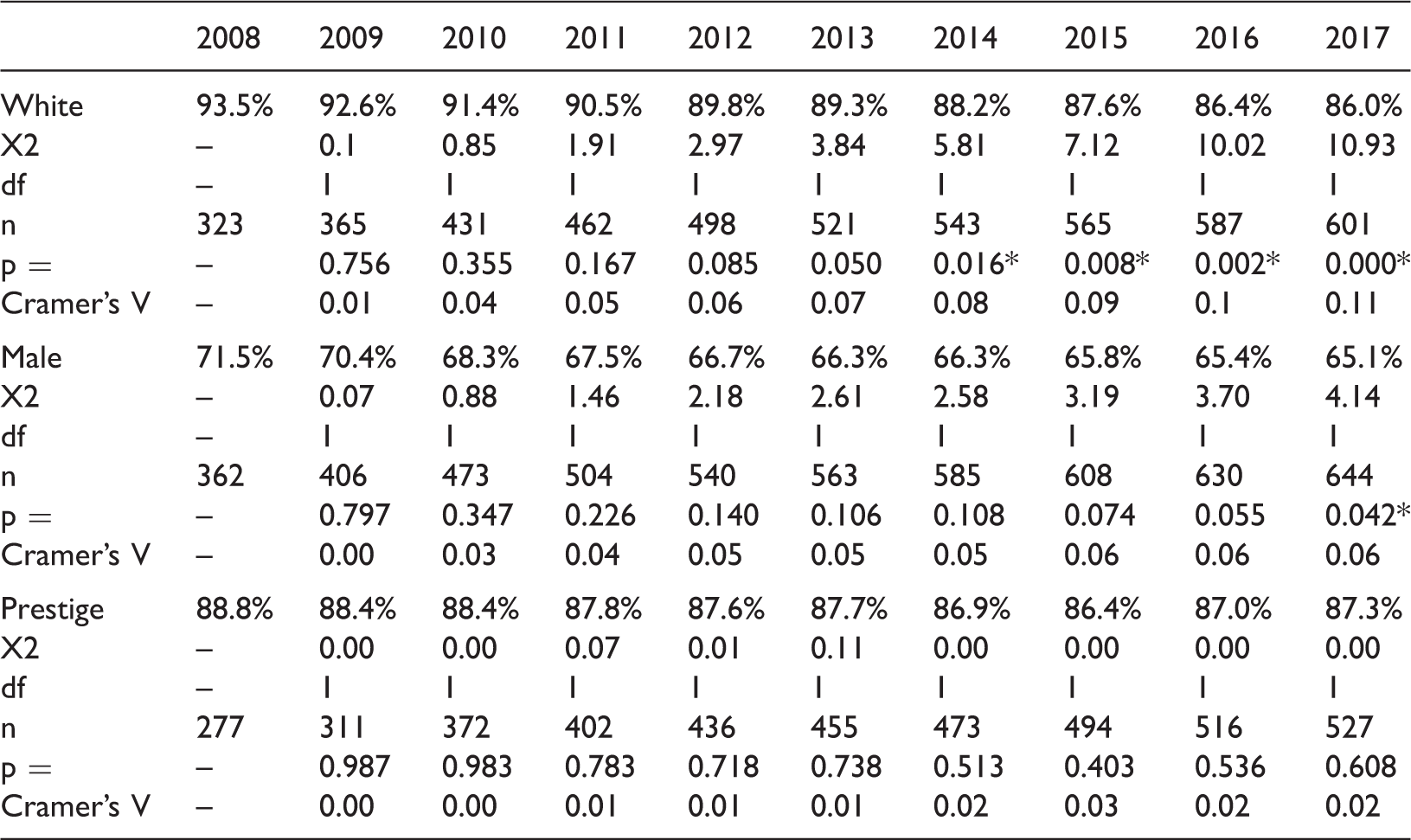
Note: n = sample size which varied between race, gender, and prestige due to missing data. Prestige is Doctoral Universities: Highest Research Activity percentage. * indicates statistical significance, p-value < 0.05.
In terms of racial diversity, the post-2008 cohorts are more diverse than 2008 (see Figure 1). Regarding race, our hypothesis was therefore confirmed, further validating the tenets of social network theory (e.g., homophily; see Borgatti et al., 2013). While Whites comprised the majority of Fellows since the Fellowship’s inception in 2008, racial diversity has slowly increased over the years.
Racial/ethnic diversity by cohort.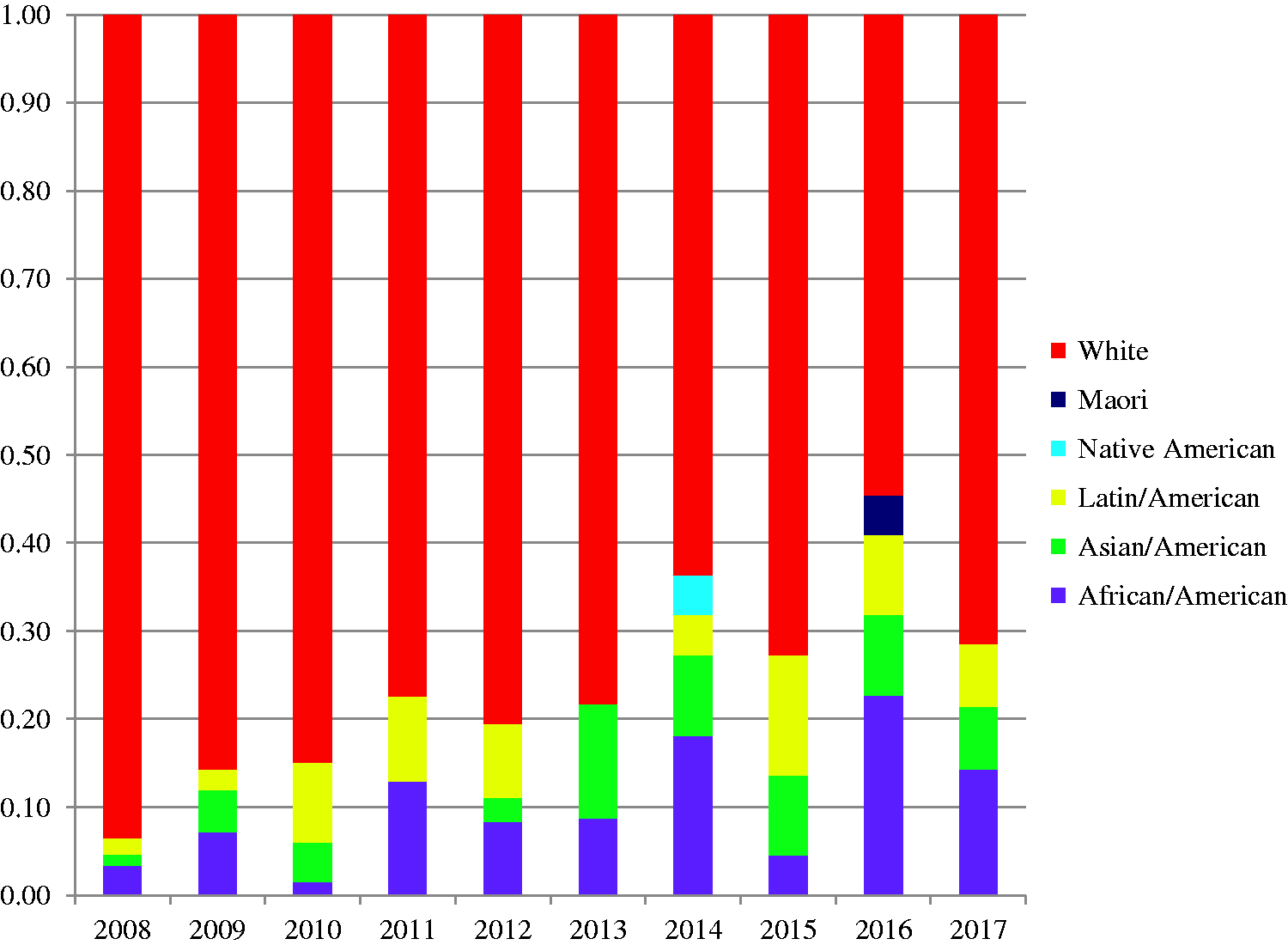
For gender diversity, we compared the proportion of male to non-male fellows. As with racial diversity, we found that gender diversity has significantly increased over time. The 2017 body of AERA Fellows was significantly more diverse than the initial 2008 cohort, X2 (1) = 4.14 p = 0.042, V = 0.06. Practical significance was never higher than V = 0.06 which is considered very small. The overall proportion of Males within the Fellows decreased from 0.72 in 2008 to 0.65 in 2017 (see Figure 2) which was statistically significant (see Table 2). Regarding gender, we confirmed our hypothesis that gender diversity increased over time.
Gender diversity by cohort.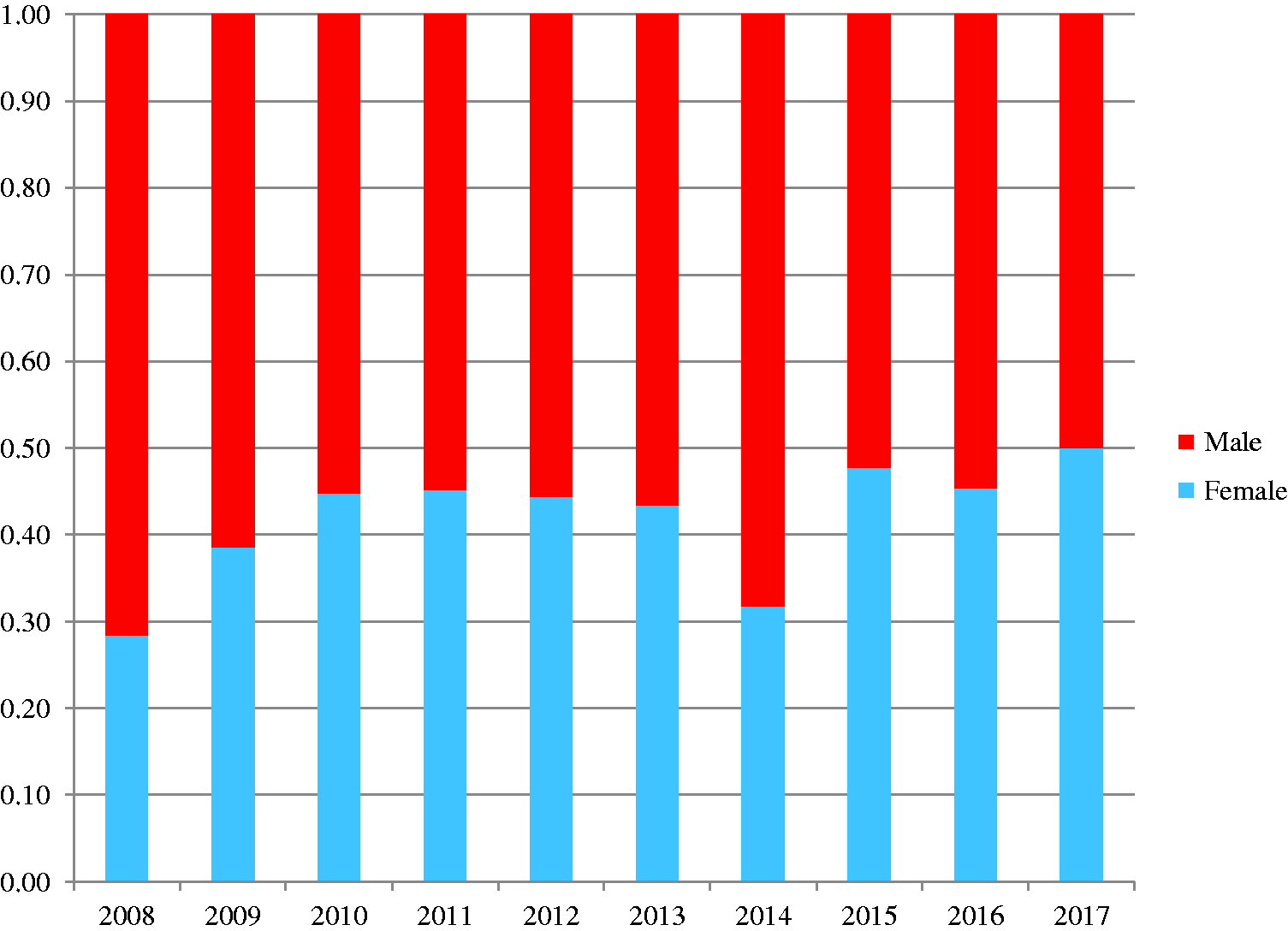
In terms of institutional pedigree, we compared the proportion of Fellows receiving terminal degrees from universities classified as Doctoral Universities: Highest Research Activity, to those receiving their degrees from universities classified otherwise. There was no statistical or practical difference in the composition of the AERA Fellows at any point (see Table 2): 88.8% of the initial 2008 cohort of new fellows came from Doctoral Universities: Highest Research Activity class (see Figure 3); and by 2015 this had dropped to 86.4%, before rising to 87.3% with the 2017 cohort. While it lies outside the scope of the present research, we wondered if assumptions are also made about the type and quantity of research that is associated with Doctoral Universities: Highest Research Activity as compared to other, ‘less prestigious’ universities. That is, if you are at a Doctoral Universities: Highest Research Activity, not only is your research perceived to be ‘rigorous’ but it is also perceived somehow to be more valid – and, as such, lending oneself to being nominated for this AERA Fellowship. Prestige comes from what a culture privileges, and the culture of AERA privileges research pedigree above all else.
Carnegie classification diversity by cohort.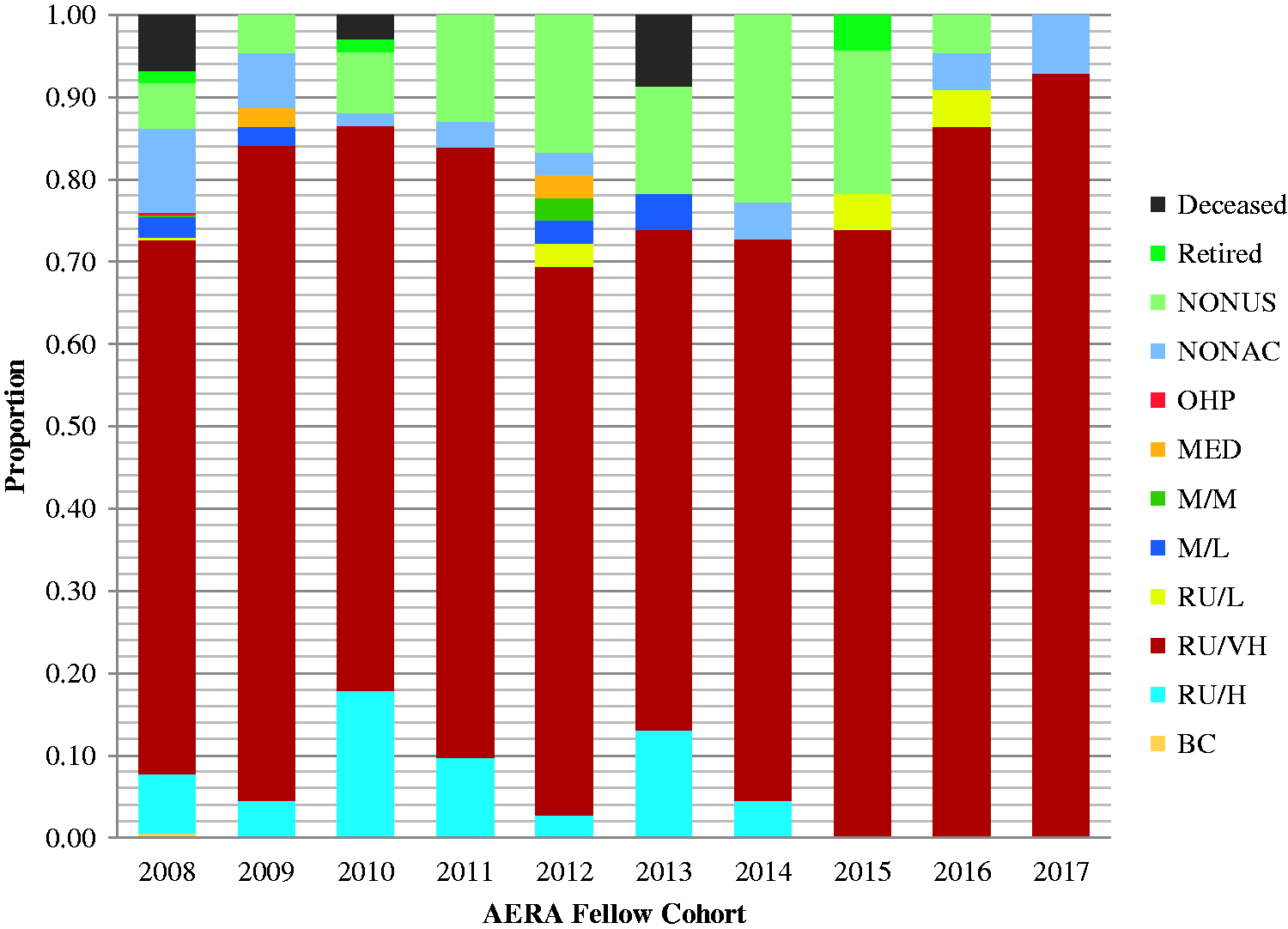
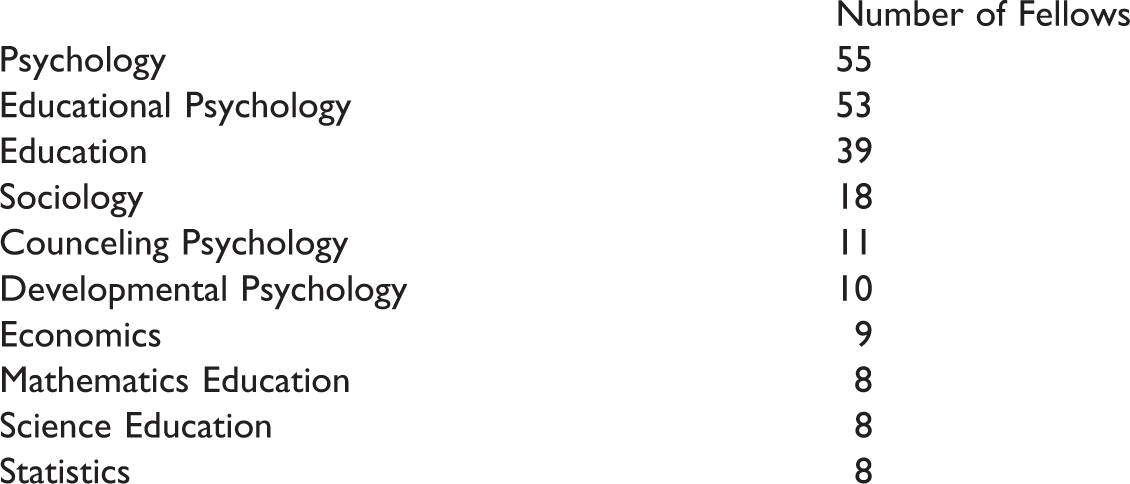
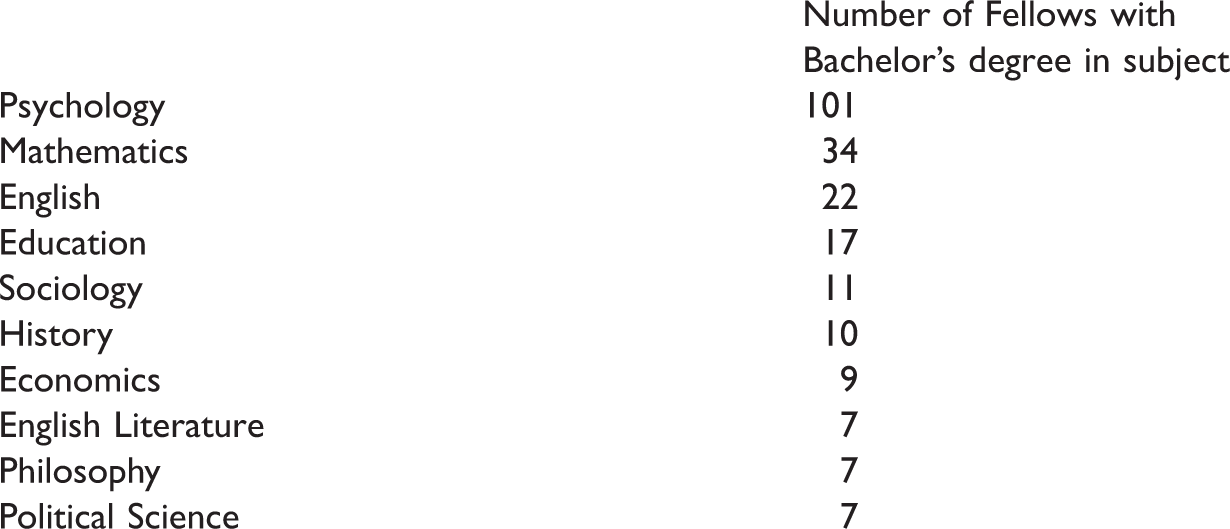
Byrne (2014) offered her observation on interdisciplinarity from her perspective as an early career researcher doctoral student: Academia at the higher levels looks worryingly resistant to interdisciplinary research. Despite universities and funding bodies paying lip service to the concept, academics report their interdisciplinary work being excluded from the Research Excellence Framework due to being ‘too risky’ and high impact journals seemingly less inclined to consider diversity among disciplines. (Byrne, 2014: para. 9)
We predicted that there would be a significant overlap between National Academy of Education (NAEd) Membership and AERA Fellow status. Of the AERA Fellows, we found that 163 (25.3%) were also NAEd members. Of the AERA Fellows who are also NAEd members, 81.0% are employed by a university in the category Doctoral Universities: Highest Research Activity compared with 64.0% of non-NAEd AERA Fellows. Similarly, when comparing the terminal degree-granting university classification, of those for whom we have data 90.1% of NAEd members who were also Fellows received their degrees from universities in the category Doctoral Universities: Highest Research Activity, compared to 86.5% of non-NAEd AERA Fellows.
Similar to concurrent NAEd membership/AERA Fellow status, we predicted an overlap with AERA Fellow status and RHSU rankings. Of the AERA Fellows, 75 (11.6%) were also RHSU ranked scholars. Of these, 86.7% were employed by Doctoral Universities: Highest Research Activity classified universities compared with 65.9% of non-RHSU ranked AERA Fellows. Of those individuals for whom we have data, 90.7% of RHSU ranked Fellows received their terminal degrees from Doctoral Universities: Highest Research Activity classified universities compared with 86.5% of non-RHSU ranked Fellows.
Mean times for Bachelor’s to terminal degree and terminal to Fellowship
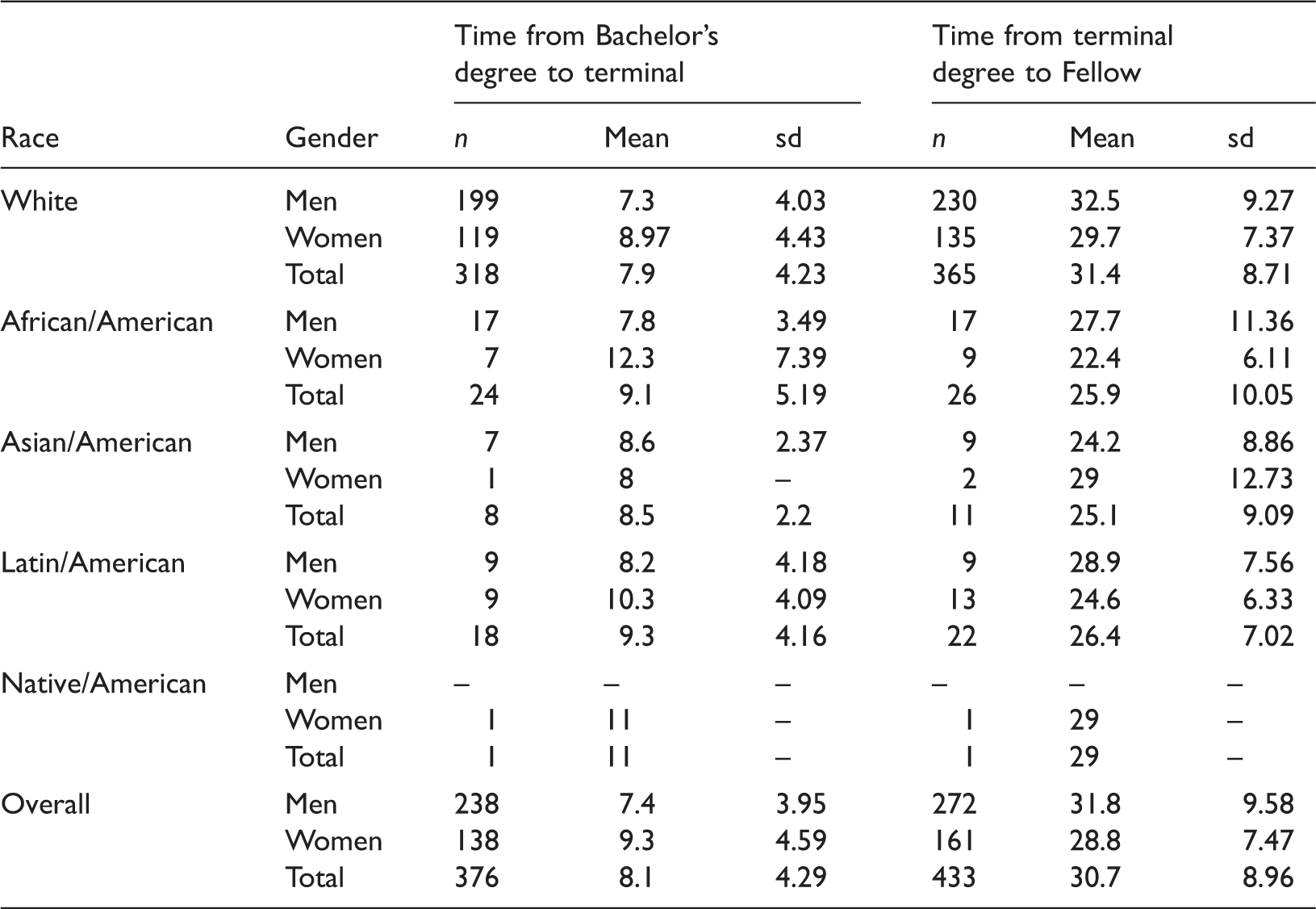
Note: Sample sizes are based on information available for that particular category.
Time from Bachelor's degree to terminal degree test for effects
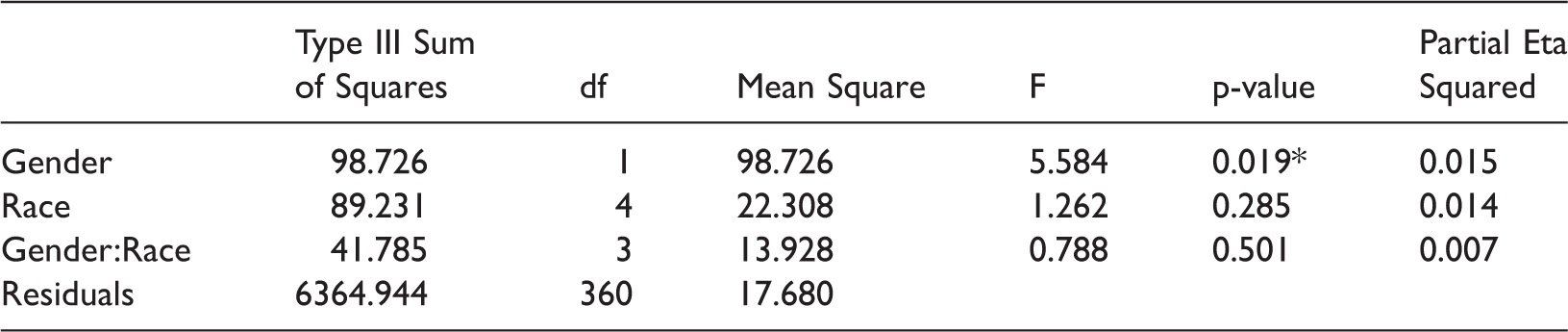
Note: *indicates statistical significance, p-value <0.05
In the case of the mean time between receiving one’s terminal degree and AERA Fellowship, the highest mean time was for Whites at 31.4 years, followed by Native/Americans at 29.0 years, and Latin/Americans at 26.4 years: Asian/Americans had the lowest mean time, at 25.1 years. The mean time for women was 28.8 years and the mean time for men was 31.8 years. Mean times broken down by gender and race are shown in Table 3.
Time from terminal degree to Fellowship test for effects
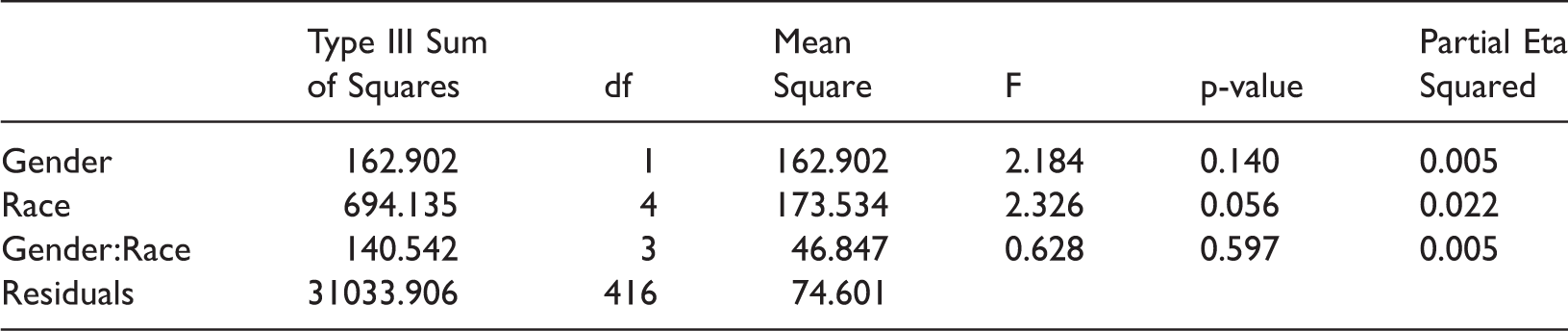
Note: * indicates statistical significance, p-value < 0.05.
Note: BC = Baccalaureate Colleges: Arts and Sciences Focus. RU/H = Doctoral Universities: Higher Research Activity. RU/VH = Doctoral Universities: Higher Research Activity. RU/L = Doctoral Universities: Limited Research Activity. M/L = Master’s Colleges and Universities: Larger Programs. M/M = Master’s Colleges and Universities: Medium Programs. MED = Special Focus Four-Year: Medical Schools & Centers. OHP = Four-Year: Other Health Professions Schools. NONAC = Holds a non-University position. NONUS = Holds a position at a non-US university.
We hypothesized that there would be a longer gap between the terminal degree and AERA Fellowship for men compared to women. We also hypothesized that Whites would have the longest time from terminal degree to Fellowship compared to other racial groups. While the means were less for men and Whites, the differences were not statistically significant.
To be considered for an AERA Fellow position, a scholar must be nominated by and endorsed by an AERA member, one of whom must be an AERA Fellow. Generally, nominees will be considered only after at least 12 years of postdoctoral contribution. Self-nominations are not accepted. A nomination or endorsement from a non-AERA Fellow should be from an accomplished scholar with expertise germane to the nomination. In keeping with social network theory, AERA Fellows act as gatekeepers and regulators of those who are permitted to join their ranks. It may well be a case of not who a prospective AERA Fellow knows on the ‘inside’ (read: who is an AERA Fellow) but, rather, if a nominated AERA Fellow is ‘known’ by those ‘inside’. AERA has become less ideologically progressive over time (Mershon and Schlossman, 2008). Who of the existing AERA Fellows is ideologically radical? Peter McLaren, (White, a man, co-author of this article), and possibly Antonia Darder (a woman and professor of color, who writes passionately about educational, social and civic justice). Our hypothesis is that nomination for AERA Fellowship will rely at least partially on prior social networks was confirmed.
Of the AERA Fellows, 75 (11.6%) have an RHSU Edu-Scholar Public Influence Ranking. 86.7% of RHSU-ranked AERA Fellows are currently employed at universities in the category Doctoral Universities: Highest Research Activity compared to 65.9% of non RHSU-ranked AERA fellows. When examining the classification of the terminal degree-granting university, 90.7% of RHSU-ranked fellows received their degrees from Doctoral Universities: Highest Research Activity universities compared to 86.5% of non RHSU-ranked fellows.
Contrary to our a priori expectation that 30% of AERA Fellows would be currently employed by a university that had awarded them a degree, only 9.5% were employed at a previous degree-granting institution. Of those, 7.0% were employed where they earned their terminal degree, 4.3% where they had earned a Master’s degree, and 2.5% where they had earned a Bachelor’s degree. Although there is no established threshold for academic imbrededness, we believe this finding is inconsistent with research conducted on ‘academic inbreeding’, whereby universities hire their own doctoral students after graduation.
Conclusions and future research
Homophily is a ‘love for the same’, whether that sameness is real or perceived (McPherson et al., 2001). In higher education there is a long and problematic history of using indicators such as where an individual completed their PhD (or who their advisor was) in making decisions about hiring. The history is problematic because, on the surface, meritocracy is the guise under which such decisions are made. An individual academic’s merit (e.g., their records of publication, teaching and service) is purportedly the principle metric for making such decisions. This includes affiliations with prestigious awards and fellowships. As such, any variance between opportunities afforded to academics are, according to meritocracy, explained by the hard work – or lack of hard work – by the individual scholar. This reinforces conceptions of ‘hard work paying off’ and the ideology that an individual needs only to blame themself and their lack of hard work, comparatively, if opportunities are not afforded to them.
In 2008 the American Educational Research Association began the AERA Fellowship program designed to increase the interdisciplinarity of educational research. The aim was to honor education researchers for their exceptional contributions to, and excellence in, education research. Using socio-demographic (race and gender), institutional (university), and ranking data as proxies for social reproduction and social network theories, we conclude that the introduction of the AERA Fellows program has resulted in no greater representation of non-elite institutions, despite the fact that ‘nominators and endorsers must not be from the same institution as the nominee’. 6 Moreover, the Fellowship program’s desire to reward more interdisciplinary research in education remains unrealized. The analysis used was primarily descriptive; and Pearson’s chi-squared test was used where categorical group comparisons were made, such as those between races or genders. In the case of continuous variables, such as time between terminal degree and AERA fellowship, two-way ANOVAs were used.
Our analysis shows that Whites make up the largest portion of AERA Fellows (80.3%) and that the majority of Fellows are males (65.1%). We also found that the majority of Fellows received their terminal degree from institutions with the highest ranking for research (68.5%) according to the Carnegie classifications, which correlates with their faculty position in a similarly classified institution. As such, academics who have positions in universities categorized as Doctoral Universities: Highest Research Activity are far more likely to receive course release time and institutional support to produce the type of research that is valued by the AERA Fellows program. Contrary to AERA’s goal of increasing interdisciplinarity of educational research, our analysis shows that the Fellows are becoming less diverse over time because the number of Fellows hailing solely from institutions classified as Doctoral Universities: Highest Research Activity is increasing. While AERA’s mission statement is to be ‘inclusive’ of ‘scholarship that constitutes and enriches educational research as an interdisciplinary field’, we found that the typical Fellow was a White male with over 30 years of experience who was awarded a terminal degree in Education or Psychology from a university classified as Doctoral Universities: Highest Research Activity.
Results from this analysis contribute to social reproduction scholarship and existing literature on fellowships by providing evidence of how homophily in higher education informs the ‘cloning’ of AERA fellowship recipients. For the future, other research and scholarly associations will likely consider adopting fellowship programs as a strategy to increase diversity of campus disciplinarity. They may consider requiring nominations from different types of institutions (Special Focus Four-Year; Master’s Colleges and Universities: Medium and Larger Programs; Doctoral Universities: Limited, Higher, and Highest) as a way of promoting inclusivity. These results also contribute to the homophily literature, more broadly, by problematizing meritocratic logic and exposing how social closure leads to ‘opportunity’ hoarding. Should further research continue to find positive outcomes from the introduction of fellowship programs, then more research associations may view this as a viable strategy for diversifying higher education in terms of institutional pedigree, race, gender and discipline.
Limitations of the research
As with all studies, there are limitations to this present work. First and foremost, in this case, was the data aggregation process. We relied primarily on publicly available information from AERA to compile a list of names, and then relied on institutional and personal websites to gather information about gender, race, current employer and other biographical information regarding degrees and dates. Not all of this information was available for every Fellow. As such, some data were missing. It is possible that our results could change if these missing data were included in our analysis. However, we do not have reason to believe that inclusion of the missing data would significantly change the nature of our findings.
Second, we made judgements about the way networks of race, gender and prestige were involved in the AERA Fellows process. While race and gender are typically thought of as invariant networks, prestige is varying. Carnegie Classifications change over time and we only looked at 2015 rankings, not rankings at the time of Fellowship. Similarly, we did not examine the professional mobility of the Fellows. For example, a professor may have been at a non-prestigious university for the bulk of their career, and then been recruited to a more prestigious university just prior to Fellowship. Our analysis only considers prestige at the milestones of where a degree was earned, and current employer. As is the case with studies examining diversity and inclusivity practices, progress is not always linear and answers are not absolute. Instead, institutional racism and sexism, being part of the fabric of the United States, still touches its institutions, and higher education is no exception.
Third, we have not considered the question of the political ideology that orients – consciously and/or unconsciously – the work of the AERA Fellows. Neither have we examined the issue of veiled censorship that could operate in the selection process in terms of including or excluding research and activism undertaken by prospective Fellows whose work reflects Marxist, neo-Marxist, or anarchist criticisms of the academy, nor work by Fellows that supports the prevailing orthodoxy of the academy (via inherited, structural and material conditions) which has frequently been described in the educational literature as liberal or neoliberal. In addition, we have not addressed in our study the issue of cultural production, or the cultural processes unique to the local context in which agents (in this case, the selection committee) become connected to the structure, an integral aspect of social reproduction, since this would require a more interpretive/phenomenological approach.
Footnotes
Acknowledgements
The authors express their thanks to the anonymous reviewers who read the article and provided meaningful feedback.
Declaration of conflicting interests
The author(s) declared no potential conflicts of interest with respect to the research, authorship, and/or publication of this article.
Funding
The author(s) received no financial support for the research, authorship, and/or publication of this article.
Notes

