



Abstract
This paper draws on social capital theory and feminist perspectives to critically examine the career navigation of Academic South Asian Women (ASAW) in British Higher Education institutions (HEI). While gender and racial inequalities in academia are well-documented (Bhopal and Pitkin, 2020; Rollock, 2019; Ahmed, 2019; Morley, 2014), the specific experiences of ASAW and their access to informal academic networking spaces remain underexplored. Findings reveal a complex interplay of factors enabling and constraining ASAW’s ability to mobilise and benefit from networks. Systemic barriers linked to entrenched white, patriarchal, and racist structures continue to persist. Participants’ narratives highlight both personal moments of realisation (‘snap moments’; Ahmed, 2017) and collective struggles, for example, racial microaggressions, stereotyping, and additional scrutiny within a field marked by exclusionary practices. As a starting point, this study adopts Bourdieu’s Theory of Practice, focussing on habitus, capital, and field (Bourdieu and Richardson, 1986). Although this perspective helps explain the types of capital used to navigate, HE, I acknowledge that Bourdieu’s framework has limitations and does not fully capture the position of ASAW. For this reason, I also draw upon the feminist perspectives of Hook (1990) and Ahmed (2012) to help more fully explore the challenges and position of ASAW careers in HE. I thus extend Bourdieu’s concept of capital and explore how other emerging capitals such as professional, digital, hybrid, and emotional capital can be used to mobilise HE careers for marginalised groups like ASAW. I also utilise Critical Race Theory (CRT) scholars (Bell hooks, 2014; Taylor, 2009; Hooks, 1990 and Crenshaw, 1991) to further interrogate the systemic racism embedded in, HE’s policies, procedures, and practices. This paper foregrounds the theme of structural inequality and its reinforcement through informal networks, within recruitment practices. Despite slow progress in diversifying HE, ASAW demonstrate innovative strategies to advance their careers, leveraging alternative capitals, such as digital, external, and emotional capital to challenge dominant norms and forge pathways to success. The research ultimately argues for the transformative potential of these strategies, illustrating how ASAW resist systemic barriers and develop flexible responsive solutions to enhance their positions within academia.
Keywords
Introduction
This paper examines the perspectives of women with a background and origin from the Indian sub-continent, which covers Pakistan, India, Bangladesh, and Sri Lanka. Both British-born women and those that have migrated to the UK, holding an academic teaching and or research position within British universities formed part of this study. These women will be referred to by using the acronym ASAW (Academic South Asian Women) throughout the paper. The interviews that form the principal dataset for this paper relied on a qualitative research method drawing upon the narratives and experiences of 24 ASAW. (Ahmed, 2012, 2017, 2019; Bhopal and Pitkin, 2020; Bourdieu and Richardson, 1986; Hooks, 1990, 2014; Morley, 2014; Rollock, 2019; Taylor, 2009; Crenshaw, 1991) The research objectives of this study are: (1) To critically evaluate what positions ASAW take within HE-related networks (2) To explore any barriers and examine who/what influences, manages, and determines access to networks for ASAW when pursuing career opportunities. (3) To examine, what, if any, networking strategies/behaviours are used by ASAW to benefit, mobilise, and develop social capital.
A range of UK based statistics from Advance HE (2024, 2022) and the Equality Challenge Unit (ECU, 2014) paint a picture of inequality in British universities for academic staff from different ethnic backgrounds. Advance, HE acknowledges there has been an increase in the number of academic staff from more ethnically diverse backgrounds (2022). However, they also recognise inequalities persist, with lower proportions of individuals from ethnic minority groups being less represented in senior management/academic roles, professorial positions or in higher salary bands. Although this information offers a quantitative account of the position of Black Asian & Minority Ethnic (BA.M.E) academics, it does not give us an insight into their experiences and does not enable their voice to be heard.
Existing research (Rabelo et al., 2020; Rollock, 2019; Cabrera et al., 2016; Leathwood et al., 2009; Pilkington, 2013; Shilliam, 2015; Bhopal and Pitkin, 2020) has examined BA.M.E academics’ lived experiences within higher education. Additionally, Rollock (2019) has focused on the lived experiences of black academics (Black here is defined in her report as African, Caribbean, and other Black background). However, there is limited focus purely on the experiences of ASAW working in HE, which is where this paper differs in its remit. Furthermore, the role of networks and career opportunities specifically linked to ASAW within academia has received very little attention. Even though existing research (Heffernan and Bosetti 2020; Yarrow, 2020; Bhopal, 2014; Hey et al., 2011) recognises the importance of networks in HE, this concept does not form the central focus of their work, specifically in relation to ASAW. My aim is to make networks the key focus of this paper, to understand how social capital may be mobilised through such networks to advance career opportunities for a distinct ethnic group of women (ASAW).
Landscape of HE
Despite various equality and diversity initiatives, such as Athena SWAN (AS) for gender equality, the Race Equality Charter (REC) for racial equity, and Equal Opportunities policies aimed at eliminating discrimination, career progression for BA.M.E academics in higher education remains unchanged. Although these initiatives aim to eliminate discrimination and promote fairness, I argue, like Ahmed (2019), that diversity in HE remains non-performative, and interventions do not achieve their stated goals. Awolowo (2024) reinforces this view, highlighting that out of 23,515 professors in the UK, only 165 are Black, with just 61 being Black women.
Furthermore, research suggests (Rabelo et al., 2020; Rollock, 2019) treatment of BA.M.E academics results in the use of differing standards, micropolitics, and marginalisation. It is argued such tactics negatively infect processes, practices, and procedures (e.g. recruitment and allocation of research hours and/or promotion) within HE, which contribute to maintaining BA.M.E academics’ position at the margins. Despite the objective criteria for success outlined through Research Excellence Framework (REF) and National Student Survey (NSS), this paper suggests there is a recognition that one needs to use social and professional networks and connections to support one’s progression in HE. Moreover, such social/professional networks, (to name a few; conferences, meetings, after-work drinks, friendship circles, task-groups, and committees) with their unwritten rules and invisible criteria are not accessible to all equally. Although HE through the rise of neo liberal practices has changed the way it operates, in many ways, it is as Bhopal and Pitkin (2020) argue ‘the same old story’ (p. 530) of an elitism that advantages some very established groups of academics (male, white, middle class) at the expense of others who do not fulfil that establishment criteria.
Research by Wright et al. (2007) focuses on British universities and examines how the experience of Black women in academia is one of marginalisation. The main aim of their research is to examine lived experiences of black women participants only, to determine how aspects of gender and ‘race’ are negotiated within predominantly white patriarchal, hierarchical and Eurocentric higher educational spaces. They recognise the significance of relationships, power and sponsorship, acknowledging the concept of connections, pointing out: If white men are opening doors for other white men and white women are opening doors for each other, where is the patronage, the support for Black women? Who is opening doors for them? (Wright et al., 2007: p. 155)
However, Wright et al. (2007) make little inquiry into exploring the use of such door openings for other ethnic groups such as ASAW, which is what this paper aims to do. Bhopal (2014) examines the experiences of BA.M.E academics in both UK and US universities, noting how networks contribute to the persistence of inequality within the Higher education. She argues Black academics are less likely than their white counterparts to have access to powerful ‘insider’ networks, in which job offers are made and opportunities for career advancement are discussed. These insider networks may include recommendations and access to particular institutions and processes, making use of friendship networks with ‘academic gatekeepers’ offering members power to provide access to jobs, promotion and funding (p.16). To understand why Black academics struggle to access powerful insider networks, as described by Bhopal (2014), I draw on Rabelo, Robotham, and McCluney’s (2020, p. 1842) analysis. They argue that institutions maintain the marginalization of Black women through organisational activities, processes and practices that operate within a ‘lens of whiteness’. Consequently, individuals who deviate from whiteness face heightened scrutiny and control (Rabelo et al., 2020: p. 1840). Examining this view from the perspective of ASAW and identifying whether HE has specific practices by which whiteness is embraced and enacted in the workplace is a point of interest for this paper.
In contrast, Kanter (1977) speaks of the notion of tokenism, whereby recruiting small numbers of diverse candidates to give the false perception of diversity at large enables some BA.M.E academics to achieve upward mobility. However, Kanter (1977) points to penalties for taking on tokenistic appointments, including increased workloads and additional scrutiny. Other studies (Becks-Moody, 2004; Miller and Groccia, 2011; Walker, 2016) validate findings from Kanter’s (1977) earlier work and point to similar penalties for taking on tokenistic appointments. Similarly, Rabelo et al. (2020) suggest failure to comply with the white gaze and downplay their differences results in detriment for BA.M.E. academics. However, for some of my participants taking on token roles and thereby moving closer to the white gaze appeared to be part of their strategy to negotiate and exploit the professional established rules/expectations in HE. In fact, one could suggest that these women are actively playing along with the rules to secure a position which, as advocated by hooks (1994) enables them to disrupt existing practices from ‘within the tent’ so to speak.
Additionally, Van Den Brink et al.’s (2010) findings highlight the importance of informal networks for career progression. Subtle persuasion at informal gatherings, lobbying superiors, making deals behind the scenes and use of strategic skills and right connections were tactics used to pursue appointments within academia. The work of Van Den Brink et al.’s (2010) saw the interviewees give examples of what could be termed ‘political games’, here influence and manipulation were used to confirm the appointment of candidates who had already been chosen. The selection committee ‘in many such cases, appeared to be merely a decorative tool used to formalise and legitimise the decision’ (p. 1469). In particular, their findings point to the view where one has a connection or direct link with the dean or university board, there is a real opportunity to influence the outcome of academic appointments (Van Den Brink et al., 2010). Tactics of lobbying, behind the scenes agreements and political games question the purpose and effectiveness of the Athena Swan (AS) Charter, Race Equality Charter (REC) and equality legislation, but equally highlight that investment in informal networks can offer opportunities in terms of progression. Drawing upon the words of Ahmed (2007a), such practices are clear reminders of why ‘diversity work remains undone’ in higher education. Additionally, Ahmed (2013) claims that a direct response to injustices within the academy can be to become what Ahmed calls becoming a ‘feminist killjoy’. Thus, a feminist who disrupts social norms by challenging sexism, racism and oppression, often being perceived as negative or difficult for refusing to maintain the status quo. Indeed, this paper suggests that ‘killjoy’ moments were experienced by the participants, although it is not clear if any, or all of the participants would have defined themselves in Ahmed’s terms as a feminist killjoy.
Higher education initiatives to tackle inequalities
Efforts to address gender and race inequality in higher education (HE) through initiatives such as AS, and the REC have yielded some progress, but it is argued they remain flawed in significant ways. While these initiatives aim to create a more inclusive, HE environment, structural limitations, resource disparities, and a lack of intersectional focus hinder their effectiveness, particularly for ASAW. However, the work required to meet AS standards is resource-intensive and often unevenly distributed. Pearce (2017) highlights that women, including those the initiative aims to support, frequently bear the administrative burden of preparing submissions. This paradoxically diverts their time from research and career development, undermining the initiative’s goal of fostering gender equity.
Intersectionality is another area where AS has faced criticism. Pearce (2017) and Crenshaw (1991) emphasize the need to consider how overlapping identities, such as race and gender shape experiences of marginalization. Without addressing these complexities, initiatives risk benefiting primarily white women (Bhopal and Pitkin, 2018), leaving ASAW and other ethnic minority groups marginalised within the academy. While the 2021 transformation of AS acknowledges intersectional inequalities (Advance he.ac.uk 2021), it remains too early to fully evaluate its impact comprehensively.
The REC, launched in 2016, mirrors the structure of AS but focuses on improving race equality for staff and students in HE. However, its uptake has been limited compared to AS. As of 2024, only 61 HEIs are REC members, with 12 holding awards, compared to 164 institutions holding 815 AS awards (Advance HE, 2024). This disparity highlights a stronger institutional appetite for addressing gender issues than race.
Bhopal and Henderson (2019) critique the REC and similar equality programs for perpetuating structural inequalities. Instead of dismantling white privilege, such initiatives often serve institutional interests, enabling HEIs to claim progress without enacting meaningful change. This lack of commitment to racial equality leaves ASAW and other marginalized groups struggling for representation and recognition within the academy. It is argued gender-based programs primarily benefit white women, while race-focused initiatives are underutilized and secondary to gender-based charters (Bhopal and Henderson, 2019). If ASAW are empowered to voice their experiences and participate fully in these initiatives, their contributions could drive meaningful change. However, achieving this requires HEIs to prioritize structural reforms that genuinely challenge exclusionary practices and create equitable opportunities for all.
Ahmed (2009) argues diversity in higher education is merely a ‘numbers game’ where, getting more people of colour added to the white faces of organisations becomes the priority, without necessarily changing anything with respect to improving career opportunities for BA.M.E groups. Essentially, it means people of colour are what gets ‘added on’ (p. 41). However, she counsels black academics to remain ‘sore and angry’ and refuse to be appropriated through institutional policy and practice as the ‘happy objects’ of diversity in universities. What universities end up doing is seeing people of colour as part of a huge marketing exercise aimed at managing their image globally, domestically, or both. ‘Diversity here is not associated with challenging disadvantage but becomes another way of doing advantage’ (Ahmed, 2007b: p. 16).
Theoretical perspectives
Bourdieu’s Theory of Practice (1986) with its conceptual framework of capital, field and habitus is used as a starting point to evaluate the data. However, it is acknowledged that Bourdieu’s perspectives (1986) can only take me so far as it lacks the ability to fully evaluate the position of ASAW. HEIs (Higher Education Institutions) are made up of many fields such as teaching, research, and enterprise, and each of these fields is made up of their own individual/collective networks, that is, conferences, teaching groups, and industry links/forums. To understand the social relations that exist between these fields and explore how they could potentially impact on career opportunities in HE, there is a need to investigate how individual ASAW navigate and position themselves within HE and aim to improve their position. From a Bourdieu and Richardson (1986) perspective the role of capitals (social, cultural and economic capital) is key to improving one’s position. The concept of social capital was originally considered and defined as an ‘individual good’ within the field of sociology (Bourdieu and Richardson (1986); Portes, 1998; Lin, 2000, 2001). Bourdieu and Richardson (1986) definition describes social capital as: The aggregate of the actual or potential resources which are linked to possessions of durable network of more or less institutionalized relationships of mutual acquaintance and recognition—or in other words membership in a group—which provides each of its members with backing of the collectively-owned capital, a ‘credential’ which entitles them to credit, in various senses of the word. (Bourdieu and Richardson (1986), pp. 248–249)
Here, Bourdieu is indicating firstly the importance of the kinds of relationships that allows individuals to claim access to resources possessed by other members of the network, and secondly the amount and quality of those resources (Rostila 2011). If ASAW are denied access to crucial relationships such as a supervisor, dean and/or line manager, the collective backing is missing for these group of women, which could then impact on their access to career opportunities. For Bourdieu and Richardson (1986) social capital reproduces positions of power by maintaining the status quo. Social capital is therefore based on membership of a group that provides an individual with the backing of collectively owned capital. For Bourdieu and Richardson (1986), social capital is not uniformly available to members of a group or collective but available to those who acquire it by achieving positions of power and status Bourdieu and Richardson (1986); a degree of ‘game playing’ is needed to manoeuvre freely within any field. Like any game players, there is a need to learn the rules of the game to progress, and this is where agents (individuals) will draw upon their habitus (skills, values, and dispositions) in order to navigate their way around the field. Both habitus and capital work together to allow agents to maximise their positions in the field. Linking this to HE specifically, researchers and/or teaching practitioners need to learn the rules or codes, which form part of the wider context called doxa.
It is important to clarify the vagueness that may surround the issue of whether it is in fact network relations themselves that are a type of social capital or whether social capital is an asset that emerges from networking. Crucially, what is clear is networks cannot be discussed without an understanding of the concept of social capital. The volume and nature of an individual’s social capital depends on the size of the networks that they can mobilise as well as on the volume of personal capital (and the social and cultural value of this capital) that the individual possesses in his or her own right (Maritz and Prinsloo, 2015). Focussing on how social capital can be acquired in HE though networks can also help to understand its multidimensional nature. Although some attention has been given to the experiences of women and social capital (Angervall et al., 2018; Yarrow, 2020) little attention has been given to the career trajectory of a specific ethnic group, namely, ASAW. Lin (2001) advocates a call for further research in this area of social capital, urging us to look at its uses and impact in HE. Additionally, it can provide insights into why underrepresented groups, such as ASAW, are often missing the required social capital to mobilise their careers.
Habitus, is shaped by individual histories and social experiences, it predisposes individuals to certain choices, impacting how ASAW utilize social capital and networks. While habitus is dynamic and can evolve, ASAW often face challenges in transcending their racialized and gendered identities within rigid institutional structures. Institutional habitus, reflecting an institution’s ingrained values and practices, is less adaptable and often resists change. This aligns with Ahmed’s (2017) metaphor of ‘brick walls’, which symbolize fixed policies and practices maintaining systemic inequalities. Together, these factors underscore the interplay of individual and institutional dynamics in shaping ASAW’s career prospects. Although individuals are primarily influenced by their childhood experiences, where habitus first takes shape, this is continually modified as one enters new and different fields. Those ASAW, who arrived as adults to work in British universities, often left behind an affluent lifestyle in their country of origin. In this sense, many ASAW have a hybrid habitus, one which encompasses the rich cultural, religious and often middle-class values of their families/friends, and another they acquire as they interact and engage with the different social fields within UK, HE. How ASAW are able to use this duality to their benefit has received little attention. Although for Bourdieu and Richardson (1986) habitus is central to the understanding of class-based culture, I am interested in examining the racialised dimension of habitus.
Stoler (2016) accuses Bourdieu of undermining the impact of race and points out he gave little attention to race in his writings. Feminist writers such as Hooks (1990) and Ahmed (2012), like Bourdieu, also draw upon individual histories to make sense of an individual’s position within given social fields. However, Hooks (1990) calls for women of colour to theorise from a ‘place of pain’, using their history of exclusion to work in the margins. Ahmed (2012) draws upon the work of Audre Lorde (1984) who encourages women (of colour) to use the anger they might have about racism as a response to the histories of racism that are unfinished. Such anger and emotion are ways in which the ‘brick walls’ (Ahmed, 2017) that reflect the history of our HE institutions can be challenged to transform the rules of the social field or potentially push ASAW to create a new field of their own.
A further important aspect of Bourdieu and Richardson (1986) approach is individual engagement within the field, in particular with the ‘rules of the game’, also known as doxa. Doxa is the unspoken but widely accepted logic that informs and structures social life these rules can shape field relations contributing significantly to how inequality is maintained or reproduced. When individuals internalise these dominant rules and ideas there is an unconscious acceptance, or what Bourdieu terms a ‘symbolic violence’ such that individuals take on the ideas of the oppressors within the structure to succeed. Such a perspective may help explain the lack of resistance and protest with the status quo. The concept of symbolic violence, however, underestimates the notion of individual agency and the ability to challenge the rules of the game. Nor does it account for the potential collective power of specialist interest groups such as Black British Female Academic Networks. Neither does it account for those ASAW as suggested by Bhopal et al. (2015) who consider the possibility that the game is no longer worth playing and leave HE altogether. However, if doxa is disturbed it can cause individuals to begin to question or resist the norms or expectations that characterise their social environment or their place within it (French, 2020). How much questioning is done within HE by ASAW is an area of focus for this paper.
It is argued the work of Bourdieu and Richardson (1986) can only go so far in explaining the position of ASAW within HE, as Bourdieu’s work focuses on bridging structure and agency and has been criticised for dwelling too much on structural reproduction (Yang, 2014), which historically maintains and reproduces inequalities. Additionally, when Bourdieu and Richardson (1986) developed his theories, the Internet had not reached its transformative potential, and digital networks were not yet a factor in social interactions. Today, digital platforms offer minoritised groups, such as ASAW, opportunities to bypass traditional gatekeepers (i.e. White male academics and or old boy networks) and convert digital engagement into social and professional capital. This relatively new type of networking is not necessarily characterised by the notion ‘it’s who you know’ (Bhopal, 2014: p. 16). For instance, open-access blogs and social media allow individuals to establish a presence and gain recognition without institutional endorsement. Unlike the networks of Bourdieu’s time, which relied heavily on personal connections, digital networks create new pathways for career opportunities, reshaping what it means to succeed in academia.
Emotional capital, although not explicitly recognized in Bourdieu’s theoretical framework (1984), is a critical resource for personal and professional growth as explored by Ahmed (2015), Nowotny (2018) and Reay (2000). It expands Bourdieu’s concepts of cultural, social, and economic capital, offering marginalized groups, such as ASAW, a means to navigate institutional challenges. Unlike Bourdieu and Richardson (1986) capitals, which often reinforce dominant norms, emotional capital is utilized by ASAW to challenge and disrupt these norms, even if doing so places them in precarious positions within the academy, such as being labelled as ‘killjoys’ (Ahmed, 2019) or ‘careless workers’ (Lynch, 2010).
Nowotny (2018) views emotional capital as a private subset of social capital with transformative potential, while Reay (2000) highlights its accumulation within relationships, often passed intergenerationally. Both Reay (2000) argue that emotional capital can be leveraged for personal gain, making it a valuable yet underexplored asset in understanding the career trajectories of ASAW. By examining emotional capital within this paper, the nuanced ways ASAW use emotions as a tool to confront systemic inequities are brought to light, demonstrating its potential to reshape power dynamics and facilitate success in higher education. Emotions build over time, but it is an individual’s historical experiences that give them meaning, and what is of interest is how emotions are used, converted and possibly even exchanged to gain an advantage. Exploring emotional capital for BA.M.E groups in HE can assist in understanding how individuals may use their marginalised experiences to generate a space in the field (network) in which they are seeking to advance. For Ahmed (2015) emotions are relational and social, and it is our contact with objects such as a picture, an article or movie, as well as other human beings which creates feelings. Some feelings are stubborn and give a sense of our limitations. For example, the feeling of being an imposter or outsider. Using Ahmed’s (2004) analysis, this feeling can represent the pain that is informed by our personal and cultural history, which is often archived by ASAW but can be ignited as new encounters, exchanges and contacts within HE is experienced. Interactions within HE where emotions can be ignited could be a conference space, meetings and/ or through a line-manager’s conduct. I argue that emotions and the emotional capital ASAW generate can be used like other forms of capital in HE, professionally to help gain social advantage for minoritised groups.
Methodology
This study focuses on the experiences of Academic South Asian Women (ASAW) in British Higher Education (HE) within the UK, specifically examining how networks and social capital influence recruitment practices and career opportunities. Ethical approval for this research was given by Birmingham City University’s ethical committee. Semi-structured interviews were conducted with 24 participants across six different British universities to explore their strategies, challenges and agency in navigating HE. This approach allowed for in-depth narratives, avoiding assumptions while encouraging participants to share their stories in their own voices. All of my participants worked within the Business School of there HE institution, but they came from a range of disciplines, which included Accounting, Psychology, Law, Social Sciences, HR and Business Management. To uphold ethical integrity, I recognized that my shared identity with participants (race, gender, language, culture and profession) could lead to assumptions that I already understood their experiences (Dwyer and Buckle, 2009; Kanuha, 2000). To mitigate this, I began interviews with a disclaimer, emphasizing the need for explicit explanations rather than assumed knowledge. I also employed clarification techniques, such as asking for concrete examples and using phrases like ‘just for the record’, to ensure rich, detailed data (DeLyser, 2001; Foster, 2009). Additionally, to protect participants’ anonymity, I assigned pseudonyms, ensuring confidentiality throughout the research process.
When preparing the interview questions, I was guided by both my research questions and literature review, which helped to develop questions, which allowed me to pursue coherent and relevant discussions during the course of the interviews. The first section of the interview asked about the background of the participants and aimed to confirm their job title and years of experience within HE. The initial set of interview questions aimed to capture participants’ perceptions of networks in higher education and examine their first-hand experiences. The next set of questions examined how participants gained access to networks, including who they spoke to, and why, how often and what they did and whether their actions yielded any career opportunities. The third set of questions focused on asking participants what factors determined their choice of using networks, and which had helped them to achieve the necessary experience and/ or career prospects. Finally, I was especially interested in capturing key moments or ‘snap’ experiences (Ahmed, 2017) which, as discussed in the literature review, often feature as part of BA.M.E academics lived experience of working in HE institutions.
As an ASAW researcher, I recognized the potential for participants to assume shared understanding due to commonalities in background. To mitigate this, semi-structured interviews were chosen for their balance between direction and openness. By asking broad, non-restrictive questions and fostering an informal, conversational environment, I aimed to empower participants and address power imbalances in the interview process. A biographical approach was employed to capture participants’ reflections as this enabled me to focus on capturing participants’ life stories, experiences, and personal trajectories to understand how past events shape their present perspectives. This method allows for in-depth exploration of identity, agency, and social context through the participant’s own narrative. This method highlighted their agency in resisting or navigating HE policies. Participants articulated their lives either as shaped by their own actions or as constrained by external structures, shedding light on the dynamics of career trajectories within HE.
Data analysis began with listening to recordings, transcribing them, and repeatedly reading through the narratives to identify overarching patterns. As Atkinson and Delamont (2006) argue, narrative analysis requires rigorous interpretation beyond presenting stories. To achieve this, I revisited the theoretical frameworks of Bourdieu and Richardson (1986) tools of practice, and feminist perspectives outlined earlier. I then chose to adapt an analytical route for data analysis laid out by McCormack (2000). I found McCormack’s lenses a useful way to analyse the data and reveal meaning in different types of narratives (Dibley, 2011) Figure 1. McCormack’s lenses (2000).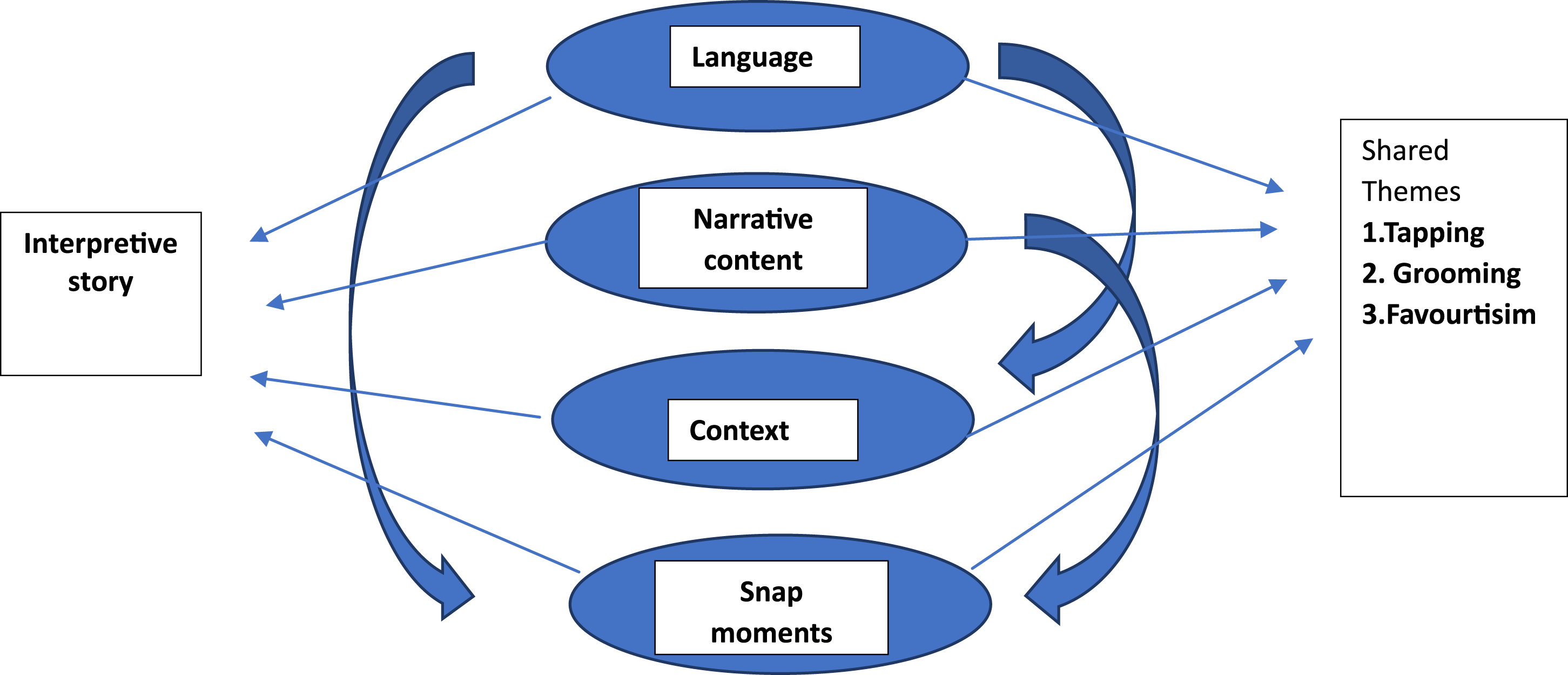
This visual demonstrates the layered approach to analysis, emphasizing connections that shape emerging themes. Using McCormack’s lens, the first focus is on language, analysing participants’ words, tone, and unsaid elements (Dibley, 2011). For example, some participants chose to speak in their native languages of Punjabi, Urdu, or Hindi, allowing them to more effectively express hurt and anger. As an ASAW myself, my familiarity with these languages fostered a shared understanding during these exchanges.
Narrative content analysis involves examining how words are structured to tell stories. Patterns such as hesitation, repetition, or chaotic expressions often reveal participants’ emotional states (Dibley, 2011). For instance, pauses and repeated phrases emphasized the importance of certain experiences, while laughter was frequently used to convey cynicism or mock equality initiatives by HEIs. Participants often shared early memories of feeling different in HE, contextualized within cultural and situational frameworks (McCormack, 2000).
The context of these narratives was shaped by ethnicity and the shared cultural background between the participants. This often fostered a sense of unity, allowing for deeper engagement with the stories being told. Common familiarity with HE frameworks like Teaching Education Framework (TEF), Research Excellence Framework (REF), and National Student Survey (NSS), facilitated a smoother storytelling process, reducing the need for explanations. Finally, McCormack’s concept of moments, sudden leaps of understanding was adapted to align with Ahmed’s (2017) concept of “snap” experiences. These snap moments are pivotal turning points characterized by frustration and anger, offering powerful insights into the challenges ASAW face. As evidenced in the findings section such experiences profoundly shaped their career trajectories, revealing the emotional toll of navigating systemic inequalities in HE. By exploring these moments, the research captures the critical junctures where ASAW’s career decisions were defined by institutional exclusion and their responses to it.
As an Academic South Asian Woman (ASAW) researching the experiences of ASAW in higher education, my insider position provided significant advantages while also requiring careful reflexivity. My shared ethnicity, profession, and cultural background allowed me quicker access to participants, stronger rapport, and a deeper understanding of the social and institutional challenges they face (Asselin, 2003). However, I acknowledge that positionality shapes research dynamics, influencing how social and professional relationships are navigated (Sanghera and Thapar-Björkert, 2008). While my insider status enhanced authentic representation, I remained vigilant against assumptions, employing strategies such as participant transcript validation to ensure credibility. Additionally, I recognize that insiderness is not fixed but fluid, influenced by intersecting factors such as age, migration background, and career stage (Mercer, 2007). Though I shared commonalities with my participants, differences in socialization, religious identity, and career trajectories at times positioned me as an outsider, highlighting the complexity of insider research. Thus, rather than viewing my role as strictly insider or outsider, I embraced the continuum of positionality, where moments of familiarity facilitated engagement while distinctions ensured critical reflexivity (Van Mol et al., 2014).
Findings and discussion
Three core themes emerged in my analysis, which illuminate the factors that can shape ASAW’s experiences of recruitment practices, and the role played by networks. The three key themes of favouritism, grooming, and tapping highlight the power of informal networks within the academy. Many participants described experiencing imposter syndrome, an internalized sense of inadequacy despite their qualifications. This feeling persisted even after reaching senior positions and was linked to institutional structures that perpetuate exclusion. Neetu’s experience at a Russell Group university encapsulates this sentiment: “I went for an interview once... and I just remember thinking it really supports all those stereotypes of academics with tweed jackets and older white men… I did not feel I could work there.” (ECR, Neetu)
The traditional architecture and culture of elite institutions often alienated participants, reinforcing a sense of otherness. Ahmed (2019) likens such environments to ill-fitting garments, highlighting how they exclude marginalized groups. Neetu’s story underscores the need for HEIs to understand the lived experiences of ASAW to enact meaningful change. Participants frequently perceived recruitment and promotion practices as inequitable, operating through informal networks rather than merit-based processes. These practices contradicted stated commitments to diversity and inclusion, as described by Durga: “The way they are selecting course leaders—favouritism in terms of progression… applicants already know members of the interview panel. This happens quite a lot.” (Mid-career academic, Durga)
Such favouritism perpetuates exclusion and aligns with Pilkington’s (2013) assertion that anti-discrimination policies often mask discriminatory practices. Participants described how HE recruitment often prioritizes ‘comfortable fits’, as Jeevan noted: “At dean/management level, they want someone who speaks like them and presents like them—it’s all about whether the face fits. it is groupthink. So, when recruiting they want someone like themselves and this is where barriers arrive as we are not like them…it’s all about whether the face fits, the way you dress, the way you present yourself, all makes a big difference”. (Senior academic, Jeevan)
This culture of conformity marginalizes ASAW, pressuring them to align with dominant norms to progress. Jeevan states ‘we are not like them’ confirming her feeling of displacement. It can become difficult to shake this feeling of unwantedness, which Bourdieu and Jean-claude (1977) would argue is derived from her being different to the field in which she operates. However, as argued earlier, difference can be welcomed and should be seen as a form of strength in order to move forward within the academy, on your own terms. (Hooks, 1990).
Tapping, grooming, and favouritism
The concept of ‘tapping’ emerged prominently, referring to informal selections for roles through personal network connections. Priya recounted her experience: “Initially I went into Head of Discipline role on an interim basis (1 year). We then had a change of dean, idea was do well in interim role and if you prove yourself, you could stay in role. I had been at this institution for 25 years and ready for more. The new dean said the role had to go to advert, which I accepted as being fair. My view was he was following protocol, but everyone was saying he has someone in mind. I was doing the job well, met targets/ metrics and good feedback. I applied did not get role, transpired dean had ‘
Tapping reflects gatekeeping by HE leaders, which privileges those who fit established moulds. My data also suggests that tapping continues at a more senior level. For example, Kuljit stated: “Later on (in terms of career) I have seen the taps on the shoulder or the work that is done even before you get there or the language you have to speak, but I suppose I have never wanted to be that kind of leader or collude with those sorts of processes. I am absolutely with you, it happens, but I didn’t see it in my early career, but I have seen it more as I got into senior roles”. (Senior academic, Kuljit)
Her words, furthermore, suggest that tapping is preceded by ‘collusion’ and ‘work done before’, indicating that a degree of investment takes place in getting candidates ready prior to the ‘tap’ itself. My data suggest those individuals that are invested in for the purposes of professional grooming either fit the image of their recruiters (Singh, 2002; Arday and Mirza 2018), and or have close proximity to the white gaze (Rabelo et al., 2020). Grooming complements maintaining the status quo by shaping candidates to meet unspoken institutional expectations. Neena’s experience illustrates this dynamic: “I applied for deputy head of department... but I knew a white female was being groomed… I wanted to see how management would justify this. On paper, I had so much more to offer.” (Senior academic, Neena)
These practices reinforce systemic inequities, as individuals are selected based on their proximity to dominant cultural norms rather than qualifications. Informal social networking spaces, such as after-work gatherings in pubs and bars, exacerbate these challenges. While these spaces are crucial for career advancement and insider information, they often exclude those from different cultural or personal backgrounds. Priya shared her reflections on this dynamic: “At this time, I had been in HE for over ten years and was getting to understand how things work. In the early days, I had always said no to going for after-work drinks as it’s not really something I like doing. I was missing out on crucial information, not privy to the tips and opportunities that were coming, and others who happened to be white middle class always seemed to know more about job opportunities. The space was used to tap and encourage selected academics to make applications. I wasn’t really part of this network but felt I should start to say yes when invited next.” (Senior academic, Priya)
This demonstrates how informal networking spaces, rooted in cultural preferences that may alienate minoritized groups, reinforce exclusion, and hinder career progression. Hey et al. (2011) observe that such practices, particularly in British HE institutions, marginalize BA.M.E academics, professional staff, and academics alike, by failing to consider diverse cultural preferences. Consequently, while these gatherings offer access to social capital and career opportunities for some, they create barriers for those who do not fit within dominant cultural norms. However, one participant spoke of her persistence despite all the setbacks: “I have applied for several roles—Programme Lead, International Lead, and Associate Dean, but I keep getting rejected. When I ask for feedback, they tell me I need 'more presence.' What does that even mean?” (Kamal said, pointing down firmly with her finger on the table to emphasize her words) “It’s frustrating because I don’t engage in the informal chit-chat and lunches where these decisions seem to happen, and I end up being sidelined. Still, I’ll keep applying because I know I have so much more to offer. What’s the worst they can do? Say no.” (Senior Academic – Kamal).
This version streamlines the expression, emphasizes the emotional impact, and highlights the structural barriers Kamal faces. Such anger and emotion are ways in which the brick walls (Ahmed, 2017) of the institute can be challenged. Despite systemic barriers, participants demonstrated agency in resisting marginalization. Neena exemplified this through her refusal to conform: “Applying for these roles if it means rubbing shoulders with people, buttering them up—I cannot and will not do this.” (Senior academic, Neena)
Her statement aligns with bell hooks’ notion of operating from the margins as a site of resistance and empowerment. Hooks (1990) argues that those on the margins can challenge dominant norms by rejecting assimilation into oppressive systems and creating alternative pathways for agency. Neena’s experience underscores how institutional structures often require individuals to ‘inhabit whiteness’ or adopt behaviours aligned with dominant norms to be deemed successful (Ahmed, 2012). Ahmed’s concept of “brick walls” is particularly relevant, as Neena’s unwillingness to conform reveals the rigidity of these institutional barriers. Her statement highlights how informal networking practices serve as gatekeeping mechanisms that privilege those who conform to these unspoken norms. Neena’s agency also demonstrates Ahmed’s concept of the ‘feminist killjoy’, where calling out or refusing to comply with oppressive practices positions the individual as a disruptor in the eyes of the institution (Ahmed, 2019). Neena’s decision to reject ingratiation strategies, despite their career benefits, is an act of resistance that challenges the institutional status quo. However, this resistance comes at a cost, as it potentially limits her career progression within a system that favours conformity.
Some participants, unlike Neena, were willing to adapt their behaviours and step away from their original habitus to advance their careers in higher education (HE). They recognized their positions as ‘token Asians’ but viewed this as a necessary compromise for personal progression. Priya illustrates this: “I was the only brown face on Governing Council…My ethnicity played a role more to the advantage of the organisation—token Asian.” (Senior academic, Priya)
Priya’s participation on the Governing Council allowed her to navigate institutional networks and gain access to influential circles. However, she remained aware that her tokenistic presence primarily benefited the institution, enabling it to meet diversity targets without addressing structural inequalities.
Emotional capital
Some participants reported greater career success through external collaborations and networks beyond their own HE institutions. For example, Neena shared how an Australian university contacted her after reading her paper, leading to collaboration and new opportunities at international conferences. These external networks (conference) allowed Neena to bypass internal barriers, which she attributed to systemic racism: “There is racism, I am noticing it more than before... When you start progressing, you face it more as you go up the ladder.” (Senior academic, Neena)
For Neena, attending conferences became a vital space for recognition and growth, contrasting with the setbacks and distrust she experienced internally. Her resilience aligns with hooks’ (1990) claim that growth often emerges from pain, as Neena converted rejection into internal strength and opportunity. Participants often linked their professional agency to childhood values instilled by their families. Diljit highlighted the influence of her parents’ work ethic: “Mum came from India… her qualifications did not count here. Seeing them work hard was reflected on us…we knew from an early age work hard do more and you have a chance” (ECR, Diljit)
Ahmed (2015) suggests memories can shape individual identities and influence professional behaviours. Kuljit emphasized how her childhood adversity fuelled her determination: I gave up my chair and I took a salary drop to take up another academic appointment at one of the top three universities in the country. Everybody thought I was mad, but a year later I got my chair back, and it meant something. People like me who grew up in the back streets of XXXXX who were told they were never going to get to university, I had something to prove to myself. (Senior academic, Kuljit)
Kuljit’s narration of her history provokes strong emotions which Ahmed (2013) argues should not be seen as just an individual matter, but instead be recognised as arising out of external cultural factors, which contribute to shaping individual identities and which influence decisions about what activities we take on, which challenges to pursue and which to walk away from. Kuljit’s childhood experience, namely, being told she would not make it to university, informed her determination and agentic tendencies. I argue, although social capital in the form of networks is a powerful tool to achieve progression, equally the role of emotional capital, which is carried by many ASAW can give similar returns. Her story illustrates Ahmed’s view that emotions are shaped by cultural and historical factors, driving individuals to overcome systemic barriers.
Digital capital
Similar to emotional capital digital networks emerged as a significant tool for ASAW to bypass traditional barriers. Traditional here reflects groups such as an old boys’ network. Kuljit noted that a positive virtual presence led to frequent head-hunter contacts: “A week wouldn’t go by where a Head-hunter wouldn’t contact me about a role.” (Senior academic, Kuljit)
Jeevan described Twitter (now X) and LinkedIn as platforms where she built rapport and connections without facing institutional ‘brick walls’: “I have lots of connections… people of all backgrounds. It’s brilliant.” (Senior academic, Jeevan)
Similarly, Kamal found digital platforms enriched her teaching and professional development: “I follow experts who blog about what they learn in my field… It informs my teaching and development.” (Mid-career academic, Kamal)
Digital spaces provided ASAW with more accessible and inclusive networking opportunities, enhancing visibility and creating new career pathways outside HE’s entrenched systems.
Conclusion and recommendations
This study highlights the unequal access to informal networks in higher education (HE), reinforcing structural barriers for ASAW. While networks are often positioned as enablers of career advancement, this research demonstrates that they frequently operate as exclusionary mechanisms, privileging those who align with dominant institutional norms. The reliance on networks for recruitment contradicts the principles of transparency and good practice, allowing decisions to be influenced by personal connections rather than merit. This undermines institutional commitments to fairness, further entrenching systemic inequalities. In response, ASAW have leveraged alternative forms of agency using digital, emotional, and external networks to navigate these barriers and create opportunities outside traditional power structures. These findings challenge the assumption that networks are universally accessible and beneficial, but at the same time highlight their continued role in shaping career opportunities and recruitment decisions, advantaging some while excluding others.
Recommendations for HE
1. Acknowledge and address white privilege – Institutions must recognize that access to networks is not equal and should not assume that existing professional networks benefit all. Open discussion and acknowledgement of privilege would be a step forward in recognising work to be done. 2. Increase accountability for managers and leaders – Decision-makers must be held responsible for ensuring transparent, equitable hiring and promotion processes do not rely on informal, exclusionary practices. 3. Expand mentorship and sponsorship programs – Universities should create structured, inclusive mentorship opportunities that actively support ASAW and other marginalized groups. 4. Reimagine networking structures – HEIs should invest in alternative networking spaces, including digital platforms and interdisciplinary collaborations, to enable broader participation.
Ultimately, institutional change is necessary to dismantle systemic barriers and ensure that career progression is based on merit rather than insider connections. While ASAW demonstrate resilience and strategic adaptation, genuine equity in HE requires structural reforms that prioritize transparency, fairness, and inclusion at all levels. Future research should track ASAW’s career trajectories over time to better understand how networks and alternative forms of capital evolve in shaping career outcomes. Although the benefits of digital networks are discussed future research could examine the effectiveness of digital networking in comparison to traditional face-to-face interactions.
Footnotes
Declaration of conflicting interests
The author(s) declared no potential conflicts of interest with respect to the research, authorship, and/or publication of this article.
Funding
The author(s) received no financial support for the research, authorship, and/or publication of this article.
