




Abstract
Biodigital Architecture and Design emerges in the intersection between nature-based design and digital technologies. This article presents the results of a project that aimed to integrate three-dimensional growth patterns from nature into a stool design series through Computational Design and Additive Manufacturing methods. The project methodology includes (1) Pattern from nature selection, (2) Generative design, (3) 3D printing, including scale models and prototypes, (4) Compression tests, and (5) Generative optimization. Findings indicate that the branching pattern was the lightest-weight pattern while showing the highest specific resistance compared to the other models evaluated. Branching pattern also took the least amount of time and material to print, these findings contribute to the decision-making process for future work. Regarding computational design method, it resulted in several design alternatives, with complex, unpredictable and efficient mechanical behavior geometries. Future work would include to a variety of patterns from nature, generative design, optimizations, and prototypes.
Keywords
Introduction
Millions of years of evolution have shaped organisms in nature, giving them unique characteristics and qualities, these qualities have long fascinated to humans. 1 Nature-based design encompasses various approaches, including biomimicry, biodesign, biofabrication, biomimetics, bioinspiration, among other proposals. 2 Biomimicry is a new science based on the inspiration, learning and imitation of strategies from nature to solve human problems through innovative proposals under a systemic and sustainable perspective, consequently to achieve a better future in a synergistic coexistence between all species. 3 The International Organization for Standardization (ISO) 4 defines biomimicry as a philosophical and multidisciplinary approach; biomimicry studies nature as a model to solve human problems through design, in various fields such as social, environmental, and economic. Most creative professions adopt multidisciplinary approaches, the connections between different areas of knowledge open opportunities for innovation. Creative professionals are constantly looking for methodologies to design products and services to solve human problems, for this challenge it is essential to explore different alternatives and possibilities, such as those offered by biomimicry. 5
As a result of the synergy between nature-based design and digital technologies emerges Biodigital Architecture and Design, Estévez 6 affirms that it is a fusion between the biological and the digital domains, genetics and cybernetics, natural intelligence and artificial intelligence, biolearning and machine learning, biomanufacturing and digital manufacturing, keywords that shape the Biodigital cloud. In this context additive manufacturing (AM) is highlighted, with this process can fabricate a physical part, object, or system directly from a Computer Aided Design (CAD) file through the successive addition of layers. The American Society for Testing and Materials ASTM 7 defines additive manufacturing as the process of joining materials to create objects from 3D model data, usually layer by layer, as opposed to fabrication methods by subtraction. AM has important advantages over conventional manufacturing technologies, such as to fabricate a physical part directly from a digital file, to materialize complex geometries (impossible with other techniques), a high level of accuracy, polymeric parts without molds, assembled mechanisms, to integrate different materials in a single process (multimateriality), and others. 8 Furthermore, AM has fewer fabrication restrictions and more freedom; the concept of Design for Additive Manufacturing (DfAM) appears, a research field aimed to study design tools and methods to AM processes and to obtain as a result easy-to-print components, usually supported on Computer Aided Design (CAD) and Computer Aided Engineering (CAE) software. DfAM system includes the analysis and modeling of generative design, topological optimization, lattice structures, support structures, among other. 9
Lately, emerging design approaches have integrated different computer-based techniques, such as algorithmic and generative design, evolutionary optimization, new manufacturing methods, proposing new approaches and paradigms. 10 Additive manufacturing capabilities are enhanced with the computational design advantages. Computational Design (CD) involves the use of computational techniques and interactions in digital environments to develop design proposals, including concepts such as Digital Design (DD), Algorithmic Design (AD), Parametric Design (PD), Generative Design (GD), and so on. In the last decades, architects and designers embraced the CD paradigm as a way to improve the typical design workflows and exploring different research threads; often requires specialized expertise from different fields, as a result is possible to obtain novel design methods, new approaches and ways to work through digital technologies. 11
This text shows the proposal, methods, activities, and results of a research project under a Biodigital approach, located at the intersection of nature, computational design, additive manufacturing and the field of product design (Figure 1). The research aimed to extract growth patterns from nature to be integrated into the design process of stools, through computational design and additive manufacturing, which highlights the advantages and possibilities of digital technologies.
12
Biodigital design proposal.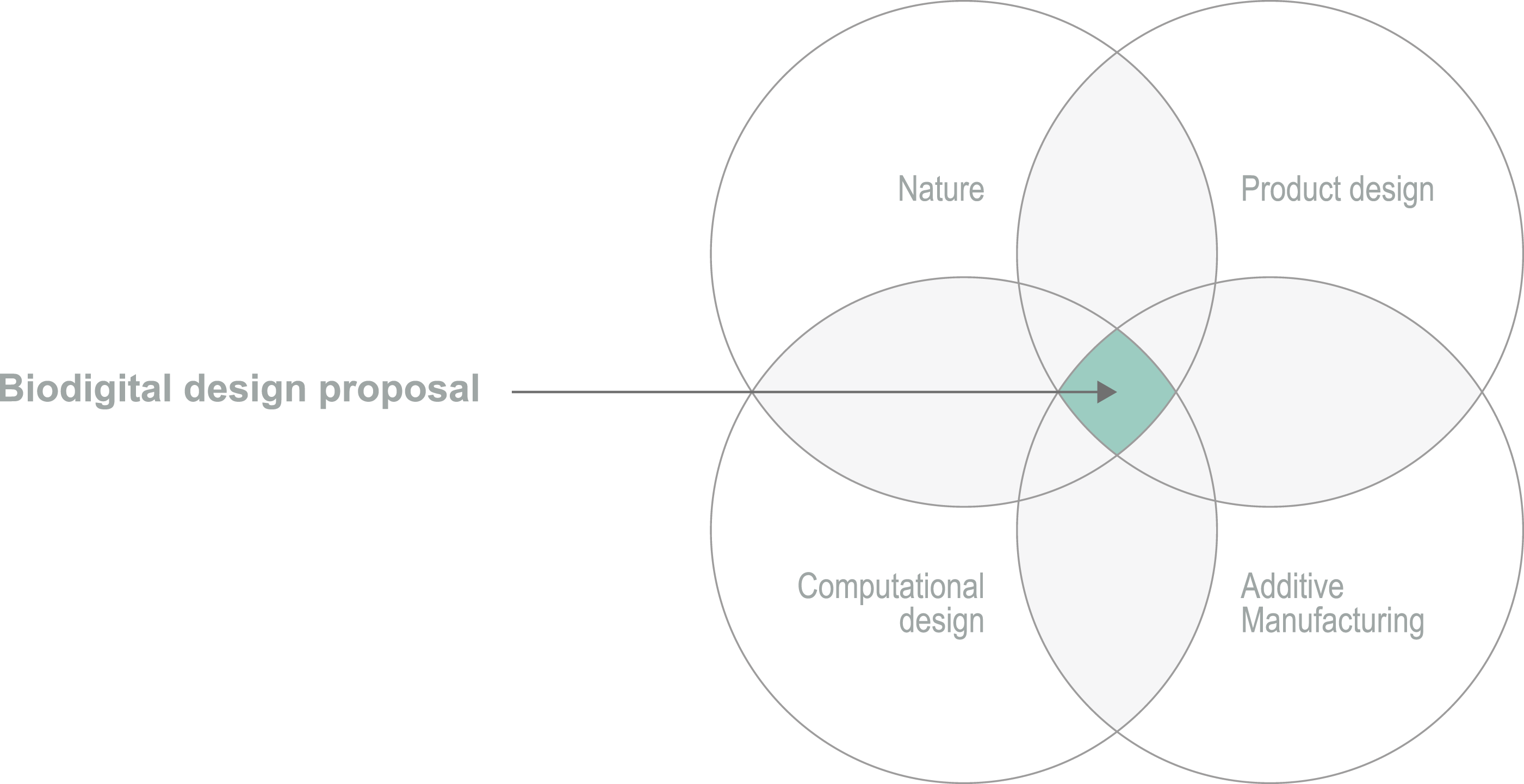
Research proposal, methods, and techniques
This project aimed to extract three-dimensional growth patterns from nature to be integrated into product design processes through the synergy of CD and AM. In regard to the CD, the possibility to generate different alternatives of complex and editable morphologies was emphasized, based on generative design idea (GD); according to Caetano et al. 11 the GD approach is a method based on algorithmic rules, in some cases involves evolutionary processes to originate design alternatives, as a result complex geometries are obtained, shapes that are not easily predictable. Regarding to AM technology, to fabricate complex geometries (impossible to be made through conventional techniques) and without molds, high accuracy and obtain 1:1 scale functional prototype. With this idea that integrates conceptual, morphologic and technological variables from the beginning of the creative process, it is expected dynamically to evaluate the stress performance of different design options. 12
An applied research project was proposed with a transdisciplinary approach, an empirical-experimental method, a combination of analog and digital tools, and the use of quantitative analysis. Regarding a nature-based design, the method by induction was used, in which a phenomenon or system in nature is studied and then possible applications in design are sought,
13
organism level was used.
14
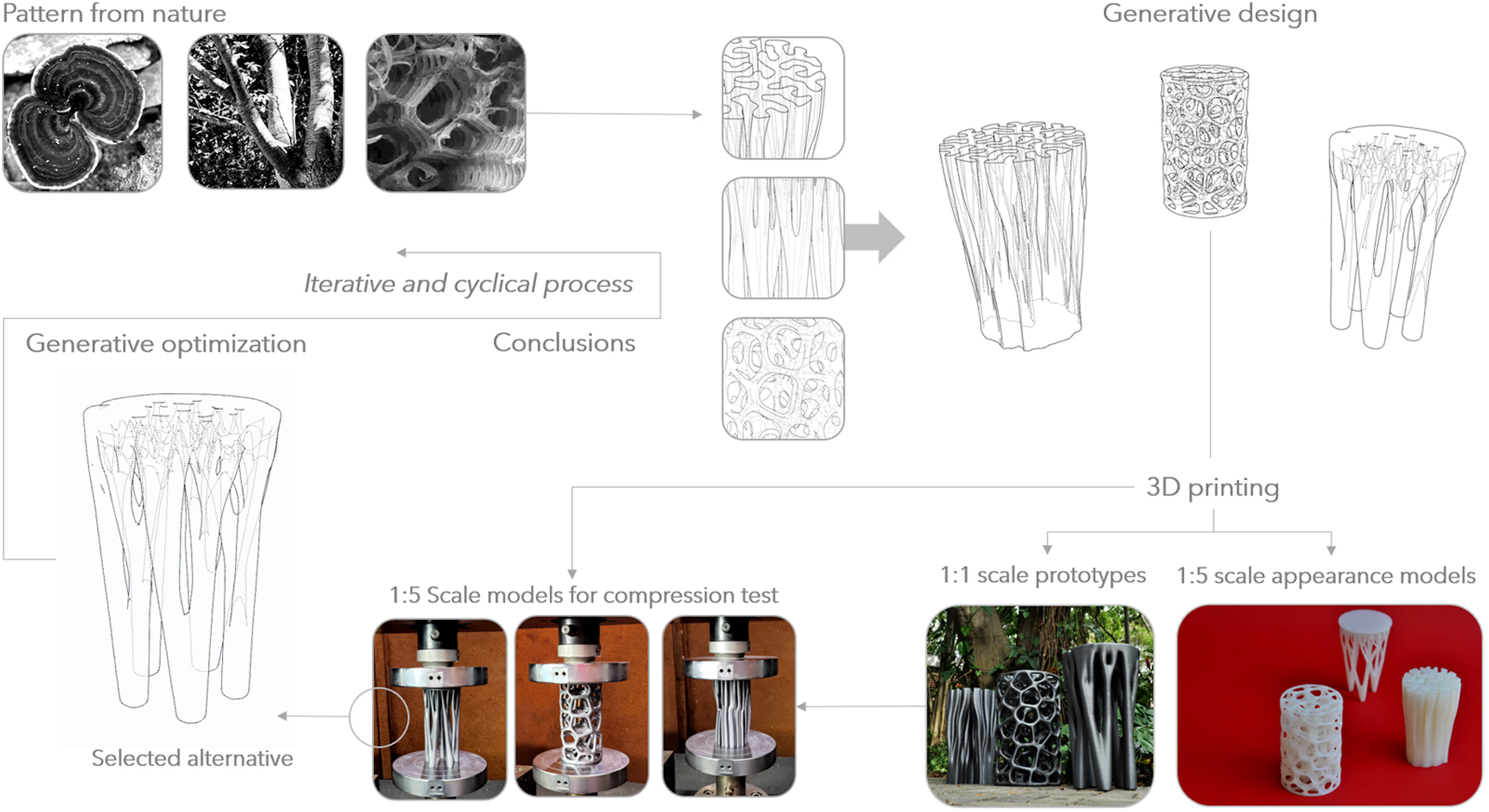
In the Figure 2 the methodological sequence can be seen with this stages and activities
1
Pattern from nature selection,
2
Generative design,
3
3D printing, including 1:5 scale models and 1:1 scale prototypes,
4
Compression test, using 1:5 scale samples, and
5
Generative optimization. It was important a constant experimentation, a non-linear process of trial and error, to do and do again, in a cyclical sequence of activities, integrating conceptual ideas with technical knowledge and with all this experience is possible to obtain a permanent learning.12 Methodological sequence.
12
Regarding software technologies, generative 3D models, topologic optimization, and finite elements analysis Grasshopper© were used in the Rhinoceros© environment, as well as different plug-in such as Kangaroo©, Dendro©, Topos©, and Millipede©. Two additive manufacturing technologies were used: Fused Deposition Modeling (FDM) and Digital Light Processing (DLP). The Creality 3D Ender-3(FDM technology) 3D printer was used, the material used was Polylactic acid -PLA-, UNIZ SLASH 2 (DLP technology) 3D printer with thermally cured epoxy resin was used and finally the files to print were processed in UltiMaker Cura©. Concerning mechanical properties testing, Instron 5582 Universal Testing Machine was used at Universidad Pontificia Bolivariana, in Medellín, Colombia.
Results
Pattern from nature
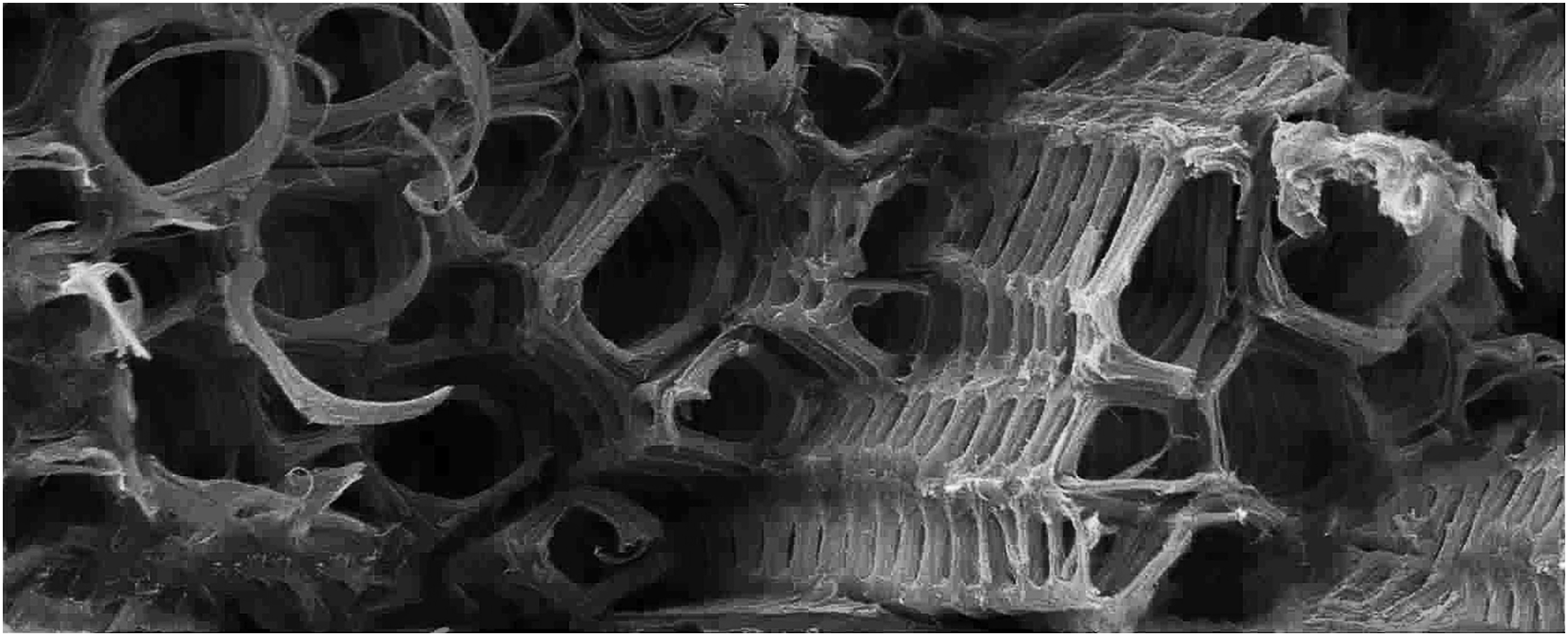
Three morphologies from nature were selected. They met the requirements of being morphological three-dimensional growth patterns with different morphological characteristics between them, from different environments and with feasibility to be applied to the target object (stool). The chosen patterns were differential growth, branching and the Voronoi diagram. Differential growth occurs in the plant kingdom and corals (animals called polyps or zooids), its non-homogeneous growth is due to the non-uniform structure of materials or intercellular transport, physical limitations in cell walls force adjacent cells to deform in a coordinated manner generating complex and irregular morphologies. Branching is a pattern that occurs in different living beings in nature, for example, in the vegetable kingdom, for example, in species such as plants and trees. In this case they give structural support to the organism, allow maximum exposure to the sun and distribute nutrients; they start from a trunk, from which different branches fork at angles that generally vary between 75° and 90°, in this project plants and trees were chosen as branching morphological models. The Voronoi diagram is a morphological pattern that can be found in different organisms, on a micro and macro scale. The pattern selected is a kind of Voronoi three-dimensional growth and is found at the microscopic level in different organisms, for example, bones, cactus, coconut, and others. In the case of bones this is a light and structurally efficient structure because it has more volume in areas that requires greater mechanical effort, in areas that it requires less effort it has a reduced volume or is empty.
12
Figures 3 and 4. Three-dimensional growth patterns, from left to right: differential growth and branching pattern. © Alberto T. Estévez, section of coconut shell, 2008: photo with a scanning electron microscope, it allows to see the three-dimensional Voronoi diagrams because of this pattern also appear on the walls perpendicular to the section.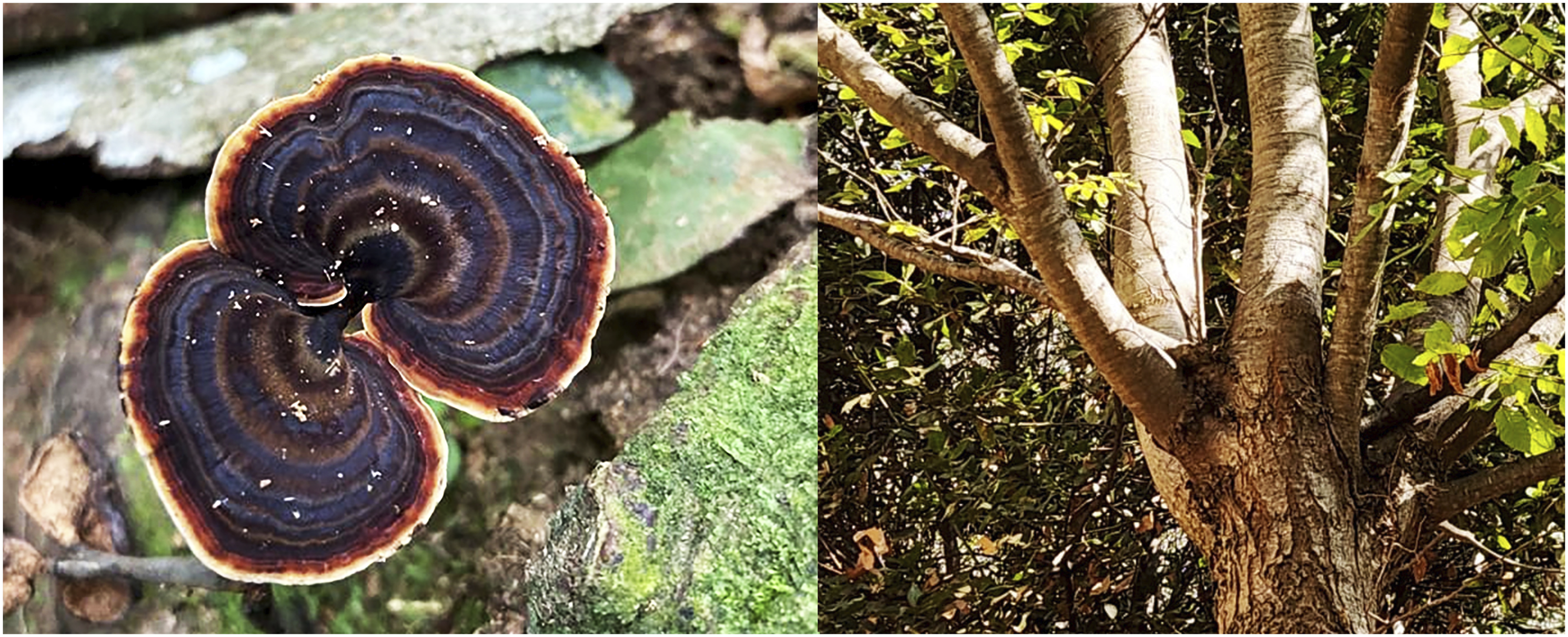
Generative design
To develop the generative design stage of three-dimensional growth patterns chosen, an algorithmic process was carried out in Grasshopper©. These morphologies were integrated into a cylindrical volume of 420 mm high and 300 mm in diameter, which correspond to dimensions of target object (stools), the algorithms can be seen in the SIGraDi 2022 conference text.
12
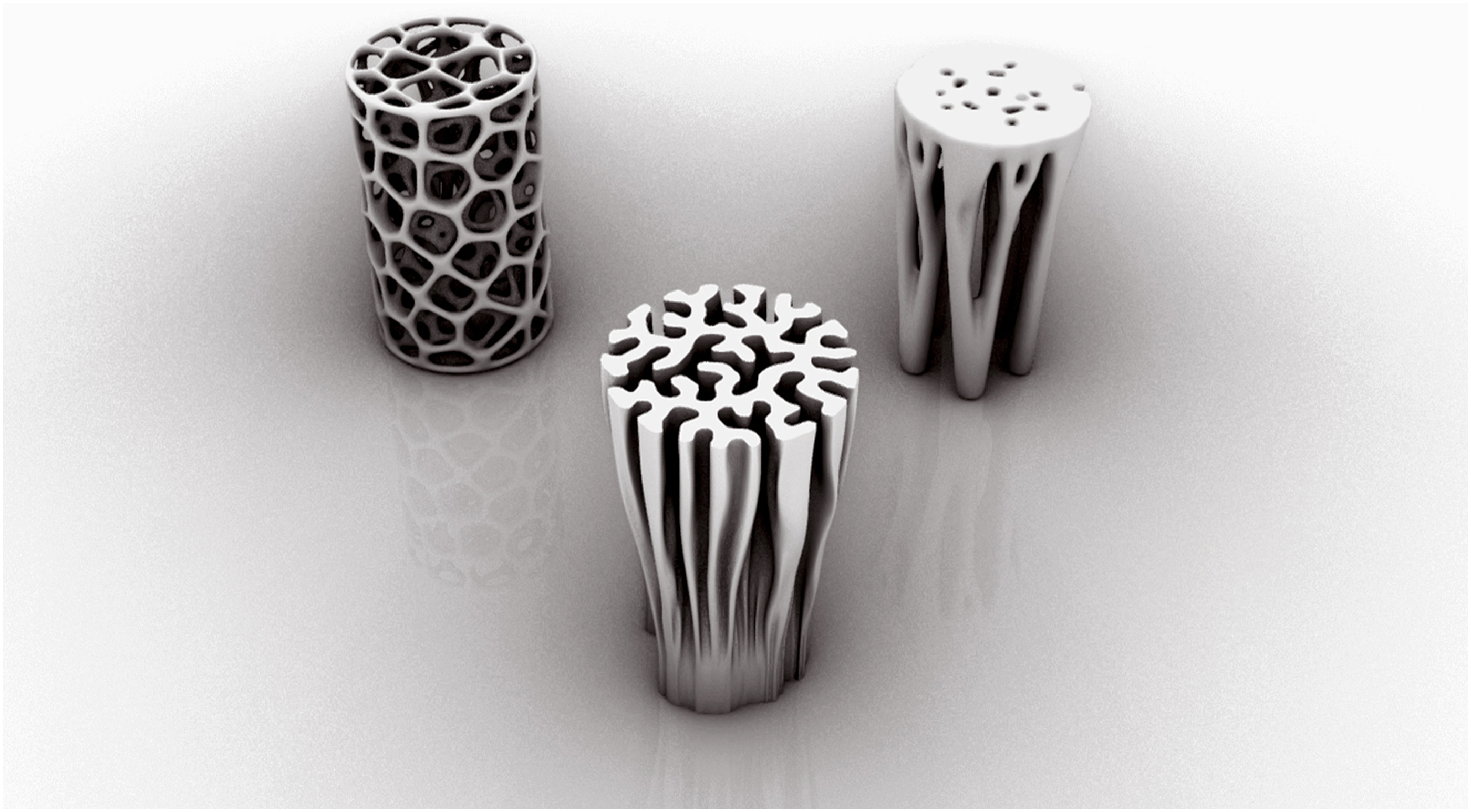
In Figures 5 and 6, the 3D models obtained can be seen. 3D models of three patterns based on nature. 3D models of three patterns based on nature.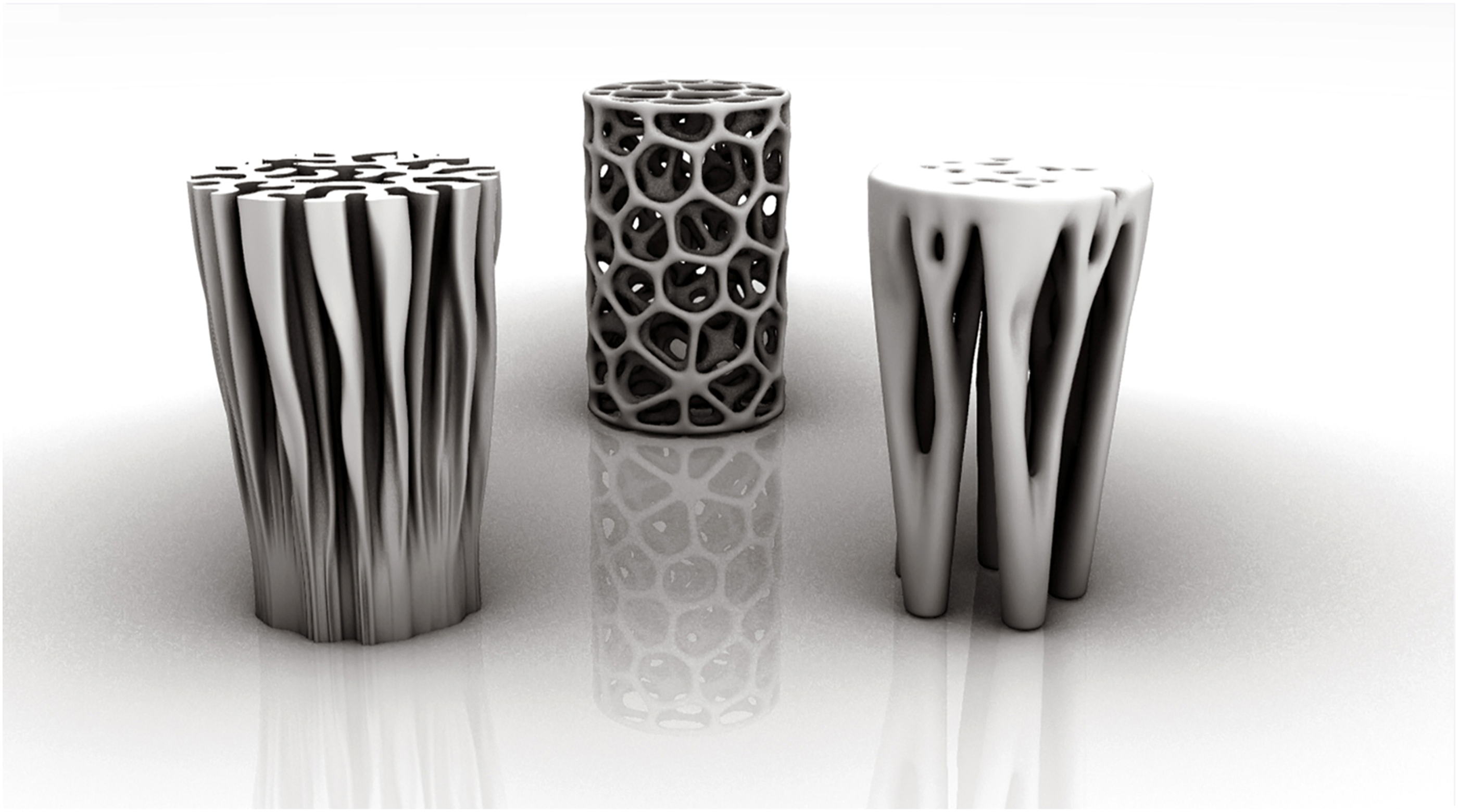
Materialization process
1:5 scale appearance models
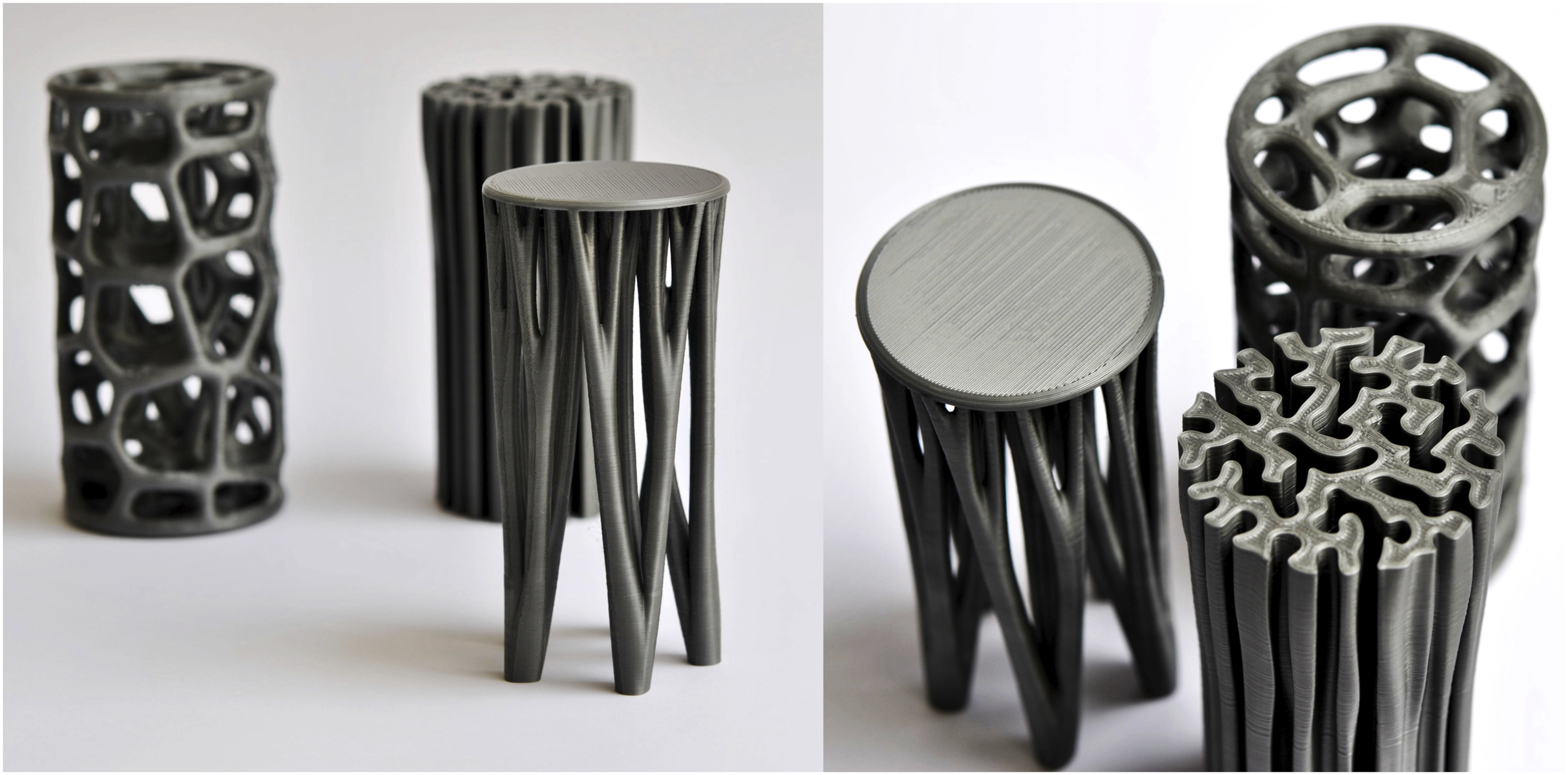
In Figure 7, 1:5 scale models can be seen. These pieces were made as a first approach, aiming to see their appearance, the fabrication process was made through Digital Light Processing (DLP) technology and using thermally cured epoxy resin. The result showed clearly the morphologies designed with high accuracy. 1:5 scale models made through digital light processing (DLP). 3D printing process at EQ3D company, Medellín, Colombia.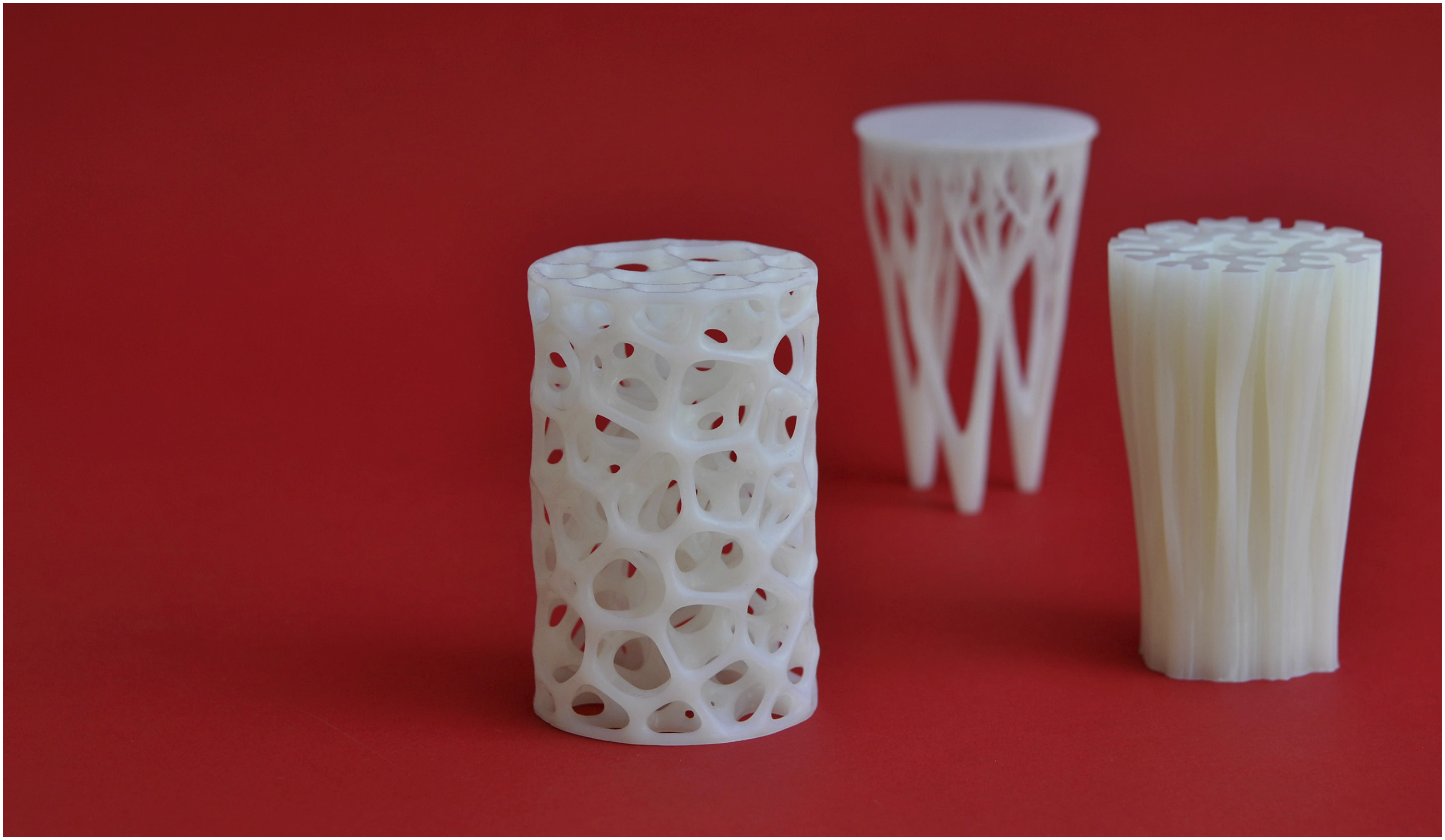
1:1 scale prototypes and user test
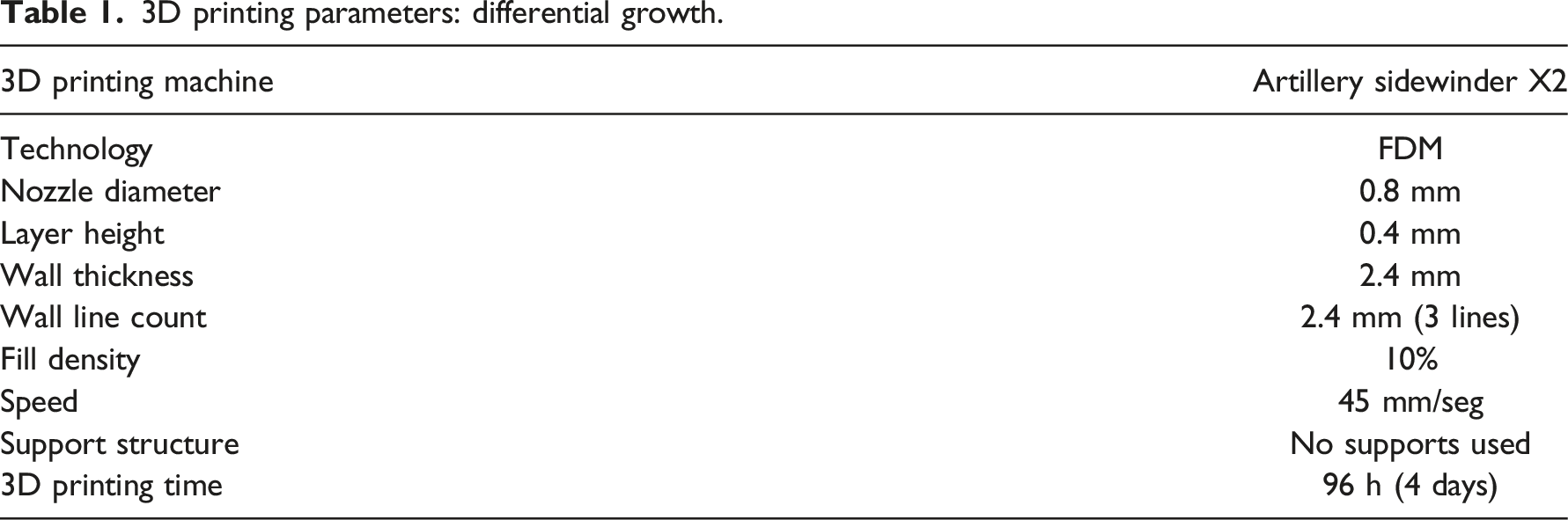
3D printing parameters: differential growth.
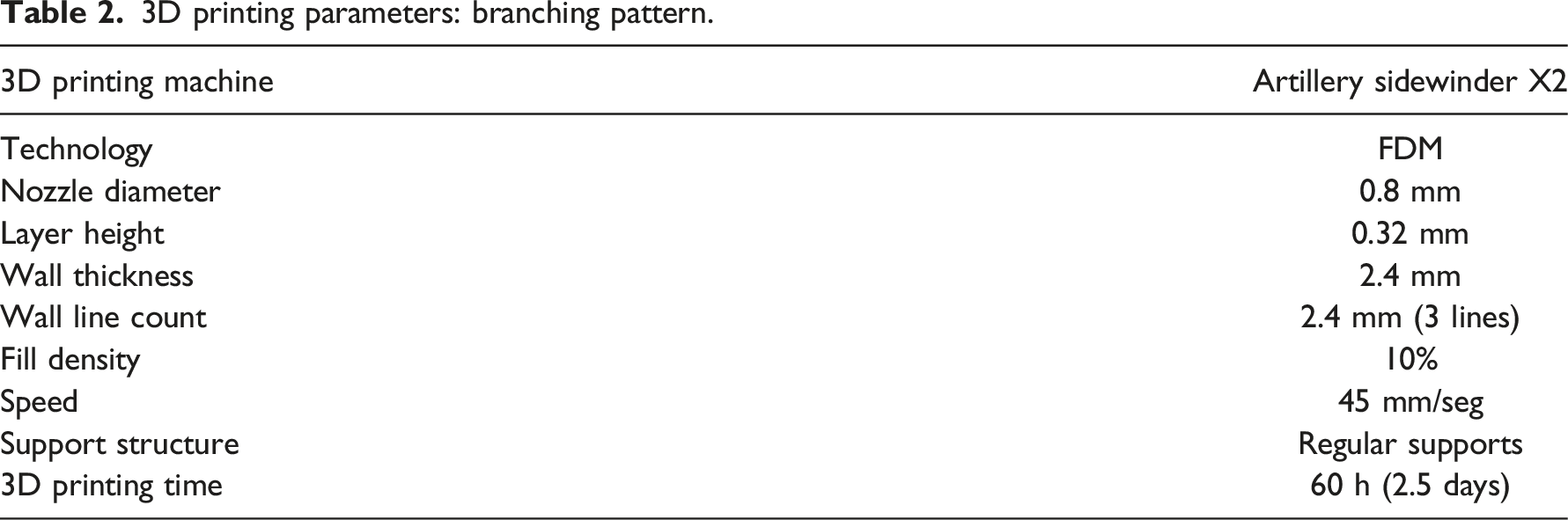
3D printing parameters: branching pattern.
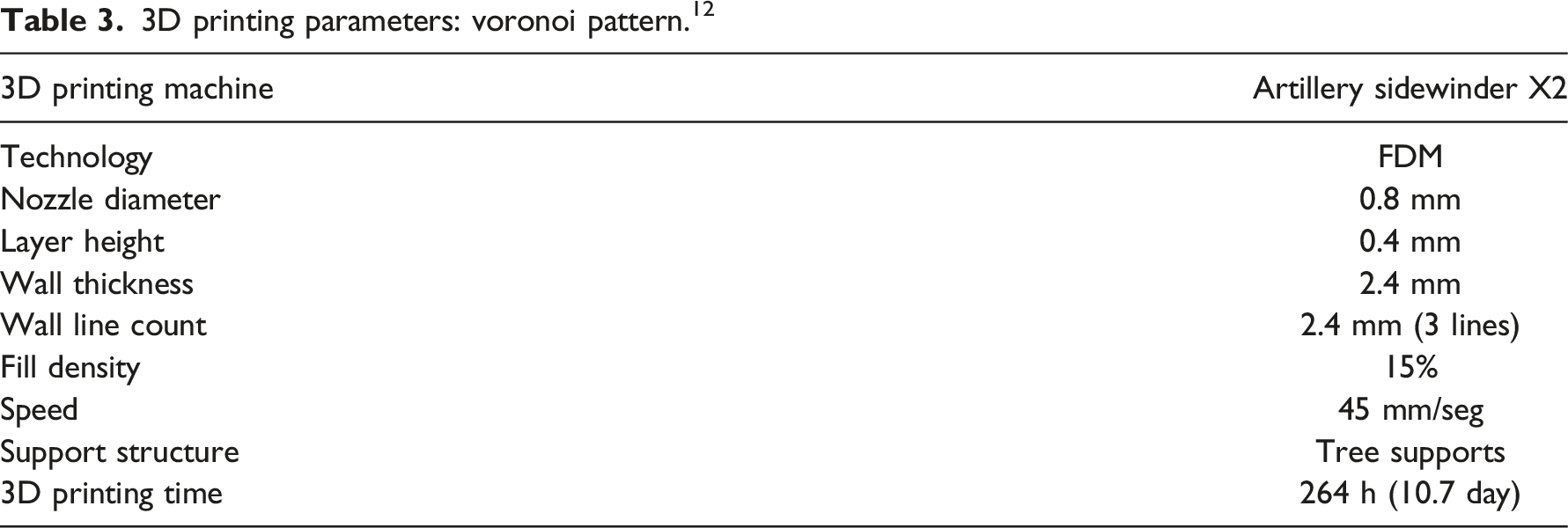
3D printing parameters: voronoi pattern. 12
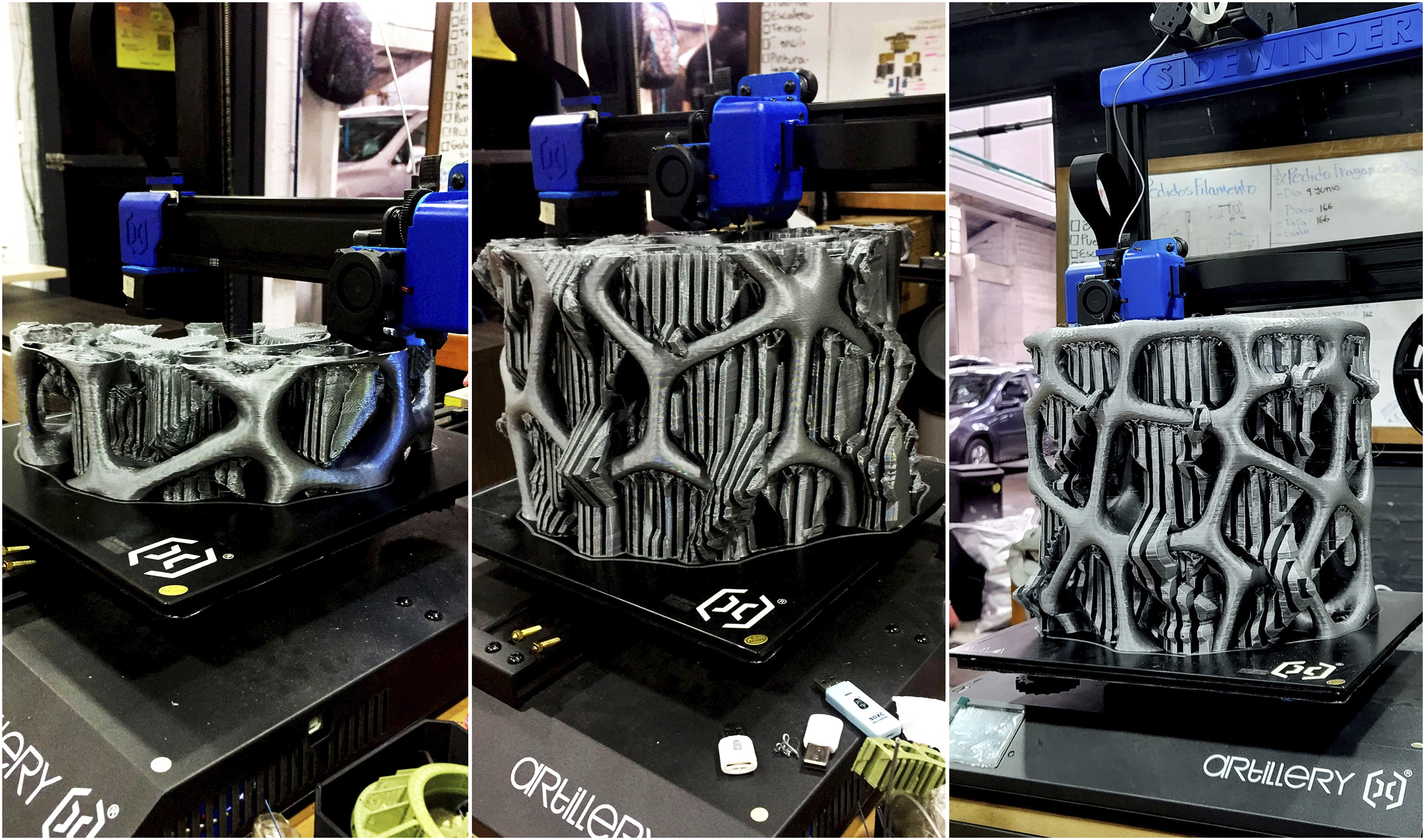
Voronoi diagram stool 3D printing process, Fused Deposition Modeling (FDM) at Polymasters company, Medellín, Colombia. 12
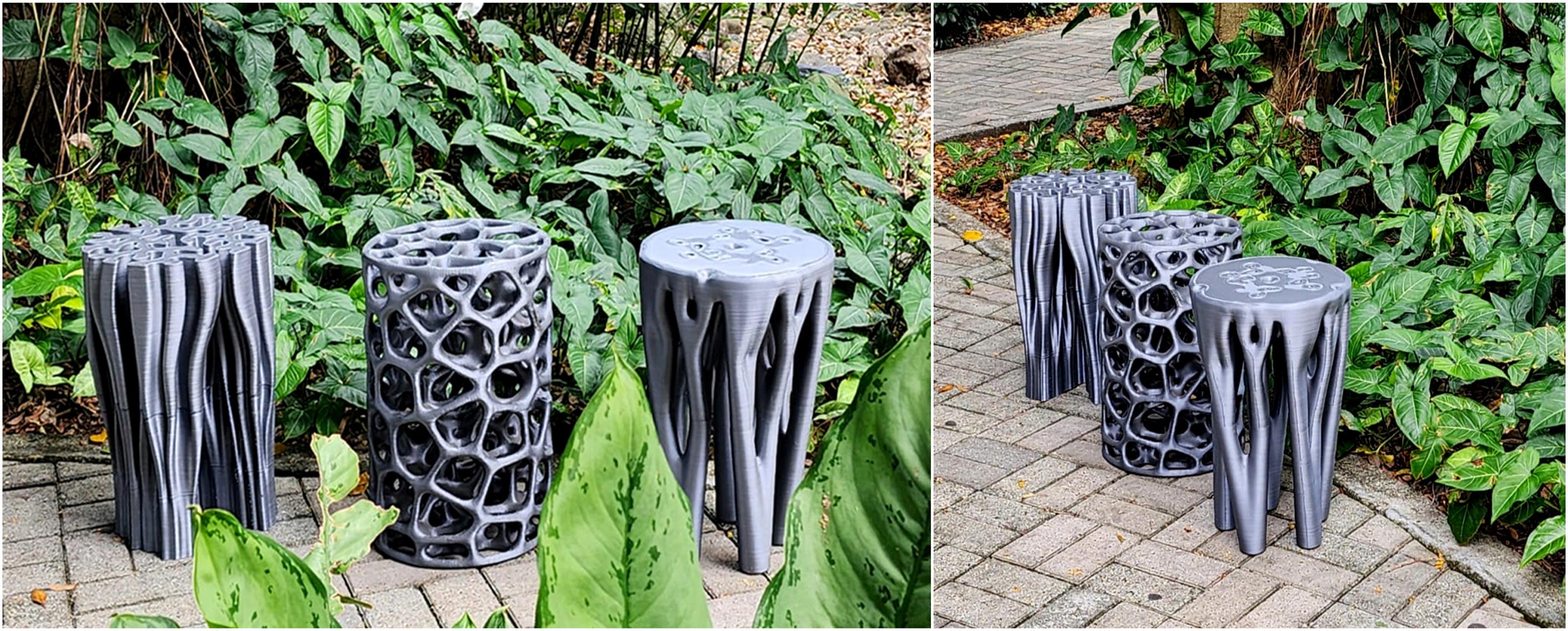
1:1 scale prototypes, growing morphologies series. Photos at Universidad Pontificia Bolivariana, Medellín, Colombia.
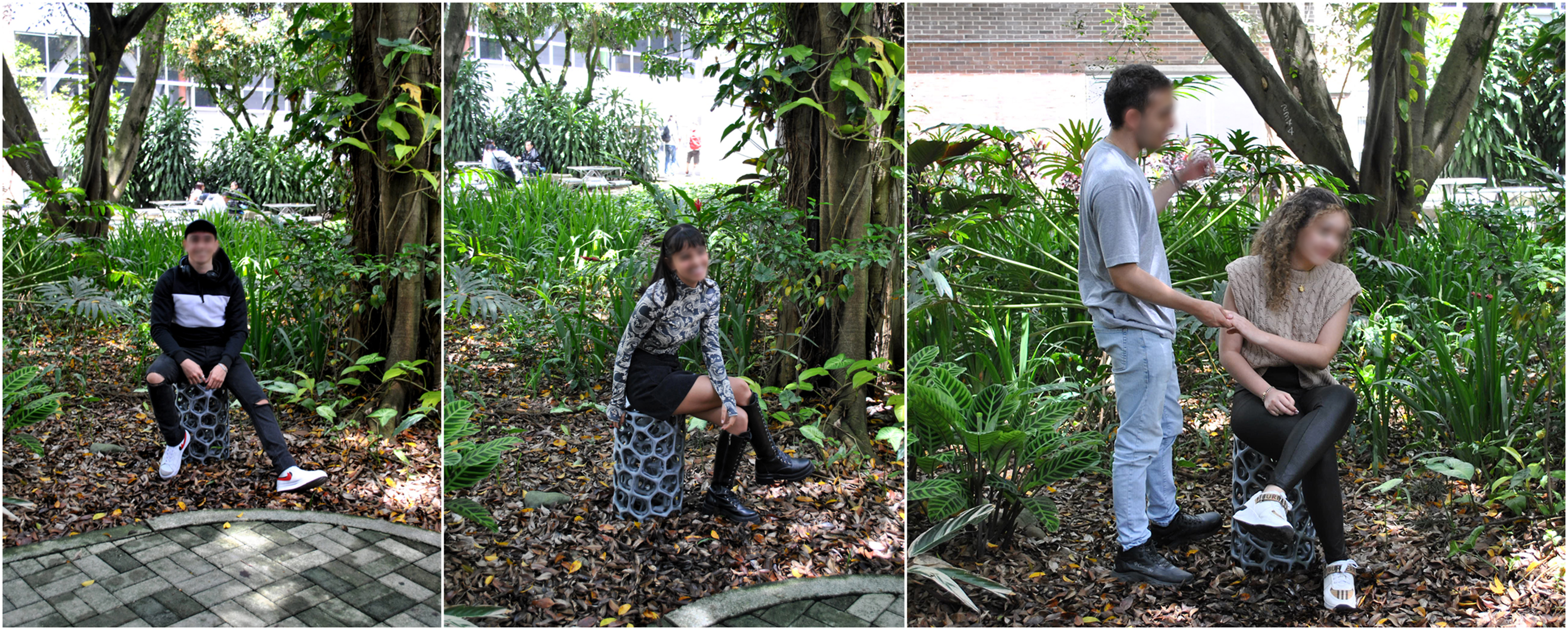
User test with voronoi pattern stool. Photos at Universidad Pontificia Bolivariana, Medellín, Colombia.
3D printing: comparative information.

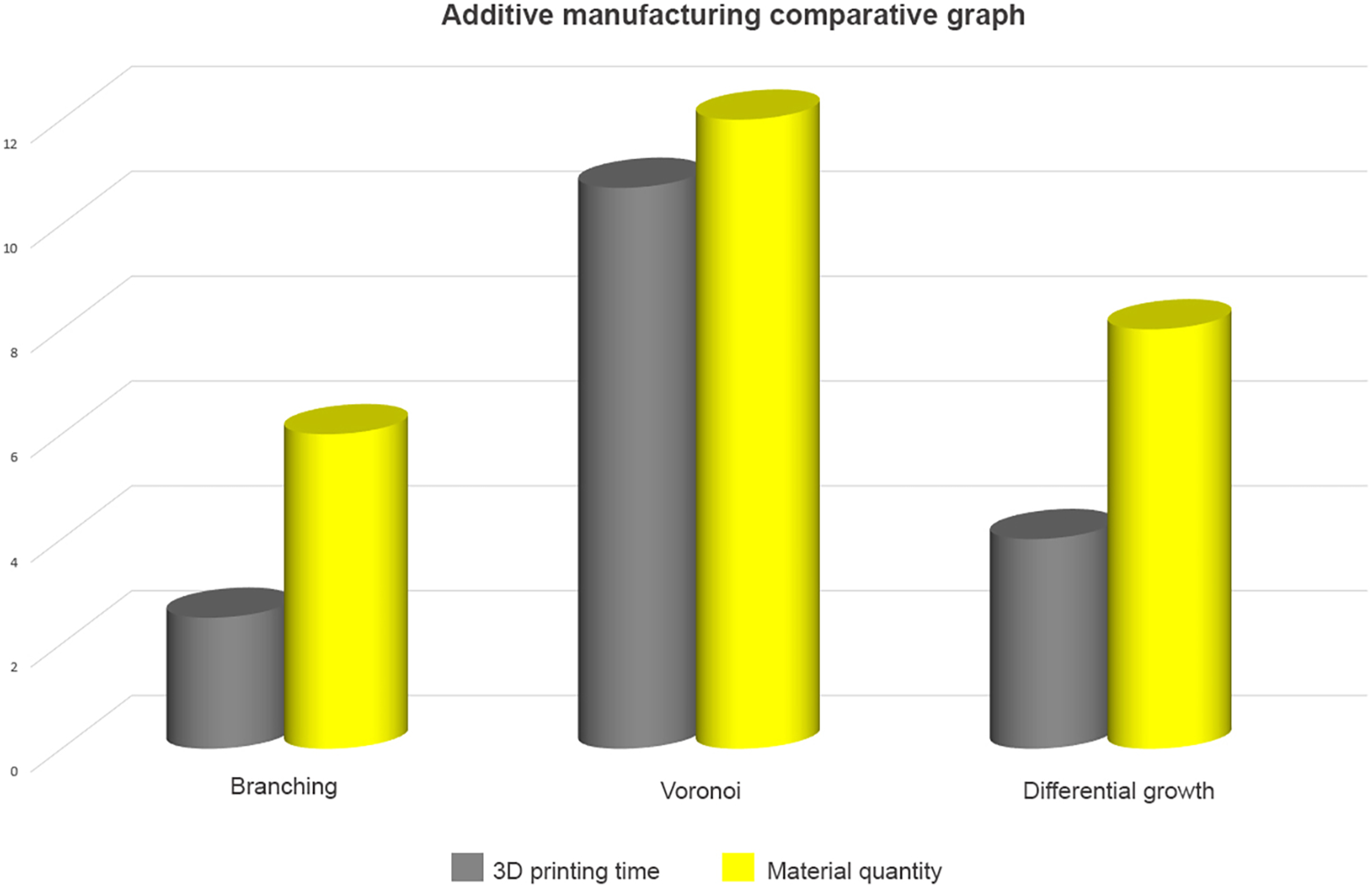
Three patterns comparative graph: 3D printing time and material quantity. Time is measured in days and material in kilograms.
Compression test
A compression test was made at Materials Laboratory, Universidad Pontificia Bolivariana, in Medellín, Colombia. Several parameters and concepts were considered for the stress test, such as the stress formula, maximum specific stress and dimensions. It was decided that the compression test would be carried out, because compression is the main effort to which the final object will be subject to. Below, effort formula (1) and maximum specific stress (2) can be seen.
12


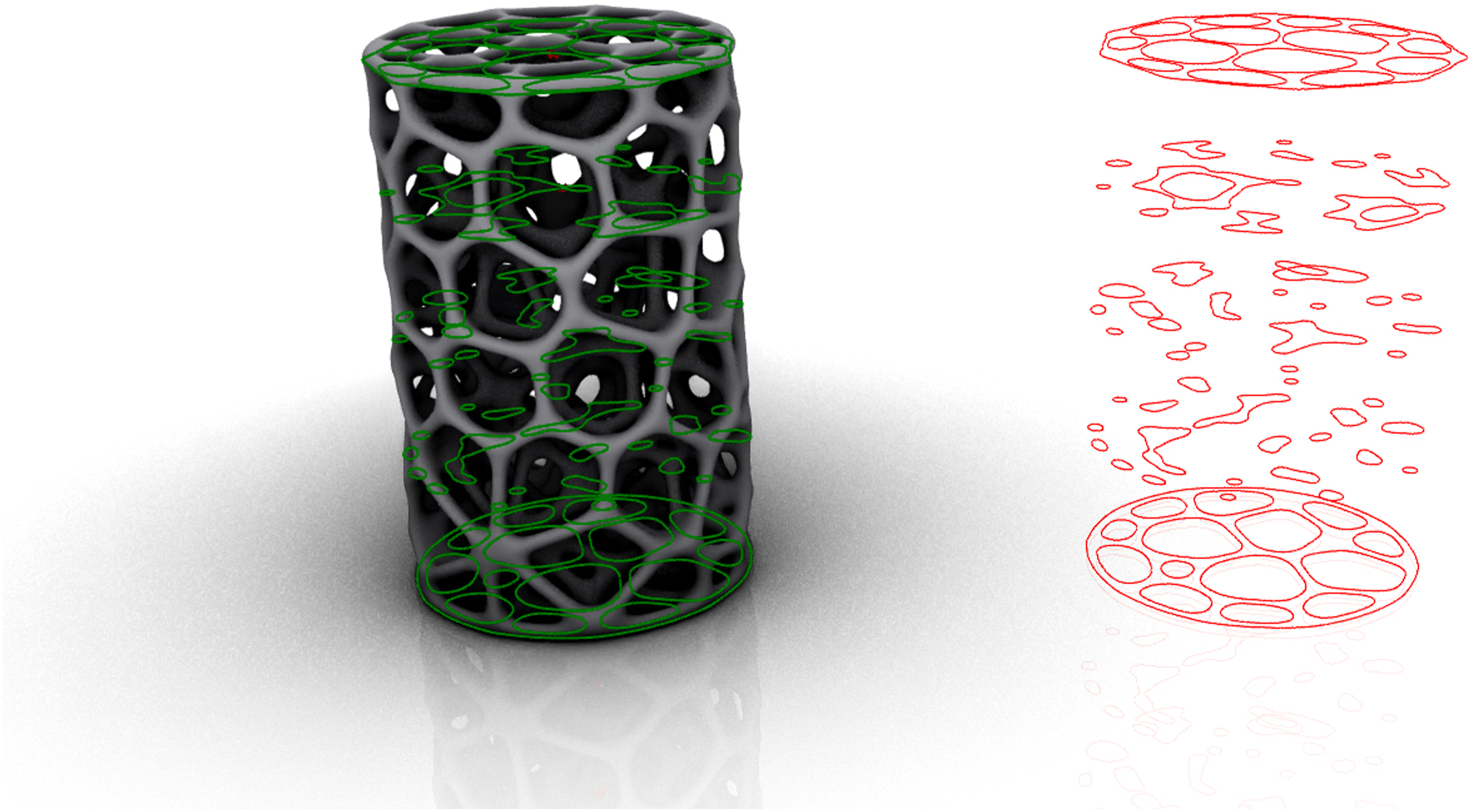
Considering that horizontal sections of each sample are different, it was necessary to define an average horizontal cross section to make the stress calculations. This average section was calculated with five cross sections for each one through of an algorithm made in Grasshopper©. The algorithm can be seen in the SIGraDi 2022 conference paper.
12
In Figure 12 can be seen an application in Voronoi pattern. Horizontal cross section of Voronoi pattern.
12
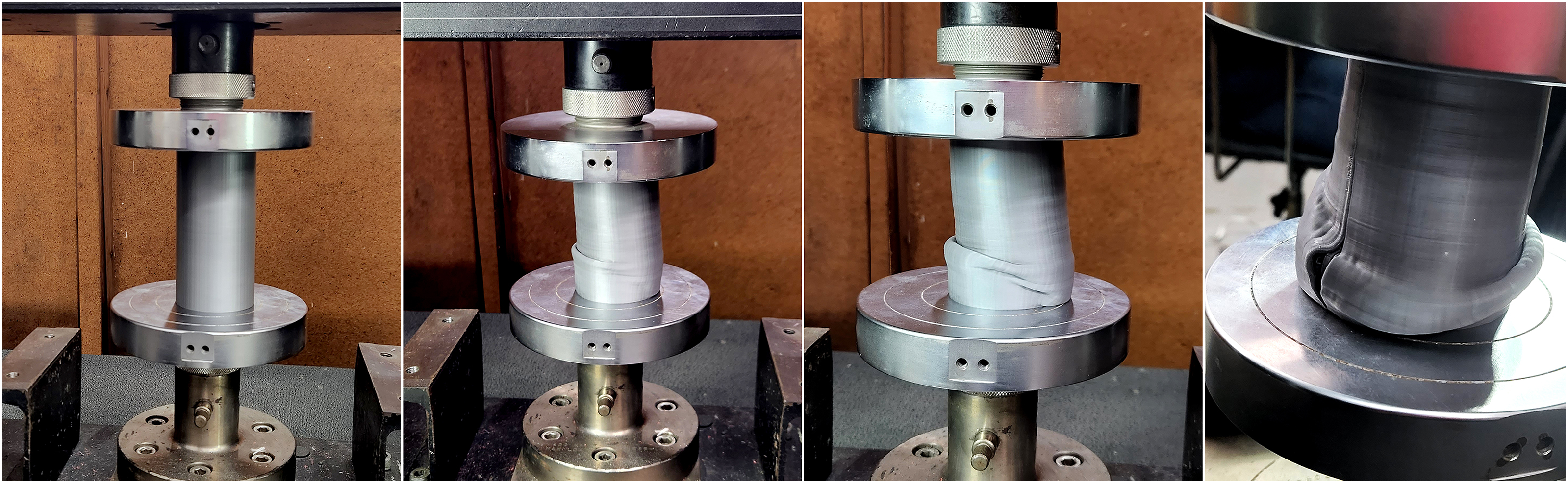
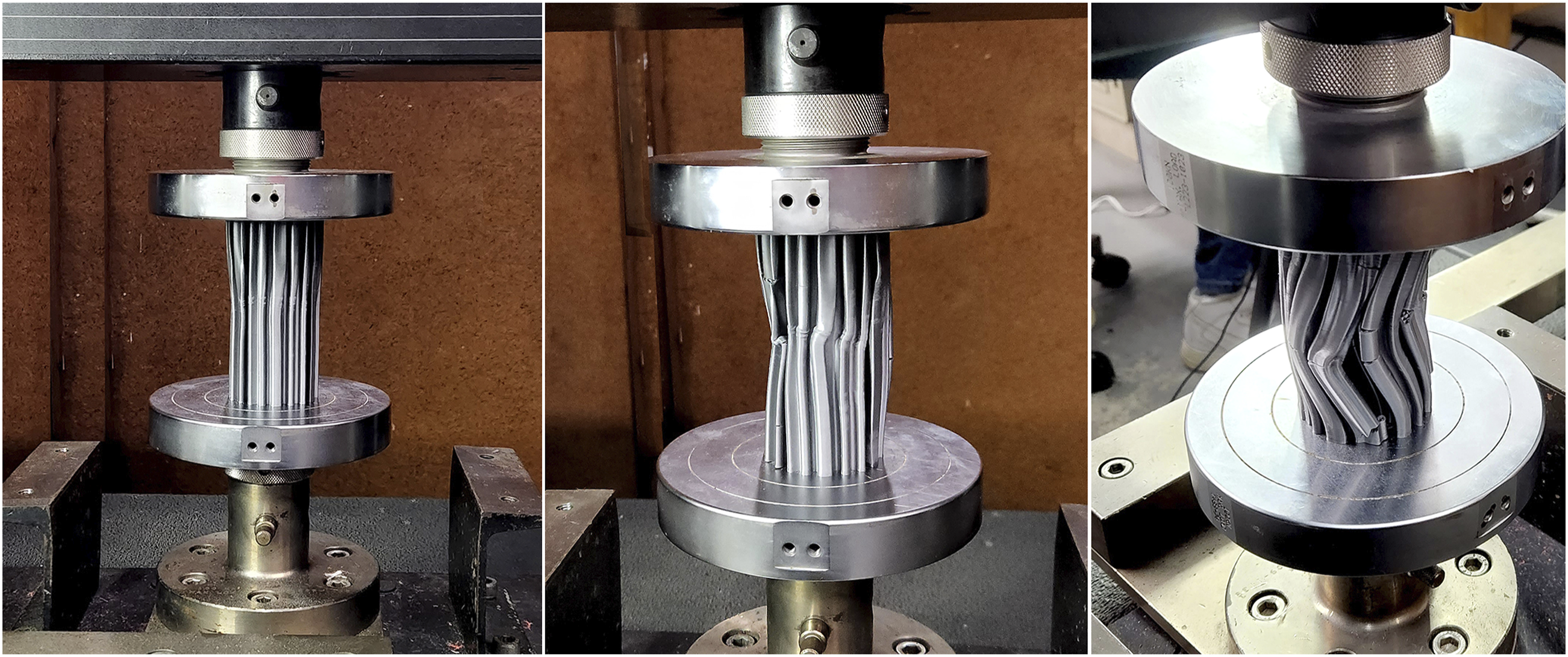
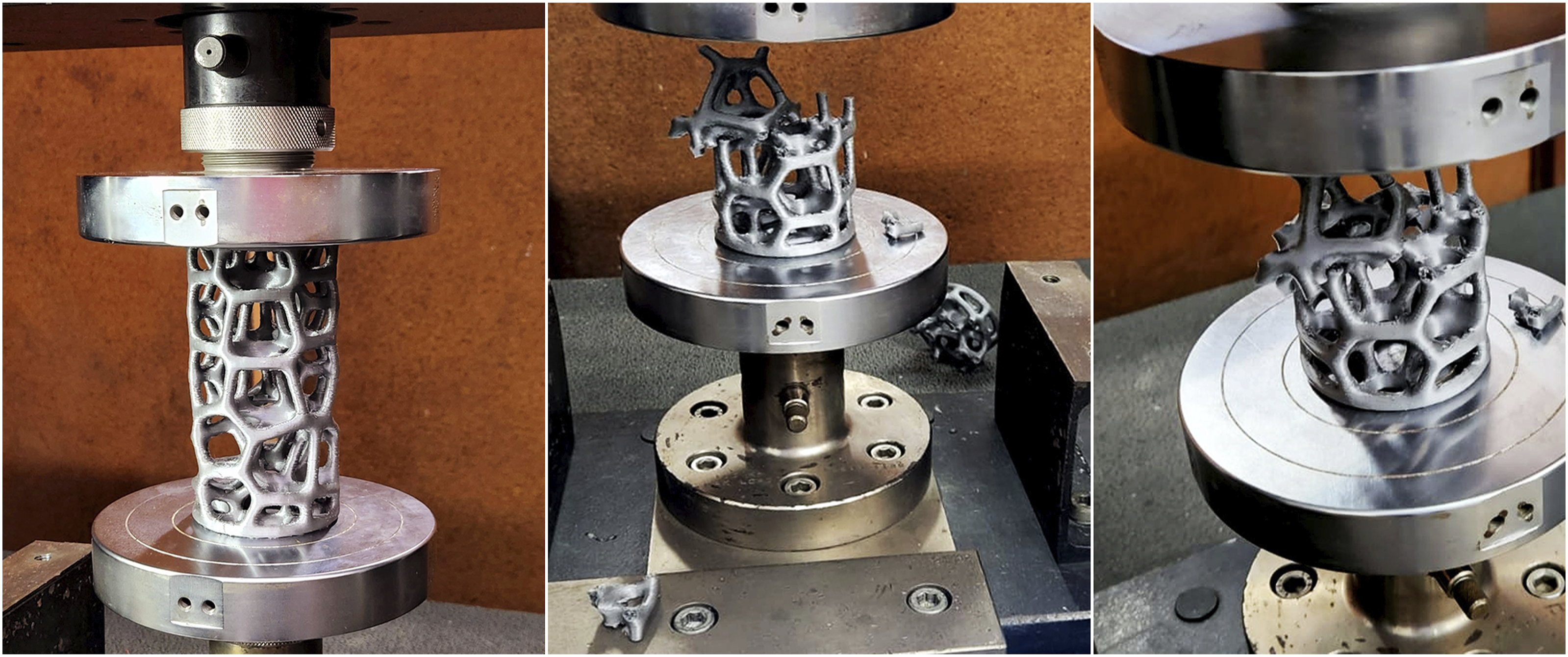
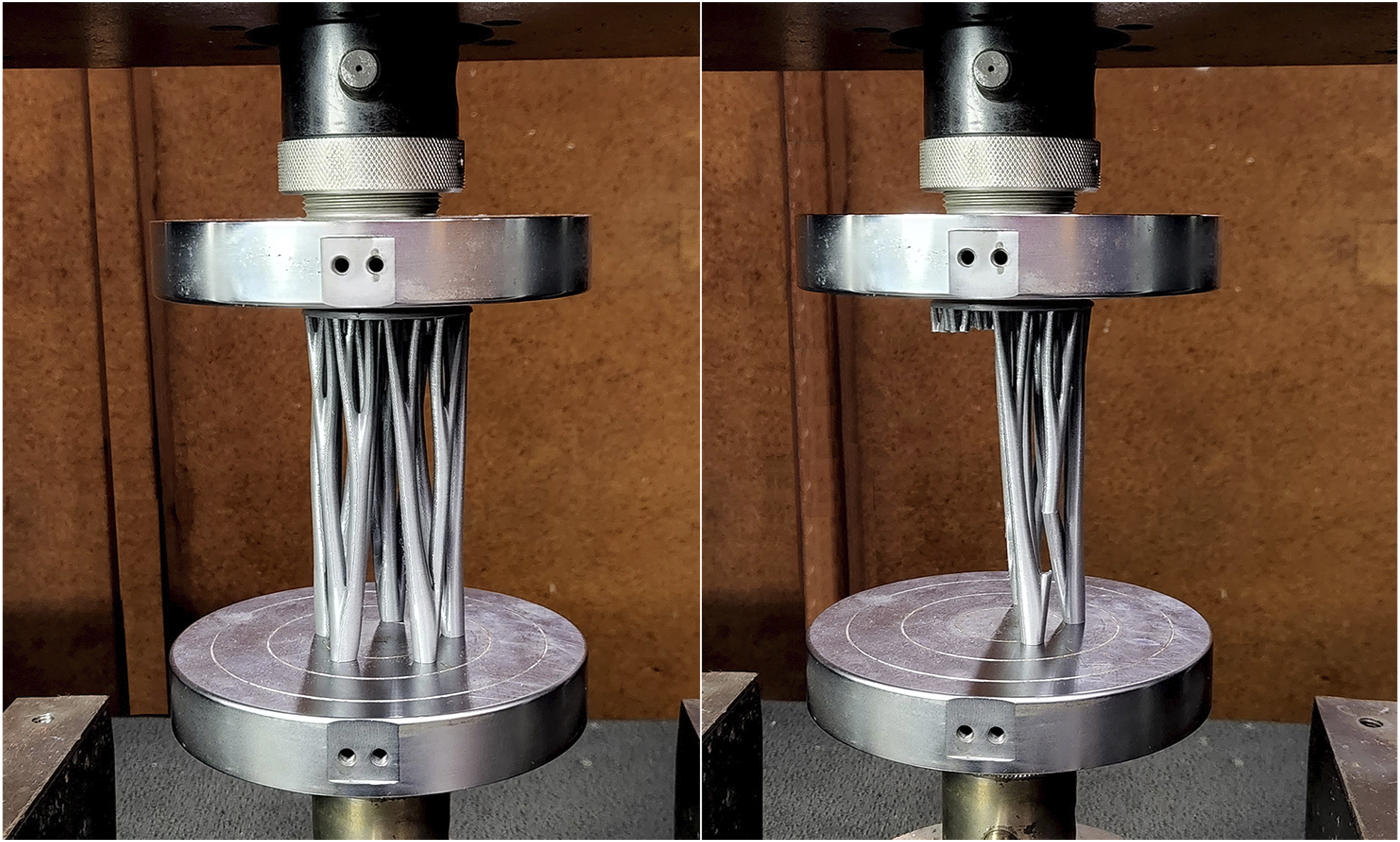
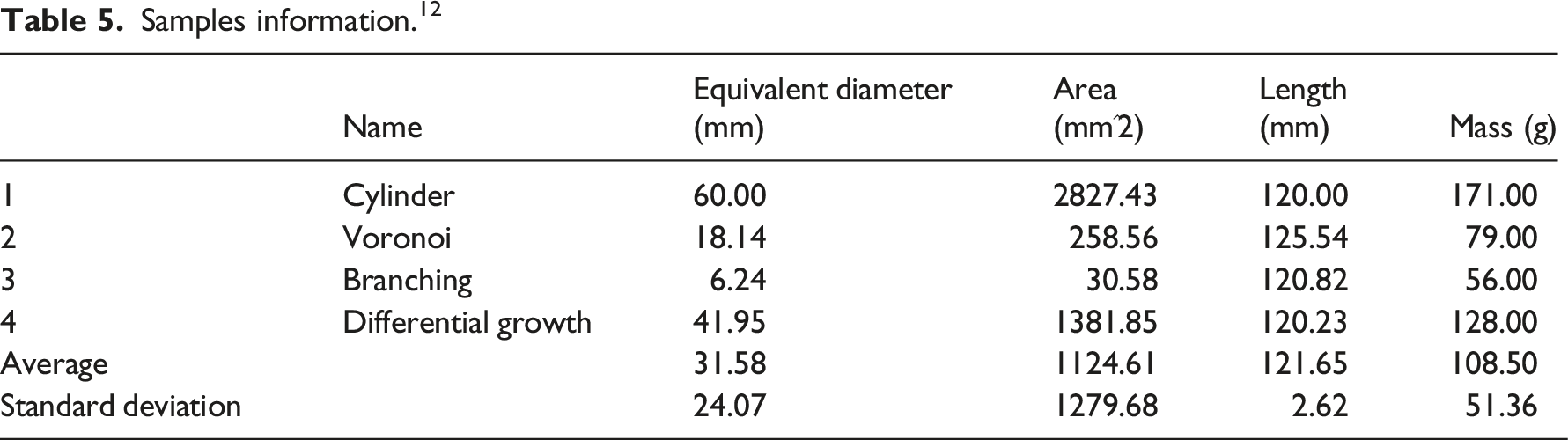
The compression test was made in Instron 5582 Universal Testing Machine, it was coupled with a 100 kN load cell, test was run at a speed of 2 mm/min. Four samples were made through DFM technology and PLA material, dimensions of 120 mm high and 60 mm diameter, one cylindrical and the three with morphologies extracted from nature; the cylindrical piece allowed to characterize this type of test with material and process chosen. From Figures 13–17 and Table 5, samples information, 1:5 scale samples and compression test process can be seen. Samples for compression test at scale 1:5, fabricated through FDM technology with PLA material at polymasters company.
12
Compression test, cylindric sample at Universidad Pontificia Bolivariana, Medellín, Colombia.
12
Compression test, differential growth sample at Universidad Pontificia Bolivariana, Medellín, Colombia.
12
Compression test, Voronoi sample at Universidad Pontificia Bolivariana, Medellín, Colombia.
12
Compression test, branching sample at Universidad Pontificia Bolivariana, Medellín, Colombia.
12
Samples information.
12
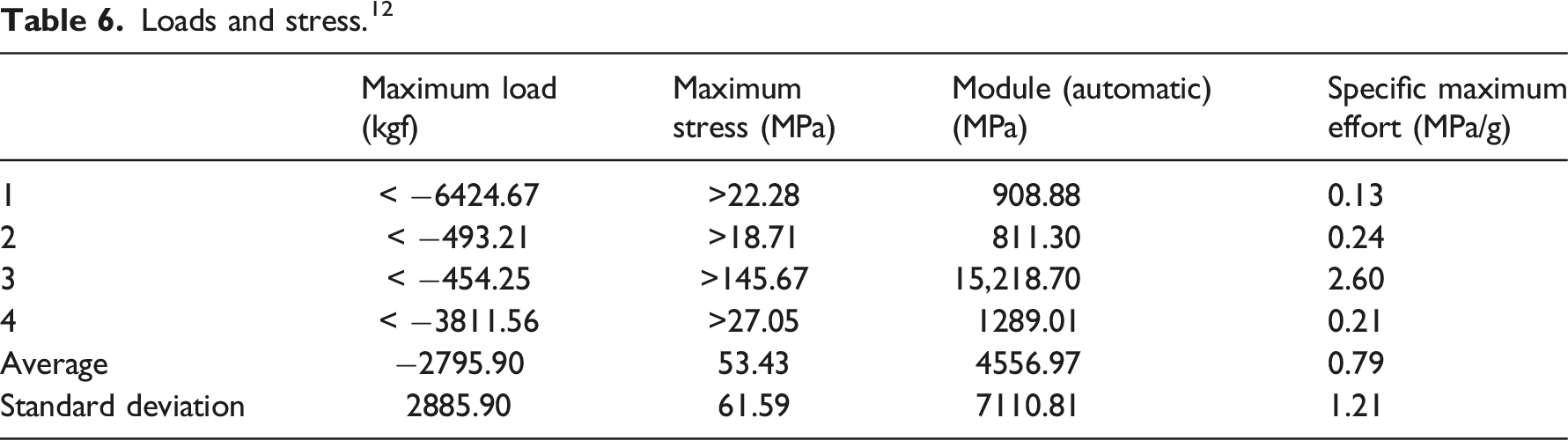
Loads and stress. 12
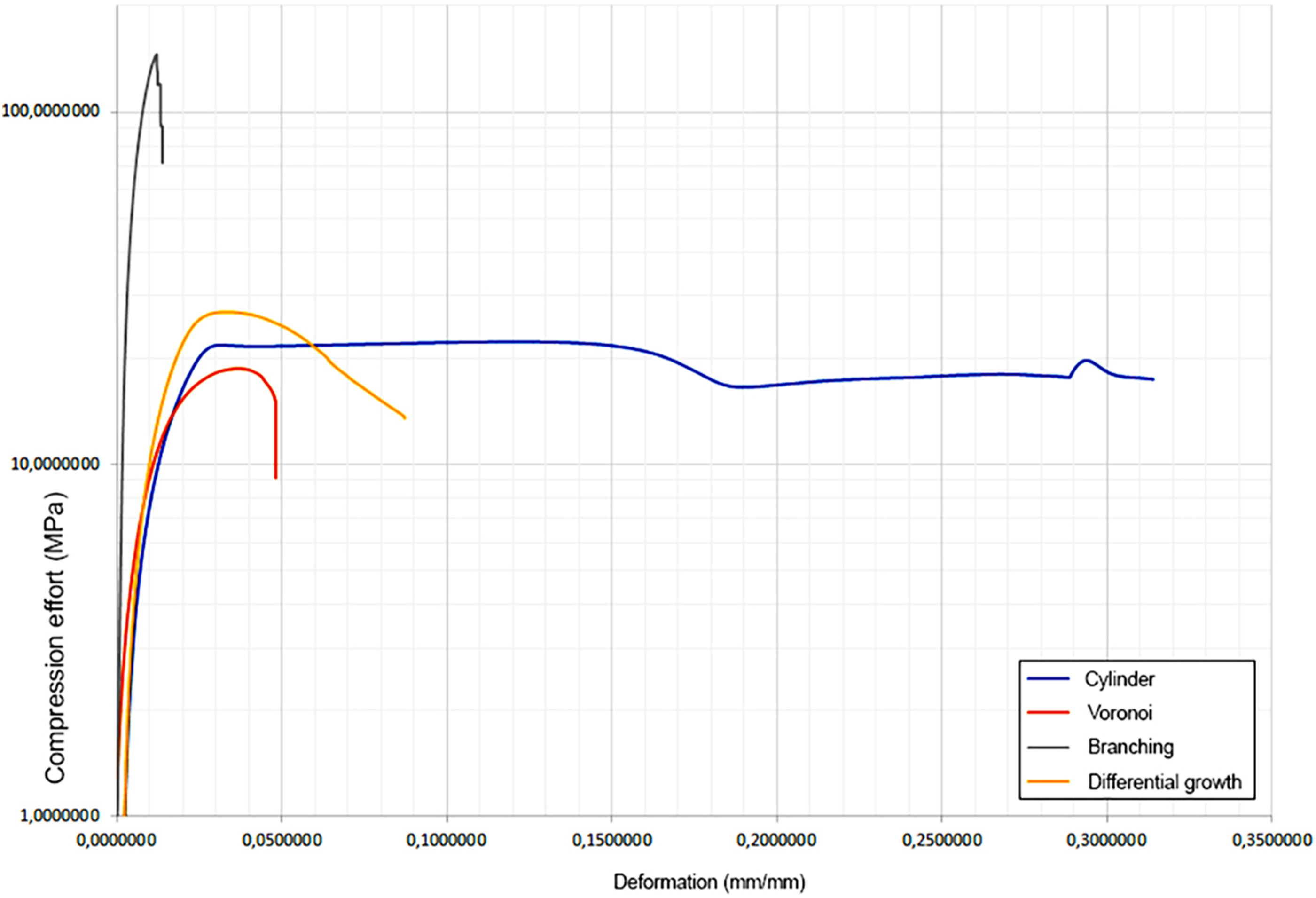
Comparative graph of stress and deformation, result of the compression test. 12
Generative optimization
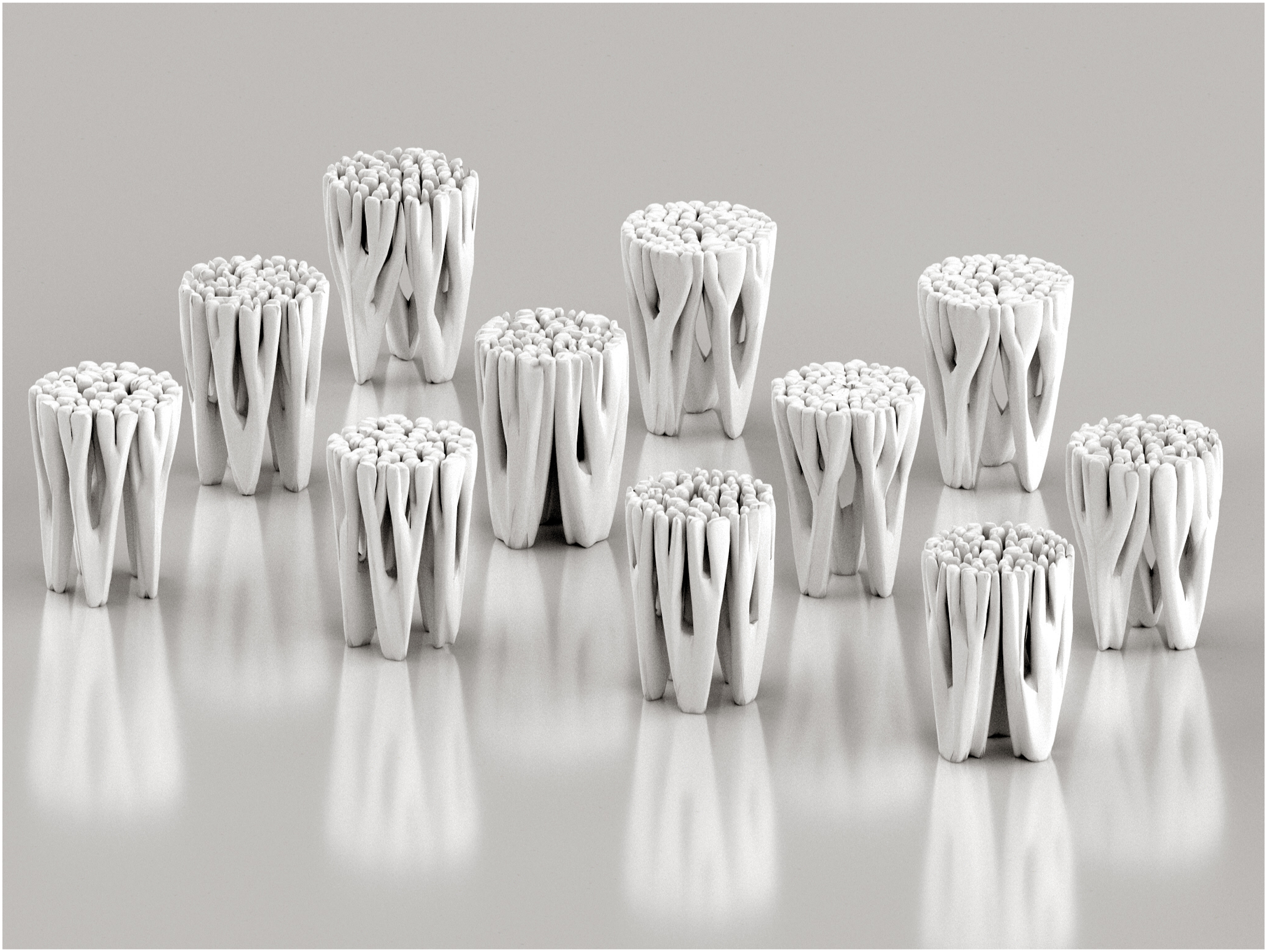
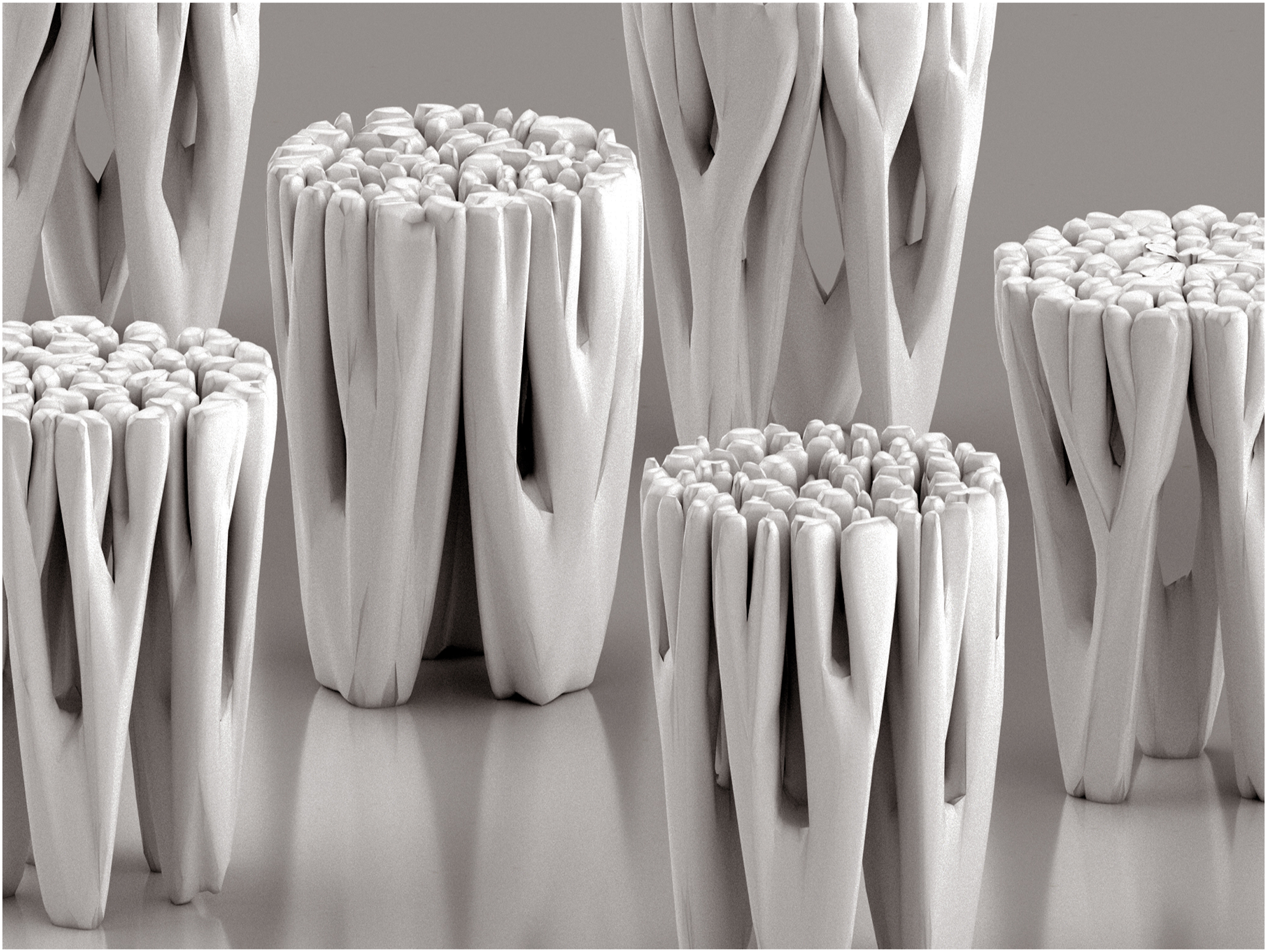
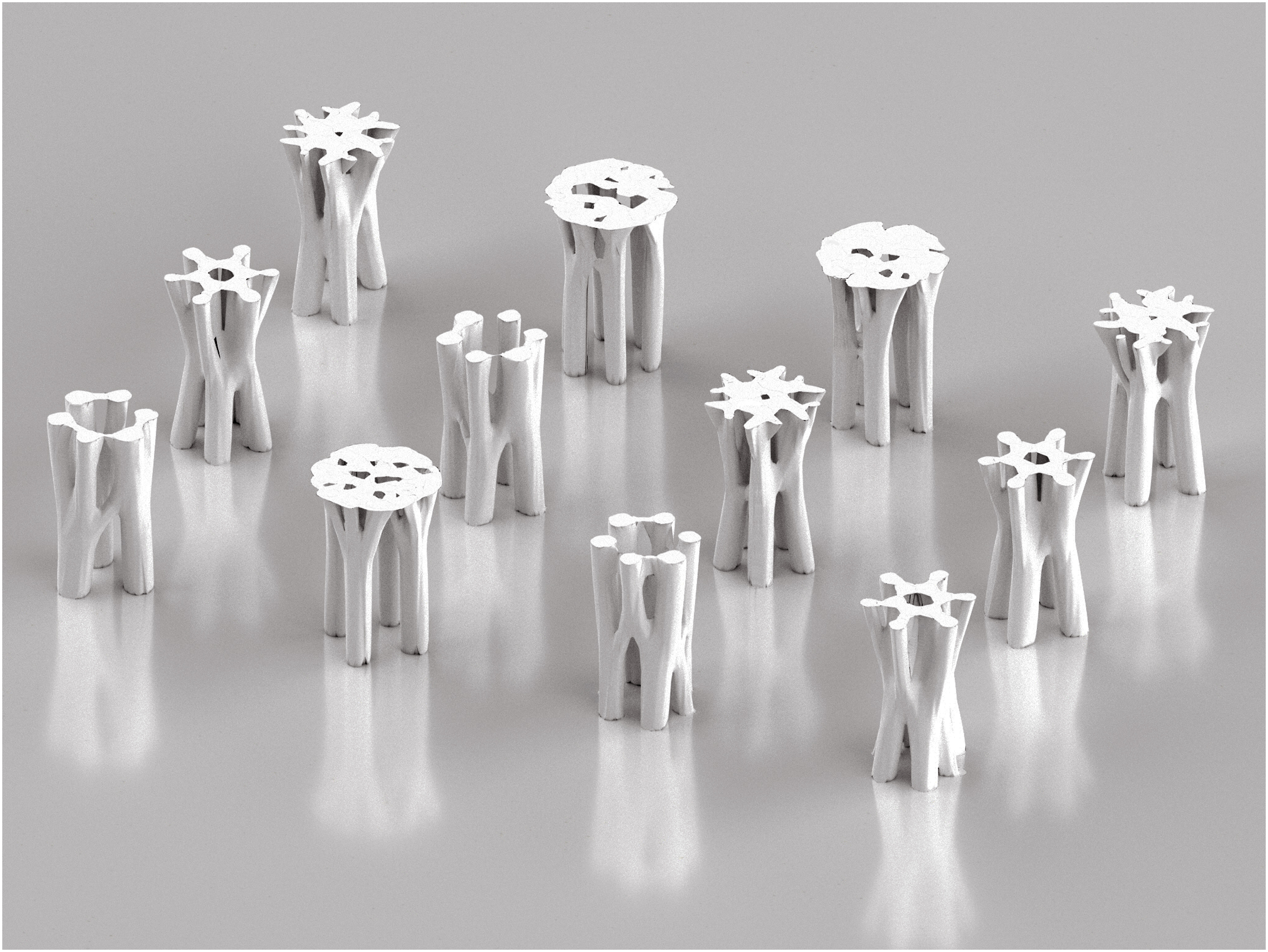
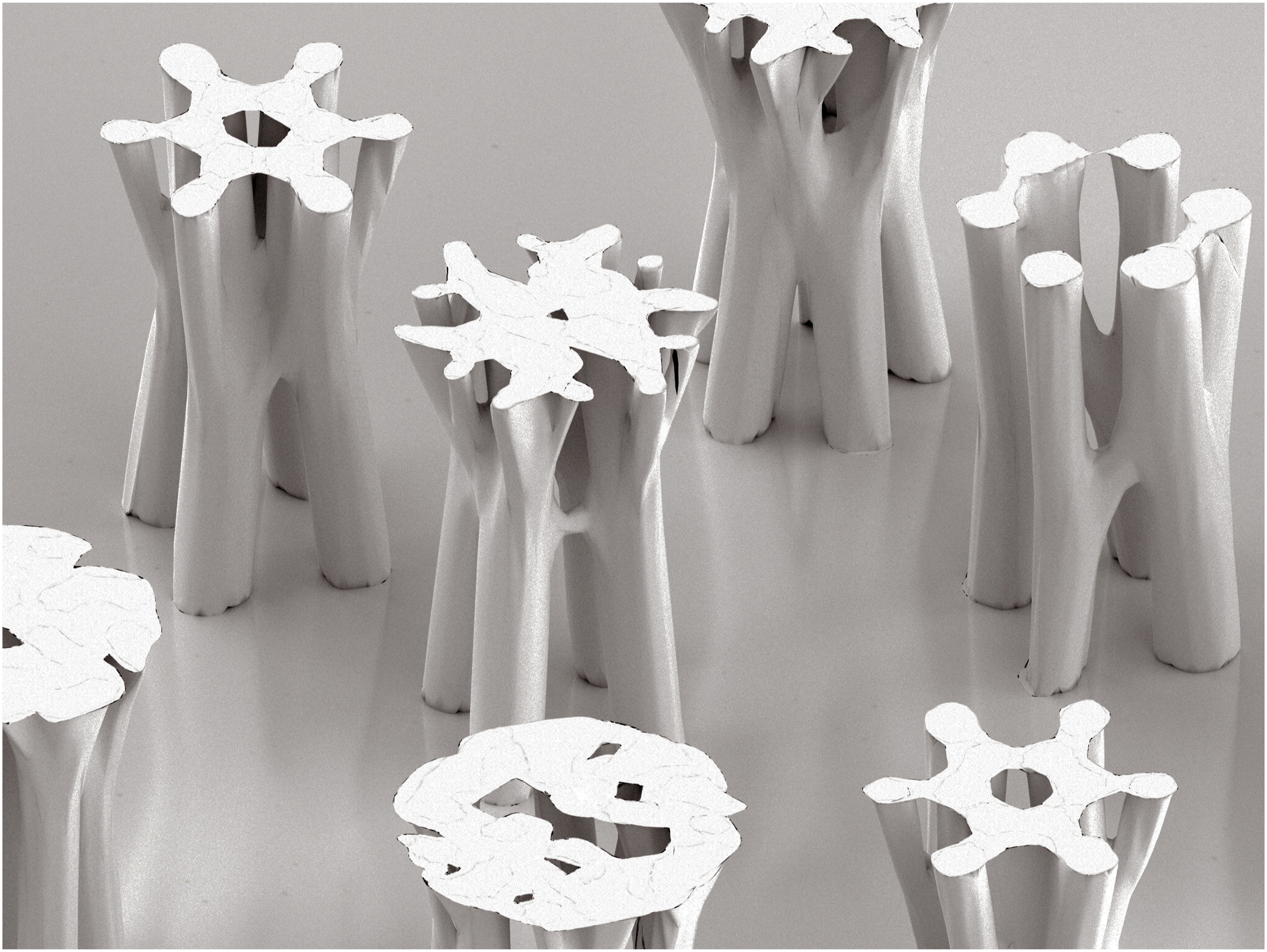
This stage aimed to improve the results already obtained. A structural optimization was carried out, using the branching model which had the best structural behavior in the compression test with samples. Topos© and Millipede© (both Grasshopper© plug-in) were used synergistically to achieve the goal, integrating topological optimization tools and Finite Element Method (FEM). In FEM process, the fixed area was the bottom (base), a vertical force of 100 kg and polymeric material were selected, the Von Misses stress analysis was made. Two paths were followed, the first one using Millipede© plug-in and using the previous branching algorithm. Variations were made in the branch’s bifurcations, between three and five at the bottom (base) and from two to five at the top. The results had a certain morphological similarity to the original model, this because the original algorithm was used as the basis to develop. In the second one using Topos© and Millipede© simultaneously, different reference points at the bottom (base) area and at the top zone, excluding the intermediate points selection. It was possible to obtain novel branching morphologies, result of a performative and generative process. The results obtained were a series of emerging morphologies or morphological families, all of them with an unpredictable shape, a very different geometries compared to the original model. From Figures 19–23 branching model (previous model), the first and second topologic optimization path can be seen. Model of the branching pattern stool. The first generative optimization path using Millipede© and the previous branching algorithm. The first generative optimization path using Millipede© and the previous branching algorithm. The second generative optimization path using Topos© and Millipede© to obtain a generative morphologies family. The second generative optimization path using Topos© and Millipede© to obtain a generative morphologies family.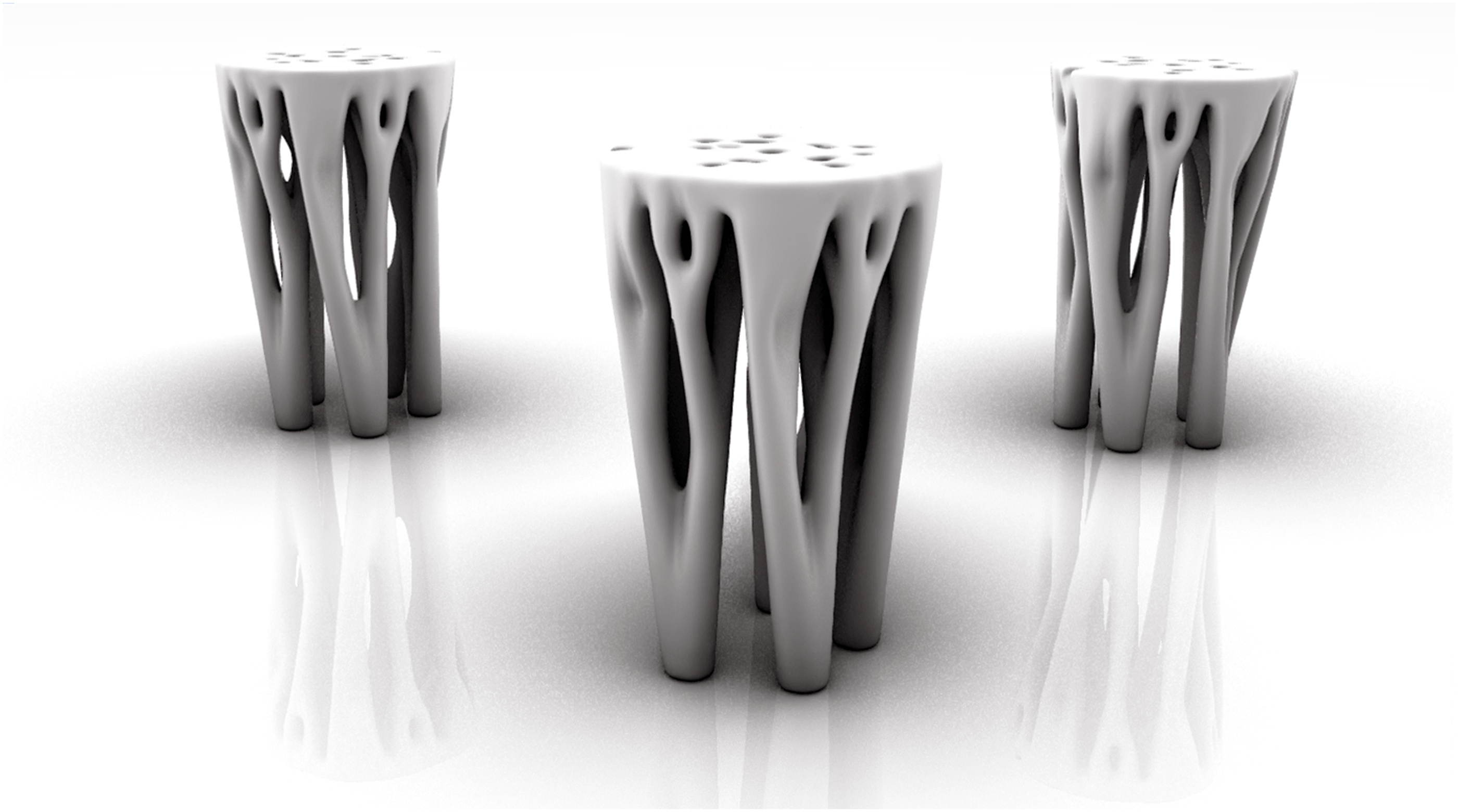
Discussion and perspectives
Nature-based design was an important contribution in this project, unpredictable and interesting results were achieved with different advantages in a creative synergy of digital technologies in all stages of the design process. In the case of a compression test with samples, branching was the lightest pattern and the one with the highest specific resistance; furthermore, this pattern took less time and used less material to print, this information may be useful for future projects. In regard to computational design techniques and generative design, it was possible to obtain a wide variety of alternatives, unpredictable; through topological optimization tools and Finite Element Method, it was possible to generate complex morphologies with a more efficient mechanical behavior. In the first path using Millipede© and the previous branching algorithm it can see some red areas with low resistance (more than 5 mm of deflection) in the second one, using Topos© and Millipede© simultaneously, no red zones are seen, this shows that algorithm allows to obtain more efficient geometries, then it was valuable to integrate the different variables from the early stages of the design process thanks to generative design approach. In addition, regarding AM technology, it was possible to build 1:1 scale polymeric prototype and to verify the possibility to materialize complex morphologies based on nature (impossible with other techniques), a high level of accuracy as possible to obtain functional objects. In the next stages, the results obtained from the generative optimization will be printed and evaluated. Morphological experimentations, analysis and generative optimizations of other two patterns (Voronoi and differential growth) will be carried out, ideally, they will be fabricated through AM technologies.
In this second stage the aiming was achieved and there was an evolution compared to the initial stage. It was possible to do a digital morphological optimization, the second stage result was a transition between an intentional design and a generative design that gives a rise to a family of emergent and unpredictable geometries; for this development some parameters were defined, but the final forms were not planned by the designer-researchers. In this project, it has been possible to appreciate the different advantages of the Biodigital approach, a new way to develop based-nature projects with wide morphological possibilities, in this case focused on the structural optimization, also with a wide fabrication freedom thanks to the additive manufacturing technologies. However, not everything done has been easy and expeditious, there have been different limitations on this project. The generation of complex algorithms requires a user with advanced computational skills, a high-performance and high-cost computer. The prototypes were often very extensive; for example, in the case of the stool based on the Voronoi diagram, its fabrication took more than 1 day and using a considerable amount of material, further it was necessary to design customized supports (branching supports), all of this had as consequently a high cost. The multidisciplinary work is valuable and important; however, it is often difficult to have an adequate communication, due to the different languages and methods of each profession. On the other hand, the importance of a constant experimentation could be seen, a non-linear process of trial and error, to do and do again in a dynamic flow. Consequently, a permanent learning and a creative enrichment of results is obtained.
Regarding the project context, it is possible to use and adopt advanced digital technologies in Latin America, in this case a synergy between generative algorithmic design and additive digital manufacturing technologies. It can be stated that the use of avant-garde technologies in that part of the world does not go against its identity, on the contrary, it is part of a process to construct an identity through hybrid integration, which links knowledge and local techniques (local identity) with global technologies (external influences) in a glocal perspective. Another interesting theme is the use of references from local nature, which enhances the construction of local identity considering the morphological and functional richness of living organisms and systems. This process of hybrid cultural construction occurs through different means. Firstly, through a team of professionals connected to advanced technologies in the world, also with knowledge and awareness of local techniques, technologies and capabilities. Secondly, this process also occurs through of the connection between universities, companies, governmental or non-governmental institutions at the local and world level, this convergence can be materialized through international projects and networks. These types of projects can be a seed to use emerging technologies at the local level, thereby to motivate professionals, researchers and students to develop new technological-based projects and as a result it is possible progressively build a local digital ecosystem, all these technological and cultural dynamics can build what can be called local appropriations.
In regard to the future of this the project, it is expected to select other patterns from nature, carry out morphological experimentations, optimizations, samples, and prototypes, possibly integrating digital fabrication technologies with conventional techniques, in a synergy of local knowledge and experiences with global technologies. All of this could occur in a context of a dynamic flow with a constant experimentation, in an iterative process of do and do again, from a transdisciplinary approach, looking for novel nature-based morphologies for design, architecture, and engineering.
Footnotes
Acknowledgments
We would like to thank the entities that have supported the development of this research project, thanks to Universidad Pontificia Bolivariana and Polymasters company.
Declaration of conflicting interests
The author(s) declared no potential conflicts of interest with respect to the research, authorship, and/or publication of this article.
Funding
The author(s) received no financial support for the research, authorship, and/or publication of this article.
