



Abstract
Reviews of youth justice intervention effectiveness prioritise hierarchies of evidence that obscure how contextual features shape the ‘mechanisms’ of change in preventative interventions. This article critiques this current evidence-based approach to youth justice interventions and its reliance on reoffending reduction as a measure of effectiveness. Community-based prevention programmes have been central to youth justice, since the late 20th century in England and Wales. However, by concentrating primarily on effect sizes, this approach often overlooks the influence specific contexts have on the mechanisms that can facilitate behaviour or attitude change through these preventative interventions. The authors propose that a realist approach could enhance understanding by focusing on how interventions work, for whom, and why. The article begins by outlining key theories that underpin youth justice programmes, followed by an overview of the realist synthesis (RS) approach to evidence review. This approach emphasises the mechanisms behind interventions and the contextual factors influencing their success. The authors apply this perspective to two types of community-based interventions used with two distinct and different groups of children: Intensive Supervision and Surveillance and Restorative Justice Conferencing in Referral Orders. The study makes three contributions. First, it provides an original detailed account of conducting an RS in the youth justice context, demonstrating the value of realist methods in evaluating youth justice interventions. Second, it highlights that youth justice interventions are often underpinned by competing programme theories that, in practice, work both in harmony and tension – producing a more diverse set of outcomes beyond simple proclamations of interventions being effective or not. Third, it emphasises that understanding and refining these underlying theories can improve children's outcomes in youth justice programmes through practical guidance.
Keywords
Introduction
In the last three decades, two key trends can be observed in youth justice systems internationally. First, prevention of offending through the management and modification of risk factors has become a primary aim of youth justice systems and the interventions implemented within them. For example, in England and Wales the Crime and Disorder Act 1998 established prevention as the primary aim for the newly formed Youth Justice System (YJS). The Youth Justice Board for England and Wales (YJB) have provided guidelines for ‘effective practice’ in prevention work to local, multi-agency Youth Offending Teams (YOTs) charged with administering preventative interventions in the community (the focus of this article). In this systemic context, ‘prevention’ and associated interventions typically indicate secondary prevention targeting young people considered ‘at risk’ of offending for the first-time and tertiary prevention targeting young people who have been identified as offenders (the prevention of reoffending). Secondly, risk management in youth justice is increasingly guided by ‘evidence-based practice’. For example, in England and Wales, the ‘Key Elements of Effective Practice’ (KEEP) guidance documents were produced to enable practitioners to adhere to national standards and case management guidance (YJB, 2003, 2009). These documents have consistently recommended ‘effective’ interventions grounded in ‘evidence-based practice’ (EBP). EBP was seen as a positive step in and beyond youth justice, because it moved away from prioritising individualised practice towards the use of research and evaluation to help to draw out lessons for good practice to facilitate consistency (Wilcox, 2003). In youth justice, KEEP guidance has overwhelmingly utilised the lens of ‘risk’ to shape understandings of and responses to children who offend. This has privileged the research evidence-base associated with the Risk Factor Prevention Paradigm (RFPP) (Hawkins and Catalano, 1992) and provided policy makers and practitioners with a clear framework to ‘identify the key risk factors for offending and implement prevention methods designed to counteract them’ (Farrington, 2007: 606).
EBP in the youth justice sector has favoured interventions targeting ‘risk factors’ that are purportedly criminogenic (crime-causing) and predictive of future offending. The predictive utility of the RFPP has been supported by a significant evidence-base of quantitative, developmental and quasi-experimental research, which identifies risk factors located in psychosocial domains of young people's lives (Farrington, 1996) – psychological (cognitive, attitudinal, emotional) and immediate social (familial, educational, neighbourhood), rather than in situational or broader socio-structural contexts (Case, 2022). Governmental reviews have reinforced the risk paradigm as providing the dominant rationale and programme theory for preventative interventions (Adler et al., 2016). This reaffirms the primacy of the psychosocial perspective and its focus on preventative interventions, with the goals to reduce risk and ‘deficits’ within the child (O'Mahony, 2009).
As a result of these developments, the ‘evidence-base’ for youth justice interventions remains somewhat partial in the dual sense of being biased and incomplete. It can be seen as biased, in that it has privileged psychosocial risk factors as criminogenic influences, at the expense of more detailed consideration of situational, relational and socio-structural influences (Case, 2022). It is incomplete because evidence reviews often exclude studies that examine alternative explanations (e.g. non-psychosocial or qualitative) of how youth justice interventions might work. The central problem here is that risk factors are predominantly identified as correlates/predictors forecasting offending outcomes, not the causes that bring about offending outcomes (Wikstrom and Treiber, 2017).
Although research evidence shows that broader contextual influences, like socio-structural, situational, and relational factors, play a role in preventing offending and supporting desistance (Smith and Gray, 2018), current guidance often neglects the significance of these. Ultimately, the youth justice evidence-base for effective interventions is limited by hierarchies of evidence (Case et al., 2022), which obscure reviews which illustrate how contextual factors shape the ‘mechanisms’ of change (decision making of children and/or young people) in preventative interventions (Sutton et al., 2022).
This article argues that a deeper understanding of how context and mechanisms interact within youth justice interventions is essential to build a more complete and less biased evidence-base. In essence, we aim to address and resolve limitations within the ‘What Works’ evidence paradigm. Using findings from a study that applied realist synthesis (RS) methodology, we examine the gaps in current effectiveness evidence. We then outline the methodology used in our recent RS in youth justice, followed by our analysis of the primary programme theories within youth justice interventions focusing on two key interventions used by YOTs. Finally, we offer key insights from our theory-testing and refining process.
Partial evaluation of ‘effectiveness’ and ‘what works’ in preventing reoffending
Internationally, preventative interventions in youth justice systems have been largely adjudged ‘effective’ based on the experimental criteria of the ‘What Works’ evaluation framework 1 (Stephenson et al., 2011). This was developed through meta-analyses that summarised interventions targeting reductions in psychosocial risk factors that allegedly predict reoffending (Sherman et al., 1997). 2 What Works’ reviews utilising the Scientific Methods Scale (Farrington et al., 2003) have privileged experimental and quasi-experimental research methodologies on the basis that they are designed to exclude alternative explanations for observed relationships between intervention and outcomes.
Such experimental studies have almost exclusively evaluated interventions that target risk factors because of their observed correlation with offending. Even a major U.K. advocate of the RFPP has admitted that: While a great deal is known about risk factors for offending, less is known about causes, or about causal pathways or mechanisms. Ideally, intervention programs should target causes of offending. (Farrington et al., 2012: 62)
In contrast, merely transforming correlates of offending into causal risk factors has resulted in a narrow, restricted approach to evaluating youth justice interventions. Psychosocial ‘causes’ have often been prioritised. Individualised developmental psychological causation aligns well with the scientific, experimental standards required by the ‘What Works’ reviews, which hold the randomised controlled trial (and systematic reviews and meta-analysis thereof) as the gold standard (Sherman et al., 1997). Whilst randomisation seeks to ensure that the only difference between control and intervention groups is the receipt of the intervention, the mechanisms of change which give rise to intervention outcomes remain in a ‘Black Box’ (Johnson et al., 2015) and the impact of context is ignored (Sutton et al., 2022).
For instance, Strang et al.'s (2013) systematic review evaluated the impact of face-to-face restorative justice conferencing (RJC) on recidivism among adults and children, including only studies with randomised designs. They found a modest but cost-effective decrease in repeat offending across the 10 RJ conferencing studies with 1879 offenders. However, the one study showing an increase in offending is obscured by the statistical method used. While they attempted moderator analyses by crime type, variations in delivery circumstances and contexts within the highly diverse sample remain concealed within the ‘Black Box’ of this approach.
There is evolving acknowledgement that methods traditionally deemed robust for evaluating the ‘effectiveness’ of preventative interventions should now be accompanied by a more systematic analysis of what is working, where and why (Tompson et al., 2020). This adaptation is evident in the U.K. government's effectiveness review (Adler et al., 2016) and in the attempts to avoid the decontextualisation of intervention effectiveness in the YJB's ‘Theory of Change’ guidance, which required more contextual focus alongside the use of ‘robust’ evidence to ‘confidently’ evaluate intervention effectiveness: what makes theory of change complicated or challenging are the social problems we are looking to address and the context in which you are working. (Noble and Hodgson, 2016: 4).
Methodology
Having asserted that dominant forms of knowledge relating to preventative interventions in the YJS are partial and reductionist, we now outline an alternative approach to analysing, evaluating and regenerating the evidence-base for ‘effective’ interventions. We wanted to know what contextual factors influence the way interventions are supposed to reduce youth crime thus providing some practical guidance on ‘what works for whom, in what circumstances’ in relation to preventing youth offending. To address this, we employed RS. The central task of RS is to identify, test and refine programme theories to build explanations about how, why and in what circumstances these interventions work through a synthesis of literature with a wide range of study designs (Pawson, 2006). The approach has been advocated as a valuable methodology to synthesise evidence in crime prevention (Johnson et al., 2015), but it remains almost entirely untested in the youth justice context (Sutton et al., 2022). Understanding context is vital as this influences whether a mechanism is fired leading to multiple outcomes within a single intervention. Generative mechanisms are, thus, the building blocks of realist explanations. They are best thought of as the different ways in which policy actors and recipients respond to the range of resources that are offered to them as part of an intervention; these responses are shaped by the context in which actors operate. A protocol for the methods used in this RS is registered with the Open Science Framework. 3
We developed our analysis through an investigation into the following research questions:
What are the main ‘programme theories’ that underpin key youth justice interventions in England and Wales? How and by whom are these interventions delivered in practice? What are the implementation processes of these interventions and how do they seek to deliver the intended mechanisms of change expressed in programme theories? How do contextual factors shape the ways in which youth justice interventions are experienced and responded to by young people, and the ways in which they may reduce crime?
As the previous brief analysis of Strang et al.'s RJC work shows, interventions are never universally successful, but the ways in which they work and the multiple outcomes they produce are shaped by the contexts in which they are implemented (Pawson, 2006). Realist explanation revolves around the Context-Mechanisms-Outcomes configuration. The central unit of analysis of RS is not the intervention per se, but the ‘programme theories’ that underpin them, which explain how the intervention is designed to produce its intended outcomes.
Our review was carried out through four, iterative phases. First, through policy analysis we identified the main programme theories underpinning government youth justice policies in the run up to and following the 1998 Crime and Disorder Act, in the United Kingdom. In Phase 2, we started to develop our understanding of YOT delivery and implementation of youth justice interventions. Phase 3 turned to a deeper consideration of the intended and unintended consequences of specific interventions. Finally, in Phase 4 we began testing and refining our programme theories to ascertain what youth justice interventions work, for whom, in what circumstances and why.
The four phases of our review involved:
Since 1996 youth justice policy and practice can be divided into two time periods which relate to dominant theories. In England and Wales YOTs primarily lead the selection, design, and delivery of preventative community interventions with children. In Phase 2, our activities also focussed on our second research question: ‘how and who delivers related youth justice interventions’. Informed by Phase 1 findings, we designed and conducted scoping reviews of the literature on Youth Offending Teams (YOTs) to
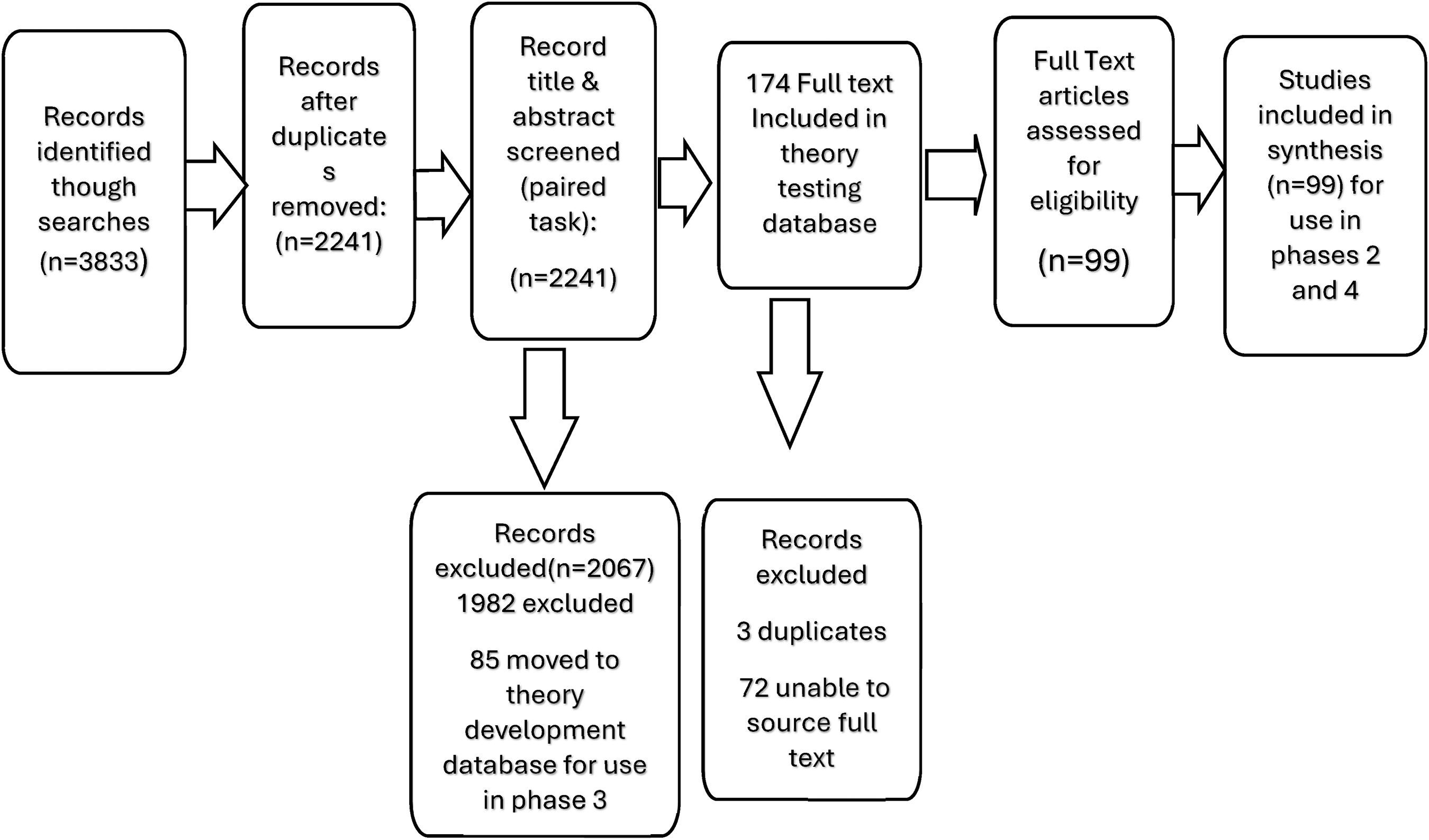
PRISMA diagram: YOT literature searches.
This search strategy comprised subject headings, free text words, alternative phrases and synonyms that described ‘Youth Offending Teams’. It was not limited by publication or study type. We refined our results through paired screening using Raayan software and coded the results into intervention groups. Studies were selected using inclusion and exclusion criteria relevant to theory testing and whether the study would allow us to test the programme theory. We also appraised study quality and rigour (Pawson, 2006). Our inclusion criteria were:
Study had to be concerned with preventing youth offending. Study had to be concerned with intervention delivery, implementation and outcomes by YOTs. Study had to be conducted in England and Wales. Study had to have been published between the years 1996 and 2020. We included non-experimental, surveys and qualitative studies exploring practitioners’ experiences of implementing and delivering these interventions, and children's and families’ experiences of receiving these interventions. We anticipated that these studies would provide detail about the mechanisms, or mediators at play in affecting change in children's or families’ behaviour, recognition and responses. Study would relate to a candidate programme theory.
Alongside the phase 1 and 2 searches, we conducted a series of expert interviews to provide lateral support (Pawson, 2006) for our process of theory identification. We consolidated and extended our Phase 1 findings through these semi-structured interviews with experts from our Special Advisory group and additional experts identified by members of this group. Interviewees (n = 7) were policy makers or practitioners who were involved in the design, implementation or delivery of youth justice services during the two periods identified. We were assisted by our understanding that the move away from risk, as the driving force of youth justice, had been towards more child friendly, individualised approaches. We tested this understanding by mapping and thematically coding results into families of interventions.
3.Phase 3 involved a 4.Phase 4 focused on
Our search strategies are summarised in the PRISMA diagrams in Figure 2. We searched nine health, education, criminal justice and social science databases, and we also ran searches in Google Scholar and five websites for studies mentioning ISS and ROs.
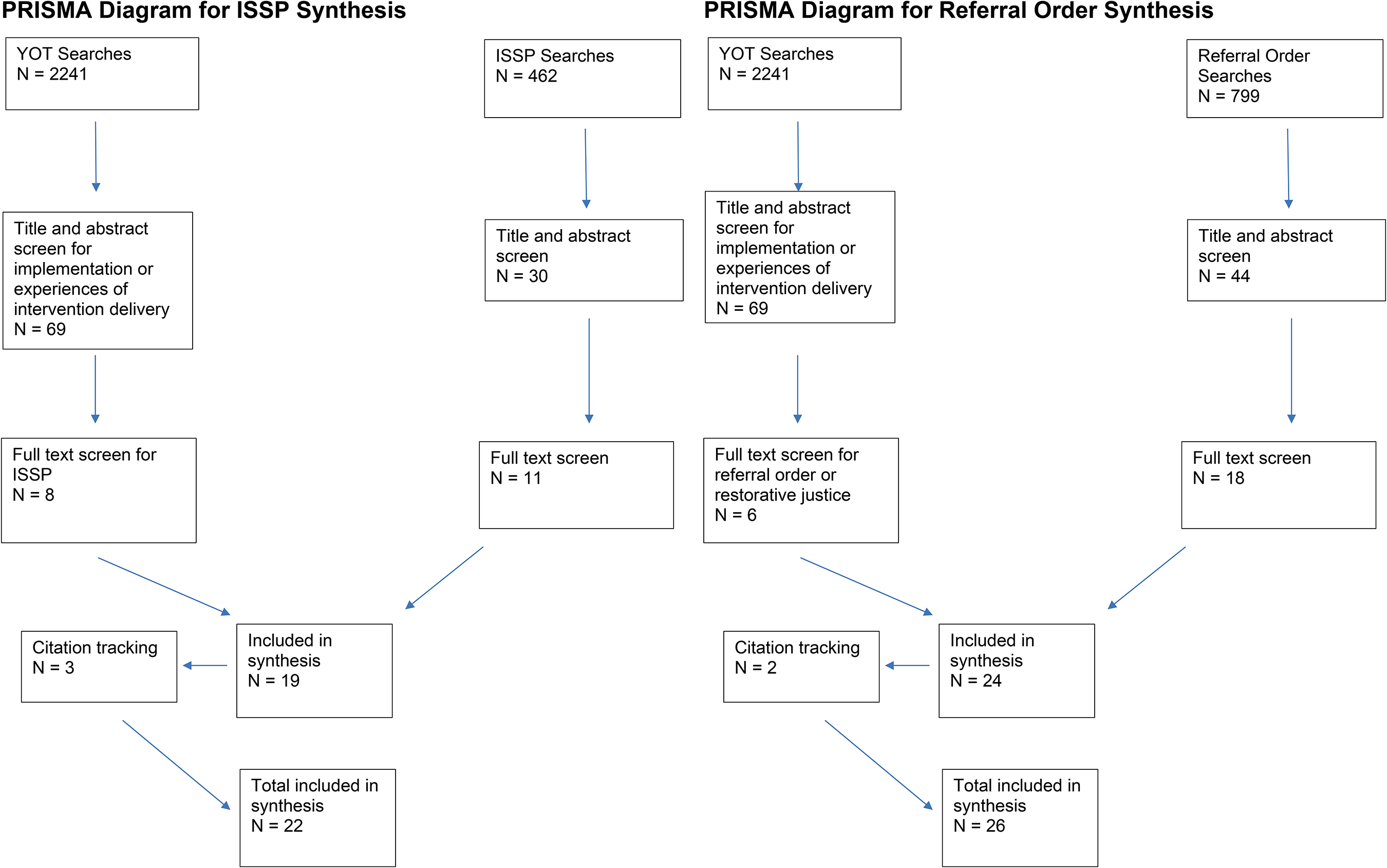
PRISMA diagrams: intervention searches.
Two reviewers independently screened titles/abstracts and full-text articles of potentially eligible reviews for inclusion using Rayyan research tools and applied a set of inclusion and exclusion criteria, based on a Population, Intervention, Comparison and Outcome framework (Richardson et al., 1995). To be included, the paper needed to report a study that:
Offers data relating to the implementation, experiences or views of those delivering or receiving intensive supervision and surveillance (ISS) orders or RJC in ROs. Was carried out in England, Wales or Northern Ireland. Was published between 1996 and 2020. Provides evidence relevant to theory testing. Has any study design.
Our analysis focused on examining how contextual features shaped the ways in which youth justice interventions are experienced and responded to by young people, and the ways in which they may reduce crime. Using an adapted version of the EMMIE Framework 5 (Johnson et al., 2015), we examined how these features supported or constrained the intended and unintended mechanisms of change and outcomes and explored how tensions between risk and relationship-based approaches were borne out in practice.
Findings
We summarise the key findings associated with our research questions: (1) What are the main the ‘programme theories’ that underpin key youth justice interventions in England and Wales? (2) How and by whom are these interventions delivered in practice? (3) What are the main mechanisms that shape the diverse outcomes of youth justice interventions in England and Wales? (4) How do contextual factors shape the ways in which youth justice interventions are experienced and responded to by young people, and the ways in which they may reduce crime?
Phase 1
In addressing our first research question, our literature searches revealed two distinct periods in the evolution of youth justice policy and practice in England and Wales. We found these thematic eras of policy and practice seemed connected to particular theories of crime causation and prevention. The first period, spanning from the late 1990s to around 2010, was characterised by the rapid emergence of costly managerial and risk-based approaches and measures, mirroring broader trends in pre-austerity public policy (e.g. education, welfare). In the second period, Youth Justice evolved under the influence of austerity measures, becoming more aligned to relationship-based and holistic methods of intervention. We explain this in more detail below.
The literature also highlighted that in England and Wales YOTs primarily lead the selection, design, and delivery of preventative community interventions with children, which helped us to decide to focus our subsequent searches on interventions which were delivered by YOTs.
Phase 2
Identifying the main programme mechanisms which shaped the outcomes of key interventions in the earlier phase was not straightforward, perhaps because of the dominance of data driven rather than theory driven evaluations. We were able to identify some of the ways of uncovering these mechanisms by focussing on families of interventions and their underpinning theories. We tested our understanding of the embedded mechanisms in these interventions to consider the accuracy and integrity of these theories and the associated mechanisms of change (Manzano, 2016). As we will now discuss, this phase identified that these theories could be categorised as risk-based and relationship-based.
We were able to explore some of the more theoretical or mechanistic ways in which interventions work for certain children in certain circumstances at certain times through the searches in this phase.
Many of the experts interviewed highlighted that a punitive managerial focus had heavily influenced both policymaking and practice, particularly in the first decade of the youth justice system in England and Wales. Whilst there was a focus on meeting needs, they confirmed that assessing risks and responsibilising children seemed to be an over-riding factor in the youth justice response during this period. The interviews suggested that the dominance of the risk management programme theory led to processes and approaches to prevention which included targeting at-risk groups of children who were yet to offend, or yet to be detected whilst offending. This meant that early intervention formed an integral part of the risk-based approach and this was enacted by a logic of increased interagency collaboration.
All of the experts interviewed suggested that, since 2010, there had been a shift in focus in youth justice policymaking and practice from risk management processes to relationship-based programme theories. This led to more holistic approaches rooted in positive engagement with children, which opened up the possibility of understanding the different ways interventions might work through the different ways children interpret interventions to which they were subjected. This explained the changing rhetoric and patterns observed in policy documentation towards a positive, relationship-based approach in the post-austerity period. Interviewees maintained that whilst this was welcomed in policymaking and practice, the risk approach was a mainstay in youth justice as it heavily featured in policy and practice documents in the pre-austerity period. Relationship-based practice was seen to develop alongside existing risk-based practice structures, with both programme theories working alongside each other. Discussion of the positive effects of prosocial relationships for justice-involved children formed a key part of the interviews. Both policymakers and practitioners acknowledged that relationships provided an important context for enabling a child to change their attitudes and offending behaviours.
Therefore, answering our first research question, the two main ‘programme theories’ that underpin key youth justice interventions in England and Wales are risk and relationship-based approaches. In answer to our second research question (How and by whom are these interventions delivered in practice?) we found that YOTs are ‘whom’. ‘How’ they are delivered depends heavily on their implementation and context of delivery. More detail on the ‘how’ continued to be explored in the subsequent phase.
Phase 3
In this phase, we addressed our third question to examine the implementation process and intended mechanisms of action for two programmes, ISS and RJC in ROs, which exemplified the dominant risk-based and relationship-based programme theories. Initially, we categorised ISS as an example of a risk-based intervention and RJC in RO as an example of relationship-based approaches. However, our analysis of the ways in which each intervention was designed and the thoughts on how they are intended to work suggested that both disposals incorporated both approaches, as we explain below.
ISS – intended mechanisms and outcomes
ISS was introduced as a programme known as Intensive Surveillance and Supervision Programme (ISSP), which was embedded in preventative disposals for persistent and serious offenders. The Criminal Justice and Immigration Act 2008 replaced ISSP with an ISS requirement, which was used with children on certain community sentences, some children on bail, or as part of Detention and Training Orders. ISS was presented as a community alternative to custody, combining supervision with surveillance in an attempt to ensure programme completion (Gray et al., 2005). ISS aligns with ‘Targeted Prevention’, defined as ‘specialist support for children who have had some contact with criminal justice services but are not currently being supported through diversion, an out of court disposal or statutory order’ (YJB, 2022). As such, is targeted at those deemed at a high risk of re-offending.
The number of children who received ISS in 2019 as part of a community order was 3840 (Home Office, 2023) and an additional 300–400 children were given ISS each year as a bail condition from 2015 to 2020 (Ministry of Justice, 2022). As it is seen to adhere closely to the RFPP programme theory (Farrington, 2007) and the principles of ‘What Works’ (Moore et al., 2006), this intervention typified the preventative and retributive objectives of the reformed youth justice system, whilst also maintaining a focus on a child's welfare (Muncie, 2014). Its design was informed by the Audit Commission's (1996) critique of supervision quality and content in Supervision Orders and their recommendation for more intensive community-based supervision (Moore et al., 2006). ISS was targeted at two groups:
A small group of prolific offenders (aged 10–17) responsible for approximately a quarter of all offences committed by children. Children who are not prolific offenders who might benefit from early and intensive intervention because they have committed crime of a very serious nature (Tameside Metropolitan Borough, 2022).
ISS could contain multiple components designed to tackle the numerous needs of young offenders. It is highly intensive and combines supervision with surveillance to attempt to ensure programme completion, and to bring structure to young people's lives. ISS was introduced in 2001 with three objectives:
To reduce the reoffending in the target group of offenders by 5%, and to reduce the seriousness of reoffending. To tackle the underlying problems of the young people concerned, in an effective manner, and with a particular emphasis on educational needs. To demonstrate that supervision and surveillance are being undertaken consistently and rigorously, and in ways that will reassure the community and sentencers of their credibility and likely success (Gray et al., 2005).
Thus, ISS incorporates ideas of building pro-social identities and self-actualisation through education and building postive relationships through close supervision but also heavily empasises risk management through close surveillance of children in the community. ISS has been described as ‘the most rigorous, non-custodial intervention available for young offenders … combin[ing] unprecedented levels of community-based surveillance with comprehensive and sustained focus on tackling the factors that contribute to the young person's offending behaviour’ (Tameside Metropolitan Borough, 2022).
Practice materials and academic literature provide insight into the theories underpinning ISS and the embedded mechanisms of change. The influence of It promises to bring structure to offenders’ lifestyles, while systematically addressing the key risk factors contributing to their offending behaviour, such as educational deficits, weaknesses in thinking skills or drug misuse. For serious offenders who do not meet the definition of persistence, it plans to address their behaviour before they become habitual and persistent offenders. (Devon County Council, 2022) The goal is to ensure that the risks that they pose are managed, and that their needs are met and continually reassessed in order to reduce their offending. (Gray et al., 2005: 3)
Risk assessment tools like Asset and AssetPlus are central to ISS, shaping both the understanding of risk and the emphasis on individual responsibility and self-actualising change mechanisms. Aligned with the RNR model, these assessments establish the severity of required surveillance, support levels, and ongoing evaluations. Stephenson et al. (2011) highlight that reforms under the 1998 Crime and Disorder Act reinforced personal accountability for behaviour change, leading intervention programmes to focus on building children and young people's skills, decision-making and coping strategies to help them participate more effectively in society. They contend that young people on programmes like ISS have a greater need for these skills and strategies, because of the complex challenges they will have previously faced in accessing education and guidance. Therefore, ISS directly reflects RNR principles by tightly managing offending risk while fostering prosocial development through intensive, tailored needs-led support.
RO panel – Intended mechanisms and outcomes
The other main intervention we included in our synthesis was the RJ Conferencing aspect of the RO. This statutory community-based order is most often used by the courts when dealing with 10–17-year-olds, particularly first-time offenders who plead guilty. The court ‘refers’ the child to a Youth Offender Panel convened by the YOT to include volunteer members of the community and held at an informal venue. ROs were introduced by the Youth Justice and Criminal Evidence Act in 1999 (YJB, 2018). ROs were intially designed to divert children back out from the formal justice system after a first time court appearance when admitting guilt for a non-custodial offence (Stephenson et al., 2011). This was later rolled out to children who had offended previously (Case, 2022).
The panel and the child agree a contract of work with a predominant focus on RJ (Ministry of Justice, 2018). As such, the RO aligns with the tier of ‘Early Prevention’, which can be defined as ‘support for children (with no linked offence) to address unmet needs/welfare concerns, usually delivered by mainstream and voluntary sector services … to improve outcomes for children’ (YJB, 2022). The number of children who received a RO in 2019 was 7739 (Home Office, 2023). In contrast to children receiving ISS, who are likely to have experienced substantial justice system involvement, they are a formal first-tier sentence. We identified that the two theories, Risk based and Relationship based, both underpin the intended mechanisms and outcomes of RO and are also evident in the procedural elements of the disposal. Risk management is a central feature of the initial stage of RO, whereby a YOT worker undertakes an assessment of the young person and produces a report that provides an analysis of the offence, information about the young person and their circumstances and an analysis of the child's risk of re-offending using AssetPlus assessments. This risk-based report then plays a role in the next stage of the RO, the RO panel meetings, as members of this panel receive a copy of the report.
However, the ideas and assumptions underlying how RO Panel meetings are intended to operate are relationship based, or more specifically, embody the principles of RJ. The RO Panel meeting is intended to engage the child, their parent/s, the victim, community representatives and a YOT worker in a collective discussion of the impact of the child's offending, the reasons for their actions and to plan to address these (Crawford and Newburn, 2003). During the meeting, in theory, all participants should be involved in deciding what restorative activities and conditions should be included in the resultant contract with the combined ‘aim of supporting the child towards living a safe and crime-free life’ (YJB, 2018) and making positive contributions through restorative interventions for those harmed by the child's offending. The approach is seen to be informed by the idea of the ‘good society’, emerging from justice practices in both ancient and contemporary indigenous communities (Crawford and Newburn, 2003; O’Mahony and Doak, 2017).
Several identifiable mechanisms in the RO Panel process are believed to help prevent reoffending. Children are given a voice or ‘agency’ and an opportunity to take ownership of their actions, by acknowledging and demonstrating guilt, and committing to activities to repair the relationships harmed (O’Mahony and Doak, 2017). Meeting needs in this way assumes that the child will not need to commit further offences. Encouraging reflection allows victims, community members and parents discussion of the consequences of a child's offending, prompting empathy amongst all participants (O’Mahony and Doak, 2017). ‘Reintegrated Shaming’ theory (Braithwaite, 1989) contends that family, friends and members of their community are important agents in both denouncing wrongdoing and supporting reintegration. Effective restorative panel meetings include known local community members, whose opinions may carry more weight with the child. It is assumed that meeting victims enables children to understand the impact of their crimes and in turn take responsibility for them. By looking beyond the offender label and affirming children's social worth communities can support children's commitment to avoid reoffending.
In a similar way to other court orders, the RO requires professionals to support the child in facilitating their journey towards a positive future; a future that is ‘offence free’ (YJB, 2018: 5) and emphasises relationship (re)building through education, training, employment or conflict resolution with victims, their family, or their community. Guidance indicates that children should be involved in deciding appropriate reparation activities and these activities should be meaningful to them (YJB, 2018).
In the final stages of RO, risk based and relationship-based programme theories operate in parallel. The YOT manager supports the young person in completing reparation and interventions, while also monitoring compliance and risk of reoffending, and reporting to the RO panel. Risk based ideas also underpin the threat of sanctions. After three unexplained breaches the child can be referred back to the RO panel, or court (Crawford and Newburn, 2003). If the child complies, the panel meets at the end of the contract to confirm completion and the conviction is signed off, with the child no longer considered to have a criminal record, in accordance with the Rehabilitation of Offenders Act (1974) (YJB, 2018).
Phase 4
In this final phase, our focus centred on addressing the fourth research question: How do contextual factors shape the ways in which youth justice interventions are experienced and responded to by young people, and the ways in which they may reduce crime? We included 55 studies in this phase: 25 for ISS and 30 for RO RJ conferences.
Influence of context: ISS
Although this evidence was less detailed, we were able to identify several features in the way ISS is implemented which shapes how and whether the intended mechanisms occur.
As noted above, whilst we understood that ISS was underpinned by the risk programme theory, surprisingly both risk-based and relationship-based programme theories were apparent in its implementation. However, as it targets serious and persistent offenders, the punitive and correctionalist elements often overtook the welfarist principles, reflected in the mechanisms identified in our review. For example, evidence from our review revealed ISS contained overly punitive elements and promoted strategies to help recipients fight urges or to develop strategies to combat offending triggers for fear of losing liberty (Feilzer et al., 2004; Moore, 2004; Prison Reform Trust, 2012). However, other studies showed how the delivery of the disposal led to addressing children's needs by identifying triggers for offending. A kind of ‘help at last’ arose from the risk-factor focus for children previously denied access to help from other agencies (Gray et al., 2005; Mylona, 2017) for learning difficulties, trauma, or housing issues. What was apparent, however, was that this help was typically only realised in the context of exaggerating the risk level associated with the child (Sutherland and Jones, 2008).
Positive mechanisms fired through ISS occurred through the development of deep trust relationships. When the child had a positive relationship with ISS staff that can encourage positive engagement with the requirements of ISS and, therefore, desistance from offending (Creaney, 2020; Ellis et al., 2009). A key context here was the reciprocity of effort to enable children to move from being passive to active participants through non-hierarchical relationships, enabling mobility, person-centred, self-actualisation by tailoring interventions to the recipient child and short-termism (a barrier to effectiveness and change) (Phoenix and Kelly, 2013). These trigger mechanisms of being ‘bought in’ to the intervention.
The implementation issues associated with the conflict between the programme's support and surveillance elements could therefore disrupt the triggers that initiate the mechanisms of change. Engagement appears to be at the heart of the success of ISS. Those taking an instrumental approach to compliance side-stepped the important triggers which activate pro-social identity development (Ellis et al., 2009; Gray, 2013; Phoenix and Kelly, 2013). However, the multiple complex needs evident in the group of children who fall into the scope of ISS, mean that practitioners can walk a tightrope in terms of addressing these (criminogenic) needs whilst also successfully engaging these children (Bottrell and Armstrong, 2012). Contrary to approaches with a punitive, risk-focus (Mylona, 2017; Phoenix and Kelly, 2013), it was apparent that a needs-led approach (i.e. needs conceptualised in welfare and personal well-being terms, not as criminogenic ‘risk factors’), delivered with a rights-based, relationship-based focus increased children's engagement (a mechanism of change).
Influence of context: The RO panel
It is vital to stress that interventions can fire conflicting or unintended mechanisms. Several authors drew on theories of compliance to articulate how intended mechanisms of RJ might operate and to highlight some of the possible unintended mechanisms. For example, Bottoms (2001) argued that young people might comply with RO for ‘instrumental’ or self-interested reasons, for normative reasons (a sense of moral obligation), out of habit or routine and because they are coerced into complying. Robinson and McNeill (2008) distinguish between ‘formal’ compliance – where young people may technically comply and meet minimum requirements vs ‘substantive’ compliance, where the young person actively engages with the process and changes their behaviour. Thus, only some forms of compliance, that is normative and ‘substantive’ compliance, align with the intended mechanisms of RO.
Testing the relationship programme theories involved reviewing this evidence to examine whether and how the implementation of ROs in practice triggered the intended mechanisms of reintegrative shaming and substantive compliance. It was apparent that this resulted in a number of intermediate outcomes. This included children taking ownership for their offending by recognising their wrongdoing and showing remorse, engaging in reparation activities and longer-term outcomes such as developing a positive self-identity, reintegrating into their community and avoiding re-offending.
We were interested in exploring how the tensions between the risk and relationship-based elements of RO panels unfolded in practice and how contextual features, such as implementation, shaped the delivery of the order and the balance between these competing ideas. Outcome patterns in the selected studies and reviews demonstrated that re-offending effect sizes were either low, or inconsistent (Livingstone et al., 2013; Strang et al., 2013). Some evidence was provided on intermediate outcomes such as remorse, reparation and reintegration. 6 Although no statistically significant differences were reported for sense of remorse, acceptance of responsibility or changed perceptions of themselves, when compared to usual court proceedings (Livingstone et al., 2013). Quantitative surveys from a small number of studies from England (Gray, 2005; Stahlkopf, 2009) and Northern Ireland (Campbell et al., 2005) on RO panels, or family group conferences, showed that the majority of children accepted responsibility for the offence, showed remorse and apologised. However, victims were not always convinced that children's apologies were genuine (Campbell et al., 2005).
It is therefore difficult to draw strong conclusions on the impact of RJ principles on outcomes due to the poor quality of the evidence. At best there may be a small reduction in rates of re-offending when RJ is used to augment usual court proceedings, at worst there is no difference at all. Moreover, there appeared to be significant variation in the ways in which RJ principles were implemented across the studies, but these reviews shed little light on the contextual features that might have shaped this pattern of outcomes. This suggests that either remorse and responsibilisation do not trigger desired mechanisms of change, or that the context of implementation may interfere with the enactment of change mechanisms.
Contextual features (individuals, interpersonal relationships, institutional settings and wider infrastructure) can be causally related to the mechanisms through which programmes work (Pawson, 2013). Studies that used a range of methods to examine how RO panels have been implemented helped us to understand how implementation and contextual features shaped intended and unintended mechanisms. We focussed on three implementation stages of the RO – panel attendance, agreeing the contract and compliance with the contract. We considered how broader organisation contexts shaped these processes.
In relation to panel attendance, our findings suggested that there was generally low victim attendance at RO panel meetings, which limited opportunities for children to understand the impact of their actions on victims (Antonie, 2012; Jones and Creaney, 2015; Newbury, 2011; Stahlkopf, 2009). Moreover, even when victims did attend, their presence did not always have a transformative effect. Newbury (2011) argues that the justice system does not make allowances for the fact that children who offend often have low self-esteem and struggle to ‘apologise on demand’ in panel meetings. When agreeing contracts, several studies suggested that community members were rarely representative of the young person's community and were not always skilled in engaging young people to agree a contract (Jones and Creaney, 2005; Stahlkopf, 2009). Budgetary constraints often meant that reparation activities were not always relevant to the child's offence or were undertaken as group work (Newbury, 2008). As such, children often experienced these as ‘punishment’ rather than a means of repairing harm (Newbury, 2008).
Findings suggested that forming trusting, collaborative and supportive relationships with YOT workers is more likely to lead to substantive compliance, because children feel like someone is on their side and that their needs are being met (Antonie, 2012; Dubberley et al., 2015; Spacey and Thompson, 2021). While YOT workers can address some of the child's immediate needs (e.g. reminders and transport to attend meetings), addressing these structural disadvantages in access experienced by children is more challenging. These findings indicated that YOT workers often have a dual role in relation to children subject to RO – as a support to address their needs and encourage positive change, but also to monitor their compliance (Smith and Gray, 2018). We found some evidence to suggest YOT workers find this dual role difficult to navigate (Newbury, 2008).
We also found that structural features of the justice system (e.g. risk management processes, background of panel members, time and resources) and aspects of children's’ lives (e.g. trauma, care experience, multiple complex needs) also constrained the efforts of YOT workers to engage in meaningful relationships during the RO process (Dubberley et al., 2015; Hart, 2011). For essential interactions to take place in the RO Panel meeting, important contextual issues must be understood and managed to facilitate primary elements in mechanisms of change, such as victim attendance; involving appropriate community representatives and preparing the child to explain their actions and help shape the contract. When these conditions are met, the process is more likely to reduce reoffending.
Discussion and conclusion
The conclusions from this evidence synthesis demonstrate that both youth justice interventions worked most effectively in child-centric, prosocial contexts of positive relationships between the child and professional. These appeared to be characterised by the child's inclusion, engagement, meaningful participation and collaborative, non-hierarchical dynamics. These contexts shaped mechanisms of change which were integral to positive, prosocial identity development driven by intrinsic motivation (i.e. internal belief, desire to change), feelings of trust, self-esteem/worth, being valued, being listened to and attachment/bonding (see also Axford et al., 2022). Conversely, both interventions were negatively affected by contexts where risk management approaches override the relationship opportunities in working to address needs and develop positive identities. These contexts gave rise to mechanisms of change characterised by experiences of punishment and feelings of compliance, which encourage extrinsic motivation (i.e. superficial, tokenistic and instrumental participation in interventions based on external rewards, such as completing an order) and reduced engagement.
We expected that these two different interventions would align to the two different programme theories we found underpinned youth justice in the first phase of this research. However, in the subsequent phases we found that the implementation of both interventions contained strands of both theories, despite being designed for very different groups of children. Furthermore, unintended consequences arose in respect of both interventions because these programme theories did not work well in tandem. The contextual factors which enhanced change mechanisms through relationship-based approaches seemed counteracted by the risk-based elements in both interventions. This resulted in diverse and inconsistent outcomes.
Realist methods (synthesis and evaluation) offer an optimal methodological approach to unpack the programme theories in interventions and the ways these work (or not) in specific contexts. Shortcomings with typical criminological approaches to explaining, and subsequently preventing crime, underline the importance in revealing the role that context plays (Sutton et al., 2022; Wikstrom et al., 2024). In effect, realist methods encourage researchers to consider which mechanisms are fired in particular contexts to produce outcomes. As no intervention is ever applied in a uniform way, realism offers less a cookbook and more a map to move towards desired outcomes in programme design. The results of this analysis provide a holistic and contextualised evaluation of intervention ‘effectiveness’ through consideration of the theories and change mechanisms which influence changes in children's attitudes and behaviours. We therefore strongly recommend the widespread use of RS to help in identifying the Contexts–Mechanisms–Outcomes relationships, to facilitate the improvement of youth justice interventions to prevent children reoffending by better supporting their pro-social development.
