




Abstract
The construction and labelling of groups of young people as ‘risky’ triggers a multifaceted and dynamic social process of stigma that frequently results in reduced life chances and limited opportunities for self-development. Drawing on case-study data from four European countries, this article focuses on the ways in which stigma is reproduced through interactions and interventions that label young people. Our analysis explores how young people experience and understand stigma, and how they respond to it. Framed within a theoretical understanding of stigma as a form of power, we examine its components and cyclical process, its role in shaping policies of social control, and its consequences for groups of ‘risky’ young people. Our analysis builds upon and develops Link and Phelan’s (2001) reconceptualization of stigma to include reference to young people’s reactions and responses: alienation and marginalization; anger and resistance; empathy and generativity. We argue that stigma acts primarily as an inhibitor of young people’s engagement in wider society, serving to further reduce access to beneficial opportunities. However, some young people are able to resist the label, and, for them, resistance can become generative and enabling.
Keywords
Introduction
The growth in neoliberal punitive policies over the last few decades (see Garland, 2001; Muncie, 2005; Wacquant 1999) has had a disproportionate impact on the lives and experiences of young people seen to be ‘at risk’ of criminal behaviour. The construction and labelling of some groups of young people as ‘risky’ or ‘troubled’ is driven by frequent reporting in the populist press about so-called out-of-control or anti-social young people (Goldson and Muncie, 2015). This ‘risky’ label is often tied to concerns about a small hard-core group of seemingly chaotic, dysfunctional or problem families (Crossley, 2015) and to discourses of disengagement that lay the blame on families and young people (Fergusson, 2016). These discourses produce and reproduce negative labels and stereotypes that drive disadvantage and trigger a multifaceted process of stigma (Link and Phelan, 2001).
Across Europe, the policies that ensue from this negative construction involve mechanisms of risk-factor prevention – from risk-based school discipline and policing strategies to harsh sentencing and punitive intervention – targeting those young people who are the ‘most marginalised and socially excluded’ (Muncie, 2005: 39). These policies exercise the various operations of power that are designed to identify and manage risk by applying ‘extralegal criminal labels’ (Lageson and Maruna, 2018: 113). Steeped in processes that label and demonize, they perpetuate the socially shaped exclusion of those affected, resulting in a cyclical reproduction of stigma and a reduction in opportunities for ‘risky’ young people.
This article focuses on the ways in which stigma is reproduced through interactions and interventions that label young people. Beginning with a review of literature, we develop, theoretical constructions of stigma, drawing on, in particular, the work of Link and Phelan (2001) and Tyler (2018), to frame the experiences of ‘risky’ youth as they navigate relationships with authorities and interventions designed to ‘manage’ their behaviour. The analysis presents data from four case studies conducted in Estonia, Portugal, Spain and the UK, to explore the experiences, actions and responses of groups of young people who are perceived, and treated, as ‘risky’ (Becker, 1963). Although these countries have different socio-political and cultural contexts, the similarity of young people’s experiences of, and responses to, stigma are striking. We argue that the risk-based and controlling nature of some youth interventions that are designed to manage behaviour, instead, serve to perpetuate a cycle of stigma and reproduce conflict between authorities and those young people deemed to be ‘risky’.
The final section explores responses to stigma by the young people involved in our study. These responses can be characterized as existing on a continuum, ranging from apathy and withdrawal, to active resistance in the form of transgressive behaviours, and actions that explicitly challenge the social norm. We argue that young people’s responses to the labelling and discrimination attached to criminalized identities often serve to both amplify and reproduce the stigma they experience. 1 However, as this article will go on to highlight, some young people were able to resist the negative label and turn the stigmatizing effect of certain interventions into generative experiences. This provides an important counterpoint to the, often bleak, stigma narrative.
The processes of stigma
In the first essay in his classic book Stigma, Goffman ([1963] 1990: 9) defines stigma as ‘the situation of the individual who is disqualified from full social acceptance’ as a result of any attribute or ‘undesirable difference’ that is ‘deeply discrediting’. He argues that it is not the attribute itself that is stigmatizing, but rather the social relationships surrounding it that depict it in this way. Thus stigma is, by nature, socially dependent, relational and contextual: it is based on what society constitutes as different or deviant. Goffman’s conceptualization of stigma also includes awareness of and unease about the stigmatizing attribute on the part of the stigmatized, who may, through ‘dramaturgy’ (Goffman, 1978), attempt to conceal the stigma from others by presenting an alternative, non-stigmatized, identity.
A vast interdisciplinary literature has built upon Goffman’s influential analysis. Within the criminological contributions, and of particular relevance to the argument presented here, stigmatization links closely with labelling theories (Becker, 1963), its role in social control (Braithwaite, 1989, 1991), and its impact on life chances (see McAra and McVie, 2005). More recent sociological discussions take stigma as a starting point from which to conceptualize how constructions of inequality are inevitably tied to different forms of social, political and economic power (Link and Phelan, 2001; Parker and Aggleton, 2003; Tyler and Slater, 2018). By focusing on social power, Link and Phelan (2001) construct an understanding of stigma that attempts to clarify its definition and map out its application. This shifts the focus away from addressing individualized attributes towards structural issues and the context of the stigma. Their construction focuses on the dynamic relationships between a set of components:
[W]e apply the term stigma when elements of labelling, stereotyping, separation, status loss and discrimination co-occur in a power situation that allows the components of stigma to unfold. (Link and Phelan, 2001: 367)
Their detailed analysis of the interconnected processes of stigmatization – labelling, stereotyping, separation, status loss and discrimination – leads to a discussion of the context within which it exists. They note that stigma exists where the stigmatizer wields power 2 over the stigmatized group, which is enacted through policies and practices that reproduce and embed elements of stigma. Within our case studies, power differentials are evident in young people’s daily interactions with a variety of authority figures and they are subject to policies and practices that directly impact on their daily lives and opportunities.
Link and Phelan go on to argue that the subsequent labelling of a person or a group can result in separation and loss of status, which has ‘serious discriminatory consequences’ (2001: 376). It is, they contend, the relationship between these elements in the context of power imbalances that produces and embeds stigma. Our research focuses on young people who experience conflict in their everyday lives – with authority figures and often in relation to social norms of behaviour. For these young people, stigma is a key part of that conflict and is experienced across multiple sites and with multiple agents. Their narratives highlight the key co-occurring components of stigma set out by Link and Phelan (2001) – from the risky label that is placed on them (and perpetuated through these interactions and interventions) to the subsequent separation, status loss and discriminatory behaviours they experience driven by those with the social, economic, and political power to enact youth management practices and policies.
Our analysis explores how young people experience and understand stigma, and how they respond to it. Their experiences are framed within a theoretical understanding of stigma as a construct of power, with clear power differentials between young people and authority (individuals, systems and the state) providing the conditions for stigma to produce and reproduce. We examine the components and cyclical process of stigma, its role in shaping policies of social control, and its consequences for groups of ‘risky’ young people. Our analysis builds upon and develops Link and Phelan’s conceptualization of stigma to include reference to young people’s reactions and responses: alienation and marginalization; anger and resistance; empathy and generativity. In conclusion, we argue that, most stigmatized young people are subject to a cyclical and amplifying process of status loss and discrimination resulting in unjust treatment and reduced life opportunities.
Stigma and policies of social control
A recent return to the analysis of stigma, in a collection of articles edited by Imogen Tyler for The Sociological Review (2018), develops the analysis of stigma as a form of power, bringing to the debate a more political formulation of the concept. Questioning readings of Goffman that focus on the stigmatized rather than the stigmatizers (Paton, 2018; Tyler and Slater, 2018), this new work positions stigma as a tool used by those with power to exploit the less powerful in order to accumulate capital. It responds to a set of social and political questions about the construction of the ‘norms’ against which the stigmatized person is measured, and ‘how stigma is used by individuals, communities and the state to produce and reproduce social inequality’ (Tyler and Slater, 2018: 721). Tyler (2018) argues that socially desirable norms of behaviour conceal and naturalize the power structures in operation. By positioning stigma in this way, these latest reconceptualizations hold particular relevance for this article. We argue that the stigma generated from non-normative behaviour and identities plays a key role in the social control of non-normative young people and serves to reproduce social inequality.
The young people taking part in our research often did not meet desirable norms of behaviour (or presentation in some cases) and their behaviour was branded as ‘anti-social’. This included engaging in criminal behaviour, relying on state benefits while eschewing the more traditional routes of education and employment, and having their own children without the financial means or practical skills to provide for them in a way that conforms to normative societal expectations.
From our research, it is apparent that norms of behaviour, and the creation of stigmatizing identities for those who contravene these norms, are closely linked with state imperatives to control abject groups. The policy-based social control of those who fail to conform to the norm – beginning in schools and extending through the life course – is inextricably tied to the negative labelling of some young people. For example, it has been noted that, in the UK, services for young people (including health, welfare and transition interventions) are gradually being replaced by control measures (Goldson, 2005; Goldson and Muncie, 2015; McAra and McVie, 2005). This trend extends across Europe, encompassing our case study sites of Estonia, Portugal and Spain. The move towards risk/control-based measures has been justified through government and public discourses of young people that set them up as the abject – ‘troubled’ young people from ‘disadvantaged’ backgrounds who require punishment and control (Goldson, 2005; Goldson and Muncie, 2015; McAra and McVie, 2005). Tyler’s analysis of social abjection as a discourse that is used to justify punishing the poor via neoliberal mechanisms, such as the dissolution of welfare structures, chimes with the milieus of the young people participating in our research. Similarly, and of particular relevance here, Wacquant (2007, 2008, 2010) addresses stigma in contemporary neoliberal societies as a feature of daily experience in areas of high unemployment and poor housing. His analysis of stigmatization, as embedded in public and media discourse, provides a counter narrative to the ‘criminal classes’ approach of recent policy initiatives (Cummins, 2016) and speaks to the key placement of experiences of stigma in the lives of people, and groups, in 21st-century Europe. Further examples of social abjection can be seen in the demonization and stigmatization of specific groups of young people, for example teenage mothers (Kidger, 2005) or young people in care (Taylor and Fitzpatrick, 2006).
The control-based policies that emanate from abjection discourses perpetuate elements of the stigma process, namely separation, status loss and discrimination, without consideration of the contextual factors experienced by the young participants in this research, such as their experiences of social and economic deprivation, neglect, abuse, bereavement, growing up in local authority care, or a range of other adverse childhood experiences.
Of course, stigma as a vehicle of social control is attached to places as well as to people. Paton’s (2018) discussion of territorial stigmatization, building on Wacquant’s (2007) identification of the stigmatization of places, is of particular consequence to many of the young people in our study. Through territorial stigmatization, whole neighbourhoods are labelled as blemished through a perpetuation of vilification in both popular and political discourses (Paton, 2018; Wacquant, 2007). For the young people living in these vilified neighbourhoods, this is a label that comes to be absorbed as they face increased surveillance, constrained opportunities, negative responses from others, limited status and significant discrimination, not least in relation to the social control that they and their neighbours may face.
Method
The research presented in this article draws on four case studies conducted in the UK, Estonia, Portugal and Spain as part of a wider European study, PROMISE. 3 PROMISE explored the breadth and depth of young people’s social involvement employing a mixed-method approach. The qualitative part of the research generated ethnographically informed case studies to represent in-depth views into a diverse range of young people in conflict with social norms and experiencing social change in unique ways. The case studies discussed in this article were conducted with young people in conflict with key sites and agents of control: the law, school and state-managed care. Participants were contacted through services and interventions designed to manage their risk such as youth justice, probation, alternative provision schooling, youth clubs and support groups. The fieldwork took place across different settings in the statutory, voluntary and private sector, ranging from formal educational programmes and justice initiatives to informal activities and street-based interactions. Table 1 provides an overview of the scope of the data collected from the four case studies.
Case studies: Respondent set and data collection.
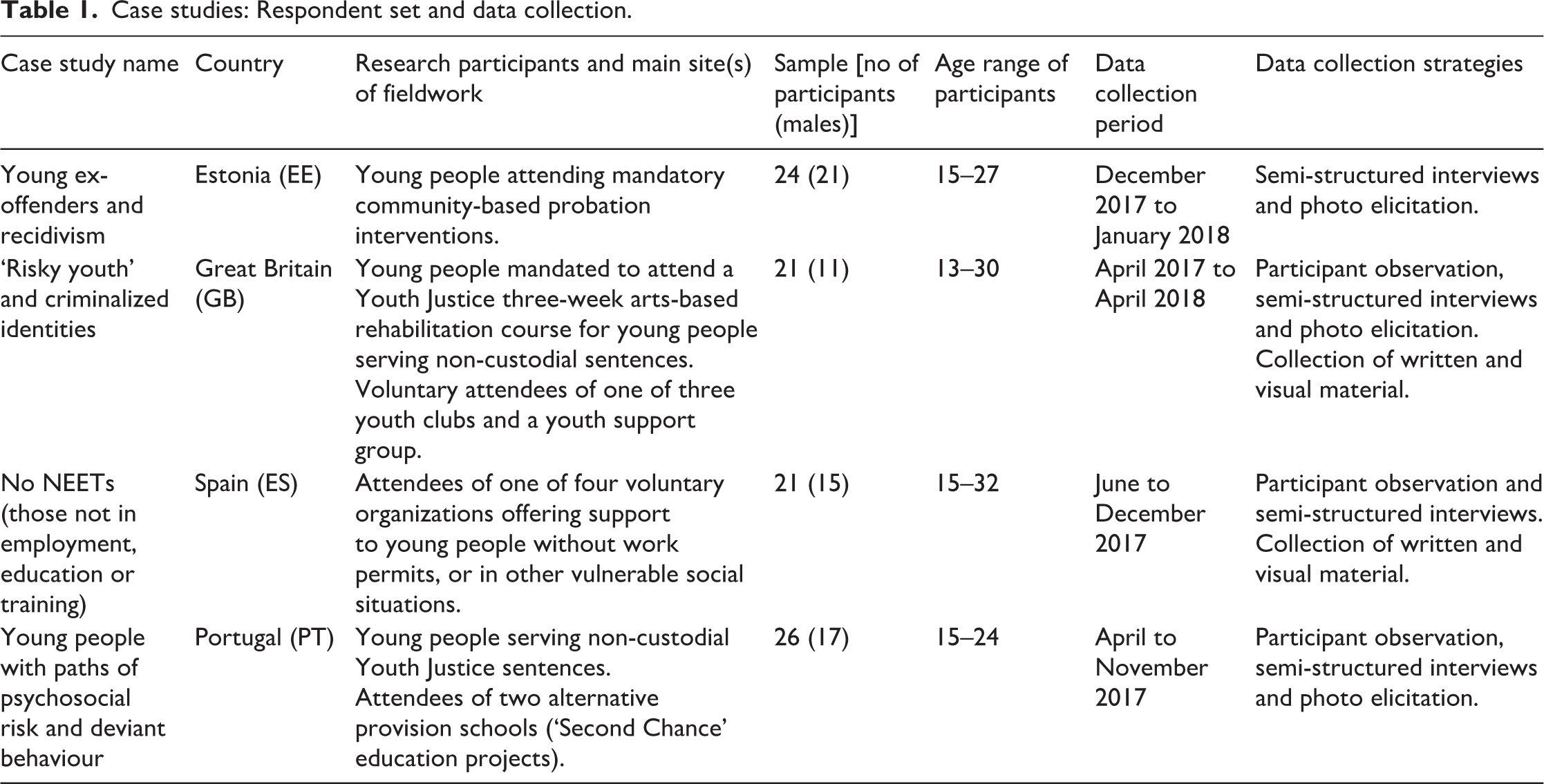
Despite the contextual variation (in research country and fieldwork site) and diversity in the characteristics of respondents, an important linking feature of these case studies is young people’s engagement with interventions designed to support and manage ‘risky’ or ‘troubled’ youth. 4 Engagement with these interventions was experienced in different ways and resulted in a variety of responses from young people. This article does not attempt to quantify the variety of experience by socio-demographic factors, or provide generalizations across a population. Instead, it presents richly illustrated examples of young people’s contextualized experiences of, and responses to, stigma within their interactions with authority and the interventions they engaged with.
We accessed interventions managed by statutory agencies and by voluntary organizations. Statutory agencies included those within the criminal justice, education (both mainstream and alternative provisions) and social care systems. The range of voluntary (also termed charitable or third sector) organizations that featured in the research represented a more complicated mix. There were a total of nine voluntary sector organizations, comprising youth clubs and youth organizations as well as support groups that dealt with specific issues (for example, young people leaving care or employment opportunities for migrant youth).
A further complicating factor in categorizing interventions arises from the fact that, as part of neoliberal policies in each country, some voluntary sector organizations may deliver interventions on behalf of statutory agencies and some of this work is outsourced to private companies. In the case studies conducted in the UK, Estonia and Portugal there were examples of education projects, workshops, courses and youth sessions that were funded by the justice or education systems but led by private or voluntary sector organizations. For instance, the ‘Second Chance’ schools’ in Portugal are voluntary sector initiatives that are partly supported, structurally and financially, by the Ministry of Education, and are offered to some young people as an optional choice, whereas others are mandated to attend as part of a court protection or justice order. This raises some debate about the boundary between formal and informal intervention and ostensibly confirms criticisms that the voluntary sector colludes with the state, providing an extended arm of penal intervention (Tomczak, 2017).
Techniques to promote a collaborative, participatory approach to data collection, analysis and dissemination were used alongside participant observation and interviews. Young people engaged in a variety of creative and dialogic activities, such as discussion-based workshops involving photography (photo elicitation), drama, visual and musical arts, through which they were able to explore their experiences and direct the discussion. These techniques were designed to provide a space for young people to have a voice, share their experiences and retain ownership of their narratives. The individual interviews in each case study ranged from 21 to 26, giving a total of 92 interviews. In addition, there were focus group interviews in Estonia (with three participants) and in the UK (six and eight participants in two separate groups). All case studies included male and female participants. Most of the participants across the four case studies were between 14 and 29 years old; however, three were aged between 30 and 32, and one respondent was 13 years old.
The interviews were designed to elicit narratives and to prioritize the lived reality of the young people, as they themselves understood it. They were conducted using a skeleton interview schedule that was adapted to suit the participant group and the case-study context (for example, school, youth club or probation setting). In each country, at least two researchers coded the data and engaged in reflexive discussion to ensure consistency within cases.
Cross-case analysis of the data was conducted using an adaptation of Noblit and Hare’s (1988) meta-ethnographic synthesis method (Pilkington, 2018), which provides a means for synthesizing the findings of large, multilingual qualitative data sets in order to see the bigger picture, while minimizing the loss of contextual differentiation. To achieve a meaningful cross-case analysis, a two-stage process was adopted. In the first stage each of the four case studies was coded individually, by the pairs and teams of researchers who had conducted the fieldwork, to produce a data set in English. The teams used a skeleton coding tree to which new codes could be added as required, thus allowing for variation in cases while retaining an overall structure necessary for the second stage. The second stage consisted of re-coding the data set to explore to the key themes (foundational and emergent) of the research. A team of researchers from Portugal and the UK were engaged in the second-stage analysis and discussion was held across the wider research group to achieve consistency between coders. Anonymization guidelines were standardized across the project, ensuring all identifying material was removed and only pseudonyms were used.
Despite these rigorous processes and procedures, conducting this research was not without its challenges. A key criticism levelled at those who research stigma is the potential for ‘re-stigmatizing’ or perpetuating the stigma (O’Connor and Earnest, 2011). Relatedly, a further criticism concerns interpretation: where researchers do not belong to stigmatized groups themselves they may be accused of approaching the research ‘from the vantage point of theories that are uninformed by the lived experience of the people they study’ (Link and Phelan, 2001: 365). Across the project, the research process and outputs strove to avoid further stigmatization of the young people taking part or others to whom the research speaks. Our methodology, particularly in these four case studies where stigma is so evident, was designed with an awareness of our positions as privileged researchers sharing in the experiences of young people. 5 Although our status as ‘outsiders’ to the groups was unavoidable, we sought to use methods that value and respect the participants’ attitudes, views and interpretations of their experience, and to break down power structures. Techniques to engage participants as much as possible and to encourage participants’ own interpretations, such as photo-, voice- and arts-based activities discussed above, were used alongside participant observation and interviews. In addition, the topic of stigma was not directly approached in the interviews by the researchers; instead discussions focused on identity and experiences of discrimination. This posed additional challenges at the analysis stage – coding was a lengthier, more complicated process – but it allowed the young people themselves to raise issues related to stigma. Many spoke of marginalization through negative representations as a key feature of their lives.
Experiences of stigma: A cyclical process
Elements of stigma, from labelling to discrimination (Link and Phelan, 2001), were described by young people from all four case studies. They saw themselves as stigmatized in relation to elements of their social identity that contravene normative expectations; for example, having been excluded from school, having a criminal record, growing up in care, having NEET status or growing up in a ‘disadvantaged’ neighbourhood. 6 Their narratives demonstrated the ways in which the stigma that exists is perpetuated and reproduced in daily interactions with authority and through interventions designed to manage and support young people. The reproduction of stigma occurred habitually across the range of statutory interventions within the education, criminal justice and social care sectors and could also be found, although less commonly, within voluntary sector provision. We argue, therefore, that stigma is reproduced and perpetuated within the structures of control and support accessed by young people. Our results demonstrate processes of stigma (adapted from Link and Phelan, 2001) existing within different settings.
Education and early stigma
Many of the young people identified elements of stigma early in their lives. The experience of being labelled as ‘bad’ or a ‘failure’ began in school and formed their first experience of state-led punishment. As demonstrated in the case studies, and elsewhere (see Deakin and Kupchik, 2016), interventions within schools can quickly spiral into suspension and permanent exclusion from mainstream education. Discussions with young people in each case study highlighted the escalation of sanctions and increased use of interventions alongside a progressive disengagement from school and wider social distancing. In each case study, there were numerous examples of young people feeling ‘written-off’ by school, parents and society in general.
In Spain, Marc’s pathway towards disengagement began with difficulties at school, where he quickly became labelled as problematic:
When I retook a year at school, then, well, the problems started to grow. . . They stigmatized me as something I was not! . . . I was asking for help but no one understood . . . (Marc, 21, Spain)
Similarly, in the UK, Estonia and Portugal, young people felt that previous disruptive behaviour during early school years led to the enduring label of ‘problematic student’. This label generated prejudicial behaviour, perpetuating conflict with teachers:
There were some teachers, man, who I could not look in the face. With some I didn’t even set foot in the room. Because there were some teachers that I just put my foot in the classroom and the teacher asked ‘Are you here to behave or get a mark against your name?’ And I would say ‘It depends, I’ll see, and whatever’. I would go in and straight away get a mark for poor discipline. Like, in one period, I had 143 discipline marks. In one period. (Nelson, 18, Portugal)
For many, the cycle of minor disruptive behaviour and sanction repeated until the child was removed from mainstream schooling to alternative provision (see also Deakin and Kupchik, 2016). At this point the label became cemented, bringing with it a new level of negative stereotyping alongside the separation of the young person from mainstream schooling and from a normative pathway into adulthood. Despite the positive work that goes on in some alternative provision schooling, the principle behind them centres on exclusion from mainstream social involvement rather than inclusion, making this stigma hard to tackle. For the majority of the young people across the case studies who experienced school exclusion, the result was a label that they felt would inevitably limit life chances and opportunities, even when the experience of the intervention was largely positive. Following her exclusion, Andreia, who attended a Second Chance school in Portugal after being excluded from mainstream education, discussed the label she believed society placed on her and others in her position:
They are normal teachers but they know we are different, special kids, right? . . . because . . . to society the people here are inferior . . . people say that we don’t do anything right and that we will never make anything of ourselves. (Andreia, 18, Portugal)
The inhibiting nature of such entrenched and widespread labelling signals status loss and discrimination. These elements of stigma have a significant effect on the opportunities available to young people excluded from school, as well as on young people’s aspirations and involvement in normative activities, as Santiago demonstrated:
Most people like me end up doing bad things to live. In a certain way you don’t have any other option, you live like a poor guy or you have to do bad things to have a life. (Santiago, 24, Portugal)
The patterns of school exclusion outlined in the case studies illustrate the five key elements of stigma (labelling, stereotyping, separation, status loss and discrimination) set out by Link and Phelan (2001) and demonstrate the cyclical nature of the process. In adapting Link and Phelan’s concept of stigma, we identify a self-perpetuating cycle of stigma. The following describes this cycle of stigma using school exclusion as an example:
Children become labelled at school as troublesome, difficult or naughty in the classroom. The early labelling of ‘problem’ children in school leads to stereotyping.
Stereotyping occurs where a set of negative attributes are assigned to the child and subsequent poor behaviour is then expected, such as in Marc and Nelson’s stories. Nelson’s story, in particular, illustrates how expectations of poor behaviour can generate conflict and perpetuate poor or conflict-driven behaviour.
A process of separation begins as the ‘problem’ child is viewed (by teachers and classmates) as the other. This creates a binary distinction between the problem child and everyone else. The child is then separated, in a physical sense, from their peers through a series of suspensions until they are permanently excluded from mainstream education. At this stage, labelling and stereotyping intensify. The excluded child has now been verified as ‘different’ from, and inferior to, the norm, as Andreia’s experience highlights.
After exclusion, status loss, which has already been evident through the earlier stages, is now heightened as recognition and respect diminish. The removal of a child from mainstream education marks a point of state-sanctioned status loss. As Santiago suggests, his positioning as an excluded child impacted negatively on his aspirations and future involvement in normative activities.
Finally, the excluded young person faces increased discrimination (harsher treatment, reduced life opportunities and so on). Andreia and Santiago both described the structural impact of their exclusion on their future life chances.
These five elements of stigma are not produced in discrete stages, nor do they take a linear path. Rather, the elements can impact upon, and strengthen, each other in a cyclical process; for example, separation heightens stereotyping and labelling; status loss can occur throughout the process; labelling and stigma may be perpetuated or heightened after separation, and so on. What is clear from this analysis is that stigma is reproduced in a self-perpetuating cycle, and the cycle continues to shape the life circumstances of young people.
Criminal justice intervention and the cycle of stigma
The stigmatizing effect of formal and informal criminal justice processes (police encounters, prison, probation supervision, youth justice intervention) can be plotted in a similar way – from first encounters with the police to formal criminal justice sanctions. Our case studies included some young people with criminal records and others who were considered ‘at risk’ of offending. In all of the case studies, young people had experienced heavy-handed encounters with the police, often occurring in public spaces owing to the highly visible presence of young people ‘hanging out’ on the streets and in parks (Goldson, 2005; Goldson and Muncie, 2015), and the targeting of certain vilified neighbourhoods (Paton, 2018). Although not all youth justice interventions are deficit based or underpinned by a concern to manage risk, many rely on ‘risk-factor’ identification or crime reduction methods aimed at limiting risky behaviours through processes involving surveillance, monitoring, enforcement, separation and incapacitation (Case et al., 2015; McAra and McVie, 2016; Smith, 2018). By their very nature, they focus on and reproduce the problem/criminal label and act upon negative stereotypes. Many interventions work to physically separate the ‘risky’ young person from mainstream society (for example, curfews, police dispersal tactics, restricted zoning or incarceration), resulting in status loss and the perpetuation of the label. These criminal justice interventions can, in essence, be seen to be stigmatizing or re-stigmatizing the young person (Link and Phelan, 2001).
The ‘risky’ label
Given the representation of young people as troublemakers, it is unsurprising that conflict with the police is experienced frequently (Goldson and Muncie, 2015). Conflict was mentioned in almost all of the interviews and discussions, and featured heavily in the photography and creative work. Young people expressed an overwhelming sense of injustice when discussing their interactions with the police, believing the police responded to them with a stereotyped view of negative assumptions. In particular they felt the police did not listen to, or respect, them, and mistreated them using excessive targeting and surveillance tactics. They expressed an overwhelming sense that the police were unfairly labelling and targeting them:
They [the police] saw two young men, they treated us badly: ‘What are you doing pimps?’ Just like that. What have we done wrong? What justification is there for that? (Francisco, 17, Portugal) Lately, magically, the police have started driving by, from time to time, to check on us. (Juan, 18, Spain) They kept on like videoing us and that. And we were like, ‘Why you videoing us? What we done wrong?’ And they was like, ‘It don’t matter what you done wrong. I can do whatever I want.’ Happens nearly every day. (Troy, 13, UK)
The young people were aware of their lack of power in relation to the officers and often felt they could not respond to police actions without generating further trouble. Stephen discusses the escalation of problems in interactions with the police, describing how shows of anger can escalate problems.
A lot of my friends have anger . . . and it escalates, you know what I mean. And when it escalates, that’s when they [the police] take that as what you’ve done. And then a small problem becomes a bigger problem. (Stephen, 17, UK)
This potential for escalation was a concern of many of the participants across the four case studies and is illustrative of the power dynamics at play between our respondents and the police. Negative police responses may be present in only some interactions with young people but their narrative of police discriminatory behaviour is indicative of young people’s awareness of the wider structural stigma they face. This could be an example of the state-sanctioned stigma discussed by Tyler and Slater (2018) that is designed to change the behaviour of undesirable groups by using humiliation and shame.
As a further example, an association was made by several care-experienced UK respondents between their status as care leavers and police expectations that they will be ‘troublemakers’ who commit anti-social and criminal behaviour. These young people felt being a care-leaver was linked closely with the label of ‘risky’ or ‘suspicious’ (Taylor and Fitzpatrick, 2006) and resulted in their exclusion from mainstream society, a loss of status and frequent experiences of discrimination. Helen, for instance, reflected on her experiences of being known to the police as a ‘troublemaker’, frequently having to be returned to her care home after being caught out on the streets late at night. Her previous run-ins with the police, for minor criminal damage, as well as her status as a looked-after child meant she was the prime suspect in any low-level criminal incident and her protestations of innocence were ignored:
I’ll never forget me and Catherine being done for smashing a load of cars that we didn’t smash. We did not smash them cars. We was nowhere near the estate when them cars got smashed. And we got nicked walking back to the estate and got accused of smashing them cars . . . which made us even more angry. . .. they don’t believe you. Because with the record that we had, they just don’t even bother trying. (Helen, 30, UK)
Helen’s story typifies the labelling of certain groups of young people and the discriminatory responses of the police. Further stigmatization was experienced by young people as they became more embedded within the criminal justice system. In line with Link and Phelan’s model (2001), our case studies reveal the cyclical elements of stigma that emanate from the ‘risky’ label. Our data indicate how, within the power dynamics of relationships with authority, negative labels are reproduced and inequalities are perpetuated.
The impact of labelling
The impact of negative labelling can be profound and enduring. It can result in structural alienation and marginalization from the mainstream. Our research suggests that, in almost all cases, negative labels and stereotypes result in, as Link and Phelan suggest, separation (of ‘us’ and ‘them’), status loss and discrimination (Link and Phelan, 2001). Here we extend Link and Phelan’s concept of stigma to include additional emotional and individual impacts of labelling centring on the embodiment of negative characteristics: alienation, marginalization, loss of self-worth, loss of ambition. These all contribute, along with structural inequalities, in a multifaceted way to limiting life chances.
The labelling and negative stereotyping of some groups of young people by the police can result in further status loss for many already marginalized groups. Ken, serving a community sentence in Estonia, talked about not being believed by the police when he reported his own experiences of child abuse. He felt his criminal conviction made him less believable in the police’s eyes. Ken’s experiences suggest the existence of a hierarchy of knowledge in which young people’s knowledge (and experiences), especially knowledge belonging to those labelled ‘offenders’, is awarded less credibility than the adult professional perspective. Being perceived as ‘unreliable’ is an example of status loss that adds to the sense of exclusion from society:
I can go talk about my problem, but nobody really believes me. Especially if you’re a criminal person. If you have a bad label attached to you, you are less likely to be believed if you say anything. (Ken, 22, Estonia)
Acquiring a criminal record resulted in increased labelling, stereotyping, separation and status loss, which in turn led to structural discrimination, which our participants were acutely aware of, from increased surveillance to reduced opportunities and difficulties finding a job.
Across the case studies, young people with criminal records talked about the difficulties of moving on from a past that included criminal behaviour, and the difficulties of shaking off a ‘criminal’ label. Most felt they had been tarnished by the label and that this affected them widely. In a practical sense, a criminal record inhibits social involvement by reducing training and employment opportunities: ‘Prison doesn’t change people . . . you can’t do anything. The result is that no one wants you to work. What do you do then?’ (Jaan, 23, Estonia). On a psychological level, the majority of respondents with a criminal conviction felt they were now expected to fail. The loss (or devaluing) of status – from law-abiding citizen to ‘criminal’ – resulted in low behavioural and goal expectations from the adults managing the young people’s interventions (for example, probation officers, youth justice workers and some alternative education teachers) and in a low sense of self-worth. Across all four case studies, young people with criminal records explained that it was very difficult to move on from criminal behaviour when no one believed that they would be able to. They felt authority figures and the ‘system’ were against them. Al, aged 22, from Estonia, when discussing his experience of attending a probation-led intervention after a period in prison, said he felt the probation officers were waiting for him to ‘mess up’ so they could return him to court and then to jail.
This form of institutional labelling, stereotyping and discrimination, as part of the process of stigmatization experienced by young people with criminal records was widespread and extremely difficult to shake off, supporting Tyler’s assertion that stigma is a key factor in determining life chances (Tyler, 2013). The exclusionary nature of interventions that ascribe the label of ‘offender’, coupled with increased scrutiny and low expectations, serves to inhibit a person’s life chances and their ability to engage in society, long after the intervention has concluded, thus perpetuating the cycle of stigma.
Responding to stigma
Young people talked not only about their experiences of stigma but also of their responses to the interventions they felt perpetuated the cycle. They talked specifically about their reactions to the educational and criminal justice interventions they are subject to. Across all four case studies, young people facing interventions were required to attend workshops and group-work sessions aimed at changing criminogenic (or anti-social) attitudes and behaviours. Many believed these interventions to be part of the problem rather than the solution, in effect increasing their stigma and perpetuating disadvantage. Their responses included latent rejection of the intervention (apathy, withdrawal, disengagement) or anger in the form of more direct resistance. Our case studies suggest these interventions frequently result in reduced opportunities for social involvement, serving to exclude rather than to involve (see the UK case-study report – Harragan et al., 2018). In a small number of cases, however, young people were able to overcome the stigma they had experienced (from their positioning as ‘risky’ and from the institutions tasked with managing them) to help other young people facing similar stigmas.
Latent rejection
A common response by young people attending these sessions was to withdraw from participating in the activities – to be there in body but not in spirit. In some cases, this was matched with a withdrawal from other forms of social involvement, such as school attendance or searching for employment. Non-participation and apathy can be seen as demonstrations of agency (Amnå and Ekman, 2015) and these (anti)responses are particularly important to record when young people’s lives are dominated by conflict or trauma (Munford and Sanders, 2015). The sense of disengagement from formal interventions was evident as young people expressed feelings of ‘not being bothered’ or ‘giving up’ engaging in the activities offered. Apathy, or ‘doing nothing’, may be seen as a form of resistance (Corrigan, 1993: 103) or, in the case of some vulnerable and stigmatized young people, it may also be a mechanism of protection.
For those undertaking mandatory activities as part of a criminal justice sentence or as a requirement to qualify for benefits, an underlying apathy or withdrawal may be obscured by a veneer of ‘going through the motions’ in order to satisfy the enforced requirements. This can be seen as a latent rejection of the interventions young people come into contact with rather than an outright refusal to attend or participate. Instead, it is a reluctant or insincere engagement, sometimes in the form of a partial withdrawal from the programme and its activities, an apathetic attitude to activities, or simply feigning engagement as a means of meeting the criteria that they are compelled to achieve. As expected, this latent rejection was more common where the intervention was mandatory on behalf of the state and could result, for instance, in a penalty for non-engagement.
Anger as resistance
Anger directed towards interventions was evident across all case studies in response to perceived injustice (‘I shouldn’t even be here’) or to the inefficacy of an intervention (‘this programme is pointless’). Some young people felt that their life experiences and the multiple problems they faced were not taken into account by the interventions offered. They felt angry and resisted the support on offer, believing it to be ineffective and, moreover, a method of social control, as demonstrated by Liam and José:
Some of them [youth offending team] are all right, but they don’t fucking listen. . . It’s like, when I say to someone, ‘I cannot be arsed’, trust me, do not tell me to do something ’cause I’ve just told you I cannot be arsed. (Liam, 15, UK) You think that you are helping me, but you have no fucking idea of what I have in my head, you know? I am fucked up here, in deep shit and you come telling me that we can solve this in that way, or that I might solve it by doing workshops, but I do not want to do workshops! (José, 27, Spain)
The experiences presented above relate to mandatory, state-led interventions, based on control and monitoring, with little or no element of choice. Both Liam and José risked a penalty or punishment for non-compliance but, reminiscent of Paul Willis’s classic 1977’ study, they actively rejected the norms, goals and expectations of this agent of socialization and control. In choosing not to engage, their actions served to maintain the stigma and reproduce the inequality they experienced from individuals, communities and the state.
For most of the young people in our case studies, statutory interventions reproduced the stigma they had already experienced, rendering the intervention, in essence, counterproductive. The stigmatizing effect of statutory provision brings into question young people’s agency as they face state-led sanctions and, more specifically, their capacity to make changes in their lives when their choices are limited and their agency is diminished. It is hard to imagine how young people might demonstrate control over their own lives and futures when they are facing social and educational exclusion, poverty and abuse (Phoenix and Kelly, 2013), and when the interventions that are designed to manage the risk these young people may pose served, largely, to reduce opportunities for social involvement.
Although the situation presented here appears bleak, there were a small number of experiences from young people across the case studies that countered this and demonstrated their ability to resist the narrative and rail against the reproduction of stigmatizing labels. It is in these cases that social involvement and generative activity can be seen.
Generative responses: When stigma becomes enabling
In a small number of cases within each case study, a young person’s response to the stigmatizing interventions and interactions they encountered enabled a more positive stance, demonstrating how key moments of a young person’s life can ‘operate to expand or restrict life choices’ (Munford and Sanders, 2015: 2). Some of the young people talked of fighting back and rejecting the label, resisting the lack of opportunity, and finding an alternative route to avoid or challenge the stigmatizing gaze of which they were so acutely aware. These young people felt enabled to reject stigma and expand their life choices. They discussed the transformative potential of affective dyadic relationships with a key adult in their lives such as a youth worker, parent or teacher, demonstrating the power of supportive relationships (Creaney, 2015). 7
Particularly powerful were the stories of young people helping others facing similar stigma. Becki, interviewed in a youth club in the UK, talked about how she resisted the stigma of being seen as ‘at risk of criminal behaviour’ and, instead, worked towards creating opportunities for development, not only for herself but also for others around her:
Most people just sit there and take it, and I don’t like it at all. And I just want everyone to like move forward and stuff like that. So right now, I’m pushing as many people as I can to . . . motivate themselves and do something with their lives. . . . Because I don’t want us to get pushed into a box or into a place that you don’t have to be in, you don’t have to be there. (Becki, 18, UK)
This defiance in the face of adversity typically came from aspirations to be successful and to ‘achieve something’ but also from a desire to prove authority figures wrong.
Examples of resistance, across all case studies, were related to young people’s anger at the types of intervention available for them. When faced with unhelpful and stigmatizing interventions, young people sometimes turned this anger into a more proactive form of resistance aimed at changing their situation, or even working to improve the conditions of other young people. In another example from the UK, Helen described, at length, her problematic relationships with a range of authority figures, including the police, youth justice, social workers and care workers. Her childhood in care had been characterized by conflict as she found herself shunted between care homes and youth justice interventions. Her anger at the stigmatizing nature of the interventions she had experienced led her to speak out against the injustice in a public forum, with the aim of raising awareness about the consequences of this stigma.
I told my story to a room of over a hundred social workers a few years back. I stood up in town hall and told them my stories, from the day I went to care to the day I come out. And it had them all crying. (Helen, 30, UK)
Helen’s experiences prompted her to return to the site of her childhood stigma and become a youth worker supporting young people as they leave care.
It’s working alongside the people that used to look after me. It’s good. It’s kind of one of those ‘Look at me now’ moments. . . Just because you’ve had a terrible past, it doesn’t mean you have a terrible future. Really doesn’t. (Helen, 30, UK)
Despite the examples presented here of young people working to resist stigma, these were infrequent within the research. Confirming Tyler’s (2013) assertion that stigma reduces life chances, our research found that, where interventions reproduce stigma, the outlook for young people is a desolate picture of reduced opportunities for development and social involvement.
Conclusion
The ‘risky’ youth label has disproportionately made some groups of young people the target of increasingly punitive and controlling policies and practices. This article has demonstrated the cyclical process of stigma that is experienced by certain marginalized groups of young people who have come into contact with interventions underpinned by these policies and practices, and designed to control and manage their perceived risk.
The young people in our study experienced stigma in diverse and complex ways, painting a particularly difficult picture of modern life to be navigated. Despite the varied national contexts within which it was gathered, the data demonstrate clear commonalities and referents indicative of some conceptual fundamentals. Across the four countries, stigma appeared to act primarily as an inhibitor of young people’s constructive engagement in wider society, serving to reduce beneficial opportunities. An overriding theme, present in all of the case studies, was the inhibiting effects of those interventions that reproduce the ‘risky’ label (see Case, 2006; McAra and McVie, 20057). The imposition of a stigmatizing label, and its subsequent reproduction, is a significant factor in determining young people’s (lack of) social involvement (Matos et al., 2019) and ‘stigma is widely accepted to be a main factor in determining life chances’ (Tyler, 2013; see also Link and Phelan, 2001; McAra and McVie, 2005).
The organizations, or parts of the organizations, that create and maintain stigma and reduce opportunities are inevitably those that monitor, control and risk-manage using enforcement and surveillance methods. They are the ones that fail to provide a safe space for young people to express their opinion (Phoenix and Kelly, 2013) and fail to nurture supportive, empowering relationships between young people and staff (Creaney, 2015). Instead, these powerful and complex sites and agents of social control enable the reproduction of stigma and serve to perpetuate existing inequalities.
Acknowledging the complexities involved in conceptualizing stigma also means having to acknowledge the difficulties in translating this into practical, useful policy approaches. As Shildrick (2018) notes in relation to poverty propaganda, stigma within neoliberal states provides justification for punitive social control policies. In the UK, for example, successive governments have overseen deep and swingeing cuts to social provision, and these cuts are ‘fuelled by the crafting of stigma, violence and hatred from above’ (Tyler, 2017).
Those policies and practices that isolate young people, individualizing or pathologizing their behaviour, fit within this category. However, since reduced life chances are a primary consequence of stigma (Link and Phelan, 2001; Tyler, 2013), governments should have an obligation, if not a socio-economic imperative, to work to protect young people from such potentially catastrophic prospects. In line with Link and Phelan’s analysis (2001), any approach must be multifaceted – addressing the multiple causes of stigma – and multilevel – encompassing the individual and the structural – in order to change fundamental attitudes or to alter the capacity for those with power to act.
This article has demonstrated the potential of stigma analyses to provide an understanding of the experiences and reduced life chances of groups of ‘risky’ young people. By showing that young people’s responses can exist along a continuum, from latent rejection to purposeful resistance, we have argued that, although some who are branded ‘risky’ are able to enact resistance strategies, for many more young people this cycle of producing and reproducing stigma can be debilitating. To break this repetitive process, and demonstrate a duty of care, it is imperative that governments and state-linked organizations resist the vilification of neighbourhoods and their young occupants and move away from restrictive, punitive interventions.
Footnotes
Acknowledgements
We would like to thank our research partners on the PROMISE project, in particular Anna Markina, Filipe Martins, Alexandra Carneiro, Luísa Campos, Luísa Ribeiro, Mariana Negrão, Clara Rubio, Zyab Ibañez, Becki Kaur, Simon Ruding and Aimee Harragan for time spent in the field and analysing data. Many thanks to Hilary Pilkington for advice on an earlier draft of this article, and to the two anonymous peer reviewers for their constructive comments. Finally, profound thanks to the young people who took part in this study and so generously shared their stories with us.
Funding
The author(s) disclosed receipt of the following financial support for the research, authorship, and/or publication of this article: This project has received funding from the European Union’s Horizon 2020 research and innovation programme under grant agreement No. 693221. This publication reflects only the views of the authors; the European Commission and Research Executive Agency are not responsible for any information it contains.
