




Abstract
This article presents an evidence-based analysis of the communicative influences on children’s engagement in the Youth Justice System of England and Wales. The multidisciplinary criminologist–linguist ‘YOT Talk’ project utilized Svalberg’s (2009) dimensions of engagement (cognitive, affective, social; augmented by behavioural) to explore the enablers of, and barriers to, children’s engagement with youth justice assessment processes. A tripartite mixed methodology of observation of assessment interviews, questionnaires with children in the Youth Justice System and youth justice practitioners, and focus groups with practitioners was implemented across three Youth Offending Teams in England and Wales. Analyses synergized methods from conversation analysis and corpus linguistics. Findings inform recommendations for refocusing youth justice assessment and staff training on facilitating children’s communicative engagement (that is, enhancing enablers and removing/minimizing barriers). These findings and recommendations challenge asymmetrical (adult-centric) power dynamics during assessment interviews and challenge perceptions of children’s communicative deficits as irreconcilable barriers to effective assessment.
Introduction
When a child breaks the law and enters the Youth Justice System (YJS) of England and Wales, 1 the primary systemic response is a detailed assessment of their circumstances and behaviours administered by adult practitioners working in multi-agency Youth Offending Teams (YOTs). The purpose of this assessment is to identify the key ‘criminogenic’ (crime-causing) influences on the child’s offending behaviour, so that these can be targeted and ameliorated through preventative interventions. Consequently, the assessment of children who offend is pivotal to practice understandings of, and responses to, offending behaviour in the Youth Justice System. Furthermore, children’s engagement with youth justice assessment processes is considered central to ‘effective practice’ in responding to offending. However, despite its potential significance, the engagement of children within assessment contexts is historically ‘the least researched’ element of youth justice practice (Stephenson et al., 2011: 72; see also Briggs et al., 2014; Case and Haines, 2015). In this article, we explore the specific influence on children’s engagement of the communicative features that underpin the child’s assessment relationships and interactions with YOT staff. We ultimately assert the need for more focus on addressing the enablers of and barriers to effective communicative engagement between children and professionals, rather than working to the constant presumption that the child’s communicative deficits are irreconcilable barriers to their engagement.
According to the original Key Elements of Effective Practice document ‘Engaging young people who offend’, produced for the Youth Justice Board (YJB – the monitoring and advisory body for the YJS) to support their ‘Asset’ assessment framework: 2
Techniques for engaging young people who offend are concerned with the question of how to gain young people’s interest and willing participation in interventions or programme of interventions intended to prevent or reduce offending. ‘Engagement’ suggests a set of objectives around developing young people’s personal motivation and commitment to involvement in activities. It implies that passive involvement is not enough . . . [if] they are not ‘engaged’ . . . the programme is unlikely to be successful. (Mason and Prior, 2008: 12)
Therefore, the focus of official definitions of ‘engagement’ at that time was on motivating children to agree with/commit to/participate in youth justice processes (notably interventions in the ‘Key Elements of Effective Practice’, or KEEP, definition) that have been predetermined by the practitioner, rather than examining co-constructed, collaborative processes (for example, assessment) to determine the most effective preventative intervention (see Case and Haines, 2015). By extension, disengagement by children was typically understood as a lack of motivation, commitment and participation in youth justice processes (interventions), yet these elements can be the first experienced during the assessment interviews that proceed and inform programmes of intervention. Consequently, disengagement can be especially detrimental to assessment and its inherent child–practitioner relationships, both central components of ‘effective practice’ in the YJS (YJB, 2019) and the focuses of the form of ‘engagement’ explored in this article. Hegemonic academic and empirical understandings of children’s disengagement in the YJS have privileged the influence of children’s deficits (for example, attitudinal, motivational, cognitive; Stephenson et al., 2011). These personalized explanations of disengagement have come at the expense of any detailed consideration of disengagement as a consequence of broader communicative features of the assessment process, particularly the potentially deleterious role of communicative dynamics and features within the assessment interview context itself (for example, power, asymmetry, nature of questioning).
In communicative terms, children who disengage from formal youth justice processes are increasingly identified as (or assumed to be) experiencing problems with their speech and communicative abilities (for example, possessing diagnosed communicative deficits), often constructed as ‘Developmental Language Disorders/DLDs’ or ‘Speech, Language Difficulties/SPLDs’ (see Hopkins et al., 2015; Bryan and Gregory, 2013), a phenomenon illustrated internationally (Anderson et al., 2016). DLDs/SPLDs are often linked to other unmet complex needs that can be criminogenic (Nacro, 2011; Talbot, 2010; Taylor et al., 2014). The purported criminogenic relationship between communicative deficits (diagnosed or perceived) and children’s offending is potentially problematic because ‘participation in the YJS requires considerable proficiency in language’ (Sowerbutts et al., 2019: 1) and children who offend ‘must navigate a succession of challenging verbal interactions’ (Sowerbutts et al., 2019: 2). Therefore, where identified/diagnosed communicative deficits are present, the communicative abilities of practitioners and paying attention to potentially deleterious communicative dynamics become even more important in facilitative effective assessment.
The emphasis on communicative deficits as the driver of disengagement and ineffective assessment has prompted YOTs to employ SPLD therapists – a much-valued resource by YOT staff (Snow et al., 2018). However, this resource is scarce and diminishing in the current financial climate, such that YOTs increasingly look to their own, non-specialist staff to address the communication issues presented by children. Moreover, there remains a paucity of guidance for practitioners regarding both how to address and enhance children’s communicative ability to engage during assessment interviews and how to avoid exacerbating existing communicative deficits through harmful communicative dynamics. Where guidelines exist for supporting communication in youth justice interactions, their evidential basis and validity remain unclear (Sowerbutts et al., 2019).
Responsibilizing the child for effective assessment
The prioritization of children’s individual deficits in explanations of ineffective assessment exemplifies a dominant trend in youth justice research – individualizing explanations of dis/engagement with youth justice mechanisms/processes by locating them within the child’s immediate psychological, emotional, familial, educational and neighbourhood contexts. Individualization fosters strategies of ‘responsibilization’ – holding children primarily responsible for engaging with, and ensuring the success of, youth justice support mechanisms, without also acknowledging and addressing the (potentially deleterious) external influences of practitioner inter-actions and systemic activities. Such individualization and responsibilization, therefore, has encouraged understandings of disengagement that are grounded in children’s deficits (including communicative deficits), with limited consideration of the potentially instrumental role of communicative dynamics and practitioner behaviour in consolidating communicative deficits and fostering disengagement. The lack of empirical and practical attention to practitioner communication in assessments is compounded by the very limited evidence base of research focused on children’s perceptions of their own literacy and communication skills and of the impacts that any perceived or real communicative deficits may have on their interactions with professionals (for example, Hopkins et al., 2015). Furthermore, the restricted assessment of the language and communication skills of children who offend that is available (for example, Winstanley et al., 2019) has typically relied on proxy measures of competence (for example, psychometric assessments of non-verbal IQ), rather than direct observations of language use in practitioner–child interactions (Sowerbutts et al., 2019), such as those offered in the current study. A corollary of these responsibilizing presumptions in assessment processes and their related communicative dynamics, therefore, has been the privileging of adult (policy, practice) perspectives and expertise and the simultaneous under-emphasis of children’s voices and participation in assessment relationships (for example, co-constructing and negotiating the meanings and understandings that shape assessment and intervention) in theoretical, conceptual, empirical and practical explanations of dis/engagement in youth justice contexts.
A consequence of the responsibilization lens and the adult-centric, practitioner bias that dominates constructions of children’s engagement within youth justice in practice can be that children’s communicative deficits (for example, SPLDs) and their (un)willingness to communicate (often assessed as attitudinal problems) are identified as the main (even exclusive) barriers to effective engagement during assessment. This emphasis can neglect examination of practitioner–child interactions and the communicative barriers (and enablers) operating within assessment contexts that may exacerbate, supersede or impute communicative deficits. Both the original YJB effective practice source document ‘Assessment, Planning Interventions and Supervision’ (YJB, 2008) and the more recent YJB ‘National Standards’ for youth justice practice (YJB, 2019) emphasized the importance of building positive, engaging relationships to enhance children’s belief, commitment and participation in assessment processes and the interventions that stem from them. Although the National Standards guidance offers limited explanatory or practical information regarding how children’s engagement could be improved through more effective communication during assessment, the YJB is in the process of updating its ‘Case Management Guidance’ to augment and elaborate these standards. It is hoped that the findings and recommendations of the YOT Talk research can provide useful indicators of promising areas for this revised guidance to address in relation to enhancing the communicative elements of assessment practice.
Justice by communication: Asymmetrical interactions and practitioner power
The individualizing and responsibilizing emphasis on children’s communicative deficits when explaining disengagement during assessment marginalizes a meaningful examination of how youth justice assessment processes (for example, the interviews that underpin AssetPlus 3 ) may precipitate children’s disengagement because of their inherently asymmetrical, adult-centric nature. Although existing research illuminates a cogent evidence base of asymmetrical communicative encounters between children and adults in police and court interview contexts (for example, Kassin et al., 2010; Skogan, 2006), the nature of communication in youth justice assessment interviews and its influence on children’s dis/engagement has received relatively little attention. It is likely that children’s ability to negotiate youth justice processes and to communicate effectively within them is determined, or at least significantly mediated, by adults’ use of ‘power discourse’ (Thornborrow, 2002). Features of this power discourse in the assessment interview context include the use of jargonized, abstract and complex terminology (Weijers, 2004) and mechanisms for controlling the speaking floor, limiting what children can say and do, and the amount of agency and influence they can exercise across the interview interaction (Humber and Snow, 2001; see also Souhami, 2007). On this basis, we contend that interactions between children and YOT practitioners during assessment interviews can be inherently asymmetrical in at least two areas that are relevant to, but which move beyond the hegemonic narrow explanatory privileging of, SPLDs (whether diagnosed, undiagnosed or simply assumed by practitioners) as the key barrier to the children’s engagement within assessment interviews:
the relative institutional and social status that children and YOT practitioners hold;
the communicative development and genre-specific communicative expertise that children and YOT practitioners possess.
Therefore, generating a more valid and holistic understanding of children’s dis/engagement and a more detailed evidence base with which to inform the communicative practice of YOT staff during their interactions with children (hereafter ‘communicative engagement’) in potentially asymmetrical interview settings should be a significant workforce development issue and is most certainly an evidential void within which the current study operates.
Operationalizing communicative engagement
A central research question was identified in order to guide the examination of communicative engagement in youth justice assessment, to broaden the engagement evidence base and to recommend improvements to practitioner guidance: What are the enablers of and barriers to children’s effective communicative engagement in assessment interviews with YOT practitioners?
This research question highlights the need to define the central analytic construct of ‘engagement’ from a communicative (that is, language in use) perspective, while differentiating it from semantically neighbouring, common currency terms such as ‘involvement’, ‘commitment’ and ‘motivation’. Within the field of linguistics, and in the context of institutional, adult–child interaction, Svalberg (2009) argues that all of these terms refer to processes in which children appear to be socially active and taking initiatives. Additionally, indeed uniquely, engagement requires children to display focused attention on a given communicative task and to make their own any knowledge derived through the task at hand.
Communicative engagement comprises three, inter-related dimensions: cognitive, affective and social (Svalberg, 2009). Cognitive engagement is a state of heightened alertness and focused attention on the task at hand. Affective engagement is characterized by a clear orientation towards one’s interlocutors, and/or what they represent during a given task. Social engagement involves an individual’s readiness to interact with others during a task. Philp and Duchesne (2016) add a fourth dimension to communicative engagement within the context of task-based learning for children, namely: behavioural engagement. This dimension refers to being ‘on task’, and requires effort, persistence and active involvement, features that directly contrast with policy and practice (mis)understandings of communicative disengagement as the product of demotivation, lack of commitment and unwillingness to participate on the part of the child (see Snow et al., 2018).
The construct of communicative engagement can thus be operationalized through a set of questions for each of its dimensions (see Philp and Duchesne, 2016; Svalberg, 2009):
- Cognitive engagement: How alert/focused is the child; how reflective are they; how critical/analytical are they?
- Affective (emotional) engagement: How willing is the child to engage; how purposeful are they; how autonomous are their actions?
- Social engagement: How interactive is the child; how supportive are they; how able are they to negotiate with other speakers; are they a leader or a follower?
- Behavioural engagement: How able is the child to operate within a set task; is there evidence of effort, persistence and active involvement in the child’s behaviour?
Methodology: Examining communicative engagement in youth justice assessment
A criminologist–linguist partnership was convened to address the research question within a project funded by The Leverhulme Trust and entitled ‘YOT Talk’. The project focused on how issues of communicative engagement may influence (for example, shape, enhance, maintain, facilitate, hinder) children’s capacity and willingness to engage with youth justice assessment processes. The study utilized Svalberg’s (2009) and Philp and Duchesne’s (2016) dimensions to unpack and explore the enablers of, and barriers to, children’s communicative engagement in assessment interviews with YOT practitioners. Because there is no a priori list of communicative features that can be mapped onto each of the dimensions, our approach was data driven and necessitated the collection of several different sources of data.
Data collection
Data relating to the dimensions of communicative engagement were collected over a six-month period (January–June 2018) from a convenience sample of three YOTs (with whom the principal investigator had existing relationships 4 ): two in England and one in Wales. A qualitative methodology was employed to elicit three iterative, inter-connected datasets:
(1) Observations of one-to-one (child–practitioner) AssetPlus assessment interviews (n = 19) were recorded and transcribed (16.5 hours/93,000 words).
(2) Focus groups (n = 2) with YOT practitioners (five practitioners per group) were recorded and transcribed. 5
(3) Questionnaires (n = 67) examining key elements of communicative engagement identified in the observations and focus groups were administered to children working with YOTs (44 responses) and YOT practitioners (23 responses).
The practitioner sample was predominantly female (83 percent) and varied in terms of professional experience, with an average of 6.3 years in the YOT role. Our initial target was to recruit children aged 15–17. The reason for this was that, according to recent youth justice statistics, the majority of officially recorded offences by children in England and Wales are committed by 15–17 year olds, in large part an artefact of the increased use of diversion from the formal YJS, particularly with younger age groups (YJB/MoJ, 2019). Ultimately, we relaxed this criterion in order to recruit as many participants as possible using convenience sampling criterion. The children sampled ranged in age from 11 to 18 years, and had an average age of 15 years and 9 months.
Data analysis
The assessment interviews and the focus groups were audio recorded by the research team and/or the practitioners, with detailed observation notes being taken regarding additional contextual information (for example, interview venue, type of interview). The questionnaire covered a number of areas that had become relevant in the focus groups and assessment interviews: assessment format, environment and topics; ensuring understanding; and building rapport during assessment interviews. Separate questionnaires for children and practitioners were developed, piloted and revised (see Appendix 1 in the online Supplementary Material). The questionnaires were administered both in electronic form (using onlinesurveys.ac.uk) and in paper form.
Transcription of the focus group recordings was content focused but preserved crucial information about how words were spoken so that we could look at, for instance, ways in which speakers might change the way that they talk in order to fit in with the other speaker. Once transcribed, the content of the focus groups and of the free text responses in the questionnaires was coded against the categories identified through the analysis of the assessment interviews. The assessment interviews were transcribed using an adapted version of the Jeffersonian annotation system (Jefferson, 2004), which captures both what is said (content) and how it is said, including loudness, intonation, pauses, non-verbal behaviour (for example hand movement) and so forth (see the transcription key in Appendix 2 in the online Supplementary Material).
In order to identify interactional features that could be subsequently linked to communicative engagement dimensions, we integrated linguistic (conversation and corpus analysis of dataset 1) and ethnographic (content analysis of datasets 2 and 3) analytic tools.
Conversation analysis
Conversation analysis involves the study of sequences in interaction and how participants co-construct meaning through these sequences, and in doing so also negotiate their identities, roles and relationships with each other (see Heritage, 2004; Sacks, 1992; Sacks et al., 1974). As such, it is useful to examine how issues of engagement and power are reflected in interaction.
Examination of interactional sequences in conversation analysis entails considering a number of features. Drew and Heritage (1992) and Heritage (2004) identify six main such features in institutional contexts, namely: turn taking (how interactants take and yield the speaking floor), turn design (communicative actions performed during a turn, for example questioning), overall structural organization (features that reveal to what extent participants adhere to the expected structure of an institutional interaction), sequence organization (features linked to topic management), social relations (features that reflect and construct participant relations) and lexical choices (significant means by which interactants evoke and orient to the institutional context of their talk).
In our analysis, the following features were identified and examined for practitioners and children:
- Turn taking: fluency, timing and the degree to which turn taking was collaborative or competitive. This entailed identifying children’s and practitioners’ use of pauses (and their duration), hesitations, overlapping speech (where one speaker talks at the same time as the other) and latching (where one speaker starts speaking so quickly after the other finishes that there is no discernible gap between turns).
- Turn design: resisting an account, explaining, apologizing, reflecting, questioning (for example question type – open/closed), observable effect of question type on answer (minimal/extended), and checking comprehension (clarification/repetition requests, etc.).
- Overall structural organization: identifying the AssetPlus sections covered within the interview, noting the length of time/number of words spent per section.
- Sequence organization: list of topics discussed, noting which speaker (practitioner/child) introduced which topic, who further developed it (and for how many turns), and who concluded it.
- Social relations: discourse power (a)symmetry between practitioner and child, identifying use of hedging (that is, where speakers modify something they say to lessen or increase its force, for example ‘is it sort of a social thing?’) and hesitations, because these can signal that the speaker has relatively less power in the interaction.
- Lexical choices: register (formal/informal), jargon (technical/specialist language), and use of lexical accommodation (how speakers change their word choices to fit in with the person to whom they are speaking).
Corpus linguistics analysis
Further analysis of lexical choices in the assessment interviews was conducted through corpus linguistics, which involves the construction and analysis of searchable databases of authentic language data (Hunston, 2002; Sinclair, 1991, 2004). This kind of database is known as a ‘corpus’ (from the Latin for ‘body’). The idea that ‘repeated events are significant’ is fundamental to corpus analysis (Stubbs, 2007: 130), which is to say, if words and phrases occur frequently, they are potentially of interest. Using specialist corpus software (in our case, AntConc; Anthony, 2016) it is possible to search for frequent words and phrases both within individual texts and across texts, enabling the identification of patterns of language use that are not apparent from close readings of individual texts. We used three corpus linguistics techniques:
- N-grams: identifying statistically frequent phrases, in our case comprising 3–6 words, in the child and practitioner corpora, and manually examining how each of these frequent phrases was used in context.
- Keywords: deriving a list of the words that were statistically frequent in the practitioner corpus when compared with the child corpus (practitioner keywords), and the keywords that are statistically frequent in the child corpus when compared with the practitioner’s (child keywords).
- Language complexity: calculating the age appropriateness of the practitioners’ language. This calculation was done by comparing the language that the practitioners used with lists of words that children typically ‘know’ by ages 13–18 years (Coxhead et al., 2015), in accordance with the age range of the majority of our sample. 6
Results
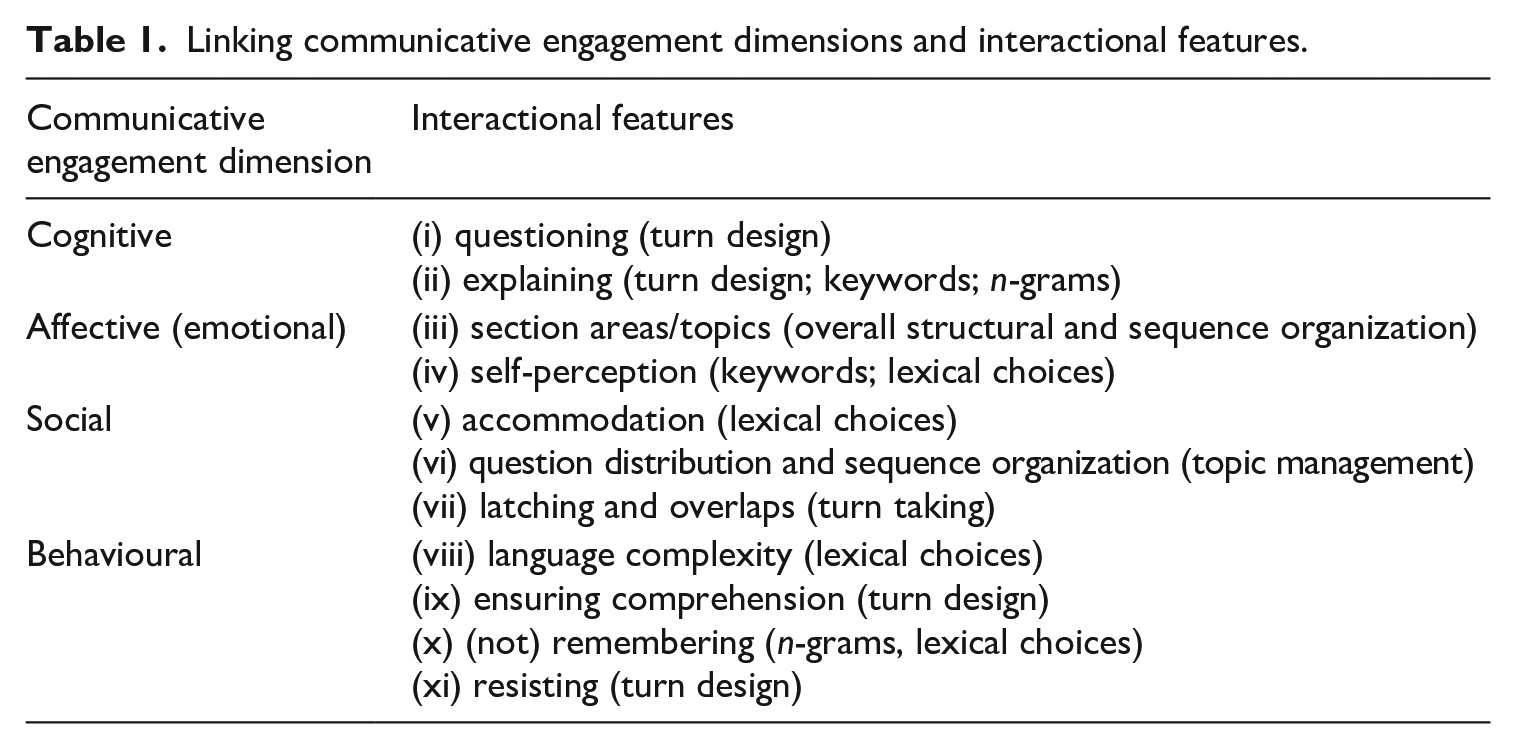
Our results provide strong evidence of children’s engagement in the context of youth justice assessment interviews; Table 1 unpacks the interactional features that underpinned each dimension of communicative engagement. Some features were relevant to more than one dimension. For instance, turn design covered a wide range of turn actions (resisting, questioning, etc.), which were variously aligned to one or more of the dimensions. In this section, we report and discuss how each of these features contributed to enhancing (as enablers) or diminishing (as barriers) children’s engagement in their assessment interviews.
Linking communicative engagement dimensions and interactional features.
Cognitive engagement
Our analysis identified two particular turn design actions as being indicative of this communicative engagement dimension in assessment interviews: (i) questioning and (ii) explaining.
(i) Questioning
The form that the questions in assessment interviews take is a crucial consideration when addressing the degree to which children may engage critically with the task at hand. Assessments made up of closed questions limit answer choices and, therefore, opportunities for critical, reflective engagement. In the assessments we examined, the majority of the questions (71 percent) were closed. The majority (80 percent) of these closed questions elicited minimal responses (for example, practitioner: ‘do you sometimes. . .?’; child: ‘sometimes, yeah’).
Use of this questioning style is in large part a result of the form of the AssetPlus assessment framework, which addresses a wider range of factors in the child’s life than previous assessment tools and is, therefore, much longer. Closed questions are a more efficient way of eliciting targeted information quickly. It makes sense, then, that, in order to elicit the large amount of information required by this extended assessment, practitioners would tend to use a closed questioning style.
Additionally, our data showed that a child was more likely to engage cognitively when asked open questions. In the 29 percent of cases where practitioners asked open questions, 59 percent received extended responses. As 41 percent of open questions also received minimal responses, it is important to note that low cognitive engagement with questions may not be down solely to the form (open/closed) they take.
(ii) Explaining
Further evidence of a child’s cognitive engagement in the assessment interviews came from the second most frequent turn design action that they performed, which was reflective in nature: explaining (n = 107). This was confirmed through the keyword analysis. The clausal connective ‘because’ and the personal stance marker ‘I think’ were among the most salient keywords in the child corpus, when compared with the practitioner corpus. Both of these lexical units are identified as indicators of cognitive engagement in learning tasks (Philp and Duchesne, 2016). Other key n-grams in the child corpus that indicated self-reflexivity were: ‘I think’, ‘I know I’, ‘I’ve got’, and four impersonal ‘it’ phrases (‘it’s not’, ‘it’s a’, ‘it’s like’, ‘it’s just’), which were used to reflect on situations, actions, the consequences thereof and obligations. Similarly, the n-grams ‘be able to’ and ‘they don’t’ were regularly used in the child corpus. The former was part of discussions of potential restrictions, that is, things that the children will not be able to do, or may be able to do but to a restricted degree. The latter was used to describe the role and influence of the children’s wider social circle on their identity and actions, for example: ‘well (-) they (—) well (-) I used to get (-) extra time ex- (.) i- in exams but they don't bother with that no more.’ It is also worth noting that the offence focus 7 of assessments is reflected in these results, as the majority of the reflective phrases that the children used, and the questions with which they were expected to cognitively engage, centred on offending behaviour and the consequences thereof.
Affective (emotional) engagement
Our analysis identified (iii) overall structural and sequence organization and (iv) lexical choices around self-perception to be crucial features of the child’s ability to display affective (emotional) engagement during the assessment interviews.
(iii) Overall structure and sequence organization (assessment sections/topics)
Children’s willingness to engage emotionally in assessment interviews was strongly determined by the specific topics being addressed, which were in turn determined to a considerable extent by the different sections in AssetPlus. The focus group and questionnaire results revealed that, although different children found it easy/difficult to talk about different topics, they generally preferred being asked ‘factual’ questions about ‘tangible’ things rather than questions about emotions. 8 Children also reported preferring to talk about positive relationships, things that they were good at and ‘things that were not a problem’ in their lives. They related being less happy to talk about offending, substance misuse and mental health, and happier to talk about hobbies, plans, work and family. The practitioner focus groups and questionnaire responses also revealed agreement on the following AssetPlus topics being most difficult for a child to emotionally engage with during the interviews: family, drinking, drugs, mental health and offending behaviour.
The above results must not be simplistically interpreted as a matter of children being willing to engage emotionally only when discussions revolve around positive elements of their situation. The child corpus did contain discussion of elements of their life in which they had had negative experiences. Rather, observations indicated that children’s reluctance to talk about certain sensitive topics came from their associated feelings of shame, embarrassment or trauma, which they were (understandably) not inclined to revisit.
All practitioner focus groups noted compliance issues in terms of feeling obligated to address every area in AssetPlus, so they did not feel able to skip sections (topics) that they felt did not apply, despite the in-built flexibility of the AssetPlus tool. This perception could be understood as a hangover from implementing the more prescriptive Asset tool prior to the inception of AssetPlus. Practitioner feelings of compliance could lead to a communicative situation in which children have to focus not only on their deficits (that is, flaws, weaknesses, criminogenic issues) and offending behaviour, but also on a range of factors that they may feel are entirely irrelevant to their case, which can negatively impact the child’s willingness to engage affectively with the assessment task.
(iv) Self-perception
At a macro level, the main topic of the assessment interviews is the child. The interviews are concerned with evaluating children – their actions, emotions, plans and so forth. A child’s ability to engage emotionally with himself/herself as an ‘evaluation topic’, as it were, is naturally affected by self-perception. Self-perception is a potential driver or inhibiter of emotional engagement (Svalberg, 2009).
Negative self-perception was found to act as a barrier to affective engagement in our study (see also Hopkins et al., 2015). Practitioners noted that one of the main challenges in trying to focus on factors promoting desistance (cessation) from offending and positive outcomes (for example, academic attainment, employment, engagement in prosocial activities) was that the child was not generally used to and/or comfortable with talking about themselves in positive terms (note an interesting contrast to findings that practitioners remained wedded to risk/deficit approaches to the completion of AssetPlus – Hampson, 2018). Discomfort when discussing positives was further confirmed by the keyword analysis results where ‘stupid’, ‘shit’ and ‘mess’ were unusually frequent words in the child corpus to describe children’s actions and/or feelings towards themselves.
Social engagement
The main interactional features linked to social engagement in our study were: (v) lexical accommodation; (vi) question distribution and sequence organization (topic management); and (vi) use of latching and overlaps (turn design).
(v) Lexical accommodation
The questionnaire results revealed that the children appreciated the chance to talk in private (‘eye to eye’) with practitioners. They particularly noted that they found it easier to engage communicatively if practitioners were relatable (‘down to earth’, ‘on my level’). A key feature to promote this sense of relatability, and hence to build rapport and promote social engagement, was the use of lexical accommodation. Of the practitioners we surveyed, 96 percent felt that they altered their speech to mirror the child in some way, most often by simplifying their language or employing slang terms where appropriate. This finding was broadly aligned to the analysis of the assessment interviews: there were 46 occurrences of lexical accommodation in the assessments observed, the majority of which (78 percent) were conducted by practitioners adopting the child’s choice of both individual words (for example ‘weed’) and phrases that revealed something about the child’s perspective on events (for example, child: ‘if he didn’t bump into me yeah? . . . I wouldn’t have done it’; practitioner: ‘how did it make you feel when he did bump into ya?’).
(vi) Question distribution and sequence organization (topic management)
Being able to lead a discussion provides further evidence of social engagement on the part of the speaker. In our data, the high degree to which practitioners led the interviews through questioning limited the child’s social engagement with the task. Practitioners asked the overwhelming majority of questions (94 percent) in the assessments – perhaps an inevitability of the interview context of practitioners soliciting information from children. The few questions asked by children largely sought to clarify some aspect of a practitioner question rather than to introduce a new line of questioning.
Connected to the above, the results of the sequence organization (topic management) analysis showed that in 62 percent of the assessment interviews practitioners addressed topics in the order in which they appear in AssetPlus materials. Where topics were introduced by the child ‘out of turn’, practitioners steered the assessment interview back to the original structure, minimizing the child’s influence on the direction of the interview. This is indicative of practitioners’ (adult-centric) control of topic management in our study.
(vii) Overlaps and latching (turn taking)
How speakers handle turn transition is indicative of their interpersonal relations and therefore affects social engagement in a given task. Use of latching and overlaps is thus important. Overall, children used almost double the amount of overlaps and latching than practitioners did. This suggests that, although practitioners tended to lead these interactions, children also contributed proactively to them. Overlaps and latching can be either ‘cooperative’ or ‘competitive’. In our study, both features were generally used cooperatively by the practitioners (92 percent cooperative overlaps; 83 percent cooperative latching) and by the children (78 percent cooperative overlaps; 86 percent cooperative latching).
Cooperative overlapping speech was also evidenced in the high frequency of affirmative n-grams (for example ‘yeah yeah’) in the child corpus (as well as the practitioner corpus). Despite this overall trend towards cooperative turn taking, it is also worth noting that children were overall more likely to use non-cooperative overlaps and latching than practitioners were. In these cases, children sought to correct the practitioners’ interpretation of their (children’s) discourse. This was one of the ways in which the children pushed back and sought to assert some discourse power in a communicative situation over which they had relatively little control.
Behavioural engagement
In our study, children’s level of behavioural engagement was linked to four interactional features: (viii) language complexity; (ix) ensuring comprehension; (x) (not) remembering; and (xi) resisting.
(viii) Language complexity
Our analysis revealed 99.5 percent of the practitioners’ language to be within the baseline vocabulary size for 13 year olds. Only 19 words were above the baseline vocabulary range of 18 year olds. Of these, nine words related to the youth justice process: ‘empathy’, ‘perpetrate’, ‘adjourn’, ‘remorse’, ‘curfew’, ‘consequential’, ‘reparation’, ‘incriminate’ and ‘remand’. Words such as (victim) ‘empathy’, ‘remorse’, ‘reparation’ and ‘consequential’ (thinking) are standard, frequently invoked concepts in youth justice intervention work. It is thus crucial that a child being assessed is able to understand their meaning. Our findings were reassuring in this respect. In all the assessment interviews we analysed, the practitioners explained the meaning of these words However, it is worth considering that even after several months of contact with the YOT, none of the children whose language we analysed had adopted them into their vocabulary, which begs the question of whether jargonized terms (for example, ‘impulsivity’, ‘consequential thinking’) should be employed in assessment interviews, rather than simpler language (for example, ‘act first, think later’), even if they are useful concepts when completing the AssetPlus assessment.
(ix) Ensuring comprehension
The main way that both practitioners and children ensured that they understood each other in these assessments was through the use of self-comprehension checks (where the speaker checked that they understood) and other-comprehension checks (where the speaker checked that the other person understood). Encouragingly, both children and practitioners used both types. Other-comprehension checks were the more popular type with both sets of speakers. In the child corpus, other-comprehension checks were much more frequent than self-comprehension checks (78 other-comprehension checks; 25 self-comprehension checks). When trying to ensure other-comprehension, the children predominantly (81 percent of the cases) asked the practitioner for an explanation/clarification. This finding was supported by children’s questionnaire responses to the question of what would they do if they did not understand something that the practitioner said: seek some form of explanation was the most frequent answer (61 percent). As regards self-comprehension, and in response to the assessment question about what the child would do if the practitioner misunderstood something that they said, the majority (63 percent) said that they would repeat the point made.
(x) (Not) remembering
Our n-gram analysis identified practical issues with memory during assessment interviews, beyond any learning difficulties that a child may have. ‘I can’t remember’ was one of the most frequently used n-grams in the child corpus. Moreover, in 41 percent of the assessments, the children expressed difficulty in remembering details of offences. This may in part be a resistance tactic, because it is known to be used in other institutional contexts, such as by witnesses in court cases (Drew and Heritage, 1992). However, our assessment interviews also demonstrated that the frequent use of the ‘I don’t remember’ n-gram was in part due to genuine difficulty in remembering details related to events that had occurred months ago.
Our analysis also showed that discussions of desistance (that is, cessation of offending) in the interviews may – ironically – in part contribute to a child’s difficulty in remembering and, hence, behaviourally engaging with the task at hand. AssetPlus presents discussions of positive factors in the children’s behaviour in terms of how they will help him/her avoid offending. The issue with this approach is that questions around ‘how would you not do X’ are more abstract – and hence more difficult to recall – than those that may ask about ‘how would you do X’.
(xi) Resisting
Resisting was the most frequent turn design action (n = 108) in the child corpus and it was realized by pushing back, disputing and/or correcting something that the practitioners said. Expectedly, resisting turns tended to occur in relation to practitioner questions and summaries that framed the children’s actions or motivations in a negative way.
Albeit less frequently, the children in our study also resisted positive assessments of their behaviour. By doing so, they actually put more effort into engaging with the task than was required by the practitioner’s question, since producing a minimal agreement to a positive assessment both requires less effort and makes it easier for a practitioner to reach a simple positive conclusion regarding the child’s behaviour. This finding was corroborated by the focus group and questionnaire responses from practitioners, who commented for instance: ‘[they don’t like] accepting praise . . . ’cause they’re so used to getting negative feedback and stuff like that from school, parents, police’, and ‘you sometimes need to tell them what the good things are because they might not see it as something positive’.
Although assessments clearly cannot ignore the offending context in which they occur, our results showed that children need more help in identifying and understanding positive elements of themselves and their behaviour than they do in identifying and understanding the negative ones.
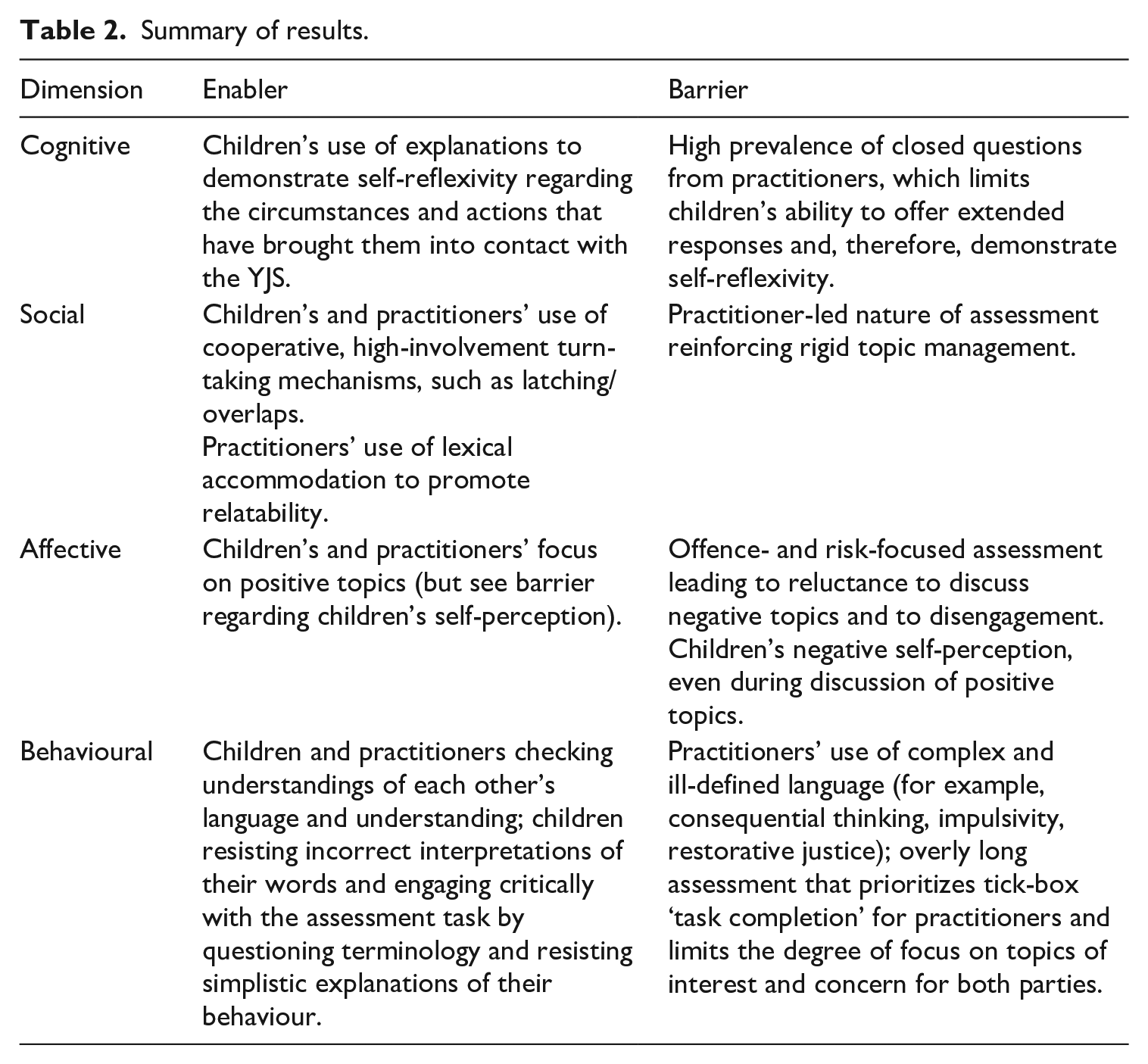
In summary, analyses identified interactional features operating as enablers of, and barriers to, children’s communicative engagement in youth justice processes (see Table 2).
Summary of results.
Discussion: Prioritizing children’s communicative engagement in youth justice assessment interviews
The YOT Talk project explored the explanatory and evidential voids around children’s communicative engagement in youth justice assessment interviews (see Sowerbutts et al., 2019), the rationale being that presumptions of communicative deficits (for example, DLDs, SPLDs) and attitudinal problems often supersede or preclude explanations for this engagement that are founded in the meaningful examination of communicative features and child–adult interactions within interview contexts.
Previous definitions of ‘engagement’ in youth justice have made vague points about how it is insufficient for children to participate; they have to do so ‘actively’ and ‘positively’ for it to constitute engagement, with little guidance as to what this means. We did not rely on vague terms such as ‘positive’ or ‘active’, rather we cross-referenced our linguistic analyses with an operationalized multi-dimensional account of engagement. Utilizing Svalberg’s (2009) dimensions of communicative engagement (supplemented with the behavioural dimension of Philp and Duchesne, 2016), YOT Talk demonstrated that children are capable of displaying cognitive, social and behavioural engagement during youth justice assessment interviews, but they struggle with affective engagement in these contexts. Findings indicate that children’s dis/engagement with youth justice assessment processes can be more complex and communicative in nature than is suggested by the existing youth justice evidence base and official practice guidance. In particular, the YOT Talk evidence identifies the crucial role of practitioners in creating and removing barriers to effective communication in assessment interviews.
The research concluded with a series of recommendations for improving the communicative features of assessment practice (from the perspective of both the child and the practitioner) in order to maximize children’s engagement (across the identified dimensions) and to mitigate and/or remove their disengagement during interviews, notably disengagement fostered by practitioner behaviours and the communicative dynamics of assessment interviews. Evidence suggested that the restructured and refocused implementation of AssetPlus should be grounded in the relationship-building between the practitioner and the child. The prioritization of relationship-building as the vehicle for promoting effective assessment can be facilitated communicatively by: rapport building (for example, practitioner use of slang, jargon, humour and inclusive language); more open questions (enhancing the child’s control over the interview contents and focus) rather than closed questions (which can inhibit cognitive engagement); practitioners’ ensuring the child’s understanding and negotiating meanings of assessment processes and associated questions, along with practitioners’ ensuring their own understanding of children’s responses.
The assessment mechanism (AssetPlus) was often perceived by practitioners and children as too long, too detailed and too negative (see Hampson, 2018). Consequently, in addition to upskilling practitioners to more effectively communicate with children, practice recommendations cohere around the need to abbreviate, streamline and rationalize implementation of the tool, including delivering assessment in the child’s home environment to maximize their comfort and the subsequent validity of assessment responses. Our findings indicate the need for a rethink of how AssetPlus is delivered in order to remove barriers to engagement that currently exist, including how practitioners approach assessment. Implementation of AssetPlus can be enhanced (communicatively) through restructuring/reordering of the assessment sections and associated questioning to foreground and privilege positive aspects of the child’s life (for example, foundations for change, strengths, capacities, prosocial experiences, interests, hobbies, goals) in a prospective manner (for example, as a means of pursuing positive behaviours and outcomes, including desistance), rather than over-emphasizing the retrospective explanation of (negative) factors presented as deficits/risks in order to prevent future offending. Refocusing on positive elements in the child’s current and future life in this way was found to increase the child’s engagement across all dimensions by offering the child more control over the direction and nature of the interview process. Furthermore, privileging positive and prospective assessment can mitigate perceptions that the assessment tool is over-long, which can engender an administrative focus on task completion rather than on enhancing engagement and thus the validity of assessment outcomes.
The YOT Talk findings align closely with the central principles of the YJB’s recent ‘Standards for Children in the Youth Justice System 2019’, which seek to move youth justice practice towards an overarching ‘Child First’ objective (YJB, 2019; see also Case and Haines, 2018) and away from previous offence- and offender-focused, risk-led approaches. As such, the project recommendations discussed serve as important indicators of key engagement issues that could be addressed in the forthcoming (updated) Case Management Guidance from the YJB that will help practitioners to animate National Standards for youth justice. The Child First objective is founded on a series of progressive principles that are reflected by the YOT Talk recommendations: child-focused youth justice practice (see recommendations for inclusive assessment interviews that facilitate the child’s meaningful participation); promoting positive behaviours/outcomes, strengths and capacities (cf. refocusing the AssetPlus structure and priorities on positive factors 9 and desistance outcomes); relationship-building between professionals and children (see prioritizing the effectiveness of rapport building and inclusive language); and the child’s participation, engagement and social inclusion (see emphasizing co-creating understanding, meaning and positive interview outcomes).
Where previous studies have identified the need for enhancing children’s engagement with youth justice processes, these have generally failed to give a comprehensive account of what this means in practice, instead relying on vague suggestions that participation should be ‘active’ and ‘positive’. Our study examined engagement in this context as a complex multi-dimensional phenomenon. In general terms, the current assessment process offers limited opportunities for and several barriers to communicative engagement. Nevertheless, our linguistic evidence points to children’s potential to be active participants in assessment processes, evidenced across the communicative dimensions. For example, children demonstrated self-reflection, critical engagement with assessment terms, supportive and collaborative turn taking, and making sure that they understand and are understood by others. However, the unwieldy nature of AssetPlus, and the resulting one-sided exchanges, mean that assessment is still largely something that happens to them and limits their opportunities to engage socially and emotionally. This also means that assessments are, to a large extent, focused on task completion, disengaging children behaviourally. Furthermore, the continued offence focus of the assessment framework (aside from making it disengaging emotionally) means that children are often being asked to engage cognitively with (that is, think and talk a lot about) their offences and the degree to which they pose a risk, rather than their strengths and the factors that might encourage desistance. This could reinforce negative self-perception and make it harder for children to recognize and accept positive personal and behavioural traits they may have demonstrated, which in turn makes it more difficult for practitioners to recommend positive desistance-based case work/solutions.
To conclude, YOT Talk strongly indicates the need for practitioners to learn, upskill and be enabled (for example, through experience, training and guidance) to conduct assessment interviews in positive, nuanced and flexible ways that address communicative enablers and barriers within child-led (Child First) processes, rather than delivering assessments containing content and structure prescribed by adult- and system-centric agendas. Children’s dis/engagement is a multi-dimensional phenomenon that can be facilitated and obstructed by assessment mechanisms and (adult) recessional practices, rather than presenting as the inevitable outcome of communicative deficits. Indeed, YOT Talk demonstrated that children can be active and reflective collaborators in the youth justice processes when enabled and supported in communicative ways, contrary to the hegemonic conclusions of the evidence bases underpinning much youth justice assessment practice.
Supplemental Material
sj-pdf-1-euc-10.1177_1477370821996850 – Supplemental material for YOT Talk: Examining the communicative influences on children’s engagement with youth justice assessment processes
Supplemental material, sj-pdf-1-euc-10.1177_1477370821996850 for YOT Talk: Examining the communicative influences on children’s engagement with youth justice assessment processes by Stephen Case, Nuria Lorenzo-Dus and Ralph Morton in European Journal of Criminology
Footnotes

References
Supplementary Material
Please find the following supplemental material available below.
For Open Access articles published under a Creative Commons License, all supplemental material carries the same license as the article it is associated with.
For non-Open Access articles published, all supplemental material carries a non-exclusive license, and permission requests for re-use of supplemental material or any part of supplemental material shall be sent directly to the copyright owner as specified in the copyright notice associated with the article.
