




Abstract
Increasingly people in prison are sharing cells but little is known about how cell-sharing may influence wellbeing. This research explores this issue using a random stratified survey of 569 imprisoned adult men in Northern Ireland. The findings reveal a relationship between cell-sharing and wellbeing but indicate that cellmate relationships may be more important than cell type in influencing wellbeing. Depending on the nature of cellmate relationships, the findings suggest that cell-sharing can enhance or diminish wellbeing beyond that experienced in single cells. In explaining these findings, it is proposed that cellmate relationships may influence the extent to which individuals feel strain from concealing their emotions and vulnerabilities, receive social support from a cellmate and/or feel safe.
Introduction
European Prison Rules (Council of Europe, 2006) and the United Nations (1955) Minimum Standards for the Treatment of Prisoners express a preference for individuals to be held in single cells. Yet individuals are often held in shared cells, especially when prisons are overcrowded. Many human rights organizations are critical of shared cells owing to their potential negative impact on wellbeing (for example, Office of the United Nations High Commissioner for Human Rights, 2005; Raffaelli, 2017). Nevertheless, Molleman and Van Ginneken (2015: 1030) note that ‘there is scant solid empirical research on the effects of cell sharing, even though it is a common practice in many countries’. This article seeks to address this gap in knowledge by investigating whether the self-reported wellbeing of imprisoned adult males detained in single cells differs significantly from that of those detained in shared cells (consisting predominantly of two people). The extent to which cell-sharing may influence wellbeing when controlling for other possible confounding factors is also examined. By addressing this gap in knowledge, this study makes an original contribution by enhancing our understanding of the possible relationship between cell-sharing and wellbeing, as well as being the first study to quantitatively investigate how the self-reported wellbeing of those in single cells compared with that of those sharing a cell with another person.
Cell-sharing and wellbeing
Research capturing cell-sharing experiences highlights several potential negative impacts of cell-sharing, such as a lack of privacy and safety, as well as an increased potential for violence (Moran et al., 2013). These ‘pains of imprisonment’ may be exacerbated in small, cramped cells, especially with numerous cellmates and little time out of the cell (European Committee for the Prevention of Torture and Inhuman or Degrading Treatment or Punishment, 2015). Often this research has taken place in overcrowded conditions, which makes it difficult to disentangle the influence of cell-sharing from the impact of overcrowding (Baggio et al., 2018; Huey and McNulty, 2005). These studies suggest that the impact of cell-sharing in overcrowded conditions is especially negative, linking it to tense prison social climates, higher levels of assault, bullying and increased rates of suicide and self-harm (for example, Haney, 2012; Huey and McNulty, 2005; Lawrence and Andrews, 2004; Marshall et al., 2000). Moreover, these studies tend to focus on the impact of cell-sharing on a systemic rather than an individual level, so that far less is known about the individual lived experience of cell-sharing and how it may affect wellbeing. Additionally, few studies have been conducted examining cell-sharing in uncrowded conditions (Molleman and van Ginneken, 2015).
Some possible positives of cell-sharing alluded to in existing research include its potential to reduce loneliness, boredom and isolation. The physical presence of another person may mitigate the impact of isolation encountered in a single cell (Knight, 2012; Liebling, 1992). Research suggests that positive social relationships, even intimate relationships, are possible and valuable for individuals in prison (Kerley and Copes, 2009; Morey and Crewe, 2018; Wulf-Ludden, 2013). Peer social support can be an effective coping strategy, linked both to better wellbeing in prison and to an increased likelihood of desistance (Cid and Martí, 2017; Mowen and Boman, 2019). Sharing emotions can also have a positive effect, psychologically and physically (Van Harreveld et al., 2007). Van Harreveld and colleagues (2007) note that cell-sharing may help create a social support system in prison that may benefit certain individuals. However, more in-depth research on this issue has not been conducted. Recent research also highlights the importance of peer relationships for influencing a prison’s social climate, although less is known about how cell-sharing may affect these relationships or how these relationships may affect wellbeing (Van Ginneken et al., 2019).
There is evidence to suggest that, when two individuals share a cell originally built for one, the negative impact of overcrowded conditions may outweigh any possible benefits (Huey and McNulty, 2005). It can be challenging for individuals to navigate the tensions involved in sharing a small space, and the success of this may depend on the cellmates’ interpersonal skills and the nature of their relationship (Laws and Crewe, 2016). It may also be the case that male prison social norms influence how effective cell-sharing can be at enabling social and emotional support. For instance, although such support can be an effective coping strategy (Van Harreveld et al., 2007; Wulf-Ludden, 2013), male prison social norms regarding the concealment of emotion may restrict the opportunities men have for seeking/receiving such support (Crewe et al., 2014; Liebling and Arnold, 2012; Sykes and Messinger, 1960). In shared cells, individuals may feel the need to continuously maintain a performance as they conceal vulnerabilities and conform to male prison social norms of ‘toughness’ to avoid losing status (Crewe et al. 2014; Jewkes, 2005). Concealing actions, values or mannerisms that are representative of an individual’s true self, but not aligned with prison social norms, may be psychologically difficult and potentially affect wellbeing (Jewkes, 2002). Indeed, research suggests that the pressure to conform to male prison social norms can affect wellbeing (Liebling and Arnold, 2012; Oliffe et al., 2018; Van Harreveld et al., 2007). Not all individuals will subscribe to such social norms to the same degree and so their wellbeing may not be affected by the strain to behave in accordance with these norms to the same degree. Individuals may then vary in the extent to which they find cell-sharing difficult because of these normative pressures and other factors possibly influencing cell-sharing and wellbeing in prison.
Other factors influencing cell-sharing and wellbeing in prison
Just as the experience of imprisonment is far from homogeneous, individuals’ experiences of cell-sharing and its impact on their wellbeing may differ. Individuals do not arrive in prison as blank slates but import pre-existing coping styles, values, experiences and characteristics into prison with them, shaping how they respond to prison and, potentially, cell-sharing (Irwin and Cressey, 1962; Zamble and Porporino, 1988). For instance, imported coping styles may influence whether or not individuals share a cell. Because prison incentivized regimes often use single cells as a reward for compliance and engagement in rehabilitative services, individuals who use substances as a means of coping or tend to withdraw/disengage from activities may be especially likely to be placed in a shared cell owing to their involvement in prison misconduct and lack of engagement with rehabilitative opportunities (Butler et al., 2019). Cell-sharing may also influence whether or not an individual is able to use their imported coping styles – for example, a cellmate’s presence may pose challenges for emotional regulation (Laws and Crewe, 2016). Additionally, the relationship between cellmates may influence their use of certain coping styles, with those experiencing positive relationships perhaps being more likely to give/receive emotional support (Wulf-Ludden, 2013). It is therefore important that these differences in coping styles and potential selection effects are controlled for when examining the possible relationship between cell-sharing and wellbeing.
Similarly, the extent to which individuals experience mental health issues or addiction may place a strain on their wellbeing and influence cell-sharing, because these conditions may affect their ability to comply with prison rules and, consequently, whether they are placed in a single or a shared cell (Butler et al., 2019; Steiner et al., 2014). Previous experiences of mental ill health and addiction may also place a strain on a person’s wellbeing, influencing how they adjust to imprisonment and potentially how they experience cell-sharing (Hughes and Huby, 2000; Rowe, 2011). Other factors that have been found to influence involvement in prison misconduct (and, consequently, may affect cell-sharing because single cells are used as a reward for compliance) include age, ethnicity, socio-economic status (SES), differences in the security status and regime of prison establishments, and the number of times an individual has been imprisoned (Steiner et al., 2014). Since a person’s status in prison incentivized regimes can influence cell allocation decisions, it is also important to control for this variable when examining the relationship between cell-sharing and wellbeing.
Further factors to consider include feelings of safety, sexuality, time served and cellmate relationships. Previous research has identified reduced feelings of safety as one of the potential negative effects of cell-sharing, and feeling unsafe in prison is associated with a lower quality of life, psychological distress and suicide ideation (for example, Favril et al., 2017; Liebling et al., 2005; Moran et al., 2013). Sexuality may be important to consider because individuals reporting a non-heterosexual identity may experience increased awkwardness with cellmates, as well as increased vulnerability to discrimination, potentially affecting their wellbeing (Carr et al., 2020; Dunn, 2013). Time served may also influence cell-sharing and wellbeing: individuals can often initially struggle to cope with the prison regime and rules in prison before then adapting as time progresses (Zamble and Porporino, 1988). Furthermore, past studies have indicated that peer relationships can play a key role in influencing how people experience prison environments and their ability to successfully navigate the tensions that can be involved in sharing a small space (for example, Laws and Crewe, 2016; Van Ginneken et al., 2019). Consequently, it would be important to control for cellmate relationships, as well as the other factors previously mentioned, when investigating how cell-sharing may affect wellbeing.
The present study
As previously outlined, this study seeks to make an original contribution to knowledge by empirically investigating the possible relationship between cell-sharing and wellbeing. It seeks to enhance our understanding of how cell-sharing may influence wellbeing, when other possible confounding factors are controlled for, and to examine whether or not there are differences in the self-reported wellbeing of those detained in single cells compared with those sharing a cell with another person. More specifically, this study seeks to answer the following two research questions:
Based on the previous literature, it is hypothesized that individuals detained in shared cells will report significantly lower wellbeing scores compared with those in single cells and that a statistically significant relationship between cell-sharing and wellbeing will be found, even when other possible confounding factors are controlled for. However, caution is required when attempting to generalize these findings to larger shared cells because the cell-sharing arrangements focused on in this research primarily consisted of two individuals.
Methodology
To answer these research questions, a random stratified survey was conducted of 569 imprisoned adult men in the Northern Ireland Prison Service (NIPS). The survey asked questions about cell-sharing, wellbeing, coping styles and other possible confounding factors that may have influenced who was selected to share a cell. There are only two adult male prisons in the NIPS, Maghaberry Prison and Magilligan Prison. This study was conducted in both prisons. Maghaberry Prison is a high security prison for adult men of all security categories who are serving varying sentence lengths, fine defaulters and/or on remand. Magilligan Prison is a medium security prison, containing adult men who have been sentenced, with under six years left to serve of their sentence. Both prisons feature single and shared cells. Owing to the nature of the population Maghaberry Prison holds, it is more susceptible to prison population fluctuations, with shared cells generally being used when the prison is overcrowded or to provide support to those with a disability or medical need. Magilligan Prison is less susceptible to overcrowding because it detains only lower security, sentenced prisoners who are transferred from Maghaberry Prison. Consequently, the population at Magilligan Prison tends to remain relatively stable, with shared cells being used less frequently, generally in response to requests to share a cell or when individuals are believed to require assistance/support. During data collection, most men could spend up to nine hours daily out of their cells. The following sections outline the sample, measures, procedure and analytical strategy used.
Sample
A random stratified sample of 569 imprisoned adult men, ranging in age from 21 to 71, with a mean age of 36 and a median age of 33, was used. The sample size of 569 represented approximately 43 percent of the total average daily number of imprisoned adult men detained in NIPS during the data collection period (NISRA, 2018). Using an anonymized list of all adult males detained in Maghaberry and Magilligan prisons, individuals were randomly selected to participate if they met the following selection criteria: understood English; were able and willing to give informed consent; were not experiencing an acute episode of physical or mental ill health at the time of data collection; did not pose a danger to the researcher; and were detained in the main prison population. The number of adults chosen from each prison was proportional to its representation in the NIPS prison population. Of a total of 770 potential participants, 569 agreed to participate, resulting in an overall response rate of approximately 74 percent.
Measures
Wellbeing
To measure wellbeing, the Warwick-Edinburgh Mental Well-being Scale (WEMWBS) was used. The WEMWBS consists of 14 positively worded items on a five-point Likert scale, ranging from 14 to 70. Each item consisted of a statement relating to a way of feeling (for example, ‘I’ve been feeling relaxed’) and the response categories ranged from ‘none of the time’ to ‘all of the time’. The WEMWBS has good face validity, internal consistency and reliability (α = 0.91) (Tennant et al., 2007). Although the WEMWBS was designed as an instrument for measuring wellbeing among the general population, it has been used successfully with a range of other populations, including those detained in prison (Tweed et al., 2019).
Coping style
The Brief COPE Inventory was used to measure coping style. The Brief COPE is a condensed version of the full COPE Inventory (Carver, 1997). It consists of 28 items, made up of 14 subscales, each consisting of two items, representing different coping styles. There are four response options, ranging from ‘I haven’t been doing this at all’ to ‘I’ve been doing this a lot’. The responses are scored from 1 to 4 and a score for each subscale is summed. Reliability coefficients of the 14 scales range from 0.54 to 0.90 (Carver, 1997). A reliability coefficient of 0.7 or higher is required for a scale to be deemed acceptable (Nunnally, 1978), and only those subscales demonstrating a reliability coefficient of 0.7 or higher were included in the analysis. This resulted in three Brief COPE subscales (Self-distraction, Venting and Self-blame) being excluded from the analysis.
Demographic information
Participants were asked about their age, ethnicity, sexual orientation, SES, previous history of imprisonment, and history of addiction and mental health issues (coded as ‘yes’ or ‘no’). Respondents were given several response categories in terms of reporting ethnicity (‘Asian’, ‘Black’, ‘Irish Traveller’, ‘Mixed’, ‘Other’ and ‘White’), SES (‘Working class’, ‘Lower middle class’, ‘Middle class’, ‘Upper middle class’, ‘Upper class’) and sexuality (attracted to ‘men and women’, ‘men only’, ‘women only’ or ‘prefer not to say’). Low cell counts necessitated coding these categories in more binary terms: ‘White excluding Irish Travellers’/‘Not White including Irish Travellers’, ‘Working/lower middle class’/‘Middle/upper class’ and ‘Straight’/‘Not straight’.
Prison-related information
Information was recorded on the prison establishment participants were detained in, their cell type, the nature of their relationship with their cellmate, perceptions of safety, their cell type preference, time served, sentence length and incentivized regime status. Respondents were asked to indicate how many people were in their cell, including themselves, with the options of ‘1’, ‘2’, ‘3’ or ‘more than 3’. The nature of cellmate relationships was recorded by asking respondents to indicate how well they got on with their cellmate(s), choosing from six options: ‘We don’t get on at all’, ‘We rarely get on well’, ‘We sometimes get on well’, ‘We get on well most of the time’, ‘We always get on well’ and ‘N/A’ representing those in single cells. These were coded into three categories: ‘N/A’, ‘Poor cellmate relationship’ (consisting of the first three response options) and ‘Good cellmate relationship’ (consisting of the last two response options). Although there was some debate as to whether indicating that one ‘sometimes got on well’ with one’s cellmate constituted a poor cellmate relationship, low cell counts necessitated coding in this way to facilitate analysis. Respondents were also asked to indicate their cell preference (‘single’ or ‘shared’), if they felt safe (‘yes’ or ‘no’) and their incentivized regime status (‘Basic’, ‘Standard’ or ‘Enhanced’). To record how much time respondents had served, six categories were used; ‘I am on remand’, ‘less than 1 year’, ‘between 1 and 2 years’, ‘between 2 and 4 years’, ‘between 4 and 10 years’ and ‘over 10 years’. Sentence length was also recorded using these categories but included two additional response categories, specifically ‘life sentence’ or ‘Imprisonment for Public Protection (IPP)’. 1
Prison male role norms
Two subscales of the Male Role Norms Inventory Short Form (MRNI-SF) were used. The MRNI-SF is a short measure of traditional masculinity ideology (Levant et al., 2013). The ‘Restrictive Emotionality’ and ‘Toughness’ subscales were chosen for inclusion because they measure the extent to which men endorse the concealment of emotion and displays of toughness as being important for a masculine image. Responses were made on a seven-point Likert-type scale ranging from 1 = strongly disagree to 7 = strongly agree. Levant and colleagues (2013) report Cronbach alphas of 0.83 and 0.79 respectively for these two subscales.
Procedure
Ethical approval was obtained from Queen’s University Belfast and NIPS. Before administering the survey, the questions, layout and language were piloted. The survey readability was also assessed as having a Flesch-Kincaid Grade Level statistic of 4.2, indicating that the reading level required to understand the survey was age 10. A combination of verbal and written communication methods was used to obtain informed voluntary consent. The voluntary nature of the research was stressed to ensure participants did not feel coerced to participate and were aware of their ability to refuse to answer a question or withdraw from the study, without any negative consequences. To allow for reading and writing difficulties, participants were given the option of completing the survey themselves or with assistance. Participants were also aware that their involvement in the survey would have no impact on cell allocation decisions made by NIPS staff. No names were recorded to ensure anonymity and confidentiality. On completion, participants placed their completed surveys in a sealed envelope in a special sealed box on the landing or returned them directly to the researcher. All data collected were stored securely and accessible only to the research team.
Analytical strategy
The survey data were coded and entered into SPSS for analysis. Missing data in the survey items and scale totals ranged between 0 and 16.3 percent. Proportions of missing data of 5 percent or less can be considered as inconsequential, although greater than 10 percent may bias results (Bennett, 2001; Dong and Peng, 2013; Schafer, 1999). Although most items had less than 5 percent missing data, this threshold was exceeded by the scale totals for the WEMWBS measure, the Brief COPE subscales, both MRNI-SF subscales of ‘Restrictive Emotionality’ and ‘Toughness’, ‘age’ and ‘previous times in prison’.
Several steps were taken to deal with missing data. Firstly, participants who had not completed any items of the dependent variable (WEMWBS scale) were deleted (n = 10). Secondly, following the WEMWBS User Guide, the person-mean was calculated to deal with cases where up to three items were missing from the WEMWBS items (Taggart et al., 2016). Thirdly, for the Brief COPE subscales, where one of the two subscale items had been completed, the same value was entered for the non-completed item (Carver, personal communication, 18 September 2017). After performing these steps, the patterns of missing data were examined to establish whether the missing data were missing completely at random (MCAR), missing at random (MAR) or missing not at random (MNAR) (Rubin, 1976). Little’s test for MCAR yielded a significant result (χ2 (3674) = 3871.484, p = .012), suggesting that the missing data were not MCAR but could be MAR or MNAR. Given that examination of separate variance t-tests indicated that MAR could be assumed (Tabachnick and Fidell, 2013), multiple imputation (MI) was performed.
Garson (2015: para. 1) describes MI as ‘a method of generating multiple simulated values for each incomplete datum, then iteratively analysing datasets with each simulated value substituted in turn’. MI is regarded as superior to alternatives such as pairwise or listwise deletion (Dong and Peng, 2013). Based on guidance from White, Royston and Wood (2011), 50 datasets were imputed using the MI Function in SPSS (Version 24) and the imputed results are presented unless otherwise specified. The imputed results were also compared with the results from the observed data and only a small number of inconsequential differences were observed, with these differences pertaining to the magnitude of relationships, with their direction and strength remaining similar.
To answer the research questions, an independent t-test was used to examine whether there was a significant difference in the self-reported wellbeing of those in single and shared cells and an Ordinary Least Squares (OLS) regression analysis was used to investigate whether cell-sharing was significantly associated with wellbeing, when other possible confounding factors were controlled for. Prior to conducting the OLS regression analysis, tests for violations of regression assumptions were performed to ensure that there were no issues regarding low cell counts, multicollinearity, outliers, normality and homoscedasticity. Because issues with multicollinearity were encountered for the ‘cell type’ and ‘cellmate relationship’ variables, ‘cell type’ was excluded from the analysis and ‘cellmate relationship’ was retained. The variable for ‘cellmate relationship’ was a more useful variable for analysis because it was coded into three response categories: ‘poor cellmate relationship’, ‘good cellmate relationship’ and ‘N/A’, which represented individuals in single cells. Accordingly, the ‘cellmate relationship’ variable provided information on whether an individual was in a single cell or a shared cell (similar to the ‘cell type’ variable’) and information about the nature of the cellmate relationship. A further issue of multicollinearity was encountered for the ‘sentence length’ and ‘time served’ variables. Because issues with low cell counts were present in the ‘sentence length’ variable, the ‘time served’ variable was used in the OLS regression analysis. The findings that emerged from this analysis and sample characteristics are presented next.
Findings
The sample characteristics are displayed in Table 1.
Sample characteristics.
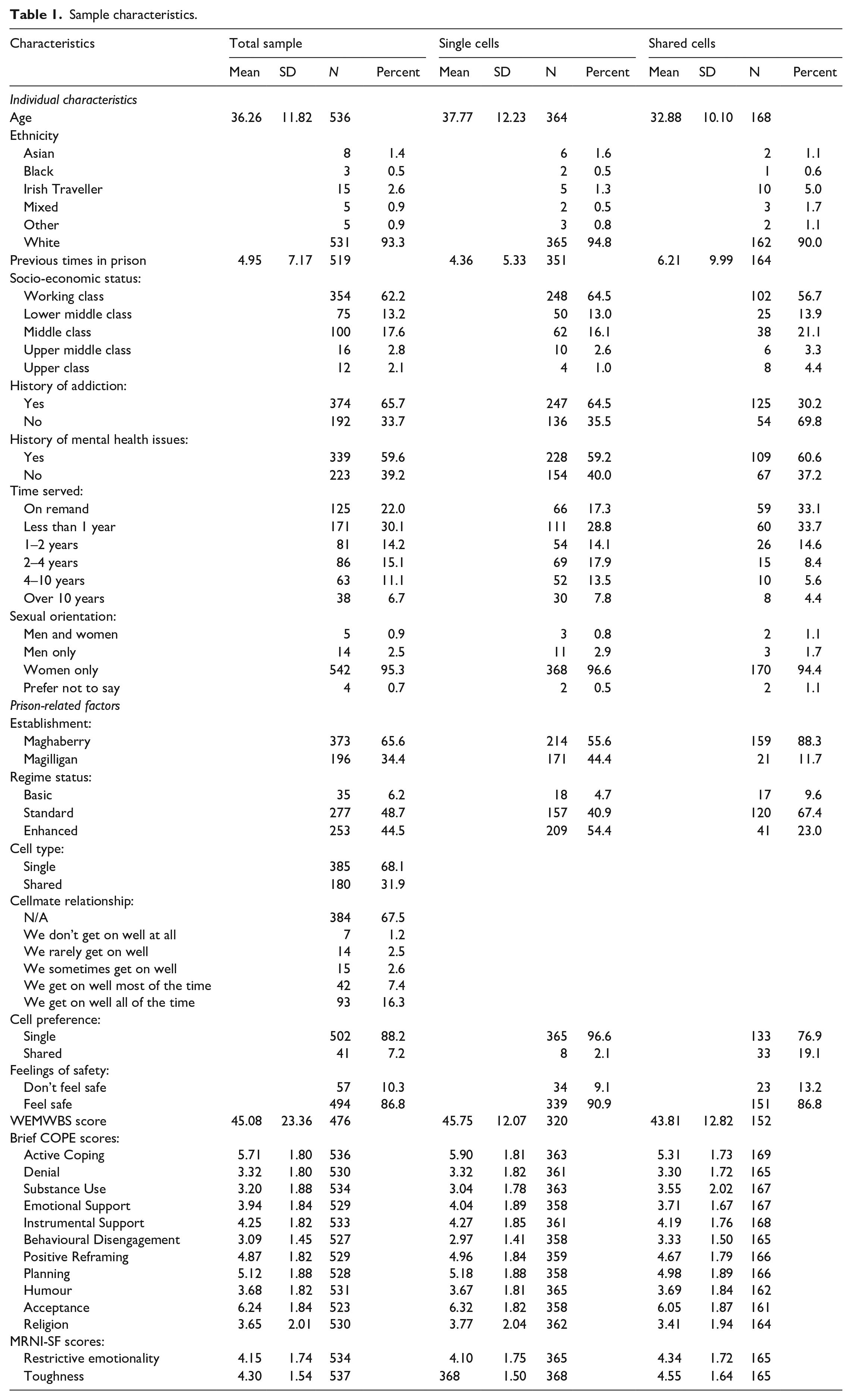
Of those who took part in the survey, 68.1 percent (n = 385) were in single cells and 31.9 percent (n = 180) were in shared cells. Four participants did not answer this question. Most participants (88.2 percent; n = 502) expressed a preference for a single cell, whereas 7.2 percent (n = 41) stated that would prefer a shared cell and 4.6 percent (n = 26) did not answer this question. Examining cell preference via current cell type revealed that a larger percentage of those in shared cells expressed a preference for being detained in a shared cell (19.1 percent) compared with those in single cells (2.1 percent).
Some differences were noted in the profile of those detained in single cells compared with those detained in shared cells, suggesting that selection effects were evident in cell allocation decisions. Mann-Whitney U tests revealed a significant difference in the imprisonment histories of those in single cells (Mdn = 3, n = 380) and those in shared cells (Mdn = 4, n = 179), with individuals in shared cells reporting significantly more periods of imprisonment compared with those in single cells (U = 29435.30, z = −2.611 p < .05). Individuals in shared cells (Mdn = 30.83, n = 179) were also significantly younger than those in single cells (Mdn = 34, n = 380) (U = 26229.26, z = −4.374, p < .001). Moreover, a higher proportion of Irish Travellers and those who were not White were found to reside in shared cells (χ2 (1, n = 559) = 3.904, p < .05). Those reporting higher SES were more likely to share a cell than those reporting lower SES (χ2 (1, n = 559) = 4.450, p < .05), and those on remand were more likely to share a cell (χ2 (5, n = 559) = 28.461, p < .001). Some significant differences were also evident in the coping styles of those detained in single and shared cells. Those in single cells were slightly more likely to use Active Coping (Mdn = 6, n = 380) compared with those in shared cells (Mdn = 5, n = 179) (U = 27828.14, z = −3.526, p < .001). Those in single cells were also slightly less likely to use Behavioural Disengagement (Mdn = 2, n = 380) compared with those in single cells (Mdn = 3, n = 179) (U = 27793.91, z = −2.885, p < .01). Further, those in shared cells were more likely to report using Substance Use as a coping style compared with those in single cells (U = 29327.08, z = −3.014, p < .01). Although the median scores for Substance Use for those in single cells (Mdn = 2, n = 380) were equal to the median scores for Substance Use for those in shared cells (Mdn = 2, n = 179), there was a difference in means for Substance Use between those in single cells (M = 3.07) and those in shared cells (M = 3.56).
Among those who were currently sharing cells, 78 percent (n = 137) reported a good cellmate relationship, whereas 22 percent (n = 38) stated they did not get on well at all, rarely or only sometimes with their cellmate. Five participants did not answer this question. Scores for wellbeing ranged from 14 (the lowest possible score) to 70 (the highest possible score). The mean score for wellbeing was 45, with a standard deviation of 12.1. This is lower than the mean wellbeing scores reported for the general population in England and Scotland, with a mean of 50 reported in 2016 (Morris and Earl, 2017; Scottish Health Survey, 2017). It is unsurprising that the mean wellbeing score of those in prison is lower than that for the general population, because prison can be a stressful environment (Haney, 2012).
In relation to research question 1, an independent t-test showed no statistically significant difference in the self-reported wellbeing scores of those in single cells (M = 45.75, SD = 12.06) compared with those in shared cells (M = 43.81, SD = 12.82, t (470) = 1.563, p = .111). This was a surprising result, in contradiction to our hypothesis that those in shared cells would have poorer wellbeing than those in single cells, as previous concerns expressed in the literature would suggest. One explanation for this finding is that wellbeing may be influenced by cellmate relationships more so than cell type, therefore a one-way between subjects ANOVA was performed to compare self-reported wellbeing by cellmate relationship. This ANOVA found a significant difference in wellbeing scores (F (2, 462) = 8.838, p <.001), with those who reported a poor cellmate relationship (M = 35.28) reporting significantly lower wellbeing scores compared with those with a good cellmate relationship (M = 45.71) or no cellmate (M = 45.76).
Next, an OLS regression was used to answer research question 2. The results of this regression model are presented in Table 2 and are based on the pooled values for unstandardized betas, 2 standard errors and p-values generated by MI.
OLS regression results for cell-sharing and wellbeing (n = 559).

Note:
Reference group.
p < .05, **p < .01, ***p < .001.
This model was found to explain 39.6 percent of the variance in wellbeing scores (R2 = .396, F (31) = 12.785, p < .001). A statistically significant relationship between cell-sharing and wellbeing was observed when other possible confounding factors were controlled for. However, the results revealed that those in single cells did not report significantly higher wellbeing scores compared with those in shared cells. Instead, those who shared a cell and had good cellmate relationships reported higher wellbeing scores compared with those in a single cell with no cellmate (b = 2.142, p = .05) (see Table 2). Although sharing a cell and having a poor cellmate relationship were not significant in this model, only a small number of individuals reported having a poor cellmate relationship in this sample. Nonetheless, the direction of the relationship was negative, suggesting that those sharing a cell and having poor cellmate relationships may be more likely to report lower wellbeing scores compared with those in single cells. Consequently, poor cellmate relationships may not have emerged as significant owing to the small number of people reporting a poor cellmate relationship rather than this variable being irrelevant in terms of influencing wellbeing. Indeed, caution has been advised in relation to over-reliance on thresholds of statistical significance when interpreting results (Wasserstein and Lazar, 2016), so this relationship merits further investigation.
Other variables found to be statistically significant in this model included some of the individual coping styles, reporting a history of mental health issues, feelings of safety and endorsing male social role norms of ‘Restrictive Emotionality’ and ‘Toughness’. The following coping styles were significantly associated with wellbeing, with participants reporting a higher use of these coping styles generally reporting higher wellbeing scores: Active Coping (b = 0.983, p < .01); Emotional Support (b = 1.329, p < .001); Positive Reframing (b = 1.288, p < .001); and Acceptance (b = 0.668, p < .05) (see Table 2). Several coping styles were significantly negatively associated with wellbeing, with participants who reported greater use of these coping styles tending to report lower wellbeing scores: Substance Use (b = −0.641, p < .05); Behavioural Disengagement (b = −2.256, p < .001); and Planning (b = −1.059, p < .01) (see Table 2). In addition, those with a history of mental health issues were found to be significantly more likely to report lower wellbeing scores compared with those who did not report such a history (b = −3.529, p < .001). Perceptions of safety were also found to be significantly related to wellbeing, with individuals who did not feel safe reporting lower wellbeing scores compared with those who felt safe (b = −5.416, p < .001) (see Table 2). Moreover, both male social role norms were found to be significantly related to wellbeing. Endorsement of ‘Restrictive Emotionality’ was significantly associated with lower wellbeing scores (b = −0.587, p < .05), and endorsement of ‘Toughness’ was significantly related to higher wellbeing scores (b = 0.722, p < .05) (see Table 2). No other significant relationships were observed. Further analysis was conducted to investigate possible interaction effects but none were found to be significant.
Discussion
Contrary to expectations, we found no significant difference between the self-reported wellbeing of those in single cells and that of those sharing a cell with another person. However, we observed a significant difference when cellmate relationships were considered, with those reporting poor cellmate relationships experiencing lower wellbeing compared with those in single cells or shared cells with good cellmate relationships. When possible confounding factors were controlled for, people with good cellmate relationships tended to report higher wellbeing scores compared with those in single cells, whereas those with poor cellmate relationships tended to report lower wellbeing scores. One possible explanation for this finding is that, where cellmates have a good relationship, they may provide positive social and emotional support to each other, bolstering wellbeing beyond that experienced in a single cell. Indeed, the regression results revealed that those who used emotional support as a coping style were more likely to report higher wellbeing, indicating a link between wellbeing and seeking emotional support from others. These findings indicate that cellmate relationships may play a more important role in shaping individuals’ experiences of cell-sharing than the simple fact that they are sharing a cell. The role played by relationships in this study points to the necessity of moving beyond a focus on material conditions and their impact on wellbeing to also paying attention to the relational dynamics and social climates that exist within prisons (Van Ginneken et al., 2019). This is relevant not only for research on issues such as prison architecture and prison regimes but also for bodies responsible for inspecting prison conditions (Williams et al., 2019).
This finding is all the more intriguing given the preference for a single cell reported by most participants. This preference may reflect the uncertainty and lack of control individuals experience over the identity of prospective cellmates, how cellmate relationships develop and the difficulties encountered coping in such circumstances. Future research is needed to explore this issue further. For individuals detained in overcrowded jurisdictions and/or facilities where multiple cellmates are common, the ability to develop and maintain good cellmate relationships may become more complicated and less achievable, increasing the possibility of poor cellmate relationships or poor relationships with some cellmates. In these conditions, the potential for cell-sharing to impact wellbeing negatively may be increased. For example, for those in dormitory cells, multiple cellmates complicate the challenges involved in managing cellmate relationships owing to the need to navigate a greater breadth of social dynamics and group hierarchies. With multiple cellmates, there are more personalities and so a greater potential for conflict to occur and for people to feel unsafe, which may not occur to the same extent in a cell shared by two people. In such conditions, the potential benefits of good cellmate relationships for wellbeing may be undermined, owing to the challenges involved in managing these relationships, the potential impact of poor relations with some cellmates and/or feeling unsafe. Further research is needed to explore how cellmate relationships develop and how people manage these relationships. At the time this research was conducted, NIPS prisons were relatively uncrowded, granting greater flexibility to staff in how they allocated cells. Indeed, research has found that NIPS staff tend to base cell-sharing decisions on both policy factors they are obliged to consider (for example, risk, smoking and remand status), as well as personal experience of how psychosocial factors may affect reactions to cell-sharing (Muirhead et al., 2020). Consequently, differences between different institutions in how cell-sharing may affect wellbeing may be evident depending on staff skills and experience, as well as the flexibility they have to place people in single or shared cells. Future research could seek to investigate this area further.
The findings also indicate that male social norms can influence wellbeing. Endorsing ‘Toughness’ was associated with higher wellbeing, possibly owing to the potential for acting ‘tough’ to deter exploitation and victimization, as well as gaining social standing or respect from others who endorse this norm. In contrast, endorsing ‘Restrictive Emotionality’ was associated with lower wellbeing. Believing that a man should not show his emotions may strain wellbeing, because some struggle to hide their emotions. These findings fit with scholarship on how prison social norms exert pressure on individuals to put on a tough front or to ‘mask’ vulnerabilities by restricting displays of emotion (Crewe et al., 2014). Previous research suggests that managing behaviour and emotions in this way can be challenging (Jewkes, 2005). However, these findings extend our knowledge by quantitatively demonstrating that higher wellbeing was generally experienced by those endorsing ‘Toughness’, whereas lower wellbeing was associated with endorsing ‘Restrictive Emotionality’.
Furthermore, individuals who report good cellmate relationships may feel able to display their emotions in front of their cellmate – despite this being in contradiction to prison social norms encouraging a tough front and the masking of vulnerability. Good cellmate relationships may allow the shared cell to operate as a type of ‘backstage’ (see Goffman, 1959), where individuals do not have to be as acutely concerned with how their behaviour may be perceived and can show vulnerability without fear of negative repercussions. This may not be possible where cellmates have a poor relationship, leading individuals to continue to feel a need to suppress their emotions and vulnerabilities in the shared cell, placing a strain on their wellbeing. Further research is needed to explore how cellmate relationships may influence the strain individuals experience from concealing emotions and vulnerabilities, as well as their willingness and ability to receive social and emotional support from a cellmate.
Individuals reporting mental health issues were also more likely to experience lower wellbeing scores, as were individuals who did not feel safe. These findings confirm previous research that has argued that imprisonment is a particularly difficult experience for individuals with mental ill health (Favril et al., 2017; Humber et al., 2011) and how perceptions of safety in prison may affect psychological wellbeing (Favril et al., 2017; Liebling et al., 2005). Mental health and feelings of safety may also influence, and be influenced by, cell-sharing and cellmate relationships. Some mental health conditions may accentuate the challenges of cell-sharing; for instance, individuals with Obsessive Compulsive Disorder may find that a cellmate interferes with their compulsive behaviour, especially relating to hygiene and cleanliness. Moreover, most prison suicides occur in single cells, suggesting that some individuals may struggle to cope alone in a cell (Reeves and Tamburello, 2014). Yet, although the presence of a cellmate may help deter prison suicides, it may cause some to feel unsafe, especially if cellmates do not know each other or act in a volatile manner. Moreover, feelings of safety may vary depending on the time spent locked in a cell (HMIP, 2007). Further research is required to understand the different ways in which mental health conditions, feelings of safety and cell-sharing may affect each other and influence wellbeing.
Based on these findings, we offer several recommendations. The main policies governing cell allocation decision-making tend to focus primarily on the risk of violence, smoking and remand status, with less attention paid to wellbeing. It is recommended that these policies are amended to also consider how cell-sharing may affect wellbeing. Staff training should be provided on how psychosocial factors may influence the effect of cell allocation on wellbeing. Moreover, although the aim to house the majority of individuals in single cells should be maintained (Council of Europe, 2006), it is recommended that some capacity for cell-sharing is retained, to ensure that individuals can access the benefits of cell-sharing when it is in their best interests in terms of promoting their wellbeing (for example, providing positive peer social and emotional support, deterring prison suicide and supporting those with a disability or medical need). In such circumstances, careful attention needs to be paid to the needs of both cellmates to ensure cell-sharing arrangements are mutually beneficial and that the use of cell-sharing for logistical or operational purposes is not being legitimated under the guise of ‘promoting wellbeing’. It is also recommended that, in examining cell-sharing, greater attention is paid to the role of relational factors, as well as of material conditions, in influencing people’s experiences so that opportunities to enhance wellbeing by improving cellmate relationships are not missed.
Of course, there are limitations to this research. A key limitation relates to its cross-sectional design and inability to make causal inferences. It cannot be determined whether cell-sharing or cellmate relationships cause differences in wellbeing, or if there are selection processes related to wellbeing that cause individuals to share cells or have better cellmate relationships. NIPS staff tended to base cell allocation decisions on both policy and psychosocial factors, including factors related to mental or physical health (Muirhead et al., 2020). Whereas mental health was controlled for in this analysis, physical health was not. Future research should address this limitation, as well as other possible selection effects, and include a longitudinal research design. Further, the sample of adult men from one small jurisdiction limits the generalizability of the results, as does the focus on cell-sharing arrangements consisting of two people. As previously described, in jurisdictions with larger numbers of people detained in shared cells, the potential for good cellmate relationships may diminish owing to the challenges involved in managing multiple cellmate relationships as well as the potential for poor relations with some cellmates to occur and for people to feel unsafe. These conditions, alongside other prison-related and societal factors, may contribute to the emergence of gangs (see Butler et al., 2018; Skarbek, 2011). Future research is needed to explore the generalizability of the findings and the other issues raised in this article.
Nevertheless, despite these limitations, this study makes a novel contribution to knowledge by enhancing our understanding of the relationship between cell-sharing and wellbeing, as well as empirically demonstrating a link between cellmate relationships and wellbeing, when other possible confounding variables are controlled for.
