




Abstract
There is growing interest in ageing offenders and their lives in prison. However, this subject is often studied from a deprivation perspective, focusing on issues such as lack of medical care and proper environmental conditions. This article highlights experiences of wellbeing while ageing in confinement, using the conceptual framework of successful ageing. An interpretive phenomenological analysis perspective was used to analyse the narratives of 18 older prisoners. The narratives revealed four themes: ‘Like all other older men’: comparing ageing in prison with ageing within the community; ‘Better than what I have outside’: prison as an escape from a life of loneliness, poverty and delinquency; ‘Here I get some respect’: the older prisoner as a mentor; and ‘I feel accomplished’: experiences of growth and self-discovery as a means for successful ageing in prison. The findings suggest that ageing in prison may not be perceived as a single, unified process, but as a personal and individual phenomenon, and that old age may facilitate positive changes in the lives of ageing offenders in prison.
The conventional cut-off used to define old age in the general population in Europe and the United States is 65 (Balachandran and James, 2019). Nonetheless, people confined to unhealthy lifestyles and inadequate health care in prisons often suffer the consequences of accelerated onset and progression of chronic conditions associated with ageing (Skarupski et al., 2018). Thus, ageing in prison typically commences at age 50 to 55 (Aday and Maschi, 2019). Recent findings reveal that 12 percent of prisoners sentenced to more than one year in state or federal prisons in the USA are over 55 (Bronson and Carson, 2019), and 17 percent of prisoners in England and Wales are over 50 (HM Inspectorate of Prisons and Care Quality Commission, 2018).
This number is expected to increase, given the ageing of the general population, the issuing of longer sentences, and the reduction in parole and early release policies (Fellner and Vinck, 2012). Accordingly, research has begun to address the challenges posed by incarcerating a burgeoning number of ageing prisoners (Aday, 1994, 2003; Cohen, 2005; Kerbs and Jolley, 2007; Maschi et al., 2013). Studies focus on issues such as the incarceration experiences of older prisoners (Smoyer et al., 2019; Sparkes and Day, 2016), distress (Baidawi et al., 2016), health issues (Joynt and Bishop, 2018; O’Hara et al., 2016), and older prisoners’ special needs (Aday and Maschi, 2019). However, a more rewarding perspective, which views incarceration in old age as an opportunity to achieve empowerment and meaning, has scarcely been discussed. This article proposes the theoretical framework of successful ageing as a heuristic anchor to explore this idea, through the narratives of older prisoners sharing their experiences of ageing in prison.
Perspectives on ageing in prison: Challenges, hardships and pain
Most of the literature emphasizes the challenges of incarceration in old age, focusing on the barriers to integration into prison life confronting this unique population. For example, it was found that some older prisoners (OPs) experienced a sense of social disconnection and reported feeling unsafe (Trotter and Baidawi, 2015), and others reported being abused or bullied in prison (Baidawi et al., 2016). Some OPs felt distressed (Baidawi and Trotter, 2015), depressed (O’Hara et al., 2016) and even suicidal during their incarceration (Opitz-Welke et al., 2019). Many studies elaborated on the prison system’s inability to provide OPs with their required health care, and highlighted experiences of mishandled pain and illness (Iftene, 2017). Thus, the overall impression from the body of research concerning ageing in prison is that most OPs suffer far more than their younger peers from the consequences of incarceration (Annaheim et al., 2018; Scaggs, 2017; Wangmo et al., 2016).
Only a little research revealed a more favourable side to ageing in prison. Noujaim et al. (2019) showed that nearly 70 percent of the OPs in their study reported good health-related self-efficacy, despite the constraints of prison life. Similarly, Loeb and Steffensmeier (2011) found that some OPs’ health improved during the course of their incarceration, and that OPs sometimes embraced new habits and strategies in pursuit of better health. De Motte (2014) reported that the opportunity to promote positive identity contributed to a good quality of life and high levels of wellbeing among OPs. Doron (2007) found that prison may be a safe haven for ageing prisoners striving to survive the hardships of the outside world. In addition, prison healthcare provision, although far from ideal, grants a level of security that could be lacking in the community (Handtke and Wangmo, 2014).
Other aspects of OPs’ wellbeing were presented in studies evaluating specialized treatment programmes for incarcerated older adults. For example, True Grit, an innovative programme in the USA designed to foster biopsychosocial wellbeing among older adults in prison, has shown a decrease in infirmary visits and use of psychiatric medication, increased feelings of wellbeing, reduced fear of dying alone in prison (Harrison, 2006) and perceived progress towards the OPs’ goals (Kopera-Frye et al., 2013). Other treatment programmes for OPs have also yielded positive outcomes, including an increased sense of achievement and motivation as a result of participating in an art-based project (Wilkinson and Caulfield, 2017); feeling connected to others in prison and having the capability of understanding and expressing feelings (Hongo et al., 2015); and feeling less depressed after participating in activity-based therapy (Meeks et al., 2008). Thus, the possibility of considering positive aspects to the experience of ageing in prison has been cautiously suggested by several previous studies. The aim of the present study was to explore this notion using the theoretical framework of successful ageing.
Successful ageing and older prisoners: A contradiction in terms?
Successful ageing may be viewed as an umbrella term that overlaps with a variety of concepts such as positive ageing, ageing well, productive ageing and healthy ageing (Zanjari et al., 2017). The most influential model of successful ageing to date was proposed by Rowe and Kahn (1987). Their concept is based on three components: (a) a low probability of disease and related disability; (b) high cognitive and physical functioning; and (c) active engagement with life. However, critical voices have challenged this model. The critics claim that such a conceptually based definition of successful ageing means that only a privileged handful of people will meet these criteria (Villar, 2012). In particular, this approach may exclude major parts of the population, such as the very old, the socially disadvantaged or those with severe functional impairment, many of whom enjoy their lives despite ageing under challenging conditions (McCarthy, 2011; Molton and Yorkston, 2017). In other words, omitting subjective criteria when attempting to define successful ageing may disregard individuals’ self-perceptions and self-evaluations about their lives. Furthermore, relying only on hard criteria may lead to ignoring the ‘agentic’ nature of individuals and their ability to cope and adapt, thereby producing their own desired development (Lerner and Busch-Rossnagel, 1981). Thus, more flexible, multi-criteria approaches to successful ageing have emerged, encompassing both objective and subjective criteria. For example, the Selection, Optimization and Compensation (SOC) model, suggested by Baltes and Baltes (1990), emphasizes the ability to adapt in old age. This model conceptualizes successful ageing as minimizing losses while maximizing gains across one’s lifetime via selecting areas of functioning; optimizing the use of available and selected resources; and compensating for deficiencies with alternative means to maintain functioning. In addition, Ryff’s multidimensional model of psychological wellbeing (Ryff and Singer, 2008) proposes six dimensions of psychological wellbeing: self-acceptance, autonomy, personal growth, purpose in life, environmental mastery and positive relationships. Both these models are based on the life circumstances of older adults and their actual condition, but they also consider how older adults deal with, approach and interpret these circumstances.
Regardless of how successful ageing is defined, it has rarely been studied in the context of prison life (Lucas et al., 2018). Several authors have questioned the possibility of psychological wellbeing as conceptualized by Ryff and Singer (2008) in prison. They found that psychological wellbeing may be connected to the inmate’s experience of social support (Mefoh et al., 2016), goal setting (Ávila and Sanjuán, 2018) and meaning-making processes in prison (Vanhooren, 2015). Even fewer studies have attempted to implement Baltes and Baltes’ (1990) SOC model in a prison environment (Niewiadomska et al., 2013).
None of these studies focused on OPs and their experience, however. In fact, it has been suggested that prison life is incompatible with the promotion of successful ageing (Filinson, 2016). Imprisonment, by its very nature, interferes with critical transitions in the life course (London and Myers, 2006) and may hasten processes of decline and loss of dignity, independence and quality of life (Maschi et al., 2011). To date, only one study has specifically examined successful ageing in prison (Lucas et al., 2018). This study describes the process by which incarcerated women experience successful ageing. The Road to Success Model presented in the study consists of five stages of adaptation (struggling, re-motivating, reforming, reintegrating and sustaining), which may lead to successful ageing. Experiences of older male prisoners in this context were not examined. Thus, the aim of the present study was to explore the different ways in which OPs talk about their experiences and attribute meaning to them within the conceptual framework of successful ageing.
Method
An interpretive phenomenological analysis method was chosen to present the narratives of OPs. This qualitative methodology is committed to understanding the lived experiences of the participants and to exploring how individuals make sense of their personal and social worlds (Smith et al., 2009).
Participants and sample
The study took place in Israel. Although recidivism rates in the state are about 39 percent and may be considered relatively low (Yukhnenko, et al., 2019), Israel’s penal culture is characterized by a military style of prison management, in which educational and therapeutic rehabilitative measures are provided to a small group of inmates (Goldberg, 2019). OPs are generally housed in regular prison wards, subject to security considerations. Only one prison in Israel has a separate ward for older inmates. The research sample included 18 male offenders confined to one of three state prisons and recruited by the National Prison Services: eight participants were living in one medium-security prison, four participants were living in another medium-security prison, and 6 participants were living in a high-security prison. Although the high-security prison had tougher restrictions (for example, more daily counts, more lockdown times, less time in the prison yard), the participants’ access to programmes and the amenities offered to prisoners were similar to those in the medium-security prisons and depended on the prisoner’s behaviour. Moreover, most of the participants had stayed at more than one prison facility during their criminal career and addressed their cumulative experiences of ageing in prison either in the current facility or in prisons where they were previously incarcerated.
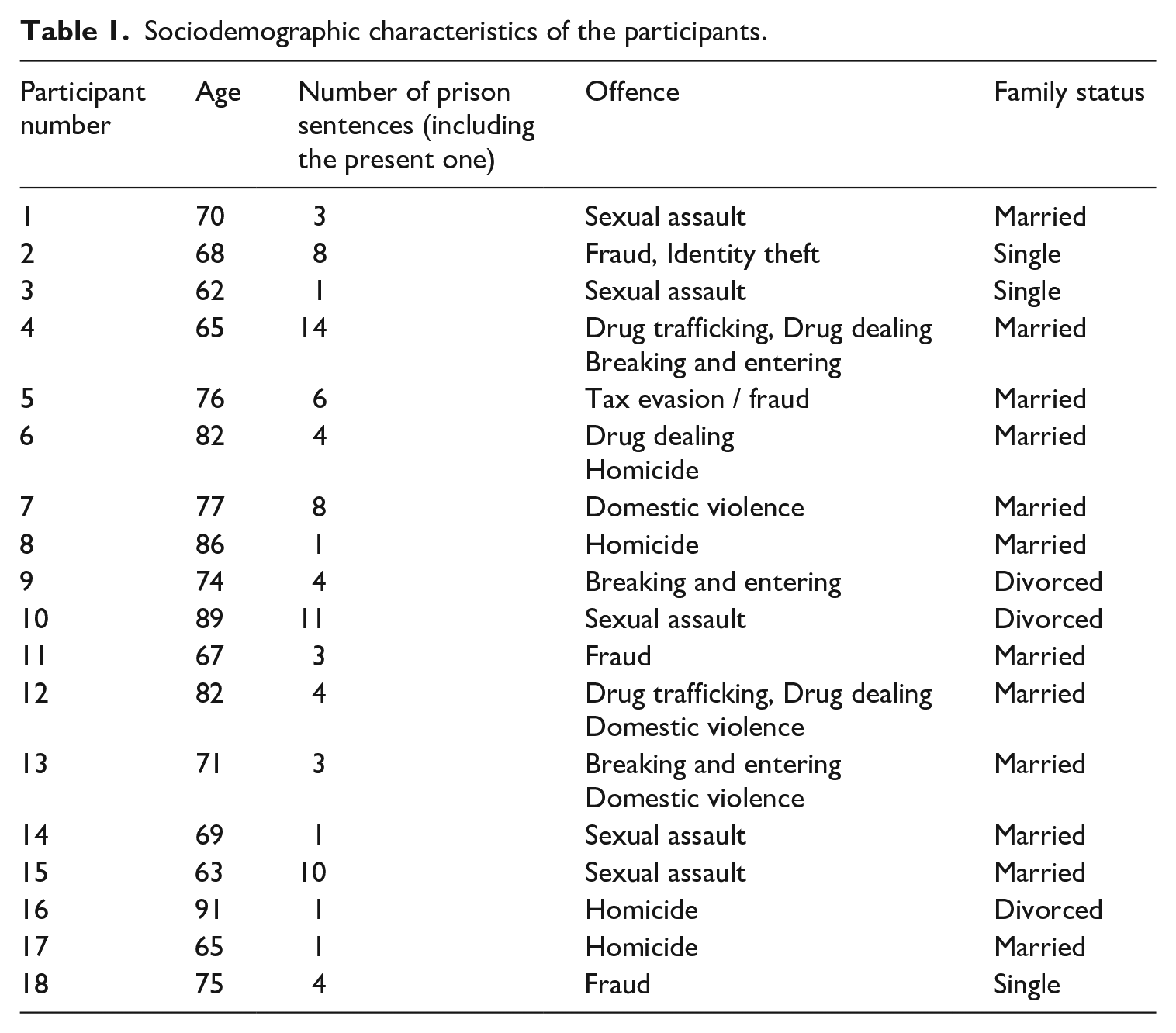
Purposive sampling (Patton, 2002) was used to select information-rich cases. The inclusion criteria were current participant age over 60 and no cognitive deterioration (for example, no diagnosis of dementia and a capacity for verbal expression in an interview). In addition, all participants had served at least two years in prison when over the age of 60. This criterion was used to guarantee the exclusion of offenders with insufficient experience as an older inmate in prison. The participants’ ages ranged from 62 to 91 years, with a mean age of 74; 13 OPs were serving their second incarceration or more, and five were serving their first prison sentence (see the participants’ details in Table 1).
Sociodemographic characteristics of the participants.
The final sample size was determined by the richness and depth of the data gathered from the informants, according to Morse’s (2000) principles of theoretical saturation. After the 18 participants had been interviewed, recurring content indicated that saturation had been reached (Saunders et al., 2018).
Data collection
Data collection was performed via in-depth, semi-structured phenomenological interviews using an interview guide (Pietkiewicz and Smith, 2014) addressing the following categories:
Life in crime, now and over the years (for example, ‘How do you experience incarceration now?’ ‘How has this experience changed over the years?’).
The role of the prison in the OP’s life (for example, ‘Describe everyday life in prison’).
Retrospective and prospective views of successful ageing experiences in prison (for example, ‘Looking back at your life in prison, what were your best moments here?’).
Procedure
All participants were identified and recruited by the National Prison Service. Following approval of the research proposal, the researcher, along with the research unit at the National Prison Service, approached prison managers to recruit OPs. Once prison managers and wardens had agreed to take part in the study, they distributed a paper explaining its aims and scope, requesting OPs to participate. Willing participants were referred to the researcher by the social worker or warden, and the former coordinated interview times and dates. The interviews themselves were conducted inside the prison ward in a private room occupied only by the researcher and the OP. No prison guard was present. The duration of the interview depended on the participants’ individual needs and abilities and usually lasted from one to two hours.
In light of the highly sensitive topic (Melville and Hincks, 2016), special provision was made to guarantee informed consent and confidentiality (Corbin and Morse, 2003). The study was approved by the university’s ethics committee (IRB) and written informed consent was obtained from each participant. In addition, the interviewer continuously sought process consent during the interviews (Kavanaugh and Ayres, 1998). Special attention was paid to the emotions expressed by the participants during the interview. Arrangements were made to provide crisis management for cases of distress, if required (Kizza et al., 2011). However, since most of the interviews revolved around experiences of success and wellbeing, crisis management was not needed. The interviews were audio-recorded and transcribed verbatim. All identifying details were changed to preserve the participants’ confidentiality.
Data analysis and trustworthiness
Data analysis was performed according to the interpretive phenomenological analysis method, as suggested by Smith, Flowers and Larkin (2009). First, the researcher read the transcripts a number of times to become as familiar as possible with the text. Initial coding was performed inductively by coding participants’ significant statements; for example, identifying a wide range of participant feelings towards ageing in prison. The next step involved grouping the statements into subthemes, including quotes that capture the essential quality of the participants’ experiences and perceptions; for example, gathering quotes relating to the way the participants view ageing outside prison in contrast to ageing inside prison. The following step focused on identifying, clustering and conceptualizing emerging connections. In this stage, the researcher heuristically used the successful ageing theoretical framework (Ouwehand et al., 2007) in a deductive manner, to provide a broader understanding of the findings and to enable identification of four superordinate themes, reflecting different OP narratives (Smith et al., 2009). Theme identification was based on the centrality of concepts in the participants’ narratives (for example, repetitions, use of metaphors and analogies; Ryan and Bernard, 2003).
During the textual analysis, the researcher attempted to identify the various ways in which participants’ accounts were similar and different. For instance, most participants perceived themselves as victims of their life circumstances, but each participant constructed a different narrative to explain how he had managed to achieve better wellbeing and a more successful prison experience within the framework of these poor circumstances (Smith et al., 2009).
Trustworthiness was achieved as follows. First, audio-recorded interviews and their verbatim transcriptions enabled verification from the original, ensuring referential adequacy (Lincoln and Guba, 2013; Rodham et al., 2015). Second, a group of colleagues familiar with qualitative methods asked introspective questions relating to the analysis, thus achieving credibility by peer debriefing (Lincoln and Guba, 2013). The researcher’s experiences were bracketed, as described by Moustakas (1994), by repeated rounds of reflection on the researcher’s preconceptions or prejudgements. These prejudgements were written down and reviewed until the researcher felt that ‘an internal sense of closure’ had been achieved (Moustakas, 1994: 89).
Findings
Spending the final years of their lives in prison motivated these OPs to construct meaning and attribute significance to this experience, as revealed through four major themes:
(1) ‘Like all other older men’: comparing ageing in prison with ageing within the community;
(2) ‘Better than what I have outside’ – prison as an escape from a life of loneliness, poverty and delinquency;
(3) ‘Here I get some respect’: the older prisoner as a mentor; and
(4) ‘I feel accomplished’: experiences of growth and self-discovery as a means for successful ageing in prison.
‘Like all other older men’: Comparing ageing in prison with ageing within the community
Older prisoners who narrated this theme attempted to attribute meaning to their late-life incarceration by constantly comparing their own situation in prison with those of older adults outside. This comparison was mentioned by 10 participants:
What’s so bad about this place [the prison]? I’ve got everything here, it’s not that different. I’ve got good friends, we sit out here in the sun, playing cards, just like any other older man. . . it’s not like all my friends outside spend their time with their families. They all have older kids who barely come over. I tell you, my kids come to visit me here more than their kids visit them at home. I don’t have to make a living here, it’s just like retirement here. (OP, 74)
Whereas some OPs compared their stay in prison to retirement, others compared it to living in a retirement home:
Since I stopped working in prison, I [find ways to] pass the time. If I want to, I get something to eat, listen to the radio, make my coffee, read my newspaper. I guess people my age live the same way in retirement homes. I pray every day in the prison’s church – well, if I were outside, I would do the same thing. I play chess with friends – I’d do the same thing in a nursing home outside. My roommates and I joke around in our cell; we would do the same thing in a nursing-home room. The only time I feel it’s a prison is when they lock the doors. This loud noise of the steel doors slamming reminds me I’m just trying to sugar-coat it – this is no retirement home. (OP, 69)
The next quote presents another example of comparing serving a prison sentence and staying in a retirement home:
It all depends on your perspective. I choose to be positive and look optimistically at this whole experience of being here [in prison] at my age. I try to picture my ward as a retirement home. I read a lot of books, and I go to the prison library twice a week. I keep busy. I have a very organized sports regime and I learned how to cook. So I ask – what’s the difference? If you look at it the right way, it’s just like a retirement home. (OP, 67)
The OPs quoted here tried to blur their current situation as older men in prison, by comparing simple, everyday situations in their lives as prisoners to those of older individuals residing either at home or in a nursing home. Thus, ageing in prison was experienced in a rather positive way, emphasizing hobbies, a social life, free time and other such activities, which may be common to many older adults in their retirement years. Pointing out the similarities between ageing in prison and ageing outside prison may have helped these OPs perceive their time in prison with acceptance. This comparison seemed to ease feelings of desperation and assured OPs that they were not ‘missing out’ on life while incarcerated.
‘Better than what I have outside’: Prison as an escape from a life of loneliness, poverty and delinquency
Prisoners who narrated this theme described life in prison as a step up from their living conditions outside prison. This theme was narrated by 12 participants:
Prison isn’t scary; after your first time, you see it’s not too bad. These aren’t dark times; people live a full life here. For me, this is more than fine. I’ve already been to hell and this isn’t it. I lived in a car park for a while, with no water and no electricity. I had just turned 70, and I needed a place to have a cup of hot tea and a shower, so I worked as a cleaner at a gym, and they let me use some of their facilities. In this type of situation, you don’t think. My mind was focused on survival, on where my next meal would come from. Where will I go from here? I didn’t have a minute’s rest. And through it all, I was being chased by people I owed money to . . . After this whole ordeal, this is better than what I have outside. The meals are served on time, there’s a shower, warm blankets in the winter. At my age, these are important things. (OP, 75)
Some prisoners refer to other aspects of relief intertwined with the incarceration experience:
Outside, I had to worry about stuff, get food, pay the bills, run around. Here it’s easier, some of life’s burdens have been lifted from my shoulders. I don’t have these worries any more and, you know, at my age, it’s a big relief. I feel that if I were outside, I wouldn’t have the strength to do it any more, live in this race. This is a rest from life. (OP, 65)
Whereas the prisoner quoted above emphasized his sense of relief from having to deal with material concerns, the next quote highlights the emotional benefits of being in prison as an ageing individual:
My friends outside are all retired, they do nothing all day. I work, I’m busy, I matter to my cell mates. I called my ex-wife over the holiday and she was home alone. It’s hard for her to get out and the kids couldn’t come over. So, she was alone like a dog, like I was before, and I was here celebrating with all my friends. I’m not alone for a second here. (OP, 63)
Some OPs perceived being in prison not as a stroke of bad luck but as a respite from the burdens of the ‘real world’. These OPs shed light on what it means to be old and involved in crime in the world outside of prison – a life often fraught with hardships such as poverty, loneliness, housing instability and death threats. Thus, incarceration was perceived as a relief, because it guaranteed the OP security, food and shelter. In addition, for those OPs suffering from a lack of social ties, confinement provided a set of readymade affiliations that offered opportunities for social interaction and escape from loneliness. They were finally able to depend on a very stable and planned routine, which some of them had lacked throughout their entire lives.
‘Here I get some respect’: The older prisoner as a mentor
Despite the harsh conditions of life in prison, some OPs viewed it as a source of social acceptance and respect by others. This experience was narrated by nine participants:
I’m a sex offender, I’m considered ‘the scum of the earth’ in the outside world and also in here, but over the years, people got to know me, to know my abilities, and the truth about me, and gradually I became, probably, the most distinguished man in this prison. Here I get some respect, people look up to me, come to consult me, to voice their pain. Because of my age, they know I can take it. (OP, 70)
Other prisoners emphasized their role as mentors to younger prisoners:
I used to be afraid here, that people would walk all over me. I’m old, I’m slow and weak, they used to push me around . . . but then people started coming to me because they heard I have a lot to say. I know things about the future, about how things work. People encounter everyday problems with their wives and children, and I advise them because I’ve got so much experience, so many things in my past. So, I mentor them, especially the young people who are alone here, and they say to me: ‘you are like a father to us.’ (OP, 77)
Whereas some OPs described mentoring through advising others, the next quote presents mentoring through setting an example:
After the first couple of years of being deeply depressed, I realized that social connections might help me out. . . So I started a charity, I collect clothes, bedsheets, deodorant, shoes . . . from prisoners who leave or who have extra, and I give these things to prisoners who don’t have any. Over the years, my charity has become sort of famous around the prison, and people started to join in, youngsters who wanted to do some good. So they spread the word, collect stuff from every prisoner who leaves the prison and they look up to me. They bring the hardest cases to my knowledge; everybody knows that, as long as I’m here, people won’t lack for their basic needs. (OP, 76)
For some OPs, feelings of social acceptance and of being valued and admired countered their experience of social rejection associated with being a criminal and a prisoner. In the case of the sex offender’s quote, it seems that old age and life experience had, in many ways, ‘compensated’ for his offence in the prison’s social world. Others, like the OP in the second quote, used their knowledge and life-long experience to carve out a unique position for themselves to sustain them in prison, despite their age-related physical weakness. Thus, old age may be perceived as both the source of trouble for OPs and the key to being accepted. Finally, prisoners like the one presented in the third quote illustrated the way old age served as a platform for gaining social power and status, and even creating circles of influence within the prison’s social system.
‘I feel accomplished’: Experiences of growth and self-discovery as a means for successful ageing in prison
The fourth theme identified in the analysis refers to OPs who underwent an empowering process of learning a new skill or starting a new hobby. This concept was mentioned by 10 participants:
I never went into the kitchen. That was my wife’s job. Even when I did time before, I was too proud to cook, like this was a girl’s job, or something. But this time around, I sort of discovered cooking. . . I love it and people line up at my door to get my meals. That feels great! I tell my kids every weekend what I want to make, and they read me some recipes over the phone. It gives us a lot to talk about. It’s not that easy to prepare a good meal here in prison, it takes creativity. It’s something I never thought I would do; now that I’m old, I can do whatever I want. (OP, 68)
Other prisoners expressed their creativity in other ways:
I was told I had to work out, but my legs are not working so well and I prefer to exercise sitting down, so I designed gym equipment for people who don’t walk. I did all the design work and built a prototype from stuff that’s allowed here. I made the machine using the elastic from my underwear and the bars from the beds in my cell. . . So, when I was working on it, I found myself taking measurements, trying to get materials, and asking for help from the math teacher. I couldn’t believe it – here I was, interested in something else, other than my drugs. (OP, 65)
Another example portraying growth and self-discovery was of an OP learning to read:
I learned to read and write here, at 65. It didn’t happen in previous arrests and, God knows, I’ve had many of those. I didn’t really go to school, and here, in prison, I had no interest before. When you are young in prison, you are in survival mode. I dealt with living day to day. I didn’t have the energy for studying. But now things look different. I just want to be able to read a book to my grandson when I go home or be able to read the newspaper. It gives me a sense of purpose and the will to keep going. (OP, 82)
In this theme, participants shared experiences of acquiring new knowledge and fields of interest, giving rise to feelings of joy, rejuvenation and pride. During past incarcerations, OPs were too enmeshed in their criminal occupations and were not yet ready – either physically or emotionally – to develop other interests. However, at this stage of their lives, OPs seemed to prioritize other activities (for example, reading a newspaper) and felt less affected by other people’s opinions (for example, ‘cooking is for girls’), and thus they tended to feel more at liberty to pursue diverse activities. Mastering a new skill was a way of finding a place in prison (for example, as cook for the other prisoners), and a way of giving meaning to time (time utilized for learning to read and write is time well spent).
Discussion
The analysis of the OPs’ narratives revealed four major themes, reflecting the significance attributed to feelings of resembling other older adults, enhancing living conditions, gaining respect from others, and engaging in meaningful activities for the overall experience of successful ageing.
In the first theme – ‘Like all other older men’: comparing ageing in prison with ageing within the community – OPs attempted to highlight their wellbeing by comparing ageing in prison with ageing outside prison. Sadly, older adults in western societies are often stigmatized and suffer from a loss of status and occupation, economic decline and diminishing social networks (Nelson, 2011). Ironically, these processes accompany incarcerated prisoners at any age (Crawley and Sparks, 2013; Schnittker, 2014). Thus, the participants in our study, who had been marginalized for years as life-long offenders, described finally feeling somehow equal to their peers, thanks to ageing. Moreover, some participants compared prison to a nursing home, which they perceived as an institution for older persons outside. This comparison strengthened their notion of being, once and for all, the same as any other older person. This perspective may have been part of an adaptive process, as suggested by Baltes and Baltes (1990), in which the OPs chose to focus their attention on rewarding emotional interpretations of their lives in prison, which optimized their chances of wellbeing. They chose to compensate for their loss of freedom, dignity and personal safety with the notion that they were just ‘like all other older men’, disregarding the differences between ageing inside and outside prison.
Whereas the first theme involved a comparison between older men outside prison and older men inside prison, the second theme – ‘Better than what I have outside’: prison as an escape from a life of loneliness, poverty and delinquency – involved comparing the life of the same individual inside and outside of prison, and the means by which prison had paved his way to a more successful ageing process. OPs in the present study reflected on past episodes of homelessness, poverty and loneliness. Unfortunately, this is not uncommon for older offenders (Wyse, 2018). Thus, prison is perceived as a redemptive environment, while the darker sides of incarceration are overlooked and the comforting prospects of having basic physical and emotional needs fulfilled in prison are highlighted. This echoes several studies that found positive aspects in incarceration (Di Lorito et al., 2018; Kozlov, 2008), and other studies that found the overall experience of being imprisoned in old age rewarding after a lifetime of disappointment and failure in the outside world (Doron, 2007). From a successful ageing perspective, it seems that being in prison may increase the OPs’ chances of achieving a sense of psychological wellbeing (Ryff, 1989; Ryff and Singer, 1996). Having a stable source of shelter, medical care, food and friends increases OPs’ chances of gaining environmental mastery (for example, OPs are able to manage their affairs and make affective use of opportunities in the prison surroundings); autonomy (for example, OPs are able to regulate their behaviour and choices without the pressures of dealing with the demands of the outside world); and positive relations with others (for example, OPs are able to form relationships that were previously missing from their lives).
The third theme – ‘Here I get some respect’: the older prisoner as a mentor – represents OPs who found a way to gain a respected social role, due to their life experience and knowledge. It seems that only the specific, limited social arena of prison could enable the possibility of OPs performing the classic mentoring role, which stands in complete opposition to their social marginality in the outside world. Respect has almost always been one of the first values to emerge in discussions with prisoners about ‘what really matters’ in prison (Liebling and Arnold, 2004). It is claimed that respect is especially unattainable for prisoners, because the traditional belief is that prisoners surrender their right to respect when they commit a crime (Butler and Drake, 2007). This made the possibility of gaining other prisoners’ recognition and appreciation even more desirable (Butler, 2008), thus explaining the importance assigned to this issue by the participants in the present study. Implementing successful ageing concepts in this context led to a sense of self-acceptance (OPs spoke of feeling good about themselves and their ability to give to others); positive relations with others (OPs felt able to find the right place for themselves within the prison society, thanks to their mentoring role); and personal growth (OPs found themselves in a new position as respected advisers; Ryff and Singer, 2008). In addition, this theme further demonstrated the psychological power of selecting and optimizing the mentoring role and its use as a mechanism to compensate for the drawbacks of ageing in prison.
The fourth and final theme – ‘I feel accomplished’: experiences of growth and self-discovery as a means for successful ageing in prison – represents feelings of accomplishment and success as a result of acquiring a new skill, learning something new or discovering a talent or an ability. Some of these skills or abilities are typically associated with the early stages of life, such as learning to read and write, but in these offenders’ lives they were not pursued or mastered at a younger age. Now, however, old age presented a new opportunity for the OPs to learn certain skills, getting to know themselves and their abilities during the process. Some OPs had no choice but to learn these new skills (for example, cooking), whereas others encountered new knowledge or a new hobby because they finally had the necessary time and peace of mind (for example, for reading and writing). Either way, OPs described a sense of purpose in life and reflected on experiences of self-growth accompanied by a sense of self-acceptance and environmental mastery, and they may have generated positive relations with others because these abilities were viewed positively by peers (Ryff and Singer, 2008). The OPs in this study reconstructed their own goal hierarchy by selecting the most important goals for the time of their incarceration, adapting standards or replacing goals that were no longer achievable for them. These new goals were acquired, applied and refined using an optimization process, allowing for the redirection of efforts to achieve these newfound capabilities (Baltes and Baltes, 1990). The findings revealed in the fourth theme are consistent with earlier studies suggesting that incarceration may, in some cases, foster personal growth (Brooks, 2000; Cohen and Silverman, 2013). However, these studies did not refer to OPs (Lucas et al., 2018).
Reviewing the OPs’ narratives that emerged from all four themes prepares the ground to move away from the conservative notion of the OP withering away in prison, and allowing for a more complex view of ageing in prison. This view includes both negative and positive perspectives and highlights the importance of personal agency in successful ageing (Smith et al., 2000). It seems that the capacity to perceive aspects of imprisonment in a favourable light is finally enabled in old age.
Limitations and recommendations for further study
This study focused mostly on recidivist OPs. To expand our understanding of the successful ageing phenomenon among older prisoners, interviews with other types of OPs, such as late-life offenders or lifers (Aday, 2003; Goetting, 1984), may provide a richer and even more diverse picture of the possibilities of successful ageing in a prison setting. Moreover, because successful ageing is a relative concept, it may be of interest to explore how it is perceived by OPs coping with health challenges, such as disabilities, chronic health conditions or age-related health deterioration.
This study is limited in its generalization ability due to its small sample size and qualitative nature. That is to say, this study does not reflect the experiences of some OPs who are housed in prison environments that may hinder their ability to enjoy successful ageing. Future studies are recommended, using quantitative methods, to gather more comprehensive data on successful ageing in prison.
In addition, this study provides a retrospective view of OPs’ thoughts about their lives in prison, and the way they perceived life throughout their years of imprisonment. Future longitudinal research may serve to broaden the current perspective and offer a real-time perception of the daily dynamics and the way successful ageing may develop and evolve. Also, the research included those prisoners who were willing to participate in qualitative research, which requires good cognitive and verbal skills. This ruled out prisoners who were less suitable or willing to do so, some of whom may be depressed or less active and outgoing. A way to overcome this may be to employ other research methods that require less good faith and trust from the participants.
Finally, the data for this study were collected a few months prior to the outbreak of the COVID-19 pandemic, and the current situation is likely to pose significant challenges to the experiences of prisoners in general, and of OPs in particular. Future research may re-evaluate the findings of the current study, taking into consideration the changes in incarceration policies that accrued during the pandemic.
Conclusion and practical implications
The research findings indicate that there is no unified profile of an older prisoner, and that prison, in some cases, can serve as a nurturing environment and promote successful ageing processes. As the ageing prisoner population grows, it is essential to create opportunities where OPs can thrive. It seems that, by offering possibilities that support the successful ageing model, OPs may be able to grow old with dignity while taking up fewer managerial, medical and even financial resources (Harrison, 2006). The different ways in which OPs narrate experiences of sense-making and personal growth in prison can serve as a framework for developing tailored interventions for these individuals. For example, professionals may identify activities that will foster feelings of self-growth and help the OP focus on them, or they may encourage OPs to take on some mentoring positions within the prisoner community. In addition, hearing the participants’ narratives in their own voices may help professionals relate to the subjective meanings attributed to life in prison by this understudied group of prisoners. Finally, it may be useful to harness the relative peace of mind found by the OPs at this point, in order to take further rehabilitative steps that will go beyond successful ageing and perhaps enable those prisoners to re-enter society as law-abiding citizens in old age.
