



Abstract
Despite its impact on imprisonment, no quantitative study has examined the factors related to people's status on prison incentive schemes. This study addresses this gap by using administrative data to explore the factors related to the status of 405 men on a prison incentive scheme. Results revealed that those who had a prior history of passing prison drug tests at time 1, and spent more time imprisoned during the follow-up period, were more likely to be on the highest level of the scheme one year later at time 2. In contrast, those who had a history of past involvement in misconduct, referrals for serious self-harm/attempted suicide in prison, not taken a prison drug test, property offences, and greater periods of custody at time 1 were more likely to be on the lower levels of the scheme at time 2. The potential implications for theory, policy, and practice are discussed.
Internationally, research indicates the use of prison incentive schemes is popular and there is a long history of using incentives to motivate compliance and engagement in rehabilitation (Bottoms, 2003; Elbers et al., 2022; Franzén and Holmqvist, 2014; Hansen et al., 2010; Liebling, 2008; Ross and Barker, 1989; Subramanian and Shames, 2013). Such schemes intend to encourage people to engage in behaviour deemed to be desirable (e.g. compliance and rehabilitation), while the withdrawal of incentives is used to discourage undesirable behaviour (Bottoms, 2003; Elbers et al., 2022; Khan, 2022). As these schemes tend to emphasise personal responsibility, they often prove popular with policy-makers and politicians as they align with wider political narratives emphasising responsibilisation and a more punitive approach to penal policy (Gendreau and Listwan, 2018; Gendreau et al., 2014; Khan, 2022; Liebling, 2008). Yet, these schemes can have a substantial impact on individuals as they often not only affect the material conditions of imprisonment but can create feelings of unfairness, inequality, and a lack of procedural justice (Bottoms, 2003; Butler and Maruna, 2012; Crewe, 2009; Khan, 2016; Liebling, 2008; Liebling et al., 1999). In particular, concerns have been expressed that some groups may experience worse outcomes than others due to their race, ethnicity, religion, mental health, and/or relationships with staff (Butler and Maruna, 2012; Hutton, 2017; Khan, 2022; Lammy, 2017; Meyers et al., 2020; Ministry of Justice, 2008). Yet, while research has been conducted on people's lived experience of prison incentive schemes, the authors are not aware of any quantitative studies that have examined the factors related to people's future status on such schemes, whereby status refers to their trajectory within the different regime levels in these schemes. Addressing this knowledge gap is important for enhancing our understanding of the potential for such schemes to cause disparities or address offending behaviour.
The present research addresses this gap in knowledge by using a prospective longitudinal design to explore the status of adult men on a prison incentive scheme in Northern Ireland after a one-year follow-up period and the factors related to their status. In this way, the research contributes to new knowledge by identifying some of the factors associated with future status on a prison incentive scheme and exploring how these factors may be related to issues of disparity and behaviour management. This research will also examine the potential insights that the findings offer for the ability of prison incentive schemes to discourage offending behaviour.
Prison incentive schemes
One of the first examples of using incentives to encourage compliance in prison can be found in Australia during the early 19th century, where Maconochie (1839) sought to use early release to promote compliance. This initiative was built on and expanded by Walter Crofton in Ireland during the mid-19th century and became known as the ‘Irish system’ or ‘Intermediate system’ (Butler, 2016; Dooley, 1981, 2003; Kilcommins et al., 2004). The Irish system involved individuals receiving marks for compliance, as well as participation in education and industry (Dooley, 1981, 2003). The accumulation of these marks enabled progression through five classes, with each class bringing additional rewards, such as better clothing and more privileges (Dooley, 1981, 2003). Nowadays, while the names of prison incentive schemes and incentives offered vary internationally, research indicates these schemes often have the dual objective of (i) encouraging compliance and engagement in rehabilitation and (ii) maintaining order (Bottoms, 2003; Butler and Maruna, 2012; Crewe, 2009; Elbers et al., 2022; Franzén and Holmqvist, 2014; Gendreau and Listwan, 2018; Hansen et al., 2010; Liebling et al., 1999; Subramanian and Shames, 2013).
Two interlinked theoretical approaches tend to underpin the use of prison incentive schemes: the rational actor model and behaviourism. The rational actor model argues that people are rational, weighing up the pros and cons of their actions before deciding how to act (Cornish and Clarke, 1986). By offering incentives, these schemes seek to shape behaviour by influencing people's thoughts regarding the perceived benefits and costs associated with particular actions. In contrast, behaviourism argues that people are conditioned to engage in behaviour that is rewarded and avoid behaviour that results in the withdrawal of rewards (Bandura et al., 1961; Pavlov, 1927; Skinner, 1938). Behaviourism proposes that over time people internalise behaviour, repeating desirable acts and avoiding undesirable ones, without weighing up the pros and cons associated with actions as proposed by the rational actor model (Bandura et al., 1961; Pavlov, 1927; Skinner, 1938). Prison staff and people in prison tend to understand and approve of the underlying theoretical premises of these schemes, and the objectives they are trying to achieve, even if opinions differ regarding the operational fairness of such schemes in practice (Bottoms, 2003; Liebling, 2008; Liebling et al., 1999).
Research on prison incentive schemes has found their influence on behaviour can be mixed (Bottoms, 2003; Elbers et al., 2022). They can help promote behavioural change by improving compliance and reducing prison misconduct (i.e. the breaking of prison rules) but only when incentives are judged to be sufficiently enticing (Bottoms, 2003; Butler and Maruna, 2012; Crewe, 2009; Gendreau et al., 2011, 2014). They can also help staff to feel empowered to address behaviour and enhance the agency some people in prison feel over their environment (Bottoms, 2003; Crewe, 2009; Liebling, 2008; Liebling et al., 1999). Additionally, the schemes have been attributed with increasing staff–prisoner interactions, individualising the experience of imprisonment and improving conditions for those who can access the incentives on offer (Bottoms, 2003; Crewe, 2009; Liebling, 2008; Liebling et al., 1999). Yet, there are concerns about the fairness of such schemes and that some people may struggle to progress on these schemes (Bottoms, 2003; Butler and Maruna, 2012; Crewe, 2009; Khan, 2016, 2022; Liebling, 2008; Liebling et al., 1999). There are concerns that the characteristics of those imprisoned, their relationships with staff, and conscious/unconscious biases may influence progression on such schemes (Bottoms, 2003; Butler and Maruna, 2012; Liebling, 2008). In addition, Cliquennois (2013) identified the potential for ‘self-fulfilling prophecies’ by demonstrating how past disruptive behaviour could influence staff's perceptions and evaluations of current behaviour, and consequently, affect status on prison incentive schemes.
Government reports in England, Wales, and North Ireland (NI) have identified how minority race, ethnic, and religious groups tend to be under-represented on the highest level of these incentive schemes and over-represented on the lowest level (Criminal Justice Inspection NI (CJINI), 2009; HM Chief Inspector of Prisons, 2010; Lammy, 2017; Ministry of Justice, 2008). These groups also tend to report more distant relationships with staff and feeling treated unfairly (CJINI, 2009; HM Chief Inspector of Prisons, 2010; Lammy 2017; Ministry of Justice, 2008). Research highlights how relationships with staff can influence staff discretion and progression on incentive schemes (Bottoms, 2003; Khan, 2022; Liebling, 2000, 2008). Close relationships with staff can result in informal tactics being used to promote compliance, rather than formal sanctions which can result in demotion on incentive schemes (Liebling, 2000). Prison policies emphasise the importance of staff assessments for informing progression/demotion on incentive schemes, with an adverse staff report or involvement in misconduct frequently resulting in demotion (Irish Prison Service, 2012; Michigan Department of Corrections, 2020; Ministry of Justice, 2022; NIPS, 2017).
Academic research has also raised concerns that people's reaction to such schemes and ability to progress can vary depending on their age, mental health, substance use, nationality, offence history, and tendency to be involved in misconduct (Butler and Maruna, 2012; Hutton, 2017; Khan, 2022; Liebling, 2008; Meyers et al., 2020). For example, research conducted in NI revealed some people in prison believed that those who were older, imprisoned for the first time, convicted of white-collar/driving offences, or foreign nationals were treated more leniently by staff and were better able to progress through the incentive scheme as a result (Butler and Maruna, 2012). Additionally, studies in England, Wales, NI, and America have raised concerns about the ability of those with mental health conditions, a history of addiction, substance misuse, co-occurring complex needs, and a risk of self-harm/suicide while imprisoned to progress due to challenges regulating their behaviour and/or thinking strategically (Butler and Maruna, 2012; Hutton, 2017; Khan, 2022; Liebling, 2008; Meyers et al., 2020). Moreover, research in America, England, Wales, and NI has highlighted how those who are more compliant, less disruptive, and feel treated fairly may be more likely to do better on incentive schemes (Bottoms, 2003; Butler and Maruna, 2012; Khan, 2022; Meyers et al., 2020). Indeed, prison incentive schemes directly link compliance with progression as involvement in misconduct is often associated with a demotion in an incentive scheme (Irish Prison Service, 2012; Michigan Department of Corrections, 2020; Ministry of Justice, 2022; NIPS, 2017). Past qualitative research in NI also found that people tended to believe that those who endorsed hyper-masculine ideals or were from more deprived neighbourhoods may be especially likely to act defiantly when they felt treated unfairly (Butler and Maruna, 2012).
While this research helps us to understand prison incentive schemes and raises concerns about how certain characteristics and features may influence progression on these schemes, the authors are not aware of any quantitative studies exploring the possible relationship between these factors and future status on prison incentive schemes. This study seeks to address this gap in knowledge by examining a group of adult men on a prison incentive scheme in NI and the factors influencing their status on this scheme after a one-year follow-up period.
The present study
The incentive scheme used in the Northern Ireland Prison Service (NIPS) is called the ‘Progressive Regimes and Earned Privileges Scheme’ (PREPS) and was introduced during 1999 ‘to enhance control and provide more development opportunities for inmates' (NIPS, 2000: 15). PREPS consists of three regime levels (Basic, Standard, and Enhanced) that reflect varying access to available incentives (NIPS, 2017). Basic is the regime level in which individuals only receive the statutory minimum entitlements under prison rules (NIPS, 2017). In 2017, when this research was conducted, people on Basic could only receive £4 per week while imprisoned, may only be allowed one visit every four weeks, had reduced access to the gym and other amenities, less time out of their cell and were able to spend less money on phone credit (maximum £25) or in the prison shop (maximum £25 plus regime payment) (NIPS, 2017). Standard is the default regime level people are placed on upon entry to prison and contains access to several incentives and privileges beyond the statutory minimum entitlements (NIPS, 2017). For instance, in 2017, people on Standard were entitled to £11 per week, longer visits, more gym access and other amenities, as well as more money to spend on phone credit (maximum £40) and in the prison shop (maximum £38 plus regime payment) compared to those on Basic (NIPS, 2017). People on Enhanced have access to the highest level of privileges and incentives available (NIPS, 2017). For example, in 2017, they were entitled to £20 per week, the longest visits, access to special family visits, more time out of their cell, extra access to the gym and other amenities, more money to spend on phone credit (maximum £65) and in the prison shop (maximum £63 plus regime payment), and potentially access to better accommodation compared to those on Basic or Standard (Muirhead et al., 2023; NIPS, 2017).
People progress up or down regime levels depending on the extent they are deemed to comply with prison rules and engage in constructive, pro-social behaviour, including participation in activities intended to address their offending behaviour (NIPS, 2017). People can be demoted regime level if prison staff give them adverse reports for not engaging constructively with the prison regime, if they refuse to take a prison drug test, or if they are found guilty of engaging in misconduct (NIPS, 2017). If demoted to Basic, people were required to obtain four positive staff reports over six weeks, pass prison drug tests, and avoid engaging in misconduct before they could be promoted to Standard (NIPS, 2017). To progress from Standard to Enhanced, people were required to display pro-social, constructive engagement with the prison regime for 12 consecutive weeks, pass all prison drug tests, and avoid engaging in misconduct (NIPS, 2017). This time requirement can limit the ability of people who are imprisoned for short periods of time to attain Enhanced status, as they must be imprisoned for at least 12 consecutive weeks before being considered for progression (NIPS, 2017). People on Basic are reviewed weekly to assess if they are eligible to progress to Standard (NIPS, 2017). Those on Standard are normally reviewed monthly while those on Enhanced are normally reviewed every three months but can be reviewed in-between times if events occur which call into question their continued status on that regime level (e.g. engaging in misconduct) (NIPS, 2017).
Prison staff can play a key role in people's progression on PREPS through adverse reports, with concerns previously being expressed about the potential links between individual characteristics (e.g. age, race/ethnicity, religion, nationality, offence, mental health, and drug use) and/or relationships with staff with progression on PREPS (Butler and Maruna, 2012; CJINI, 2009). Prison staff submit reports outlining their views on whether people in prison have been behaving in a pro-social manner, engaging constructively with the prison regime and warrant promotion or demotion on PREPS (NIPS, 2017). Prison managers then review all available evidence to decide if someone should be promoted or demoted, as well as audit and monitor the process (NIPS, 2017). The PREPS process can also be subjected to independent review as part of the wider work of the CJINI (e.g. CJINI, 2009).
The aim of this research was to quantitatively explore the factors related to the men's future status on PREPS by examining their regime level over a one-year follow-up period. Using a prospective longitudinal research design, the men's status on PREPS was investigated and data collected on several measures at time 1 to identify what factors (if any) were associated with whether they were on the Basic, Standard, or Enhanced regime one year later at time 2. In this way, the study provided a quantitative analysis of whether some of the factors that others had previously raised concerns about were related to future PREPS regime levels. The methodology used to conduct this research is described next.
Methodology
Data
The research used prospective longitudinal administrative data obtained from the NIPS Prison Records Information Management System (PRISM). While this data did not contain information on staff–prisoner relationships, it did contain information on key socio-demographic characteristics, medical and offending histories, as well as a number of in-prison behaviours. The sample consisted of 405 adult males participating in PREPS who were imprisoned in Maghaberry Prison on 22 November 2017 (time 1) and remained imprisoned on 22 November 2018 (time 2), with one outlier excluded (see below). There are only two adult male prisons in the NIPS: Maghaberry Prison and Magilligan Prison. Maghaberry Prison is the largest adult male prison and contains all high security and remand adult males, as well as sentenced adult males of varying security classifications (NIPS, 2020). Magilligan Prison only holds lower security sentenced adult males with less than 6 years left to serve on their sentence (NIPS, 2020). As all adult men are detained in Maghaberry Prison before potentially being transferred to Magilligan Prison, this sampling method provided a relatively representative view of imprisoned adult males in NIPS, with official statistics indicating that this sample accounted for approximately 31.5% of the daily average number of adult men imprisoned in NIPS during 2017/2018 (NISRA, 2018). Information on those detained in Magillian Prison at time 1 was not available but those who were transferred to Magillian Prison during the one-year follow-up period were tracked and included in the sample. Some men (n = 73, 18.0%) were also released and re-imprisoned during the follow-up period. The men's responses on the following measures were captured at time 1 and used to predict their PREPS status at time 2.
Measures
Dependent
PREPS Regime: The men's status on PREPS was captured at time 1 and time 2, with this information coded as ‘Basic’, ‘Standard’, or ‘Enhanced’ depending on which regime they were on at that time. The dependent variable used in this research was PREPS regime at time 2.
Independent
Age: As past research raised concerns about how age may influence people's reaction to incentive schemes and progression (Butler and Maruna, 2012; Liebling, 2008), the men's age in years was included.
Race/ethnicity: Race/ethnicity was examined due to past reports identifying minority race and ethnic groups as experiencing worse outcomes than others on prison incentive schemes (Lammy 2017; Ministry of Justice, 2008). Self-reported race/ethnicity was collapsed into two categories: ‘white excluding travellers’ and ‘non-white or traveller’, the latter combined into one single group due to the small sample size. 1 Irish travellers were grouped with ‘non-white’ as they are recognised as a distinct race-ethnic group under the Race Relations (NI) Order 1998.
Nationality: Nationality was included as prior research in NI queried whether nationality may influence interactions with staff and regime level (Butler and Maruna, 2012). Due to the NI conflict, nationality is a key marker of diversity and identity that can influence attitudes and behaviours towards state officials. Those identifying as ‘Irish’ or ‘British’ can hold more polarising views than those identifying as ‘Northern Irish’ (McNicholl, 2019). Moreover, those identifying as ‘Irish’ can express more negative views towards state officials and be less likely to work for some state organisations (Deloitte, 2016; Ellison and Smyth, 2000). Self-reported nationality was coded as one of the following: ‘Northern Irish’, ‘Irish’, ‘British’, or ‘Other nationality’.
Religion: A measure of religion was included as previous reports have highlighted how some religious groups were more likely to experience worse outcomes on prison incentive schemes (CJINI, 2009; HM Chief Inspector of Prisons, 2010; Ministry of Justice, 2008). In this study, religion is used to refer to self-disclosed religious identity rather than religiosity, with responses recoded as belonging to one of three possible categories: ‘Catholic’, ‘Protestant’, or ‘Other religion’.
Neighbourhood deprivation: Neighbourhood deprivation was also included due to the past research in NI suggesting that people believed it may influence defiant behaviour in prison (Butler and Maruna, 2012). The postcode of the men's NI address prior to their most recent imprisonment was matched to publicly available NI Multiple Deprivation Measures 2017 (NISRA, 2017). NI neighbourhoods are divided into 890 small areas with these areas ranked on levels of deprivation from 1 to 890 (NISRA, 2017). The rankings were reversed coded for ease of interpretation, with higher values indicating higher levels of deprivation. Of the 405 men, 70 did not have a NI postcode because they lived abroad (n = 11, 2.7%), were of no fixed abode (n = 43, 10.6%), or their address was unknown (n = 16, 3.9%). As these cases were not random, observations were imputed from the average deprivation rank and a dummy variable was created to flag these cases as missing. Robustness checks revealed no notable differences between including or excluding these cases.
Medical history: Self-reported medical history was included due to fears that people with mental health conditions and addictions may experience worse outcomes on prison incentive schemes (Butler and Maruna, 2012; Hutton, 2017; Khan, 2022; Meyers et al. 2020). Prior research has also shown that impairments and head injuries can increase the risk of being involved in misconduct (Butler et al., 2023; Matheson et al., 2020). Responses were recorded into six measures with ‘Yes’ or ‘No’ used to indicate if the men had reported a history of experiencing the following on committal: mental health conditions; head injury/epilepsy; behaviour issues; impairments (including hearing, vision, speech or communication); addiction; and self-harming behaviour. Responses were self-reported and not verified by prison staff.
Offence history: As past research identified how people in prison believed that offence history may influence staff–prisoner interactions, and consequently progression on PREPS (Butler and Maruna, 2012), offending history was measured using four categorical measures of the following offences: ‘violence’, ‘property’, ‘drugs’, or ‘other offences’. Dummy variables were used to indicate if the men had a history of committing each offence and these measures were not mutually exclusive.
Prison complaints: The number of prison complaints the men had submitted was also included as an indicative measure of feelings of unfairness, as past research has linked the submission of prison complaints to prison violence and disorder (Bierie, 2013). To take account of variations in time spent imprisoned, the total number of complaints was divided by the total days the men had spent imprisoned at time 1.
Prison visitation: Studies have identified visitation as a key incentive encouraging engagement with prison incentive schemes (Booth, 2020; Hutton, 2017; Khan, 2016, 2022) and as being associated with reduced involvement in misconduct (Butler et al., 2022; Cochran, 2012; Steiner et al., 2014). Thus, the number of visits the men had attended at time 1 was included. To adjust for variations in time spent imprisoned, the total number of visits attended was divided by the total days spent imprisoned at time 1.
Prior history of proportion of prison drug tests passed: As past research in NI raised concerns about how substance use can affect PREPS progression (Butler and Maruna, 2012), a measure of the participants’ past ability to pass prison drug tests at time 1 was included as an indicative measure of the extent to which they may be continuing to struggle with substance misuse issues while imprisoned. The proportion of prison drug tests passed is measured in this dataset from 0 (none) to 1 (all). Some men had not yet taken a prison drug test (n = 7, 1.7%) and these cases were coded as 1 as this was the most common mode response (33.6%). Another variable was created to flag these cases as missing (described next) and no notable changes were observed in robustness checks excluding these cases from the analysis.
No drug test: As NIPS did not routinely administer drug tests during the first 30 consecutive days of imprisonment, a very small number of men had not taken a prison drug test (n = 7, 1.7%). A dummy variable was created to identify these cases.
Supporting prisoners at risk (SPAR) referrals: Given Liebling (2008) had raised concerns about the ability of those at risk of self-harm/suicide to engage with and progress on prison incentive schemes, a measure of SPAR referrals was also included in the dataset. NIPS refers people under the SPAR policy if they have engaged in serious self-harm, attempt to take their own life, or staff believe that serious self-harm is likely while in prison (Sudgen, 2016). To account for varying times spent imprisoned, the total number of SPAR referrals received was divided by the total days spent imprisoned at time 1. One case was excluded from the sample due to being an outlier as they had only been imprisoned for a small number of days but had amassed a SPAR referral, resulting in an extremely high rate of SPAR referrals, which when included in the regression analysis produced the error of being completely determined. This case has not been included in the analytical sample of 405 adult men.
Periods of incarceration: The number of times the men had been imprisoned was also included as Butler and Maruna (2012) had highlighted how some imprisoned in NIPS believed that people imprisoned for the first time could be treated more leniently by staff and be better able to progress through PREPS as a result.
Past involvement in misconduct: As progression on PREPS was linked to compliance, a measure of past involvement in misconduct was included to reflect the men's previous tendency to break prison rules. To address variations in the time spent imprisoned, total past involvement in misconduct was divided by the total number of days spent imprisoned at time 1.
Control
Days spent imprisoned during the follow-up period: As some of the men had been released and re-imprisoned during the follow-up period, it was necessary to consider variations in the amount of time spent imprisoned. For this reason, the total number of days spent imprisoned between time 1 and time 2 was included in the analysis.
Procedure
Upon receiving ethical approval from NIPS and Queen's University Belfast (QUB), the variables of interest were identified and an anonymised dataset was provided to the QUB researchers for analysis. Only NIPS staff had access to PRISM and the QUB researchers worked with a NIPS staff member to address any queries that emerged. The anonymised dataset contained a ‘snapshot’ of those detained at Maghaberry Prison at time 1, with these men followed up one year later. If the men remained imprisoned one year later, the NIPS staff member recorded their PREPS status at time 2. The anonymised dataset was provided in Excel file format and the data was cleaned, coded, and entered into Stata version 15 for analysis.
Analytical strategy
A multinomial logistical regression was used to analyse the data as the dependent variable was nominal with more than two categories. Preliminary analysis revealed that the assumptions for conducting this regression were met and robustness checks indicated no notable differences in the models depending on whether missing variables were included or excluded from the analysis. The final model presented includes all 405 cases with all variables entered into the full model.
Results
Table 1 shows the descriptive statistics for the analytic sample. At time 2, 5.4% of the men were on the Basic regime, 38.5% were on the Standard regime, and 56.1% were on the Enhanced regime. The average age was 35.3 and 94.6% were white excluding travellers. Most men (68.6%) identified as Northern Irish, with the rest identifying as Irish (9.6%), British (14.1%), or other (7.7%). Half (50.9%) reported being Catholic, a third (35.6%) being Protestant, and the rest reporting another type of religion (13.6%). The average deprivation rank was 609.7 (with 890 being the most deprived rank). In regard to medical history at time 1, 41.5% self-reported having had a mental health condition, 16.3% head injury or epilepsy, 4.9% behavioural issues, 10.1% impairments, 53.8% a history of addiction, and 59.8% previously engaging in self-harm. Previous offence history revealed that 90.4% had a history of violent offences, 55.6% property offences, 29.1% drug offences, and 34.3% some other type of offence (these were not mutually exclusive categories). The following measures are averages of occurrences per day in prison up to time 1: 0.01 complaints, 0.06 visitations, 0.00 SPAR referrals, and 0.01 past involvement in misconduct. Additionally, the men had passed on average 78% of their prison drug tests at time 1, with 1.7% not having taken a drug test. The average number of periods of custody was 5.77 and the average number of days spent in prison between time 1 and time 2 was 338.71.
Descriptive statistics for sample (n = 405).
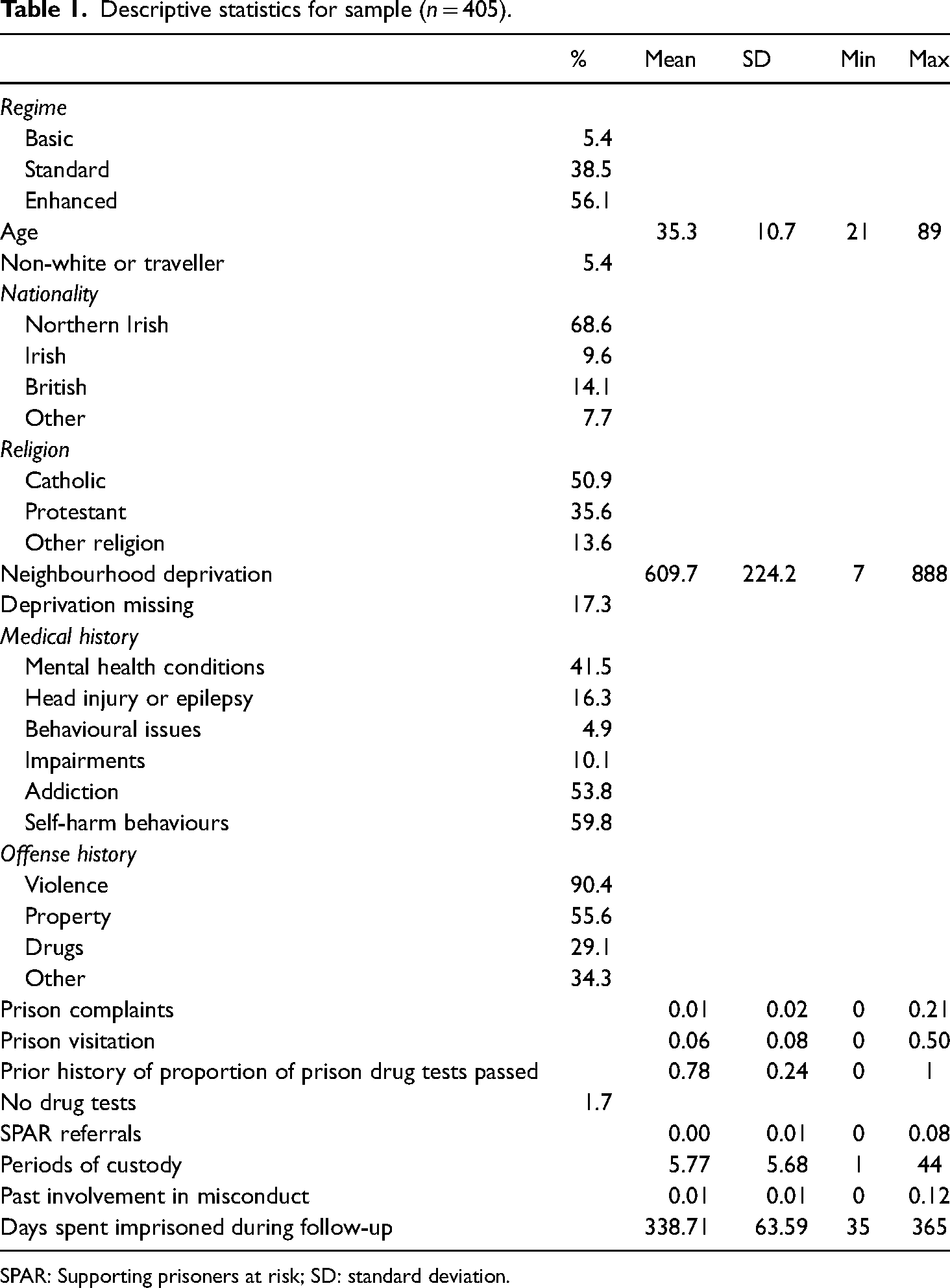
SPAR: Supporting prisoners at risk; SD: standard deviation.
To understand how the men's status changed from time 1 to time 2, Table 2 presents the men's PREPS status at time 1 and time 2. The table reveals a number of interesting trends. First, most men remained in the same regime at both time points (61%), while approximately 25% improved regime, and 13% moved to a lower regime. Second, the largest proportion of the sample was on Enhanced at both time points (34%), followed by Standard at both time points (26%), and then advancing from Standard at time 1 to Enhanced at time 2 (21%). Generally, few men were on Basic at either time point and only 1% were on Basic at both time points.
Total percent distributions of Progressive Regimes and Earned Privileges Scheme (PREPS) regime status (n = 405).
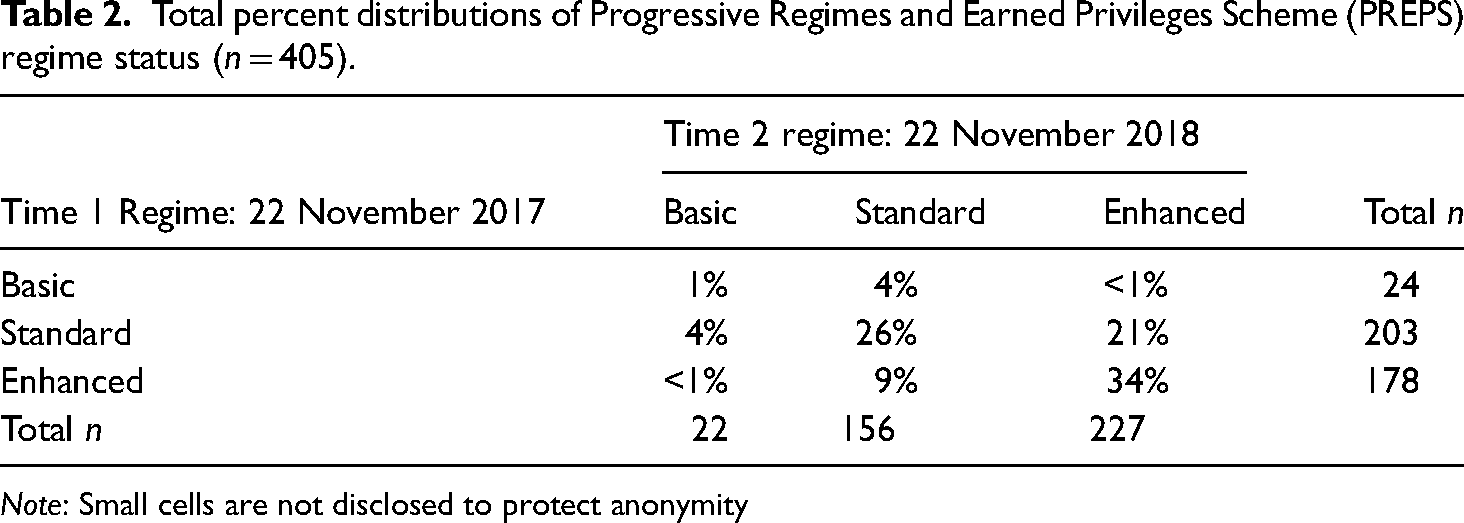
Note: Small cells are not disclosed to protect anonymity
To investigate what factors measured at time 1 influenced the men's PREPS status at time 2, multinomial logistic regressions were conducted examining the likelihood of being on Basic (Table 3) or Standard (Table 4) compared to Enhanced. In a multinomial regression, these two comparisons are produced in the same regression but presented in two tables for ease of viewing. It is important to note that due to the limited movement between different PREPS regimes in the analysis, status at time 1 was not included as a predictor in the analysis to avoid multicollinearity. Turning to Table 3, the results suggest that the proportion of drug tests passed at time 1 is negatively related to being on Basic compared to Enhanced (reduced rank regression (RRR) = 0.077). Not having taken a drug test at time 1 was related to a higher risk of being on the Basic regime (RRR = 64.451). Moreover, a greater past involvement in misconduct at time 1 was related to a higher risk of being on Basic (RRR = 7.28 × 10 32). Two other characteristics reached marginal significance (p < .10), with a history of property offences related to a higher risk of being on Basic compared to Enhanced, whereas the more days spent imprisoned during the follow-up period was negatively related to being on the Basic regime compared to the Enhanced regime. Notably, some caution should be taken in these interpretations. The number of men on the Basic regime was small, which can lead to limited significance and can bias coefficients away from null (in other words, the large RRRs seen with past misconduct and having no drug test could be due in part to small sample sizes).
Multinomial logistic regression for sample on PREPS status n = 405 (Basic compared to Enhanced).
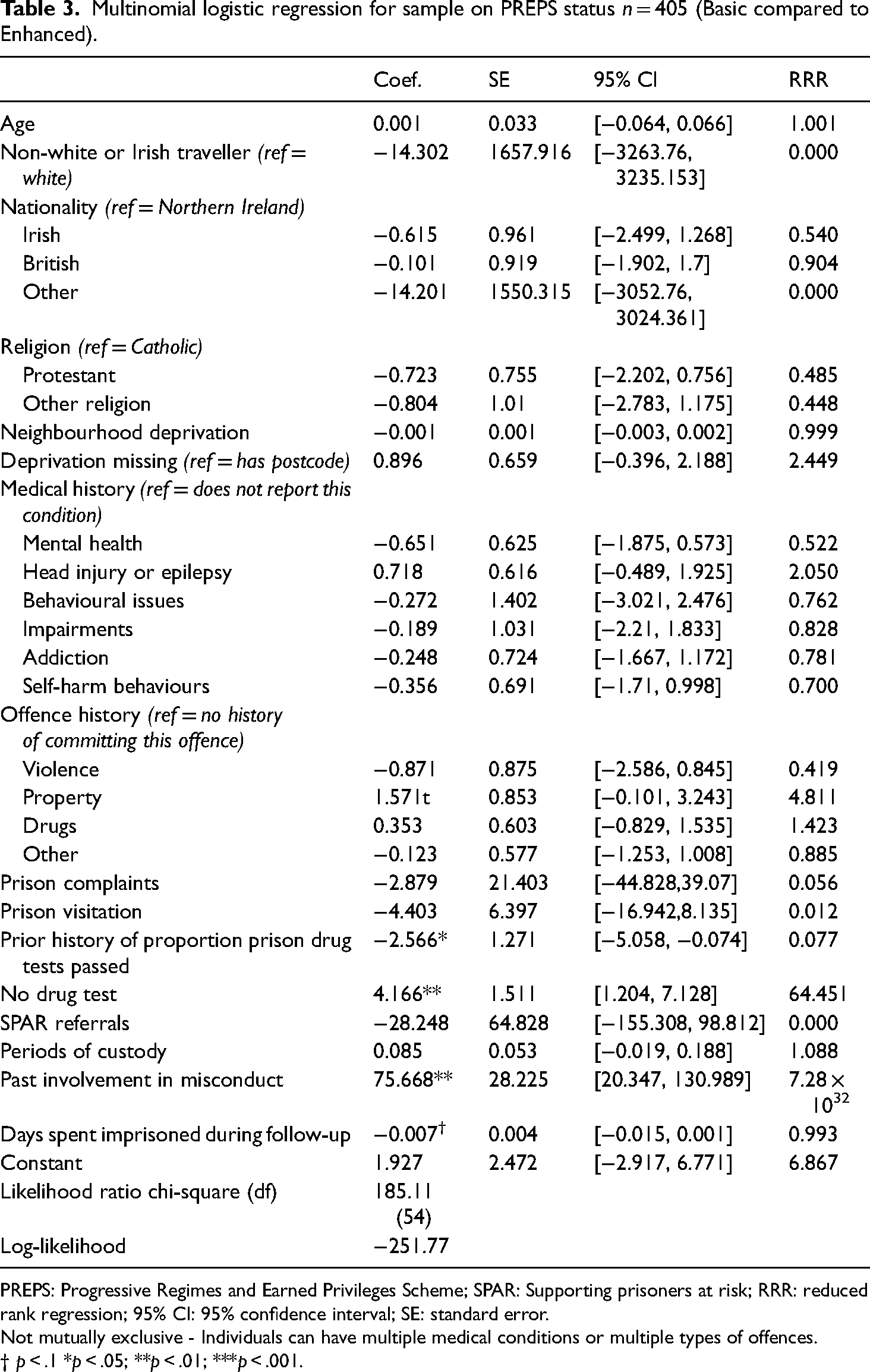
PREPS: Progressive Regimes and Earned Privileges Scheme; SPAR: Supporting prisoners at risk; RRR: reduced rank regression; 95% CI: 95% confidence interval; SE: standard error.
Not mutually exclusive - Individuals can have multiple medical conditions or multiple types of offences.
p < .1 *p < .05; **p < .01; ***p < .001.
Multinomial logistic regression for sample on PREPS status n = 405 (Standard compared to Enhanced).
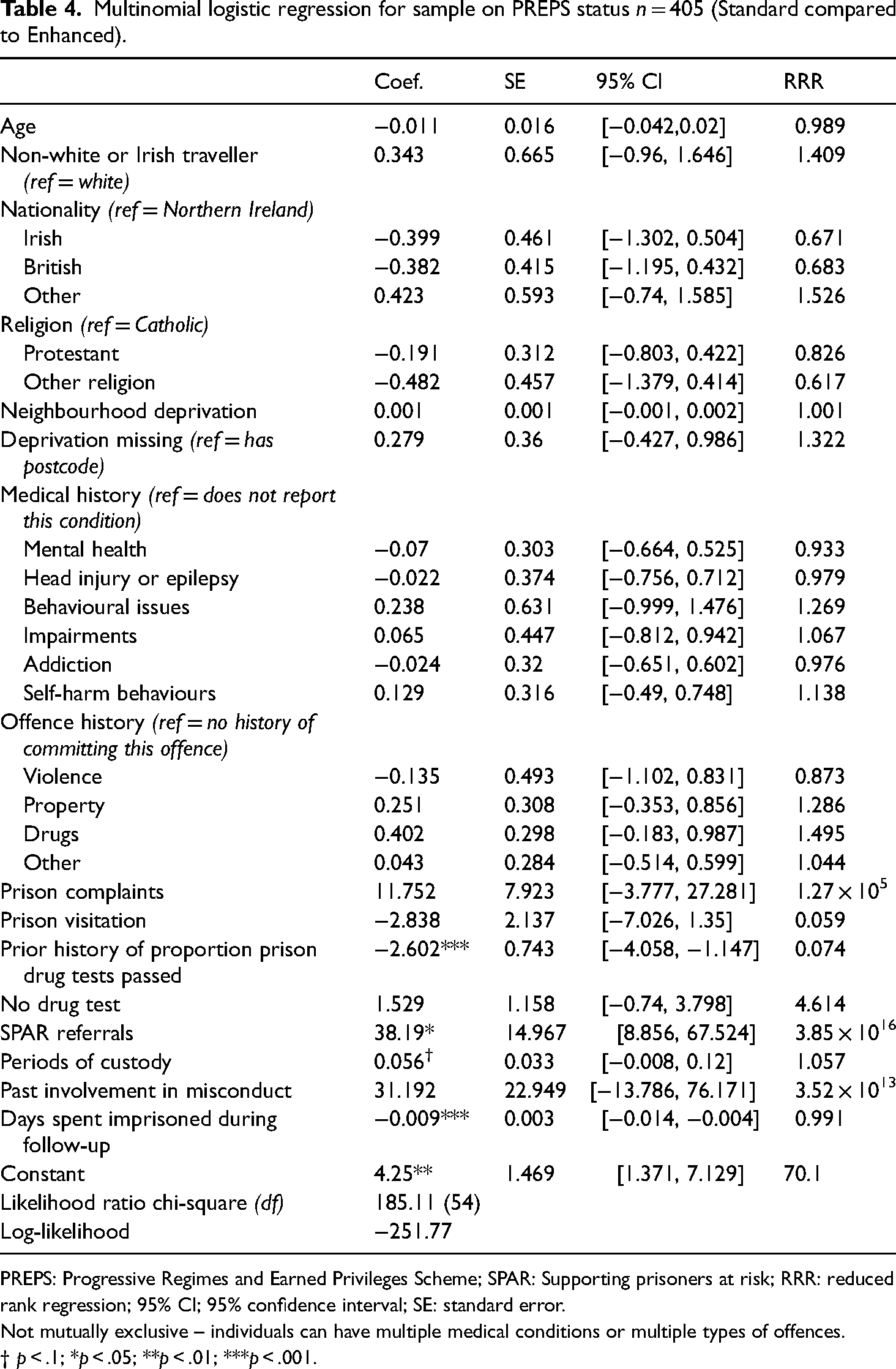
PREPS: Progressive Regimes and Earned Privileges Scheme; SPAR: Supporting prisoners at risk; RRR: reduced rank regression; 95% CI; 95% confidence interval; SE: standard error.
Not mutually exclusive – individuals can have multiple medical conditions or multiple types of offences.
p < .1; *p < .05; **p < .01; ***p < .001.
Table 4 displays the results comparing the Standard regime to the Enhanced regime. Similar to the previous comparison, the risk of being on Standard compared to Enhanced decreased as the proportion of passed drug tests increased (RRR = 0.074). Moreover, days spent in prison during follow-up were negatively related to being on Standard compared to Enhanced (RRR = 0.991), meaning the longer the men spent imprisoned during the follow-up period the less likely they were to be on Standard compared to Enhanced. Conversely, more SPAR referrals at time 1 increased the risk of being on Standard compared to Enhanced (RRR = 3.85 × 10¹⁶). Periods of custody were also found to be marginally significant (p < .10), with more periods of custody at time 1 related to a higher risk of being on Standard compared to Enhanced.
Discussion
An examination of the status of a group of adult men on a prison incentive scheme revealed that the majority were on the same regime at time 1 and time 2. Most men remained on the Enhanced or Standard regime, with only a small proportion found to be on Basic at time 1 and time 2 (1%). This suggests that most men continued to avoid the Basic regime or had moved to the Standard or Enhanced regime. While several men had progressed from Standard to Enhanced by time 2, it is notable that a greater proportion was on Standard at both time points. Possible explanations for this finding may include that some struggled to move on from Standard to Enhanced and/or believed the incentives offered on Enhanced were not sufficiently enticing. Alternatively, they may have moved between the different regime levels during the one-year follow-up, returning to Standard when the data was collected at time 2. Past research demonstrates the importance of offering enticing incentives if prison incentive schemes are to motivate behavioural change (Bottoms, 2003; Butler and Maruna, 2012; Crewe, 2009; Gendreau et al., 2011, 2014). Studies indicate that while most wish to avoid the lowest level of prison incentive schemes, the privileges and incentives offered on the highest level can be insufficiently motivating for some (Bottoms, 2003; Butler and Maruna, 2012; Crewe, 2009). Indeed, previous qualitative research conducted in NI found that some men thought ‘there was too little variation between the Enhanced and Standard regimes to justify the “hassle” required to progress’ (Butler and Maruna, 2012: 55). Moreover, prior studies have found that some groups (e.g. those with addiction, substance misuse problems, co-occurring complex needs, or at risk of self-harm/suicide in prison) may struggle to progress on such schemes, due to difficulties controlling and regulating their emotions, thoughts, and behaviours, as well as thinking strategically (Butler and Maruna, 2012; Hutton, 2017; Khan, 2022; Liebling, 2008; Meyers et al., 2020).
These results also reveal that a history of using drugs in prison played an important role in influencing future PREPS status. The higher the prior history of the proportion of prison drug tests passed at time 1, the less likely the men were to be on the Standard or Basic regime compared to the Enhanced regime at time 2. In other words, those who had a higher prior history of passing prison drug tests tended to progress, while those who had previously failed prison drug tests did not. Past qualitative research in NI had highlighted how prison drug use was believed to affect the motivation and ability of people to engage in incentive schemes, as their desire for drugs may outweigh any potential incentives or privileges offered, while the use of drugs may affect their ability to control or regulate behaviour (Butler and Maruna, 2012). The findings from this research raise questions about whether this prior history of prison drug use is indicative of continuing issues with substance misuse and, consequently, the ability of failed prison drug tests to reduce substance use. Past research in England and Wales has found that there is little evidence of referral to substance use treatment services upon failure of a prison drug test and that these tests are limited in their ability to deter substance use in prison (Singelton et al., 2005). Based on the findings of this research, and past studies, there may be a need for more targeted interventions to tackle drug use in prison and more enticing incentives believed worthy of discontinuing substance use in prison.
The results also found that those who spent more days in prison during the follow-up period were less likely to be on the Basic or Standard regime. In other words, the longer the men were imprisoned, the more likely they were to be on Enhanced. This finding (notably marginal for Basic compared to Enhanced though this may be due to the small number of men on Basic) may be partly explained by the nature of the PREPS policy, which required individuals to demonstrate their compliance and participation in rehabilitation for a certain period before they were eligible for progression (NIPS, 2017). For instance, individuals on Standard must display their compliance and willingness to participate in rehabilitation for 12 weeks before they were normally eligible for consideration to be promoted to Enhanced (NIPS, 2017). However, this relationship may also reflect a tendency for people who are imprisoned for longer to be more motivated and able to engage in prison incentive schemes. Research has found that when people are first imprisoned, they can struggle to cope, potentially resulting in friction with staff and other inmates, as well as mental health conditions (Jones and Schmidt, 2000; Liebling, 1999). Under such circumstances, people may be more focused on the immediate goals of adjusting to the prison regime and addressing mental health conditions rather than trying to progress on an incentive scheme. Similarly, those who are only imprisoned for short periods of time may not be motivated to participate in incentive schemes if they will not be imprisoned long enough to benefit from the incentives and privileges on offer (Wainwright et al., 2019).
When examining the lowest level of the prison incentive scheme, three factors emerged as being uniquely associated with placement on the Basic regime, in addition to the prior history of the proportion of prison drugs passed at time 1 and days spent imprisoned during the follow-up period. An absence of drug tests and past involvement in misconduct were found to be statistically significant, while a history of committing property offences reached marginal significance. It is not immediately clear why those with a history of property offences were more likely to be on Basic in comparison with Enhanced. It is possible that they may have unique characteristics that distinguish them from other types of offenders or unique experiences of imprisonment but further research is needed to explore this finding and the robustness of this marginal significance. In contrast, it is possible to offer explanations for the remaining two factors. People who had no prison drug tests at time 1 were found to be significantly more likely to be on Basic compared to Enhanced one year later. As NIPS did not routinely administer prison drug tests during the first 30 consecutive days of a person's imprisonment, it is likely that these men had recently entered prison for the first time or were only imprisoned for short periods of time. Consequently, they may be more likely to be on Basic because they were struggling to adjust to and comply with the prison regime and/or their period of imprisonment was too short to motivate them to comply. Some men may also refuse to take a prison drug test which could result in them being demoted to Basic (NIPS, 2012). Past research in England and Wales has found that those who refuse to take a prison drug test can be treated more harshly than those who fail a prison drug test (Singleton et al., 2005). Finally, past involvement in misconduct was associated with being placed on the Basic regime, with men who had a greater involvement in misconduct at time 1 being significantly more likely to be on Basic one year later. This suggests that those who have failed to be deterred by previous punishments for past misconduct are those who are also more likely to be on the Basic regime in the future. Consequently, specialist support which seeks to address the underlying reasons for their offending behaviour is required.
Focusing specifically on the Standard regime, the findings reveal that in addition to the proportion of prison drug tests passed and days spent imprisoned during the follow-up period, SPAR referrals were significant while periods of custody were marginally significant (p < .10). Those with greater periods of custody were significantly more likely to be on Standard compared to Enhanced. One possible explanation is that people who are imprisoned more often may be serving shorter periods of custody and are not motivated to achieve Enhanced status as they may not be eligible for consideration for Enhanced or do not believe the incentives are sufficiently enticing. Indeed, this suggestion corresponds to prior work which argues that those imprisoned for short periods of time are not motivated to engage as they are often not imprisoned long enough to benefit from the incentives on offer (Wainwright et al., 2019). Men with more SPAR referrals at time 1 were also significantly more likely to be on the Standard regime in comparison with the Enhanced regime at time 2. While the reasons behind this finding are unclear, it raises the possibility that those who engaged in serious self-harm while imprisoned, attempted to take their own life, or were believed to be at risk of serious self-harm may present with particular needs which affect their ability to progress onto Enhanced. Liebling (2008: 38) previously stated that those ‘at risk of suicide tended to have high needs and to find engagement with formal aspects of the regime difficult, and so fell foul of what the policy required of them (strategic and self-controlled behaviour)’. This research supports the idea that they may struggle to engage with an incentive scheme but, unlike Liebling (2008) who reported that they find their way onto the Basic regime, this research found no relationship between SPAR referrals and the Basic regime. These results therefore suggest that it was the ability of those with a SPAR referral to progress onto the highest level of the prison incentive scheme that was being hindered rather than them being more likely to be placed on the lowest level of the prison incentive scheme. Concerns have been expressed about the services and support provided to those with SPAR referrals (CJINI, 2023). Accordingly, providing additional services and support to this group may be beneficial.
Conclusion
This research provides a novel contribution by providing the first empirical investigation of the factors related to future status on a prison incentive scheme. While previous work had raised concerns that certain factors may affect progression, this study advances our knowledge by quantitatively examining the potential relationship between these factors and future status on a prison incentive scheme. The findings of this research offer several important insights for theory, policy, and practice. Firstly, no relationship was observed between the men's future status on the prison incentive scheme and their race/ethnicity or religion. This suggests that while minority groups can be over-represented on prison incentive schemes, when in-prison behaviours, offending history, and time spent imprisoned were controlled for, race/ethnicity or religion did not appear to directly influence their future status on PREPS. Notably, the absolute number of minority race/ethnicity people in NIPS is small (5%), which would limit statistical significance in this analysis. Another key limitation of this research is that it did not include a measure of staff–prisoner relationships or staff's perceptions of the men, limiting its ability to explore the role of staff–prisoner relationships or subjective judgements made by staff about the men in influencing future PREPS status.
Secondly, the findings raise concerns about those who use drugs in prison, are referred under the SPAR policy, and have a history of being involved in misconduct. While the rational actor model and behaviourism may be appropriate for understanding the progression of many men on such schemes, those who are using drugs in prison, are referred under the SPAR policy, and have a history of being involved in misconduct may struggle to control, regulate, and alter their behaviour on their own without additional services and supports. The finding that those who have been previously punished through the prison disciplinary process for misconduct are more likely to be on Basic one year later suggests that the use of punishments and withdrawal of incentives have failed to deter offending and that an alternative approach is required to break this cycle. Indeed, Butler and Maruna (2012: 114) found that both imprisoned men and staff agreed that ‘the PREPS process and adjudication [prison disciplinary system] simply do not work for individuals addicted to drugs’. Consequently, targeted services and support may be required to address the underlying reasons for continued involvement in drug use and misconduct, as well as help people regulate and control their emotions and behaviours. Prison incentive schemes and policies emphasising personal responsibility may struggle to promote behaviour change among these groups without the provision of these additional specialist services.
Thirdly, the findings offer suggestions for what additional services and support may help people to progress on prison incentive schemes. As discussed above, specialist services which help to reduce prison drug use, improve mental health, and address serious self-harm would be beneficial. More services and support to help those who are imprisoned for the first time and are struggling to adjust to life in prison could also prove beneficial. Fourthly, the findings highlight how time in prison can influence status on prison incentive schemes and how those detained for shorter periods of time may not be motivated to engage. Accordingly, policymakers may need to consider how the length of time required to pass before being eligible to progress may influence engagement on incentive schemes and how other tools may be required to engage those detained for short periods.
Of course, there are limitations associated with this research. The findings have limited generalisability as the study was only conducted with adult men in one jurisdiction. The research did not measure staff–prisoner relationships and the men's own accounts of their experience of progression on the prison incentive scheme are absent from the research. Moreover, the study did not capture the movement between PREPS regime levels that may have occurred between time 1 and time 2 or the subjective nature of the decision-making process of prison staff which can affect progression and demotion on PREPS. Additionally, other potential measures of interest (e.g. family status, occupation before imprisonment, etc.) were outside the scope of the available administrative data. Future research should look at addressing these limitations, examine the robustness of the study's findings and explore the possible reasons for these findings. Despite these limitations, a key strength of this research is its prospective longitudinal design and contribution to new knowledge by empirically investigating the factors related to future status on a prison incentive scheme status.
Footnotes
Acknowledgements
The authors wish to thank the Northern Ireland Prison Service for their cooperation with the research and for facilitating access to the anonymised data used in this study.
Declaration of Conflicting Interests
The author(s) declared the following potential conflicts of interest with respect to the research, authorship, and/or publication of this article: Kelly is employed in the Psychology Services Department of the Northern Ireland Prison Service.
Funding
The author(s) received no financial support for the research, authorship, and/or publication of this article.
