




Abstract
The present study investigated whether parent–child interactions during shared reading in a diverse sample of 91 three- to five-year-old dual language learners (DLLs) in Norway supported the development of the children’s first (L1) and second language (L2) vocabulary skills. The dyads spoke 11 different L1s (i.e., Arabic, Polish, Somali, and Urdu). The analysis of shared reading was based on predefined story elements in the book, and differentiated between whether central story elements were introduced as parent inferential questions and child responses, or as parent and child narrative statements. The children’s L1 and L2 receptive vocabulary skills were assessed prior to the reading as well as 8 months later. Regression analyses revealed that parent inferential questions predicted children’s L1 vocabulary development across the time-period. Child responses to adult inferential questions predicted their L1 and L2 vocabulary development. These findings support the growing research base that emphasizes the importance of eliciting child reasoning during shared reading.
Many preschoolers grow up as dual language learners (DLLs), speaking a language at home that is different from the societal language. This demographic reality calls for a better understanding of the mechanisms that support young DLLs’ development in their first (L1) and second languages (L2). Although dual language development theory suggests that support of the L1 may facilitate L2 learning (Cummins, 1979), little research has investigated these issues among young DLLs. In dyadic shared reading interactions, the adult and child talk about the illustrations, themes, and storyline of a picture book. The present study, which was undertaken with a diverse sample of preschool-aged DLLs who grew up in families where both parents used a home language different from the societal language, investigated whether parent–child book-sharing practices conducted mainly in the L1 facilitated the development of children’s L1 and L2 receptive vocabulary skills over a period of 8 months.
Investigations into the ways adults support early language and cognitive development with preschool children have distinguished between literal (low cognitive demand) talk about objects and events that can be directly perceived in the immediate environment, and inferential (high cognitive demand) talk addressing more decontextualized topics that extend the here and now (Deshmukh et al., 2019; Mascareño et al., 2016). Although literal talk in episodes of joint engagement and attention may be quite important early in life to ensure a strong foundation of language, adult decontextualized and inferential talk may need to increase with children’s age to support their conceptual understanding and academic language skills (e.g., Rowe et al., 2017; Uccelli et al., 2019). Studies have reported that in the context of shared reading, preschoolers can be supported in their ability to make narrative inferences (e.g., understand the relationships between events and protagonists’ intentions and emotional states) by having adults ask questions that relate to the causal structure of stories (Kleeck, 2008; Luo and Tamis-LeMonda, 2017). In the following, we review relevant literature on adult inferential questions and child responses during shared reading, as well as research on how support for DLL’s L1 may contribute to children’s L1 and L2 development.
Adult inferential questions and child responses
A growing research base has emphasized the importance of eliciting child reasoning during adult–child shared reading among diverse samples (Hindman et al., 2014; Luo and Tamis-LeMonda, 2017; Mascareño et al., 2016). In a study of families from different ethnic/racial groups in the US context, Luo and Tamis-LeMonda (2017) found that parent questions and child contributions during shared reading were strongly contingent on one another across dyads, and that parents’ questions elicited child contributions at the same inferential level and vice versa. Adults’ modeling of inferential questions may help children to acquire and internalize more sophisticated ways of thinking. Moreover, questions may increase the overall amount of attention that children allocate to the various parts of the story during shared reading and help them to identify meaningful relations in the text (Silva et al., 2014).
Child responses to adult questions may also support children’s production of language. In a study of dyadic play interactions, Rowe et al. (2017) documented that fathers’ inferential questions (wh- questions) predicted their toddlers’ growth in vocabulary and in verbal reasoning ability over 1 year. Moreover, toddlers’ responses to inferential questions were more frequent and syntactically complex than their responses to other types of questions. Similarly, in a study of shared reading in many different preschool classrooms, Deshmukh et al. (2019) found that teachers’ why and how questions elicited longer multiword responses from the children than other types of questions.
It is well documented that how adults invite children to participate in more microlevel interactions is embedded in the broader social contexts of the family (Gonzalez et al., 2017; Hindman et al., 2014; Yu et al., 2019). Yu et al. (2019) found that parents from working-class families asked less than half as many questions to teach their children compared with parents from middle-class families.
Shared reading and dual language vocabulary development
The vast majority of research on support for dual language learning has been conducted in the preschool or school context. Studies of whether teacher-led shared reading in the L1 in addition to shared reading in the L2 may benefit preschool DLLs’ language skills suggest positive effects on children’s L1 vocabulary development (Farver et al., 2009; Naqvi et al., 2013). The findings are more mixed as to whether DLLs’ L2 vocabulary skills may benefit from shared reading in the L1. A meta-analysis with DLLs (including children up to age 12 and different L2 language and literacy outcomes) in the US found no differences in the effectiveness of shared reading by the language of reading, indicating that bilingual or L1-only reading yielded the same effects as L2-only reading on children’s L2 outcomes (Fitton et al., 2018).
However, a study of home literacy resources and practices in a US sample, in which the vast majority (87%) of the parents reported using the L1 or a combination of the L1 and L2 when reading with their preschool-aged child, suggests significant relations between active parental involvement in literacy activities (such as the frequency of shared reading) and children’s L2 receptive vocabulary skills (Gonzalez et al., 2017). Moreover, other studies of young DLLs conducted outside of the context of shared reading reported that children’s L1 vocabulary interacted with the acquisition of L2 vocabulary. For instance, Grøver et al. (2018) found that Turkish–Norwegian preschoolers with stronger L1 vocabulary skills benefitted more from exposure to vocabulary rich classroom talk in the L2 in the process of acquiring L2 vocabulary. Karlsen et al. (2017) used path models to investigate the vocabulary development in a sample of Urdu–Norwegian speaking children from kindergarten to first grade. They found that the children’s initial L1 (Urdu) vocabulary skills predicted growth in L2 (Norwegian) vocabulary across 1 year.
The few existing studies on the relation between parent–child shared reading in the L1 and preschool-aged DLLs’ vocabulary development also suggest that parent–child shared reading in the L1 may support DLLs’ L2 vocabulary skills in addition to their L1 vocabulary skills (Quiroz et al., 2010; Roberts, 2008). This evidence is in line with the interdependence hypothesis put forward by Cummins (1979), suggesting that certain academic language skills (e.g., metacognitive reflections and inferences) may transfer, or facilitate, L2 learning.
In summary, although recent research linking adult–child shared reading to child outcomes has included samples with varying socioeconomic and ethnic backgrounds, these studies have mostly linked interactions in one language to child outcomes in the same language. We know from research with DLLs that measures of relative L1 and L2 use in the home predict vocabulary skills in the respective language (Quiroz et al., 2010; Rydland and Grøver, 2021). However, we also need to know whether features of parent–child interactions facilitate vocabulary skills across languages or only for the language in which they predominantly occur. Indeed, there is evidence to suggest that DLLs may build on the sociopragmatic skills they have developed in the L1 to improve their comprehension outcomes in the L2 (Grøver et al., 2018).
The present study
In the present study, we investigated parent–child shared reading in the home language (L1) among a diverse sample of preschool DLLs in Norway. More specifically, we asked the following research questions:
(1) Do parent inferential questions and child responses during shared reading in the L1 predict child L1 receptive vocabulary skills across one preschool year?
(2) Do parent inferential questions and child responses during shared reading in the L1 predict child L2 receptive vocabulary skills across one preschool year?
Method
Sample
The present sample comprised 91 DLLs (45% girls) with a mean age of 52 months (M = 52.04, SD = 9.47) at the onset of the study. They were part of a larger randomized controlled shared-reading intervention study (further described below) that included 464 DLLs who had parents who spoke a non-Scandinavian language as their L1 and who were identified as bilinguals by their parents (for recruitment and inclusion guidelines, see Grøver et al., 2020). We selected the present sample because they submitted a recording of the first book that was sent home to the intervention families and shared the book in one of 11 different home languages (Albanian: 3, Arabic: 13, Bosnian: 6, Polish: 25, Russian: 1, Somali: 10, Sorani Kurdish: 8, Tamil: 5, Turkish: 8, Urdu: 6, and Vietnamese: 6). For these 11 languages we had access to research assistants with competency to assess parent–child shared reading and children’s bilingual language skills. The children attended 47 different multiethnic preschool classrooms in which the common language was Norwegian. Norwegian public preschools are partly subsidized and available from age 1, and the mean age of preschool entrance in the present sample was 20 months (SD 27.5, range 10–56).
Prior to the intervention bilingual research assistants conducted telephone interviews with one of the child’s parents who offered information about family language use and parents’ level of education. The parents’ and child’s language use were scored on a scale from 1 (mostly use the L1) to 3 (mostly use the L2 Norwegian). The interviews confirmed that the vast majority of parents in the present sample mostly used the L1 when addressing their child. However, the target children varied more in their language use when addressing their parents during everyday interactions. For example, approximately 90% of the fathers and mothers mostly used the L1 when addressing their child, while approximately 60% of the children mostly used the L1 when addressing their mother or father. In total, we received information about the education level of 84 mothers and 81 fathers. Parental education was scored on a scale from 1 to 6 (1 = 0–4 years of schooling, 2 = 5–7 years of schooling, 3 = junior high school, 4 = high school, 5 = bachelor’s degree, and 6 = master’s degree or more). The mean level of parental education was an obtained high school degree (mothers: M = 4.08, SD = 1.22; fathers: M = 4.17, SD = 1.23). Nearly 11% of the mothers and 10% of the fathers reported having 7 years of schooling or less, which most likely reflects limited access to education in their country of origin.
The intervention study from which the present sample is drawn
The overall intervention study (Grøver et al., 2020) was developed to meet the need for more systematic measures to support DLLs language development in preschool. The Norwegian preschool context is characterized by informal learning activities and child-driven play. Although the national Framework Plan for Kindergartens (2017) emphasizes the importance of children’s encounters with texts and that preschools should support DLLs’ use of the L1 in addition to their L2, Norwegian preschools are not provided a more concrete curriculum or guidance on how to implement these overarching goals and values. Perhaps as a result, many DLLs in Norwegian preschools are not regularly exposed to L1 use in the classroom context or to teacher-led shared reading in the L2 (Grøver et al., 2022). In multiethnic preschools, where the L2 is the common language and DLLs speak many different L1s at home, parents may be the most valuable source of L1 exposure. Thus, when we developed a preschool shared reading intervention in the L2, we chose to include a small home component to support children’s L1. Across one preschool year, classrooms in the intervention group received 15 new books organized into four thematic units. The implementation of small-group shared reading activities in the classrooms was followed up with support material and guidance.
The parents of the children in the intervention group received a small selection of the picture books read in preschool (one book per thematic unit) and were asked to share the book in their preferred language at home. The parents also received an audio recorder and were asked to record one shared reading interaction with their child for each book. The four books we selected for the preschool–home collaboration were predominantly wordless narrative picture books by foreign authors (the last book we sent home to the families had text translated to Norwegian as well as the families’ home language). We selected these books for two reasons. First, wordless narrative picture books invite parents and children to use the languages of their preference. Second, these books were not available in Norwegian bookstores and libraries, so we expected them to be unfamiliar to educators and parents. The parents did not receive support materials or direct guidance but were informed about the words teachers would focus on when sharing the same book in preschool. While teachers only introduced these words in L2 Norwegian, parents were offered these words in L1 and L2. As some preschools would typically share the words they focused on with the parents in the L2 (i.e., through e-mail or posters), it was important to also inform the parents of these words in the L1 to further endorse L1 use when sharing the books at home. The information for parents emphasized that the aim was to enjoy the book with the child and to focus on the child’s engagement with the story.
Across either the time 1 or time 2 vocabulary assessments, in total 16 children were missing values in L1 vocabulary and 7 children were missing values in L2 vocabulary. These children were included in the analyses of parent inferential questions and child responses but were excluded from analyses linking shared reading strategies to vocabulary outcomes.
Assessment of receptive vocabulary skills
The target children’s L2 receptive vocabulary skills were assessed with two different assessments: one standardized instrument (the British Picture Vocabulary Scale II (BPVS-II)) and one researcher-developed instrument (L2 Voc Receptive) (Grøver et al., 2020). The BPVS-II (Dunn et al., 1997) has been adapted into Norwegian (Lyster et al., 2010). In this assessment, the child is asked to point to the picture that matches the word said by the assessor. The child is given one point per correct response (stop rules were used). The Cronbach’s alpha for this measure was 0.93.
The L2 Voc Receptive test in Norwegian comprises 46 items and was developed to assess knowledge of target words in the books that were read as part of the preschool intervention (examples of word items: frog, ostrich, float, resemble, jealous, and ripe). This assessment was administered based on procedures that resembled the BPVS-II in which the child had to select the picture (from four drawings) that corresponded to a word said by the assessor. No start or stop rules were applied, and the child was given one point per correct item. The Cronbach’s alpha for this assessment was 0.74.
L1 receptive vocabulary skills were assessed with translated versions of the L2 Voc Receptive measure. We used professional translators to translate items from Norwegian to the 11 different L1s. The L1 items were then translated back to Norwegian by the bilingual research assistants in the project. Discrepancies identified through the translation-backtranslation process were solved by consulting other speakers of the L1 familiar with children’s language use in the targeted language. The L1 Voc Receptive test comprised 43 items as we had to delete three items for which we could not find an appropriate translation in one of the L1s (see also Rydland and Grøver, 2021 for reports on item-difficulty analyses across languages). An analysis of the full sample at time 1 revealed a significant correlation between child use of the L1 with different communication partners and the L1 Voc Receptive assessment across language groups, confirming the validity of the measure (Rydland and Grøver, 2021). No stop rules were used in the L1 Voc Receptive assessment, and the Cronbach’s alpha was 0.74.
Procedures
Language assessment
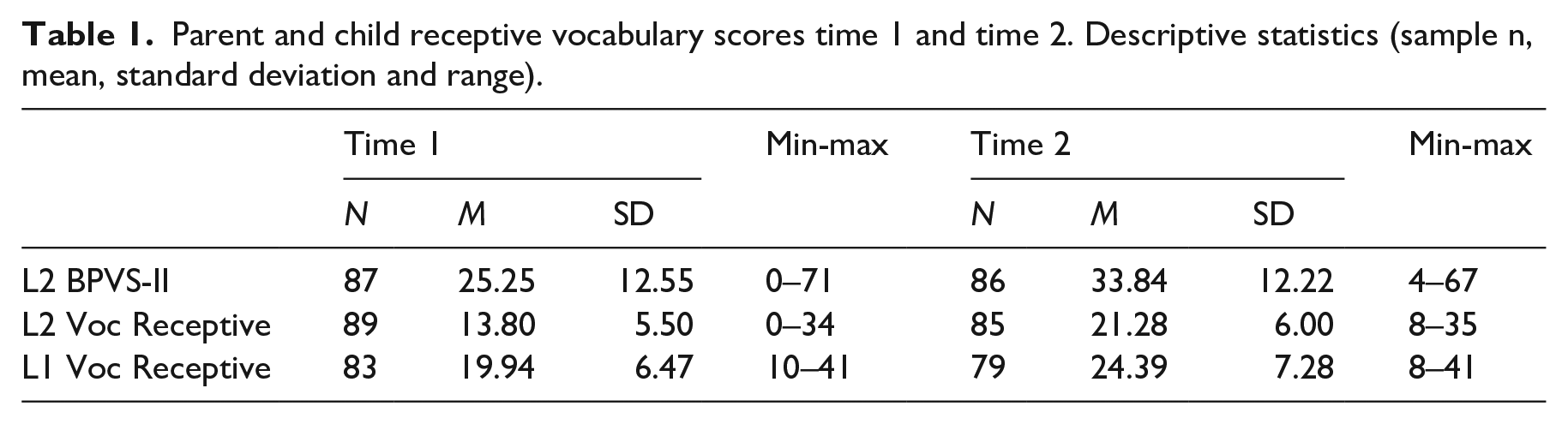
Children’s receptive vocabulary skills were assessed at the beginning (time 1) and end (time 2) of the preschool year, (child age at time 2 was M = 59.84, SD = 9.35). The mean time between child assessments was 7.8 months. Children’s scores from each assessment time are provided in Table 1. All individual assessments were administered by trained research assistants in a quiet room in the child’s preschool. Bilingual research assistants assessed the children’s L1 receptive vocabulary skills.
Parent and child receptive vocabulary scores time 1 and time 2. Descriptive statistics (sample n, mean, standard deviation and range).
Shared reading
The present study builds on the first book (a wordless narrative picture book) that parents in the intervention group received home in the beginning of the fall semester, Frog, Where Are You? (Mayer, 1969). Although the 91 parent–child dyads were selected for the present analysis because they mainly used the L1 during the interactions, parents and children also alternated briefly to the L2, typically introducing single words (e.g., frog, wake up, angry, owl, bee, deer) or expressions (e.g., where are you?) in Norwegian. Nearly 73% (n = 66) of the children shared the book with their mother, and 24% (n = 22) of the children shared the book with their father. In addition, three children shared the book with another family member in the household (older sibling or grandparent) in the recording. Thus, it should be noted that a few children were not read to by one of their parents although we used the term “parent” to refer to the adult reader.
The audiotapes of the shared reading collected during the fall had a mean duration of nine minutes (M = 8.86, SD = 4.28). These recordings were transcribed, translated, and verified by bilingual research assistants using the transcription system Codes for the Human Analysis of Transcripts (CHAT) (MacWhinney, 2014). The transcripts were coded with a narrative coding scheme (see Luo et al., 2014) that identified 48 predetermined story elements, differentiating between parent and child contributions. The story elements comprised the events on each page of the book, including the protagonists’ attempts, the experienced consequences of those attempts, and the protagonists’ reactions and inner states. We chose to use this coding scheme because it was specifically developed for the content of the book Frog, Where Are You? (Mayer, 1969) and because it had been tested and verified in an ethnically diverse sample of families (Luo et al., 2014).
The coding of parent narrative contributions distinguished between whether the predetermined story elements (i.e., “the boy is mad” and “the boy tells the dog to be quiet”) were introduced as questions or statements. These story elements could be communicated through one or more utterances. “Parent questions” were attempts to elicit child narrative production with inferential wh- prompts, such as “Why is the dog running away?” and “What does the boy feel now?” “Parent statements” were the parents’ contribution of story components, such as “The boy falls into the water” and “Now the frog had found his family.” Parent questions that contained narrative components in their structure but only required a yes/no response or confirmation from the child were coded as parent statements (“Did the dog fall?” and “The dog fell, right?”). Note that we did not code literal questions that were referential in nature (“What’s this?,” “What’s over there?,” “Where is the rock?,” etc.). Cohen’s kappa for the inter-rater reliability coding of the parent strategies was 0.89.
In the coding of child narrative contributions, we made a distinction between child contributions of predetermined story components that were responses to parent questions (child responses), and unique and spontaneous child contributions of predetermined story components (child statements). The child did not get a point for a stated component if he/she repeated the parent’s statement. However, if the child repeated the content of the parent statement (“The boy is sleeping”) but rephrased it in the form of a question (“Is the boy sleeping?”), this would be coded as a unique, non-elicited contribution from the child (child statement). Cohen’s kappa for the inter-rater reliability coding of the child strategies was 0.88.
Child exposure to L2 shared reading intervention in preschool
The preschool teachers in each classroom reported on the number of times the target child was exposed to small-group shared reading in the L2 as part of the intervention, a measure that reflected preschool implementation fidelity as well as child absence from preschool. Out of 45 planned reading sessions across the preschool year, the target children of the present study were exposed to a mean of 27 reading sessions in preschool, ranging from 5–43 classroom reading sessions per child (hereafter referred to as preschool intervention exposure).
Child exposure to L1 shared reading intervention at home
Across the preschool year, the families returned from one to four (M = 2.85, SD = 1.22) audio recordings of book sharing in the L1. This measure of home implementation fidelity is hereafter referred to as home intervention exposure.
Analysis
To address research questions 1 and 2, we conducted separate regression analyses of parent and child contributions as predictors for each outcome variable. All regression analyses were conducted using the time 2 scores as the outcome, with the corresponding time 1 scores, the children’s age in months, maternal education, and exposure to the intervention as control variables. For maternal education, missing data were replaced by the serial mean (information missing from seven mothers). We conducted preliminary analyses to decide on the appropriate control variables. Maternal education was used as a control because preliminary analyses revealed that maternal education was more consistently related to child outcomes than paternal education or a combined measure of maternal and paternal education. However, all analyses were initially run with these different parental education variables to ensure that this decision did not significantly have an impact on the main findings. Home and preschool intervention exposure were not concurrently related to any of the L1 or L2 outcomes at time 1. This finding suggests that adults implemented the shared reading activities throughout the year regardless of the children’s initial skill levels. However, significant correlations were found between home intervention exposure and child L1 outcomes at time 2, and between preschool intervention exposure and child L2 outcomes at time 2. This indicates that the number of times the children were exposed to shared reading of the intervention books at home and in the classroom significantly impacted their vocabulary development. Since the home and preschool intervention exposure measures were related only to the same-language outcomes at time 2 (i.e., preschool intervention exposure in the L2 did not predict L1 outcomes, and home intervention exposure in the L1 did not predict L2 outcomes), we controlled for the variable home intervention exposure in the L1 analyses to answer research question 1, and the variable preschool intervention exposure in the L2 analyses to answer research question 2. We conducted initial analyses with both intervention exposure measures in the models to ensure that this decision did not impact the main findings.
We also conducted initial analyses of the duration of the book sharing recordings, as we expected a relationship between the number of predetermined story components addressed by participants and the duration of the recordings. Correlational analyses (controlling child age in months) revealed that the number of parent and child statements was not significantly related to the length of the book sharing recordings, while parents who contributed more questions also spent more time sharing the book with their child. These findings suggest that more interactive dyads spent more time in shared reading. While it is a common approach to calculate the proportion of coded utterances or words per minute when the length of recordings vary among same-language samples, such an approach was not deemed adequate for the present assessment, in which the participants were only credited for addressing predetermined story components in different L1s (for a similar procedure, see Luo et al., 2014).
Results
Table 2 presents the descriptive statistics of parent and child narrative contributions during shared reading at time 1. As shown in the table, the mean level of parent questions and statements were relatively balanced. A similar tendency was also seen in the group means of child responses and statements. However, the high SDs reflected wide variability in all measures. Table 2 also presents correlations between parent and child narrative contributions during shared reading and maternal education, while controlling for child age in months at time 1. These analyses revealed a strong positive correlation between parent questions and child responses (r = 0.93, p < 0.001), conveying a pronounced contingency in parent–child talk. We found no relationship between parent questions and parent statements or child responses and child statements, which indicated that the dyads that were characterized by many parent questions and child responses did not necessarily produce more statements. Note also that we found a significant negative correlation between parent and child statements, which most likely reflects the fact that, in some parent–child dyads, either the parent or the child took on the role of the main narrator. Furthermore, we found that maternal education was associated with parent questions and child responses, but not with parent statements and child statements.
Parent and child narrative contributions and maternal education. Descriptive statistics (mean, standard deviation and range) and partial correlations (controlling for child age in months) between parent and child narrative contributions and maternal education.
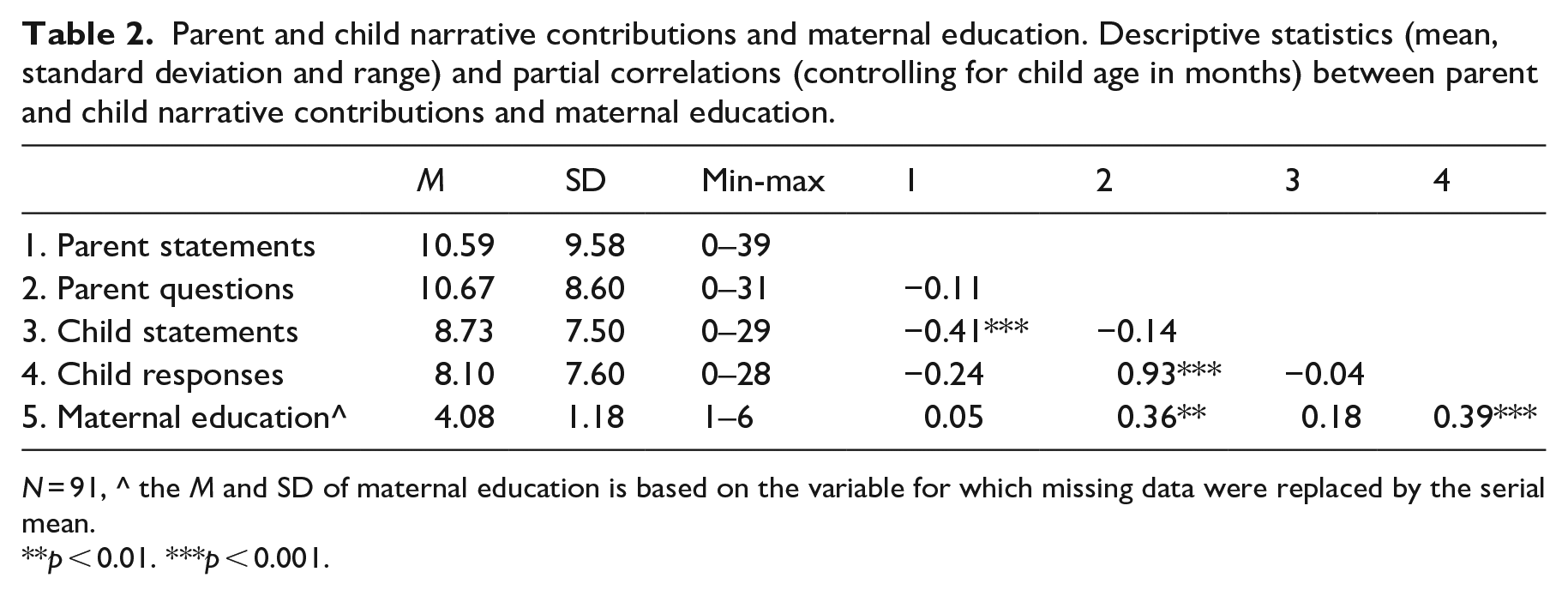
N = 91, ^ the M and SD of maternal education is based on the variable for which missing data were replaced by the serial mean.
p < 0.01. ***p < 0.001.
Concurrent correlations at time 1 (controlling for child age in months) revealed that maternal education was significantly related to children’s scores on the BPVS-II (r = 0.26, p < 0.05) and L1 Voc Receptive (r = 0.35, p < 0.01), but not on the L2 Voc Receptive (r = 0.06, p = 0.563). Moreover, there appeared to be no relationship between maternal education and child exposure to the intervention at home (number of submitted audio recordings of shared reading) or at preschool (number of times the child was present when the intervention books were shared at preschool). At time 1, L1 Voc Receptive was significantly related to L2 BPVS-II (r = .46, p < 0.001), but not to L2 Voc Receptive (r = 0.13, p = 0.242). There was a strong positive relation between L2 BPVS-II and L2 Voc Receptive (r = 0.59, p < 0.001).
Neither parent statements nor child statements predicted child outcomes when included as predictors of children’s time 2 receptive vocabulary. Moreover, time 1 receptive vocabulary in one language did not predict time 2 receptive vocabulary in the other language once the control-variables were included in our models. As a result, these measures were excluded from further analysis.
Predicting L1 and L2 receptive vocabulary skills
Table 3 presents the regression analyses predicting L1 receptive vocabulary skills at time 2. Parent questions predicted children’s L1 Voc Receptive scores at time 2, even controlling for child age, time 1 L1 Voc Receptive scores, maternal education and home intervention exposure. We also found that child responses predicted increases in L1 Voc Receptive scores over time and that this relationship was maintained when the control variables were included.
Predicting child L1 Voc Receptive scores at time 2 by inferential talk (parent questions and child responses) time 1, controlling for child age and time 1 scores, maternal education and home intervention exposure.
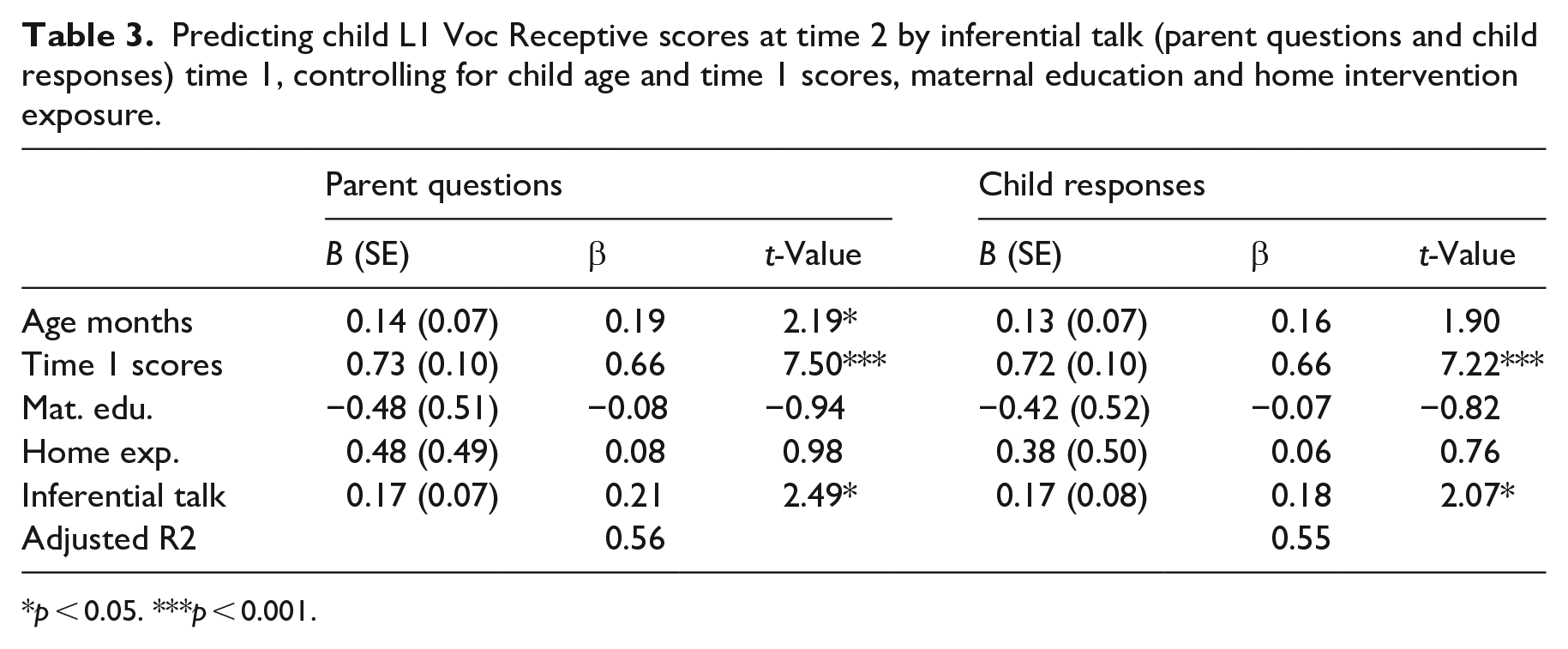
p < 0.05. ***p < 0.001.
Table 4 presents the regression analyses predicting L2 BPVS-II scores at time 2. Parent questions did not directly predict child BPVS-II scores. Nonetheless, child responses to adult questions during the shared reading encounter did predict child L2 receptive vocabulary assessed with the BPVS-II across the year, controlling for child age in months, time 1 BPVS-II scores, maternal education and preschool intervention exposure.
Predicting child L2 BPVS-II scores at time 2 by inferential talk (parent questions and child responses) time 1, controlling for child age and time 1 scores, maternal education and preschool intervention exposure.
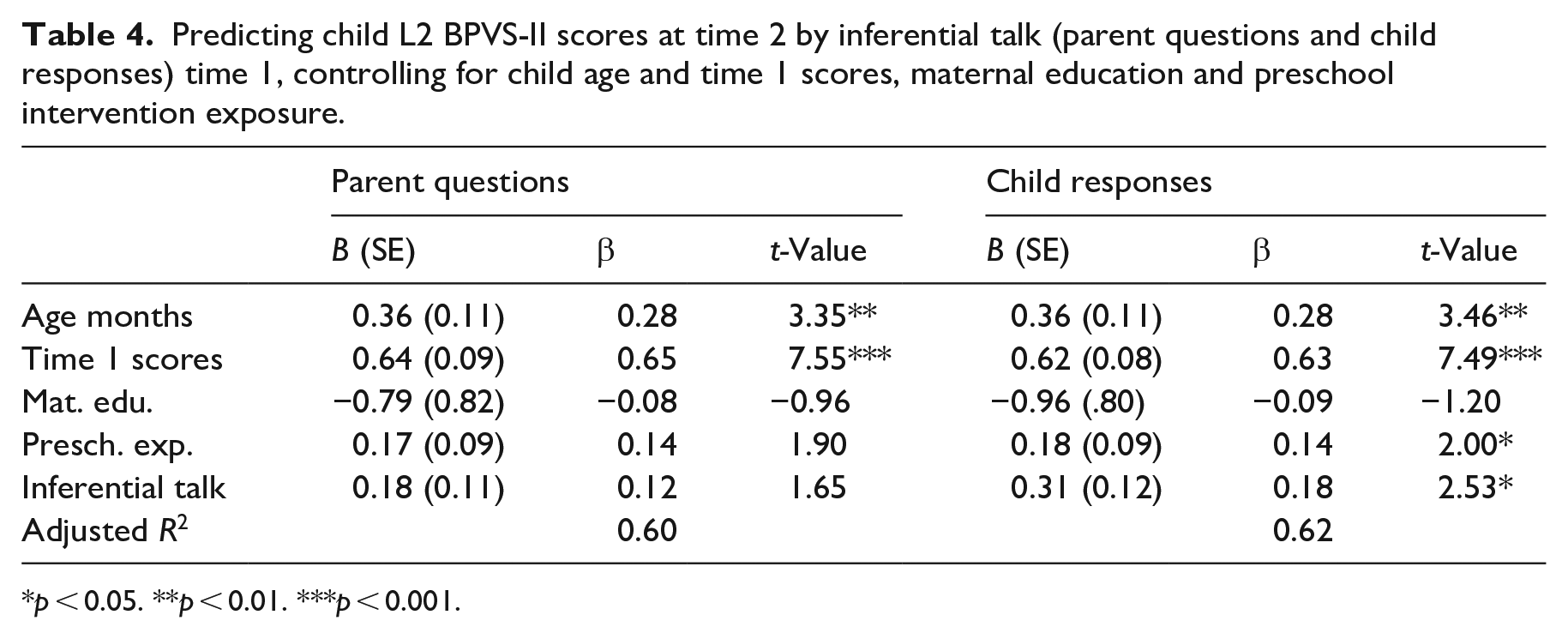
p < 0.05. **p < 0.01. ***p < 0.001.
Parent questions and child responses did not predict L2 Voc Receptive across the year (see Table 5). Not surprisingly, there was a particularly strong relationship between preschool intervention exposure and the L2 Voc Receptive measure which assessed words targeted in the intervention.
Predicting child L2 Voc Receptive scores at time 2 by inferential talk (parent questions and child responses) time 1, controlling for child age and time 1 scores, maternal education and preschool reading exposure.
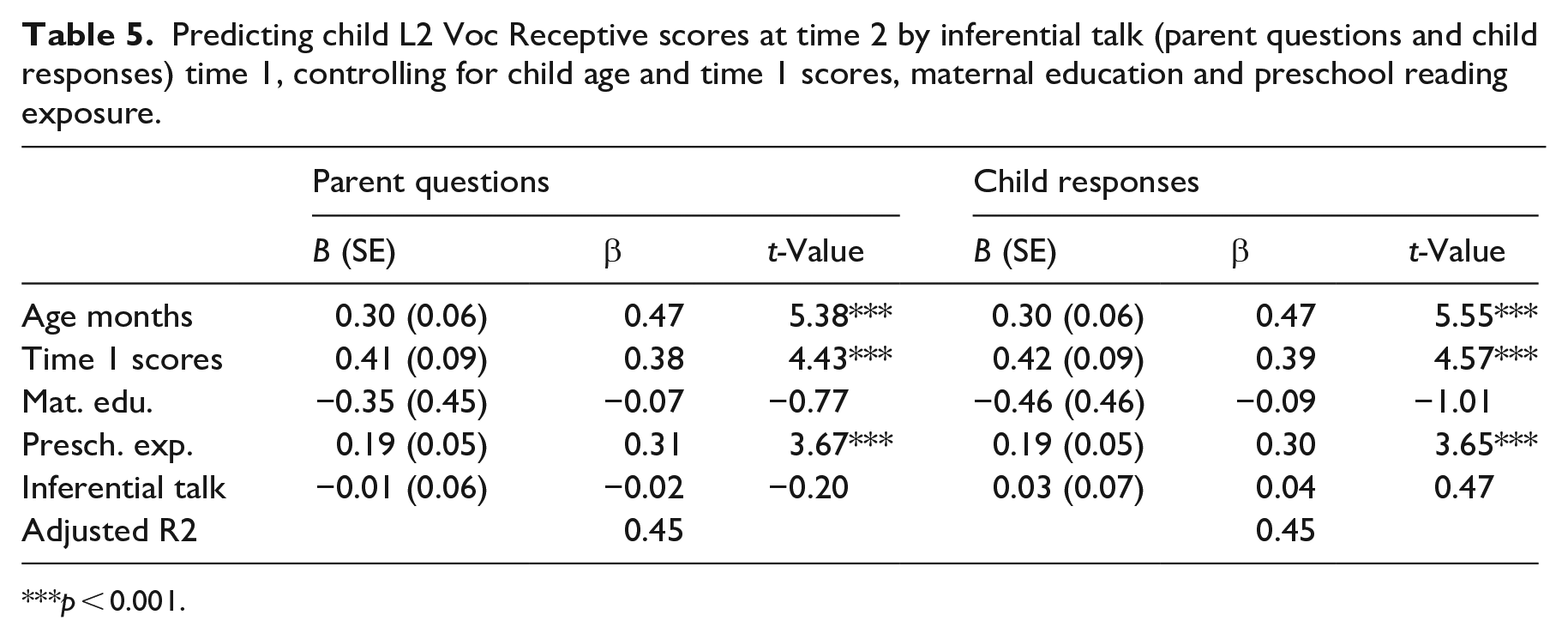
p < 0.001.
Discussion
In the present study, we investigated a sample of parents who used the L1 when sharing a wordless narrative picture-book with their child to identify the interactional qualities that may support young DLLs’ vocabulary development. More specifically, we investigated whether parent inferential questions and child responses predicted child L1 receptive vocabulary skills (research question 1) and child L2 receptive vocabulary skills (research question 2) across one preschool year.
In response to research question 1, we found that specific features of parent–child shared reading in the L1 predicted child L1 receptive vocabulary outcomes over a period of 8 months. More specifically, we found that parents’ inferential questions (coded as attempts to elicit central story components from the child, typically phrased as wh- questions) as well as child responses to these questions predicted children’s development of L1 receptive vocabulary skills across the year.
Related to research question 2, we found that child responses to adult inferential questions predicted children’s L2 receptive vocabulary development across the year, based on assessment with the BPVS-II measure. This finding suggests that shared reading in the L1 may support children’s L2 development through questions that demand inferential responses from the child. However, maybe as a result of the strong effect of preschool intervention exposure, we did not find that features of the parent–child shared reading in the L1 explained the additional variance in children’s L2 Voc Receptive scores at time 2.
Taken together, the findings of the present study extend previous studies assessing interactions and outcomes in the same language (e.g., Deshmukh et al., 2019; Rowe et al., 2017) by suggesting that parent inferential questions during shared reading may support the general comprehension and sociopragmatic skills underlying receptive vocabulary development in both the L1 and L2 among DLLs who were exposed to the two languages on a regular basis. Similar cross-language relationships have only been investigated in a few other studies of shared reading. For instance, in a study of DLLs in the US who spoke either Hmong or Spanish at home, Roberts (2008) found that shared reading in an L1 was at least as effective as shared reading in the L2 English for L2 vocabulary learning. Similarly, in a study of Spanish–English DLLs in the US, Quiroz et al. (2010) found that specific maternal strategies during shared reading in L1 Spanish were positively associated with children’s vocabulary in both languages. However, while the Quiroz et al. (2010) study pointed to the importance of mothers’ questions related to the labeling of pictures (literal questions) in the L1, the present study suggests that parent questions that demand children to infer meaning and draw connections in the story may be an important mechanism in child receptive vocabulary development in both languages. Note, however, that the present sample comprised a selection of parents who showed a preference toward sharing the book in the L1 and that the target children appeared to be L1 dominant when they entered this study (see Table 1). Even so, since we did not code parent literal questions in the present study, we do not know whether such strategies would add further understandings of the relationships reported here. It may be that parent questions (both literal and inferential) are important because they strengthen parent–child joint engagement and interconnected talk, an interactional quality that appears to be a potent predictor of later vocabulary development (e.g., Hirsh-Pasek et al., 2015).
The mechanisms driving the relationships detected in the present study need further investigation. The finding that it was child responses to parent inferential questions, and not the parents’ questions, that predicted child L2 BPVS-II scores, may reflect that children draw on and incorporate their growing L2 vocabulary knowledge when responding to parent inferential questions. The children in the present study both used the L2 more than their parents during everyday communication at home and introduced words and expressions in the L2 during the shared reading interactions in the L1. The parents appeared to maintain use of the L1 while simultaneously endorsing the inclusion of L2 words and expressions to maximize child participation and understanding. Future research should investigate whether such intrasentential codeswitching strategies (e.g., including L2 words in L1 interactions) support parent–child communication in ways that promote children’s vocabulary development across languages. Nonetheless, since child responses are mediated by parent inferential questions, it is difficult to tease apart the effects of child and parent contributions. The fact that parent and child statements did not predict outcomes in the present study suggests that not all components of talk during shared reading are equally predictive of children’s vocabulary skills. Similarly, Hindman et al. (2014) reported that vocabulary skills at 4 years of age were weaker for those whose mothers emphasized recalling or summarizing the story. However, as the present study assessed only the contribution of predetermined story components, parents and children may have contributed (in the form of statements) and made attempts to elicit (in the form of questions) inferential talk that was not assessed in the present study.
Finally, the present study contributes to the current research literature by demonstrating that children who have parents with higher levels of education appear to be more exposed to adult inferential questions during shared reading compared with children whose parents have lower levels of education. Although previous research with DLLs has demonstrated that access to books for children in the home is linked to the parents’ level of education (Rydland and Grøver, 2021), the present study demonstrates that such socioeconomic differences also surfaced when parents shared the same picture book with their child.
Limitations
Since narrative participation is likely reflective of cultural norms and practices, it is a limitation of the present study that we did not collect information about narrative traditions in the homes. Unfortunately, the different home language groups were too small to allow analysis of whether specific narrative strategies could be identified within specific cultural groups in the present study. Moreover, it is important to note that the variability in child home language background and children’s participation in the preschool intervention may have precluded our ability to detect significant relationships.
As most observational studies of parent–child interaction seldom include information of the child’s experiences with other caregivers, it is a strength that we controlled for the extent to which each child was exposed to the shared reading intervention in preschool and at home across the year. Nonetheless, it is a limitation of the present study that we did not control for the level of inferential talk the target children were exposed to during their shared reading encounters in preschool. On a similar note, it is a limitation that we did not control the extent to which the parents and children familiarized themselves with the book before they conducted the recording, or investigate how the parent–child dyads introduced new words during the shared readings (for instance, differentiating between words that were part of the intervention and other words). As the present study only addressed children’s receptive vocabulary skills, future research should investigate other aspects of children’s oral language skills, such as expressive vocabulary.
Despite these limitations, our findings support the growing research base that emphasizes the significance of eliciting child reasoning and verbal responses during shared reading. As such, the current results underscore the importance of examining the quality of parent–child interactions, in addition to quantity, in connection with children’s L1 and L2 development. Kleeck’s (2008) work suggests that support for children’s inferencing skills in early years may potentially prevent later comprehension problems. Thus, future research should investigate whether the early experiences identified in the present study can predict DLLs’ longer-term language development and reading comprehension outcomes.
Implications of the present study
DLLs who are extensively exposed to the societal (L2) language in preschool face the challenging task of maintaining command of their home language (L1). Indeed, many young DLLs begin early on to introduce the L2 when communicating with their parents even though their parents try to maintain use of the L1 (Rydland and Grøver, 2021). The findings of the present study support the notion that use of the L1 at home does not compromise, and might even strengthen, DLLs L2 development when parents focus on child reasoning and participation.
In the present study, we found that the parents implemented shared reading at home as part of the overall intervention (number of returned audio recordings of shared reading) regardless of their educational level. This finding has promising implications for future efforts to support child language development through parent collaboration, for instance, by welcoming the use of the L1. However, the findings of the present study also align with prior research linking socioeconomic status, home literacy resources and practices, and receptive vocabulary skills among young DLLs (Gonzalez et al., 2017; Rydland and Grøver, 2021). The findings that demographic characteristics (maternal education) related to the parent–child microlevel interactions suggest that strategies that involve parents should be attuned to families’ needs and resources if the goal is to counteract the systematic group differences evident at an early age. Indeed, the present study findings support the notion that quality aspects of the shared reading experience may support child dual language development beyond the impact of the child’s initial skill levels and more distant measures of the home environment.
Footnotes
Acknowledgements
We would like to express our appreciation to all the families and research assistants who contributed their time and interest in this study. Thanks to Nataliya Honcharova who helped out with the coding of parent–child interactions.
Funding
The authors disclosed receipt of the following financial support for the research, authorship, and/or publication of this article: The overall project was financed by the Research Council of Norway (grant number 218280).
