




Abstract
This study investigated whether features of teacher talk predicted children’s oral language development in diverse early childhood education and care settings, and whether the potential effects differed due to children’s age or dual language learner (DLL) status. The study included 203 classrooms with 734 children aged between 25 and 59 months at onset, 56.6% of whom were DLLs. Teacher talk during small-group shared readings was recorded in the fall and coded for question types (advanced and referential wh-questions) and linguistic features (vocabulary quantity, vocabulary diversity, and utterance length), and children’s vocabulary and syntactic comprehension were assessed in the fall and spring. Our findings suggest that teachers’ advanced wh-questions can significantly promote children’s development of syntactic comprehension, regardless of their age and DLL status. Furthermore, teachers’ utterance length and diverse vocabulary use predicted children’s development of syntactic comprehension, and teacher’s diverse vocabulary use predicted children’s vocabulary development, with some of these relationships being moderated by children’s age and DLL status. These findings emphasize the importance of teachers employing strategies that elicit children’s participation and activate thinking from a young age and irrespective of their language background.
Keywords
Introduction
Children’s oral language skills are crucial not only for their ability to effectively communicate and engage in daily activities but also for future literacy acquisition and reading comprehension (Lesaux & Geva, 2006; Lieven, 2019). Given that many children spend substantial time in early childhood education and care (ECEC) programs (OECD, 2024), it is essential that teachers provide experiences that foster oral language development. This is particularly important for children growing up in urban areas characterized by segregation and poor living conditions to ensure equitable opportunities for development (Andersen et al., 2021). We, therefore, need more knowledge about effective strategies teachers can employ to support language acquisition for children living in these contexts.
Research has gained insights into how adult–child linguistic interactions can affect children’s oral language in home settings (e.g., Anderson et al., 2021; Hoff, 2006) and, increasingly, within ECEC settings (e.g., Hadley et al., 2023). However, there is a notable gap in understanding these dynamics in diverse ECEC settings that may include both younger and older children as well as significant proportions of dual language learners (DLLs) who are exposed to a language at home other than the societal language used in ECEC. Unlike home settings, where parental interactions are often limited to a few children who may share genetic ties, ECEC teachers engage with larger groups of children with a broad range of individual differences. Differences in children’s age and backgrounds may lead to varied group interaction patterns across ECEC settings (e.g., Girolametto & Weitzman, 2002; Kurkul et al., 2022) and can pose significant challenges for teachers in determining effective strategies for fostering oral language that are adapted to individual children’s needs. Yet, few studies have considered the influence of individual child characteristics such as age and DLL status when investigating how teacher talk can support children’s oral language development over time. Recent studies have shown negligible relationships between societal language support in ECEC and DLLs’ development in that language (Hansen et al., 2023; Partika et al., 2021), underscoring the need for more research to identify effective strategies.
This study was conducted in diverse urban ECEC classrooms in Norway, where ECEC is universally available to children from the age of 1 year and the predominant language of communication is the societal language Norwegian. The aim of the study is to investigate whether teacher talk features in classrooms serving children from 2 years of age predict children’s oral language development across one academic year, and whether the potential effects differ due to individual children’s age or DLL status.
Supporting children’s oral language development
Vocabulary and grammar are considered core oral language skills in young children (Lonigan & Milburn, 2017). Although vocabulary and grammar are not necessarily directly dependent on each other, they are strongly correlated, which potentially reflects common sources of influence, such as the richness of children’s language input (Brinchmann et al., 2019). Sociocultural theory proposes that language learning occurs through social interaction and the qualities of input from more knowledgeable others (Vygotsky, 1978). In ECEC settings, this includes teachers and how they engage children in conversations and expose them to different features of talk. As children’s learning is assumed to be promoted in their zones of proximal development—when input is challenging but not too difficult—the impact of specific features of teacher talk can vary with the developmental stage of children (Rowe & Snow, 2020; Vygotsky, 1978).
Central to supporting children’s language development is interactive talk, in which elicitation practices such as asking questions are employed to encourage child talk (Hadley et al., 2023; Rowe & Snow, 2020). Through questions, teachers elicit active participation by having children display what they already know and by challenging them to think and build their knowledge (Kleeck, 2008). Teachers also gain insight into children’s language use and resources, allowing them to fine-tune their talk to children’s zones of proximal development (Hadley et al., 2023). When children participate in conversations, they are also exposed to features of linguistic talk that are typically not consciously chosen by speakers (Hoff & Naigles, 2002), providing children with crucial information about linguistic forms and functions (Hadley et al., 2023). Thus, teachers can provide rich language input by engaging children in conversations through questioning and enabling them to extract information about linguistic features that are not directly taught to them, contributing to their understanding of language structure.
Particularly suitable for promoting language skills are meaning-focused activities, such as shared book reading, in which the active construction of the meaning of a story takes place (Connor et al., 2006; Kleeck, 2008). Shared reading has been shown to elicit more interactive talk and richer language than other activities, particularly when reading wordless narrative books, which are more unstructured and open-ended (Dickinson et al., 2014; Mathers et al., 2024). Studies suggest that frequently participating in and allocating time for reading activities can promote children’s language development (Connor et al., 2006; Hagen, 2018). As such, shared reading may serve as a valuable context for language learning.
In the following two sections, we review studies investigating the relationships between adult talk features and children’s oral language. Since very little research in ECEC settings has included children under the age of 3 years, studies in home settings can shed light on the effects of adult talk on younger children.
Relationship between adult question types and children’s oral language
Questions vary in their form (e.g., open- or closed-ended; yes/no or wh-questions) and level of cognitive demand, which refers to the extent children are required to think abstractly to resolve them (Sigel, 1986). Questions of lower cognitive demand ask for literal information that is immediately available to children and are usually limited in the range of possible responses. These questions can be framed as yes/no questions aimed at checking or building understanding, or as referential wh-questions that ask for labels, descriptions, or locations. Questions at a higher cognitive level ask children to infer by going beyond the here and now context. These questions include advanced wh-questions and are often more open-ended, allowing for more child interpretation and longer, more elaborate answers (Deshmukh et al., 2019; Luo et al., 2022). The level of cognitive demand is, in turn, likely to elicit responses from children at the same level (Kucherenko et al., 2023; Tompkins et al., 2017; Zucker et al., 2010). For instance, when parents or teachers ask open-ended questions framed with wh-question words, particularly advanced how- and why-questions, they tend to prompt longer and more complex responses from children than other types of questions (Deshmukh et al., 2019; Rowe et al., 2017). Advanced wh-questions are, therefore, considered more challenging and especially supportive of language learning as children are given the opportunity to practice using language.
In line with this, studies have found that parents’ use of all types of wh-questions during play predicted vocabulary skills in 2-year-olds (Rowe et al., 2017) and advanced wh-questions during shared reading predicted vocabulary development across 8 months in 3- to 5-year-olds (Rydland & Grøver, 2023). While fewer studies have included measures of child grammar as outcome, Buckalew et al. (2024) found that all types of wh-questions posed by mothers predicted grammar skills measured as syntactic comprehension and production among 5- to 7-year-olds. Other studies have suggested that mothers’ less challenging questions—that is, referential and yes/no questions—predicted 2-year-olds’ language comprehension 1 year later (Luo et al., 2022) and vocabulary development across 6 months in 4- to 5-year-olds (Tompkins et al., 2017). Although the authors noted that more advanced questions were very low in frequency, possibly explaining their lack of predictive effect, it suggests that lower-challenge questions may serve an important purpose in supporting language development by promoting joint attention and conversational turns. Moreover, the effects of question types on child language development may depend on children’s initial skill levels, as children with a larger vocabulary at age 2 were found to benefit more from referential questions than children with a smaller vocabulary (Luo et al., 2022).
When investigating ECEC teachers’ open-ended questions that elicit multi-word responses from children during whole-group shared reading, Hindman et al. (2019) reported no significant relationship with vocabulary development across one academic year in 3- to 4-year-olds and suggested that the null association could be explained by the rarity of open-ended questions. In similar settings, Zucker et al. (2010) found an association between advanced questions that require inferencing and 4-year-olds’ elaborated responses but not with their vocabulary development across 1 year. In whole-group settings, it might be difficult for teachers to encourage active participation from all children or to fine-tune their questions to individual children’s needs (Zucker et al., 2010). Studies of small-group play and shared reading applying measures of teacher elicitation practices, including asking open-ended questions, have indicated positive relationships with vocabulary development in 3- to 5-year-olds across one (Cabell et al., 2015; Kane et al., 2023) and two academic years (Justice et al., 2018), even beyond other dimensions of teacher talk when examined simultaneously (Justice et al., 2018; Kane et al., 2023). Furthermore, one study reported that higher-challenge questions asking for associations between words and concepts during small-group shared reading were related to 4-year-olds’ vocabulary development across 4 months, as opposed to lower-challenge questions asking for labeling or defining, with no indications of an interaction with children’s initial language skills (Gonzalez et al., 2014). However, few studies have investigated the relationship between specific types of teacher questions and child oral language with significant proportions of DLLs in their sample.
Relationship between adult linguistic features and children’s oral language
Linguistic features such as the quantity, diversity, and complexity of adult talk have been demonstrated as important for child language development in home settings (see Anderson et al., 2021, for a meta-analysis). For instance, studies have shown that variations in parents’ vocabulary diversity and mean length of utterance (MLU) account for variations in 2-year-olds’ production of vocabulary and complex utterances during play and other daily activities (Hoff & Naigles, 2002; Tamis-LeMonda et al., 2012). These relationships were also observed between adoptive mothers’ talk during play and 2- to 6-year-olds’ vocabulary development, suggesting that the significance of adult linguistic features persists even in the absence of genetic confounds (Coffey et al., 2022). When comparing different age groups, studies have found the specific aspects of parents’ linguistic features related to child vocabulary development at different ages: vocabulary quantity and MLU were significant predictors for 1- to 2-year-olds, while vocabulary diversity and sophistication were significant predictors for older children (Coffey et al., 2022; Rowe, 2012). Similarly, a meta-analysis reported that the effect of diversity and complexity of parent talk on children’s oral language skills increased as the children aged (Anderson et al., 2021).
In ECEC classrooms, Justice et al. (2018) found that teacher linguistic features during small-group play interactions were not associated with vocabulary or grammar development in 3- to 5-year-olds. They hypothesized that this might be due to shared variance with other quality dimensions, such as teachers’ language-eliciting practices, underlining the importance of encouraging children’s active participation in conversations. Nevertheless, children of the same age have been found to mirror teachers’ use of complex utterances, indicating that they use this as a learning support to engage in more complex talk themselves (Justice et al., 2013). Indeed, other studies observed that teacher vocabulary diversity and talk complexity during play, circle time, and shared reading were positively associated with 3- to 5-year-olds’ vocabulary development across 1 year (Grøver Aukrust & Rydland, 2011; Grøver et al., 2022; Sun & Verspoor, 2022). Although these studies included DLLs, one study found that teachers’ diverse vocabulary use during circle and snack time was only beneficial for monolingual 4-year-olds, while high vocabulary quantity and short utterances positively influenced their DLL peers, indicating that the mechanisms underlying vocabulary acquisition in DLLs parallel those in younger monolingual children (Bowers & Vasilyeva, 2011). Thus, the impact of DLL status remains uncertain.
The Norwegian ECEC context
In Norway, 94% of all children aged 1 to 5 years attend ECEC programs (Statistics Norway, 2024). Structural aspects of ECEC quality are regulated by the Kindergarten Act (2017) and require staff-child ratios of minimum 1:3 and 1:6 for children under and over the age of 3, respectively, and classroom head teachers to have 3 years of ECEC teacher education. Classrooms typically serve around 9 children aged 1 to 3 years or 18 children aged 3 to 6 years, though the age composition and size of the classrooms varies between centers. In some classrooms, teachers may share the pedagogical responsibility. Additionally, centers must follow the content and task guidelines in the National Framework Plan for Kindergartens (Ministry of Education and Research, 2017), which emphasize free play, opportunities for exploration, and peer-driven interaction as essential for child learning and development. Nationwide, 20% of children attending ECEC are DLLs, while up to 78% are DLLs in some districts of Oslo, Norway’s capital (Statistics Norway, 2024), where this study was conducted. Nonetheless, the common language between staff and children in ECEC classrooms is Norwegian.
The present study
This study aims to investigate the relationships among teacher talk features, child oral language development, and child characteristics within diverse urban ECEC settings. We include measures of both vocabulary and grammar in children attending classrooms that are age heterogeneous and include significant proportions of DLLs. We investigated the following research questions:
Drawing upon the reviewed literature, we hypothesized that both teacher questions and linguistic features would positively predict the development of vocabulary and grammar in children. Specifically, we expected higher-challenge questions (i.e., advanced wh-questions) to exert a stronger predictive effect than lower-challenge questions (i.e., referential wh-questions), and the diversity and complexity of talk (i.e., vocabulary diversity and utterance length) to have a stronger predictive effect than the quantity of talk. Due to the limited number of studies examining the moderating effects of child characteristics in ECEC settings—primarily focusing on 4-year-olds (Bowers & Vasilyeva, 2011; Gonzalez et al., 2014)—we also drew on evidence from home settings involving younger children (Anderson et al., 2021; Luo et al., 2022) and hypothesized that children’s age and DLL status would moderate the observed relationships.
Methods
Participants
This study included 734 children across 203 classrooms. The children were aged between 25 and 59 months at the onset of the study (M = 41.0, SD = 9.2), and 369 (50.3%) were girls. Furthermore, 425 (67.2%) had parents with higher education at the BA or MA level, 410 (56.6%) had two parents who spoke a first language other than a Scandinavian language, 1 while 93 (12.8%) had one parent who spoke a first language other than a Scandinavian language, representing over 50 different languages. The classrooms were age heterogeneous, with 180 (25%) children attending classrooms serving younger children aged 1 to 3 years, 501 (68%) attending classrooms serving older children aged 3 to 6 years, and 53 (7%) attending classrooms serving children aged 1 to 6 years. Of the teachers, 173 (88%) were female, 173 (87%) held ECEC teacher degrees, and 75 (40%) had at least 10 years of teaching experience.
This study used data from the initial phases of a longitudinal professional development intervention study aimed at supporting children’s language development in ECEC classrooms serving children aged 1 to 6 years in diverse districts of Oslo. In classrooms where teachers shared pedagogical responsibilities, they were asked to select one teacher to assume primary responsibility for participation and data collection. The participants had been randomized into two groups, and the current study drew upon data from both groups to enhance the overall sample size, which can lead to more robust statistical analyses. The intervention entailed a practice-based coaching model with pedagogical content to enhance teachers’ capacity to support child exploration and participation in extended dialogues during shared reading, natural science activities, and peer play. Teacher talk was measured before the onset of the intervention at the beginning of the academic year (T1), while child language outcomes were measured at T1 and at the end of the academic year (T2), during the midpoint of the intervention. We adjusted for the intervention status in the analysis to account for any potential intervention effects on child language outcomes. In the main study, 887 children participated. We excluded children younger than 24 months at baseline in this study, since their language was assessed from 24 months of age.
Teachers were encouraged to recruit children with demographic backgrounds and DLL status reflecting the classroom composition. No exclusion criteria were applied. Consent forms and informational videos were offered to parents in Norwegian and 11 of the most common languages spoken by the immigrant populations in Oslo. All parents and teachers provided written consent forms and could withdraw at any time. This study was approved by the Norwegian Agency for Shared Services in Education and Research (approval no. 564726) on April 4, 2021.
Procedures
Audio recordings of teacher talk
We collected audio recordings of shared readings from each classroom at T1 (November 2021). All teachers read the book ‘The Farmer and the Clown’ (Frazee, 2014), which we expected to be unfamiliar in Norwegian classrooms. The book tells a story about a lonely farmer who rescues a baby clown who has fallen off a circus train and how their friendship grows through play and laughter. The book is textless and tells the story through pictures, which we considered suitable for both younger and older children. All teachers were given the book to review before they started sharing it in rooms free from interruptions. They were instructed to read the book as they would normally do and to share it in small groups of children whose parents had consented to their participation. The teachers decided the duration of the shared reading and a trained observer managed the audio recording. We were able to collect a total of 197 recordings from the 203 classrooms. The audio recordings were checked, and the reading durations were calculated, starting when the teachers began talking about the book and finishing when they had completed reading and the conversation turned to activities not related to the story. The average reading duration was 11.80 min (range: 2.33–31.02), with a mean of three children present (range: 1–6).
The audiotaped readings were transcribed by one transcriber. The transcripts were then refined and validated by trained project assistants who incorporated any utterances initially inaudible to the first transcriber. The transcripts were formatted according to CHAT guidelines and analyzed using the CLAN programs from the Child Language Data Exchange System (McWhinney, 2000). All talk during the shared reading was transcribed. We were not able to identify individual children’s voices with sufficient reliability; therefore, we distinguished only between teacher and child utterances. Inaudible words and words in a language other than Norwegian were marked and excluded from the analysis.
Child language assessment
Child language was assessed at T1 (November 2021) and T2 (June 2022), at an interval of approximately 7 months. Trained research assistants visited each classroom and conducted language assessments during sessions of a maximum of 30 min. The assistants had completed 2 days of training and certification administered by the project members.
Measures
Teacher talk measures
Teacher book theme questions
All teacher questions related to the book theme were coded from 11,167 teacher questions. This overarching category included questions which were both directly related to the book theme, and which went beyond the book theme by for instance making connections to children’s experiences. It consisted of all question types, such as wh-questions (e.g., ‘Why is he smiling?’), yes/no questions (e.g., ‘Is that a clown?’), and tag questions (e.g., ‘You do the same at home, right?’). We excluded questions that regulated a child’s behavior (e.g., ‘Do you want to sit here?’), or regulated the conversation by confirming (e.g., ‘Really?’ and ‘Do you think so?’) or clarifying (e.g., ‘What did you say?’).
Similar to previous studies (e.g., Deshmukh et al., 2019; Rowe et al., 2017; Tompkins et al., 2017), the book theme questions were subcategorized based on the question word used (i.e., how, why, where, which, who, when, and what), regardless of its position in the utterance. We performed additional coding of what-questions, since they varied from asking children to label (e.g., ‘What is that?’), to asking for elaboration and prediction (e.g., ‘What do you think will happen next?’). This resulted in two mutually exclusive subcategories:
Advanced wh-questions, which encompassed all how- and why-questions, in addition to what-questions that were open in structure, asking for longer elaborated responses. These typically invited children to analyze, explain, evaluate, extend, and predict—requiring them to go beyond the explicit meaning of the story.
Referential wh-questions, which included all where-, which-, who-, and when-questions, in addition to what-questions that were more closed in structure, asking for specific pieces of information. These questions usually had one correct answer, inviting children to engage in more concrete and literal talk, such as labeling.
Examples of each subcategory are provided in Supplemental Table S1. A coding manual was developed by the authors to categorize the questions, and the independent coders completed 2 days of training where examples from transcripts were collaboratively coded, discussing inclusion and exclusion criteria for each category. Interrater reliability between the trainees was calculated based on 16 transcripts of longer duration and considered as good across all categories (Cohen’s kappa = .86–.92) as well as specifically across the categories advanced and referential wh-questions (Cohen’s kappa = .83–.88).
Teacher linguistic features
Teacher vocabulary quantity was measured as the total number of word tokens and vocabulary diversity was measured as the total number of word types. The lists of types from each transcript were visually examined by trained research assistants and reduced by excluding onomatopoeia (words that phonetically imitate sounds), filler words (e.g., ‘ah’, ‘mm’), and inconsistencies in spelling. Finally, we measured the MLU in words, which is typically used as a measure of talk complexity (e.g., Justice et al., 2018; Tamis-LeMonda et al., 2012).
Child oral language outcomes
Vocabulary
We assessed receptive vocabulary using the British Picture Vocabulary Scale-II (BPVS-II; Dunn et al., 1997; Norwegian version by Lyster et al., 2010). Each child was presented with four pictures on paper and then asked to select the picture illustrating the target word presented orally by the examiner. From the original test consisting of 12 sets of 12 items, we included the 9 first sets and removed 1 item considered unfamiliar in the Norwegian context. The test consisted of 107 items, which were scored as 0 for incorrect and 1 for correct. It was administered starting with the age-appropriate set of items and using the stop criterion of eight or more incorrect answers in one set. The interitem reliability in our sample at T1 was a Cronbach’s alpha of .96.
Syntactic comprehension
We assessed syntactic comprehension using the Test for the Reception of Grammar-2 (TROG-2; Bishop, 2003; Norwegian version by Lyster & Horn, 2009). Each child was presented with four pictures on paper and then asked to select the picture illustrating the sentence presented orally by the examiner. The tasks were divided into different blocks, each measuring a specific grammatical construction. The test consisted of 80 items, which were scored as 0 for incorrect and 1 for correct. It was administered starting from the first item and using the stop criterion of five incomplete blocks (at least one incorrect item) in a row. The interitem reliability in our sample at T1 was a Cronbach’s alpha of .96.
Background variables
We collected background information from the parents, including child date of birth (used to calculate age in months at onset), child DLL status (0 = one or both parents with Norwegian, Swedish, or Danish as their first language; 1 = two parents with a first language other than a Scandinavian language), and the number of years of education of the parent who answered the questionnaire (1 = 0–4 years, 2 = 5–7 years, 3 = 8–10 years, 4 = 11–13 years, 5 = Bachelor’s degree, 6 = Master’s degree or higher).
Analysis
All the participating teachers shared the same book and could decide on the time spent reading, which resulted in considerable variation in reading duration. Although this variation might serve as an important indicator of quality, our primary focus was to examine the effect of teacher talk beyond the reading duration. We, therefore, adjusted for this variation by calculating relative measures of teacher talk features. For teacher questions measured at the utterance level, we calculated the proportion of each question category relative to the total number of teacher utterances (e.g., Hindman et al., 2019; Rowe et al., 2017). We calculated teacher density of tokens by dividing the total number of tokens by the number of minutes spent in reading (e.g., Coffey et al., 2022; Grøver Aukrust & Rydland, 2011). Density of types per minute was not applicable to our data due to the variation in reading duration; teachers with increased reading time are more inclined to repeat word types, resulting in lower densities of types per minute. Therefore, we included both the number and density of tokens but only the number of types. As MLU is a relative measure at utterance level, it did not warrant further adjustments. We conducted a correlation analysis between the teacher talk variables, which confirmed the negative association between reading duration and teacher density of types (r = −.57, p = <.001). In preliminary analysis, we also checked for differences between DLL and monolingual children in BPVS-II and TROG-2 scores. Consistent with previous studies (e.g., Bowers & Vasilyeva, 2011), the DLLs scored on average lower than the monolingual children in our sample.
To address the research questions, we employed linear mixed models with BPVS-II and TROG-2 as dependent variables. The reading duration, proportion of book theme questions, proportion of advanced wh-questions, proportion of referential wh-questions, MLU, density of tokens, number of tokens, and number of types were entered as predictors in separate models. In all the models, the predictor variables were converted to Z-scores for easier interpretation of the estimates and entered as main effects, together with their interactions with time. The effects of these interactions were of main interest.
All analyses were adjusted for child age in months at baseline, DLL status, and parent education as main effects. Since we expected that the intervention could affect children’s language outcomes over the study period, all analyses were also adjusted for the interaction intervention × time. It is important to note that an investigation of potential intervention effects was not part of the present study. In the models including absolute numbers of tokens and types, we additionally adjusted for the main effect of reading duration and the interaction reading duration × time. In the next stage of the analysis, we added three-way interactions with DLL status and age in addition to their main effects, one by one, to check if the effects were moderated by DLL status or age.
We used three-level models with time points nested within children nested within classrooms as random effects. Missing data on child outcomes ranged from 7.4% to 9.1%. Mixed models include participants with available outcome data for at least one time point. Missing data on covariates were handled using available case analysis, that is, each analysis includes all cases with data on the variables needed in that analysis. We report estimates with 95% confidence intervals (CI) where relevant and regard two-sided p-values under .05 to represent statistical significance. The analyses were conducted using IBM SPSS Statistics 30.0.
Results
Descriptive statistics of child oral language outcomes in raw scores and teacher talk during shared reading (both absolute and relative numbers) are presented in Table 1. The mean scores for child outcomes showed an increase over the academic year. The shared readings ranged from 2.3 to 31.0 min and included on average 208.5 teacher utterances—approximately two-thirds of all utterances offered by the teacher and the children together. On average, 20.9% of the teacher utterances were book theme questions, 3.3% of the teacher utterances were advanced wh-questions, and 9.1% of the teacher utterances were referential wh-questions. Teachers produced on average 1087.3 tokens and 237.9 types and their MLU was 5.2 words while reading. Correlational analysis, provided in Table 2, showed significant positive correlations among various teacher talk measures and reading duration.
Descriptive Statistics of Child Outcomes and Teacher Talk During Shared Reading.
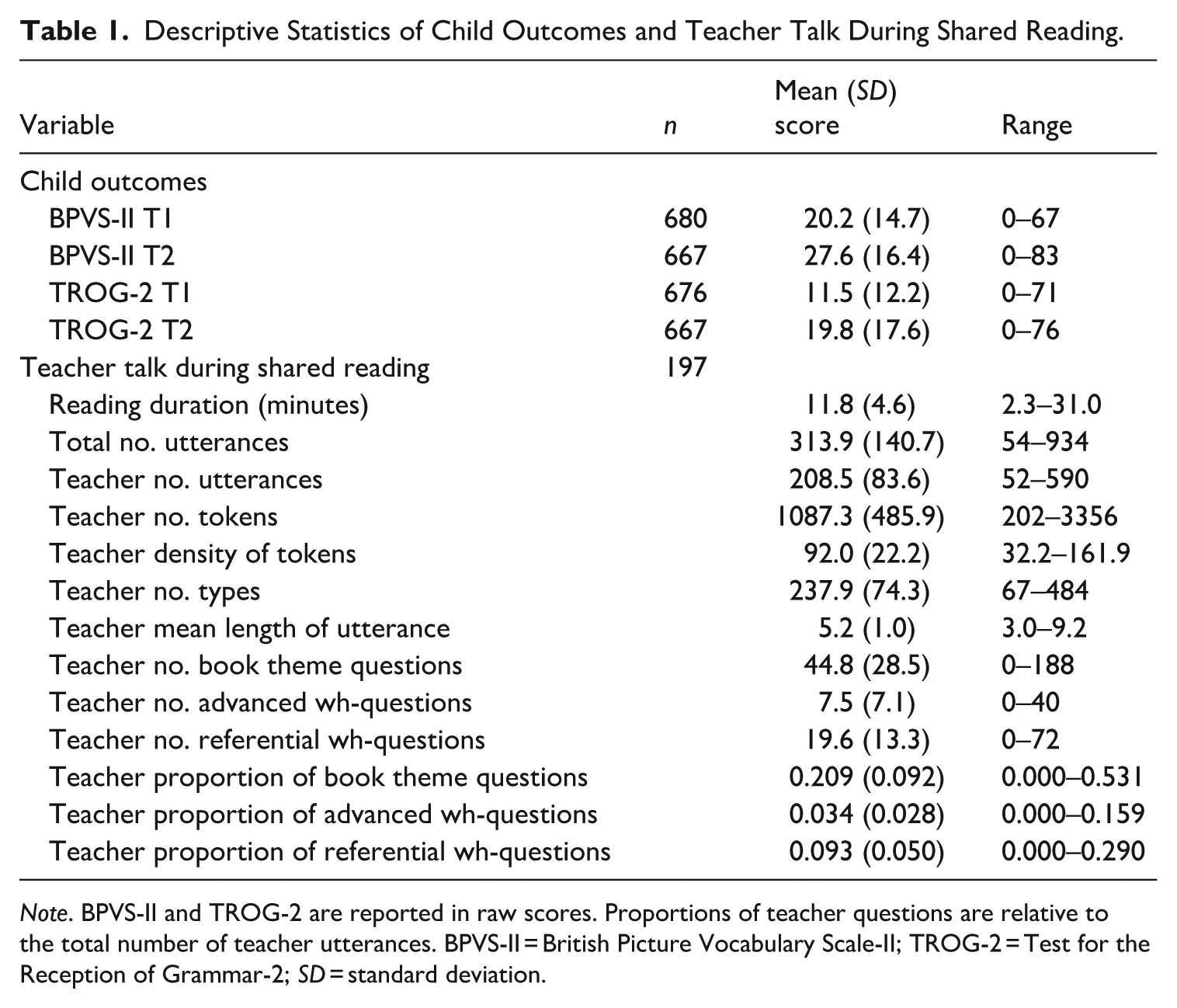
Note. BPVS-II and TROG-2 are reported in raw scores. Proportions of teacher questions are relative to the total number of teacher utterances. BPVS-II = British Picture Vocabulary Scale-II; TROG-2 = Test for the Reception of Grammar-2; SD = standard deviation.
Correlations Between Teacher Talk Variables During Shared Reading.
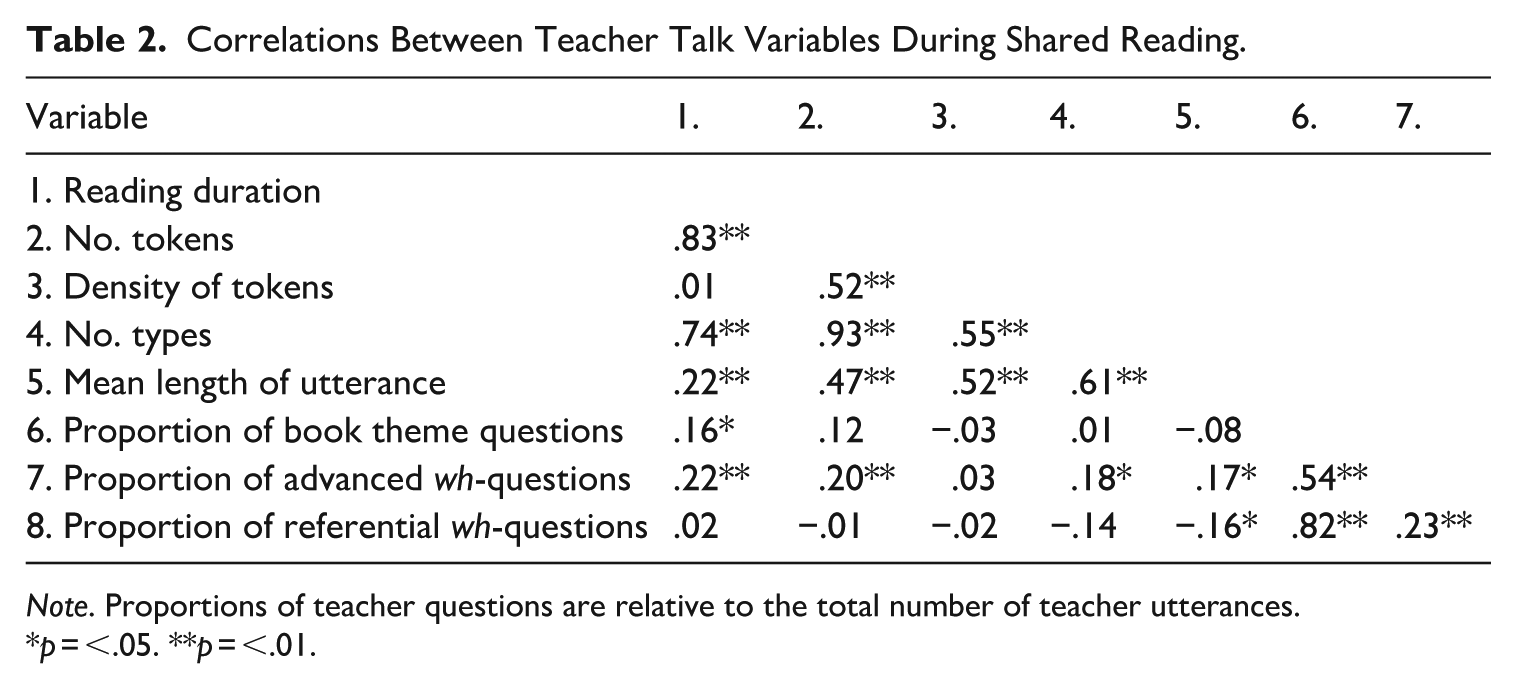
Note. Proportions of teacher questions are relative to the total number of teacher utterances.
p = <.05. **p = <.01.
In the linear mixed models, we first examined the concurrent associations between the predictors and outcomes at T1 to check whether teacher talk was influenced by the language proficiency of the child group. We found none except one significant negative concurrent relationship between proportion of referential wh-questions and TROG-2 (estimate −1.05, 95% CI [−2.06, −0.05], p = .041). Additionally, the covariates DLL status, age, and parent education were significantly associated with TROG-2 and BPVS-II in all the models, while the interaction intervention status × time showed no significant relationships. We then examined the longitudinal relationships between the predictors and outcomes, presented in Table 3. Reading duration significantly predicted increase in child BPVS-II scores over time, indicating that spending time reading might be an important quality for vocabulary development, while it predicted change in TROG-2 with borderline significance. In the following sections, we address the effect of teacher talk features beyond the reading duration.
Linear Mixed Effect Models with Estimated Effects of Teacher Talk on Child Language Development Measures.
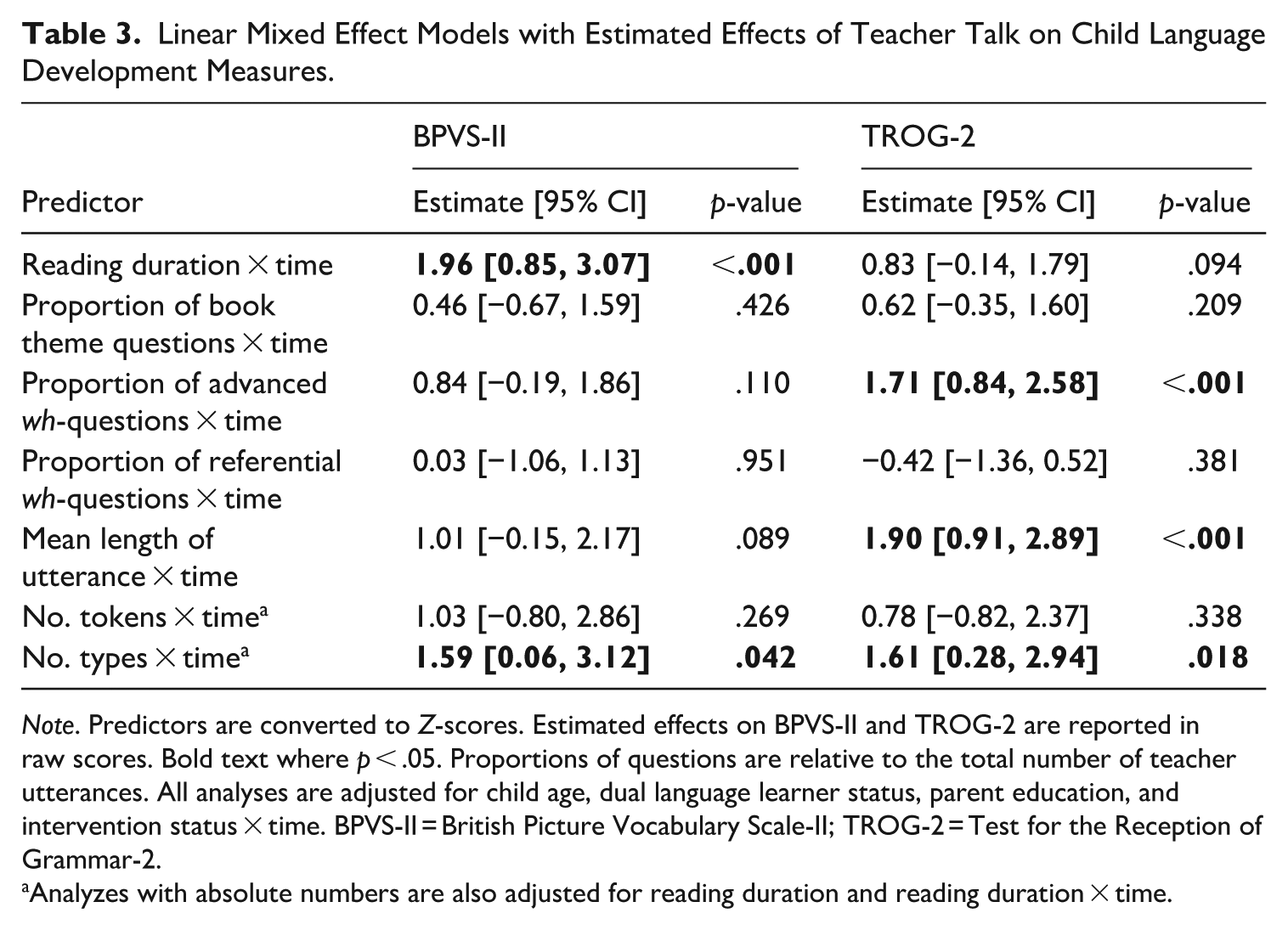
Note. Predictors are converted to Z-scores. Estimated effects on BPVS-II and TROG-2 are reported in raw scores. Bold text where p < .05. Proportions of questions are relative to the total number of teacher utterances. All analyses are adjusted for child age, dual language learner status, parent education, and intervention status × time. BPVS-II = British Picture Vocabulary Scale-II; TROG-2 = Test for the Reception of Grammar-2.
Analyzes with absolute numbers are also adjusted for reading duration and reading duration × time.
Did teacher questions predict child oral language development (RQ1)?
As seen in Table 3, the proportion of advanced wh-questions significantly predicted increase in TROG-2, suggesting that advanced wh-questions were beneficial for children’s development of syntactic comprehension. Neither the overarching category of book theme questions nor referential wh-questions were related to change in TROG-2. Book theme questions, advanced wh-questions, and referential wh-questions were not related to change in BPVS-II. In the next step of the analyses, including the three-way interactions, the results showed that no relationships were moderated by age or DLL status with p < .05.
Did teacher linguistic features predict child oral language development (RQ2)?
As also seen in Table 3, number of types and MLU significantly predicted increase in TROG-2 over time. Furthermore, number of types significantly predicted increase in BPVS-II, while MLU predicted change BPVS-II with borderline significance. This indicates that, beyond reading duration, exposure to diverse vocabulary and longer utterances may be beneficial for children’s syntactic comprehension, while exposure to diverse vocabulary may support vocabulary development. Number of tokens was not related to development in TROG-2 or BPVS-II when adjusting for reading duration, which was confirmed with density of tokens per minute.
When adding the three-way interactions, child age significantly moderated the relationship between MLU and TROG-2 (p = .032) and between the number of types and BPVS-II (p = .034). We obtained the following estimates for different ages for the effect of MLU on change in TROG-2: 0.99 (95% CI [−0.09, 2.06], p = .073) at 36 months and 2.43 ([1.12, 3.75], p < .001) at 48 months; and for the effect of types on change in BPVS-II: 0.83 ([−0.82, 2.47], p = .324) at 36 months and 2.43 ([0.65, 4.21], p = .008) at 48 months. This suggests a higher effect of longer utterances on syntactic development and diverse vocabulary on vocabulary development for older children. In addition, DLL status significantly moderated the relationship between number of types and BPVS-II (p = .012). The effect of types on change in BPVS-II was 2.93 ([1.09, 4.76], p = .002) for monolingual children and 0.17 ([−1.74, 2.07], p = .865) for DLLs, suggesting that diverse vocabulary was of higher importance for vocabulary development in monolingual than DLL children.
Robustness checks and additional analyses
We conducted several robustness checks which confirmed our main results. A description of these is provided in section ‘Robustness Checks’ in Supplemental Material. We also explored models where we included the teacher talk predictors (proportion of advanced wh-questions, proportion of referential wh-questions, MLU, number of tokens, and number of types) simultaneously (similar to Kane et al., 2023). The results, provided in Supplemental Table S2, showed that the number of types emerged as the only significant predictor for BPVS-II, while proportion of advanced wh-questions emerged as the only significant predictor for TROG-2. Finally, we explored models using absolute numbers of teacher talk features without adjusting for talkativeness or reading duration. This revealed more significant positive relationships, reported in Supplemental Table S3. We then used absolute numbers of teacher questions while adjusting for reading duration, which confirmed the main findings.
Discussion
The aim of this study was to investigate the relationship between features of teacher talk during shared reading and child oral language development in diverse ECEC settings and whether potential relationships are influenced by child characteristics. The study revealed the following main findings: (a) teachers’ advanced wh-questions predicted children’s development of syntactic comprehension regardless of their age and DLL status; and (b) teacher vocabulary diversity predicted children’s development of vocabulary and syntactic comprehension, while teacher utterance length predicted children’s development of syntactic comprehension, with some of these relationships being moderated by child age and DLL status.
The main finding of this study suggests that teachers can significantly promote the development of syntactic comprehension in diverse groups of children by asking advanced questions that are open-ended and cognitively challenging. This finding aligns with previous studies reporting positive effects of teacher open-ended questioning, measured as both higher-challenge questions (Gonzalez et al., 2014) and broader language-eliciting practices (Cabell et al., 2015; Justice et al., 2018; Kane et al., 2023), on children’s vocabulary development. Our results add to these studies by investigating specific question types on language outcomes beyond vocabulary in a diverse sample of children. Similar to previous findings (Justice et al., 2018; Kane et al., 2023), teachers’ advanced questioning emerged as the only significant predictor of children’s syntactic development when investigated simultaneously with other teacher talk features, underlining the importance of employing elicitation practices to engage children in conversations.
Unexpectedly, the results did not replicate the positive relationship between teacher open-ended questions and child vocabulary development reported in prior studies (Cabell et al., 2015; Gonzalez et al., 2014; Justice et al., 2018; Kane et al., 2023). These null findings, which have also emerged in other studies (Hindman et al., 2019; Zucker et al., 2010), can arise for various reasons. Our ability to identify potential connections might have been restricted by only assessing children’s receptive vocabulary, as most prior studies have included measures of expressive vocabulary. For instance, Kane et al. (2023) observed that teachers’ elicitation practices were uniquely associated with children’s expressive but not receptive vocabulary. Since open-ended questions tend to elicit longer and more complex verbal responses from children (Deshmukh et al., 2019; Rowe et al., 2017), they may serve as opportunities for children to practice word production, thus fostering expressive vocabulary. Additionally, Gonzalez et al. (2014) noted that the duration, rather than the frequency, of teacher advanced questioning was positively associated to children’s receptive vocabulary, hypothesizing that extended questioning may promote deeper processing of words, thereby supporting children’s receptive vocabulary development. Although our measure of teacher proportion of advanced wh-questions may elicit discussions and explanations about the events in the book which, in turn, help children comprehend sentence structures, this effect may be less detectable through measures of children’s receptive vocabulary.
Notably, the relationship between advanced questions and syntactic comprehension was not moderated by child characteristics, suggesting that they are beneficial for children across ages and language backgrounds. By including children from the age of 2 with diverse language backgrounds, this finding further expands the results of Gonzalez et al. (2014), who found that the positive effect of teachers’ higher-level questioning on 4-year-olds’ vocabulary did not depend on their skill level. Although we expected child age and DLL status to have a moderating effect in our sample as advanced wh-questions are cognitively demanding, teachers might be sufficiently tuned into individual children’s zones of proximal development and adjust their questions accordingly, making them challenging but not too difficult. While similar studies of wh-questions have been conducted in parent-child dyads (Buckalew et al., 2024; Luo et al., 2022; Rowe et al., 2017; Rydland & Grøver, 2023; Tompkins et al., 2017), this study contributes to knowledge about effective strategies in ECEC. The categorization of advanced and referential wh-questions, with additional coding of what-questions, provided valuable insights into specific types of teacher questions based on their form. Although some types of questions—for example, ‘What is happening here?’—may elicit both elaborate and referential answers, we coded them as advanced since the choice of response lies with the children and our sample was young. This categorization differentiates this study from others focusing on teacher why- and how-questions (e.g., Deshmukh et al., 2019).
Regarding teacher linguistic features, the findings indicate that using longer utterances and diverse vocabulary supports children’s development of vocabulary and syntactic comprehension, thereby confirming prior studies of child vocabulary development in diverse ECEC settings (Grøver Aukrust & Rydland, 2011; Grøver et al., 2022; Sun & Verspoor, 2022) and extending these by also including a measure of syntactic comprehension. Furthermore, corroborating studies of parents’ linguistic features (Anderson et al., 2021; Coffey et al., 2022; Rowe, 2012), the results suggested that diverse vocabulary and complex utterances are of greater importance for older children than younger children. In line with the concept of children’s zones of proximal development (Rowe & Snow, 2020; Vygotsky, 1978), this distinction implies that older children, being in more advanced stages of language development, may need more sophisticated linguistic forms offered by teachers to further develop their language.
Although there were no observed differences in the effects of teacher utterance length and vocabulary diversity on the development of syntactic comprehension for monolingual and DLL children, the results suggested that a diverse vocabulary did not benefit DLLs’ vocabulary development to the same extent as their monolingual peers. This aligns with the findings of Bowers and Vasilyeva (2011), who also measured the total number of teacher word types. However, studies employing alternative measures of vocabulary diversity, such as more exclusive measures of low-frequency words, suggest that exposure to a certain level of complex and sophisticated input can support DLLs’ vocabulary acquisition (Grøver Aukrust & Rydland, 2011; Grøver et al., 2022; Sun & Verspoor, 2022). Taken together, these findings might indicate that rather than relying solely on a wide range of word types, some DLLs may benefit more from instructional strategies that provide multiple exposures to words in meaningful contexts to build their vocabulary. Moreover, the use of a textless book in this study may have provided teachers with less structure and linguistic support compared to a book with text, possibly affecting DLLs’ ability to benefit from diverse vocabulary. For instance, Mathers et al. (2024) found that although books with text elicited less inferential talk in parents, they also elicited more labels, definitions, and explanations compared to textless books. The authors hypothesized that this was due to the vocabulary scaffold provided to parents by the text in the book.
In interpreting the findings, it is important to recognize that teacher talk is plausibly influenced by shared reading as the context of the interactions (Dickinson et al., 2014; Mathers et al., 2024). Within this context, teacher talk is intertwined in conversations that unfold over time, and our results suggest that reading duration is related to children’s vocabulary development. Extended reading durations may be linked to more opportunities for back-and-forth conversational turns, which have been positively associated with children’s vocabulary skills (Duncan et al., 2020). While research on the effects of reading duration is limited, some studies of ECEC classrooms underscore the importance of extended teacher talk during shared reading (Gonzalez et al., 2014) and allocating time for meaning-focused activities (Connor et al., 2006). Furthermore, teacher talk can be influenced by child talk (Justice et al., 2013), although Girolametto and Weitzman (2002) noted that group-directed teacher talk may not be very sensitive to variation in children’s expressive language abilities. This is possibly reflected in our study, which found few concurrent associations between teacher talk and child language at the onset of the study. Still, teachers tended to use more referential wh-questions when interacting with groups of children who exhibited lower syntactic comprehension skills. This may indicate that teachers ask for specific pieces of information and labeling when children’s language proficiency is lower.
Our findings provide valuable insights given that recent studies have reported negligible effects of teachers’ societal language support on DLLs development in the target language (Hansen et al., 2023; Partika et al., 2021). These studies have led researchers to propose that the support may not be sufficiently linguistically sensitive or may be less critical compared to support for DLLs’ home language. However, the positive effects of teacher advanced questions, utterance length, and vocabulary diversity on children’s oral language development in this study indicate that qualities of teacher talk in the societal language is of importance for both DLLs and their monolingual peers. While global measures of classroom quality may not adequately index more proximal processes (Justice et al., 2018), our results suggest that observing teacher linguistic input during a language-supportive activity such as shared reading provides a valuable indicator of interaction quality. Interestingly, we observed these relationships in an ECEC context that emphasizes free play and peer interactions (Ministry of Education and Research, 2017), which may lead to fewer teacher-led conversations throughout the day compared to other ECEC contexts. In many Norwegian ECEC classrooms, language-supportive practices are not systematically implemented (Oxford Research, 2018), and shared reading occurs relatively infrequent (Hagen, 2018). Still, the predictive value of teacher talk during such confined activities was confirmed with a large and diverse sample in this study. The quality and duration of these reading interactions may reflect teachers’ experience with book sharing in the classroom, thus contributing to children’s language development over time.
Limitations and future directions
The current study has certain limitations. First, even though this study investigated teachers’ contributions to teacher–child interactions, the relationship between teacher talk and child language can be bidirectional (Justice et al., 2013); teacher talk could support child language, while children’s skill level could also lead teachers to appropriately adapt their talk. Although the results suggested few concurrent associations between teacher talk features and child outcomes, future research should further investigate this bidirectionality by looking closer at individual children’s participation in the conversation. Moreover, future studies examining the relationship between teacher talk and children’s oral language development should include measures of both expressive and receptive language skills.
While we focused on capturing some central dimensions of teacher talk quality, there might be other dimensions that foster children’s language development, such as conceptually supportive features (Hadley et al., 2023; Rowe & Snow, 2020) or the duration of teacher talk features (e.g., Gonzalez et al., 2014). Additionally, some of the quality dimensions included in this study were related to each other and may be related to other dimensions. Future studies should explore other quality dimensions and potential profiles of teacher talk quality in diverse ECEC settings.
Furthermore, this study included a young and heterogeneous sample, which may introduce variations in oral language proficiency—particularly among DLLs—that were not fully captured by the measures employed. While we focused on children’s development in the societal language, it is a limitation that we did not include measures of DLLs’ first language. It would be valuable to investigate how teacher talk relates to dual language development. Additionally, we applied a coarse dichotomous categorization of DLL status. Given the heterogeneity of our sample, with DLLs representing over 50 different languages, there might be moderating effects of DLL status we did not capture. Due to this heterogeneity, other dynamics of conversations may emerge in settings where children are more similar in language skills and the same languages are spoken by the teacher and children.
Finally, this study was part of a larger intervention study, of which both the intervention and control groups were included to increase the sample size. Although we adjusted for intervention status during the study period, there may have been confounding intervention effects we were not able to control for.
Conclusions
Teachers are faced with the difficult task of supporting the language development of diverse groups of children, each with unique abilities and needs. To elucidate effective strategies, this study investigated the interplay among the qualities of teacher talk during small-group shared readings, child oral language development, and individual child characteristics. Our findings suggest that teachers can significantly promote children’s oral language development by posing questions that invite children to provide elaborate answers and by gradually using more complex utterances and diverse vocabulary as children grow older. Importantly, these relationships were observed over a relatively short period in a highly heterogeneous sample.
These findings hold significant implications for teacher practice and professional development, emphasizing the importance of employing strategies that elicit children’s participation and activate thinking from a young age and irrespective of their language background. By integrating such strategies into ECEC settings, teachers can better support the oral language development of all their students, thereby fostering inclusive and effective learning environments.
Supplemental Material
sj-docx-1-fla-10.1177_01427237251377897 – Supplemental material for Does Teacher Talk During Shared Reading Predict Child Oral Language Development in Diverse ECEC Settings?
Supplemental material, sj-docx-1-fla-10.1177_01427237251377897 for Does Teacher Talk During Shared Reading Predict Child Oral Language Development in Diverse ECEC Settings? by Tone Sofie Røsholt Ovati, Veslemøy Rydland, Ratib Lekhal, Stian Lydersen and Vibeke Grøver in First Language
Footnotes
Acknowledgements
The authors wish to thank the teachers and children who participated in The Oslo Early Education Study. We also thank the research assistants and collaborators from the Center for Science Education and the Pedagogical-Psychological Counseling Service who participated in the data collection. The authors acknowledge to have received editing assistance from a third-party.

Ethical considerations
This study was approved by the Norwegian Agency for Shared Services in Education and Research (approval no. 564726) on April 4, 2021.
Consent to participate
All participants provided written consent forms.
Author contributions
Funding
The authors disclosed receipt of the following financial support for the research, authorship, and/or publication of this article: The authors declare financial support was received from the Research Council of Norway, under grant number 320258.
Declaration of conflicting interests
The authors declared no potential conflicts of interest with respect to the research, authorship, and/or publication of this article.
Data availability statement
The datasets presented in this article are not readily available because of concerns regarding participant anonymity. Requests to access the datasets should be directed to the corresponding author.
Supplemental material
Supplemental material for this article is available online.
Notes
References
Supplementary Material
Please find the following supplemental material available below.
For Open Access articles published under a Creative Commons License, all supplemental material carries the same license as the article it is associated with.
For non-Open Access articles published, all supplemental material carries a non-exclusive license, and permission requests for re-use of supplemental material or any part of supplemental material shall be sent directly to the copyright owner as specified in the copyright notice associated with the article.
