



Abstract
Scholars have long sought to impact management practice. However, the current conceptualization of impact is grounded in dualisms, separating researchers from managers, means from ends, and thought from action. Such a dualistic understanding of impact hampers researchers’ and managers’ ability to achieve impact. Nowhere is this issue more acute than in the context of grand challenges, which require researchers and managers to work together closely. As a way forward, we propose a pragmatist perspective on impact, where impact is not seen as a one-time, unidirectional event, but rather as a relational and recursive process. By overcoming dualisms in traditional approaches to impact, pragmatist impacting can help advance progress on grand challenges and our current understanding of co-creation. In this article, we illustrate pragmatist impacting and reflect on its opportunities and challenges through our experience at Innovation North, an innovation laboratory that brought together researchers and managers to co-create a systems innovation process.
Climate change, biodiversity loss, and public health issues have reached crisis proportions, affecting organizations, society, and the planet. In response, researchers seek to impact management practice (Williams and Whiteman, 2021) to tackle these and other grand challenges (Wickert et al., 2021), which we define as urgent, complex, and significant issues that are wreaking havoc on social, environmental, and economic systems (Banks et al., 2016).
However, the impact of prior research on grand challenges may have been hampered, in part, because of how impact has been conceptualized. Specifically, existing approaches to research are deeply rooted in dualisms, which divide research and its impact on managers into opposing elements (Farjoun, 2010), resulting in divisions such as researcher versus manager, means versus ends, and thought versus action. Dualisms are especially pernicious in the context of grand challenges because they motivate researchers to select only those activities that they believe to be impactful when the activities that are needed to tackle grand challenges are those in which impact may be harder to foresee, measure, and attribute.
In this article, we ask: How can researchers reconceptualize impact to overcome dualisms and, thus, more effectively tackle grand challenges? To answer this question, we draw on the philosophy of pragmatism (e.g. Dewey, 1938; Follett, 1942; Mead, 1934; Peirce, 1877), which challenges the dualisms inherent in more traditional approaches to impact. Pragmatism offers a processual, relational, and recursive approach to scholarship. It asks researchers to shift their perspective from the outcome of impact to the process of impacting. In doing so, the boundaries between research and practice become less distinct, which is critical in tackling the urgent, dynamic, and critical issues confronting humanity.
We illustrate this pragmatist impacting through our work with the Lab at Innovation North, which is situated at the Ivey Business School at Western University (London, Canada). The Lab comprises a team of management researchers and a set of “practice partners” who seek to apply systems thinking to corporate innovation challenges. In this Lab, we operationalize some of the principles of pragmatism. Our aim is to recognize both the opportunities and challenges associated with such an endeavor.
We make a few noteworthy contributions in this article. A pragmatist approach to impacting extends traditional views that conceptualize impact as unidirectional by proposing a more bilateral and inclusive form of impact. Furthermore, it broadens the concept of impact from grandiose events to a process that evolves over time, transforming a singular impact event with predefined measurable outcomes into an ongoing process of impacting. Finally, pragmatist impacting advances prior approaches by suggesting that impacting requires experimenting with ideas in practice to see what does and does not work. We argue that this pragmatist approach to impacting puts researchers and managers in a better position to tackle grand challenges more effectively.
Traditional approaches to impact foster dualisms
The concept of impact is deeply rooted in fundamental dualisms, a particular belief system that divides the world into two opposing or contrasting elements such as mind-body, micro-macro, structure-agency, and change-stability. The dualistic view presupposes a clear-cut contrast, precisely defined boundary, and mutual exclusivity between the two categories (Farjoun et al., 2015; Simpson, 2017).
While such distinctions provide conceptual clarity and simplicity, they reduce complex issues into independent categories, missing a holistic perspective (Tsoukas and Dooley, 2011; Whitford, 2002). Human action, however, often transcends boundaries imposed by the dualistic thinking that splits thinking from acting (e.g. Joas, 1996; Paul, 2021). Consequently, scholars have come to view dualisms as a major shortcoming in contemporary social theory (Joas, 1996; Kilpinen, 1998; Knights and Mueller, 2004). We describe three important dualisms implicit in the current conceptualizations of impact in the literature—researcher–manager, means–ends, and thought–action—and explain how they inhibit impact.
Researcher-manager dualism
The first dualism separates researchers from managers. Many studies on research impact strongly emphasize the “Great Divide” (Rynes et al., 2001) between researchers and managers (Bartunek and Rynes, 2014; Kondrat, 1992), which many argued could be bridged by translating research insights for practice (Shapiro et al., 2007).
Researchers play marginal roles in shaping management practices (Barley et al., 1988; Fincham and Clark, 2009; Gibson and Tesone, 2001; Spell, 2001) because research and practice represent two vastly different worlds with their own distinct institutional logics (Kieser and Leiner, 2009) and approaches to knowledge (Van de Ven and Johnson, 2006). For instance, researchers aim for rigor while managers ask for relevance (Carlsen et al., 2014); researchers value generalizable, descriptive knowledge, while managers favor context-specific, prescriptive advice (Kondrat, 1995; Sharma and Bansal, 2020); researchers are incentivized to produce knowledge, while for managers, knowledge is only valuable when it is applied in their world (Kelemen and Bansal, 2002). Moreover, researchers have relatively long timeframes in their pursuit of knowledge, while managers have much shorter time horizons for decision-making (Bartunek et al., 2003; Bartunek and Rynes, 2014).
Such a dualistic understanding of the researcher–manager relationship has contributed to researchers adopting a self-centered point of view, conceptualizing impact as a unidirectional process where knowledge flows from researchers to managers. Managers are often seen as passive consumers of knowledge without the requirement to participate actively in producing knowledge.
Means-ends dualism
A second dualism is the divide between means and ends. The traditional approach in researcher–manager collaborations typically begins with defining a problem (i.e. ends), and then proceeds to find a solution (i.e. means). By clearly separating means from ends, impact is seen as a predefined outcome achieved through appropriate means. It is assumed that impact lies in producing an “output,” which involves repackaging research findings into a language and through a medium that is accessible to managers (Pfeffer and Sutton, 2000; Spencer, 2001).
However, the approach is critiqued for its “if you build it, they will come” assumption (Bansal et al., 2012; Mohrman, Gibson, and Mohrman et al., 2001). In addition, such an approach turns our gaze toward metrics, such as the number of downloads or mentions in the media (e.g. Aguinis et al., 2014), which are, at best, incomplete indicators of impact. Such an outcome-based conceptualization also fails to acknowledge the dynamic interplay between problems and solutions. The notion of co-evolution, as highlighted by Dorst and Cross (2001), suggests that problems and solutions are not static and distinct entities but are tightly intertwined and shaped by each other over time.
Thought-action dualism
The last dualism separates thought from action. By upholding this separation, previous studies implicitly suggest that researchers are primarily responsible for thinking, such as through theorizing, while managers are tasked with acting and implementing. Furthermore, there is a prevailing belief that changes in thinking should precede changes in action (Tsoukas and Chia, 2002). Therefore, thinking is not only distinct but often considered a prerequisite for action.
Even progressive perspectives to impact divide thinking from acting. For example, Lewin (1946) referred to a “spiral of steps,” in which each step has a distinct role: planning, action, and evaluation (p. 38). Similarly, Coghlan (2011) characterized research impact as encompassing “repeated cycles of problem identification, planning, taking action, and evaluation” (p. 57).
However, this approach tends to limit knowledge to one side (Rhodes and Carlsen, 2018), with researchers often acting as on-lookers while managers as implementers. There is still relatively little discussion about how researchers can act together with managers and how managers can theorize with researchers.
Why the traditional approach to impact fails grand challenges
The persistence of such a dualistic approach to impact becomes especially problematic when dealing with grand challenges. Grand challenges are “formulations of global problems that can be plausibly addressed through coordinated and collaborative effort.” (George et al., 2016: 1880). They are (1) interdependent and complex, so they manifest especially in modern, globally connected societies, making it difficult to pinpoint their root causes (Ferraro et al., 2015; Liu et al., 2015), (2) collective, so their impacts extend beyond the boundaries of a single organization or community and thus can only be effectively addressed through coordinated and collaborative efforts (Colquitt and George, 2011; George et al., 2016), and (3) significant and urgent (George et al., 2016; Seelos et al., 2023), so they greatly affect human welfare and demand immediate action. These grand challenges, by nature, defy the dualisms still implicit in the traditional conceptualization of impact.
First, the traditional conceptualization of impact has delineated distinct roles for researchers and managers, implicitly assuming impact as a one-way process in which researchers drive changes in practice. This approach confers authority upon researchers, presuming they singularly have the expertise. However, such a clear separation between researchers and managers becomes problematic when addressing complex grand challenges. These grand challenges involve interactions across domains, locations, and time frames (Ferraro et al., 2015; Gehman et al., 2022), necessitating diverse perspectives of multiple stakeholders (Ferraro et al., 2015).
Accordingly, grand challenges call for the dissolution of traditional boundaries and a more flexible understanding of roles (Grodal and O’Mahony, 2017; Gümüsay et al., 2022; Kroeger et al., 2022; Stjerne et al., 2022). For example, Reinecke and Ansari (2016) studied the Democratic Republic of Congo, showing how complex problems such as conflict minerals require the blurring of public and private sector boundaries. Researchers addressing grand challenges, too, should “rethink their role within society” (Gümüsay et al., 2022: 2). A role that dissolves the boundaries between research and practice, even if momentarily, such that researchers can engage more deeply with other actors.
Second, the traditional conceptualization of impact pushes both researchers and managers to predefine a goal for their collaboration and then work together to identify the means to achieve it. However, this clear separation between means and ends in conceptualizing impact becomes problematic in grand challenges, which are inherently uncertain, lack clear cause-and-effect relationships, and evolve unpredictably (Ferraro et al., 2015; Knight, 1921). One cannot predefine what impact looks like because predefined outcomes could lead to unintended consequences (Gehman et al., 2022; Sterman, 1989), just like when ethanol fuel, initially promoted as part of the solution to alleviate climate change, diverted corn from feeding people (Ferraro et al., 2015). Well-intentioned innovations can unintentionally marginalize fringe stakeholders even further (Khan et al., 2007). Microfinance institutions aiming to alleviate poverty push people further into poverty, creating additional problems, such as deteriorating mental health among borrowers (Finch and Kocieniewski, 2022). As such, research impact in the context of addressing grand challenges demands that researchers break away from the means-ends divide and embrace a more dynamic approach to impact.
Finally, the traditional notion of impact separates thought from action, implying that researchers need to fully understand a situation before managers can act in researcher–manager collaborations. However, such a division between thought and action becomes particularly concerning when tackling grand challenges. These challenges demand prompt action, yet their complexity (Ferraro et al., 2015) makes relying solely on existing knowledge impossible (Rittel and Webber, 1973).
Addressing grand challenges requires iterative actions that promote evolutionary learning through local (Mair et al., 2016) or distributed experimentation (Ferraro et al., 2015). For instance, ecologies of local efforts to reduce greenhouse gas emissions in the United States were more potent than the single, top-down approaches (Lutsey and Sperling, 2008). Experiments are crucial as COVID-19 showed us that past knowledge may not apply to unprecedented problems (Bansal et al., 2022). There is no silver bullet that solves a grand challenge once and for all, and there is no way of knowing at the outset how best to proceed. Therefore, researchers studying grand challenges need to move away from the thought-action divide and open themselves up to the emergence of insights that are “stumble(d) upon” (Wiedner and Ansari, 2017: 15) and gained while actively engaging in acting.
Toward a pragmatist turn to impact
For our theoretical grounding, we draw on classical pragmatism, associated with philosophers like Peirce, James, Dewey, Mead, Follett, and Addams to re-conceptualize the impact for grand challenges. Pragmatism offers a rich philosophy (see e.g. Bernstein, 2010; Elkjaer and Simpson, 2011; Simpson and Den Hond, 2022) in which knowledge is grounded firmly in practice: the etymology of pragmatism is from the Greek word pragma for deed or act, and prassein for “to do,” which is the same root as practices, praxis, and practical. Pragmatism is one of the important traditions from which scholars have drawn for exploring the relationship between practice and theory (see also Buch and Schatzki, 2018; Nicolini and Monteiro, 2018), and can be considered a theory of practice (Simpson, 2009).
There are a few key tenets of pragmatism that make it particularly relevant for this article: (1) pragmatist philosophy of science; (2) pragmatism as systemic, and (3) pragmatism as antidualistic. First, the pragmatist philosophy of science (e.g. Dewey, 1938; Peirce, 1877, 1878) puts problems derived from practice rather than problems derived from theory at the center. This focus on the practical has several consequences. First is the pragmatist belief in progress and emancipation (Dewey, 1939). Pragmatism is not satisfied with simply describing the status quo. Pragmatism is instead about actuating change and progressing toward a better future.
Such a stance toward actuating change yields what pragmatism highlights as the experimental nature of science (Peirce, 1877). Pragmatists described experiments as an approach to test concepts through their practical consequences (Peirce, 1878) and the importance of being open to new evidence (Shields, 2003). As such, pragmatism does not merely describe and represent reality; it highlights that we learn through experiments that change reality (e.g. Simpson and Lorino, 2016). Furthermore, as a philosophy of science, pragmatism argues for a social nature of epistemology. Individuals do not conduct research alone. Instead, researchers need to engage with other stakeholders and a wider community to deal with problematic situations (Dewey, 1925; Lorino, 2018).
Second, pragmatism is systemic. Pragmatism influenced early systems theorists (see for discussions, e.g. Barton, 1999; Britton and McCallion, 1994). Pragmatism considers the situation a central concept (e.g. Follett, 1942), which allows researchers to see a system’s interconnectedness. Situations cover vast spaces and time, drawing on remembered past, imagined future, and our explanations of the situation. Mary Parker Follett argued that we need to understand how problems are part of a wider system (Follett, 1942). Such an understanding of systems can cope with both systems’ dynamics and complexity.
Third is the antidualistic stance of pragmatism. Pragmatism critiques dualistic explanations because they are static, as they pit two forces against each other (e.g. light and dark, hot and cold, thought and action). Pragmatists were skeptical of absolutes, certainties, and claims of final truth (Dewey, 1917; Elkjaer and Simpson, 2015; Lorino, 2018). Instead, pragmatism offers an alternative in which dualisms are broken up by highlighting their interrelatedness rather than separateness, which considers the situation and the process more (Dewey, 1917). An example is Dewey’s approach to art as an experience (Dewey, 1925). Instead of reducing art to be an object with a distinct meaning, Dewey included the onlooker as an active participant in art. Art is not only in the eye of the beholder, but the beholder becomes part of the art. Throughout pragmatism, the critique of dualisms and work toward dualities is a common thread (e.g. Elkjaer and Simpson, 2011; Lorino, 2018).
From impact to (pragmatist) impacting
Pragmatism offers unique insights that recast impact in a new light. We respond to the call by Gehman et al. (2022) to deepen our understanding of impact and grand challenges by drawing on the relational, processual, and recursive aspects of pragmatism. The relational aspects highlight “where” impact occurs in changing relationships. The processual aspects highlight “what” impact is, focusing on the ever-becoming nature of impact. The recursive aspects delve into the mechanisms of “how” impact happens. These three aspects collectively transform our conceptualization of “impact” into “impact-ing”—an ongoing, recursive process in the relationships between managers, researchers, and situations.
Relational impacting through transactions in a community of inquiry
Pragmatism offers a relational perspective that describes social entities and ideas through connections and relationships rather than their intrinsic attributes (e.g. Emirbayer, 1997; Simpson, 2009). A relational perspective posits that “relations between terms or units [are] preeminently dynamic in nature, [are] unfolding, ongoing processes rather than as static ties among inert substances” (Emirbayer, 1997: 289). In other words, instead of seeing humans as individuals with independent attributes, pragmatism argues we are who we are through our relationships with those around us.
In the context of research impact, the relational ontology of pragmatism does not posit a clear-cut division between researchers and managers. While it still recognizes differences in the roles of researchers and managers, it emphasizes their complementary nature and interdependence. We argue that pragmatism’s strong focus on relationships has significant implications for reconceptualizing “where” impact occurs, prompting researchers to shift their perspective away from the separation between researchers and managers. It discourages the unidirectional targeting of others (e.g. managers) as the sole recipients of impact. Instead, relationality encourages researchers and managers to perceive relationships as collaborative spaces for impact.
From a pragmatist perspective, the relational impacting is not solely the result of “interactions,” where researchers and managers are essentially opposing entities, balanced against each other in a causal connection (Dewey and Bentley, 1949). True relational impacting necessitates “transaction,” 1 indicating a deeper level of engagement that transforms both researchers and managers. To put it differently, while interaction might imply a straightforward exchange of ideas or actions between parties, where “entities remain fixed and unchanging throughout such interaction” (Emirbayer, 1997: 235), transaction signifies an engagement that can lead to substantial changes, learning, or transformation for all parties involved. The pragmatist notion of transaction encourages us to delve deeper into the triadic relationship involving researchers, managers, and the situation.
Reconceptualizing impact as transaction becomes especially important when addressing grand challenges, which typically demand substantial and transformative solutions (Lorino, 2020). Transaction implies ontological and thus more profound changes than interactions (Dewey and Bentley, 1949; Emirbayer, 1997), a crucial aspect when dealing with complex and deeply ingrained challenges. Furthermore, addressing grand challenges requires the integration of diverse perspectives, often involving a multitude of stakeholders (Ferraro et al., 2015). The concept of transaction underscores that these interactions should be viewed as valuable opportunities for collaborative learning and personal development, transforming all parties involved. Transaction becomes particularly important when confronting challenges that transcend the comprehension of any single entity and demand interdisciplinary and cross-sectoral collaboration.
The pragmatist notion of a “community of inquiry” (Dewey, 1916) is particularly relevant to embracing a more transactional research approach. Such a community highlights that researchers and managers engage with each other on a more equal footing while maintaining different roles (e.g. Lorino et al., 2011; Wegener and Lorino, 2021). In this sense, researchers become more active in practice, while managers become more integral to the theorizing process but maintain a degree of distinction in their roles.
Three key aspects are central to a community of inquiry: dialogue, diversity, and deliberations (Shields, 2003). First, dialogue plays a pivotal role in a community by facilitating the exchange of ideas and experiences, leading to a more profound understanding of the situation, the problem, and its potential solutions (Shotter, 2008; Tsoukas, 2009). From a pragmatic standpoint, dialogue encompasses far more than just spoken words. It entails nonverbal expressions, cues, and actions, a concept elucidated by Mead’s “conversation of gestures” (Mead, 1934; Simpson, 2009, 2017). Second, while other approaches emphasize the necessity of shared interests and goals, pragmatism offers a contrary perspective, asserting that value is in diversity (Lorino, 2019). Diverse viewpoints within a community of inquiry yield valuable insights when differences are acknowledged, explored, and turned into action (Follett, 1924, 1942). Therefore, within research impact, the differences between researchers and managers are not viewed as a gap to be bridged but rather as an opportunity to enrich the potential for impact. Finally, deliberation (Dewey, 1922) is the process of what to do next through a democratic process (Dewey, 1916, 1925).
In summary, relational impacting sees impact as not just unidirectional but transforms all parties involved. This transformation includes managers and the immediate situation and extends to the researchers themselves. It recognizes that researchers are not passive observers but active participants who can also experience growth, change, and transformation as they engage in impact work. Such a two-way change is possible through a transactional approach that values dialogue, diversity, and deliberation.
Processual impacting through ends-in-view
Pragmatism is rooted in a process ontology underpinned by “an ontological commitment that views the world as constantly becoming” (Langley and Tsoukas, 2016: 4). This perspective shifts the focus from static entities that “interact” with each other to dynamic flows, movements, and emergence (Dewey and Bentley, 1949; Emirbayer, 1997; Garud et al., 2015).
In the context of research impact, we argue that process ontology allows researchers to redefine “what” impact is. A process ontology enables an understanding of impact as not a predetermined outcome but rather a process that evolves over time, emerging not just at the end of researcher–manager collaboration but throughout the journey. We recognize that such a processual conceptualization of impact is not entirely novel. A few scholars have previously advocated for a more process-driven approach to researcher–manager collaboration (e.g. Bansal and Sharma, 2021; Coghlan, 2011). However, we argue that a pragmatist perspective takes it further by transitioning from an epistemological to an ontological process (Langley and Tsoukas, 2016). This shift entails moving beyond merely understanding the process as it relates to our ways of doing research, embracing process philosophy, and taking process ontology seriously in research impact.
Process as ontology is distinct from process as epistemology. A process ontology rejects the tendency to compartmentalize means and ends. Pragmatism offers key insights on moving away from such means-ends dualism. Dewey (1933: 140) highlighted that beginning with a predefined problem is artificial, suggesting that reality does not neatly present itself as discrete problems. Instead, problems arise from troubling and perplexing situations with inherent problematic qualities that require investigation. Therefore, pragmatism suggests that fully comprehending the problem involves engaging in problematization, a process through which insights into both the problem and the solution are gained in a co-evolutionary manner. In essence, the true nature of the problem only becomes apparent once a solution has been found (Dewey, 1938).
Instead of positing final ends as telos, Dewey (1920, 1958) proposed that actors must devise actions based on more situated “ends-in-view.” These serve as loose guides for further action based on the current understanding of the situation. Ends-in-view provide just enough direction for actors to determine the appropriate next actions and observe the consequences; subsequently, these ends-in-view become the means for the next ends-in-view. This process makes inquiry proactive, creative, and intentional (Joas, 1996), as it selects actions based on combinations of means and ends-in-view, with practical consequences guiding the process (Joas, 1996; Joas and Beckert, 2002).
This processual understanding of impact significantly departs from traditional conceptualizations as it calls for focusing on impact in real time. Such a processual view would enable impact scholars to consider the emergent nature of the impact, which becomes especially critical in grand challenges, where problems are nonlinear and can reveal new concerns as they are being tackled (Ferraro et al., 2015). Impact scholars need to pay closer attention to the overall process, including how our understanding of what is impactful changes over time. Instead of achieving a predetermined goal, the focus is recognizing how problems and solutions co-evolve over time.
Recursive impacting through pragmatist experiments
Recursiveness pertains to how processes operate in a looping manner, circling back to their origins (Farjoun et al., 2015). It involves the idea of “multiple or chained influences returning over time to their instigating source” (Farjoun et al., 2015: 1800; Ansell, 2011). Recursiveness emphasizes that change and development are nonlinear processes characterized by feedback loops where the consequences of our actions inform and reshape our thoughts and practices. In turn, these modified thoughts and practices facilitate further action.
In the context of research impact, we argue that the pragmatist notion of recursiveness informs “how” impact unfolds. The emphasis on recursiveness within pragmatism underscores the intertwining of thought and action, challenging the stark separation between thought and action as dualism (see e.g. Dewey, 1929). Rather than maintaining a clear boundary, recursiveness highlights the capacity of individuals to adapt their actions and behaviors through reflective thinking while actively engaged in action (Dewey, 1922; Farjoun et al., 2015; Schön, 1983).
The division between thought and action becomes especially detrimental when tackling grand challenges. These challenges demand swift action, yet their complexity (Ferraro et al., 2015) makes it nearly impossible to rely solely on actions based on existing knowledge. One can never understand a system by just observing it (Follett, 1924). Instead, action is essential for acquiring a deeper understanding of the complexity of these challenges, particularly because of the interdependencies of the manifold relationships throughout the system.
The concept of pragmatist experiments (Ansell, 2012) offers a solution to this divide between thought and action. The pragmatist maxim is to focus on practical consequences (Peirce, 1878), in which experiments are crucial to understanding the value and validity of ideas. Pragmatist experiments are about learning what works and what does not in practice (Ansell, 2012). In positivistic experimentation often conducted in a Lab setting, the focus is on “if-then” logic, where researchers create hypotheses and design experiments to test specific linear cause-and-effect relationships. This approach is characterized by a deductive framework, where researchers predict outcomes based on established theories and then confirm or disconfirm those predictions through experimentation (Ansell, 2012).
On the contrary, pragmatist experimentations do not start with strict predictions; instead, they begin with practical situations that are in some way problematic (Gross, 2009), following Dewey’s (1925) idea that “the starting point is the actually problematic” (p. 61). This problem forces individuals to reevaluate their beliefs, theories, interpretations, and habitual actions (Dewey, 1922: 364). Pragmatist experiments take on a “what if” mind-set. Researchers and managers engage in pragmatist experiments by exploring a wide array of possibilities and scenarios (Bartel and Garud, 2009; Golden-Biddle, 2019; Mantere and Ketokivi, 2013). They formulate several competing working hypotheses, including the problem, its potential solution, the actions one should take, and the expected outcomes (Lorino, 2018). Pragmatist experiments acknowledge the complexities of real-world issues while understanding that real-world experiments may not always yield definitive or clear-cut answers (Dewey, 1938). While abduction, a form of reasoning where explanations are inferred from specific observations (Peirce, 1998), plays a crucial role, it is only part of the overall process. The working hypothesis generated through abduction requires validation or refutation through practical experiments or “what-if” scenarios tried in real-world contexts (Lorino, 2018).
An illustration of pragmatist impacting: the Lab at Innovation North
We, the authors, recognize the importance and limits of academic research in connecting with practice. As a result, we have been developing an approach to research that would engage practice deeply on issues related to grand challenges. This journey has offered a new understanding of “impact,” outlined in this paper.
We illustrate aspects of relational, processual, and recursive impacting by drawing on our experiences with Innovation North, which was housed at the Ivey Business School in Canada. It was founded by Pratima (Tima) Bansal, one of the authors, and supported by the four other authors as research team members. A primary activity of Innovation North was to form a Lab that was composed of approximately 30 organizations that included businesses, nonprofits, and government agencies. We called organizations “practice partners.” The first Lab session was in October 2019 and the last in October 2024. We use the Lab to illustrate the efforts by the research team to take a more pragmatist approach to impacting and to reflect on the challenges involved in this undertaking.
Innovation North overview
Innovation North’s objective was to apply systems thinking to corporate innovation in order to address grand challenges. Traditional approaches to corporate innovation either put internal stakeholders or the customer at the center to build the market and create economic value for the firm. They often reduce problems down into smaller, more manageable pieces and tend to look for silver bullet solutions (Bansal et al., 2022).
A systems approach, on the other hand, considers the entire system in the innovation process. We follow the perspective led by scholars such as Peter Senge (e.g. Senge, 1990) in which systems thinking is an approach that recognizes the importance of analyzing the whole system and not just its parts, and that systems are complex, dynamic, and the outcomes unpredictable.
The Lab was created on the assumption that a systems approach to innovation fosters more creativity and is more likely to generate products, services, and processes that contribute to positive societal change and generate long-term revenues for the corporation than a more traditional approach to innovation.
As a systems approach to corporate innovation is new, the researchers organizing the Lab engaged managers in a range of activities, including: (1) quarterly meetings or Lab sessions, which bring together researchers and managers, (2) the development of a new systems innovation tool, which we called the Compass, and (3) projects called “use cases” within individual businesses and organizations. We describe each activity in more detail below.
Lab sessions were quarterly meetings in which researchers and managers explore specific systems thinking and innovation topics. They generally ran over a half-day. They were conceptualized as in-person meetings, but after the second meeting, COVID-19 required they be held online. The sessions included a keynote speaker, who was generally a researcher, or a scholar-manager with expertise in the topic of the Lab session. The research team worked with the keynote speaker to design the session in a way that combines presentations with active exercises. Each partner organization could send up to three people to participate in the session. After each Lab session, the research team debriefed and reviewed their own extensive notes. This debrief informed the topics and ideas that would be included in the systems innovation tool the Lab was developing.
The Compass is a systems innovation tool that the researchers and Lab participants had been building since 2021 based on the experience from the various Lab sessions. The tool included a North Star and four spaces: problem framing, building systems awareness, ideating, and acting. The Compass has undergone multiple iterations and, at the time of writing this article, continues to be modified. Users of the tool were encouraged to iterate among the four spaces, deepening their understanding of the system through actions, and moving ever closer to the North Star. The research team ultimately developed worksheets with managers and applied to their problems to help apply the Compass with ease.
In 2022, researchers and managers started engaging in “use cases,” which are projects that applied the Compass to address an innovation problem in practice partners’ organizations. As an example, the Canadian Standards Association wanted to catalyze a circular built environment that embraced the circular economy principles of regeneration, zero waste, and minimum emissions. In another project, Co-operators Insurance worked with the research team to develop a more resilient and sustainable approach to insurance claims. Each project involved meetings, interviews, and workshops to navigate through the various parts of the Compass.
Practical consequences of the Lab
To understand the practical consequences of engagement in the Lab, the research team relied on conversations with managers and the journals, which the Lab participants filled out before and after each Lab session. At the beginning of every Lab session, managers recorded, in their individual journals, insights and data about changes they have implemented in the past three months (i.e. since the last session). They recorded changes to both organizational practices and their own thinking based on their experiences with the Lab. Some of these practical consequences are illustrated in the following excerpts from the journals:
“I . . .have been using systems thinking to explore the idealized design of a future value chain.”
“We have incorporated the process of ‘standing in other’s perspectives’ (exercise conducted in a prior Lab session) to look at problem areas.”
“We’ve created an Innovation at [name of company] working group. . .we are trying to create culture (of innovation, which is a systemic approach), not [house innovation activities in] a department!”
“Systems thinking is now a big part of our innovation process.”
“[We are] developing a systems approach to building collaborative solutions around non-reusable plastics.”
Below, we provide additional examples from the Lab to illustrate relational, processual, and recursive pragmatist impacting. Even though we describe the three aspects of impact as separate, they are deeply integrated in reality.
Enacting pragmatist impacting
Relational impacting
In describing impact as relational, we advocate that the relationship between managers and researchers be seen as reciprocal relationship. Furthermore, pragmatist impacting that is relational implies change, learning, and transformation for all actors involved, not just managers, as they engage deeply through “transactions” in a “community of inquiry” (Dewey, 1916).
One way in which Innovation North has been striving to approach relational impacting is by revisiting role boundaries between researchers and managers. Over time, researchers and managers have gradually expanded engagement beyond their traditional roles. The first Lab sessions resembled a traditional, even didactic, workshop, in which researchers were facilitators and managers were there to learn through researcher presentations and group exercises. These roles began to blur over time. Managers had become increasingly involved with the planning and structuring of the Lab.
For example, in July 2023, the research team met with a small group of managers from each organization participating in the Lab. The 90-minute meetings were organized for the research team to explain the Compass and its worksheets so that managers could understand, react, and engage with the tool to tackle innovation challenges in their organizations. Each organization sent beforehand one challenge in the form of a problem statement, and this anchored the researchers’ explanations of the worksheets. During these sessions, the research team also discussed with managers the possibility of some managers leading the next Lab session based on the innovation challenges they were working on. Three organizations volunteered to lead the October 2023 session, in which they facilitated breakout groups of other managers.
To prepare for the session with a software company in October, researchers and managers interviewed members of that organization to gain insight into the innovation problem the organization was facing. After conducting interviews separately, the research team and the managers met to share what they had learned. Following this sharing of insights, the group had an open discussion and realized the initial problem the organization was working on needed to be reframed. The company had initially framed the problem as a lack of employee engagement. After the discussion, the research team and managers concluded the problem had to do with how online work exposed issues related to forming new relationships, fixing existing ones, and building local community ties. The reframed problem shed light on issues related to the future of work, inclusion, and the company’s role as an important community actor tackling social and environmental issues.
The example above offers two illustrative insights: a shift from researchers leading the Lab sessions to managers taking on this role and researchers and managers playing similar roles in interviewing, analyzing insights, and taking actions. By so doing, they moved closer to relational impacting. Researchers and managers shared hats, including facilitators, experts, problem-solvers, consultants, and ideators. This blurring of traditional role boundaries fostered co-inquiry among researchers and managers and transformed both parties.
Processual impacting
Impact is processual when we consider the Lab’s emergent organizing and objectives. Below, we illustrate the notion of “ends-in-view” that becomes the means in the further process. Importantly, we show that ends were emergent and could not be planned fully such that the subsequent means were emergent and yielded the next ends-in-view.
When the Lab was created, we intentionally began with a broad idea of co-creating a systems-based approach to innovation, not toward a predetermined end goal, but with a general notion that many of the grand challenges arose out of a singular focus on organizational profits in the innovation process and that these grand challenges were highly systemic. We knew we needed a more systemic approach to innovation.
For the first few years, the Lab sessions and the review of the existing research helped the research team develop a new systems innovation tool. A year into the Lab, the research team started sharing versions of the Compass with the managers and asked for feedback on positive aspects and areas for improvement.
During a smaller meeting in early February 2022, however, one manager suggested that the Compass needed to be tried in practice: we’ve done a bunch of research and now we’ve got a model and a tool; [can we] now use this innovation tool, test it, and iterate it by using it and doing it to make it even better by trying to solve one or two real problems?
This was a turning point since the manager was nudging the research team to not see the Compass as an end in itself. Researchers and managers have applied the Compass to several innovation projects such as building more resilience in the built environment and increasing the circularity of building materials, a topic of concern to an insurance company participating in the Lab.
The journey of the Compass’s development illustrates impact as a process in which means and ends are not separate. The Compass, initially considered as the primary goal (i.e. end) of the Lab during its early years, evolved into a tool (i.e. means) to solve complex challenges the partner organizations are facing. At the same time, by applying the Compass to complex challenges, the research team continues to revise the tool, such that the means contribute to the outcomes of tool refinement, which becomes the next end-in-view. In other words, the Compass constantly evolved such that each version represents an ends-in-view, which is further improved through the means that follow.
Recursive impacting
In describing impact as recursive, we argued that thought and action are not linear; they happen in a looping manner. We suggested that such recursiveness of thought and action can be achieved through pragmatist experiments that researchers and managers engage in that are action-oriented and bring thinking and acting closer together. Experiments, from a pragmatist lens, can be of many forms such as thought experiments and trying ideas out in practice.
We illustrate the recursive understanding of impact with an even closer look at how the Compass has evolved. The idea of the Compass originated from our prior experience of working at the intersection of research and practice. It was clear from that experience that conceptual frameworks are limited in supporting action in organizations and systems; rather, we needed a shift from frameworks to tools. Hence, the idea of developing a Compass started to take shape.
In 2022, the Compass emerged in its current form, a circular shape comprising four core components, referred to as “spaces”: Problems, Awareness, Ideas, and Actions. “Spaces” was chosen as an alternative word that deviates from a more linear process, such as “steps” or “stages,” and thus builds recursiveness into the tool and innovation process.
As the research team started to apply the Compass to individual projects, we realized each researcher worked with the Compass components differently. For instance, the “Awareness space” in one project tackling a nature-based financial instrument consisted of a map of relationships between industries and the natural environment. However, in a project tackling sustainability challenges in the insurance industry, the “Awareness space” was a map of the flows of materials involved in home insurance and repair, not relationships. This heterogeneity in use led the research team to create worksheets to guide people through each Tool space. The initial version of the worksheets was developed in the Spring of 2023, and each worksheet had several instructions, in which the research team tried to capture all learnings from previous projects.
When the research team met with each participating organization in July 2023, we brought thinking and acting on the Compass closer together. As researchers and managers discussed the Compass, they realized that the complexity built into the worksheets had become overwhelming. Most managers were lost in engaging with the Compass, reflected in confused looks during meetings and not being sure where to start. The research team started to adapt the worksheets in real time. One meeting after the other researchers would discuss potential changes in real time with managers—illustrating reflection-in-action. The researchers would take notes, make changes to the worksheets, and start the next meeting with the new design.
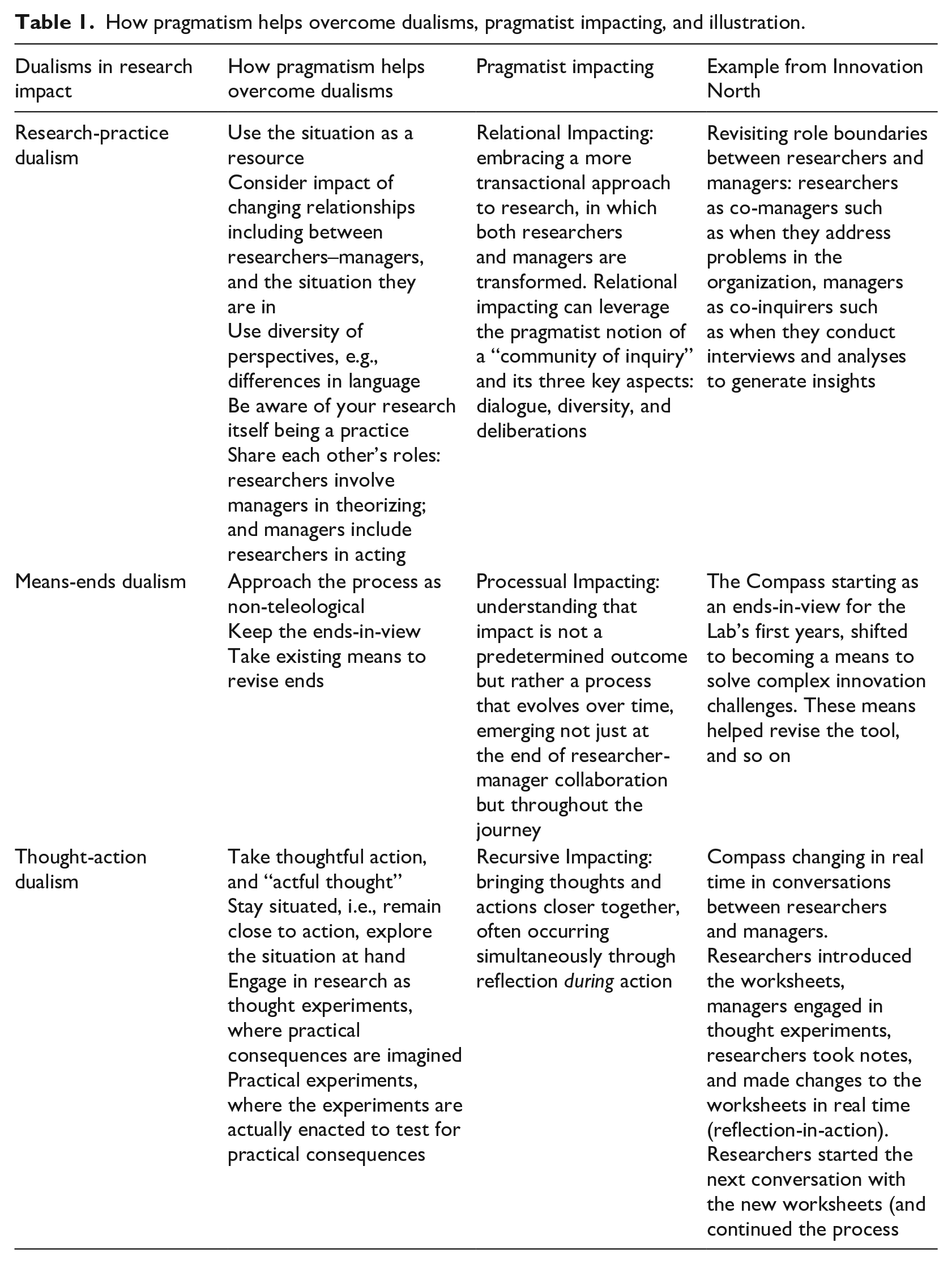
We summarize the insights from these examples in Table 1.
How pragmatism helps overcome dualisms, pragmatist impacting, and illustration.
Discussion
In this article, we challenged the way strategy and management scholarship have conceptualized research impact. We argued that the traditional understanding of impact has rested upon the dualisms between researchers and managers, means and ends, and thought and action. Such dualisms have ironically hindered researchers from realizing their ambition to have a greater impact. As a way forward, we draw on classical pragmatism to offer the notion of pragmatist impacting. Pragmatist impacting holds important implications for scholars interested in research impact broadly.
By moving from impact as a distinct, unidirectional event at a specific point in time, to impacting as an emergent relational process, we advocate for a reconceptualization of impact as an ongoing process of becoming. We propose that the very nature of the word “impact” may hamper our ability to create the very thing that researchers desire. We need to change, then, not just what we do, but the process of how we do it and engage more deeply with the processual nature of impacting itself.
Contributions and implications of pragmatist impacting
Our article makes a few important contributions toward the understanding of research impact, particularly in the context of more recent literature on co-creation which represents a more active form of impact that involves managers directly in the research (Bartunek, 2007; Sharma and Bansal, 2020, 2023; Van de Ven, Angle, and Poole, 2000).
In theorizing a view of impact that is relational, we propose moving beyond a unidirectional view of impact, which recognizes that researchers are not only creators of impact but also recipients of it. In so doing, we extend past the argument for collective inquiry and the importance of dialogue in the existing work on impact and co-creation (Beech et al., 2010). We argue that in relationality, researchers’ “transactions” with managers and other co-inquirers are not only shaped by researchers but also shape researchers.
This insight has important implications for scholars interested in co-creating knowledge with managers. Prior research on co-creation starts from a place of separation such that researchers and managers are described as situated in different knowledge worlds, or what paradox theory calls different poles of a contradiction (Bartunek and Rynes, 2014; Smith and Lewis, 2011). Scholars describe the (micro) practices (Parola et al., 2022; Sharma and Bansal, 2020) that help navigate these tensions and move the research-practice collaboration toward impact. Implicit in this focus is that researchers and their research, target managers and their practice, yielding questions such as whether managers care as much about research impact as we do, or are researchers, in the guise of impact simply telling managers what to do (Bartunek and Rynes, 2014). Practically, relational impacting eschews such a view. Theoretically, in claiming that researchers and managers change their practice, we posit that both poles of the tension can change. This contrasts a paradox perspective that takes a static view of the opposing poles. This insight opens new possibilities for researchers to explore the deep relationality in the processes of co-creating.
Second, theorizing pragmatist impacting as processual helps us realize that impact emerges over time and need not be driven by a grand and final goal. Traditionally, impact has been defined as quantifiable and measurable changes in predefined outcomes. Admittedly, more recent studies on co-creation have taken a step in the right direction by advocating for a more process-driven approach to impact. They describe impact as not only the material outcomes of the project but also changes in how researchers and managers involved in such projects understand each other (Bansal and Sharma, 2021; Chen et al., 2023), often leading to potential reframing of the problem (Coghlan, 2011). However, even though this co-creation approach to impact is more process-oriented than the traditional approach, they still tend to compartmentalize means and ends. Even in co-creation, the process typically begins with defining (framing and reframing) a problem (i.e. ends) and then proceeds to find a solution (i.e. means) that most effectively addresses the problem.
In pragmatist impacting, impact is not merely a static endpoint but a dynamic process. By advocating for ends-in-view (Dewey, 1922), we align with the insight that in co-creation, problem definitions evolve over time, subsequently shaping solutions (e.g. Chen et al., 2023; Slawinski et al., 2023). Pragmatist impacting goes beyond co-creation literature as it argues against defining problems or solutions upfront or at specific points in time. Instead, it proposes a view in which both problems and solutions co-evolve and shape each other as we learn more about the situation.
Thus, impact extends beyond grandiose outcomes to encompass the significance of small actions and decisions made along the way. While less noticeable initially, small wins accumulate over time and allow for a broader perspective and more complex actions that align with ongoing learning (Weick, 1984). In addition, such a mundane view of impact invites co-creation researchers to consider tensions in research-practice collaborations. In so doing, we complement the calls to not only look at tensions that are debilitating (Lewis, 2000) but also look at tensions as the “unremarkable everyday of actors getting on with their work” (Lê and Bednarek, 2017: 8). Such a mundane view of impact encourages researchers to celebrate each small win in their quest toward impact, and hence continue doing the work of impact.
Finally, recursive impacting enables researchers to join managers in solving problems, thereby advancing progress in addressing grand challenges. Although grand challenges demand swift and adaptive responses, researchers tend to isolate themselves from the practical world, building metaphorical “Ivory Towers” (Gray, 2023). They do so because academia criticizes change orientation as activism which is considered outside the purview of research: “don’t confuse your academic obligations with the obligation to save the world; that’s not your job as an academic . . . [O]ur job is not to change the world, but to interpret it” (Fish, 2004).
Co-creation scholars have railed against this approach to impact since the knowledge created may ultimately not be relevant to practical action. In action research (Coghlan, 2011), for example, researchers collaborate with managers on projects that often involve cycles of action and reflection to tackle real-world problems. This approach sees actions as “laboratory and field experiments in social change” (Lewin, 1946: 36) or “change experiments on real problems in social systems” (Coghlan, 2011: 56–57). Van de Ven (2007) describes the pivotal role of action in engaged scholarship, and Bansal and Sharma et al. (2022) advocate for managers and researchers to jointly design “low-risk, low-effort experiments” (p. 355) to gain insights from the practical application of ideas.
We build on this recent development in conceptualizing recursive impacting. We offer the notion of pragmatist experimentation (see also Ansell, 2012; Wicks and Freeman, 1998) which does not sacrifice rigorous theorizing for action. In fact, pragmatist experimentation makes clear the inseparability of the thought and action. In pragmatist experimentation, the validity of ideas is established through testing their practical consequences (see also Worren et al., 2002), as exemplified in the illustration of Innovation North. It represents the fusion of thought and action, where thinking while acting adapts actions, and action while thinking informs thought.
Recursive impacting offers valuable insights for reevaluating the separation of thought and action in research impact. It responds to recent calls that question the split between theory and impact (Reinecke et al., 2022). Recursive impacting implies that interventions (actions) can help researchers theorize by interrogating past insights based on new experience instead of always theory (thought) dictating interventions and action (e.g. Weick, 1999). There is a momentum building around such theorizing (e.g. see “prescriptive theorizing” by Hanisch, 2024), and the concept of recursive impacting offers the handholds for doing such theorizing.
Challenges of pragmatist impacting
Researchers pursuing a pragmatist approach to impacting will inevitably encounter a number of challenges in their impact journeys. The most immediate and obvious challenge for researchers is that the current academic system does not incentivize a pragmatist approach to impacting. The prevailing systems, especially in academia, demand that impact be clearly measurable and attributable. For instance, researchers are typically required to define the expected outcomes and the research approach prior to being granted funding. This approach does not allow impact to emerge in a relational, processual, and recursive manner. Researchers are often asked to predefine measures of impact through numbers, which inhibits the researchers’ ability to foster pragmatist impacting that allows for the emergence of what is impactful throughout the process. For managers, there is a similar pressure for results, and in many cases, with a short-term orientation. Of the partners who left the Lab, most departed because the executives were expecting concrete, demonstrable results in a short period of time.
Another significant challenge inherent in pragmatist impacting is associated with its relational nature. In an ideal world, with this new approach to impact, both researchers and managers would meet as equals to collaborate in a dialogue of co-production and solve a shared problem. However, researchers often still need to take the primary initiative. In our example of the Lab, researchers still took the lead in establishing the Lab and inviting managers to participate. At the time, many managers did not see the issue with their innovation process being exclusively focused on firm-level outcomes, nor did they understand the work of researchers to see us as a potential facilitator of building a new process. Over time, the dynamic has changed, and managers also initiate ideas and projects to work on with the research team, but this shift needed significant time and effort.
Pragmatist impacting also requires openness and trust between researchers and managers. In a pragmatist approach, such trust emerges through long-term engagement between researchers and managers. Pragmatist impacting is not an act performed independently by researchers but rather a dance where both parties engage in a constant exchange, responding to each other’s movements and cues over time. Therefore, pragmatist impacting requires a willingness to embrace change among managers, which is hard and increasingly harder as time and attention become increasingly short among managers.
A further challenge of pragmatist impact is the vice and virtue of diversity. On the one hand, a diverse group of participants, such as several executives from a variety of industries and several researchers at different stages in their careers, enriches the impact journey. On the other hand, diversity can be a challenge as different perspectives, interests, and language differences can generate tension (Jarzabkowski et al., 2023), and hinder integration and the development of win-win situations. The endeavor is thus to interweave the different perspectives and experiences into a meaningful integration of diversity (Follett, 1924).
Finally, the experimental nature of pragmatist impacting involves a high degree of uncertainty. It requires that all knowledge remains open to challenge and viewed as inherently fallible. Pragmatism asserts that everything should remain susceptible to potential doubt. It requires a willingness to subject our ideas to empirical scrutiny and testing. This can be quite unsettling and disconcerting for both researchers and managers as it entails acting on ideas that may not be entirely certain, and it also requires embracing the inherent risk of potential failure.
Conclusion
The growing desire for impact has spawned special issues in journals (including this one for Strategic Organization), research programs, administrative positions (e.g. Associate Dean of Business + Impact at the Ross Business School, University of Michigan), and assessment exercises associated with faculty promotions and funding (e.g. the UK’s 2014 Research Excellence Framework). There is an impact movement within business schools, and nowhere is it more obvious than among researchers of grand challenges.
Although we strongly support the impact movement, we question the word itself and have advocated its reconceptualization. “Impact” has raised the stakes for achieving measurable outcomes and sparked actions that may undermine the ambition of the members of the movement. This paper is a call to the management research community to engage managers in their research and not simply seek to “impact” them. Drawing from the philosophy of pragmatism and our own experiences within Innovation North, we offered a new approach to impact—one that is more inclusive, continuous, and ongoing: pragmatist impacting.
What we have shared in this article with the Lab offers only a humble step forward. We invite researchers to join us on this journey of embracing pragmatist impacting. And, in no place does it feel more important and urgent than in the pursuit of tackling grand challenges.
Footnotes
Acknowledgements
We gratefully acknowledge the contributions of several members of the Innovation North team, including Michelina Aguanno, Valen Boyd, Angela Greco, and Sylvia Grewatsch, during the early discussions of the ideas presented in this article. We also thank the participants of the PHILOS 2021 conference, Organization Theory Workshop, Joel Gehman, guest editor Gail Whiteman, and the three anonymous reviewers for their valuable comments and suggestions.
Authors’ note
This article was a collaborative effort.
Funding
The author(s) disclosed receipt of the following financial support for the research, authorship, and/or publication of this article: We acknowledge funding from the Social Sciences and Humanities Council of Canada (Grant # 895-2015-0026).
