




Abstract
This article builds on the pragmatist approach of Grand Challenges to derive pedagogical strategies for management education, especially for courses that aim to prepare students to face the unprecedented context of multi-crises. The notion of Grand Challenges, used to frame the multiple problematic situations that characterize the context, echoes the flourishing literature on responsible management learning and education, which claims an urgent need to rethink management education to deal with issues of increasing inequality, human rights, and climate change. The responsible management learning and education literature encompasses three pedagogical approaches, including a pragmatist approach. We rely on Dewey’s pragmatist philosophy of education to enrich this approach and develop pedagogical strategies for preparing students to intervene in the context of Grand Challenges. We suggest a view of knowledge as tool for transformation and of the classroom as a community of inquiry working to intervene in problematic situations. We illustrate the strength of these pedagogical strategies through an account of an educational experience in a course of Design and Management of Social Innovation.
Introduction
Management students find themselves in a paradoxical situation when analyzing crises in terms of the current socio-environmental context. They have come to business schools to acquire knowledge and skills that will equip them to organize and control the activities involved in conducting business. However, the organizational environment is increasingly marked by uncertainty and crisis, making prediction and control difficult. Also present is a growing sense that conventional business knowledge itself may be partially responsible for some of the daunting problems facing the world, such as climate change (Slawinski et al., 2017). Management activities and theories have been criticized for serving to aggravate rather than alleviate extant environmental and social problems (Ferraro et al., 2015; Spicer and Böhm, 2007). Hence, while business students continue to expect knowledge geared to profit maximization, they simultaneously assign increasing importance to ethical, human, and ecological values in management education (Koris et al., 2017).
In recent years, faced with the climate emergency and growing inequalities that have been highlighted by the COVID-19 pandemic, business schools have been revising their curricula to include issues such as sustainable development, social responsibility and ethics. Nevertheless, there are voices pressing them to go even further and directly address the content of their teaching and, concomitantly, their pedagogical approaches: “Business schools must own up to the role we play in creating the problems that society now faces through the courses we teach, the theories we espouse, and the values we profess” (Hoffman, 2021: 3). In this view, management curriculum content should be problematized in relation to issues such as socio-economic inequality and irreversible ecological mutations, with a view toward engaging students in action. Such an objective requires reflection on pedagogical approaches that are conducive to such problematization. Our aim here is to explore how elements of Dewey’s pragmatist philosophy of education suggest a view of knowledge as a tool for transformation and of the classroom as a community of inquiry working to intervene in problematic situations.
In management studies, current problematic situations are demarcated and framed within the concepts of Grand Challenges (Ferraro et al., 2015) and wicked problems (Ansari et al., 2011). From this perspective, new analytical and pedagogical approaches must be developed (Ferraro et al., 2015: 381) to avoid the reproduction of easy, familiar solutions which may themselves contribute to prolonging and intensifying such challenges (Martí, 2018). Scholars who identify the nature of these challenges as complex, uncertain, and evaluative (Ferraro et al., 2015) suggest consequent implications for collective and innovative approaches to situated problem solving: An interesting insight from this literature is that it invites us to think about tentative, temporal and fragmentary solutions to such Grand Challenges, on the one hand, and encourages research on how particular business models might, de facto, reinforce such problems, on the other. (Martí, 2018: 970)
However, although new analytical frameworks have been proposed and tentative conclusions drawn regarding organizations in the context of uncertainty, less attention has so far been given to the pedagogical implications and the methods used to prepare management students to face such daunting problems without exacerbating them.
The notion of Grand Challenges echoes the flourishing literature on responsible management learning and education (RMLE), which claims an urgent need to rethink management education to deal with issues of increasing inequality, human rights, and climate change. The RMLE literature encompasses three pedagogical approaches. The first approach reflects the ongoing evolution of management education curriculum in adapting to current societal values and responding to criticisms of business school teaching. This approach, which is meant to be experiential, encourages “inserting sustainability” or “greening” the curriculum, without questioning the homo oeconomicus model of action and decision-making underlying extant theories and models. The second, more critical approach addresses the role of organizations, managers, and management theories as causes of societal and ecological problems. However, while proposing more reflexive and critical pedagogical strategies, it offers few practical means for students to bring change to problematic situations. The third approach, inspired by pragmatism, revisits the theory of profit-maximizing actors that underlies the corpus of neoclassical economics. In contrast, it promotes a conception of the actor as possessing the competence and capability to resolve problematic situations by intervening in a creative and socially reflexive manner. With that in mind, this approach favors placing students in learning situations that require practical problem solving, to be achieved through a process of social inquiry. A process of this nature inherently implies an expanded range of available mental models when considering these issues.
The three aforementioned pedagogical approaches are based on different cognitive models of thinking and learning, thereby inviting a multiplicity of theoretical lenses for examining complex problems. In general, these approaches follow an expert-based decision-making model, as opposed to a collective decision-making model that includes all individuals and groups affected by the issues (Callon et al., 2001). In this article, we seek to answer the following question: How can business students be prepared to intervene in the complex and indeterminate issues related to Grand Challenges?
Our proposed pedagogical strategies are based on a pragmatist approach that harnesses the collective decision-making mechanism posited in the Grand Challenges literature. These mechanisms include multivocal inscription, distributed experimentation, and participatory architectures. While such mechanisms are now being used primarily for developing new organizational strategies and models (Martí, 2018), we argue that they may be equally useful in developing new pedagogical strategies—ones that would foster the design and implementation of solutions which actually bring about positive transformational effects. In seeking to more effectively equip students to tackle contemporary problems, we draw on mechanisms outlined in the organizational literature on Grand Challenges as well as on elements of Dewey’s educational philosophy.
Our proposed pedagogical strategies aim at empowering management students to intervene in a problematic reality in collaboration with those organizations and people experiencing or being affected by the problematic situation. In collaboration with management practitioners, students are led to develop practically focused action plans for improvement and transformation of management practices (Blum, 2017). The application of these pedagogical strategies is demonstrated in our outline of a course in Design and Management of Social Innovation. The course is built around students’ on-site involvement, in collaboration with practitioners, in controversial situations wherein various ideas, paradigms, and management models are tested in the quest for solutions that are sustainable.
Our contribution to the management education literature lies in designating concrete mechanisms of collective decision-making around pedagogical strategies. This approach to Grand Challenges involves opening up the classroom and organizing communities of inquiry made up of students, practitioners and various concerned groups. While the social nature of cognition and the collective dimension of the problem-solving process are recognized by critical and pragmatist approaches to management learning (Visser, 2019: 53), the experimental site often remains confined to the classroom and the composition of investigators restricted to academic researchers and students. The pedagogical strategies presented here permit on-site student engagement with community people to work on transforming organizational agencements and their associated management models and tools. We also enrich the mechanisms proposed by Ferraro et al. (2015) and Martí (2018) with a co-design mechanism applied to drawing up organizational arrangements.
Grand Challenges as new contexts for management education
As previously indicated, the organizational literature delineating the context of contemporary organizational action has produced such concepts as Grand Challenges (Buckley et al., 2017; Ferraro et al., 2015) and wicked problems (Reinecke and Ansari, 2016). Conceptualized and operationalized in a variety of ways (Brammer et al., 2019), the term Grand Challenges refers to problems that are complex, broad, and indeterminate—that is, imprecisely known and not necessarily resolvable. These issues, which include poverty and world hunger, are “complex problems with significant implications, unknown solutions, and intertwined and evolving technical and social interactions” (Eisenhardt et al., 2016: 1115). Extreme poverty and climate change are among the issues that have been labeled wicked problems, defined as “large scale social challenges caught in causal webs of interlinking variables spanning national boundaries that complicate both their diagnosis and prognosis” (Reinecke and Ansari, 2016: 299).
The literature on Grand Challenges and wicked problems calls on organizational scholars to develop new ways of conceptualizing and acting on ecological and social issues, thereby providing an opportunity for critical self-assessment in terms of their own capacity to develop new responses, policies and models. For example, Ansari et al. (2011) have discussed how the Grand Challenge of climate change has called into question traditional and corporate models, and indicated the need for multiple metrics in assessing social and ecological performance. These authors challenge the discipline with a provocative question: “Are we, as organizational scholars, too embedded, too myopic, or too comfortable ourselves to tackle these societal challenges?” (p. 74). Reinecke and Ansari (2016) analyze how wicked problems, such as “conflict minerals,” dissolve the boundaries between public and private responsibilities, so that a specific issue can engage a business in a process of accountability which inherently includes a firm commitment to the solutions arrived at. Grand Challenges and wicked problems challenge organizational scholars to be reflexive, self-critical, and active in elaborating theories on socio-ecological issues, with regard both to diagnosis of the problems and development of solutions.
Reflection on Grand Challenges “resonates with scholars who have advocated for problem-oriented and impact-focused approaches to organization studies” (Ferraro et al., 2015: 364). The new organizational action context—complex, radically uncertain and even “wicked” (difficult or impossible to remedy)—precludes both definitive modeling of the context and production of structured alternatives (Ferraro et al., 2015: 366; Martí, 2018).
Drawing largely on a pragmatist approach, the literature on Grand Challenges offers bold new ideas in organization studies, particularly with regard to decision-making in uncertain contexts (Colquitt and George, 2011). The American stream of pragmatism grows out of the work of John Dewey (1859–1952), William James (1842–1910), and Charles Sanders Pierce (1839–1914), among others. It suggests that individuals are solvers of practical problems and that when faced with situations of uncertainty, they adopt situated, socially distributed, and procedural problem-solving approaches (Ferraro et al., 2015). Pragmatically oriented scholars focus on organizational actions and practices rather than intentions or institutional structures. For Ferraro et al. (2015) “robust actions” taken by an organization to address Grand Challenges are guided by three principles: the importance of collective deliberation in the problem-solving process; formalized recognition of the plurality of evaluative criteria that allow coordination among the actors; and ongoing local experimentation practices which allow testing of various avenues of solutions in an abductive manner. These principles are translated respectively by Ferraro et al. (2015) and Martí (2018) into a “conceptual toolkit” made up of three mechanisms: (1) establishing of architectures which allow participation; (2) inclusion of a plurality of evaluation criteria in guidelines, routines, norms, or processes to allow coordination between a number of stakeholders; and (3) multiple distributed experiments on the consequences of various possible responses to the Grand Challenges. New avenues for research are outlined by Gehman et al. in a 2021 paper that revisits their model while reaffirming the relevance of these robust action strategies.
The uncertain consequences of organizational responses, policies, and models may be addressed by considering the influence exerted by certain ideas, knowledge, or models in the very conception and implementation of management models and tools (Martí, 2018). For example, Martí proposes to tackle Grand Challenges through the design and implementation of management tools (e.g. business models) with a collective decision-making mechanism that makes them more inclusive and transformative.
But while scholars have addressed the effects of Grand Challenges in organizations and management decisions (Buckley et al., 2017; Ferraro et al., 2015; Georges et al., 2016), few have discussed the pedagogical implications of these new contexts, the primary focus being organizational strategies and business models. This article seeks to contribute to the development of contextually appropriate pedagogical approaches and strategies. In doing so, we draw on the rich and diverse literature in management education dealing with challenges such as sustainability, social responsibility, and social innovation.
Grand Challenges and management education debate
Grand Challenges resonate with the literature on RMLE, with recent works specifically addressing the urgent need for a rethinking that addresses climate change, increasing inequalities, and human rights issues (Arevalo et al., 2020; Arevalo and Mitchell, 2017; Moosmayer et al., 2020; Starik et al., 2010). In particular, the concept of “sustainability” has drawn considerable attention since the early 21st century (Arevalo et al., 2020; Figueiró and Raufflet, 2015).
More recently, regrouping sustainability, responsibility, and ethics under the heading of “responsible management” has been advocated by some scholars (Laasch and Conaway, 2016; Moosmayer et al., 2020). In this view, RMLE can be defined as “the learning and education of a management approach that considers sustainability, responsibility and ethics in its decision-making” (Moosmayer et al., 2020: xxvii). In responding to Grand Challenges—as well as to a legitimacy crisis that business schools experienced in the wake of the global financial crash in 2007/2008 (Starkey and Tempest, 2009)—RMLE seems to offer a way to transform educational practices encompassing curriculum, research, pedagogy, and extracurricular activities (Rasche and Gilbert, 2015). It does so by adopting a “challenge-centered impact”: “RMLE should be the creation, dissemination and application of individual, organizational and systemic level solutions to the pressing social and environmental challenges that our societies face today and in dynamic futures” (Moosmayer et al., 2020: 10, our emphasis).
Pedagogical approaches to Grand Challenges: experiential, critical, and pragmatist
We distinguish three main pedagogical approaches to preparing management students for the transformations required by Grand Challenges. Each approach positions itself in terms of the kind of change for which students should be prepared and how that preparation should be accomplished. The first position prioritizes the necessity of solving social and environmental problems, and relies on experiential learning that deploys an instrumental strategy along with the body of technical knowledge in management. The second position involves questioning and transforming existing socio-political models, thus necessitating a critical approach to uncover domination structures. The third position considers change from the perspective of practical activity in environments and relies on a pragmatist approach.
The experiential approach to Grand Challenges
In part, RMLE can be seen as a “natural evolution” in management education, accompanied by ongoing self-criticism. On one hand, it follows the reassessment of the societal values held among management faculties (Ghoshal, 2005; Giacalone, 2004; Grey, 2004; Starkey et al., 2004; Starkey and Tempest, 2009). This aspect is particularly developed with regard to business ethics and corporate social responsibility (CSR) where, for example, between 1992 and 2014 no less than 64 publications involved the articulation of individual, organizational and societal levels and values in business faculties’ curricula (Béchard, 2016). However, as Béchard (2016) and Figueiró and Raufflet (2015) argue, such articulation (of levels and values) remains difficult to operationalize due to the fact that key concepts are either unclear or under debate (e.g. ethical management, corporate social responsibility (CSR)).
On the other hand, the call for new adapted and effective management models that address Grand Challenges echoes the practical relevance of content contained in business school curricula (e.g. the theory-practice gap) and responds to organizational needs (Béchard, 2016; Khurana, 2007; Mintzberg, 2004). High priority is accorded to the real-life impacts and outcomes of management education: If teaching students about sustainability is beneficial to both business and society, should we not care about the impact of SiME [sustainability in management education] courses and programs? Should we not want these impacts to be substantive, comprehensive, measurable, and as positive as possible? (Arevalo et al., 2020: 690)
However, this practical turn raises critical issues, such as opening the door to opportunism and “greenwashing” strategies, which we shall now consider.
Our review of the literature confirms the main pedagogical approach to RMLE to be based on experiential learning. This approach is obviously not new to management education, having been introduced through the work of the educational theorist David Allen Kolb (1984). Nonetheless, as Hope et al. (2020) indicate, business schools are being questioned as to whether they “are able to produce new graduates with the requisite skills and knowledge required to behave ethically and deal with responsibility and sustainability challenges” (p. 265). For many, experiential learning techniques offer promising ways of combining relevance, motivation, skills development, and awareness in RMLE (Hope et al., 2020). However, as we will explain, this approach proposes adapting management education to societal pressures but without examining certain assumptions underlying contemporary business education. For the most part, especially with regard to sustainability (Figueiró and Raufflet, 2015), the experiential approach consists of “inserting sustainability” through the same pedagogical strategies—case studies, lectures, problem-based learning—without questioning the instrumental model of action and decision-making shaping management theories and practices.
How does the experiential approach prepare students for Grand Challenges? What is proposed in terms of pedagogical content is the development of cross-disciplinary teaching resources that adopt a global perspective on Grand Challenges but which mostly combine the “moral imperative with the practicalities of business decision-making” through means such as case studies, videos, simulations, and games, as well as textbooks and papers (Aragon-Correa et al., 2017: 474). Experiential learning encompasses a variety of techniques such as problem-based learning, action learning, service learning, inquiry-based learning, and case-based learning. Figueiró and Raufflet (2015) demonstrate the predominance of the experiential learning approach in sustainable management education. Out of the 78 publications they studied (including some involving multiple categories), 27 draw on cases, 29 on action/experiential learning, 9 on service learning, 10 on problem-based learning, and another 19 on other techniques, including discussions, seminars, games, videos, field trips, and brainstorming. Overall, the experiential approach seeks to expose students to “real life” learning experiences (Hope et al., 2020) that touch on issues of sustainability and responsibility.
The critical approach to Grand Challenges
A much more radical position on the transformations needed to address Grand Challenges grows out of critical pedagogy. Since the 1990s, Critical Management Education (CME) has clearly pointed to the role played by organizations, managers, and management theories in causing societal and ecological problems such as social inequality, gender discrimination, workplace alienation and distress, capitalistic exploitation, and extractivism (Cunliffe et al., 2002; Grey, 2004; Perriton and Reynolds, 2018; Spicer et al., 2009). Consequently, the goals of a more critical approach are that students develop the ability to (1) question assumptions of the discipline of management studies and provide alternative theories and thinking; (2) critically address the influence of power and ideology in institutional structures such as the corporation and bureaucracy; and (3) aim for emancipation and, thus, empower managers and workers by making them more aware and reflexive in their practice, thereby enhancing democracy and fairness (Perriton and Reynolds, 2004; Reynolds, 1998). Education is seen as an occasion for fostering conscientization, politicization, and critical thinking among both teachers and students. With a view toward collective action that will shape sustainable and responsible management, learning is considered the process of changing (Grey, 2004).
In terms of pedagogical strategies, CME draws on the work of the critical education theorists Barnett (1997), Brookfield (2005), and Freire (1970) and builds a strategy around problem-based learning of real-world issues. Fundamentally, it postulates that students are “critical beings” who can engage in critical thinking, reflecting and action (Barnett, 1997 in Dehler, 2009) when addressing complex social problems such as oppression and injustice. Paolo Freire (1970) advocates a problem-posing instructional approach, wherein students address a real-world problem, seek to resolve it, and develop a systemic and critical analysis.
A more critical lens questions the pertinence of Grand Challenges concept, viewing it as “decaf resistance” since it does not question the underlying power relations and structures (Contu, 2008). For Kaldewey (2018), to define contemporary crises as “challenges” implies that they can be overcome—that is, resolved. Also, focusing on solutions rather than causes reflects a common bias in management that minimizes the political dimension of a crisis. Springett (2005) argues that although the Brundtland Report “did embrace” a view of sustainability that includes social justice, equality, and relations with others, sustainable development “has been appropriated—‘hijacked’—by the corporate discourse and accommodated to represent ‘greener’ more ‘benign’ business” (p. 151).
Nonetheless, the contextual frame of Grand Challenges and the heightened interest in RMLE widen opportunities for extending a critical pedagogical approach (Storey, 2020) to issues like climate change, gender equality, values, poverty reduction, globalization, and corruption. The role of management education posited here is not the identification of best practices or business opportunities in the face of these challenges. It is rather the development of critical thinking in a sustainable and responsible way that challenges the dominant paradigm and transforms management and its practices (Kearins and Springett, 2003; Kurucz et al., 2014; Springett, 2005; Springett and Kearins, 2005). Teaching sustainability, therefore, involves nothing more than re-embedding the economy in social and environmental theorizing: “an alternative vision of management education as a progressive educative practice: one that embraces our embeddedness in the natural world and our social relation to one another” (Kurucz et al., 2014: 437).
However, the path to a critical, radical position can be tricky and challenging (Fenwick, 2005; Perriton and Reynolds, 2018). Management students are reluctant to adopt such a perspective due to their socialization and life choices (Fenwick, 2005; Koris et al., 2017; Perriton and Reynolds, 2018). Enjoying cultural and social privilege, they may take criticism of their current or future role as managers to be oppressive and disillusioning. Also, given the immensity and complexity of issues like globalization and climate change being addressed by critical pedagogy, problem-based learning may instill a sense of powerlessness in students (Dehler, 2009). Overall, the critical approach has not succeeded in developing institutional spaces or programs and thus remains marginal (Contu, 2018; Perriton and Reynolds, 2018).
The pragmatist approach to Grand Challenges
The American pragmatist approach applied to management education is driven by the work of Charles Sanders Peirce (1839–1914), William James (1842–1910), John Dewey (1859–1952), and George Herbert Mead (1863–1931). It is not a unified theoretical current but rather a philosophy of research and education—a method, which can be characterized by general elements, including: (1) the primacy given to experience; (2) an emphasis on process and emergence; (3) knowledge as fallible and experimental; (4) consideration of the practical effects of knowledge; (5) public discussion of problems and sensitivity to ethics and democracy; (6) alignment toward action and future-oriented meliorism; and (7) pluralism of models and values (Chateauraynaud and Debaz, 2017: 604–606; Simpson and Den Hond, 2022). Pragmatism is deployed in contemporary theories of practice involving different fields, including management sciences and organization studies (Frega, 2006; Martela, 2015; Simpson and Den Hond, 2022).
Since the earliest pragmatists, the experience-anchored empiricist conception of learning has generated “learning by doing” currents, such as problem-based learning (Barrows, 1985), D. A. Kolb’s (1984) experiential learning and service learning, and Donald A. Schön’s (1983) reflexive practitioner. Dewey’s foundational concepts of “learning through intelligent action” and “intelligent experimentation” have also influenced various fields of management research and practice, such as organizational learning, responsible education, and business ethics (e.g. stakeholder-oriented approaches, among others) (Gohl, 2020: 544).
For Gohl (2020), pragmatism in RMLE “has often been more an inspiration than a fully developed program” (p. 544). Pragmatism offers an alternative theory of action to that of neoclassical economics and positivism in management. It favors students being placed in learning situations that require practical problem solution through inquiry, thereby providing an alternative to the instrumental and utilitarian approaches which carry a conception of individuals as profit-maximizing actors. Instead, pragmatism generates a conception of competent, responsible and free human beings, capable of solving the problematic situations that they encounter by intervening in a creative and socially reflective manner (Gohl, 2020; Moosmayer et al., 2019).
Thus, work in RMLE is inspired by the principles of reflexivity and social learning that allow students to: think about themselves in their community (Gohl, 2020; Visser, 2019; Wicks and Freeman, 1998); take into account the consequences of their action on others and on the world in general; and reflect on action in terms of intentionality, not just as a means to achieve objectives (Gohl, 2020: 547). This fosters a cognitive approach to problems, resting on a pluralism of mental models and values that serve as a foundation for teaching ethics and responsible management. For example, Moosmayer et al. (2019) apply a pragmatist approach to business education that aims to equip students with a plurality of theories, supplementing neoclassical economics with other economic perspectives (e.g., Post-Keynesian, Marxist, ecological, evolutionary and feminist economics) and views from other disciplines (e.g., sociology, psychology, and political science) on economic behavior. Moreover, (. . .) putting students into learning situations that require practical problem solution through interdependent social inquiry (e.g., using cases and real-world business projects). (p. 924)
Two important ideas seem to have gained less of a foothold in the current pragmatist pedagogical approach. The first is acknowledging the fallibility of all knowledge, including academic knowledge. This involves not only using multiple theories to examine problems, but testing these theories in situation to determine which ones serve to advance human projects and goals (Martela, 2015: 540). The ethical question, generally included in the curriculum as a discipline in itself, is seen here as intrinsic to the idea of experimentation and inquiry underlying a pedagogical approach in conjunction with experience. The second idea is Dewey’s recognition of public capacity to identify and resolve “pathologies of society” (Visser, 2019: 53), which is translatable into a more open pedagogy of public inquiry about social problems—one that recognizes the multiple transformative experiences that arise from local initiatives in response to a dynamic and complex world (Farjoun et al., 2015). It goes along with the idea that the people who actually experience the problematic situations are also producers of knowledge about these problems. This knowledge can then take its place as part of the “multiple diverse perspectives [that should be] the starting point of a discursive engagement for solutions at the levels of classroom and society” (Moosmayer et al., 2019: 914).
For further development and deployment of these ideas, we draw on certain elements of Dewey’s philosophy of practice. This responds to Gohl’s call (2020) to use pragmatism not only to develop courses in business ethics and responsibility but also to mobilize the pragmatist epistemology of experience for a deep rethinking of management instructional approaches. For this purpose, the central elements of Dewey’s logic of experience—experience, transaction, experimentation, and inquiry—can serve as a framework for reflection.
Dewey’s pragmatism and its resonance with the question of Grand Challenges
Dewey’s views on education are presented in Democracy and Education (1916) and Experience and Education (1938). Another side of his work has relevance in the context of Grand Challenges: articulation of a new epistemological configuration arising from the nature of experience in the contemporary world. This world has been so profoundly transformed by scientific, industrial, and political activities (Frega, 2006: 93), that one can no longer say that theory is separate from practice, science from society, and so on.
A clear example is offered by the concept of Anthropocene, which highlights the human impact on the planet, an influence responsible for irreversible changes and destruction that have altered the state of the planet (Ergene et al., 2021). This newly altered state calls into question the possibility of: (1) genuine scientific activity that is totally detached from the rest of the world, and (2) knowledge that provides certainty about a stable and unchanging reality. This conceptual vector is linked to the emergence and consolidation of a “practice turn” in several disciplines, including management. It entails “a questioning that challenges the bases on which the relationship between knowledge and action has traditionally been posed” (Frega, 2006: 90). In organizational theory, this translates into “calls for an empirical stance as an alternative to the prevailing metaphysical stance in organizational research” (Simpson and Den Hond, 2022: 127). It also prompts a rereading of classical American pragmatism, wherein Dewey occupies a prominent place stemming from his philosophy of experience (Martela, 2015).
This philosophy permeates Dewey’s thinking about education, his political engagement, and his ethical positions (Zask, 2015: 40). With it, he integrates the practical moment into the concept of knowledge, and the concept of knowledge into the practical moment, making it possible to better control and intervene in the moment as it unfolds (Frega, 2006: 110). He moves from the idea of contemplation to that of exercising practical judgment in the context of problematic situations. Transformation is thus at the heart of his theory of judgment, which is both instrumental (means) and ethical (ends). Knowledge, theories, and models are questioned in the light of the practical objectives (ends-in-view) that can be achieved through changes—the ultimate goal being a good life for humans. During an experiment, questions can arise over the way in which knowledge, ideas, or theories cause changes that do or do not serve concrete purposes (Zask, 2015). Situational intelligence thus aims at increasing the power to act in relation to an environment (Martela, 2015: 540).
The philosophy of experience describes a process of continuous adjustment between an organism and its environment. “This environment ‘is human as well as physical’ and ‘includes the materials of tradition and institutions as well as local surroundings’” (Gohl, 2020: 548). Hence, experience is an interactive process between ideas and action, between a subject and an object, between theory and practice. Dewey’s logic of experience shifts the focus from the cognitive activity of the learner, culminating in strategies to facilitate acquisition of knowledge, to conceiving strategies that make the classroom a space for the enrichment of experience. Since, for Dewey, learning comes through experience, education is the “reconstruction or reorganization of experience that increases the meaning of experience itself and the ability to direct the course of successive experiences” (Dewey, 2009: 45; Frega, 2006: 209).
Applied to the current context of Grand Challenges, this approach implies educational strategies that involve immersing students in contemporary crisis situations so that they come to mobilize, experiment, and produce knowledge in the course of transforming these situations. The explicit aim of greater justice (end-in-view) is shared with the people experiencing the problematic situations. The classroom experience is thus intrinsically transformative, both of the situation itself and of the students, whose experience is enriched and who acquire a method of intervention. Furthermore, this approach is necessarily collective and democratic; theories, models, and management tools are being tested in concrete situations and becoming conceptual tools of varying utility for the resolution of practical problems.
The philosophy of experience and the pedagogical strategies to prepare students for tackling Grand Challenges
In the organizational literature on Grand Challenges, pragmatist ideas are translated into a “conceptual toolkit” for developing organizational strategies to deal with those challenges (Ferraro et al., 2015) or for designing and implementing business models (Martí, 2018) through situated collective decision-making mechanisms. Coupling the pragmatist approach with action strategies yields decision-making rules that keep the decision-making process open to multiple perspectives and flexible enough to adapt to indeterminate situations. A problem-solving approach that is situated, distributed, and processual generates very specific rules for decision-making and collaboration.
Drawing on elements of Dewey’s philosophy of experience, we translate the problem-solving approach developed by Ferraro et al. (2015) into instructional strategies to prepare students to face Grand Challenges. For Dewey, situational intelligence is “a method of adjusting abilities and conditions within specific situations” (Dewey, 1908 in Zask, 2015: 54). Faced with a troubling, problematic and seemingly insoluble situation, this method of inquiry seeks to transform the situation so as to render it comprehensible (i.e. predictable, coherent, stable). Consequently, it is particularly suitable for preparing students to intervene in Grand Challenges contexts. Differing from experiential and critical approaches, this pragmatist approach is thus characterized by three core principles:
1. The analysis of problems is not carried out from an expert position but is anchored in an experienced situation.
Problems are not approached from an external standpoint but as rooted in an “experienced” environment (Journé, 2007: iv). For Dewey, experience is a continuous and interactive process between a subject and an object, wherein the properties of each are modified through adjustment. Since the modification involves both the situation and the individuals involved, students must actually intervene in a situation to know it, rather than simply collect information about situational “context.”
2. The experience of problematic situations takes the form of a collective experimentation.
For Dewey, “the truth”—facts, knowledge—grows out of experimentation, a process applicable to any form of experience, not just what takes place in a laboratory. As in the sciences, investigation is social and collective (Lorino, 2018: 127), since the individual cannot be thought of apart from his or her environment and a problematic situation may involve a number of actors. Consequently, the investigative process is situated, collective and plural from the outset, and it evolves along with the evolution taking place in the situation that it is transforming.
3. Management theories, models, and ideas are tested in situations and can be transformed.
In Dewey’s perspective of systematic experimentation, students should approach theories and models not as truths to be absorbed passively but as hypotheses or proposals for action to be tested (Frega, 2006: 209). Their value is proportionate to their effectiveness in improving the problematic situation in which students are involved.
Based on these principles, as well as our experience in the classroom, we will outline our concrete proposals concerning instructional strategy.
Which pedagogical strategies to prepare students for tackling Grand Challenges?
Drawing on the pragmatist perspective of Ferraro et al. (2015) and in keeping with Dewey’s approach to inquiry, our approach embodies the following strategies: (1) exploration of the experiential knowledge of the people involved in the problematic situation to identify a public problem; (2) co-construction of an experimentation plan with these practitioners; and (3) testing of theories, models, and management tools on the problematic situation to gradually produce an in situ action plan.
We experimented with these strategies in a business school course called Design and Management of Social Innovation. 1 The concept of social innovation seeks to encapsulate the variety of transformative initiatives induced by a multi-crisis context; it encompasses approaches ranging from the most moderate to the most critical and radical. Our pragmatist path in the domain of social innovation distinguishes itself from the dominant teaching approach in the field, which is inspired by social entrepreneurship. From that perspective, learning to manage social innovation often relies on acquiring relatively traditional management tools that can be applied by a social entrepreneur in developing his or her particular project.
Our course allows students to explore initiatives triggered by various problematic situations unfolding in the current multi-crisis context and to initiate a collaborative project with organizations oriented toward social transformation. These community and municipal organizations are involved, at different levels, with public problems such as poverty, housing, and transportation, among others. Through this firsthand organizational collaboration, students have the chance to go outside the classroom—to observe, listen, propose, and learn. After exploring the particular problem that the partner organization is dealing with, students work with the organization to create an illustration and analysis of a co-defined issue and to co-construct a proposal for action.
This pedagogical experimentation takes place in a leading Canadian business school, where the authors have worked together on redesigning a graduate course in social innovation given by the department of management studies. In this context, the pragmatist approach to Grand Challenges seems particularly promising. The course was redesigned in the summer of 2019 and has since been taught for four semesters (Fall 2019, 2021; Winter 2020, 2021). Students (n = 10–30 per semester) have majors in social innovation (60%), management and strategy (35%), and certain other programs (design, architecture, 5%). The majority of the social innovation majors have diverse undergraduate backgrounds (e.g. management, social work, sociology, philosophy) and, obviously, have a marked interest in social innovation and social change. This interest is shared by those in other specializations/disciplines who have chosen this optional course.
The course’s pedagogical objectives are as follows: (1) conceptualize and understand the different forms that social innovation can take; (2) problematize and adapt management practices and tools in a context of social innovation; and (3) develop social innovation know-how and capacity for action.
Three blocks, corresponding to the three pedagogical strategies that are developed in this article, constitute the course in social innovation that we present in the next section. The first block (sessions 1–4) initiates the problematizing of the various crises surrounding us, targets one or more specific controversial issues that will be addressed, and identifies the various groups affected by these issues. The second block (sessions 5–10) is an inquiry phase, during which students begin collaborating and co-constructing social innovation projects with community and municipal organizations focused on specific public issues (e.g. poverty alleviation, citizen empowerment). “Classic” management practices, tools and theories are confronted with the context of social innovation to develop critical and alternative management models and tools. During this block, students become familiar with engaged research and collaborative approaches. The final block (sessions 11–13) conducts reflexive feedback on the process and the learning that emerged therefrom. The different positions taken by the participants in their respective roles (students, teachers, partner organizations, other stakeholders) are confronted with each other, from which dialogue arises. During each module, the three pedagogical strategies are mobilized sequentially.
Public problem identification
The first important step is the creation of a “participatory architecture,” that is, “a structure and rules of engagement that allow diverse and heterogeneous actors to interact constructively over prolonged timespans” (Ferraro et al., 2015: 373). Such collaboration between the various actors—who may include governments, corporations, or nongovernmental organizations—is a prerequisite to dealing effectively with Grand Challenges.
In Dewey’s perspective on inquiry, collectives emerge from the interaction of actors around a problematic situation. Architecture is not the result of a plan but is built in action. Students are, therefore, invited to identify and circumscribe these fields of experience around a problematic situation and to connect to them.
The first part of the course introduces the analysis of public controversies involving broad and indeterminate problems or crises. This pragmatist approach deals with complex issues on a situation-by-situation basis, rather than embracing systemic and multidimensional issues like globalization or social injustice. For example, addressing the totality of climate change is a formidable and multifaceted challenge. But framing it in terms of an issue closer to home, such as increased local spring flooding, can make it more engaging while still evocative of the overall crisis.
The pragmatist perspective views social innovation as the result of collective action in situation. Analyzing the situated dynamics of social innovation entails going into the field to see how the questions are posed and putting together the problematization thereof with the people involved these situations. The overall process may be described as connecting to an architecture of participation, so as to take part in the collective inquiry that lies at the heart of the social innovation process.
Controversy analysis was developed as a research and educational instrument to explore and visualize issues. 2 As a pedagogical method focused on problematic situations, the analysis of controversy triggers investigations aimed at dynamic and timely mapping of the different positions existing in the situation. Whereas in stakeholder mapping, the problem is defined in class through one group’s perspective and efforts to identify the actors involved and their interests, in controversy analysis, the students observe, listen, and gather the multiple voices and points of view held by the people actually experiencing the situation. Here, objectivity grows out of a description of all points of view and their foundations, rather than from a single overarching and detached viewpoint.
Accordingly, students will, for example, produce a cartography representing the positions of every actor and the respective arguments and evidence they offer, as well as the different elements of the situation that matter to them and the values they place on them. Beyond stakeholder mapping, controversy-type cartography represents actors, issues, values, and institutional environment (see Venturini, 2010).
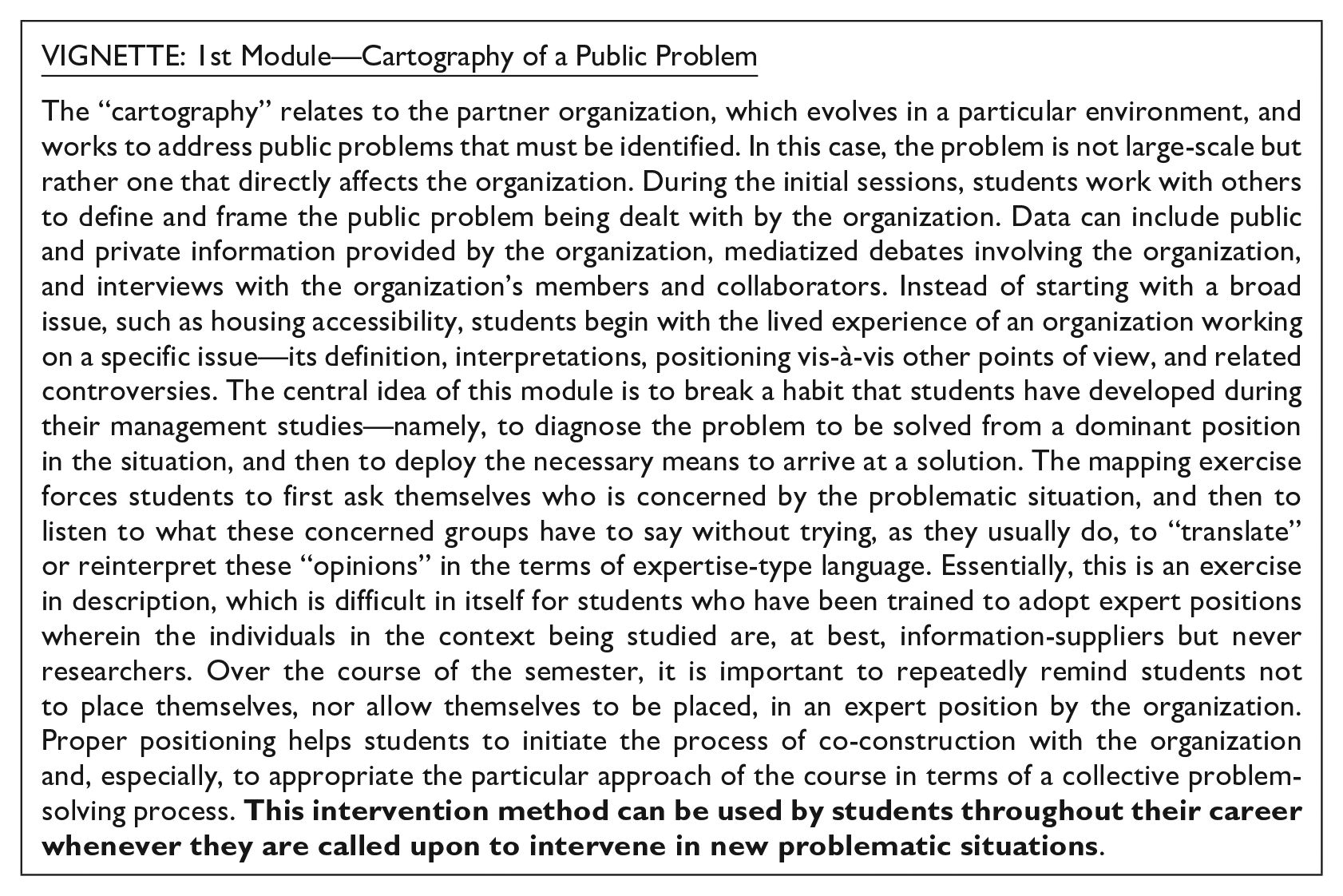
Students are, therefore, encouraged to take the same approach to analyzing controversies with the organization they will be working with, beginning with analysis of the public problem the organization is attempting to respond to. In this analytical perspective, the organization’s environment—in Dewey’s sense, a field of action and a plurality of experiences—is distinct from its context. Hence, students must go into the field to connect with a space of collective experience. This work is analogous to their mapping of the problem which identifies the actors involved and their respective positions on the problem. Mapping the process of collective problem solving proceeds through the students’ quest to understand the situation or the issue in which the organization is embedded.
Collective inquiry
A second mechanism of collective decision-making is distributed experimentation, which is defined as “iterative action that generates small wins, promotes evolutionary learning and increases engagement, while allowing unsuccessful efforts to be abandoned” (Ferraro et al., 2015: 376). Applied to management teaching, distributed experimentation mechanism involves students testing management-related options while effecting transformation in the theories and models as well as in the problematic situation.
The initial exploration prompted by doubt or confusion leads to the generation of an action plan to allow intervention in the situation. This plan is made up of guidelines for approaching the situation and utilizing its elements as a means of transformation. Analogous to his experimental approach, the plan reflects Dewey’s instrumental logic in putting plans, hypotheses and proposals to the test in the situation. For Dewey, “conceptions, theories or systems of thought are always open to development through use (. . .) They are tools. Like all tools, their value does not lie in themselves, but in their capacity to bring about consequences in use” (Dewey, 1920 in Zask, 2015: 59). This fundamental dynamic finds expression in the classroom as students are led not only to enlarge the scope of their understanding, but also to transform the theories, models, and management tools taken up for consideration.
From the pragmatist viewpoint, an organization, company, or market is a sociomaterial agencement resulting from a continuous assembling of sociomaterial elements (Callon, 1998). Such organizational agencements are the framework within which managers’ identity, norms and assumptions are enacted. This explains the importance of exploring the assumptions embedded in management devices—that is, the arrangements of heterogeneous elements like texts, tools, spaces and interacting people. Conceptualizing the organization as an agencement inherently suggests the possibility of transforming the arrangement and collectively reflecting on alternative agencements that would enact the desired assumptions. For example, reflexivity concerning the notion of power involves not only questioning the role of managers and how they mobilize power, but also the way in which organizational structures and certain management devices, such as the annual performance evaluation, induce a particular type of power relations—and how these relations can be transformed.
For management students—and, perhaps, practicing managers—pragmatism’s “reasoning by consequences” aims at broadening awareness of the assumptions carried by certain organizational agencements (e.g. business plan, organization chart, social impact measurement), by testing them in situations. From a pragmatist theory of action, Ferraro et al. (2015) note that means and ends are not clearly determined prior to action. In the classroom, this translates into the need to reflect on and test the different means—models and tools—offered by management through experimentation. In Dewey’s view, this approach will either validate the accuracy of certain working hypotheses or force the investigator to revise them and test new ones. The investigation thus becomes an iterative, trial-and-error process wherein each experiment serves as a basis for and guides the next. Unlike a means to an end, the plan of action is not a grid to be applied to reach an objective but a knowledge that is constructed as the situation is being transformed. The investigation results in a more intelligible, coherent situation, where new understanding of the situation leads to new ways of acting that increase the group’s capacity for action (Lorino, 2018: 126).
The design of management tools and instruments is integral to critical thinking about alternative structuring of collective action (Aggeri, 2017). Starting from the premise that business models can transform reality, Martí (2018) proposes examining them with a view toward (1) better identifying their effects (even those designed to produce social and environmental value) and (2) asking ourselves, if there are types of social structures that would prevent those who inhabit them from being truly human; and more specifically to what extent business model design and implementation might affect such structures by (re)defining particular interactions between different impacted stakeholders (p. 969).
These critical questions can generate fruitful classroom discussion among management students.
The focus on the signification and reengineering of tools makes it possible to capitalize on students’ creativity in thinking about alternative structures for collective action and the generation of new organizational agencements. Some elements of management tools, such as those involving investment, can be modified to take account of the long-term ecological effects of strategic positions and to exclude overly competitive positions.
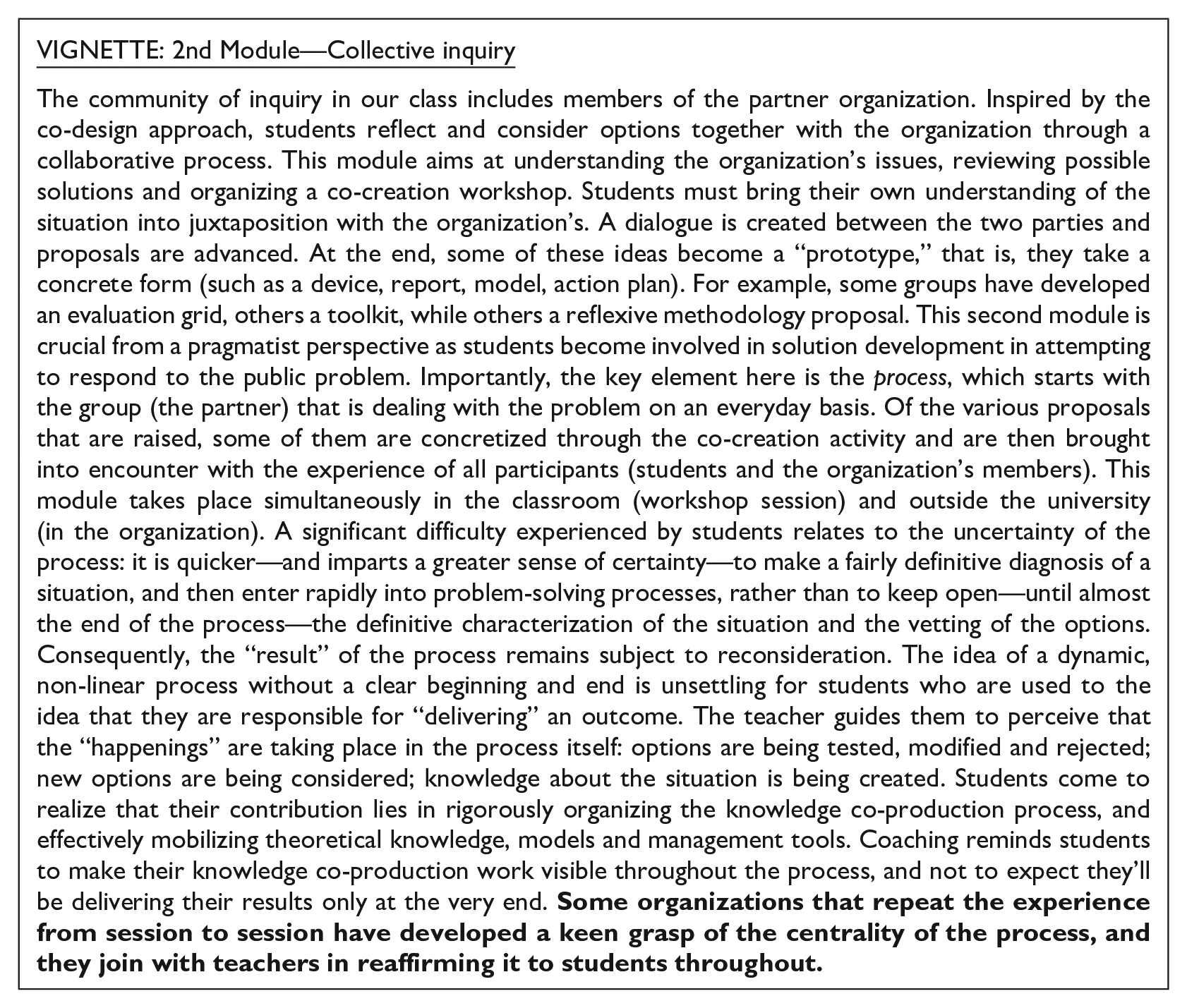
While a Grand Challenges definition of problems may sometimes refer to “social” complexity, interdependencies or major structural forces, a pragmatist perspective invites us to conceive of organizations as socio-technical agencements which can be designed and redesigned. By allowing Grand Challenges to be tackled locally rather than on an overall systemic/societal scale, this perspective facilitates concrete and accessible takes on transformation. It also harnesses management students’ particular competence to deal with these challenges since they have studied many organizational devices as part of their curriculum.
Production of an action plan
A third mechanism of collective decision-making is multivocal inscription, that is, “discursive and material activities that sustain different interpretations among various audiences with different evaluative criteria” (Ferraro et al., 2015: 373). Ferraro et al. (2015) argue that “pragmatism highly values the diversity of perspectives that different individuals and organizations bring to the definition of the problems, and to the generation of possible solutions” (p. 369). The heterogeneity of the actors involved in the exchange is reflected in the variety of interpretations that arise in different audiences.
Dewey’s experiential logic, which places the social and collective dimension at the center of the inquiry process, shapes his political and his educational outlook. The experience of participatory democracy begins in the classroom, and Dewey develops the idea of a “community of investigators” in which all those affected by a problematic situation should take part in all stages of the investigation (Lorino, 2018: 127). It is precisely this collective process, this community experience, which juxtaposes interpretations and ideas, and puts them to the test. For Dewey, democracy is a method, and “this method of democracy is none other than the ‘method of experience’, which itself corresponds to inquiry” (Zask, 2015: 53). This explains the importance we assign to opening the classroom to the perspectives of other actors affected by problematic situations.
For Dewey, an inquiry is triggered by a disturbance—an unsettling doubt felt in the midst of a situation. The investigator seeks to understand the nature of his or her feelings and determine their cause, after which he or she produces initial intuitions that suggest further exploration of particular situational data. Problematization grows out of experiments aimed at reconstructing troubled situations (Zask, 2015: 51). Given an indeterminate situation, a variety of problematizations are possible. Overarching issues, such as globalization, are raised and captured through their manifestation in local situations, which are closer to the students’ experience.
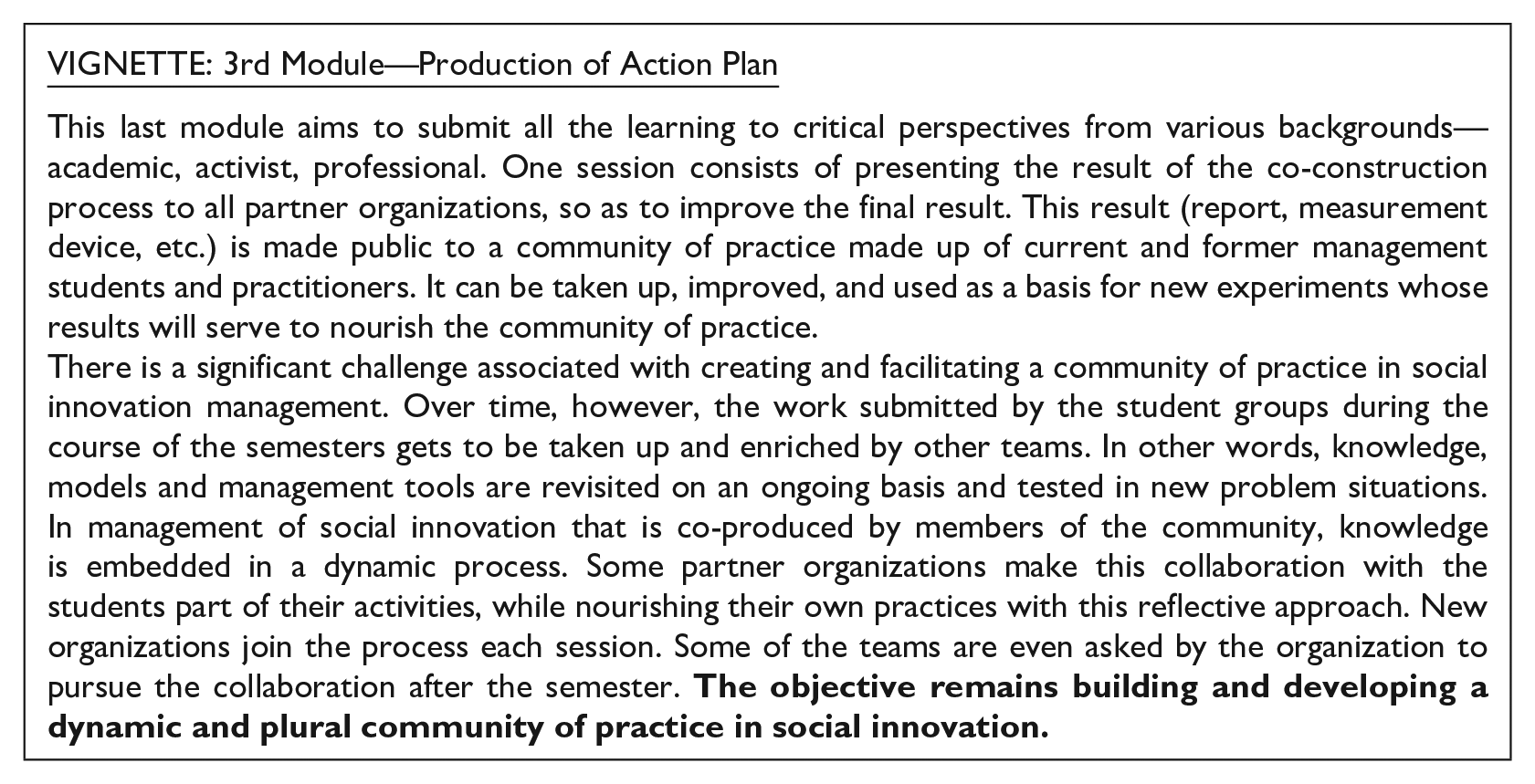
In the pedagogical strategy corresponding to this mechanism, the problematizing process does not remain confined to the classroom but opens out into real-world experimentation (Muniesa and Callon, 2007). In the opened classroom, the multivocal inscription mechanism creates a space of discussion in which actors experiment with indeterminate situations, listen to the multiplicity of voices, positions, and experiences associated with the problem, and map the process of experimentation, culminating in evaluation of the various ideas and options considered.
Discussion: a pragmatist approach in the classroom
Through a reflective pedagogical experiment, this article has explored strategies to better prepare business students to face and act on Grand Challenges, which are socially controversial in terms of diagnosis, resolution and evaluation of consequences. Issues like social inequality, climate change, social polarization, and current/future pandemics are intertwined with economics, businesses, and, thus, management education. A critical examination reveals the responsibility borne by management theories and practices, particularly the presuppositions that those theories and models convey for a model of action within a neo-liberalist perspective. The pedagogical approach inspired by elements of Dewey’s logic of experience—his instrumentalism, in particular—allows for both questioning of theories and greater control over the likely consequences of their application to problematic situations. While critical reflection may shed light on the domination structures responsible for inequalities and for exploitation of people and nature, it has difficulty providing students with concrete levers of action (Spicer et al., 2016), and may even confront management students too starkly, leading to inaction or shutdown (Fenwick, 2005). Based on our experience with the course Design and Management of Social Innovation, we seek to mobilize a pragmatist approach to Grand Challenges that addresses three challenges in management education: How to prepare students (1) to face complex, uncertain, and controversial problems, (2) without teaching them maladjusted or problematic theories, tools, and practices that risk enhancing problems, (3) but still giving them concrete ways to intervene and act on these challenges as managers, so that the situation is improved.
Given their awareness of the state of society with which they enter the classroom, students expect to learn how to be successful managers while, at the same time, adopting a humane, ethical and eco-friendly outlook, and valuing intellectual curiosity, critical thinking, and introspection (Koris et al., 2017). Our literature review on current pedagogical approaches led us to develop strategies based on three principles: (a) recognition of the plurality of experience in a situation, and the consequent plurality of evaluation criteria allowing coordination among actors; (b) the importance of collective deliberation in a problem-solving process; and (c) ongoing local experimentation practices that allow testing of various avenues of solutions (ideas, theories, models) in an abductive manner (Ferraro et al., 2015; Martí, 2018).
These principles have led us to engage students in complex situations to explore how problems are defined by those who experience them and to explore solutions with these same people. We consider students as active experimenters with the capacity to collaborate with people experiencing problematic situations through a process of co-construction of options and solutions, a process that involves blending academic and experiential knowledge. By being opened, the classroom is enriched by the perspectives of the actors involved in these situations.
Contributions for management education: collective decision-making and redesign
We argue that the organizational literature on Grand Challenges, with its pragmatist framing, opens a new context for management education. Sustainability education and RMLE have addressed related themes by proposing pedagogical strategies that aim at imbuing students with a sense of accountability vis-à-vis these challenges and by allowing them to analyze the major structural forces responsible for accentuating the crises. Moreover, given the complexity, uncertainty and controversial dimension of societal and environmental problems, we developed a pedagogical approach and strategies that equip students to intervene in indeterminate situations through a collective decision-making process.
Responding to the call to develop new approaches in research and pedagogy to tackle Grand Challenges (Ferraro et al., 2015; Georges et al., 2016; Hoffman, 2021), we reviewed the debate within management education over sustainability and RMLE. Experiential, critical, and pragmatist pedagogical approaches do not directly prepare students for intervention, especially as the pragmatist approach remains inspirational in its broad principles rather than being truly appropriated as a philosophy of practice. Moreover, these approaches often adopt the external and detached point of view characteristic of an expert decision-making model (Callon et al., 2001). In contrast, our teaching proposals are grounded in a situated collective decision-making and intervention process taking place both in and outside of the classroom. While drawing on the pragmatist perspective on Grand Challenges (Ferraro et al., 2015), our vector is shaped by a philosophy of practice that converges with other socially engaged perspectives in management, such as alternative organization (Fournier, 2006; Parker et al., 2014) and Southern epistemologies (Pozzebon et al., 2021). This constitutes our first contribution to management education.
Our second contribution lies in proposing key strategies that permit students to develop a real “grip on the action” through a process of design of organizational arrangements (Blum, 2017), without minimizing the complexity of the problem or abdicating the critical and reflective dimension. As in such experiential approaches as problem-based learning and action-based learning, we invite students to engage themselves in real-life situations, but also to bring to bear the knowledge, models, and tools that are taught and employed in management situations. We direct their attention to the sociomaterial elements (e.g. organizational agencements) that characterize a problematic situation. This exemplification of a pragmatist approach has not yet been developed in management education—pragmatism having been mostly left for discussion under business ethics. Consideration of multiple points of view and of the materiality of management situations (Aggeri, 2017; De Vaujany, 2006; Girin, 1995, 2016; Journé and Raulet-Croset, 2008) expands students’ awareness of the performative dimension of management models and tools. This change is essential in the context of Grand Challenges as most of the problematic situations that students inherit embody management models, tools and structures that mark the organizational context (i.e. bureaucracy), and must therefore be redirected (e.g. vis-à-vis the healthcare system during a pandemic) (Bonnet et al., 2019). Our pedagogical strategies lead students to contextualize and problematize management tools and models by applying them in situations, thus differing from the consultant/expert outlook, and even from some critical theorists generally taught in business schools. Instead of staying out of the problem by adopting an overarching point of view, students position themselves in the situation with the partner organization by critically and collectively addressing the problems and effects of models (Aggeri and Labatut, 2010: 27–28; De Vaujany, 2005). After considering models and tools that exert a heavy structural influence on collective action, students then contextualize them during the problematization phase. They take an action-based approach with the partner organization and examine the implications of the chosen options critically, reflectively, and collectively. In this perspective, instrumentalization is more than mediation; it is “a privileged intervention to develop new capacities of action (Joas, 1999), (. . .) it contributes to transforming organizations” (Aggeri and Labatut, 2010: 6, our translation).
We join others, such as Bonnet et al. (2019), in deeming management students to be the most able and best situated to understand this heavily management-oriented context and to collaborate with stakeholders in transforming management practices and structures. With management’s responsibility in Grand Challenges having been demonstrated (Ferraro et al., 2015), we think that it is time to undertake the development of management models and tools that are sustainable. Our pedagogical strategies offer a step in this direction and open a field in management education debate by enriching discussions of experiential learning and CME with the concept of organizational agencement (Aggeri, 2017; Girin, 2016).
Finally, these principles impact more broadly how we conceive and practice management education beyond the classroom. As we presented, our experience shows how management students are used to adopting an “expert position” and focusing on the result, rather than on the process and equal-equal position with the organization. This creates a challenge for us as it takes time and energy to deconstruct this expert position on organizational problems. Fortunately, this social innovation course attracts a diversity of profiles and eager students who want to transform our world. This clearly eases our work as teachers, but still leaves us wondering how this approach would fare with MBA students—as well as how to initiate such pedagogical strategies with students who are not really concerned about Grand Challenges. There is also the question of whether this is an audience that we would/should reach as management educators.
Also, our course presents a different way to bring about convergence of the educational and the “third” missions of the university. Usually, the “third mission” means that, beyond research and education, the university can be seen as a vector of social transformation through its involvement in communities and environment. In the case of social innovation, universities thus contribute to the transformative process through collaboration, engagement, capacity building, and venture support with non-academic organizations (Milley et al., 2020). Our article presents a way to combine pedagogy and social transformation with communities through ongoing collaboration between organizations and students. However, even though these collaborations aim to be equal-to-equal, there are still power and resource allocation inequalities. The organization’s participation is voluntary, being, in most cases, the product of a trusting relationship built on past collaborations with the teachers. Thus, when we conceive such a course, we must balance the expectations, realities, and availability of our partners, who are often overstretched (especially in the case of community organizations). Similarly, we have to balance the realities of the students, who have other courses and increasing obligations (work, family, etc.). During all these years, we have remained sensitive to the experiences of students and organizations, and have organized follow-up sessions to improve the course and process.
As university teachers, this has led us to broader questioning of how we conceive and develop courses, programs and other academic elements. Applying the “pragmatist toolkit” to our own practice means opening up the process of designing, teaching, evaluating, and redesigning university courses/programs. As teachers, we are only one expert among others—thus, opening this process means reconsidering how and to whom we are attributing power and resources to grant them a genuine and equal voice in the course/program (re)elaboration. We have catalyzed this experience informally and imperfectly, but it requires changes that go beyond the classroom.
Contributions to the literature on Grand Challenges
This article contributes to the literature on the Grand Challenges in two ways. The first is by offering a reflection on relevant pedagogical approaches based on Dewey’s philosophy of education, in contrast to the prevailing literature, which focuses largely on research approaches or management tools (Brammer et al., 2019; Martí, 2018). With their steady growth of enrollment in recent years, business schools have become a more significant part of university education, giving urgency to preparing business students to analyze and address the scope of the Grand Challenges. An important part of this endeavor involves reflection on the content presented to management students, and on ways of making them more reflexive in their management practices (Hoffman, 2021). The classroom can become a place for exploring the complex situations connoted by Grand Challenges, guided by pragmatist principles that emphasize the importance of collective deliberation in the problem-solving process. This includes ongoing local experimentation practices which allow testing of various avenues to solutions in an abductive manner, and formalized recognition of pluralized evaluation criteria that permit coordination among the actors. The classroom actualizes these principles by according importance to: collective problematization as a framing process; inquiry that allows testing the concrete effects of various options and engineering different agencements to reorient challenged organizations; and production of an action plan that copes with complexity in a situation-by-situation manner.
Our second contribution involves mobilizing a collective decision-making and action process by inviting students, alongside practitioners, to act on Grand Challenges through specific managerial situations and, more importantly, through organizational agencements. We translate Martí’s (2018) proposals on developing and implementing transformational business models into a pedagogical approach which is distinctive. In our open classroom, students work and learn in conjunction with real organizations to diagnose, solve and evaluate effects of different options in situations where organizational agencements (management tools, business models, organizational structures, etc.) need to be rearranged (Aggeri, 2014, 2017). This contribution grows out of our core educational mission: to motivate students to test options and explore solutions with people in situations so as to co-produce managerial solutions and tools which are
A significant remaining question concerns the actual impact of this instructional approach on Grand Challenges. Does the students’ “opportunity to intervene” translate into changes in the “real world”? This question is particularly pertinent in a course which goes on for 12 weeks. The issue of impact in engaged management research has recently been addressed by certain authors (Cunliffe and Scaratti, 2017; MacIntosh et al., 2017) who argue that impact should not be seen as an “add-on”—or simple transfer from theory to practice following the research activity—but as being itself embedded in engaged research. Cunliffe and Scaratti (2017) develop their argument around Haraway’s (1988) notion of “situated knowledge”—which echoes our concept of “situated action.” Situated knowledge is “defined as knowledge embedded within a social, historical, cultural and political time and place that reflects contextual features and lived experiences” (Cunliffe and Scaratti, 2017: 30). In this view, the temporal dimension of research impact is embedded in the research process itself as it involves a dialogical encounter between researchers and practitioners.
This conception of impact is conveyed mostly during the collaboration phase of our course, which involves situated knowledge, action, dialogue, and reflexivity. The pedagogical objectives articulate the objective of developing the student’s general stance and ability to replicate and adopt this open, plural, and dialogical process outside of the classroom. Furthermore, we seek to develop long-term collaboration with the organization and pursue a similar mandate building on students’ previous work. Finally, we are currently developing an online platform listing the various public problems addressed during the project, the organizations that have dealt with them, and various results of the collaboration that may be of benefit to other organizations.
Overall, our article proposes educational strategies that serve to advance the teaching of social transformation in business schools. Up to now, a rational, problem-solving approach has been the one most commonly employed in preparing business school students for the challenges of social and environmental crises. Such an approach analyzes a problematic context from an external perspective to identify the problem, gather information on proven solutions, make a diagnosis, and propose a solution to the problem—one that often involves a technical fix. However, as mentioned at the beginning of this article, management students are caught in a conflict between their expectation of useful knowledge for predictable situations and their realization of the uncertain and indeterminate nature of the situations actually confronting them. How are they to handle precarious situations that are difficult to control, with “problem-solution” type approaches that require precise information on the problems to be solved and the needs to be met? Students’ yearning for the context of certainty presupposed by extant models of decision-making is upended when they see these models themselves being held partly responsible for the Grand Challenges that overshadow today’s world. Inevitably, a stepping back from prevailing theories, models and techniques is necessary to find alternatives to technical approaches to problem solving, and to redirect current models.
Conclusion
The relevance and urgency of developing new approaches to dealing with Grand Challenges grow with each passing day. The need is even more pressing in the domain of management as management activities and theories have themselves been identified as staple agents in crisis. Re-conducting the familiar approaches and solutions can actually contribute to aggravating rather than alleviating environmental and social challenges (Martí, 2018). Besides developing our own contribution to the management literature, we have listened closely to management students who are immersed in this precarious context and who require methods and tools just to navigate through it before they can even begin thinking about transformation.
In this complex and indeterminate context, the pragmatist pedagogical approach offers a promising way of addressing Grand Challenges in management programs and developing students’ capacities to intervene in such uncertain contexts. However, a certain tension exists within both the pragmatic and critical schools. On one hand, the critical approach discloses the realities about the logic of power and oppression, the performativity of management theories and tools, and the effects of teaching and socialization in management schools. On the other hand, the critical approach may be felt as oppressive and serve to shrink the capacity for action (Fenwick, 2005; Perriton and Reynolds, 2018). Analogously, pragmatism allows the development of real handles on the action, the possible redesign of many prevailing sociotechnical arrangements, and the discovery of room for maneuver. However, pragmatism is sometimes accused of lacking space for criticism or for overlooking the political dimension. There is a great risk of remaining disconnected from the problematic situations and of replicating problematic solutions when the pragmatist approach is conceived as a theory of decision-making, rather than as a way of connecting with people who are experiencing indeterminate situations and exploring and testing options with them. Like Ferraro et al. (2015), we believe that in research as well as in education, there is an unprecedented urgent need for an approach that recognizes the critical capacities of people living in problematic situations, the plurality of ways of being in our crisis-ridden world, and the means of rebuilding a common world together.
