



Abstract
In this article, we investigate a crucial factor in open strategy research: participation. By drawing on the attention-based view, we argue that the degree of participation in both analog and digital practices of open strategy is the result of “attention contests.” These attention contests arise as the attention structure of Open Strategy initiatives (as quasi-temporary organizations) and the attention structure of the main organization compete for actors’ limited attention. As these attention structures collide, four tensions emerge (process ambiguity, status transitions, time constraints, and identity shifts). We argue that the impact of these tensions is contingent on the type of Open Strategy practice; digital or analog forms of Open Strategy-making. Therefore, we offer a new theoretical understanding of why and how actors participate in Open Strategy initiatives. Based on this, we offer various mechanisms of how firms can facilitate meaningful participation in these different practices. This essay opens up promising avenues for future Open Strategy and participation research.
Introduction
“Sometime they’ll give a party and nobody will come.”
In 2002, IBM’s CEO Sam Palmisano invited all 350,000 employees to participate in developing a new corporate value system guiding IBM’s future strategic direction (Palmisano, 2004; Whittington et al., 2011). While an impressive 50,000 people checked out the new format, almost 86% of employees have not logged into the community forum. And, even if we assume that every comment came from a different employee, still more than 97% of IBM’s workforce did not engage actively. Similarly, in 2009, the non-profit organization Wikimedia announced an open strategic planning process and called for participation. From its millions of users, 9299 registered to take part in Wikimedia’s Open Strategy (OS) initiative, with 3096 actually attending. The top 11 voluntaries produced more than 40% of all contributions (Dobusch et al., 2019). We are aware of the slight hyperbole in how we frame those examples. Still, successfully harnessing the wisdom of the many for strategy-making (e.g. Hautz et al., 2017; Plotnikova et al., 2020; Stieger et al., 2012) rests on a key condition: participation.
Drawing on the recent advances in the attention-based-view (ABV) of the firm, we propose that the degree of participation of internal actors in OS is the result of “attention contests.” These contests arise as the attention structures of OS in the form of analog or digital practices (Hautz et al., 2019), as well as the attention structure of the main organization compete for actors’ limited attention (Ocasio, 1997; Simon, 1947). These structures shape how and to which extent individuals pay attention to certain events and, hence, how they strategically behave (e.g. Ren and Guo, 2011; Stevens et al., 2015).
As the attention structures of analog and digital OS practices and the existing organization collide, the attention contests become manifest in the following four main tensions: process ambiguity, status transitions, time constraints, and identity shifts. We argue that the impact of these tensions varies across analog or digital forms of OS as these practices typically display different logics of participation, such as the timing of self-selection (Hautz et al., 2019). Therefore, we provide a new theoretical understanding of how and why participation in both analog and digital forms of OS occurs.
This essay contributes to the growing field of OS. First, the notion of attention contests opens up new avenues for empirical research but also raises important practical implications for how firms may try to intervene in the distribution of attention and influence participation. Second, we contribute to the understanding of how participation in analog and digital OS practices may play out differently due to the differences in their underlying attention structures. Third, we suggest considering participation a key condition of OS and conceptually differentiate participation from inclusion. Extant research on OS has been concerned with inclusiveness (e.g. Hautz et al., 2017; Mack and Szulanski, 2017; Seidl et al., 2019; Whittington et al., 2011). While inclusiveness is a key to create variety, it is still dependent on participation. Finally, we answer calls for research regarding the underlying mechanisms of participation by extending research on the “participation problem” in the strategy process (Mantere and Vaara, 2008; Tavella, 2020).
Open strategy: what do we know about participation?
Our understanding of the strategy process has changed over the decades. While previously, strategy-making has been considered the domain of an exclusive elite (e.g. Chandler, 1962; Williamson, 1970), this view was superseded by a plethora of studies showing that strategy-making is distributed across the organization (e.g. Mintzberg and Waters, 1985; Mirabeau and Maguire, 2014; Regnér, 2003), highlighting the role of actors on different levels (e.g. Burgelman, 1983; Friesl et al., 2019; Wooldridge and Floyd, 1990). Enabled by the advances of information technology (IT), yet another shift in strategy-making is noticeable; the strategy process debate of the 21st century manifests in what came to be called OS. Many organizations deliberately open up their strategy process and become more inclusive in their approach to strategy-making (Whittington et al., 2011).
To realize the inclusion of a wider range of actors in the strategy process, firms deploy both analog and digital practices, depending on their goals and the strategy process stage (Hautz et al., 2019). In analog practices, participation is mostly limited to a selected group of actors (Mack and Szulanski, 2017; Seidl and Werle, 2018). In contrast, digital practices can typically cater for large groups (e.g. Hutter et al., 2017; Plotnikova et al., 2020). In such cases, it is up to each individual to self-select into the process and participate (Felin et al., 2017).
OS promises two key benefits. It enables the distribution of valuable strategic knowledge across different levels of a firm (e.g. Plotnikova et al., 2020), facilitating the implementation of a strategy (e.g. Denyer et al., 2011; Seidl et al., 2019; Stieger et al., 2012). Also, OS initiatives allow leveraging the expertise of a wide range of actors and thus promise the creation of superior strategies (e.g. Hautz et al., 2017; Mack and Szulanski, 2017; Malhotra et al., 2017). Indeed, due to actors’ bounded rationality, the top management team cannot consider all possible options to choose the “perfect” strategy (Cyert and March, 1963; March et al., 1958). OS allows extending the range of options by allowing internal and external stakeholders to contribute to the strategy process (e.g. Haefliger et al., 2011; Mack and Szulanski, 2017; Seidl et al., 2019).
The condition for realizing the benefits of OS practices sounds almost trivial: participation. Indeed, using distributed knowledge to create superior strategies presupposes that actors possessing this knowledge invest their attention to share it. Despite its importance, only a few scholars have distinguished participation from inclusion (Plotnikova et al., 2020; Stieger et al., 2012). In the emerging literature on OS, there are currently three different approaches to participation: participation as a consequence of inclusion, participation as inclusion with lower intensity, and participation as an essential challenge of OS.
First, actors’ participation is often implicitly considered a given consequence of inclusion and hence, not examined as a phenomenon in its own right (e.g. Hutter et al., 2017; Malhotra et al., 2017). Symptomatic for this is Whittington et al.’s (2011: 532) seminal paper. They define inclusion as “the range of people involved in making strategy” (p. 532). In this definition, participation is implicitly assumed to be a consequence of inclusion. Second, for Mack and Szulanski (2017), participation and inclusion are independent dimensions. While participation aims to maximize actors’ input to improve strategic decisions at a given time, inclusion aims to sustain actors’ long-term engagement in the strategy process. This perspective provides a new understanding of the consequences of participation but does not explain how and why participation in OS occurs. Finally, a third perspective on participation is represented by Plotnikova et al. (2020) and Stieger et al. (2012). They show how actors’ participation in online communities is an essential challenge of OS. However, they do not specify the mechanisms that underpin participation in analog or digital OS practices.
Attention please: participation in open strategy as an attention contest
Drawing on the ABV, we argue that participation in analog or digital practices of OS is influenced by attention contests. We see OS initiatives as quasi-temporary organizations that mostly exist for a restricted period of time and for a particular purpose (e.g. Bakker et al., 2016; Grabher, 2004). We argue that the tensions between the attention structures of OS practices and the attention structures of the main organization influence actors’ degree of participation in OS. Below we will show how attention contests are manifest in analog and digital forms of OS. While in digital OS practices actors typically self-select into the process, in analog settings participation is usually invited (Hautz et al., 2019). Yet, self-selection is still present in analog settings. It particularly takes place “in the way” actors participate, for example, whether they speak up or stay silent in OS workshops. The next section explains how participation in analog and digital OS practices is shaped by the collision of attention structures.
Managerial attention and attention structures
Attention is a limited and valuable resource within organizations (Ocasio, 1997; Simon, 1947). To capture the role of attention for strategy-making, Ocasio (1997) established the ABV. Ocasio (1997) particularly emphasizes the role of attention structures that shape the distribution of individual effort, time, and attentional focus within organizations (Ren and Guo, 2011; Stevens et al., 2015). Attention structures consist of four broad attention regulators, which are fundamental to understand participation in OS.
First, the “Rules of the Game,” as Ocasio (1997) calls them, represent the firm’s mostly implicit principles like norms, values, and incentives. These principles guide actors’ attention in their interpretation of organizational reality and constitute a logic of action (e.g. Nigam and Ocasio, 2010; Ocasio and Thornton, 1999). Thus, the rules of the game create a framework in which coordination and conflict take place (e.g. Bower, 1970; Mintzberg, 1985). Second, attention is also regulated by actors “Structural Position” in the organization; this means their formal roles and social identity. Structural positions are connected to hierarchy and, hence, actors’ status and power (Brass and Burkhardt, 1993). Moreover, structural positions are part of the organizational architecture and thus result in a specific attentional focus (Joseph and Ocasio, 2012) which in turn influences decision-making (Jensen and Zajac, 2004). Third, attention is regulated by firm-level “Resources and Routines.” These are the building blocks of firms’ value-creating activities (Nelson and Winter, 1982; Wernerfelt, 1984). Resource allocation and deployment as well as the performance of organizational routines are substantial parts of organizational life and thus consume actors’ attentional focus. Finally, the fourth attention regulator is the “Players.” Players are the actors influencing a firm’s decision-making. These actors are embedded in the structures and social fabric of an organization which shape the beliefs and values that underpin strategy development (e.g. Hart, 1992) and reflect in a firm’s attentional direction (Ocasio, 2011).
Colliding attention structures lead to attention contests
Why should OS research care about attention structures? We argue that OS initiatives collide with the attention structure of the main organization leading to attention contests. Thus, the degree of participation in digital or analog OS practices is substantially shaped by these attention contests. What exactly are the mechanisms that give rise to these contests? (see Figure 1).
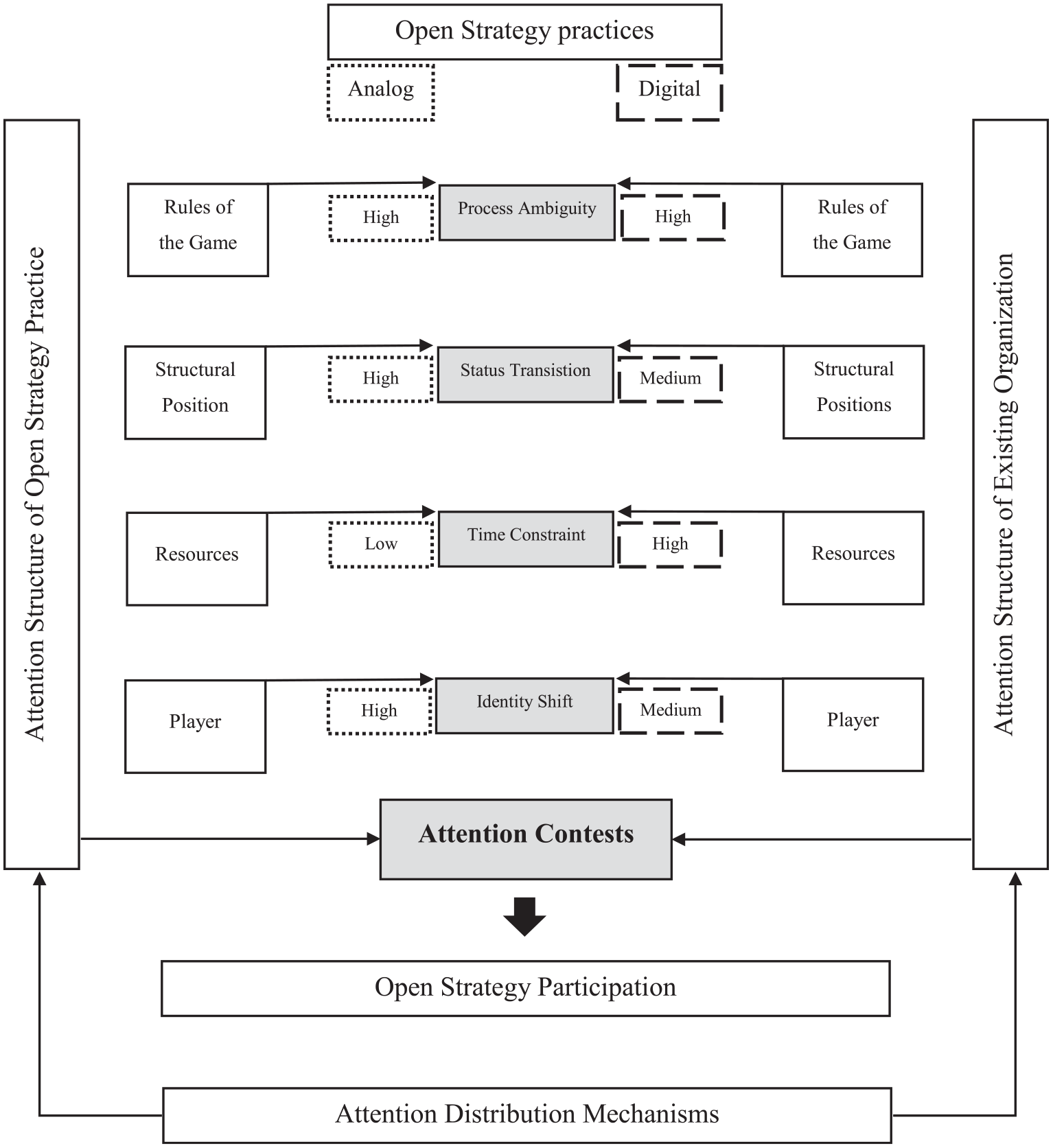
Attention contests and open strategy participation in analog and digital open strategy practices.
Attention contests based on process ambiguity: An organization’s rules of the game help actors in dealing with ambiguous information by providing a logic of action guiding actors’ attention. This logic of action creates a narrow framework regulating how to behave appropriately and succeed in the organizational game (e.g. March and Olsen, 1989; Ocasio and Thornton, 1999). However, for OS, the rules of the main organization may be suspended, and other rules may apply altogether. In OS, clear and transparent procedural rules are essential to establish and maintain openness in strategy-making (Dobusch and Dobusch, 2019; Dobusch et al., 2019). This is important as OS initiatives are often designed to create options that break with the current logic of action (e.g. Hautz et al., 2017). For actors, this switch of the organizational “rule book” may result in substantial ambiguity regarding the appropriateness of actions in this context and how to be effective in shaping strategic conversations.
New actors in the organizational game have to learn what to say but also what not to say (van Maanen and Schein, 1977) as providing critical input may be regarded as “boat rocking” or “dissident behavior” (e.g. Redding, 1985; Sprague and Ruud, 1988). Thus, actors may avoid challenging the status quo as they do not want to be labeled as “troublemaker” or “complainer,” impairing relationships within the organization (Milliken et al., 2003; Morrison and Milliken, 2000). The same issues may arise in digital and analog OS practices thwarting their value in capturing broader knowledge for strategy-making. In digital settings, actors may be reluctant to self-select into the process due to the ambiguity of how to behave appropriately. In both practices, actors may be reluctant to provide critical input or breaking with the logic of action due to the expectancy of negative consequences in the organizational game (Denyer et al., 2011). This self-restriction may be more prevalent in analog face-to-face settings in which the rules of the main organization are likely to become more salient and thus suppress the rules that should ideally prevail in OS settings.
Attention contests based on status transitions: OS values actors’ input regardless of hierarchy, authority, or structural position. This stands in contrast to daily organizational life, in which, decision-making is influenced by hierarchical relationships associated with power, status, and influence (Brass and Burkhardt, 1993; Thompson, 1961). In practice, the status transition that occurs as actors participate in OS initiatives may create tensions. For lower level employees, these tensions arise as they transition into a role in which the stakes are higher due to additional accountability for the firm’s strategy (Hautz et al., 2017). This may play an important role for participation in analog and digital practices. For higher level managers, participation in digital OS practices may be accompanied by a perceived loss of power and status, decreasing the willingness to attend. Besides, higher level managers may restrict their attention on these OS initiatives as—due to their position—their contribution may have a disproportionately strong influence (Plotnikova et al., 2020). In analog settings, hierarchy and associated status and power may become even more salient than in digital settings as in the latter case technology might partially mitigate the effect of status differences (Denyer et al., 2011). Therefore, in analog settings, higher ranking managers may explicitly or implicitly maintain status differences by signals of power (e.g. Detert and Treviño, 2010; Morrison and Milliken, 2000; Redding, 1985), controlling and restraining the participation of lower levels (Mantere and Vaara, 2008; Tavella, 2020).
Attention contests based on time constraints: A feature of organizational life is processes and routines (Nelson and Winter, 1982). They are the means through which resources are allocated and deployed (Eggers and Kaplan, 2013), yet may also be a major tax on individuals’ time and attention (Cyert and March, 1963; March et al., 1958). From this perspective, the hurdles to self-select into digital OS initiatives are high. Actors are deeply embedded in routines (Nelson and Winter, 1982) as they guide, legitimize, and give meaning to everyday activities (Feldman and Pentland, 2003). Digital OS practices demand the investment of attentional resources besides everyday activities actors are absorbed in (Hautz et al., 2017) but do not fulfill the functions of these established activity patterns. For instance, participation in a digital strategy community may not allow actors to officially account for their time in the same way as day-to-day routines (Feldman and Pentland, 2003). Therefore, digital OS practices compete with everyday routines for actors’ limited time and attention, influencing participation. The situation is different with analog OS practices. Time constraints may only play a subordinate role as time is explicitly freed up and legitimized.
Attention contests based on identity shifts: The very idea of OS is that actors from all levels have the potential to become strategists. Yet, the transitioning out of operative roles into strategic roles implies a shift in actors’ self-image, their identities. Indeed, participating in the strategy process requires a “strategist identity” associated with a special mind-set and specific skills that underpin strategic conduct (Mantere and Whittington, 2020). Embracing contributions to OS initiatives as part of one’s professional identity might be challenging. Lower level actors usually focus on high-detail and short-term operational tasks, whereas strategy-making requires a broad and long-term orientation (c.f. Bansal et al., 2018). A lack of this “strategist identity” may lead to uncertainty, timidity, and even embarrassment resulting in reluctance to participate in OS initiatives (Mantere and Whittington, 2020). Hence, we propose that the identity shifts triggered by changes to what it means to be a “player” in the strategy process may affect participation in OS practices. In this regard, analog settings may be even more challenging for lower levels as they enter the direct, synchronous strategy dialogue, potentially without the experience and prior exposure that would enable comfortable and self-confident participation (Mantere and Whittington, 2020).
Process ambiguity, status transitions, time constraints, and identity shifts simultaneously affect the degree of participation in OS practices. This matters as any such initiative comes with expectations about who should optimally participate and in which way. Thus, empirical research on attention contests has the potential to better understand participation in digital and analog OS practices. Attention contests may help explain why some actors in digital OS practices self-select into the process while others are not. Moreover, by investigating attention contests in analog OS practices, we can gain new insights into the underlying mechanisms that shape participation in the form of situated contributions to strategic conversations.
How to deal with attention contests in open strategy? Attention distribution mechanisms
If participation in OS is indeed affected by attention contests, an important question remains: How should firms deal with attention contests to facilitate participation in OS? The argument presented above would suggest that this requires mechanisms of attention (re-)distribution: The managerial actions involved in mitigating the consequences of process ambiguity, status transitions, time constraints, and identity shifts on participation. Empirically, attention contests might be resolved through a plethora of activities contingent on whether OS initiatives build on analog and digital practices. Yet, to illustrate our point, we provide three examples of what attention distribution mechanisms might look like.
Incentives as an attention distribution mechanism: Firms can create material and immaterial incentives to mitigate the attention contests and promote participation in OS practices (Plotnikova et al., 2020; Stieger et al., 2012). Incentives may weaken attention contests by reducing tensions between the attention structures of the main organization and the OS initiative. For example, in a digital setting, Ericsson awarded highly engaged contributors with titles like “thought leader” triggering social dynamics of peer reputation (Plotnikova et al., 2020). Such immaterial incentives potentially mitigate the negative effect of process ambiguity and strengthen the confidence of non-strategists to participate—an approach that can be transferred to analog practices. Moreover, incentives may mitigate time constraints by legitimizing time spent on digital OS practices. Nevertheless, firms have to be aware of the unintended consequences of incentivizing OS initiatives. Giving an award to the best idea implies not rewarding the mass of other ideas carrying the risk of user frustration (Baptista et al., 2017), demotivation, and de-energization (Westley, 1990). Still, further research on different types of incentives promises valuable insights into participation in OS initiatives.
Organizational climate as an attention distribution mechanism: Research shows that raising criticism with superiors is associated with fear of retaliation leading to reluctance and silence as dominant behavior (e.g. Milliken et al., 2003; van Dyne et al., 2003). The implications for OS are clear: To ensure valuable participation in OS, the initiatives have to be a “safe place” with a climate of openness (Detert and Burris, 2007). Creating such an environment is more difficult as it seems. Firms using OS, either in digital or analog forms, have to be aware of the fact that even well-intentioned managers are influenced by implicit stereotypes about lower levels (Milliken et al., 2003) and tacit authority structures limiting a climate of openness (Detert and Treviño, 2010). In digital OS practices, we see two levers for firms to address this issue: First, actors must have the possibility to provide ideas anonymously or through independent intermediaries. Second, the exclusion of high-power actors is an option to facilitate attending OS initiatives (Plotnikova et al., 2020). However, reflecting the dilemmatic nature of OS, this approach may lead to a legitimacy loss and surely contradicts the very idea of inclusion (Hautz et al., 2017). In analog practices, creating a climate of openness is even more difficult as process ambiguity and status transitions may become more salient in face-to-face settings. To reduce this effect, firms could select the participants such that personal dependencies are minimized.
The design of OS as an attention distribution mechanism: Finally, the materiality of digital and analog practices (c.f., Jarzabkowski and Kaplan, 2015), such as the characteristics and affordances of physical spaces (Gibson, 1979) and the “perceived ease of use” of IT tools (Davis, 1989) may act as an attention distribution mechanism. In analog practices, small things like the seating arrangement in workshops may further exacerbate or mitigate hierarchical relationships influencing the inherent process ambiguity in OS. In digital practices, low perceived ease of use leads to user frustration reflecting in a lower degree of participation (Hutter et al., 2017). Low perceived ease of use is associated with higher effort (Davis, 1989), reinforcing the time constraint. Thus, it is essential to design OS platforms as user-friendly as possible. Highly complex digital platforms could implicitly exclude actors lacking digital capabilities inhibiting them from participating. This can lead to a legitimacy loss of the results of OS initiatives. Moreover, a digital divide could occur, resulting in conflicts within an organization.
Discussion
This essay highlights a fundamental condition of OS initiatives: participation. We theorize the degree of participation as the result of attention contests that emerge as the attention structures of OS practices and the main organization collide. Overall, we make the following contributions to future research.
Our essay provides a fresh perspective on participation in OS specifically and the strategy process research generally (Mantere and Vaara, 2008). It complements OS research by framing participation as the outcome of attention contests and the management of participation as the (re-)distribution of attention. Applying the ABV to analog and digital OS practices opens up further research questions with high practical relevance: How can OS practices be designed such that actors participate in a meaningful manner? How do authority and status shape different OS practices and influence the degree of participation? How do non-strategists build a strategist identity by engaging in different OS practices? Which attention distribution mechanisms are the most suitable for which OS practice?
Moreover, the focus on participation creates further conceptual clarity in research on OS. Currently, research has largely focused on “inclusion” and “transparency” as underlying characteristics of OS (Hautz et al., 2017; Mack and Szulanski, 2017; Seidl et al., 2019), for example. While inclusiveness is a “moral” intent and a central means to use the variety of skills and perspectives distributed within an organization for strategy-making (e.g. Hautz et al., 2017; Whittington et al., 2011), participation is the actual uptake of this offer and the necessary condition to realize these benefits. The mechanisms through which participation unfolds may be contingent on the OS practices chosen. Thus, focusing on participation provides the opportunity to explore the practices involved in harnessing the creative power of OS.
Our approach has certain limitations. Our notion of attention contests assumes that OS initiatives are time-bound. However, there are also examples of “born open” organizations. In these organizations, strategy-making is wired into the organizational DNA and is practiced continuously (Gegenhuber and Dobusch, 2017; Luedicke et al., 2017). Thus, participation is not influenced by the result of colliding attention structures but rather the result of a particular culture (Gibson and Birkinshaw, 2004). Also, for the purpose of this essay, we simplified our theorization of digital and analog OS practices by arguing that digital practices are based on self-selection while analog practices are associated with ex-ante selected participation. Moreover, while we separated the effects of digital and analog practices, OS may involve hybrid approaches. In such instances, which attention contests arise is an interesting question for future research. Finally, while we focus on internal actors as participants, we acknowledge that OS practices may also include actors outside the organization’s boundaries (Malhotra et al., 2017; Whittington et al., 2011). In such cases, attention contests may still arise yet are highly contingent on the attention structures of the respective external organizations. While, for example, invited scientists may contribute independently from existing authority structures, representatives of a supplier may be exposed to tensions to a particularly high degree.
Conclusion
Strategy work often comes with a halo. It is linked to the corporate elite and the use of strategy discourse as a symbol of influence and power (Knights and Morgan, 1991). This is underpinned by the assumption that being part of the strategy process is attractive. The reality, however, turns out to be different. Strategy work in general and OS in particular happens in a contested space. In digital OS practices, the tentative empirical evidence available depicts the following picture: Firms invest substantial resources in virtual infrastructure to discuss strategic issues, yet only a fraction of actors participates. In analog practices, insights from the “speak up” literature (Milliken et al., 2003; van Dyne et al., 2003) indicate that participating in a critical way is highly challenging. Moreover, in both analog and digital practices, the identity question becomes crucial: Are non-managerial employees able and ready to enter the strategy game? Therefore, OS is always at risk of becoming a marginal activity, or worse still, a mechanism of top-down communication. Framing participation as the result of attention contests highlights the fact that organization members are pulled in all sorts of directions, and actors make choices, whether deliberate or not, on how to participate. By drawing on ABV, our essay starts to reveal how attention for strategy work is wired into the very fabric of organizations. Understanding this wiring is crucial for successful OS initiatives and other strategy processes. Just imagine, people are invited to do strategy, and they all participate.
Footnotes
Declaration of conflicting interests
The author(s) declared no potential conflicts of interest with respect to the research, authorship and/or publication of this article.
Funding
The author(s) received no financial support for the research, authorship, and/or publication of this article.
