



Abstract
Scholars have recently emphasized a need to advance the attention-based view to account for a new “post-Chandlerian” environment wherein firms organized along Chandlerian m-form lines are increasingly unable to cope with rapid and discontinuous changes and strategic issues that can emerge anywhere in the organization. This article works to make such an advance by drawing on the underdeveloped idea of attentional control—that is direction of members’ attention—within the attention-based view. The article develops the concept of attentional control systems and, as its core contribution, proposes that firms can use issue-specific emergent attentional control systems to address emergent strategic issues that are characteristic of post-Chandlerian environments. Key components of these systems include emergent, issue-specific communication channels, reconfigured roles, and interactive control practices. These three interrelated attentional control mechanisms enable attentional dynamism and high-quality attention to be directed toward emergent strategic issues, thus mediating effective strategic decision-making as well as resource commitment and ultimately enhancing strategic adaptation.
Keywords
The attention-based view (ABV) of the firm brings attention to the fore as critical for strategic adaptation by firms (Ocasio, 1997, 2011). The ABV proposes that attention can be seen as distributed through an organizational system wherein attention mediates organizational decisions, behaviors, resource commitments, and ultimately adaptation. Since its introduction a quarter-century ago, much research has examined antecedents and patterns of organizational attention (Bouquet and Birkinshaw, 2008; Joseph and Ocasio, 2012; Ocasio and Joseph, 2005; Rerup, 2009), demonstrated consequences of attentional patterns for strategy, innovation and performance (e.g. Cho and Hambrick, 2006; Eggers and Kaplan, 2009; Eklund and Mannor, 2021; Ocasio and Joseph, 2018), and developed a rich conceptual infrastructure regarding the nature of attention in organizations (Ocasio, 1997, 2011; Rerup, 2009; Weick and Sutcliffe, 2006).
Recently, several attention-based scholars have focused on the centrality of communication and attentional dynamics (e.g. Ocasio et al., 2018, 2022; Ocasio and Joseph, 2018; Rerup, 2009). The long-dominant Chandlerian m-form multi-business firm (Chandler, 1962, 1977; Williamson, 1975), with its emphasis on hierarchy and strategic decision-making at the top, is seen as increasingly unable to cope with rapid and discontinuous changes wherein strategic issues can emerge anywhere in the organization (Ocasio et al., 2022; Ocasio and Joseph, 2018; Rerup, 2009). The emphasis is moving to interaction and engagement that produce rapid shifts of attention and broader participation in strategic issues (Ocasio et al., 2022: essays by Ocasio; Laamenen; Rerup; Whittington). The changes have led several prominent ABV scholars to label the current milieu as a “Post-Chandlerian world” (Ocasio et al., 2022). But, Ocasio has pointed out that the Chandlerian m-form was the implicit model for the original formulation of the ABV, and he (and others) has called for theoretical development of the ABV to better address the new post-Chandlerian world (Ocasio et. al., 2022: 108).
One core aspect of the ABV which has attracted less explicit attention in this post-Chandlerian move is the structural distribution of attention (Ocasio, 1997). This core principle of the ABV involves how the firm “distributes and controls the allocation of issues, answers and decision-makers within activities, communications and procedures” (Ocasio, 1997:191). Its potential relevance to current theorizing within the ABV is suggested by strategy and organization theory research explaining how large multi-business firms have made design changes to effectively adapt to post-Chandlerian challenges such as high velocity change, disruptive technologies, industry evolution and permeability, and digital transformation (Bower and Christensen, 1995; D’Aveni, 2010; Eisenhardt and Brown, 1998; Foss and Saebi, 2017; Rigby et al., 2016; Tushman and O’Reilly, 1996). These changes, from an ABV perspective, can be seen as changes in firms’ structural distribution of attention and suggest that drawing on that idea could help extend ABV theorizing to explain adaptation in the new post-Chandlerian world.
This article takes a step in that direction by suggesting that the attention-based view can better explain attentional dynamics by drawing on the theme of attentional control (that is, direction of member’s attention) to develop theory about how organizational mechanisms can constitute a system of attentional control that shapes attention patterns in the firm. Attentional control is present in the structural distribution of attention, and in some ABV work (e.g. Ocasio and Wohlgezogen, 2010), but the article argues that the concept has further theoretical potential. To that end, the article starts by developing the concept of attentional control systems, which are sets of interrelated organizational mechanisms (e.g. structural positions, communication channels, and control practices) that direct members’ attention and thus mediate decision-making, resource commitments, and ultimately strategic adaptation.
The article’s main argument is that with the range of emergent strategic issues in the post-Chandlerian world, firms at times need to deploy more dynamic attentional control systems than the Chandlerian m-form one. One way that firms do so is to meet emergence with emergence: managers create specialized and issue-specific Emergent Attentional Control Systems to respond to specific emergent strategic issues.
At the heart of these emergent attentional control systems are issue-specific communication channels. These can be rapidly initiated with minimal structural disruption, yet they serve as potent and multi-faceted attentional control mechanisms (Ocasio and Wohlgezogen, 2010). They bridge organizational boundaries through bringing together participants who would not typically interact around an emerging issue. They can create an issue-specific attention control regime that situates joint attentional engagement (Ocasio, 2011), enabling rapid decisions and resource commitments. The emergent channel approach stands in sharp contrast to the stable channel architecture that does the heavy lifting in the Chandlerian attentional control system (Joseph and Ocasio, 2012)—although the latter remains (in parallel to emergent ones) to control attention toward operational and strategic issues consistent with its capabilities.
Emergent attentional control systems also incorporate reconfigurations of roles that loosen the coupling between roles and formal structural positions, providing members flexibility in their attention toward emergent strategic issues. For instance, this enables individuals to semi-permanently take on various strategic and leadership roles based on their proximity and potential contribution (e.g. expertise and resource access) to emergent issues, rather than being limited by their formal positions as in the Chandlerian system. Finally, in emergent attentional control systems managers initiate interactive control practices whose goal is the generation of sustained joint attentional engagement and rapid attention cycles. These occur in the emergent channels just described, and so channel control (introduced by Ocasio and Wohlgezogen, 2010) becomes much more prominent—and is arguably more appropriate in environments marked by high uncertainty, ambiguity, and complexity. This approach stands in sharp contrast to the long-term (e.g. annual) outcome controls and review thereof that are at the heart of control practices in the Chandlerian system. Overall, emergent attentional control systems enable more dynamic direction of high-quality attention (Ocasio et al., 2022: Rerup & Whittington essays; Rerup, 2009) toward emergent strategic issues and thus effective decision-making, resource commitments, and strategic adaptation.
The article aims to contribute to the attention-based view of the firm in three ways. The first and most important is developing the idea of emergent attentional control systems as solutions to the central problem of emergence in the post-Chandlerian world. The article explains how emergent strategic issues can be addressed through emergent issue-specific channels, reconfigured roles, and interactive control practices that enable high-quality attention patterns, and in consequence increase the firm’s responsiveness to emergent strategic issues. A broader but related contribution is to increase the prominence of attentional control in the ABV, specifically through the concept of attentional control systems and through distinguishing a Chandlerian approach to such systems from emergent ones. Attentional control and systems thereof appear to be powerful integrating concepts, yet they have arguably been underemphasized to date and the hope is that this work will provide a foundation and impetus for further research on them. A final contribution comes through expanding existing ABV work on communication channels specifically (e.g. Joseph and Ocasio, 2012; Ocasio and Joseph, 2005; Ocasio and Wohlgezogen, 2010). Channels have multifaceted attentional influences and so can be seen as the “stars of the show” in emergent attentional control systems.
Theoretical development
Attentional control systems within the ABV
Attentional control
This section develops the concept of an attentional control system. This concept has not been explicitly articulated in previous work, but it builds on prior ABV research and the concept of attentional control. For a firm, attentional control can be conceptualized as involving how organizational mechanisms (e.g. structures and processes) generate patterns of attention within the firm through directing what members pay attention to and how they do so (Ocasio and Wohlgezogen, 2010).
Historical development of attentional control in the ABV
While the term attentional control has not appeared explicitly in ABV work, individual mechanisms thereof appear in several studies. For instance, attentional control can be seen in explanations of attentional differentiation and emphasis arising from the organization’s formal structure (Bouquet and Birkinshaw, 2008; Ocasio and Joseph, 2018; Rerup, 2009).
Attentional control is also exercised through communication channels, which have been central in the ABV since inception (Ocasio, 1997). Ocasio and Joseph notably explained how GE’s standing networks of governance channels regulated the flow of issues and interactions among organizational members (Joseph and Ocasio, 2012; Ocasio and Joseph, 2005). Through doing so, channel architecture and design (e.g. membership, agendas) mediated alignment and strategic decisions across that large organization.
Attentional control was explicitly developed in Ocasio and Wohlgezogen’s (2010) pioneering work on how established organizational control mechanisms (i.e. hierarchical, behavioral, outcome, and cultural ones; Cardinal et al., 2010; Ouchi, 1979) 1 differentially control what organizational members pay attention to across time and space. The article is also notable for introducing attentional control through communication channels, a central theme in the present article. Building on these ideas, Schulze and Brusoni (2022) recently applied attentional control ideas to explain how outcome measurement and meetings sustained engineers’ attention in implementing new product development methodologies.
These studies illustrate several ways in which organizational efforts to direct attention and exercise attentional control have been present within ABV work to date. That said, the concept itself remains underdeveloped. In particular, an integrated view of the organization as a system (or systems) of attentional control has yet to be articulated.
Attentional control systems
The motivation for developing the attentional control system concept comes from the ABV’s conception of an organization as a distributed system of attention (Ocasio, 1997). This conception raises a basic question: Given that attention is distributed, how is that distributed attention controlled? That is, how does attentional agency on the part of members (Nicolini and Korica, 2021; Ocasio, 1997) come together with organizational mechanisms that direct attention to create patterns of attention within the system? Conceptualizing attentional control systems represents an effort toward answering these questions. These systems are composed of interrelated sets of attentional control mechanisms that direct members’ attention, such the firm’s structural positions, processes, practices (notably control practices), routines, and communication channels, among others. The mechanisms can be seen as constitutive of a system because they often work interactively (and are intended to work cohesively), resulting in attention patterns not reducible to linear combinations of the components. For instance, much of the organization’s attentional processing occurs in communication channels (Ocasio, 1997), wherein the channel’s design attributes shape how attention is directed by members’ structural positions and the organization’s control practices (Ocasio and Wohlgezogen, 2010). This article focuses on three major components of attentional control systems:
The organization’s network of communication channels (Joseph and Ocasio, 2012; Ocasio, 1997; Ocasio and Joseph, 2005). Communication channels are defined here as intended opportunities for interaction among organizational members, following Ocasio and Wohlgezogen (2010). 2 Channels are seen as the organization’s primary sites of attentional processing through enabling such interaction (Ocasio, 1997).
The organization’s formal structural positions. Formal structural positions are a key part of the firm’s attention structure through their creation of roles, responsibilities and relationships and differentiating attention across issues and answers (Bouquet and Birkinshaw, 2008; Ocasio, 1997).
The organization’s control practices, that is practices through which participants enact mechanisms that are intended to control attention (e.g. through hierarchical, outcome, cultural, or behavioral control, see Ocasio and Wohlgezogen, 2010; Ouchi, 1979).
These three components are core components of attentional control systems, though other components could be considered as well. These three components are chosen because the article’s research focus evokes a structural perspective, and because of the scope limitations of a single article.
Attentional Effects of Attentional Control Systems. An attentional control system’s effects can be assessed through the spatial and temporal patterns of attention (Ocasio, 1997) that it enables and creates. Rerup (2009) has proposed that for effective adaptation, three attentional qualities need to be achieved: attentional vividness (complexity of representation of issues), attentional coherence (similarity and compatibility of attention across people and units), and attentional stability (sustained attention to issues). Deficiencies in any one are problematic. For example, attentional failures can arise from fragmented attention wherein issues are attended to and interpreted differently and incompatibly, preventing attentional coherence and thus effective decision-making and resource commitments (Rerup, 2009). The three qualities are used to assess the effectiveness of attentional control systems in this article, with the general term “high quality attention” (Ocasio et al., 2022: Rerup and Whittington essays) referring to their simultaneous presence.
Attentional control systems also affect other “varieties” of attention (using Ocasio, 2011’s term), notably attentional engagement (sustained focus of attention) as well as attentional perspective (e.g. mental schemas, logics, and mindsets applied to issues). By situating members attention in organizational contexts (e.g. within communication channels), attentional control systems influence both (a) top-down cognitive processing by shaping the individual’s selections from their repertoire of attentional perspectives and (b) bottom-up processing driven by perceptions of what stimuli are salient (Ocasio, 2011). Attentional perspectives are also important here because at times new attentional perspectives are needed for individuals and organizations to effectively make sense of emerging strategic changes.
The attentional patterns created through the effects just described go on to mediate decision-making, behavior, and resource commitments. They also connect to strategy, conceptualized as the firm’s patterns of attention within the ABV (Ocasio, 1997, citing Mintzberg, 1973 and Andrews, 1971). Ultimately, an attentional control system’s effectiveness is judged on its success in supporting strategic adaptation.
Summary. The attentional control system concept constitutes a meaningful theoretical advance for the ABV through its simultaneous consideration of structure, cognition, and communications in explaining how interrelated organizational mechanisms create contexts that situate and thus shape members’ individual and collective attention. This is consistent with the original mission of the ABV (Ocasio, 1997) to bring together organizational theories based on structure (e.g. positions, practices, and routines; Cyert and March, 1963; March and Simon, 1958) and on cognition (e.g. sensemaking and enactment; Weick, 1995) with communication channels as key sites of attentional processing (Ocasio, 1997; Ocasio and Joseph, 2005; Ocasio and Wohlgezogen, 2010). As such, it builds an integrated perspective on attentional control that has not been present in the ABV, even if at the same time it draws on much existing ABV research. The remainder of the article works to apply and develop the attentional control system concept by applying it to explain attentional failures of Chandlerian firms and then proposing emergent attentional control systems as an approach to avoid those failures in the post-Chandlerian world.
Attentional failures in Chandlerian attentional control systems
Emergent strategic issues in the post-Chandlerian world
The Chandlerian m-form has been a durable approach to effective adaptation in many contexts. That said, struggles by large multi-business firms in addressing emergent and potentially existential strategic opportunities and threats have been widely discussed in ABV work (Ocasio and Joseph, 2018; Rerup, 2009; Vuori and Huy, 2016) as well as strategy and organization theory research (Christensen and Overdorf, 2000; Eisenhardt and Brown, 1998; Foss and Saebi, 2017; Henderson and Clark, 1990; Tushman and O’Reilly, 1996). This work has emphasized that emergent strategic opportunities and threats are often unfamiliar, complex, and attended by uncertainty and ambiguity (Bower and Christensen, 1995; Martin and Eisenhardt, 2010; Rerup, 2009; Tushman and O’Reilly, 1996). In addition, attentional perspectives which have been effective in the past often need to be revised or discarded (Christensen and Overdorf, 2000; Foss and Saebi, 2017; Henderson and Clark, 1990; Ocasio and Joseph, 2018; Tripsas and Gavetti, 2000; Tushman and O’Reilly, 1996). Before discussing emergent attentional control systems, it is important to consider problematic attentional dynamics that can underly these failures and that can be in significant part created by attentional control systems at m-form firms.
Fragmented attention creates attentional failures
From an attentional perspective, problems in adaptation to such strategic challenges can be seen as attentional failures. Often, these failures arise from fragmented attention wherein these issues are attended to and interpreted differently and incompatibly, preventing attentional coherence (Rerup, 2009). A typical pattern is that a strategic issue emerges and gains initial attention somewhere in the organization. At the point of emergence, organizational members close to the issue may develop an attentionally vivid (Rerup, 2009) understanding of its potential or threat. But, when managers whose positions span organizational boundaries attend to such issues, they often do so in incompatible ways. For instance, the issue can fail to gain attentional engagement with key managers, being ignored or quickly dismissed based on a shallow interpretation of its implications (Rerup, 2009). Alternatively, an issue may be interpreted with mismatched attentional perspectives, either because managers’ experience no longer applies (Henderson and Clark, 1990; Tripsas and Gavetti, 2000) or because evaluative criteria such as financial ones (market size, margins) are applied even if their validity is questionable (e.g. as in disruptive innovations, Christensen and Overdorf, 2000). The mismatch between those close to the issue and those further away constitutes significant fragmentation of attention that delays decisions, resource commitments, and strategic adaptation.
How Chandlerian attentional control systems contribute to attention failures. Here the proposition is that Chandlerian attentional control systems contribute to fragmented attention of this kind, even if the explanation above implicitly locates it within the managers. This is because these attentional control systems embed managers in contexts that can situate their attention maladaptively with respect to uncertain and unfamiliar emergent strategic issues. Such potentially maladaptive influences can be illuminated by stepping through key components of attentional control systems at firms that follow a Chandlerian m-form model:
Structural positions: Structural positions in the Chandlerian m-form create a clear vertically and horizontally differentiated structure (Chandler, 1962; Stinchcombe, 1990). Across the firm, positions create boundaries between business units led by general managers (as well as functional boundaries below the general manager). The assumption is that adaptation is facilitated by decomposing tasks along business lines (Stinchcombe, 1990). Structural positions direct attention toward business-unit-specific issues at the GM level and functional ones below that. Individuals prioritize attentional allocation and interpret issues based on their structural position (Ocasio, 1997). This attentional control mechanism, however, leads to fragmented attention when strategic issues cut across industry boundaries, as can occur with the rising permeability of industries in the post-Chandlerian world (Foss and Saebi, 2017; Ocasio and Joseph, 2018). Fragmentation occurs because general managers are likely to prioritize business-unit-specific issues and each will interpret the strategic challenge narrowly, from the standpoint of their position (Martin, 2011; Martin and Eisenhardt, 2010).
Control practices: The signature control practice in Chandlerian firms is outcome control by corporate HQ of general managers. Financial performance targets are set for the business unit and general managers are held accountable for reaching financial performance targets. This design feature enabled decentralization which fueled the m-form firm’s strategic success (Chandler, 1962; Williamson, 1975). An underlying and important assumption is that the environment is at least moderately stable and predictable, such that past experience can guide reasonably durable and valid forecasting. The attentional control implication of such outcome control is that financial performance targets strongly influence managers’ attentional perspectives and allocations. In post-World-War II industrial markets, the assumptions were maintained, by and large, and the control practices were often adaptive. But as markets and technologies became faster-paced and more uncertain, targets rapidly became outdated and ineffective as attentional guides (Eisenhardt and Brown, 1998). With emergent strategic issues, forecasting often was actively counterproductive (Christensen and Overdorf, 2000; Ries, 2017). Attentional fragmentation occurred when senior managers’ interpretations of issues (often still driven by an outcome-control mentality) diverged from that of those closer to the issue.
Communication channels: Key communication channels in the Chandlerian model follow a largely hierarchical model, as seen in Joseph and Ocasio’s (2012) characterization of GE’s governance channels in the 1950s and 1960s. The channels were specialized toward financial, operational and business issues and were designed to support a hierarchical control model. In that model senior managers, by virtue of superior experience, made strategic decisions that were implemented lower down. The channels were oriented toward pressing issues with clear financial or operational implications, with channel norms inclined toward rapid decisions which drew on established attentional perspectives. The underlying assumptions included vertical decomposability (top managers make strategic decisions; those lower down execute) as well as those already mentioned. These points highlight problems that arise when uncertain and emergent issues arise—they are not likely to gain attention within the channel (as they are typically not seen as pressing) and given norms of rapid decisions by top managers, those managers will apply existing attentional perspectives (which are relatively inertial; Shepherd et al., 2017; Tripsas and Gavetti, 2000). These are the scenarios described in the discussion of attentional fragmentation, but augmented by communication channels’ architecture and norms.
Summary. The forgoing describes several ways in which Chandlerian attentional control systems fragment attention toward emergent strategic issues. Even if managers have the cognitive flexibility to adjust or learn attentional perspectives in the abstract, the attentional control system situates their attention in ways that create barriers to doing so. These barriers can leave the system relatively unresponsive to critical emergent strategic issues. The role of underlying assumptions of decomposability (horizontal and vertical) as well as moderate stability and predictability is also important. Attentional control systems implicitly or explicitly embed assumptions about the nature of the strategic environment. Changes that violate those assumptions may not be noticed as such but can critically in undermine the effectiveness of attentional control systems.
Caveats
The rise of a post-Chandlerian world does not mean that Chandlerian attentional control systems become entirely ineffective, not by any means. A large fraction of strategic issues, including many that emerge lower down in the organization, can be effectively interpreted through established attentional perspectives and roles. For instance, as much of 50% of strategic advantage is said to come from incremental improvements made quickly and effectively (Foss and Saebi, 2017). A Chandlerian attentional control system can direct attention effectively for such issues. Executives have also adjusted the Chandlerian system to enhance its capabilities in dealing with uncertain and complex issues, as seen in Joseph and Ocasio’s (2012) analysis of the how GE’s communication network was expanded and made more interactive and also in Rerup’s (2009) analysis of changes that augmented Novo-Nordisk’s sensitivity to emergent issues. These caveats being recognized, continuing instances of attentional failures suggest that further theoretical development focused on solutions is worthwhile. The next section works in that direction.
Emergent attentional control systems for emergent strategic issues
As just described, firms need a more adaptive attentional control system to succeed in the post-Chandlerian world, with its range of emergent strategic issues. The core idea in this article is that post-Chandlerian firms at times create specialized issue-specific Emergent Attentional Control Systems to respond to individual emergent strategic issues. These are semi-permanent systems that include each of the components (channels, roles, and control practices) discussed so far. The core design principles for these components, however, involve interactivity and dynamism that enable high-quality attention to be directed toward emergent strategic issues. The principles are in marked contrast to the Chandlerian principles of decomposability and (moderate) stability and predictability. That said, the emergent attentional control system does not replace but rather exists alongside the firm’s established (typically generally Chandlerian) established attentional control system, as the latter retains strengths in addressing operational and many strategic issues as described. The individual and interrelated components of emergent attentional control systems are described next, along with their attentional control mechanisms and impacts. Table 1 also provides a summary comparison of Chandlerian and emergent attentional control systems.
Illustrative comparison of emergent and Chandlerian Attentional Control Systems (ACS).
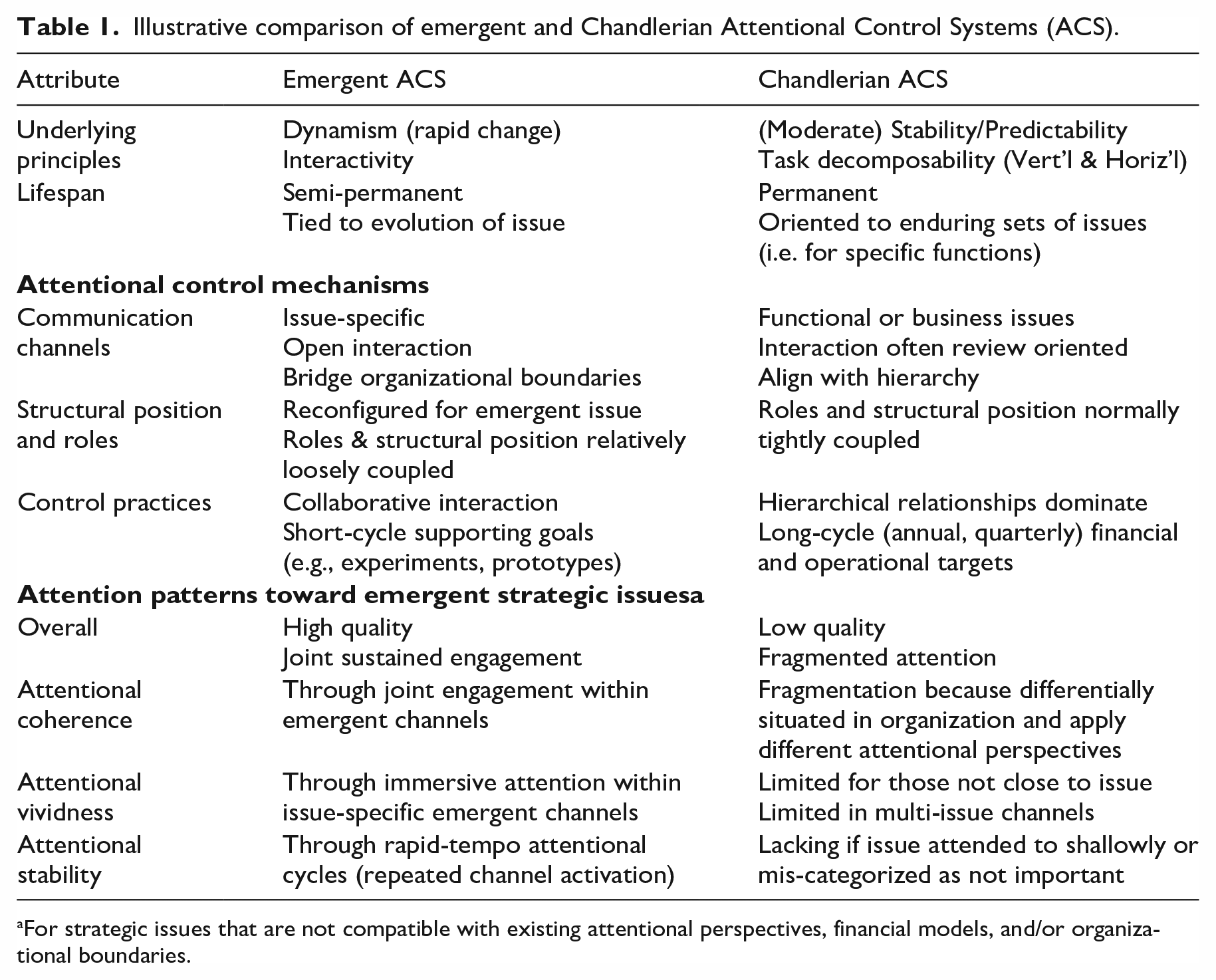
For strategic issues that are not compatible with existing attentional perspectives, financial models, and/or organizational boundaries.
Emergent issue-specific communication channels
The centerpiece of emergent attentional control systems is issue-specific, emergence-oriented communication channels. The ABV, from inception, has conceptualized communication channels as core sites of attentional processing (Ocasio, 1997), so it is no surprise that these are central actors here. Indeed, channels are described first, rather than structural positions as in the analysis of the Chandlerian attentional control system. This is because channels are the basis for interaction and are core to generating dynamic (i.e. responsive and flexible) attention patterns.
Emergent channels are flexible and dynamic
To start, it is important to simply highlight the extraordinarily flexible and dynamic nature of channels. A new channel can be initiated rapidly and with markedly less disruption than other approaches, such as structural or systems changes. Attentional demands on participants are limited, in the extreme only encompassing time spent in the channel. Yet, they can lead to important shifts in attentional patterns, with potentially wide-ranging implications, as seen in multiple examples where senior executives are exposed firsthand to new technologies, for instance (e.g. Hamel, 2000; Levy, 2006; Merchant, 2017; Schonfeld and Gunn, 1998).
Emergent channels bridge organizational boundaries
In addition, channel participants can be drawn from across organizational boundaries to bring together members who would not normally directly contact each other around the emergent issue. Such participants can skip across vertical levels, bringing together senior’s strategic perspectives with junior’s deeper knowledge of the emergent issue itself. Participants can also work across horizontal barriers, with similar and well-established benefits (Clark and Wheelwright, 1992). Again, this increases dynamism and interaction around the issue.
Multifaceted Attentional control within channels. While channels are flexible and not difficult to create, they punch above their weight (so to speak) as multifaceted attentional control mechanisms. Indeed, issue-specific channels can be thought of as enabling a distinctive issue-specific attentional control regime. The core mechanism is a channel’s ability to situate attention and so deeply shape attentional processing. Fundamentally, organizations are a constructed social reality (DiMaggio and Powell, 1983). Channels, as strong social situations (Mischel, 1977), can situate attention so as to construct a particular version of that social reality, if only for a time and to a certain degree.
Three dimensions of the channel’s attentional control are particularly important to highlight:
Attentional vividness as the issue is the primary stimuli. First, an issue-specific channel situates participants such that the issue is the primary stimuli. A deeply contextualized and vivid interpretation of the issue can emerge, which is a pre-requisite for effective decisions and actions with complex issues (Rerup, 2009). This is in sharp contrast to the shallow interpretations that can emerge when emergent issues fail to gain attentional engagement within established channels with agendas that also include multiple and often more pressing or apparently immediately important issues.
Attentional coherence through joint interactive engagement. Emergence-oriented channels are naturally focused as much on understanding and problem-solving as decision-making. Their interaction norms accordingly often aim to produce interactive engagement, meaning sustained communication that is relatively unconstrained by the participant’s structural position or status. Such joint attention brings multiple attentional perspectives to bear on the issue, increasing the possibility that relevant concerns and options are surfaced and incorporated. While not guaranteed, this can lead to attentional coherence as a collectively-held perception of the issue emerges. Attentional coherence is foundational for effective decisions and action (Rerup, 2009).
Attentional stability through rapid-tempo attention cycles. Often channels are activated on a regular and relatively rapid tempo, providing continuity and stability in attention to the issue (Rerup, 2009; Schulze and Brusoni, 2022). Even if participants do not see the emergent issue as a critical priority—and might stray from it if on their own—channels imbue attentional demands with a legitimacy that helps maintain attention on the issue.
Generativity (recombination) and dynamic attentional perspectives
The foregoing linked channels’ attentional control to the quality of attention (i.e. vividness, coherence, and stability) directed toward emergent issues. Channels also can produce at least two important additional attentional outcomes. The first is attentional generativity (Ocasio and Wohlgezogen, 2010) wherein through recombination of individual’s perspectives and knowledge, new ideas emerge that would not have done so from the participants independently. The second comes through the repetitive sharing of attentional perspectives in an immersive and interactive context. Such contexts facilitate individuals adapting and updating their individual attentional perspectives (Shepherd et al., 2017). For instance, a senior manager might recognize an attentional perspective based on their long prior experience is leading them to make an erroneous assessment, and also develop a new perspective through immersive interaction. Both additional outcomes augment the core themes of interactivity and dynamism.
Manipulating other components of attentional control systems
A critical attribute of attentional control systems is that their components often interact, often in reinforcing ways. This is at the core of why taking a systems perspective can bring new insights. Channels have this attribute to a great degree because they are the sites where attentional processing occurs (Ocasio, 1997). By situating individuals in a particular context, channels affect how other attentional control mechanisms will manifest themselves. For instance, channels affect how roles and control practices are enacted in emergent attentional control systems. In-depth discussion is deferred, though, until those other mechanisms are discussed.
Examples
An good example of issue-specific channels is seen in Hamel’s (2000) account of IBM’s shift from hardware manufacturer to Internet services provider. The shift was triggered by an initial (and emergent) skip-level meeting between an engineer who recognized a potential threat (and opportunity) and the firm’s group marketing vice president. Managers subsequently initiated an array of issue-specific channels that dynamically shaped IBM’s pattern of attention to the issue. Although only limited formal resource commitments were involved (e.g. pilots, demos, device upgrades), the efforts eventually penetrated the core decision-making channels in multiple business units. The early attention was said to be critical in enabling IBM to (unexpectedly) obtain a leadership position in Internet services.
Similar approaches can be seen in Martin and Eisenhardt’s (2010) case studies of cross-business unit innovation initiatives in software firms and in Schwab’s development of online trading (Schonfeld and Gunn, 1998). The latter is a case where the CEO, upon direct viewing of a technological development, initiated the process. Another CEO-led case is described in O’Reilly and Tushman (2004)’s account of USA Today, the media firm. Online news emerged as a critical threat which cut across business boundaries (print, broadcasting, online). The critical step (from the perspective here) was the CEO’s decision to create an emergent channel wherein the CEO and three division presidents met daily to agree on the day’s news agenda. Combined with other actions, this channel appeared to create high-quality attention toward this cross-business strategic issue and so was instrumental in USA Today’s ability to effectively implement an integrated approach.
Emergence-oriented channel networks
So far, the discussion has been at the level of the channel. Emergent attentional control systems often begin within a single channel, but typically multiple channels are created to reach across boundaries and bring in additional participants or to spread attention across different sub-issues. Expansion of the channel network builds a broader pattern of high-quality attention around the emergent strategic issue, providing attentional spaces that can lead to supportive decisions, build supporter networks, and secure needed (typically modest) resource commitments.
An important question involves the architecture of these emergent networks—specifically, how should these channels be coupled (i.e. focused on shared agendas) to the Chandlerian channel network? Existing work (Joseph and Ocasio, 2012) finds channel coupling critical to successful adaptation.
Interestingly, a different logic seems likely to apply where emergence is concerned. Coupling between emergent and Chandlerian networks may be problematic instead of enabling. This is because the same problems with incompatible assumptions that cause attentional fragmentation in the Chandlerian network generally, seem likely to recur if cross-network coupling is attempted. It is likely more critical to create a fully developed and coupled (sometimes loosely) network of issue-specific channels. That is, the emergent network of channels is best seen as complementary and separate rather than integrative with the mainline ones. As an example, IBM’s engagement with the Internet (Hamel, 2000) utilized a long series of coupled channels that remained largely separate from the primary channel network until much later, when business units made decisions to internally leverage capabilities developed through the emergent attentional control system.
Role reconfiguration in emergent attentional control systems
Reconfiguring roles in emergent attentional control systems
In emergent attentional control systems, participants’ roles are often reconfigured by loosening the coupling between structural positions and role expectations such that individuals’ roles can vary with respect to the emergent issue. Formal (structural) positions are important in directing attention, as in the discussion of Chandlerian attentional control systems above. Structural positions link individuals to roles and responsibilities (among other things). Roles act as attentional control mechanisms through creating expectations about individuals’ appropriate focus of attention and the attentional perspectives they should legitimately apply.
Reconfiguring roles generates dynamism and higher quality attention
Reconfiguring roles simply means that an individual is enabled to occupy a different role with respect to an emergent strategic issue than their structural position would imply. High-powered cross-functional product teams are an example of such role reconfiguration. Team member’s roles are often configured to include strategic and leadership responsibilities in addition to the functional ones specified by their formal positions in the organization (Clark and Wheelwright, 1992; Govindarajan and Trimble, 2010). Executives remain involved, but their roles are reconfigured toward sponsorship rather than supervision (Clark and Wheelwright, 1992).
Role reconfiguration increases attentional dynamism, as it allows full role constellations (e.g. leadership, strategic, and technical roles) to be created in post-Chandlerian contexts where executives are overloaded and may find it difficult to fully attend to an emergent issue even if they see it as important. Apple’s current “discretionary leadership” model (Podolny and Hansen, 2020) provides an excellent example. 3 By design, senior leaders at the firm do not have sufficient attentional capacity for all the product responsibilities that their formal position includes. Apple’s leaders use their discretion to take more or less involved roles (e.g. leader, teacher, learner) across those responsibilities. At times, they also reconfigure their subordinates’ roles as well to compensate. Choices about how to enact role portfolios shift over time with shifts in the challenges and stakes involved. This example also illustrates how role reconfiguration not only enables more dynamic attentional patterns, it is also likely to increase continuity in attention (attentional stability, Rerup, 2009) by addressing attentional overload.
Reconfigured roles also increase attention quality by broadening the attentional perspectives that participants in emergent attentional control systems employ. This has the potential to increase both attentional vividness and coherence, through directing individuals who are close to the issue to attend to the issue with multiple perspectives that both increase their understanding and enable them to understand other’s perspectives. In the cross-functional product development team example described above, Clark and Wheelwright (1992) allude to this through emphasizing that team members need to wear both a “functional hat” and a “team hat” (i.e. take a strategic orientation) to succeed in their reconfigured roles.
Emergent channels support role reconfiguration
Emergent channels can provide a supportive context for role reconfiguration. This is important because shifting roles is not guaranteed to be enacted smoothly. As important parts of the social reality, roles engender durable expectations over time and are relatively inertial. This inertia is likely substantial in Chandlerian m-form firms wherein roles and positions are normally tightly coupled and structural boundaries are clearly defined. However, emergent channels can help break through this inertia by providing a novel attentional context wherein a reconfigured role expectation can be made salient to the role occupant as well as others. Changes in roles can be reinforced through channel design that explicitly supports members enacting them. For instance, interactive communication norms can dampen existing role-induced status differences within the channel. The interaction between channels and roles speaks more broadly to the importance of considering attentional control as a systems phenomenon rather than simply a linear combination of attentional control mechanisms.
Interactive control practices in emergent attentional control systems
Shifting control practices toward interactive communication channels
The core move in control practices in emergent attentional control systems is toward practices aimed at promoting interaction rather than hierarchical dominance and reviews. The new approach arises from the fundamental assumptions of dynamism and interaction. Emergent strategic issues often occur in the presence of dynamic environments wherein prediction of even moderately distant future states is not feasible. This breaks the assumptions of environmental predictability and dominance of top management in decision-making that underly the planning-and-review driven control practices in the Chandlerian model. In such circumstances, an effective approach often involves moving in the most effective apparent direction but recognizing that the strategic situation may well quickly change (Eisenhardt and Brown, 1998). Control, then, is in significant part about generating attentional vividness and coherence to ensure that a reasonable short-term direction is set and to maintain attentional stability so that the direction can be reassessed frequently. This can be accomplished through continuing, collaborative, open interaction that brings different perspectives to bear and so reduces uncertainty and ambiguity.
Attentional control through interactive issue-focused communication channels has already been described and can thoroughly fit this need. Indeed, for emergent strategic issues the emergent issue-focused channels may become the core control practice. This might seem counterintuitive or repetitious with the previous discussion. However, the insight is that channels are effective control practices in these contexts, because interaction itself is a primary desired attentional outcome.
It is illuminating to contrast communication channels’ role in attentional control between the emergent and Chandlerian systems. In Chandlerian ones, long-term outcome controls and hierarchical controls are the two dominant control practices, with channels acting more as vehicles or containers that support these practices by providing contexts for their enactment. This changes dramatically in emergent attentional control systems, where the channels themselves become critical control practices in their own right. Outcome and hierarchical controls move to a more supporting role.
Outcome controls shift to fit in rapid-tempo attention cycles
Outcome controls remain important in emergent attentional control systems, but the specifics of this control practice change dramatically. The need shifts to short-term deliverables (e.g. probes, experiments, analyses, and prototypes; Eisenhardt and Brown, 1998) that fit the dynamic environment and enable rapid-tempo attention cycles, instead of long-term outcomes in an accountability modality. Activating communication channels at a rapid tempo supports this approach to outcome control. Here, the outcomes (e.g. results of a focus group or prototype test) tend to inform the core interaction-driven control practice rather than being the primary attribute of interest.
Evolution of control practices in emergent attentional control
Control practices are not static as emergent strategic issues gain attentional engagement across participants. Initially, the key challenge is to enable interactions that reduce uncertainty and ambiguity and make sense of complexity, in part through developing new cognitive frames and attentional perspectives. As this occurs additional resources are often committed to further advance the firm’s strategic response to the issue. More typical project management approaches and goals can be folded in to exercise attentional control over those resources, although these typically still work on shorter time frames and without the same sense of predictability that is often present in less dynamic contexts. In addition, as top managers gain new attentional perspectives through close attention to an emergent issue, they may reassert their traditional hierarchical role and control approach to an extent.
Challenges and alternatives
The forgoing description of emergent attentional control systems explains how the multiple moves involved—emergent issue-focused channels, reconfigured roles, and interactive control practices—act together to create attentional dynamism and achieve high-quality attention toward emergent strategic issues that might otherwise fragment attention. In turn, high-quality attention provides a foundation for effective decision-making and resource commitments, and ultimately enhances strategic adaptation.
At the same time, these systems make specific demands of organizational members and present trade-offs. While a full discussion is beyond the scope here, some key concerns and challenges can be touched on. The first of these is that an emergent channel network approach requires meaningful commitment from executives. Novelty takes much more time to understand than the familiar. Executives may find it difficult to justify (to themselves and to others) directing their critically valuable attention toward what appears as uncertain and not clearly important issues. However, the demands are time-limited, as discussed in the section on channels, and even a few hours of attention can have strategic consequences.
Another challenge arises from emergent attentional control systems incorporating different role assumptions than Chandlerian ones, as mentioned. Executives may find it hard to step out of habitual hierarchical and evaluative roles. Lower-level individuals may find it difficult to take the initiative and risks expected in reconfigured roles. Support from senior managers can help address the latter issue. In Apple’s model, for instance, Podolny and Hansen (2020) report senior managers provide prompt, constructive critiques of subordinates’ performance that help them adapt to their elevated role.
The shifts toward interactive control practices are also likely challenging. Management control systems are central to executives’ success in Chandlerian firms. Letting go of familiar control practices that have served them well through their career could be unsettling, especially when the replacement is a “softer” approach without metrics that emphasize accountability (Govindarajan and Trimble, 2010).
Overall, it may be that much depends on executives’ own views of their role. If executives take a view that their role includes avoiding attentional failures from challenging emergent strategic issues, and they have some understanding of the dynamics involved, they may welcome the emergent approach. If the reverse is true, it may be better to try to augment established attentional control systems instead.
This last point raises the question of whether there is truly a need to create separate emergence-oriented attentional control systems in the first place? An alternative could be broadening the purview of the existing communication channels and other elements. One concern here, though, is that great cognitive flexibility is required to switch between operational and emergent strategic issues. The two types of issues require a quite different mind-set (as discussed), and cognitive costs for such switching are substantial (Shepherd et al., 2017). Indeed, one reason firms give for creating separate channels is exactly that executives report great difficulty in switching mindsets between these contexts (Govindarajan and Trimble, 2010).
Discussion
This article aims to join and advance the conversation within ABV scholarship regarding successful strategic adaptation in the face of challenges present in the post-Chandlerian world (Ocasio et al., 2022). Scholars have emphasized that firms based on the Chandlerian m-form model have found these challenges problematic, and have pointed to increased attentional dynamism, interaction, and engagement as crucial ingredients of success (Ocasio et al., 2022). Scholars have also identified a need to advance the ABV in this domain, in part because the Chandlerian m-form was the implicit model in mind when the original theoretical ideas underlying the ABV were developed (Ocasio, 1997; Ocasio et al., 2022).
This article works to make an advance by focusing on a theme within the attention-based view that is important but underdeveloped—the idea of attentional control (Ocasio and Wohlgezogen, 2010). The article leverages the idea of attentional control to propose the concept of attentional control systems. These are interrelated sets of organizational attentional control mechanisms that direct members’ attention (e.g. structural positions, communication channels, and control practices). The concept provides a novel theoretical lens into how firms can influence attention patterns, one which incorporates the structural, cognitive and communication dynamics that are a distinctive emphasis of the attention-based view (Joseph and Ocasio, 2012; Ocasio, 1997). The article’s main effort involves distinguishing between two types of attentional control systems—Chandlerian attentional control systems and emergent attentional control systems. Doing so advances our understanding of attentional failures of Chandlerian firms. More importantly it explicates an alternative emergent attentional control model that is argued to better enable strategic adaptation in the post-Chandlerian world.
Emergent attentional control systems
The first main contribution of the article is its development of the emergent attentional control system concept. This is an emergent, semi-permanent attentional control system wherein the firm matches an emergent strategic issue with an emergent attentional control system that is built in response to and directed especially at that specific strategic issue. The emergent attentional control system is in a sharp contrast with the Chandlerian one. The latter includes a more stable and permanent set of communication channels, structural positions, and control practices (Chandler, 1962; Joseph and Ocasio, 2012; Stinchcombe, 1990). In the emergent system, those are instead built new or reconfigured around the core assumptions of dynamism and interaction.
The article explains how emergent attentional control systems can bring high-quality attention (Ocasio, 2011; Ocasio et al., 2022; Rerup, 2009) to emergent strategic issues that can be problematic for Chandlerian firms, and thus potentially mediate effective strategic adaptation to those issues. The emergent attentional control system creates a more dynamic attentional modality first through interactive communication channels, which are the heart of the new system. The channels bridge organizational boundaries and enable joint, generative sensemaking (Weick, 1995) toward the emergent issue. This enables building attentional vividness, creating attentional coherence, and stabilizing attention (Rerup, 2009). These attentional outcomes are also enabled by reconfigurations of roles that loosen the connection between members’ roles and their fixed structural positions, enabling more flexible role constellations and attention patterns within the emergent domain. Finally, control practices shift toward interaction and collaboration within channels, reinforcing joint attentional engagement, sustaining interactive attention, and dampening Chandlerian control practices built around simplification, hierarchy, and review.
The emergent attentional control system concept, then, advances a novel theoretical model explaining how firms can generate attentional outcomes such as dynamism, engagement, and interaction that have been emphasized in recent ABV scholarship (Ocasio et al., 2018, 2022; Rerup, 2009). The emergent attentional control system is also distinctive as a flexible approach that can be deployed rapidly and with little disruption to the firms’ structure as such. It is thus distinct from, though complementary to, approaches to emergent strategic issues that advise creating separate structures around the emergent strategic issue (e.g. ambidexterity and disruptive innovation, Christensen and Overdorf, 2000; Tushman and O’Reilly, 1996). Another complementary approach involves augmenting Chandlerian attentional control systems with more interactive components (e.g. GE under Welch’s leadership as described in Joseph and Ocasio, 2012). This latter approach can have salutary effects, though it likely also faces inherent limits because of cognitive and communication switching costs between established business challenges and emergent ones (Govindarajan and Trimble, 2010).
Attentional control and systems thereof
The article’s second main contribution is its development of attentional control systems and its emphasis on attentional control. These address a basic question inherent in the ABV’s conception of the organization as a distributed system of attention (Ocasio, 1997): How is distributed attention controlled? That is, how does attentional agency on the part of members come together with organizational mechanisms that direct that attention to create patterns of attention within the system? Attentional control almost by definition seems to offer a path to answering this question. But even if attentional control has been present in the ABV since its inception (i.e. in the definition of the structural distribution of attention, Ocasio, 1997), an attentional control perspective has not been well developed (Ocasio and Wohlgezogen, 2010). The attentional control system concept is an advance through simultaneously considering structure, cognition, and communications in explaining how interrelated organizational mechanisms create contexts that situate and thus shape members’ individual and collective attention. This is consistent with the original mission of the ABV to bring together organizational models based on structure (e.g. Cyert and March, 1963) and on cognition (Weick, 1995) with communication channels as key sites of attentional processing (Ocasio, 1997; Ocasio and Joseph, 2005; Ocasio and Wohlgezogen, 2010).
A strength of the attentional control system concept is seen in its flexibility in addressing organizational and attentional dynamism as well as efficiency and stability. A comparison of the Chandlerian and emergent attentional control system models illustrates this point. The attentional control system concept can accordingly be seen to advance the original concept of the structural distribution of attention (Ocasio, 1997) with a pathway to a more dynamic model. Distribution evokes allocation and so implicitly can create a somewhat static background. The emergent attentional control system illustrates a dynamic model of attentional redistribution and reconfiguration, where organizational attentional patterns are constantly evolving to respond to and anticipate strategic opportunities and threats. This also shows how attentional control systems and attentional control, while evoking the idea of organizational control, are distinctive from that latter concept and literature. Organizational control mechanisms (e.g. outcome controls, managerial direction, cultural expectations) emphasize the influence of established standards of various types, and so it has had challenges addressing strategic adaptation to emergent issues such as those considered here (Sitkin et al., 2020).
Communication channels—star of the show
A third contribution comes through the study’s development of communication channels as (arguably) the core mechanism for attentional control, and especially for generating attentional dynamism. Communication channels have been prominent in the attention-based view as core sites of “attentional processing” from the start (Ocasio, 1997), have been developed extensively in Ocasio & Joseph’s work analyzing channel networks at GE (Joseph and Ocasio, 2012; Ocasio and Joseph, 2005), and their attentional control properties were introduced by Ocasio and Wohlgezogen (2010). The contribution here is in advancing this line of work. The article portrays channels as unusually flexible mechanisms that can address emergence with generative and recombinatory attention, in contrast to much work that has primarily portrayed them in terms of alignment and coordination (although see Schulze and Brusoni, 2022 and Plotnikova, Pandza & Whittington, this issue, for related ideas). The article also distinguishes attentional control properties of types of channels (i.e. interactive vs review) and ties that to their differential roles in enabling strategic adaptation. It connects channels to the development of different qualities of attention (i.e. vividness, coherence, and stability, Rerup, 2009). Each of these advances understandings of channels in the ABV. Communication channels are an intriguing concept more generally. Their prominence in the ABV contrasts with relatively low salience, as an organizational design concept, in many theoretical traditions as well as out in the field (though see Jarzabkowski and Seidl, 2008; Rovelli, 2020). The hope is that this work helps highlight that disconnect and inspires more work along similar lines.
Conclusion
In the effort to address new challenges of the post-Chandlerian world, this article has developed the idea of attentional control and particularly the idea of emergent attentional control systems. In doing so it has reached back to original work, wherein control of attention was a constituent part of foundational ideas. The project here has been to develop attentional control more explicitly and to show how it can provide a powerful lens that highlights the ABV’s distinctive combination of focus on structure, cognition, and communication. A key message is that attentional control can, perhaps counterintuitively given the word’s common usage, be a powerful source of dynamism for firms. The hope is that this article stimulates further work on the concepts of attentional control, attentional control systems, and dynamism within them.
Footnotes
Acknowledgements
The author thanks Willie Ocasio for his especially generous and insightful advice, particularly regarding emergence and attentional control systems. The author also thanks editor Claus Rerup for his needed encouragement as well as much insightful and helpful advice, especially regarding development of the Chandlerian vs Post-Chandlerian contrast. Finally, the author thanks the anonymous reviewers and participants at two Illinois Strategic Organizations Initiative workshops at Gies College of Business for their constructive comments and helpful ideas.
Funding
The author(s) received no financial support for the research, authorship, and/or publication of this article.
